Categories
Commentary

Daily Brief For July 12, 2022

The daily brief is a free glimpse into the prevailing fundamental and technical drivers of U.S. equity market products. Join the 300+ that read this report daily, below!
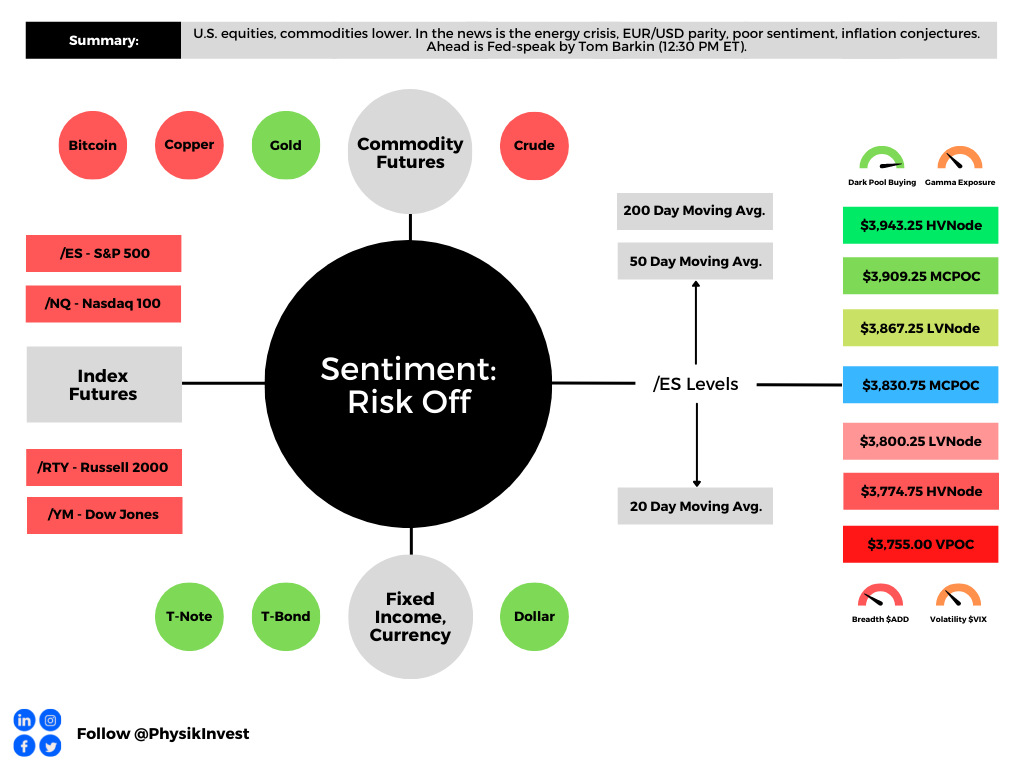
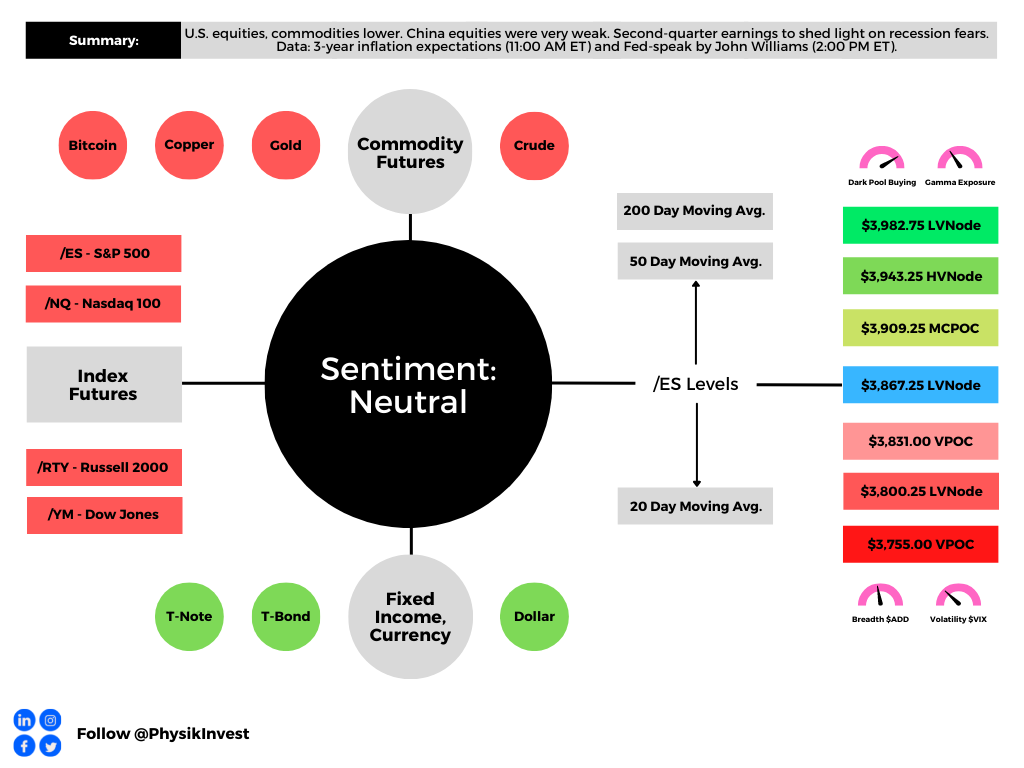
Graphic updated 7:00 AM ET. Sentiment Risk-Off if expected /ES open is below the prior day’s range. /ES levels are derived from the profile graphic at the bottom of the following section. Levels may have changed since initially quoted; click here for the latest levels. SqueezeMetrics Dark Pool Index (DIX) and Gamma (GEX) calculations are based on where the prior day’s reading falls with respect to the MAX and MIN of all occurrences available. A higher DIX is bullish. At the same time, the lower the GEX, the more (expected) volatility. Learn the implications of volatility, direction, and moneyness. Breadth reflects a reading of the prior day’s NYSE Advance/Decline indicator. VIX reflects a current reading of the CBOE Volatility Index (INDEX: VIX) from 0-100.

Fundamental

The top headlines are on the inflation conjectures, the depth and breadth of the energy crisis, supply constraints, EUR/USD parity, geopolitical unrest, and global economic slowing.
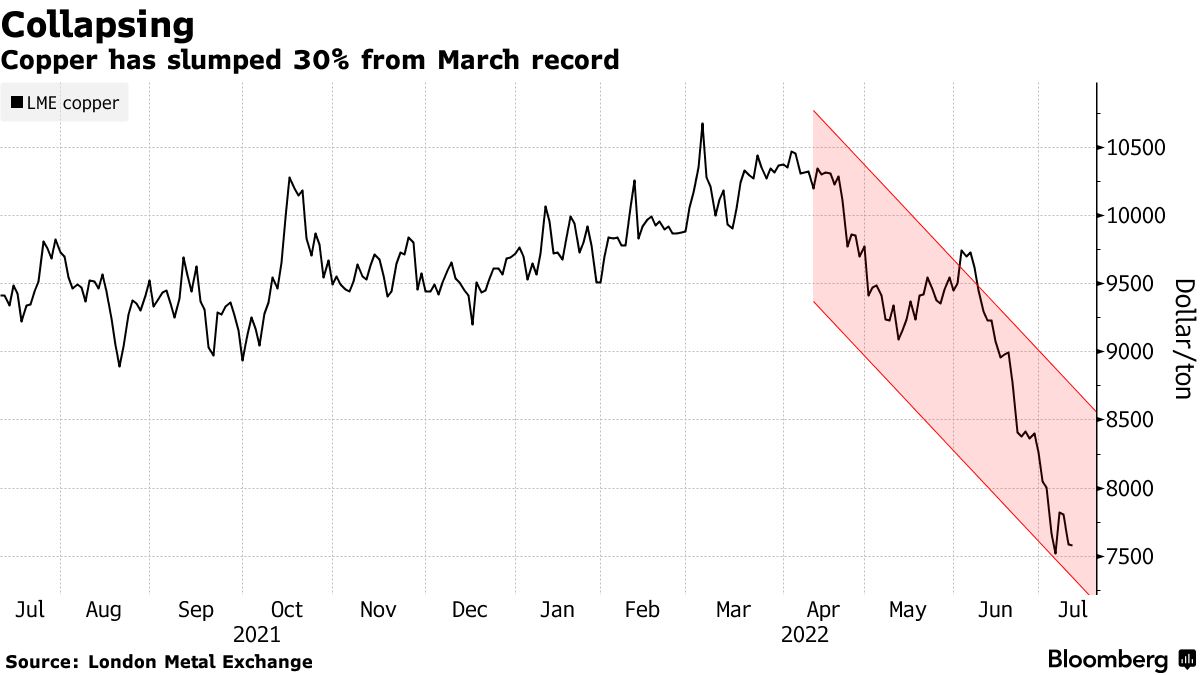
Graphic: Via Bloomberg. Dollar surge, European growth path, waning demand, and increasing supply weigh on copper, a bellwether of the world economy.

A boiling point, if not already, is soon to be reached, in short.

For instance, the energy crisis, which is, in part, the result of earlier capacity erosion, short-term triggers, and panic, is expected to worsen according to the International Energy Agency (IEA).

Per Goldman Sachs Group Inc (NYSE: GS), a “full interruption to Russian flows to Europe would be equivalent to a 35% supply shock to the European gas market.” 
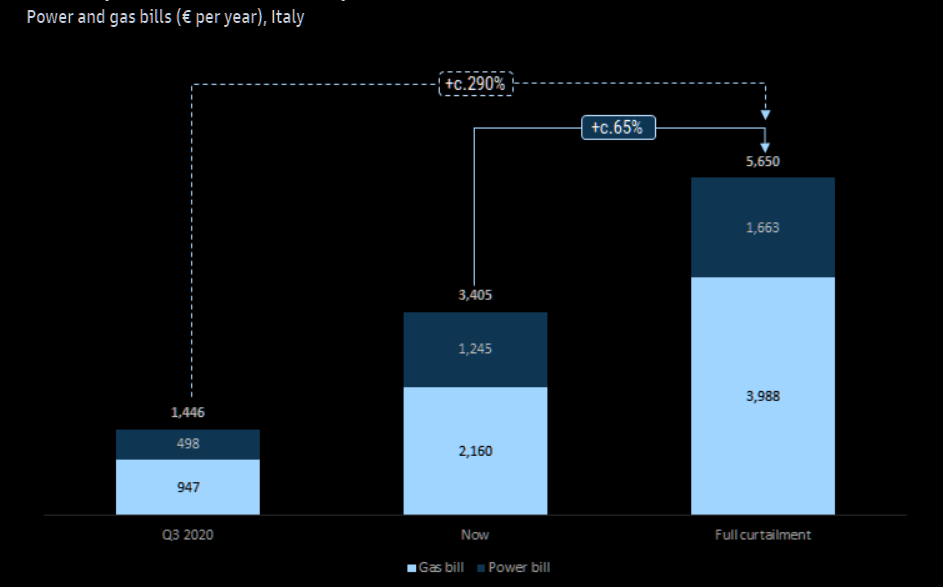
Graphic: Retrieved via The Market Ear. Via Goldman Sachs Group Inc (NYSE: GS). “[W]e estimate bills would increase by c.65% from here in this event, bringing the total household cost for power and gas to nearly €500/month, creating a meaningful affordability problem. Versus the summer-2020 trough, we estimate that gas/power bills would have increased by nearly 300% on this basis.”

What does this mean for the markets we’re focused on day-to-day in this letter?

Well – and this is pursuant to the Daily Brief for Monday, July 11 – markets have only suffered through compression in multiples. Does it stop or is there a looming earnings compression?

Most likely there is an earnings compression. For now, it is only sentiment that is taking the hit. 
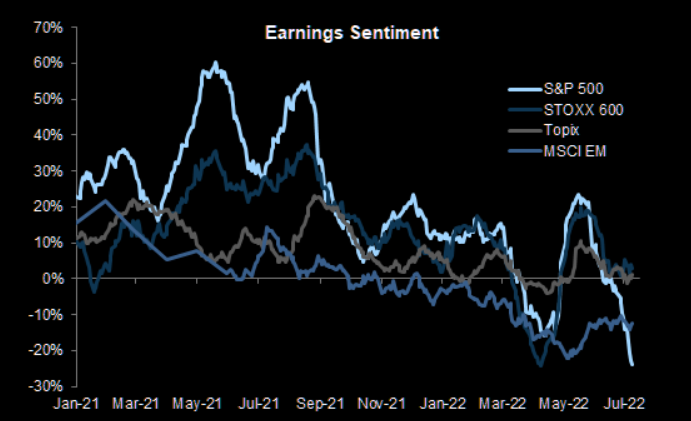
Graphic: Retrieved via The Market Ear. Taken from FactSet Research Systems Inc (NYSE: FDS). 

When will the turn occur?

As stated yesterday, it will be the earnings season that is likely to shed clarity on the answer all the while – what is known right now – a strong dollar is for sure to translate into a headwind for S&P 500 earnings growth.
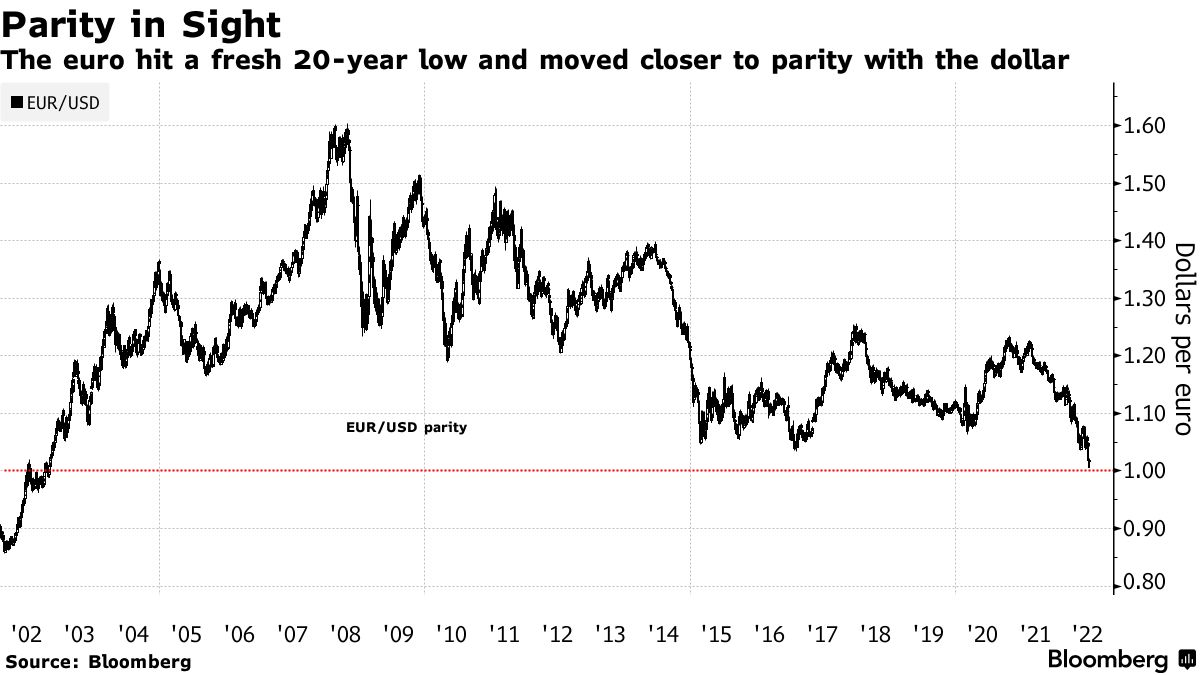
Graphic: Via Bloomberg. The “Fed is still perceived as having more room to hike rates going forward, also on the back of the strong US jobs report for June,” Unicredito SPA (OTC: UNCRY) analysts explained. “On the other hand, other central banks, such as the ECB and the BoE, might be forced to become more prudent, given the more direct exposure their respective economies have to the gas and energy crisis.”

What’s lending to the dollar’s strength?

Let’s start with the following. Participants were extending moneyness to nonmonetary assets, given easy monetary policies and an environment of ample debt and leverage (which cuts into asset price volatility). 
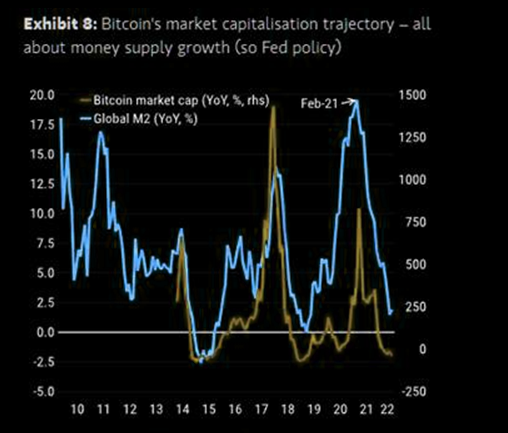
Graphic: Retrieved from The Market Ear. Via Morgan Stanley (NYSE: MS).

When the reverse happens – tighter liquidity and credit – and volatility eventually rises, the demand (and competition) for money (or cash) deflates assets.
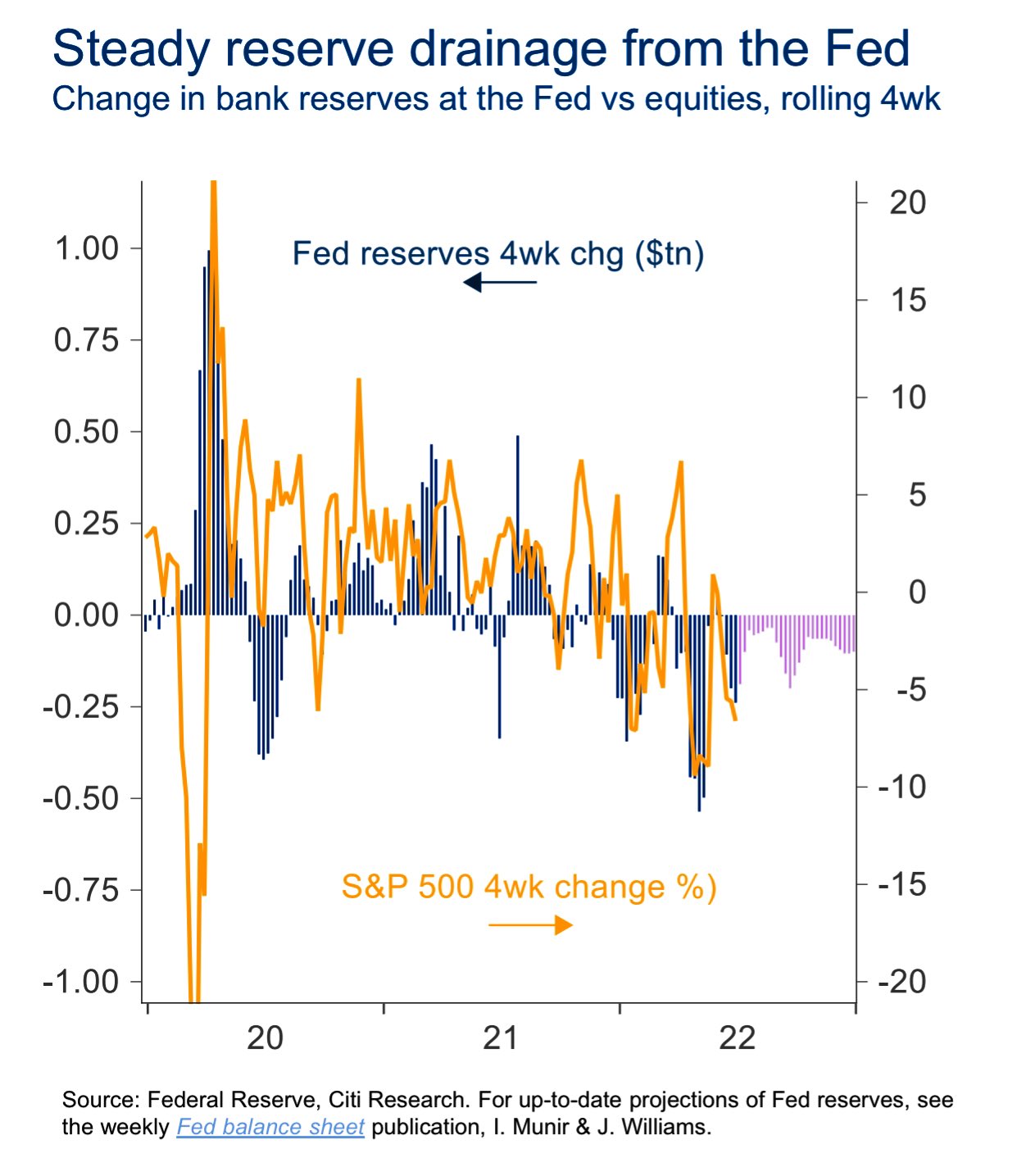
Graphic: Via Citigroup Inc (NYSE: C). According to Joseph Wang, amidst asset price volatility and bank deposits to drain about $1 trillion or so by year-end, investors will “continue to lower their selling prices to compete for the cash they want.”

It is a deflationary pulse manifesting disinflation in consumer prices, that will prompt the Fed to reverse itself on rates and quantitative tightening (QT).

What does this mean?

Depends on the timeframe. 

Though the policy pivot may come alongside a peak in the de-rate markets are experiencing, now, longer-term there are multi-decade trends brewing on the back of the de-globalization pulse, for instance, and a tendency to spend wealth, instead of creating it (as supply chains are replicated here at home), is inflationary which makes the context for a more two-sided market in the future (rather than straight up or down).

Read: Former Bridgewater Associate talks recession odds, capturing a macro edge.

What about the dollar?

With the Fed “still perceived as having more room to hike rates going forward,” per Unicredito SPA (OTC: UNCRY), all the while “other central banks, such as the ECB and the BoE … [are] more prudent, given … the[ir] gas and energy crisis,” short-term dollar strength does more to diminish the global reliance on the U.S.

This is explained even better by Lyn Alden of Lyn Alden Investment Strategy.

The dollar is the dominant currency for carry primarily due to easy monetary policies removing the risk of an ultra-strong dollar. Accordingly, the dollar is “the currency that most offshore debt is denominated in all over the world,” as explained by Bankless, who interviewed Alden.

“Non-US entities make dollar-based loans and transactions in pretty much all markets everywhere because it’s considered more trustworthy than native fiat,” they add. “When there’s a disruption in global cash flows, there’s effectively a short squeeze on the dollar.”

“The stronger the dollar gets in comparison, the less tenable it becomes as a global reserve,” and that is a pressure on the long-term trajectory of that currency.

Positioning

Yesterday’s letter was spot on with respect to positioning.

We can speculate as to where the market may move next, after the release of inflation figures, this week. What’s likely is that, even if the print is hot, the first move is to be structural, per Kai Volatility’s Cem Karsan.

“A function of inevitable rebalancing of dealer inventory post-event. The second move and final resolution, if you wait for it, is usually tied to the incremental effects on liquidity (QE/QT).”

Rising inflation probably bolsters the Fed’s backing of a 75 basis point rate hike on July 27. So, don’t fight the Fed. Rising rates and the withdrawal of liquidity prompts a continued de-rate.

Knowing this, the “flattening in the downside fixed strike skew, while the upside wings [are] more smiley,” as described by JPMorgan Chase & Co (NYSE: JPM), has made for attractive low-cost spread opportunities, as talked about yesterday and in the July 8, 2022 letter.

The moral is as follows: own volatility where the market is likely to not expire. Sell it where the market is likely to expire. Just because implied (IVOL) volatility is at a high starting point does not mean it should be sold, blindly.

Read: Explanations and Applications – Moontower on Gamma.

Technical

As of 7:00 AM ET, Tuesday’s regular session (9:30 AM – 4:00 PM ET), in the S&P 500, is likely to open in the lower part of a negatively skewed overnight inventory, outside of prior-range and -value, suggesting a potential for immediate directional opportunity.

In the best case, the S&P 500 trades higher.

Any activity above the $3,830.75 MCPOC puts into play the $3,867.25 LVNode. Initiative trade beyond the LVNode could reach as high as the $3,909.25 MCPOC and $3,943.25 HVNode, or higher.

In the worst case, the S&P 500 trades lower.

Any activity below the $3,830.75 MCPOC puts into play the $3,800.25 LVNode. Initiative trade beyond the LVNode could reach as low as the $3,774.75 HVNode and $3,755.00 VPOC, or lower.

Click here to load today’s key levels into the web-based TradingView charting platform. Note that all levels are derived using the 65-minute timeframe. New links are produced, daily.
Graphic: 65-minute profile chart of the Micro E-mini S&P 500 Futures.

Considerations: Responsiveness near key-technical areas (that are discernable visually on a chart), suggests technically-driven traders with short time horizons are very active. 

Such traders often lack the wherewithal to defend retests and, additionally, the type of trade may be indicative of the other time frame participants waiting for more information to initiate trades.

Example: The below 65-minute S&P 500 chart with volume profiles was included in the July 8, 2022 edition of the newsletter. Prices were near an inflection (micro-composite point of control and two key volume-weighted average price levels). From thereon, selling surfaced.

This is what is meant by responsiveness near key-technical areas.

Graphic: Updated 7/2/22. 65-minute profile chart of the Micro E-mini S&P 500 Futures.

Definitions

Volume Areas: A structurally sound market will build on areas of high volume (HVNodes). Should the market trend for long periods of time, it will lack sound structure, identified as low volume areas (LVNodes). LVNodes denote directional conviction and ought to offer support on any test. 

If participants were to auction and find acceptance into areas of prior low volume (LVNodes), then future discovery ought to be volatile and quick as participants look to HVNodes for favorable entry or exit.

POCs: POCs are valuable as they denote areas where two-sided trade was most prevalent in a prior day session. Participants will respond to future tests of value as they offer favorable entry and exit.

MCPOCs: POCs are valuable as they denote areas where two-sided trade was most prevalent over numerous day sessions. Participants will respond to future tests of value as they offer favorable entry and exit.

Volume-Weighted Average Prices (VWAPs): A metric highly regarded by chief investment officers, among other participants, for quality of trade. Additionally, liquidity algorithms are benchmarked and programmed to buy and sell around VWAPs.

About

After years of self-education, strategy development, mentorship, and trial-and-error, Renato Leonard Capelj began trading full-time and founded Physik Invest to detail his methods, research, and performance in the markets.

Capelj also develops insights around impactful options market dynamics at SpotGamma and is a Benzinga reporter.

Some of his works include conversations with ARK Invest’s Catherine Wood, investors Kevin O’Leary and John Chambers, FTX’s Sam Bankman-Fried, former Bridgewater Associate Andy Constan, Kai Volatility’s Cem Karsan, The Ambrus Group’s Kris Sidial, among many others.

Disclaimer

In no way should the materials herein be construed as advice. Derivatives carry a substantial risk of loss. All content is for informational purposes only.

Categories
Commentary

Daily Brief For July 11, 2022

The daily brief is a free glimpse into the prevailing fundamental and technical drivers of U.S. equity market products. Join the 300+ that read this report daily, below!

Graphic updated 7:00 AM ET. Sentiment Neutral if expected /ES open is inside of the prior day’s range. /ES levels are derived from the profile graphic at the bottom of the following section. Levels may have changed since initially quoted; click here for the latest levels. SqueezeMetrics Dark Pool Index (DIX) and Gamma (GEX) calculations are based on where the prior day’s reading falls with respect to the MAX and MIN of all occurrences available. A higher DIX is bullish. At the same time, the lower the GEX, the more (expected) volatility. Learn the implications of volatility, direction, and moneyness. Breadth reflects a reading of the prior day’s NYSE Advance/Decline indicator. VIX reflects a current reading of the CBOE Volatility Index (INDEX: VIX) from 0-100.

Fundamental

To start, thank you to the many new subscribers who joined in the past weeks. I’m honored.

Further, today we start broad (fundamental) and hone into specifics on how to act in the current trade environment (positioning), as well as potential inflection (technical) points.

I encourage you to read through to the technicals part, if possible. Have a great week!

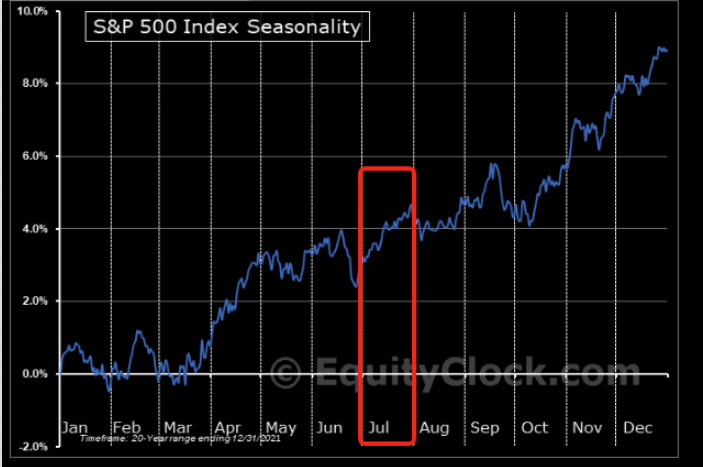
Seasonally speaking, the markets are in the midst of one of the most bullish periods of the year.

Graphic: Retrieved from The Market Ear.

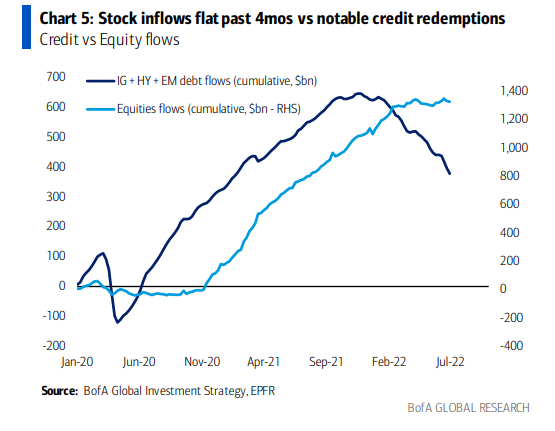
This is as stock market flows have yet to turn as they did for bonds months ago.

Graphic: Retrieved from Callum Thomas’ Topdown Charts. Via Bank of America Corporation (NYSE: BAC)

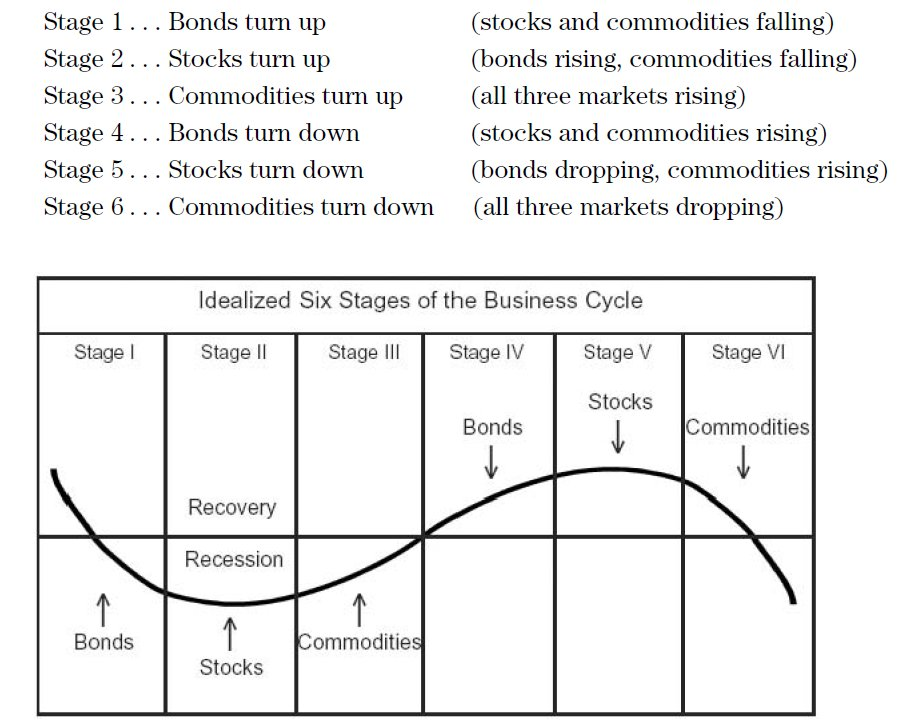
The cycle is as follows: typically bonds are the first to turn. Stocks and commodities follow. 

Graphic: Retrieved from @granthawkridge

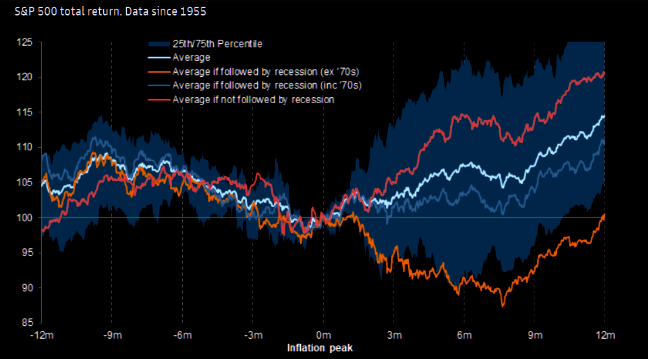
With bonds and equity products now off their swing lows and commodities off their highs (as inflation has, potentially, peaked), we have to question how much more?

Graphic: Retrieved from Goldman Sachs Group Inc (NYSE: GS).

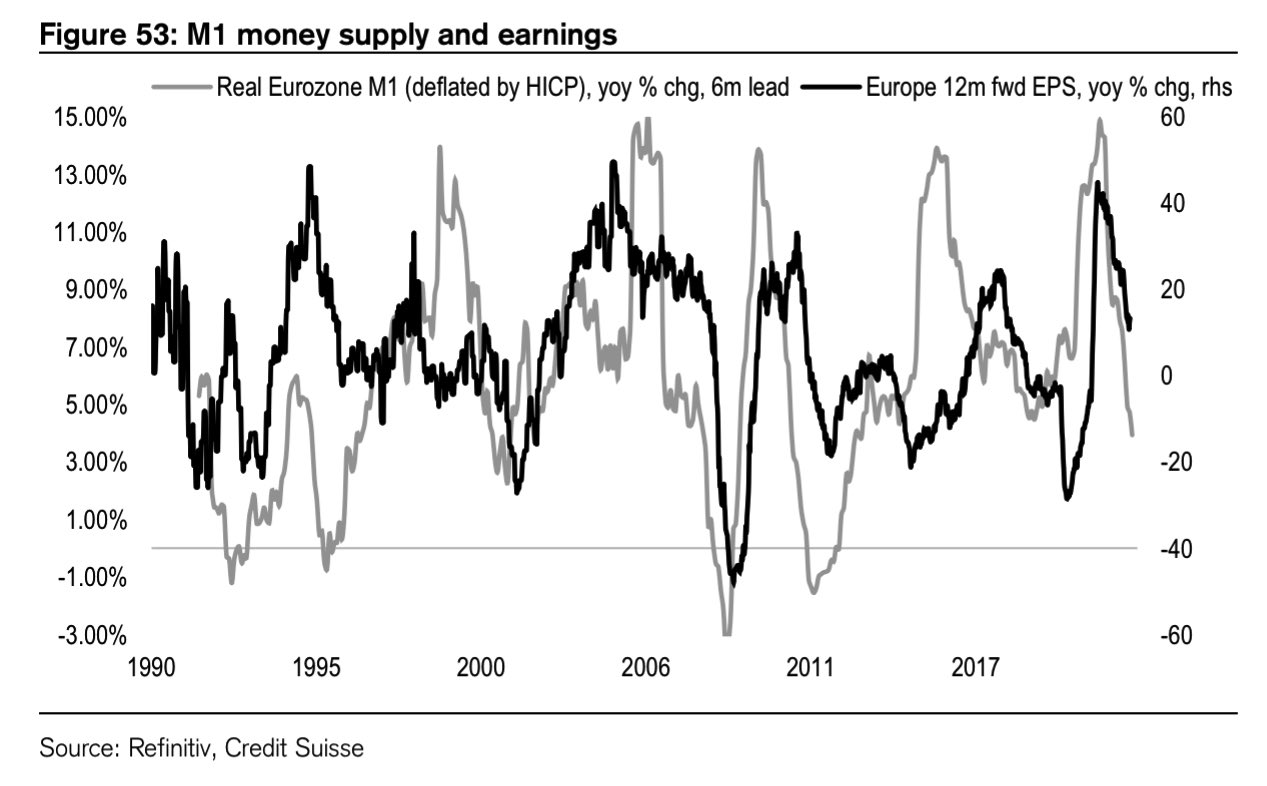
Well, thus far, and this is something we’ve talked about in the past, markets have suffered through compression in multiples. Does it stop or is there a looming earnings compression?

Graphic: Retrieved from Credit Suisse Group AG (NYSE: CS).

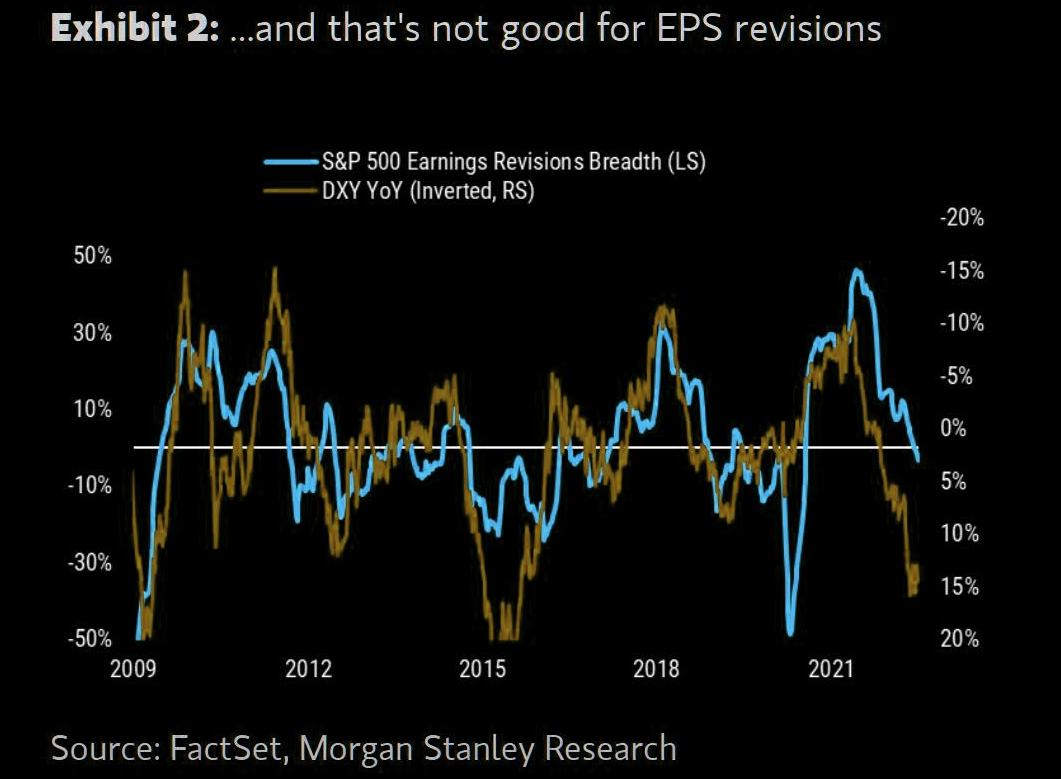
The earnings season shall shed clarity on the answer all the while – what is known – a strong dollar is sure to translate into a headwind for S&P 500 earnings growth.

Graphic: Retrieved from The Market Ear. Via Morgan Stanley (NYSE: MS) research. “The simple math on S&P 500 earnings from currency is that for every percentage point increase on a year-on-year basis it’s approximately a 0.5xhit to EPS growth. At today’s 16% year-on-year level, that translates into an 8% headwind for S&P 500 EPS growth, all else equal”

“The main point for equity investors is that this dollar strength is just another reason to think earnings revisions are coming down,” Morgan Stanley’s Mike Wilson explains

“[T]he recent rally in stocks is likely to fizzle out before too long.”

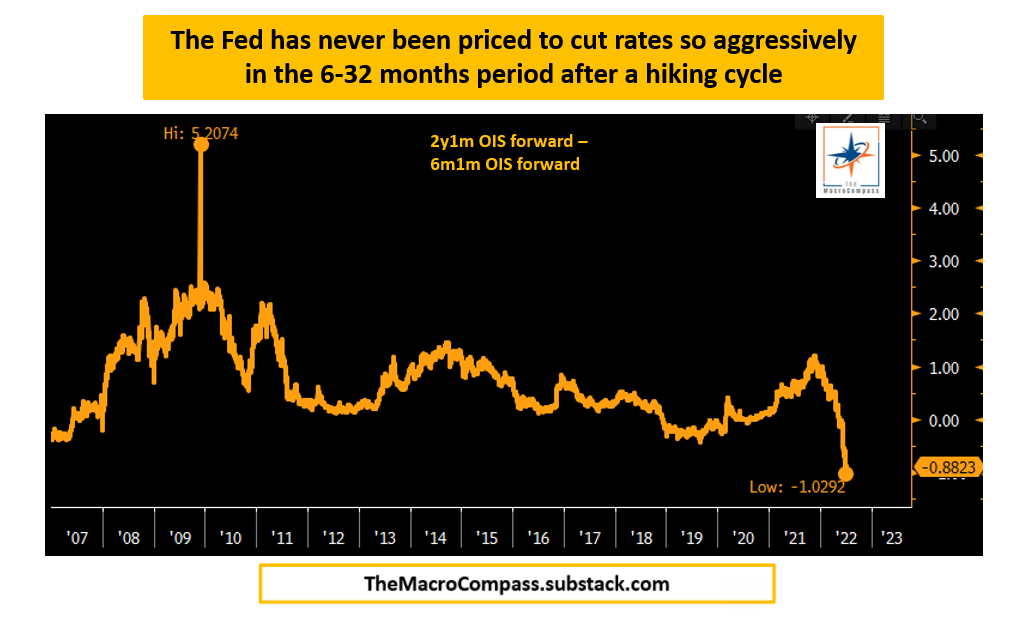
Moreover, with the impulse in credit falling, labor market showing preliminary signs of weakness, a drawdown in commodities (which is consistent with sharply lower economic growth), and bond market pricing rate cuts in early 2023, immediately following the hiking cycle, portfolios can “stay away from highly speculative assets, own USD cash and start allocating towards 5-10y+ government bonds,” as Alfonso Peccatiello explains well in his letter, The Macro Compass.

Graphic: Retrieved from The Macro Compass published by Alfonso Peccatiello.

Positioning

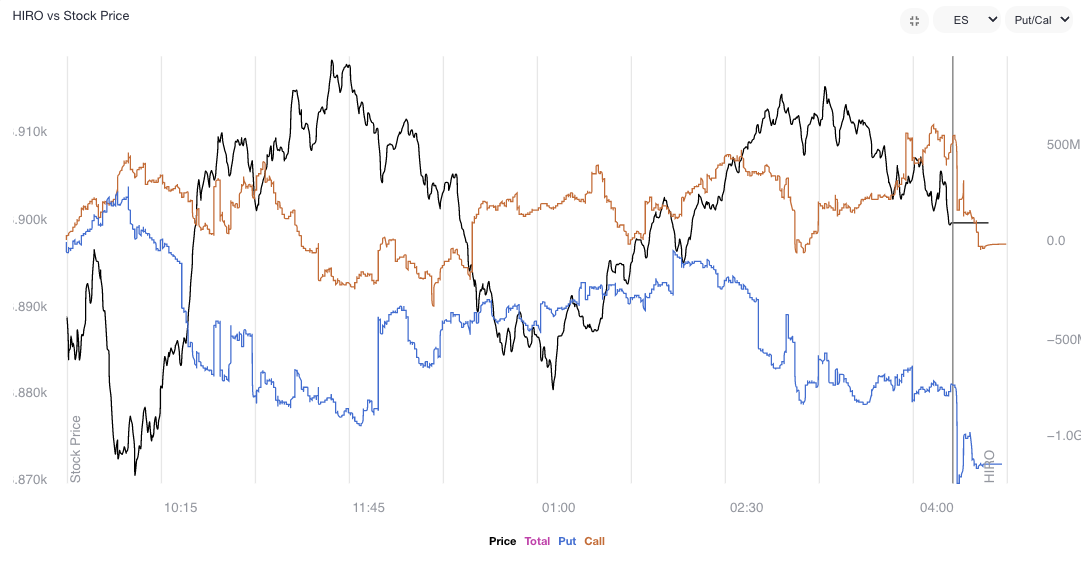
Calmer trade alongside easing volatility and generally rising gamma exposures. Trade, at times, was responsive. Participants would add positive (negative) delta bets into weakness (strength).

Graphic: Updated 7/8/2022. SpotGamma’s Hedging Impact of Real-Time Options (HIRO) indicator registers the sale of put (blue line) and call (orange) options.

Noteworthy is the continued sale of volatility, particularly across shorter time horizons, as well as increased demand for call options, especially in some of the larger index weights. Volatility sale, on the part of customers, leaves liquidity providers warehousing long volatility (which is kind of a naive thing to say as we’re discounting customer trades being paired off with each other).

Nonetheless, these liquidity providers’ positions, all else equal, will maintain or increase in value if underlying(s) realize volatility (especially that far in excess of implied). To hedge, rips (dips) will be sold (bought) to offset the increasing positive (negative) delta.

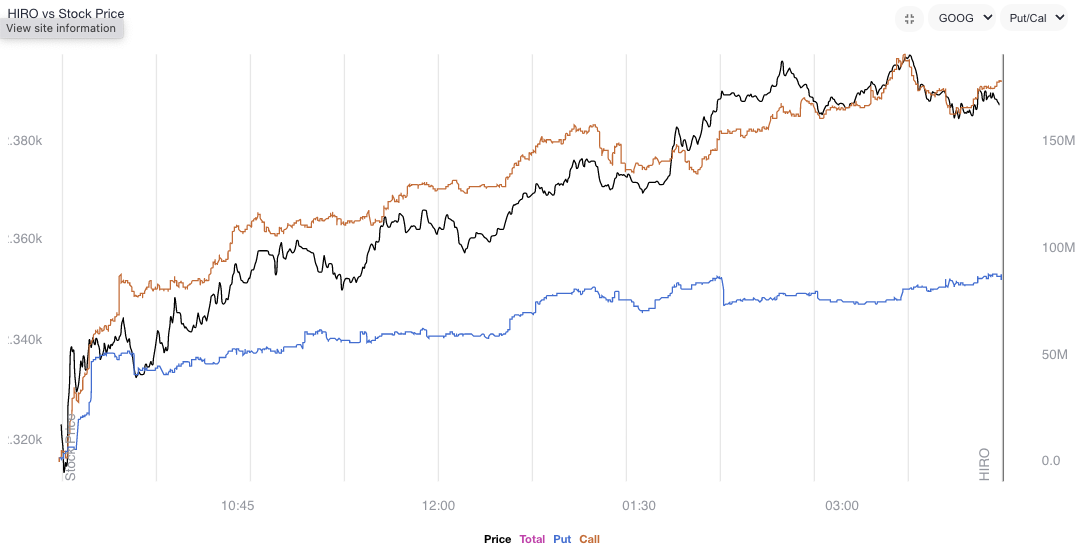
Graphic: Updated 7/7/2022. SpotGamma’s HIRO indicator for Alphabet Inc (NASDAQ: GOOG) (NASDAQ: GOOGL). Rising orange and blue lines point to call buying and put selling, both of which have bullish implications.

Moreover, this trend in volatility supply is in part on the loss of interest in “leveraged long S&P” trades, as well as “marginal demand for puts,” as SqueezeMetrics has stated, before.

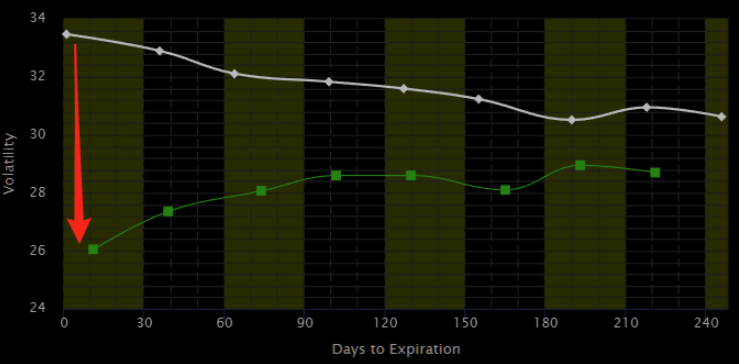
Graphic: Retrieved from The Market Ear. Originally sourced via VIX Central. “Chart shows the VIX term structure ‘crash’ since June 13, which was the most recent VIX peak. The curve is now back to normal with the short end of the curve ‘much’ lower than longer-term maturities. Let’s see how far down they ‘press’ this.”

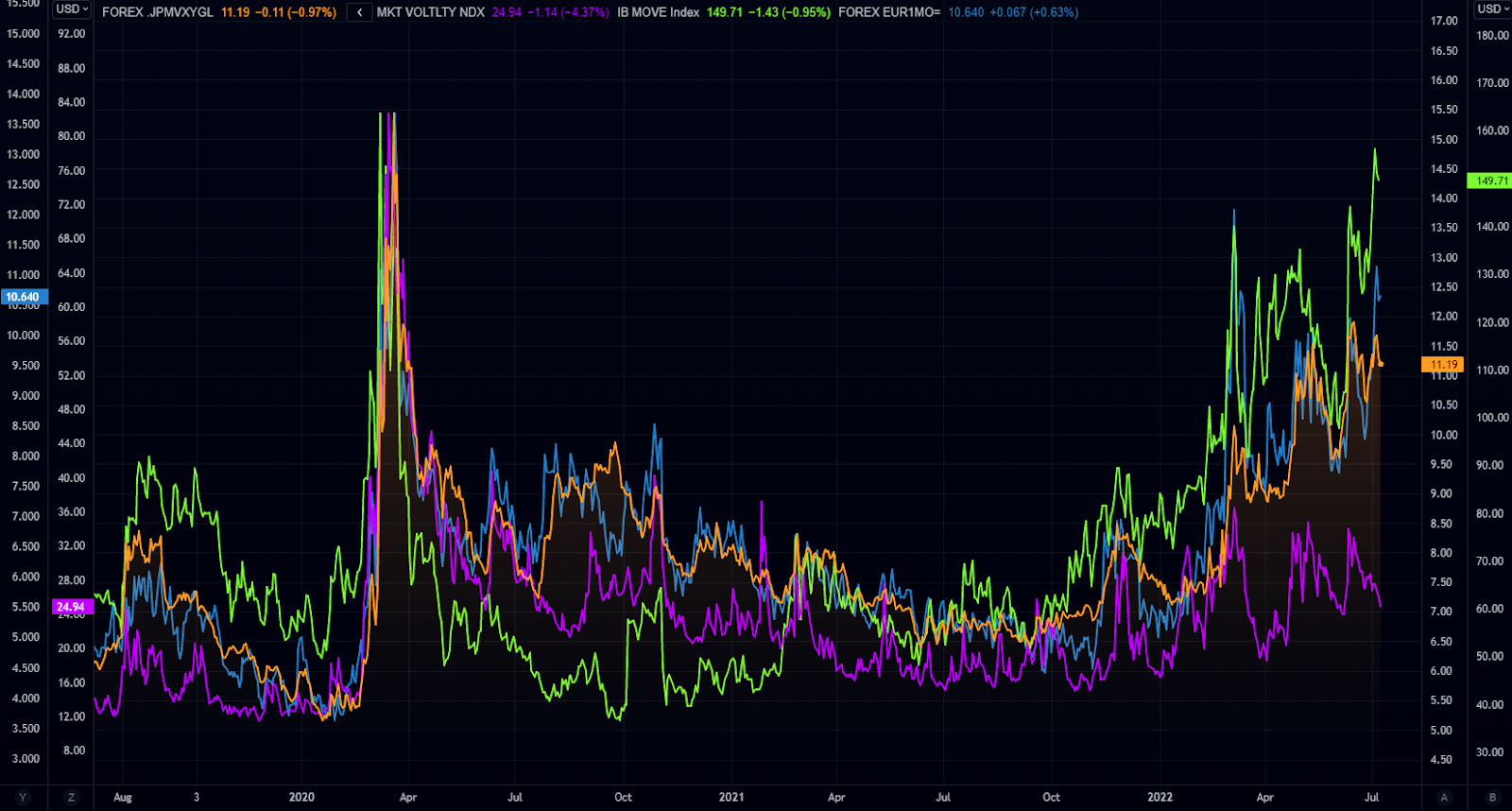
“Creeping into net selling territory is ‘smart’ bear market positioning. Short delta, short skew.”

Graphic: Retrieved from The Market Ear. “VIX has decoupled from cross-asset volatilities.”

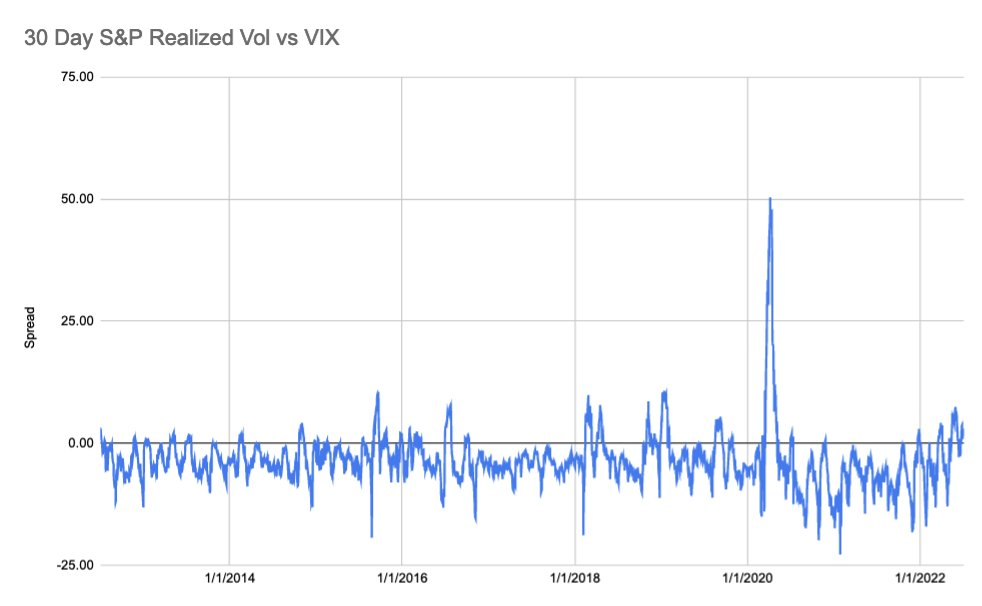
Accordingly, the volatility markets have realized (RVOL) has crept (and exceeded, at times) the volatility implied (IVOL). 

Graphic: Via S&P Global. As explained by SpotGamma, “30-day realized SPX volatility is now trading above the VIX, something that generally shows after major selloffs wherein IV “premium” needs to reset to calmer/higher equity markets.”

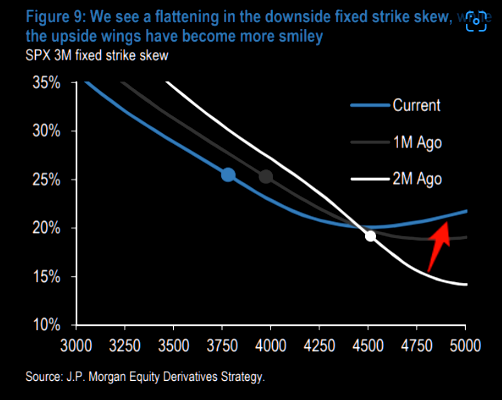
This, coupled with “a flattening in the downside fixed strike skew, while the upside wings [are] more smiley,” as described by JPMorgan Chase & Co (NYSE: JPM), has made for attractive low-cost spread opportunities, as talked about in the July 8, 2022 letter.

Graphic: Via JPMorgan Chase & Co (NYSE: JPM). Taken from The Market Ear.

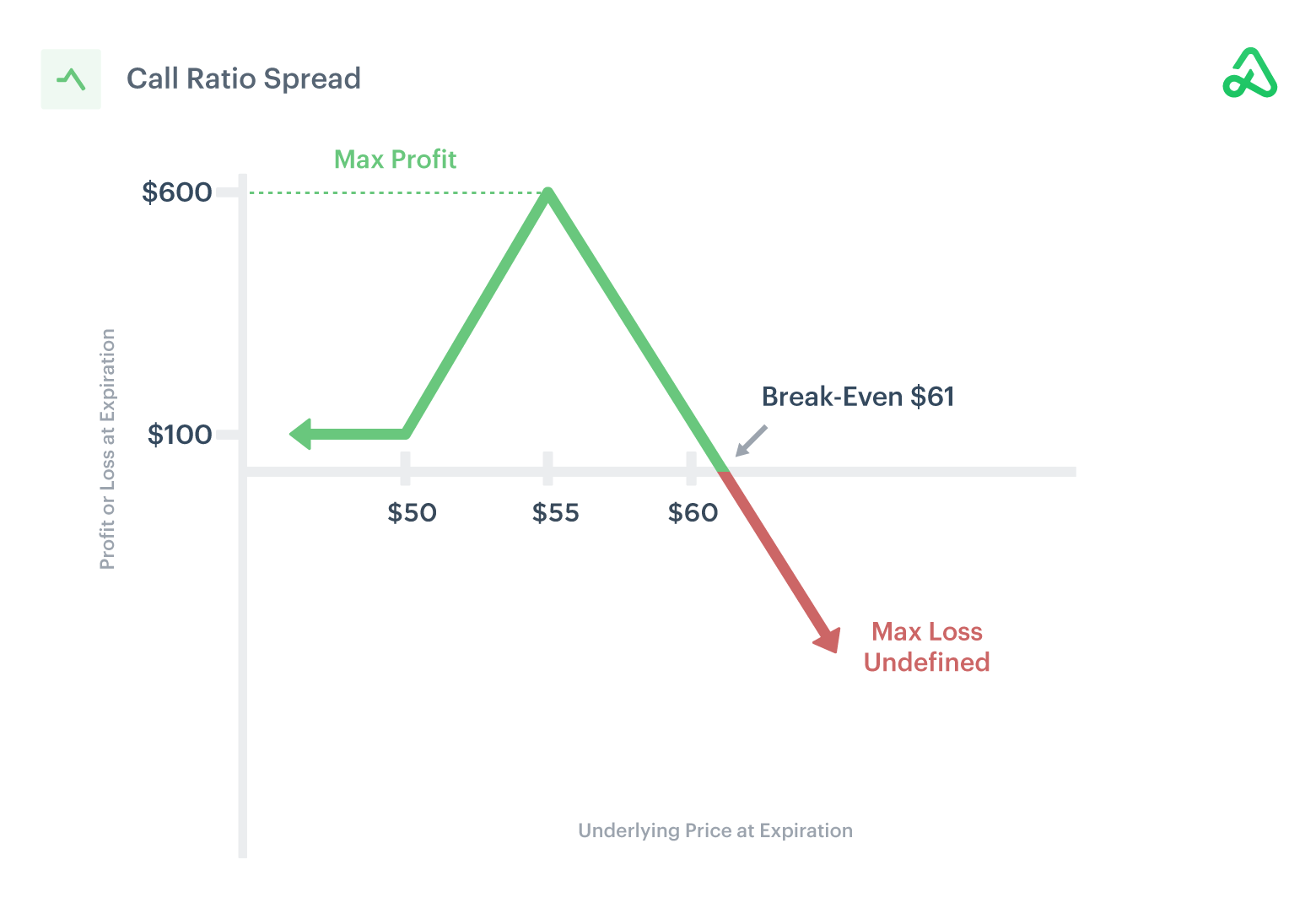
For instance, as discussed Friday, ratio spreads continue to work well for low- or no-cost exposure to the upside. 

Graphic: Via Option Alpha.

Pursuant to those remarks, no-cost spreads this letter’s writer has structured in Alphabet Inc (NASDAQ: GOOG) (NASDAQ: GOOGL) are pricing hundreds of dollars in credit to close.

Graphic: Via Charles Schwab Corporation-owned (NYSE: SCHW) TD Ameritrade’s Thinkorswim. 

Obviously, there’s no mention, here, of the risk management (e.g., sizing and width) involved. Again, this is as I’m trying to give actionable info without providing explicit recommendations.

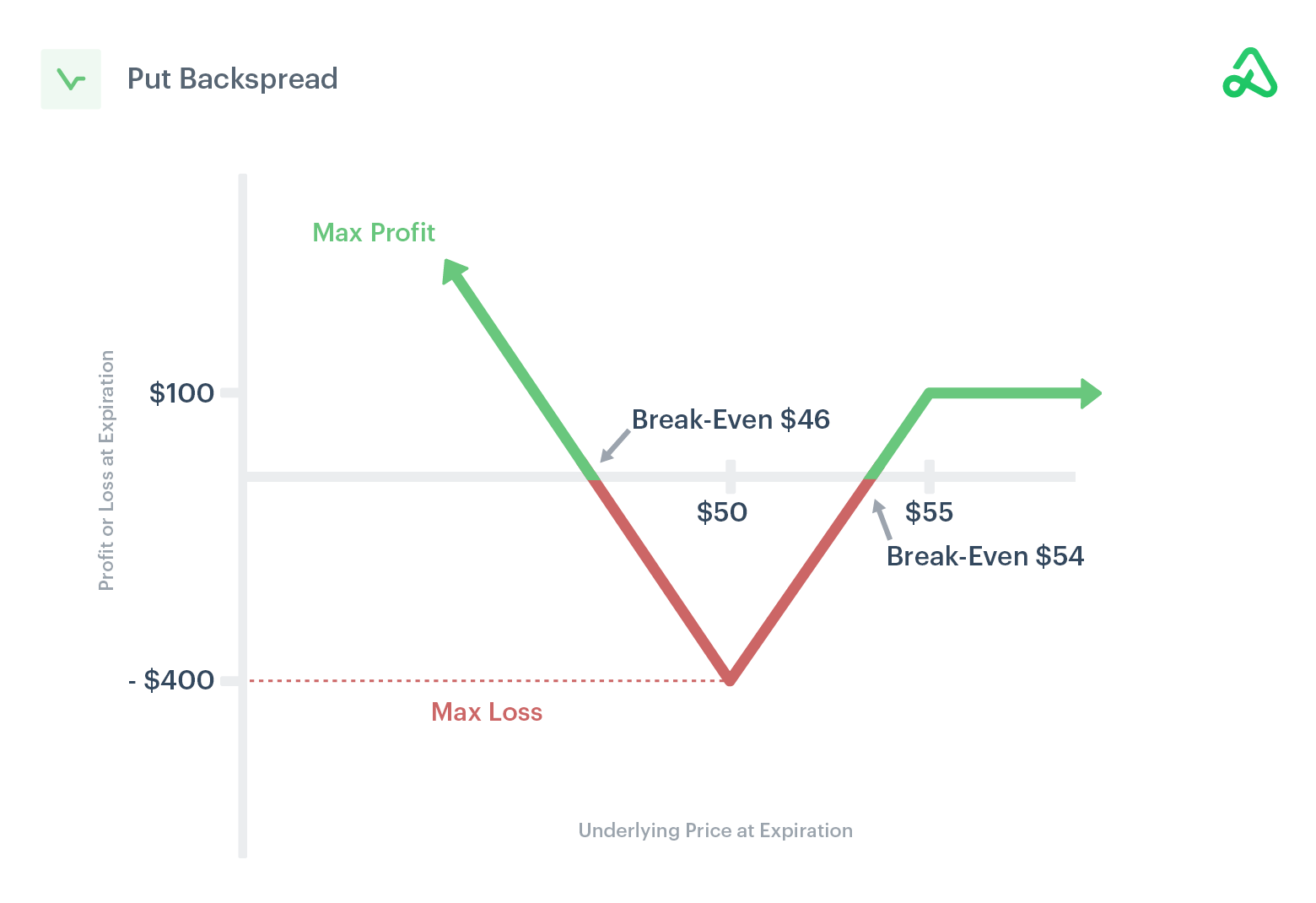
Similarly, if one thought volatility, though at a high starting point particularly at the money (ATM), was due for a repricing, they would look for exposure to the downside via something such as an inverse ratio (or back spread), as said last week.

Graphic: Via Option Alpha.

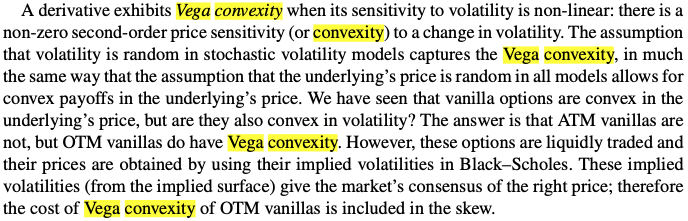
This is as the ATMs, unlike those further out of the money (OTM), are less convex in vega.

Graphic: Via Mohamed Bouzoubaa et al’s Exotic Options and Hybrids.

Technical

As of 7:00 AM ET, Monday’s regular session (9:30 AM – 4:00 PM ET), in the S&P 500, is likely to open in the middle-to-lower part of a negatively skewed overnight inventory, inside of prior-range and -value, suggesting a limited potential for immediate directional opportunity.

In the best case, the S&P 500 trades higher.

Any activity above the $3,867.25 LVNode puts into play the $3,909.25 MCPOC. Initiative trade beyond the MCPOC could reach as high as the $3,943.25 HVNode and $3,982.75 LVNode, or higher.

In the worst case, the S&P 500 trades lower.

Any activity below the $3,867.25 LVNode puts into play the $3,831.00 VPOC. Initiative trade beyond the VPOC could reach as low as the $3,800.25 LVNode and $3,755.00 VPOC, or lower.

Click here to load today’s key levels into the web-based TradingView charting platform. Note that all levels are derived using the 65-minute timeframe. New links are produced, daily.
Graphic: 65-minute profile chart of the Micro E-mini S&P 500 Futures.

Considerations: Responsiveness near key-technical areas (that are discernable visually on a chart), suggests technically-driven traders with short time horizons are very active. 

Such traders often lack the wherewithal to defend retests and, additionally, the type of trade may be indicative of the other time frame participants waiting for more information to initiate trades.

Example: The below 65-minute S&P 500 chart with volume profiles was included in the July 8, 2022 edition of the newsletter. Prices were near an inflection (micro-composite point of control and two key volume-weighted average price levels). From thereon, selling surfaced.

This is what is meant by responsiveness near key-technical areas.
Graphic: Updated 7/2/22. 65-minute profile chart of the Micro E-mini S&P 500 Futures.

Definitions

Volume Areas: A structurally sound market will build on areas of high volume (HVNodes). Should the market trend for long periods of time, it will lack sound structure, identified as low volume areas (LVNodes). LVNodes denote directional conviction and ought to offer support on any test. 

If participants were to auction and find acceptance into areas of prior low volume (LVNodes), then future discovery ought to be volatile and quick as participants look to HVNodes for favorable entry or exit.

POCs: POCs are valuable as they denote areas where two-sided trade was most prevalent in a prior day session. Participants will respond to future tests of value as they offer favorable entry and exit.

MCPOCs: POCs are valuable as they denote areas where two-sided trade was most prevalent over numerous day sessions. Participants will respond to future tests of value as they offer favorable entry and exit.

Volume-Weighted Average Prices (VWAPs): A metric highly regarded by chief investment officers, among other participants, for quality of trade. Additionally, liquidity algorithms are benchmarked and programmed to buy and sell around VWAPs.

About

After years of self-education, strategy development, mentorship, and trial-and-error, Renato Leonard Capelj began trading full-time and founded Physik Invest to detail his methods, research, and performance in the markets.

Capelj also develops insights around impactful options market dynamics at SpotGamma and is a Benzinga reporter.

Some of his works include conversations with ARK Invest’s Catherine Wood, investors Kevin O’Leary and John Chambers, FTX’s Sam Bankman-Fried, former Bridgewater Associate Andy Constan, Kai Volatility’s Cem Karsan, The Ambrus Group’s Kris Sidial, among many others.

Disclaimer

In no way should the materials herein be construed as advice. Derivatives carry a substantial risk of loss. All content is for informational purposes only.

Categories
Commentary

Daily Brief For June 13, 2022

The daily brief is a free glimpse into the prevailing fundamental and technical drivers of U.S. equity market products. Join the 300+ that read this report daily, below!

What Happened

Overnight, futures for commodities, the equity indexes, and bonds were weak. There was no salvation in different assets. Instead, the realized correlation, across markets, tightened.

This is on the heels of inflation data updates that have traders pricing a 50-50 odds for a 75 basis point interest rate hike in July, after a 50 basis point hike this month.

That said, Ben Bernanke, who is a former Federal Reserve (Fed) Chair, said monetary policy leaders may be able to sidestep a big recession, expressing hopes that improvements in supply chains, among other things, would help rein inflation.

In other news, Chinese military officials warned their U.S. counterparts to avoid the Taiwan Strait and dismissed the need for the United Nations to review labor standards in the Xinjiang region.

This is as Britain’s economy unexpectedly shrank and Russia claims it has destroyed U.S. and European weapons stores in Ukraine. Additionally, despite OPEC+’s modest output gains, the average price of a gallon of gas rose to over $5 per gallon in the U.S. 

This output shock is likely to last into 2023 with gas potentially reaching as high as $6-$7.

Interestingly, as an aside, power grid operators in the Midwest are suggesting rolling blackouts in the coming years. This is just as power use in the South hit all-time records.

Ahead is data on inflation expectations (11:00 AM ET). This week’s focus is on the Federal Open Market Committee’s (FOMC) monetary policy decisions and large derivative expirations.

Graphic updated 6:30 AM ET. Sentiment Risk-Off if expected /ES open is below the prior day’s range. /ES levels are derived from the profile graphic at the bottom of the following section. Levels may have changed since initially quoted; click here for the latest levels. SqueezeMetrics Dark Pool Index (DIX) and Gamma (GEX) calculations are based on where the prior day’s reading falls with respect to the MAX and MIN of all occurrences available. A higher DIX is bullish. At the same time, the lower the GEX, the more (expected) volatility. Learn the implications of volatility, direction, and moneyness. SHIFT data used for S&P 500 (INDEX: SPX) options activity. Note that options flow is sorted by the call premium spent; if more positive, then more was spent on call options. Breadth reflects a reading of the prior day’s NYSE Advance/Decline indicator. VIX reflects a current reading of the CBOE Volatility Index (INDEX: VIX) from 0-100.

What To Expect

Fundamental: The CPI report was released Friday. 

Expected was an 8.2% rise year-over-year (YoY) and 0.7% month-over-month (MoM). Core CPI (which excludes food and energy) was to rise by 5.9% YoY and 0.5% MoM, respectively.

Officially, the headline number rose to 8.6%, and, the same day, consumer sentiment dropped to record lows while expectations for inflation (5-10 years from now) jumped 0.3%.

Graphic: Via All-Star Charts. Taken from the Weekly S&P 500 ChartStorm.

As Bloomberg’s John Authers put it well, the report’s details “were if anything even more alarming. There’s no way around it; this was a bad report.”

Graphic: Via Schroders plc (OTC: SHNWF). Taken from the Weekly S&P 500 ChartStorm. “Everyone’s (current) favorite economic data report was out this week and it showed annual CPI inflation running at an 8.6% clip. On this chart that would imply a P/E ~11x (Current P/E is ~20x).

Subsequently, a key part of the U.S. yield curve turned upside down while traders priced more tightening by September (i.e., two 50 basis point hikes and one that is potentially 75 basis points), selling nearly everything but the U.S. dollar.

Graphic: Via CME Group Inc’s (NASDAQ: CME) FedWatch Tool.

Early last week, after commentaries resumed, we talked about the reach for cash amid poor safety in fixed income and stock price declines.

Ultimately, to quote Joseph Wang who was a trader at the Fed, an increase in the RRP (reverse repo) and QT (which is a direct flow of capital to capital markets) “would drain the pool of bank deposits by ~$1t by year-end,” and this may prompt investors to “continue to lower their selling prices to compete for the cash they want.”

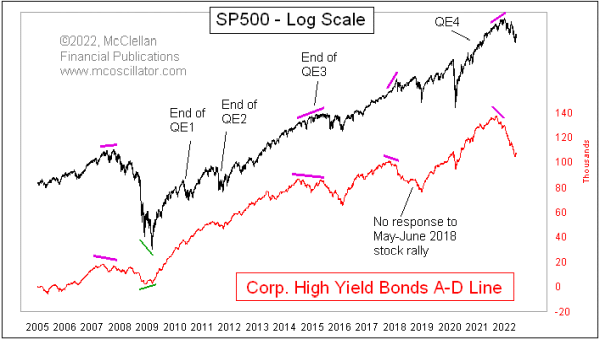
Graphic: Via McClellan Financial Publications. “These bonds move a lot more like the stock market than like T-Bonds. What makes them even more interesting is that they tend to be terribly sensitive to liquidity, both good and bad.”

“Inflation is eating margins, eating consumer demand, and causing the dramatic monetary tightening we are witnessing. None of this is good for stocks,” said James Athey of Abrdn. 

“There is still much downside to come.” 

Positioning: In short, prior-mentioned supply and demand dynamics resulted in divergences between the volatility that the market realizes (RVOL) and that which is implied (IVOL).

Graphic: Via Robson Chow, founder at Tradewell. The SPDR S&P 500 ETF Trust (NYSE: SPY) “is off ~5% in two trading sessions and implied volatility is still below realized volatility.”

Basically, participants are hedged and volatility remains well-supplied, due in part to suppressive volatility selling, as well as passive flows supporting the largest index constituents.

Consequently, the market’s descent has been orderly and not exacerbated by the demand for hedges and associated repricings of volatility.

This was expected, per Kai Volatility Cem Karsan’s commentary published in December 2021.

Graphic: Commentary published by Kai Volatility.

Accordingly, for “divergences in RVOL and IVOL to resolve, it would likely take forced selling,” as I explained in a recent SpotGamma commentary.

This is similar to the happenings of the Global Financial Crisis when, according to The Ambrus Group’s Kris Sidial, “vol slowly [ground] until the eventual October 2008 move (i.e., Lehman).”

“The markets were understanding that there was a change going on, especially in credit. But that risk was discounted until it was forced into realization.”

In light of this, on June 8, we talked about long volatility structures (that, one, either sold very short-dated pre-FOMC and OPEX volatility to fund that which is farther-dated or, two, buy into implied skew convexity, non-linear with respect to delta [gamma] and vega [volga] changes).

Why would you do that?

When you think there is to be an outsized move in the underlying, relative to what is priced, you buy options (positive exposure to gamma) so that you may have gains that are potentially amplified in case of directional movement.

When you think there is to be an outsized move in the implied volatility, relative to what is priced, you buy options (positive exposure to volga) so that you may have gains that are potentially amplified in case of implied volatility repricing.

Graphic: Via Banco Santander SA (NYSE: SAN) research.

Ultimately, “liquidity providers’ response to demand for protection (en masse) would, then, likely exacerbate the move and aid in the repricing of volatility to levels where there would be more stored energy to catalyze a rally.”

More on these dynamics later this week.

Technical: As of 6:30 AM ET, Monday’s regular session (9:30 AM – 4:00 PM ET), in the S&P 500, will likely open in the lower part of a negatively skewed overnight inventory, outside of prior-range and -value, suggesting a potential for immediate directional opportunity.

In the best case, the S&P 500 trades higher; activity above the $3,808.50 HVNode puts in play the $3,836.25 LVNode. Initiative trade beyond the $3,836.25 LVNode could reach as high as the $3,863.25 LVNode and $3,911.00 VPOC, or higher.

In the worst case, the S&P 500 trades lower; activity below the $3,808.50 HVNode puts in play the $3,768.25 HVNode. Initiative trade beyond the $3,768.25 HVNode could reach as low as the $3,727.75 and $3,688.75 HVNode, or lower.

Click here to load today’s key levels into the web-based TradingView charting platform. Note that all levels are derived using the 65-minute timeframe. New links are produced, daily.
Graphic: 65-minute profile chart of the Micro E-mini S&P 500 Futures.

Definitions

Volume Areas: A structurally sound market will build on areas of high volume (HVNodes). Should the market trend for long periods of time, it will lack sound structure, identified as low volume areas (LVNodes). LVNodes denote directional conviction and ought to offer support on any test. 

If participants were to auction and find acceptance into areas of prior low volume (LVNodes), then future discovery ought to be volatile and quick as participants look to HVNodes for favorable entry or exit.

Point Of Control: POCs are valuable as they denote areas where two-sided trade was most prevalent in a prior day session. Participants will respond to future tests of value as they offer favorable entry and exit.

Micro Composite Point Of Control: POCs are valuable as they denote areas where two-sided trade was most prevalent over numerous day sessions. Participants will respond to future tests of value as they offer favorable entry and exit.

Volume-Weighted Average Prices (VWAPs): A metric highly regarded by chief investment officers, among other participants, for quality of trade. Additionally, liquidity algorithms are benchmarked and programmed to buy and sell around VWAPs.

About

After years of self-education, strategy development, mentorship, and trial-and-error, Renato Leonard Capelj began trading full-time and founded Physik Invest to detail his methods, research, and performance in the markets.

Capelj also develops insights around impactful options market dynamics at SpotGamma and is a Benzinga reporter.

Some of his works include conversations with ARK Invest’s Catherine Wood, investors Kevin O’Leary and John Chambers, FTX’s Sam Bankman-Fried, Kai Volatility’s Cem Karsan, The Ambrus Group’s Kris Sidial, among many others.

Disclaimer

In no way should the materials herein be construed as advice. Derivatives carry a substantial risk of loss. All content is for informational purposes only.

Categories
Commentary

Daily Brief For January 13, 2022

The Daily Brief is a free glimpse into the prevailing fundamental and technical drivers of U.S. equity market products. Join the 200+ that read this report daily, below!

What Happened

Overnight, equity index futures diverged from commodity and bond products. Measures of implied volatility showed signs of bottoming. The dollar continued a plunge. 

Overall, the stance is neutral as the “hottest U.S. inflation in 39 years sets up March rate liftoff.”

Ahead is data on jobless claims and producer prices (8:30 AM ET). The Federal Reserve’s Lael Brainard will have a confirmation hearing (10:00 AM ET), Tom Barkin will speak later (12:00 PM ET), with Charles Evans speaking last (1:00 PM ET).

Graphic updated 5:55 AM ET. Sentiment Neutral if expected /ES open is inside of the prior day’s range. /ES levels are derived from the profile graphic at the bottom of the following section. Levels may have changed since initially quoted; click here for the latest levels. SqueezeMetrics Dark Pool Index (DIX) and Gamma (GEX) calculations are based on where the prior day’s reading falls with respect to the MAX and MIN of all occurrences available. A higher DIX is bullish. At the same time, the lower the GEX, the more (expected) volatility. Learn the implications of volatility, direction, and moneyness. SHIFT data used for S&P 500 (INDEX: SPX) options activity. Note that options flow is sorted by the call premium spent; if more positive, then more was spent on call options. Breadth reflects a reading of the prior day’s NYSE Advance/Decline indicator. VIX reflects a current reading of the CBOE Volatility Index (INDEX: VIX) from 0-100.

What To Expect

Fundamental: The consumer price index printed 7%, rising 0.5% from November. 

Much of the increases were attributed to shelter, used vehicles, and food.

With unemployment falling and inflation proving stubborn, monetary policymakers have been emboldened to tighten, raising rates in March and (later) shrinking the balance sheet. 

“In terms of where the Fed is on their dual mandate — inflation and the labor market — they’re basically there,” Michael Gapen, chief U.S. economist at Barclays Plc (NYSE: BCS), said on Bloomberg Television. “I don’t really think anything stops them going in March except one of these kind of outlier events. I think they’re ready.”

Market reaction was muted, mostly, with commodities bearing the brunt of the bullishness.

The calm reaction in equities, ahead of the earnings season, and bonds “showed that there was nothing particularly surprising in the [CPI] report, and that traders were confident that prices already covered the risks,” Bloomberg’s John Authers explained

“Fed funds futures barely budged, leaving a first rate hike in March almost fully priced. As they did before these numbers came out, dealers feel certain that the Fed will hike at least three times this year, while a fourth in December is seen as a 50-50 call.”

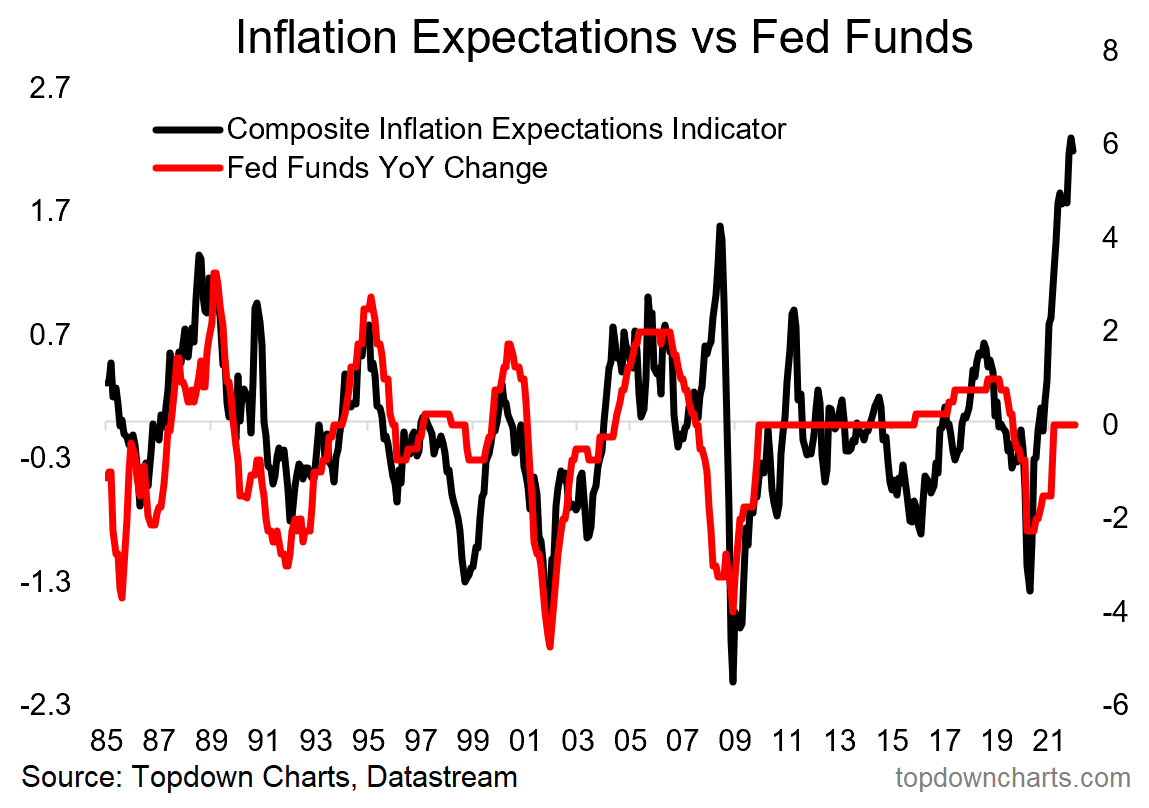
Graphic: Via Callum Thomas of Topdown Charts, “With the composite measure of inflation expectations at 40-year highs it’s fair to suggest that the Fed may have some catching up to do as it kicks off the transition away from easing.”

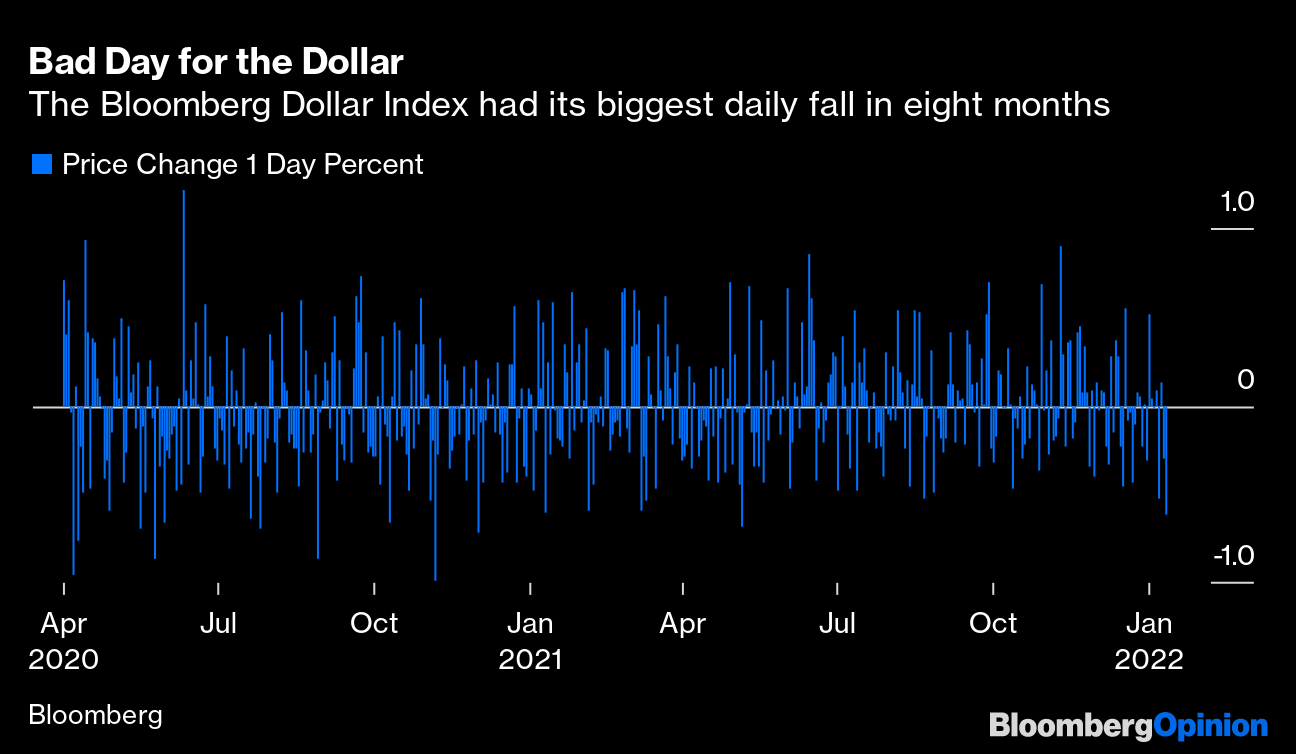
As an aside, there was a big drop in the dollar. In raising rates, currencies ought to attract money. Right? 

“[T]he combination of another really bad inflation number and an insouciant bond market response has been enough to knock the dollar off course. Many factors drive currencies, but this is consistent with a view that the rate hikes already priced in, and supporting the dollar until now, won’t be enough to head off inflation.”

Graphic: Via Bloomberg, “a weaker dollar makes imports more expensive and increases inflation.”

Positioning: On January 7, this commentary suggested metrics of options positioning, versus buying pressure (measured via short sales or liquidity provision on the market-making side) were positively skewed, even more so than before.

What followed was upside resolve, exacerbated in part by the compression in volatility and unwind of hedges to destabilizing customer options activity (i.e., put buying and call selling).

What now?

Scott Rubner of Goldman Sachs Group Inc (NYSE: GS) had the following to say.

“I am in the process of writing flow-of-funds note for February. My gut tells me to be bearish in February for when the ‘January Inflows’ run out. However, I just re-ran the CURRENT SET-UP for January and the conditions are not in place for a larger correction (>5%). Said another way, I want to be bearish, but this is the consensus. Investors are short, hedges are too big, everyone has on the puts, sentiment is negative (lowest in 86 weeks), I think everyone is already looking for the correction, and this may shift into buying dip alpha.”

So, what does all that mean? 

Demand for downside protection, as already touched on, coincided with customers indirectly taking liquidity and destabilizing the market as the participant short the put sold underlying to neutralize risk.

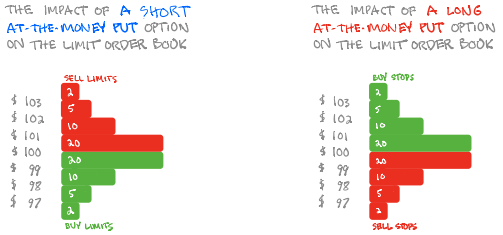
Graphic: SqueezeMetrics details the implications of customer activity in the options market, on the underlying’s order book. For instance, in selling a put, customers add liquidity and stabilize the market. How? The market maker long the put will buy (sell) the underlying to neutralize directional risk as price falls (rises).

Expansion in implied volatility increases the directional exposure of that protection. 

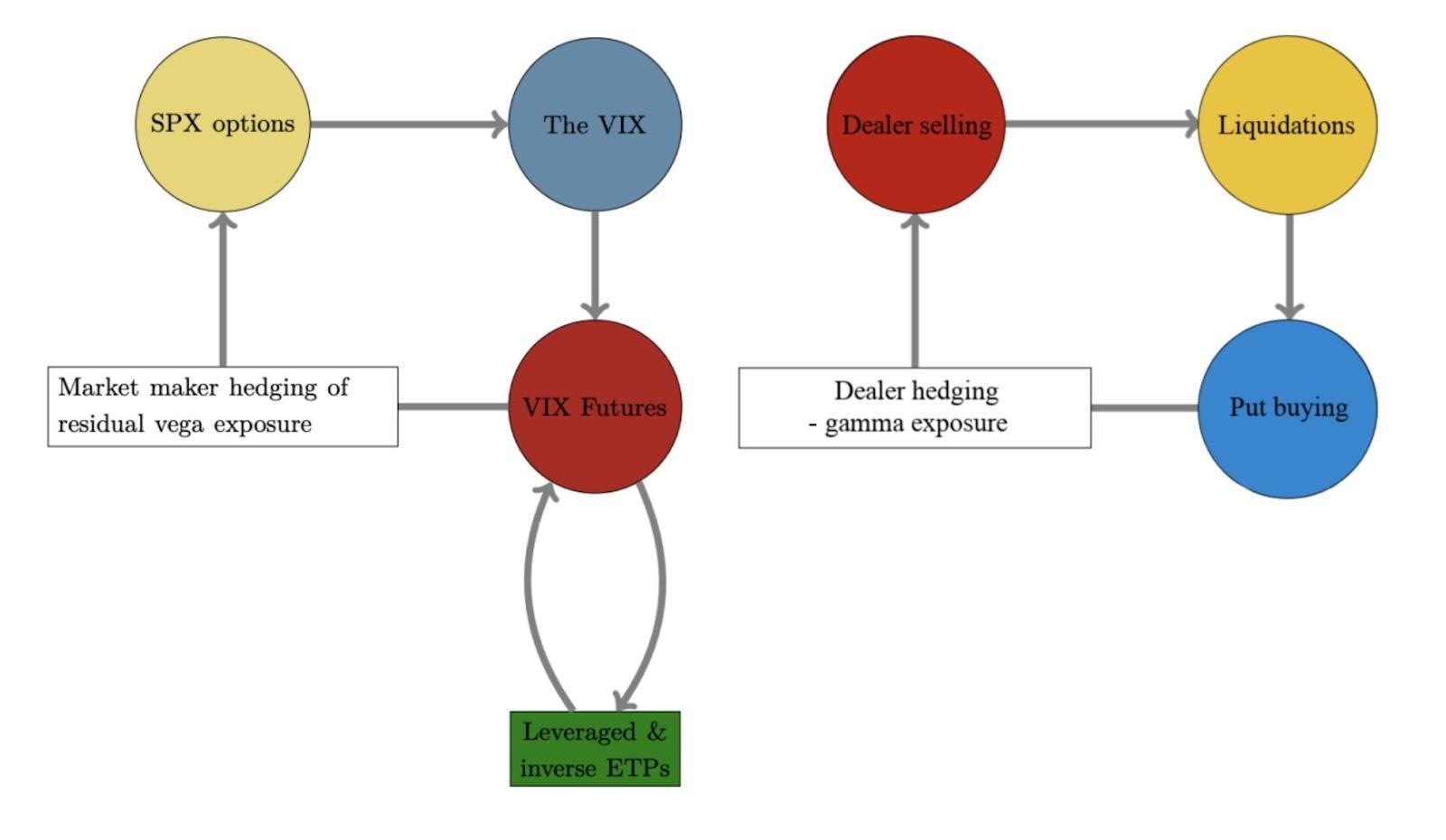
This is good for put buyers and bad for put sellers, simply put. As a result, in weakness, hedging of these contracts pressures markets further, making for violent up and down trade.

Graphic: The “Biggest tail risk to SPX isn’t any macro data/virus/war but its own options market.”

As volatility contracts, however, and underlying prices rise, the directional exposure of protection declines. This is bad for put buyers and good for put sellers. In offsetting this decline in directional risk, counterparties will unwind earlier hedges to bearish customer options activity. 

The unwind of these hedges, as SpotGamma explains, “likely invokes supportive dealer hedging flows with respect to time (‘charm’) and volatility (‘vanna’).”

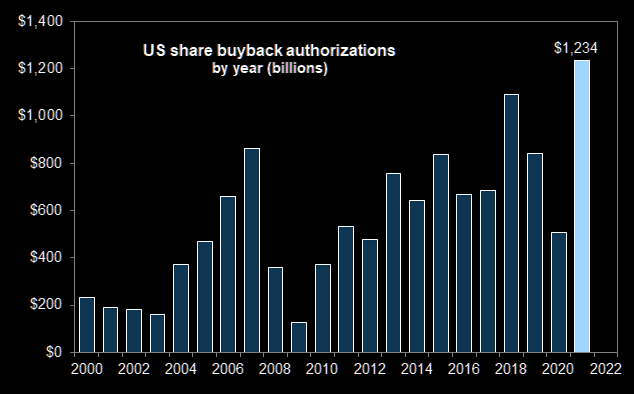
Couple this flow with strong passive buying support, as evidenced by metrics quoted elsewhere in this newsletter (e.g., DIX), the odds that markets continue to rally (or trade sideways, at least, short-term), in the face of “above-trend growth” and a record year of buybacks, as well as other things, seem good.

Graphic: Taken from The Market Ear. Goldman Sachs’ Scott Rubner: “The GS corporate buyback desk expects a record year for executions of $975B or >$4B per day.”

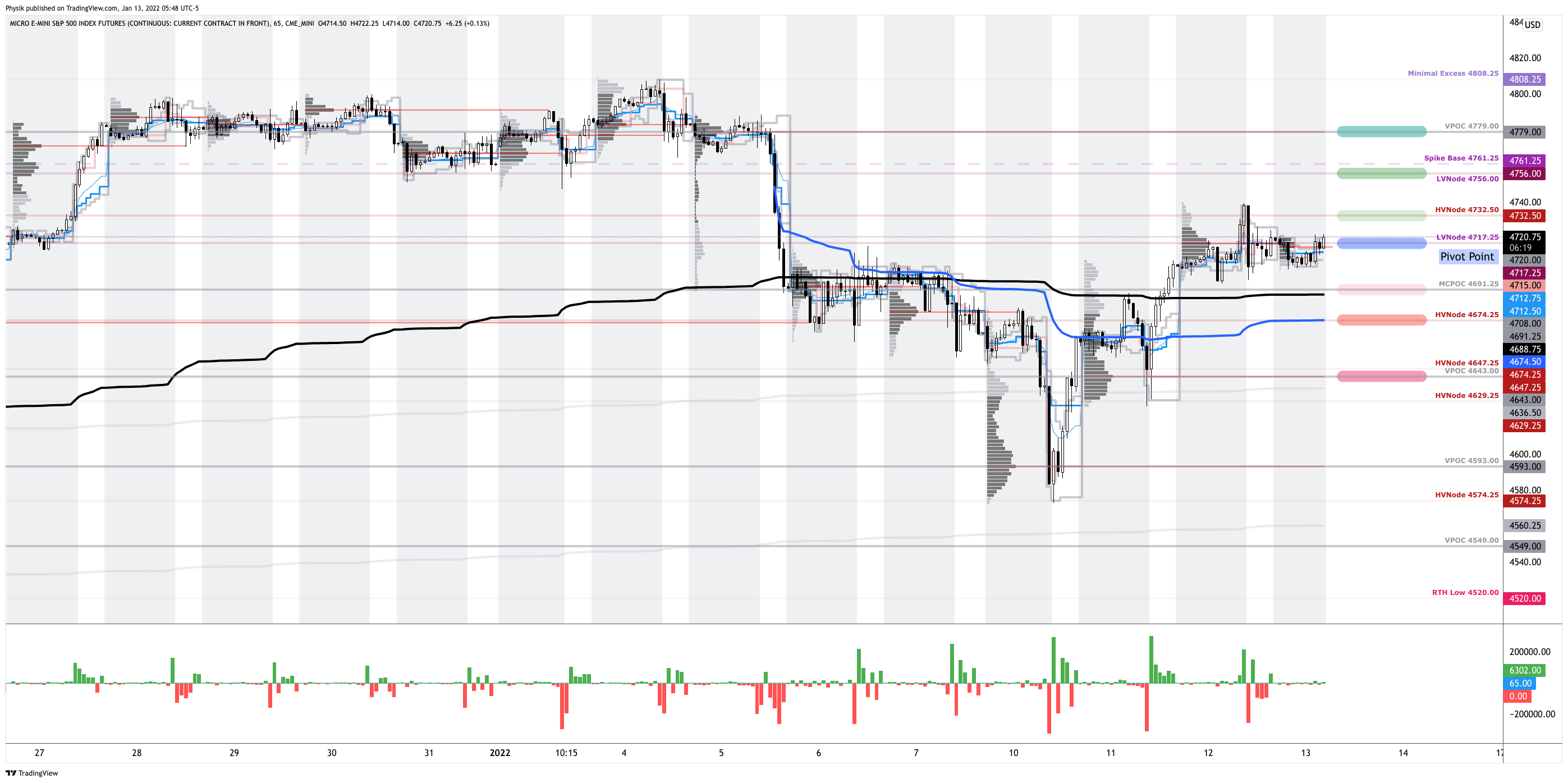
Technical: As of 5:55 AM ET, Thursday’s regular session (9:30 AM – 4:00 PM ET), in the S&P 500, will likely open in the middle part of a negatively skewed overnight inventory, inside of prior-range and -value, suggesting a limited potential for immediate directional opportunity.

In the best case, the S&P 500 trades higher; activity above the $4,717.25 low volume area (LVNode) puts in play the $4,732.50 high volume area (HVNode). Initiative trade beyond the HVNode could reach as high as the $4,756.00 LVNode and $4,779.00 untested point of control (VPOC), or higher.

In the worst case, the S&P 500 trades lower; activity below the $4,717.25 LVNode puts in play the $4,691.25 micro composite point of control (MCPOC). Initiative trade beyond the MCPOC could reach as low as the $4,674.25 HVNode and $4,643.00 VPOC, or lower.

Considerations: As evidenced by the volume-weighted average price anchored from the release of FOMC minutes (blue color, below), the average buyer, since that, is winning.

Click here to load today’s key levels into the web-based TradingView charting platform. Note that all levels are derived using the 65-minute timeframe. New links are produced, daily.
Graphic: 65-minute profile chart of the Micro E-mini S&P 500 Futures.

What People Are Saying

Definitions

Volume Areas: A structurally sound market will build on areas of high volume (HVNodes). Should the market trend for long periods of time, it will lack sound structure, identified as low volume areas (LVNodes). LVNodes denote directional conviction and ought to offer support on any test. 

If participants were to auction and find acceptance into areas of prior low volume (LVNodes), then future discovery ought to be volatile and quick as participants look to HVNodes for favorable entry or exit.

DIX: For every buyer is a seller (usually a market maker). Using DIX — which is derived from short sales (i.e., liquidity provision on the market-making side) — we can measure buying pressure.

Gamma: Gamma is the sensitivity of an option to changes in the underlying price. Dealers that take the other side of options trades hedge their exposure to risk by buying and selling the underlying. When dealers are short-gamma, they hedge by buying into strength and selling into weakness. When dealers are long-gamma, they hedge by selling into strength and buying into weakness. The former exacerbates volatility. The latter calms volatility.

Vanna: The rate at which the delta of an option changes with respect to volatility.

Charm: The rate at which the delta of an option changes with respect to time.

Options: If an option buyer was short (long) stock, he or she would buy a call (put) to hedge upside (downside) exposure. Option buyers can also use options as an efficient way to gain directional exposure.

POCs: POCs are valuable as they denote areas where two-sided trade was most prevalent in a prior day session. Participants will respond to future tests of value as they offer favorable entry and exit.

MCPOCs: POCs are valuable as they denote areas where two-sided trade was most prevalent over numerous day sessions. Participants will respond to future tests of value as they offer favorable entry and exit.

Options Expiration (OPEX): Traditionally, option expiries mark an end to pinning (i.e, the theory that market makers and institutions short options move stocks to the point where the greatest dollar value of contracts will expire) and the reduction dealer gamma exposure.

Volume-Weighted Average Prices (VWAPs): A metric highly regarded by chief investment officers, among other participants, for quality of trade. Additionally, liquidity algorithms are benchmarked and programmed to buy and sell around VWAPs.

Rates: Low rates have to potential to increase the present value of future earnings making stocks, especially those that are high growth, more attractive. To note, inflation and rates move inversely to each other. Low rates stimulate demand for loans (i.e., borrowing money is more attractive).

About

After years of self-education, strategy development, mentorship, and trial-and-error, Renato Leonard Capelj began trading full-time and founded Physik Invest to detail his methods, research, and performance in the markets.

Capelj is also a Benzinga finance and technology reporter interviewing the likes of Shark Tank’s Kevin O’Leary, JC2 Ventures’ John Chambers, FTX’s Sam Bankman-Fried, and ARK Invest’s Catherine Wood, as well as a SpotGamma contributor developing insights around impactful options market dynamics.

Disclaimer

Physik Invest does not carry the right to provide advice.

In no way should the materials herein be construed as advice. Derivatives carry a substantial risk of loss. All content is for informational purposes only.

Categories
Commentary

Daily Brief For November 22, 2021

What Happened

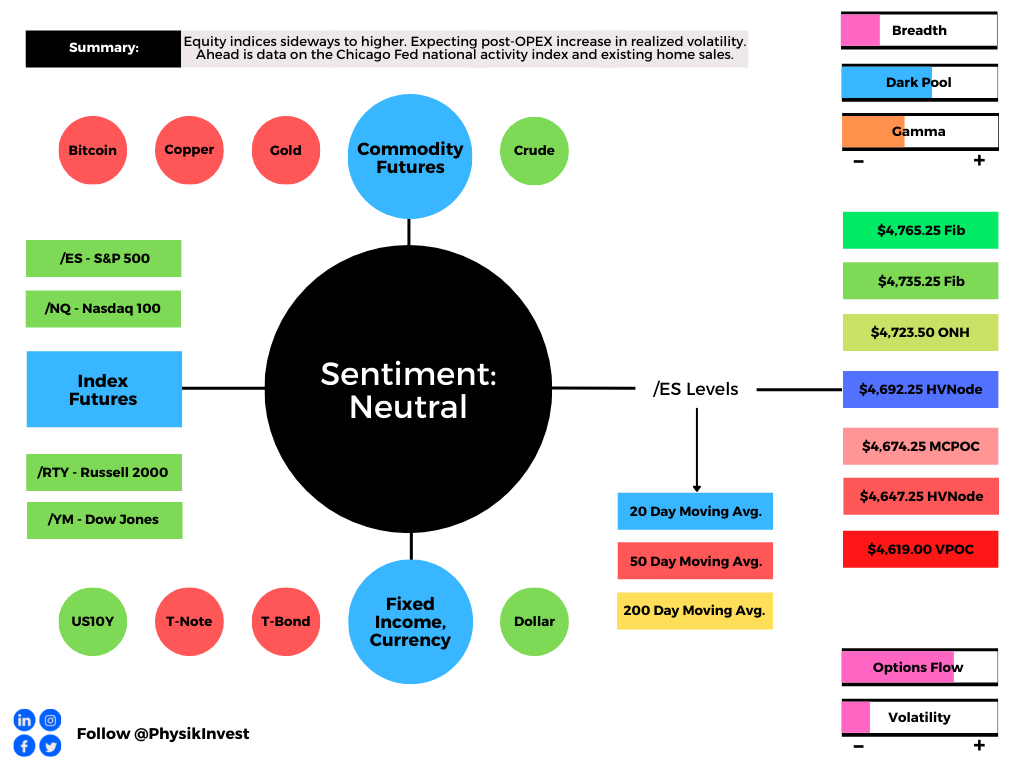
Overnight, equity index futures were sideways alongside the narrative that a strengthening dollar and the need to counteract inflation may endanger the rally in risk assets.

Ahead is data on the Chicago Fed National Activity Index (8:30 AM ET) and Existing Home Sales (10:00 AM ET).

Graphic updated 6:20 AM ET. Sentiment Neutral if expected /ES open is inside of the prior day’s range. /ES levels are derived from the profile graphic at the bottom of the following section. Levels may have changed since initially quoted; click here for the latest levels. SqueezeMetrics Dark Pool Index (DIX) and Gamma (GEX) calculations are based on where the prior day’s reading falls with respect to the MAX and MIN of all occurrences available. A higher DIX is bullish. At the same time, the lower the GEX, the more (expected) volatility. Learn the implications of volatility, direction, and moneyness. SHIFT data used for S&P 500 (INDEX: SPX) options activity. Note that options flow is sorted by the call premium spent; if more positive then more was spent on call options. Breadth reflects a reading of the prior day’s NYSE Advance/Decline indicator. VIX reflects a current reading of the CBOE Volatility Index (INDEX: VIX) from 0-100.

What To Expect

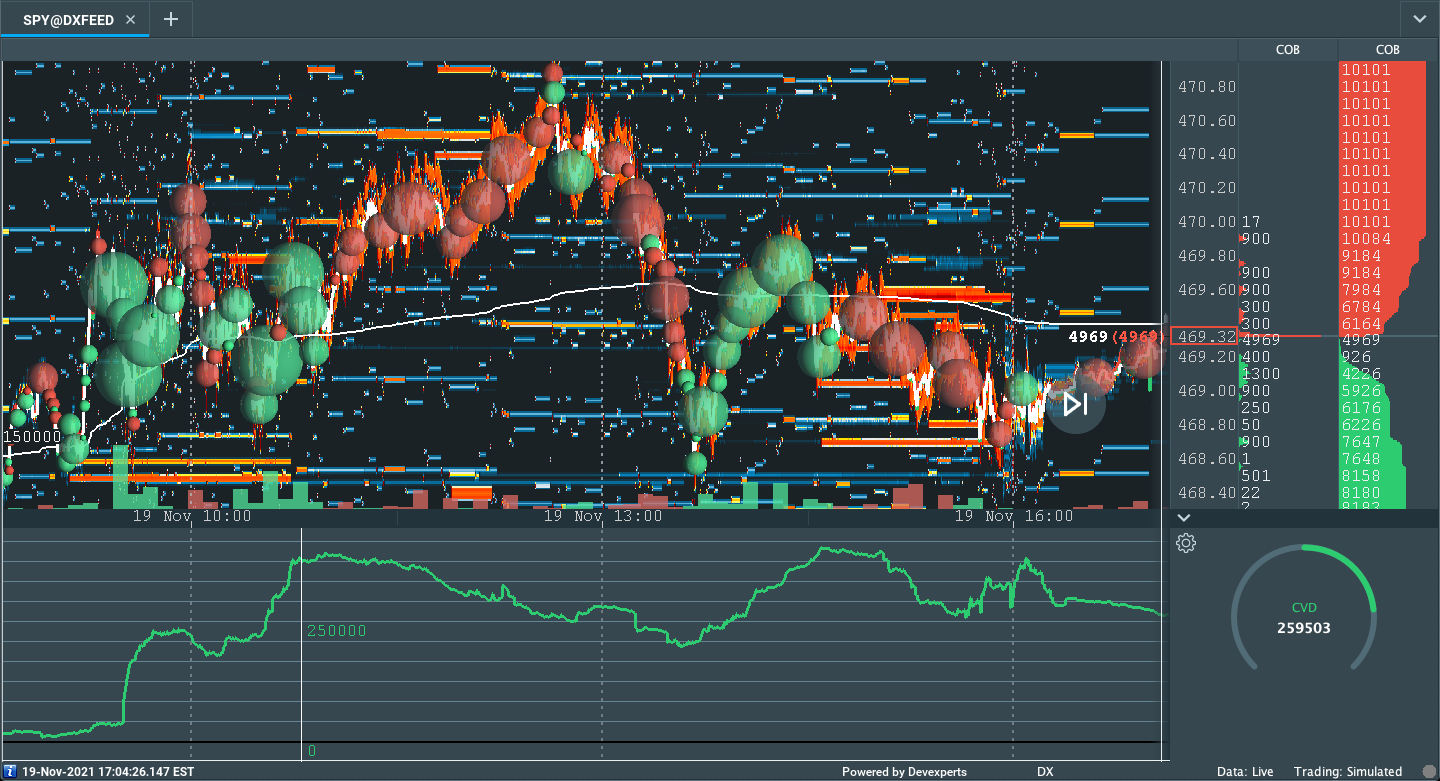
To start, on weak intraday breadth and supportive market liquidity metrics, the best case outcome occurred, evidenced by the balance and overlap of value areas in the S&P 500.

Taken together, the activity of the past two weeks or so signals participants’ willingness to position for directional resolve (i.e., trend) in the face of new information, and the like. 

Graphic: Divergent delta (i.e., non-committed selling as measured by volume delta or buying and selling power as calculated by the difference in volume traded at the bid and offer) in SPDR S&P 500 ETF Trust (NYSE: SPY), one of the largest ETFs that track the S&P 500 index, via Bookmap. The readings are supportive of responsive trade (i.e., rotational trade that suggests current prices offer favorable entry and exit; the market is in balance).

Context: The aforementioned trade is happening in the context of concerns over peak liquidity and prevailing monetary frameworks. 

Specifically, as Bloomberg’s John Authers put it, the abundance of global liquidity, that stoked one of the best stock market recoveries in history, is in peril by the strengthening of the dollar and the need to counter inflationary pressures. 

“Obstinately low real yields help to explain why the threat to liquidity has as yet had minimal effect on the stock market. Higher real yields are the shoe that hasn’t dropped this year; investors need a clear plan of evasive action for such an eventuality. For now, liquidity, liquidity, liquidity is still keeping stocks going up, up, up.”

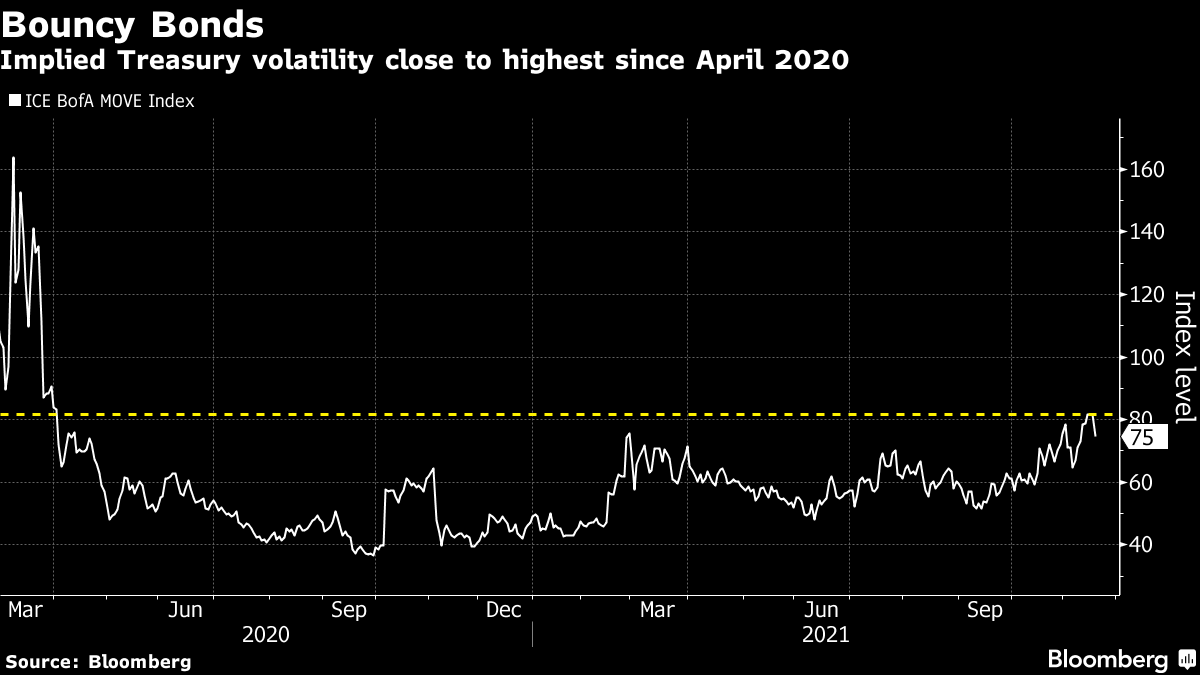
Some of this fear around monetary evolution, so to speak, though, has yet to feed into the pricing of equity market risk. Fear in one market tends to feed into the fear of another.

Graphic: “The ICE BofA MOVE Index, which measures implied volatility for Treasuries, is close to the steepest level since April 2020,” via Bloomberg. This measure, on a relative basis, has diverged from the CBOE Volatility Index (VIX), which is a measure of implied volatility for equities, specifically the S&P 500. 

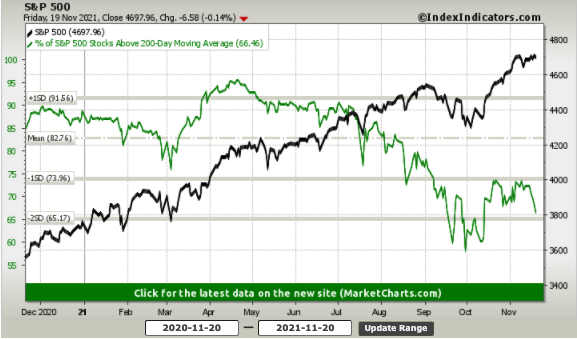
At the same time, we see a divergence in breadth.

Graphic: % of SPX stocks above their 200-Day Moving Average versus SPX, via indexindicators.com.

The takeaway here is that the SPX is sideways to higher while many of its constituents seem to not be participating in the most recent round of markup.

What factors are to blame for this? Two include an all-time high in buybacks, as well as extremes in speculation and upside volatility in heavily-weighted index constituents.

Adding, the S&P 500 closing last week pinned to the level at which dealers (i.e., those participants that take the other side of options trades and warehouse risk) exposure to positive options gamma was highest. 

Note that I talk about the implications options so much due to increased use and impact on underlying price, as a result of associated hedging. 

The aforementioned explains why the S&P can’t move; “If dealer hedging has suppressed index level volatility, but underlying components are still exhibiting idiosyncratic volatility, then the only reconciliation is a decline in correlation,” according to one paper by Newfound Research.

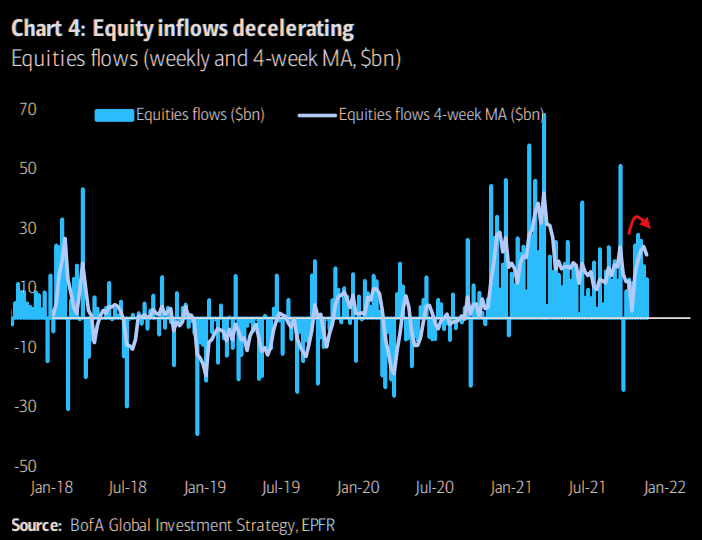
So trash breadth and a deceleration in equity inflows, coupled with exuberance (and upside volatility in heavily weighted index constituents) and clustered options positioning over the past weeks, is part of the reason why indices are sideways. Yes, to some extent.

Graphic: Per The Market Ear, “BofA points out the halt to inflows in market leaders such as tech, energy and financials. Basically, the “pillar of the pillar” of this market is fading. Do we still trust the seasonality pattern?”

The tone is to change, soon.

After OPEX, the absence of supportive vanna and charm flows (defined below), for which we can attribute some of the trends in extended day outperformance, alongside that sticky gamma hedging, so to speak, frees the market for directional resolve

According to SpotGamma, in light of recent exuberance, “participants are underexposed to downside put protection. Should these participants reach for long-gamma put exposures amidst volatility, there is a potential for a destabilizing, reflexive reaction on the part of dealers.”

The reason is, as volatility rises and customers demand out-of-the-money put protection, counterparties are to hedge by selling stock and futures into weakness. 

Cognizant of the risks, though, I end this section with the following. 

“[D]uring the 12-month period starting six months before and ending six months after a tightening cycle begins, the valuation of the S&P 500 has on average remained remarkably steady,” according to a post by The Market Ear.

At the same time, seasonality is great as, according to Callum Thomas, “Historically most of the time if the market closed up 20%+ for the year, the next year was also positive (84% of the time). As of writing, the market is up some 27% YTD (albeit, this year ain’t over yet!).”

Going forward, we shall monitor for the first signs of instability via spikes in the CBOE Volatility-Of-Volatility Index (INDEX: VVIX) and upward shifts in the VIX futures term structure.

Expectations: As of 6:20 AM ET, Monday’s regular session (9:30 AM – 4:00 PM ET), in the S&P 500, will likely open in the upper part of a positively skewed overnight inventory, inside of prior-range, suggesting a limited potential for immediate directional opportunity.

Balance-Break Scenarios: A change in the market (i.e., the transition from two-time frame trade, or balance, to one-time frame trade, or trend) may occur.

We monitor for acceptance (i.e., more than 1-hour of trade) outside of the balance area. Rejection (i.e., return inside of balance) portends a move to the opposite end of the balance.

Given the passage of OPEX, we ought to give more weight to directional resolve (i.e., trend).

In the best case, the S&P 500 trades sideways or higher; activity above the $4,692.25 high volume area (HVNode) puts in play the $4,723.50 overnight high (ONH). Initiative trade beyond the ONH could reach as high as the $4,735.25 and $4,765.25 Fibonacci, or higher.

In the worst case, the S&P 500 trades lower; activity below the $4,692.25 HVNode puts in play the $4,674.25 micro composite point of control (MCPOC). Initiative trade beyond the MCPOC could reach as low as the $4,647.25 HVNode and $4,619.00 VPOC, or lower.

Click here to load today’s updated key levels into the web-based TradingView charting platform. Note that all levels are derived using the 65-minute timeframe. New links are produced, daily.
Graphic: 65-minute profile chart of the Micro E-mini S&P 500 Futures. Learn about the profile

Definitions

Overnight Rally Highs (Lows): Typically, there is a low historical probability associated with overnight rally-highs (lows) ending the upside (downside) discovery process.

Volume Areas: A structurally sound market will build on areas of high volume (HVNodes). Should the market trend for long periods of time, it will lack sound structure, identified as low volume areas (LVNodes). LVNodes denote directional conviction and ought to offer support on any test. 

If participants were to auction and find acceptance into areas of prior low volume (LVNodes), then future discovery ought to be volatile and quick as participants look to HVNodes for favorable entry or exit.

Gamma: Gamma is the sensitivity of an option to changes in the underlying price. Dealers that take the other side of options trades hedge their exposure to risk by buying and selling the underlying. When dealers are short-gamma, they hedge by buying into strength and selling into weakness. When dealers are long-gamma, they hedge by selling into strength and buying into weakness. The former exacerbates volatility. The latter calms volatility.

Vanna: The rate at which the delta of an option changes with respect to volatility.

Charm: The rate at which the delta of an option changes with respect to time.

POCs: POCs are valuable as they denote areas where two-sided trade was most prevalent in a prior day session. Participants will respond to future tests of value as they offer favorable entry and exit.

MCPOCs: POCs are valuable as they denote areas where two-sided trade was most prevalent over numerous day sessions. Participants will respond to future tests of value as they offer favorable entry and exit.

About

After years of self-education, strategy development, and trial-and-error, Renato Leonard Capelj began trading full-time and founded Physik Invest to detail his methods, research, and performance in the markets.

Additionally, Capelj is a Benzinga finance and technology reporter interviewing the likes of Shark Tank’s Kevin O’Leary, JC2 Ventures’ John Chambers, and ARK Invest’s Catherine Wood, as well as a SpotGamma contributor, developing insights around impactful options market dynamics.

Disclaimer

At this time, Physik Invest does not manage outside capital and is not licensed. In no way should the materials herein be construed as advice. Derivatives carry a substantial risk of loss. All content is for informational purposes only.