Categories
Commentary

Daily Brief For Black Friday 2021

What Happened

Ahead of a shortened holiday session, equity index futures auctioned lower alongside the narrative of a resurgence in the COVID-19 coronavirus. 

Most affected appears the Russell 2000 which was down nearly 4.00%, at the time of this writing. The S&P 500 was off about 2.00% or so, buoyed by the innovation- and tech-heavy Nasdaq 100 which was only down about 1.00%. 

This shift in relative strength comes as the ten-year yield sits lower about 8.00%. The CBOE Volatility Index (INDEX: VIX) was up over 40.00% and the implications of this are staggering, given the underhedged market I talked about over the past sessions.

Moreover, there are no scheduled economic releases, today.

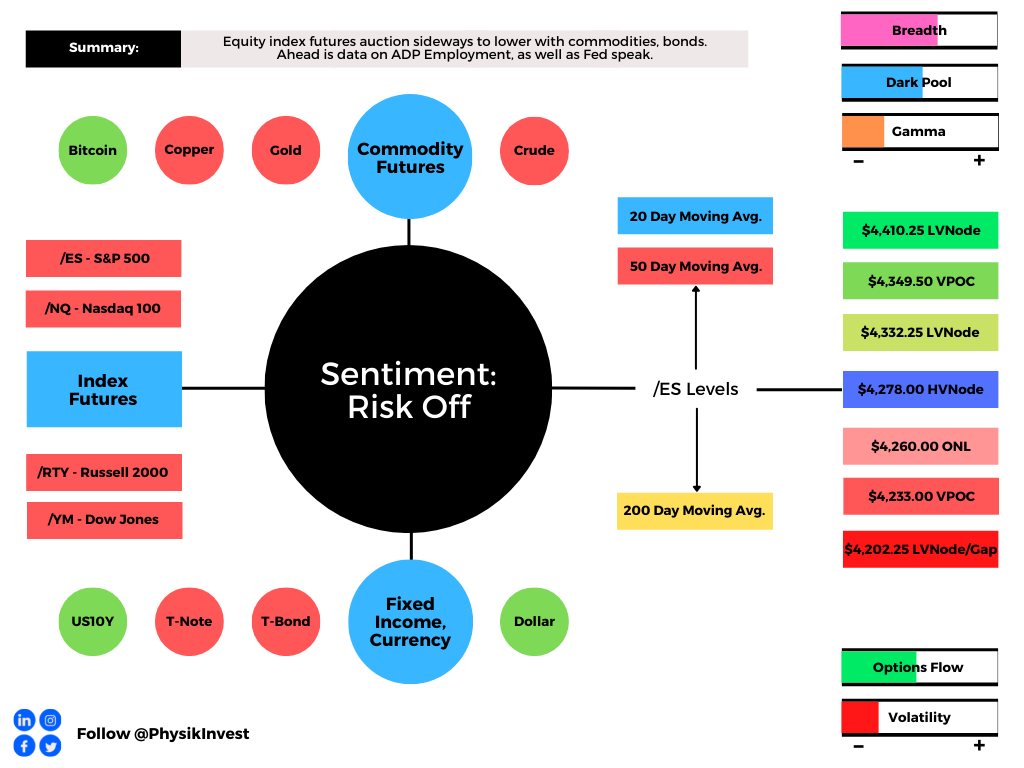
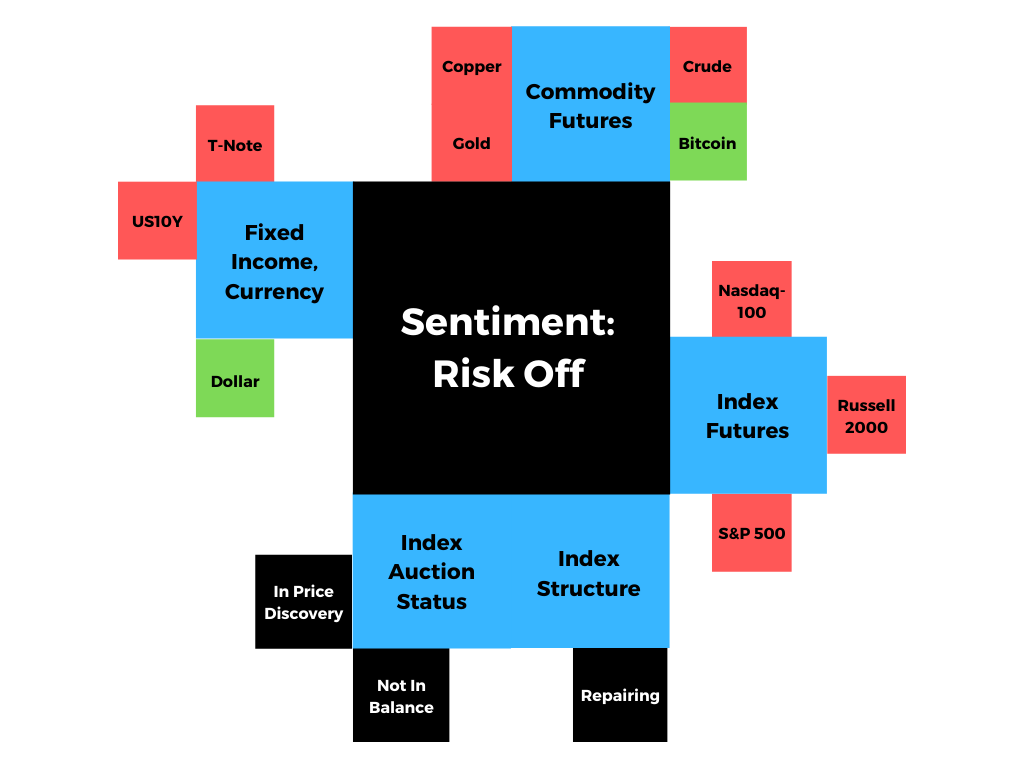
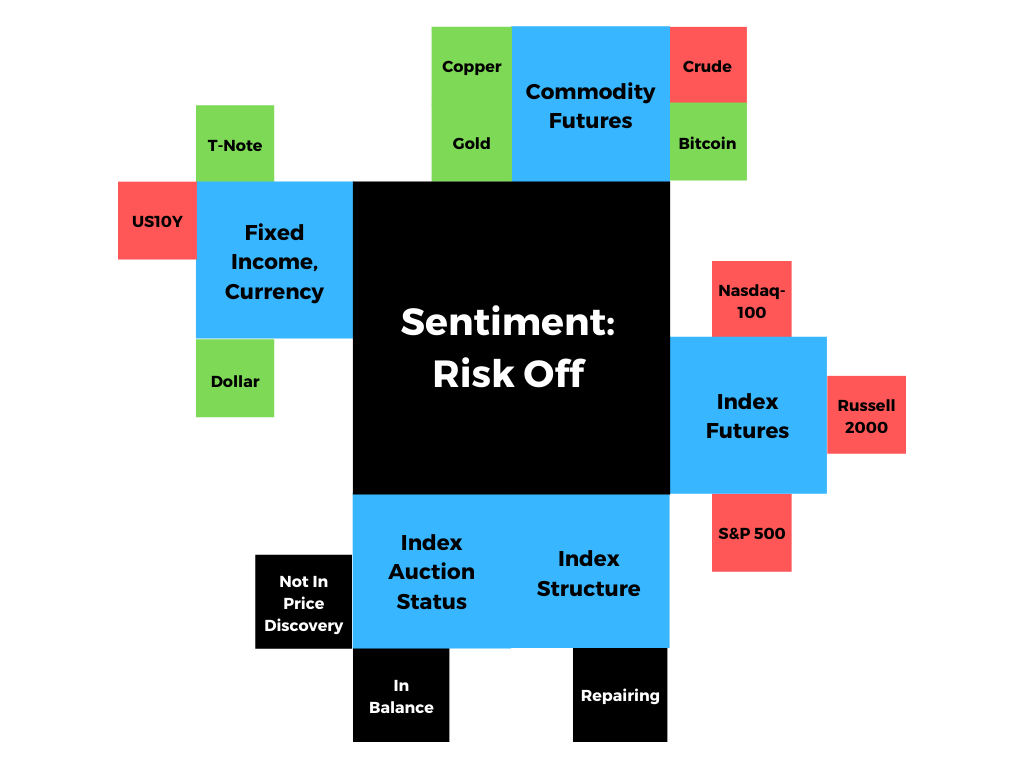
Graphic updated 6:00 AM ET. Sentiment Risk-Off if expected /ES open is below the prior day’s range. /ES levels are derived from the profile graphic at the bottom of the following section. Levels may have changed since initially quoted; click here for the latest levels. SqueezeMetrics Dark Pool Index (DIX) and Gamma (GEX) calculations are based on where the prior day’s reading falls with respect to the MAX and MIN of all occurrences available. A higher DIX is bullish. At the same time, the lower the GEX, the more (expected) volatility. Learn the implications of volatility, direction, and moneyness. SHIFT data used for S&P 500 (INDEX: SPX) options activity. Note that options flow is sorted by the call premium spent; if more positive then more was spent on call options. Breadth reflects a reading of the prior day’s NYSE Advance/Decline indicator. VIX reflects a current reading of the CBOE Volatility Index (INDEX: VIX) from 0-100.

What To Expect

On Wednesday’s lackluster breadth and market liquidity metrics, the best case occurred. 

The S&P 500 recovered its $4,697.50 spike base, below which selling activity appeared to be the result of weaker-handed participants liquidating as a result of poor location and news.

Overnight, however, the tone shifted. The S&P 500 initiated back through its $4,647.25 high volume area (HVNode) which had corresponded with the 20-day simple moving average.

The 20-day presented participants with a clear way to measure risk, given the mechanical responses in prior trade. As explained, Wednesday, should participants manage to break past the 20-day, then conditions have changed and follow-through was likely

Reason being? Those visual levels are acted on by short-term, technically-driven participants who generally are unable to defend retests.
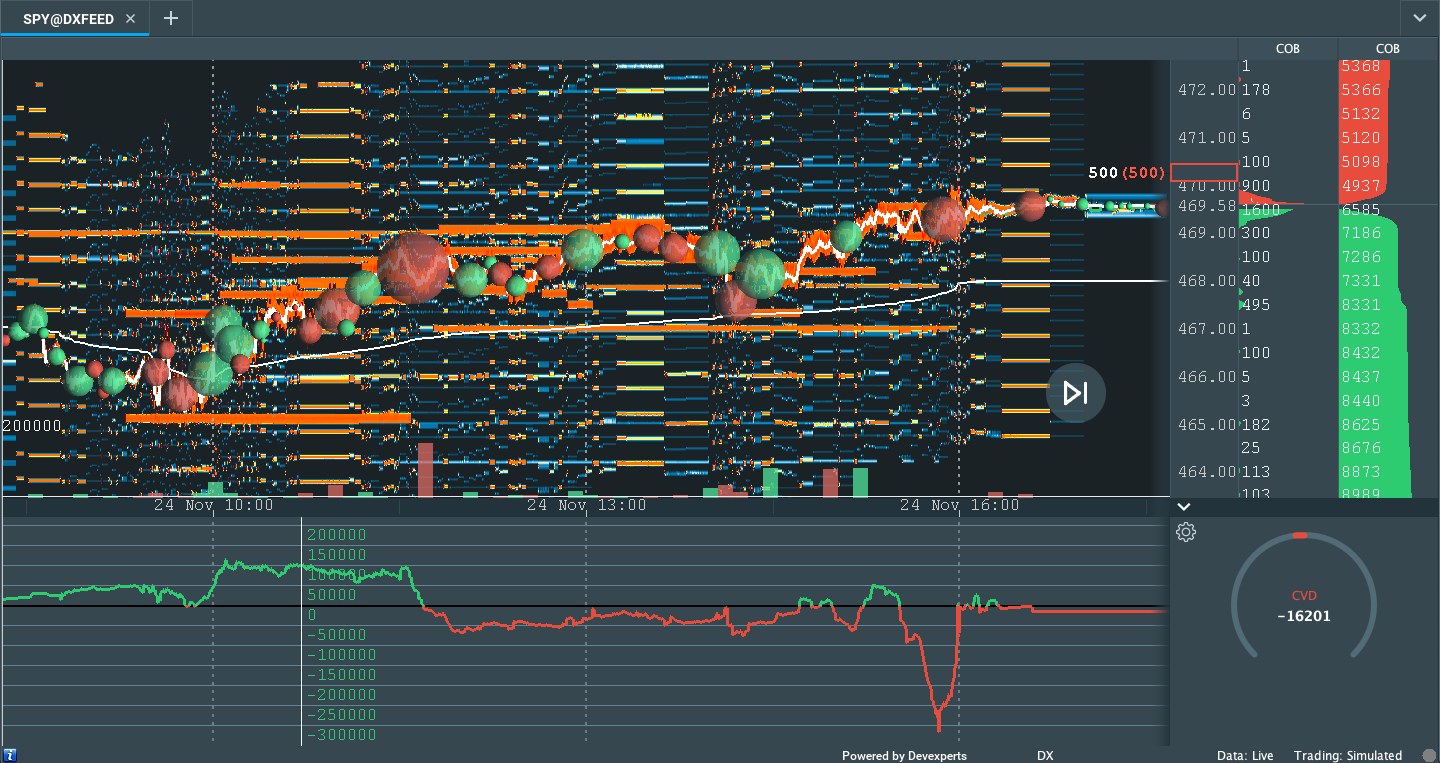
Graphic: Divergent delta (i.e., non-committed buying as measured by volume delta or buying and selling power as calculated by the difference in volume traded at the bid and offer) in SPDR S&P 500 ETF Trust (NYSE: SPY), one of the largest ETFs that track the S&P 500 index, via Bookmap. The readings were supportive of responsive trade (i.e., rotational trade that suggests current prices did not offer favorable entry and exit; the market was in balance).

Context: The aforementioned trade is happening in the context of an “insatiable appetite for stocks this year,” as Bloomberg explains

“Investors have poured almost $900 billion into equity exchange-traded and long-only funds in 2021 — exceeding the combined total from the past 19 years.”

This appetite fed into the activity of some high-flyers like Tesla Inc (NASDAQ: TSLA) with customers opting to aggressively sell puts and buy calls heading into the November monthly options expiration (OPEX).
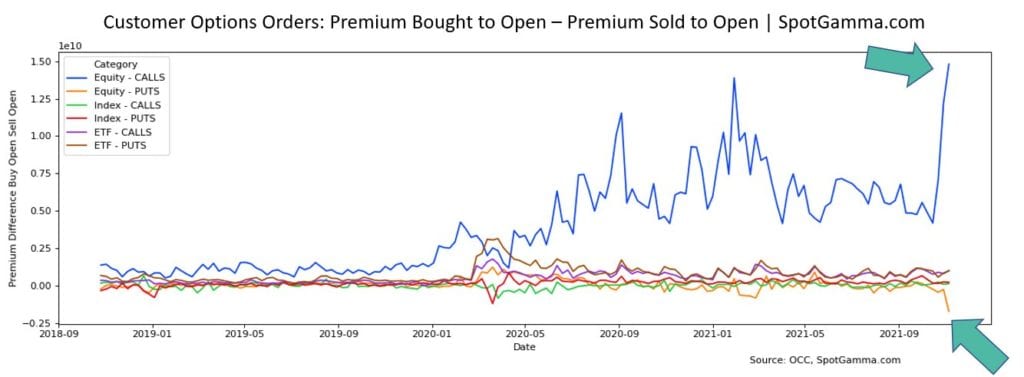
Graphic: Customers took on significant leverage in their purchase and sale of options, via SpotGamma.

Unfortunately, (1) after OPEX, the absence of sticky and supportive hedging flows freed the broader market for directional resolve, and (2) according to SpotGamma, in light of recent exuberance, “participants [were] underexposed to downside put protection.”

The implications of the latter are staggering.

In short, should volatility continue to pick up, those participants (who were once exuberant) are likely to reach for protection forcing dealers to reflexively hedge in a destabilizing manner. 

As volatility rises and customers demand protection, counterparties are to hedge by selling into weakness. The conditions worsen when much of the activity is in shorter-dated tenors where options gamma is more sensitive if we will. This is what we’re seeing.
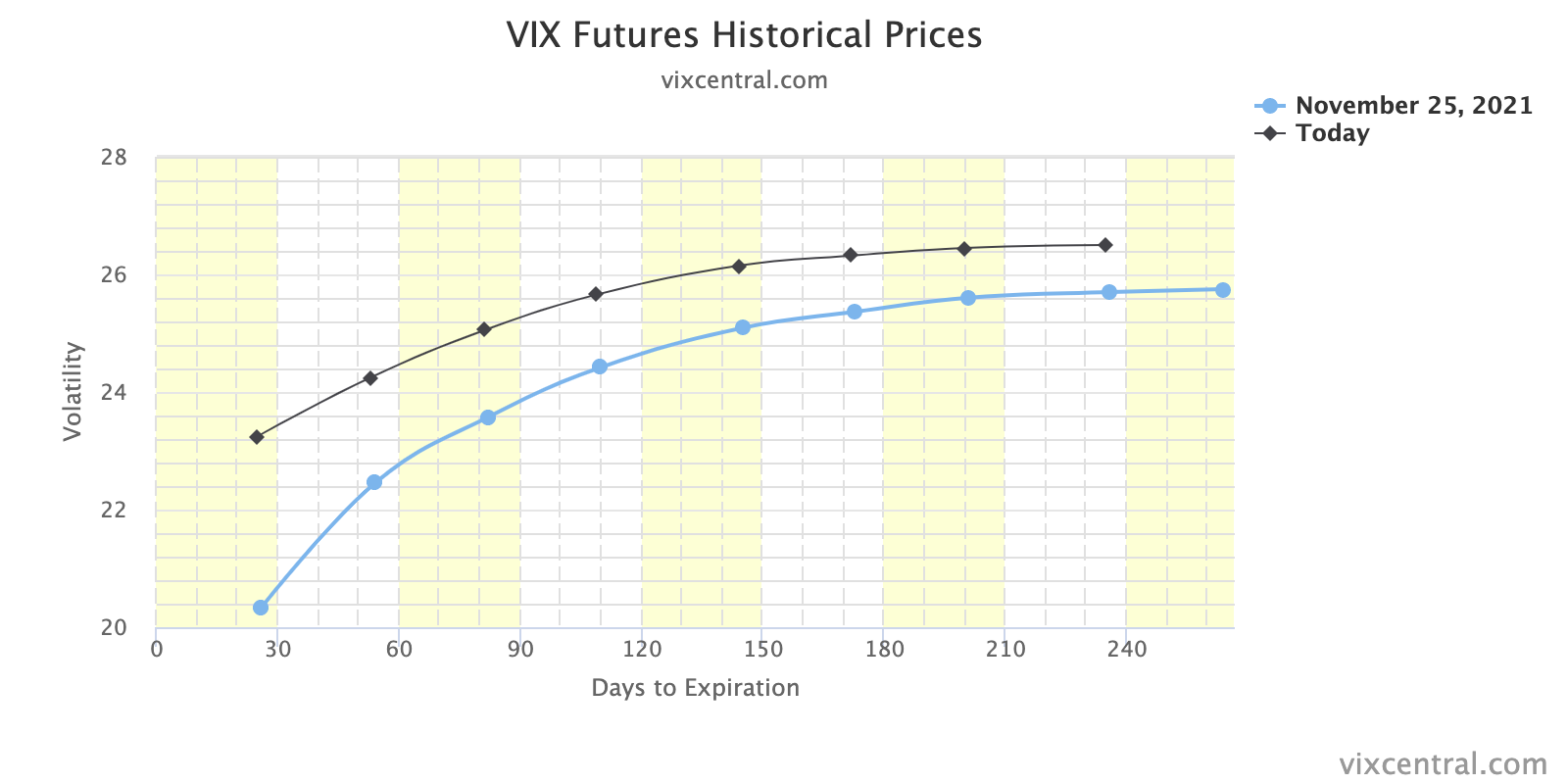
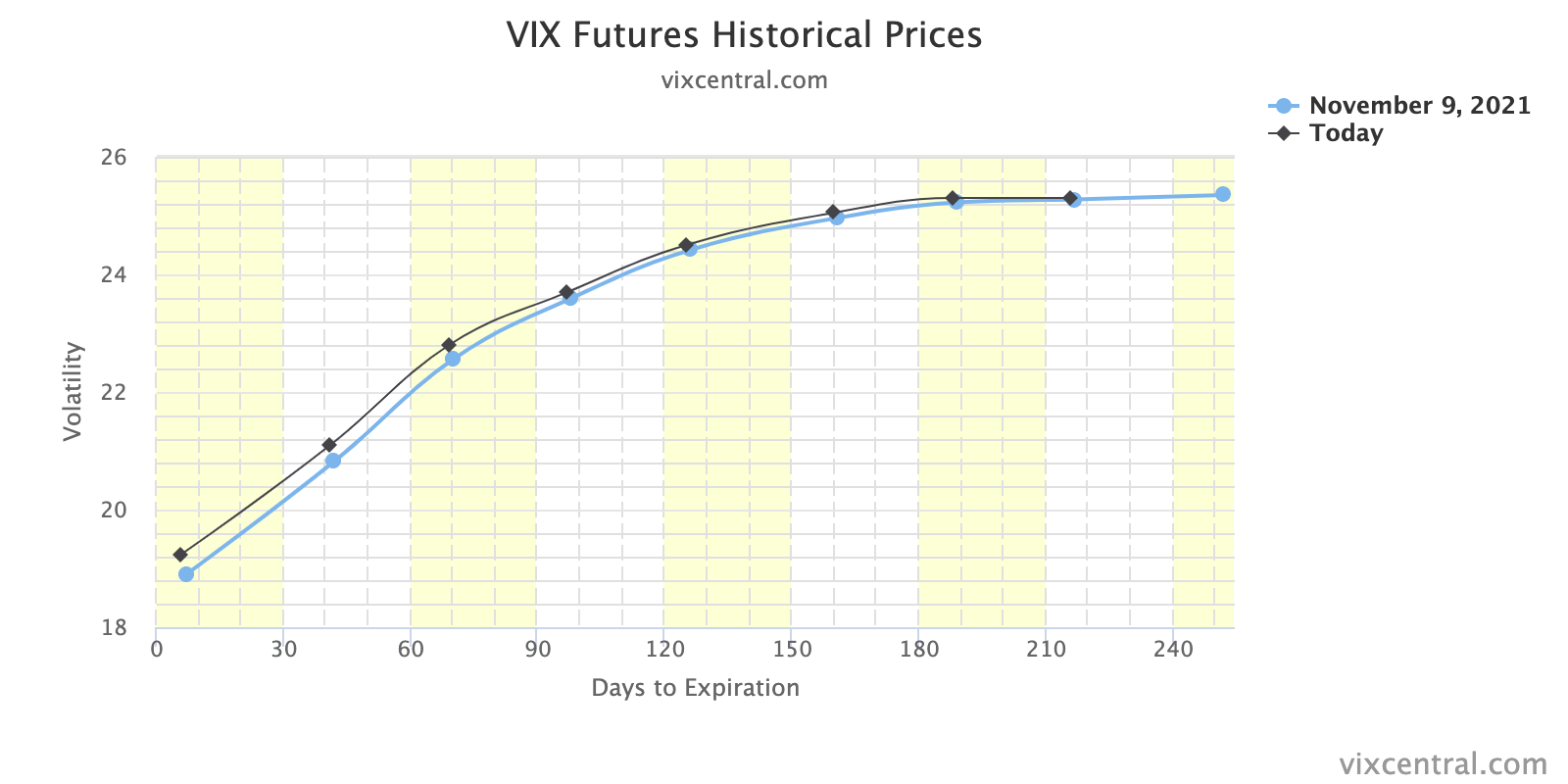
Graphic: The CBOE Volatility Index (INDEX: VIX) was higher, while demand came in most predominantly across the entire area of the VIX futures term structure. That, alongside the market’s entry into short-gamma, suggests participants’ hedging has destabilizing implications.

Note that I said short-dated

Once that exposure rolls off the table (and/or is monetized), dealers/counterparties will reverse and support the market, buying-to-close their existing stock/futures hedges to negative gamma positions. 

This flow is stabilizing and may play into a seasonally-aligned rally into Christmas.

As stated on November 23, 2021: “This last part is educated conjecture. It’s what I also feel as though would frustrate the most amount of participants. Basically, a quick wash (or sideways to lower), followed by a move higher into year-end. Be nimble and responsive!”

Expectations: As of 6:00 AM ET, Friday’s regular session (9:30 AM – 1:00 PM ET), in the S&P 500, will likely open in the lower part of a negatively skewed overnight inventory, outside of prior-range and -value, suggesting a potential for immediate directional opportunity.

Gap Scenarios Are In Play: Gaps ought to fill quickly. Should they not, that’s a signal of strength; do not fade. Leaving value behind on a gap-fill or failing to fill a gap (i.e., remaining outside of the prior session’s range) is a go-with indicator.

Auctioning and spending at least 1-hour of trade back in the prior range suggests a lack of conviction; in such a case, do not follow the direction of the most recent initiative activity.

In the best case, the S&P 500 trades sideways or higher; activity above the $4,618.75 high volume area (HVNode) puts in play the $4,647.25 HVNode. Initiative trade beyond the latter HVNode could reach as high as the $4,674.25 micro composite point of control (MCPOC) and $4,691.25 HVNode, or higher.

In the worst case, the S&P 500 trades lower; activity below the $4,618.75 HVNode puts in play the $4,596.75 overnight low (ONL) and $4,590.00 balance boundary (BAH). Initiative trade beyond the BAH could reach as low as the $4,574.25 HVNode and $4,551.75 LVNode, or lower.

Click here to load today’s updated key levels into the web-based TradingView charting platform. Note that all levels are derived using the 65-minute timeframe. New links are produced, daily.
Graphic: 65-minute profile chart of the Micro E-mini S&P 500 Futures. Learn about the profile.

Charts To Watch

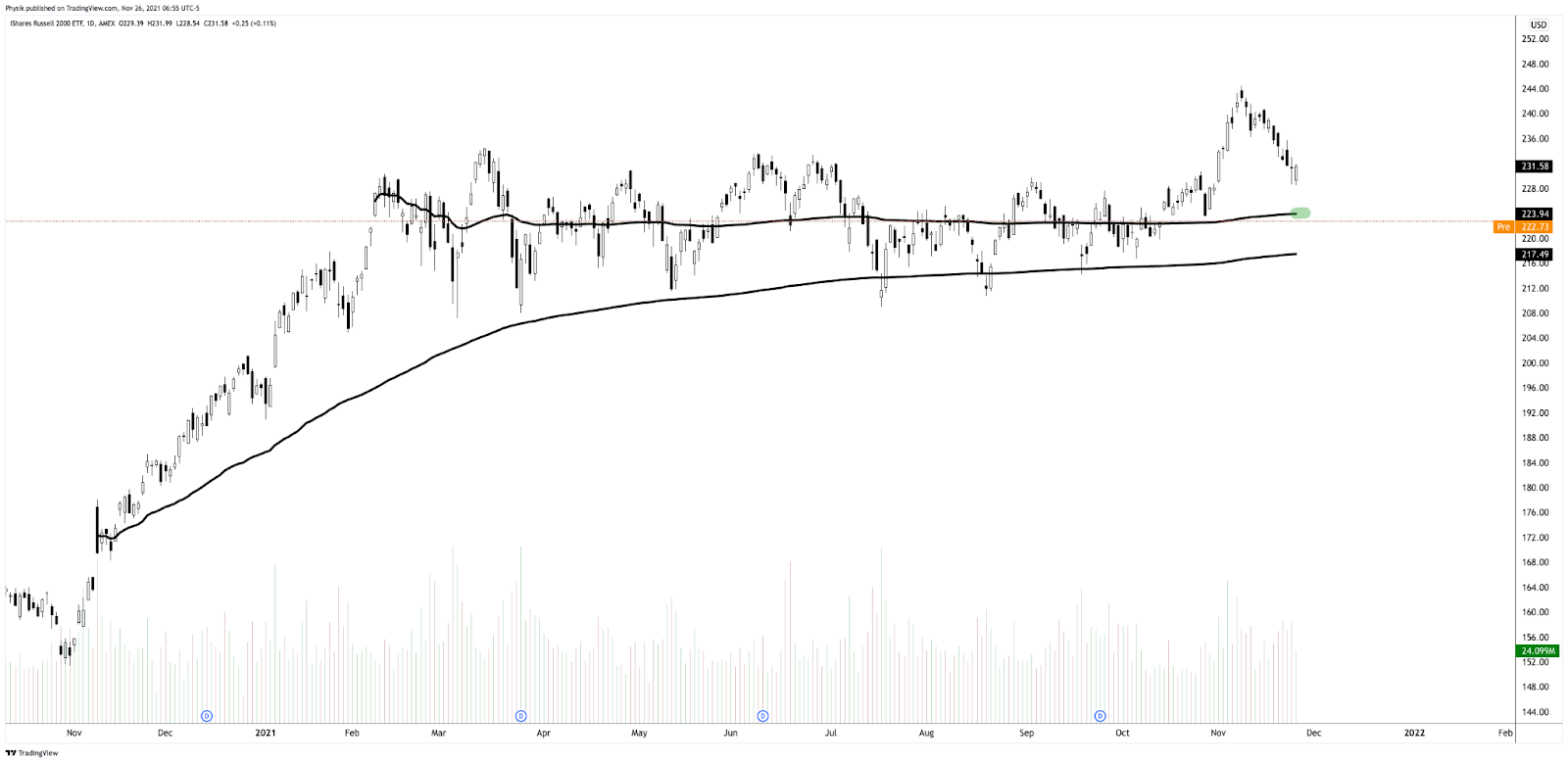
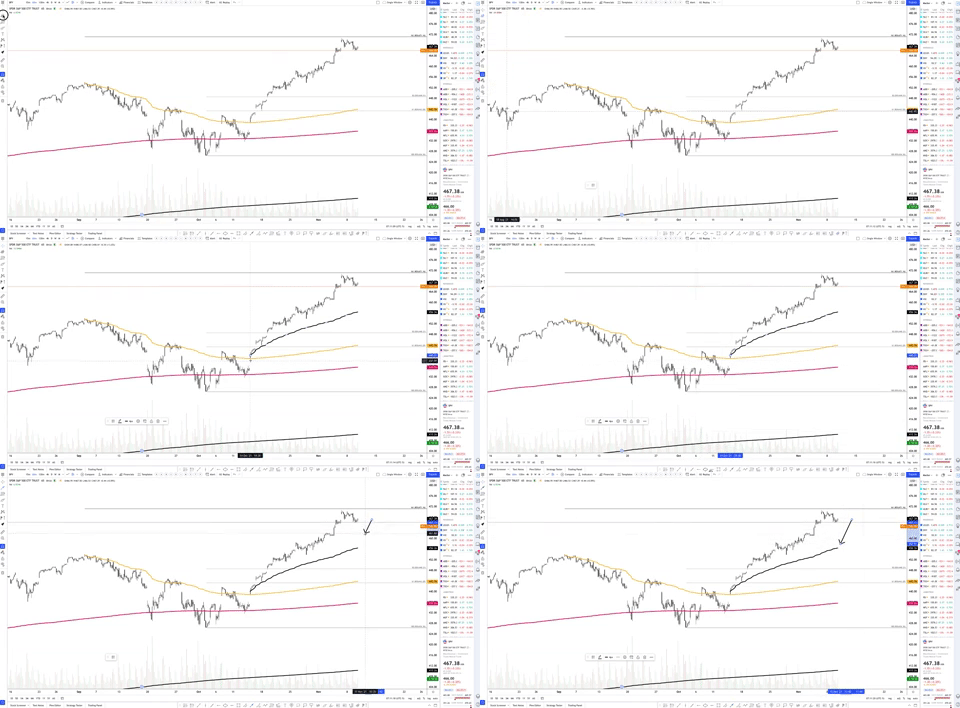
Graphic: (ETF: IWM). (Key VWAP support at ~$223)
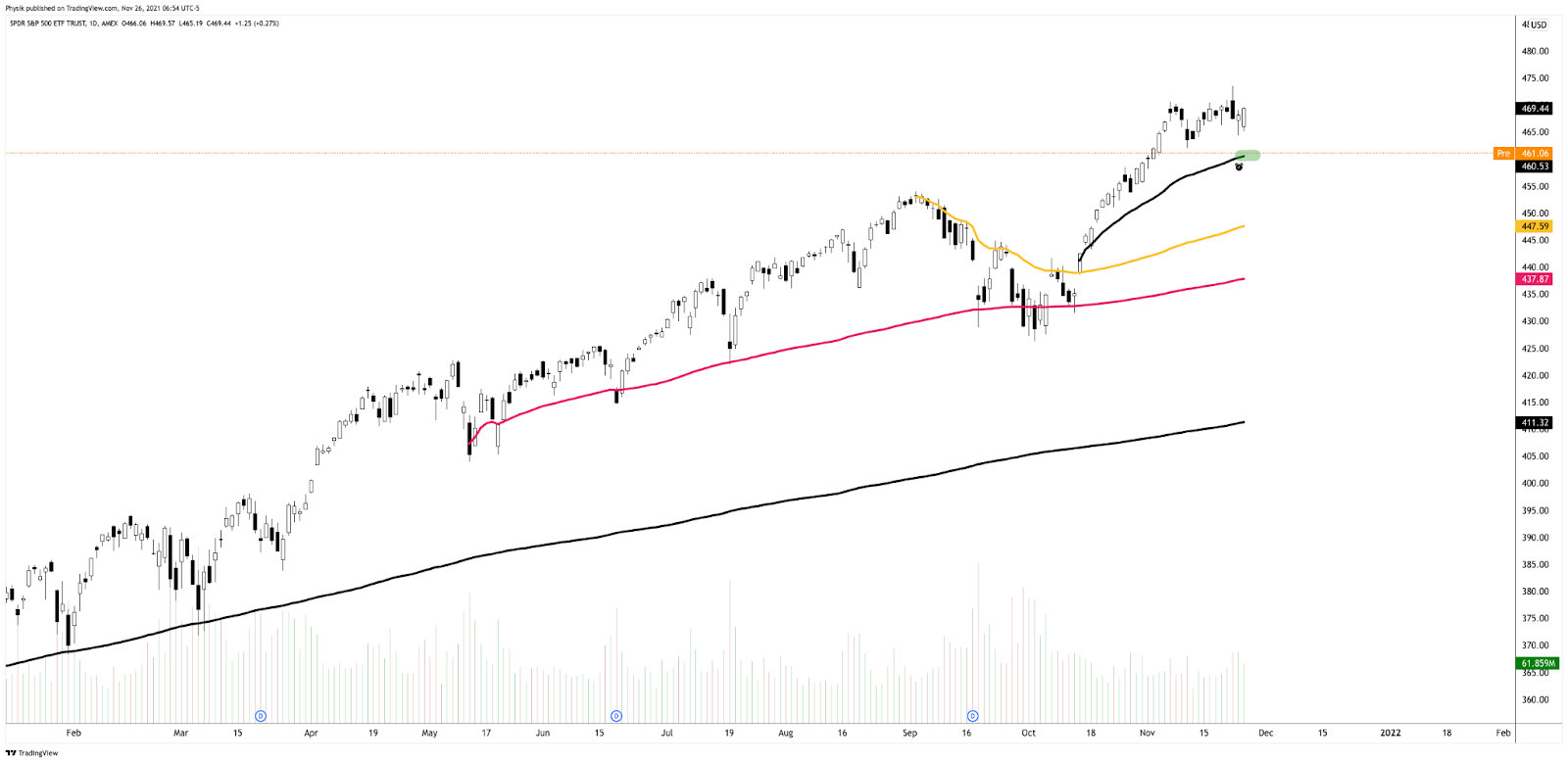
Graphic: (ETF: SPY). (Key VWAP support at ~$460)
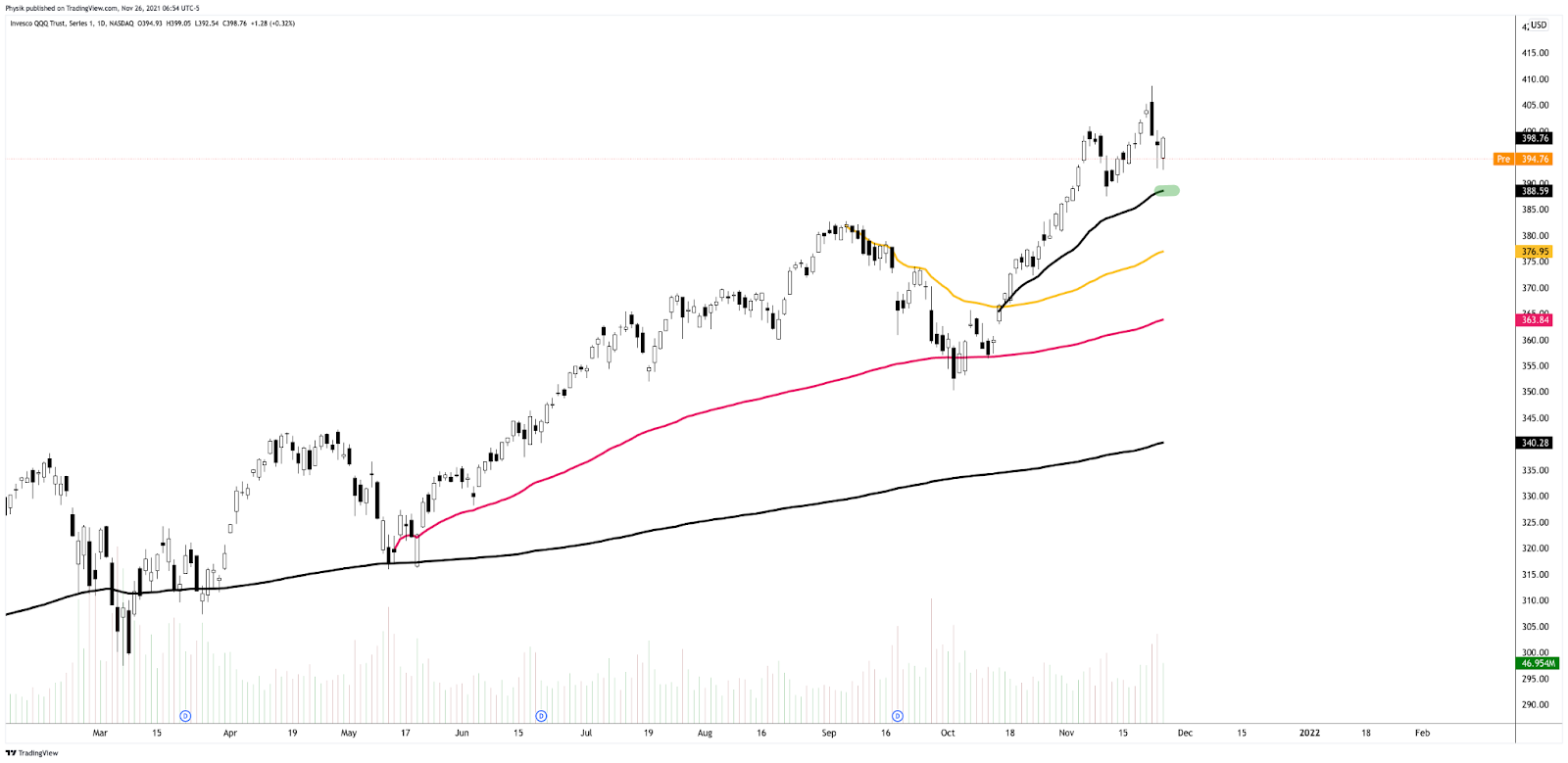
Graphic: (ETF: QQQ). (Key VWAP support at ~$388)

What People Are Saying

Definitions

Spikes: Spike’s mark the beginning of a break from value. Spikes higher (lower) are validated by trade at or above (below) the spike base (i.e., the origin of the spike).

Overnight Rally Highs (Lows): Typically, there is a low historical probability associated with overnight rally-highs (lows) ending the upside (downside) discovery process.

Volume Areas: A structurally sound market will build on areas of high volume (HVNodes). Should the market trend for long periods of time, it will lack sound structure, identified as low volume areas (LVNodes). LVNodes denote directional conviction and ought to offer support on any test. 

If participants were to auction and find acceptance into areas of prior low volume (LVNodes), then future discovery ought to be volatile and quick as participants look to HVNodes for favorable entry or exit.

Gamma: Gamma is the sensitivity of an option to changes in the underlying price. Dealers that take the other side of options trades hedge their exposure to risk by buying and selling the underlying. When dealers are short-gamma, they hedge by buying into strength and selling into weakness. When dealers are long-gamma, they hedge by selling into strength and buying into weakness. The former exacerbates volatility. The latter calms volatility.

MCPOCs: POCs are valuable as they denote areas where two-sided trade was most prevalent over numerous day sessions. Participants will respond to future tests of value as they offer favorable entry and exit.

Options Expiration (OPEX): Traditionally, option expiries mark an end to pinning (i.e, the theory that market makers and institutions short options move stocks to the point where the greatest dollar value of contracts will expire) and the reduction dealer gamma exposure.

Volume-Weighted Average Prices (VWAPs): A metric highly regarded by chief investment officers, among other participants, for quality of trade. Additionally, liquidity algorithms are benchmarked and programmed to buy and sell around VWAPs.

About

After years of self-education, strategy development, and trial-and-error, Renato Leonard Capelj began trading full-time and founded Physik Invest to detail his methods, research, and performance in the markets.

Additionally, Capelj is a Benzinga finance and technology reporter interviewing the likes of Shark Tank’s Kevin O’Leary, JC2 Ventures’ John Chambers, and ARK Invest’s Catherine Wood, as well as a SpotGamma contributor, developing insights around impactful options market dynamics.

Disclaimer

At this time, Physik Invest does not manage outside capital and is not licensed. In no way should the materials herein be construed as advice. Derivatives carry a substantial risk of loss. All content is for informational purposes only.

Categories
Commentary

Daily Brief For November 10, 2021

What Happened

Equity index futures sideways, overnight, on powerful derivative market forces, alongside participants’ aims to base ahead of added clarity on the economic outlook.

Ahead is data on inflation and jobless claims (8:30 AM ET), wholesale inventories (10:00 AM ET), and the monthly budget statement (2:00 PM ET).

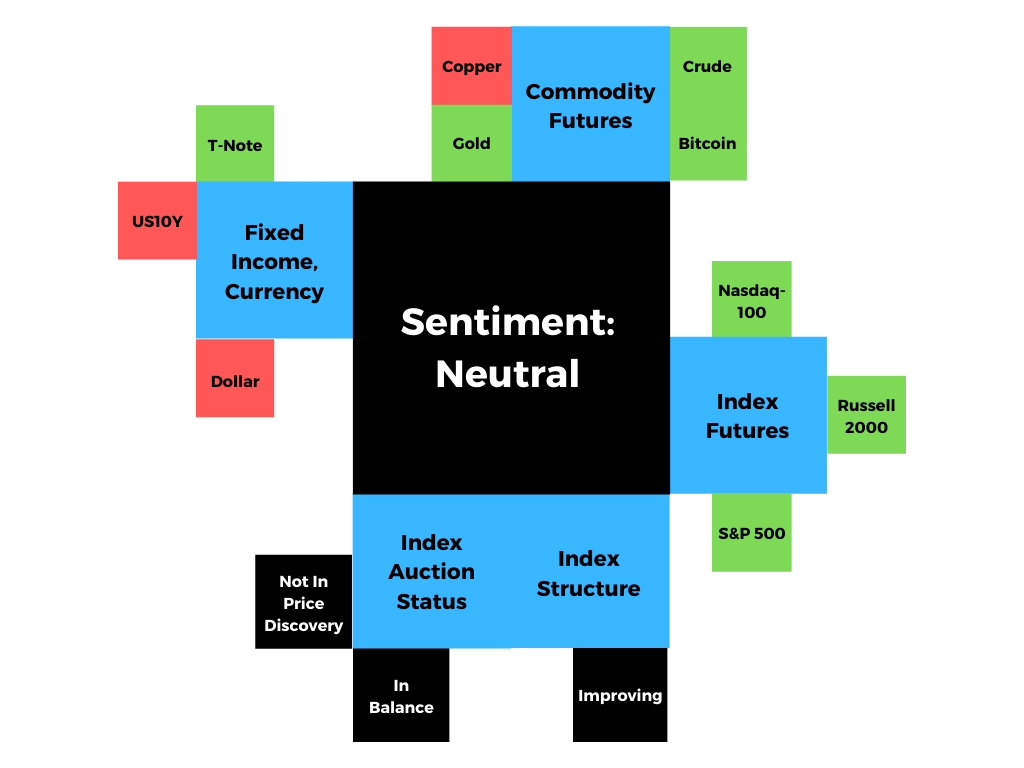
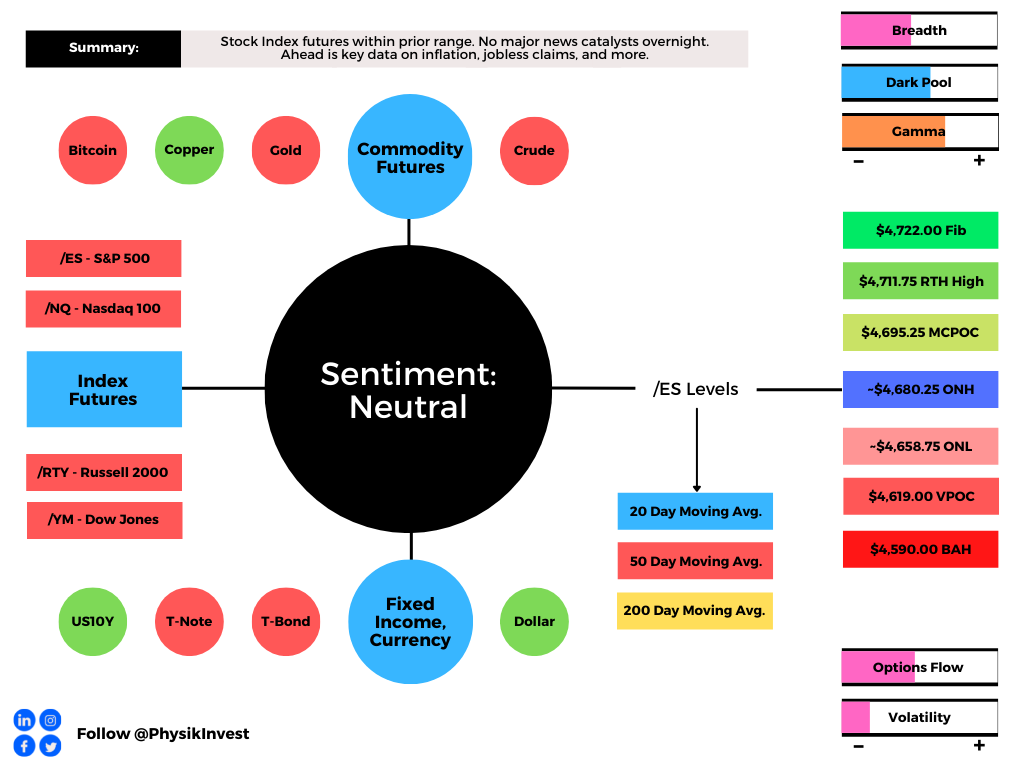
Graphic updated 5:30 AM ET. Sentiment Neutral if expected /ES open is inside of the prior day’s range. /ES levels are derived from the profile graphic at the bottom of the following section. Levels may have changed since initially quoted; click here for the latest levels. SqueezeMetrics Dark Pool Index (DIX) and Gamma (GEX) calculations are based on where the prior day’s reading falls with respect to the MAX and MIN of all occurrences available. A higher DIX is bullish. At the same time, the lower the GEX, the more (expected) volatility. Learn the implications of volatility, direction, and moneyness. SHIFT data used for S&P 500 (INDEX: SPX) options activity. Note that options flow is sorted by the call premium spent; if more positive then more was spent on call options. Breadth reflects a reading of the prior day’s NYSE Advance/Decline indicator. VIX reflects a current reading of the CBOE Volatility Index (INDEX: VIX) from 0-100.

What To Expect

As evidenced by a b-shaped liquidation break profile distribution (i.e., morning drop on fast tempo, followed by sideways trade) there was likely selling by short-term momentum-driven participants who had poor location.

We are confident this may be the case given where the price is, relative to the volume-weighted average price (VWAP) anchored from the Federal Open Market Committee (FOMC) announcement, last week; the average buyer, since then, is losing.

To note, given the context – lackluster breadth and market liquidity metrics – the failure to expand the range, markedly, suggests there was no new money selling.

This activity, which marks a potential willingness to clear stubborn inventory and break balance, is occurring in the face of poor structure down below, a dynamic that adds to technical instability.

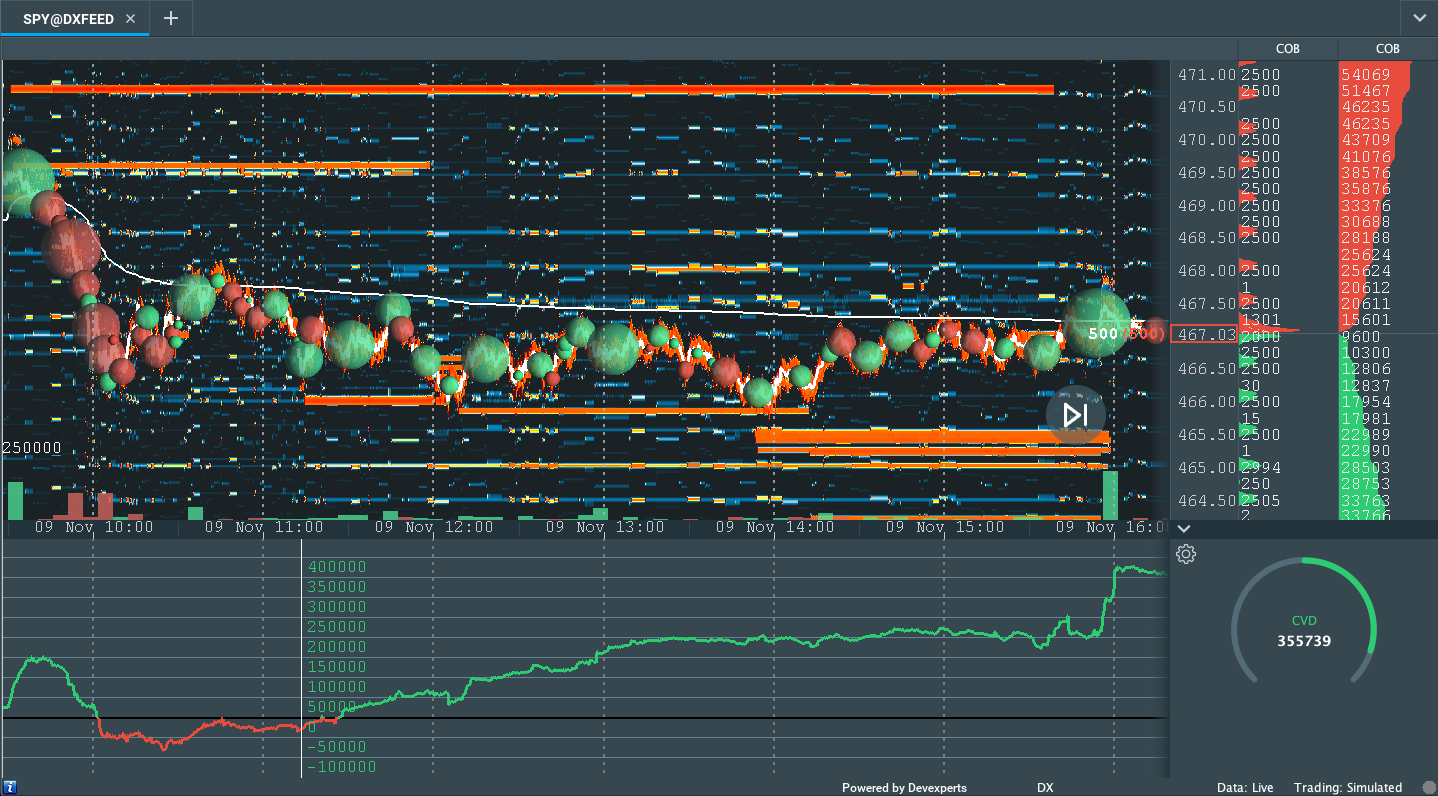
Graphic: Divergent delta (i.e., non-committed selling as measured by volume delta or buying and selling power as calculated by the difference in volume traded at the bid and offer) in SPDR S&P 500 ETF Trust (NYSE: SPY), one of the largest ETFs that track the S&P 500 index, via Bookmap. The readings are supportive of responsive trade (i.e., rotational trade that suggests current prices offer favorable entry and exit; the market is in balance).

Context: Yesterday, I made an emphasis on some of the “high leverage and risk” short-term speculators’ record call buying and put selling posed on the equity market, at large.

That’s odd. Why? 

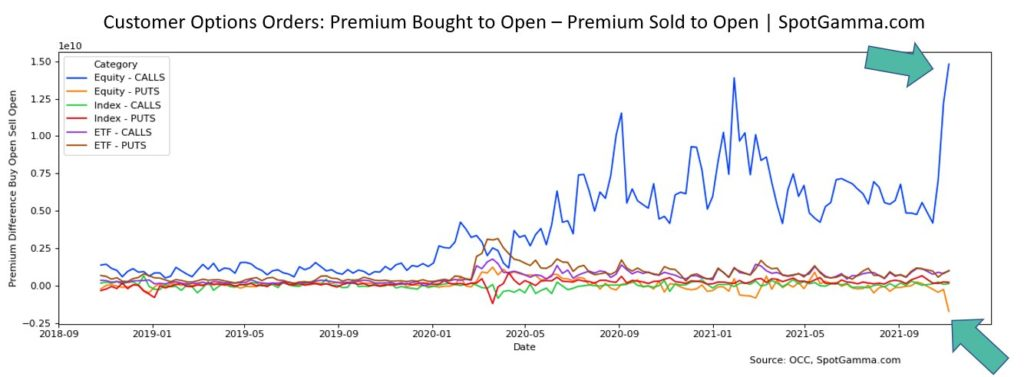
Well, into the near-vertical price rise of highly volatile stocks like Tesla Inc (NASDAQ: TSLA), customers (you and I) signed up, through the agency of counterparties, to add liquidity to the market, via options activity.

Graphic: Customers took on significant leverage in their purchase and sale of options, via SpotGamma.

So long as implied volatility remained bid (and stock prices go to the moon) – the effect of inadequate liquidity – counterparties were to exacerbate upside volatility in hedging their exposure to customer positioning. In other words, dealer short-gamma.

Note those participants that take the other side of options trades will hedge their exposure to risk by buying and selling the underlying. 

When dealers are short-gamma (e.g., Tesla), they buy into strength and sell into weakness, exacerbating volatility

When dealers are long-gamma (e.g., S&P 500), counterparties buy into weakness and sell into strength, calming volatility.

Enter shock – Elon Musk selling Tesla stock – alongside a decline in implied volatility, amidst a build of gamma at higher stock prices (which has the effect of dampening realized volatility), we saw the unthinkable happen; high-flying stocks (more so Tesla, which is a large S&P 500 index constituent) turned away from the moon and headed back to earth.

The implications of this were staggering; the bulk of customers’ short puts (long calls) quickly rose (declined) in value and traded in-the-money (out-of-the-money). 

As SpotGamma noted, yesterday, “[t]here was a serious dearth of liquidity to start today’s session,” and volatility rose, as a result, in compensating for that fact.

Now, if customer short put, counterparty long put. 

To hedge, counterparty ought to buy, right? Nope

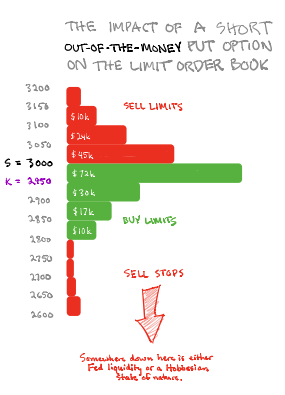
As SqueezeMetrics explains, “Sold puts are, quite literally, a bunch of huge buy limit orders below the market, and then a bunch of liquidity-taking stop-losses further down.”

Graphic: SqueezeMetrics unpacks implications of short put options on the limit order book.

This is, to put it simply, due in part to short-term speculators lacking the wherewithal to stay in these margin-intensive positions; as price falls, put buying (covering of shorts, too) takes liquidity and destabilizes the market.

We’re starting to see this activity, in individual stocks, affect the S&P 500 complex, too

The CBOE Volatility Index (INDEX: VIX) was higher, with demand coming in across the front area of the VIX futures term structure, mostly; both suggest a demand for hedges and a reduction in the flows (e.g., vanna) that support sideways to higher trade. 

Graphic: Demand for options hedges comes in at the front end of the term structure.

That has already been reflected by the trend of outperformance in the extended day. 

In other words, the front-running of increasingly impactful (and supportive) vanna and charm flows (both of which are tied to the hedging of options exposure), as a result of increased options activity (which, at least at this juncture, exposes customers to high leverage and risk), seems to be changing, slowly. 

We’re (likely) opening sideways to lower today. That’s a change, for once!

With expectations that there may be a front-running of the monthly (OPEX) options expiration (into which the forces that promote pining usually turn stronger with counterparties supplying more liquidity as their long gamma rises), a time when dealer gamma exposure is to decline, allowing for increased realized volatility (as a result of less liquidity), the added demand for hedges (as evidenced by the bid in volatility and VIX term structure shift), is of concern. 

Participants have been uber bullish, up until early this week. Should sentiment turn, and (1) those participants cover their levered, long delta exposure alongside (2) new money hedging, tempo ought to quicken; an abrupt liquidation could be in the cards.

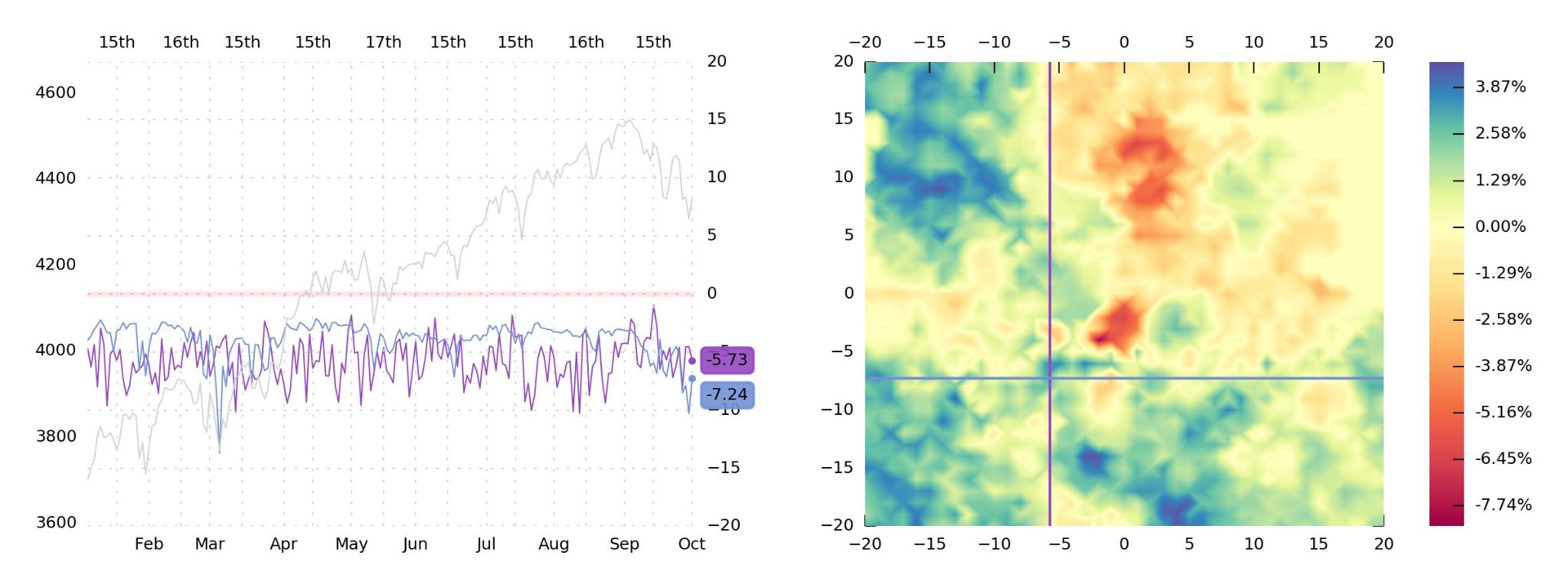
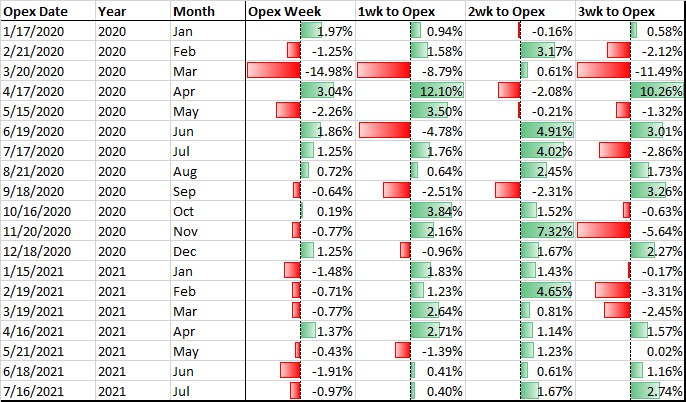
Graphic: @pat_hennessy breaks down returns for the S&P 500, categorized by the week relative to OPEX. 

In light of seasonality, buybacks, and earnings surprises, the potential for a rally into the end of the year remains strong. As a result, we start to look for big picture references where we may see responsive buying. See the graphic below!

Expectations: As of 5:30 AM ET, Wednesday’s regular session (9:30 AM – 4:00 PM ET), in the S&P 500, will likely open in the middle part of a balanced overnight inventory, inside of prior-range and -value, suggesting a limited potential for immediate directional opportunity.

Balance Scenarios: Modus operandi is responsive trade (i.e., fade the edges), rather than initiative trade (i.e., play the break).

In the best case, the S&P 500 trades sideways or higher; activity above the $4,680.25 overnight high (ONH) puts in play the $4,695.25 micro composite point of control (MCPOC). Initiative trade beyond the MCPOC could reach as high as the $4,711.75 regular trade high and $4,722.00 Fibonacci, or higher.

In the worst case, the S&P 500 trades lower; activity below the $4,680.25 ONH puts in play the $4,658.75 overnight low (ONL). Initiative trade beyond the ONL could reach as low as the $4,619.00 untested point of control (VPOC) and $4,590.00 balance area boundary, or lower.

Click here to load today’s updated key levels into the web-based TradingView charting platform. Note that all levels are derived using the 65-minute timeframe. New links are produced, daily.
Graphic: 65-minute profile chart of the Micro E-mini S&P 500 Futures. Note the low-volume structure beneath current prices. There is the potential for a cave-fill to widen the area deemed favorable to transact at by an increased share of participants. Learn about the profile.

Definitions

Overnight Rally Highs (Lows): Typically, there is a low historical probability associated with overnight rally-highs (lows) ending the upside (downside) discovery process.

Volume Areas: A structurally sound market will build on areas of high volume (HVNodes). Should the market trend for long periods of time, it will lack sound structure, identified as low volume areas (LVNodes). LVNodes denote directional conviction and ought to offer support on any test. 

If participants were to auction and find acceptance into areas of prior low volume (LVNodes), then future discovery ought to be volatile and quick as participants look to HVNodes for favorable entry or exit.

Vanna: The rate at which the delta of an option changes with respect to volatility.

Charm: The rate at which the delta of an option changes with respect to time.

POCs: POCs are valuable as they denote areas where two-sided trade was most prevalent in a prior day session. Participants will respond to future tests of value as they offer favorable entry and exit.

MCPOCs: POCs are valuable as they denote areas where two-sided trade was most prevalent over numerous day sessions. Participants will respond to future tests of value as they offer favorable entry and exit.

About

After years of self-education, strategy development, and trial-and-error, Renato Leonard Capelj began trading full-time and founded Physik Invest to detail his methods, research, and performance in the markets.

Additionally, Capelj is a Benzinga finance and technology reporter interviewing the likes of Shark Tank’s Kevin O’Leary, JC2 Ventures’ John Chambers, and ARK Invest’s Catherine Wood, as well as a SpotGamma contributor, developing insights around impactful options market dynamics.

Disclaimer

At this time, Physik Invest does not manage outside capital and is not licensed. In no way should the materials herein be construed as advice. Derivatives carry a substantial risk of loss. All content is for informational purposes only.
Categories
Commentary

Daily Brief For October 6, 2021

Market Commentary

Equity index futures, commodities, and bonds trade sideways to lower.

  • Fed action, debt ceiling fear mounting.
  • Ahead: ADP Employment, Fed speak.
  • Indices position for directional resolve.

What Happened: U.S. stock index futures auctioned sideways to lower overnight alongside narratives surrounding adjustments to monetary policy and debt ceiling complications.

Ahead is data on ADP employment (8:15 AM ET) and Fed speak (9:00 and 11:30 AM ET).

Graphic updated 6:30 AM ET. Sentiment Risk-Off if expected /ES open is below the prior day’s range. /ES levels are derived from the profile graphic at the bottom of the following section. SqueezeMetrics Dark Pool Index (DIX) and Gamma (GEX) calculations are based on where the prior day’s reading falls with respect to the MAX and MIN of all occurrences available. A higher DIX is bullish. At the same time, the lower the GEX, the more (expected) volatility. SHIFT data used for S&P 500 (INDEX: SPX) options activity. Note that options flow is sorted by the call premium spent; if more positive then more was spent on call options. Breadth reflects a reading of the prior day’s NYSE Advance/Decline indicator. VIX reflects a current reading of the CBOE Volatility Index (INDEX: VIX) from 0-100.

What To Expect: As of 6:30 AM ET, Wednesday’s regular session (9:30 AM – 4:00 PM EST) in the S&P 500 will likely open outside of prior-range and -value, suggesting an increased potential for immediate directional opportunity.

Adding, during the prior day’s regular trade, on positive albeit weak intraday breadth and divergent market liquidity metrics, the best case outcome occurred, evidenced by trade up to $4,358.00, the level of a key anchored volume-weighted average price (VWAP).

Graphic: Divergent delta (i.e., non-committed buying as measured by volume delta or buying and selling power as calculated by the difference in volume traded at the bid and offer) in SPDR S&P 500 ETF Trust (NYSE: SPY), one of the largest ETFs that track the S&P 500 index, via Bookmap. The readings are supportive of responsive trade or balance (i.e., rotational trade that suggests current prices offer favorable entry and exit).

Thereafter, equity index futures, led by the Nasdaq 100 and Russell 2000, liquidated overnight, leaving behind Tuesday’s prominent point of control (POC) before finding responsive buyers at a key high volume area (HVNode) for this most recent developing balance area (between the $4,363.25 and $4,278.00 HVNodes).

This trade is significant because it marks acceptance, or a willingness to transact at lower prices. We’re carrying forward, though, the presence of poor structures (e.g., Friday’s advance away from session value on a taper of volume, and a minimal excess low, suggests a lack of commitment to take prices lower).

Given the overnight gap inside of balance, the following scenarios apply.

Balance-Break Scenarios: A change in the market (i.e., the transition from two-time frame trade, or balance, to one-time frame trade, or trend) may occur.

Monitor for acceptance (i.e., more than 1-hour of trade) outside of the balance area. Rejection (i.e., return inside of balance) portends a move to the opposite end of the balance.

Further, the aforementioned trade is happening in the context of a traditionally volatile October, as well as narratives surrounding adjustments to monetary policy and debt ceiling complications.

Despite these themes supporting fear and uncertainty, Marko Kolanovic, JPMorgan’s chief global markets strategist, said the following in a note Monday: “We do not believe the recent bout of de-risking will lead to sustained falls, and maintain the stance to keep buying into any weakness.”

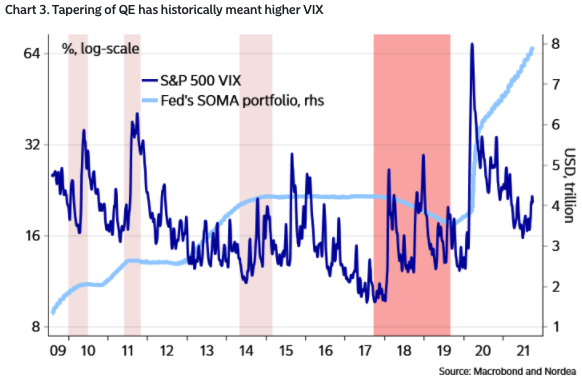
On the other hand, in support of continued volatility, Nordea believes there are “4 macro reasons why 2022 should be noisier than 2021: liquidity, growth slowdown, cost/margin problems and the risk of the Fed put looking very different if inflation indicators stay elevated.”

Graphic: According to Nordea, “The Fed is also quickly moving closer to a tapering decision, which now sounds almost as a done deal for November. The previous three episodes of QE tapering have all gone hand in hand with rising volatility. Our scenario with Fed rate hikes in the second half of 2022 would add to those volatility risks.”

Prior to yesterday’s advance, this newsletter noted that indices were best positioned for a vicious rebound as near-term downside discovery metrics likely reached a limit

Graphic: ​​On October 5, 2021, according to SqueezeMetrics, “Net Put Delta (NPD) and the customer Vanna-Gamma Ratio (VGR) [] settled in a *bullish* place. Risk to the upside.”

The overnight liquidation challenges that thesis, putting indexes in a peculiar position; it’s likely that participants are seeking more information to base a directional move.

Moreover, for today, participants may make use of the following frameworks.

In the best case, the S&P 500 trades sideways or higher; activity above the $4,278.00 HVNode puts in play the $4,332.25 low volume area (LVNode). Initiative trade beyond the LVNode could reach as high as $4,349.00 untested POC (VPOC) and $4,410.25 LVNode, or higher.

In the worst case, the S&P 500 trades lower; activity below the $4,278.00 HVNode puts in play the $4,260.00 overnight low (ONL). Initiative trade beyond the ONL could reach as low as $4,233.00 VPOC and $4,202.25 LVNode, or lower.

Graphic: 65-minute profile chart of the Micro E-mini S&P 500 Futures updated 6:30 AM ET.

Definitions

Overnight Rally Highs (Lows): Typically, there is a low historical probability associated with overnight rally-highs (lows) ending the upside (downside) discovery process.

Volume Areas: A structurally sound market will build on areas of high volume (HVNodes). Should the market trend for long periods of time, it will lack sound structure, identified as low volume areas (LVNodes). LVNodes denote directional conviction and ought to offer support on any test. 

If participants were to auction and find acceptance into areas of prior low volume (LVNodes), then future discovery ought to be volatile and quick as participants look to HVNodes for favorable entry or exit.

POCs: POCs are valuable as they denote areas where two-sided trade was most prevalent in a prior day session. Participants will respond to future tests of value as they offer favorable entry and exit.

Balance (Two-Timeframe Or Bracket): Rotational trade that denotes current prices offer favorable entry and exit. Balance-areas make it easy to spot a change in the market (i.e., the transition from two-time frame trade, or balance, to one-time frame trade, or trend). 

Modus operandi is responsive trade (i.e., fade the edges), rather than initiative trade (i.e., play the break).

Excess: A proper end to price discovery; the market travels too far while advertising prices. Responsive, other-timeframe (OTF) participants aggressively enter the market, leaving tails or gaps which denote unfair prices.

More On Volume-Weighted Average Prices (VWAPs): A metric highly regarded by chief investment officers, among other participants, for quality of trade. Additionally, liquidity algorithms are benchmarked and programmed to buy and sell around VWAPs.

Rates: Low rates have to potential to increase the present value of future earnings making stocks, especially those that are high growth, more attractive. To note, inflation and rates move inversely to each other. Low rates stimulate demand for loans (i.e., borrowing money is more attractive). In conjunction with the rapid recovery, lower rates solicit hawkish commentary as policymakers look to inhibit inflation.

News And Analysis

‘Volmageddon’ history as SEC greenlights leveraged VIX ETFs.

World trade rebounds at a faster clip than was initially expected.

Treasuries’ pain deepened amid the grimmest year since 2013.

European gas surges 60% in two days as EU sounds the alarm.

Unrelenting political brinkmanship edging U.S. closer to default.

What People Are Saying

About

After years of self-education, strategy development, and trial-and-error, Renato Leonard Capelj began trading full-time and founded Physik Invest to detail his methods, research, and performance in the markets. 

Additionally, Capelj is a finance and technology reporter. Some of his biggest works include interviews with leaders such as John Chambers, founder and CEO, JC2 Ventures, Kevin O’Leary, businessman and Shark Tank host, Catherine Wood, CEO and CIO, ARK Invest, among others.

Disclaimer

At this time, Physik Invest does not manage outside capital and is not licensed. In no way should the materials herein be construed as advice. Derivatives carry a substantial risk of loss. All content is for informational purposes only.
Categories
Commentary

Daily Brief For October 5, 2021

Editor’s Note: Sorry for the delay, everyone. I’m back in action, today, after traveling!

Market Commentary

Equity index futures trade higher with yields and the dollar. Commodities were mixed.

  • Positioning: Some risks weigh to the upside.
  • Ahead is data on the trade deficit, PMI, ISM.
  • Fundamental narratives are reducing clarity.

What Happened: U.S. stock index futures sideways to higher overnight alongside narratives surrounding a taper to Federal Reserve asset purchases and debt ceiling complications.

Ahead is data on the trade deficit (8:30 AM ET), Markit services PMI (9:45 AM ET), and ISM services index (10:00 AM ET).

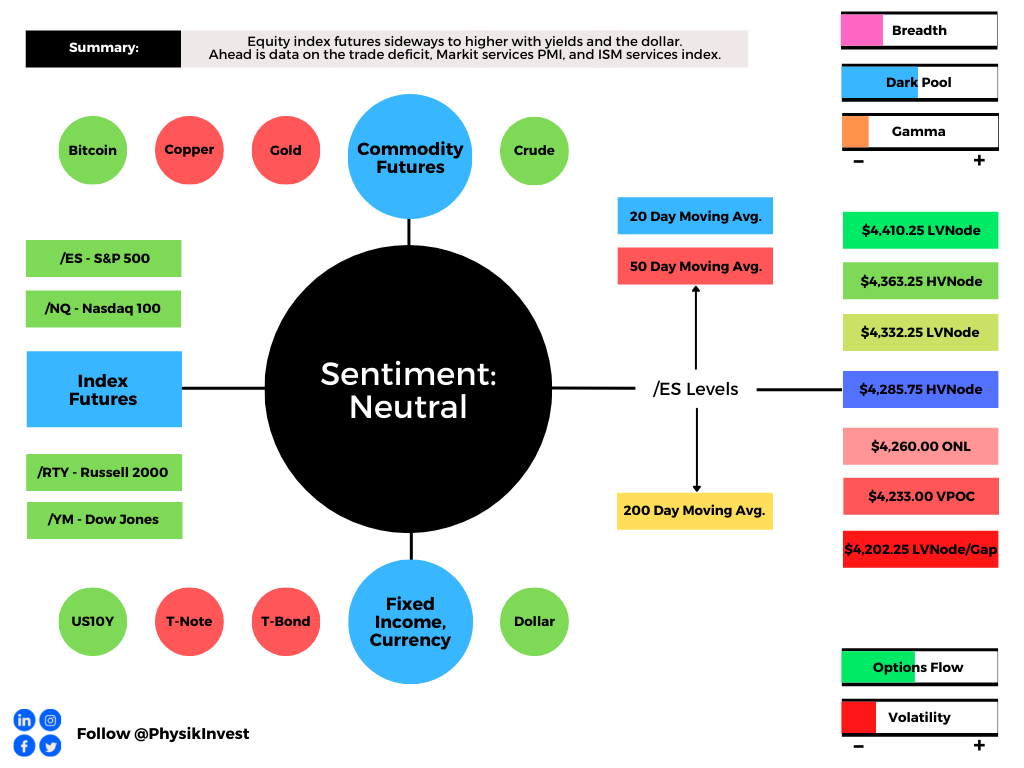
Graphic updated 7:50 AM ET. Sentiment Neutral if expected /ES open is inside of the prior day’s range. /ES levels are derived from the profile graphic at the bottom of the following section. SqueezeMetrics Dark Pool Index (DIX) and Gamma (GEX) calculations are based on where the prior day’s reading falls with respect to the MAX and MIN of all occurrences available. A higher DIX is bullish. At the same time, the lower the GEX, the more (expected) volatility. SHIFT data used for S&P 500 (INDEX: SPX) options activity. Note that options flow is sorted by the call premium spent; if more positive then more was spent on call options. Breadth reflects a reading of the prior day’s NYSE Advance/Decline indicator. VIX reflects a current reading of the CBOE Volatility Index (INDEX: VIX) from 0-100.

What To Expect: As of 7:50 AM ET, Tuesday’s regular session (9:30 AM – 4:00 PM EST) in the S&P 500 will likely open inside of prior-range and -value, suggesting a limited potential for immediate directional opportunity.

Adding, during the prior day’s regular trade, on weak intraday breadth and divergent market liquidity metrics, the worst-case outcome occurred, evidenced by a liquidation into the bulk of last Friday’s value, the area where about 70% of the volume took place. 

In the process, participants left a letter b-shaped profile which suggests participants were “too” long and had poor location; Friday’s advance away from the value area, on a taper of volume, left poor structure – lacking commitment – that gave during Monday’s move lower alongside fundamental drivers, putting in play the S&P 500’s October 1 $4,260.00 overnight low (ONL).

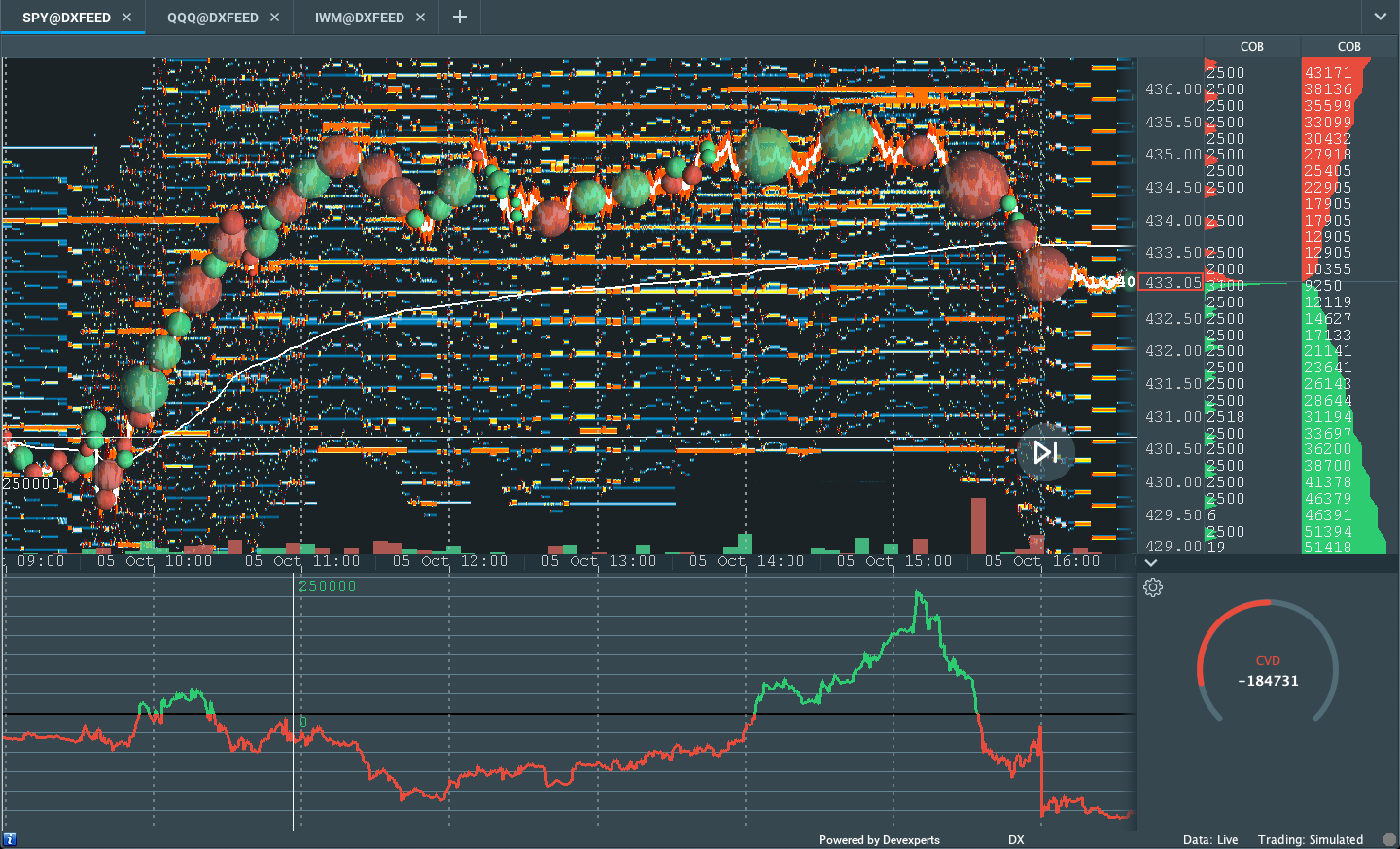
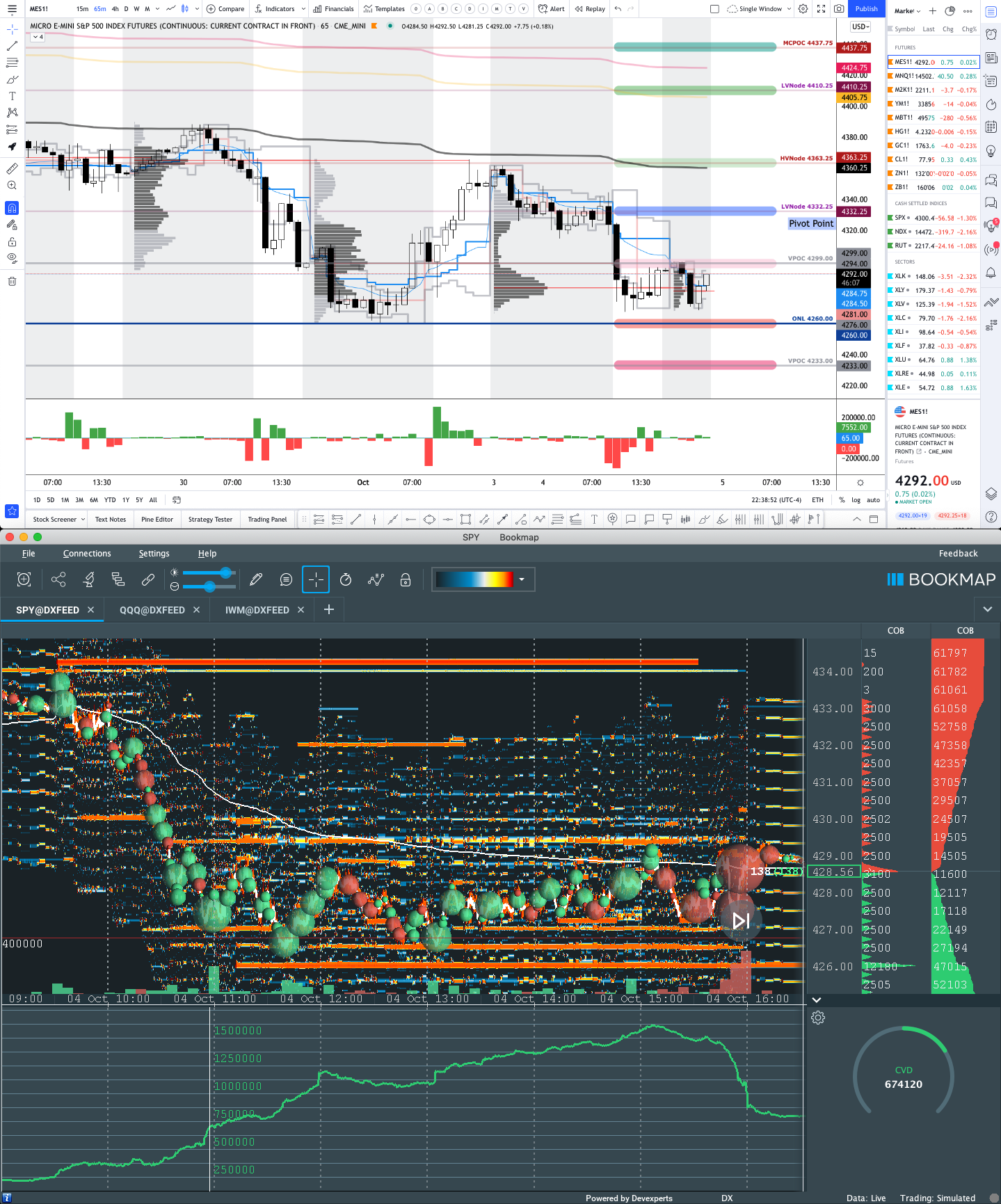
Graphic: Divergent delta (i.e., non-committed selling as measured by volume delta or buying and selling power as calculated by the difference in volume traded at the bid and offer) in SPDR S&P 500 ETF Trust (NYSE: SPY), one of the largest ETFs that track the S&P 500 index, via Bookmap. The readings are supportive of responsive trade or balance (i.e., rotational trade that suggests current prices offer favorable entry and exit).

Further, the aforementioned trade is happening in the context of a traditionally volatile October, as well as narratives surrounding a taper to Federal Reserve asset purchases and debt ceiling complications.

These themes are supportive of fear and uncertainty.

To elaborate, on one hand, according to Bloomberg, “the bond market thinks the Fed is going to make a hawkish mistake, and stamp out the life in the economy when previously there had been a belief that the Fed would be easy and let inflation move higher.”

On the other hand, in reference to default on a failure to raise or suspend the debt limit, “The consensus (from clients to whom we speak) is that it just will not happen,” Barclays Plc (NYCE: BCS) analysts explained. “But political schisms in Congress are stronger than they have been in a long time and battle lines more hardened.”

In addition, according to The Market Ear, Morgan Stanley’s (NYSE: MS) Mike Wilson sees the inability of companies to pass on pricing, margin risk related to higher wages, and a reversion to trend in goods consumption, coupled with near term risks on supply chain issues, weighing earnings into early next year.

“In short, higher real rates should mean lower equity prices. Secondarily, they may also mean value over growth even as the overall equity market goes lower. This makes for a doubly difficult investment environment given how most investors are positioned,” Wilson said in a discussion that also touched on a fraying in the buy-the-dip psychology

In opposition, JPMorgan Chase & Co (NYSE: JPM) sales believe liquidity will remain ample while a capital return and consumer balance sheet health make the recent dip a buy.

Graphic: Morgan Stanley unpacks fraying of buy-the-dip psychology, visually, via The Market Ear.

In terms of positioning, there is more risk to the upside than the downside; indices are best positioned for a vicious rebound as near-term downside discovery has likely reached a limit.

Moreover, for today, participants may make use of the following frameworks.

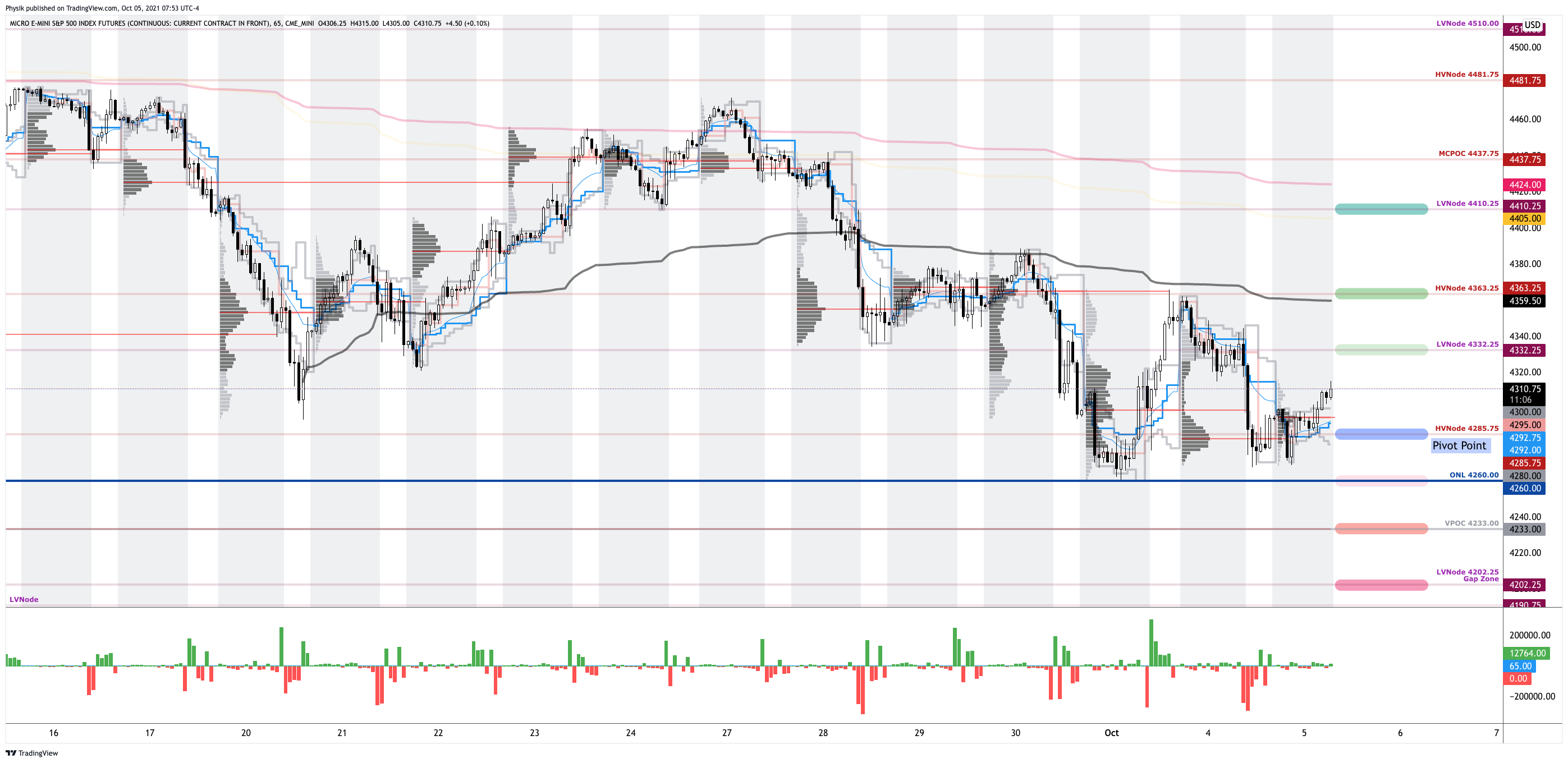
In the best case, the S&P 500 trades sideways or higher; activity above the $4,285.75 high volume area (HVNode) puts in play the $4,332.25 low volume area (LVNode). Initiative trade beyond the LVNode could reach as high as the $4,363.25 HVNode and $4,410.25 LVNode, or higher.

In the worst case, the S&P 500 trades lower; activity below the $4,285.75 HVNode puts in play the $4,260.00 overnight low (ONL). Initiative trade beyond the ONL could reach as low as the $4,233.00 VPOC and $4,202.25 gap zone, or lower.

Graphic: 65-minute profile chart of the Micro E-mini S&P 500 Futures updated 7:50 AM ET.

Definitions

Overnight Rally Highs (Lows): Typically, there is a low historical probability associated with overnight rally-highs (lows) ending the upside (downside) discovery process.

Volume Areas: A structurally sound market will build on areas of high volume (HVNodes). Should the market trend for long periods of time, it will lack sound structure, identified as low volume areas (LVNodes). LVNodes denote directional conviction and ought to offer support on any test. 

If participants were to auction and find acceptance into areas of prior low volume (LVNodes), then future discovery ought to be volatile and quick as participants look to HVNodes for favorable entry or exit.

POCs: POCs are valuable as they denote areas where two-sided trade was most prevalent in a prior day session. Participants will respond to future tests of value as they offer favorable entry and exit.

News And Analysis

Stagflation fear is having a British renaissance.

Global energy crisis is first of many in transition.

Buy the dip has failed. Here’s what you do next.

What People Are Saying

About

After years of self-education, strategy development, and trial-and-error, Renato Leonard Capelj began trading full-time and founded Physik Invest to detail his methods, research, and performance in the markets. 

Additionally, Capelj is a finance and technology reporter. Some of his biggest works include interviews with leaders such as John Chambers, founder and CEO, JC2 Ventures, Kevin O’Leary, businessman and Shark Tank host, Catherine Wood, CEO and CIO, ARK Invest, among others.

Disclaimer

At this time, Physik Invest does not manage outside capital and is not licensed. In no way should the materials herein be construed as advice. Derivatives carry a substantial risk of loss. All content is for informational purposes only.
Categories
Commentary

Daily Brief For October 4, 2021

Market Commentary

Equity index futures were sideways to lower with bonds and the dollar.

  • Nordea: Macro backdrop worsens.
  • Ahead is a relatively light calendar.
  • October is volatile while Q4 bullish.

What Happened: U.S. stock index futures auctioned sideways to lower overnight alongside reports that China was showing little interest in a direct bailout of Evergrande and U.S. political leaders remain at odds on the debt limit.

Ahead is data on factory orders and core capital goods orders (10:00 AM ET).

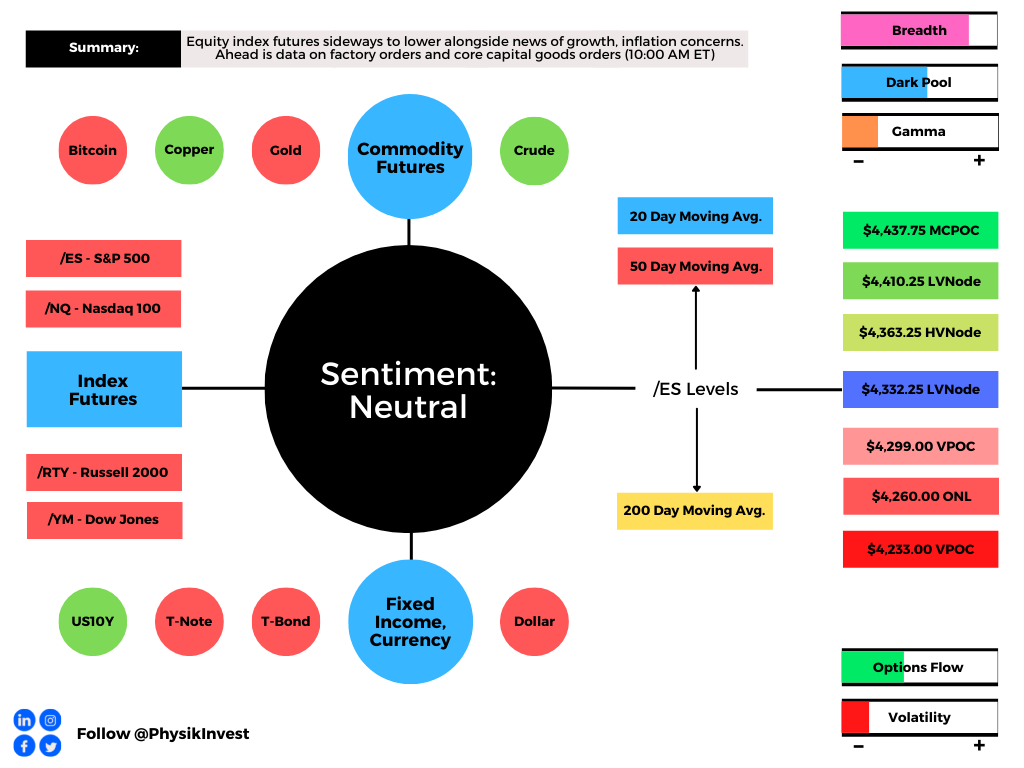
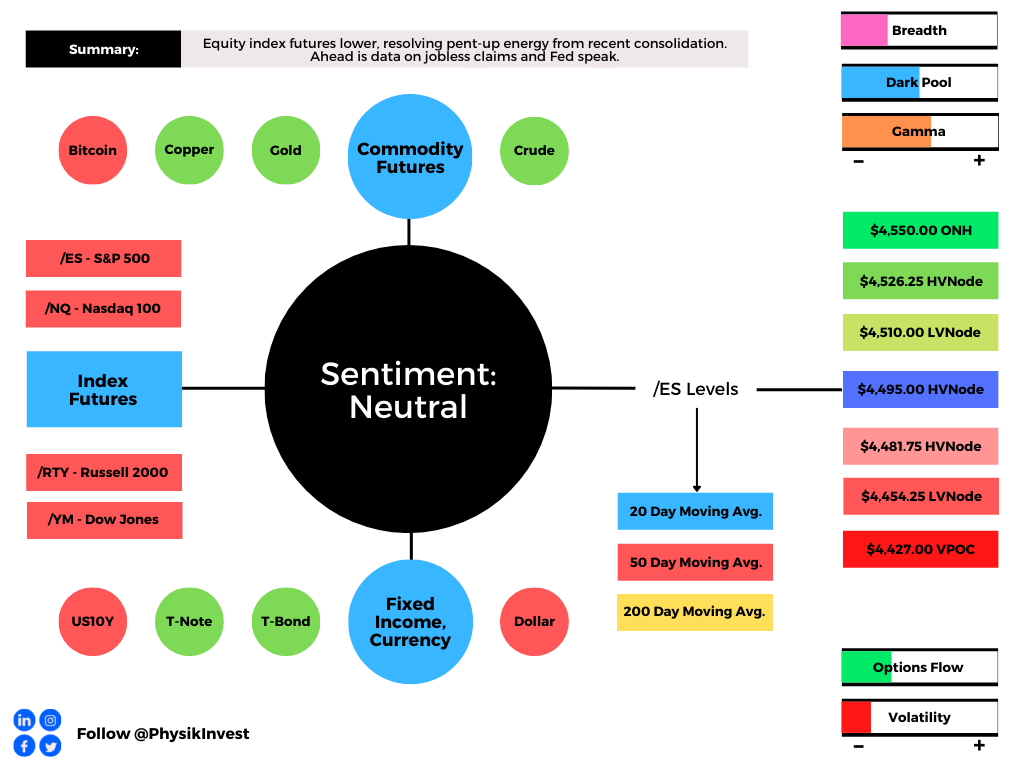
Graphic updated 6:30 AM ET. Sentiment Neutral if expected /ES open is inside of the prior day’s range. /ES levels are derived from the profile graphic at the bottom of the following section. SqueezeMetrics Dark Pool Index (DIX) and Gamma (GEX) calculations are based on where the prior day’s reading falls with respect to the MAX and MIN of all occurrences available. A higher DIX is bullish. At the same time, the lower the GEX, the more (expected) volatility. SHIFT data used for S&P 500 (INDEX: SPX) options activity. Note that options flow is sorted by the call premium spent; if more positive then more was spent on call options. Breadth reflects a reading of the prior day’s NYSE Advance/Decline indicator. VIX reflects a current reading of the CBOE Volatility Index (INDEX: VIX) from 0-100.

What To Expect: As of 6:30 AM ET, Monday’s regular session (9:30 AM – 4:00 PM EST) in the S&P 500 will likely open inside of prior-range and -value, suggesting a limited potential for immediate directional opportunity.

Adding, during the prior day’s regular trade, on a strengthening of intraday breadth, among other metrics including positioning measures, the best case outcome occurred, evidenced by a recovery of Thursday’s $4,365.00 untested point of control (VPOC). 

Given the overnight response at the top of Friday’s value area – the bulk of where trade was conducted – it looks as though participants are interested in slowing the pace of downside discovery. 

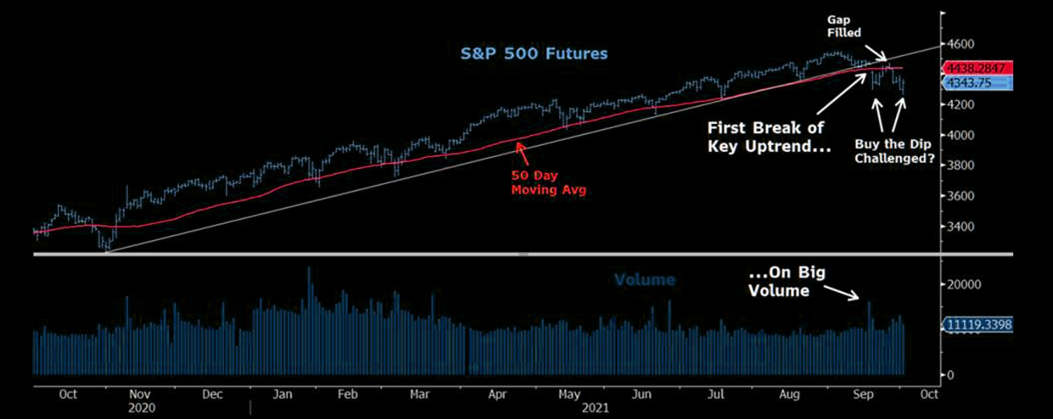
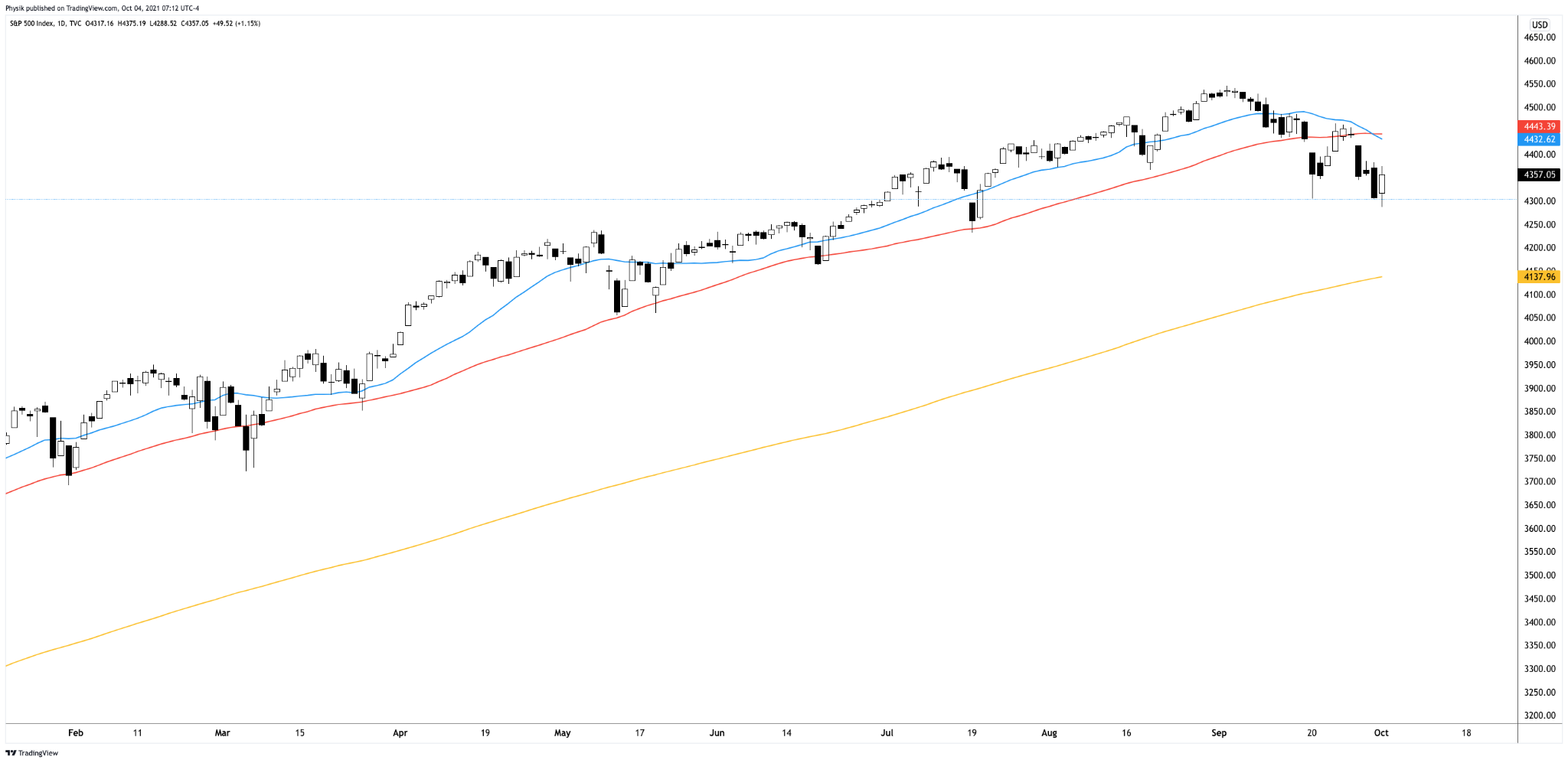
Still, the S&P 500 is well below its 20- and 50-day simple moving averages and multiple distribution profile structures denote emotion, as well as a lack of commitment

Graphic: S&P 500 daily chart with 20-, 50-, and 200-day simple moving average.

Further, the aforementioned trade is happening in the context of a traditionally volatile October and a fraying in the buy-the-dip psychology.

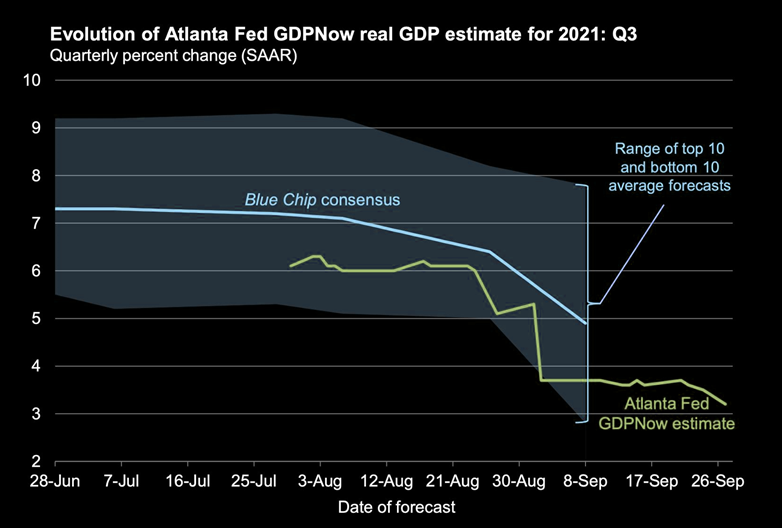
According to Nordea, despite a calm, upward-sloping term structure, there has been “a slightly upward tilting trend” in futures tracking the S&P 500 volatility index, likely warranted by several macro reasons including a worsening in liquidity, a slowdown in growth, cost/margin problems, and risks to the Fed put.

Graphic: Fed’s GDPNow estimate lowers expectations for U.S. economic growth, via The Market Ear

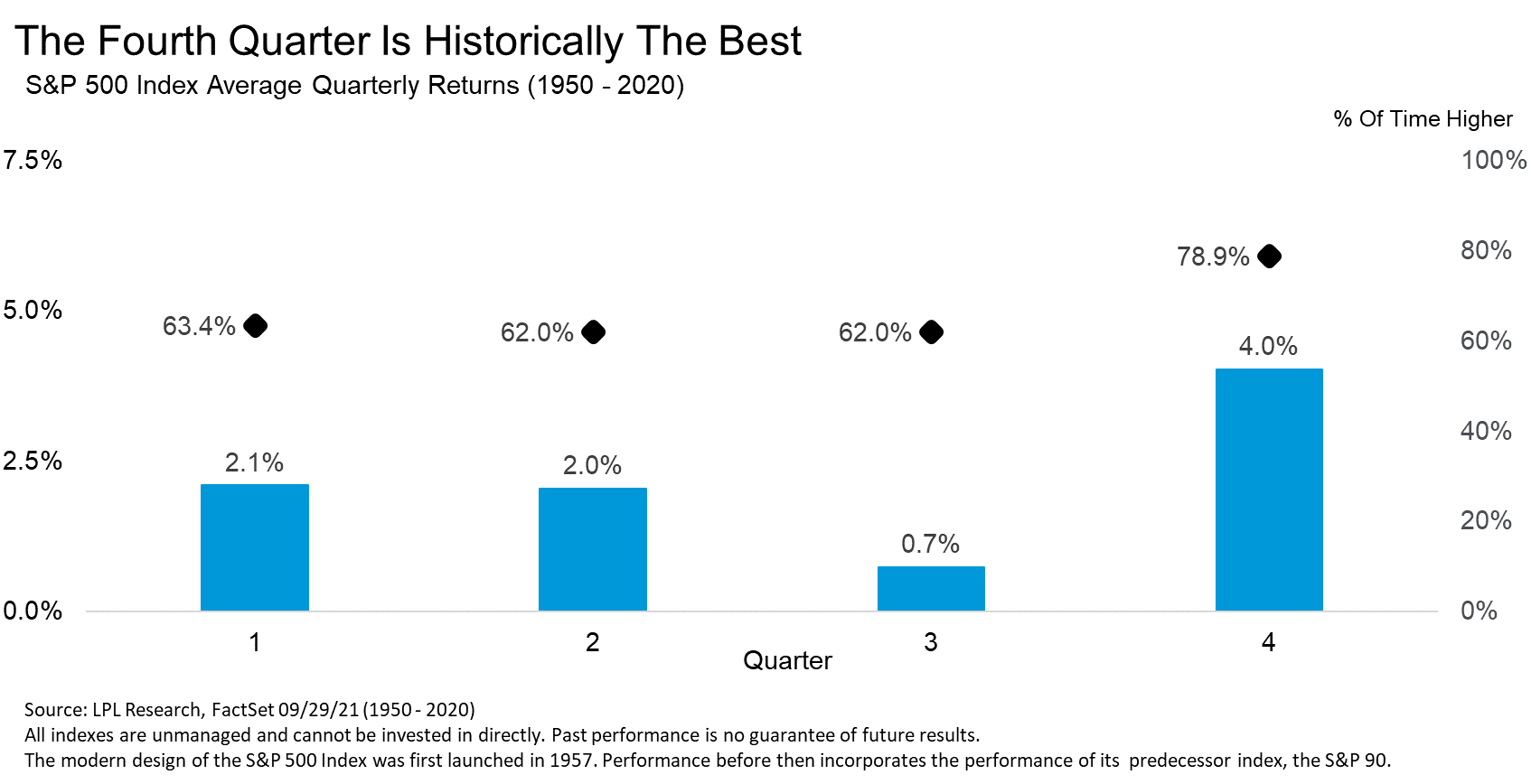
LPL Research adds that aside from October, no other month has seen more 1% moves, and the fourth quarter is “historically the best for stocks, with the third quarter the worst.”

Graphic: LPL Research unpacks S&P 500 seasonality. 

Moreover, for today, given expectations of heightened volatility, participants may make use of the following frameworks.

In the best case, the S&P 500 trades sideways or higher; activity above the $4,332.25 low volume area (LVNode) puts in play the $4,363.25 high volume area (HVNode). Initiative trade beyond the HVNode could reach as high as the $4,410.25 LVNode and $4,437.75 micro composite point of control (MCPOC), or higher.

In the worst case, the S&P 500 trades lower; activity below the $4,332.25 LVNode puts in play the $4,299.00 VPOC. Initiative trade beyond the VPOC could reach as low as $4,260.00 overnight low (ONL) and $4,233.00 VPOC, or lower.

Graphic: 65-minute profile chart of the Micro E-mini S&P 500 Futures updated 6:30 AM ET.

Definitions

Overnight Rally Highs (Lows): Typically, there is a low historical probability associated with overnight rally-highs (lows) ending the upside (downside) discovery process.

Volume Areas: A structurally sound market will build on areas of high volume (HVNodes). Should the market trend for long periods of time, it will lack sound structure, identified as low volume areas (LVNodes). LVNodes denote directional conviction and ought to offer support on any test. 

If participants were to auction and find acceptance into areas of prior low volume (LVNodes), then future discovery ought to be volatile and quick as participants look to HVNodes for favorable entry or exit.

POCs: POCs are valuable as they denote areas where two-sided trade was most prevalent in a prior day session. Participants will respond to future tests of value as they offer favorable entry and exit.

MCPOCs: POCs are valuable as they denote areas where two-sided trade was most prevalent over numerous day sessions. Participants will respond to future tests of value as they offer favorable entry and exit.

Responsive Buying (Selling): Buying (selling) in response to prices below (above) an area of recent price acceptance.

Price Discovery (One-Timeframe Or Trend): Elongation and range expansion denotes a market seeking new prices to establish value, or acceptance (i.e., more than 30-minutes of trade at a particular price level).

News And Analysis

EM bond markets continue to grow, as do vulnerabilities.

There’s is no inflation without income; there’s no income.

Action on Evergrande to avoid financial, social instability.

Global growth steady as delta spurs big regional swings.

Doomsday clock for U.S. debt ticks on political clashings.

Global Credit Conditions Q4: supply strain, inflation pain.

What People Are Saying

About

After years of self-education, strategy development, and trial-and-error, Renato Leonard Capelj began trading full-time and founded Physik Invest to detail his methods, research, and performance in the markets. 

Additionally, Capelj is a finance and technology reporter. Some of his biggest works include interviews with leaders such as John Chambers, founder and CEO, JC2 Ventures, Kevin O’Leary, businessman and Shark Tank host, Catherine Wood, CEO and CIO, ARK Invest, among others.

Disclaimer

At this time, Physik Invest does not manage outside capital and is not licensed. In no way should the materials herein be construed as advice. Derivatives carry a substantial risk of loss. All content is for informational purposes only.
Categories
Commentary

Daily Brief For September 9, 2021

Editor’s Note: Daily market commentaries to pause until Thursday, September 16, 2021, due to travel commitments. A weekend commentary will be in your inbox earlier this week.

All the best, 

Renato

Market Commentary

Equity index futures trade lower with yields, dollar, and bitcoin. Most commodities were green.

  • Narratives around slower recovery rising.
  • Ahead is jobless claims data, Fed speak.
  • Positioning risks mounting case for lower.

What Happened: U.S. stock index futures auctioned lower overnight alongside narratives surrounding a slowed economic recovery and stimulus reductions. 

Ahead is data on jobless claims (8:30 AM ET), as well as Fed-speak by Bowman (1:00 PM ET) and Williams (2:00 PM ET).

Graphic updated 6:30 AM ET. Sentiment Neutral if expected /ES open is inside of the prior day’s range. SqueezeMetrics Dark Pool Index (DIX) and Gamma (GEX) calculations are based on where the prior day’s reading falls with respect to the MAX and MIN of all occurrences available. A higher DIX is bullish. At the same time, the lower the GEX, the more (expected) volatility. SHIFT data used for S&P 500 (INDEX: SPX) options activity approximation. Note that options flow is sorted by the call premium spent; if more positive then more was spent on call options. Breadth reflects a reading of the prior day’s NYSE Advance/Decline indicator. VIX reflects a current reading of the CBOE Volatility Index (INDEX: VIX) from 0-100.

What To Expect: As of 6:30 AM ET, Thursday’s regular session (9:30 AM – 4:00 PM EST) in the S&P 500 will likely open inside of prior-range and -value, suggesting a limited potential for immediate directional opportunity.

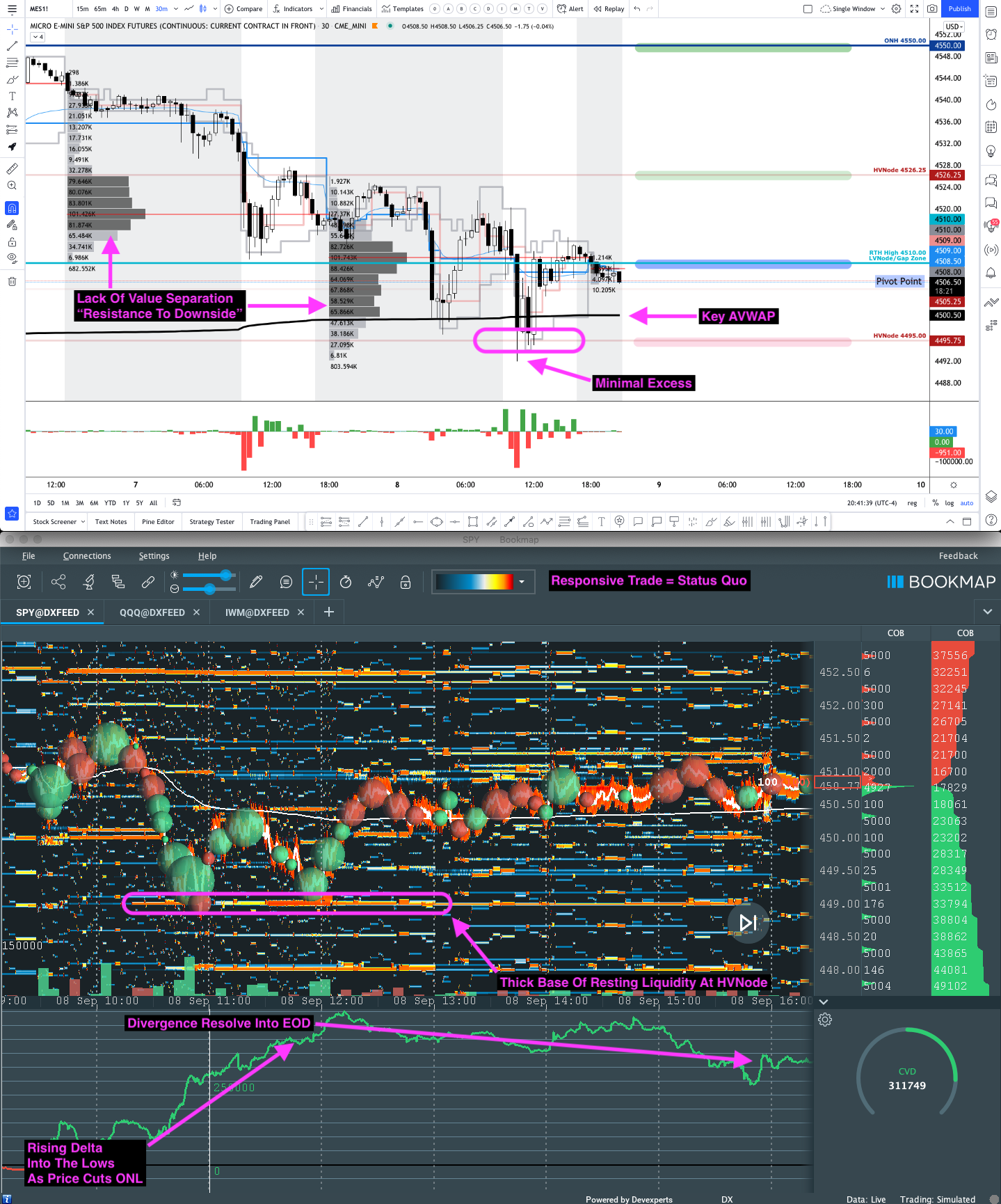
Adding, during the prior day’s regular trade, on weak intraday breadth and divergent market liquidity metrics, the best case outcome occurred, evidenced by sideways trade at the $4,510.00 pivot, the low end of a recent consolidation (i.e., balance) area. 

Balance (Two-Timeframe Or Bracket): Rotational trade that denotes current prices offer favorable entry and exit. Balance-areas make it easy to spot a change in the market (i.e., the transition from two-time frame trade, or balance, to one-time frame trade, or trend). 

Modus operandi is responsive trade (i.e., fade the edges), rather than initiative trade (i.e., play the break).

To note, participants had a tough time separating value and expanding range lower.

This is evidenced by the minimal excess at yesterday’s regular trade low (RTH Low), coupled with an overnight response at the 20-day simple moving average (i.e., a visual level likely paid attention to by short-term, technically-driven market participants). 

In other words, we’re carrying forward the difficulty participants had, in days prior, to moving prices out and away from balance. The path of least resistance – at least in prior trade – was not down; stronger sellers are not yet on board.

Excess: A proper end to price discovery; the market travels too far while advertising prices. Responsive, other-timeframe (OTF) participants aggressively enter the market, leaving tails or gaps which denote unfair prices.

Value-Area Placement: Perception of value unchanged if value overlapping. Perception of value has changed if value not overlapping (i.e., outside day). Delay action in the former case.
Graphic: 30-minute profile chart of the Micro E-mini S&P 500 Futures and market liquidity, via Bookmap, for the SPDR S&P 500 ETF Trust (NYSE: SPY). Notice the volume delta (CVD) or buying and selling power as calculated by the difference in volume traded at the bid and offer.
Balance-Break Scenarios In Play: A change in the market (i.e., the transition from two-time frame trade, or balance, to one-time frame trade, or trend) has occurred.

Though we expect sideways to lower trade – for the time being – we monitor for rejection (i.e., return inside of balance) which portends a move higher, to the opposite end of the balance.

Further, the aforementioned trade is happening in the context of peak growth and a moderation in the economic recovery, as well as non-seasonally aligned inflows, impactful options market dynamics, divergent sentiment, and fears of a mid-cycle transition.

The implications of these themes on price are contradictory

To elaborate, Morgan Stanley (NYSE: MS), Citigroup Inc (NYSE: C), and Goldman Sachs Group Inc (NYSE: GS) cautioned investors about equity outlooks. Of concern, in particular, is a rise in cases of the delta variant, tensions between inflation expectations and yields, as well as seasonality. 

Among other risks, as SqueezeMetrics summarizes, “[p]eople pretty much stopped buying S&P 500 puts [last] week. At the same time, people are overexposed to changes in VIX, and will be hurt more than usual if VIX starts moving up. Historically, this means SPX down, VIX up.”

Moreover, for today, given an increased potential for moderate volatility and responsive trade, participants may make use of the following frameworks.

In the best case, the S&P 500 trades sideways or higher; activity above the $4,495.00 high volume area (HVNode) pivot puts in play the $4,510.00 low volume area (LVNode). Initiative trade beyond the LVNode could reach as high as the $4,526.25 HVNode and $4,550.00 overnight high (ONH).

In the worst case, the S&P 500 trades lower; activity below the $4,495.00 HVNode puts in play the $4,481.75 HVNode. Initiative trade beyond the $4,481.75 HVNode could reach as low as the $4,454.25 LVNode and $4,427.00 untested point of control (VPOC).

Note the developing volume-weighted average price (VWAP) pinch. VWAP is a metric highly regarded by chief investment officers, among other participants, for quality of trade. Additionally, liquidity algorithms are benchmarked and programmed to buy and sell around VWAPs. We look to buy above a flat/rising VWAP pinch. Sell below a flat/declining VWAP pinch.

Overnight Rally Highs (Lows): Typically, there is a low historical probability associated with overnight rally-highs (lows) ending the upside (downside) discovery process.

Volume Areas: A structurally sound market will build on past areas of high volume. Should the market trend for long periods of time, it will lack sound structure (identified as a low volume area which denotes directional conviction and ought to offer support on any test). 

If participants were to auction and find acceptance into areas of prior low volume, then future discovery ought to be volatile and quick as participants look to areas of high volume for favorable entry or exit.

POCs: POCs are valuable as they denote areas where two-sided trade was most prevalent. Participants will respond to future tests of value as they offer favorable entry and exit.
Graphic: 65-minute profile chart of the Micro E-mini S&P 500 Futures updated 6:30 AM ET. 

News And Analysis

Traders rush to dump China tech stocks as gaming targeted again.

Decision Guide: The ECB counts risks in setting bond-buying pace.

Aluminum notches fresh 13-year high on supply woes and demand.

China’s zero-COVID approach will aggravate rising corporate risks.

Fauci: We don’t even have “modestly good control” over COVID-19.

Coinbase threat shows there’s a new cryptocurrency sheriff in town.

White House eyeing increased hacking around the coming holidays.

What People Are Saying

About

After years of self-education, strategy development, and trial-and-error, Renato Leonard Capelj began trading full-time and founded Physik Invest to detail his methods, research, and performance in the markets. 

Additionally, Capelj is a finance and technology reporter. Some of his biggest works include interviews with leaders such as John Chambers, founder and CEO, JC2 Ventures, Kevin O’Leary, businessman and Shark Tank host, Catherine Wood, CEO and CIO, ARK Invest, among others.

Disclaimer

At this time, Physik Invest does not manage outside capital and is not licensed. In no way should the materials herein be construed as advice. Derivatives carry a substantial risk of loss. All content is for informational purposes only.
Categories
Commentary

Daily Brief For June 21, 2021

Market Commentary

Index futures attempt to balance.

  • Yield curve flattens, China eyes BTC.
  • Ahead: CFNAI. ECB and Fed speak.
  • Indices auctioned sideways to higher.

What Happened: U.S. stock index futures auctioned higher and yields dropped.

After a big shift in the Federal Reserve’s so-called dot-plot, bond yields on the short-end of the curve rose while long-dated yields dropped in line with projections future inflation is easing. This flatter yield curve is a negative for cyclical stocks which can’t pass on increased costs, thereby impacting sales and margins.

Given the divergence across major, broad market indices, the implications of a flatter yield curve are apparent. Investors sold, heavily, cyclical stocks, evidenced by relative weakness in sectors like financials and transportation. 

In other areas, bitcoin fell after China cracked down on crypto-related transactions. Oil held its highs on a slowdown in talks between the U.S. and Iran. 

Ahead is data on the Chicago Fed National Activity Index (CFNAI). Also, today, members of the ECB and Fed will speak. 

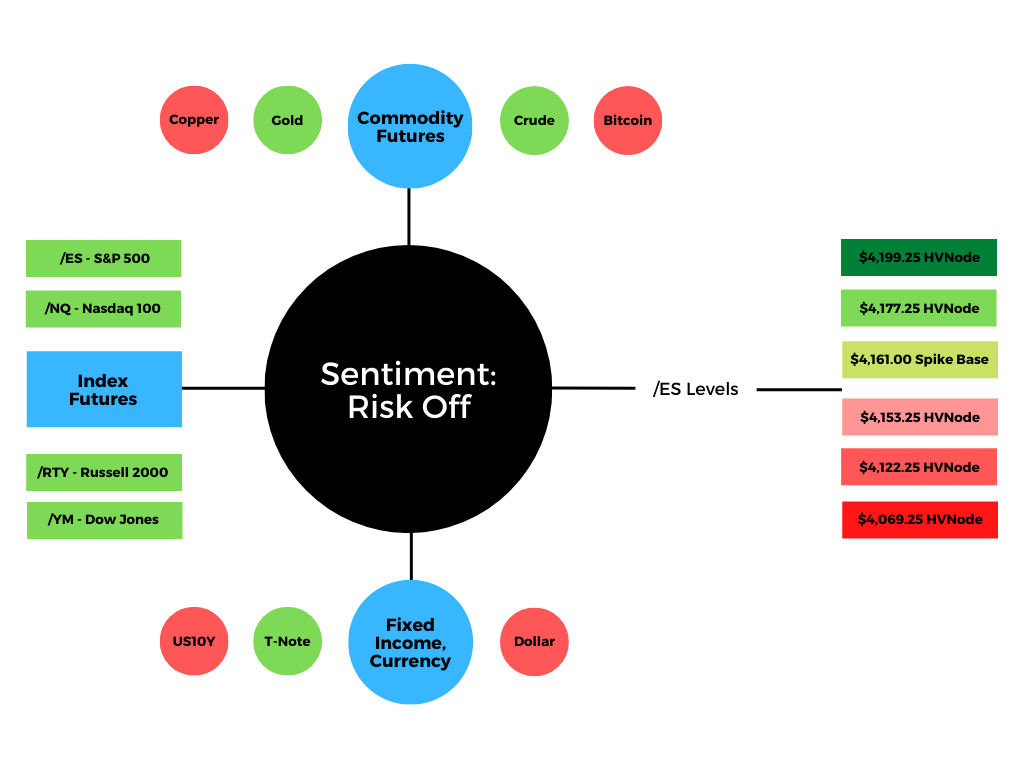
Graphic updated 7:10 AM ET.

What To Expect: Monday’s regular session (9:30 AM – 4:00 PM EST) in the S&P 500 will likely open inside of prior-range and -value, suggesting a limited potential for immediate directional opportunity.

Adding, during the prior day’s regular trade, the worst-case outcome occurred, evidenced by initiative trade below the $4,177.25 high volume area (HVNode) and end-of-day spike liquidation to and through $4,161.00, a strong support going into Friday’s derivative expiry.

Spikes: Spike’s mark the beginning of a break from value. Spikes higher (lower) are validated by trade at or above (below) the spike base (i.e., the origin of the spike).
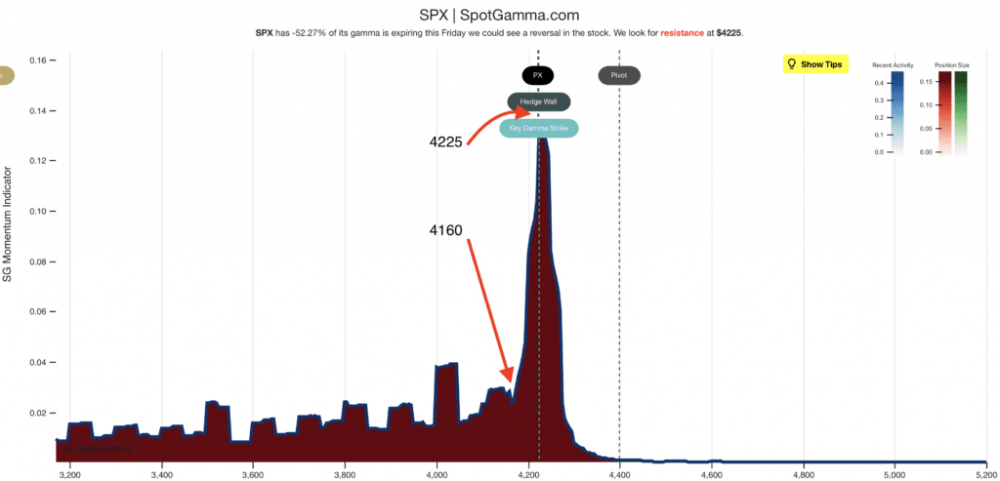
Graphic: SpotGamma analysis suggested minimal support below $4,200.00, in the S&P 500.

For today, participants can trade from the following frameworks. 

In the best case, the S&P 500 trades sideways or higher; activity above the $4,161.00 spike base puts in play the $4,177.25 HVNode. Initiative trade beyond the $4,177.25 HVNode could reach as high as the $4,199.25 HVNode.

Volume Areas: A structurally sound market will build on past areas of high volume. Should the market trend for long periods of time, it will lack sound structure (identified as a low volume area which denotes directional conviction and ought to offer support on any test). 

If participants were to auction and find acceptance into areas of prior low volume, then future discovery ought to be volatile and quick as participants look to areas of high volume for favorable entry or exit.

In the worst case, the S&P 500 trades lower; activity below $4,161.00 suggests an acceptance of Friday’s knee-jerk move from value. In such a case, participants are cautioned on further downside. First comes the $4,153.25 HVNode. Thereafter, if lower, participants can target the overnight low (ONL) at $4,126.75 and HVNode at $4,122.25.

Overnight Highs (Lows): Typically, there is a low historical probability associated with overnight rally-highs (lows) ending the upside (downside) discovery process.
Graphic: 65-minute profile chart of the Micro E-mini S&P 500 Futures.
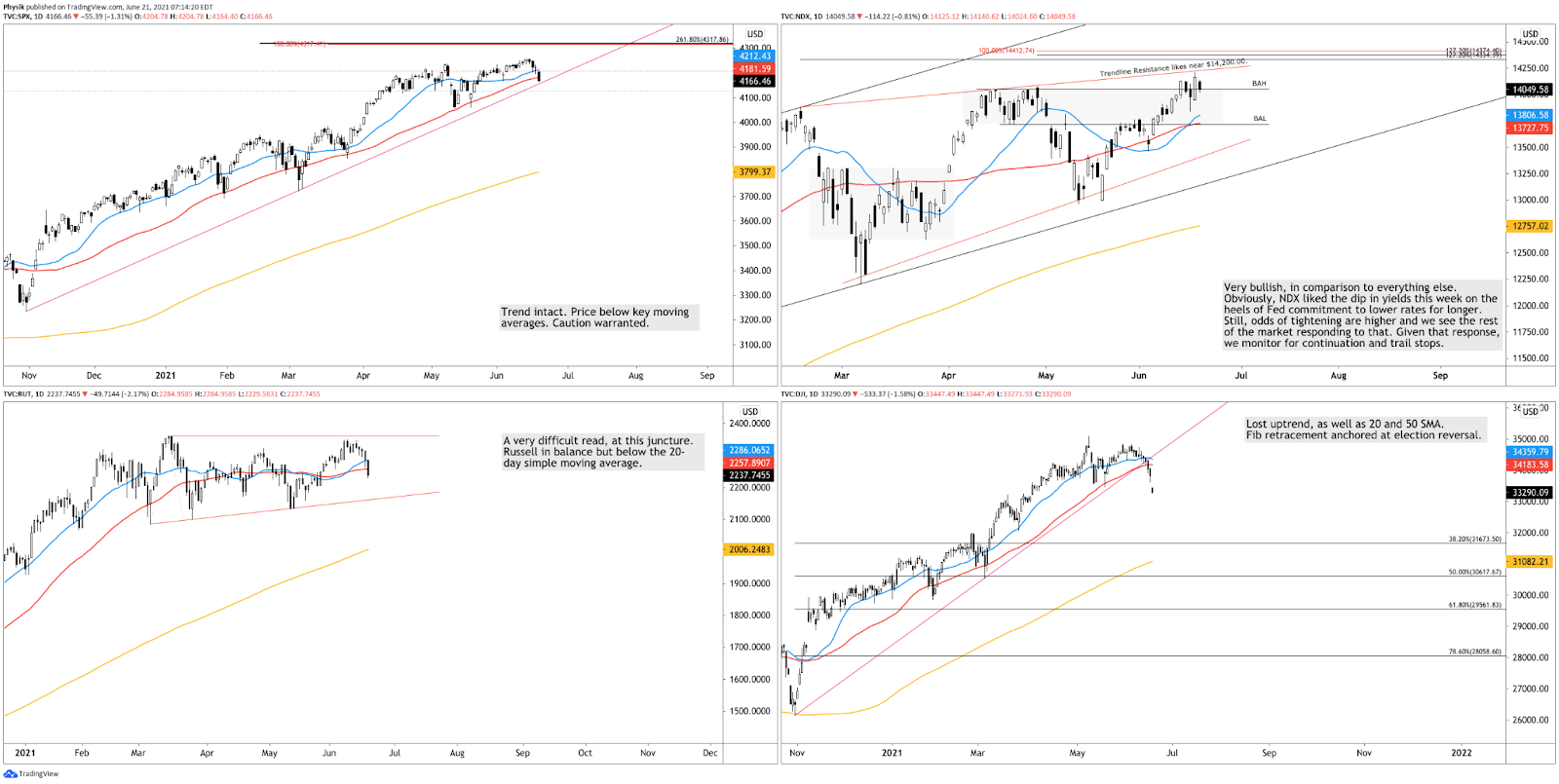
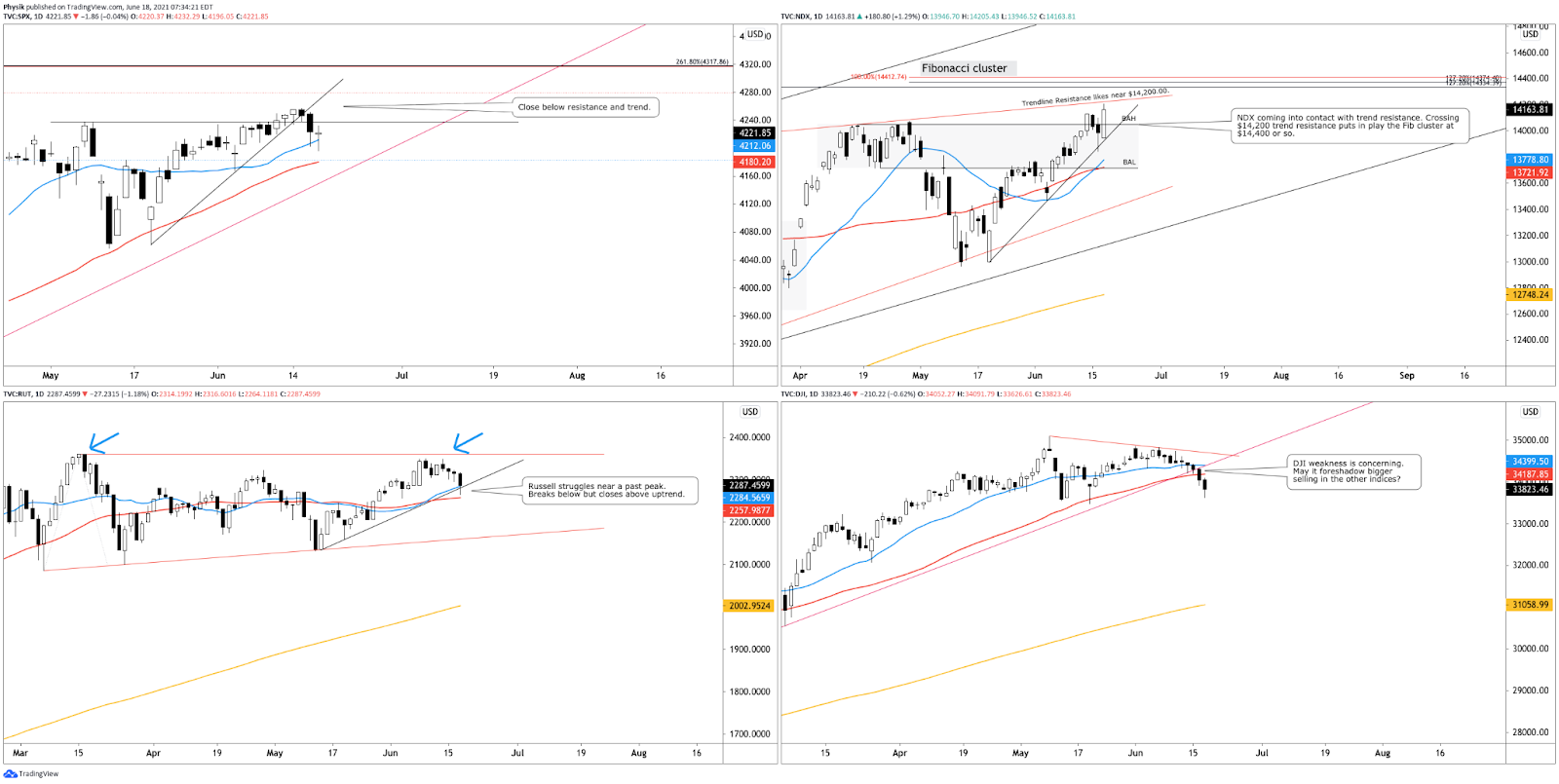
Graphic: Daily candlestick charts of the S&P 500 (top left), Nasdaq 100 (top right), Russell 2000 (bottom left), and Dow Jones Industrial Average (bottom right). Noting, seasonality supports the Nasdaq 100’s relative strength. 
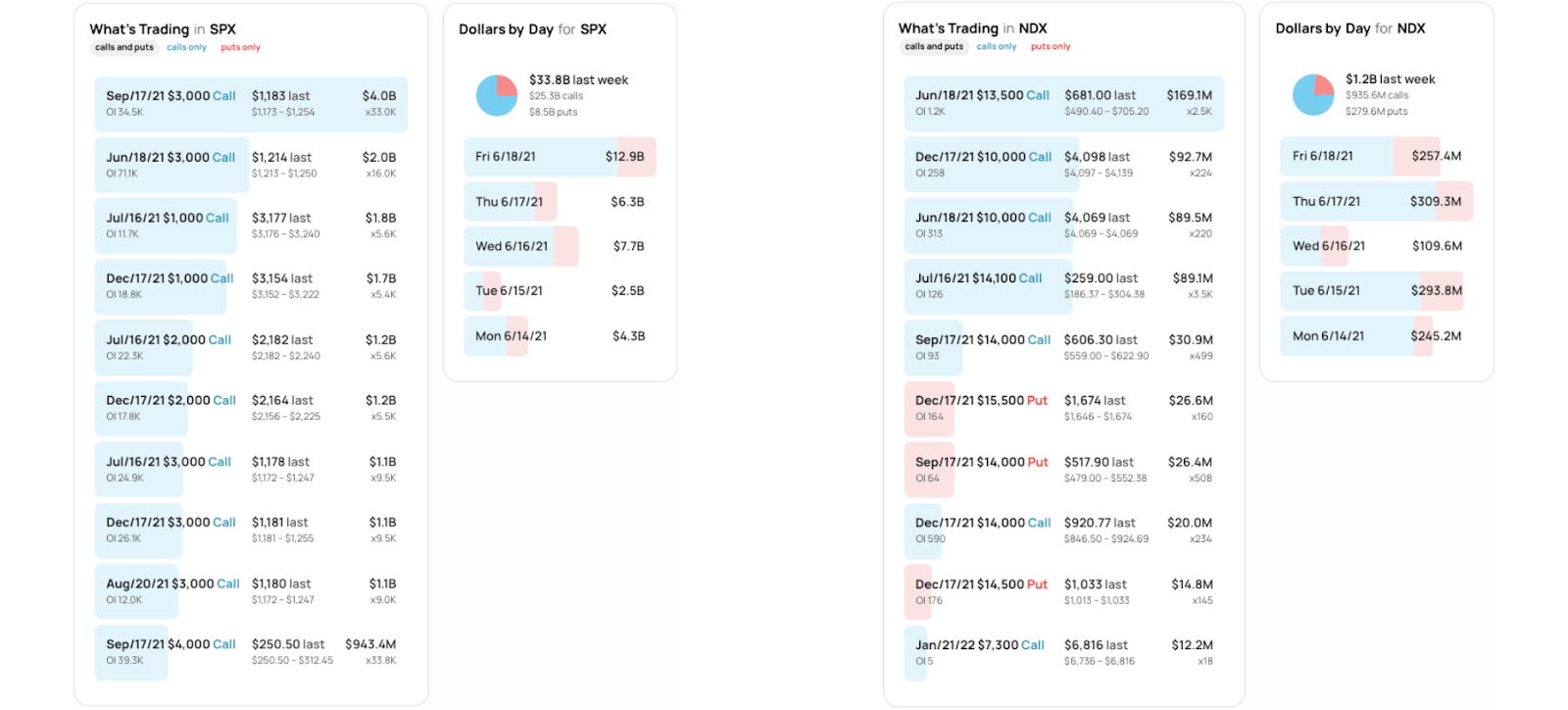
Graphic: SHIFT search suggests participants were most interested in call strikes at and below current prices in the cash-settled S&P 500 Index (INDEX: SPX) and Nasdaq 100 (INDEX: NDX), last week. This activity may denote (1) stock replacement, (2) hedges for underlying short positions, or (3) speculation on the upside.

News And Analysis

Energy | Natural-gas glut has evaporated, driving prices higher. (WSJ)

Economy | Supply chain risks extend into 2022, stoking inflation. (WSJ)

Travel | American Air cuts some flights to avoid potential strains. (WSJ)

Politics | House bills put big tech step closer to antitrust regulation. (Fitch)

Markets | Goldman, JPMorgan pin emerging-market bets on hawks. (BBG)

Politics | Infrastructure bill talks continue; China comes in focus. (Moody’s)

Travel | Europe’s air traffic reaches 50% of 2019 amid recovery. (BBG)

Travel | Canada won’t fully reopen border until 75% vaccinations. (BBG)

What People Are Saying

Innovation And Emerging Trends

Technology | GM plans to expand its fuel-cell business beyond EVs. (CNBC)

Technology | Why the big automakers are pouring money into robotics. (TC)

Education | The pandemic’s effects have depressed college enrollment. (Axios)

About

Renato founded Physik Invest after going through years of self-education, strategy development, and trial-and-error. His work reporting in the finance and technology space, interviewing leaders such as John Chambers, founder, and CEO, JC2 Ventures, Kevin O’Leary, businessman and Shark Tank host, Catherine Wood, CEO and CIO, ARK Invest, among others, afforded him the perspective and know-how very few come by.

Having worked in engineering and majored in economics, Renato is very detailed and analytical. His approach to the markets isn’t built on hope or guessing. Instead, he leverages the unique dynamics of time and volatility to efficiently act on opportunity.

Disclaimer

At this time, Physik Invest does not manage outside capital and is not licensed. In no way should the materials herein be construed as advice. Derivatives carry a substantial risk of loss. All content is for informational purposes only.
Categories
Commentary

Daily Brief For June 18, 2021

Editor’s Note: Happy Friday! In the coming days, there will be some additions to the newsletter helping you better identify the levels in play. Also, I will try to improve engagement with some visual effects.

Stay tuned,

Renato

Market Commentary

Index futures balance after violent downside discovery.

  • Inflation fears spark morning dips.
  • EU opened up travel with the US.
  • Indicies traded sideways to lower.

What Happened: U.S. stock index futures auctioned sideways to lower after violent downside discovery just days prior.

Ahead, there are no significant economic releases.

Graphic updated 7:48 AM ET.

What To Expect: Friday’s regular session (9:30 AM – 4:00 PM EST) in the S&P 500 will likely open inside of prior-range and -value, suggesting a limited potential for immediate directional opportunity. 

Adding, during the prior day’s regular trade, the best case outcome occurred, evidenced by sideways trade at and around the VWAP (blue in color on the below graphic) anchored from the time of Wednesday’s Federal Reserve event. This suggests the average buyer, since the event, is regaining strength. 

So, what is needed in the coming days? Ideally, the S&P 500 trades (and stays) above the blue VWAP line.

Volume Weighed Average Price (VWAP): The average price at which a stock is traded over a certain horizon.

Moreover, since the Federal Reserve’s signal of the faster-than-expected pace of policy tightening provided participants more clarity, major indices broke out of balance, but in different directions. 

The S&P 500, Russell 2000, and Dow Jones Industrial Average are trading relatively weak in comparison to the tech- and growth-focused Nasdaq 100 which quickly recovered FOMC losses to discover higher prices. This divergence, in conjunction with sectoral breakdowns, is concerning and may foreshadow increased volatility after the monthly options expiration (OPEX), into quarter-end. 

Options Expiration (OPEX): Option expiries mark an end to pinning (i.e, the theory that market makers and institutions short options move stocks to the point where the greatest dollar value of contracts will expire worthless) and the reduction dealer gamma exposure.

According to SpotGamma’s models, up to 50% of the gamma in and across the S&P 500 complex is expiring. Here’s an explanation and visual to understand why that matters.

After those gamma exposures drop (and related hedging forces disappear), the market will be subject to more movement. That is when things will get interesting. 

Based on the price action across the biggest FANGMANT stocks, participants would think another run higher is likely. However, looking at the breakdowns in individual sectors – financials and transportation, for instance – a dip in certain breadth metrics, elevated skew, put/call ratios, and volatility spreads, the picture becomes less clear. 

Without going into things too deep, the odds favor volatility and sideways trade for today’s session.

Like yesterday, in the best case, the S&P 500 trades sideways or higher; activity above the $4,207.25 VWAP (blue in color on the below chart) puts in play the $4,227.25 HVNode. Initiative trade beyond that HVNode could reach as high as the $4,235.00 Virgin Point Of Control (VPOC), $4,249.00 low volume area (LVNode), and $4,258.00 overnight high (ONH).

Overnight Highs (Lows): Typically, there is a low historical probability associated with overnight rally-highs (lows) ending the upside (downside) discovery process.

POCs: POCs (like HVNodes described above) are valuable as they denote areas where two-sided trade was most prevalent. Participants will respond to future tests of value as they offer favorable entry and exit.

In the worst case, the S&P 500 trades lower; activity below the blue VWAP suggests a risk-off sentiment remains. In such a case, there is the potential to test lower, into the $4,182.50 overnight low (ONL) and $4,177.25 HVNode. Breaking $4,177.25 suggests a higher potential to trade to the HVNodes at $4,153.25, $4,122.25, and $4,069.25.

Graphic: 65-minute profile chart of the Micro E-mini S&P 500 Futures.
Graphic: Daily candlestick charts of the S&P 500 (top left), Nasdaq 100 (top right), Russell 2000 (bottom left), and Dow Jones Industrial Average (bottom right).
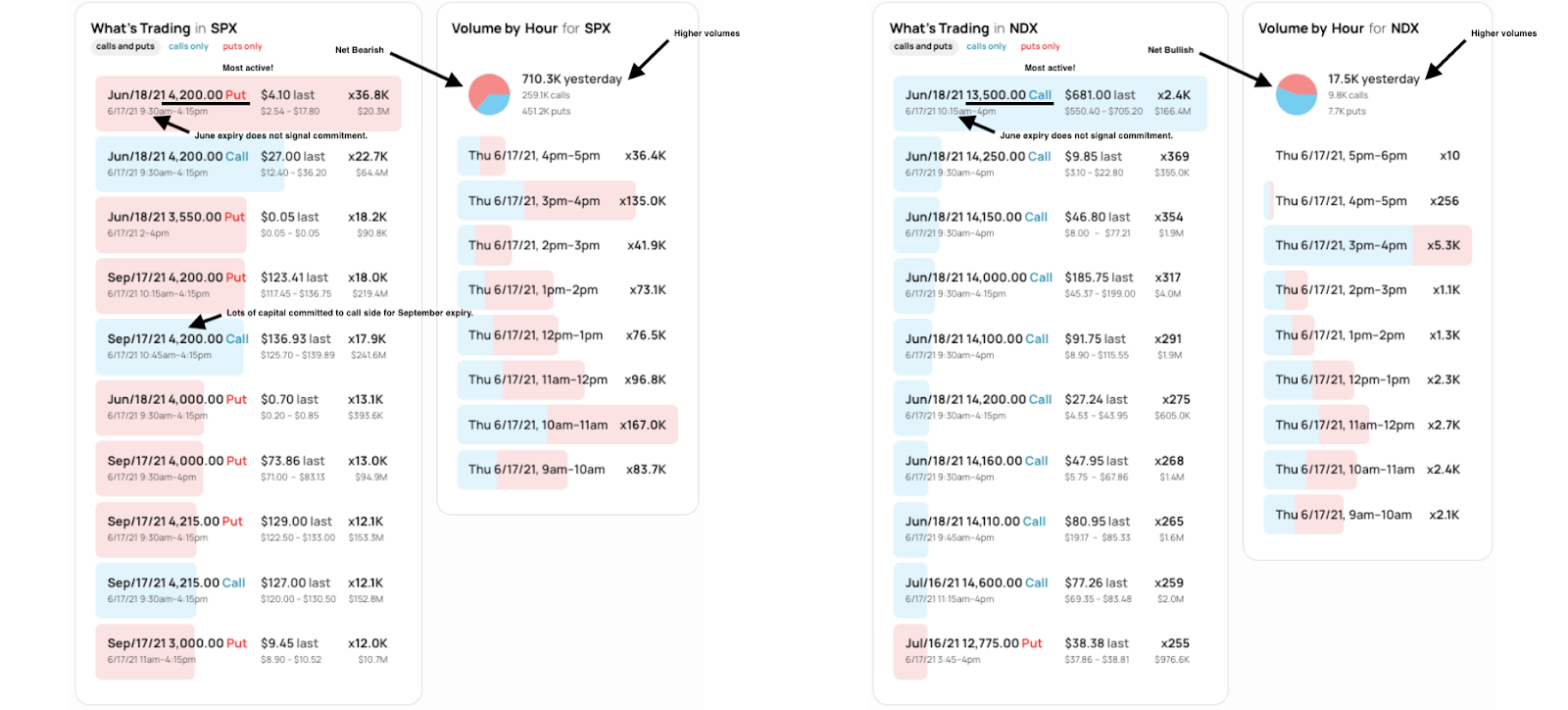
Graphic: SHIFT search suggests participants were most interested in put strikes at and below current prices in the cash-settled S&P 500 Index (INDEX: SPX), yesterday. On the other hand, in the cash-settled Nasdaq 100 Index (INDEX: NDX), participants were most interested in call strikes at and above current prices.

News And Analysis

Economy | Fed’s Bullar says inflation running hotter than expected. (REU)

Economy | EU opens up for Americans wanting to vacation abroad. (BBG)

Economy | Faster world recovery boosting prices, inflation will halt. (Fitch)

Economy | Fear during the COVID-19 comeback largely transitory. (Axios)

Economy | Inflation data holding key to Fannie Mae’s new forecast. (MND)

Politics | Pacific cable project sinks after warning against China bid. (REU)

Politics | Supreme Court rejects GOP challenge to Affordable Care. (BBG)

What People Are Saying

Innovation And Emerging Trends

FinTech | Mark Cuban wants stablecoin regulation amid token crash. (BBG)

Markets | Google to open first retail store steps away from Apple. (BBG)

About

Renato founded Physik Invest after going through years of self-education, strategy development, and trial-and-error. His work reporting in the finance and technology space, interviewing leaders such as John Chambers, founder, and CEO, JC2 Ventures, Kevin O’Leary, businessman and Shark Tank host, Catherine Wood, CEO and CIO, ARK Invest, among others, afforded him the perspective and know-how very few come by.

Having worked in engineering and majored in economics, Renato is very detailed and analytical. His approach to the markets isn’t built on hope or guessing. Instead, he leverages the unique dynamics of time and volatility to efficiently act on opportunity.

Disclaimer

At this time, Physik Invest does not manage outside capital and is not licensed. In no way should the materials herein be construed as advice. Derivatives carry a substantial risk of loss. All content is for informational purposes only.

Categories
Commentary

Daily Brief For June 17, 2021

Market Commentary

Index futures exit balance, discover lower prices.

  • The Fed eyes taper, signals faster tightening.
  • Ahead: Claims, Business Outlook, and more.
  • Indices exit balance, trade lower, then base.

What Happened: U.S. stock index futures auctioned sideways-to-lower after news the Federal Reserve is signaling a faster-than-expected pace of policy tightening. This comes alongside concerns over inflation which the Federal Reserve suggests is transitory. 

“The reason for the committee moving a bit in this direction is risk management,” said Jonathan Wright, an economics professor at Johns Hopkins University and a former Fed economist. “The risks of overheating are a bit greater than they were.”

Today, participants get data on weekly jobless claims, the Philadelphia Fed Business Outlook, and the U.S. Leading Index. Additionally, Janet Yellen will speak on the budget and the SEC may issue a decision on cryptocurrency ETFs.

Graphic updated 7:25 AM ET.

What To Expect: Thursday’s regular session (9:30 AM – 4:00 PM EST) in the S&P 500 will likely open inside of prior-range and -value, suggesting a limited potential for immediate directional opportunity. 

Adding, during the prior day’s regular trade, the worst-case outcome occurred evidenced by initiative trade below the $4,227.75 high volume area (HVNode). This is significant because that level marked a pivot (i.e., above = bullish, below = bearish) on the composite profile. 

Initiative Selling: Selling within or below the previous day’s value area.

Volume Areas: A structurally sound market will build on past areas of high volume. Should the market trend for long periods of time, it will lack sound structure (identified as a low volume area which denotes directional conviction and ought to offer support on any test). 

If participants were to auction and find acceptance into areas of prior low volume, then future discovery ought to be volatile and quick as participants look to areas of high volume for favorable entry or exit.

It is important to think about who is winning and losing. We start by anchoring a VWAP (blue in color on the below graphic) from the time of the Federal Reserve event. Clearly, the S&P 500 is trading below this VWAP. This suggests the average buyer, since yesterday’s liquidation, is losing. Trading (and staying) above this blue line changes the dynamics; in such a case, shorts should reconsider their involvement.

Volume Weighed Average Price (VWAP): The average price at which a stock is traded over a certain horizon.

For today, participants can trade from the following frameworks. 

In the best case, the S&P 500 trades sideways or higher; activity above the $4,207.25 VWAP (blue in color on the below chart) puts in play the $4,227.25 HVNode. Initiative trade beyond that HVNode could reach as high as the $4,235.00 Virgin Point Of Control (VPOC), $4,249.00 low volume area (LVNode), and $4,258.00 overnight high (ONH).

Overnight Highs (Lows): Typically, there is a low historical probability associated with overnight rally-highs (lows) ending the upside (downside) discovery process.

POCs: POCs (like HVNodes described above) are valuable as they denote areas where two-sided trade was most prevalent. Participants will respond to future tests of value as they offer favorable entry and exit.

In the worst case, the S&P 500 trades sideways or lower; activity below the blue VWAP suggests a risk-off sentiment remains. In such a case, there is the potential to test lower, into the $4,182.50 overnight low (ONL) and $4,177.25 HVNode. If a probe into lower value is not responded to, lookout. There’s a higher potential to trade to the HVNodes at $4,153.25, $4,122.25, and $4,069.25.

Graphic: 65-minute profile chart of the Micro E-mini S&P 500 Futures.
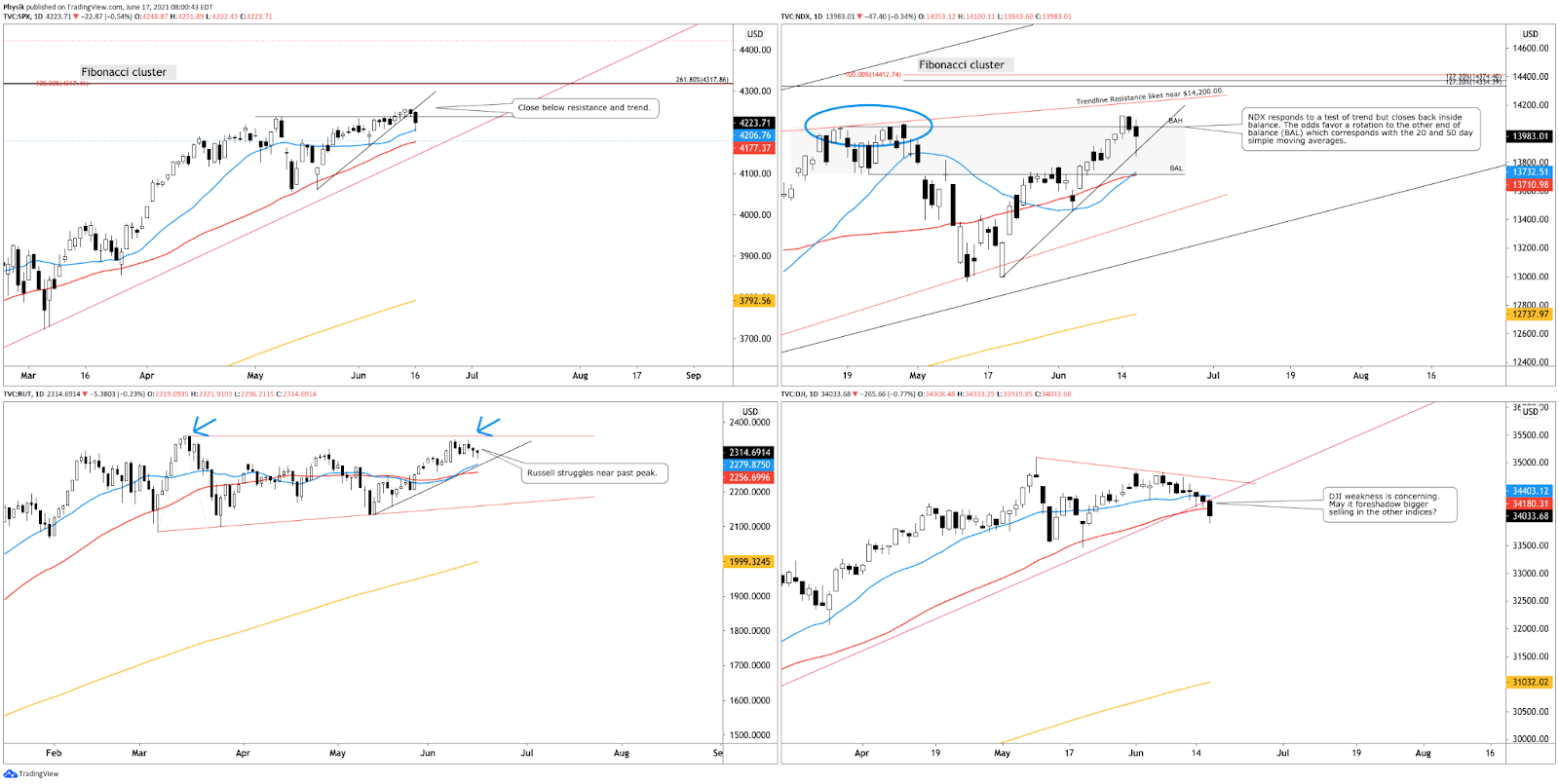
Graphic: Daily candlestick charts of the S&P 500 (top left), Nasdaq 100 (top right), Russell 2000 (bottom left), and Dow Jones Industrial Average (bottom right).
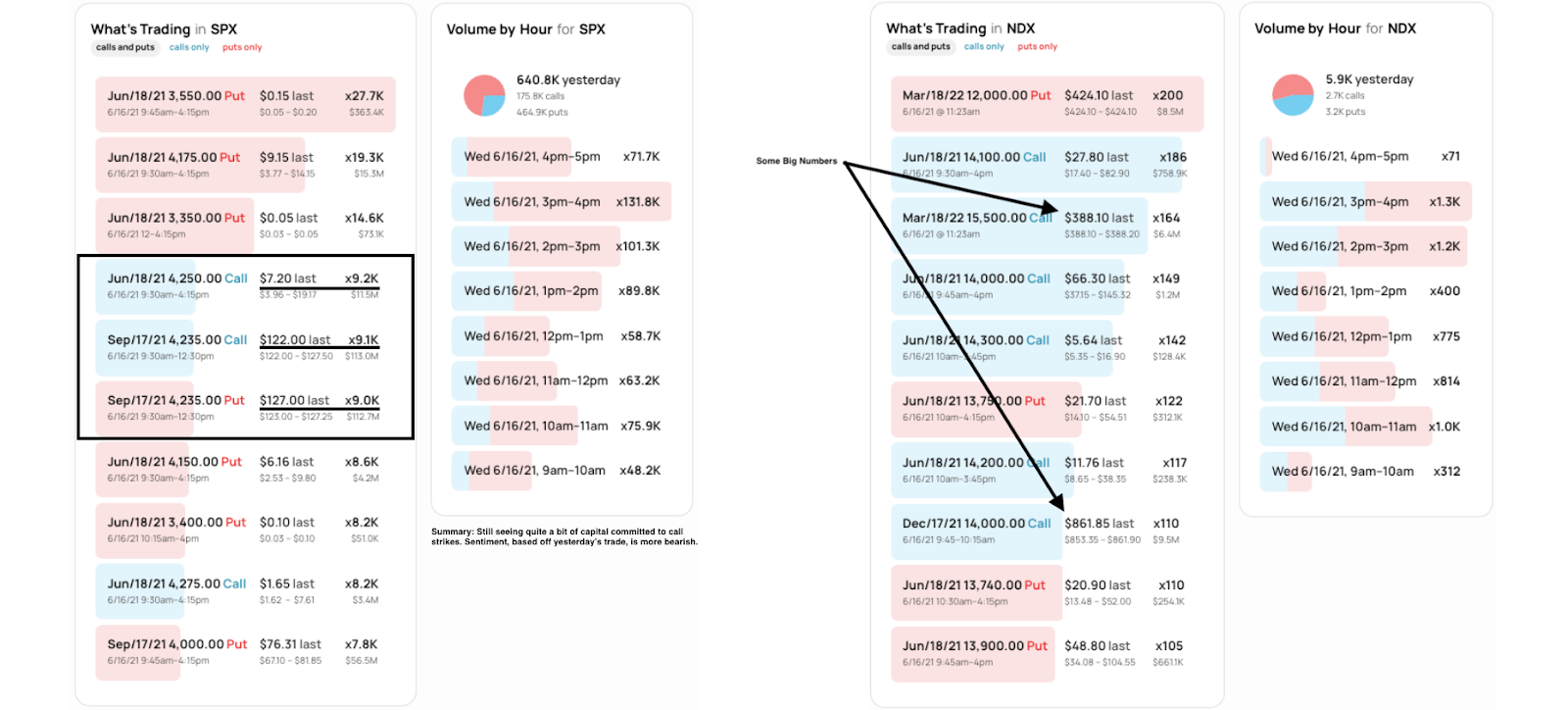
Graphic: SHIFT search suggests participants were most interested in put strikes at and below current prices in the cash-settled S&P 500 Index (INDEX: SPX) and Nasdaq 100 Index (INDEX: NDX), yesterday. Noting, participants are still paying up for upside call exposure.

News And Analysis

Energy | Climbing oil prices signal the need for more output. (REU)

Markets | OPEX is a huge thing and June FOMC a non-event. (HR)

COVID | Delta variant fuelled a 50% rise in England infections. (REU)

Economy | World Bank rejects El Salvador’s request on BTC. (REU)

Energy | Blistering heatwave hits California and fire risks build. (Axios)

What People Are Saying

Innovation And Emerging Trends

Markets | OnlyFans explores share sale after the lockdown boom. (FT)

FinTech | New crypto working group in Congress to hone policies. (TB)

Markets | Cboe extends global trading hours in SPX, VIX options. (MM)

Markets | How SEC boss should deal with ‘meme’ stock schemes. (NYP)

About

Renato founded Physik Invest after going through years of self-education, strategy development, and trial-and-error. His work reporting in the finance and technology space, interviewing leaders such as John Chambers, founder, and CEO, JC2 Ventures, Kevin O’Leary, businessman and Shark Tank host, Catherine Wood, CEO and CIO, ARK Invest, among others, afforded him the perspective and know-how very few come by.

Having worked in engineering and majored in economics, Renato is very detailed and analytical. His approach to the markets isn’t built on hope or guessing. Instead, he leverages the unique dynamics of time and volatility to efficiently act on opportunity.

Disclaimer

At this time, Physik Invest does not manage outside capital and is not licensed. In no way should the materials herein be construed as advice. Derivatives carry a substantial risk of loss. All content is for informational purposes only.

Categories
Commentary

Daily Brief For May 14, 2021

Editor’s Note: Thanks for being a loyal subscriber! If you think this newsletter is valuable, please consider sharing it. Other than that, have a great rest of your day!

Market Commentary

Index futures back in balance.

  • Selling slows, commodities take hit.
  • Ahead: A big day for data releases.
  • Index futures were higher overnight. 

What Happened: U.S. stock index futures auctioned higher overnight ahead of ECB minutes, data on retail sales, U.S. import and export prices, industrial and manufacturing production, business inventories, as well as sentiment figures.

Ongoing Theme: “Stocks with more attractive valuations and slower growth will do well in a higher-interest rate environment,” according to Louise Dudley, global equities portfolio manager at the international business of Federated Hermes. Expensive growth stocks, by contrast, “are sensitive to higher interest rates.” – Bloomberg

Graphic updated 7:00 AM EST.

What To Expect: Friday’s regular session (9:30 AM – 4:00 PM EST) in the S&P 500 may open just outside of prior -range and -value, suggesting a limited potential for immediate directional opportunity. 
Adding, during the prior day’s regular trade, the best case outcome occurred, evidenced by responsive trade up to and around the $4,117.00 POC, which is significant because it marked the most valuable price to trade at during a prior session.

POCs: POCs are valuable as they denote areas where two-sided trade was most prevalent. Participants will respond to future tests of value as they offer favorable entry and exit.

The rebound comes after violent downside discovery earlier in the week. After a failed balance-breakout, alongside weak economic data, the S&P 500 liquidated down to its balance-area low, a typical target on a failed balance break. Thereafter, prices were advertised below the balance area but did not attract aggressive sellers. Participants then rotated the index back inside the balance area suggesting they are seeking better prices to sell at or more information to base a directional move.

Further, for today, participants can trade from the following frameworks. 

In the best case, the S&P 500 trades sideways or higher; activity above the $4,133.75 50.00% Fibonacci retracement has the potential to trade up to the $4,177.75 high volume area (HVNode). Initiative trade beyond the HVNode could reach as high as the $4,227.00 POC. 

Volume Areas: A structurally sound market will build on past areas of high volume. Should the market trend for long periods of time, it will lack sound structure (identified as a low-volume area which denotes directional conviction and ought to offer support on any test). 

If participants were to auction and find acceptance into areas of prior low-volume, then future discovery ought to be volatile and quick as participants look to areas of high volume for favorable entry or exit.

In the worst case, the S&P 500 trades lower; activity below the $4,133.75 50.00% Fibonacci retracement puts in play the $4,122.75 HVNode, the $4,104.75 and $4,089.25 low volume areas (LVNodes), and lastly, the $4082.75 and $4,071.25 HVNodes. 

Trading below the $4,029.25 overnight low (ONL) suggests a continuation of the bear trend. Caution longs.

Overnight Highs (Lows): Typically, there is a low historical probability associated with overnight rally-highs (lows) ending the upside (downside) discovery process.
Graphic: 4-hour profile chart of the Micro E-mini S&P 500 Futures.
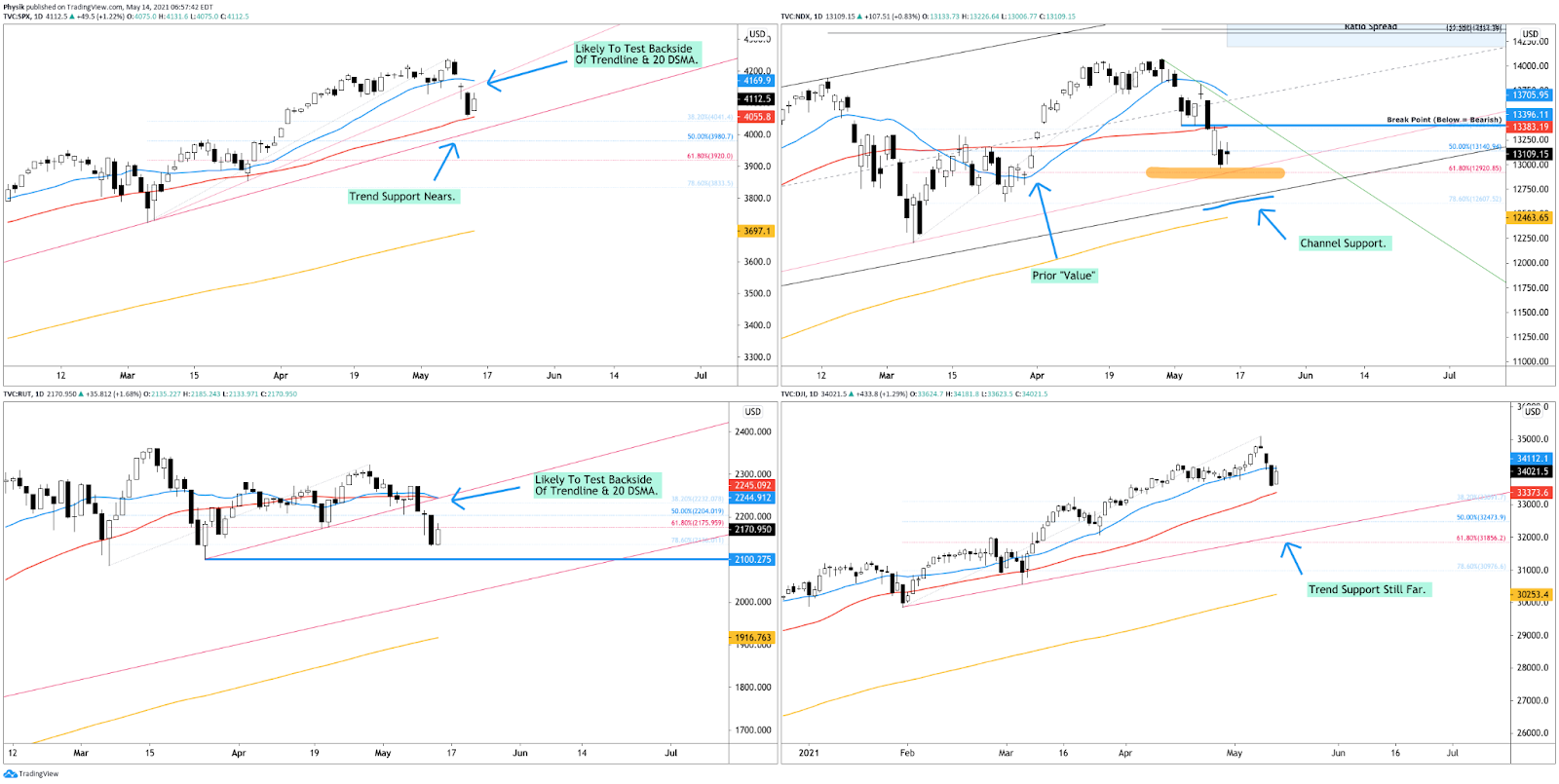
Graphic: Daily candlestick charts of the S&P 500 (top left), Nasdaq 100 (top right), Russell 2000 (bottom left), and Dow Jones Industrial Average (bottom right).
Graphic: Physik Invest maps out the purchase of call and put options in the SPDR S&P 500 ETF Trust (NYSE: SPY), for May 13. Activity in the options market was primarily concentrated in short-dated tenors, in strikes as low as $406.00, which corresponds with ~$4,080.00 in the cash-settled S&P 500 Index (INDEX: SPX).
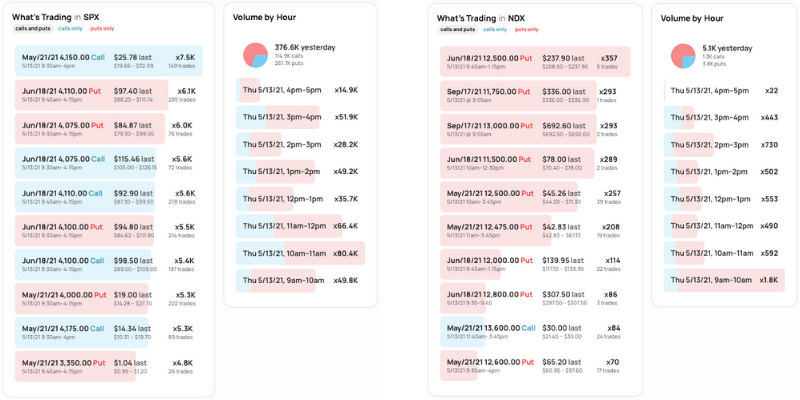
Graphic: SHIFT search suggests participants were most interested in put strikes at and below current prices in the cash-settled S&P 500 Index (INDEX: SPX) and Nasdaq 100 Index (INDEX: NDX), May 13. Participants, unlike in prior sessions, are positioning themselves in longer-dated expiries suggesting more commitment. 

News And Analysis

COVID-19 | CDC lifts most mask guidance in a key step back to normal. (BBG)

Markets | The automotive chip-shortage cost estimate surges to $110B. (BBG)

COVID-19 | Singapore moves back toward lockdown as virus cases rise. (BBG)

Finance | JPMorgan, others to issue credit cards to people with no credit. (WSJ)

Housing | The U.S. housing market is hot — but Canada’s is even hotter. (FP)

Markets | Hedge fund titans pitch their top stock picks at Sohn Event. (BBG)

M&A | Canadian National Railway beat Canadian Pacific in KCS offer. (FP)

What People Are Saying

Innovation And Emerging Trends

FinTech | Musk well-positioned to steer cryptocurrency’s direction of travel. (FT)

Markets | Distressed HFs sit on cash and compete for crumbs to invest in. (Axios)

FinTech | Cryptocurrency company Coinbase posts a record Q1 revenue. (Axios)

Housing | If you sell a house these days, the buyer might be a pension fund. (WSJ)

About

Renato founded Physik Invest after going through years of self-education, strategy development, and trial-and-error. His work reporting in the finance and technology space, interviewing leaders such as John Chambers, founder, and CEO, JC2 Ventures, Kevin O’Leary, businessman and Shark Tank host, Catherine Wood, CEO and CIO, ARK Invest, among others, afforded him the perspective and know-how very few come by.

Having worked in engineering and majored in economics, Renato is very detailed and analytical. His approach to the markets isn’t built on hope or guessing. Instead, he leverages the unique dynamics of time and volatility to efficiently act on opportunity.

 Disclaimer

At this time, Physik Invest does not manage outside capital and is not licensed. In no way should the materials herein be construed as advice. Derivatives carry a substantial risk of loss. All content is for informational purposes only.