Categories
Commentary

All You Need To Know For November 8, 2021

What Happened

Overnight, equity index futures auctioned sideways to higher alongside an absence in impactful fundamental developments and news catalysts.

Ahead, today, there are no major data releases scheduled.

In the following section, I unpack, in-depth, the fundamental and technical context shadowing recent trade. If you like what is said, consider sharing!
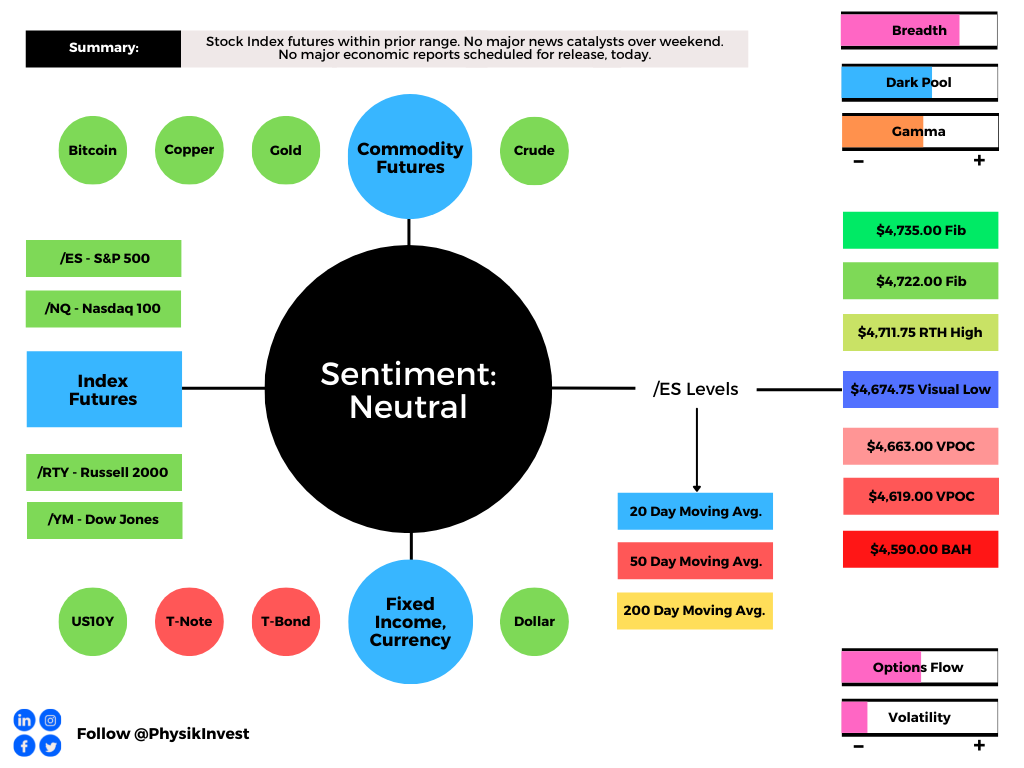
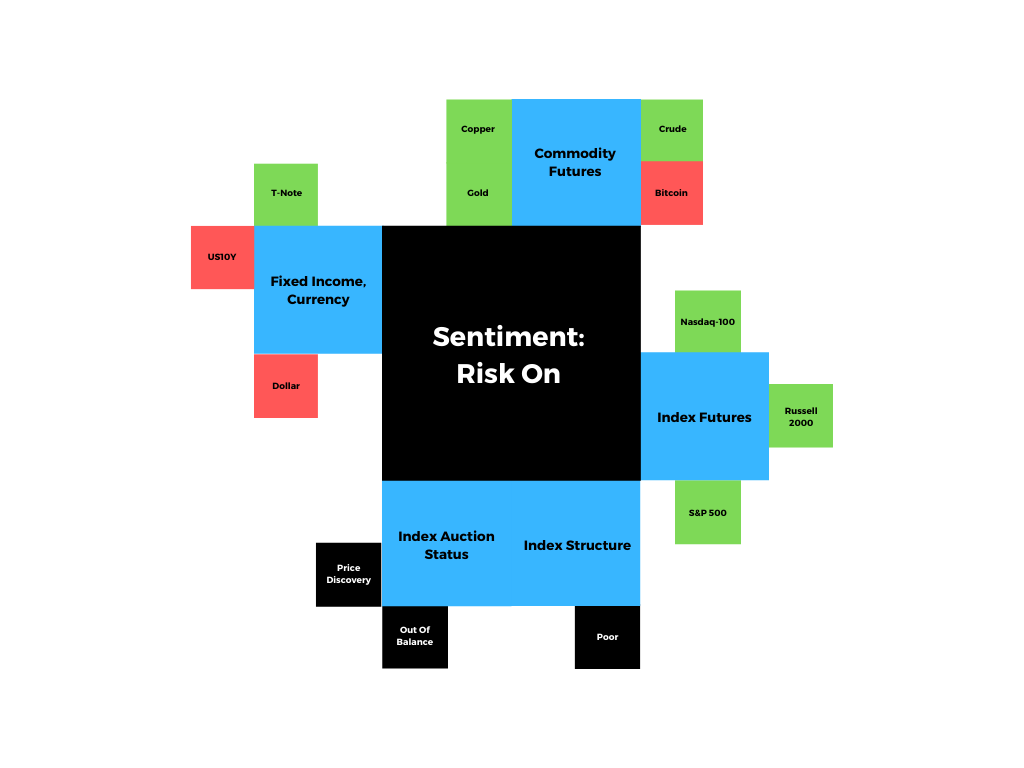
Graphic updated 6:30 AM ET. Sentiment Neutral if expected /ES open is inside of the prior day’s range. /ES levels are derived from the profile graphic at the bottom of the following section. Levels may have changed since initially quoted; click here for the latest levels. SqueezeMetrics Dark Pool Index (DIX) and Gamma (GEX) calculations are based on where the prior day’s reading falls with respect to the MAX and MIN of all occurrences available. A higher DIX is bullish. At the same time, the lower the GEX, the more (expected) volatility. Learn the implications of volatility, direction, and moneyness. SHIFT data used for S&P 500 (INDEX: SPX) options activity. Note that options flow is sorted by the call premium spent; if more positive then more was spent on call options. Breadth reflects a reading of the prior day’s NYSE Advance/Decline indicator. VIX reflects a current reading of the CBOE Volatility Index (INDEX: VIX) from 0-100.

What To Expect

On supportive intraday breadth and lackluster market liquidity metrics, the best case outcome occurred, evidenced by a gap and hold of newly discovered S&P 500 prices.

This activity, which marks a potential willingness to continue the trend, coincides with poor structure, a dynamic that adds to technical instability.
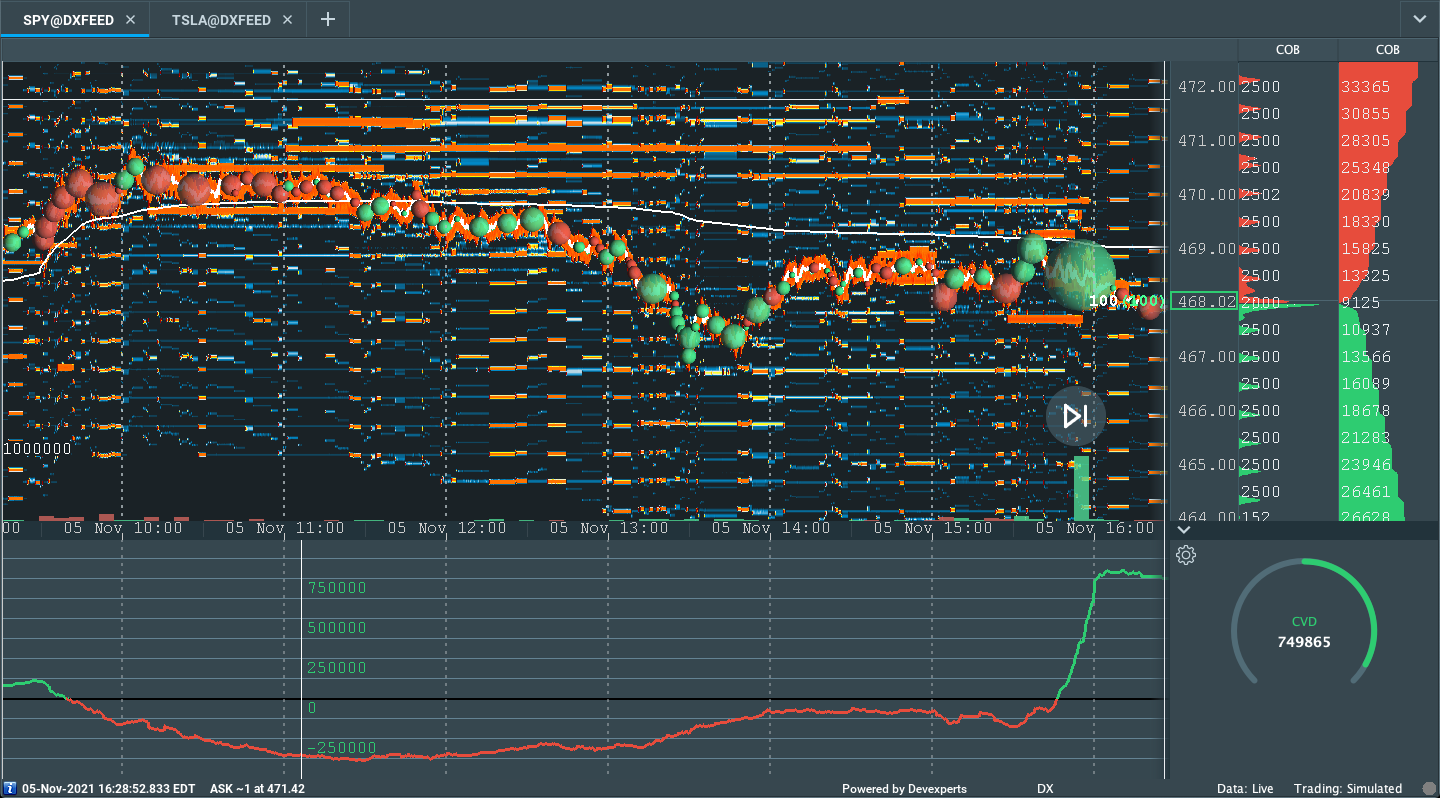
Graphic: Divergent delta (i.e., buying and selling power as calculated by the difference in volume traded at the bid and offer) in SPDR S&P 500 ETF Trust (NYSE: SPY). The readings are supportive of responsive trade (i.e., rotational trade that suggests current prices offer favorable entry and exit; the market is in balance).

Context: The aforementioned trade is happening in the context of interesting developments with respect to fiscal and monetary policy, as well as supply and demand imbalances.

To start, in regards to fiscal policy, ARK Invest’s Cathie Wood thinks that there will be no capital gains tax rate increases and an installment of a minimum corporate tax (about 15%). 

“I think that is one reason the market’s been rallying,” she said in an episode of In The Know

In sticking with Wood’s theses, why would the market be rallying if all that we (i.e., the market participants) see, in the news, is heavily focused around fears of inflation, so to speak? It wouldn’t; Wood feels that inflation is on its way out.

Major reasons? 

(1) Productivity increases will offset dented margins and therefore not lead to impactful price increases; (2) turmoil, with respect to China’s housing and financial sector, ought to depress commodity pricing further as “when China has caught a cold, commodity prices get pneumonia”; (3) at-home inventory build-ups may takeaway from consumption during the holidays (for which businesses are scrambling to increase inventories), and this ultimately should be reflected in commodity prices, given excess inventory; (4) disruptive innovation and declining cost curves.

“The markets are conflicting,” she explains. “You’ve got energy and financials at the top for the year, 54% and 35%, respectively. Those two sectors are associated with very strong boom time economies with a yield curve steepening, meaning long rates are rising faster than short rates.”

“That would be consistent with inflation, but the other two top-performing sectors are real estate and consumer discretionary, and those do not benefit from inflation. They benefit from inflation coming down and lower interest rates.”

The bond market, on the other hand, is in the lower inflation camp. At the same time, the dollar is going up alongside assets like bitcoin, often construed as an inflation hedge.

“Could this mean that the velocity of money is going down,” she asks. “Velocity of money has been coming down because people have been saving and putting money into assets.”

This dynamic is supported by disappointing GDP figures with growth coming mostly from inventories; “Real final sales were slightly negative. Could it be … that [millennials] would prefer not to spend on goods and services, but to invest?”

It seems that participants are increasingly extending moneyness to nonmonetary assets – given monetary policies and an environment of debt and leverage that ultimately cuts into asset price volatility – adding to the prevailing risks of carry when volatility does rise and the demand for money pushes deflation.

A great explainer on the growth of global carry is the book titled The Rise of Carry: The Dangerous Consequences of Volatility Suppression and the New Financial Order of Decaying Growth and Recurring Crisis.

“Ivy Zelman of Zelman Research came out this week. She made a fantastic call on the housing bubble and bust starting in 05-06, and she was right, just a little early. She is very concerned that the housing prices we’re seeing right now are not sustainable,” because of speculation, as well as iBuying and private equity participation. 

For instance, just last week, Zillow Group Inc (NASDAQ: Z), a major iBuyer, sought to raise liquidity, dumping properties en masse.

“This is unsustainable … and I’m wondering if even the housing market inflation is going to give way, here,” Wood added. 

That leads to the question: what effects will a taper and the eventual reduction in the Federal Reserve’s balance sheet – a removal of liquidity – have?

Thus far, given monetary frameworks and max liquidity, markets rallies have been enforced by some of the processes embedded within the volatility market

To quote Cem Karsan of Kai Volatility: “There’s this constant structural positioning that naturally drives markets higher as long as volatility is compressed, or there’s a supply of volatility.”

“As volatility is compressed, … the hedging vanna and charm flows, and whatnot will push the markets higher,” Karsan added in reference to options sliding down their term structure (vanna) and skew decaying (charm). Both dynamics have counterparties covering their hedges to the most dominant customer positioning in the market (i.e., short call, long put). 

With option volumes now comparable to stock volumes, related hedging flows can represent an increased share of volume in underlying stocks; “It’s not a coincidence that the mid-February to mid-March 2020 downturn literally started the day after February expiration and ended the day of March quarterly expiration. These derivatives are incredibly embedded in how the tail reacts and there’s not enough liquidity, given the leverage, if the Fed were to taper.”

Learn more about the implications of convexity, edge, and risk management, as well as Liquidity Cascades: The Coordinated Risk of Uncoordinated Market Participants.

Aside from a lot of these big picture dynamics – growing derivatives markets and tail risk, the heightened moneyness of nonmonetary assets, trends in seasonality, earnings surprises, and more – we have some more impactful near-term happenings to be aware of.
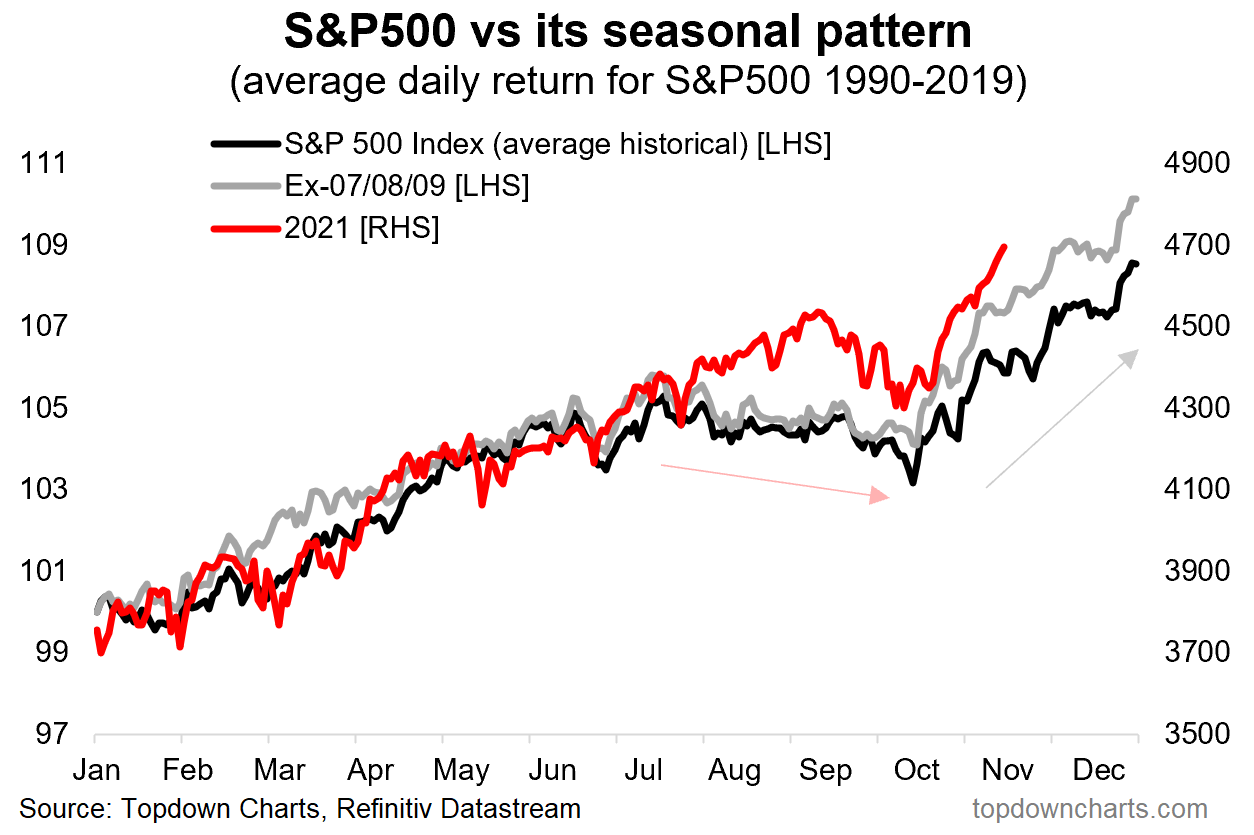
Graphic: “Whenever the market has been up 20%+ YTD through to October (like e.g. THIS YEAR), it has *always* had an up month in November (albeit with a n=8). Basically I would say it speaks to the momentum in the market, which despite the September stumble seems pretty much alive and well.” – Callum Thomas

The first is fragile positioning. The second is the monthly options expiration (OPEX). 

According to SqueezeMetrics analyses, “middling dark pool sentiment and middling gamma exposure [portends] … 1-month negative returns.”

Alongside that, according to data compiled and analyzed by Pat Hennessy, “2 weeks prior to OPEX (e.g., 7/30/21 to 8/6/21 in this late-cycle) [have] been extremely bullish,” while “OPEX week returns peaked in 2016 and have trended lower since.”
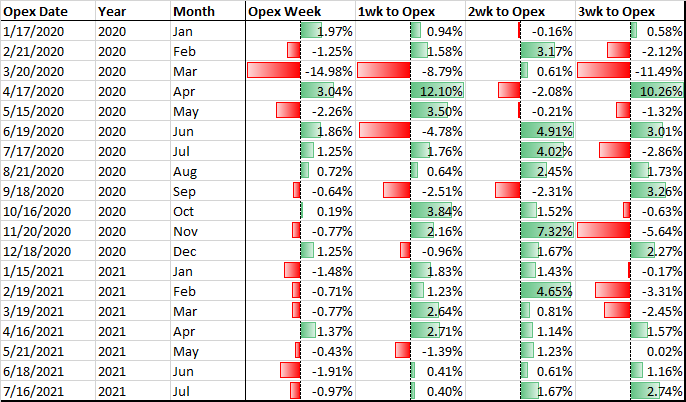
Graphic: @pat_hennessy breaks down returns for the S&P 500, categorized by the week relative to OPEX. 

This comes as investors marked the S&P 500 up to the $4,700.00 strike, at which positive gamma – delta sensitivity to underlying price – is highest. 

In referencing a note I wrote for SpotGamma, “as volatility continues to decline, the gamma of those options, which are now at the money, ought to increase, forcing counterparties to supply more liquidity.”

Ultimately, $4,700.00 ought to be a magnet (or resistance) into that aforementioned pre-OPEX weakness.

This is unless (1) volatility declines markedly, “a tailwind for the S&P complex as options slid[ing] down their term structure would cause dealers to continue covering their hedges in an asymmetric manner,” or (2) more capital is committed to options at higher strikes. 
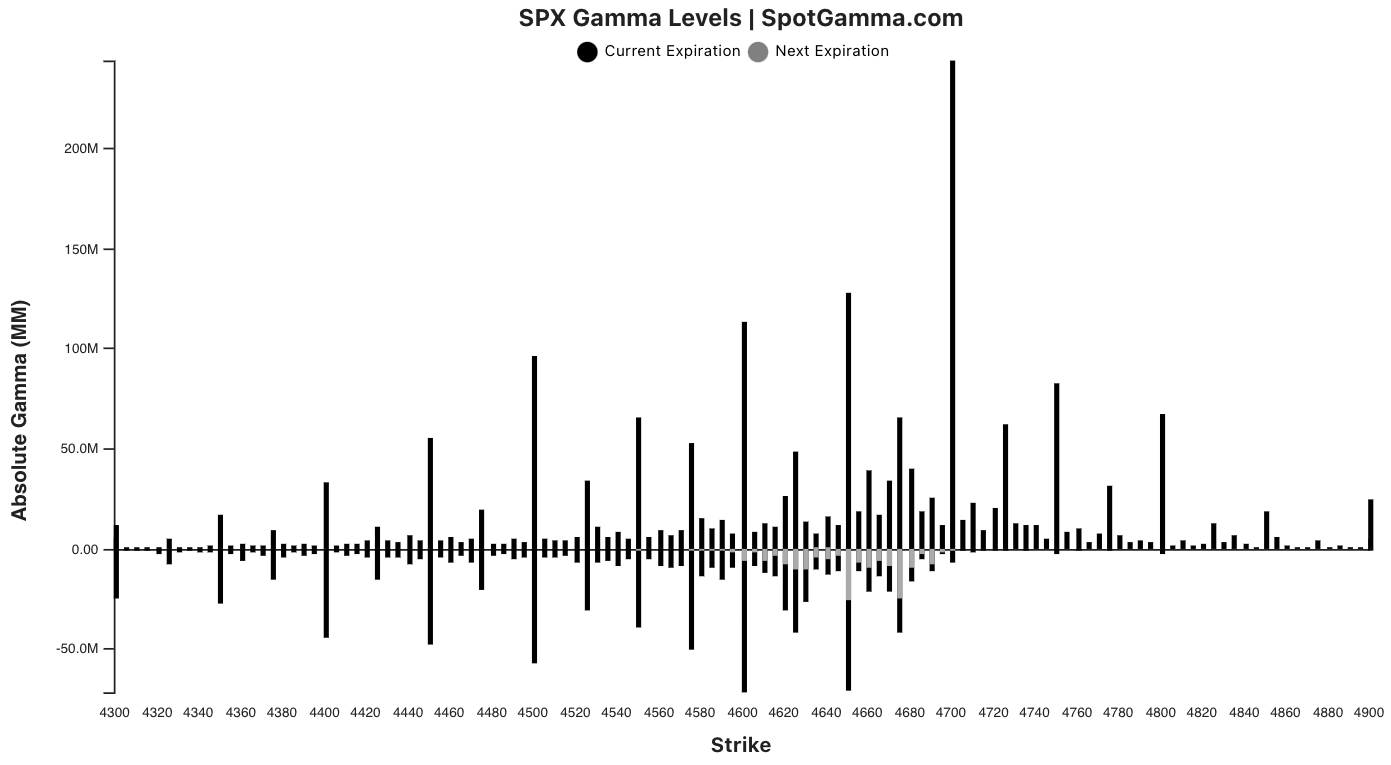
Graphic: SpotGamma shows large positive gamma at the $4,700.00 strike. “Large options strikes are considered to be support or resistance zones. The change in gamma at various levels over time can shed light on how traders are viewing the market (i.e., adding calls is bullish, puts bearish).”

Expectations: As of 6:30 AM ET, Monday’s regular session (9:30 AM – 4:00 PM ET), in the S&P 500, will likely open in the upper part of a positively skewed overnight inventory, inside of prior-range and -value, suggesting a limited potential for immediate directional opportunity.

Market Is In Balance: Current prices offer favorable entry and exit. Modus operandi is responsive trade (i.e., fade the edges), rather than initiative trade (i.e., play the break).

In the best case, the S&P 500 trades sideways or higher; activity above the $4,674.75 visual low (likely paid attention to by short-term, technically driven market participants who seldom defend retests) puts in play the $4,711.75 regular trade high (RTH High). Initiative trade beyond the RTH High could reach as high as the $4,722.00 and $4,735.00 Fibonacci, or higher.

In the worst case, the S&P 500 trades lower; activity below the $4,674.75 visual low puts in play the $4,663.00 untested point of control (VPOC). Initiative trade beyond the VPOC could reach as low as the $4,619.00 VPOC and $4,590.00 balance area boundary (BAH), or lower.

As an aside, the $4,674.75 visual low corresponds with the volume-weighted average price (VWAP) anchored at last week’s Federal Open Market Committee (FOMC) meeting. 

This is a metric highly regarded by chief investment officers, among other participants, for quality of trade. Additionally, liquidity algorithms are benchmarked and programmed to buy and sell around VWAPs.

Click here to load today’s updated key levels into the web-based TradingView charting platform. Note that all levels are derived using the 65-minute timeframe. New links are produced, daily.
Graphic: 65-minute profile chart of the Micro E-mini S&P 500 Futures. Learn about the profile.

Definitions

Gamma: Gamma is the sensitivity of an option to changes in the underlying price. Dealers that take the other side of options trades hedge their exposure to risk by buying and selling the underlying. When dealers are short-gamma, they hedge by buying into strength and selling into weakness. When dealers are long-gamma, they hedge by selling into strength and buying into weakness. The former exacerbates volatility. The latter calms volatility.

Vanna: The rate at which the delta of an option changes with respect to volatility.

Charm: The rate at which the delta of an option changes with respect to time.

POCs: POCs are valuable as they denote areas where two-sided trade was most prevalent in a prior day session. Participants will respond to future tests of value as they offer favorable entry and exit.

Options Expiration (OPEX): Traditionally, option expiries mark an end to pinning (i.e, the theory that market makers and institutions short options move stocks to the point where the greatest dollar value of contracts will expire) and the reduction dealer gamma exposure. In recent history, this reset in dealer positioning has been front-run; prior, there was an increase in volatility after the removal of large options positions and associated hedging.

About

After years of self-education, strategy development, and trial-and-error, Renato Leonard Capelj began trading full-time and founded Physik Invest to detail his methods, research, and performance in the markets.

Additionally, Capelj is a Benzinga finance and technology reporter interviewing the likes of Shark Tank’s Kevin O’Leary, JC2 Ventures’ John Chambers, and ARK Invest’s Catherine Wood, as well as a SpotGamma contributor, developing insights around impactful options market dynamics.

Disclaimer

At this time, Physik Invest does not manage outside capital and is not licensed. In no way should the materials herein be construed as advice. Derivatives carry a substantial risk of loss. All content is for informational purposes only.

Categories
Commentary

Daily Brief For October 29, 2021

Abstract

In sync with bonds, equity index futures were sideways to lower. Commodities were mixed. Volatility expanded.

  • Economic growth rate slows 2%.
  • Fed may not follow counterparts.
  • Increased prospects for volatility.

What Happened

U.S. stock index futures auctioned sideways to lower overnight, within the prior day’s range, as investors looked to price in emerging dynamics with respect to slower growth and inflation, as well as the risks of a taper in asset purchases and a hike in interest rates. 

Ahead is data on income, consumer spending, core inflation, and the employment cost index (8:30 AM ET), as well as Chicago PMI (9:45 AM ET), consumer sentiment, and inflation expectations (10:00 AM ET).

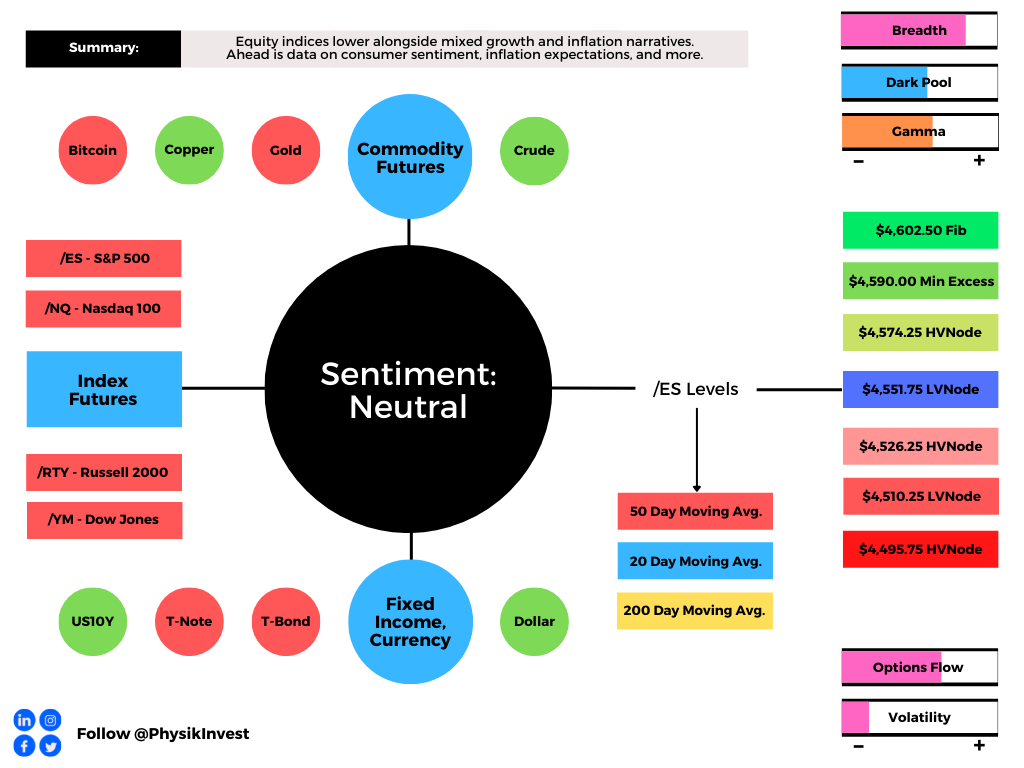
Graphic updated 7:00 AM ET. Sentiment Neutral if expected /ES open is inside of the prior day’s range. /ES levels are derived from the profile graphic at the bottom of the following section. Levels may have changed since initially quoted; click here for the latest levels. SqueezeMetrics Dark Pool Index (DIX) and Gamma (GEX) calculations are based on where the prior day’s reading falls with respect to the MAX and MIN of all occurrences available. A higher DIX is bullish. At the same time, the lower the GEX, the more (expected) volatility. Learn the implications of volatility, direction, and moneyness. SHIFT data used for S&P 500 (INDEX: SPX) options activity. Note that options flow is sorted by the call premium spent; if more positive then more was spent on call options. Breadth reflects a reading of the prior day’s NYSE Advance/Decline indicator. VIX reflects a current reading of the CBOE Volatility Index (INDEX: VIX) from 0-100.

What To Expect

Action: During the prior day’s regular trade, on supportive intraday breadth and market liquidity metrics, the best case outcome occurred, evidenced by a spike above current S&P 500 (INDEX: SPX) (ETF: SPY) (FUTURE: /ES) prices.

Intent: The spike marked a willingness to continue the trend.

Validation: Overnight, Thursday’s end-of-day price discovery, away from value, was not validated; after two weeks of markup, participants are likely basing ahead of new information.

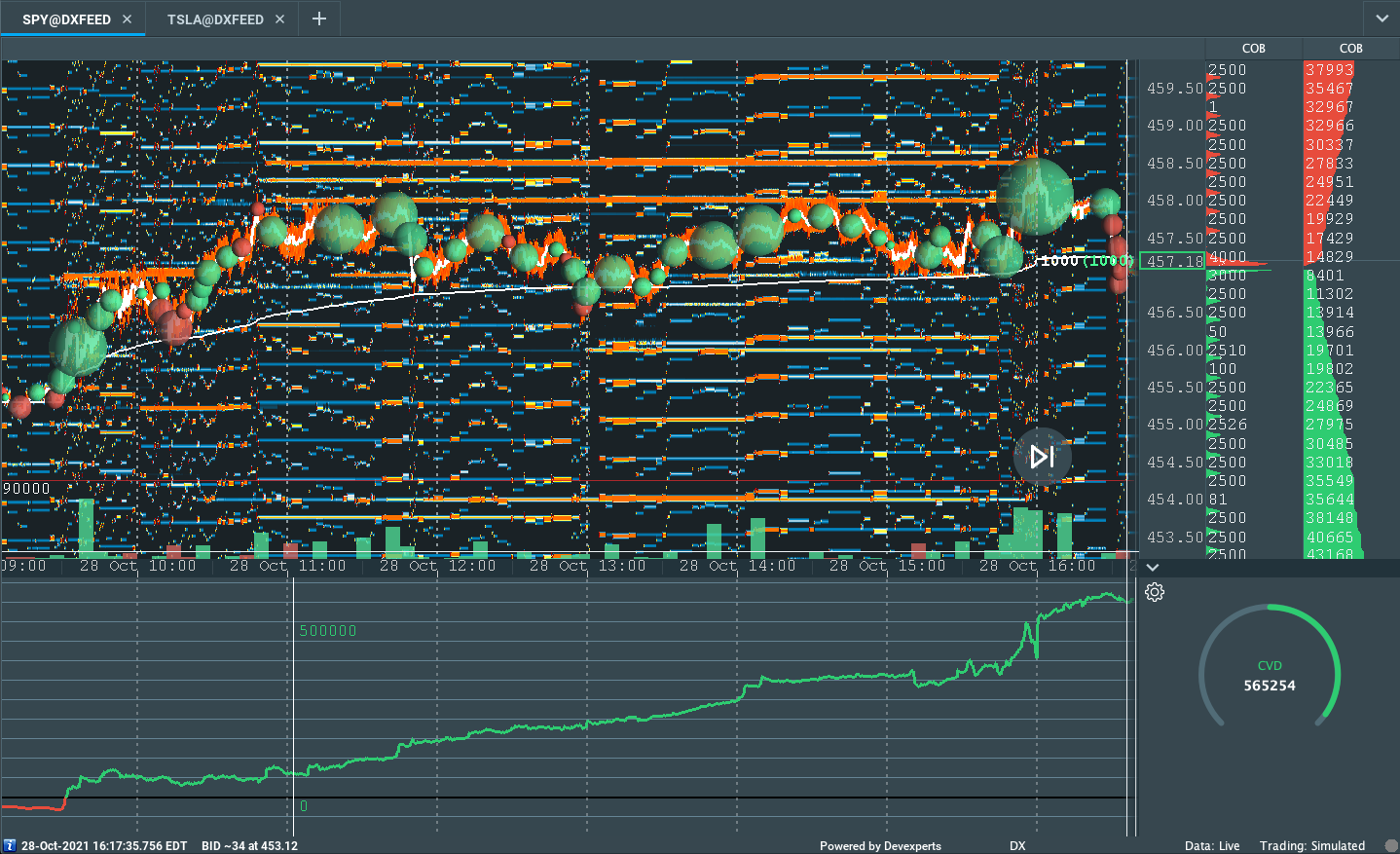
Graphic: Supportive delta (i.e., committed buying as measured by volume delta or buying and selling power as calculated by the difference in volume traded at the bid and offer) in SPDR S&P 500 ETF Trust (NYSE: SPY), one of the largest ETFs that track the S&P 500 index, via Bookmap.

Context: After unimpressive earnings results by Amazon Inc (NASDAQ: AMZN) and Apple Inc (NASDAQ: AAPL), on no substantial change in volume and minimal expansion of range, we see the Nasdaq 100 (INDEX: NDX) (ETF: QQQ) (FUTURE: /NQ) trading weak, relative to its peers. 

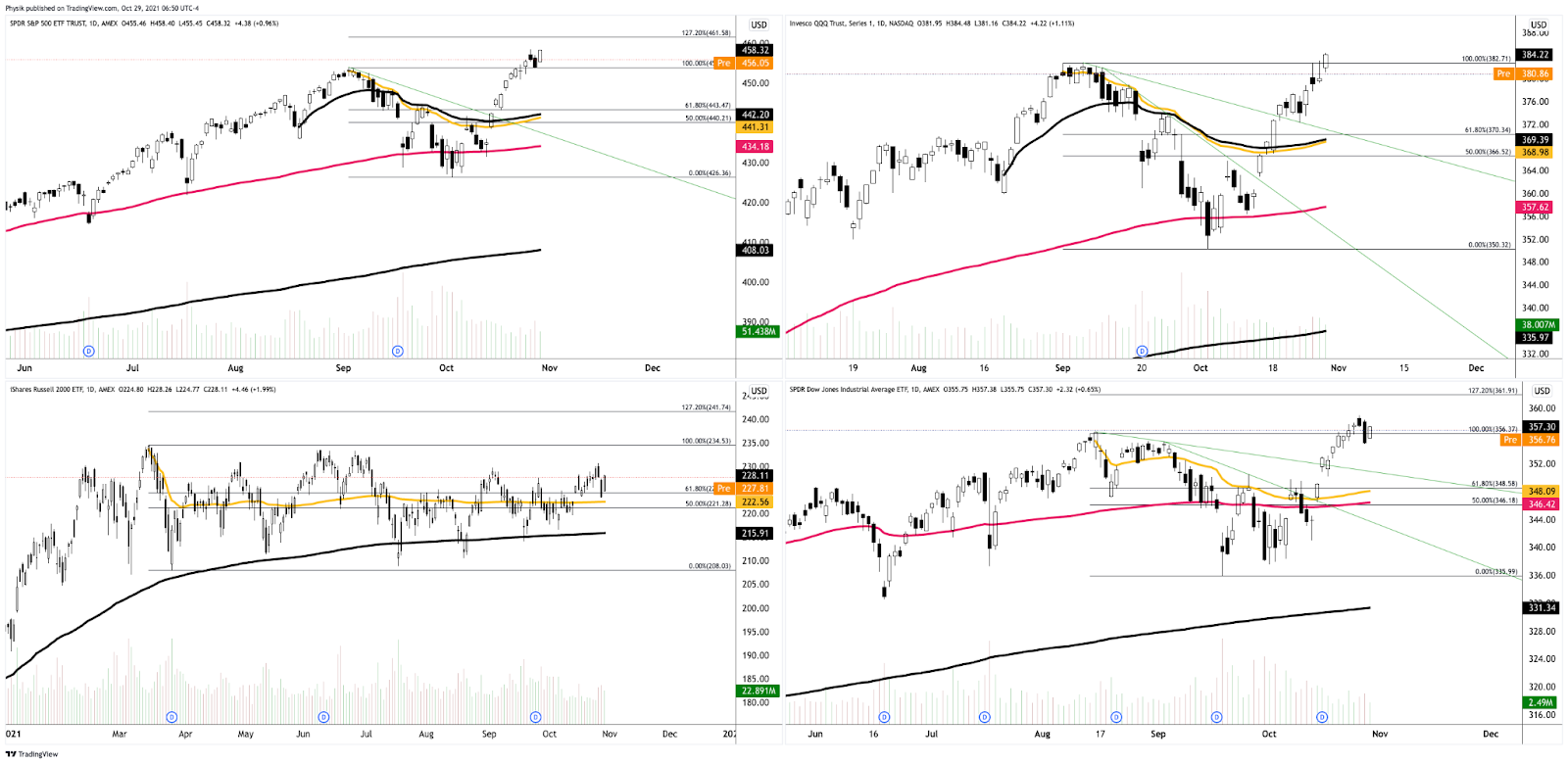
This comes as three of the major indices (pictured below) struggle to maintain prices above their September peaks.

Still, as evidenced by where the indices are in relation to their yellow volume-weighted average price (VWAP) indicators, the average buyer, since the last major peak, is in a profitable position. 

Should indices snap lower, those VWAPs ought to serve as dynamic support levels.

Graphic: SPDR S&P 500 ETF (NYSE: SPY) top left, Invesco QQQ Trust Series 1 (NASDAQ: QQQ) top right, iShares Russell 2000 ETF (NYSE: IWM) bottom left, SPDR Dow Jones Industrial Average ETF Trust (NYSE: DIA) bottom right. The S&P 500, in particular, is out of balance on the weekly and monthly, in balance on the daily.

Further, the aforementioned trade is happening in the context of slowing growth, as well as the risks of a taper in asset purchases and a hike in interest rates.

According to a note by The Market Ear, however, JPMorgan Chase & Co’s (NYSE: JPM) Jay Barry believes “Inflation developments have been global in nature and inflation is indeed proving to be less transitory than previously expected.”

“Our understanding of the Fed’s reaction function, as well as our view on likely compositional changes on the FOMC, leads us to believe that the Fed is unlikely to follow its British and Canadian counterparts in raising rates too early simply on inflation concerns.”

In terms of positioning, the CBOE Volatility Index (INDEX: VIX) was higher, while the VIX futures term structure settled in contango, shifting a tad higher across the entire curve. That dynamic, coupled with the long-gamma environment, signals a potential for very near-term stability.

On the other hand, according to SqueezeMetrics analyses, “middling dark pool sentiment and middling gamma exposure [portends] … 1-month negative returns.”

That’s in line with what SpotGamma sees as a potential window for volatility – given OPEX – into next week’s Federal Open Market Committee (FOMC) meeting.

“It’s likely that traders will not look to sell volatility on Monday/Tuesday (pre-Fed) which could bring a pause to this market rise.”

Expectations: As of 7:00 AM ET, Friday’s regular session (9:30 AM – 4:00 PM ET) in the S&P 500 will likely open in the lower part of a negatively skewed overnight inventory, inside of prior-range and -value, suggesting a limited potential for immediate directional opportunity.

Balance-Break Scenarios: A change in the market (i.e., the transition from two-time frame trade, or balance, to one-time frame trade, or trend) may occur.

Monitor for acceptance (i.e., more than 1-hour of trade) outside of the balance area. Rejection (i.e., return inside of balance) portends a move to the opposite end of the balance.

In the best case, the S&P 500 trades sideways or higher; activity above the $4,551.75 low volume area (LVNode) puts in play the $4,574.25 high volume area (HVNode). Initiative trade beyond the $4,574.25 HVNode could reach as high as the $4,590.00 minimal excess high and $4,602.50 Fibonacci extension, or higher.

In the worst case, the S&P 500 trades lower; activity below the $4,551.75 LVNode puts in play the $4,526.25 HVNode. Initiative trade beyond the $4,526.25 HVNode could reach as low as the $4,510.25 LVNode and $4,495.75 HVNode, or lower.

Click here to load today’s updated key levels into the web-based TradingView charting platform. Note that all levels are derived using the 65-minute timeframe. New links are produced, daily.
Graphic: 65-minute profile chart of the Micro E-mini S&P 500 Futures. Learn about the profile.

What People Are Saying

Definitions

Spikes: Spike’s mark the beginning of a break from value. Spikes higher (lower) are validated by trade at or above (below) the spike base (i.e., the origin of the spike).

Volume Areas: A structurally sound market will build on areas of high volume (HVNodes). Should the market trend for long periods of time, it will lack sound structure, identified as low volume areas (LVNodes). LVNodes denote directional conviction and ought to offer support on any test. 

If participants were to auction and find acceptance into areas of prior low volume (LVNodes), then future discovery ought to be volatile and quick as participants look to HVNodes for favorable entry or exit.

Gamma: Gamma is the sensitivity of an option to changes in the underlying price. Dealers that take the other side of options trades hedge their exposure to risk by buying and selling the underlying. When dealers are short-gamma, they hedge by buying into strength and selling into weakness. When dealers are long-gamma, they hedge by selling into strength and buying into weakness. The former exacerbates volatility. The latter calms volatility.

Options Expiration (OPEX): Traditionally, option expiries mark an end to pinning (i.e, the theory that market makers and institutions short options move stocks to the point where the greatest dollar value of contracts will expire) and the reduction dealer gamma exposure. In recent history, this reset in dealer positioning has been front-run; prior, there was an increase in volatility after the removal of large options positions and associated hedging.

Excess: A proper end to price discovery; the market travels too far while advertising prices. Responsive, other-timeframe (OTF) participants aggressively enter the market, leaving tails or gaps which denote unfair prices.

Volume-Weighted Average Prices (VWAPs): A metric highly regarded by chief investment officers, among other participants, for quality of trade. Additionally, liquidity algorithms are benchmarked and programmed to buy and sell around VWAPs.

About

After years of self-education, strategy development, and trial-and-error, Renato Leonard Capelj began trading full-time and founded Physik Invest to detail his methods, research, and performance in the markets. 

Additionally, Capelj is a finance and technology reporter. Some of his biggest works include interviews with leaders such as John Chambers, founder and CEO, JC2 Ventures, Kevin O’Leary, businessman and Shark Tank host, Catherine Wood, CEO and CIO, ARK Invest, among others.

Disclaimer

At this time, Physik Invest does not manage outside capital and is not licensed. In no way should the materials herein be construed as advice. Derivatives carry a substantial risk of loss. All content is for informational purposes only.
Categories
Commentary

Daily Brief For August 30, 2021

Market Commentary

Equity index futures, bonds, dollar, VIX sideways to higher. Commodities were mixed.

  • Positioning lightened. Ample liquidity.
  • Ahead: Data on pending home sales.

What Happened: U.S. stock index futures auctioned sideways to higher overnight alongside news that the Federal Reserve would not make changes to its policy.

Ahead is data on pending home sales (10:00 AM ET).

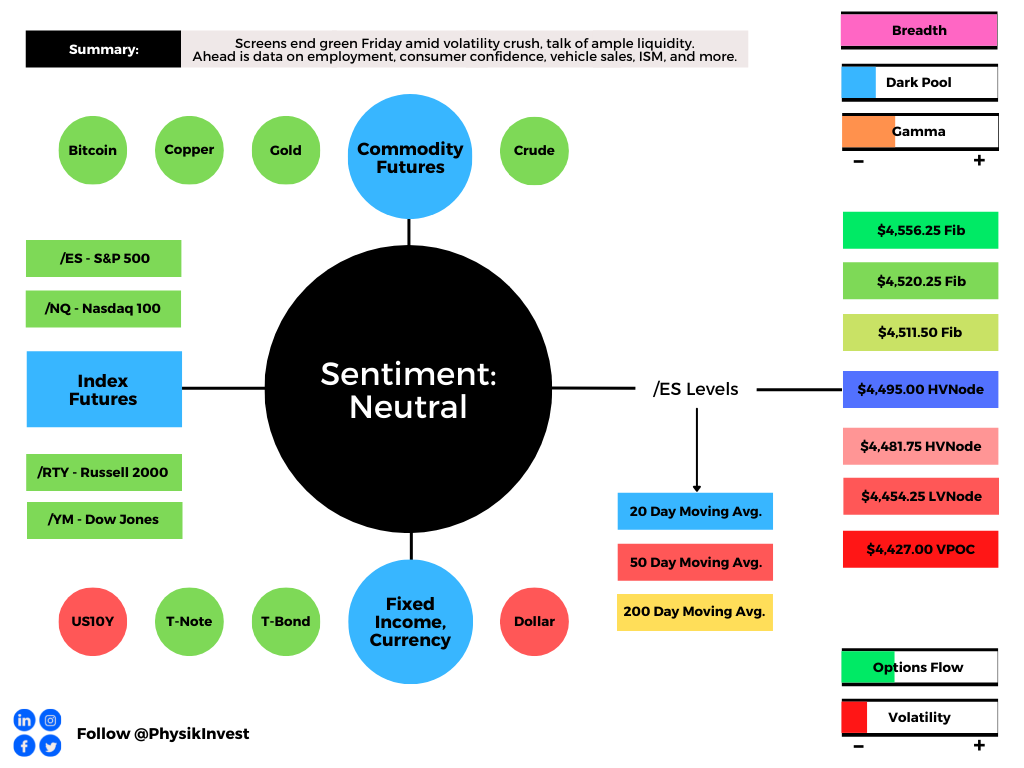
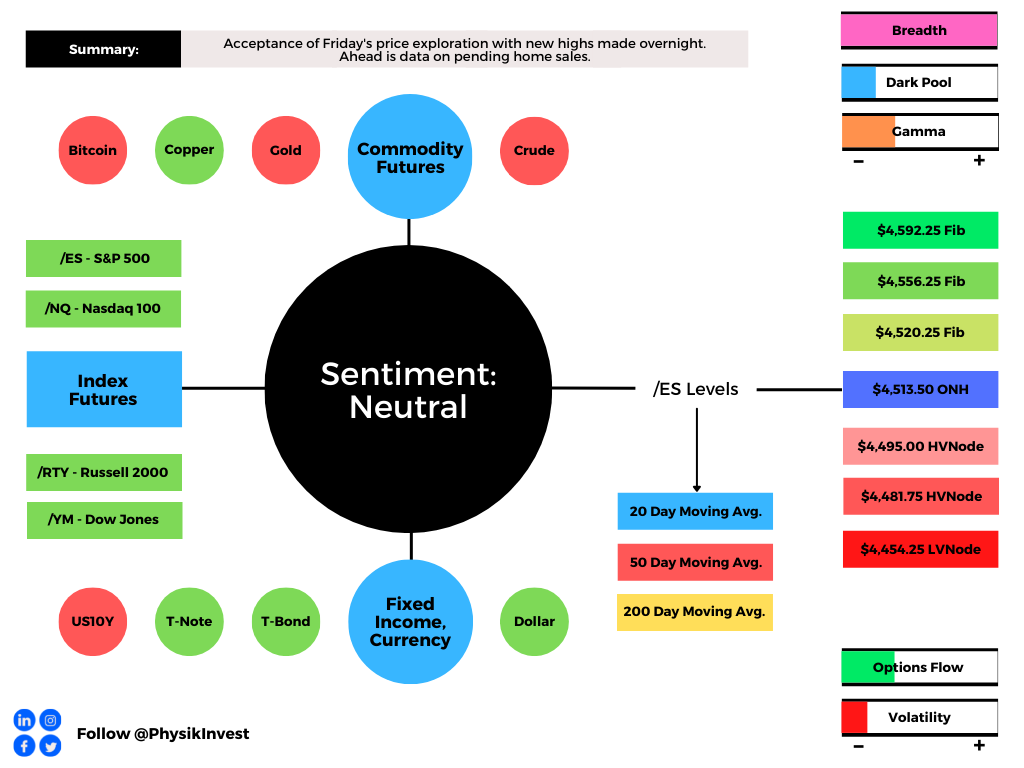
Graphic updated 6:30 AM ET. Sentiment Neutral if expected /ES open is inside of the prior day’s range. SqueezeMetrics Dark Pool Index (DIX) and Gamma (GEX) calculations are based on where the prior day’s reading falls with respect to the MAX and MIN of all occurrences available. A higher DIX is bullish. At the same time, the lower the GEX, the more (expected) volatility. SHIFT data used for S&P 500 (INDEX: SPX) options activity approximation. Note that options flow is sorted by the call premium spent; if more positive then more was spent on call options. Breadth reflects a reading of the prior day’s NYSE Advance/Decline indicator. VIX reflects a current reading of the CBOE Volatility Index (INDEX: VIX) from 0-100.

What To Expect: As of 6:30 AM ET, Monday’s regular session (9:30 AM – 4:00 PM EST) in the S&P 500 will likely open near prior-range and -value, suggesting a more limited potential for immediate directional opportunity.

Adding, during the prior day’s regular trade, on strong intraday breadth and lackluster market liquidity metrics, the best case outcome occurred, evidenced by new all-time highs in the S&P 500 and Nasdaq 100. This is significant because it suggests continued bullishness after a v-pattern recovery.

V-Pattern: A pattern that forms after a market establishes a high, retests some support, and then breaks above said high. In most cases, this pattern portends continuation.

Further, the aforementioned trade is happening in the context of the Federal Reserve’s commitment to stay the course with respect to monetary policy. This theme’s implications on price are supportive; to elaborate, the absence of a rate hike or taper, alongside low bond and equity market volatility, among other things, suggests liquidity will remain ample.

The key for this week is U.S. jobs data later; those metrics will allow participants to better contextualize the taper timeline. At the same time, there’s been a cooling amongst some positioning metrics, also.

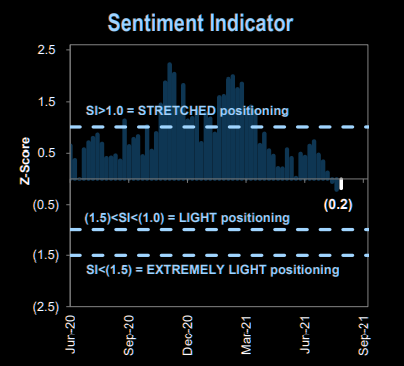
Graphic: Goldman Sachs Group Inc (NYSE: GS) Sentiment Indicator. According to The Market Ear, the “indicator measures stock positioning across retail, institutional, and foreign investors versus the past 12 months. Readings below -1.0 or above +1.0 indicate extreme positions that are significant in predicting future returns.”

Moreover, for today, given poor structure, a divergent volume delta Friday, as well as a decline in metrics like DIX and GEX, the odds of significant upside volatility are lower. Still, participants may make use of the following objective frameworks for today’s trade.

In the best case, the S&P 500 trades sideways or higher; activity above the $4,513.50 overnight high (ONH) puts in play the $4,520.25 Fibonacci extension. Initiative trade beyond the Fibonacci level could reach as high as $4,556.25 and $4,592.25, two other key Fibonacci extensions.

In the worst case, the S&P 500 trades lower; activity below the $4,513.50 ONH puts in play the $4,495.00 high volume area (HVNode). Initiative trade beyond the $4,495.00 HVNode could reach as low as the $4,481.75 HVNode and $4,454.25 LVNode, or lower. 

To note, the $4,454.25 LVNode corresponds with an anchored volume-weighted average price (VWAP), a metric highly regarded by chief investment officers, among other participants, for quality of trade. Additionally, liquidity algorithms are benchmarked and programmed to buy and sell around VWAPs.

Overnight Rally Highs (Lows): Typically, there is a low historical probability associated with overnight rally-highs (lows) ending the upside (downside) discovery process.

Volume Areas: A structurally sound market will build on past areas of high volume. Should the market trend for long periods of time, it will lack sound structure (identified as a low volume area which denotes directional conviction and ought to offer support on any test). 

If participants were to auction and find acceptance into areas of prior low volume, then future discovery ought to be volatile and quick as participants look to areas of high volume for favorable entry or exit.

Volume Delta: Buying and selling power as calculated by the difference in volume traded at the bid and offer.

DIX: For every buyer is a seller (usually a market maker). Using DIX — which is derived from short sales (i.e., liquidity provision on the market-making side) — we can measure buying pressure.

Gamma: Gamma is the sensitivity of an option to changes in the underlying price. Dealers that take the other side of options trades hedge their exposure to risk by buying and selling the underlying. When dealers are short-gamma, they hedge by buying into strength and selling into weakness. When dealers are long-gamma, they hedge by selling into strength and buying into weakness. The former exacerbates volatility. The latter calms volatility.
Graphic: 65-minute profile chart of the Micro E-mini S&P 500 Futures updated 6:30 AM ET.

News And Analysis

Banks are effectively sterilizing central bank liquidity.

Morgan Stanley eyes mid-cycle transition, correction.

An options turn upheavals into mid-month sure thing.

Ida made landfall in Louisiana, stronger than Katrina.

Sustained vaccine demand to support pharma growth.

Billionaire Paulson is calling cryptocurrency a bubble.

Crypto nomads – surfing the world for risk and profit.

Cadano’s Ada is the latest cryptocurrency surging up.

What People Are Saying

About

After years of self-education, strategy development, and trial-and-error, Renato Leonard Capelj began trading full-time and founded Physik Invest to detail his methods, research, and performance in the markets. 

Additionally, Capelj is a finance and technology reporter. Some of his biggest works include interviews with leaders such as John Chambers, founder and CEO, JC2 Ventures, Kevin O’Leary, businessman and Shark Tank host, Catherine Wood, CEO and CIO, ARK Invest, among others.

Disclaimer

At this time, Physik Invest does not manage outside capital and is not licensed. In no way should the materials herein be construed as advice. Derivatives carry a substantial risk of loss. All content is for informational purposes only.
Categories
Commentary

Weekly Brief For August 29, 2021

Editor’s Note: If this commentary was valuable to you, consider forwarding it to your peers. Alternatively, share on social media and tag either @renatolcapelj or @physikinvest.

Wishing you good health and success!

Market Commentary

Equity index, bond, and commodity futures traded higher Friday. The VIX, US10Y, and dollar were sideways to lower.

  • What happened and things to expect.
  • Ahead is important employment data.
  • Trade Idea: Complex spread in GME.
  • Expecting less volatility to the upside.

What Happened: U.S. stock index futures auctioned sideways to higher last week alongside impactful events like the Federal Reserve’s Jackson Hole Economic Symposium. 

Ahead this coming week is important data on employment, consumer confidence, vehicle sales, manufacturing, and more. See here for updated calendar data.

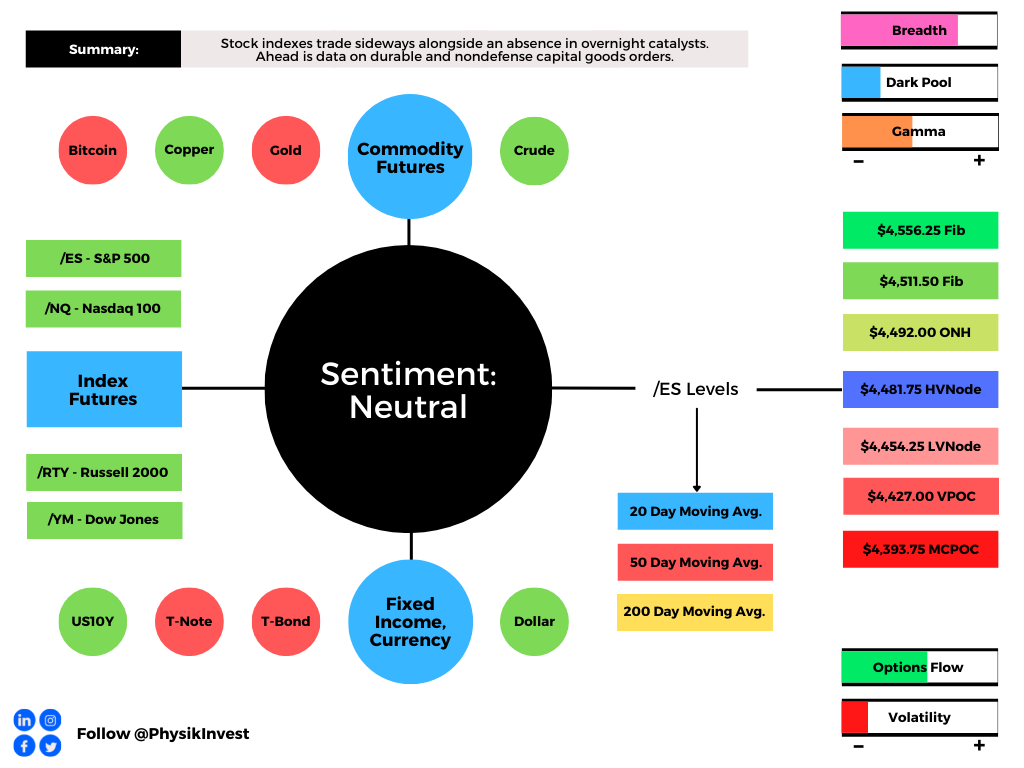
Graphic updated 7:30 AM ET Sunday. Sentiment Neutral if expected /ES open is inside of the prior day’s range. SqueezeMetrics Dark Pool Index (DIX) and Gamma (GEX) calculations are based on where the prior day’s reading falls with respect to the MAX and MIN of all occurrences available. A higher DIX is bullish. At the same time, the lower the GEX, the more (expected) volatility. SHIFT data used for S&P 500 (INDEX: SPX) options activity approximation. Note that options flow is sorted by the call premium spent; if more positive then more was spent on call options. Breadth reflects a reading of the prior day’s NYSE Advance/Decline indicator. VIX reflects a current reading of the CBOE Volatility Index (INDEX: VIX) from 0-100.

What To Expect: During the prior week’s trade, on mostly strong intraday breadth and market liquidity metrics, the best case outcome occurred, evidenced by new all-time highs in the S&P 500 and Nasdaq 100. This is significant because it suggests continued bullishness after a v-pattern recovery.

V-Pattern: A pattern that forms after a market establishes a high, retests some support, and then breaks above said high. In most cases, this pattern portends continuation.
Graphic: Ally Financial Inc-owned (NYSE: ALLY) Ally Invest chart shows S&P 500 defending advance.

Further, the aforementioned trade is happening in the context of the Jackson Hole Economic Symposium. This event’s implications on price are supportive

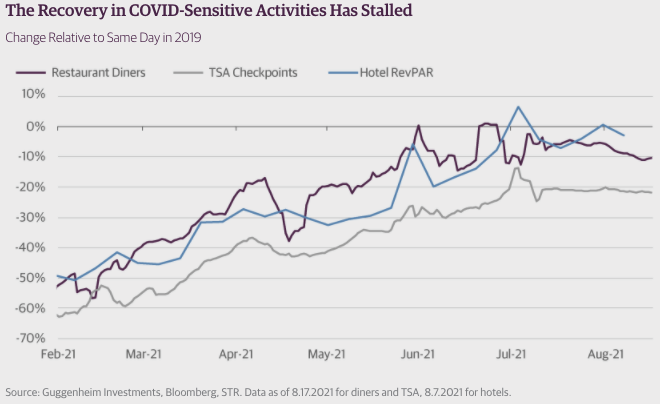
To elaborate, given a slow down in the pace of the post-pandemic recovery, the Federal Reserve (i.e., Fed) decided not to manipulate policy to offset temporary factors. The reason being, policy effects are often delayed; doing something now could curb the recovery. 

Graphic: Guggenheim Investments unpacks the impact of weaker data on monetary policy.

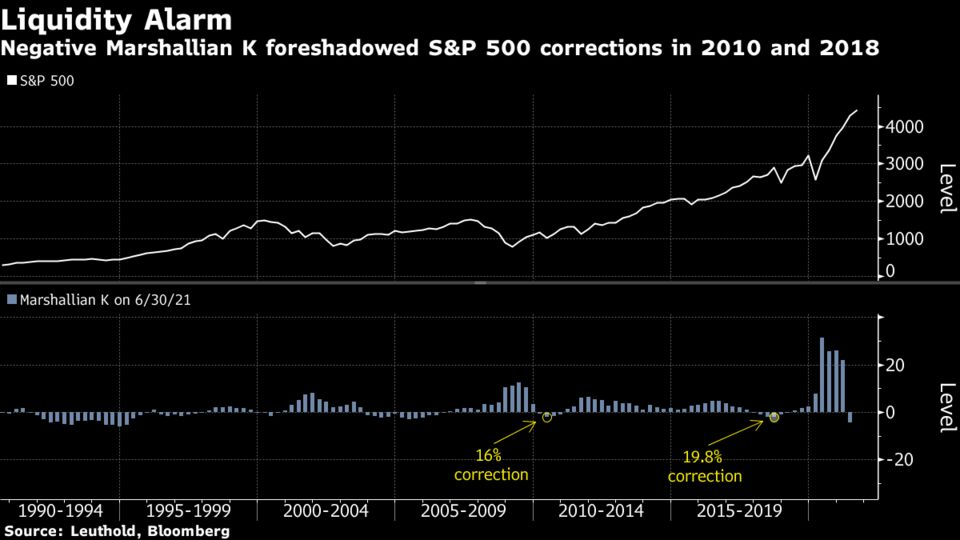
At the same time, with measures like the Marshallian K – the difference between year-over-year growth in M2 money supply and GDP – turning negative, there are concerns around liquidity and its impact on the equity market.

Graphic: According to Bloomberg, “While stocks kept rising during frequent negative Marshallian K readings in the 1990s, the pattern since the 2008 global financial crisis — a period when the central bank was in what Ramsey calls a “perpetual crisis mode” — begs for caution.”

According to Moody’s, however, “it will take a while before liquidity concerns are justified even with the Fed likely to begin tapering its $120 billion in monthly asset purchases either late this year or early next.”

Why? Well, for starters, if liquidity was an issue, financial institutions wouldn’t be parking that much money at the Fed. Low volatility in the bond and stock market also implies ample liquidity, Moody’s adds.

So, by not rapidly reducing its asset purchases, the Fed isn’t worried about the economy overheating due to non-temporary inflation; instead, Chairman Jerome Powell maintains that “[o]verall global deflationary trends remain in force.”

Eventually, though, after progress is made on full employment, the Fed will taper, likely keeping inflation expectations in line.

To note, last week’s straight-up trade came alongside the so-called sale of any volatility spike which can – through the process of hedging – support the market. Here’s just one example that received a lot of attention.

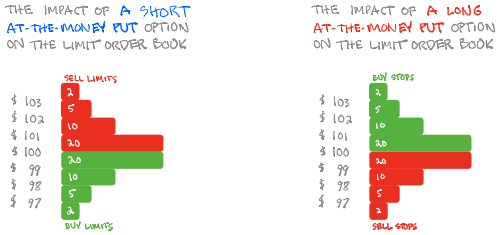
“In theory, if a stock was dropping and the retail masses all started to sell puts, they could push market makers to start buying large blocks of shares,” SpotGamma, an important voice in the space, says. “This could stabilize a dropping stock.”

Graphic: SqueezeMetrics details the implications of customer activity in the options market, on the underlying’s order book. For instance, in selling a put, customers add liquidity and stabilize the market. How? The counterparty long the put will buy (sell) the underlying to neutralize directional risk as price falls (rises).

Moreover, given a divergent volume delta and decline in metrics like DIX and GEX, the odds of significant upside volatility are lower. Still, participants may make use of the following objective frameworks for next week’s trade. Check for updated levels in Monday morning’s commentary.

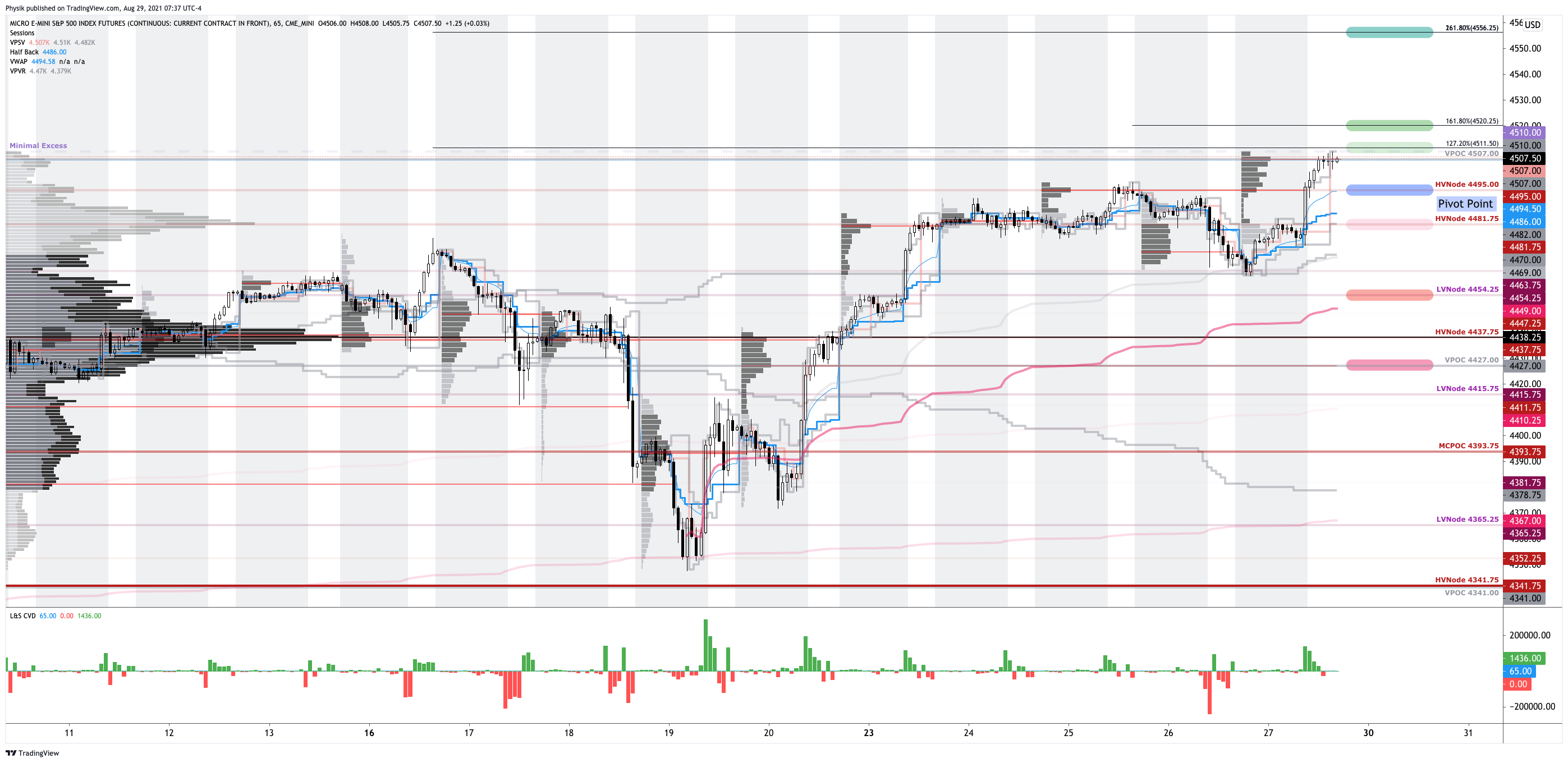
In the best case, the S&P 500 trades sideways or higher; activity above the $4,495.00 high volume area (HVNode) pivot puts in play the minimal excess all-time high and $4,511.50 Fibonacci extension. Initiative trade beyond the $4,511.50 level could reach as high as the $4,520.25 and $4,556.25 extensions.

In the worst case, the S&P 500 trades lower; activity below the $4,495.00 HVNode puts in play the $4,481.75 HVNode. Initiative trade beyond the $4,481.75 HVNode could reach as low as the $4,454.25 low volume area (LVNode) and $4,427.00 untested point of control (VPOC).

To note, the $4,454.25 LVNode corresponds with an anchored volume-weighted average price (VWAP), a metric highly regarded by chief investment officers, among other participants, for quality of trade. Additionally, liquidity algorithms are benchmarked and programmed to buy and sell around VWAPs.

Volume Delta: Buying and selling power as calculated by the difference in volume traded at the bid and offer.

DIX: For every buyer is a seller (usually a market maker). Using DIX — which is derived from short sales (i.e., liquidity provision on the market-making side) — we can measure buying pressure.

Gamma: Gamma is the sensitivity of an option to changes in the underlying price. Dealers that take the other side of options trades hedge their exposure to risk by buying and selling the underlying. When dealers are short-gamma, they hedge by buying into strength and selling into weakness. When dealers are long-gamma, they hedge by selling into strength and buying into weakness. The former exacerbates volatility. The latter calms volatility.

Volume Areas: A structurally sound market will build on past areas of high volume. Should the market trend for long periods of time, it will lack sound structure (identified as a low volume area which denotes directional conviction and ought to offer support on any test). 

If participants were to auction and find acceptance into areas of prior low volume, then future discovery ought to be volatile and quick as participants look to areas of high volume for favorable entry or exit.

Excess: A proper end to price discovery; the market travels too far while advertising prices. Responsive, other-timeframe (OTF) participants aggressively enter the market, leaving tails or gaps which denote unfair prices.

POCs: POCs are valuable as they denote areas where two-sided trade was most prevalent. Participants will respond to future tests of value as they offer favorable entry and exit.
Graphic: 65-minute profile chart of the Micro E-mini S&P 500 Futures updated 7:30 AM ET Sunday.

Weekly Trade Idea

Please Note: In no way is the below a trade recommendation. It is a peek into the thought process here at Physik Invest.

Options offer an efficient way to gain directional exposure. 

If an option buyer was short (long) stock, he or she could buy a call (put) to hedge upside (downside) exposure. Additionally, one can spread, or buy (+) and sell (-) options together, strategically.

Commonly discussed spreads include credit, debit, ratio, back, and calendar.

Credit: Sell -1 option closer to the money. Buy +1 option farther out of the money.

Debit: Buy +1 option closer to the money. Sell -1 option farther out of the money.

Ratio: Buy +1 option closer to the money. Sell -2 options farther out of the money. 

Back: Sell -1 option closer to the money. Buy +2 options farther out of the money.

Calendar: Sell -1 option. Buy +1 option farther out in time, at the same strike.

Typically, if bullish (bearish), sell at-the-money put (call) credit spread and/or buy a call (put) debit/ratio spread structured around target price. Alternatively, if the expected directional move is great (small), opt for a back spread (calendar spread). Also, if credit spread, capture 50-75% of the premium collected. If debit spread, capture 2-300% of the premium paid.

Be cognizant of risk exposure to direction (delta), time (theta), and volatility (vega). 

Negative (positive) delta = synthetic short (long). 

Negative (positive) theta = time decay hurts (helps).

Negative (positive) vega = volatility hurts (helps).

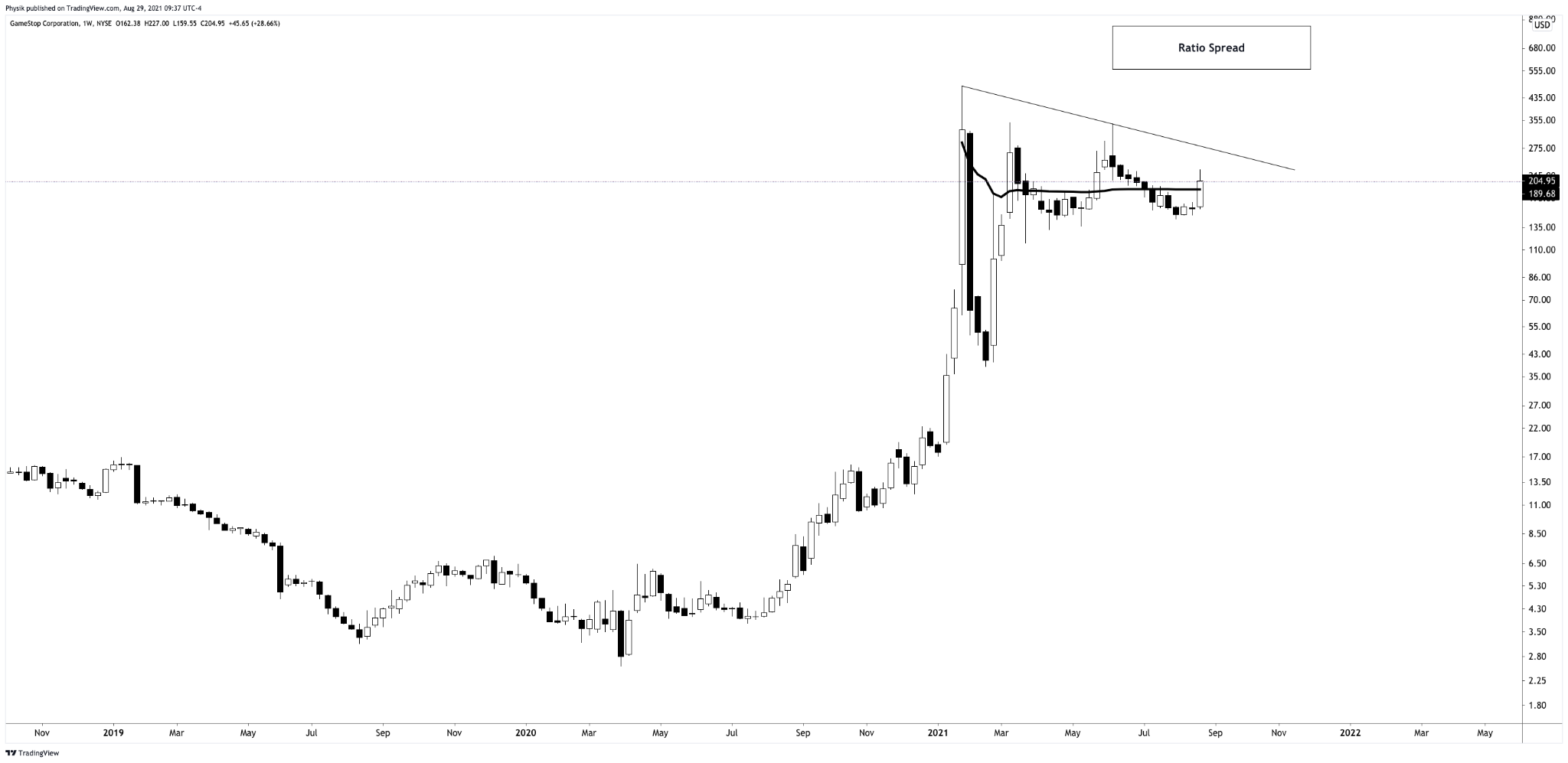
Trade Idea: SELL -1 1/2 BACKRATIO GME 100 17 SEP 21 530/680 CALL @1.20 LMT

Though I began filling this trade at limits for credit as high as 2.00, the spread collapsed markedly, Friday. Still, there’s an opportunity for unique structures such as the 530C+1, 680C-2 that pay you to be long the stock.

All else equal (i.e., discounting factors such as an increase in volatility), should the spread trade fully in-the-money – meaning the stock travels to the $680 short strike – the 530 strike will be 150 points in-the-money while the at-the-money strikes, combined (based on current at-the-money pricing), will trade around $53.00.

That suggests the spread should price for a credit north of $97.00 to close. Nice!

Thesis: I’m bullish on GameStop and I think the stock may climb over the next week few weeks. 

I will structure a spread above the current stock price, expiring in 18 days. I will buy the 530 call option once (+1) and sell the 680 call option twice (-2) for a $1.20 credit or better. Should the stock not move to my target, I keep the $120.00 credit. Should it move to $680, I could make $15,000.00 at expiry. Should the stock move past $830 break even or so, I may incur unlimited losses. My goal with this spread is to capture the initial credit and close for additional credit if the stock moves higher. 

If necessary, I will hedge the position by either (A) buying stock, (B) widening strikes, (C) buying a far out-of-the-money call option to cap upside in case of an unpredictable move higher, or (D) roll strikes up in price and out in time.

Below is a log chart of GameStop Corporation (NYSE: GME) and the ratio spread profit zone.

News And Analysis

Treasury bears redeemed as Citi, Michael Burry see higher yields.

Visa jumps into the NFT craze, buying a CryptoPunk for $150,000.

The top 7 reasons why COVID-19 could lead to inflationary regime.

Storm Ida roars toward Louisiana with winds of 150 miles per hour.

Chinese health officials reject U.S. allegations on COVID-19 probe.

What People Are Saying

Let’s Hang Out

Los Angeles, CA September 10-12

Salt Lake City, UT September 28-30

About

After years of self-education, strategy development, and trial-and-error, Renato Leonard Capelj began trading full-time and founded Physik Invest to detail his methods, research, and performance in the markets. 

Additionally, Capelj is a finance and technology reporter. Some of his biggest works include interviews with leaders such as John Chambers, founder and CEO, JC2 Ventures, Kevin O’Leary, businessman and Shark Tank host, Catherine Wood, CEO and CIO, ARK Invest, among others.

Disclaimer

At this time, Physik Invest does not manage outside capital and is not licensed. In no way should the materials herein be construed as advice. Derivatives carry a substantial risk of loss. All content is for informational purposes only.

Categories
Commentary

Daily Brief For August 25, 2021

Editor’s Note: Dark Pool Index (DIX) and Gamma (GEX) visuals are based on where each metric falls with respect to the MAX and MIN for all data available on https://squeezemetrics.com/monitor/dix (i.e., DIX in relation to high and low of the entire DIX data set).

Market Commentary

Equity index futures trade sideways.

  • Updates to DIX, GEX calculation.
  • Implications of Fed’s cash deluge.
  • Ahead: Some goods orders data.
  • Positioned for sideways to higher.

What Happened: U.S. stock index futures auctioned sideways alongside an absence in overnight catalysts.

Ahead is data on durable and nondefense capital goods orders (8:30 AM ET).

Graphic updated 6:30 AM ET. Sentiment Neutral if expected /ES open is inside of the prior day’s range. SqueezeMetrics Dark Pool Index (DIX) and Gamma (GEX) calculations are based on where the prior day’s reading falls with respect to the MAX and MIN of all occurrences available. A higher DIX is bullish. At the same time, the lower the GEX, the more (expected) volatility. SHIFT data used for S&P 500 (INDEX: SPX) options activity approximation. Note that options flow is sorted by the call premium spent; if more positive then more was spent on call options. Breadth reflects a reading of the prior day’s Advance/Decline indicator. VIX reflects a current reading of the CBOE Volatility Index (INDEX: VIX) from 0-100.

What To Expect: As of 6:30 AM ET, Wednesday’s regular session (9:30 AM – 4:00 PM EST) in the S&P 500 will likely open inside of prior-range and -value, suggesting a limited potential for immediate directional opportunity.

Adding, during the prior day’s regular trade, on strong intraday breadth and lackluster market liquidity metrics, the best case outcome occurred, evidenced by sideways trade at the $4,481.75 high volume area (HVNode). This is significant because sideways trade – after the completion of a v-pattern recovery – denotes an acceptance of higher prices (i.e., participants find prices valuable to transact at).

V-Pattern: A pattern that forms after a market establishes a high, retests some support, and then breaks above said high. In most cases, this pattern portends continuation.

Further, ahead of the upcoming Jackson Hole Economic Symposium on August 26-28, 2021, the aforementioned trade is happening in the context of moderating economic growth and monetary distortions.

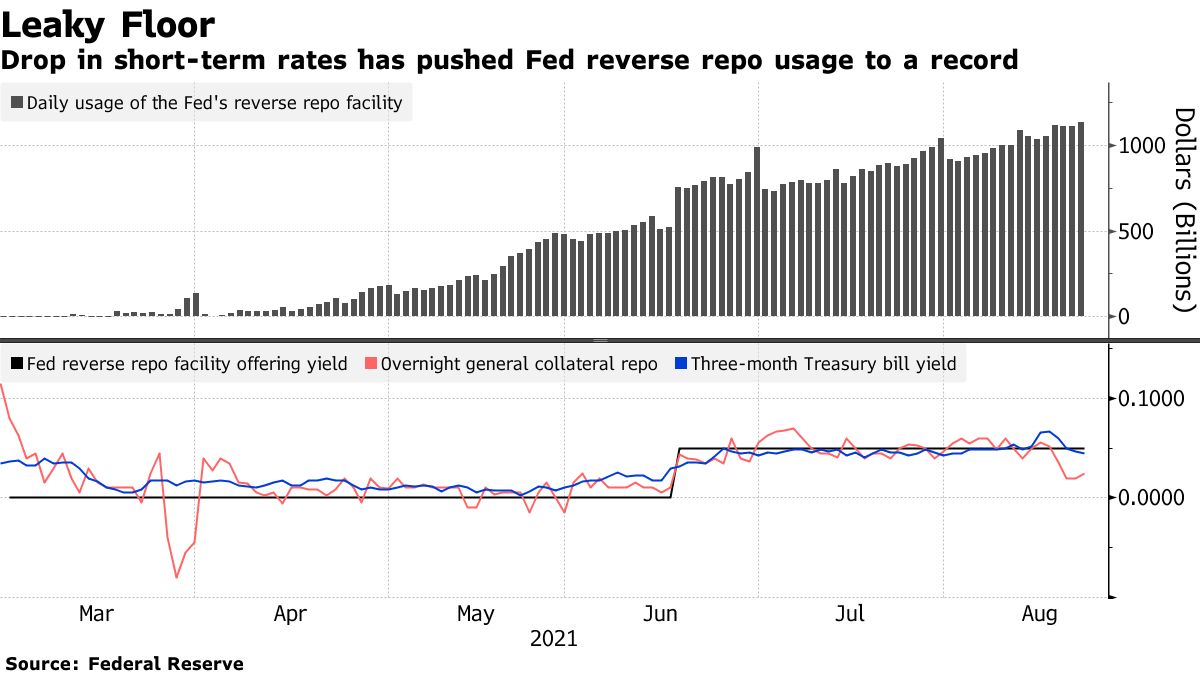
According to Bloomberg, “[d]emand for the so-called RRP facility has surged as a flood of dollars threatens to overwhelm funding markets. That’s in part a result of the central bank’s long-standing asset purchases and drawdowns of the Treasury’s cash account, which is pushing reserves into the system. As a result, liquidity has been swelling, especially as the Treasury cuts supply to create more borrowing room under the debt ceiling.”

“Even if the central bank were to complete tapering by August 2022, as JPMorgan expects, there may still be an additional $850 billion to $1 trillion of additional liquidity injected into the financial system.”

Graphic: Bloomberg plots Federal Reserve data on reverse repo usage.

Moreover, for today, participants may make use of the following frameworks.

In the best case, the S&P 500 trades sideways or higher; activity above the $4,481.75 high volume area (HVNode) puts in play the $4,492.00 overnight, minimal excess all-time high (ONH). Initiative trade beyond the ONH could reach as high as the $4,511.50 and $4,556.25 Fibonacci extensions.

In the worst case, the S&P 500 trades lower; activity below the $4,481.75 HVNode puts in play the $4,454.25 low volume area (LVNode). Initiative trade beyond the LVNode could reach as low as the $4,427.00 untested point of control (VPOC) and $4,393.75 micro composite point of control (MCPOC).

To note, the $4,427.00 level corresponds with an anchored volume-weighted average price (VWAP), a metric highly regarded by chief investment officers, among other participants, for quality of trade. Additionally, liquidity algorithms are benchmarked and programmed to buy and sell around VWAPs.

Overnight Rally Highs (Lows): Typically, there is a low historical probability associated with overnight rally-highs (lows) ending the upside (downside) discovery process.

Excess: A proper end to price discovery; the market travels too far while advertising prices. Responsive, other-timeframe (OTF) participants aggressively enter the market, leaving tails or gaps which denote unfair prices.

Volume Areas: A structurally sound market will build on past areas of high volume. Should the market trend for long periods of time, it will lack sound structure (identified as a low volume area which denotes directional conviction and ought to offer support on any test). 

If participants were to auction and find acceptance into areas of prior low volume, then future discovery ought to be volatile and quick as participants look to areas of high volume for favorable entry or exit.

POCs: POCs are valuable as they denote areas where two-sided trade was most prevalent. Participants will respond to future tests of value as they offer favorable entry and exit.
Graphic: 65-minute profile chart of the Micro E-mini S&P 500 Futures updated 6:30 AM ET.

News And Analysis

MSCI CEO dismisses concern Chinese stocks are uninvestable.

Federal Reserve policy got Chinese criticism as PBOC diverges.

President Biden praises house adoption of a $3.5B budget plan. 

S&P Global: Global oil demand peak by 2025 under UN pathway.

How U.S. infrastructure investment could boost jobs, productivity.

U.S. on a pace to complete a full Afghanistan withdrawal by 8/31.

Catherine Wood is more optimistic than pessimistic about China.

What People Are Saying

About

After years of self-education, strategy development, and trial-and-error, Renato Leonard Capelj began trading full-time and founded Physik Invest to detail his methods, research, and performance in the markets. 

Additionally, Capelj is a finance and technology reporter. Some of his biggest works include interviews with leaders such as John Chambers, founder and CEO, JC2 Ventures, Kevin O’Leary, businessman and Shark Tank host, Catherine Wood, CEO and CIO, ARK Invest, among others.

Disclaimer

At this time, Physik Invest does not manage outside capital and is not licensed. In no way should the materials herein be construed as advice. Derivatives carry a substantial risk of loss. All content is for informational purposes only.

Categories
Commentary

Weekly Brief For April 18, 2021

Happy Sunday! Though markets were relatively choppy, they ended higher last week. This came at a time of heightened public attention to the market.

The following commentary on U.S. broad market equity indices will discuss what happened, why it matters, what to expect, and how participants can position themselves for the coming week.

But first, here’s a quote from Sterling professor of economics at Yale, Robert J. Shiller:

“The current widespread fascination with the rising market accompanied by recent concern about a possible downward spiral and strained stock market valuations echo those of 100 years ago.”

Market Commentary

What Happened: The S&P 500, Nasdaq-100, and Dow Jones Industrial Average made new all-time highs before closing the week out with an attempt to balance and validate newly discovered prices.

  • Data suggests economic outlook improving.
  • Earnings pick up, add to clarity on recovery.
  • Risk, reward poor for new entries. Be picky.

Why It Matters: The price rise in U.S. broad market equity indices comes as the economic recovery from the COVID-19 coronavirus pandemic accelerated.

According to S&P Global, the recovery’s acceleration warranted a revision in the firm’s 2021 global GDP growth forecast to 5.5%, a 50 basis point change.

At the same time, it’s S&P’s belief that U.S. inflation fears are overblown. Traders began to price in that realization, last week. 

After a slew of economic releases, yields pulled back dramatically.

In a Bloomberg article, Barclays strategists, including Anshul Pradhan, noted a raising of the bar on reflation; the drop in yields “reflects the fact that expectations for growth, inflation and the hiking cycle have all been significantly revised higher.”

Further, participants saw the CBOE Volatility Index (INDEX: VIX), a measure of the stock market’s expectation of volatility based on S&P 500 (INDEX: SPX) options, continue a multi-week drop attracting the participation of systemic strategies and opportunistic hedging, as noted last week.

It is important to note that this most recent rally in equity indices, which coincides with a historically bullish period, came soon after Archegos Capital’s default on margin calls which triggered a fire sale by several big Wall Street banks.

SpotGamma, a source for actionable insights based on activity in the options market, in a commentary, attempted to unpack the narrative which suggests the mechanical bid across the broad market is tied to a “tangled web of counterparty risk and hedging,” among other factors.

Moving beyond speculations, a couple of things are true and must be accounted for in our narrative.

First, equity market inflows, over the past 5 months, exceeded inflows of the prior 12 years, total. Second, as the April monthly options expiration (OPEX) passes and the positioning of participants changes, the risks of a near-term pullback have increased substantially. 

Despite the stock market trading in a historically bullish period, as well as declining volatility attracting the participation of systematic strategies, increased put selling, and the like, downside protection is trading cheap relative to its upside counterpart.

Option Expiration (OPEX): Option expiries mark an end to pinning (i.e, the theory that market makers and institutions short options move stocks to the point where the greatest dollar value of contracts will expire worthless) and the reduction dealer gamma exposure.

Should the market turn and customers demand downside protection in an increasing fashion, dealers’ risk exposure to direction and volatility will cause violent crash dynamics to transpire.

An example of this is last year’s sell-off.

In a discussion on rising delta and volatility forcing dealers to sell into weakness to hedge a rapid move in prices, Kris Sidial, a former institutional trader and the co-chief investment officer of The Ambrus Group, a volatility arbitrage fund that looks to exploit changing market structure dynamics, said: “You have this dynamic in the derivatives market where there is a gamma squeeze when people are buying way far out-of-the-money [options], and dealers reflexively have to hedge off their risk,” Sidial said.

Graphic: SqueezeMetrics highlights implications of volatility, direction, and moneyness.

Putting it all together, despite markets being in a position to move higher, should there be a turn and spike in volatility, participants must be ready to accept the possibility of a violent liquidation.

As Market Ear puts it, hedge when you can, not when you must.

What To Expect: An increased potential to correct in time and price.

In addition, metrics, like DIX, market liquidity, and speculative derivatives activity, confirm participants’ bullishness and opportunistic hedging ahead of an acceleration in the global restart and a turn in flows, the result of consumers shifting their preferences from saving and investing to spending.

Graphic: Physik Invest maps out the purchase of call and put options in the SPDR S&P 500 ETF Trust (NYSE: SPY), for the week ending April 16. Activity in the options market was primarily concentrated in short-dated tenors, in strikes as low as $364, which corresponds with $3,640 in the cash-settled S&P 500 Index (INDEX: SPX).
Graphic: SHIFT search suggests participants are not as inclined to add call-side exposure, through the month of May, in the SPDR S&P 500 ETF Trust (NYSE: SPY).

What To Do: In the coming sessions, participants will want to pay attention to where the S&P 500 trades in relation to Friday’s open-high-low-close (OHLC). 

Any activity above Friday’s regular trade-low suggests participants are not yet done discovering higher prices. Trading below Friday’s low suggests an inclination by participants to (1) form a consolidation area that denotes acceptance of higher prices or (2) revert to the mean and repair some of the poor structure left behind prior discovery. 

It is important to take note of the minimal excess and cluster of price extensions at $4,200.00, a typical price target based on Fibonacci principles.

Excess: A proper end to price discovery; the market travels too far while advertising prices. Responsive, other-timeframe (OTF) participants aggressively enter the market, leaving tails or gaps which denote unfair prices.

So, in the best case, the S&P 500 makes an attempt to balance or discover prices as high as $4,200.00. In the worst case, participants look to auction the S&P 500 into prior poor structures and low-volume areas (LVNodes) that ought to offer little-to-no support.

More On Volume Areas: A structurally sound market will build on past areas of high-volume (HVNode). Should the market trend for long periods of time, it will lack sound structure (identified as a low-volume area (LVNode) which denotes directional conviction and ought to offer support on any test). 

If participants were to auction and find acceptance into areas of prior low-volume, then future discovery ought to be volatile and quick as participants look to areas of high volume for favorable entry or exit.
Graphic: 4-hour profile chart of the Micro E-mini S&P 500 Futures.

News And Analysis

Economy | Housing starts reach the highest level since 2006. (MND)

Recovery | U.S. is unlikely to ‘just cancel’ J&J COVID-19 shots. (BBG)

Markets | Citi to exit banking in 13 markets across Asia, Europe. (BBG)

Markets | Record-high systemic leverage is pressuring rates. (Moody’s)

Economy | S&P Global Ratings expects global rebound to roar. (S&P)

Economy | Projections on global population, aging, urbanization. (REU)

Trade | Amazon sellers slammed with COVID-induced constraints. (S&P)

Recovery | How well COVID-19 vaccines work against variants. (AB)

Markets | SPACs boost credit at targets but carry unique risks. (Moody’s)
Markets | ‘Roaring Kitty’ adds to GME bet after exercising calls. (BBG)

What People Are Saying

Innovation And Emerging Trends

Economy | Looking at the pop culture of the original Roaring Twenties. (NYT)

Markets | Want to take your company public? Here are your options. (CB)

FinTech | Societe Generale adds first structured product on blockchain. (SG)

Exodus | Hedge funds are ready to get out of NY and move to FL. (BBG)

Trading | The answer to how much capital you should be allocating. (TT)

Venture | European venture reaches all-time high in first quarter 2021. (CB)

About

Renato founded Physik Invest after going through years of self-education, strategy development, and trial-and-error. His work reporting in the finance and technology space, interviewing leaders such as John Chambers, founder, and CEO, JC2 Ventures, Kevin O’Leary, Canadian businessman and Shark Tank host, Catherine Wood, CEO and CIO, ARK Invest, among others, afforded him the perspective and know-how very few come by.

Having worked in engineering and majored in economics, Renato is very detailed and analytical. His approach to the markets isn’t built on hope or guessing. Instead, he leverages the unique dynamics of time and volatility to efficiently act on opportunity.

 Disclaimer

At this time, Physik Invest does not manage outside capital and is not licensed. In no way should the materials herein be construed as advice. Derivatives carry a substantial risk of loss. All content is for informational purposes only.
Cover photo by eberhard grossgasteiger from Pexels.

Categories
Commentary

Weekly Brief For April 11, 2021

Editor’s Note

Welcome to Market Intelligence, Physik Invest’s response to the many newsletters that seldom provide actionable market insights, free.

Through this newsletter you will get a glimpse into the following:

  • The implications of credit and positioning.
  • Impactful events in finance and technology.
  • Technical commentary for index products.
  • Media on emerging trends and hot topics.

Again, thanks for joining! Physik Invest looks forward to providing you an objective view into the who, what, when, where, why, and how in finance and technology.

Regards,

Renato Leonard Capelj


Market Commentary

Index futures are in price discovery mode.

  • Institutions bullish but risks add up.
  • Earnings season to start this week.
  • Balance-to-higher into April OPEX.

What Happened: U.S. stock index futures closed higher, last week.

What Does It Mean: The S&P 500 closed above $4,100 for the first time as investors looked to price in an economic “‘Goldilocks moment’—fast, sustained growth alongside inflation and interest rates that drift slowly upward.”

According to a letter by JPMorgan Chase & Co’s (NYSE: JPM) Jamie Dimon, strong consumer savings, an increased pace in COVID-19 coronavirus vaccinations, and unprecedented efforts to spur economic activity could mean that a boom lasts as long as 2023. 

This perspective differs from Dimon’s comments a year ago; he warned of a recession in which GDP could fall nearly 35%. Is Dimon one to fade? Likely not, given the fact that (1) he heads one of the biggest banks and (2) most forecasts by other institutions support Dimon’s perspectives.

Further, the CBOE Volatility Index (INDEX: VIX), a measure of the stock market’s expectation of volatility based on S&P 500 (INDEX: SPX) options, traded to its lowest level since February 2020.

At the same time, participants saw blocks of VIX call spreads — bets that serenity won’t last — hit the tape; the unknown participant(s) bought nearly 200,000 contracts.

Graphic 1: Risk graph of the 25/40 VIX call spread in question via MarketEar

“With VIX being priced in the low 17 area, I would imagine we would see more of these larger-sized bets going forward,” Kris Sidial, co-chief investment officer at Ambrus Group, told Bloomberg. “I think smart money understands that, although volatility has contracted a lot in these last two months, we are still seeing signs of excess market fragility appear from many different angles.”

Graphic 2: Volatility declines to its lowest level since February 2020.

As stated last week, the market is in a historically bullish period, ahead of the upcoming corporate earnings season, with structural flows supporting the ongoing narrative into the coming April monthly options expiration (OPEX).

Option Expiration (OPEX) Significance: Option expiries mark an end to pinning (i.e, the theory that market makers and institutions short options move stocks to the point where the greatest dollar value of contracts will expire worthless) and the reduction dealer gamma exposure.

Adding, most funds are committed to holding long positions. In the interest of lower volatility returns, these funds will collar off their positions, selling calls to finance the purchase of downside put protection.

As a result of this activity, options dealers are long upside and short downside protection.

This exposure must be hedged; dealers will sell into strength as their call (put) positions gain (lose) value and buy into weakness as their call (put) positions lose (gain) value.

Now, unlike theory suggests, dealers will hedge call losses (gains) quicker (slower). This leads to “long-gamma,” a dynamic that crushes volatility and promotes momentum, observed by lengthy sprints — like the one the market is currently in — followed by rapid de-risking events as the market transitions into “short-gamma.”

What To Expect: Balance-to-higher.

Important to note is that equity market inflows, over the past 5 months, exceeded inflows of the prior 12 years, total. Think about the supply and demand dynamics of the market; in case of an equity market sell-off, a lot of late buyers will have poor location which may leave a thick area of supply above the market, putting a dampener on future rallies. 

“You should definitely be worried about valuations and all the more so when people start justifying extremely high valuations. We are risk-on, but we haven’t put our foot down on the accelerator because of valuations in some parts of the market,” said Fahad Kamal, chief investment officer at Kleinwort Hambros.

Adding to the narrative, metrics, like DIX, confirm increased buying pressure while divergences in options activity suggest opportunistic hedging, especially with puts trading at their cheapest level, relative to calls the same delta.

Graphic 3: 1-month 25 delta risk-reversal, via SpotGamma, suggests puts are trading cheap.
More On DIX: For every buyer is a seller (usually a market maker). Using DIX — which is derived from short sales (i.e., liquidity provision on the market-making side) — we can measure buying pressure.
Graphic 4: Physik Invest maps out the purchase of call and put options in the SPDR S&P 500 ETF Trust (NYSE: SPY), for the week ending April 9, 2021. Activity in the options market was primarily concentrated in short- and long-dated tenors, in put strikes as low as $340, which corresponds with $3,400 in the cash-settled S&P 500 Index (INDEX: SPX).

What To Do: In the coming sessions, participants will want to pay attention to where the S&P 500 trades in relation to Friday’s end-of-day spike higher.

More On Spikes: Spike’s mark the beginning of a break from value. Spikes higher (lower) are validated by trade at or above (below) the spike base (i.e., the origin of the spike).

In the best case, the S&P 500 remains above the $4,104.00 spike base. Doing so means that the participants are validating the prices caused by the late-day knee-jerk rally. 

In the case of higher prices, given that the 161.80% and 127.20% Fibonacci price extensions were achieved, and after-market trade established an overnight high at $4,121.50, participants can target prices as high as the $4,197.25 price extension.

More On Overnight Rally Highs (Lows): Typically, there is a low historical probability associated with overnight rally-highs (lows) ending the upside (downside) discovery process.

Any activity below the $4,104.00 spike base puts the rally on hold and calls for balance or an attempt to digest higher prices.

Balance (Two-Timeframe Or Bracket): Rotational trade that denotes current prices offer favorable entry and exit. Balance-areas make it easy to spot a change in the market (i.e., the transition from two-time frame trade, or balance, to one-time frame trade, or trend).

In the case of lower prices, participants can look to whether a test of the $4,069.00 high-volume area (HVNode) solicits a response. If not, initiative trade could take prices as low as $3,943.00, the next most valuable price area in the chain.

More On Volume Areas: A structurally sound market will build on past areas of high-volume (HVNode). Should the market trend for long periods of time, it will lack sound structure (identified as a low-volume area (LVNode) which denotes directional conviction and ought to offer support on any test). 

If participants were to auction and find acceptance into areas of prior low-volume, then future discovery ought to be volatile and quick as participants look to areas of high volume for favorable entry or exit.
Graphic 5: 4-hour profile chart of the Micro E-mini S&P 500 Futures.

News And Analysis

Economy | No elevated default risk expected until 2023. (Moody’s)

Economy | China looks to curtail loan growth amid bubble fears. (BBG)

Markets | Pre-IPO, Coinbase releases blowout Q1 2021 results. (BW)

Markets | Growing signs that equity bull market overheating. (Axios)

Economy | CFPB warns lenders of a wave of distressed mortgages. (MP)

Markets | Cboe extends global trading for VIX and SPX options. (Cboe)

Markets | Unpacking the feedback loop that is distorting markets. (RV)

Trade | Global trade disruptions after the Suez Canal incident. (S&P)

Economy | U.S. COVID-19 vaccination rates to plateau in April. (Surgo)

Markets | Treasuries rally signaling bets on Fed hikes pared back. (BBG)

Markets | Bitcoin fills a demand for alternatives to fiat currencies. (BBG)

Economy | Powell says the economy poised for stronger growth. (BBG)

Markets | Earnings season starts with banks reporting this week. (WSJ)

Markets | Citadel Securities feels the heat of the political spotlight. (BBG)

Markets | Oil sideways. Gold, DXY higher. Copper, aluminum lower. (REU)

What People Are Saying

Innovation And Emerging Trends

Strategy | Strategies one VC believes made Stripe so successful. (BI)

FinTech | Fidelity, Square, and others, form crypto trade group. (WSJ)

FinTech | WealthCharts expands offer, tackles emerging trends. (BZ)

FinTech | SoftBank invests $500M in mortgage lender Better. (CNBC)

FinTech | Rarible co-founder says NFTs to stay, growth robust. (BZ)

FinTech | JPMorgan’s Dimon acknowledges fintech’s big threat. (BZ)

FinTech | Vesica launches a search engine for the options market. (BZ)

About

Renato founded Physik Invest after going through years of self-education, strategy development, and trial-and-error. His work reporting in the finance and technology space, interviewing leaders such as John Chambers, founder, and CEO, JC2 Ventures, Kevin O’Leary, Canadian businessman and Shark Tank host, Catherine Wood, CEO and CIO, ARK Invest, among others, afforded him the perspective and know-how very few come by.

Having worked in engineering and majored in economics, Renato is very detailed and analytical. His approach to the markets isn’t built on hope or guessing. Instead, he leverages the unique dynamics of time and volatility to efficiently act on opportunity.

Disclaimer

At this time, Physik Invest does not manage outside capital and is not licensed. In no way should the materials herein be construed as advice. Derivatives carry a substantial risk of loss. All content is for informational purposes only.
Cover photo by Kammeran Gonzalez-Keola from Pexels.

Categories
Commentary

Market Commentary For The Week Ahead: ‘Up, Up And Away’

Key Takeaways:

What Happened: U.S. stock index futures closed higher, last week.

What Does It Mean: The S&P 500 closed above $4,000.00 for the first time.

This comes as investors shifted their focus from the risks of rapidly rising inflation to the increasing pace of COVID-19 coronavirus vaccinations and a rebound in economic activity.
At the time, the CBOE Volatility Index (INDEX: VIX), a measure of the stock market’s expectation of volatility based on S&P 500 (INDEX: SPX) options, hit the lowest level since February of 2020. This was likely the result of an oversupply in volatility due to contract rolling, signaling a shift in the demand for volatility and options-based hedging.
Graphic 1: Volatility declines ahead of the extended holiday weekend.

Adding, the market is entering into a historically bullish period, ahead of the upcoming corporate earnings season, with structural flows supporting the ongoing narrative, also, at least until mid-April. The reason being, most funds are committed to holding long positions. In the interest of lower volatility returns, these funds will collar off their positions, selling calls to finance the purchase of downside put protection.

Graphic 2: April, historically speaking, is usually a good month for equity investors. 

As a result of this activity, options dealers are long upside and short downside protection.

This exposure must be hedged; dealers will sell into strength as their call (put) positions gain (lose) value and buy into weakness as their call (put) positions lose (gain) value.

Now, unlike theory suggests, dealers will hedge call losses (gains) quicker (slower). This leads to “long-gamma,” a dynamic that crushes volatility and promotes momentum, observed by lengthy sprints — like the one the market is currently in — followed by rapid de-risking events as the market transitions into “short-gamma.”

What To Expect: Balance-to-higher into mid-April.

Why? One last hurrah before the reopening accelerates and flows turn. 

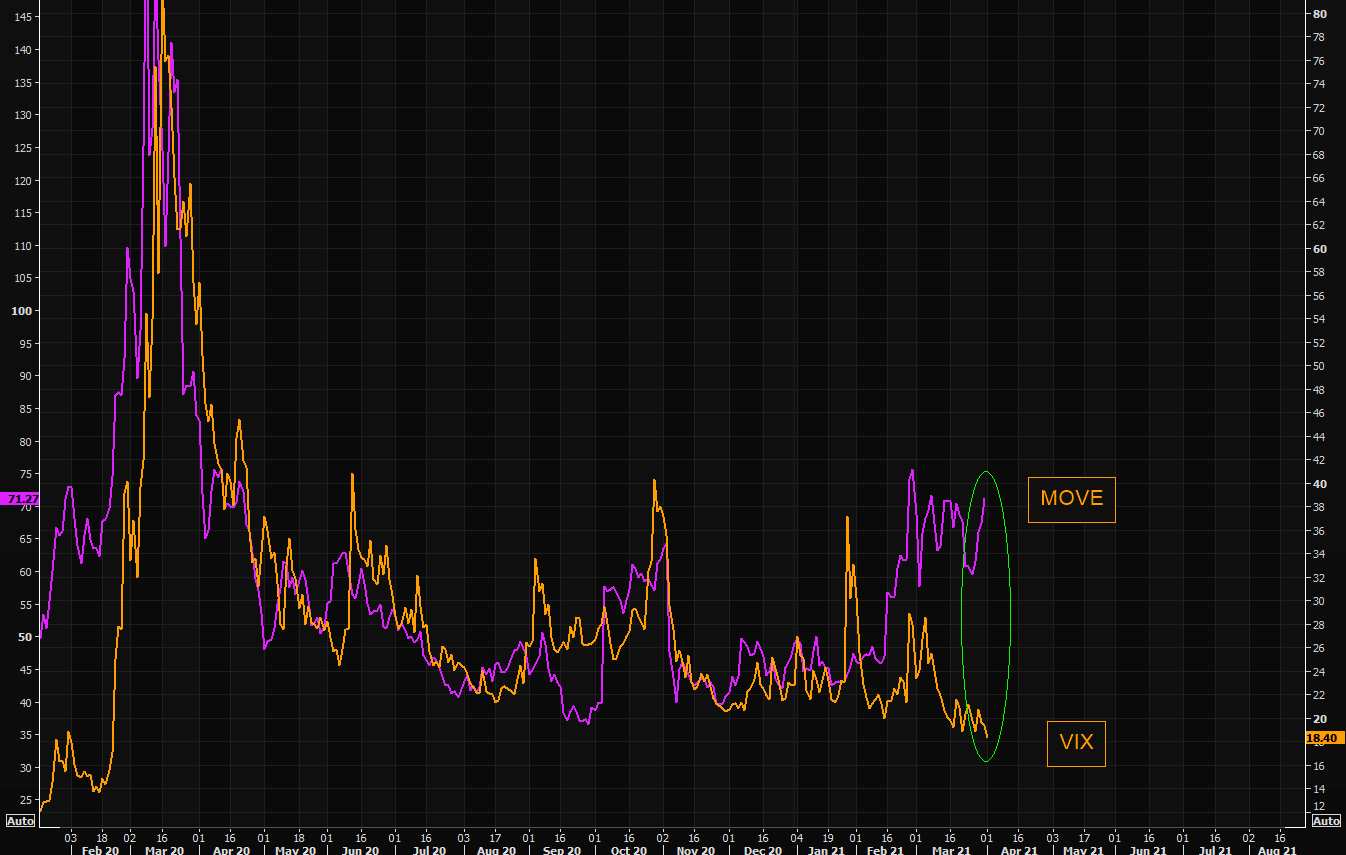
When flows turn, it is likely that equity and bond market volatility converge; the ongoing divergence comes alongside an attempt, by market participants, to price in rising debt levels and inflation. As consumers shift their preferences from saving and investing to spending, this divergence ought to disappear.

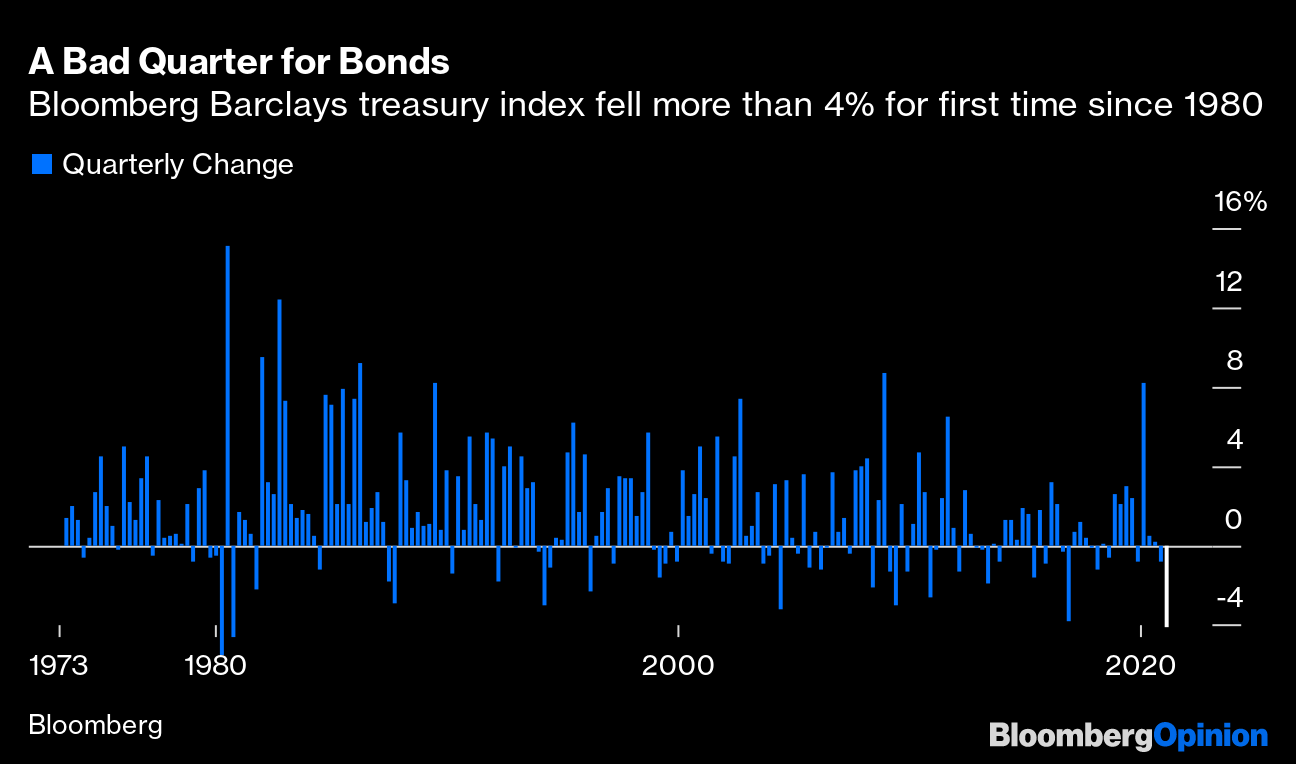
Graphic 3: Q1 2021 the worst quarter for bonds in decades, via Bloomberg
Graphic 4: Divergence in volatility across the bond and equity market.

Adding, metrics, like DIX, confirm increased buying pressure while divergences in options activity and volume delta suggest opportunistic selling.

More On DIX: For every buyer is a seller (usually a market maker). Using DIX — which is derived from short sales (i.e., liquidity provision on the market-making side) — we can measure buying pressure.

Volume Delta: Buying and selling power as calculated by the difference in volume traded at the bid and offer.
Graphic 5: Physik Invest maps out the purchase of call and put options in the SPDR S&P 500 ETF Trust (NYSE: SPY), for the week ending April 4, 2021. Activity in the options market was primarily concentrated in short- and long-dated tenors, in strikes as low as $330, which corresponds with $3,300 in the cash-settled S&P 500 Index (INDEX: SPX).

What To Do: In the coming sessions, participants will want to pay attention to where the S&P 500 trades in relation to Thursday’s end-of-day spike higher.

More On Spikes: Spike’s mark the beginning of a break from value. Spikes higher (lower) are validated by trade at or above (below) the spike base (i.e., the origin of the spike).

In the best case, the S&P 500 remains above the $4,004.25 spike base. Doing so means that the participants are finding higher prices, above the VWAP anchored from the March 17 rally-high, valuable (i.e., buyers, on average, are in control and winning since the March 17 rally-high).

More On Volume-Weighted Average Prices (VWAPs): A metric highly regarded by chief investment officers, among other participants, for quality of trade. Additionally, liquidity algorithms are benchmarked and programmed to buy and sell around VWAPs. 

In the case of higher prices, given that the $4,015.25 price extension was achieved in after-market trade that established an overnight high at $4,038.25, participants can target the $4,062.00 extension.

More On Overnight Rally Highs (Lows): Typically, there is a low historical probability associated with overnight rally-highs (lows) ending the upside (downside) discovery process.

Any activity below the $4,004.25 spike base puts the rally on hold and calls for balance or digestion of higher prices.

Balance (Two-Timeframe Or Bracket): Rotational trade that denotes current prices offer favorable entry and exit. Balance-areas make it easy to spot a change in the market (i.e., the transition from two-time frame trade, or balance, to one-time frame trade, or trend).

In the case of lower prices, participants can look to whether a test of the $3,943.00 and $3,908.25 high-volume areas (HVNodes) solicit a response.

More On Volume Areas: A structurally sound market will build on past areas of high-volume (HVNode). Should the market trend for long periods of time, it will lack sound structure (identified as a low-volume area (LVNode) which denotes directional conviction and ought to offer support on any test). 

If participants were to auction and find acceptance into areas of prior low-volume, then future discovery ought to be volatile and quick as participants look to areas of high volume for favorable entry or exit.
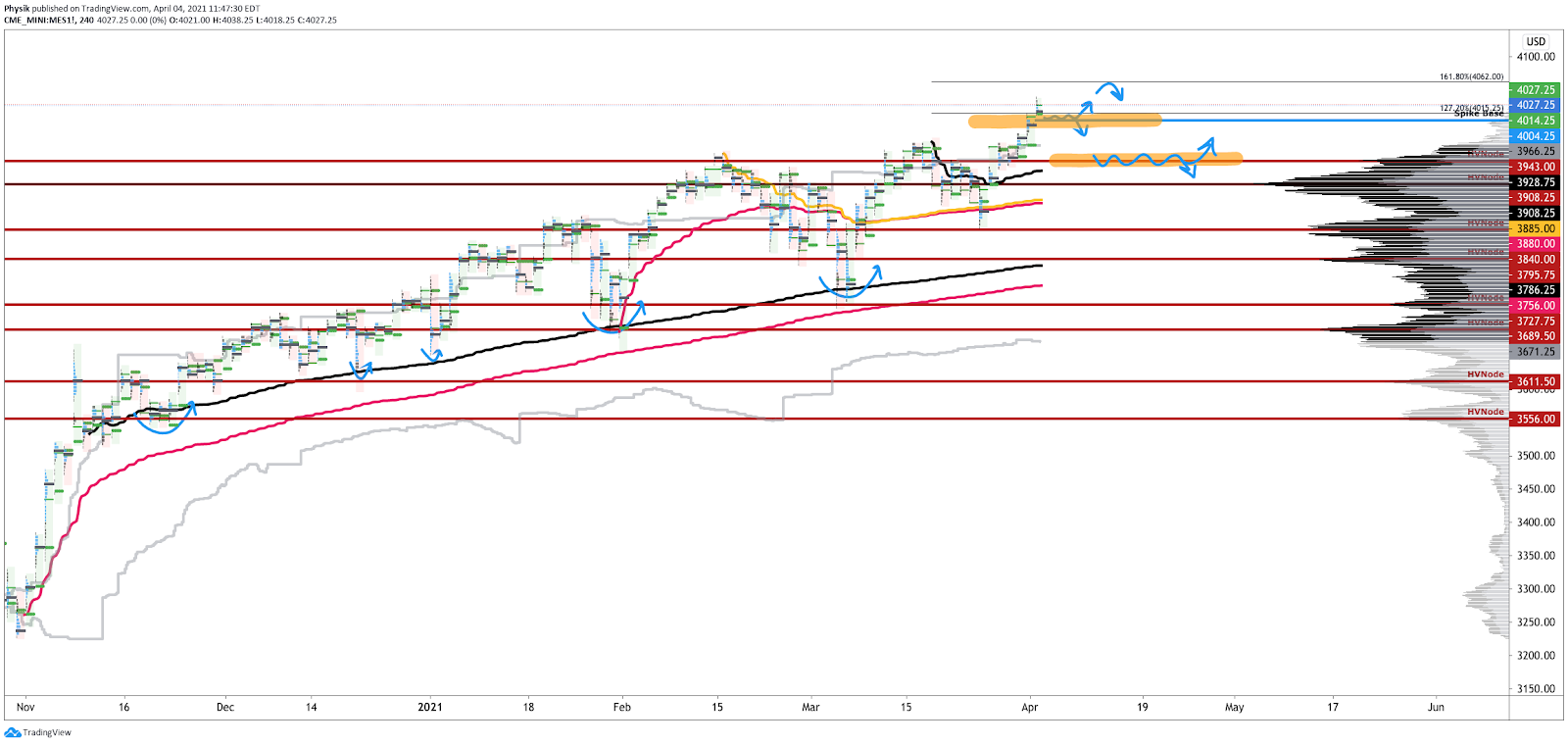
Graphic 6: 4-hour profile chart of the Micro E-mini S&P 500 Futures.

Conclusions: The go/no-go level for next week’s trade is $4,004.25.

Any activity above this level confirms the bullishness of last Thursday’s end-of-day spike. 

Levels Of Interest: $4,004.25 Spike Base.

Cover photo by Taryn Elliott from Pexels.

Categories
Commentary

Market Commentary For The Week Ahead: ‘Down, Then Up’

Key Takeaways:

What Happened: U.S. stock index futures closed higher, last week.

What Does It Mean: In the face of stretched sentiment and positioning — a heightened appetite for risk — investors shifted their focus from the risks of rapidly rising inflation to the increasing pace of COVID-19 coronavirus vaccinations and a rebound in economic activity.

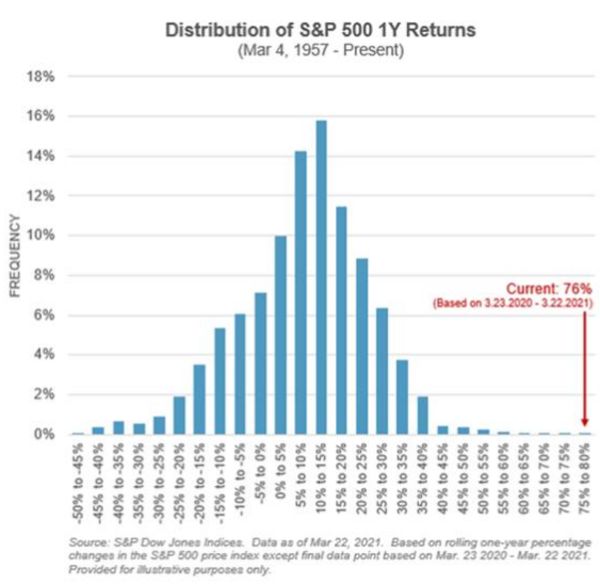
This comes after an outlier 2020; the distribution of S&P 500 1-year returns was ‘unexpected,’ sitting in the far end of the right tail.

Graphic 1: Distribution of S&P 500 1-Year Returns via Bloomberg

Adding, according to S&P Global Ratings, concerns over inflation appear “overblown and [] orderly reflation, around a return to sustainable growth, is a healthy development for both macro and credit outcomes.”

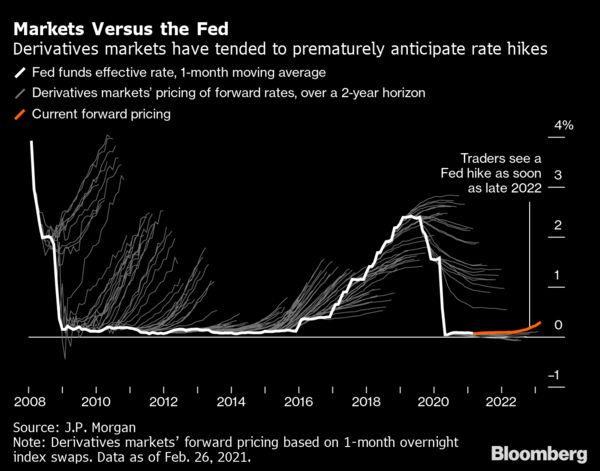
This notion is further validated by history; according to Bloomberg, “Since 2008, markets have consistently priced in a more aggressive path of Fed rate hikes than what ultimately happened. Consider the situation in late 2008: traders were already bracing for several hikes in the years ahead, according to data crunched by JPMorgan Chase & Co. (NYSE: JPM), but policy makers held off on tightening until 2015.”

Due to this mispricing, traders are behind the curve when the Fed finally hikes. Between 2017, through 2018, traders were scrambling to keep up with the Fed’s seven hikes.

Graphic 2: Bloomberg maps out the pricing in of Federal Reserve rate hikes.

“The market has its pricing and perceptions, and what happens can differ from that and has,” Alex Roever, head of U.S. rates strategy at JPMorgan, told Bloomberg News. The market has been testing the Fed by “trying to push further forward the first hike. But Fed officials don’t seem to be having any of it.”

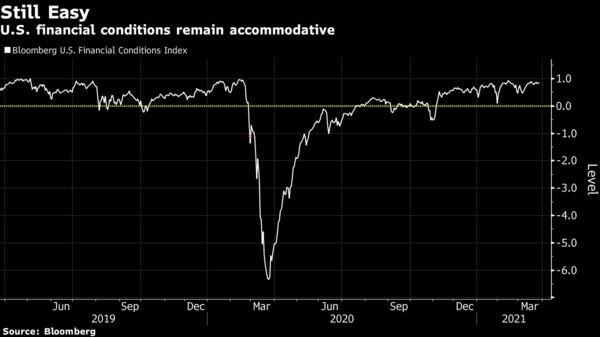
The Fed’s hesitancy to change its stance is warranted; broadly speaking, financial conditions haven’t budged. 

Graphic 3: U.S. financial conditions appear accommodative, via Bloomberg

Analysts at S&P Global Ratings put it best: “Our bottom line is that orderly reflation is, on balance, a healthy development for macro and credit outcomes. This narrative implies that moderate demand and wage pressures have reemerged after a lost decade and that the interest rate structure has the potential to return to more normal levels. While there will inevitably be some market adjustments as credit is repriced, this will lead to better outcomes.”

A natural evolution — trend in rates toward normalcy — would provide monetary authorities ammunition in another downturn, and price credit in a way that rebalances the natural supply and demand dynamics of the market (i.e., non-productive firms are forced out of business).

What To Expect: Directional resolve.

Why? During prior trade, participants lacked conviction. This is evidenced by a failure, by participants, to introduce excess (e.g., tails or range expansion past historical turning points) in the S&P 500.

More On Excess: A proper end to price discovery; the market travels too far while advertising prices. Responsive, other-timeframe (OTF) participants can aggressively enter the market, leaving tails or gaps which denote unfair prices.

Adding, metrics, like DIX, suggest increased buying pressure. This comes after what appears to have been opportunistic buying or short covering into weakness, and some bearish trades in the cash-settled S&P 500 Index (INDEX: SPX), among other products like Chinese technology stocks and U.S. media companies. 

More On DIX: For every buyer is a seller (usually a market maker). Using DIX — which is derived from short sales (i.e., liquidity provision on the market making side) — we can measure buying pressure.
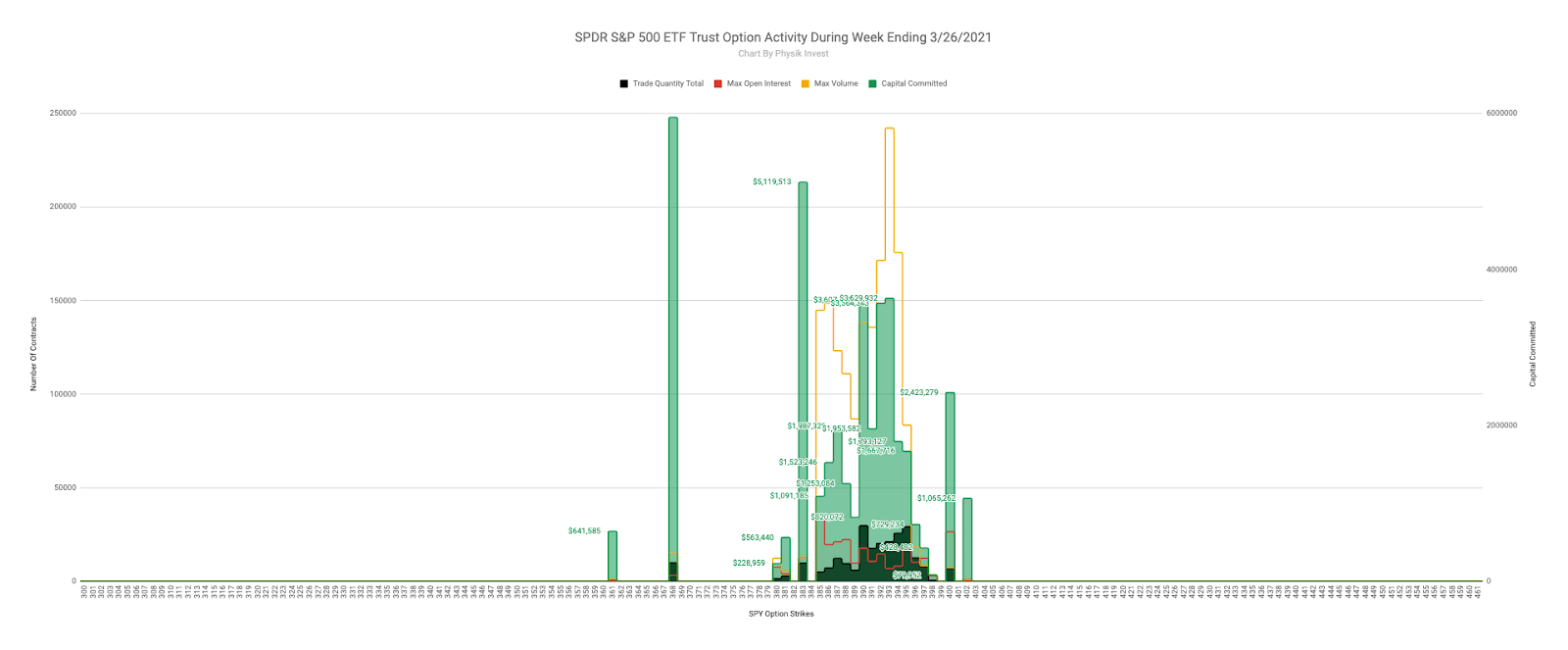
Graphic 4: Physik Invest maps out the purchase of call and put options in the SPDR S&P 500 ETF Trust (NYSE: SPY), for the week ending March 26, 2021. Activity in the options market was primarily concentrated in short- and long-dated tenors, in strikes as low as $361, which corresponds with $3,610 in the cash-settled S&P 500 Index (INDEX: SPX).

What To Do: In the coming sessions, participants will want to pay attention to where the S&P 500 trades in relation to Friday’s end-of-day spike higher, which was likely the result of hedging.

More On Spikes: Spike’s mark the beginning of a break from value. Spikes higher (lower) are validated by trade at or above (below) the spike base (i.e., the origin of the spike).

In the best case, the S&P 500 remains above the $3,934.00 spike base, taking out Friday’s minimal excess high. Doing so means that the participants are finding higher prices, above the VWAP anchored from the March 17 rally-high, valuable (i.e., buyers, on average, are in control and winning since the March 17 rally-high).

More On Volume-Weighted Average Prices (VWAPs): A metric highly regarded by chief investment officers, among other participants, for quality of trade. Additionally, liquidity algorithms are benchmarked and programmed to buy and sell around VWAPs. 

In case of higher prices, participants can target the $3,978.50 overnight rally-high, as well as the $4,015.25 and $4,062.00 price extensions.

More On Overnight Rally Highs (Lows): Typically, there is a low historical probability associated with overnight rally-highs (lows) ending the upside (downside) discovery process.

Any activity below the VWAP anchored from the $3,978.50 peak may (1) leave the $3,900.00 HVNode as an area of supply, offering initiative sellers favorable entry and responsive buyers favorable exit.

More On Volume Areas: A structurally sound market will build on past areas of high-volume (HVNode). Should the market trend for long periods of time, it will lack sound structure (identified as a low-volume area (LVNode) which denotes directional conviction and ought to offer support on any test). 

If participants were to auction and find acceptance into areas of prior low-volume, then future discovery ought to be volatile and quick as participants look to areas of high-volume for favorable entry or exit.
Graphic 5: 4-hour profile chart of the Micro E-mini S&P 500 Futures.

Conclusions: The go/no-go level for next week’s trade is $3,934.00.

Any activity above this level confirms the bullishness of last Friday’s end-of-day spike. 

Levels Of Interest: $3,934.00 Spike Base.

Cover photo by Min An from Pexels

Categories
Commentary

Market Commentary For The Week Ahead: ‘Green Shoots’

Notice: Physik Invest’s daily market commentaries will be suspended until further notice.

Please accept our apologies for the inconvenience, thank you for the support, and see you next week!

Key Takeaways:

What Happened: U.S. stock index futures closed lower, last week.

What Does It Mean: Heading into last week’s Federal Reserve policy update, stock index futures were in balanced, two-sided trade as participants looked for more information to base their next move. 

Then, Federal Reserve Chairman Jerome Powell discussed his organization’s commitment to an inclusive recovery. At the same time, the central bank announced it expects real GDP to grow 6.5% and inflation to rise as high as 2.4% this year.

The comments were immediately followed by a vertical price rise.

Thereafter, participants that caused the vertical price rise traded out, evidenced by the index trading lower into Friday’s derivative expiry.

Important to note is that despite the attempted pricing in of rising debt levels and inflation, a divergence in bond and equity market volatility persists. Historically, fear across markets tends to move in tandem. That hasn’t been the case for a number of weeks, now (e.g., Graphic 1).

Graphic 1: Divergence in volatility across the bond and equity market. 

What To Expect: Directional resolve.

Why? The passage of a large derivative expiry, the resolve of the vertical price range that occurred in the face of Federal Reserve policy updates, as well as market liquidity metrics suggesting opportunistic buying or short covering into weakness, and increased buying pressure (as witnessed through measures like DIX and options activity).

More On DIX: For every buyer is a seller (usually a market maker). Using DIX — which is derived from short sales (i.e., liquidity provision on the market making side) — we can measure buying pressure.

More On Option Expiration (OPEX): Option expiries mark an end to pinning (i.e, the theory that market makers and institutions short options move stocks to the point where the greatest dollar value of contracts will expire worthless) and the reduction dealer gamma exposure.
Graphic 2: Physik Invest maps out the purchase of call and put options in the SPDR S&P 500 ETF Trust (NYSE: SPY), for the week ending March 19, 2021. Activity in the options market was primarily concentrated in short- and long-dated tenors, in strikes as high as $435, which corresponds with $4,350.00 in the cash-settled S&P 500 Index (INDEX: SPX).
Graphic 3: Index option traders add to call buying and put selling, a bullish dynamic. 

What To Do: In the coming sessions, participants will want to pay attention to the VWAP anchored from the $3,978.50 overnight rally-high, as well as the high-volume area (HVNode) near $3,900.00.

Volume-Weighted Average Prices (VWAPs): Metrics highly regarded by chief investment officers, among other participants, for quality of trade. Additionally, liquidity algorithms are benchmarked and programmed to buy and sell around VWAPs.

More On Volume Areas: A structurally sound market will build on past areas of high-volume (HVNode). Should the market trend for long periods of time, it will lack sound structure (identified as a low-volume area (LVNode) which denotes directional conviction and ought to offer support on any test). 

If participants were to auction and find acceptance into areas of prior low-volume, then future discovery ought to be volatile and quick as participants look to areas of high-volume for favorable entry or exit.

More On Overnight Rally Highs (Lows): Typically, there is a low historical probability associated with overnight rally-highs (lows) ending the upside (downside) discovery process.

In the best case, the S&P 500 remains above the $3,900.00 volume area, and VWAP anchored from the $3,978.50 peak, taking out Friday’s minimal excess high. This would suggest buyers, on average, are in control and winning since the March 17 rally-high.

More On Excess: A proper end to price discovery; the market travels too far while advertising prices. Responsive, other-timeframe (OTF) participants aggressively enter the market, leaving tails or gaps which denote unfair prices.

Any activity below the VWAP anchored from the $3,978.50 peak may (1) leave the $3,900.00 HVNode as an area of supply, offering initiative sellers favorable entry and responsive buyers favorable exit.

Graphic 4: Profile overlays on a 30-minute candlestick chart of the Micro E-mini S&P 500 Futures.
Graphic 5: 4-hour profile chart of the Micro E-mini S&P 500 Futures.

Conclusions: The go/no-go level for next week’s trade is $3,900.00.

Any activity at this level suggests market participants are looking for more information to base their next move. Anything above (below) this level increases the potential for higher (lower).

Levels Of Interest: $3,900.00 HVNode.

Photo by Ylanite Koppens from Pexels.