Categories
Commentary

Daily Brief For December 22, 2021

What Happened

Overnight, equity index futures were divergent while most commodity and bond products were sideways to higher. This is as traders position themselves for the less liquid holiday trade.

Ahead is data on gross domestic product and income (8:30 AM ET), consumer confidence, and existing home sales (10:00 AM ET).
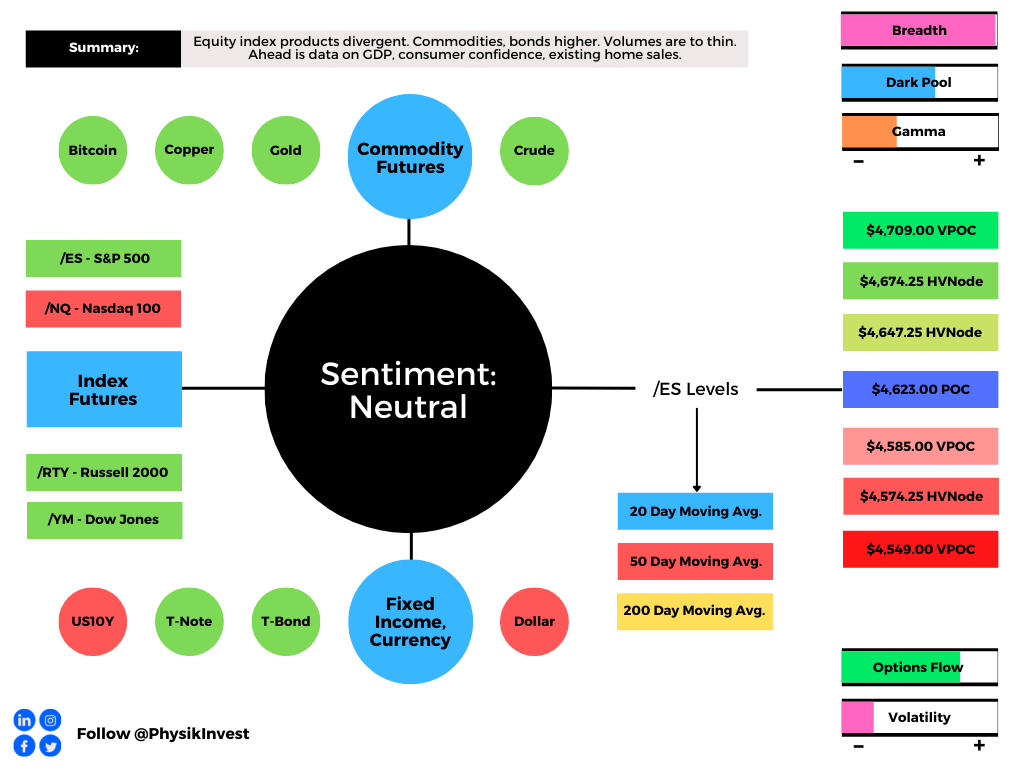
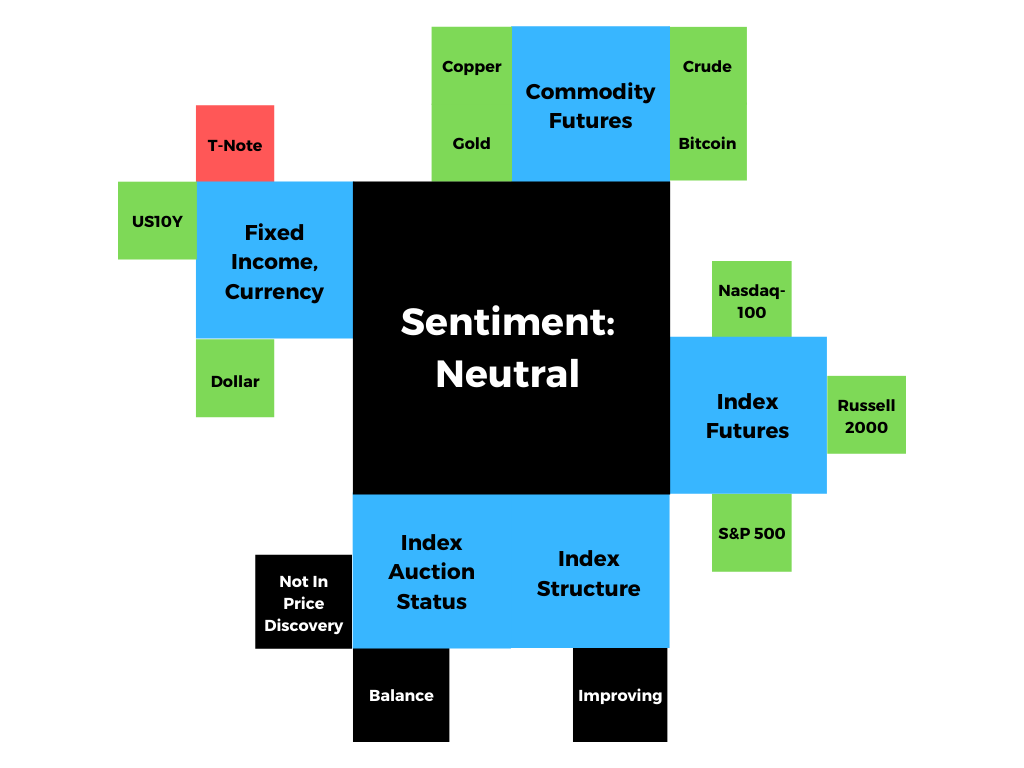
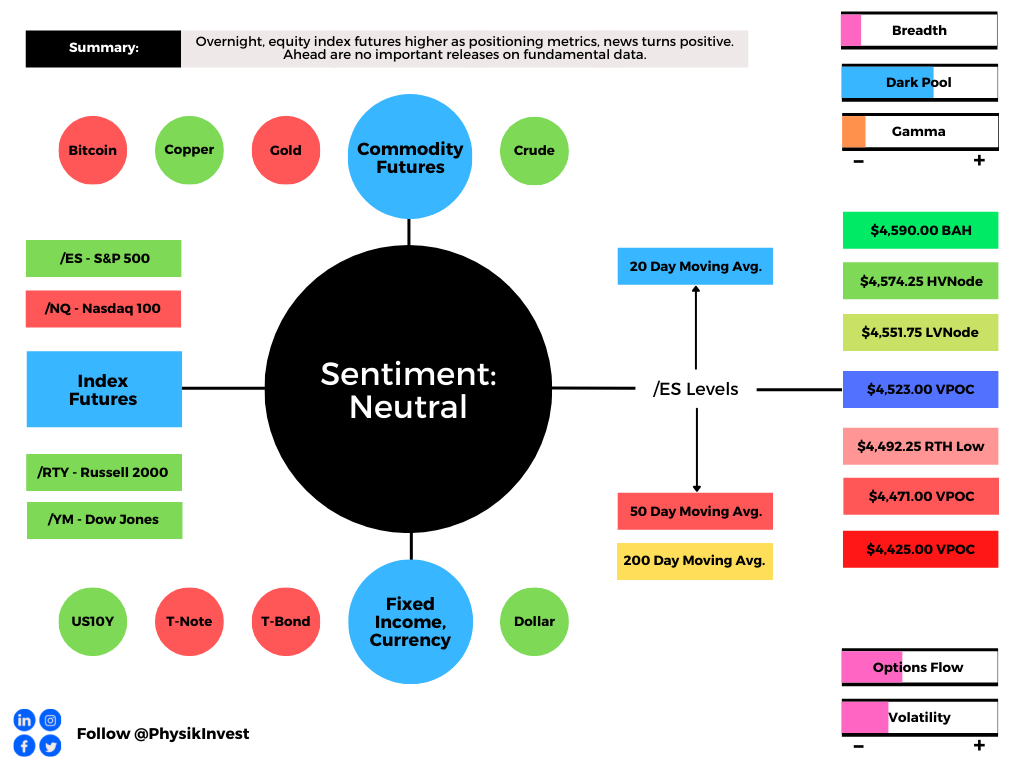
Graphic updated 6:30 AM ET. Sentiment Neutral if expected /ES open is inside of the prior day’s range. /ES levels are derived from the profile graphic at the bottom of the following section. Levels may have changed since initially quoted; click here for the latest levels. SqueezeMetrics Dark Pool Index (DIX) and Gamma (GEX) calculations are based on where the prior day’s reading falls with respect to the MAX and MIN of all occurrences available. A higher DIX is bullish. At the same time, the lower the GEX, the more (expected) volatility. Learn the implications of volatility, direction, and moneyness. SHIFT data used for S&P 500 (INDEX: SPX) options activity. Note that options flow is sorted by the call premium spent; if more positive then more was spent on call options. Breadth reflects a reading of the prior day’s NYSE Advance/Decline indicator. VIX reflects a current reading of the CBOE Volatility Index (INDEX: VIX) from 0-100.

What To Expect

On supportive intraday breadth and divergent market liquidity metrics, the best case outcome occurred; the S&P 500 auctioned away from intraday value, the levels at which participants found it most favorable to trade at.

Given the mechanical responses to key technical levels, visually-driven, weaker-handed participants (which seldom bear the wherewithal to defend retests) are very much in control.

Moreover, Tuesday’s activity, which was follow-through on Monday’s responsive buying, left low-volume structures in its wake. 

Virgin tests of the low-volume – a void of sorts – ought to hold. Successful penetration portends follow-through given the participants that were most active at those levels. 
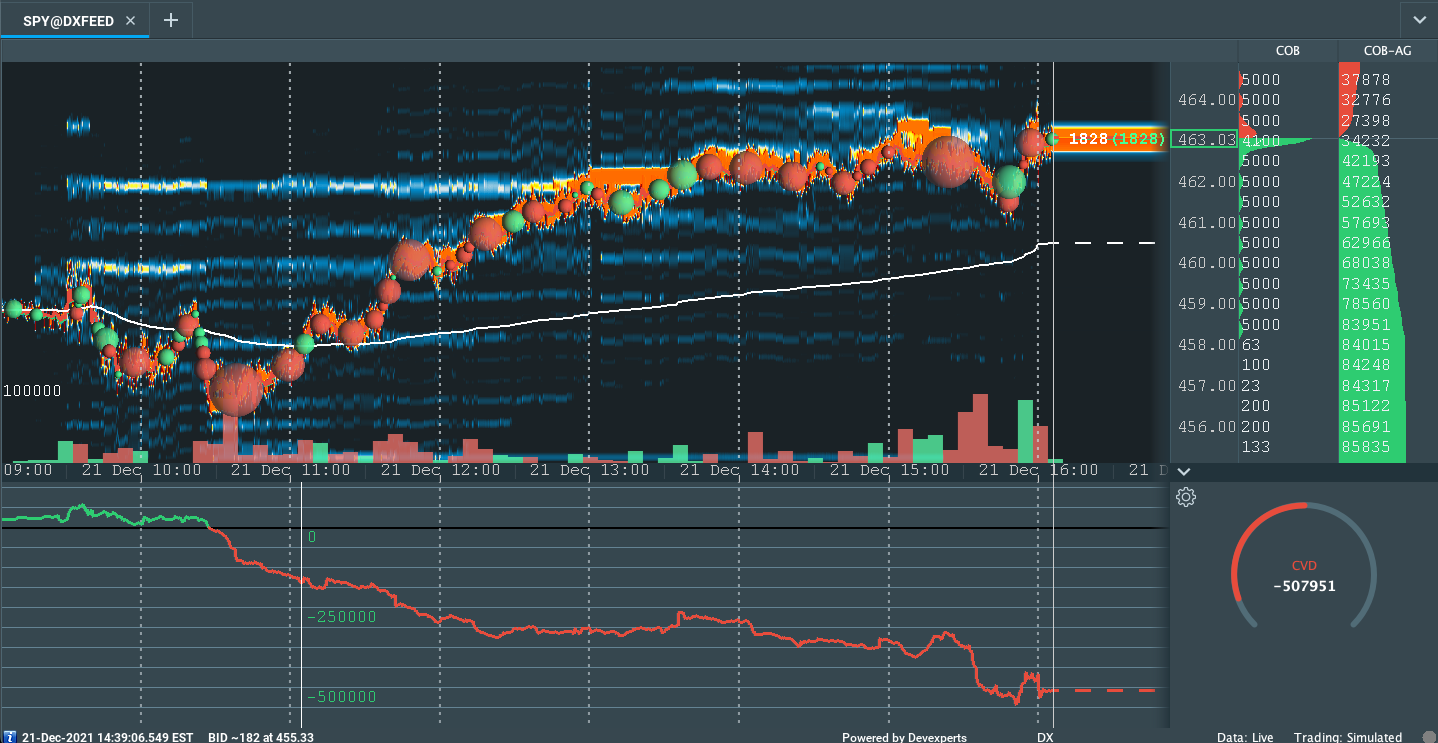
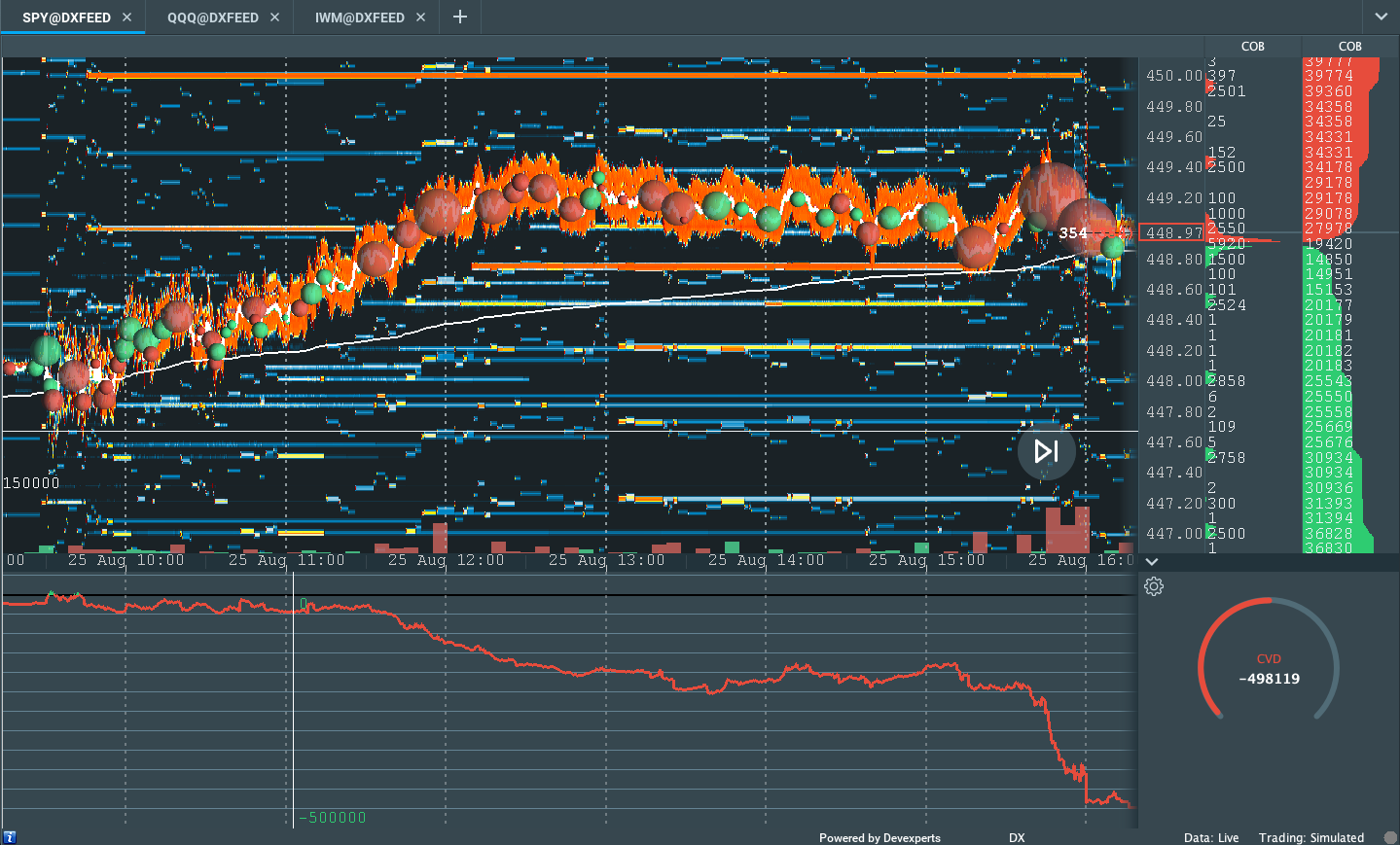
Graphic: Divergent delta (i.e., non-committed buying as measured by volume delta or buying and selling power as calculated by the difference in volume traded at the bid and offer) in SPDR S&P 500 ETF Trust (NYSE: SPY), one of the largest ETFs that track the S&P 500 index, via Bookmap. The readings are supportive of responsive trade (i.e., rotational trade that suggests current prices offer favorable entry and exit; the market is in balance).

Context: In light of elevated implied volatility and limited macro, and micro catalysts, Goldman Sachs Group (NYSE: GS) sees “options selling strategies as attractive in the near term.”

“We estimate there is a 12% probability of a 1-month 5% down-move in the SPX in this economic environment based on our GS-EQMOVE model. Options are pricing a 22% probability of that size move indicating that puts are overvalued.”

The commitment of capital on lower directional volatility results in counterparties taking on more exposure to positive gamma which they will offset by supplying the market with liquidity, thereby pressuring the price discovery process.

Note: As a position’s delta rises with stock or index price rises, gamma (or how an option’s delta is expected to change given a change in the underlying) is added to the delta.

“I use this analogy of a jet,” Kai Volatility’s Cem Karsan once explained to me, referencing the three factors – the change in the underlying price (gamma), implied volatility (vanna), and time (charm) – that are well known to impact an options exposure to directional risk or delta. 

“As volatility is compressed, those jets will keep firing because … the hedging vanna and charm flows, and whatnot will push the markets higher.”

Still, many products are in lower liquidity and short-gamma (wherein an options delta decreases with stock prices rises and increases when stock prices drop) in which moves are more erratic.

If the S&P were to further trend sideways, as a result of the aforementioned hedging pressures, a decline in correlation – among volatile constituents – would be the only reconciliation.

A post-holiday collapse in implied volatility, coupled with the management of massive S&P positions, and relentless, seasonally-aligned “passive buying support,” may bring in positive flows that would bolster any attempt higher.
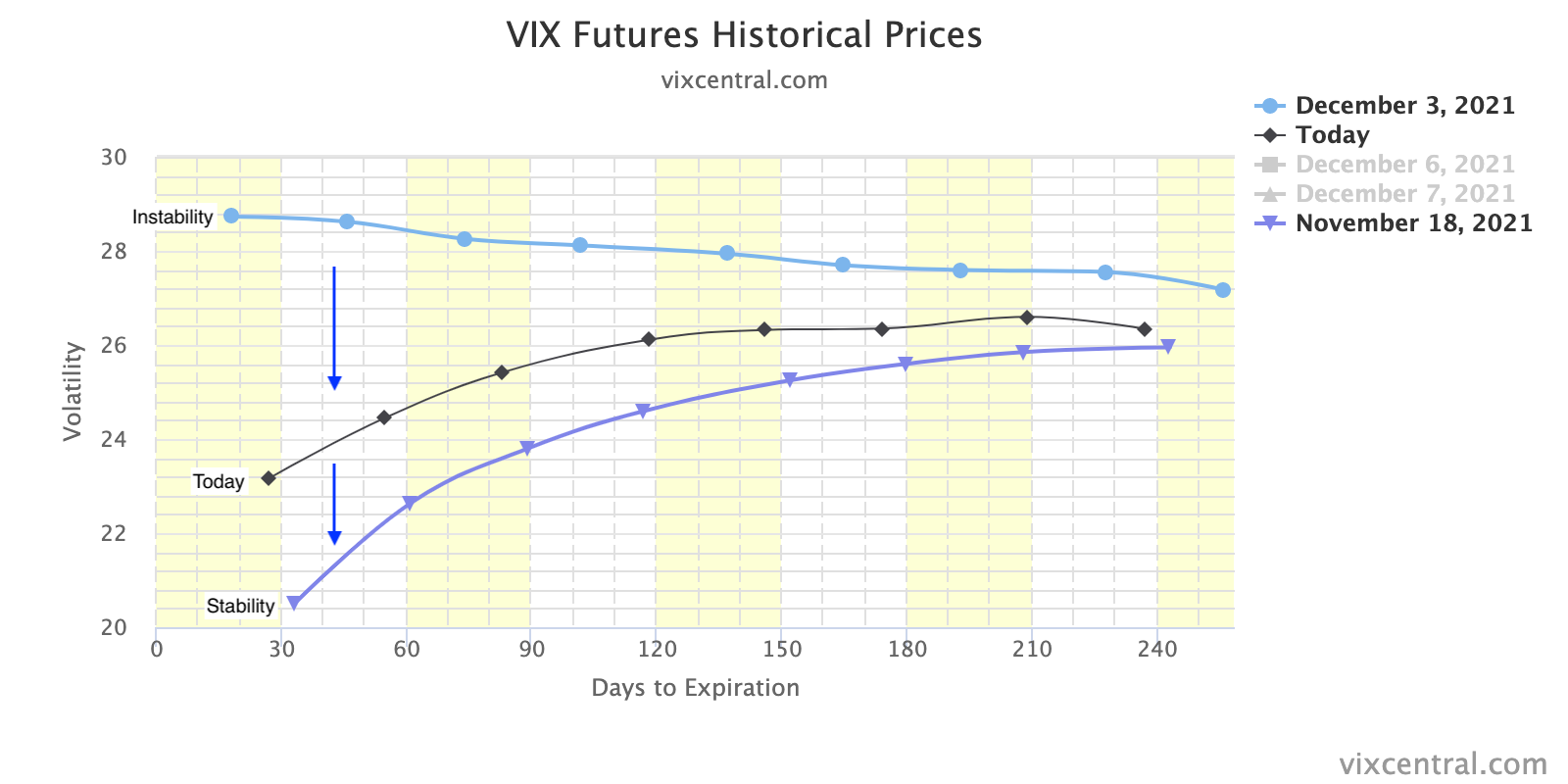
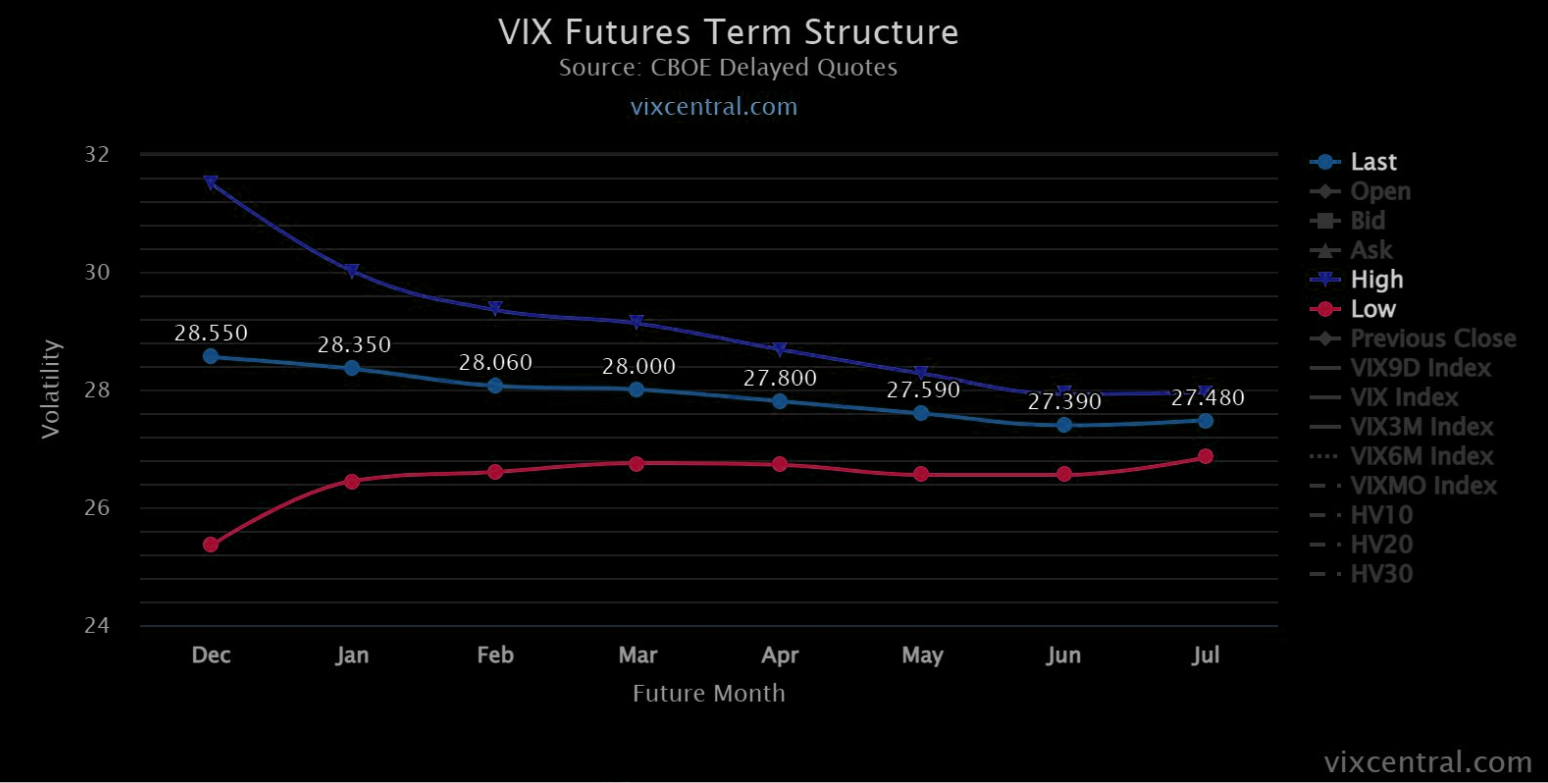
Graphic: A compression in the VIX term structure would provide markets a boost.

Expectations: As of 6:30 AM ET, Wednesday’s regular session (9:30 AM – 4:00 PM ET), in the S&P 500, will likely open in the upper part of a balanced overnight inventory, just outside of prior-range and -value, suggesting a potential for immediate directional opportunity.

Gap Scenarios In Play: Gaps ought to fill quickly. Should they not, that’s a signal of strength; do not fade. Leaving value behind on a gap-fill or failing to fill a gap (i.e., remaining outside of the prior session’s range) is a go-with indicator.

Auctioning and spending at least 1-hour of trade back in the prior range suggests a lack of conviction; in such a case, do not follow the direction of the most recent initiative activity.

In the best case, the S&P 500 trades sideways or higher; activity above the $4,623.00 point of control (POC) puts in play the $4,647.25 high volume area (HVNode). Initiative trade beyond the HVNode could reach as high as the $4,674.25 HVNode and $4,709.00 VPOC, or higher.

In the worst case, the S&P 500 trades lower; activity below the $4,623.00 POC puts in play the $4,585.00 VPOC. Initiative trade beyond the VPOC could reach as low as the $4,574.25 HVNode and $4,549.00 VPOC, or lower.

Click here to load today’s key levels into the web-based TradingView charting platform. Note that all levels are derived using the 65-minute timeframe. New links are produced, daily.
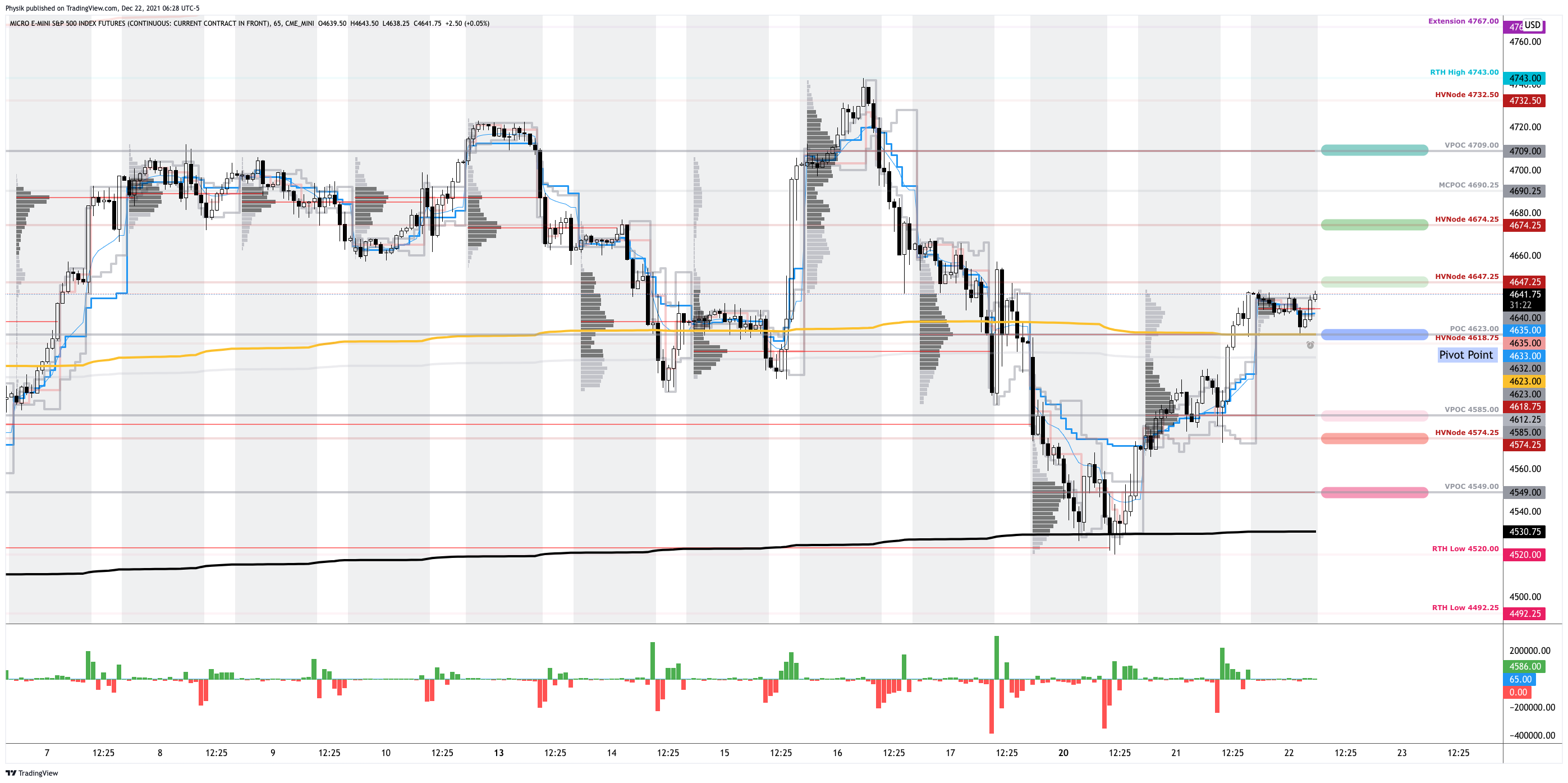
Graphic: 65-minute profile chart of the Micro E-mini S&P 500 Futures. Learn about the profile.

What People Are Saying

Definitions

Volume Areas: A structurally sound market will build on areas of high volume (HVNodes). Should the market trend for long periods of time, it will lack sound structure, identified as low volume areas (LVNodes). LVNodes denote directional conviction and ought to offer support on any test. 

If participants were to auction and find acceptance into areas of prior low volume (LVNodes), then future discovery ought to be volatile and quick as participants look to HVNodes for favorable entry or exit.

POCs: POCs are valuable as they denote areas where two-sided trade was most prevalent in a prior day session. Participants will respond to future tests of value as they offer favorable entry and exit.

MCPOCs: POCs are valuable as they denote areas where two-sided trade was most prevalent over numerous day sessions. Participants will respond to future tests of value as they offer favorable entry and exit.

Volume-Weighted Average Prices (VWAPs): A metric highly regarded by chief investment officers, among other participants, for quality of trade. Additionally, liquidity algorithms are benchmarked and programmed to buy and sell around VWAPs.

About

After years of self-education, strategy development, and trial-and-error, Renato Leonard Capelj began trading full-time and founded Physik Invest to detail his methods, research, and performance in the markets.

Additionally, Capelj is a Benzinga finance and technology reporter interviewing the likes of Shark Tank’s Kevin O’Leary, JC2 Ventures’ John Chambers, and ARK Invest’s Catherine Wood, as well as a SpotGamma contributor, helping develop insights around impactful options market dynamics.

Disclaimer

At this time, Physik Invest does not carry the right to provide advice. In no way should the materials herein be construed as advice. Derivatives carry a substantial risk of loss. All content is for informational purposes only.

Categories
Commentary

Daily Brief For December 6, 2021

What Happened

Overnight, equity index futures auctioned sideways to higher after Friday’s liquidation had the S&P 500 undercutting its 50-day simple moving average (SMA), a visual go/no-go level.

Strength shifted, again, to the Russell 2000 while the tech-heavy Nasdaq 100 was underwater. This comes as policymakers look to temper inflation with the tightening of monetary policy.

In regards to news, China’s central bank looked to boost liquidity for its slowing economy. It was also found that a new virus variant was not fueling a surge in hospitalizations; the U.S.’s adviser on the issue, Anthony Fauci, said there wasn’t “a great degree of severity to omicron.”

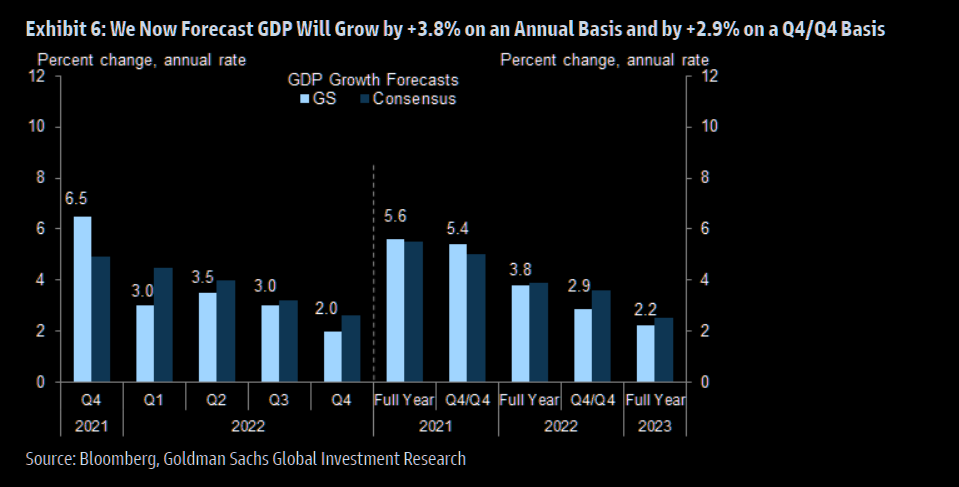
That didn’t stop the economists at Goldman Sachs Group Inc (NYSE: GS) from cutting their forecasts for U.S. GDP next year; the estimates were revised down on an expectation the omicron strain would drag growth.

Ahead are no important releases on fundamental data.

Graphic updated 6:30 AM ET. Sentiment Neutral if expected /ES open is inside of the prior day’s range. /ES levels are derived from the profile graphic at the bottom of the following section. Levels may have changed since initially quoted; click here for the latest levels. SqueezeMetrics Dark Pool Index (DIX) and Gamma (GEX) calculations are based on where the prior day’s reading falls with respect to the MAX and MIN of all occurrences available. A higher DIX is bullish. At the same time, the lower the GEX, the more (expected) volatility. Learn the implications of volatility, direction, and moneyness. SHIFT data used for S&P 500 (INDEX: SPX) options activity. Note that options flow is sorted by the call premium spent; if more positive then more was spent on call options. Breadth reflects a reading of the prior day’s NYSE Advance/Decline indicator. VIX reflects a current reading of the CBOE Volatility Index (INDEX: VIX) from 0-100.

What To Expect

On weak intraday breadth and divergent market liquidity metrics, the worst outcome occurred; there was an expansion of range, to the downside, and participants spent the majority of the session building value at lower prices (i.e., levels at which 70% of that day’s volume occurred).

The lower bound of Friday’s range was $4,500.00 or so, at which the 50-day SMA corresponded with a large base of resting liquidity. 

To note, the 50-day is visual level at which short-term, technically-driven participants were likely buying in response to probes below developing balance. 

Successfully auctioning beneath the 50-day is a concern. Those short-term participants lack the wherewithal (both emotional and financial) to defend retests.

Continuation lower, in such a case, is likely.

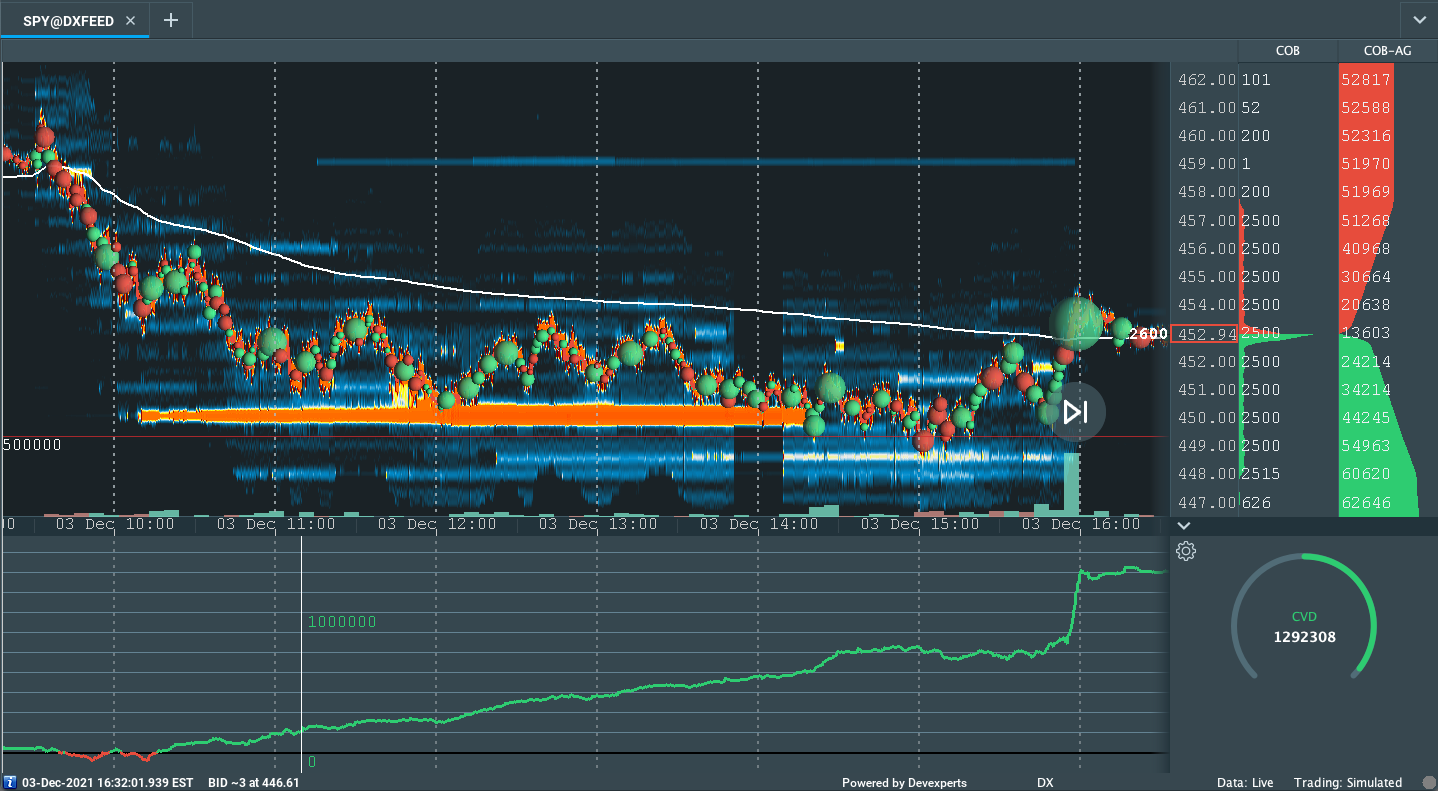
Graphic: Divergent delta (i.e., non-committed selling as measured by volume delta or buying and selling power as calculated by the difference in volume traded at the bid and offer) in SPDR S&P 500 ETF Trust (NYSE: SPY), one of the largest ETFs that track the S&P 500 index, via Bookmap. The readings are supportive of responsive trade (i.e., rotational trade that suggests current prices offer favorable entry and exit; the market is in balance).

Context: The Fed’s intent to moderate stimulus and uncertainty with regards to how a new COVID-19 variant will impact the global recovery.

According to Bloomberg, “the Fed is seen responding to the inflation fears stalking businesses by leaning toward an older playbook of prioritizing the fight against price pressures — even if that risks weaker growth over the longer term.”

In line with the aforementioned, traders already started pricing in potential rate overshoots with the “December 2024 eurodollar yields [rising] above December 2025 contracts, a curve inversion that signals expectations the central bank may consider cutting rates in 2025.”

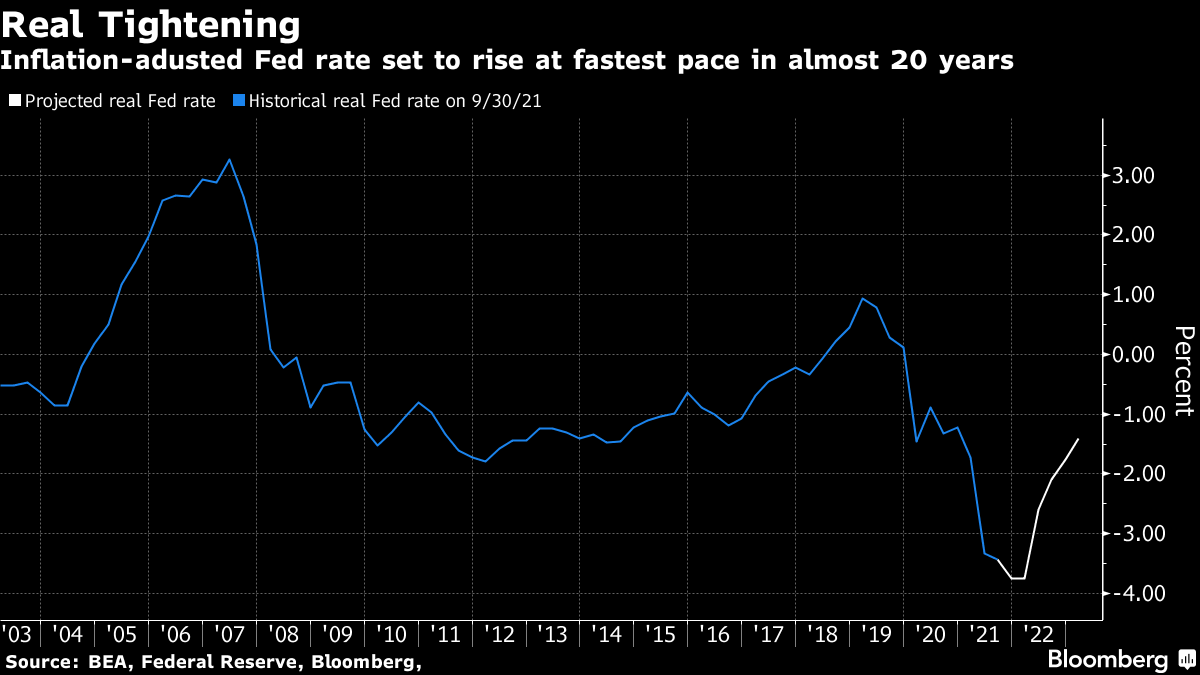
The result is that the U.S. may realize the swiftest tightening in financial conditions since 2005 if the Fed was to hike rates three times next year.

Graphic: Via Bloomberg, trades price in a rapid increase in the real Fed rate.

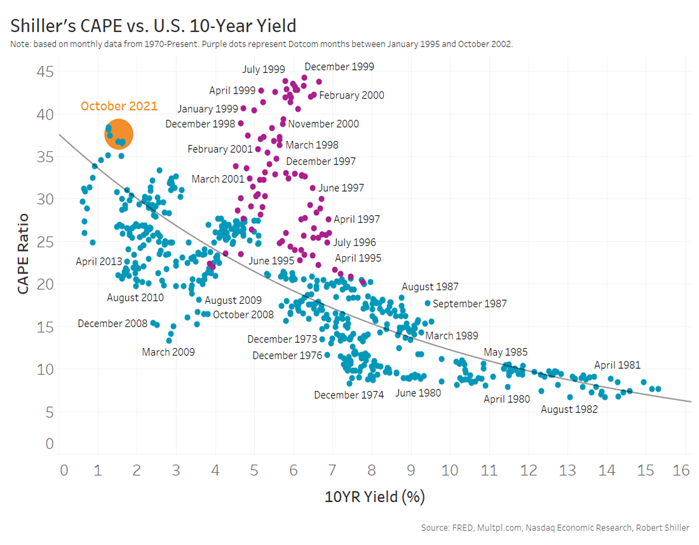
This development carries weight; now, more than during the tech-and-telecom bubble, low rates support current valuations.

Graphic: Low rates support current valuations better than the ‘90s, according to Nasdaq.

The reason being? 

“Lower interest rates lead to future cashflow discounting less – leading to higher valuations. From another perspective, a company with a 5% profit margin is a much more attractive investment when long-term borrow costs are less than 2%, as they are now than when it costs 5%-7% to borrow money back in the ‘90s.”

The Fed’s intent to taper faster, and eventually hike rates, just as liquidity conditions have deteriorated, pushed “the orange dot [in the above graphic] toward the right during the year.”

Notwithstanding, “growth in earnings is so far stronger than the multiple compression caused by rising rates (blue line),” and that is helping support this year’s rally.

The intent to moderate stimulus is likely to serve as a headwind; there’s always a possibility of unanticipated policy adjustments, in the face of a resurgent COVID-19 digging further into the economy’s growth.

That’s partially why we saw Goldman Sachs cut their forecasts for GDP. 

Graphic: Via The Market Ear. Goldman Sachs cut its forecast for GDP.

But, for every negative view, there is a positive (either by the same institution or a competitor).

We see JPMorgan Chase & Co (NYSE: JPM), among others, doubling down on their bullishness.

“We are calling for another year of positive earnings surprises, relative to current consensus estimates.”

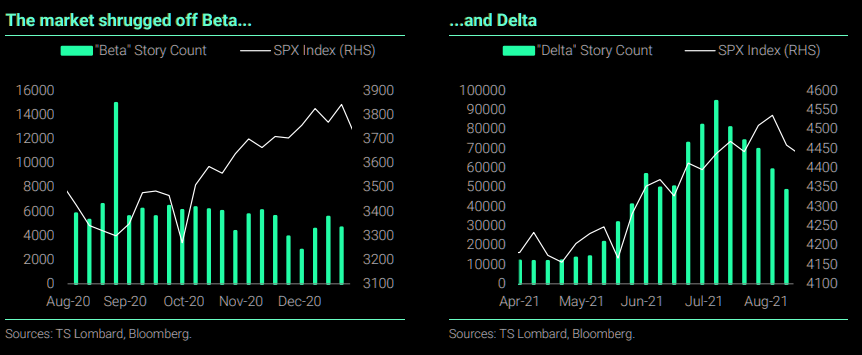
Similarly, the market may shrug off omicron just as it did beta and delta

Graphic: Via The Market Ear, the market shrugs off COVID-19 variants with ease.

And, despite the market’s trade in short-gamma (a “negative [gamma] implies the opposite [selling into lows, buying into highs], thus magnifying market volatility”) destabilizing demand for downside protection is concentrated in shorter-dated options

Graphic: A roll lower in the VIX term structure brings in supportive flows. Via The Market Ear.

Once that short-dated protection rolls off the table (and/or is monetized), counterparties will quickly reverse and support the market, buying to close their existing stock/futures hedges.

This flow is stabilizing and may play into a seasonally-aligned rally into Christmas as participants see defenses rolled out against the new COVID-19 variant, and the positive effects of pro-cyclical inflation, economic growth, and improvements in global trade.

Such development plays into a thesis held by Moody’s Corporation (NYSE: MCO). 

“The forecast is that the Dow Jones Industrial Average increases this quarter and peaks in early 2022. However, the rest of the contours of the forecast didn’t change. We expect the DJIA to steadily decline throughout 2022, but because it will now peak later than previously thought, the level of the DJIA will be higher at the end of next year and over the near-term forecast.”

Similarly, here are some views by Morgan Stanley (NYSE: MS), compiled by The Market Ear. 

“The Morgan Stanley’s Global Risk Demand Index (GRDI) [fell] to a 10Y low reading of -4.2SD, last Friday (currently -3.SD). Historically, such a level has proved to be a solid buy signal over the next 3m. Other signs that investor sentiment has overshot to the downside include the VIX > 30, a steep put-call skew, and the AAII survey where 42% of respondents are bearish (90th percentile reading). Over the last decade, MSCI ACWI has risen 98% of the time over the next 3m post this signal and by an average of 10%.”

Expectations: As of 6:30 AM ET, Monday’s regular session (9:30 AM – 4:00 PM ET), in the S&P 500, will likely open in the middle part of a positively skewed overnight inventory, inside of prior-range and -value, suggesting a limited potential for immediate directional opportunity.

Balance-Break Scenarios: A change in the market (i.e., the transition from two-time frame trade, or balance, to one-time frame trade, or trend) may occur.

Monitor for acceptance (i.e., more than 1-hour of trade) outside of the developing balance area. Rejection (i.e., return inside of balance) portends a move to the opposite end of the balance.

In the best case, the S&P 500 trades sideways or higher; activity above the $4,523.00 untested point of control (VPOC) puts in play the $4,551.75 low volume area (LVNode). Initiative trade beyond the LVNode could reach as high as the $4,574.25 high volume area (HVNode) and $4,590.00 balance area high (BAH), or higher.

In the worst case, the S&P 500 trades lower; activity below the $4,523.00 VPOC puts in play the $4,492.25 regular trade low (RTH Low). Initiative trade beyond the RTH Low could reach as low as the $4,471.00 and $4,425.00 VPOC, or lower.

Click here to load today’s updated key levels into the web-based TradingView charting platform. Note that all levels are derived using the 65-minute timeframe. New links are produced, daily.
Graphic: 65-minute profile chart of the Micro E-mini S&P 500 Futures. Learn about the profile.

What People Are Saying

Definitions

Volume Areas: A structurally sound market will build on areas of high volume (HVNodes). Should the market trend for long periods of time, it will lack sound structure, identified as low volume areas (LVNodes). LVNodes denote directional conviction and ought to offer support on any test. 

If participants were to auction and find acceptance into areas of prior low volume (LVNodes), then future discovery ought to be volatile and quick as participants look to HVNodes for favorable entry or exit.

Liquidation Breaks: The profile shape suggests participants were “too” long and had poor location.

POCs: POCs are valuable as they denote areas where two-sided trade was most prevalent in a prior day session. Participants will respond to future tests of value as they offer favorable entry and exit.

About

After years of self-education, strategy development, and trial-and-error, Renato Leonard Capelj began trading full-time and founded Physik Invest to detail his methods, research, and performance in the markets.

Additionally, Capelj is a Benzinga finance and technology reporter interviewing the likes of Shark Tank’s Kevin O’Leary, JC2 Ventures’ John Chambers, and ARK Invest’s Catherine Wood, as well as a SpotGamma contributor, developing insights around impactful options market dynamics.

Disclaimer

At this time, Physik Invest does not manage outside capital and is not licensed. In no way should the materials herein be construed as advice. Derivatives carry a substantial risk of loss. All content is for informational purposes only.
Categories
Commentary

Daily Brief For October 11, 2021

Editor’s Note: The newsletter schedule has changed.

From now on, you can expect to see Daily Briefs only – Monday through Friday – posted shortly before 8:00 AM ET. The Weekly Trade Idea will be packaged into Monday’s commentary, also.

Thanks again for your continued support. I strive to simplify and add value, as best I can.

Market Commentary

Equity index futures trade sideways to lower with bonds. Commodities were mixed.

  • October bottom; a rip up into EOY?
  • Ahead: No economic reports today.

What Happened: Ahead of a busy start to the third-quarter earnings season, this week, U.S. stock index futures auctioned sideways to lower overnight alongside some mixed narratives.

Last night, it was revealed that Goldman Sachs Group (NYSE: GS) cut its U.S. growth forecast on consumption and a fiscal slowdown. Not even a day later, there is news that Goldman, alongside JPMorgan Chase & Co (NYSE: JPM) strategists, suggests the recent dip is a buy.

Given the Columbus Day holiday, today, no economic reports are scheduled.

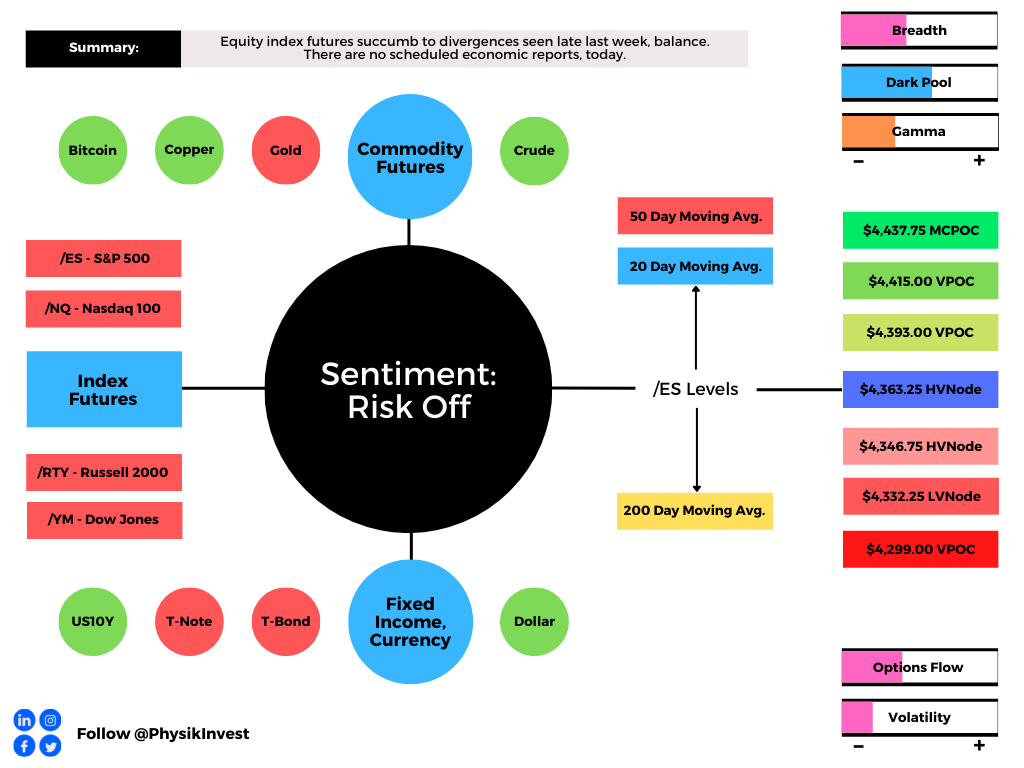
Graphic updated 6:20 AM ET. Sentiment Risk-Off if expected /ES open is below the prior day’s range. /ES levels are derived from the profile graphic at the bottom of the following section. SqueezeMetrics Dark Pool Index (DIX) and Gamma (GEX) calculations are based on where the prior day’s reading falls with respect to the MAX and MIN of all occurrences available. A higher DIX is bullish. At the same time, the lower the GEX, the more (expected) volatility. SHIFT data used for S&P 500 (INDEX: SPX) options activity. Note that options flow is sorted by the call premium spent; if more positive then more was spent on call options. Breadth reflects a reading of the prior day’s NYSE Advance/Decline indicator. VIX reflects a current reading of the CBOE Volatility Index (INDEX: VIX) from 0-100.

What To Expect: As of 6:20 AM ET, Monday’s regular session (9:30 AM – 4:00 PM EST) in the S&P 500 will likely open outside of prior-range and -value, suggesting a potential for immediate directional opportunity.

Gap Scenarios: Gaps ought to fill quickly. Should they not, that’s a signal of strength; do not fade. Leaving value behind on a gap-fill or failing to fill a gap (i.e., remaining outside of the prior session’s range) is a go-with indicator.

Auctioning and spending at least 1-hour of trade back in the prior range suggests a lack of conviction; in such a case, do not follow the direction of the most recent initiative activity.

Further, during the prior week’s trade, on mostly strong intraday breadth and divergent market liquidity metrics, equity index futures established a rounded bottom and minimal excess low.

Then, a swift recovery ensued; initiative sellers lacked the wherewithal to take prices lower, beyond the S&P 500’s $4,363.25-$4,278.00 balance area. Initiative buyers were then emboldened, expanding range and value the opposite way.

During this recovery process, the S&P 500 – as evidenced by p-shaped emotional, multiple-distribution profile structures – established a minimal excess high before momentum from covering shorts was overpowered by responsive selling at key areas of resting liquidity, at and around /ES $4,410.25 (SPY $441.00), the site of a key anchored volume-weighted average price (VWAP) level.

Note: Liquidity algorithms are benchmarked and programmed to buy and sell around VWAPs.

Friday’s session succumbed to divergences in buying and selling power as calculated by the difference in volume traded at the bid and offer, resolving some of the aforementioned emotional structures through what’s called the “cave-fill” process. 

During this process, participants revisited, repaired, and strengthened – building out areas of high volume (HVNodes), or value – areas low volume (LVNodes).

Note: The cave-fill process widened the area deemed favorable to transact at by an increased share of participants. This is a good development.

Moreover, September’s seasonally-aligned weakness saw the Nasdaq 100 lead lower. Last week – alongside improvement amongst some positioning metrics – the tone shifted with the cash-settled Nasdaq 100 (INDEX: NDX) rising 4.35% versus the S&P 500 (INDEX: SPX) rising 3.25%.

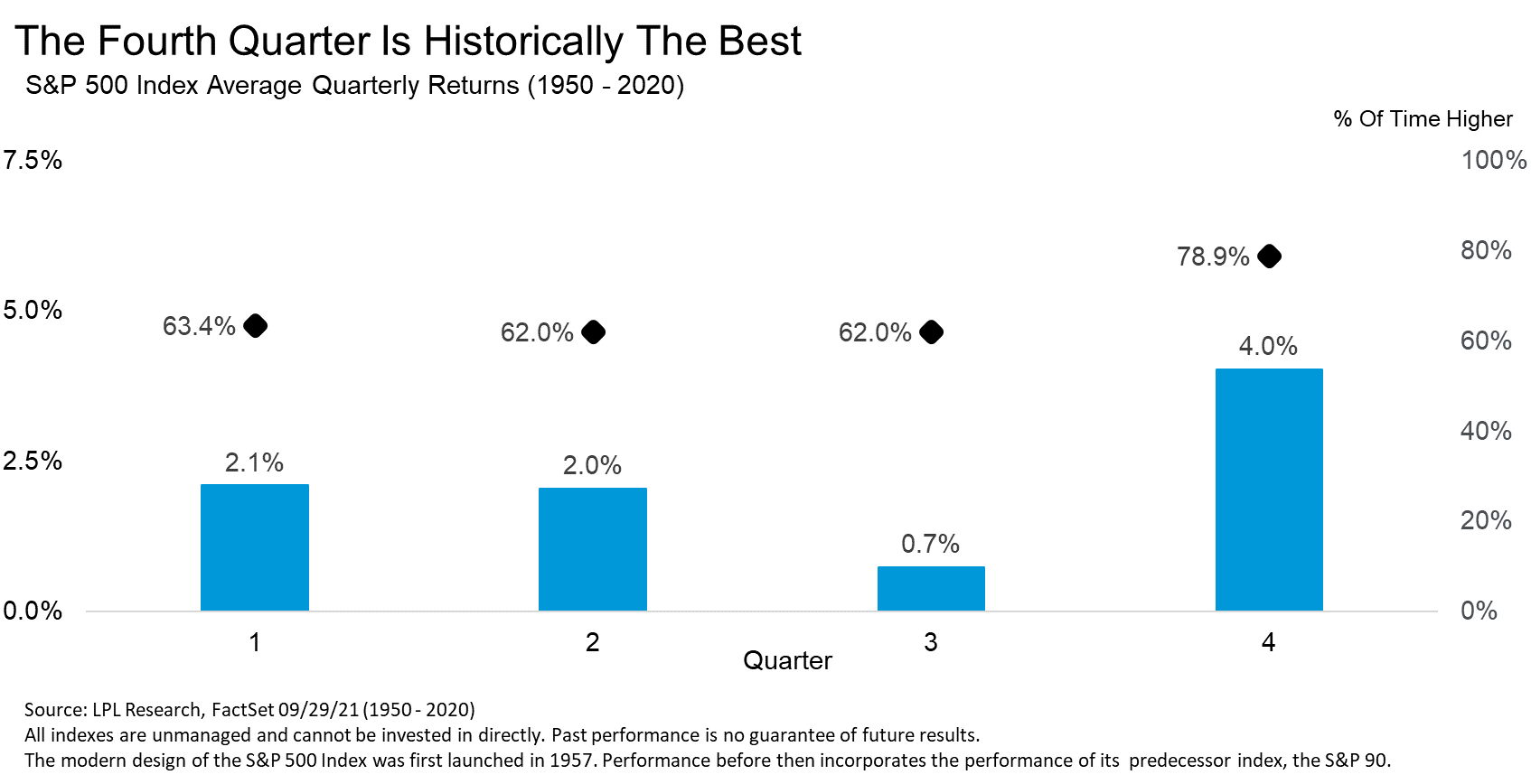
That comes as October traditionally marks an end to weakness amidst a cycle of rebalancing and earnings; according to LPL Financial Research, “Stocks rise 3.8% on average during the fourth quarter, but the past seven times the S&P 500 was up 15% year-to-date heading into the home stretch of the year, the fourth quarter was higher every single time, up a very impressive 5.8%.” 

“Earnings for the third quarter should again be strong and mostly outpace expectations,” Leuthold Group chief investment strategist Jim Paulsen adds. “Hours worked in the third quarter rose by about 5% suggesting real GDP for the quarter may be close to 7%. With most companies reporting strong pricing power, solid real GDP growth should result in another surprisingly strong corporate earnings season.”

Graphic: LPL Financial Research unpacks S&P 500 seasonality.
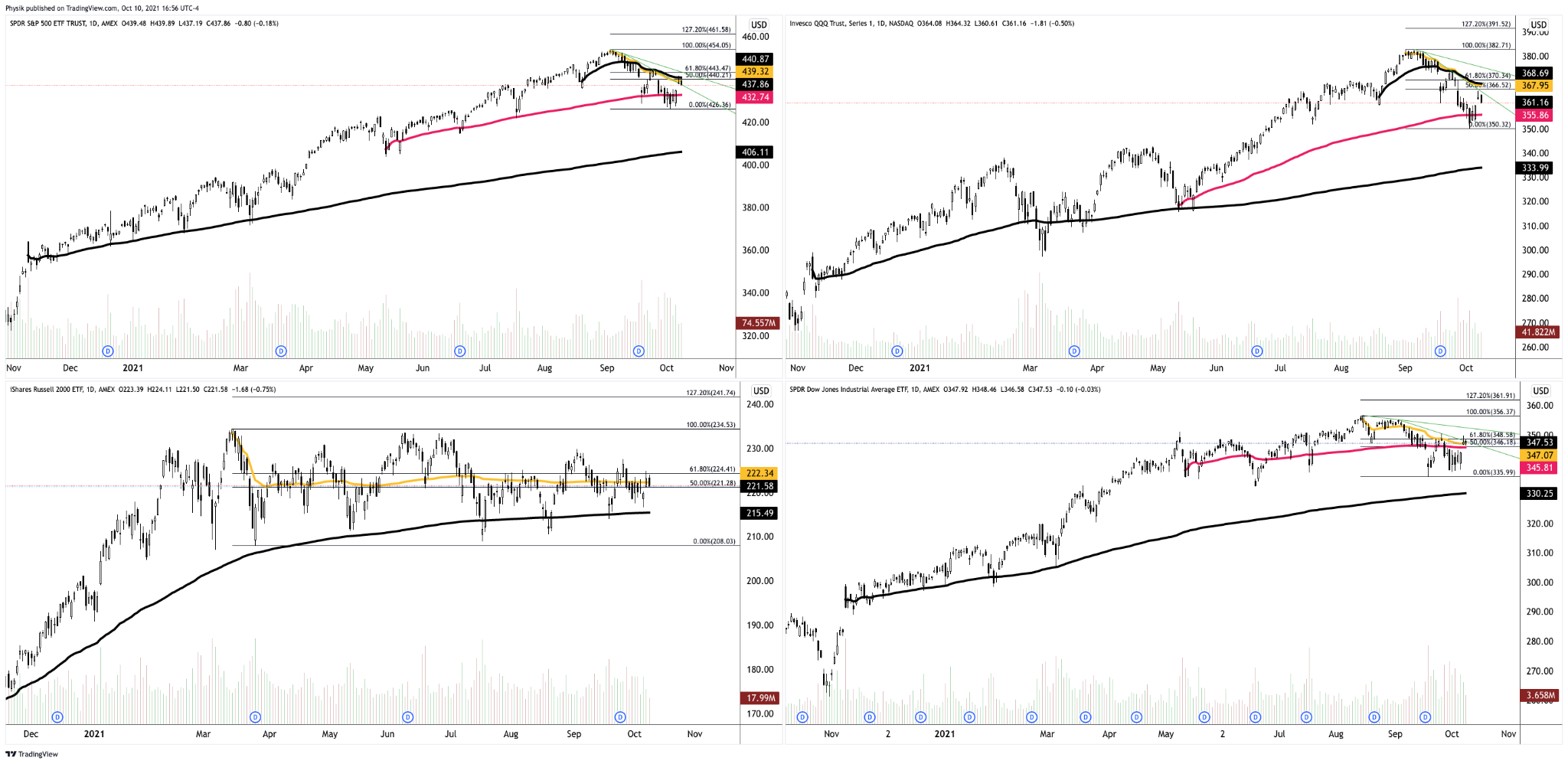
Graphic: SPDR S&P 500 ETF (NYSE: SPY) top left, Invesco QQQ Trust Series 1 (NASDAQ: QQQ) top right, iShares Russell 2000 ETF (NYSE: IWM) bottom left, SPDR Dow Jones Industrial Average ETF Trust (NYSE: DIA) bottom right. Spending more than a few hours of trade above trend, VWAP (yellow), and the 61.80% Fibonacci retracement suggest good odds of upside continuation.

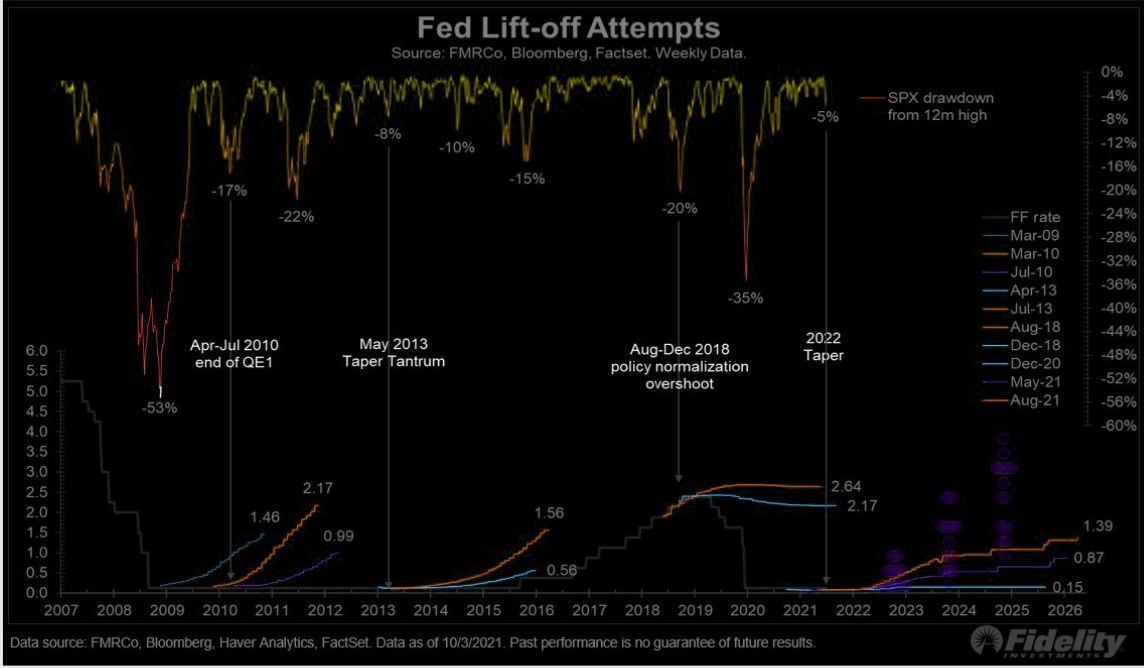
Notwithstanding, some risks to be aware of include the Federal Reserve’s tapering initiatives and the prospects of a rise in the Fed funds rate, amidst hot sentiment, a decline in top-of-book depth, as well as back and forth entry (exit) into (from) short-gamma.

“What we see in the equity space is a lot of sensitivity to higher real yields,” Joseph Little, chief global strategist at HSBC Holdings Plc (NYSE: HSBC) Asset Management, said. “We are seeing policy normalization everywhere. That creates a little bit of a challenge for [the] equity market because it does change the drivers of equity performance.”

Graphic: A “gentle reminder of the fact tapering matters,” via The Market Ear.
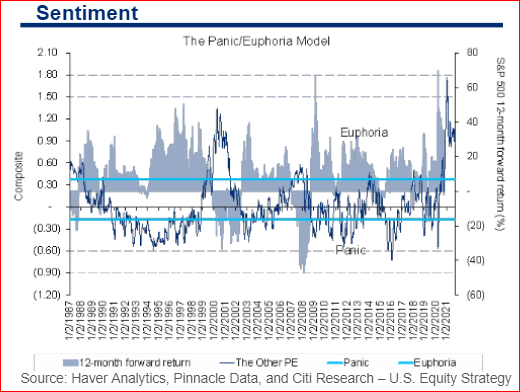
Graphic: Sentiment elevated, “generating a 96% historical probability of down markets in the next 12 months at current levels.”

In addition, to balance some of our Q4 bullishness, in a quote highlighted by The Market Ear, Bank of America Corporation (NYSE: BAC) explained: September 30 “was the 24th time since 1928 that the S&P experienced two or more 3-sigma shocks in 10 trading days, … [and] only in 3 of 23 episodes (and 1 in the last 50yrs) did the S&P surpass the prior month’s peak in the month following the second shock.”

Moreover, for today, participants may make use of the following frameworks.

In the best case, the S&P 500 trades sideways or higher; activity above the $4,363.25 high volume area (HVNode) puts in play the $4,393.00 untested point of control (VPOC). Initiative trade beyond the $4,393.00 VPOC could reach as high as the $4,415.00 VPOC and $4,437.75 micro composite point of control (MCPOC), or higher.

In the worst case, the S&P 500 trades lower; activity below the $4,363.25 HVNode puts in play the $4,346.75 HVNode. Initiative trade beyond the HVNode could reach as low as the $4,332.25 low volume area (LVNode) and $4,299.00 VPOC, or lower.

Graphic: 65-minute profile chart of the Micro E-mini S&P 500 Futures updated 6:20 AM ET.

Definitions

Volume Areas: A structurally sound market will build on areas of high volume (HVNodes). Should the market trend for long periods of time, it will lack sound structure, identified as low volume areas (LVNodes). LVNodes denote directional conviction and ought to offer support on any test. 

If participants were to auction and find acceptance into areas of prior low volume (LVNodes), then future discovery ought to be volatile and quick as participants look to HVNodes for favorable entry or exit.

Gamma: Gamma is the sensitivity of an option to changes in the underlying price. Dealers that take the other side of options trades hedge their exposure to risk by buying and selling the underlying. When dealers are short-gamma, they hedge by buying into strength and selling into weakness. When dealers are long-gamma, they hedge by selling into strength and buying into weakness. The former exacerbates volatility. The latter calms volatility.

POCs: POCs are valuable as they denote areas where two-sided trade was most prevalent in a prior day session. Participants will respond to future tests of value as they offer favorable entry and exit.

MCPOCs: POCs are valuable as they denote areas where two-sided trade was most prevalent over numerous day sessions. Participants will respond to future tests of value as they offer favorable entry and exit.

Excess: A proper end to price discovery; the market travels too far while advertising prices. Responsive, other-timeframe (OTF) participants aggressively enter the market, leaving tails or gaps which denote unfair prices.

Value-Area Placement: Perception of value unchanged if value overlapping (i.e., inside day). Perception of value has changed if value not overlapping (i.e., outside day). Delay trade in the former case.

News And Analysis

Banks bought epic amounts of safe assets; forget inflation.

The Fed is likely to side with growth and keep policy easy.

Merck seeks emergency use authorization for COVID pills.

Europe Economic Snapshot: Faster-than-expected restart.

Latin America settles into new post-pandemic slow growth.

S&P talking stock-flow confusion again – QE and tapering.

What People Are Saying

Weekly Trade Idea

About

After years of self-education, strategy development, and trial-and-error, Renato Leonard Capelj began trading full-time and founded Physik Invest to detail his methods, research, and performance in the markets. 

Additionally, Capelj is a finance and technology reporter. Some of his biggest works include interviews with leaders such as John Chambers, founder and CEO, JC2 Ventures, Kevin O’Leary, businessman and Shark Tank host, Catherine Wood, CEO and CIO, ARK Invest, among others.

Disclaimer

At this time, Physik Invest does not manage outside capital and is not licensed. In no way should the materials herein be construed as advice. Derivatives carry a substantial risk of loss. All content is for informational purposes only.
Categories
Commentary

Daily Brief For August 26, 2021

Market Commentary

Equity index futures traded lower overnight. Commodities, the dollar, and yields rose.

  • Jackson Hole Economic Symposium starts.
  • Ahead: Data on GDP, jobless claims, profit.
  • Participants position for a directional move.

What Happened: U.S. stock index futures auctioned lower overnight ahead of the Federal Reserve’s Jackson Hole Economic Symposium August 26-28, 2021.

Ahead is data on GDP, corporate profits, and jobless claims (8:30 AM ET).

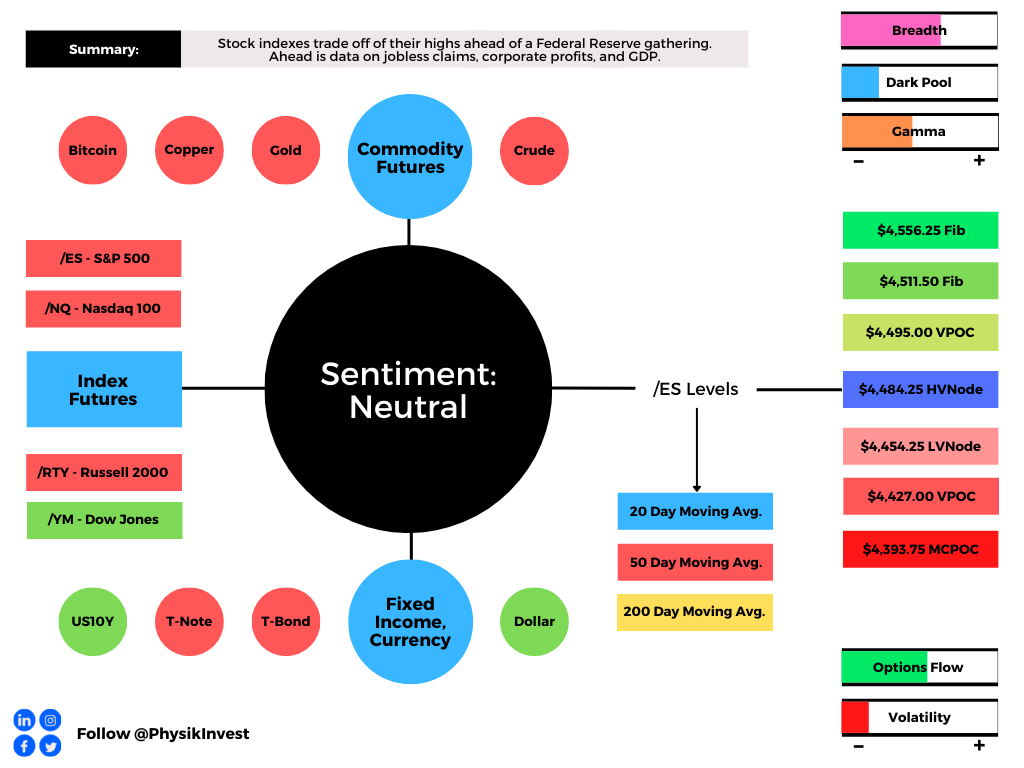
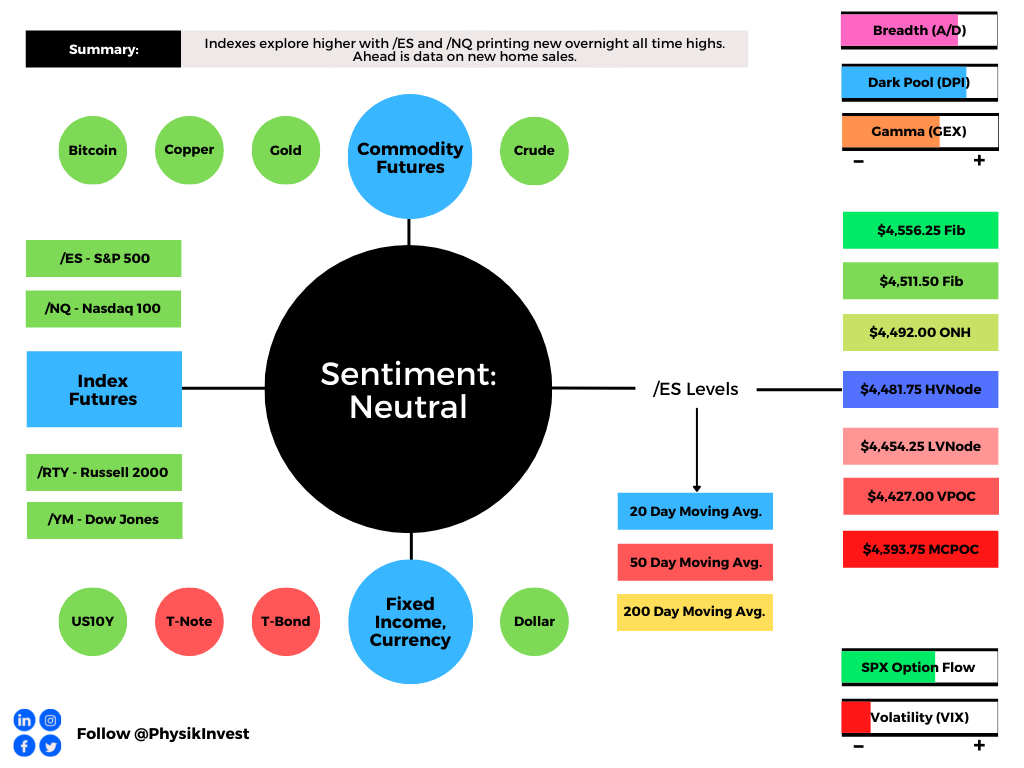
Graphic updated 6:20 AM ET. Sentiment Neutral if expected /ES open is inside of the prior day’s range. SqueezeMetrics Dark Pool Index (DIX) and Gamma (GEX) calculations are based on where the prior day’s reading falls with respect to the MAX and MIN of all occurrences available. A higher DIX is bullish. At the same time, the lower the GEX, the more (expected) volatility. SHIFT data used for S&P 500 (INDEX: SPX) options activity approximation. Note that options flow is sorted by the call premium spent; if more positive then more was spent on call options. Breadth reflects a reading of the prior day’s Advance/Decline indicator. VIX reflects a current reading of the CBOE Volatility Index (INDEX: VIX) from 0-100.

What To Expect: As of 6:20 AM ET, Thursday’s regular session (9:30 AM – 4:00 PM EST) in the S&P 500 will likely open inside of prior-range and -value, suggesting a limited potential for immediate directional opportunity.

Adding, during the prior day’s regular trade, on weaker intraday breadth, volume, and market liquidity metrics, the best case outcome occurred, evidenced by trade above the $4,481.75 high volume area (HVNode) pivot. This trade is significant because it marked the repair of the $4,492.00 overnight, a minimal excess all-time high (ONH), and a move higher in value (i.e., an acceptance of higher prices). 

Graphic: Divergent delta (i.e., non-committed buying as measured by volume delta) in SPDR S&P 500 ETF Trust (NYSE: SPY), one of the largest ETFs that track the S&P 500 index. 

Further, the aforementioned trade is happening in the context of the highly anticipated Jackson Hole Economic Symposium. This event may have a large impact on the price as policymakers reinforce the message of taper to bond-buying; to elaborate, “The Fed has fostered a broad range of bubbles because their massive liquidity injections have been trapped in the financial economy,” Rich Bernstein of Richard Bernstein Associates said in a summary quoted by Bloomberg

“As with any cornered market, there are limited buyers and prices fall as the “cornerer” sells. Accordingly, bond prices seem likely to fall (interest rates rise) [as the] Fed reduces its cornered positions. Rising interest rates could be the kryptonite to the bubble in long-duration assets (long-term bonds, technology, innovation, disruption, bitcoin, etc.).”

At the same time, according to JPMorgan Chase & Co (NYSE: JPM) metrics published by The Market Ear, the market isn’t pricing too much risk ahead of the event; “the SPX and the SX5E are pricing in a 1% move, … but on the other hand 1 day realized vol for Jackson Hole events has been around 0.45% for SX5E writes JPM.”

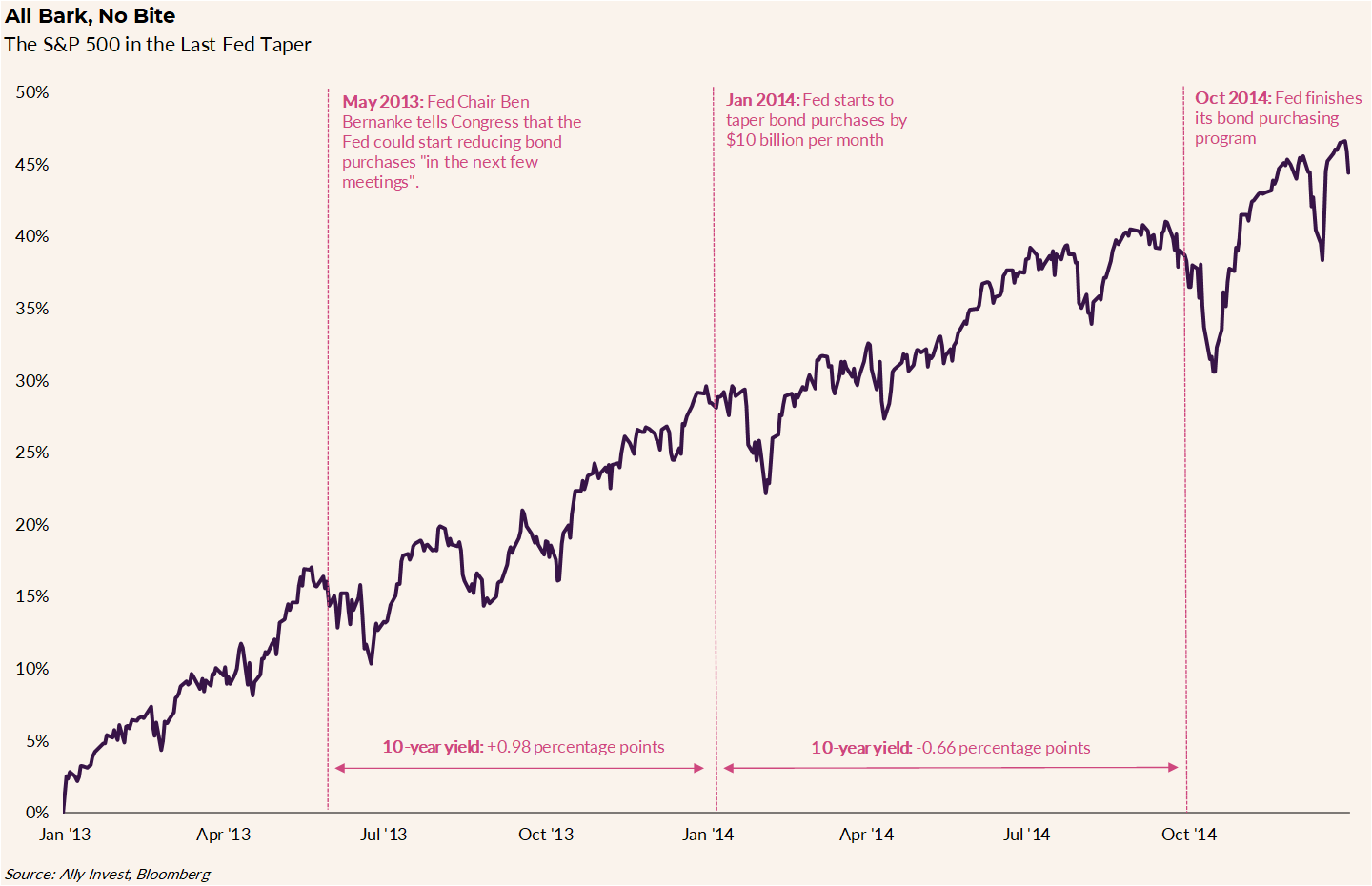
We balance the risks presented by the event by looking back to 2014 when the Fed was scaling back bond purchases and the S&P 500 rose over 10% as rates fell after spiking initially.

Graphic: Ally Financial Inc-owned (NYSE: ALLY) Ally Invest unpacks 2014 taper of Federal Reserve bond buying.

Moreover, for today, participants may make use of the following frameworks.

In the best case, the S&P 500 trades sideways or higher; activity above the $4,494.25 high volume area (HVNode) puts in play the $4,495.00 untested point of control (VPOC). Initiative trade beyond the VPOC could reach as high as the $4,511.50 and $4,556.25 Fibonacci extensions.

In the worst case, the S&P 500 trades lower; activity below the $4,484.25 HVNode puts in play the $4,454.25 low volume area (LVNode). Initiative trade beyond the LVNode could reach as low as the $4,427.00 VPOC and $4,393.75 micro composite point of control (MCPOC).

Volume Areas: A structurally sound market will build on past areas of high volume. Should the market trend for long periods of time, it will lack sound structure (identified as a low volume area which denotes directional conviction and ought to offer support on any test). 

If participants were to auction and find acceptance into areas of prior low volume, then future discovery ought to be volatile and quick as participants look to areas of high volume for favorable entry or exit.

POCs: POCs are valuable as they denote areas where two-sided trade was most prevalent. Participants will respond to future tests of value as they offer favorable entry and exit.
Graphic: 65-minute profile chart of the Micro E-mini S&P 500 Futures updated 6:20 AM ET.

News And Analysis

Good times keep rolling for U.S. alternative asset managers.

Virtual Jackson Hole underscores uncertainty in Fed’s vision.

Small caps are having a nice move higher on fundamentals.

Bank of Korea ups rate with debt risk seen bigger than virus.

La Nina’s return could threaten South American crops again.

As labor demand exceeds supply it may be the time to taper.

Asian banks’ crypto-asset push calls for regulatory harmony.

PIIE: There’s another reason to up the Fed’s inflation target.

Dick’s Sporting Goods, other retailers, unpack higher profits.

Delta Air Lines imposes monthly surcharge on unvaccinated.

What People Are Saying

About

After years of self-education, strategy development, and trial-and-error, Renato Leonard Capelj began trading full-time and founded Physik Invest to detail his methods, research, and performance in the markets. 

Additionally, Capelj is a finance and technology reporter. Some of his biggest works include interviews with leaders such as John Chambers, founder and CEO, JC2 Ventures, Kevin O’Leary, businessman and Shark Tank host, Catherine Wood, CEO and CIO, ARK Invest, among others.

Disclaimer

At this time, Physik Invest does not manage outside capital and is not licensed. In no way should the materials herein be construed as advice. Derivatives carry a substantial risk of loss. All content is for informational purposes only.
Categories
Commentary

Daily Brief For August 24, 2021

Market Commentary

Equity index and commodity futures trade higher overnight. Yields and VIX are higher, too.

  • Unpacking drivers behind market.
  • Ahead: Data on new home sales.
  • Eyeing digestion, sideways trade.

What Happened: U.S. stock index futures explored higher prices overnight as investors looked to position themselves for the upcoming Jackson Hole Economic Symposium August 26-28, 2021. The Russell 2000 is leading the pack alongside the Nasdaq 100.

Ahead is data on new home sales (10:00 AM ET).

Graphic updated 6:30 AM ET. Sentiment Neutral if expected /ES open is inside of the prior day’s range. See here for more on the Dark Pool Index (DPI) and Gamma (GEX). A higher DPI approximation is bullish. At the same time, the lower the GEX approximation, the more volatility. SHIFT data used for options activity approximation. Note that options flow is sorted by the call premium spent; if green and more positive then more was spent on call options. Breadth reflects a reading of the prior day’s Advance/Decline indicator. VIX reflects a current reading of the CBOE Volatility Index from 0-100.

What To Expect: As of 6:30 AM ET, Tuesday’s regular session (9:30 AM – 4:00 PM EST) in the S&P 500 will likely open just inside of prior-range and -value, suggesting a limited potential for immediate directional opportunity.

Adding, during the prior day’s regular trade, on strong intraday breadth and middling market liquidity metrics, the best case outcome occurred, evidenced by trade above the $4,476.50 overnight high (ONH). This is significant because Monday’s trade took back 100% of last week’s liquidation, completing a v-pattern recovery.

V-Pattern: A pattern that forms after a market establishes a high, retests some support, and then breaks above said high. In most cases, this pattern portends continuation.

Further, the aforementioned trade is happening in the context of impactful options market dynamics, moderating growth, and inclination to taper stimulus in spite of a resurgence in COVID-19.

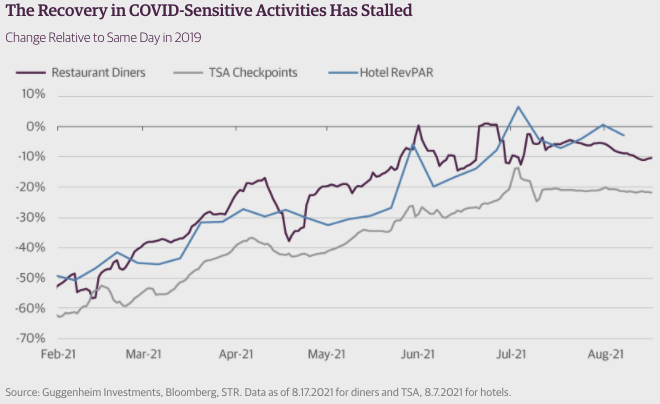
Some of the implications of these themes on price are supportive and contradictory; to elaborate, “[t]he good news is that our economic recovery is unlikely to fully reverse, given lack of political will for a return to stricter lockdown measures. But evidence of a slowdown in third-quarter economic activity will continue to mount in the coming weeks, putting the Fed’s 7 percent real GDP growth projection for 2021 out of reach,” strategists at Guggenheim noted.

“This string of weaker data will likely prompt the Fed, led by Chair Powell and Governor Brainard, to take a more cautious approach to the timing and speed of tapering plans, in turn keeping Treasury yields low.”

At the same time, briefly, we should touch on the so-called sale of any volatility spike which can – through the process of hedging – support the market. Here’s just one example that’s been receiving a lot of attention.

“In theory, if a stock was dropping and the retail masses all started to sell puts, they could push market makers to start buying large blocks of shares,” SpotGamma, an important voice in the space, says. “This could stabilize a dropping stock.”

Graphic: SqueezeMetrics details the implications of customer activity in the options market, on the underlying’s order book. For instance, in selling a put, customers add liquidity and stabilize the market. How? The counterparty long the put will buy (sell) the underlying to neutralize directional risk as price falls (rises).

Moreover, for today, given expectations of heightened volatility and responsive trade, participants may make use of the following frameworks.

Responsive Buying (Selling): Buying (selling) in response to prices below (above) an area of recent price acceptance.

In the best case, the S&P 500 trades sideways or higher; activity above the $4,481.75 high volume area (HVNode) puts in play the $4,492.00 overnight, minimal excess all-time high (ONH). Initiative trade beyond the ONH could reach as high as the $4,511.50 and $4,556.25 Fibonacci extensions.

In the worst case, the S&P 500 trades lower; activity below the $4,481.75 HVNode puts in play the $4,454.25 low volume area (LVNode). Initiative trade beyond the LVNode could reach as low as the $4,427.00 untested point of control (VPOC) and $4,393.75 micro composite point of control (MCPOC).

Overnight Rally Highs (Lows): Typically, there is a low historical probability associated with overnight rally-highs (lows) ending the upside (downside) discovery process.

Excess: A proper end to price discovery; the market travels too far while advertising prices. Responsive, other-timeframe (OTF) participants aggressively enter the market, leaving tails or gaps which denote unfair prices.

Volume Areas: A structurally sound market will build on past areas of high volume. Should the market trend for long periods of time, it will lack sound structure (identified as a low volume area which denotes directional conviction and ought to offer support on any test). 

If participants were to auction and find acceptance into areas of prior low volume, then future discovery ought to be volatile and quick as participants look to areas of high volume for favorable entry or exit.

POCs: POCs are valuable as they denote areas where two-sided trade was most prevalent. Participants will respond to future tests of value as they offer favorable entry and exit.
Graphic: 65-minute profile chart of the Micro E-mini S&P 500 Futures updated 6:30 AM ET.

News And Analysis

Ignoring Risk: S&P 500 doubles to the fastest bull market.

Moviegoers return, but COVID, streaming threaten theater.

Fed Chairman Jerome Powell navigating inflation debates.

S&P Global unpacks digital asset infrastructure – custody.

Existing home sales back on a rise as inventory improves.

Latin American conditions are painting a favorable portrait.

Funds trimming hawkish Fed bets as Jackson Hole looms.

Ten cities successfully weathering COVID on management.

Cumberland Advisors: Who is working and who is not yet?

PBOC will boost its credit support, stabilize money growth.

USDC reserve to be converted into less risky investments.

Year-to-date loan default volumes down 88% versus 2020.

Bank acquisitions of big fintechs rare amid startup growth.

What People Are Saying

About

After years of self-education, strategy development, and trial-and-error, Renato Leonard Capelj began trading full-time and founded Physik Invest to detail his methods, research, and performance in the markets. 

Additionally, Capelj is a finance and technology reporter. Some of his biggest works include interviews with leaders such as John Chambers, founder and CEO, JC2 Ventures, Kevin O’Leary, businessman and Shark Tank host, Catherine Wood, CEO and CIO, ARK Invest, among others.

Disclaimer

At this time, Physik Invest does not manage outside capital and is not licensed. In no way should the materials herein be construed as advice. Derivatives carry a substantial risk of loss. All content is for informational purposes only.
Categories
Commentary

Weekly Brief For August 1, 2021

Editor’s Note: On Thursday (8/5) and Friday (8/6) there will be no Daily Brief newsletter. Additionally, there will be no Weekly Brief Sunday (8/8), either. All commentaries to resume August 9, 2021.

If in the Miami, Florida area please contact renato@physikinvest.com if interested in connecting over markets, fintech, and the like.

PS: Added a new “Weekly Trade Ideas” section. Hope it provides added value!

Regards,

Renato Leonard Capelj

Market Commentary

Key Takeaways: Equity index futures to start the week off neutral, in prior-range and -value.

  • Debt limit, China, fiscal policy cloud outlook.
  • Expecting a heavy week for economic data.
  • Responsive trade until key levels are taken.
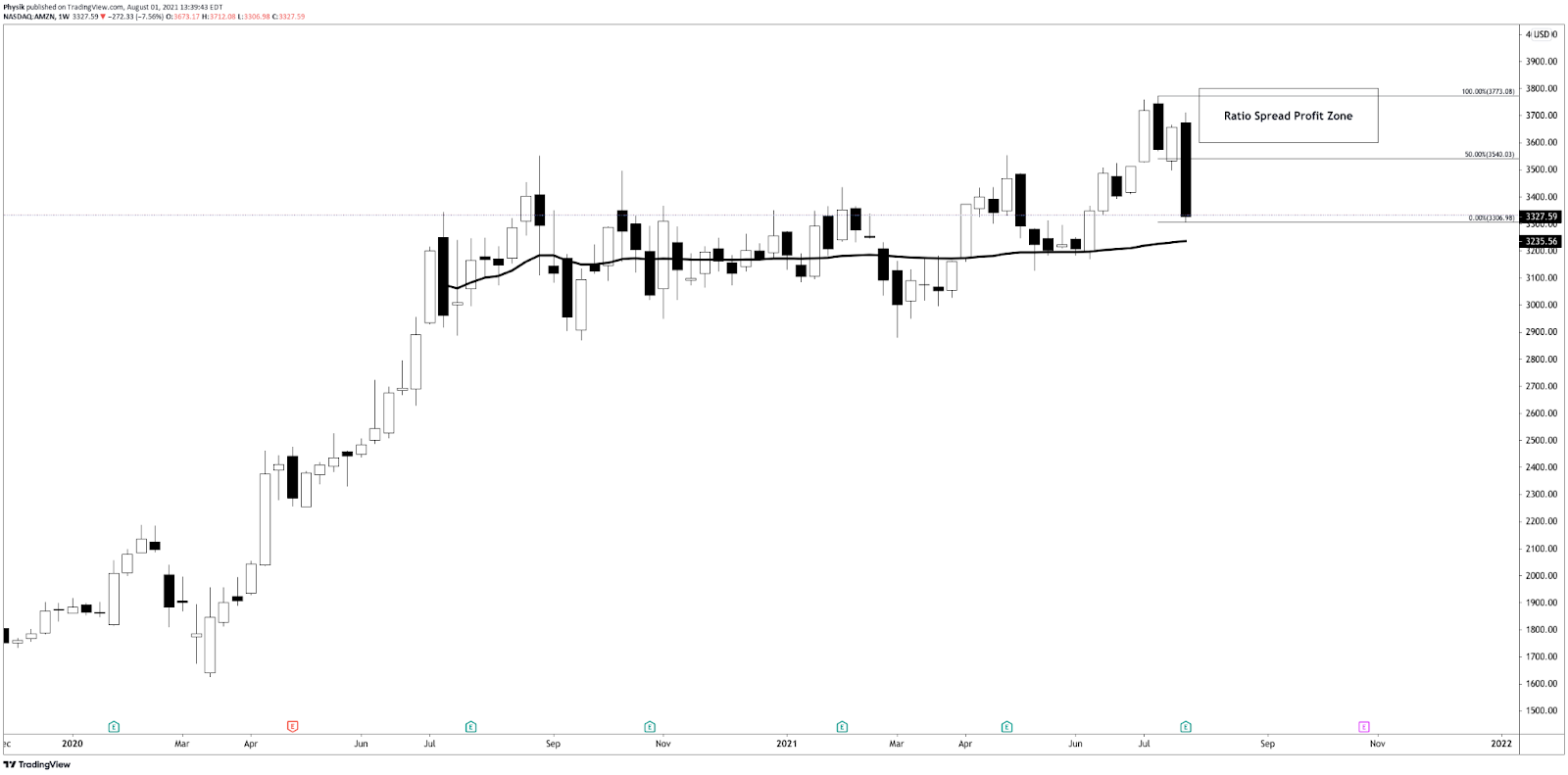
  • Amazon Inc (NASDAQ: AMZN) trade ideas.

What Happened: With respect to hot topic market risks, the week prior offered a ton of information to add to our narrative. We list for clarity.

  • Debt Limit: The August 1 reinstatement of the U.S. debt limit may have severe consequences, increasing the odds of a rating downgrade on government debt.
  • Monetary: Come September, participants will likely receive increased clarity over taper timelines with an official start early next year. Adding, Chairman Jerome Powell expressed inflation as temporary and the committee announced the creation of a pair of standing facilities to strengthen its ability to be the lender of last resort in the repo market.
  • China: Cross-asset volatility in China worsened, prompting talk of a yuan devaluation. A devaluation is something to fear; to note, The People’s Bank of China (PBOC) roiled global equity markets after its 2015 yuan devaluation.
  • Growth: U.S. economic data came in weaker suggesting growth likely peaked. Notwithstanding, consumer confidence improved markedly with sentiment recovering fully. Moody’s strategists look for real GDP to rise 6.7% this year, a downward revision on some fiscal policy assumptions.
  • Fiscal: Lawmakers debate another round of stimulus to ensure the strong long-term growth of lower- and middle-income households. The proposed legislation is receiving pushback with respect to its impact on inflation and taxes. Moody’s strategists note “higher taxes will weigh on economic growth, but the impact on the economy from the higher proposed taxes will be small.”
  • Pandemic: COVID-19 variants are a cause for concern – especially with respect to the Federal Reserve’s tapering of quantitative easing – but hospitalization ratios and mobility metrics suggest the crisis is likely over. In other areas, the CDC’s rental eviction moratorium and FHFA’s foreclosure moratorium expired with forbearance on government-backed mortgages and student loans ending September, also.
  • Yields: Technical factors – issuance, short coverings, a fading reflation trade, and peak growth – are to blame for lower Treasury yields. A longer-term deviation from the implied “economic fair value” of 1.6% and 1.65% for the 10-year yield would suggest other forces are driving long-term interest rates.
  • Earnings: Year-over-year profit growth of S&P 500 constituents stands at 85% with 88% of companies beating estimates for revenue and profit, according to Business Insider
  • Positioning: According to one Bank of America Corporation (NYSE: BAC) comment, highlighted by The Market Ear, “The average recovery time following 2-sigma one-day S&P declines has shortened significantly post-GFC, reaching an all-time low this year.” This has a lot to do with the inventory positioning of participants; volatility is oversupplied and associated heading forces make it so there is more liquidity and less movement. Should the market unpin, there’s “not enough liquidity” to absorb leverage on the tails.

Putting it all together, Goldman Sachs Group Inc (NYSE: GS) believes “[e]xpectations of higher interest rates and higher corporate tax rates by year-end are the primary reasons [to] forecast that the S&P 500 will trade sideways,” into end-of-year.

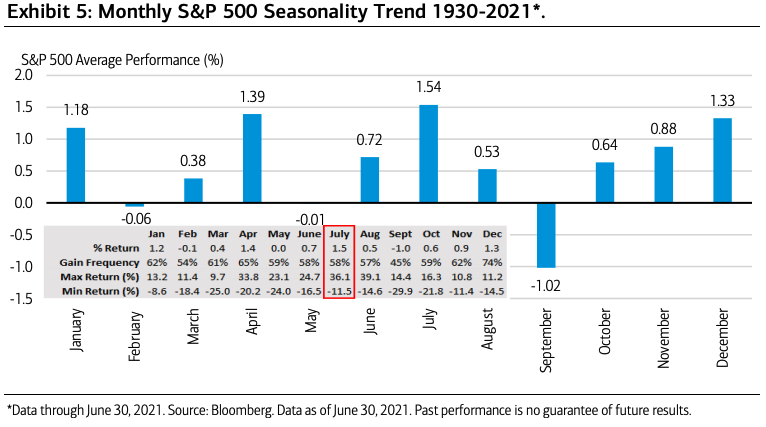
In support of that view is seasonality, also.

Graphic: Seasonality metrics via the Capital Market Outlook by Merrill.

What To Expect: The S&P 500, Nasdaq 100, and Dow Jones Industrial Average are above their key 20-, 50-, and 200-week moving averages while the Russell 2000 is stuck inside a multi-month trading range, between its 20- and 50-week moving averages.

Given the higher long-term trend, traders of the S&P 500, in particular, must contend with a week-long balance area, the result of participants finding higher prices valuable as they position themselves for a directional move, given increased clarity on earnings, taper, and more. 

Balance (Two-Timeframe Or Bracket): Rotational trade that denotes current prices offer favorable entry and exit. Balance-areas make it easy to spot a change in the market (i.e., the transition from two-time frame trade, or balance, to one-time frame trade, or trend).

In the coming sessions, given that the modus operandi is responsive trade (i.e., fade the edges), rather than initiative trade (i.e., play the break), participants will want to focus their attention on where the S&P 500 trades in relation to the $4,392.25 high volume area (HVNode) pivot.

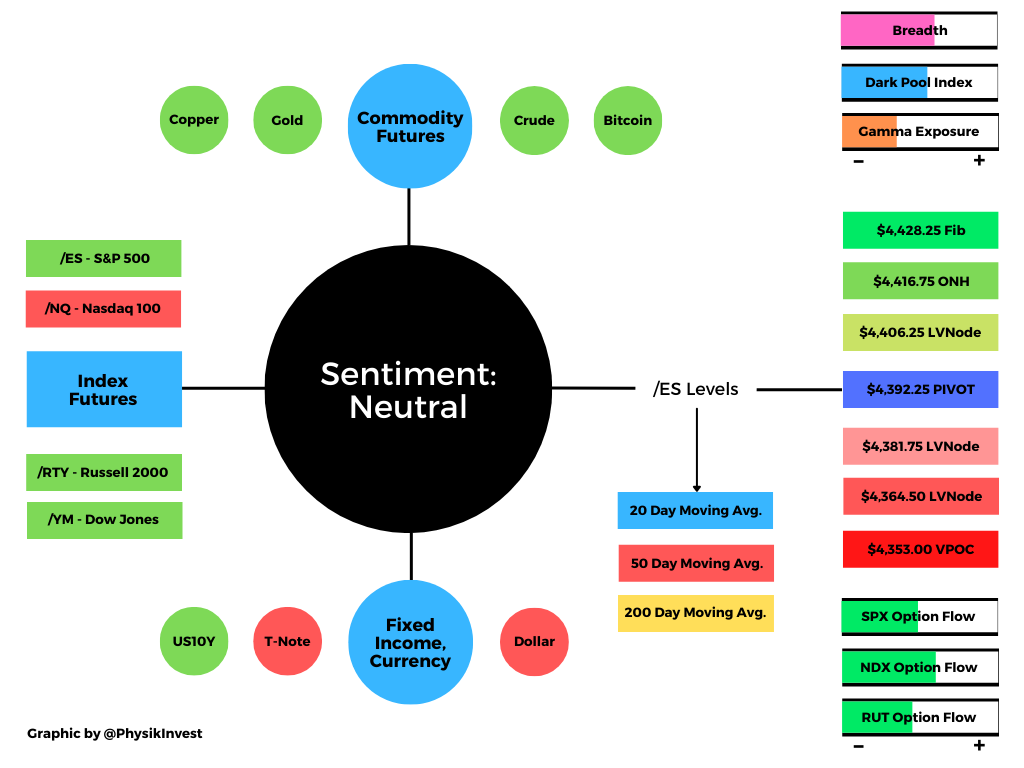
In the best case, the S&P 500 trades sideways or higher; activity above the $4,392.25 HVNode pivot puts in play the $4,406.25 low volume area (LVNode) and $4,419.00 untested point of control (VPOC). Initiative trade beyond the VPOC portends a potential breakout above the $4,422.75 minimal excess high, up to the $4,428.25 Fibonacci extension.

In the worst case, the S&P 500 trades lower; activity below the $4,392.25 HVNode pivot puts in play the $4,381.75 LVNode. Initiative trade beyond the LVNode portends a potential breakdown below the $4,370.50 minimal excess low, down to the $4,353.00 VPOC and $4,341.75 micro-composite point of control (MCPOC).

Volume Areas: A structurally sound market will build on past areas of high volume. Should the market trend for long periods of time, it will lack sound structure (identified as a low volume area which denotes directional conviction and ought to offer support on any test). 

If participants were to auction and find acceptance into areas of prior low volume, then future discovery ought to be volatile and quick as participants look to areas of high volume for favorable entry or exit.

POCs: POCs are valuable as they denote areas where two-sided trade was most prevalent. Participants will respond to future tests of value as they offer favorable entry and exit.

Excess: A proper end to price discovery; the market travels too far while advertising prices. Responsive, other-timeframe (OTF) participants aggressively enter the market, leaving tails or gaps which denote unfair prices.
Graphic: 65-minute profile chart of the Micro E-mini S&P 500 Futures. Note the blue anchored Volume Weighted Average Price (VWAP) which suggests the average buyer, since FOMC, is underwater. To note, VWAP is a metric highly regarded by chief investment officers, among other participants, for quality of trade. Additionally, liquidity algorithms are benchmarked and programmed to buy and sell around VWAPs.

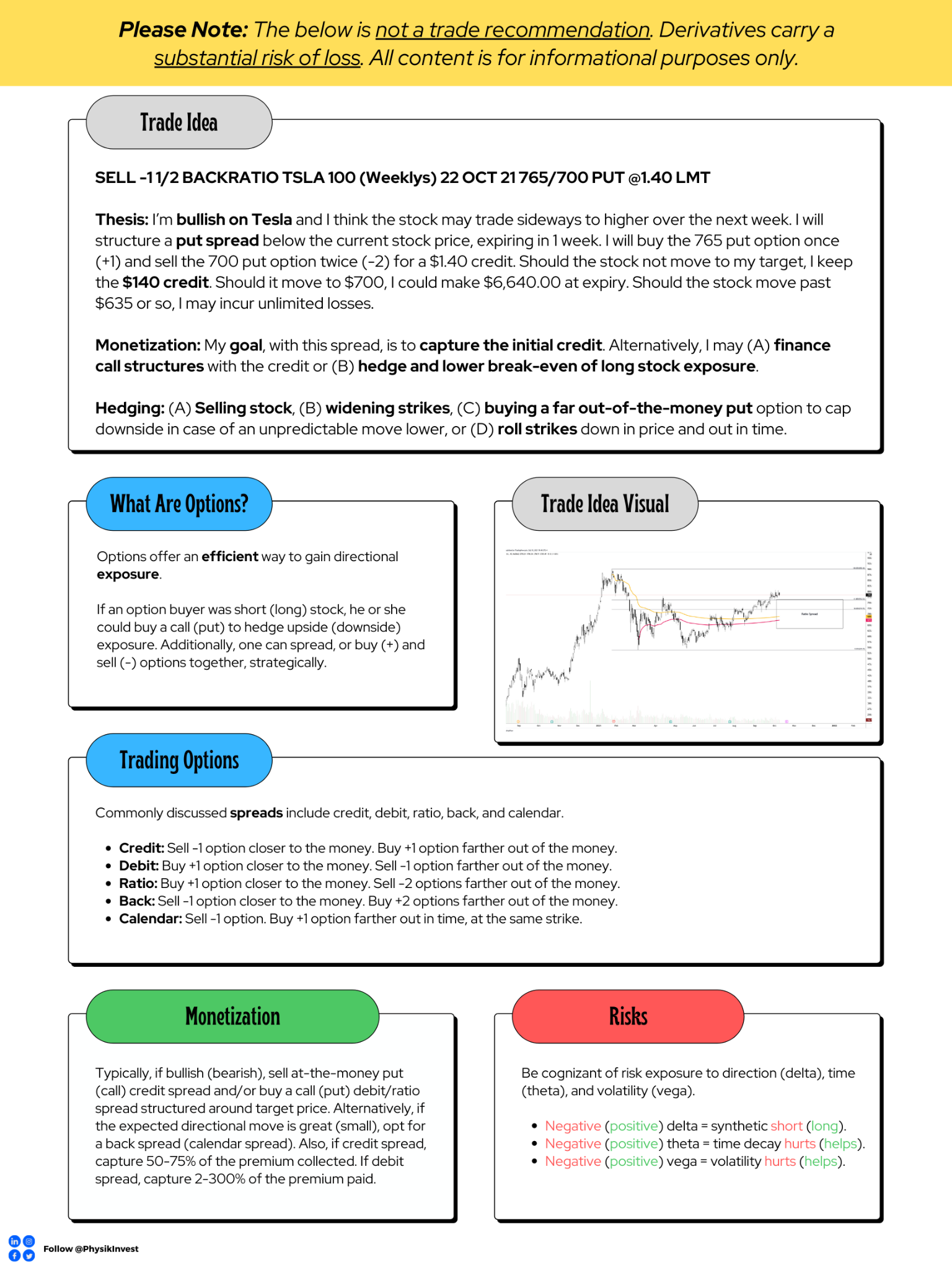
Weekly Trade Idea

Please Note: In no way is the below a trade recommendation. It is a peek into the thought process here at Physik Invest. To cover my butt, so to speak, I say DO NOT take this trade. Also, if you would like to see this section included in future commentaries, email me at renato@physikinvest.com with the subject line “Please Include Weekly Trade Ideas”.

Options offer an efficient way to gain directional exposure. 

If an option buyer was short (long) stock, he or she could buy a call (put) to hedge upside (downside) exposure. Additionally, one can spread, or buy (+) and sell (-) options together, strategically.

Commonly discussed spreads include credit, debit, ratio, back, and calendar.

  • Credit: Sell -1 option closer to the money. Buy +1 option farther out of the money.
  • Debit: Buy +1 option closer to the money. Sell -1 option farther out of the money.
  • Ratio: Buy +1 option closer to the money. Sell -2 options farther out of the money. 
  • Back: Sell -1 option closer to the money. Buy +2 options farther out of the money.
  • Calendar: Sell -1 option. Buy +1 option farther out in time, at the same strike.

Typically, if bullish (bearish), sell at-the-money put (call) credit spread and/or buy a call (put) debit/ratio spread structured around target price. Alternatively, if the expected directional move is great (small), opt for a back spread (calendar spread). Also, if credit spread, capture 50-75% of the premium collected. If debit spread, capture 2-300% of the premium paid.

Be cognizant of risk exposure to direction (delta), time (theta), and volatility (vega). 

  • Negative (positive) delta = synthetic short (long). 
  • Negative (positive) theta = time decay hurts (helps).
  • Negative (positive) vega = volatility hurts (helps).

Trade Idea: SELL -1 1/2 BACKRATIO AMZN 100 (Weeklys) 6 AUG 21 3600/3700 CALL @.50 LMT

I’m bullish on Amazon and I think the stock may climb over the next week, toward $3,600. I will structure a spread above the current stock price, expiring in 1 week. I will buy the 3600 call option once (+1) and sell the 3700 call option twice (-2) for a $0.50 credit. Should the stock not move to my target, I keep the $50 credit. Should it move to $3,700, I could make $10,050.00 at expiry. Should the stock move past $3,850.00, I may incur unlimited losses. My goal, with this spread, is to capture the initial credit and close for additional credit if the stock moves higher. 

If necessary, I will hedge the position by either (A) buying long stock, (B) widening strikes, (C) buying a far out-of-the-money call option to cap upside in case of an unpredictable move higher, or (D) roll strikes up in price and out in time.

What People Are Saying

About

After years of self-education, strategy development, and trial-and-error, Renato Leonard Capelj began trading full-time and founded Physik Invest to detail his methods, research, and performance in the markets. 

Additionally, Capelj is a finance and technology reporter. Some of his biggest works include interviews with leaders such as John Chambers, founder, and CEO, JC2 Ventures, Kevin O’Leary, businessman and Shark Tank host, Catherine Wood, CEO and CIO, ARK Invest, among others.

Disclaimer

At this time, Physik Invest does not manage outside capital and is not licensed. In no way should the materials herein be construed as advice. Derivatives carry a substantial risk of loss. All content is for informational purposes only.
Categories
Commentary

Daily Brief For July 29, 2021

Market Commentary

Equity index futures are sideways and divergent.

  • FOMC started the clock on tapering.
  • Ahead: Claims and U.S. GDP data.
  • NDX weak relative to RUT and SPX.

What Happened: U.S. stock index futures auctioned within prior range alongside positive earnings reports, infrastructure progress, China liquidity injections, and optimism that the Federal Reserve would not taper stimulus.

Adding, in a statement, Neil Dutta, head of U.S. economics at Renaissance Macro Research, explained: “The Fed is starting the clock on tapering. It is not happening now or even in September, but expect the pace of asset buying to slowdown late this year or early next.”

Moreover, participants should keep an eye out for data on initial and continuing jobless claims, U.S. GDP, as well as pending home sales and earnings.

Graphic updated 6:30 AM ET. Sentiment Neutral if expected /ES open is inside of the prior day’s range. See here for more on the Dark Pool Index and Gamma. A positive Dark Pool Index reading is bullish. At the same time, the higher (lower) the gamma, the less (more) volatility. SHIFT Search data used for options activity. Note that options flow is sorted by the call premium spent; if green and more (less) positive then more (less) was spent on call options. Breadth reflects a reading of the prior day’s Advance/Decline indicator.

What To Expect: As of 6:30 AM ET, Thursday’s regular session (9:30 AM – 4:00 PM EST) in the S&P 500 will likely open inside of prior-range and -value, suggesting a limited potential for immediate directional opportunity.

Adding, during the prior day’s regular trade, the best case outcome occurred, evidenced by resolve above the Volume Weighted Average Price (blue in color on the below profile graphic) anchored from the 2:00 PM ET Federal Open Market Committee (FOMC) announcement. 

This is significant because this metric paints the picture of who is winning, so to speak; simply put, since FOMC, the average buyer is in a better position.

Moreover, as evidenced by the developing 5-day balance area in the profile graphic below, participants are finding higher prices valuable as they position themselves for a directional move, given increased clarity over earnings, taper, and more. 

Balance (Two-Timeframe Or Bracket): Rotational trade that denotes current prices offer favorable entry and exit. Balance-areas make it easy to spot a change in the market (i.e., the transition from two-time frame trade, or balance, to one-time frame trade, or trend).

The modus operandi, in light of the above, is responsive trade. Auctioning beyond the $4,416.75 overnight high (ONH) or $4,364.50 opens the window for follow-through. In such a case, participants ought to abandon their focus on responsive trade. 

Overnight Rally Highs (Lows): Typically, there is a low historical probability associated with overnight rally-highs (lows) ending the upside (downside) discovery process.

Initiative Buying (Selling): Buying (selling) within or above (below) the previous day’s value area.

Responsive Buying (Selling): Buying (selling) in response to prices below (above) an area of recent price acceptance.

Internally speaking, after the Russell 2000 and Nasdaq 100 weakness in days prior, conditions improved markedly. Breadth, at the exchange level, was positive with a steady inflow into the stocks that were up, versus those that were down. However, though, weakness in the Nasdaq 100 returned this morning, a potential drag on any initiative activity in the coming session(s). 

To note, quickly, we remember that as time passes, alongside the ebbing of post-FOMC volatility, there will be positive flows with respect to the unwind of options hedges.

Further, for today, participants can trade from the following frameworks. 

In the best case, the S&P 500 trades sideways or higher; activity above the $4,393.75 high volume area (HVNode) pivot puts in play the $4,406.25 low volume area (LVNode). Initiative trade beyond the $4,406.25 LVNode puts in play the $4,416.75 ONH and $4,428.25 Fibonacci extension.

In the worst case, the S&P 500 trades lower; activity below the $4,393.75 HVNode puts in play the $4,381.75 LVNode. Initiative trade beyond the $4,381.75 LVNode could reach as low as the $4,364.50 LVNode and $4,341.75 micro-composite point of control (MCPOC).

Volume Areas: A structurally sound market will build on past areas of high volume. Should the market trend for long periods of time, it will lack sound structure (identified as a low volume area which denotes directional conviction and ought to offer support on any test). 

If participants were to auction and find acceptance into areas of prior low volume, then future discovery ought to be volatile and quick as participants look to areas of high volume for favorable entry or exit.

POCs: POCs are valuable as they denote areas where two-sided trade was most prevalent. Participants will respond to future tests of value as they offer favorable entry and exit.
Graphic: 65-minute profile chart of the Micro E-mini S&P 500 Futures. Graphic updated 6:30 AM ET.

News And Analysis

Gold demand has yet to recover fully from COVID-19, says WGC. 

MBS Recap: Fed hinted at a tapering, but bonds don’t really care.

The four biggest ways that the Robinhood app changed investing.

Biden’s two-front economic agenda made headway in the Senate.

China stocks rally as Beijing intensifies efforts to calm the market.

S&P Data: Growth is still on track despite rising COVID-19 cases.

U.S. corporate bond market near record pace as Fed taper looms.

Oversight of China payment companies likely boosts compliance.

What People Are Saying

About

After years of self-education, strategy development, and trial-and-error, Renato Leonard Capelj began trading full-time and founded Physik Invest to detail his methods, research, and performance in the markets. Additionally, Capelj is a finance and technology reporter. Some of his biggest works include interviews with leaders such as John Chambers, founder and CEO, JC2 Ventures, Kevin O’Leary, businessman and Shark Tank host, Catherine Wood, CEO and CIO, ARK Invest, among others.

Disclaimer

At this time, Physik Invest does not manage outside capital and is not licensed. In no way should the materials herein be construed as advice. Derivatives carry a substantial risk of loss. All content is for informational purposes only.
Categories
Commentary

Weekly Brief For June 20, 2021

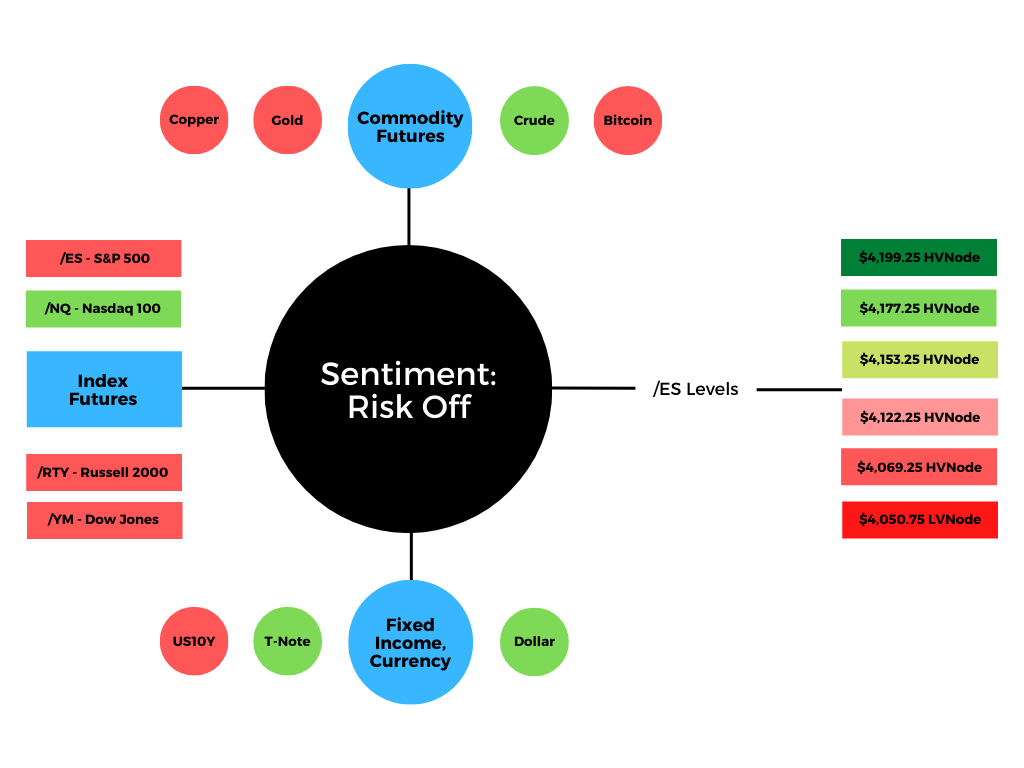
Too Lazy; Didn’t Read: As the market enters into a seasonally weak period, participants have noticed a divergence appear across the broader market. A breakdown in individual sectors – financials and transportation, for instance – and breadth, policy tightening concerns, outflows, elevated skew, put/call ratios, and degrossing on risk-taking (e.g., speculative activity in so-called meme stocks), in conjunction with the passage of Quadruple Witching, may portend increased volatility.

Market Commentary

Key Takeaways: Index futures diverge. Risk-off sentiment returns.

  • Fears over inflation and taper sparking movements.
  • Ahead: GDP, Home sales, PMI, Claims, Fed speak.
  • Indices sideways to lower; growth, tech stay strong.
Weekly price action graphic updated Sunday, June 20, 2021, at 12:00 PM ET.

What Happened: Last week, U.S. stock index futures diverged.

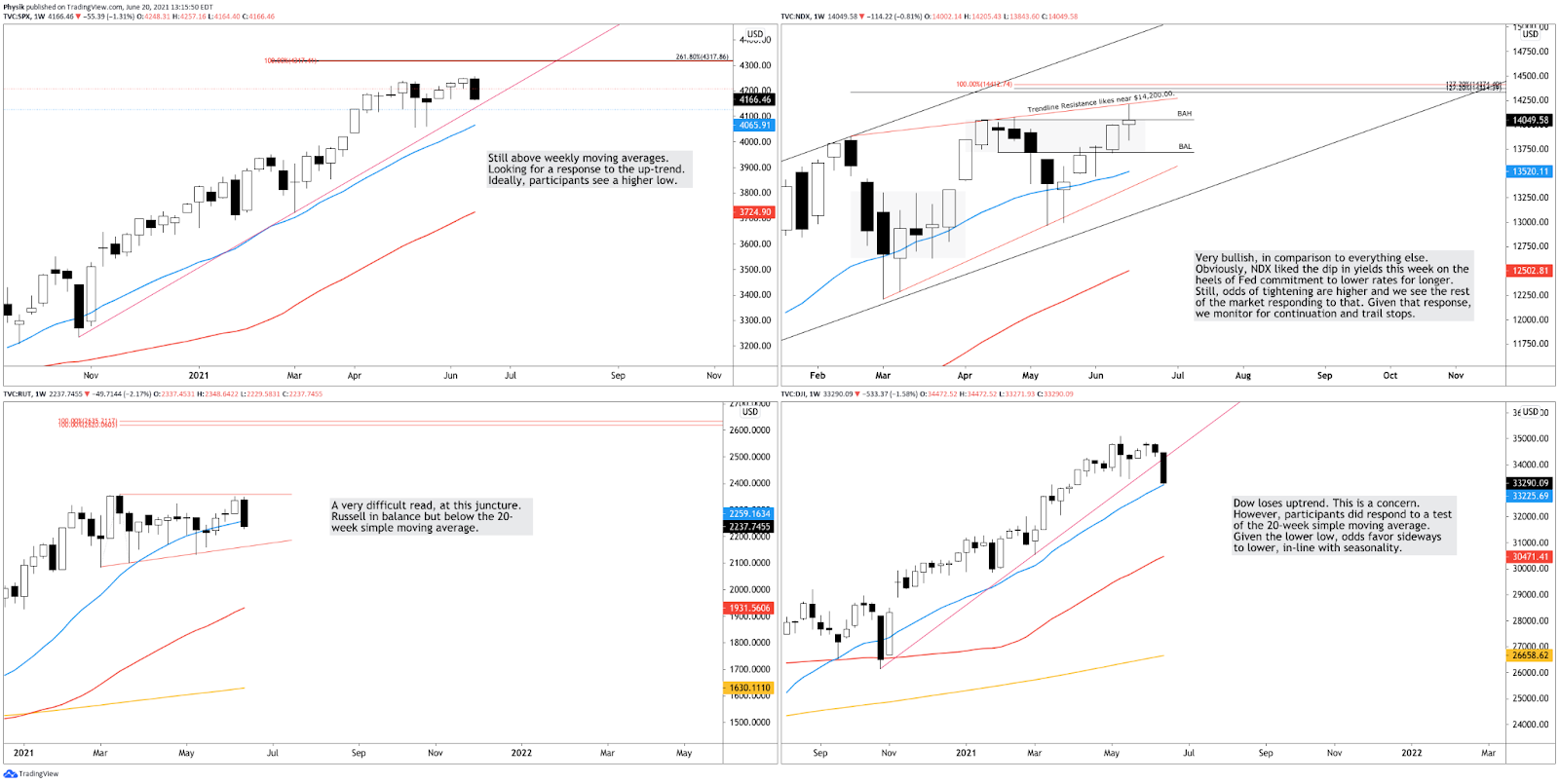
The Nasdaq 100 traded relatively strong, in comparison to the weaker S&P 500, Russell 2000, and Dow Jones Industrial Average. This action comes as the Federal Reserve signaled a faster-than-expected pace of policy tightening (learn more about the impact of policy tightening, here).

At the same time, in conjunction with the divergence in major indexes, participants saw sectoral breakdowns, a concern that may portend increased volatility after ‘Quadruple Witching’ Friday, or the rebalancing of benchmarks, as well as the expiration of stock index futures, stock index options, stock options, and single stock futures.

In light of the event, participants found it very difficult to discover prices. That’s according to Matt Tuttle, the CEO at Tuttle Capital Managment LLC. 

“When you get one of these events, you get noises around share movements,” Tuttle said by phone. “It messes up the information that we’re seeing.”

Adding, this Quadruple Witching Friday may throw a wrench into the recent bullishness.

Much of the advance, since the election, came in light of a historically bullish period for markets, amid increased mobility and reflation, supportive structural flows, as well as the pricing in of positive earnings expectations.

Now that the reaction to earnings was lackluster, in addition to the passage of a large derivative expiration and move into a seasonally weak period, the odds of volatility are substantially higher. 

Why? Most funds are committed to holding long positions. In the interest of lower volatility returns, these funds will collar off their positions, selling calls to finance the purchase of downside put protection. 

As a result of this activity, options dealers are long upside and short downside protection. 

This exposure must be hedged; dealers will sell into strength as their call (put) positions gain (lose) value and buy into weakness as their call (put) positions lose (gain) value. 

Now, unlike theory suggests, dealers will hedge call losses (gains) quicker (slower). This leads to “long-gamma,” a dynamic that crushes volatility and promotes momentum, observed by lengthy sprints — like the one the market is currently in — followed by rapid de-risking events as the market transitions into “short-gamma.” 

“‘Equities stable on hawkish Fed guidance’ is the wrong read here,” Nomura’s Charlie McElligott notes. “Equities are stable for the same reason they’ve been chopping for weeks: markets continue choking on an oversupply of gamma from vol sellers!”

The implications of this volatility supply can be summed up with the below graphic.

Given that OPEX will lead to a drop in gamma exposures, the market will, in the simplest way, be subject to more movement in its attempt to price in changing financial conditions.

Options Expiration (OPEX): Option expiries mark an end to pinning (i.e, the theory that market makers and institutions short options move stocks to the point where the greatest dollar value of contracts will expire worthless) and the reduction dealer gamma exposure.

“The extremely low SPX realized volatility is consistent with the possibility that 18-Jun has left ‘the street’ long index gamma, in which case realized volatility could pick up once positions are cleaner,” Rocky Fishman of Goldman Sachs said.

What To Expect: In the coming sessions, participants will want to focus their attention on where the S&P 500 trades in relation to the $4,153.25 high volume area (HVNode).

Volume Areas: A structurally sound market will build on past areas of high volume. Should the market trend for long periods of time, it will lack sound structure (identified as a low volume area which denotes directional conviction and ought to offer support on any test). 

If participants were to auction and find acceptance into areas of prior low volume, then future discovery ought to be volatile and quick as participants look to areas of high volume for favorable entry or exit.

That said, participants can trade from the following frameworks.

In the best case, the index trades sideways or higher; activity above $4,153.25 puts in play the HVNodes at $4,177.25 and $4,199.25. Initiative trade beyond $4,199.25 could reach as high as the $4,227.75 HVNode, $4,235.00 Point Of Control (POC), and $4,258.00 overnight high (ONH). 

POCs: POCs are valuable as they denote areas where two-sided trade was most prevalent. Participants will respond to future tests of value as they offer favorable entry and exit.

Overnight Highs (Lows): Typically, there is a low historical probability associated with overnight rally-highs (lows) ending the upside (downside) discovery process.

In the worst case, the index trades lower; activity below $4,153.25 puts in play the $4,122.25 HVNode. Thereafter, if lower, participants should look for responses at the $4,069.25 HVNode and $4,050.75 low volume area (LVNode).

Graphic: 4-hour profile chart of the Micro E-mini S&P 500 Futures.
Graphic: Weekly candlestick charts of the S&P 500 (top left), Nasdaq 100 (top right), Russell 2000 (bottom left), and Dow Jones Industrial Average (bottom right).
Graphic: SHIFT search suggests participants, based on dollars committed, were most interested in call strikes at and below current prices in the cash-settled S&P 500 Index (INDEX: SPX) and Nasdaq 100 (INDEX: NDX), last week. This activity may denote (1) stock replacement, (2) hedges for underlying short positions, or (3) speculation on the upside.

News And Analysis

Economy | Big shift in the so-called “dot-plot” that tracks rate projections. (Moody’s)

Economy | Housing boom moderates on lower building permit authorizations. (S&P)

Economy | Capital gains – a century-old tax break gets a rush of attention. (WSJ)

Economy | Supply crunch risks are extending into 2022, stocking inflation. (WSJ)

Economy | New Chinese regulation requires recovery, resolution plans. (Moody’s)

Markets | Troubled companies take pages from AMC playbook, selling stock. (WSJ)

Markets | Brace for huge oil volatility one U.S. trading group suggests. (REU)

Economy | U.S. bank loan-to-deposit ratios fall and pressure margins. (S&P)

Economy | U.S. economic recovery doesn’t have to follow herd immunity. (Moody’s)

Economy | The U.S. distress ratio continued its downward trend last month. (S&P)

Economy | Global structured finance – charting the recovery from COVID-19. (S&P)

Economy | The MBA is predicting another decline in new home sales. (MND)

Markets | Bond market in midst of repricing, but not the kind we’re used to. (MND)

What People Are Saying

Innovation And Emerging Trends

FinTech | Owning the paycheck is the key to financial technology success. (TC)

FinTech | Mark Cuban says ‘banks should be scared’ of crypto-based DeFi. (CNBC)

FinTech | Outlook: How the API economy is reinventing financial services. (CBI)

FinTech | Analysis: Big differences between a digital dollar and a CBDC. (BBG)

FinTech | Cryptocurrency lode of $100B stirs worries over hidden danger. (BBG)

FinTech | Axis-Z is working hard to bring virtual reality (VR) tech to trading. (BZ)

FinTech | OVTLYR’s platform helps investors take advantage of volatility. (BZ)

FinTech | Liti Capital allows investors tokenized access to litigation finance. (BZ)

Disclaimer

In no way should the materials herein be construed as advice. Derivatives carry a substantial risk of loss. All content is for informational purposes only.

Categories
Commentary

Daily Brief For April 27, 2021

Market Commentary

Index futures auction sideways, validating higher prices.

  • 80% of companies beat expectations.
  • Ahead: FOMC, Biden Address, GDP.
  • Indices balance and correct with time.

What Happened: U.S. stock index futures auctioned sideways, overnight, while Treasury yields and commodities posted substantive gains.

This price action comes as nearly 80% of companies that reported their earnings have either met or beaten expectations. The muted response suggests much the optimism has already been priced in. Now, participants are looking for more information to base their next move. 

See here for information on how to read an earnings report.

Ahead, is data on home prices, consumer confidence, and manufacturing. On Wednesday, Federal Reserve Chair Jerome Powell will hold a conference on central bank policy. On the same day, Joe Biden will address Congress. Thursday, U.S. GDP will likely show improvement in the first quarter, 2021.
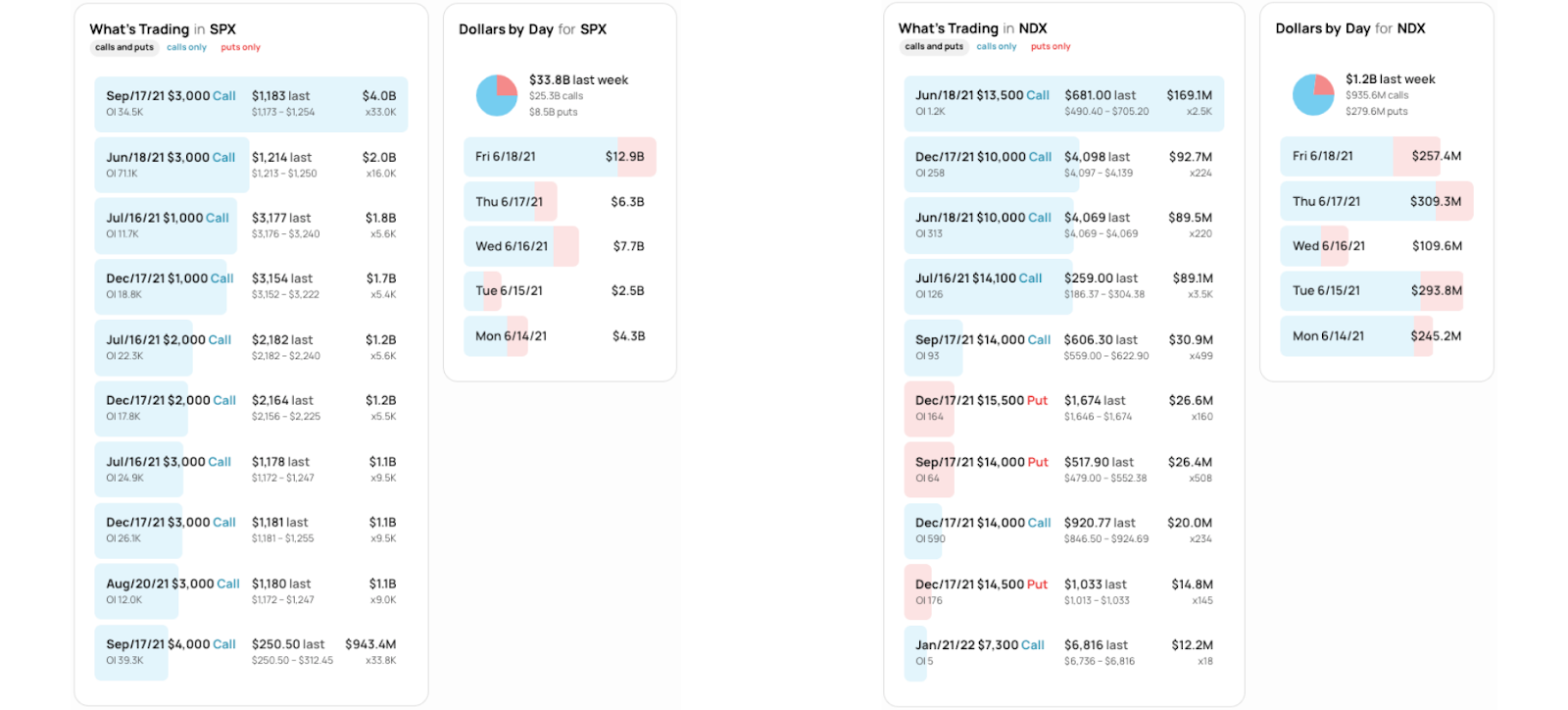
Graphic updated 8:30 AM EST.

What To Expect: Tuesday’s regular session (9:30 AM – 4:00 PM EST) will likely open inside of prior-range and -value, suggesting a limited potential for immediate directional opportunity. 

Adding, during the prior day’s regular trade, the best case outcome occurred, evidenced by sideways trade just shy of the $4,186.75 balance-area high. 

Balance (Two-Timeframe Or Bracket): Rotational trade that denotes current prices offer favorable entry and exit. Balance-areas make it easy to spot change in the market (i.e., the transition from two-time frame trade, or balance, to one-time frame trade, or trend).

All this comes after a substantial advance. The S&P 500 is up nearly 13% since the start of March and it could be said that the product has been marked up, enough. Given the busy calendar, the odds favor sideways trade. The reason being: a market in balance tends to stay in balance unless some exogenous factor provides participants more information to base their next move.

Adding, Jeff Buchbinder, Equity Strategist for LPL Financial says: “[W]hile sentiment may be overly optimistic and a pickup in volatility would be totally normal, strong breadth measures suggest stocks still may have more upside. This week we tackle that same topic of peak optimism, but by looking at some valuation metrics. While valuations are elevated, they still appear reasonable when factoring in interest rates and inflation.”

Moving on, for today, participants can trade from the following frameworks. 

In the best case, the S&P 500 trades sideways or higher; activity above the $4,186.75 ledge targets the $4,191.75 overnight high (ONH). Initiative trade beyond the ONH may introduce excess and could reach as high as the Fibonacci-derived price targets, $4,197.25-$4,263.00. 

In the worst case, the S&P 500 trades lower; activity below $4,173.25 regular-trade low (RTH Low) targets the $4,164.25 high-volume area (HVNode). Thereafter, if lower, participants can look for responses at the $4,163.25, $4,137.25, and $4,122.75 HVNodes.

Ledges: Flattened area on the profile which suggests responsive participants are in control, or initiative participants lack the confidence to continue the discovery process. The ledge will either hold and force participants to liquidate (cover) their positions, or crack and offer support (resistance).

Overnight Rally Highs (Lows): Typically, there is a low historical probability associated with overnight rally-highs (lows) ending the upside (downside) discovery process.

Initiative Trade: Buying (selling) within or above (below the previous day’s value area.

Excess: A proper end to price discovery; the market travels too far while advertising prices. Responsive, other-timeframe (OTF) participants aggressively enter the market, leaving tails or gaps which denote unfair prices.

Volume Areas: A structurally sound market will build on past areas of high volume. Should the market trend for long periods of time, it will lack sound structure (identified as a low-volume area which denotes directional conviction and ought to offer support on any test). 

If participants were to auction and find acceptance into areas of prior low-volume, then future discovery ought to be volatile and quick as participants look to areas of high volume for favorable entry or exit.

As long as the S&P 500 remains in the $4,186.75-$4,110.50 balance area, the course of action is responsive trade.

Graphic: 65-minute profile chart of the Micro E-mini S&P 500 Futures.
Graphic: SHIFT search maps out the trade of call and put options in the SPDR S&P 500 ETF Trust (NYSE: SPY), for April 26. Activity in the options market was primarily concentrated in short-dated tenors, in strikes near current prices. To put it simply, not much is going on, yet.

News And Analysis

Banking | Nomura, UBS take global banks’ Archegos hit to $10B. (BBG)

Economy | U.S. auto dealers are winners as chip shortage lifts profit. (REU)

Markets | Goldman Sachs watching total margin loans after blow-ups. (REU)

M&A | New York Community Bancorp will buy Flagstar Bancorp. (REU)

Economy | France, and Germany support U.S. 21% corporate tax plan. (BBG)

Travel | The E.U. set to let vaccinated U.S. tourists visit this summer. (NYT)

What People Are Saying

Innovation And Emerging Trends

FinTech | Citi eyes mortgage tech in push to close the wealth gap. (BBG)

Innovation | Germany to spend recovery money on green, digital goals. (REU)

FinTech | Mobile bank Current raises $220M Series D, tripling value. (TC)

FinTech | S!NG wants creators to lean on NFTs to protect their IP. (TC

About

Renato founded Physik Invest after going through years of self-education, strategy development, and trial-and-error. His work reporting in the finance and technology space, interviewing leaders such as John Chambers, founder, and CEO, JC2 Ventures, Kevin O’Leary, Canadian businessman and Shark Tank host, Catherine Wood, CEO and CIO, ARK Invest, among others, afforded him the perspective and know-how very few come by.

Having worked in engineering and majored in economics, Renato is very detailed and analytical. His approach to the markets isn’t built on hope or guessing. Instead, he leverages the unique dynamics of time and volatility to efficiently act on opportunity. 

Disclaimer

At this time, Physik Invest does not manage outside capital and is not licensed. In no way should the materials herein be construed as advice. Derivatives carry a substantial risk of loss. All content is for informational purposes only.