Categories
Commentary

Daily Brief For November 10, 2021

What Happened

Equity index futures sideways, overnight, on powerful derivative market forces, alongside participants’ aims to base ahead of added clarity on the economic outlook.

Ahead is data on inflation and jobless claims (8:30 AM ET), wholesale inventories (10:00 AM ET), and the monthly budget statement (2:00 PM ET).
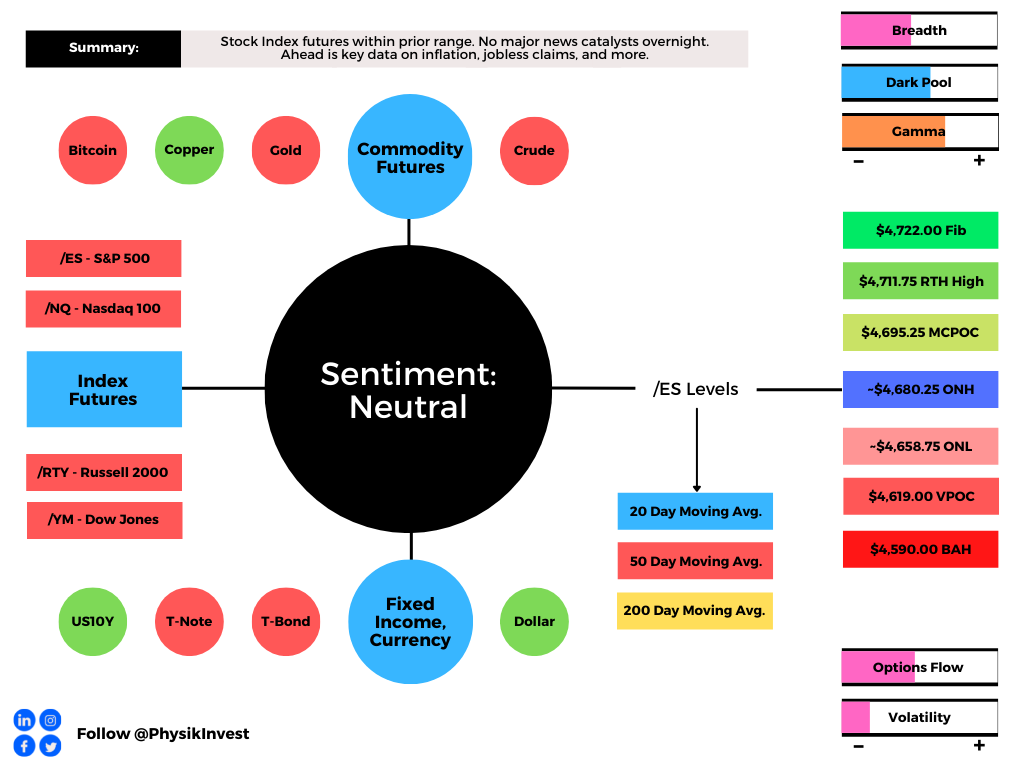
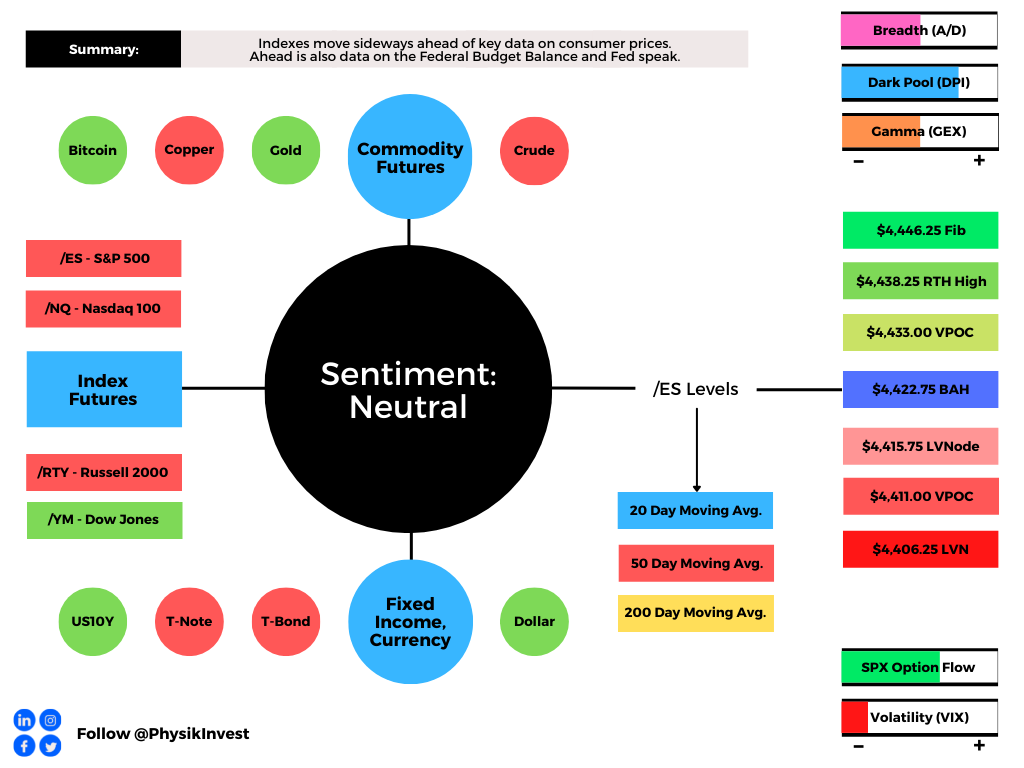
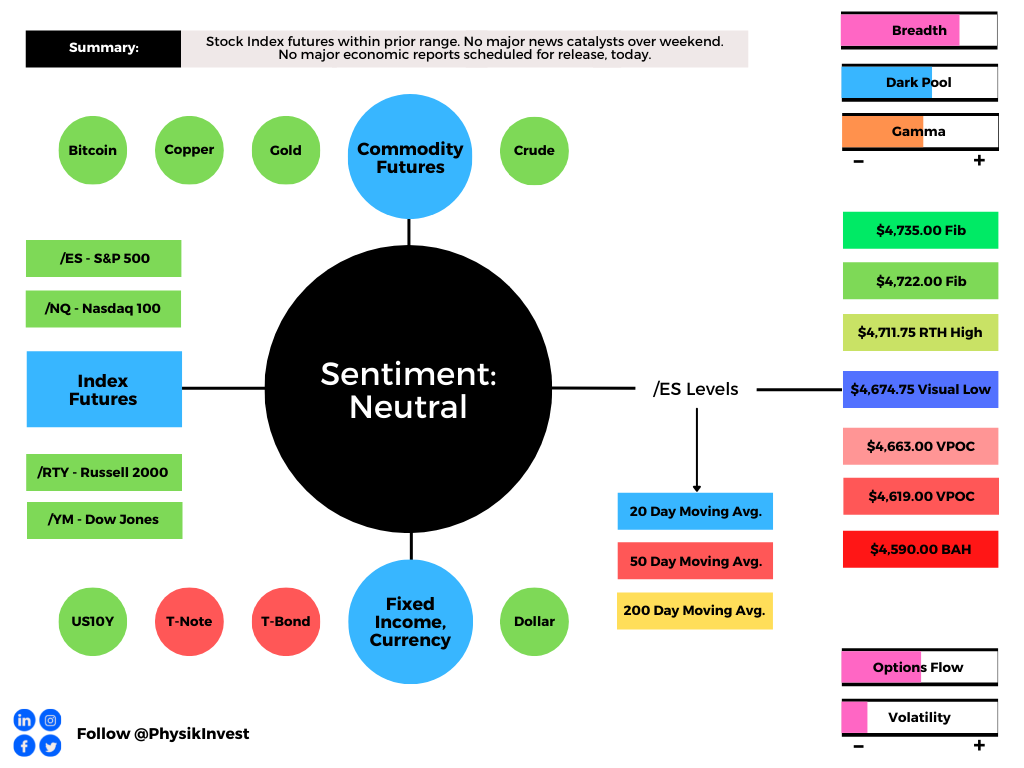
Graphic updated 5:30 AM ET. Sentiment Neutral if expected /ES open is inside of the prior day’s range. /ES levels are derived from the profile graphic at the bottom of the following section. Levels may have changed since initially quoted; click here for the latest levels. SqueezeMetrics Dark Pool Index (DIX) and Gamma (GEX) calculations are based on where the prior day’s reading falls with respect to the MAX and MIN of all occurrences available. A higher DIX is bullish. At the same time, the lower the GEX, the more (expected) volatility. Learn the implications of volatility, direction, and moneyness. SHIFT data used for S&P 500 (INDEX: SPX) options activity. Note that options flow is sorted by the call premium spent; if more positive then more was spent on call options. Breadth reflects a reading of the prior day’s NYSE Advance/Decline indicator. VIX reflects a current reading of the CBOE Volatility Index (INDEX: VIX) from 0-100.

What To Expect

As evidenced by a b-shaped liquidation break profile distribution (i.e., morning drop on fast tempo, followed by sideways trade) there was likely selling by short-term momentum-driven participants who had poor location.

We are confident this may be the case given where the price is, relative to the volume-weighted average price (VWAP) anchored from the Federal Open Market Committee (FOMC) announcement, last week; the average buyer, since then, is losing.

To note, given the context – lackluster breadth and market liquidity metrics – the failure to expand the range, markedly, suggests there was no new money selling.

This activity, which marks a potential willingness to clear stubborn inventory and break balance, is occurring in the face of poor structure down below, a dynamic that adds to technical instability.
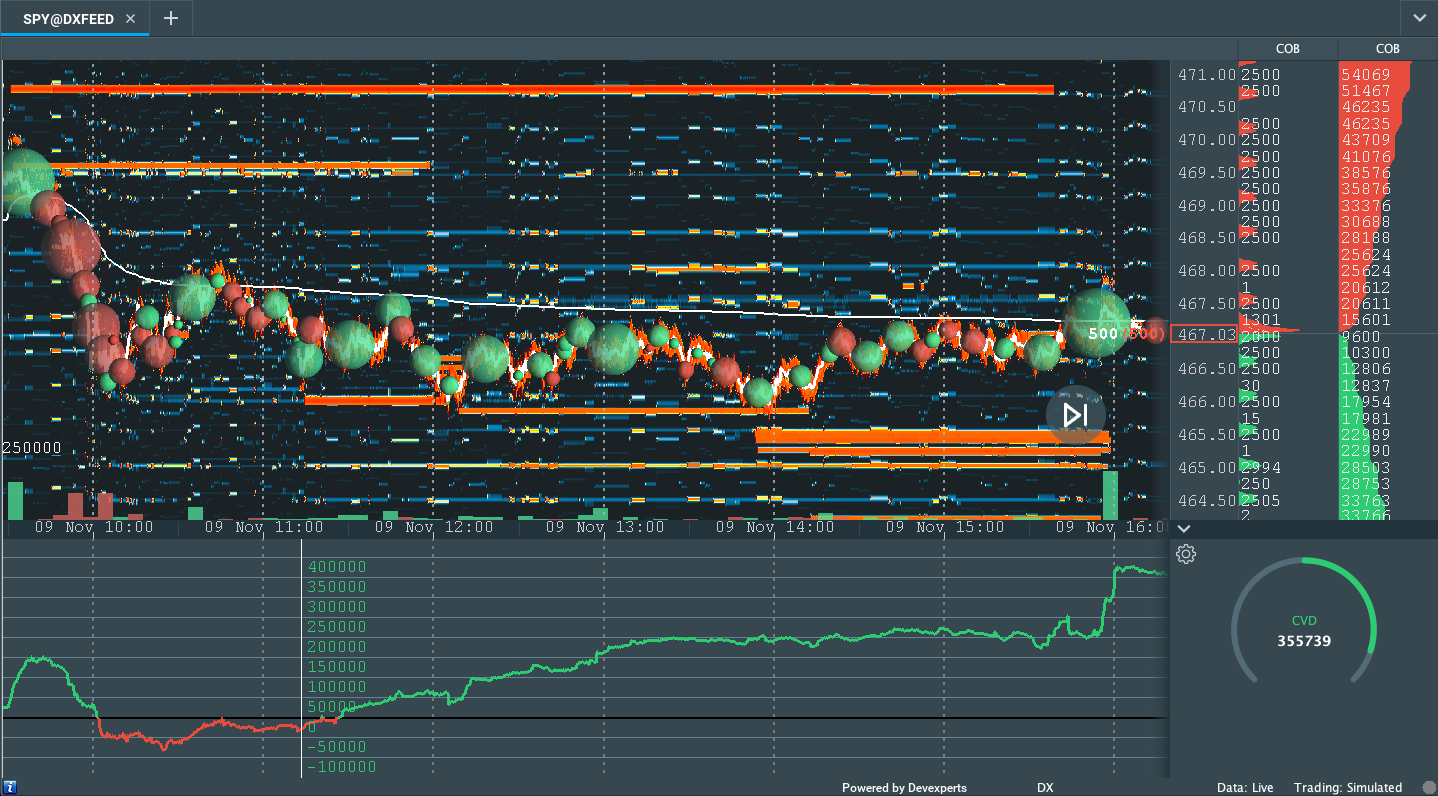
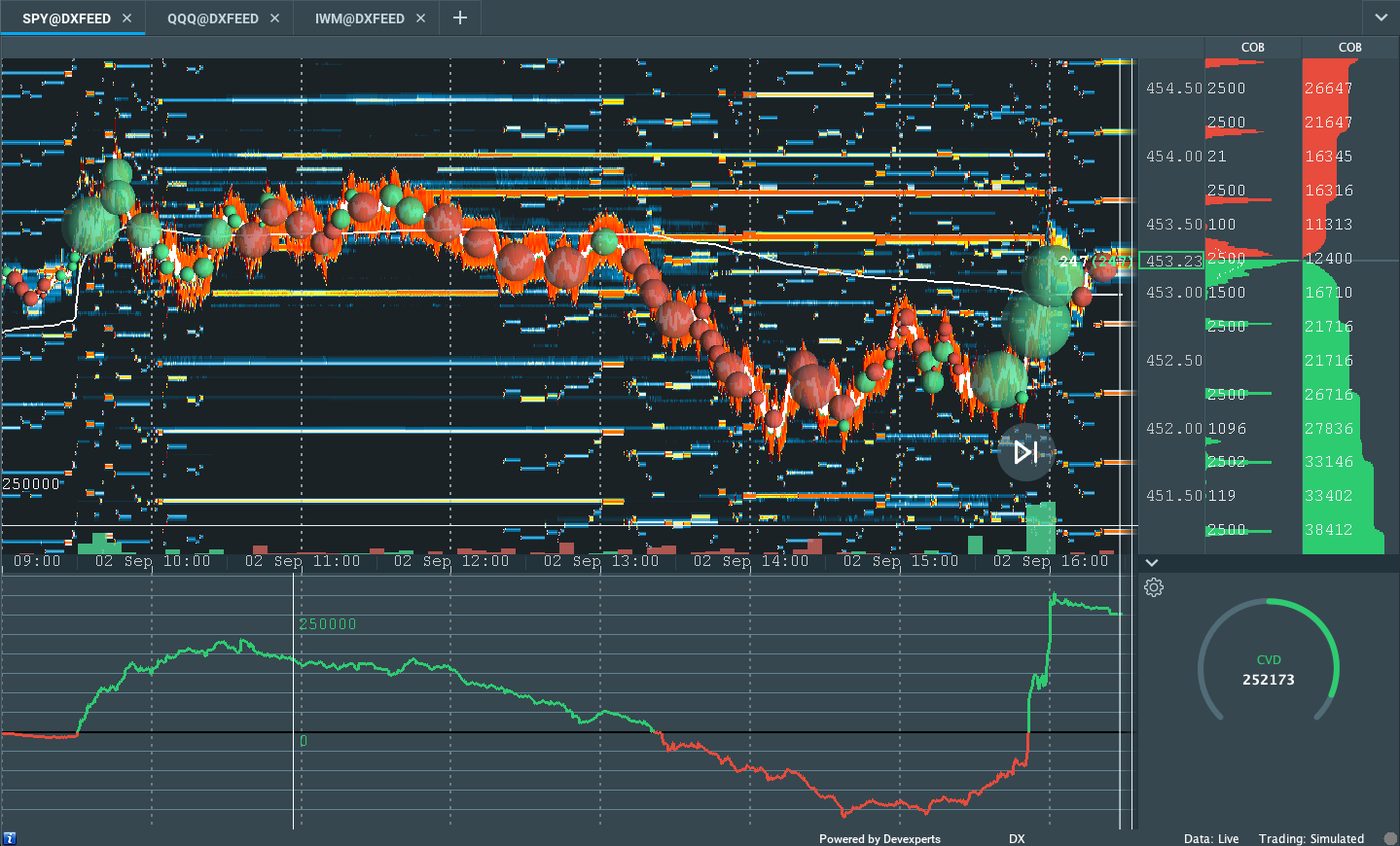
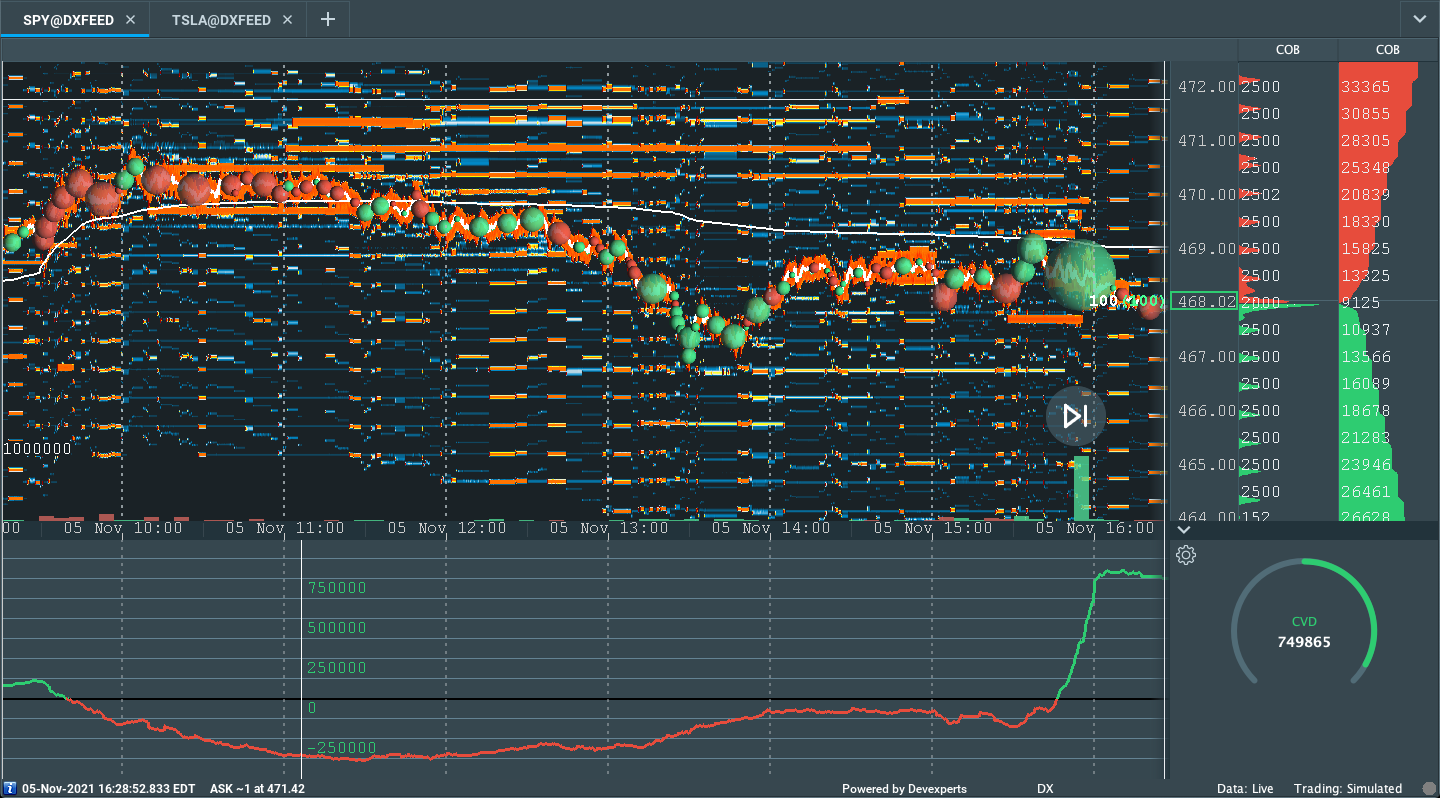
Graphic: Divergent delta (i.e., non-committed selling as measured by volume delta or buying and selling power as calculated by the difference in volume traded at the bid and offer) in SPDR S&P 500 ETF Trust (NYSE: SPY), one of the largest ETFs that track the S&P 500 index, via Bookmap. The readings are supportive of responsive trade (i.e., rotational trade that suggests current prices offer favorable entry and exit; the market is in balance).

Context: Yesterday, I made an emphasis on some of the “high leverage and risk” short-term speculators’ record call buying and put selling posed on the equity market, at large.

That’s odd. Why? 

Well, into the near-vertical price rise of highly volatile stocks like Tesla Inc (NASDAQ: TSLA), customers (you and I) signed up, through the agency of counterparties, to add liquidity to the market, via options activity.
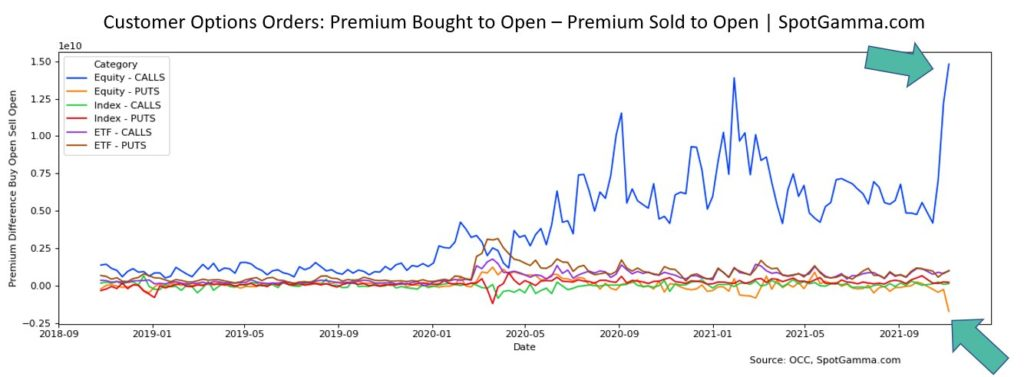
Graphic: Customers took on significant leverage in their purchase and sale of options, via SpotGamma.

So long as implied volatility remained bid (and stock prices go to the moon) – the effect of inadequate liquidity – counterparties were to exacerbate upside volatility in hedging their exposure to customer positioning. In other words, dealer short-gamma.

Note those participants that take the other side of options trades will hedge their exposure to risk by buying and selling the underlying. 

When dealers are short-gamma (e.g., Tesla), they buy into strength and sell into weakness, exacerbating volatility

When dealers are long-gamma (e.g., S&P 500), counterparties buy into weakness and sell into strength, calming volatility.

Enter shock – Elon Musk selling Tesla stock – alongside a decline in implied volatility, amidst a build of gamma at higher stock prices (which has the effect of dampening realized volatility), we saw the unthinkable happen; high-flying stocks (more so Tesla, which is a large S&P 500 index constituent) turned away from the moon and headed back to earth.

The implications of this were staggering; the bulk of customers’ short puts (long calls) quickly rose (declined) in value and traded in-the-money (out-of-the-money). 

As SpotGamma noted, yesterday, “[t]here was a serious dearth of liquidity to start today’s session,” and volatility rose, as a result, in compensating for that fact.

Now, if customer short put, counterparty long put. 

To hedge, counterparty ought to buy, right? Nope

As SqueezeMetrics explains, “Sold puts are, quite literally, a bunch of huge buy limit orders below the market, and then a bunch of liquidity-taking stop-losses further down.”
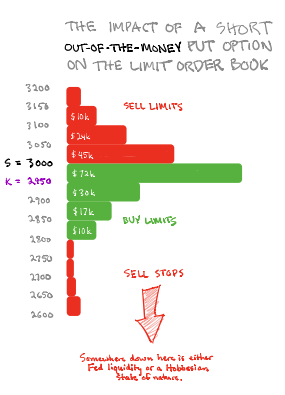
Graphic: SqueezeMetrics unpacks implications of short put options on the limit order book.

This is, to put it simply, due in part to short-term speculators lacking the wherewithal to stay in these margin-intensive positions; as price falls, put buying (covering of shorts, too) takes liquidity and destabilizes the market.

We’re starting to see this activity, in individual stocks, affect the S&P 500 complex, too

The CBOE Volatility Index (INDEX: VIX) was higher, with demand coming in across the front area of the VIX futures term structure, mostly; both suggest a demand for hedges and a reduction in the flows (e.g., vanna) that support sideways to higher trade. 
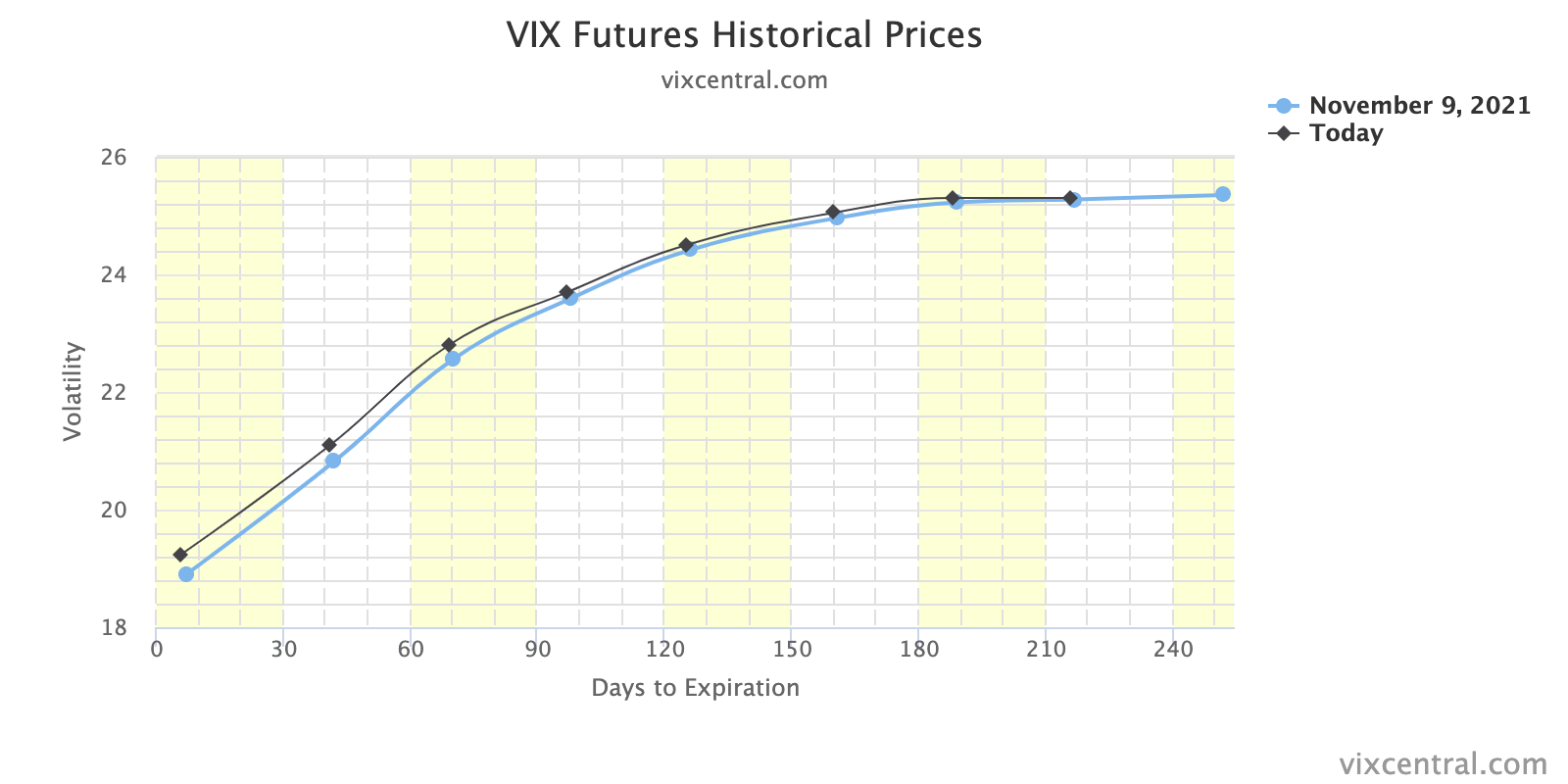
Graphic: Demand for options hedges comes in at the front end of the term structure.

That has already been reflected by the trend of outperformance in the extended day. 

In other words, the front-running of increasingly impactful (and supportive) vanna and charm flows (both of which are tied to the hedging of options exposure), as a result of increased options activity (which, at least at this juncture, exposes customers to high leverage and risk), seems to be changing, slowly. 

We’re (likely) opening sideways to lower today. That’s a change, for once!

With expectations that there may be a front-running of the monthly (OPEX) options expiration (into which the forces that promote pining usually turn stronger with counterparties supplying more liquidity as their long gamma rises), a time when dealer gamma exposure is to decline, allowing for increased realized volatility (as a result of less liquidity), the added demand for hedges (as evidenced by the bid in volatility and VIX term structure shift), is of concern. 

Participants have been uber bullish, up until early this week. Should sentiment turn, and (1) those participants cover their levered, long delta exposure alongside (2) new money hedging, tempo ought to quicken; an abrupt liquidation could be in the cards.
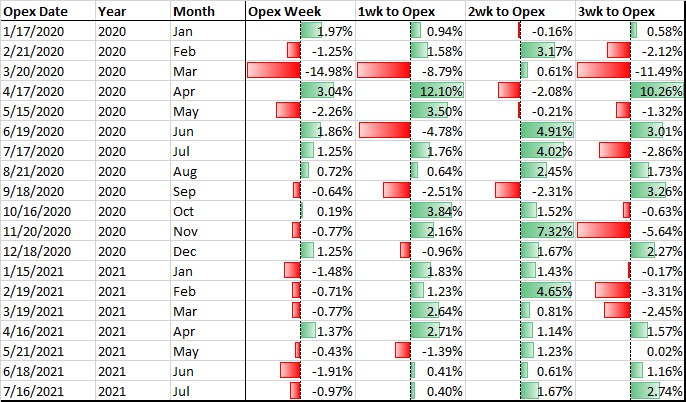
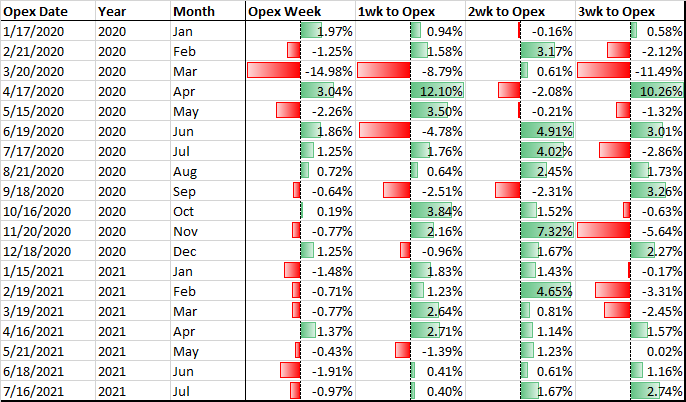
Graphic: @pat_hennessy breaks down returns for the S&P 500, categorized by the week relative to OPEX. 

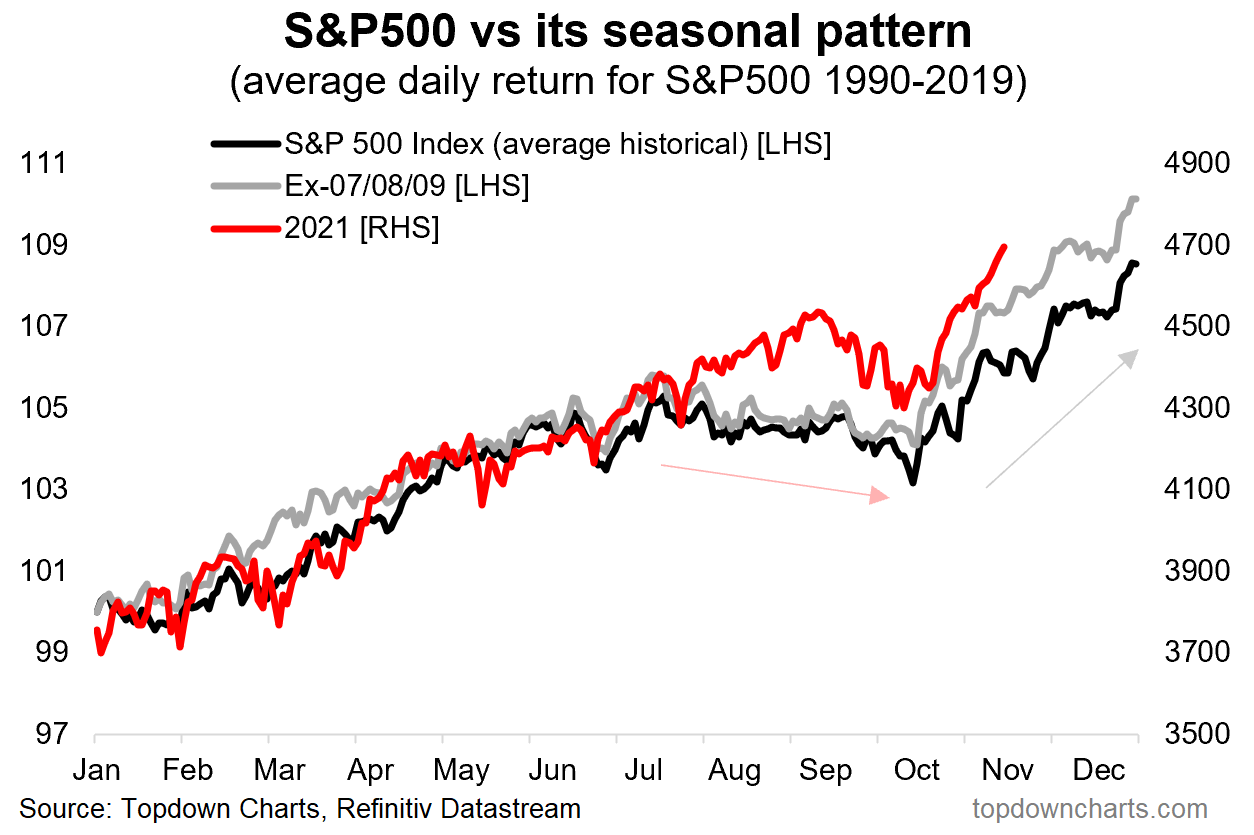
In light of seasonality, buybacks, and earnings surprises, the potential for a rally into the end of the year remains strong. As a result, we start to look for big picture references where we may see responsive buying. See the graphic below!
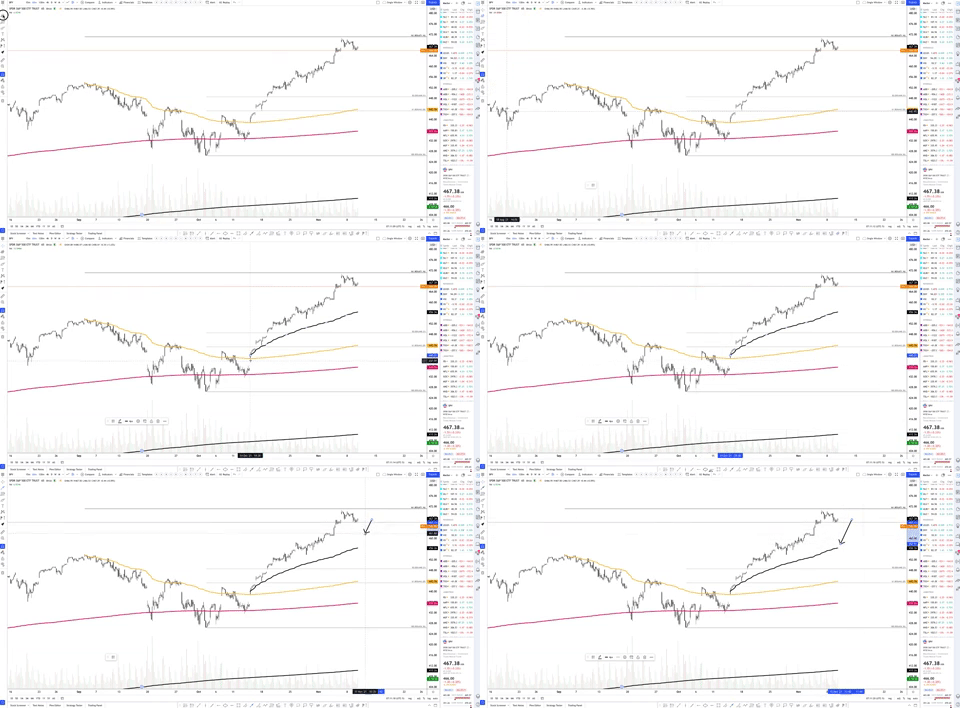
Expectations: As of 5:30 AM ET, Wednesday’s regular session (9:30 AM – 4:00 PM ET), in the S&P 500, will likely open in the middle part of a balanced overnight inventory, inside of prior-range and -value, suggesting a limited potential for immediate directional opportunity.

Balance Scenarios: Modus operandi is responsive trade (i.e., fade the edges), rather than initiative trade (i.e., play the break).

In the best case, the S&P 500 trades sideways or higher; activity above the $4,680.25 overnight high (ONH) puts in play the $4,695.25 micro composite point of control (MCPOC). Initiative trade beyond the MCPOC could reach as high as the $4,711.75 regular trade high and $4,722.00 Fibonacci, or higher.

In the worst case, the S&P 500 trades lower; activity below the $4,680.25 ONH puts in play the $4,658.75 overnight low (ONL). Initiative trade beyond the ONL could reach as low as the $4,619.00 untested point of control (VPOC) and $4,590.00 balance area boundary, or lower.

Click here to load today’s updated key levels into the web-based TradingView charting platform. Note that all levels are derived using the 65-minute timeframe. New links are produced, daily.
Graphic: 65-minute profile chart of the Micro E-mini S&P 500 Futures. Note the low-volume structure beneath current prices. There is the potential for a cave-fill to widen the area deemed favorable to transact at by an increased share of participants. Learn about the profile.

Definitions

Overnight Rally Highs (Lows): Typically, there is a low historical probability associated with overnight rally-highs (lows) ending the upside (downside) discovery process.

Volume Areas: A structurally sound market will build on areas of high volume (HVNodes). Should the market trend for long periods of time, it will lack sound structure, identified as low volume areas (LVNodes). LVNodes denote directional conviction and ought to offer support on any test. 

If participants were to auction and find acceptance into areas of prior low volume (LVNodes), then future discovery ought to be volatile and quick as participants look to HVNodes for favorable entry or exit.

Vanna: The rate at which the delta of an option changes with respect to volatility.

Charm: The rate at which the delta of an option changes with respect to time.

POCs: POCs are valuable as they denote areas where two-sided trade was most prevalent in a prior day session. Participants will respond to future tests of value as they offer favorable entry and exit.

MCPOCs: POCs are valuable as they denote areas where two-sided trade was most prevalent over numerous day sessions. Participants will respond to future tests of value as they offer favorable entry and exit.

About

After years of self-education, strategy development, and trial-and-error, Renato Leonard Capelj began trading full-time and founded Physik Invest to detail his methods, research, and performance in the markets.

Additionally, Capelj is a Benzinga finance and technology reporter interviewing the likes of Shark Tank’s Kevin O’Leary, JC2 Ventures’ John Chambers, and ARK Invest’s Catherine Wood, as well as a SpotGamma contributor, developing insights around impactful options market dynamics.

Disclaimer

At this time, Physik Invest does not manage outside capital and is not licensed. In no way should the materials herein be construed as advice. Derivatives carry a substantial risk of loss. All content is for informational purposes only.

Categories
Commentary

All You Need To Know For November 8, 2021

What Happened

Overnight, equity index futures auctioned sideways to higher alongside an absence in impactful fundamental developments and news catalysts.

Ahead, today, there are no major data releases scheduled.

In the following section, I unpack, in-depth, the fundamental and technical context shadowing recent trade. If you like what is said, consider sharing!
Graphic updated 6:30 AM ET. Sentiment Neutral if expected /ES open is inside of the prior day’s range. /ES levels are derived from the profile graphic at the bottom of the following section. Levels may have changed since initially quoted; click here for the latest levels. SqueezeMetrics Dark Pool Index (DIX) and Gamma (GEX) calculations are based on where the prior day’s reading falls with respect to the MAX and MIN of all occurrences available. A higher DIX is bullish. At the same time, the lower the GEX, the more (expected) volatility. Learn the implications of volatility, direction, and moneyness. SHIFT data used for S&P 500 (INDEX: SPX) options activity. Note that options flow is sorted by the call premium spent; if more positive then more was spent on call options. Breadth reflects a reading of the prior day’s NYSE Advance/Decline indicator. VIX reflects a current reading of the CBOE Volatility Index (INDEX: VIX) from 0-100.

What To Expect

On supportive intraday breadth and lackluster market liquidity metrics, the best case outcome occurred, evidenced by a gap and hold of newly discovered S&P 500 prices.

This activity, which marks a potential willingness to continue the trend, coincides with poor structure, a dynamic that adds to technical instability.

Graphic: Divergent delta (i.e., buying and selling power as calculated by the difference in volume traded at the bid and offer) in SPDR S&P 500 ETF Trust (NYSE: SPY). The readings are supportive of responsive trade (i.e., rotational trade that suggests current prices offer favorable entry and exit; the market is in balance).

Context: The aforementioned trade is happening in the context of interesting developments with respect to fiscal and monetary policy, as well as supply and demand imbalances.

To start, in regards to fiscal policy, ARK Invest’s Cathie Wood thinks that there will be no capital gains tax rate increases and an installment of a minimum corporate tax (about 15%). 

“I think that is one reason the market’s been rallying,” she said in an episode of In The Know

In sticking with Wood’s theses, why would the market be rallying if all that we (i.e., the market participants) see, in the news, is heavily focused around fears of inflation, so to speak? It wouldn’t; Wood feels that inflation is on its way out.

Major reasons? 

(1) Productivity increases will offset dented margins and therefore not lead to impactful price increases; (2) turmoil, with respect to China’s housing and financial sector, ought to depress commodity pricing further as “when China has caught a cold, commodity prices get pneumonia”; (3) at-home inventory build-ups may takeaway from consumption during the holidays (for which businesses are scrambling to increase inventories), and this ultimately should be reflected in commodity prices, given excess inventory; (4) disruptive innovation and declining cost curves.

“The markets are conflicting,” she explains. “You’ve got energy and financials at the top for the year, 54% and 35%, respectively. Those two sectors are associated with very strong boom time economies with a yield curve steepening, meaning long rates are rising faster than short rates.”

“That would be consistent with inflation, but the other two top-performing sectors are real estate and consumer discretionary, and those do not benefit from inflation. They benefit from inflation coming down and lower interest rates.”

The bond market, on the other hand, is in the lower inflation camp. At the same time, the dollar is going up alongside assets like bitcoin, often construed as an inflation hedge.

“Could this mean that the velocity of money is going down,” she asks. “Velocity of money has been coming down because people have been saving and putting money into assets.”

This dynamic is supported by disappointing GDP figures with growth coming mostly from inventories; “Real final sales were slightly negative. Could it be … that [millennials] would prefer not to spend on goods and services, but to invest?”

It seems that participants are increasingly extending moneyness to nonmonetary assets – given monetary policies and an environment of debt and leverage that ultimately cuts into asset price volatility – adding to the prevailing risks of carry when volatility does rise and the demand for money pushes deflation.

A great explainer on the growth of global carry is the book titled The Rise of Carry: The Dangerous Consequences of Volatility Suppression and the New Financial Order of Decaying Growth and Recurring Crisis.

“Ivy Zelman of Zelman Research came out this week. She made a fantastic call on the housing bubble and bust starting in 05-06, and she was right, just a little early. She is very concerned that the housing prices we’re seeing right now are not sustainable,” because of speculation, as well as iBuying and private equity participation. 

For instance, just last week, Zillow Group Inc (NASDAQ: Z), a major iBuyer, sought to raise liquidity, dumping properties en masse.

“This is unsustainable … and I’m wondering if even the housing market inflation is going to give way, here,” Wood added. 

That leads to the question: what effects will a taper and the eventual reduction in the Federal Reserve’s balance sheet – a removal of liquidity – have?

Thus far, given monetary frameworks and max liquidity, markets rallies have been enforced by some of the processes embedded within the volatility market

To quote Cem Karsan of Kai Volatility: “There’s this constant structural positioning that naturally drives markets higher as long as volatility is compressed, or there’s a supply of volatility.”

“As volatility is compressed, … the hedging vanna and charm flows, and whatnot will push the markets higher,” Karsan added in reference to options sliding down their term structure (vanna) and skew decaying (charm). Both dynamics have counterparties covering their hedges to the most dominant customer positioning in the market (i.e., short call, long put). 

With option volumes now comparable to stock volumes, related hedging flows can represent an increased share of volume in underlying stocks; “It’s not a coincidence that the mid-February to mid-March 2020 downturn literally started the day after February expiration and ended the day of March quarterly expiration. These derivatives are incredibly embedded in how the tail reacts and there’s not enough liquidity, given the leverage, if the Fed were to taper.”

Learn more about the implications of convexity, edge, and risk management, as well as Liquidity Cascades: The Coordinated Risk of Uncoordinated Market Participants.

Aside from a lot of these big picture dynamics – growing derivatives markets and tail risk, the heightened moneyness of nonmonetary assets, trends in seasonality, earnings surprises, and more – we have some more impactful near-term happenings to be aware of.

Graphic: “Whenever the market has been up 20%+ YTD through to October (like e.g. THIS YEAR), it has *always* had an up month in November (albeit with a n=8). Basically I would say it speaks to the momentum in the market, which despite the September stumble seems pretty much alive and well.” – Callum Thomas

The first is fragile positioning. The second is the monthly options expiration (OPEX). 

According to SqueezeMetrics analyses, “middling dark pool sentiment and middling gamma exposure [portends] … 1-month negative returns.”

Alongside that, according to data compiled and analyzed by Pat Hennessy, “2 weeks prior to OPEX (e.g., 7/30/21 to 8/6/21 in this late-cycle) [have] been extremely bullish,” while “OPEX week returns peaked in 2016 and have trended lower since.”

Graphic: @pat_hennessy breaks down returns for the S&P 500, categorized by the week relative to OPEX. 

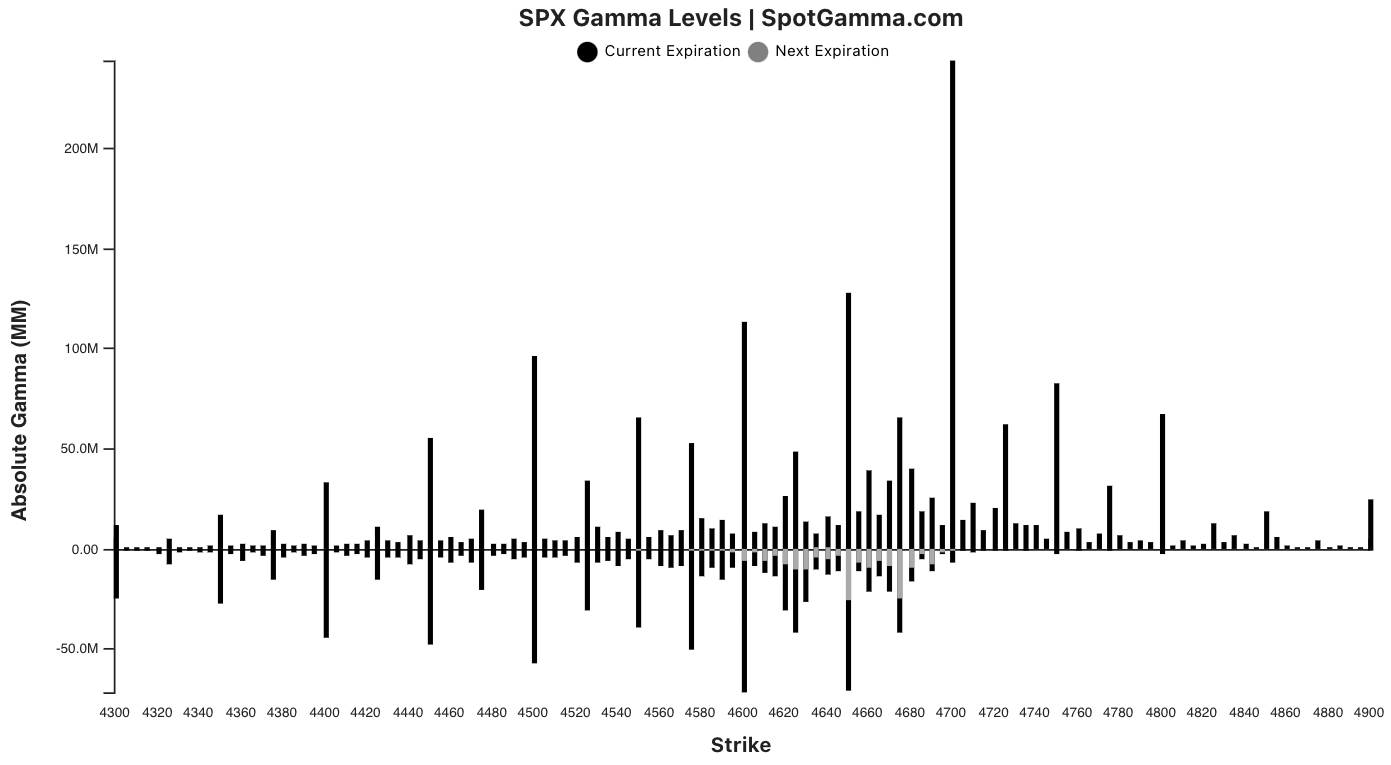
This comes as investors marked the S&P 500 up to the $4,700.00 strike, at which positive gamma – delta sensitivity to underlying price – is highest. 

In referencing a note I wrote for SpotGamma, “as volatility continues to decline, the gamma of those options, which are now at the money, ought to increase, forcing counterparties to supply more liquidity.”

Ultimately, $4,700.00 ought to be a magnet (or resistance) into that aforementioned pre-OPEX weakness.

This is unless (1) volatility declines markedly, “a tailwind for the S&P complex as options slid[ing] down their term structure would cause dealers to continue covering their hedges in an asymmetric manner,” or (2) more capital is committed to options at higher strikes. 

Graphic: SpotGamma shows large positive gamma at the $4,700.00 strike. “Large options strikes are considered to be support or resistance zones. The change in gamma at various levels over time can shed light on how traders are viewing the market (i.e., adding calls is bullish, puts bearish).”

Expectations: As of 6:30 AM ET, Monday’s regular session (9:30 AM – 4:00 PM ET), in the S&P 500, will likely open in the upper part of a positively skewed overnight inventory, inside of prior-range and -value, suggesting a limited potential for immediate directional opportunity.

Market Is In Balance: Current prices offer favorable entry and exit. Modus operandi is responsive trade (i.e., fade the edges), rather than initiative trade (i.e., play the break).

In the best case, the S&P 500 trades sideways or higher; activity above the $4,674.75 visual low (likely paid attention to by short-term, technically driven market participants who seldom defend retests) puts in play the $4,711.75 regular trade high (RTH High). Initiative trade beyond the RTH High could reach as high as the $4,722.00 and $4,735.00 Fibonacci, or higher.

In the worst case, the S&P 500 trades lower; activity below the $4,674.75 visual low puts in play the $4,663.00 untested point of control (VPOC). Initiative trade beyond the VPOC could reach as low as the $4,619.00 VPOC and $4,590.00 balance area boundary (BAH), or lower.

As an aside, the $4,674.75 visual low corresponds with the volume-weighted average price (VWAP) anchored at last week’s Federal Open Market Committee (FOMC) meeting. 

This is a metric highly regarded by chief investment officers, among other participants, for quality of trade. Additionally, liquidity algorithms are benchmarked and programmed to buy and sell around VWAPs.

Click here to load today’s updated key levels into the web-based TradingView charting platform. Note that all levels are derived using the 65-minute timeframe. New links are produced, daily.
Graphic: 65-minute profile chart of the Micro E-mini S&P 500 Futures. Learn about the profile.

Definitions

Gamma: Gamma is the sensitivity of an option to changes in the underlying price. Dealers that take the other side of options trades hedge their exposure to risk by buying and selling the underlying. When dealers are short-gamma, they hedge by buying into strength and selling into weakness. When dealers are long-gamma, they hedge by selling into strength and buying into weakness. The former exacerbates volatility. The latter calms volatility.

Vanna: The rate at which the delta of an option changes with respect to volatility.

Charm: The rate at which the delta of an option changes with respect to time.

POCs: POCs are valuable as they denote areas where two-sided trade was most prevalent in a prior day session. Participants will respond to future tests of value as they offer favorable entry and exit.

Options Expiration (OPEX): Traditionally, option expiries mark an end to pinning (i.e, the theory that market makers and institutions short options move stocks to the point where the greatest dollar value of contracts will expire) and the reduction dealer gamma exposure. In recent history, this reset in dealer positioning has been front-run; prior, there was an increase in volatility after the removal of large options positions and associated hedging.

About

After years of self-education, strategy development, and trial-and-error, Renato Leonard Capelj began trading full-time and founded Physik Invest to detail his methods, research, and performance in the markets.

Additionally, Capelj is a Benzinga finance and technology reporter interviewing the likes of Shark Tank’s Kevin O’Leary, JC2 Ventures’ John Chambers, and ARK Invest’s Catherine Wood, as well as a SpotGamma contributor, developing insights around impactful options market dynamics.

Disclaimer

At this time, Physik Invest does not manage outside capital and is not licensed. In no way should the materials herein be construed as advice. Derivatives carry a substantial risk of loss. All content is for informational purposes only.
Categories
Commentary

Weekly Brief For September 4, 2021

Editor’s Note: Before getting into today’s commentary, we take a moment to reflect on the following quote taken from page 123 of The Disciplined Trader by Mark Douglas. 

“For years, many people in the academic community believed that the markets were random; this is a perfect example of their general lack of understanding of human nature. People act as a force on prices in perfectly logical ways, when you understand the logic of their fears.”

Also, given Labor Day, markets are closed Monday, September 6. As a result, Daily Briefs will resume Tuesday, September 7. Thank you and have a great extended weekend!

Market Commentary

Equity index futures traded sideways to higher last week.

  • Reality throwing a wrench in seasonality.
  • Ahead: Light calendar to base decisions.
  • Equity indices rising; SPX above 50-day.
  • Positioning risks mount case for volatility.
  • A couple trade ideas for the week ahead.

What Happened: U.S. stock index futures auctioned mostly sideways to higher, into Friday’s nonfarm payrolls miss.

Next week participants have a light calendar to base decisions around.

Graphic updated 10:30 AM ET 9/4/2021. Sentiment Neutral if expected /ES open is inside of the prior day’s range. SqueezeMetrics Dark Pool Index (DIX) and Gamma (GEX) calculations are based on where the prior day’s reading falls with respect to the MAX and MIN of all occurrences available. A higher DIX is bullish. At the same time, the lower the GEX, the more (expected) volatility. SHIFT data used for S&P 500 (INDEX: SPX) options activity approximation. Note that options flow is sorted by the call premium spent; if more positive then more was spent on call options. Breadth reflects a reading of the prior day’s NYSE Advance/Decline indicator. VIX reflects a current reading of the CBOE Volatility Index (INDEX: VIX) from 0-100.

What To Expect: During the prior week’s trade, on mostly lackluster intraday breadth and market liquidity metrics, the best case outcome occurred, evidenced by new all-time highs in the S&P 500 and Nasdaq 100. 

This is significant because the sideways to higher trade marks acceptance, or a willingness to transact at higher prices after a v-pattern recovery, above the key 50-day simple moving average.

V-Pattern: A pattern that forms after a market establishes a high, retests some support, and then breaks above said high. In most cases, this pattern portends continuation.
Graphic: S&P 500 maintaining prices above the 50-day simple moving average. This moving average can be looked at as a key dynamic level on any move lower. Losing that particular level likely changes the tone.

Further, the aforementioned trade is happening in the context of peak growth and a moderation in the economic recovery, as well as non-seasonally aligned inflows, impactful options market dynamics, divergent sentiment, and fears of a mid-cycle transition.

The implications of these themes on price are contradictory

To elaborate, August, over the past 25 years, has historically been the largest month for equity outflows. According to Goldman Sachs Group Inc’s (NYSE: GS) Scott Rubner, “We have seen none of these outflows and it has been buying the dip (TINA).” 

Given this divergence from the norm, advances are not “welcomed and may lead to a quick right tail hedging … [as] option volume notional is 120% of stock volume notional.” 

To put it simply, an increased share of options being traded expires within two weeks. The hedging of these directionally sensitive options can represent an increased share of volume in underlying stocks. 

As a result, option flows impact the underlying’s price, markedly. 

We couple this so-called right-tail hedging with the structural positioning – the so-called wall of worry – that can drive the market through three factors – change in the underlying price (gamma), implied volatility (vanna), and time (charm) – that are well known to impact an options exposure to directional risk or delta.

“Charm is a major driver for support in the markets,” said Cem Karsan of Kai Volatility Advisors. “All of that support is leading up to and accelerating into that Monday-Wednesday window” ahead of options expiration (OPEX). “And then the window really opens for lack of support. It’s not like there’s a bunch of selling all of a sudden. It’s a window of non-strength; a lack of these supportive flows that have been there prior.”

Graphic: @pat_hennessy breaks down returns for the S&P 500, categorized by the week relative to OPEX. Based on his analysis, Pat sees that the “2 weeks prior to OPEX (e.g., 7/30/21 to 8/6/21 in this late-cycle) [have] been extremely bullish.”

With the August monthly OPEX behind us, the focus shifts now to September. At and around the same time, Morgan Stanley’s (NYSE: MS) Michael Wilson expects a formal signal (which would align with Karsan’s window of non-strength) on the taper of asset purchases, that could lead to a mid-cycle transition and possibly an S&P 500 correction.

“Assuming a stable equity risk premium at 345bp, P/Es would fall to 19x, or 10% lower.”

Graphic: @pat_hennessy breaks down S&P 500 OPEX returns. Pat sees that “OPEX week returns peaked in 2016 and have trended lower since.”

Adding, the eventual reduction in the Federal Reserve’s balance sheet – a removal of liquidity – may exacerbate any sort of risk-off scenario in which participants try to get ahead of whatever cascading reaction may come with a taper.

As Karsan explains: “It’s not a coincidence that the mid-February to mid-March 2020 downturn literally started the day after February expiration and ended the day of March quarterly expiration. These derivatives are incredibly embedded in how the tail reacts and there’s not enough liquidity, given the leverage, if the Fed were to taper.”

SpotGamma – in a September 2, 2021 note – echoed the possibility of volatility; “markets are fast approaching a window of volatility which could produce some pretty sharp volatility: 9/15 VIX expiration, 9/17 Quarterly OPEX and the 9/22 FOMC. This lineup is particularly interesting as we believe that expiration leads to a pickup in volatility – however, traders may hold the pause button on selling that volatility due to the FOMC. This could catch less sophisticated vol sellers off guard and lead to some exacerbated volatility.”

Others, like SqueezeMetrics – which sees “the current combination of weak put flows and large customer vanna exposure” as fragile – suggest that volatility risks have risen, too.

Given the big picture context (i.e., status quo – higher prices – in the face of volatility risks) participants may make use of the following frameworks.

In the best case, the S&P 500 trades sideways or higher; activity above the $4,527.75 high volume area (HVNode) pivot puts in play the $4,550.00 overnight high (ONH). Initiative trade beyond the ONH could reach as high as the Fibonacci extensions at $4,556.25 and $4,592.25.

In the worst case, the S&P 500 trades lower; activity below the $4,527.75 HVNode puts in play the $4,510.00 regular trade high (RTH High). Initiative trade beyond the RTH High could reach as low as the $4,495.00 and $4,481.75 HVNodes.

Overnight Rally Highs (Lows): Typically, there is a low historical probability associated with overnight rally-highs (lows) ending the upside (downside) discovery process.

Volume Areas: A structurally sound market will build on past areas of high volume. Should the market trend for long periods of time, it will lack sound structure (identified as a low volume area which denotes directional conviction and ought to offer support on any test). 

If participants were to auction and find acceptance into areas of prior low volume, then future discovery ought to be volatile and quick as participants look to areas of high volume for favorable entry or exit.
Graphic: 65-minute profile chart of the Micro E-mini S&P 500 Futures updated 10:30 AM ET 9/4/2021.

Weekly Trade Ideas

Please Note: In no way is the below a trade recommendation. Derivatives carry a substantial risk of loss. All content is for informational purposes only.

Options offer an efficient way to gain directional exposure. 

If an option buyer was short (long) stock, he or she could buy a call (put) to hedge upside (downside) exposure. Additionally, one can spread, or buy (+) and sell (-) options together, strategically.

Commonly discussed spreads include credit, debit, ratio, back, and calendar.

  • Credit: Sell -1 option closer to the money. Buy +1 option farther out of the money.
  • Debit: Buy +1 option closer to the money. Sell -1 option farther out of the money.
  • Ratio: Buy +1 option closer to the money. Sell -2 options farther out of the money. 
  • Back: Sell -1 option closer to the money. Buy +2 options farther out of the money.
  • Calendar: Sell -1 option. Buy +1 option farther out in time, at the same strike.

Typically, if bullish (bearish), sell at-the-money put (call) credit spread and/or buy a call (put) debit/ratio spread structured around target price. Alternatively, if the expected directional move is great (small), opt for a back spread (calendar spread). Also, if credit spread, capture 50-75% of the premium collected. If debit spread, capture 2-300% of the premium paid.

Be cognizant of risk exposure to direction (delta), time (theta), and volatility (vega). 

  • Negative (positive) delta = synthetic short (long). 
  • Negative (positive) theta = time decay hurts (helps).
  • Negative (positive) vega = volatility hurts (helps).

Trade Idea 1: SELL -1 1/2 BACKRATIO GOOGL 100 17 SEP 21 2770/2670 PUT @.15 LMT

I’m neutral on Alphabet Inc and I think the stock may travel sideways to lower over the next couple of weeks, toward $2,770.00, or the volume-weighted average price anchored from the July 28 gap. I will structure a spread below the current stock price, expiring in 2 weeks. I will buy the 2770 put option once (+1) and sell the 2670 put option twice (-2) for a $0.15 credit. Should the stock not move to my target, I keep the $15 credit. Should it move to $2,670.00 I could make $10,015.00 at expiry. Should the stock move past $2,570.00 or so, I may incur unlimited losses. My goal, with this spread, is to capture the initial credit and close for additional credit if the stock moves lower.

If necessary, I will hedge the position by either (A) selling stock, (B) widening strikes, (C) buying a far out-of-the-money put option to cap downside in case of an unpredictable move lower, or (D) roll strikes down in price and out in time.

Trade Idea 2: SELL -1 1/2 BACKRATIO SPX 100 (Weeklys) 10 SEP 21 4480/4430 PUT @.25 LMT

I’m neutral on the S&P 500 and I think the index may travel sideways to lower over the next week, toward its key moving averages. I will structure a spread below the current index price, expiring in 2 weeks. I will buy the 4480 put option once (+1) and sell the 4430 put option twice (-2) for a $0.25 credit. Should the index not move to my target, I keep the $25 credit. Should it move to $4,430.00, past the 20-day simple moving average, I could make $5,025.00 at expiry. Should the index move past $4,380.00 or so, beyond the 50-day simple moving average, I may incur unlimited losses. My goal, with this spread, is to capture the initial credit and close for additional credit if the index moves lower.

If necessary, I will hedge the position by either (A) selling futures, (B) widening strikes, (C) buying a far out-of-the-money put option to cap downside in case of an unpredictable move lower, or (D) roll strikes down in price and out in time.

News And Analysis

Moody’s Weekly Market Outlook on Ida, gas, and inflation. 

Reinventing tail risk: a fresh look at market crash protection.

Kansas City Southern mulls $27B CP Rail bid after ruling.

ARK Invest on commodities, innovation, economic signals.

Taliban relies on financing from China following withdrawal.

Hedge Funds cut exposure to stocks that count on China.

Three hours a week: China has put limits on video gaming.

Global gas prices threatening to dent economic recovery.

Are Treasuries in a cautious stance as debt story unfolds?

Could the macro theme/picture be an edge for day traders?

George Soros: Investors in China face a rude awakening.

400,000 homeowners enter the final month in forbearance.

Let’s Hang Out

Los Angeles, CA September 10-12

Salt Lake City, UT September 28-30

About

After years of self-education, strategy development, and trial-and-error, Renato Leonard Capelj began trading full-time and founded Physik Invest to detail his methods, research, and performance in the markets. 

Additionally, Capelj is a finance and technology reporter. Some of his biggest works include interviews with leaders such as John Chambers, founder and CEO, JC2 Ventures, Kevin O’Leary, businessman and Shark Tank host, Catherine Wood, CEO and CIO, ARK Invest, among others.

Disclaimer

At this time, Physik Invest does not manage outside capital and is not licensed. In no way should the materials herein be construed as advice. Derivatives carry a substantial risk of loss. All content is for informational purposes only.
Categories
Commentary

Daily Brief For September 3, 2021

Market Commentary

Equity indexes were sideways to higher with most commodities, yields, and the dollar. 

  • Ahead: NFP, unemployment, and more.
  • Participants await context on Fed taper.
  • Indexes positioned for directional move.
  • Market is closed Monday, September 6. 

What Happened: U.S. stock index futures auctioned higher overnight ahead of Friday’s jobs report which may provide market participants context with respect to the Federal Reserve’s intent to de-stimulate.

Ahead is data on nonfarm payrolls, unemployment rate, and average hourly earnings (8:30 AM ET), as well as Markit services PMI (9:45 AM ET) and ISM services index (10:00 AM ET).

Graphic updated 6:40 AM ET. Sentiment Risk-On if expected /ES open is above the prior day’s range. SqueezeMetrics Dark Pool Index (DIX) and Gamma (GEX) calculations are based on where the prior day’s reading falls with respect to the MAX and MIN of all occurrences available. A higher DIX is bullish. At the same time, the lower the GEX, the more (expected) volatility. SHIFT data used for S&P 500 (INDEX: SPX) options activity approximation. Note that options flow is sorted by the call premium spent; if more positive then more was spent on call options. Breadth reflects a reading of the prior day’s NYSE Advance/Decline indicator. VIX reflects a current reading of the CBOE Volatility Index (INDEX: VIX) from 0-100.

What To Expect: As of 6:40 AM ET, Friday’s regular session (9:30 AM – 4:00 PM EST) in the S&P 500 will likely open outside of prior-range and -value, suggesting a potential for immediate directional opportunity.

Adding, during the prior day’s regular trade, on positive intraday breadth and divergent market liquidity metrics, the best case outcome occurred, evidenced by trade sideways above the $4,526.25 level, a prominent high volume area (HVNode).

Graphic: Divergent delta (i.e., non-committed selling as measured by volume delta or buying and selling power as calculated by the difference in volume traded at the bid and offer) in SPDR S&P 500 ETF Trust (NYSE: SPY), one of the largest ETFs that track the S&P 500 index, via Bookmap. The readings are supportive of responsive trade or balance (i.e., rotational trade that suggests current prices offer favorable entry and exit).

This is significant because of acceptance, or a willingness to transact at higher prices. We’re carrying forward the presence of poor structure left behind prior trade.

Gap Scenarios Likely In Play: Gaps ought to fill quickly. Should they not, that’s a signal of strength; do not fade. Leaving value behind on a gap-fill or failing to fill a gap (i.e., remaining outside of the prior session’s range) is a go-with indicator.

Auctioning and spending at least 1-hour of trade back in the prior range suggests a lack of conviction; in such a case, do not follow the direction of the most recent initiative activity.

Further, the aforementioned trade is happening in the context of Friday’s jobs report. This report may have strong implications on the equity market; to elaborate, the data release will provide market participants color with respect to the Federal Reserve’s intent to wind down stimulus.

Forecasted is the addition of 725,000 jobs in August, according to Bloomberg, a moderate pace in comparison to months prior. 

A strong report would suggest a success, on the part of businesses, to hire after months of crunched labor supply. On the other hand, “The softening in employment activity would be consistent with other economic data that have weakened since the surge in Covid case counts due to the delta variant,” Bank of America Corporation (NYSE: BAC) economists said.

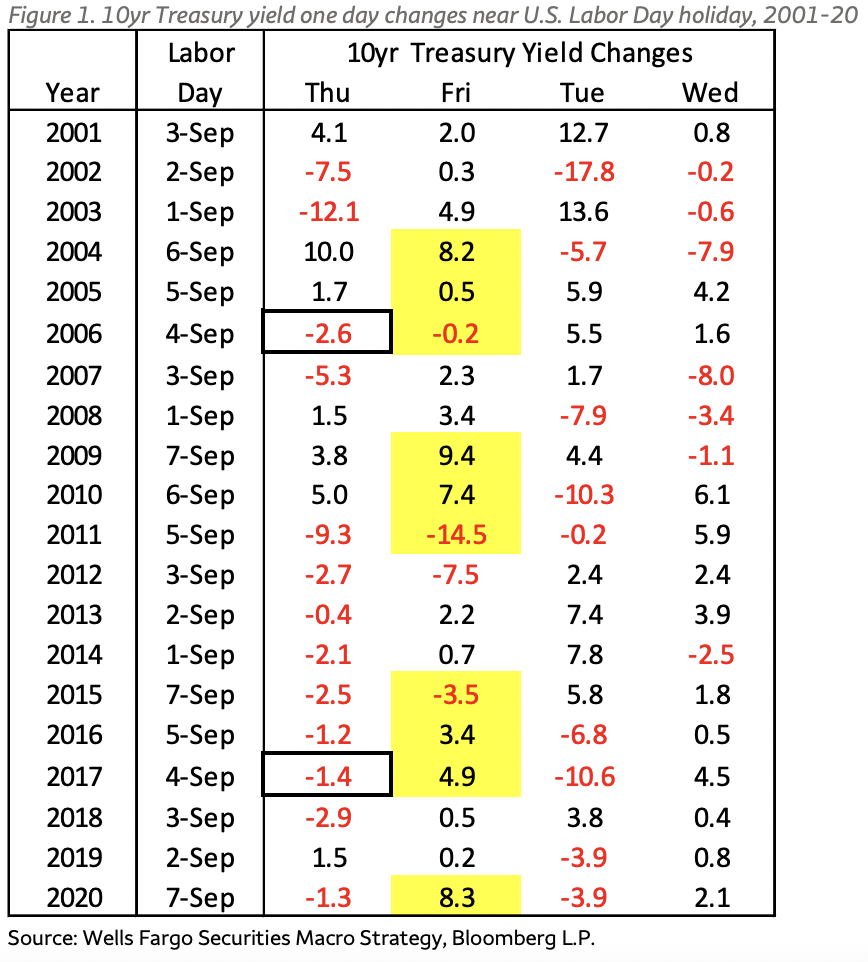
Bloomberg’s Katie Greifeld adds: “[R]ates are more likely to push higher on the heels of an unexpectedly strong jobs print than they are to fall in the wake of a weak one. With that dynamic in mind, bet against bonds.”

Graphic: Wells Fargo & Co (NYSE: WFC) data plotted by Bloomberg. 

To note, a softer report may pause any talk of taper to asset purchases. A reduction in the Federal Reserve’s balance sheet – a removal of liquidity – could prompt a sort of risk-off scenario in which participants try to get ahead of whatever cascading reactions may come with the taper.

In other words, as Kai Volatility’s Cem Karsan explained to me: “It’s not a coincidence that the mid-February to mid-March 2020 downturn literally started the day after February expiration and ended the day of March quarterly expiration. These derivatives are incredibly embedded in how the tail reacts and there’s not enough liquidity, given the leverage, if the Fed were to taper.”

Moreover, for today, given an increased potential for higher volatility and initiative trade, participants may make use of the following frameworks.

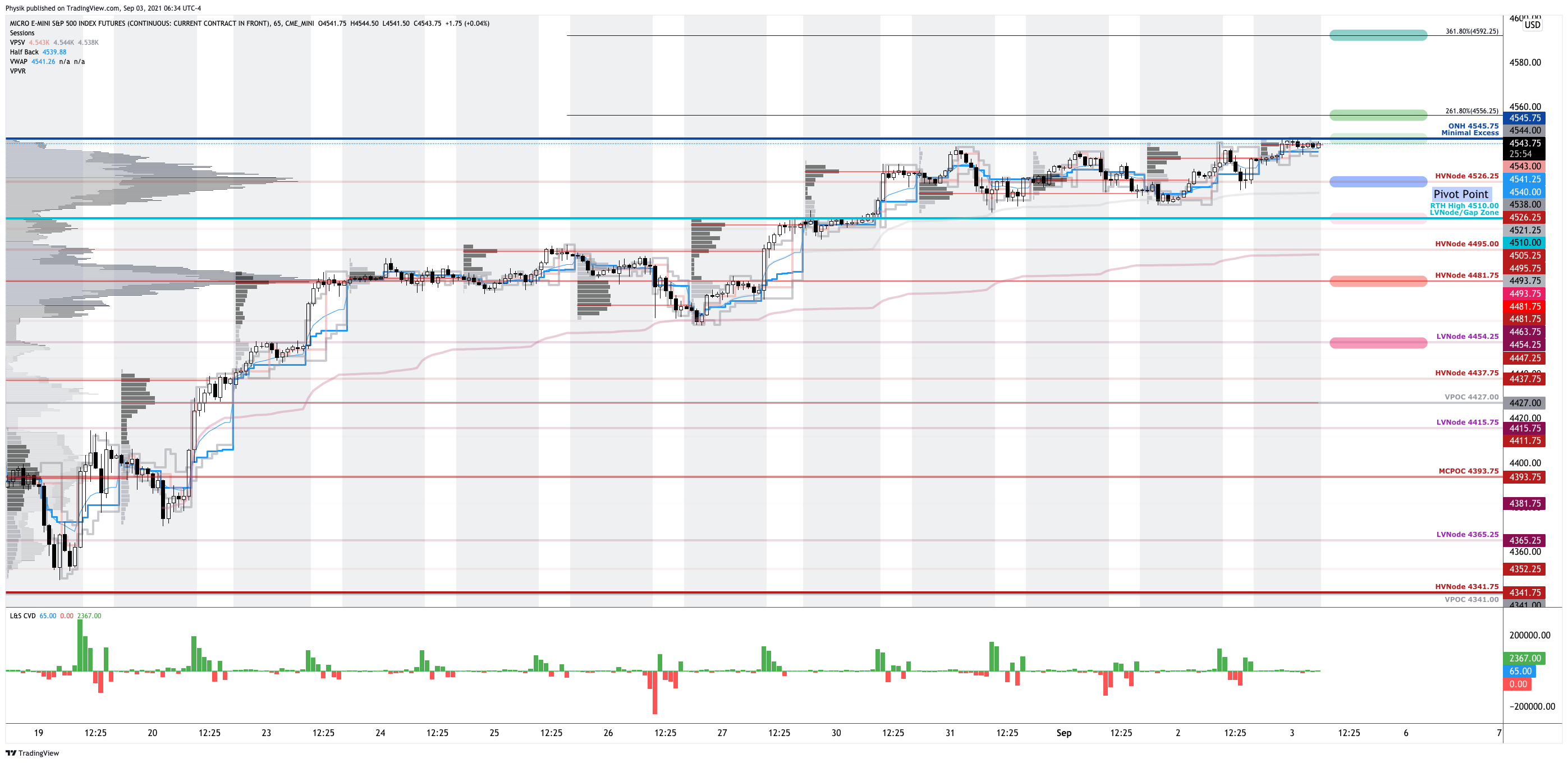
In the best case, the S&P 500 trades sideways or higher; activity above the $4,526.25 high volume area (HVNode) puts in play the $4,545.75 overnight high (ONH). Initiative trade beyond the ONH puts in play the $4,556.25 and $4,592.25 Fibonacci extensions. 

In the worst case, the S&P 500 trades lower; activity below the $4,526.25 HVNode puts in play the $4,510.00 level, a regular trade high (RTH High), and gap. Initiative trade beyond the RTH High and gap puts in play the $4,481.75 HVNode and $4,454.25 LVNode.

Overnight Rally Highs (Lows): Typically, there is a low historical probability associated with overnight rally-highs (lows) ending the upside (downside) discovery process.

Volume Areas: A structurally sound market will build on past areas of high volume. Should the market trend for long periods of time, it will lack sound structure (identified as a low volume area which denotes directional conviction and ought to offer support on any test). 

If participants were to auction and find acceptance into areas of prior low volume, then future discovery ought to be volatile and quick as participants look to areas of high volume for favorable entry or exit.

Initiative Buying (Selling): Buying (selling) within or above (below) the previous day’s value area.
Graphic: 65-minute profile chart of the Micro E-mini S&P 500 Futures updated 6:30 AM ET.

News And Analysis

Moody’s Weekly Market Outlook on Ida, gas, and inflation expectations. 

Short bets rise against consumer discretionary stocks as stimulus fades.

Traders set to test Powell’s push to delink hikes from bond-buying taper.

Three doses could become a standard COVID regimen, Dr. Fauci says.

The Western U.S. drought is forecasted to continue through fall at least.

U.S. structured finance issuance totaled $57B in August, rising 65% YoY.

What People Are Saying

About

After years of self-education, strategy development, and trial-and-error, Renato Leonard Capelj began trading full-time and founded Physik Invest to detail his methods, research, and performance in the markets. 

Additionally, Capelj is a finance and technology reporter. Some of his biggest works include interviews with leaders such as John Chambers, founder and CEO, JC2 Ventures, Kevin O’Leary, businessman and Shark Tank host, Catherine Wood, CEO and CIO, ARK Invest, among others.

Disclaimer

At this time, Physik Invest does not manage outside capital and is not licensed. In no way should the materials herein be construed as advice. Derivatives carry a substantial risk of loss. All content is for informational purposes only.
Categories
Commentary

Daily Brief For August 11, 2021

Market Commentary

Equity index futures are sideways and divergent.

  • Senate passes new $3.5T economic blueprint.
  • Ahead: Data on CPI, Federal Budget Balance.
  • Sideways chop as participants position for CPI.

What Happened: U.S. stock index futures auctioned sideways ahead of data that would provide clarity on the direction of consumer prices.

According to Moody’s: “The CPI rose 0.9% in June, but it likely moderated in July, since we don’t expect used car prices to have risen as quickly as they have recently. Elsewhere on the inflation front, we will get data on producer and import prices. After the release of the CPI and PPI, we will have a good idea of what the core PCE deflator, the Fed’s preferred measure of inflation, did in June.”

Ahead is also data on the Federal Budget Balance and Fed speak.

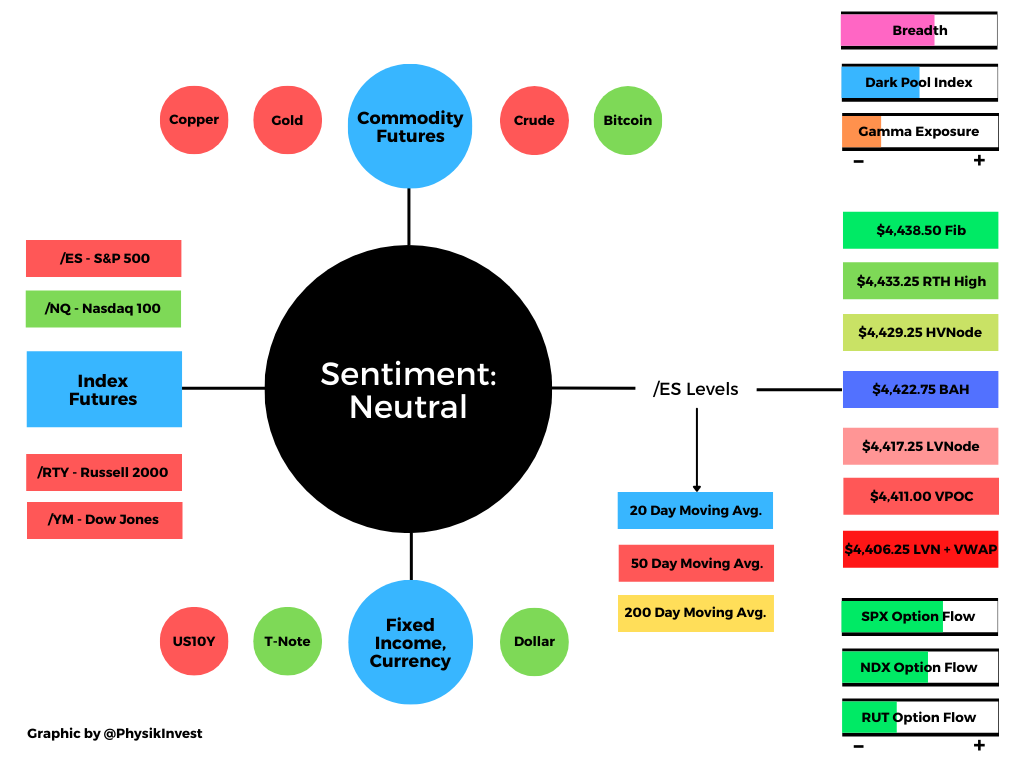
Graphic updated 6:45 AM ET. Sentiment Neutral if expected /ES open is inside of the prior day’s range. See here for more on the Dark Pool Index and Gamma. A positive Dark Pool Index reading is bullish. At the same time, the higher (lower) the gamma, the less (more) volatility. SHIFT Search data used for options activity. Note that options flow is sorted by the call premium spent; if green and more (less) positive then more (less) was spent on call options. Breadth reflects a reading of the prior day’s Advance/Decline indicator. VIX reflects a reading of the CBOE Volatility Index from 0-100.

What To Expect: As of 6:45 AM ET, Wednesday’s regular session (9:30 AM – 4:00 PM EST) in the S&P 500 will likely open inside of prior-range and -value, suggesting a limited potential for immediate directional opportunity.

Adding, during the prior day’s regular trade, the best case outcome occurred, evidenced by initiative trade above the $4,422.75, a prior balance area high (BAH), up to the $4,438.50 Fibonacci extension. 

Initiative Buying (Selling): Buying (selling) within or above (below) the previous day’s value area.

Balance (Two-Timeframe Or Bracket): Rotational trade that denotes current prices offer favorable entry and exit. Balance-areas make it easy to spot a change in the market (i.e., the transition from two-time frame trade, or balance, to one-time frame trade, or trend). 

This advance happened in spite of top-line divergences, as well as lackluster metrics with respect to market liquidity and breadth.

Unlike on the NYSE side of things (which sported positive breadth with an inflow into stocks that were up versus down), internals on the Nasdaq were markedly weak with negative breadth supporting a liquidation in the Nasdaq 100 (INDEX: NDX). 

In terms of market liquidity, the cumulative volume delta – a measure of buying and selling power as calculated by the difference in volume traded at the bid and offer – revealed no actionable divergences.

Coming into today’s Consumer Price Index (CPI) release, participants will notice the S&P 500, in particular, trading within a 3-day balance area, above a prior 10-day balance area. In short, since last week’s breakout, little has changed. What was thought would happen (i.e., expansion of range) didn’t happen.

Instead, trade was volatile, establishing excess just a tick short of the $4,438.50 Fibonacci extension as participants likely worked to position themselves for the mid-week data dump. As a result, until after the first couple of impulses on the CPI release, participants are cautioned on early trade.

Excess: A proper end to price discovery; the market travels too far while advertising prices. Responsive, other-timeframe (OTF) participants aggressively enter the market, leaving tails or gaps which denote unfair prices.

Moreover, for today, participants can trade from the following frameworks. 

In the best case, the S&P 500 trades sideways or higher; activity above the $4,422.75 BAH likely puts in play the $4,433.00 untested point of control (VPOC). Initiative trade beyond the VPOC could reach as high as the $4,438.25 regular trade high (RTH High) and $4,446.25 Fibonacci extension.

In the worst case, the S&P 500 trades lower; activity below the $4,422.75 BAH likely puts in play the $4,415.75 low volume area (LVNode). Initiative trade beyond the LVNode could reach as low as the $4,411.00 VPOC and $4,406.25 LVNode.

Volume Areas: A structurally sound market will build on past areas of high volume. Should the market trend for long periods of time, it will lack sound structure (identified as a low volume area which denotes directional conviction and ought to offer support on any test). 

If participants were to auction and find acceptance into areas of prior low volume, then future discovery ought to be volatile and quick as participants look to areas of high volume for favorable entry or exit.

Significance Of Prior ATHs, ATLs: Prices often encounter resistance (support) at prior highs (lows) due to the supply (demand) of old business. These areas take time to resolve. Breaking and establishing value (i.e., trading more than 30-minutes beyond this level) portends continuation.

POCs: POCs are valuable as they denote areas where two-sided trade was most prevalent. Participants will respond to future tests of value as they offer favorable entry and exit.
Graphic: 65-minute profile chart of the Micro E-mini S&P 500 Futures. Graphic updated 6:45 AM ET.

News And Analysis

Earnings historically strong and policy transition.

Hackers steal $600M in likely largest DeFi theft.

Economic activity restart is real and broadening.

A turning point for markets meriting a hard look.

Biden administration to urge OPEC output boost.

The Senate passed a $550B infrastructure plan.

Delta forces hospitals to ration scarce ICU beds.

Mortgage applications rise with rates below 3%.

A systemic cyberattack presents risks for banks.

What People Are Saying

About

After years of self-education, strategy development, and trial-and-error, Renato Leonard Capelj began trading full-time and founded Physik Invest to detail his methods, research, and performance in the markets. 

Additionally, Capelj is a finance and technology reporter. Some of his biggest works include interviews with leaders such as John Chambers, founder and CEO, JC2 Ventures, Kevin O’Leary, businessman and Shark Tank host, Catherine Wood, CEO and CIO, ARK Invest, among others.

Disclaimer

At this time, Physik Invest does not manage outside capital and is not licensed. In no way should the materials herein be construed as advice. Derivatives carry a substantial risk of loss. All content is for informational purposes only.
Categories
Commentary

Daily Brief For August 10, 2021

Market Commentary

Equity index futures are sideways and divergent.

  • Taper talk, COVID-19 fears, infrastructure news.
  • Ahead: NFIB, productivity, unit labor, Fed speak.

What Happened: U.S. stock index futures auctioned sideways alongside COVID-19 fears, infrastructure, crypto regulation, and taper talk.

This comes as core inflation is expected to come in around 4.8%, “likely unhinging Powell and expediting the talk about talking about tapering as early as in September,” according to Nordea.

Ahead is data on the NFIB small-business index, productivity, unit labor costs, and earnings. Cleveland Fed President Loretta Mester speaks at 10:00 AM ET.

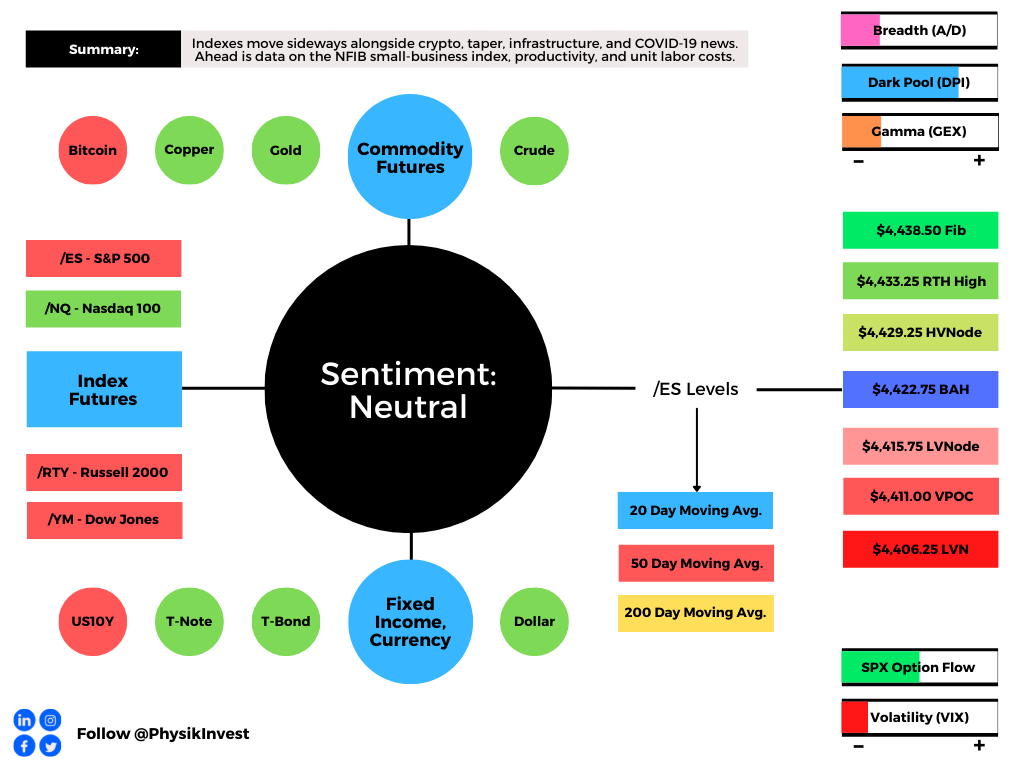
Graphic updated 6:30 AM ET. Sentiment Neutral if expected /ES open is inside of the prior day’s range. See here for more on the Dark Pool Index and Gamma. A positive Dark Pool Index reading is bullish. At the same time, the higher (lower) the gamma, the less (more) volatility. SHIFT Search data used for options activity. Note that options flow is sorted by the call premium spent; if green and more (less) positive then more (less) was spent on call options. Breadth reflects a reading of the prior day’s Advance/Decline indicator. VIX reflects a reading of the CBOE Volatility Index from 0-100.

What To Expect: As of 6:30 AM ET, Tuesday’s regular session (9:30 AM – 4:00 PM EST) in the S&P 500 will likely open inside of prior-range and -value, suggesting a limited potential for immediate directional opportunity.

Adding, during the prior day’s regular trade, the best case outcome occurred, evidenced by sideways trade at the $4,422.75 balance area high (BAH). This is significant because the BAH marked a shift in tone (i.e., a transition from two-time frame trade, or balance, to one-time frame trade, or trend).

Given that the BAH was not lost, the default balance break scenarios remain in play (i.e., play the break rather than fade the edges). As a result, we monitor for rejection (i.e., a return inside of balance). This would portend a move to the opposite end of balance, or the $4,365.25 low volume area (LVNode) in the S&P 500 future.

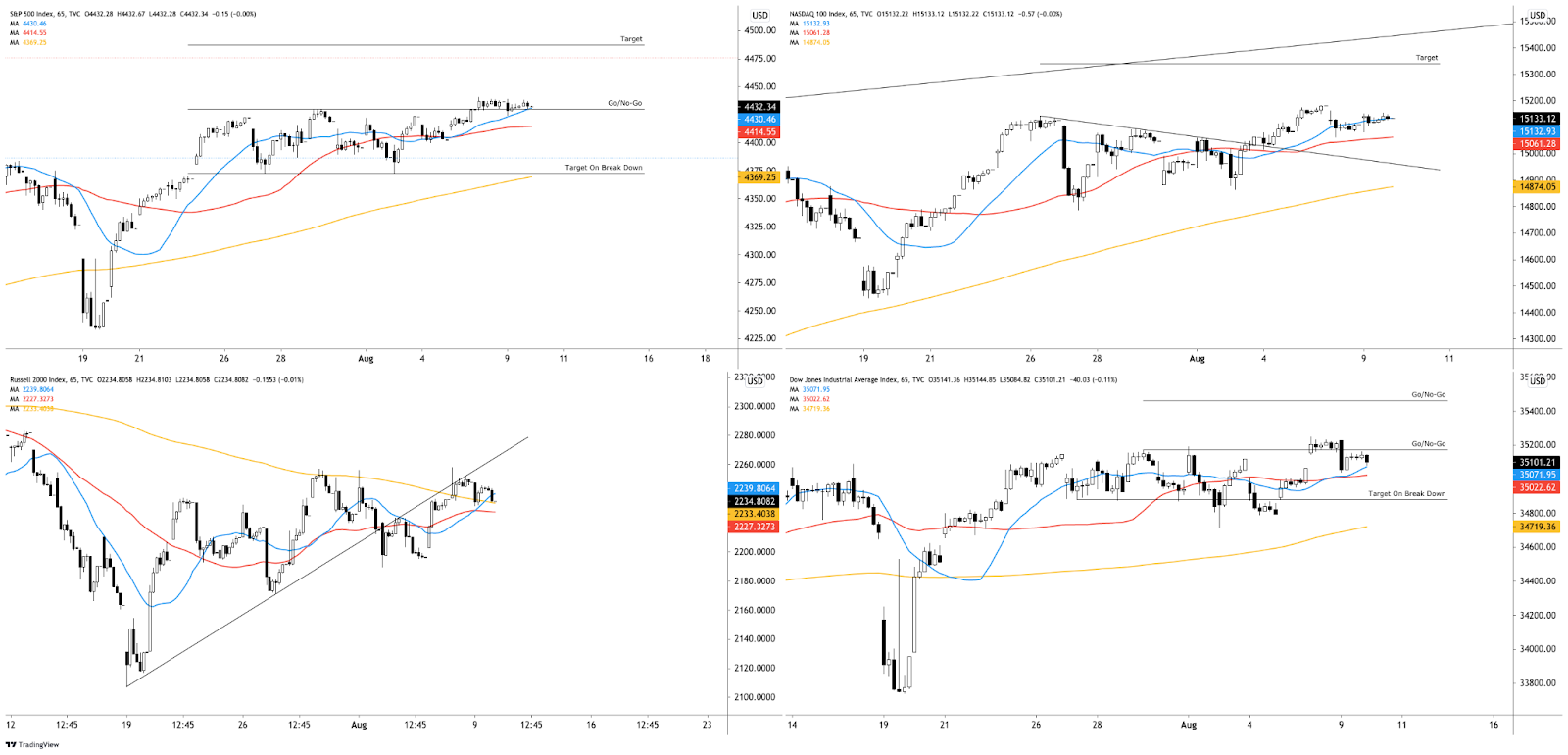
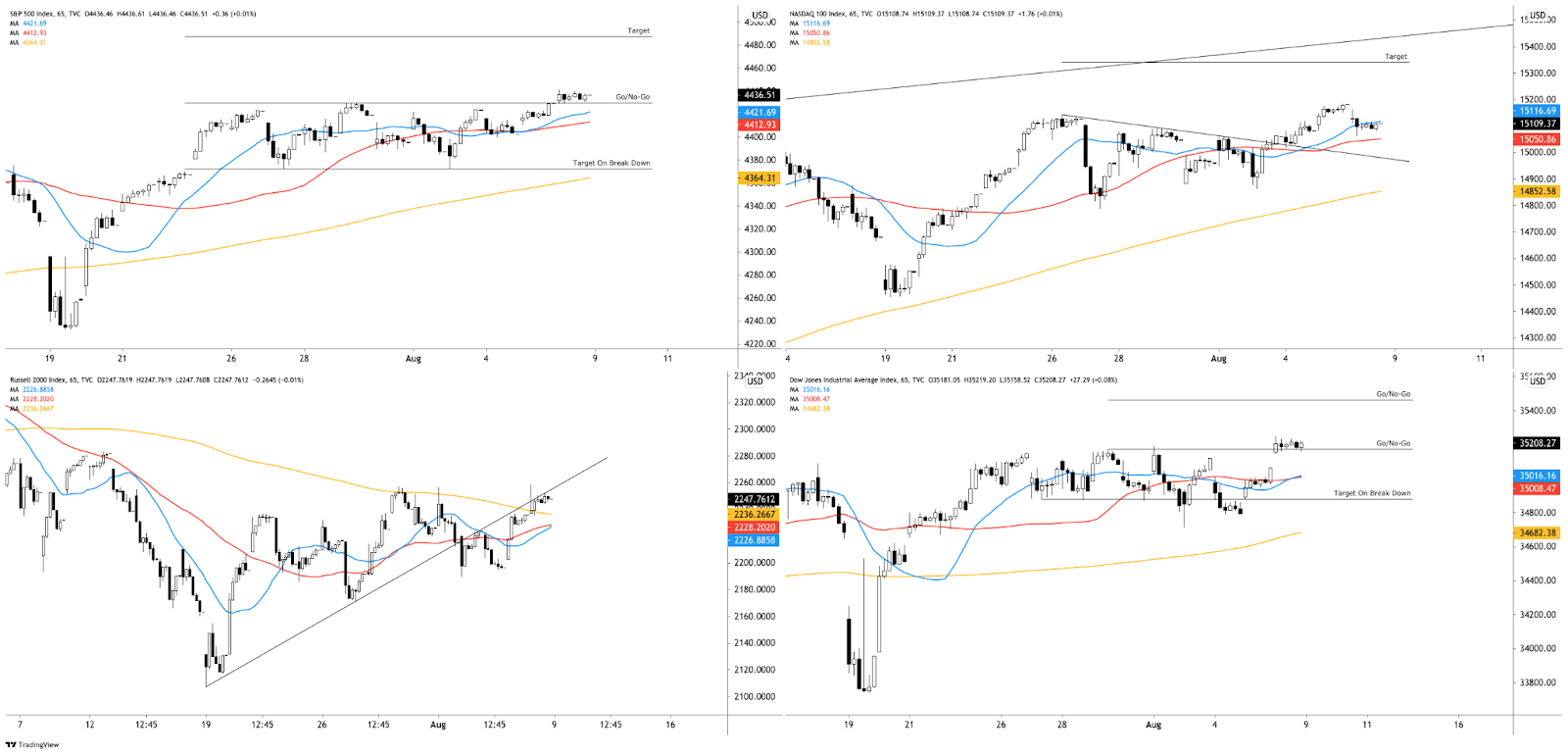
Graphic: 65-minute candlestick charts of the cash-settled S&P 500 (INDEX: SPX), Nasdaq 100 (INDEX: NDX), Russell 2000 (INDEX: RUT), and Dow Jones Industrial Average (INDEX: DJI). The S&P 500, of the four index products covered, has yet to invalidate its breakout.

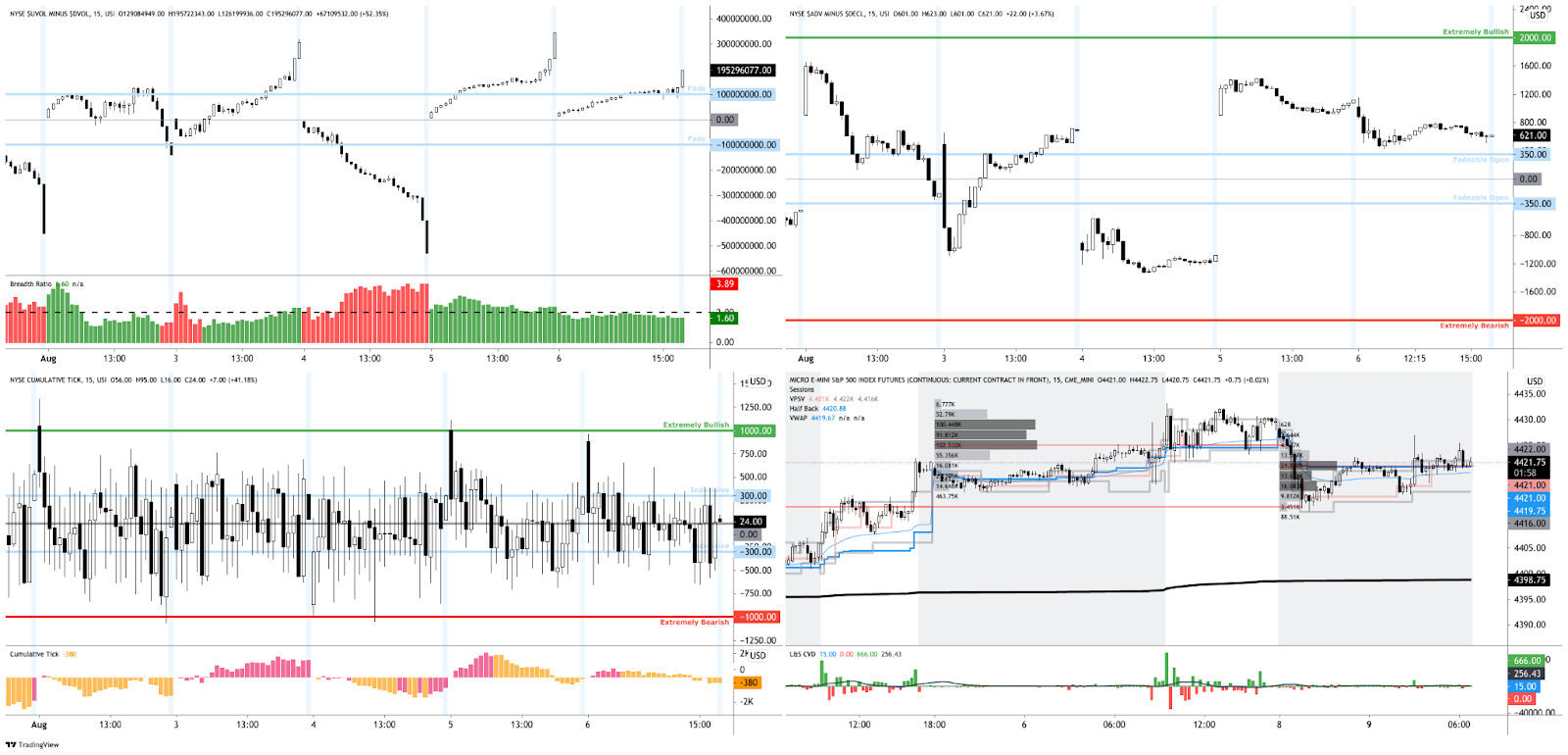
To note, briefly, yesterday’s rangebound trade came alongside divergences with respect to price, market liquidity, and market internals. 

For instance, breadth at the exchange level was negative with a minuscule inflow into stocks that were down, versus those that were up. The cumulative volume delta – a measure of buying and selling power as calculated by the difference in volume traded at the bid and offer – diverged from mid-afternoon prices inspiring confidence in responsive trade. 

Responsive Buying (Selling): Buying (selling) in response to prices below (above) an area of recent price acceptance.

Moreover, for today, participants can trade from the following frameworks. 

In the best case, the S&P 500 trades sideways or higher; activity above the $4,422.75 BAH puts in play the $4,429.25 high volume area (HVNode). Initiative trade beyond the HVNode could reach as high as the $4,433.25 regular trade high (RTH High) and $4,438.50 Fibonacci extension.

In the worst case, the S&P 500 trades lower; activity below the $4,422.75 BAH puts in play the $4,415.76 LVNode. Initiative trade beyond the LVNode could reach as low as the $4,411.00 untested point of control (VPOC) and $4,406.25 LVNode.

Initiative Buying (Selling): Buying (selling) within or above (below) the previous day’s value area.

Volume Areas: A structurally sound market will build on past areas of high volume. Should the market trend for long periods of time, it will lack sound structure (identified as a low volume area which denotes directional conviction and ought to offer support on any test). 

If participants were to auction and find acceptance into areas of prior low volume, then future discovery ought to be volatile and quick as participants look to areas of high volume for favorable entry or exit.

POCs: POCs are valuable as they denote areas where two-sided trade was most prevalent. Participants will respond to future tests of value as they offer favorable entry and exit.

Significance Of Prior ATHs, ATLs: Prices often encounter resistance (support) at prior highs (lows) due to the supply (demand) of old business. These areas take time to resolve. Breaking and establishing value (i.e., trading more than 30-minutes beyond this level) portends continuation.
Graphic: 65-minute profile chart of the Micro E-mini S&P 500 Futures. Graphic updated 6:20 AM ET.

News And Analysis

China’s top oil refiner said to cut run as delta hits.

Biden’s agenda teed up for Senate endorsement.

SoftBank cut China investments until more clarity.

Major shocks see a divergence in rating migration.

The fully vaccinated are still catching COVID-19.

Analysts are warning on buy now, pay later trend.

What People Are Saying

About

After years of self-education, strategy development, and trial-and-error, Renato Leonard Capelj began trading full-time and founded Physik Invest to detail his methods, research, and performance in the markets. 

Additionally, Capelj is a finance and technology reporter. Some of his biggest works include interviews with leaders such as John Chambers, founder and CEO, JC2 Ventures, Kevin O’Leary, businessman and Shark Tank host, Catherine Wood, CEO and CIO, ARK Invest, among others.

Disclaimer

At this time, Physik Invest does not manage outside capital and is not licensed. In no way should the materials herein be construed as advice. Derivatives carry a substantial risk of loss. All content is for informational purposes only.

Categories
Commentary

Daily Brief For August 9, 2021

Market Commentary

Equity index futures diverge, trading sideways to lower with commodities.

  • Themes: COVID-19, taper, infrastructure.
  • Ahead: JOLTS, Fed speak, and earnings.
  • Indices negate breakout and trade lower.

What Happened: U.S. stock index futures auctioned sideways to lower alongside talk of infrastructure and taper, as well as a resurgence in the COVID-19 coronavirus.

Adding, in research put out by Nordea, Andreas Steno Larsen said: “Powell hinted that the Fed has already reached one out of two targets and that full employment and inflation ‘moderately exceeding the 2% target’ are not prerequisites for a taper decision.”

Moreover, ahead is data on job openings, earnings, and Fed speak. 

Graphic updated 6:30 AM ET. Sentiment Neutral if expected /ES open is inside of the prior day’s range. See here for more on the Dark Pool Index and Gamma. A positive Dark Pool Index reading is bullish. At the same time, the higher (lower) the gamma, the less (more) volatility. SHIFT Search data used for options activity. Note that options flow is sorted by the call premium spent; if green and more (less) positive then more (less) was spent on call options. Breadth reflects a reading of the prior day’s Advance/Decline indicator.

What To Expect: As of 6:30 AM ET, Monday’s regular session (9:30 AM – 4:00 PM EST) in the S&P 500 will likely open on a small gap just below prior-range and -value, suggesting a potential for immediate directional opportunity.

Gap Scenarios: Gaps ought to fill quickly. Should they not, that’s a signal of strength; do not fade. Leaving value behind on a gap-fill or failing to fill a gap (i.e., remaining outside of the prior session’s range) is a go-with indicator.

Auctioning and spending at least 1-hour of trade back in the prior range suggests a lack of conviction; in such a case, do not follow the direction of the most recent initiative activity.

Adding, during the prior day’s regular trade, the best case outcome occurred – a balance area breakout – evidenced by trade above the $4,422.75 balance area high (BAH). This is significant because it marked a shift in tone (i.e., a transition from two-time frame trade, or balance, to one-time frame trade, or trend).

In such a case, the modus operandi shifts from responsive trade (i.e., fade the edges) to initiative trade (i.e., play the break). 

A failure to expand range in the indexes – as evidenced by Friday’s lackluster breakout and early trade Monday – portends a rotation back toward the lower end of the balance, which corresponds with the $4,365.25 low volume area (LVNode) in the S&P 500 Future.

Graphic: Market Internals (Advance/Decline, Up-Volume/Down-Volume, Tick) displayed as Peter Reznicek at ShadowTrader teaches.
Graphic: 65-minute candlestick charts of the cash-settled S&P 500 (INDEX: SPX), Nasdaq 100 (INDEX: NDX), Russell 2000 (INDEX: RUT), and Dow Jones Industrial Average (INDEX: DJI).

For today, participants can trade from the following frameworks. 

In the best case, the S&P 500 trades sideways or higher; activity above the $4,422.75 BAH puts in play the $4,429.25 high volume area (HVNode). Initiative trade beyond the HVNode could reach as high as the $4,433.25 regular trade high (RTH High) and $4,438.50 fibonacci-derived price target.

In the worst case, the S&P 500 trades lower; activity below the $4,422.75 BAH puts in play the $4,417.25 low volume area (LVNode). Initiative trade beyond the LVNode could reach as low as the $4,411.00 untested point of control (VPOC) and $4,406.25 LVNode.

To note, the $4,406.25 level corresponds with a key anchored volume-weighted average price (VWAP), a metric highly regarded by chief investment officers, among other participants, for quality of trade. Additionally, liquidity algorithms are benchmarked and programmed to buy and sell around VWAPs.

Volume Areas: A structurally sound market will build on past areas of high volume. Should the market trend for long periods of time, it will lack sound structure (identified as a low volume area which denotes directional conviction and ought to offer support on any test). 

If participants were to auction and find acceptance into areas of prior low volume, then future discovery ought to be volatile and quick as participants look to areas of high volume for favorable entry or exit.

POCs: POCs are valuable as they denote areas where two-sided trade was most prevalent. Participants will respond to future tests of value as they offer favorable entry and exit.
Graphic: 65-minute profile chart of the Micro E-mini S&P 500 Futures. Graphic updated 6:38 AM ET.

News And Analysis

Moody’s Weekly Market Outlook: Jobs and talk of tapering plans.

Oil tumbles to three-week low as virus spread menaces outlook. 

Why it is too early to celebrate the blockbuster July jobs report.

The key lessons for traders from fund managers with Ken Katzen. 

The financial fragility of U.S. households and businesses hit low.

A large loosening of consumer underwriting standards continues.

U.S. labor market job loss mismatch could persist through 2022. 

China’s semiconductor self-reliance is posing overcapacity risks.

The technology upside from the COVID-19 coronavirus pandemic. 

Homeowners have a tough time finding themselves underwater.

VC tear continues with $61B invested and 53 new unicorns born.

What People Are Saying

About

After years of self-education, strategy development, and trial-and-error, Renato Leonard Capelj began trading full-time and founded Physik Invest to detail his methods, research, and performance in the markets. 

Additionally, Capelj is a finance and technology reporter. Some of his biggest works include interviews with leaders such as John Chambers, founder and CEO, JC2 Ventures, Kevin O’Leary, businessman and Shark Tank host, Catherine Wood, CEO and CIO, ARK Invest, among others.

Disclaimer

At this time, Physik Invest does not manage outside capital and is not licensed. In no way should the materials herein be construed as advice. Derivatives carry a substantial risk of loss. All content is for informational purposes only.