Categories
Commentary

Daily Brief For September 9, 2021

Editor’s Note: Daily market commentaries to pause until Thursday, September 16, 2021, due to travel commitments. A weekend commentary will be in your inbox earlier this week.

All the best, 

Renato

Market Commentary

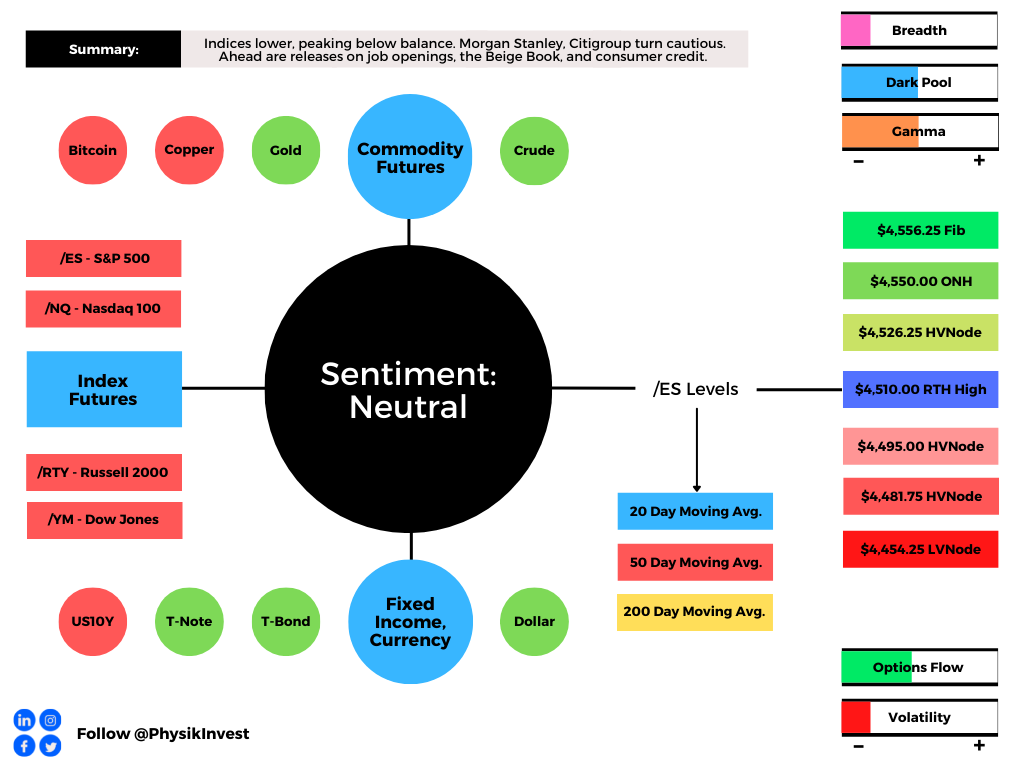
Equity index futures trade lower with yields, dollar, and bitcoin. Most commodities were green.

  • Narratives around slower recovery rising.
  • Ahead is jobless claims data, Fed speak.
  • Positioning risks mounting case for lower.

What Happened: U.S. stock index futures auctioned lower overnight alongside narratives surrounding a slowed economic recovery and stimulus reductions. 

Ahead is data on jobless claims (8:30 AM ET), as well as Fed-speak by Bowman (1:00 PM ET) and Williams (2:00 PM ET).
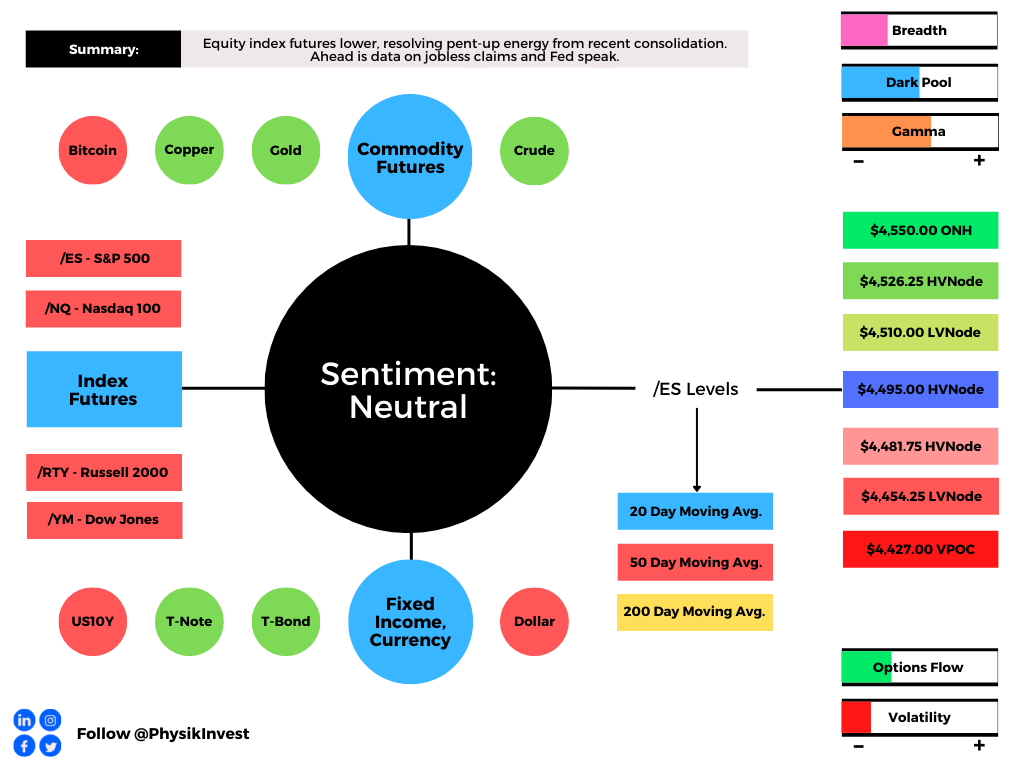
Graphic updated 6:30 AM ET. Sentiment Neutral if expected /ES open is inside of the prior day’s range. SqueezeMetrics Dark Pool Index (DIX) and Gamma (GEX) calculations are based on where the prior day’s reading falls with respect to the MAX and MIN of all occurrences available. A higher DIX is bullish. At the same time, the lower the GEX, the more (expected) volatility. SHIFT data used for S&P 500 (INDEX: SPX) options activity approximation. Note that options flow is sorted by the call premium spent; if more positive then more was spent on call options. Breadth reflects a reading of the prior day’s NYSE Advance/Decline indicator. VIX reflects a current reading of the CBOE Volatility Index (INDEX: VIX) from 0-100.

What To Expect: As of 6:30 AM ET, Thursday’s regular session (9:30 AM – 4:00 PM EST) in the S&P 500 will likely open inside of prior-range and -value, suggesting a limited potential for immediate directional opportunity.

Adding, during the prior day’s regular trade, on weak intraday breadth and divergent market liquidity metrics, the best case outcome occurred, evidenced by sideways trade at the $4,510.00 pivot, the low end of a recent consolidation (i.e., balance) area. 

Balance (Two-Timeframe Or Bracket): Rotational trade that denotes current prices offer favorable entry and exit. Balance-areas make it easy to spot a change in the market (i.e., the transition from two-time frame trade, or balance, to one-time frame trade, or trend). 

Modus operandi is responsive trade (i.e., fade the edges), rather than initiative trade (i.e., play the break).

To note, participants had a tough time separating value and expanding range lower.

This is evidenced by the minimal excess at yesterday’s regular trade low (RTH Low), coupled with an overnight response at the 20-day simple moving average (i.e., a visual level likely paid attention to by short-term, technically-driven market participants). 

In other words, we’re carrying forward the difficulty participants had, in days prior, to moving prices out and away from balance. The path of least resistance – at least in prior trade – was not down; stronger sellers are not yet on board.

Excess: A proper end to price discovery; the market travels too far while advertising prices. Responsive, other-timeframe (OTF) participants aggressively enter the market, leaving tails or gaps which denote unfair prices.

Value-Area Placement: Perception of value unchanged if value overlapping. Perception of value has changed if value not overlapping (i.e., outside day). Delay action in the former case.
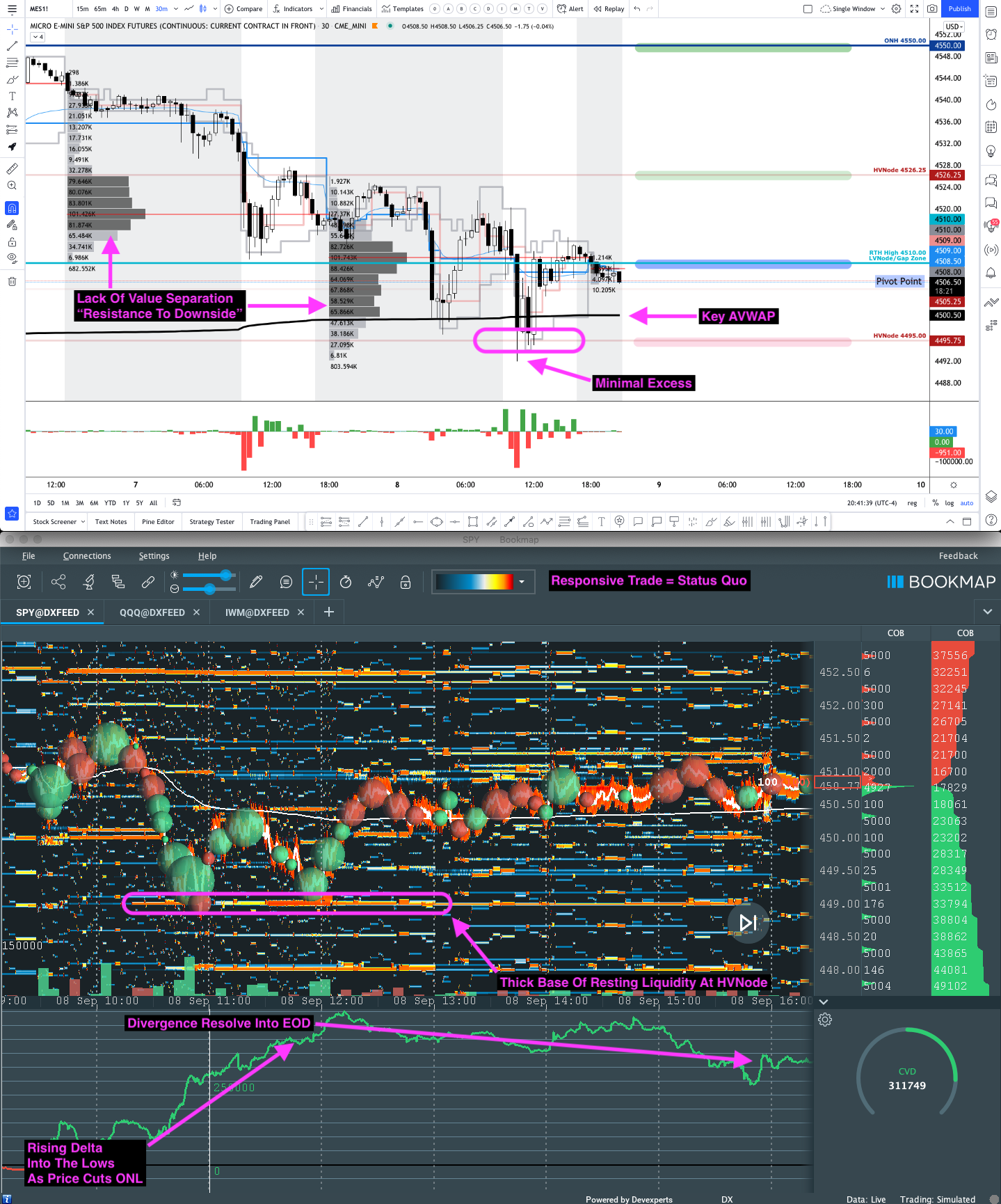
Graphic: 30-minute profile chart of the Micro E-mini S&P 500 Futures and market liquidity, via Bookmap, for the SPDR S&P 500 ETF Trust (NYSE: SPY). Notice the volume delta (CVD) or buying and selling power as calculated by the difference in volume traded at the bid and offer.
Balance-Break Scenarios In Play: A change in the market (i.e., the transition from two-time frame trade, or balance, to one-time frame trade, or trend) has occurred.

Though we expect sideways to lower trade – for the time being – we monitor for rejection (i.e., return inside of balance) which portends a move higher, to the opposite end of the balance.

Further, the aforementioned trade is happening in the context of peak growth and a moderation in the economic recovery, as well as non-seasonally aligned inflows, impactful options market dynamics, divergent sentiment, and fears of a mid-cycle transition.

The implications of these themes on price are contradictory

To elaborate, Morgan Stanley (NYSE: MS), Citigroup Inc (NYSE: C), and Goldman Sachs Group Inc (NYSE: GS) cautioned investors about equity outlooks. Of concern, in particular, is a rise in cases of the delta variant, tensions between inflation expectations and yields, as well as seasonality. 

Among other risks, as SqueezeMetrics summarizes, “[p]eople pretty much stopped buying S&P 500 puts [last] week. At the same time, people are overexposed to changes in VIX, and will be hurt more than usual if VIX starts moving up. Historically, this means SPX down, VIX up.”

Moreover, for today, given an increased potential for moderate volatility and responsive trade, participants may make use of the following frameworks.

In the best case, the S&P 500 trades sideways or higher; activity above the $4,495.00 high volume area (HVNode) pivot puts in play the $4,510.00 low volume area (LVNode). Initiative trade beyond the LVNode could reach as high as the $4,526.25 HVNode and $4,550.00 overnight high (ONH).

In the worst case, the S&P 500 trades lower; activity below the $4,495.00 HVNode puts in play the $4,481.75 HVNode. Initiative trade beyond the $4,481.75 HVNode could reach as low as the $4,454.25 LVNode and $4,427.00 untested point of control (VPOC).

Note the developing volume-weighted average price (VWAP) pinch. VWAP is a metric highly regarded by chief investment officers, among other participants, for quality of trade. Additionally, liquidity algorithms are benchmarked and programmed to buy and sell around VWAPs. We look to buy above a flat/rising VWAP pinch. Sell below a flat/declining VWAP pinch.

Overnight Rally Highs (Lows): Typically, there is a low historical probability associated with overnight rally-highs (lows) ending the upside (downside) discovery process.

Volume Areas: A structurally sound market will build on past areas of high volume. Should the market trend for long periods of time, it will lack sound structure (identified as a low volume area which denotes directional conviction and ought to offer support on any test). 

If participants were to auction and find acceptance into areas of prior low volume, then future discovery ought to be volatile and quick as participants look to areas of high volume for favorable entry or exit.

POCs: POCs are valuable as they denote areas where two-sided trade was most prevalent. Participants will respond to future tests of value as they offer favorable entry and exit.
Graphic: 65-minute profile chart of the Micro E-mini S&P 500 Futures updated 6:30 AM ET. 

News And Analysis

Traders rush to dump China tech stocks as gaming targeted again.

Decision Guide: The ECB counts risks in setting bond-buying pace.

Aluminum notches fresh 13-year high on supply woes and demand.

China’s zero-COVID approach will aggravate rising corporate risks.

Fauci: We don’t even have “modestly good control” over COVID-19.

Coinbase threat shows there’s a new cryptocurrency sheriff in town.

White House eyeing increased hacking around the coming holidays.

What People Are Saying

About

After years of self-education, strategy development, and trial-and-error, Renato Leonard Capelj began trading full-time and founded Physik Invest to detail his methods, research, and performance in the markets. 

Additionally, Capelj is a finance and technology reporter. Some of his biggest works include interviews with leaders such as John Chambers, founder and CEO, JC2 Ventures, Kevin O’Leary, businessman and Shark Tank host, Catherine Wood, CEO and CIO, ARK Invest, among others.

Disclaimer

At this time, Physik Invest does not manage outside capital and is not licensed. In no way should the materials herein be construed as advice. Derivatives carry a substantial risk of loss. All content is for informational purposes only.

Categories
Commentary

Daily Brief For September 8, 2021

Abstract: Status quo briefly disrupted after equity index futures traded lower overnight. 

Alongside today’s light events calendar, participants ought to be most concerned with positioning risks and calls by large investment banks for cautiousness. A key pivot for today’s trade in the S&P 500 stands at $4,510.00.

Given the expected open, there may be limited potential for immediate directional opportunity.

Market Commentary

Equity index futures trade lower with yields, bitcoin, and copper. Gold, oil, bonds, VIX higher.

  • Big banks revised down growth forecasts.
  • Ahead: Job openings, Beige Book, credit.
  • Positioning risks mount case for volatility.

What Happened: U.S. stock index futures auctioned sideways to lower overnight alongside calls by large investment banks for cautiousness amidst outsized risks.

Ahead is data on job openings (10:00 AM ET), Beige Book (2:00 PM ET), and consumer credit (3:00 PM ET).

Graphic updated 6:30 AM ET. Sentiment Neutral if expected /ES open is inside of the prior day’s range. SqueezeMetrics Dark Pool Index (DIX) and Gamma (GEX) calculations are based on where the prior day’s reading falls with respect to the MAX and MIN of all occurrences available. A higher DIX is bullish. At the same time, the lower the GEX, the more (expected) volatility. SHIFT data used for S&P 500 (INDEX: SPX) options activity approximation. Note that options flow is sorted by the call premium spent; if more positive then more was spent on call options. Breadth reflects a reading of the prior day’s NYSE Advance/Decline indicator. VIX reflects a current reading of the CBOE Volatility Index (INDEX: VIX) from 0-100.

What To Expect: As of 6:30 AM ET, Wednesday’s regular session (9:30 AM – 4:00 PM EST) in the S&P 500 will likely open inside of prior-range and -value, suggesting a limited potential for immediate directional opportunity.

Adding, during the prior day’s regular trade, on weak intraday breadth and divergent market liquidity metrics, the worst-case outcome occurred, evidenced by trade to the low end of a recent consolidation area or balance. 

Overnight, despite the low end of that balance being briefly pierced, responsive buying surfaced pushing the S&P 500 back into Tuesday’s range. 

Balance-Break Scenarios In Play: A change in the market (i.e., the transition from two-time frame trade, or balance, to one-time frame trade, or trend) may occur.

Monitor for acceptance (i.e., more than 1-hour of trade) outside of the balance area. Rejection (i.e., return inside of balance) portends a move to the opposite end of the balance.

Further, the aforementioned trade is happening in the context of peak growth and a moderation in the economic recovery, as well as non-seasonally aligned inflows, impactful options market dynamics, divergent sentiment, and fears of a mid-cycle transition.

The implications of these themes on price are contradictory

To elaborate, Morgan Stanley (NYSE: MS) and Citigroup Inc (NYSE: C) – in addition to Goldman Sachs Group Inc (NYSE: GS), yesterday – are cautioning investors about equity outlooks. Of concern, in particular, is a rise in cases of the delta variant, tensions between inflation expectations and yields, as well as seasonality. 

Among other risks, as SqueezeMetrics summarizes, “[p]eople pretty much stopped buying S&P 500 puts [last] week. At the same time, people are overexposed to changes in VIX, and will be hurt more than usual if VIX starts moving up. Historically, this means SPX down, VIX up.”

Moreover, for today, participants may make use of the following frameworks.

In the best case, the S&P 500 trades sideways or higher; activity above the $4,510.00 regular trade high (RTH High) puts in play $4,526.25, a prominent high volume area (HVNode). Initiative trade beyond the HVNode could reach as high as the $4,550.00 overnight high (ONH) and $4,556.25 Fibonacci extension.

In the worst case, the S&P 500 trades lower; activity below the $4,510.00 RTH High puts in play the $4,495.00 HVNode. Initiative trade beyond the $4,495.00 HVNode could reach as low as the $4,481.75 HVNode and $4,454.25 LVNode.

We note that, as of 6:30 AM ET, prices are back in the most recent consolidation after finding responsive buyers at the overnight low (ONL) which corresponded with an anchored volume-weighted average price (AVWAP), a metric highly regarded by chief investment officers, among other participants, for quality of trade. Additionally, liquidity algorithms are benchmarked and programmed to buy and sell around VWAPs. Losing that ONL changes the tone, obviously.

Overnight Rally Highs (Lows): Typically, there is a low historical probability associated with overnight rally-highs (lows) ending the upside (downside) discovery process.

Volume Areas: A structurally sound market will build on past areas of high volume. Should the market trend for long periods of time, it will lack sound structure (identified as a low volume area which denotes directional conviction and ought to offer support on any test). 

If participants were to auction and find acceptance into areas of prior low volume, then future discovery ought to be volatile and quick as participants look to areas of high volume for favorable entry or exit.
Graphic: 65-minute profile chart of the Micro E-mini S&P 500 Futures updated 6:15 AM ET.

News And Analysis

Ray Dalio says China opportunities can’t be neglected.

Delta variant is slowing reversal of some rating actions.

Rates stagnate; mortgage demand at lowest in months.

Investors should watch closely for peak in profit margin.

Weak jobs data could derail Fed’s bond tapering plans.

Coinbase fell after SEC plans to sue over new product.

Global mobility near post-pandemic high despite delta.

U.S. hits 75% of adults with at least one vaccine dose.

Evergrande dollar bonds fall after suspended payment.

What People Are Saying

About

After years of self-education, strategy development, and trial-and-error, Renato Leonard Capelj began trading full-time and founded Physik Invest to detail his methods, research, and performance in the markets. 

Additionally, Capelj is a finance and technology reporter. Some of his biggest works include interviews with leaders such as John Chambers, founder and CEO, JC2 Ventures, Kevin O’Leary, businessman and Shark Tank host, Catherine Wood, CEO and CIO, ARK Invest, among others.

Disclaimer

At this time, Physik Invest does not manage outside capital and is not licensed. In no way should the materials herein be construed as advice. Derivatives carry a substantial risk of loss. All content is for informational purposes only.

Categories
Commentary

Daily Brief For September 7, 2021

Market Commentary

Equity index futures traded sideways to lower, in line with most commodities and bonds. Yields, the dollar, and VIX were higher.

  • Goldman revised down growth forecasts.
  • Ahead: Light calendar to base decisions.
  • Positioning risks mount case for volatility.

What Happened: U.S. stock index futures traded sideways to lower coming into this shortened week. 

Ahead is no data of interest.

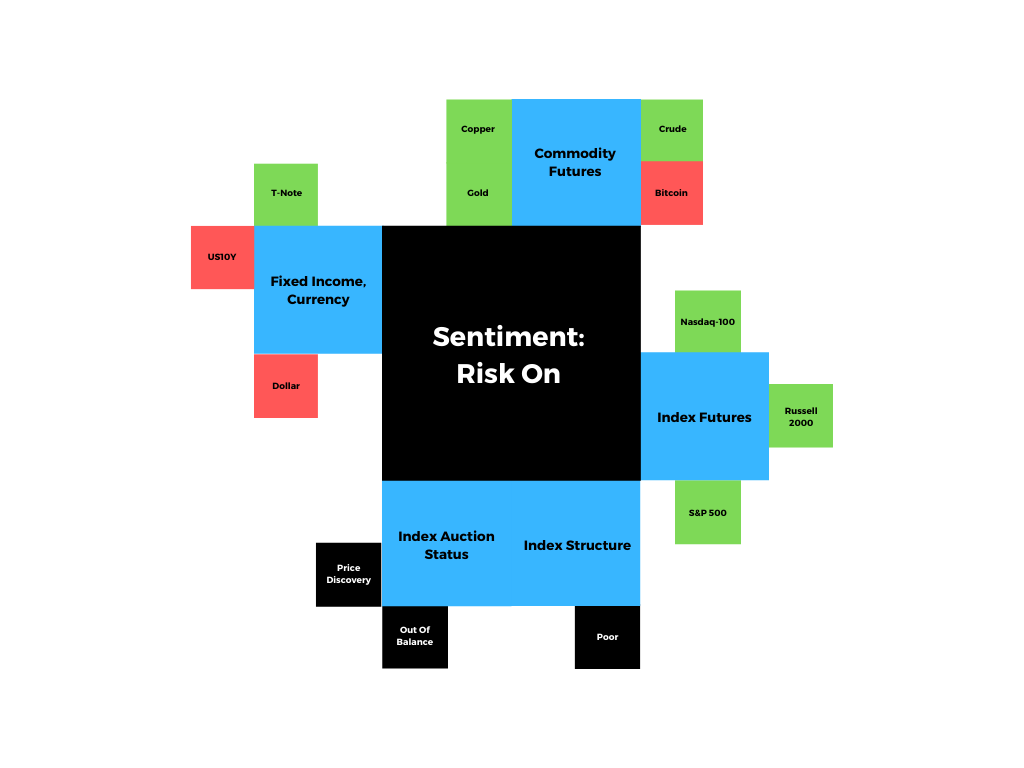
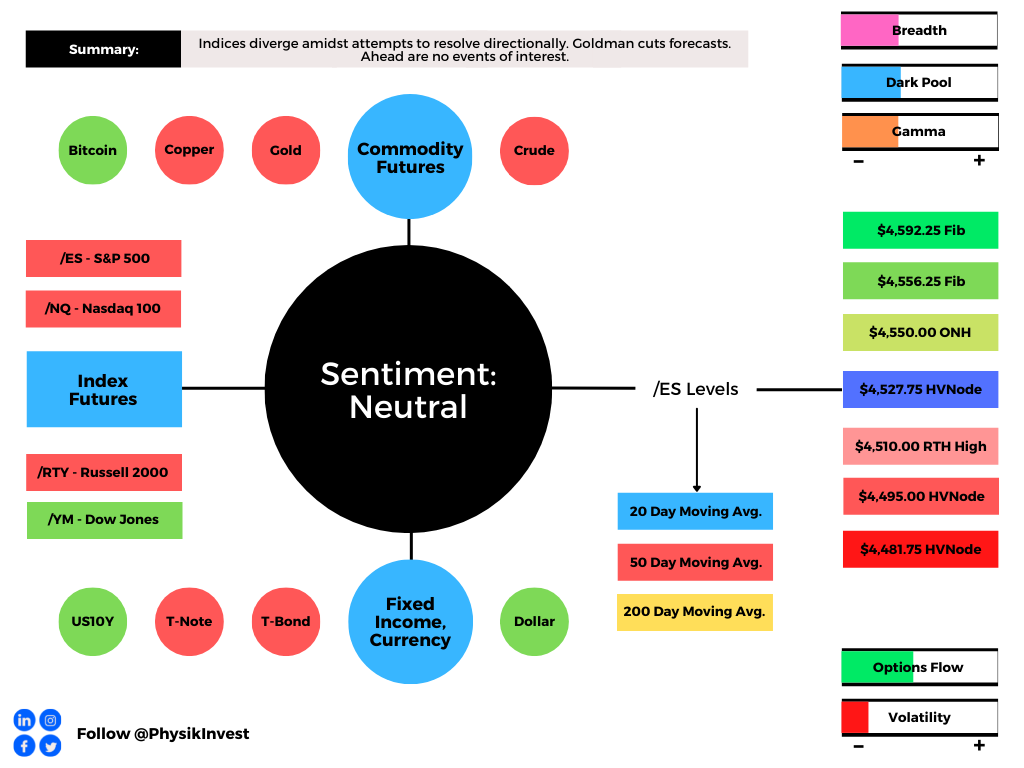
Graphic updated 6:15 AM ET. Sentiment Neutral if expected /ES open is inside of the prior day’s range. SqueezeMetrics Dark Pool Index (DIX) and Gamma (GEX) calculations are based on where the prior day’s reading falls with respect to the MAX and MIN of all occurrences available. A higher DIX is bullish. At the same time, the lower the GEX, the more (expected) volatility. SHIFT data used for S&P 500 (INDEX: SPX) options activity approximation. Note that options flow is sorted by the call premium spent; if more positive then more was spent on call options. Breadth reflects a reading of the prior day’s NYSE Advance/Decline indicator. VIX reflects a current reading of the CBOE Volatility Index (INDEX: VIX) from 0-100.

What To Expect: As of 6:15 AM ET, Tuesday’s regular session (9:30 AM – 4:00 PM EST) in the S&P 500 will likely open inside of prior-range and -value, suggesting a limited potential for immediate directional opportunity.

Adding, during Friday’s regular trade, on lackluster intraday breadth and market liquidity metrics, the best case outcome occurred, evidenced by sideways trade above $4,527.75, a prominent high volume area.

This is significant because sideways to higher trade (i.e., balance) marks acceptance, or a willingness to transact at higher prices after a v-pattern recovery, above the key 50-day simple moving average.

Balance (Two-Timeframe Or Bracket) Is The Status Quo: Rotational trade that denotes current prices offer favorable entry and exit. Balance-areas make it easy to spot a change in the market (i.e., the transition from two-time frame trade, or balance, to one-time frame trade, or trend). 

Modus operandi is responsive trade (i.e., fade the edges), rather than initiative trade (i.e., play the break).

V-Pattern: A pattern that forms after a market establishes a high, retests some support, and then breaks above said high. In most cases, this pattern portends continuation.
Graphic: S&P 500 maintaining prices above the 50-day simple moving average. This moving average can be looked at as a key dynamic level on any move lower. Losing that particular level likely changes the tone.

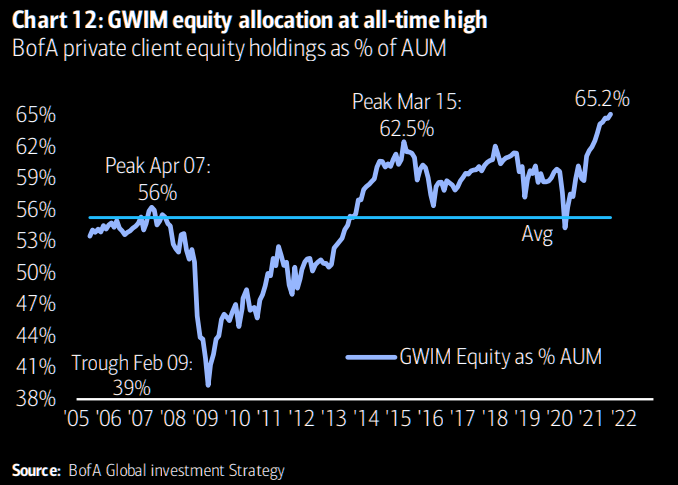
Further, the aforementioned trade is happening in the context of peak growth and a moderation in the economic recovery, as well as non-seasonally aligned inflows, impactful options market dynamics, divergent sentiment, and fears of a mid-cycle transition.

Graphic: Bank of America Corporation (NYSE: BAC) graphic via The Market Ear. All-time highs in the equity markets alongside all-time high equity allocations.

The implications of these themes on price are contradictory

That’s according to Goldman Sachs Group Inc (NYSE: GS) economists who revised lower their forecast for growth in the U.S. economy citing the COVID-19 delta variant, fading fiscal support, supply chain disruptions, and a switch in demand to services. 

“The hurdle for strong consumption growth going forward appears much higher: the Delta variant is already weighing on Q3 growth, and fading fiscal stimulus and a slower service-sector recovery will both be headwinds in the medium term,” said Goldman Sachs’ Ronnie Walker.

Among other risks include fragility with respect to “the current combination of weak put flows and large customer vanna exposure” which, according to SqueezeMetrics, puts us “a hair’s breadth away from some of the most consistently bearish and volatile behavior in the S&P 500.”

In simpler terms, as SqueezeMetrics summarizes, “[p]eople pretty much stopped buying S&P 500 puts [last] week. At the same time, people are overexposed to changes in VIX, and will be hurt more than usual if VIX starts moving up. Historically, this means SPX down, VIX up.”

I also encourage a read of the Weekly Brief for Saturday, September 4, which covered some market risks ahead.

Given the big picture context (i.e., status quo – higher prices – in the face of volatility risks) participants may make use of the following frameworks.

In the best case, the S&P 500 trades sideways or higher; activity above the $4,527.75 high volume area (HVNode) pivot puts in play the $4,550.00 overnight high (ONH). Initiative trade beyond the ONH could reach as high as the Fibonacci extensions at $4,556.25 and $4,592.25.

In the worst case, the S&P 500 trades lower; activity below the $4,527.75 HVNode puts in play the $4,510.00 regular trade high (RTH High). Initiative trade beyond the RTH High could reach as low as the $4,495.00 and $4,481.75 HVNodes.

Overnight Rally Highs (Lows): Typically, there is a low historical probability associated with overnight rally-highs (lows) ending the upside (downside) discovery process.

Volume Areas: A structurally sound market will build on past areas of high volume. Should the market trend for long periods of time, it will lack sound structure (identified as a low volume area which denotes directional conviction and ought to offer support on any test). 

If participants were to auction and find acceptance into areas of prior low volume, then future discovery ought to be volatile and quick as participants look to areas of high volume for favorable entry or exit.
Graphic: 65-minute profile chart of the Micro E-mini S&P 500 Futures updated 6:15 AM ET.

News And Analysis

Soros calls BlackRock China investment a tragic mistake.

GM reshuffling production plans as chip shortage persists.

London taking aim at New York with 5-year financial plan.

TP ICAP slams work from home as it hampers risk-taking.

Global growth rebound solidifies while risks broaden away.

Deutsche Telekom grows bet on U.S. with SoftBank deal.

Bitcoin facing big test as El Salvador makes it legal tender.

Facebook admits “trust deficit” as it looks to launch wallet.

Without help for oil producers, net-zero is a distant dream.

What People Are Saying

About

After years of self-education, strategy development, and trial-and-error, Renato Leonard Capelj began trading full-time and founded Physik Invest to detail his methods, research, and performance in the markets. 

Additionally, Capelj is a finance and technology reporter. Some of his biggest works include interviews with leaders such as John Chambers, founder and CEO, JC2 Ventures, Kevin O’Leary, businessman and Shark Tank host, Catherine Wood, CEO and CIO, ARK Invest, among others.

Disclaimer

At this time, Physik Invest does not manage outside capital and is not licensed. In no way should the materials herein be construed as advice. Derivatives carry a substantial risk of loss. All content is for informational purposes only.

Categories
Commentary

Daily Brief For August 24, 2021

Market Commentary

Equity index and commodity futures trade higher overnight. Yields and VIX are higher, too.

  • Unpacking drivers behind market.
  • Ahead: Data on new home sales.
  • Eyeing digestion, sideways trade.

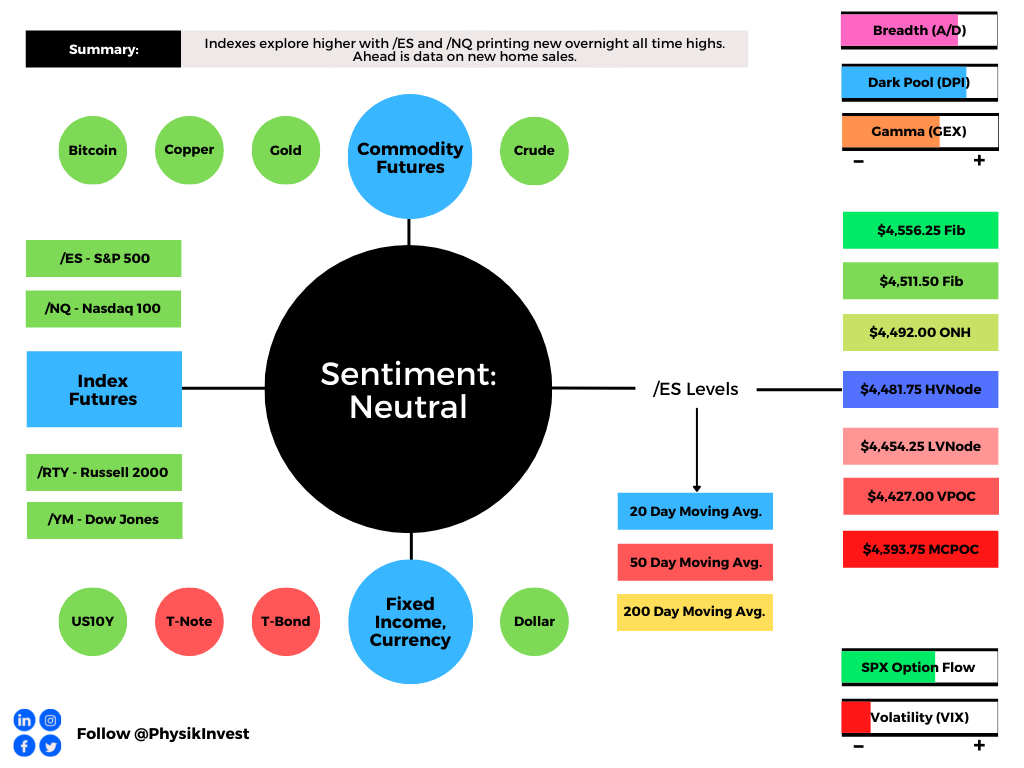
What Happened: U.S. stock index futures explored higher prices overnight as investors looked to position themselves for the upcoming Jackson Hole Economic Symposium August 26-28, 2021. The Russell 2000 is leading the pack alongside the Nasdaq 100.

Ahead is data on new home sales (10:00 AM ET).

Graphic updated 6:30 AM ET. Sentiment Neutral if expected /ES open is inside of the prior day’s range. See here for more on the Dark Pool Index (DPI) and Gamma (GEX). A higher DPI approximation is bullish. At the same time, the lower the GEX approximation, the more volatility. SHIFT data used for options activity approximation. Note that options flow is sorted by the call premium spent; if green and more positive then more was spent on call options. Breadth reflects a reading of the prior day’s Advance/Decline indicator. VIX reflects a current reading of the CBOE Volatility Index from 0-100.

What To Expect: As of 6:30 AM ET, Tuesday’s regular session (9:30 AM – 4:00 PM EST) in the S&P 500 will likely open just inside of prior-range and -value, suggesting a limited potential for immediate directional opportunity.

Adding, during the prior day’s regular trade, on strong intraday breadth and middling market liquidity metrics, the best case outcome occurred, evidenced by trade above the $4,476.50 overnight high (ONH). This is significant because Monday’s trade took back 100% of last week’s liquidation, completing a v-pattern recovery.

V-Pattern: A pattern that forms after a market establishes a high, retests some support, and then breaks above said high. In most cases, this pattern portends continuation.

Further, the aforementioned trade is happening in the context of impactful options market dynamics, moderating growth, and inclination to taper stimulus in spite of a resurgence in COVID-19.

Some of the implications of these themes on price are supportive and contradictory; to elaborate, “[t]he good news is that our economic recovery is unlikely to fully reverse, given lack of political will for a return to stricter lockdown measures. But evidence of a slowdown in third-quarter economic activity will continue to mount in the coming weeks, putting the Fed’s 7 percent real GDP growth projection for 2021 out of reach,” strategists at Guggenheim noted.

“This string of weaker data will likely prompt the Fed, led by Chair Powell and Governor Brainard, to take a more cautious approach to the timing and speed of tapering plans, in turn keeping Treasury yields low.”

At the same time, briefly, we should touch on the so-called sale of any volatility spike which can – through the process of hedging – support the market. Here’s just one example that’s been receiving a lot of attention.

“In theory, if a stock was dropping and the retail masses all started to sell puts, they could push market makers to start buying large blocks of shares,” SpotGamma, an important voice in the space, says. “This could stabilize a dropping stock.”

Graphic: SqueezeMetrics details the implications of customer activity in the options market, on the underlying’s order book. For instance, in selling a put, customers add liquidity and stabilize the market. How? The counterparty long the put will buy (sell) the underlying to neutralize directional risk as price falls (rises).

Moreover, for today, given expectations of heightened volatility and responsive trade, participants may make use of the following frameworks.

Responsive Buying (Selling): Buying (selling) in response to prices below (above) an area of recent price acceptance.

In the best case, the S&P 500 trades sideways or higher; activity above the $4,481.75 high volume area (HVNode) puts in play the $4,492.00 overnight, minimal excess all-time high (ONH). Initiative trade beyond the ONH could reach as high as the $4,511.50 and $4,556.25 Fibonacci extensions.

In the worst case, the S&P 500 trades lower; activity below the $4,481.75 HVNode puts in play the $4,454.25 low volume area (LVNode). Initiative trade beyond the LVNode could reach as low as the $4,427.00 untested point of control (VPOC) and $4,393.75 micro composite point of control (MCPOC).

Overnight Rally Highs (Lows): Typically, there is a low historical probability associated with overnight rally-highs (lows) ending the upside (downside) discovery process.

Excess: A proper end to price discovery; the market travels too far while advertising prices. Responsive, other-timeframe (OTF) participants aggressively enter the market, leaving tails or gaps which denote unfair prices.

Volume Areas: A structurally sound market will build on past areas of high volume. Should the market trend for long periods of time, it will lack sound structure (identified as a low volume area which denotes directional conviction and ought to offer support on any test). 

If participants were to auction and find acceptance into areas of prior low volume, then future discovery ought to be volatile and quick as participants look to areas of high volume for favorable entry or exit.

POCs: POCs are valuable as they denote areas where two-sided trade was most prevalent. Participants will respond to future tests of value as they offer favorable entry and exit.
Graphic: 65-minute profile chart of the Micro E-mini S&P 500 Futures updated 6:30 AM ET.

News And Analysis

Ignoring Risk: S&P 500 doubles to the fastest bull market.

Moviegoers return, but COVID, streaming threaten theater.

Fed Chairman Jerome Powell navigating inflation debates.

S&P Global unpacks digital asset infrastructure – custody.

Existing home sales back on a rise as inventory improves.

Latin American conditions are painting a favorable portrait.

Funds trimming hawkish Fed bets as Jackson Hole looms.

Ten cities successfully weathering COVID on management.

Cumberland Advisors: Who is working and who is not yet?

PBOC will boost its credit support, stabilize money growth.

USDC reserve to be converted into less risky investments.

Year-to-date loan default volumes down 88% versus 2020.

Bank acquisitions of big fintechs rare amid startup growth.

What People Are Saying

About

After years of self-education, strategy development, and trial-and-error, Renato Leonard Capelj began trading full-time and founded Physik Invest to detail his methods, research, and performance in the markets. 

Additionally, Capelj is a finance and technology reporter. Some of his biggest works include interviews with leaders such as John Chambers, founder and CEO, JC2 Ventures, Kevin O’Leary, businessman and Shark Tank host, Catherine Wood, CEO and CIO, ARK Invest, among others.

Disclaimer

At this time, Physik Invest does not manage outside capital and is not licensed. In no way should the materials herein be construed as advice. Derivatives carry a substantial risk of loss. All content is for informational purposes only.
Categories
Commentary

Daily Brief For August 3, 2021

Editor’s Note: On Thursday (8/5) and Friday (8/6) there will be no Daily Brief newsletter. Additionally, there will be no Weekly Brief Sunday (8/8), either. All commentaries to resume August 9, 2021.

Market Commentary

Equity index futures move higher, back into range. 

  • News: China, COVID-19, and crypto.
  • Ahead: Data on orders, vehicle sales.
  • Responsive trade remains dominant.

What Happened: U.S. stock index futures auctioned higher amid news surrounding China, COVID-19, and cryptocurrency regulation.

Adding, Goldman Sachs Group Inc (NYSE: GS) turned slightly bearish on U.S. growth; “[e]xpectations of higher interest rates and higher corporate tax rates by year-end are the primary reasons [to] forecast that the S&P 500 will trade sideways,” strategists noted recently.

Ahead is data on factory and core capital goods orders, as well as motor vehicle sales.

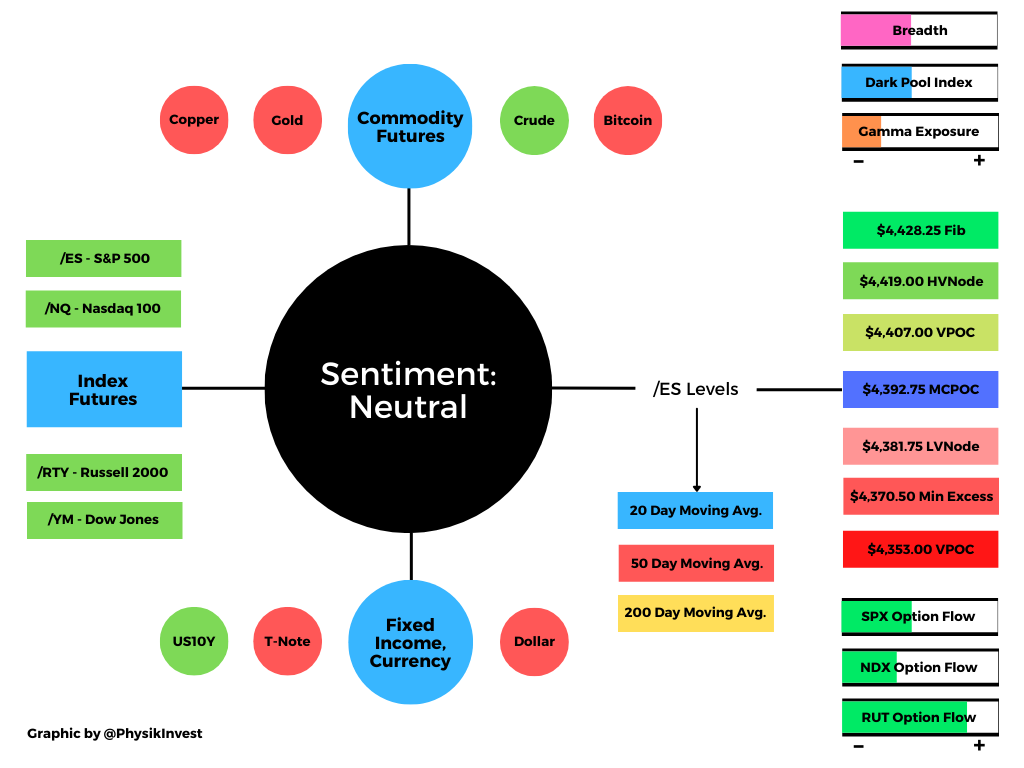
Graphic updated TIME 6:40 ET. Sentiment Neutral if expected /ES open is inside of the prior day’s range. See here for more on the Dark Pool Index and Gamma. A positive Dark Pool Index reading is bullish. At the same time, the higher (lower) the gamma, the less (more) volatility. SHIFT Search data used for options activity. Note that options flow is sorted by the call premium spent; if green and more (less) positive then more (less) was spent on call options. Breadth reflects a reading of the prior day’s Advance/Decline indicator.

What To Expect: As of 6:40 AM ET, Tuesday’s regular session (9:30 AM – 4:00 PM EST) in the S&P 500 will likely open on a small gap, inside of balance and prior-range, suggesting a low potential for immediate directional opportunity.

Balance (Two-Timeframe Or Bracket): Rotational trade that denotes current prices offer favorable entry and exit. Balance-areas make it easy to spot a change in the market (i.e., the transition from two-time frame trade, or balance, to one-time frame trade, or trend).

Adding, during the prior day’s regular trade, the worst case outcome occurred, evidenced by trade below the $4,392.75 micro composite point of control (MCPOC), to the $4,381.75. This is significant because the MCPOC (which corresponds with an important anchored volume-weighted average price or VWAP) denotes the fairest price to do business on a bigger timeframe. 

Volume Areas: A structurally sound market will build on past areas of high volume. Should the market trend for long periods of time, it will lack sound structure (identified as a low volume area which denotes directional conviction and ought to offer support on any test). 

If participants were to auction and find acceptance into areas of prior low volume, then future discovery ought to be volatile and quick as participants look to areas of high volume for favorable entry or exit.

POCs: POCs are valuable as they denote areas where two-sided trade was most prevalent. Participants will respond to future tests of value as they offer favorable entry and exit.

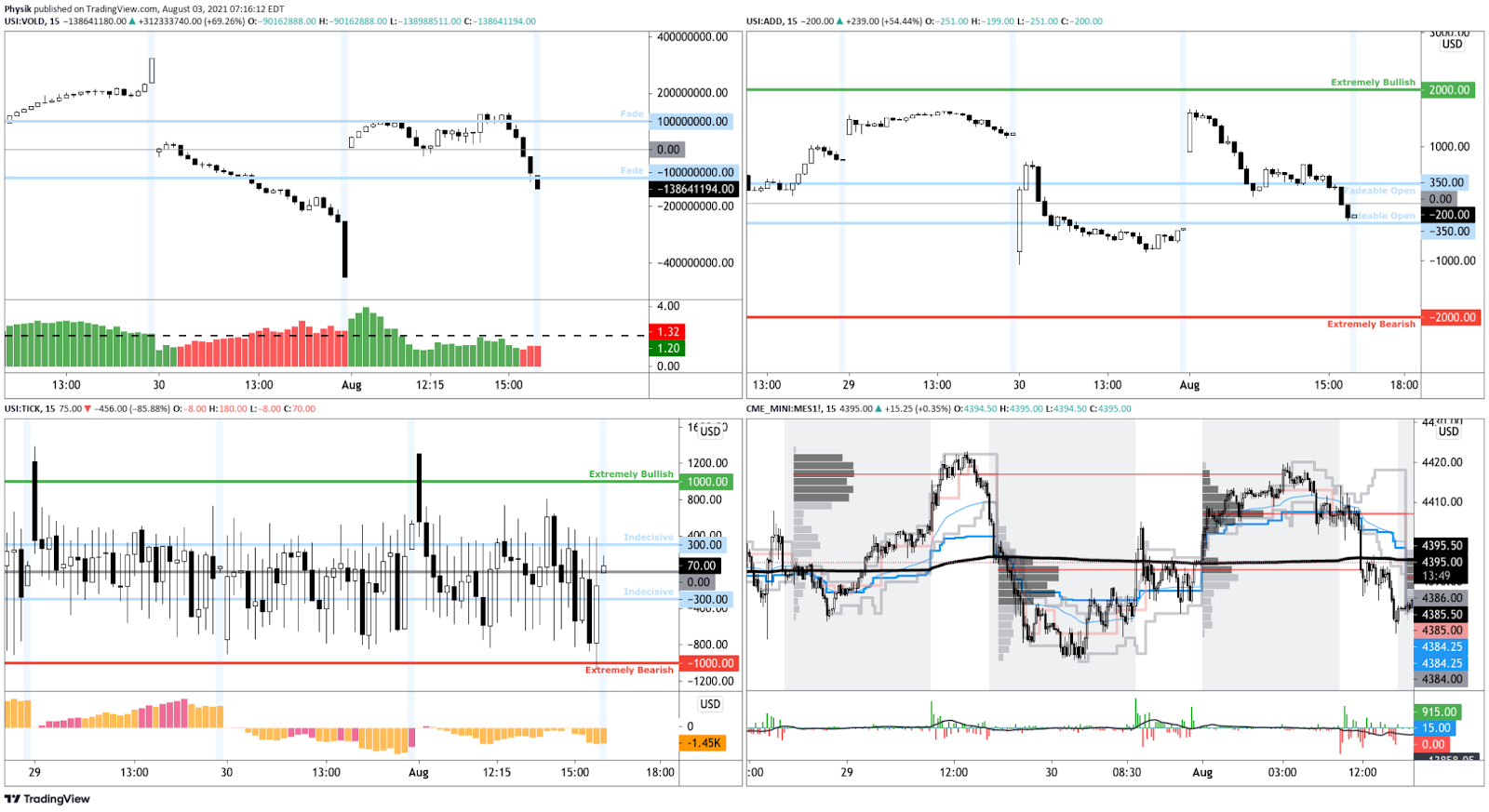
Adding, the move lower, into yesterday’s settlement, was not supported by value or strong metrics with respect to breadth and market liquidity. 

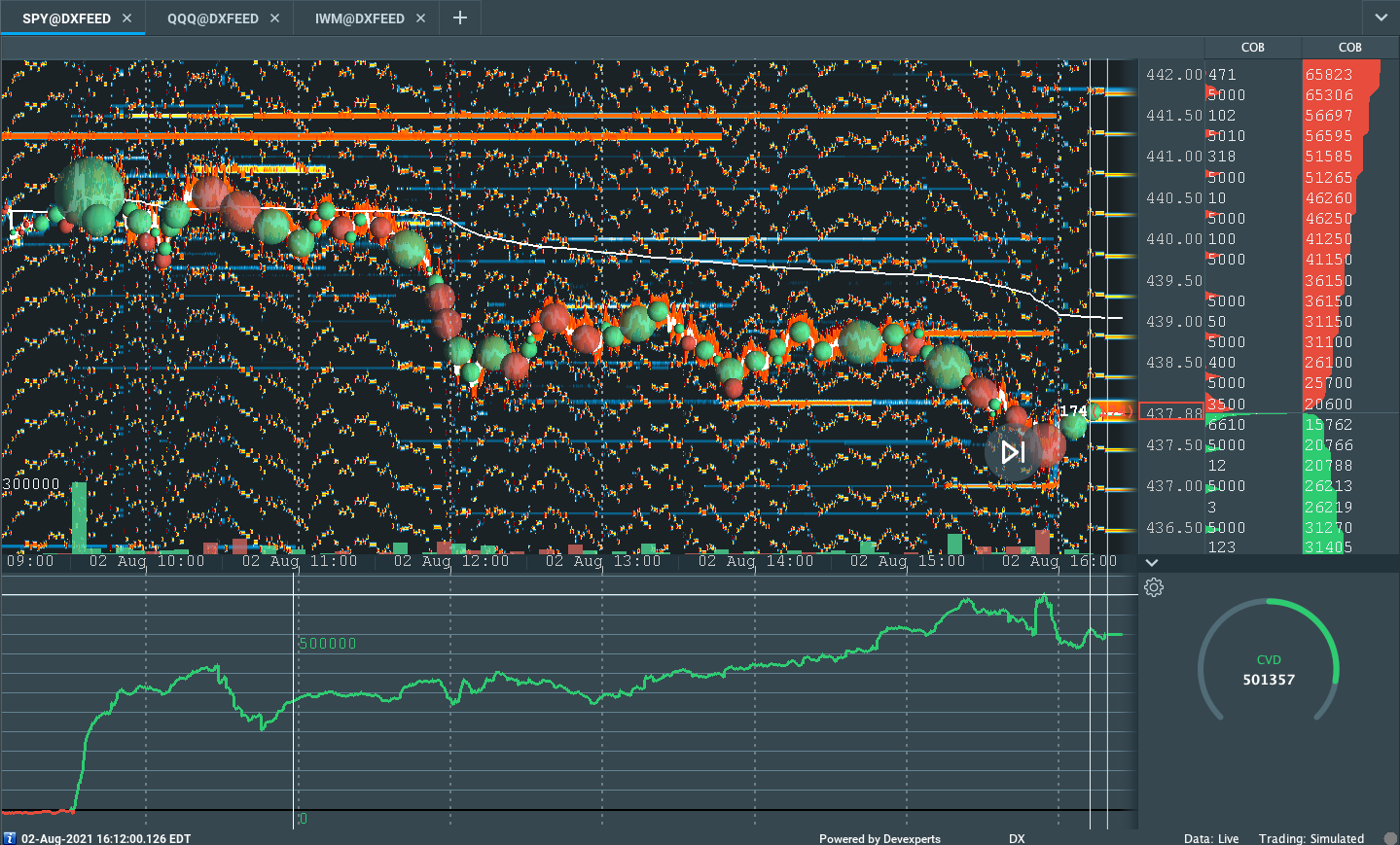
Breadth at the exchange level was neutral with a minuscule inflow into the stocks that were down, versus those that were up. Similarly, the cumulative volume delta – a measure of buying and selling power as calculated by the difference in volume traded at the bid and offer – diverged from price.

Graphic: Market Internals (Advance/Decline, Up-Volume/Down-Volume, Tick) displayed as Peter Reznicek at ShadowTrader teaches
Graphic: Market liquidity and cumulative volume delta (CVD) for the SPDR S&P 500 ETF Trust (NYSE: SPY), one of the largest ETFs that track the S&P 500 index.

To put it differently, the market is in balance, and the modus operandi in such case (as happened Monday) is responsive trade (i.e., fade the edges), rather than initiative trade (i.e., play the break).

Given the context, for today, participants may trade from the following frameworks. 

In the best case, the S&P 500 trades sideways or higher; activity above the $4,392.75 MCPOC puts in play the $4,407.00 POC. Initiative trade beyond the POC could reach as high as the $4,419.00 HVNode and $4,428.25 Fibonacci extension.

In the worst case, the S&P 500 trades lower; activity below the $4,392.75 MCPOC puts in play the $4,381.75 LVNode. Initiative trade beyond the LVNode could reach as low as the $4,370.50 minimal excess low and $4,353.00 POC.

Excess: A proper end to price discovery; the market travels too far while advertising prices. Responsive, other-timeframe (OTF) participants aggressively enter the market, leaving tails or gaps which denote unfair prices.
Graphic: 65-minute profile chart of the Micro E-mini S&P 500 Futures. Graphic updated 6:40 AM ET.

News And Analysis

‘China model’ eyeing prosperity without democracy.

Axios: Markets could be fine with the Fed tapering.

The new SEC boss looks to more crypto oversight.

Biden Fed pick pits Powell against regulatory push.

What People Are Saying

About

After years of self-education, strategy development, and trial-and-error, Renato Leonard Capelj began trading full-time and founded Physik Invest to detail his methods, research, and performance in the markets. Additionally, Capelj is a finance and technology reporter. Some of his biggest works include interviews with leaders such as John Chambers, founder and CEO, JC2 Ventures, Kevin O’Leary, businessman and Shark Tank host, Catherine Wood, CEO and CIO, ARK Invest, among others.

Disclaimer

At this time, Physik Invest does not manage outside capital and is not licensed. In no way should the materials herein be construed as advice. Derivatives carry a substantial risk of loss. All content is for informational purposes only.

Categories
Commentary

Daily Brief For August 2, 2021

Editor’s Note: On Thursday (8/5) and Friday (8/6) there will be no Daily Brief newsletter. Additionally, there will be no Weekly Brief Sunday (8/8), either. All commentaries to resume August 9, 2021.

Market Commentary

Equity index futures higher overnight.

  • Infrastructure bill gains in the Senate.
  • Ahead: PMI, ISM, construction spend.
  • Favoring sideways, responsive trade.

What Happened: U.S. stock index futures auctioned higher after a busy week of earnings and positive developments with respect to an infrastructure package.

Ahead is data on Markit manufacturing PMI, ISM manufacturing, and construction spending.

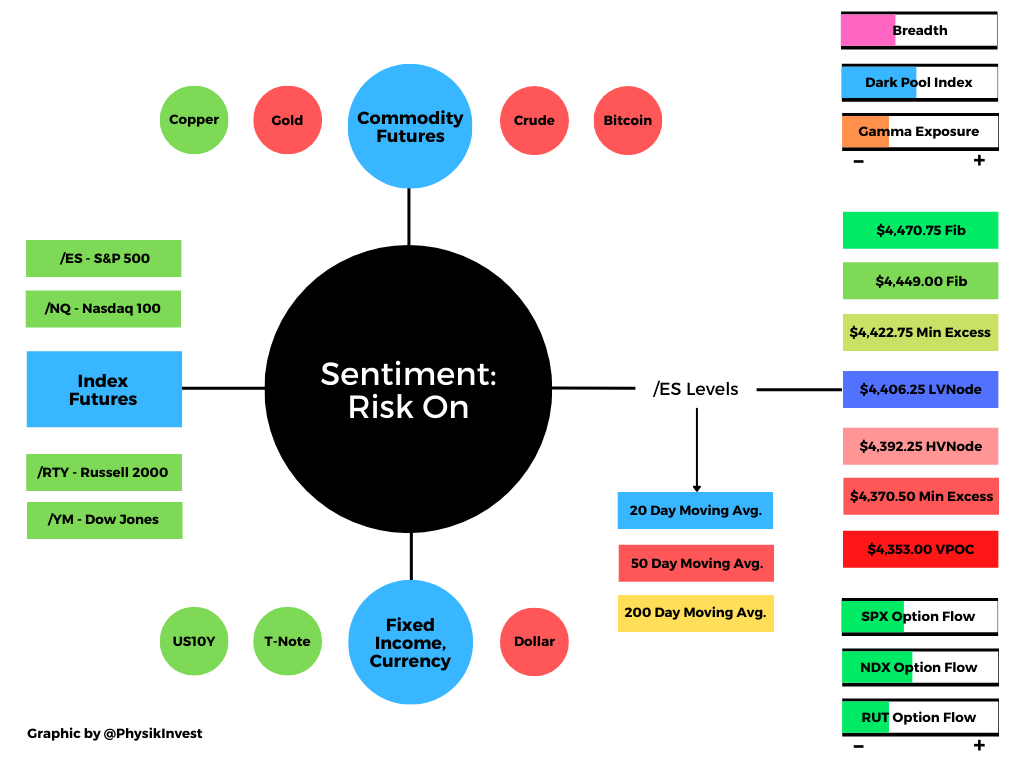
Graphic updated 6:40 AM ET. Sentiment Risk-On if expected /ES open is above the prior day’s range. See here for more on the Dark Pool Index and Gamma. A positive Dark Pool Index reading is bullish. At the same time, the higher (lower) the gamma, the less (more) volatility. SHIFT Search data used for options activity. Note that options flow is sorted by the call premium spent; if green and more (less) positive then more (less) was spent on call options. Breadth reflects a reading of the prior day’s Advance/Decline indicator.

What To Expect: As of 6:40 AM ET, Monday’s regular session (9:30 AM – 4:00 PM EST) in the S&P 500 will likely open on a small gap, outside of prior-range and -value, suggesting a potential for directional opportunity.

Gap Scenarios: Gaps ought to fill quickly. Should they not, that’s a signal of strength; do not fade. Leaving value behind on a gap-fill or failing to fill a gap (i.e., remaining outside of the prior session’s range) is a go-with indicator.

Auctioning and spending at least 1-hour of trade back in the prior range suggests a lack of conviction; in such a case, do not follow the direction of the most recent initiative activity.

Take the word potential lightly. Despite the gap higher, the S&P 500 is trading within a larger area of balance, the result of participants finding higher prices valuable as they position themselves for a directional move, given increased clarity on earnings, taper, and more. 

Balance (Two-Timeframe Or Bracket): Rotational trade that denotes current prices offer favorable entry and exit. Balance-areas make it easy to spot a change in the market (i.e., the transition from two-time frame trade, or balance, to one-time frame trade, or trend).

The modus operandi, in light of the above, is responsive trade (i.e., fade the edges), rather than initiative trade (i.e., play the break).

As a side note, this balancing activity comes as the market enters into the worst two-month period of the year. At the same time, the CBOE Volatility Index (INDEX: VIX), a measure of the market’s volatility expectation based on S&P 500 options, and high-yield spreads (which can signal a worsening in economic conditions) have become stickier at higher levels.

At a more micro level, in support of responsive trade are metrics with respect to breadth, market liquidity, and the options market. For instance, as stocks went sideways, Friday, breadth, at the exchange level, was negative with a steady, albeit soft inflow into the stocks that were down, versus those that were up.

Moreover, given the context, for today, participants can trade from the following frameworks. 

In the best case, the S&P 500 trades sideways or higher; activity above the $4,406.25 low volume area (LVNode) puts in play the $4,422.75 minimal excess high. Initiative trade beyond the minimal excess high could reach as high as the $4,428.25, $4,449.00, and $4,470.75 Fibonacci price extensions.

In the worst case, the S&P 500 trades lower; activity below the $4,406.25 LVNode puts in play the $4,392.25 high volume area (HVNode). Initiative trade beyond the HVNode could reach as low as the $4,370.50 minimal excess low and $4,353.00 untested point of control (VPOC).

Volume Areas: A structurally sound market will build on past areas of high volume. Should the market trend for long periods of time, it will lack sound structure (identified as a low volume area which denotes directional conviction and ought to offer support on any test). 

If participants were to auction and find acceptance into areas of prior low volume, then future discovery ought to be volatile and quick as participants look to areas of high volume for favorable entry or exit.

Excess: A proper end to price discovery; the market travels too far while advertising prices. Responsive, other-timeframe (OTF) participants aggressively enter the market, leaving tails or gaps which denote unfair prices.

POCs: POCs are valuable as they denote areas where two-sided trade was most prevalent. Participants will respond to future tests of value as they offer favorable entry and exit.
Graphic: 65-minute profile chart of the Micro E-mini S&P 500 Futures. Graphic updated 6:30 AM ET.

News And Analysis

World’s biggest pension fund slashes U.S. bond weighting. 

Real GDP expands above pre-pandemic levels, BEA said.

Goldman Sachs’ flow desk – earnings beats not rewarded.

Senate plans to deliver infrastructure win for Biden agenda.

The broadest China outbreak since Wuhan; COVID update.

‘Buy Now, Pay Later,’ plans are having their moment again.

Nordea: Bullard is likely a muppet, but he is probably right.

What People Are Saying

About

After years of self-education, strategy development, and trial-and-error, Renato Leonard Capelj began trading full-time and founded Physik Invest to detail his methods, research, and performance in the markets. 

Additionally, Capelj is a finance and technology reporter. Some of his biggest works include interviews with leaders such as John Chambers, founder and CEO, JC2 Ventures, Kevin O’Leary, businessman and Shark Tank host, Catherine Wood, CEO and CIO, ARK Invest, among others.

Disclaimer

At this time, Physik Invest does not manage outside capital and is not licensed. In no way should the materials herein be construed as advice. Derivatives carry a substantial risk of loss. All content is for informational purposes only.
Categories
Commentary

Daily Brief For July 22, 2021

Market Commentary

Equity index futures trade higher as volatility implodes. Yields, commodities are higher, too. 

  • President Biden played down inflation.
  • Ahead: Claims, home sales, earnings.
  • Equity indices up on fantastic breadth.

What Happened: U.S. stock index futures auctioned higher alongside comments against inflation by President Joe Biden, yesterday. Virus fears ebbed as infections accelerated. 

Bitcoin extended its advance after Elon Musk, Catherine Wood, and Jack Dorsey talked cryptocurrency at a virtual event.

Ahead is data on weekly jobless claims, existing home sales, and corporate earnings. 

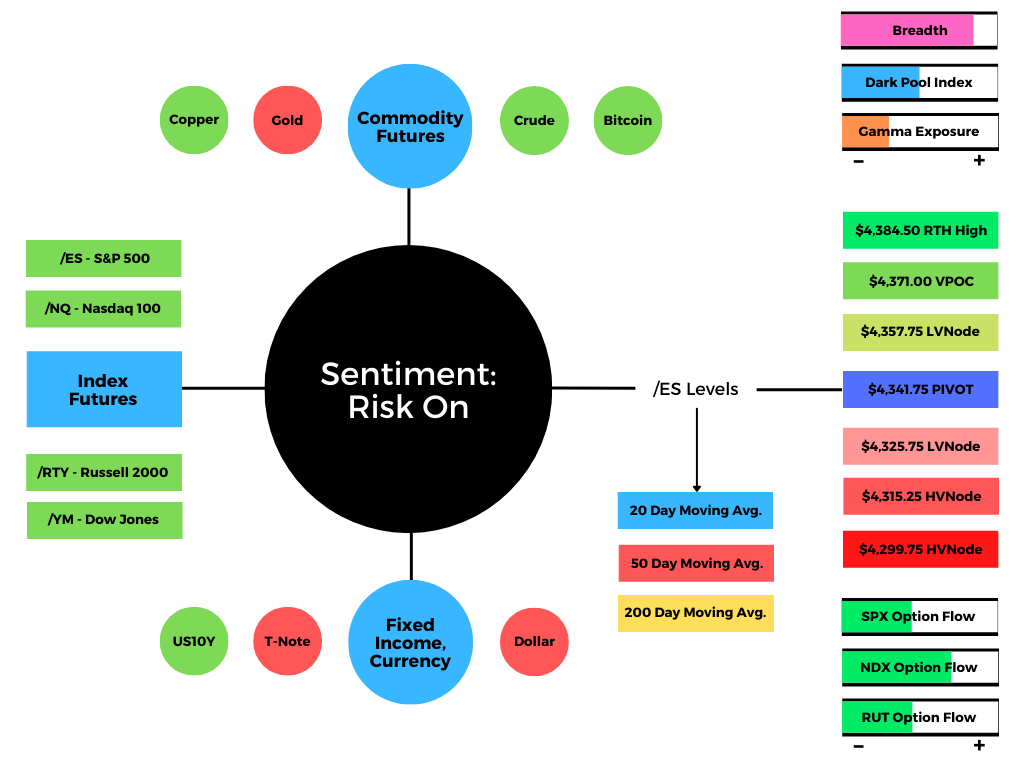
Graphic updated 6:30 AM ET. Sentiment Risk-On if expected /ES open is above the prior day’s range. See here for more on the Dark Pool Index and Gamma. A positive Dark Pool Index reading is bullish. At the same time, the higher (lower) the gamma, the less (more) volatility. SHIFT Search data used for options activity. Note that options flow is sorted by the call premium spent; if green and more (less) positive then more (less) was spent on call options. Breadth reflects a reading of the prior day’s Advance/Decline indicator.

What To Expect: As of 6:30 AM ET, Thursday’s regular session (9:30 AM – 4:00 PM EST) in the S&P 500 will likely open on a small gap, just outside of prior-range and -value, suggesting a potential for immediate directional opportunity.

Balance-Break and/or Gap Scenarios: Monitor for acceptance (i.e., more than 1-hour of trade) outside of the balance area.

Gaps ought to fill quickly. Should they not, that’s a signal of strength; do not fade. Leaving value behind on a gap-fill or failing to fill a gap (i.e., remaining outside of the prior session’s range) is a go-with indicator.

Auctioning and spending at least 1-hour of trade back in the prior range suggests a lack of conviction; in such a case, do not follow the direction of the most recent initiative activity.

Adding, during the prior day’s regular trade, the best case outcome occurred, evidenced by trade above the $4,334.25 spike base. As that happened, participants found increased acceptance at higher prices, moving the micro-composite Point of Control (MCPOC) up to $4,341.75, a pivot point (i.e., above = bullish, below = bearish) for today’s trade. This is noteworthy since it suggests the fairest price to do business, on a larger timeframe, is higher. 

At the same time, in support of the price rise was fantastic breadth and dynamics with respect to the derivatives market; amidst a crash in volatility, associated hedging activities bolster the rally. 

Coming into the balance-area sellers initiated from the weak prior, however, certain mechanics may quell the upside volatility, potentially leading to a stall or slower advance. 

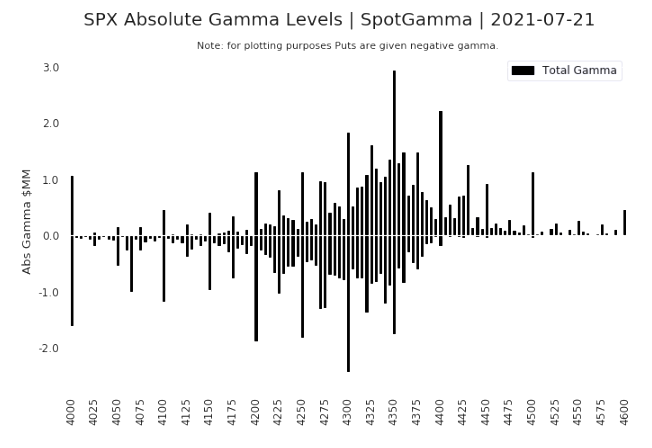
Graphic: SpotGamma data suggests the S&P 500 is back in so-called “long-gamma” territory. Gamma is the sensitivity of an option to changes in the underlying price. Dealers that take the other side of options trades hedge their exposure to risk by buying and selling the underlying. When dealers are short-gamma, they hedge by buying into strength and selling into weakness. When dealers are long-gamma, they hedge by selling into strength and buying into weakness. The former exacerbates volatility. The latter calms volatility.

Moreover, for today, participants can trade from the following frameworks. 

In the best case, the S&P 500 trades sideways or higher; activity above the $4,341.75 MCPOC puts participants just short of entry into a prior balance area, near the $4,357.75 low volume area (LVNode). Initiative trade beyond the $4,357.75 LVNode could reach as high as the $4,371.00 POC and $4,384.50 minimal excess regular trade high (RTH), the typical scenario on re-entry into balance. 

In the worst case, the S&P 500 trades lower; activity below the $4,341.75 MCPOC puts in play the $4,325.75 LVNode. Initiative trade beyond the $4,325.75 LVNode could reach as low as the $4,315.25 and $4,299.75 high volume areas (HVNodes). 

It is important to note also that the prior two HVNodes correspond with key Volume Weighted Average Price (VWAP) levels, a metric highly regarded by chief investment officers, among other participants, for quality of trade. Additionally, liquidity algorithms are benchmarked and programmed to buy and sell around VWAPs.

Balance (Two-Timeframe Or Bracket): Rotational trade that denotes current prices offer favorable entry and exit. Balance-areas make it easy to spot a change in the market (i.e., the transition from two-time frame trade, or balance, to one-time frame trade, or trend).

POCs: POCs are valuable as they denote areas where two-sided trade was most prevalent. Participants will respond to future tests of value as they offer favorable entry and exit.

Volume Areas: A structurally sound market will build on past areas of high volume. Should the market trend for long periods of time, it will lack sound structure (identified as a low volume area which denotes directional conviction and ought to offer support on any test). 

If participants were to auction and find acceptance into areas of prior low volume, then future discovery ought to be volatile and quick as participants look to areas of high volume for favorable entry or exit.

Excess: A proper end to price discovery; the market travels too far while advertising prices. Responsive, other-timeframe (OTF) participants aggressively enter the market, leaving tails or gaps which denote unfair prices.
Graphic: 65-minute profile chart of the Micro E-mini S&P 500 Futures. Updated 6:30 AM ET.

News And Analysis

Strong job and real estate markets support credit. (Moody’s)

Federal Reserve ramps up debate on taper timing. (WSJ)

China offers oil reserves in a move to cool oil rally. (BBG)

Biden dismisses inflation worries, warns on hiring. (BBG)

U.S.-China goods trade booms amid virus, tariffs. (BBG)

Powell has broad support among top Biden aides. (BBG)

PG&E plans to bury power lines in fire-risk areas. (WSJ)

EMEA economies recovering faster than thought. (S&P)

Structured finance sees issuances rising to $1.4T. (S&P)

What People Are Saying

About

After years of self-education, strategy development, and trial-and-error, Renato Leonard Capelj began trading full-time and founded Physik Invest to detail his methods, research, and performance in the markets. Additionally, Capelj is a finance and technology reporter. Some of his biggest works include interviews with leaders such as John Chambers, founder and CEO, JC2 Ventures, Kevin O’Leary, businessman and Shark Tank host, Catherine Wood, CEO and CIO, ARK Invest, among others.

Disclaimer

At this time, Physik Invest does not manage outside capital and is not licensed. In no way should the materials herein be construed as advice. Derivatives carry a substantial risk of loss. All content is for informational purposes only.

Categories
Commentary

Daily Brief For July 7, 2021

Market Commentary

Equity index futures rotate after participants initiated the bracketing process.

  • Bad news for China tech & vaccine hesitancy.
  • Ahead: Fed minutes, Mortgage Apps, JOLTS.
  • Equity index futures see volatility before open.

What Happened: U.S. stock index futures auctioned higher ahead of June’s Federal Reserve meeting minutes release at 2:00 PM ET.

The release should provide participants clarity over the Fed’s intent to taper asset purchases and the expected path for inflation.

In other areas, so-called vaccine hesitancy is a concern as President Joe Biden’s target to get up to 70% of Americans vaccinated, by July 4, was missed. 

Also, participants get data on U.S. mortgage applications, JOLTS, and the EIA energy outlook, as well as Fed-speak by President Raphael Bostic.

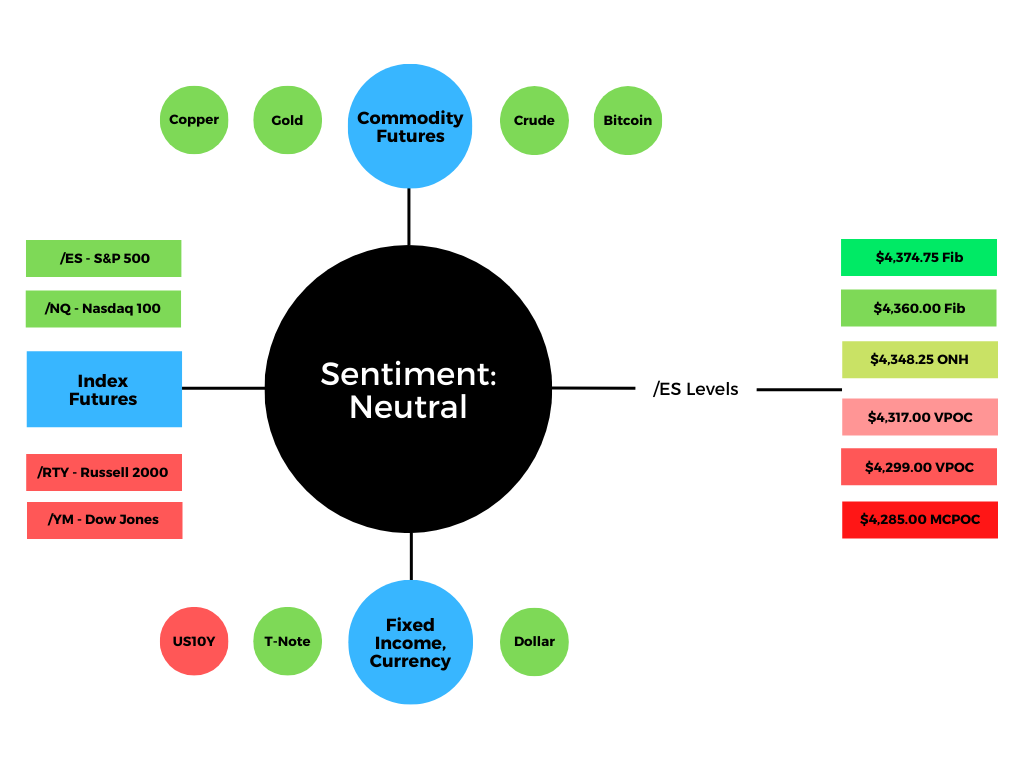
Graphic updated 9:09 AM ET.

What To Expect: Wednesday’s regular session (9:30 AM – 4:00 PM EST) in the S&P 500 will likely open outside of prior value but inside of range. Such dynamic increases the potential for directional opportunity.

Adding, during the prior day’s regular trade, the best case outcome occurred, evidenced by a liquidation break that found responsive buyers at a key anchored Volume Weighted Average Price (VWAP). Thereafter, on lighter volume, the S&P 500 established value (i.e., evidenced by more than 30-minutes of trade) above the VWAP anchored from the $4,348.25 overnight high (ONH). This suggests the average buyer, since the peak, is in a winning position.

Liquidation Breaks: The profile shape suggests participants were “too” long and had poor location. Such dynamic offers responsive buyers (initiative sellers) favorable entry (exit).

More On Volume-Weighted Average Prices (VWAPs): A metric highly regarded by chief investment officers, among other participants, for quality of trade. Additionally, liquidity algorithms are benchmarked and programmed to buy and sell around VWAPs.

Overnight Rally Highs (Lows): Typically, there is a low historical probability associated with overnight rally-highs (lows) ending the upside (downside) discovery process.

Adding, Tuesday’s liquidation break marked the start of balance as participants look to establish value at higher prices. This, in conjunction with a severe breakdown in yields, was a boon for the tech-heavy Nasdaq 100 which, unlike the S&P 500, closed higher.

Balance (Two-Timeframe Or Bracket): Rotational trade that denotes current prices offer favorable entry and exit. Balance-areas make it easy to spot a change in the market (i.e., the transition from two-time frame trade, or balance, to one-time frame trade, or trend).

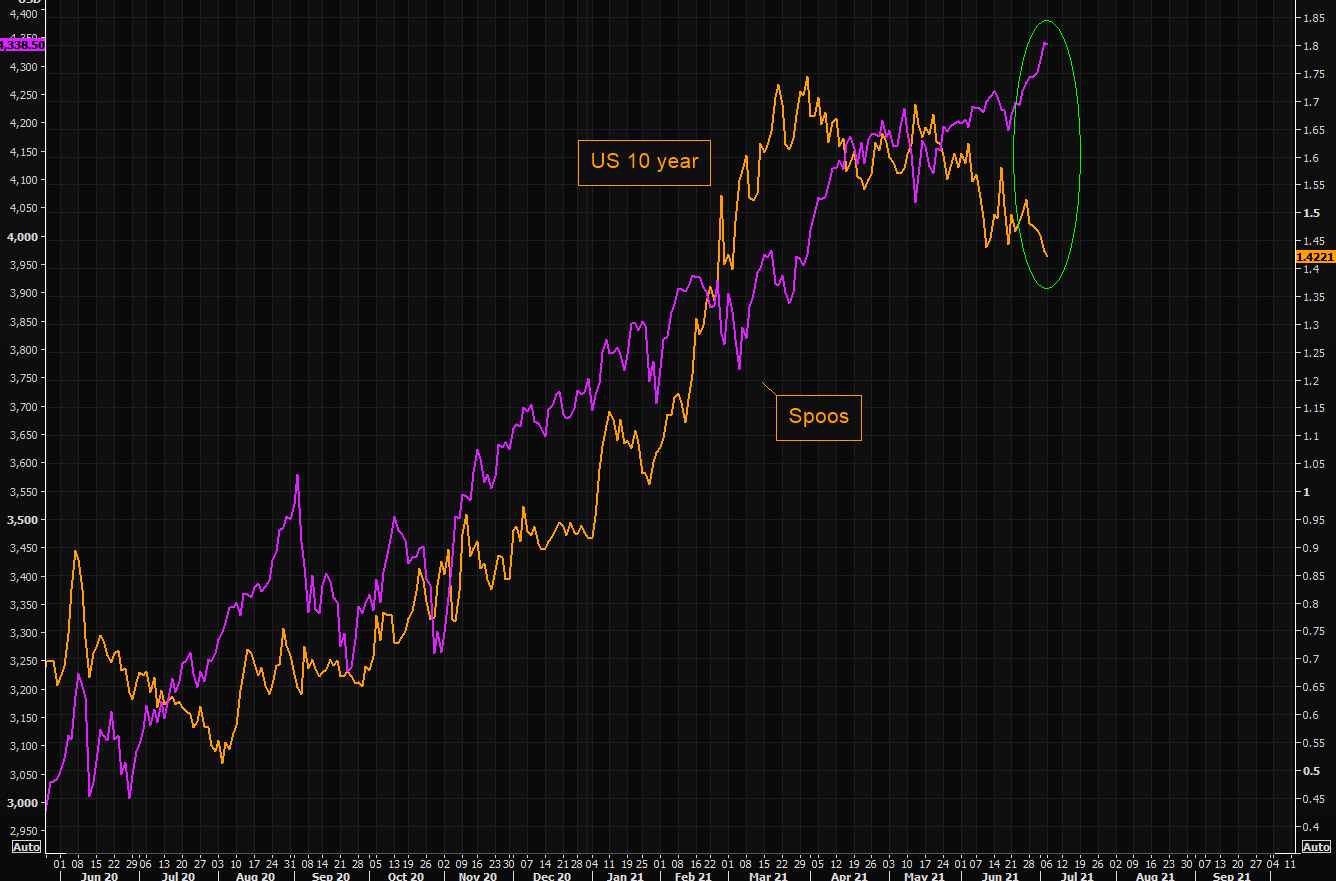
Low rates have to potential to increase the present value of future earnings making stocks, especially those that are high growth, more attractive. To note, inflation and rates move inversely to each other. Low rates stimulate demand for loans (i.e., borrowing money is more attractive). In conjunction with the rapid recovery, lower rates may solicit hawkish commentary as policymakers look to inhibit inflation.

Graphic: Rates (yellow color) on the 10 Year T-Note move lower, via The Market Ear. 

Important to note, also, as stated in the weekly commentary, the CBOE Volatility Index (INDEX: VIX), a measure of the stock market’s expectation of volatility, recently traded to its lowest level since February 2020. This dynamic has the potential to solicit the involvement of certain systematic strategies which can not only add fuel to the price rise but, potentially, exacerbate any future liquidation. 

Putting it all together, for today, participants can trade from the following frameworks. 

In the best case, the S&P 500 trades sideways or higher; activity above the yellow AVWAP (near $4,325.00) puts in play the $4,348.25 ONH. Thereafter, if higher, participants can look for responses at the $4,360.00 and $4,374.75 Fibonacci-derived price extensions. 

In the worst case, the S&P 500 trades lower; activity below the yellow AVWAP (near $4,325.00) puts in play the $4,317.00 untested Point of Control (POC). Initiative trade beyond the POC could reach as low as the $4,299.00 POC and $4,285.00 micro-composite high volume area (HVNode). 

POCs: POCs are valuable as they denote areas where two-sided trade was most prevalent. Participants will respond to future tests of value as they offer favorable entry and exit.

Volume Areas: A structurally sound market will build on past areas of high volume. Should the market trend for long periods of time, it will lack sound structure (identified as a low volume area which denotes directional conviction and ought to offer support on any test). 

If participants were to auction and find acceptance into areas of prior low volume, then future discovery ought to be volatile and quick as participants look to areas of high volume for favorable entry or exit.
Graphic: 65-minute profile chart of the Micro E-mini S&P 500 Futures.
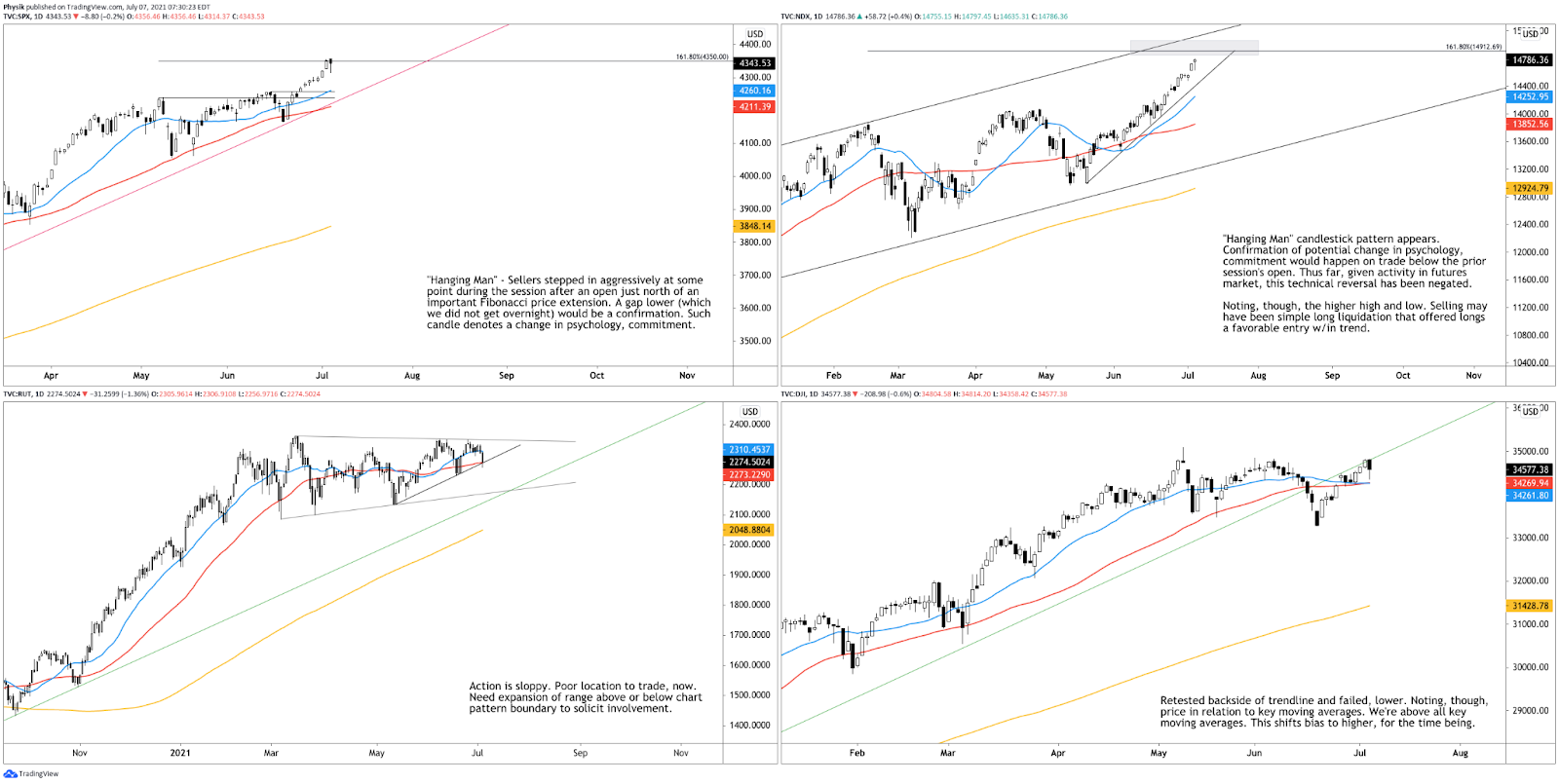
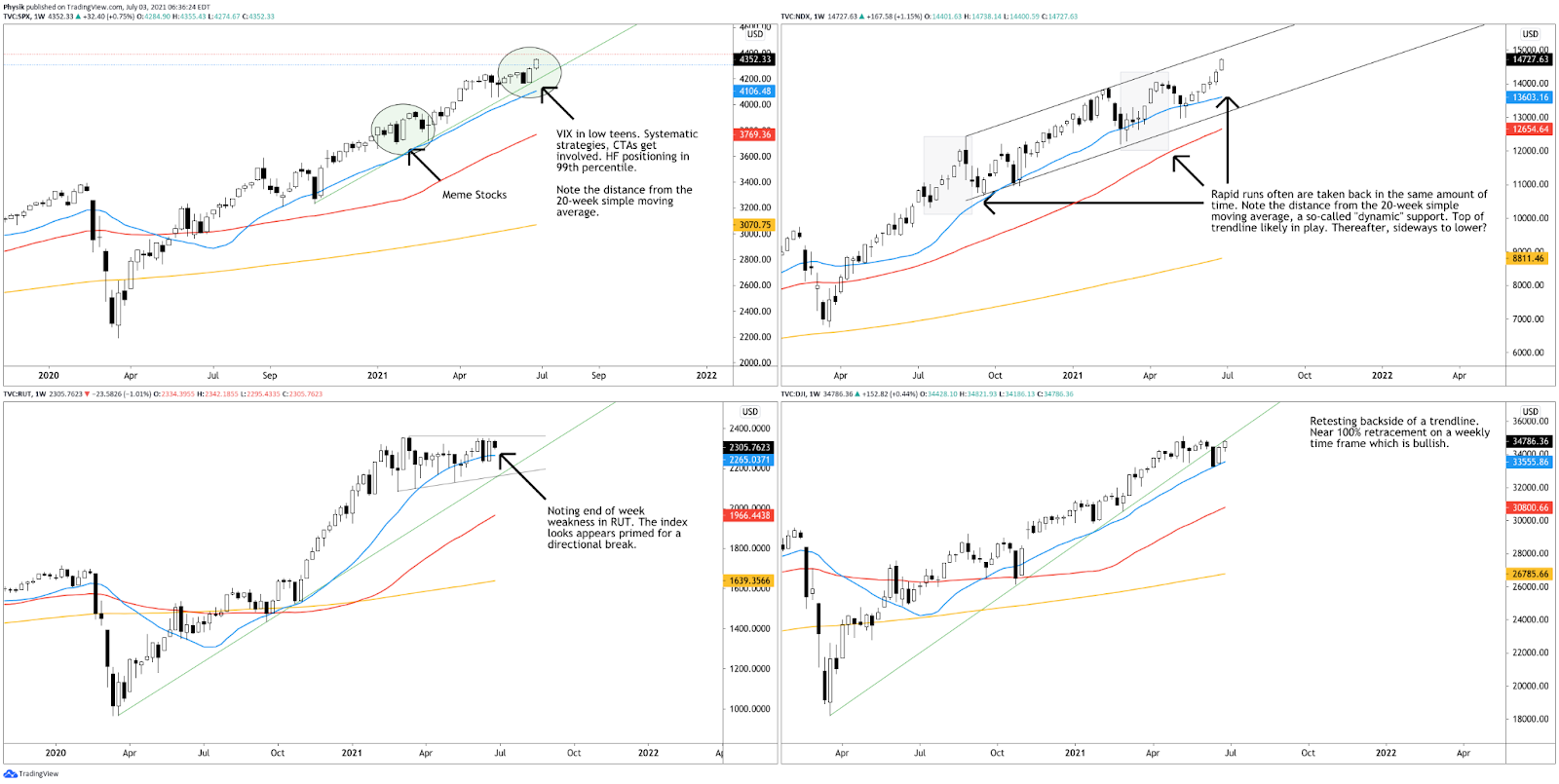
Graphic: Daily candlestick charts of the S&P 500 (top left), Nasdaq 100 (top right), Russell 2000 (bottom left), and Dow Jones Industrial Average (bottom right).
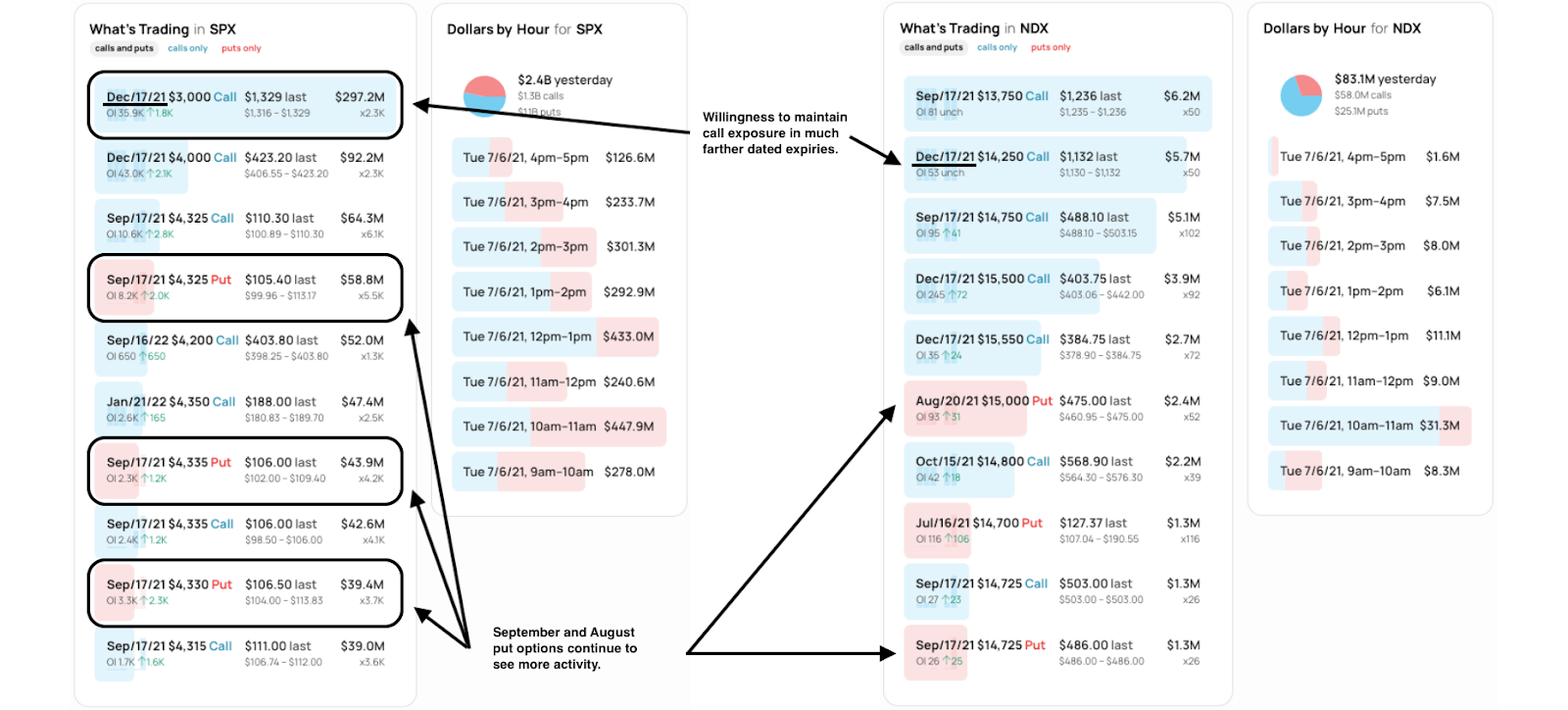
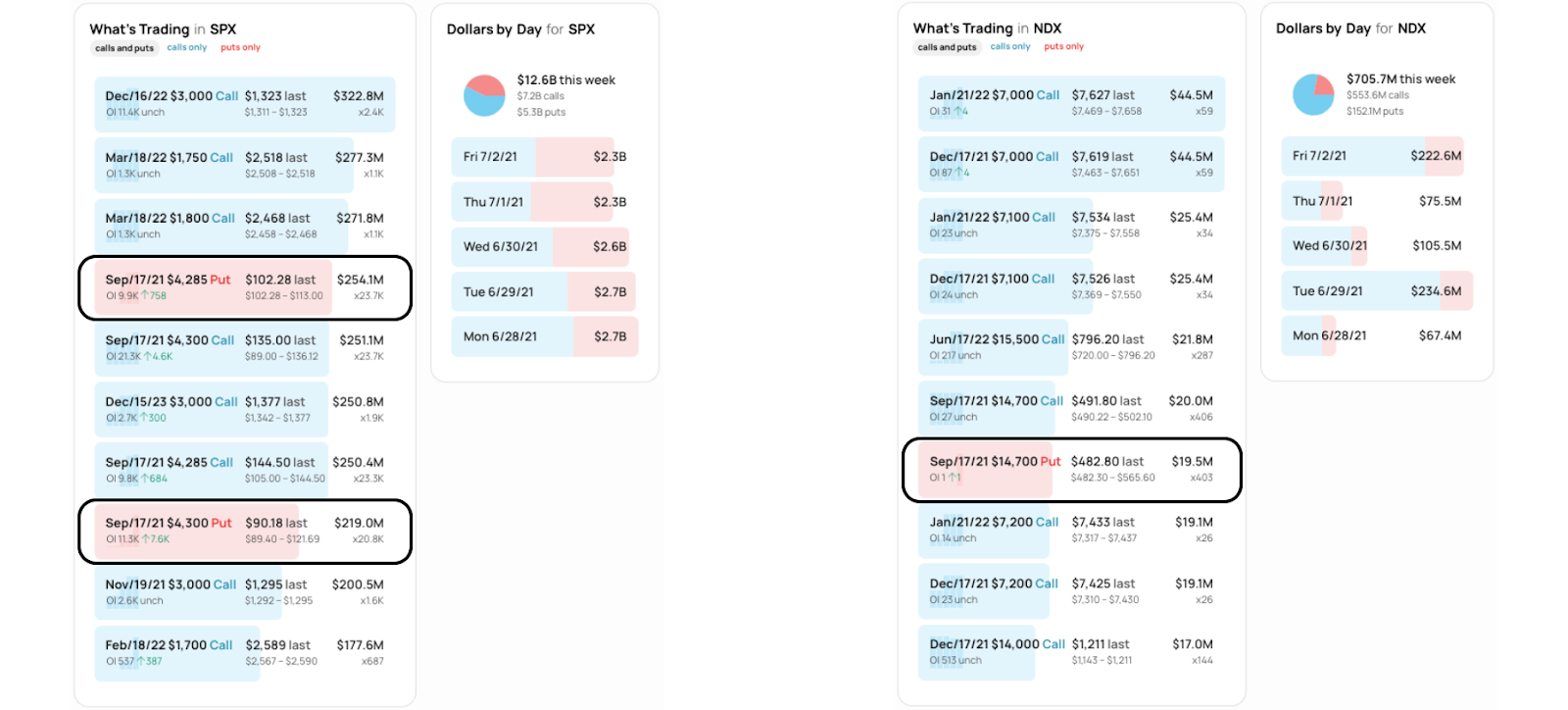
Graphic: SHIFT search suggests participants were committing the most capital to call strikes at and below current prices in the cash-settled S&P 500 Index (INDEX: SPX) and Nasdaq 100 (INDEX: NDX), yesterday. This dynamic suggests participants, despite their commitment to higher prices, are hedging against near-term risks, like the Jackson Hole Economic Symposium.

News And Analysis

Economy | America is hitting its vaccination ceiling. (Axios)

Economy | Mortgage applications sinking to lowest. (CNBC)

Markets | Nomura’s prime brokerage is pulling back. (BBG)

Economy | EU forecasts higher growth in eurozone. (REU)

Trade | Cargo glut at key shipping port has loosened. (Axios)

What People Are Saying

About

Renato founded Physik Invest after going through years of self-education, strategy development, and trial-and-error. His work reporting in the finance and technology space, interviewing leaders such as John Chambers, founder, and CEO, JC2 Ventures, Kevin O’Leary, businessman and Shark Tank host, Catherine Wood, CEO and CIO, ARK Invest, among others, afforded him the perspective and know-how very few come by.

Having worked in engineering and majored in economics, Renato is very detailed and analytical. His approach to the markets isn’t built on hope or guessing. Instead, he leverages the unique dynamics of time and volatility to efficiently act on opportunity.

Disclaimer

At this time, Physik Invest does not manage outside capital and is not licensed. In no way should the materials herein be construed as advice. Derivatives carry a substantial risk of loss. All content is for informational purposes only.

Categories
Commentary

Weekly Brief For July 3, 2021

Market Commentary

Key Takeaways: U.S. equity index futures diverge in their attempt to discover fair prices for two-sided trade.

  • Economy is set for sustained boom.
  • Ahead is a light economic calendar.
  • SPX, NDX, DJI higher. RUT coiling.

Summary: Last week, U.S. stock index futures auctioned sideways to higher into Friday’s employment report. The release showed an addition of 850,000 jobs in June, the strongest employment gain since last summer. 

The S&P 500 and Nasdaq 100 led the week-long rally, while the Dow Jones Industrial Average followed closely behind. Though the Russell 2000 did end lower, it has been building energy for a break.

Considerations: It was the beginning of April JPMorgan Chase & Co’s (NYSE: JPM) Jamie Dimon wrote strong consumer savings, an increased pace in COVID-19 coronavirus vaccinations, and unprecedented efforts to spur economic activity could mean that a boom lasts as long as 2023.

Dimon’s comments remain valid. Months after, officials are hard at work in helping the U.S. reach herd immunity with vaccines that produce antibodies for the most well-known variants of COVID-19. Additionally, the economy is making progress toward meeting the Federal Reserve’s objectives for employment and inflation; just a couple of weeks ago the institution brought forward the time frame on when it will raise interest rates. 

In a statement, BlackRock strategists noted: “We believe the Fed’s new outlook will not translate into significantly higher policy rates any time soon. This, combined with the powerful restart, underpins our pro-risk stance.”

Alongside that news, the equity market sold violently, into Quadruple Witching, or the large expiry of futures and options. Thereafter, indexes staged a massive reversal, and the CBOE Volatility Index (INDEX: VIX), a measure of the stock market’s expectation of volatility, traded to its lowest level since February 2020.

According to SpotGamma models, up to 50% of the gamma in and across the S&P 500 complex was taken off the table that expiry.

This, as SpotGamma has said in the past, “creates volatility because, as large options positions expire[], are closed and/or rolled, dealers have large hedges they need to adjust.”

Put more simply, the initial action, into the expiry, may have been attributable to the sale of long stock that hedged expiring short exposure above the market (i.e., call side).

After that exposure was cleared, the prospects for a rally improved, boosted by the buying back of short put hedges as volatility imploded.

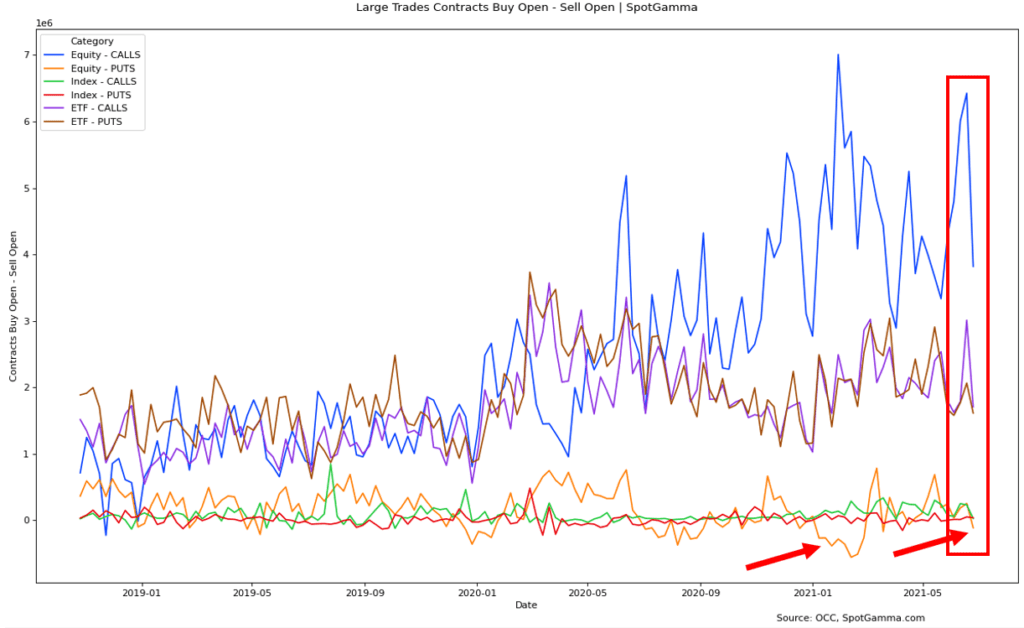
Last week, though, things became a tad frothy with the number of put options sold-to-open seeing heightened levels.

Graphic: SpotGamma’s analysis suggests equity put options were sold-to-open (red arrow). 

Put sales, which can be part of sophisticated volatility-based trading strategies, often suggest increased confidence as market participants look to options for income, and not insurance.

Historically, the returns after such developments are mixed; more often the appearance of strong initiative buying surfaces (e.g., August and January 2020) before a liquidation helps correct excess inventory, and bring sense back into the market. 

Kris Sidial – co-chief investment officer at The Ambrus Group, a volatility arbitrage fund – and I recently held a conversation regarding meme stock volatility, market structure, and regulation. He noted that ongoing risk-on dynamics can be traced back to factors like Federal Reserve stabilization efforts, and low rates, which incentivize risk-taking.

“The growth of structured products, passive investing, the regulatory standpoint that’s been implemented with Dodd-Frank and dealers needing to hedge off their risk more frequently, than not,” are all part of a regime change that’s affected the stability of markets, Sidial notes. “These dislocations happen quite frequently in small windows, and it offers the potential for large outlier events,” like the equity bust and boom during 2020. “Strength and fragility are two completely different components. The market could be strong, but fragile.”

That dynamic is playing out as Cem Karsan, founder at Kai Volatility, notes volatility is dramatically oversupplied. As a result, as implied volatility drops, options gamma – an option delta’s sensitivity to market price changes – rises. Associated hedging forces make it so there’s more liquidity and less movement. In other words, the market tends to pin.

Still, in line with Sidial’s comments, Karsan believes expected distributions are fat-tailed, given “fragility.” In other words, it’s hard for the market to unpin. Should it unpin, however, there’s “not enough liquidity” to absorb leverage on the tails.

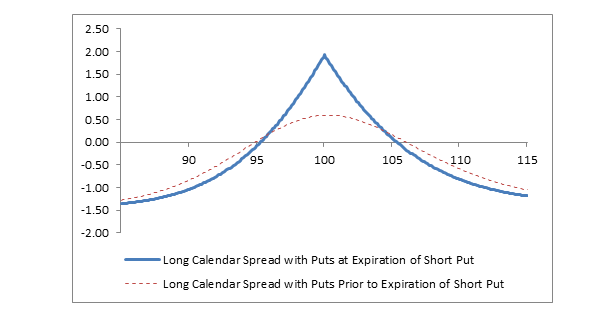
Given this, Karsan finds it interesting to sell at-the-money option structures to fund out-of-the-money structures. Alternatively, knowing what forces – e.g., charm or the rate at which the delta of an option changes with respect to time – decay poses on so-called “dealer positioning,” going into the July option expirations (OPEX), one could look into long calendar put spreads on the S&P 500.

In such a case, traders are short puts in July and long puts on forward. This way, you’re collecting decay as a result of realized pinning. Here’s Karsan’s full take, from the source.

Graphic: The risk profile of a long put calendar spread, via Fidelity.

After mid-July, though, the window for fundamental dynamics (e.g., a shift in preferences from saving and investing to spending, monetary tightening, seasonality, or a COVID-19 resurgence) to take over is opened. 

In a note on COVID resurgence, to not venture too far off into the abyss, I cite strategists led by JPMorgan Chase & Co’s (NYSE: JPM) Marko Kolanovic who last year correctly suggested equities would continue rallying on the basis of low rates, improved fundamentals, buybacks, as well as systematic and hedge fund strategies. 

“The delta variant should not have significant repercussions for the pandemic situation in developed markets (e.g. Europe and North America, which have [made] strong progress in vaccinations) due to the level of population immunity.”

What To Expect: In the coming sessions, participants will want to focus their attention on where the S&P 500 trades in relation to Friday’s $4,323.00 untested Point of Control (POC).

POCs: POCs are valuable as they denote areas where two-sided trade was most prevalent. Participants will respond to future tests of value as they offer favorable entry and exit.

That said, participants can trade from the following frameworks.

In the best case, the index trades sideways or higher; activity above the $4,323.00 POC puts in play the $4,347.00 excess high. Initiative trade beyond the excess high could reach as high as the $4,357.50 Fibonacci-derived price target.

Excess: A proper end to price discovery; the market travels too far while advertising prices. Responsive, other-timeframe (OTF) participants aggressively enter the market, leaving tails or gaps which denote unfair prices.

In the worst case, the index trades lower; activity below the $4,323.00 POC puts in play the untested POC at $4,299.00, as well as the POC and micro-composite HVNode at $4,285.00. Thereafter, if lower, participants may look for responses at the $4,263.25 LVNode, $4,247.75 LVNode, as well as the $4239.25 HVNode and $4,229.00 POC.

Volume Areas: A structurally sound market will build on past areas of high volume. Should the market trend for long periods of time, it will lack sound structure (identified as a low volume area which denotes directional conviction and ought to offer support on any test). 

If participants were to auction and find acceptance into areas of prior low volume, then future discovery ought to be volatile and quick as participants look to areas of high volume for favorable entry or exit.

For a full list of important levels, see the 65-minute profile and candlestick chart, below.

Graphic: 65-minute profile chart of the Micro E-mini S&P 500 Futures.
Graphic: Weekly candlestick charts of the S&P 500 (top left), Nasdaq 100 (top right), Russell 2000 (bottom left), and Dow Jones Industrial Average (bottom right).
Graphic: SHIFT search suggests participants were committing the most capital to call strikes at and below current prices in the cash-settled S&P 500 Index (INDEX: SPX) and Nasdaq 100 (INDEX: NDX), last week. This activity denotes (1) stock replacement, (2) hedges for underlying short positions, or (3) speculation on the upside. Also, there was a meaningful bid in September puts on the S&P 500 and Nasdaq 100. This dynamic suggests participants, despite their commitment to higher prices, are hedging against near-term risks, like the Jackson Hole Economic Symposium.

News And Analysis

Markets | The premium Elon Musk adds to Tesla, other ventures. (Kyla)

Markets | Forward-looking indicators point to improving credit trends. (S&P)

Travel | TSA screenings surpassed 2019 levels in a pandemic first. (CNBC)

Energy | WH is worried about high oil prices, sees enough supply. (REU)

Energy | An overview of data from IEA’s Energy prices database. (IEA)

Energy | OPEC ends Friday’s meeting without a deal for agreement. (CNBC)

Agriculture | Dry weather damage spells trouble for U.S. spring crops. (S&P)

Economy | States ending jobless benefits early hit labor milestones. (REU)

Markets | Spotlight turning to mergers, acquisition for fintech SPACs. (S&P)

Economy | Jobs gain largest in 10 months; employers up wages. (REU)

Energy | Cal-ISO, utilities ask consumers to conserve amid heatwave. (S&P)

Economy | Economic growth hiccup to derail credit spread stability. (BBG)

Markets | Record S&P 500 masks fear trade gripping stock market. (BBG)

Innovation And Emerging Trends

FinTech | BTC mining now easier, more profitable after crackdowns. (CNBC)

FinTech | ‘Flight to quality’ as private insurtechs draw big investments. (S&P)

FinTech | Bank customers cement relationships with digital channels. (S&P)

Markets | Money-losing companies sell record stock, flashing signal. (CNBC)

Markets | Wall Street rebels warning of ‘disastrous’ $11T index boom. (BBG)

Mobility | When do electric vehicles become cleaner than gas cars? (REU)

About

Renato founded Physik Invest after going through years of self-education, strategy development, and trial-and-error. His work reporting in the finance and technology space, interviewing leaders such as John Chambers, founder, and CEO, JC2 Ventures, Kevin O’Leary, businessman and Shark Tank host, Catherine Wood, CEO and CIO, ARK Invest, among others, afforded him the perspective and know-how very few come by.

Having worked in engineering and majored in economics, Renato is very detailed and analytical. His approach to the markets isn’t built on hope or guessing. Instead, he leverages the unique dynamics of time and volatility to efficiently act on opportunity.

Disclaimer

At this time, Physik Invest does not manage outside capital and is not licensed. In no way should the materials herein be construed as advice. Derivatives carry a substantial risk of loss. All content is for informational purposes only.
Categories
Commentary

Weekly Brief For April 18, 2021

Happy Sunday! Though markets were relatively choppy, they ended higher last week. This came at a time of heightened public attention to the market.

The following commentary on U.S. broad market equity indices will discuss what happened, why it matters, what to expect, and how participants can position themselves for the coming week.

But first, here’s a quote from Sterling professor of economics at Yale, Robert J. Shiller:

“The current widespread fascination with the rising market accompanied by recent concern about a possible downward spiral and strained stock market valuations echo those of 100 years ago.”

Market Commentary

What Happened: The S&P 500, Nasdaq-100, and Dow Jones Industrial Average made new all-time highs before closing the week out with an attempt to balance and validate newly discovered prices.

  • Data suggests economic outlook improving.
  • Earnings pick up, add to clarity on recovery.
  • Risk, reward poor for new entries. Be picky.

Why It Matters: The price rise in U.S. broad market equity indices comes as the economic recovery from the COVID-19 coronavirus pandemic accelerated.

According to S&P Global, the recovery’s acceleration warranted a revision in the firm’s 2021 global GDP growth forecast to 5.5%, a 50 basis point change.

At the same time, it’s S&P’s belief that U.S. inflation fears are overblown. Traders began to price in that realization, last week. 

After a slew of economic releases, yields pulled back dramatically.

In a Bloomberg article, Barclays strategists, including Anshul Pradhan, noted a raising of the bar on reflation; the drop in yields “reflects the fact that expectations for growth, inflation and the hiking cycle have all been significantly revised higher.”

Further, participants saw the CBOE Volatility Index (INDEX: VIX), a measure of the stock market’s expectation of volatility based on S&P 500 (INDEX: SPX) options, continue a multi-week drop attracting the participation of systemic strategies and opportunistic hedging, as noted last week.

It is important to note that this most recent rally in equity indices, which coincides with a historically bullish period, came soon after Archegos Capital’s default on margin calls which triggered a fire sale by several big Wall Street banks.

SpotGamma, a source for actionable insights based on activity in the options market, in a commentary, attempted to unpack the narrative which suggests the mechanical bid across the broad market is tied to a “tangled web of counterparty risk and hedging,” among other factors.

Moving beyond speculations, a couple of things are true and must be accounted for in our narrative.

First, equity market inflows, over the past 5 months, exceeded inflows of the prior 12 years, total. Second, as the April monthly options expiration (OPEX) passes and the positioning of participants changes, the risks of a near-term pullback have increased substantially. 

Despite the stock market trading in a historically bullish period, as well as declining volatility attracting the participation of systematic strategies, increased put selling, and the like, downside protection is trading cheap relative to its upside counterpart.

Option Expiration (OPEX): Option expiries mark an end to pinning (i.e, the theory that market makers and institutions short options move stocks to the point where the greatest dollar value of contracts will expire worthless) and the reduction dealer gamma exposure.

Should the market turn and customers demand downside protection in an increasing fashion, dealers’ risk exposure to direction and volatility will cause violent crash dynamics to transpire.

An example of this is last year’s sell-off.

In a discussion on rising delta and volatility forcing dealers to sell into weakness to hedge a rapid move in prices, Kris Sidial, a former institutional trader and the co-chief investment officer of The Ambrus Group, a volatility arbitrage fund that looks to exploit changing market structure dynamics, said: “You have this dynamic in the derivatives market where there is a gamma squeeze when people are buying way far out-of-the-money [options], and dealers reflexively have to hedge off their risk,” Sidial said.

Graphic: SqueezeMetrics highlights implications of volatility, direction, and moneyness.

Putting it all together, despite markets being in a position to move higher, should there be a turn and spike in volatility, participants must be ready to accept the possibility of a violent liquidation.

As Market Ear puts it, hedge when you can, not when you must.

What To Expect: An increased potential to correct in time and price.

In addition, metrics, like DIX, market liquidity, and speculative derivatives activity, confirm participants’ bullishness and opportunistic hedging ahead of an acceleration in the global restart and a turn in flows, the result of consumers shifting their preferences from saving and investing to spending.

Graphic: Physik Invest maps out the purchase of call and put options in the SPDR S&P 500 ETF Trust (NYSE: SPY), for the week ending April 16. Activity in the options market was primarily concentrated in short-dated tenors, in strikes as low as $364, which corresponds with $3,640 in the cash-settled S&P 500 Index (INDEX: SPX).
Graphic: SHIFT search suggests participants are not as inclined to add call-side exposure, through the month of May, in the SPDR S&P 500 ETF Trust (NYSE: SPY).

What To Do: In the coming sessions, participants will want to pay attention to where the S&P 500 trades in relation to Friday’s open-high-low-close (OHLC). 

Any activity above Friday’s regular trade-low suggests participants are not yet done discovering higher prices. Trading below Friday’s low suggests an inclination by participants to (1) form a consolidation area that denotes acceptance of higher prices or (2) revert to the mean and repair some of the poor structure left behind prior discovery. 

It is important to take note of the minimal excess and cluster of price extensions at $4,200.00, a typical price target based on Fibonacci principles.

Excess: A proper end to price discovery; the market travels too far while advertising prices. Responsive, other-timeframe (OTF) participants aggressively enter the market, leaving tails or gaps which denote unfair prices.

So, in the best case, the S&P 500 makes an attempt to balance or discover prices as high as $4,200.00. In the worst case, participants look to auction the S&P 500 into prior poor structures and low-volume areas (LVNodes) that ought to offer little-to-no support.

More On Volume Areas: A structurally sound market will build on past areas of high-volume (HVNode). Should the market trend for long periods of time, it will lack sound structure (identified as a low-volume area (LVNode) which denotes directional conviction and ought to offer support on any test). 

If participants were to auction and find acceptance into areas of prior low-volume, then future discovery ought to be volatile and quick as participants look to areas of high volume for favorable entry or exit.
Graphic: 4-hour profile chart of the Micro E-mini S&P 500 Futures.

News And Analysis

Economy | Housing starts reach the highest level since 2006. (MND)

Recovery | U.S. is unlikely to ‘just cancel’ J&J COVID-19 shots. (BBG)

Markets | Citi to exit banking in 13 markets across Asia, Europe. (BBG)

Markets | Record-high systemic leverage is pressuring rates. (Moody’s)

Economy | S&P Global Ratings expects global rebound to roar. (S&P)

Economy | Projections on global population, aging, urbanization. (REU)

Trade | Amazon sellers slammed with COVID-induced constraints. (S&P)

Recovery | How well COVID-19 vaccines work against variants. (AB)

Markets | SPACs boost credit at targets but carry unique risks. (Moody’s)
Markets | ‘Roaring Kitty’ adds to GME bet after exercising calls. (BBG)

What People Are Saying

Innovation And Emerging Trends

Economy | Looking at the pop culture of the original Roaring Twenties. (NYT)

Markets | Want to take your company public? Here are your options. (CB)

FinTech | Societe Generale adds first structured product on blockchain. (SG)

Exodus | Hedge funds are ready to get out of NY and move to FL. (BBG)

Trading | The answer to how much capital you should be allocating. (TT)

Venture | European venture reaches all-time high in first quarter 2021. (CB)

About

Renato founded Physik Invest after going through years of self-education, strategy development, and trial-and-error. His work reporting in the finance and technology space, interviewing leaders such as John Chambers, founder, and CEO, JC2 Ventures, Kevin O’Leary, Canadian businessman and Shark Tank host, Catherine Wood, CEO and CIO, ARK Invest, among others, afforded him the perspective and know-how very few come by.

Having worked in engineering and majored in economics, Renato is very detailed and analytical. His approach to the markets isn’t built on hope or guessing. Instead, he leverages the unique dynamics of time and volatility to efficiently act on opportunity.

 Disclaimer

At this time, Physik Invest does not manage outside capital and is not licensed. In no way should the materials herein be construed as advice. Derivatives carry a substantial risk of loss. All content is for informational purposes only.
Cover photo by eberhard grossgasteiger from Pexels.