Categories
Commentary

Daily Brief For May 20, 2021

Market Commentary

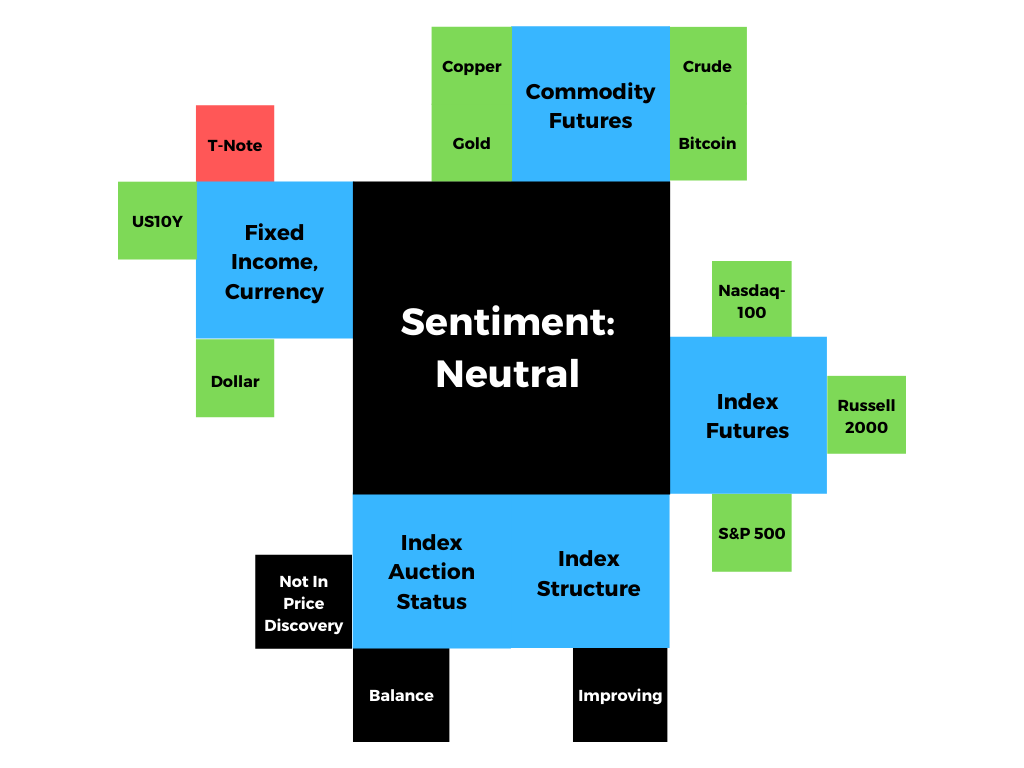
Index futures in balance.

  • Federal Reserve considers taper.
  • Ahead: Business outlook, claims.
  • Indexes in prior-range, sideways.

What Happened: U.S. stock index futures auctioned within prior-range, overnight, ahead of fundamental releases such as the Philadelphia Fed Business Outlook and claims data.
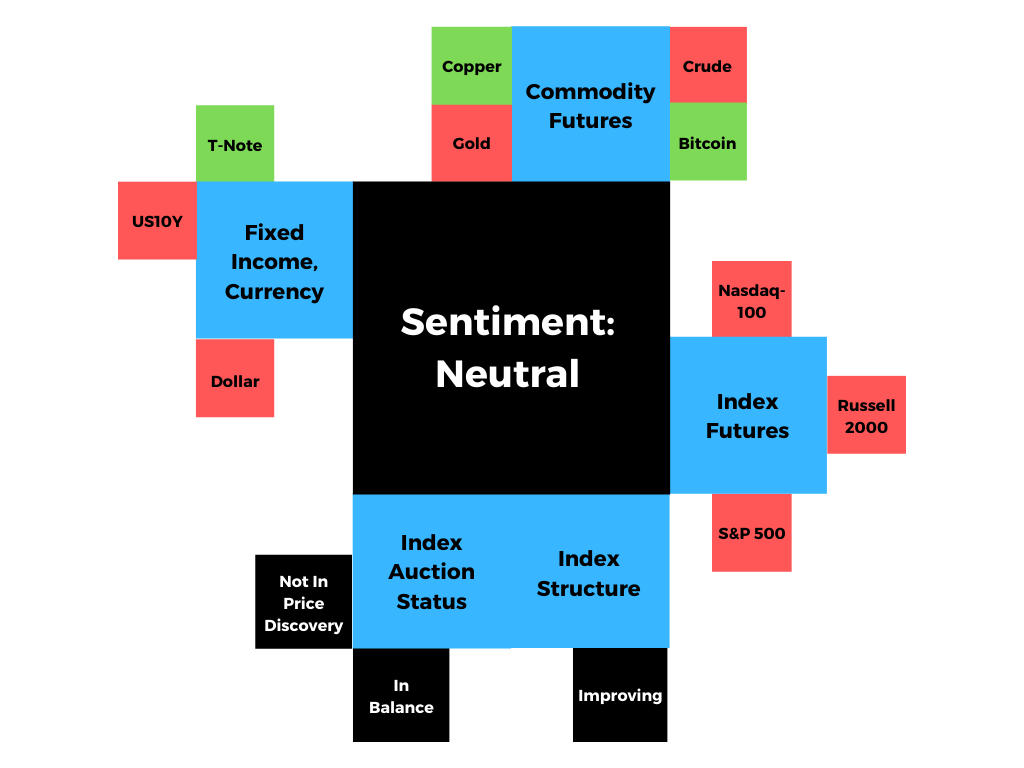
Graphic updated at 7:30 AM EST.

What To Expect: Thursday’s regular session (9:30 AM – 4:00 PM EST) in the S&P 500 will likely open inside of prior-range and -value, suggesting a limited potential for immediate directional opportunity. 

Adding, during the prior day’s regular trade, the best case outcome occurred, evidenced by responsive trade above the $4,069.25 high volume area (HVNode), which is significant because that value marked the other end of a micro-composite low volume area.

Volume Areas: A structurally sound market will build on past areas of high volume. Should the market trend for long periods of time, it will lack sound structure (identified as a low volume area which denotes directional conviction and ought to offer support on any test). 

If participants were to auction and find acceptance into areas of prior low volume, then future discovery ought to be volatile and quick as participants look to areas of high volume for favorable entry or exit.

Responsive Buying (Selling): Buying (selling) in response to prices below (above) area of recent price acceptance.

Further, this activity is happening in the context of concerns over rising inflation, which may prompt monetary authorities to ease back on stimulus. Yesterday, the Federal Reserve’s minutes showed that some on the committee were interested in tapering discussions. 

“It was a surprise to hear the talk about Fed tapering,” Joyce Chang, JPMorgan’s chair of global research, said. “The market had been thinking there might be a couple of months before you really saw this particular issue come into focus.”

Why is this – inflation – a concern? Generally speaking, inflation and rates move inverse to each other. Low rates stimulate demand for loans (i.e., borrowing money more attractive). With the rapid recovery, though, market participants fear that rates will rise to protect the economy from overheating.

Higher rates have the potential to reduce the present value of future earnings, making stocks, especially those that are high growth, less attractive. To note, however, rates are still rangebound; rates on the 10 Year T-Note sit below their March high and are likely to continue higher, which the market will likely absorb.

For today, beyond fundamental context, participants can trade from the following frameworks. 

In the best case, the S&P 500 trades sideways or higher; activity above the $4,104.75 low volume area (LVNode) has the potential to reach up to the $4,122.25 HVNode. Initiative trade beyond the $4,122.25 HVNode could reach as high as the $4,134.00 spike base (a pivot on the composite profile; above = bullish, below = neutral-to-bearish). 

Spikes: Spike’s mark the beginning of a break from value. Spikes higher (lower) are validated by trade at or above (below) the spike base (i.e., the origin of the spike).

In the worst case, the S&P 500 trades lower; activity below the $4,069.25 HVNode targets a repair of the minimal excess low at $4,055.75. Thereafter, on a failed response, prices may continue lower, below the $4,050.75 LVNode boundary. In such a situation, caution longs. The potential exists to trade to the POCs at $4,015.00 and $4,001.00, if not even lower.

POCs: POCs (like HVNodes described above) are valuable as they denote areas where two-sided trade was most prevalent. Participants will respond to future tests of value as they offer favorable entry and exit.

Excess: A proper end to price discovery; the market travels too far while advertising prices. Responsive, other-timeframe (OTF) participants aggressively enter the market, leaving tails or gaps which denote unfair prices.
Graphic: 4-hour profile chart of the Micro E-mini S&P 500 Futures.
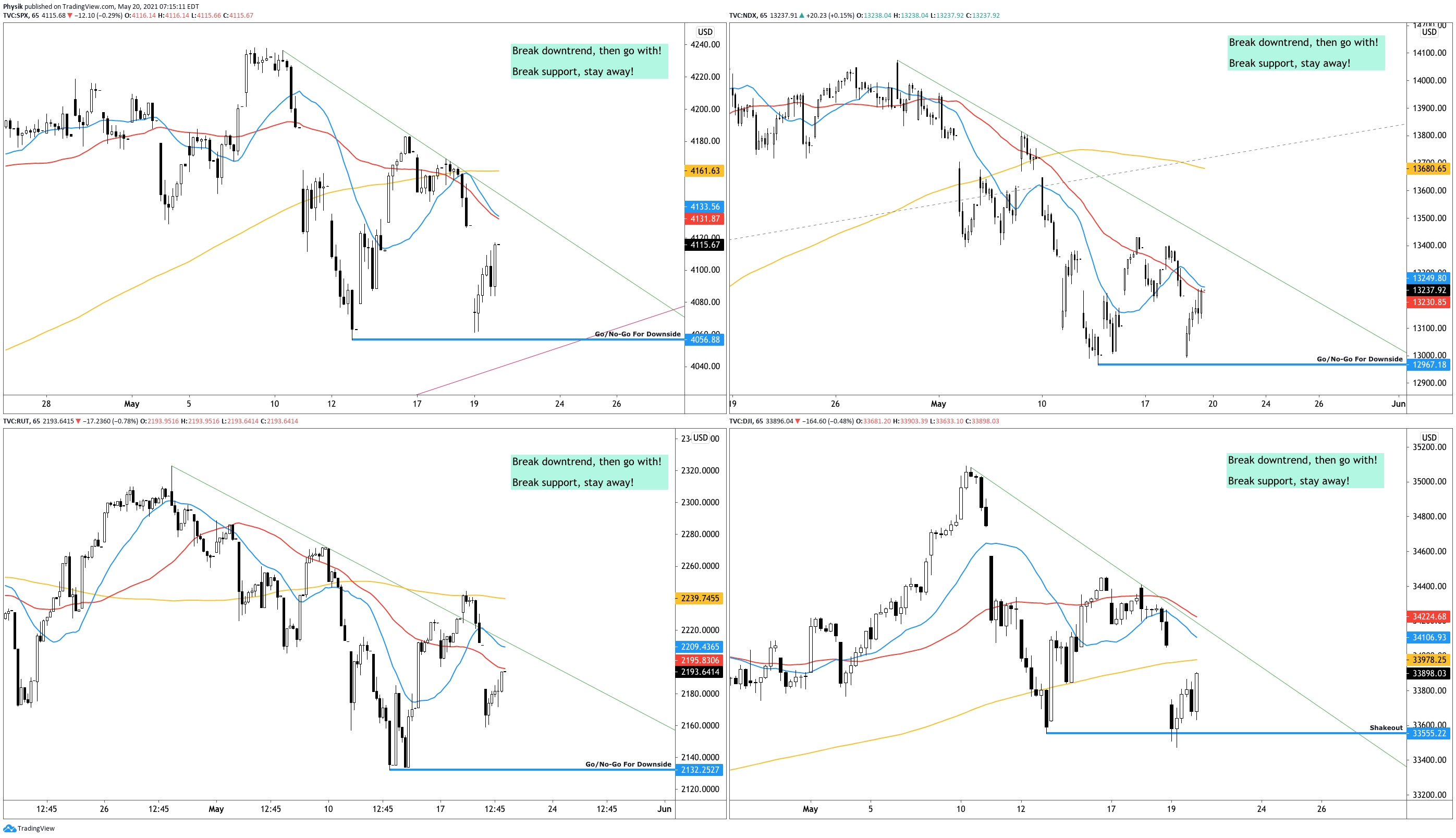
Graphic: 65-minute candlestick charts of the S&P 500 (top left), Nasdaq 100 (top right), Russell 2000 (bottom left), and Dow Jones Industrial Average (bottom right).
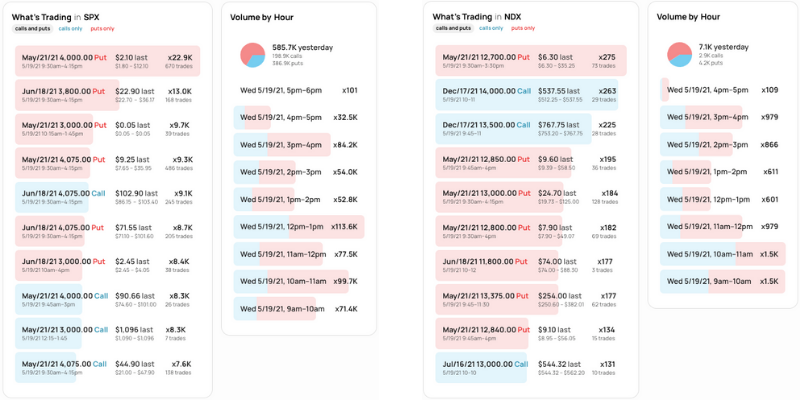
Graphic: SHIFT search suggests participants were most interested in put strikes at and below current prices in the cash-settled S&P 500 Index (INDEX: SPX) and Nasdaq 100 Index (INDEX: NDX), May 19. To note, however, participants were paying up for longer-dated upside exposure (evidenced by call activity). Note the December calls trading in the NDX and June calls in SPX.

News And Analysis

Recovery | New COVID-19 coronavirus cases fell by 20% in the last week. (Axios)

Economy | Central bank taper timelines are now starting to come into focus. (Axios)

Recovery | Vaccine boosters could be necessary as soon as September. (Axios)

Technology | Cisco says shortages will disrupt supply chains for rest of year. (FT)

Economy | Recovery funds increase investment but long-term gains uncertain. (Moody’s)

Energy | China’s industrial commodities slide after warning of crackdowns. (REU)

Travel | The U.S. is weighing changes to pandemic air travel restrictions. (REU)

Economy | Refinance volumes increase for the second week despite rate bump. (MND)

Economy | Inflation surveys, market pricing consistent with what Fed wants. (Barrons)

What People Are Saying

Innovation And Emerging Trends

FinTech | New digitial exchange offers gold exposure and funding for miners. (REU)

Crypto | Sh*t coin billionaire: tales from the fringe of the cryptocurrency craze. (BBG)

Crypto | China deepens its fintech dominance with new digital currency. (Diplomat)

Crypto | Central bank digital currencies could disrupt financial systems. (Fitch)

FinTech | OCC chief signals new direction on bank supervision and fintech. (AB)

FinTech | Stripe betting on creator economy powered by likes of Clubhouse. (BI)

About

Renato founded Physik Invest after going through years of self-education, strategy development, and trial-and-error. His work reporting in the finance and technology space, interviewing leaders such as John Chambers, founder, and CEO, JC2 Ventures, Kevin O’Leary, businessman and Shark Tank host, Catherine Wood, CEO and CIO, ARK Invest, among others, afforded him the perspective and know-how very few come by.

Having worked in engineering and majored in economics, Renato is very detailed and analytical. His approach to the markets isn’t built on hope or guessing. Instead, he leverages the unique dynamics of time and volatility to efficiently act on opportunity.

Disclaimer

At this time, Physik Invest does not manage outside capital and is not licensed. In no way should the materials herein be construed as advice. Derivatives carry a substantial risk of loss. All content is for informational purposes only.

Categories
Commentary

Weekly Brief For May 16, 2021

Market Commentary

Key Takeaways: Index futures are back in balance.

  • Economic data failing to surprise.
  • JPM: “Market is a little oversold.”
  • Indices reject lower prices, rotate.

What Happened: Last week, U.S. stock index futures auctioned lower alongside the release of uninspiring economic data.

In particular, the S&P 500 advertised prices below a key consolidation area but failed to solicit aggressive selling. Thereafter, participants rotated the index back inside the aforementioned consolidation, suggesting they were seeking more information to base a directional move. 

As stated in the last few weekly commentaries, participants have a lot to account for in positioning themselves during one of the weakest stretches of the year. Among their worries are inflation expectations – in part due to “choke points in global supply chains” – and stalling retail sales, as well as consumer price and job data misses. At the same time, sentiment and positioning metrics are waning while inflows remain strong, across the globe, and many year-end index targets remain clustered at and above current prices.

Of all the factors mentioned, inflation is a key concern. Why? Generally speaking, inflation and rates move inverse to each other. Low rates stimulate demand for loans (i.e., borrowing money more attractive). With the rapid recovery, though, market participants are fearful that rates may have to rise to protect the economy from overheating.

Higher rates have the potential to reduce the present value of future earnings, making stocks, especially those that are high growth, less attractive. To note, however, rates remain rangebound; rates on the 10 Year T-Note sit below their March high and are likely to continue higher, which, according to research by JPMorgan Chase & Co (NYSE: JPM), the market will likely absorb.

In fact, JPMorgan’s Marko Kolanovic, in a CNBC appearance, said that the market is a little oversold, and his S&P 500 target of $4,400.00 remains in play.

“I think market is now actually getting cheap, in some sense,” Kolanovic said. “I think we’re at the end of this upset. I think the market is going to go higher here. That said, we do still again prefer reflationary themes.”

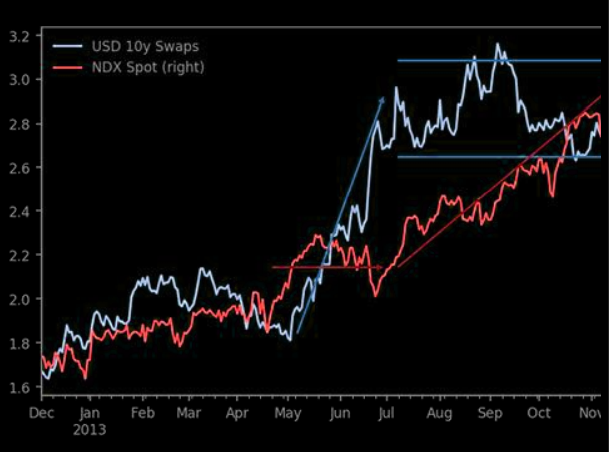
Looking back, also, according to The Market Ear, even during the so-called Taper Tantrum, in the early 2010s, rates settled in a wide range, and equities rallied big. 

Graphic: Nasdaq 100 rallies in 2013 after rates settle in a wide range, via The Market Ear.

To add, technically speaking, after testing into a composite low volume area (LVNode), the S&P 500 rejected lower prices and quickly traded back to the valuable $4,177.25 high volume area (HVNode).

Volume Areas: A structurally sound market will build on past areas of high volume. Should the market trend for long periods of time, it will lack sound structure (identified as a low-volume area which denotes directional conviction and ought to offer support on any test). 

If participants were to auction and find acceptance into areas of prior low-volume, then future discovery ought to be volatile and quick as participants look to areas of high volume for favorable entry or exit.

This volatility was expected; coming into the May 13 reversal, stock indexes were positioning for a vicious rebound as near-term downside discovery reached a potential limit, based on market liquidity metrics and the inventory positioning of participants. According to SqueezeMetrics, the steepness of the GammaVol (GXV) curve suggested there was more risk to the upside than the downside.

More On Gamma: In the simplest way, gamma is the sensitivity of an option to changes in the underlying price. Dealers that take the other side of options trades to hedge their exposure to risk by buying and selling the underlying. When dealers are short-gamma, they hedge by buying into strength and selling into weakness. When dealers are long-gamma, they hedge by selling into strength and buying into weakness. The former exacerbates volatility. The latter calms volatility.

What To Expect: In the coming sessions, participants will want to focus their attention on where the S&P 500 trades in relation to the $4,177.25 HVNode pivot.

That said, participants can trade from the following frameworks.

In the best case, the index trades sideways or higher; activity above the $4,177.25 HVNode may reach as high as the $4,227.00 POC. Initiative trade beyond the POC could reach as high as $4,238.00 overnight high (ONH) and $4,294.75 Fibonacci price extension, a typical recovery target.

POCs: POCs (like HVNodes described above) are valuable as they denote areas where two-sided trade was most prevalent. Participants will respond to future tests of value as they offer favorable entry and exit.

Overnight Highs (Lows): Typically, there is a low historical probability associated with overnight rally-highs (lows) ending the upside (downside) discovery process.

In the worst case, the index trades lower; activity below the $4,177.25 HVNode has the potential to reach the $4,136.25 HVNode. Beyond that level, of interest is the $4,122.25 HVNode, the $4,104.75 LVNode, and the $4,069.25 HVNode. 

Trading below the $4,029.25 overnight low (ONL) suggests a continuation of the bear trend. Caution longs.

Graphic: 4-hour profile chart of the Micro E-mini S&P 500 Futures.
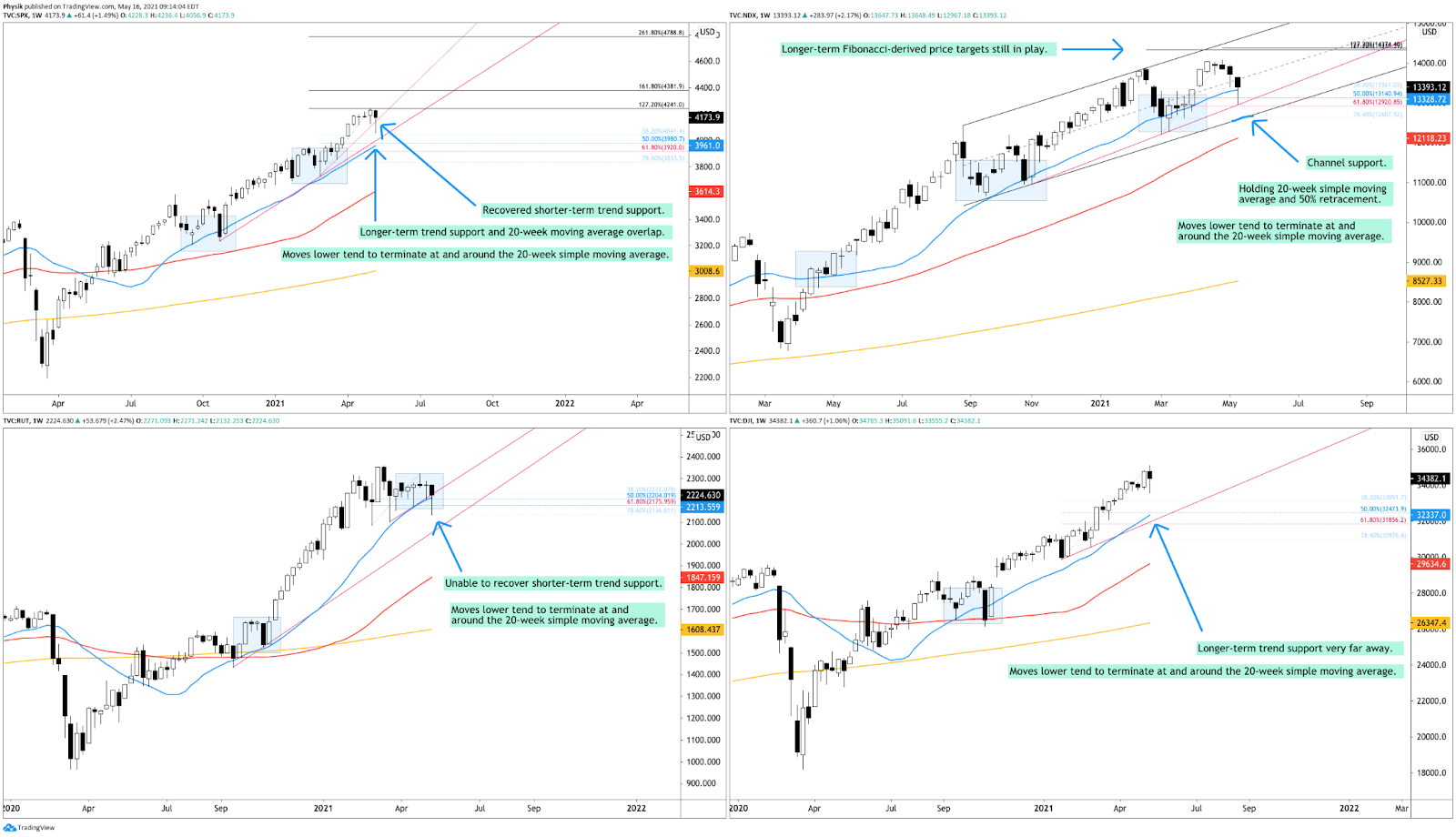
Graphic: Weekly candlestick charts of the S&P 500 (top left), Nasdaq 100 (top right), Russell 2000 (bottom left), and Dow Jones Industrial Average (bottom right).
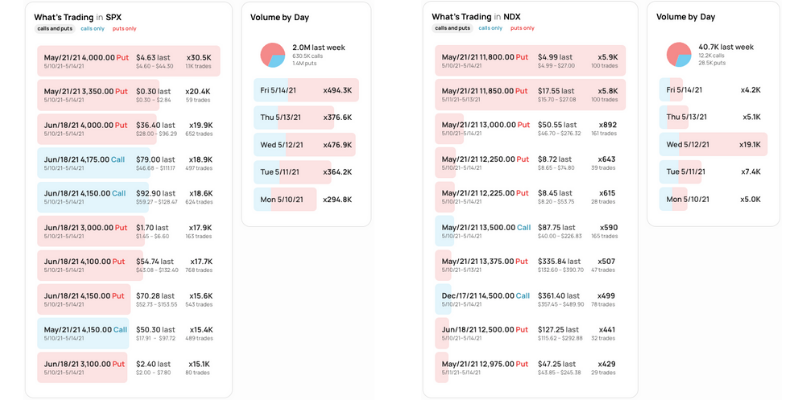
Graphic: SHIFT search suggests participants were most interested in put strikes at and below current prices in the cash-settled S&P 500 Index (INDEX: SPX) and Nasdaq 100 Index (INDEX: NDX), last week. It appears that participants were positioning themselves in strikes across further-dated expiries (e.g., June 18, 2021) suggesting more commitment.

News And Analysis

Markets | Rates remain resilient after the recent inflation scare. (MND)

Markets | Caught-short strategists are a stealth market accelerant. (BBG)

Ratings | Out-of-court restructurings may lead to repeat defaults. (S&P)

Energy | Oil, and gas benefiting from rising crude, value rotation. (BBG)

Energy | Colonial Pipeline resumes normal operations after hack. (Axios)

Markets | Selected indicators – global automotive manufacturing. (REU)

Ratings | Risk of supply chain financing, partial asset sell-downs. (S&P)

Economy | U.K.’s worse recession to turn into a stronger recovery. (S&P)

Economy | Don’t you dare say stagflation; safeguards are slipping. (BBG)

What People Are Saying

Innovation And Emerging Trends

Working | Reimagining the workplace – adapting to new normals. (S&P)

Banking | US banks could cut nearly 200K jobs over the next decade. (FT)

Space | China has made history with its successful Mars landing. (Axios)

FinTech | Cryptocurrency, and blockchain must lead in sustainability. (TC)

Energy | California Governor proposes a $3.2B EV investment plan. (TC)

About

Renato founded Physik Invest after going through years of self-education, strategy development, and trial-and-error. His work reporting in the finance and technology space, interviewing leaders such as John Chambers, founder, and CEO, JC2 Ventures, Kevin O’Leary, businessman and Shark Tank host, Catherine Wood, CEO and CIO, ARK Invest, among others, afforded him the perspective and know-how very few come by.

Having worked in engineering and majored in economics, Renato is very detailed and analytical. His approach to the markets isn’t built on hope or guessing. Instead, he leverages the unique dynamics of time and volatility to efficiently act on opportunity.

Disclaimer

At this time, Physik Invest does not manage outside capital and is not licensed. In no way should the materials herein be construed as advice. Derivatives carry a substantial risk of loss. All content is for informational purposes only.

Categories
Commentary

Daily Brief For May 12, 2021

Market Commentary

Index futures in balance.

  • Tugging as sectors push and pull.
  • Ahead: Consumer prices, inflation.
  • Indices settle, position for resolve.

What Happened: After responsive buying the day prior, U.S. stock index futures auctioned lower overnight, ahead of data on inflation.

Graphic updated at 6:35 AM EST.

What To Expect: Wednesday’s regular session (9:30 AM – 4:00 PM EST) in the S&P 500 will likely open inside of prior-range and -value, suggesting a limited potential for immediate directional opportunity.

Adding, during the prior day’s regular trade, the worst-case outcome occurred, evidenced by the initiative trade down to the $4,110.50 minimal excess low. Thereafter, responsive buying brought the S&P 500 back in range. Later, participants found it most favorable to transact at last Tuesday’s POC, a development that suggests visually-driven technical traders may be out in full force.

Initiative Selling (Buying): Selling (buying) within or below (above) the previous day’s value area.

Excess: A proper end to price discovery; the market travels too far while advertising prices. Responsive, other-timeframe (OTF) participants aggressively enter the market, leaving tails or gaps which denote unfair prices.

Responsive Buying (Selling): Buying (selling) in response to prices below (above) an area of recent price acceptance.

POCs: POCs are valuable as they denote areas where two-sided trade was most prevalent. Participants will respond to future tests of value as they offer favorable entry and exit.

Further, this week’s early dip comes ahead of inflation figures that will provide clarity on emerging price pressures. Generally speaking, inflation and rates move inverse to each other. Low rates stimulate demand for loans (i.e., borrowing money more attractive). With the rapid recovery, though, market participants are fearful that rates may have to rise to protect the economy from overheating.

That’s pretty significant.

Higher rates may reduce the present value of future earnings, making stocks, especially those that are high growth, less attractive. To note, however, rates haven’t budged much since March. Rates on the 10 Year T-Note sit well below their March high.

That said, here is a quote to sum current conditions: “For an economy coming out of a pandemic, normal rules don’t apply,” said Matthew Cady, an investment strategist at Brooks Macdonald. “For broad sustained inflation you really need to see much tighter labor markets, and the bottom line is that the CPI out-turn due this week is very unlikely to change that picture.”

Further, for today, participants can trade from the following frameworks.

In the best case, the S&P 500 trades sideways or higher; activity above the $4,141.00 POC targets first the $4,163.00 POC and then the $4,177.25 composite high volume (HVNode) pivot. Initiative trade beyond the pivot could reach as high as the $4,224.75 HVNode. 

Volume Areas: A structurally sound market will build on past areas of high volume. Should the market trend for long periods of time, it will lack sound structure (identified as a low volume area which denotes directional conviction and ought to offer support on any test). 

If participants were to auction and find acceptance into areas of prior low volume, then future discovery ought to be volatile and quick as participants look to areas of high volume for favorable entry or exit.

In the worst case, the S&P 500 trades sideways or lower; activity below the $4,141.00 POC targets first the $4,103.00 excess low. Thereafter, if no response, participants may look for responses at the $4,128.00 and $4,093.00 POCs.

At this juncture, it pays not to be involved; the risk-to-reward of establishing new swing positions, in a tight trading range, is poor. Responsive trade is the course of action. Only after trading beyond the HVNode pivot, or excess low, may participants have the conviction to participate in initiative trades.

Graphic: 65-minute profile chart of the Micro E-mini S&P 500 Futures.
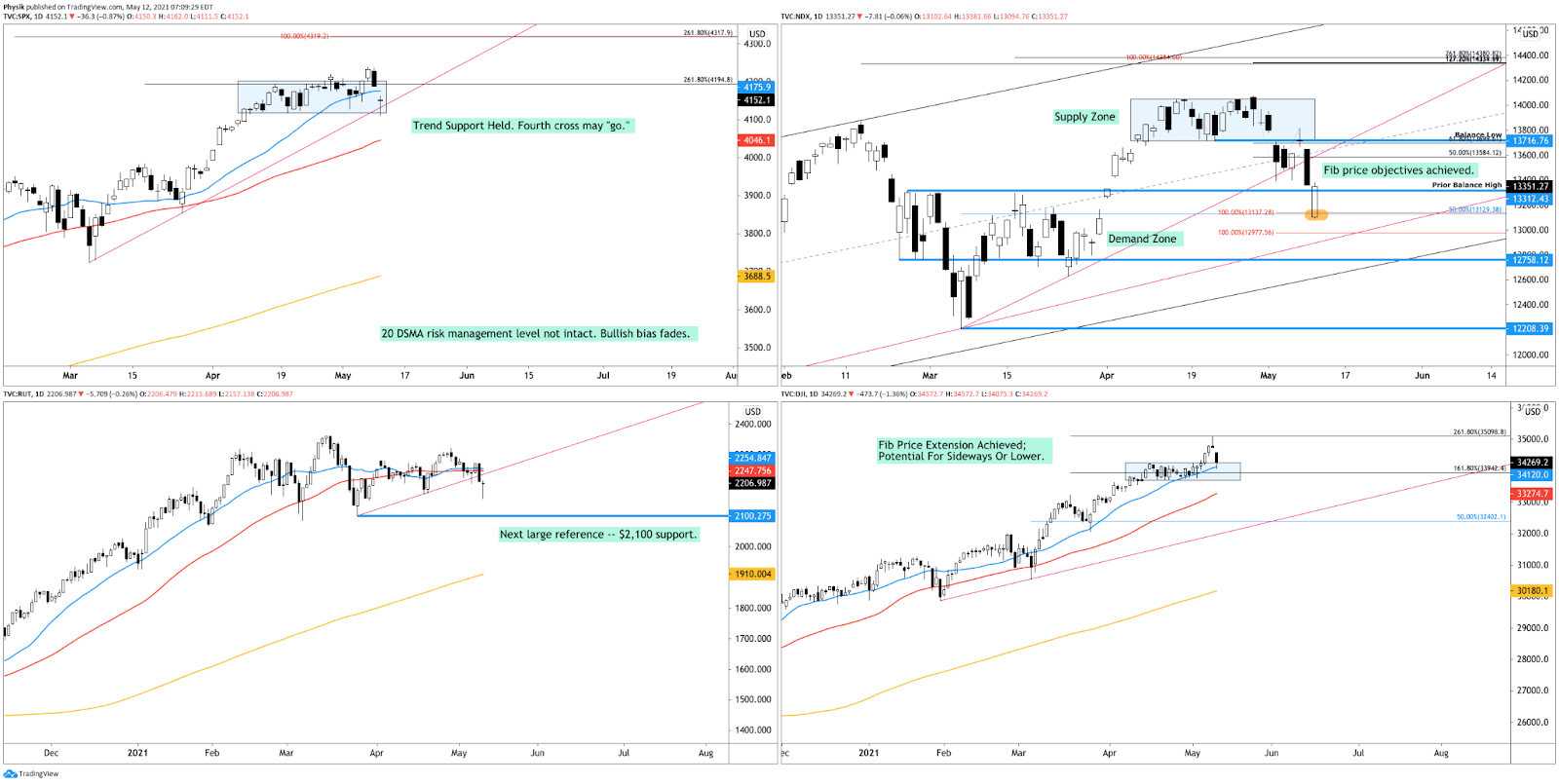
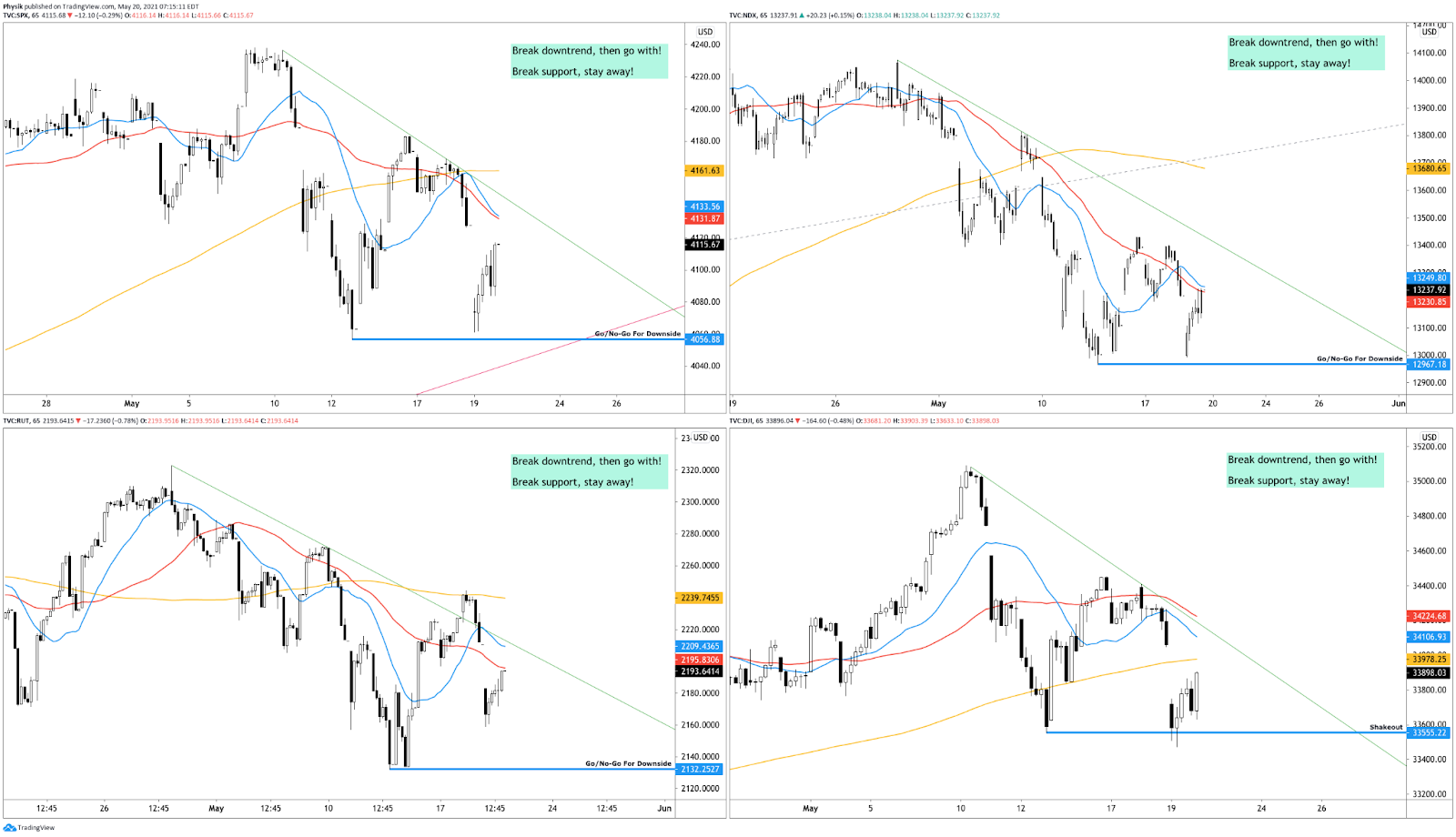
Graphic: Daily candlestick charts of the S&P 500 (top left), Nasdaq 100 (top right), Russell 2000 (bottom left), and Dow Jones Industrial Average (bottom right). The Dow is the strongest of the four. The Nasdaq is beginning to strengthen, relative to its peers. 
Graphic: Physik Invest maps out the purchase of call and put options in the SPDR S&P 500 ETF Trust (NYSE: SPY), for May 11. Activity in the options market was primarily concentrated in very short-dated tenors, in strikes as low as $396.00, which corresponds with ~$4,050.00 in the cash-settled S&P 500 Index (INDEX: SPX). Despite some size bets on both sides of the market, a short duration suggests an overall lack of commitment. 
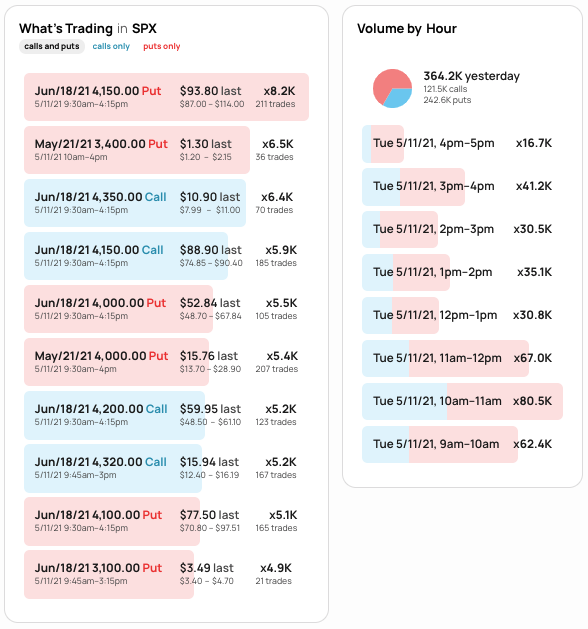
Graphic: SHIFT search suggests participants were most interested in put strikes at and below current prices in the cash-settled S&P 500 Index (INDEX: SPX), Tuesday. Exposure was concentrated in both the May and June monthly expiries.

News And Analysis

Commodities | Colonial faces deadline to decide on hacked pipeline restart. (BBG)

Politics | Israel and Hamas escalate deadly strikes as the U.S. calls for calm. (BBG)

Markets | SPAC fees to support banks through 2022 even as deals dry up. (BBG)

Markets | COVID-19 concerns, chip sell-off roil the Taiwanese stock market. (WSJ)

Markets | SEC warning over bitcoin futures risks in mutual fund investments. (BBG)

Markets | A higher U.S. corporate tax rate is not a key credit risk driver. (Fitch)

What People Are Saying

Innovation And Emerging Trends

Economy | Housing-market surge is making the cheapest homes the hottest. (WSJ)

Markets | Media account Litquidity Capital is the Meme King of Wall Street. (VOX)

FinTech | eBay joined the NFT frenzy, will allow sale of NFTs on its platform. (REU)

About

Renato founded Physik Invest after going through years of self-education, strategy development, and trial-and-error. His work reporting in the finance and technology space, interviewing leaders such as John Chambers, founder, and CEO, JC2 Ventures, Kevin O’Leary, businessman and Shark Tank host, Catherine Wood, CEO and CIO, ARK Invest, among others, afforded him the perspective and know-how very few come by.

Having worked in engineering and majored in economics, Renato is very detailed and analytical. His approach to the markets isn’t built on hope or guessing. Instead, he leverages the unique dynamics of time and volatility to efficiently act on opportunity.

 Disclaimer

At this time, Physik Invest does not manage outside capital and is not licensed. In no way should the materials herein be construed as advice. Derivatives carry a substantial risk of loss. All content is for informational purposes only.

Categories
Commentary

Daily Brief For April 27, 2021

Market Commentary

Index futures auction sideways, validating higher prices.

  • 80% of companies beat expectations.
  • Ahead: FOMC, Biden Address, GDP.
  • Indices balance and correct with time.

What Happened: U.S. stock index futures auctioned sideways, overnight, while Treasury yields and commodities posted substantive gains.

This price action comes as nearly 80% of companies that reported their earnings have either met or beaten expectations. The muted response suggests much the optimism has already been priced in. Now, participants are looking for more information to base their next move. 

See here for information on how to read an earnings report.

Ahead, is data on home prices, consumer confidence, and manufacturing. On Wednesday, Federal Reserve Chair Jerome Powell will hold a conference on central bank policy. On the same day, Joe Biden will address Congress. Thursday, U.S. GDP will likely show improvement in the first quarter, 2021.

Graphic updated 8:30 AM EST.

What To Expect: Tuesday’s regular session (9:30 AM – 4:00 PM EST) will likely open inside of prior-range and -value, suggesting a limited potential for immediate directional opportunity. 

Adding, during the prior day’s regular trade, the best case outcome occurred, evidenced by sideways trade just shy of the $4,186.75 balance-area high. 

Balance (Two-Timeframe Or Bracket): Rotational trade that denotes current prices offer favorable entry and exit. Balance-areas make it easy to spot change in the market (i.e., the transition from two-time frame trade, or balance, to one-time frame trade, or trend).

All this comes after a substantial advance. The S&P 500 is up nearly 13% since the start of March and it could be said that the product has been marked up, enough. Given the busy calendar, the odds favor sideways trade. The reason being: a market in balance tends to stay in balance unless some exogenous factor provides participants more information to base their next move.

Adding, Jeff Buchbinder, Equity Strategist for LPL Financial says: “[W]hile sentiment may be overly optimistic and a pickup in volatility would be totally normal, strong breadth measures suggest stocks still may have more upside. This week we tackle that same topic of peak optimism, but by looking at some valuation metrics. While valuations are elevated, they still appear reasonable when factoring in interest rates and inflation.”

Moving on, for today, participants can trade from the following frameworks. 

In the best case, the S&P 500 trades sideways or higher; activity above the $4,186.75 ledge targets the $4,191.75 overnight high (ONH). Initiative trade beyond the ONH may introduce excess and could reach as high as the Fibonacci-derived price targets, $4,197.25-$4,263.00. 

In the worst case, the S&P 500 trades lower; activity below $4,173.25 regular-trade low (RTH Low) targets the $4,164.25 high-volume area (HVNode). Thereafter, if lower, participants can look for responses at the $4,163.25, $4,137.25, and $4,122.75 HVNodes.

Ledges: Flattened area on the profile which suggests responsive participants are in control, or initiative participants lack the confidence to continue the discovery process. The ledge will either hold and force participants to liquidate (cover) their positions, or crack and offer support (resistance).

Overnight Rally Highs (Lows): Typically, there is a low historical probability associated with overnight rally-highs (lows) ending the upside (downside) discovery process.

Initiative Trade: Buying (selling) within or above (below the previous day’s value area.

Excess: A proper end to price discovery; the market travels too far while advertising prices. Responsive, other-timeframe (OTF) participants aggressively enter the market, leaving tails or gaps which denote unfair prices.
Volume Areas: A structurally sound market will build on past areas of high volume. Should the market trend for long periods of time, it will lack sound structure (identified as a low-volume area which denotes directional conviction and ought to offer support on any test). 

If participants were to auction and find acceptance into areas of prior low-volume, then future discovery ought to be volatile and quick as participants look to areas of high volume for favorable entry or exit.

As long as the S&P 500 remains in the $4,186.75-$4,110.50 balance area, the course of action is responsive trade.

Graphic: 65-minute profile chart of the Micro E-mini S&P 500 Futures.
Graphic: SHIFT search maps out the trade of call and put options in the SPDR S&P 500 ETF Trust (NYSE: SPY), for April 26. Activity in the options market was primarily concentrated in short-dated tenors, in strikes near current prices. To put it simply, not much is going on, yet.

News And Analysis

Banking | Nomura, UBS take global banks’ Archegos hit to $10B. (BBG)

Economy | U.S. auto dealers are winners as chip shortage lifts profit. (REU)

Markets | Goldman Sachs watching total margin loans after blow-ups. (REU)

M&A | New York Community Bancorp will buy Flagstar Bancorp. (REU)

Economy | France, and Germany support U.S. 21% corporate tax plan. (BBG)

Travel | The E.U. set to let vaccinated U.S. tourists visit this summer. (NYT)

What People Are Saying

Innovation And Emerging Trends

FinTech | Citi eyes mortgage tech in push to close the wealth gap. (BBG)

Innovation | Germany to spend recovery money on green, digital goals. (REU)

FinTech | Mobile bank Current raises $220M Series D, tripling value. (TC)

FinTech | S!NG wants creators to lean on NFTs to protect their IP. (TC

About

Renato founded Physik Invest after going through years of self-education, strategy development, and trial-and-error. His work reporting in the finance and technology space, interviewing leaders such as John Chambers, founder, and CEO, JC2 Ventures, Kevin O’Leary, Canadian businessman and Shark Tank host, Catherine Wood, CEO and CIO, ARK Invest, among others, afforded him the perspective and know-how very few come by.

Having worked in engineering and majored in economics, Renato is very detailed and analytical. His approach to the markets isn’t built on hope or guessing. Instead, he leverages the unique dynamics of time and volatility to efficiently act on opportunity. 

Disclaimer

At this time, Physik Invest does not manage outside capital and is not licensed. In no way should the materials herein be construed as advice. Derivatives carry a substantial risk of loss. All content is for informational purposes only.

Categories
Commentary

Market Commentary For The Week Ahead: ‘Up, Up And Away’

Key Takeaways:

What Happened: U.S. stock index futures closed higher, last week.

What Does It Mean: The S&P 500 closed above $4,000.00 for the first time.

This comes as investors shifted their focus from the risks of rapidly rising inflation to the increasing pace of COVID-19 coronavirus vaccinations and a rebound in economic activity.

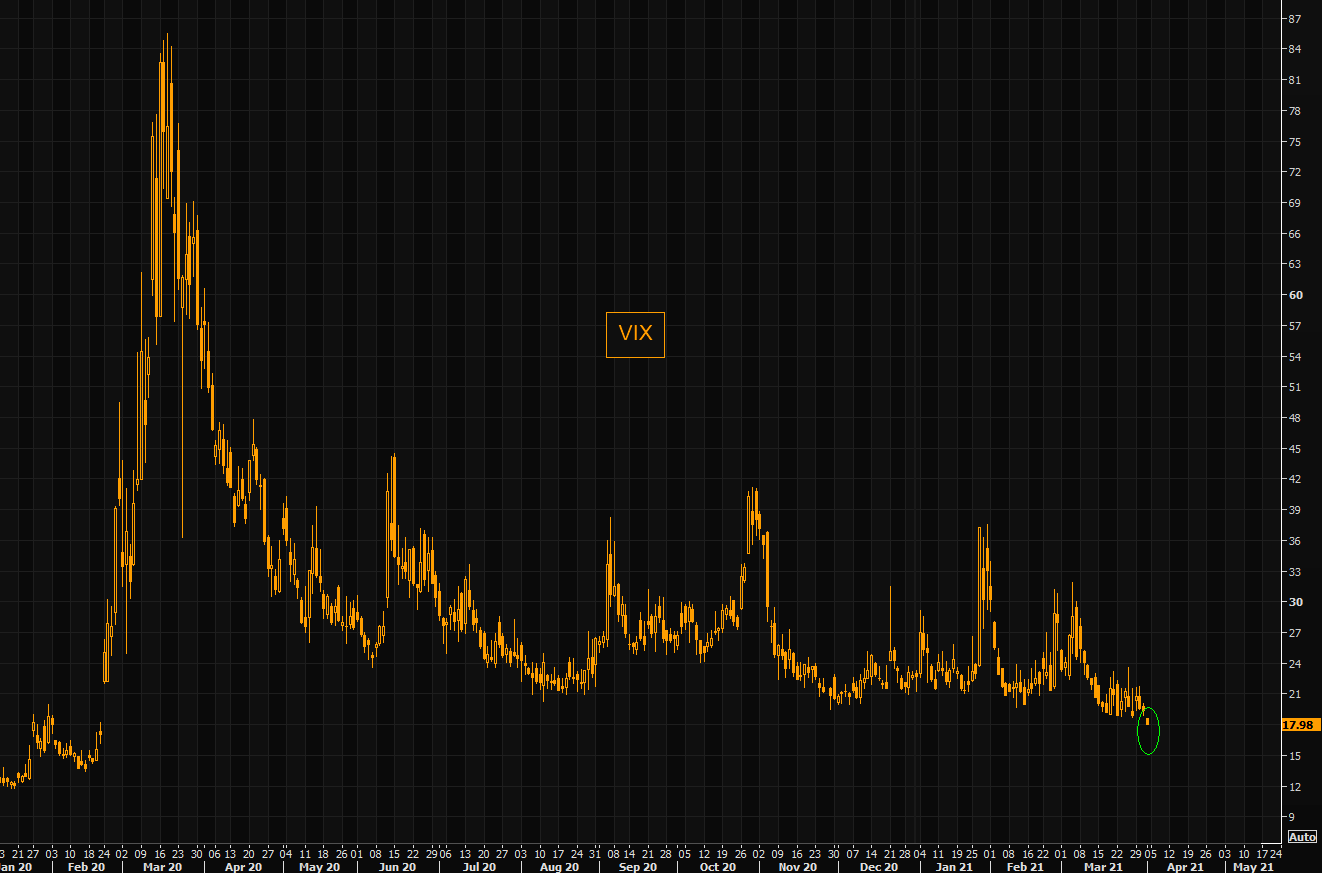
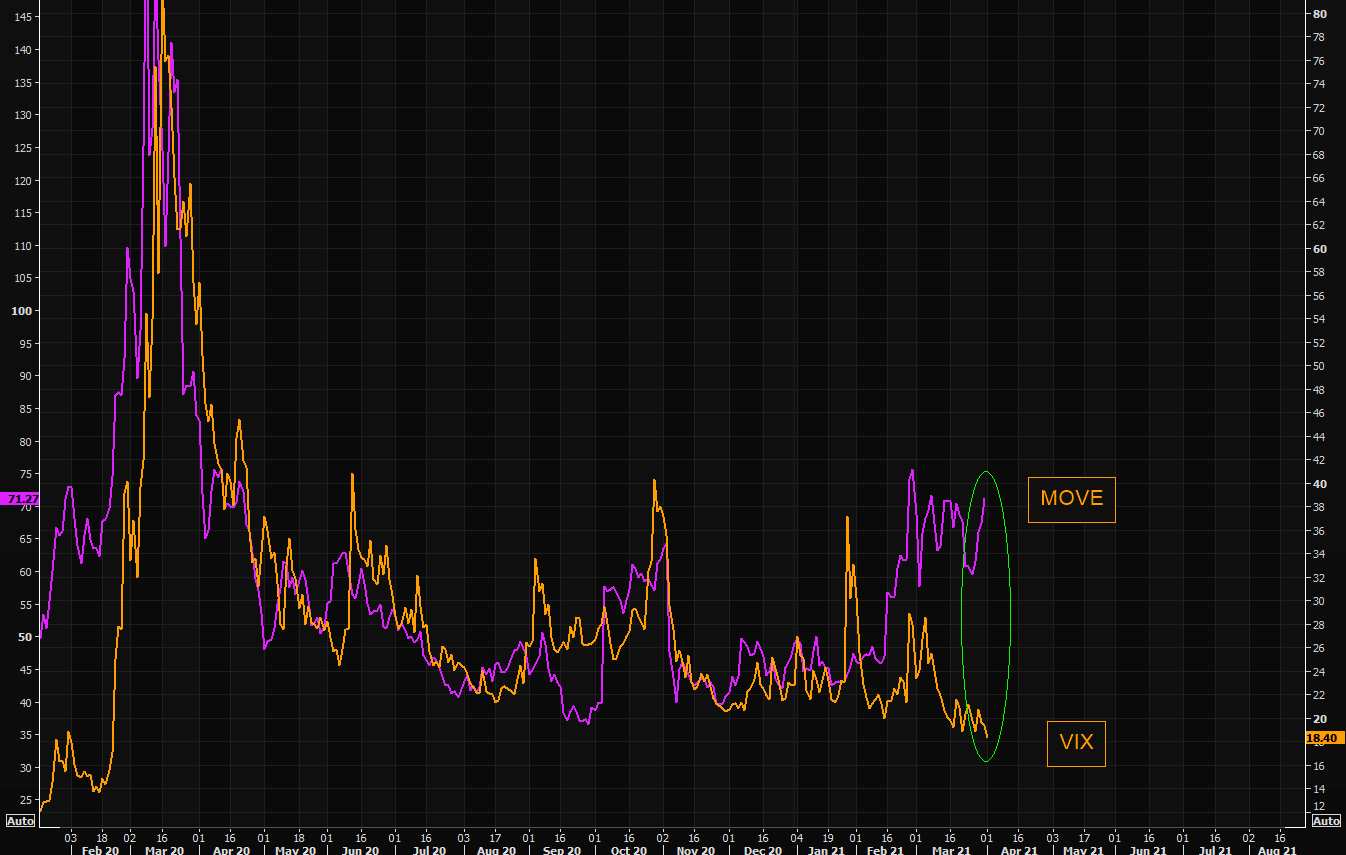
At the time, the CBOE Volatility Index (INDEX: VIX), a measure of the stock market’s expectation of volatility based on S&P 500 (INDEX: SPX) options, hit the lowest level since February of 2020. This was likely the result of an oversupply in volatility due to contract rolling, signaling a shift in the demand for volatility and options-based hedging.

Graphic 1: Volatility declines ahead of the extended holiday weekend.

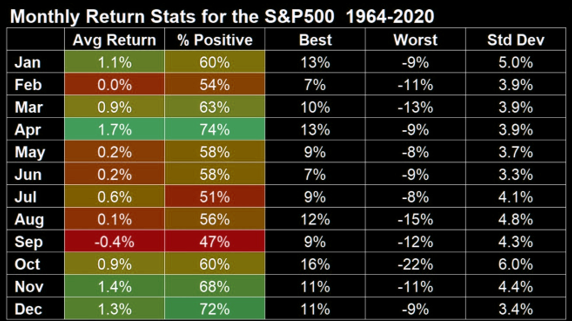
Adding, the market is entering into a historically bullish period, ahead of the upcoming corporate earnings season, with structural flows supporting the ongoing narrative, also, at least until mid-April. The reason being, most funds are committed to holding long positions. In the interest of lower volatility returns, these funds will collar off their positions, selling calls to finance the purchase of downside put protection.

Graphic 2: April, historically speaking, is usually a good month for equity investors. 

As a result of this activity, options dealers are long upside and short downside protection.

This exposure must be hedged; dealers will sell into strength as their call (put) positions gain (lose) value and buy into weakness as their call (put) positions lose (gain) value.

Now, unlike theory suggests, dealers will hedge call losses (gains) quicker (slower). This leads to “long-gamma,” a dynamic that crushes volatility and promotes momentum, observed by lengthy sprints — like the one the market is currently in — followed by rapid de-risking events as the market transitions into “short-gamma.”

What To Expect: Balance-to-higher into mid-April.

Why? One last hurrah before the reopening accelerates and flows turn. 

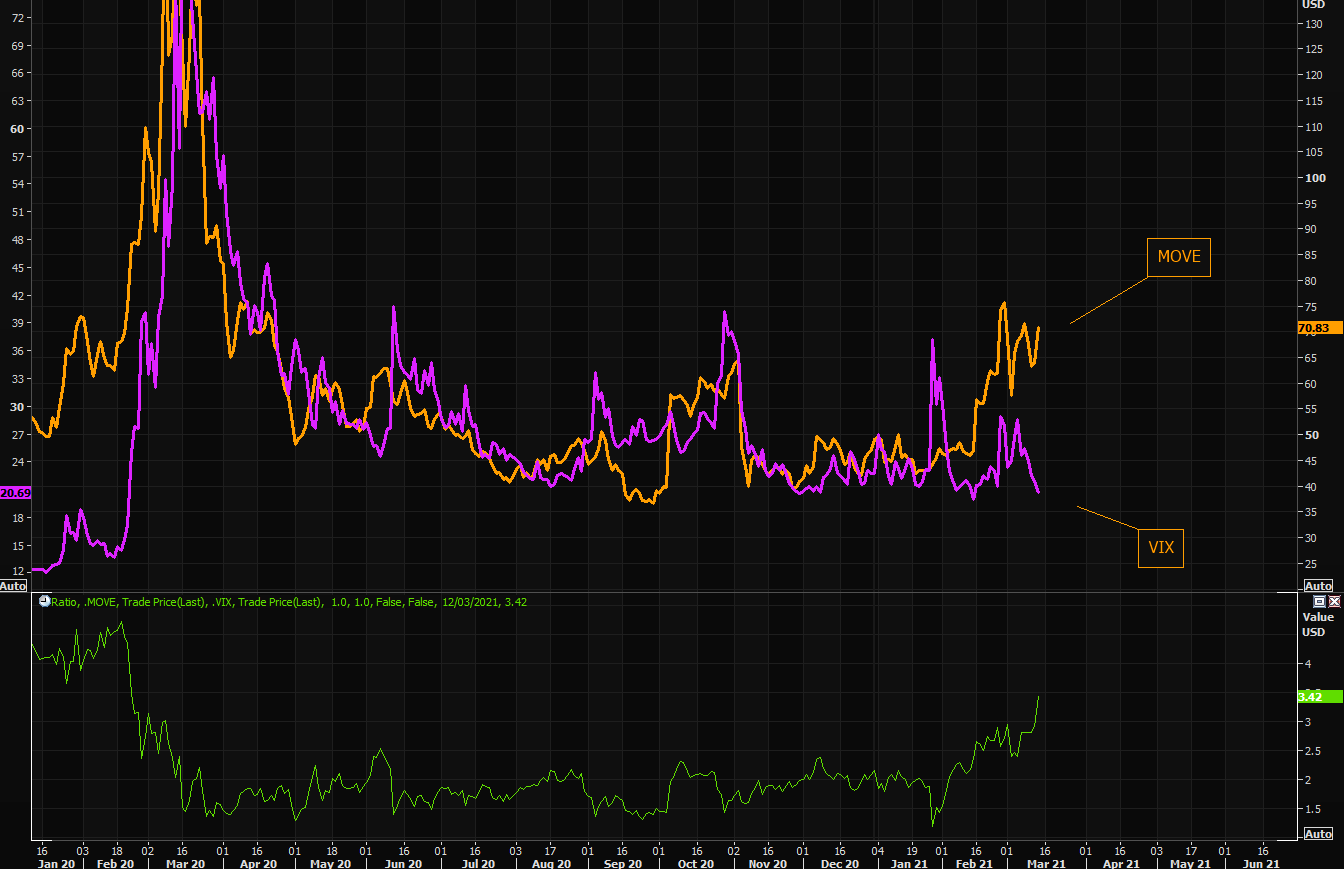
When flows turn, it is likely that equity and bond market volatility converge; the ongoing divergence comes alongside an attempt, by market participants, to price in rising debt levels and inflation. As consumers shift their preferences from saving and investing to spending, this divergence ought to disappear.

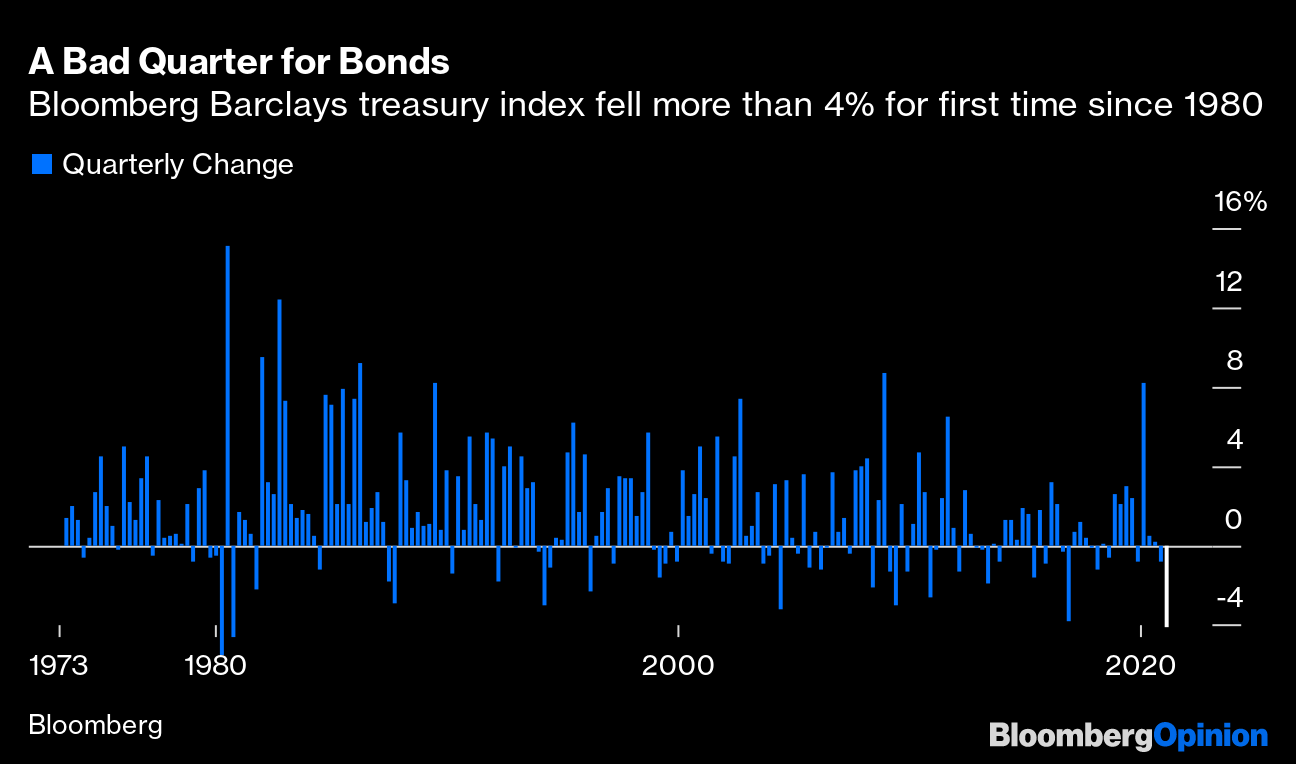
Graphic 3: Q1 2021 the worst quarter for bonds in decades, via Bloomberg
Graphic 4: Divergence in volatility across the bond and equity market.

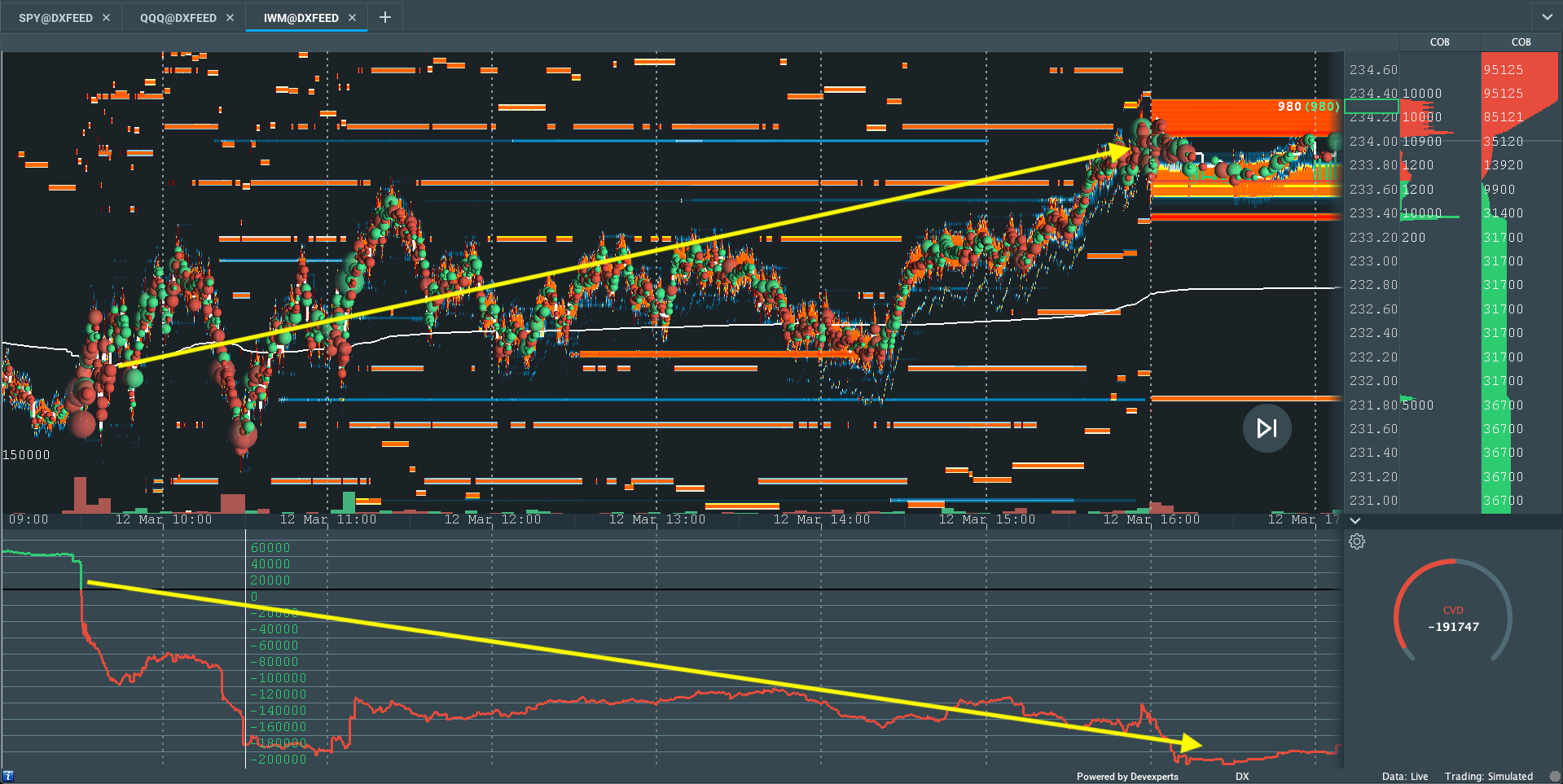
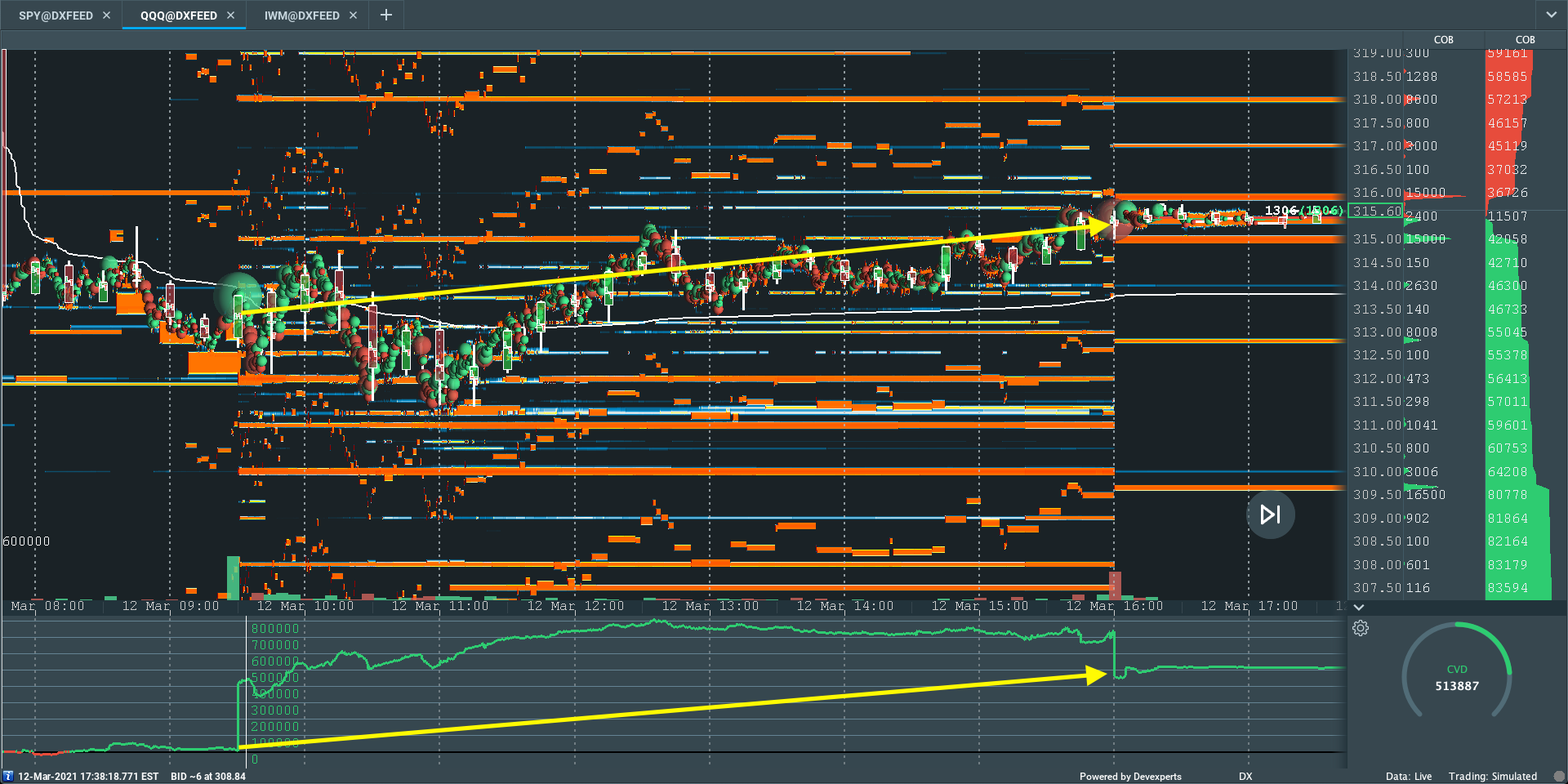
Adding, metrics, like DIX, confirm increased buying pressure while divergences in options activity and volume delta suggest opportunistic selling.

More On DIX: For every buyer is a seller (usually a market maker). Using DIX — which is derived from short sales (i.e., liquidity provision on the market-making side) — we can measure buying pressure.

Volume Delta: Buying and selling power as calculated by the difference in volume traded at the bid and offer.
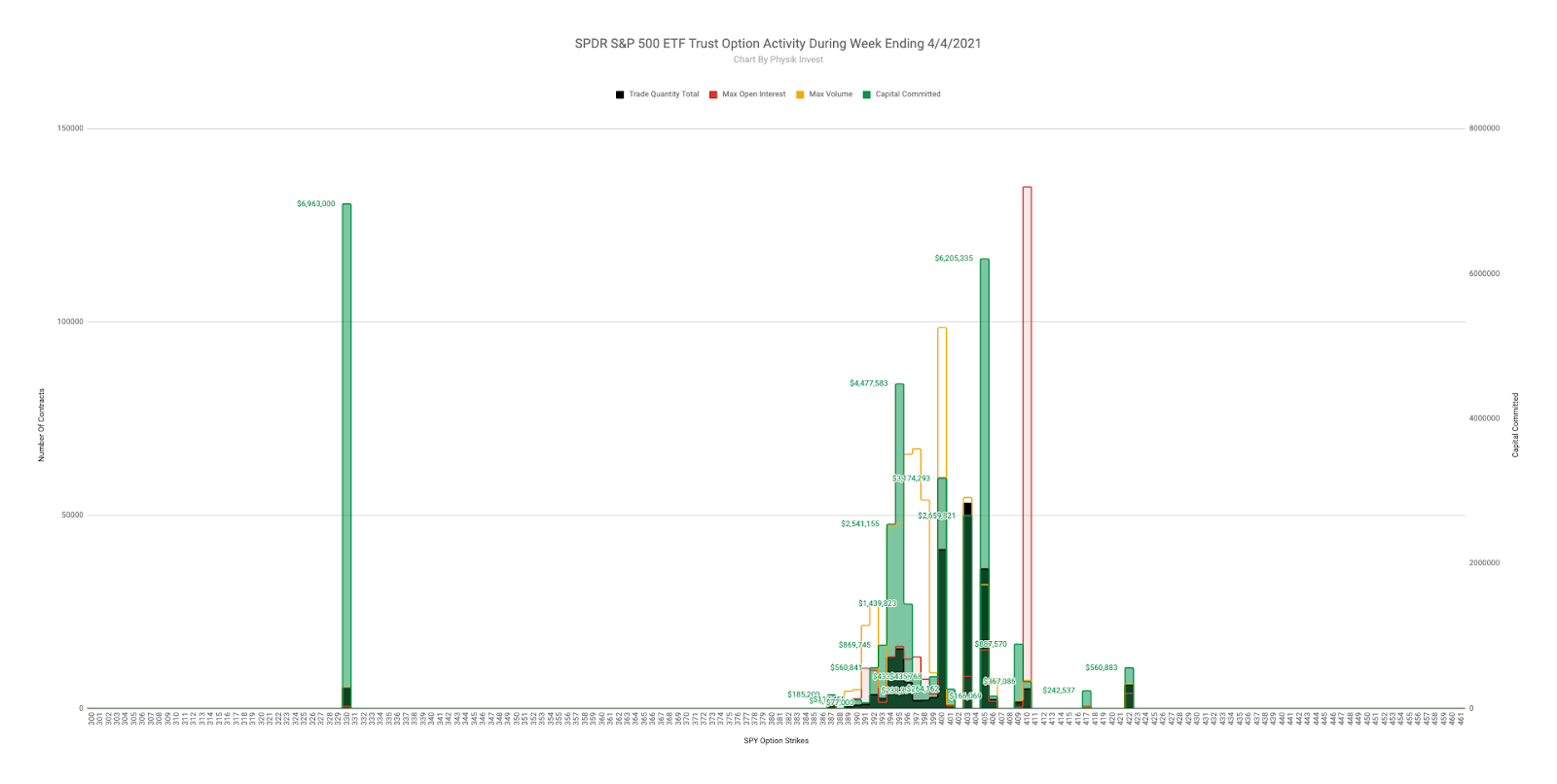
Graphic 5: Physik Invest maps out the purchase of call and put options in the SPDR S&P 500 ETF Trust (NYSE: SPY), for the week ending April 4, 2021. Activity in the options market was primarily concentrated in short- and long-dated tenors, in strikes as low as $330, which corresponds with $3,300 in the cash-settled S&P 500 Index (INDEX: SPX).

What To Do: In the coming sessions, participants will want to pay attention to where the S&P 500 trades in relation to Thursday’s end-of-day spike higher.

More On Spikes: Spike’s mark the beginning of a break from value. Spikes higher (lower) are validated by trade at or above (below) the spike base (i.e., the origin of the spike).

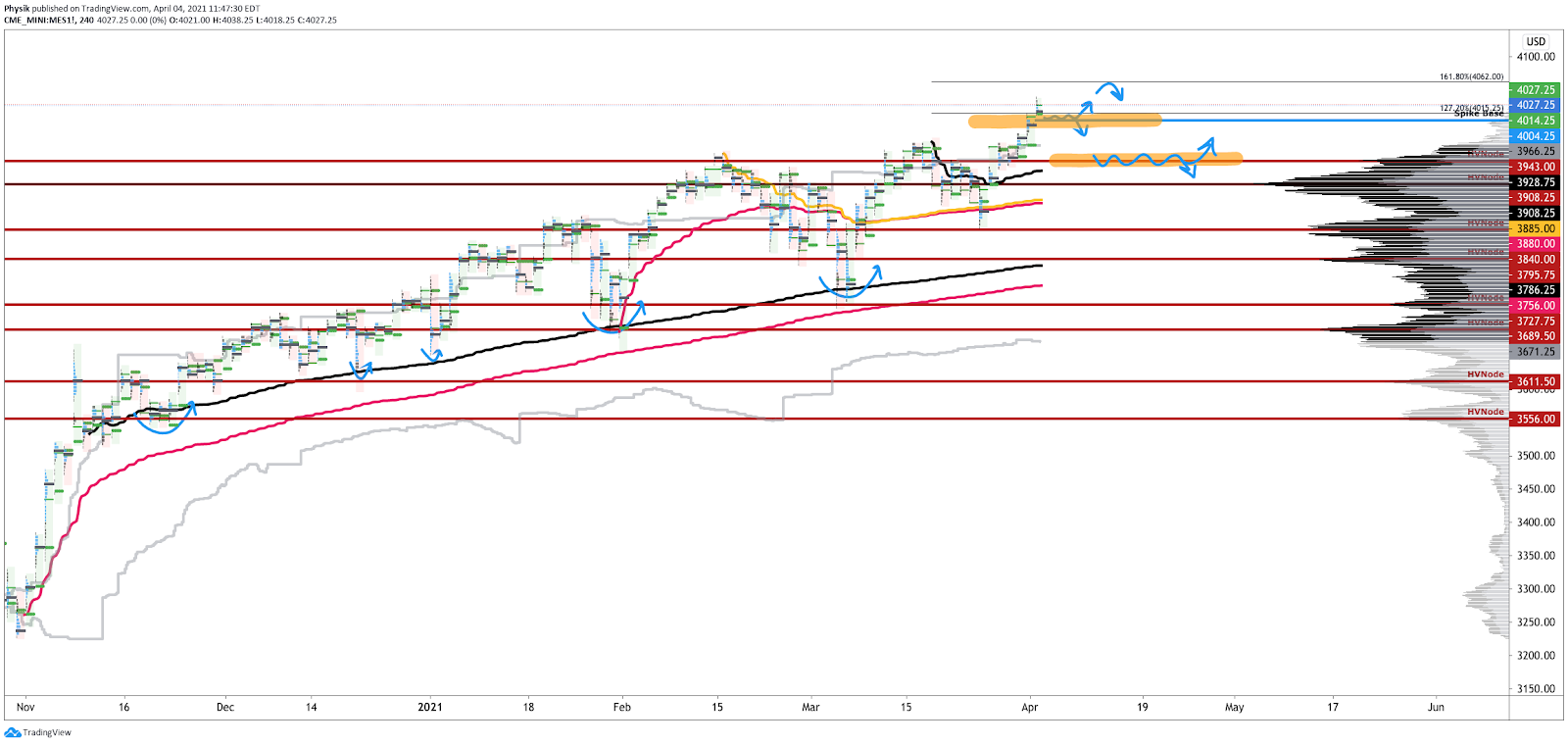
In the best case, the S&P 500 remains above the $4,004.25 spike base. Doing so means that the participants are finding higher prices, above the VWAP anchored from the March 17 rally-high, valuable (i.e., buyers, on average, are in control and winning since the March 17 rally-high).

More On Volume-Weighted Average Prices (VWAPs): A metric highly regarded by chief investment officers, among other participants, for quality of trade. Additionally, liquidity algorithms are benchmarked and programmed to buy and sell around VWAPs. 

In the case of higher prices, given that the $4,015.25 price extension was achieved in after-market trade that established an overnight high at $4,038.25, participants can target the $4,062.00 extension.

More On Overnight Rally Highs (Lows): Typically, there is a low historical probability associated with overnight rally-highs (lows) ending the upside (downside) discovery process.

Any activity below the $4,004.25 spike base puts the rally on hold and calls for balance or digestion of higher prices.

Balance (Two-Timeframe Or Bracket): Rotational trade that denotes current prices offer favorable entry and exit. Balance-areas make it easy to spot a change in the market (i.e., the transition from two-time frame trade, or balance, to one-time frame trade, or trend).

In the case of lower prices, participants can look to whether a test of the $3,943.00 and $3,908.25 high-volume areas (HVNodes) solicit a response.

More On Volume Areas: A structurally sound market will build on past areas of high-volume (HVNode). Should the market trend for long periods of time, it will lack sound structure (identified as a low-volume area (LVNode) which denotes directional conviction and ought to offer support on any test). 

If participants were to auction and find acceptance into areas of prior low-volume, then future discovery ought to be volatile and quick as participants look to areas of high volume for favorable entry or exit.
Graphic 6: 4-hour profile chart of the Micro E-mini S&P 500 Futures.

Conclusions: The go/no-go level for next week’s trade is $4,004.25.

Any activity above this level confirms the bullishness of last Thursday’s end-of-day spike. 

Levels Of Interest: $4,004.25 Spike Base.

Cover photo by Taryn Elliott from Pexels.

Categories
Commentary

Market Commentary For The Week Ahead: ‘Down, Then Up’

Key Takeaways:

What Happened: U.S. stock index futures closed higher, last week.

What Does It Mean: In the face of stretched sentiment and positioning — a heightened appetite for risk — investors shifted their focus from the risks of rapidly rising inflation to the increasing pace of COVID-19 coronavirus vaccinations and a rebound in economic activity.

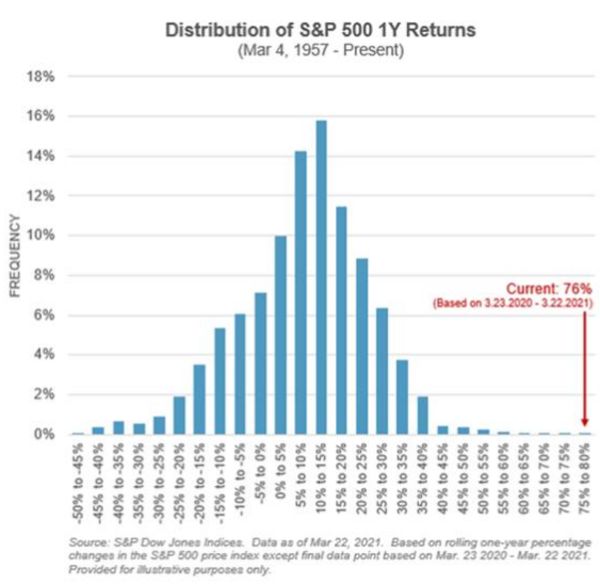
This comes after an outlier 2020; the distribution of S&P 500 1-year returns was ‘unexpected,’ sitting in the far end of the right tail.

Graphic 1: Distribution of S&P 500 1-Year Returns via Bloomberg

Adding, according to S&P Global Ratings, concerns over inflation appear “overblown and [] orderly reflation, around a return to sustainable growth, is a healthy development for both macro and credit outcomes.”

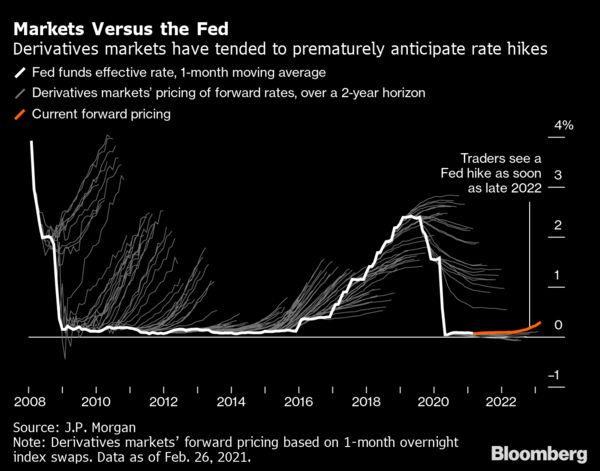
This notion is further validated by history; according to Bloomberg, “Since 2008, markets have consistently priced in a more aggressive path of Fed rate hikes than what ultimately happened. Consider the situation in late 2008: traders were already bracing for several hikes in the years ahead, according to data crunched by JPMorgan Chase & Co. (NYSE: JPM), but policy makers held off on tightening until 2015.”

Due to this mispricing, traders are behind the curve when the Fed finally hikes. Between 2017, through 2018, traders were scrambling to keep up with the Fed’s seven hikes.

Graphic 2: Bloomberg maps out the pricing in of Federal Reserve rate hikes.

“The market has its pricing and perceptions, and what happens can differ from that and has,” Alex Roever, head of U.S. rates strategy at JPMorgan, told Bloomberg News. The market has been testing the Fed by “trying to push further forward the first hike. But Fed officials don’t seem to be having any of it.”

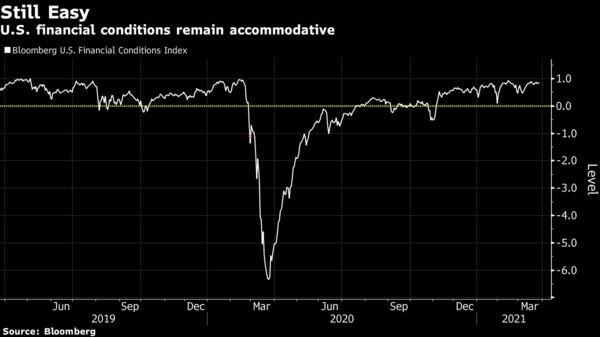
The Fed’s hesitancy to change its stance is warranted; broadly speaking, financial conditions haven’t budged. 

Graphic 3: U.S. financial conditions appear accommodative, via Bloomberg

Analysts at S&P Global Ratings put it best: “Our bottom line is that orderly reflation is, on balance, a healthy development for macro and credit outcomes. This narrative implies that moderate demand and wage pressures have reemerged after a lost decade and that the interest rate structure has the potential to return to more normal levels. While there will inevitably be some market adjustments as credit is repriced, this will lead to better outcomes.”

A natural evolution — trend in rates toward normalcy — would provide monetary authorities ammunition in another downturn, and price credit in a way that rebalances the natural supply and demand dynamics of the market (i.e., non-productive firms are forced out of business).

What To Expect: Directional resolve.

Why? During prior trade, participants lacked conviction. This is evidenced by a failure, by participants, to introduce excess (e.g., tails or range expansion past historical turning points) in the S&P 500.

More On Excess: A proper end to price discovery; the market travels too far while advertising prices. Responsive, other-timeframe (OTF) participants can aggressively enter the market, leaving tails or gaps which denote unfair prices.

Adding, metrics, like DIX, suggest increased buying pressure. This comes after what appears to have been opportunistic buying or short covering into weakness, and some bearish trades in the cash-settled S&P 500 Index (INDEX: SPX), among other products like Chinese technology stocks and U.S. media companies. 

More On DIX: For every buyer is a seller (usually a market maker). Using DIX — which is derived from short sales (i.e., liquidity provision on the market making side) — we can measure buying pressure.
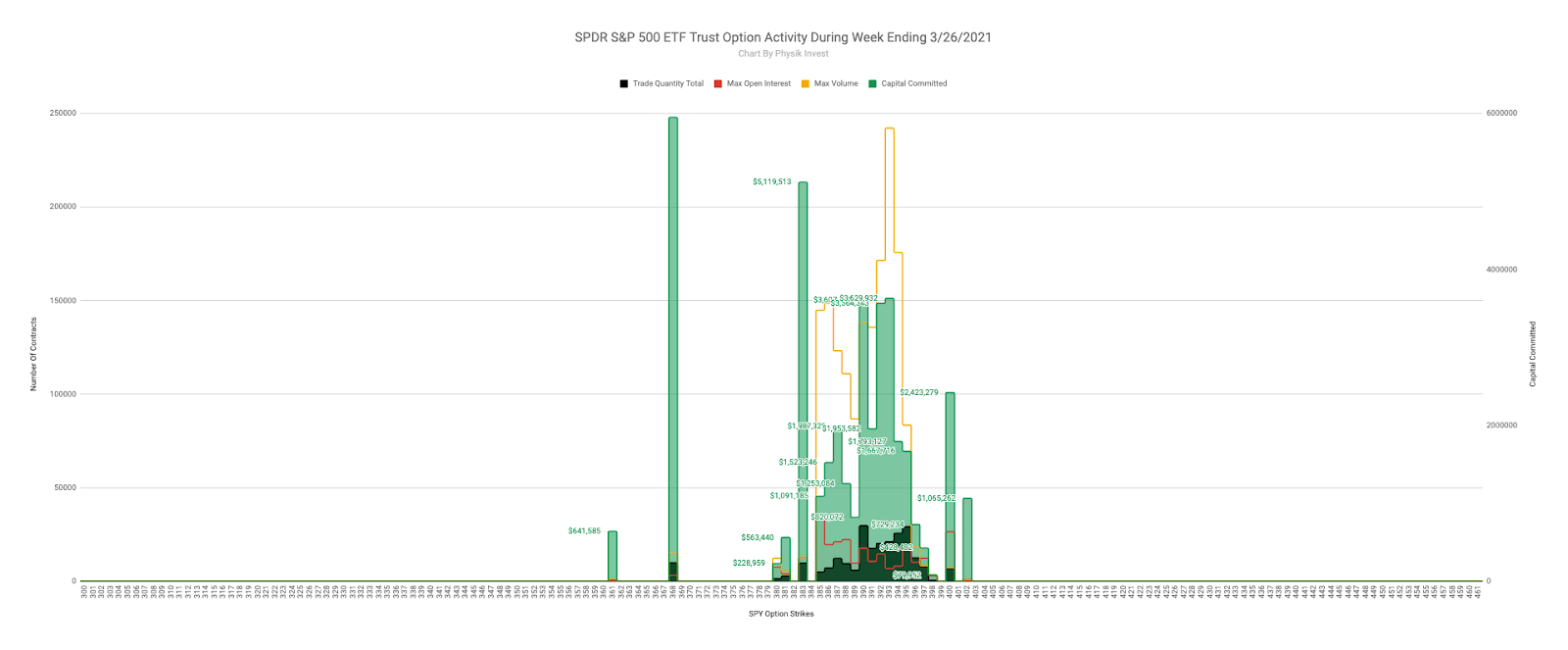
Graphic 4: Physik Invest maps out the purchase of call and put options in the SPDR S&P 500 ETF Trust (NYSE: SPY), for the week ending March 26, 2021. Activity in the options market was primarily concentrated in short- and long-dated tenors, in strikes as low as $361, which corresponds with $3,610 in the cash-settled S&P 500 Index (INDEX: SPX).

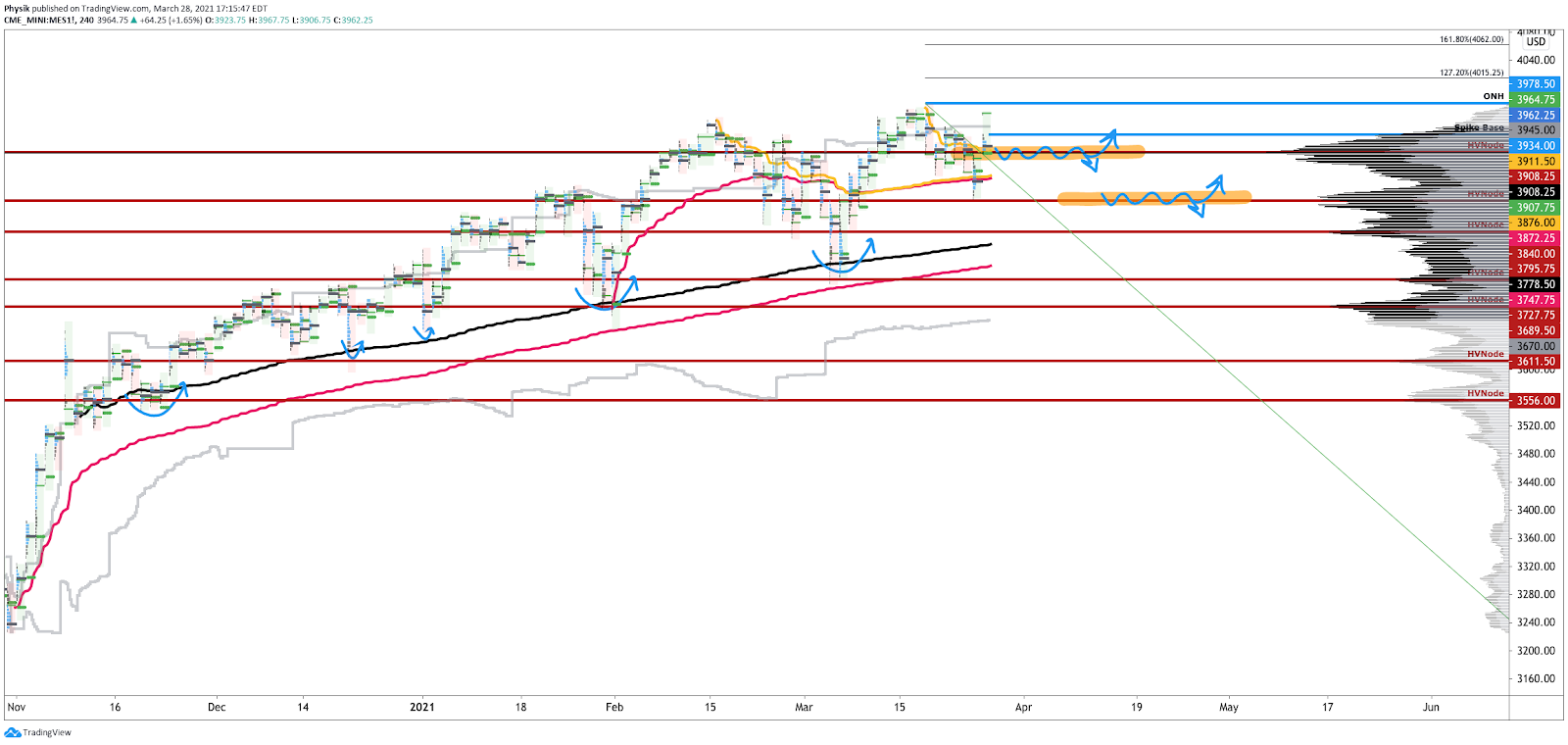
What To Do: In the coming sessions, participants will want to pay attention to where the S&P 500 trades in relation to Friday’s end-of-day spike higher, which was likely the result of hedging.

More On Spikes: Spike’s mark the beginning of a break from value. Spikes higher (lower) are validated by trade at or above (below) the spike base (i.e., the origin of the spike).

In the best case, the S&P 500 remains above the $3,934.00 spike base, taking out Friday’s minimal excess high. Doing so means that the participants are finding higher prices, above the VWAP anchored from the March 17 rally-high, valuable (i.e., buyers, on average, are in control and winning since the March 17 rally-high).

More On Volume-Weighted Average Prices (VWAPs): A metric highly regarded by chief investment officers, among other participants, for quality of trade. Additionally, liquidity algorithms are benchmarked and programmed to buy and sell around VWAPs. 

In case of higher prices, participants can target the $3,978.50 overnight rally-high, as well as the $4,015.25 and $4,062.00 price extensions.

More On Overnight Rally Highs (Lows): Typically, there is a low historical probability associated with overnight rally-highs (lows) ending the upside (downside) discovery process.

Any activity below the VWAP anchored from the $3,978.50 peak may (1) leave the $3,900.00 HVNode as an area of supply, offering initiative sellers favorable entry and responsive buyers favorable exit.

More On Volume Areas: A structurally sound market will build on past areas of high-volume (HVNode). Should the market trend for long periods of time, it will lack sound structure (identified as a low-volume area (LVNode) which denotes directional conviction and ought to offer support on any test). 

If participants were to auction and find acceptance into areas of prior low-volume, then future discovery ought to be volatile and quick as participants look to areas of high-volume for favorable entry or exit.
Graphic 5: 4-hour profile chart of the Micro E-mini S&P 500 Futures.

Conclusions: The go/no-go level for next week’s trade is $3,934.00.

Any activity above this level confirms the bullishness of last Friday’s end-of-day spike. 

Levels Of Interest: $3,934.00 Spike Base.

Cover photo by Min An from Pexels

Categories
Commentary

Market Commentary For The Week Ahead: ‘Green Shoots’

Notice: Physik Invest’s daily market commentaries will be suspended until further notice.

Please accept our apologies for the inconvenience, thank you for the support, and see you next week!

Key Takeaways:

What Happened: U.S. stock index futures closed lower, last week.

What Does It Mean: Heading into last week’s Federal Reserve policy update, stock index futures were in balanced, two-sided trade as participants looked for more information to base their next move. 

Then, Federal Reserve Chairman Jerome Powell discussed his organization’s commitment to an inclusive recovery. At the same time, the central bank announced it expects real GDP to grow 6.5% and inflation to rise as high as 2.4% this year.

The comments were immediately followed by a vertical price rise.

Thereafter, participants that caused the vertical price rise traded out, evidenced by the index trading lower into Friday’s derivative expiry.

Important to note is that despite the attempted pricing in of rising debt levels and inflation, a divergence in bond and equity market volatility persists. Historically, fear across markets tends to move in tandem. That hasn’t been the case for a number of weeks, now (e.g., Graphic 1).

Graphic 1: Divergence in volatility across the bond and equity market. 

What To Expect: Directional resolve.

Why? The passage of a large derivative expiry, the resolve of the vertical price range that occurred in the face of Federal Reserve policy updates, as well as market liquidity metrics suggesting opportunistic buying or short covering into weakness, and increased buying pressure (as witnessed through measures like DIX and options activity).

More On DIX: For every buyer is a seller (usually a market maker). Using DIX — which is derived from short sales (i.e., liquidity provision on the market making side) — we can measure buying pressure.

More On Option Expiration (OPEX): Option expiries mark an end to pinning (i.e, the theory that market makers and institutions short options move stocks to the point where the greatest dollar value of contracts will expire worthless) and the reduction dealer gamma exposure.
Graphic 2: Physik Invest maps out the purchase of call and put options in the SPDR S&P 500 ETF Trust (NYSE: SPY), for the week ending March 19, 2021. Activity in the options market was primarily concentrated in short- and long-dated tenors, in strikes as high as $435, which corresponds with $4,350.00 in the cash-settled S&P 500 Index (INDEX: SPX).
Graphic 3: Index option traders add to call buying and put selling, a bullish dynamic. 

What To Do: In the coming sessions, participants will want to pay attention to the VWAP anchored from the $3,978.50 overnight rally-high, as well as the high-volume area (HVNode) near $3,900.00.

Volume-Weighted Average Prices (VWAPs): Metrics highly regarded by chief investment officers, among other participants, for quality of trade. Additionally, liquidity algorithms are benchmarked and programmed to buy and sell around VWAPs.

More On Volume Areas: A structurally sound market will build on past areas of high-volume (HVNode). Should the market trend for long periods of time, it will lack sound structure (identified as a low-volume area (LVNode) which denotes directional conviction and ought to offer support on any test). 

If participants were to auction and find acceptance into areas of prior low-volume, then future discovery ought to be volatile and quick as participants look to areas of high-volume for favorable entry or exit.

More On Overnight Rally Highs (Lows): Typically, there is a low historical probability associated with overnight rally-highs (lows) ending the upside (downside) discovery process.

In the best case, the S&P 500 remains above the $3,900.00 volume area, and VWAP anchored from the $3,978.50 peak, taking out Friday’s minimal excess high. This would suggest buyers, on average, are in control and winning since the March 17 rally-high.

More On Excess: A proper end to price discovery; the market travels too far while advertising prices. Responsive, other-timeframe (OTF) participants aggressively enter the market, leaving tails or gaps which denote unfair prices.

Any activity below the VWAP anchored from the $3,978.50 peak may (1) leave the $3,900.00 HVNode as an area of supply, offering initiative sellers favorable entry and responsive buyers favorable exit.

Graphic 4: Profile overlays on a 30-minute candlestick chart of the Micro E-mini S&P 500 Futures.
Graphic 5: 4-hour profile chart of the Micro E-mini S&P 500 Futures.

Conclusions: The go/no-go level for next week’s trade is $3,900.00.

Any activity at this level suggests market participants are looking for more information to base their next move. Anything above (below) this level increases the potential for higher (lower).

Levels Of Interest: $3,900.00 HVNode.

Photo by Ylanite Koppens from Pexels.

Categories
Commentary

Market Commentary For 3/17/2021

Notice: To view this week’s big picture outlook, click here.

What Happened: U.S. stock index futures liquidated as investors weighed the implications of rising yields ahead of outcomes on a U.S. Federal Reserve policy meeting.

What Does It Mean: Heading into Wednesday’s session, which ought to be volatile as participants position themselves in response to new economic projections, responsive trade is the course of action.

This notion is supported by market liquidity metrics, which suggest buying pressure is leveling out, and options activity, which points to a build in interest at the $4,000 S&P 500 level, ahead of Friday’s monthly option expiration (OPEX).

More On Option Expiration (OPEX): Option expiries mark an end to pinning (i.e, the theory that market makers and institutions short options move stocks to the point where the greatest dollar value of contracts will expire worthless) and the reduction dealer gamma exposure.

What To Expect: Wednesday’s regular session (9:30 AM – 4:00 PM ET) will likely open just outside of prior-range and -value, suggesting a limited potential for immediate directional opportunity.

During Tuesday’s trade, participants established minimal excess at a new all-time rally-high before auctioning the S&P 500 below its $3,947.75 spike base, negating the bullishness of Monday’s end-of-day trade.

More On Spikes: Spike’s mark the beginning of a break from value. Spikes higher (lower) are validated by trade at or above (below) the spike base (i.e., the origin of the spike).

Excess: A proper end to price discovery; the market travels too far while advertising prices. Responsive, other-timeframe (OTF) participants aggressively enter the market, leaving tails or gaps which denote unfair prices.

For today, participants can trade from the following frameworks.

In the best case, the S&P 500 finds acceptance (i.e., resolves higher or sideways), above the $3,931.00 Virgin Point of Control (VPOC). In the worst case, the S&P 500 finds acceptance (i.e., resolves lower or sideways) below the $3,931.00 VPOC.

In case of higher prices, participants may look to auction as high as the $3,948.00 VPOC and $3,970.75 rally-high. In case of lower prices, participants can look to the $3,904.25 low-volume area (LVNode) for a response.

More On Volume Areas: A structurally sound market will build on past areas of high-volume. Should the market trend for long periods of time, it will lack sound structure (identified as a low-volume area which denotes directional conviction and ought to offer support on any test). 

If participants were to auction and find acceptance into areas of prior low-volume, then future discovery ought to be volatile and quick as participants look to areas of high-volume for favorable entry or exit.

More On POCs: POCs (like HVNodes described above) are valuable as they denote areas where two-sided trade was most prevalent. Participants will respond to future tests of value as they offer favorable entry and exit.

Levels Of Interest: $3,931.00 VPOC.

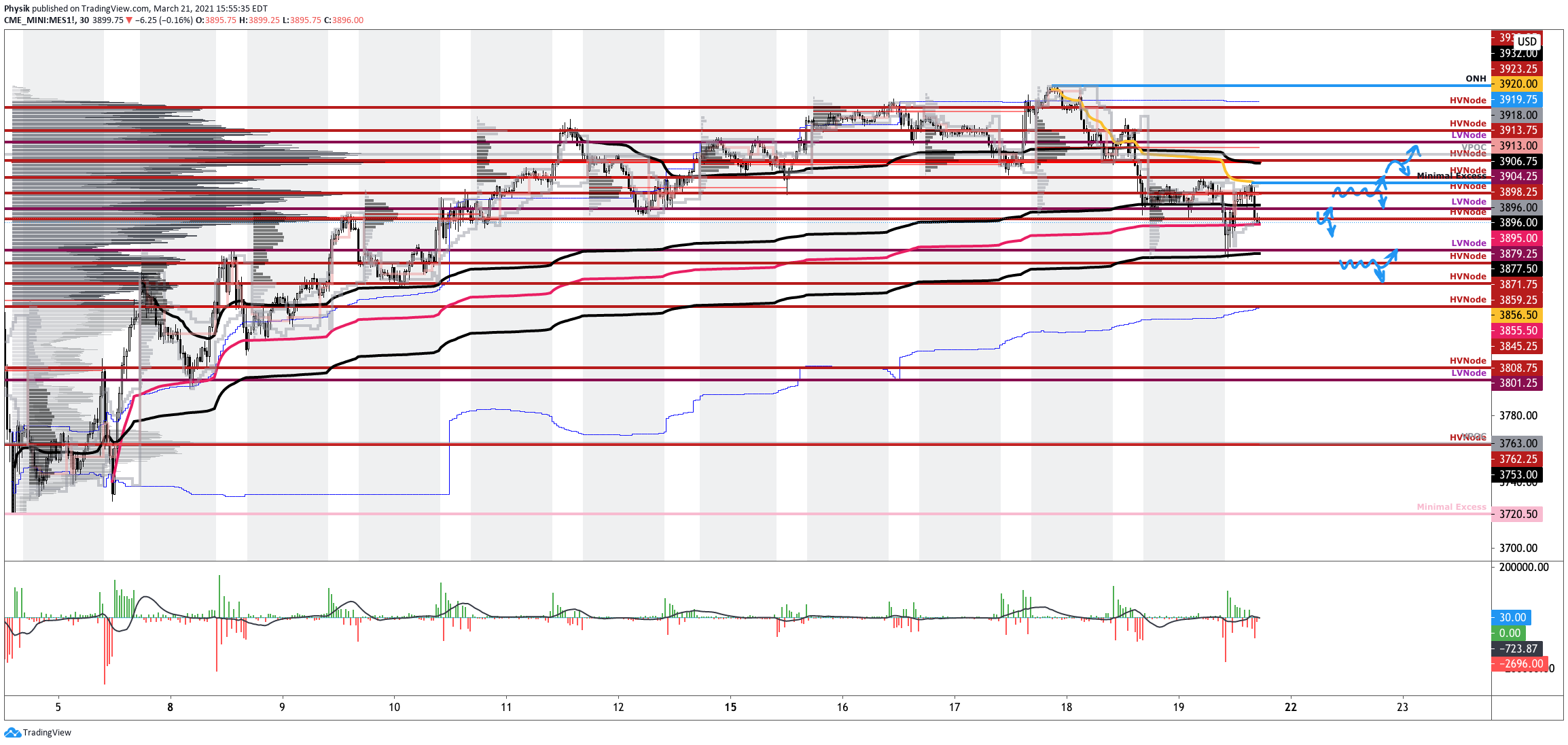
Profile overlays on a 15-minute candlestick chart of the Micro E-mini S&P 500 Futures.
Categories
Commentary

Market Commentary For The Week Ahead: ‘Mostly Sunny’

Key Takeaways:

  • $1.9T relief package is enacted.
  • Inflation to print past Fed goal.
  • Policy actions to limit volatility.
  • Potential for late-March selling.
  • Bond, equity volatility diverged.
  • U.S. to lead economic recovery.

What Happened: U.S. stock index futures closed higher, last week.

This came alongside (1) the enactment of a massive, $1.9 trillion coronavirus relief plan, (2) convergence in the 10-year Treasury rate and S&P 500 dividend yield, as well as (3) a material divergence in bond and equity market volatility.

What Does It Mean: The pandemic disrupted the global economy, hitting the hardest airlines, leisure facilities, energy, manufacturing, and restaurants, among other industries.

The stock market tumbled, as a result, and the subsequent recovery was lead by technology, which delivered its strongest annual average return since the Global Financial Crisis (GFC).

Now, as virus case counts fall, the pace of vaccinations accelerates, and massive coronavirus relief bills are passed, shares of stocks in beaten-down industries are becoming favorites.

This reopening trade, as it’s called, comes alongside projections the U.S. will lead the 2021 global economic recovery.

Amidst the bullishness, the yield on a 10-year Treasury, a risk-free asset, which was — per Axios — “artificially depressed by the flight-to-quality trade during the coronavirus pandemic, as well as by large-scale purchases by the Federal Reserve,” converged with S&P 500’s dividend yield. 

Graphic 1: Goldman Sachs Group Inc (NYSE: GS) projects yields to rise and the curve to steepen.

Typically, the S&P 500’s dividend yield is less than the risk-free rate because investors expect to earn less in dividends than they would holding the same amount in bonds, absent rising stock prices.

Values are derived using the discounted cash flow calculation; as interest and discount rates go up, the present value of future earnings goes down, which will drag stock prices, especially in growth categories, as evidenced by the Nasdaq-100’s relative weakness.

Graphic 2: Nordea Group expects inflation to print above the Federal Reserve’s target, soon.

Still, historically speaking, rising yields aren’t that harmful. Looking as far back as the 1960s, there are 13 periods in which the yield on a 10-year Treasury rose by at least 1.5%.

“In nearly 80% (10 of 13) of the prior periods, the S&P 500 Index posted gains as rates rose, as it has so far in the current rising-rate period,” a statement by LPL Financial said. “In fact, the average yearly gain for the index during the previous rising-rate periods, at 6.4%, is just a little lower than the historical average over the entire period of 7.1%, while rising rates have been particularly bullish for stocks since the mid-1990s.”

Further, despite an attempted pricing in of rising debt levels and inflation, a divergence in bond and equity market volatility persists.

Historically, fear across markets tends to move in tandem. That’s not the case today.

Graphic 3: Divergence in volatility across the bond and equity market. 

What To Expect: Balance, or two-sided trade as participants look for more information to base their next move on after last week’s rapid recovery.

Coming into the weekend, market liquidity suggested (1) buying pressure was leveling out and/or (2) buyers were absorbing resting liquidity (opportunistic selling or selling into strength), while speculative options activity was concentrated on the put-side. 

Graphic 4: Physik Invest maps out the purchase of call and put options in the SPDR S&P 500 ETF Trust (NYSE: SPY), for the week ending March 12, 2021. Activity in the options market was primarily concentrated in short- and long-dated tenors, in strikes as low as $353, which corresponds with $3,530.00 in the cash-settled S&P 500 Index (INDEX: SPX).

What To Do: In the coming sessions, participants will want to pay attention to the VWAP anchored from the $3,959.25 overnight rally-high, as well as the $3,840.00 high-volume area (HVNode).

Volume-Weighted Average Prices (VWAPs): Metrics highly regarded by chief investment officers, among other participants, for quality of trade. Additionally, liquidity algorithms are benchmarked and programmed to buy and sell around VWAPs.

More On Volume Areas: A structurally sound market will build on past areas of high-volume (HVNode). Should the market trend for long periods of time, it will lack sound structure (identified as a low-volume area (LVNode) which denotes directional conviction and ought to offer support on any test). 

If participants were to auction and find acceptance into areas of prior low-volume, then future discovery ought to be volatile and quick as participants look to areas of high-volume for favorable entry or exit.

More On Overnight Rally Highs (Lows): Typically, there is a low historical probability associated with overnight rally-highs (lows) ending the upside (downside) discovery process.

In the best case, the S&P 500 remains above the $3,840.00 volume area, and VWAP anchored from the $3,959.25 peak. This would suggest buyers, on average, are in control and winning since the February 15 rally-high.

Any activity below the VWAP anchored from the $3,959.25 peak may (1) leave the $3,840.00 HVNode as an area of supply, offering initiative sellers favorable entry and responsive buyers favorable exit.

Graphic 5: Profile overlays on a 30-minute candlestick chart of the Micro E-mini S&P 500 Futures.
Graphic 6: 4-hour profile chart of the Micro E-mini S&P 500 Futures.

Conclusions: The go/no-go level for next week’s trade is $3,840.00.

Any activity at this level suggests market participants are looking for more information to base their next move. Anything above (below) this level increases the potential for higher (lower). 

Levels Of Interest: $3,840.00 HVNode.

Photo by Aleksandar Pasaric from Pexels.

Categories
Commentary

Market Commentary For The Week Ahead: ‘Fast Moves’

Key Takeaways:

  • U.S. Senate passes a $1.9T relief package.
  • COVID vaccination timeline is sped up.
  • Equities are recipients of $12B in inflows.
  • Treasury yields aren’t at worrisome levels.
  • VIX term structure suggests no real panic.
  • Real GDP growth to be over 6% this year.

What Happened: U.S. stock index futures ended the week mixed.

This came after U.S. non-farm payrolls grew by 379,000, versus a consensus of ~180,000, improvement in sales and manufacturing data, as well as news that COVID-19 coronavirus vaccinations were accelerating.

Dynamics Unpacked: On a relative basis, the Nasdaq-100 is weaker, while the S&P 500, Russell 2000, and Dow Jones Industrial Average are stronger. This push-pull dynamic, in prior sessions, made it hard for participants to resolve directionally, evidenced by volatility.

On Friday, after an attempt by market participants to resolve lower, via a break of consolidation, stock indexes made a vicious rebound.

Why did stock indexes make a sudden reversal? Well, despite indexes being best positioned for sideways or lower trade, technically, near-term downside discovery reached its limit, based on market liquidity metrics and the inventory positioning of participants.

As stated in Friday’s morning commentary, according to SqueezeMetrics, the steepness of the GammaVol (GXV) curve suggested there was more risk to the upside than downside.

More On Gamma: Gamma is the sensitivity of an option to changes in the underlying price. Dealers that take the other side of options trades hedge their exposure to risk by buying and selling the underlying. When dealers are short-gamma, they hedge by buying into strength and selling into weakness. When dealers are long-gamma, they hedge by selling into strength and buying into weakness. The former exacerbates volatility. The latter calms volatility.
Graphic 1: SqueezeMetrics data suggested a near-term turnaround after Thursday’s violent liquidation.

Adding, also, coming into Friday’s session, market liquidity suggested (1) buying pressure was increasing and/or (2) sellers were absorbing resting liquidity (opportunistic buying or short covering into weakness), while speculative options activity was concentrated on the call-side.

In simple terms, one could argue, based on the aforementioned dynamics (e.g., speculative derivatives activity), that participants bought last week’s dip.

Graphic 2: Physik Invest maps out the purchase of call and put options in the SPDR S&P 500 ETF Trust (NYSE: SPY), for the week ending February 26, 2021. Noting activity in short- and long-dated tenors, near the $380, a strike that corresponds with $3,800.00 in the cash-settled S&P 500 Index (INDEX: SPX).

Important to note, though, is the S&P 500’s long-term trend break, prior to Friday’s dramatic reversal and higher close, as well as Friday’s divergent volume delta in ETFs that track the S&P 500, Nasdaq-100, and Russell 2000.

Graphic 3: Long-term uptrend in the cash-settled S&P 500 Index (INDEX: SPX) was broken.
More On Volume Delta: Buying and selling power as calculated by the difference in volume traded at the bid and offer.

What To Expect: Directional resolve and volatility, given news that the U.S. Senate, on Saturday, passed President Joe Biden’s $1.9 trillion COVID-19 coronavirus relief plan, as well as the (2) short-gamma (Graphic 4) environment (i.e, volatility is exacerbated due to dealer hedging requirements), as mentioned in the prior section.

Graphic 4: SpotGamma data suggests Nasdaq-100, the weakest index discussed in this commentary, is below the “Short-Gamma” juncture.

What To Do: In the coming sessions, participants will want to pay attention to the VWAP anchored from the $3,959.25 peak, the $3,720.50 minimal excess low, as well as the $3,837.75 high-volume area (HVNode).

Volume-Weighted Average Prices (VWAPs): Metrics highly regarded by chief investment officers, among other participants, for quality of trade. Additionally, liquidity algorithms are benchmarked and programmed to buy and sell around VWAPs.

More On Excess: A proper end to price discovery; the market travels too far while advertising prices. Responsive, other-timeframe (OTF) participants aggressively enter the market, leaving tails or gaps which denote unfair prices.

More On Volume Areas: A structurally sound market will build on past areas of high-volume (HVNode). Should the market trend for long periods of time, it will lack sound structure (identified as a low-volume area (LVNode) which denotes directional conviction and ought to offer support on any test). 

If participants were to auction and find acceptance into areas of prior low-volume, then future discovery ought to be volatile and quick as participants look to areas of high-volume for favorable entry or exit.

In the best case, the S&P 500 opens and remains above the $3,837.75 volume area. Auctioning above the VWAP anchored from the $3,959.25 peak would suggest buyers, on average, are in control and winning since the February 15 rally high.

In such a case, participants can look to the $3,892.75 HVNode for favorable entry and exit, the $3,934.25 profile ledge, and $3,959.25 overnight rally-high.

More On Ledges: Flattened area on the profile which suggests responsive participants are in control, or initiative participants lack confidence to continue the discovery process. The ledge will either hold and force participants to liquidate (cover) their positions, or crack and offer support (resistance).

More On Overnight Rally Highs (Lows): Typically, there is a low historical probability associated with overnight rally-highs (lows) ending the upside (downside) discovery process.

Any activity below the VWAP anchored from the $3,959.25 peak may leave the $3,837.75 HVNode as an area of supply — offering initiative sellers favorable entry and responsive buyers favorable exit.

In such a case, participants can look to other areas of high-volume (i.e., $3,795.75 and $3,727.75) for favorable entry and exit, as well as the repair of the $3,720.50 minimal excess low.

Graphic 5: Profile overlays on a 65-minute candlestick chart of the Micro E-mini S&P 500 Futures.
Graphic 6: 4-hour chart of the Micro E-mini S&P 500 Futures.

Conclusions: The go/no-go level for next week’s trade is $3,837.75.

Any activity at this level suggests market participants are looking for more information to base their next move. Anything above (below) this level increases the potential for higher (lower). 

Levels Of Interest: $3,837.75 HVNode.

Cover photo by Chris Peeters from Pexels.