Categories
Commentary

Daily Brief For July 22, 2021

Market Commentary

Equity index futures trade higher as volatility implodes. Yields, commodities are higher, too. 

  • President Biden played down inflation.
  • Ahead: Claims, home sales, earnings.
  • Equity indices up on fantastic breadth.

What Happened: U.S. stock index futures auctioned higher alongside comments against inflation by President Joe Biden, yesterday. Virus fears ebbed as infections accelerated. 

Bitcoin extended its advance after Elon Musk, Catherine Wood, and Jack Dorsey talked cryptocurrency at a virtual event.

Ahead is data on weekly jobless claims, existing home sales, and corporate earnings. 
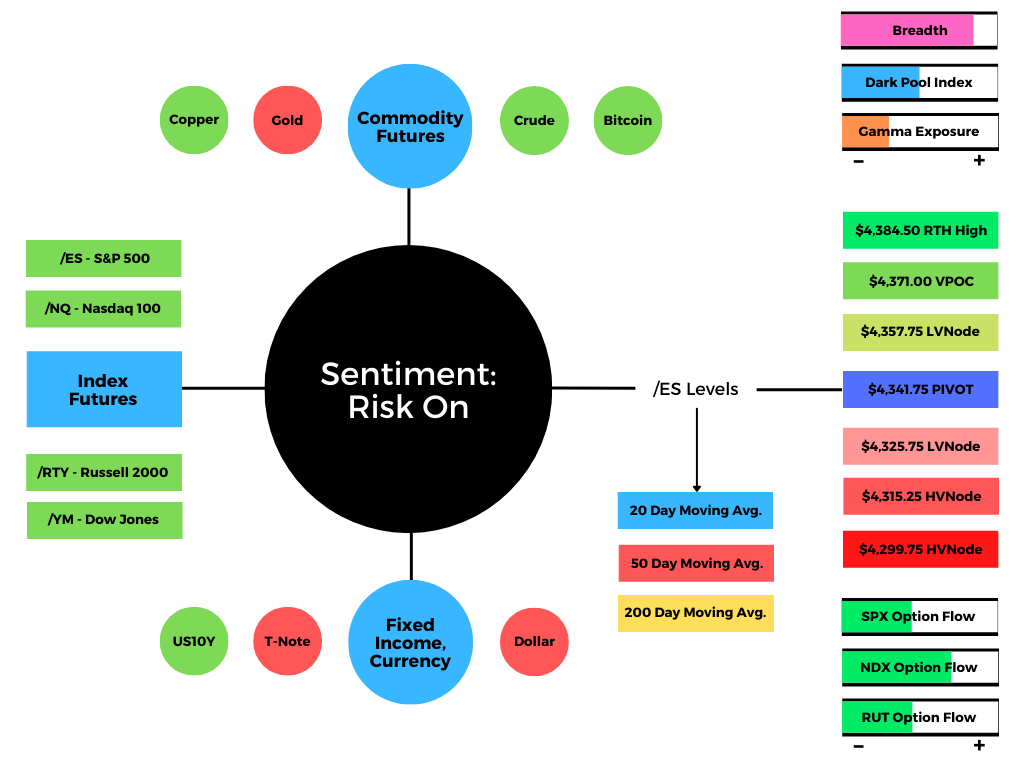
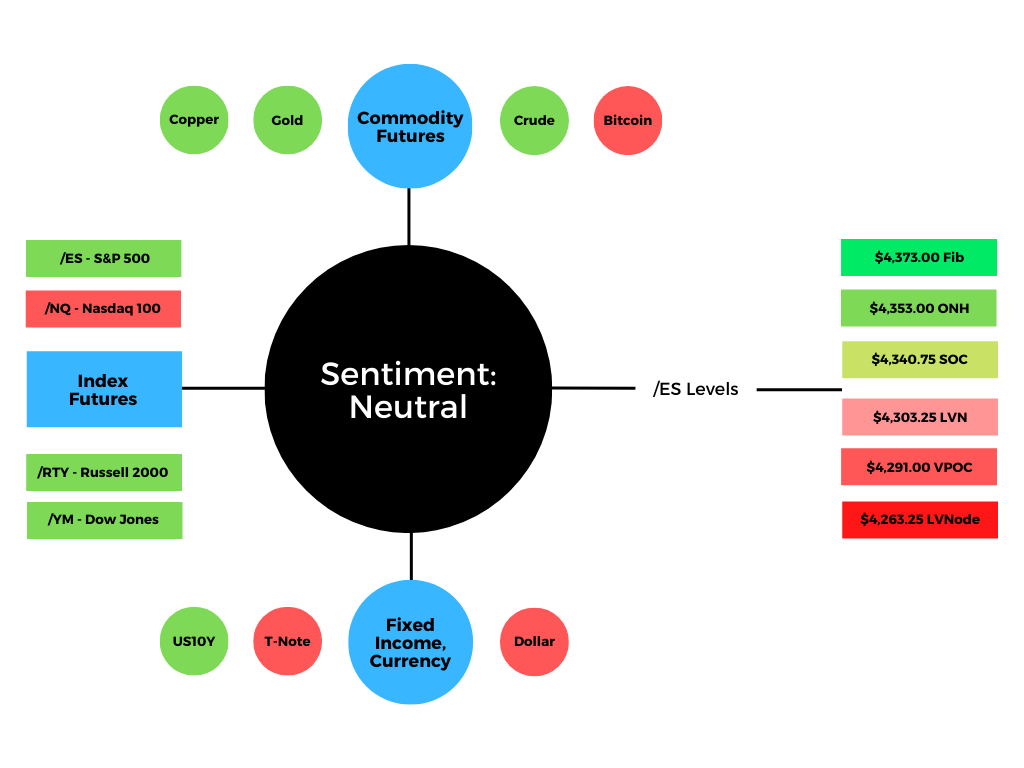
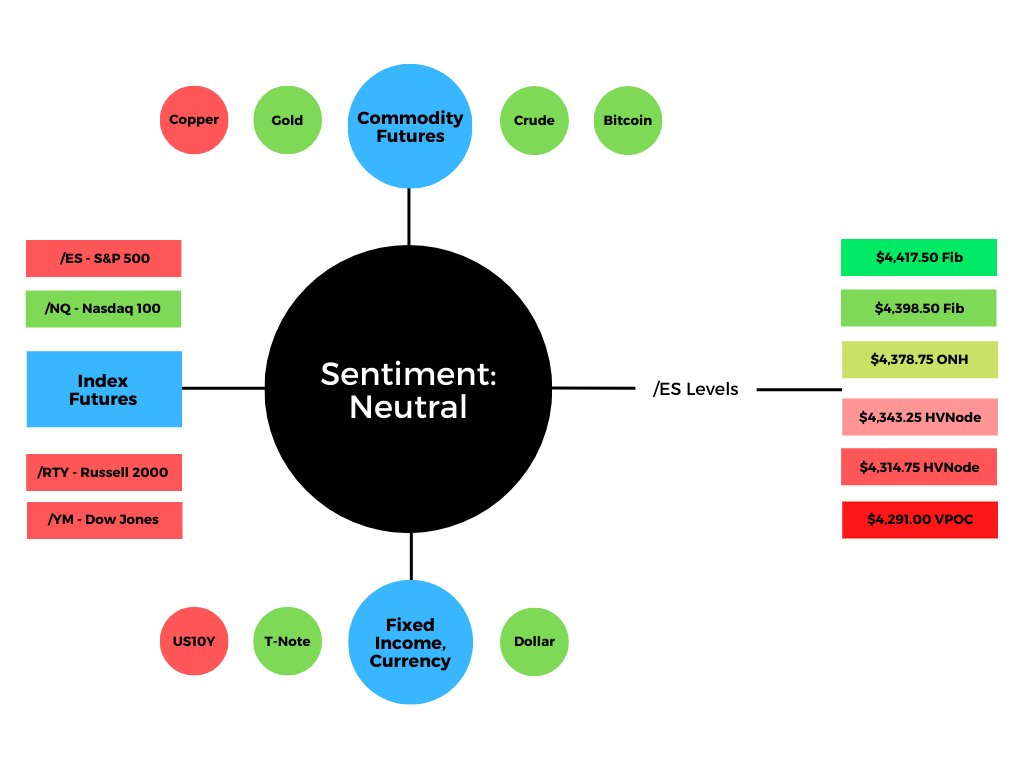
Graphic updated 6:30 AM ET. Sentiment Risk-On if expected /ES open is above the prior day’s range. See here for more on the Dark Pool Index and Gamma. A positive Dark Pool Index reading is bullish. At the same time, the higher (lower) the gamma, the less (more) volatility. SHIFT Search data used for options activity. Note that options flow is sorted by the call premium spent; if green and more (less) positive then more (less) was spent on call options. Breadth reflects a reading of the prior day’s Advance/Decline indicator.

What To Expect: As of 6:30 AM ET, Thursday’s regular session (9:30 AM – 4:00 PM EST) in the S&P 500 will likely open on a small gap, just outside of prior-range and -value, suggesting a potential for immediate directional opportunity.

Balance-Break and/or Gap Scenarios: Monitor for acceptance (i.e., more than 1-hour of trade) outside of the balance area.

Gaps ought to fill quickly. Should they not, that’s a signal of strength; do not fade. Leaving value behind on a gap-fill or failing to fill a gap (i.e., remaining outside of the prior session’s range) is a go-with indicator.

Auctioning and spending at least 1-hour of trade back in the prior range suggests a lack of conviction; in such a case, do not follow the direction of the most recent initiative activity.

Adding, during the prior day’s regular trade, the best case outcome occurred, evidenced by trade above the $4,334.25 spike base. As that happened, participants found increased acceptance at higher prices, moving the micro-composite Point of Control (MCPOC) up to $4,341.75, a pivot point (i.e., above = bullish, below = bearish) for today’s trade. This is noteworthy since it suggests the fairest price to do business, on a larger timeframe, is higher. 

At the same time, in support of the price rise was fantastic breadth and dynamics with respect to the derivatives market; amidst a crash in volatility, associated hedging activities bolster the rally. 

Coming into the balance-area sellers initiated from the weak prior, however, certain mechanics may quell the upside volatility, potentially leading to a stall or slower advance. 
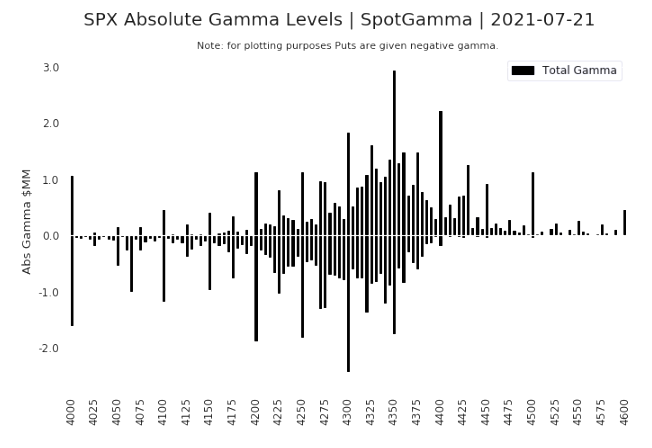
Graphic: SpotGamma data suggests the S&P 500 is back in so-called “long-gamma” territory. Gamma is the sensitivity of an option to changes in the underlying price. Dealers that take the other side of options trades hedge their exposure to risk by buying and selling the underlying. When dealers are short-gamma, they hedge by buying into strength and selling into weakness. When dealers are long-gamma, they hedge by selling into strength and buying into weakness. The former exacerbates volatility. The latter calms volatility.

Moreover, for today, participants can trade from the following frameworks. 

In the best case, the S&P 500 trades sideways or higher; activity above the $4,341.75 MCPOC puts participants just short of entry into a prior balance area, near the $4,357.75 low volume area (LVNode). Initiative trade beyond the $4,357.75 LVNode could reach as high as the $4,371.00 POC and $4,384.50 minimal excess regular trade high (RTH), the typical scenario on re-entry into balance. 

In the worst case, the S&P 500 trades lower; activity below the $4,341.75 MCPOC puts in play the $4,325.75 LVNode. Initiative trade beyond the $4,325.75 LVNode could reach as low as the $4,315.25 and $4,299.75 high volume areas (HVNodes). 

It is important to note also that the prior two HVNodes correspond with key Volume Weighted Average Price (VWAP) levels, a metric highly regarded by chief investment officers, among other participants, for quality of trade. Additionally, liquidity algorithms are benchmarked and programmed to buy and sell around VWAPs.

Balance (Two-Timeframe Or Bracket): Rotational trade that denotes current prices offer favorable entry and exit. Balance-areas make it easy to spot a change in the market (i.e., the transition from two-time frame trade, or balance, to one-time frame trade, or trend).

POCs: POCs are valuable as they denote areas where two-sided trade was most prevalent. Participants will respond to future tests of value as they offer favorable entry and exit.

Volume Areas: A structurally sound market will build on past areas of high volume. Should the market trend for long periods of time, it will lack sound structure (identified as a low volume area which denotes directional conviction and ought to offer support on any test). 

If participants were to auction and find acceptance into areas of prior low volume, then future discovery ought to be volatile and quick as participants look to areas of high volume for favorable entry or exit.

Excess: A proper end to price discovery; the market travels too far while advertising prices. Responsive, other-timeframe (OTF) participants aggressively enter the market, leaving tails or gaps which denote unfair prices.
Graphic: 65-minute profile chart of the Micro E-mini S&P 500 Futures. Updated 6:30 AM ET.

News And Analysis

Strong job and real estate markets support credit. (Moody’s)

Federal Reserve ramps up debate on taper timing. (WSJ)

China offers oil reserves in a move to cool oil rally. (BBG)

Biden dismisses inflation worries, warns on hiring. (BBG)

U.S.-China goods trade booms amid virus, tariffs. (BBG)

Powell has broad support among top Biden aides. (BBG)

PG&E plans to bury power lines in fire-risk areas. (WSJ)

EMEA economies recovering faster than thought. (S&P)

Structured finance sees issuances rising to $1.4T. (S&P)

What People Are Saying

About

After years of self-education, strategy development, and trial-and-error, Renato Leonard Capelj began trading full-time and founded Physik Invest to detail his methods, research, and performance in the markets. Additionally, Capelj is a finance and technology reporter. Some of his biggest works include interviews with leaders such as John Chambers, founder and CEO, JC2 Ventures, Kevin O’Leary, businessman and Shark Tank host, Catherine Wood, CEO and CIO, ARK Invest, among others.

Disclaimer

At this time, Physik Invest does not manage outside capital and is not licensed. In no way should the materials herein be construed as advice. Derivatives carry a substantial risk of loss. All content is for informational purposes only.

Categories
Commentary

Daily Brief For July 21, 2021

Market Commentary

Equity index futures sideways to higher overnight. 

  • Pandemic continues to accelerate.
  • Ahead is oil market data, earnings.
  • Indices sideways as volatility ebbs.

What Happened: U.S. stock index futures auctioned sideways to higher alongside an increased spread of COVID-19 variants, earnings, and tremendous bond market volatility.

The trade comes also as leading indicators for global economic growth show unusually strong readings, according to Merrill, “pointing to one of the strongest economic expansions of the past 70 years.” In line, strategists at JPMorgan Chase & Co (NYSE: JPM) revised higher their year-end S&P 500 price target from $4,400 to $4,600. 

Ahead, participants are looking forward to data on oil market inventory and earnings.

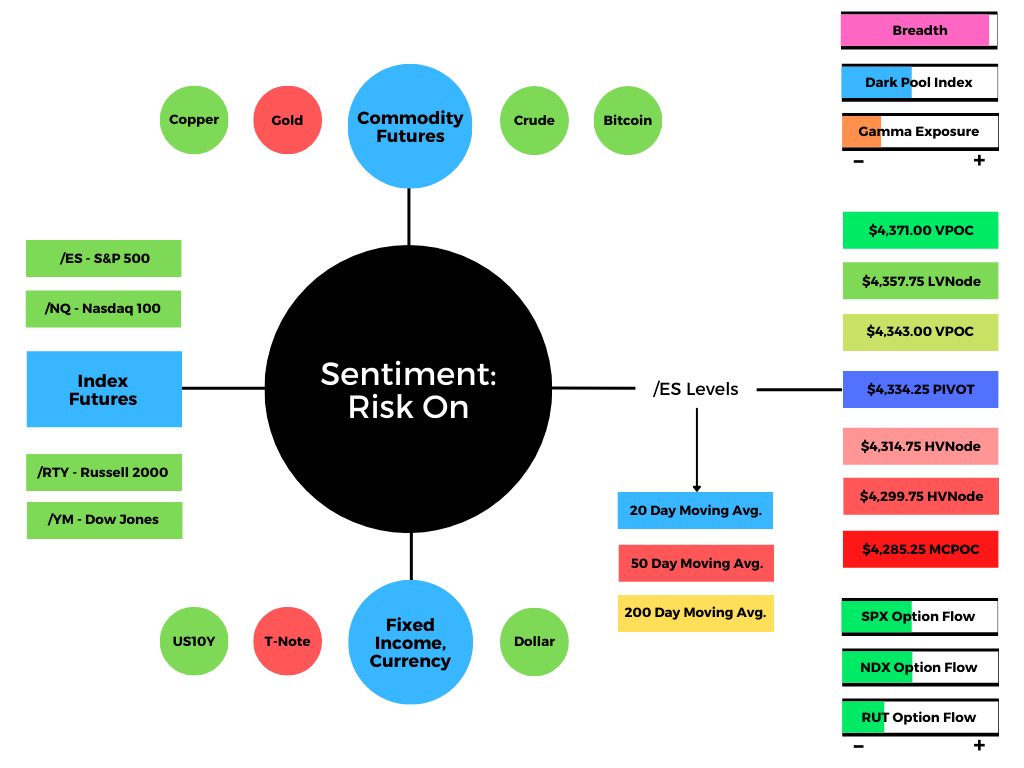
Graphic updated 6:30 AM ET. Sentiment Risk-On if expected /ES open is above the prior day’s range. A positive Dark Pool Index reading is bullish. At the same time, the higher (lower) the gamma, the less (more) volatility. SHIFT Search data used for options activity. Note that options flow is sorted by the call premium spent; if green and more (less) positive then more (less) was spent on call options. Breadth reflects a reading of the prior day’s Advance/Decline indicator.

What To Expect: As of 6:30 AM ET, Wednesday’s regular session (9:30 AM – 4:00 PM EST) in the S&P 500 will likely open on a small gap, just outside of prior-range and -value, suggesting a potential for directional opportunity.

Balance-Break and/or Gap Scenarios: Monitor for acceptance (i.e., more than 1-hour of trade) outside of the balance area.

Gaps ought to fill quickly. Should they not, that’s a signal of strength; do not fade. Leaving value behind on a gap-fill or failing to fill a gap (i.e., remaining outside of the prior session’s range) is a go-with indicator.

Auctioning and spending at least 1-hour of trade back in the prior range suggests a lack of conviction; in such a case, do not follow the direction of the most recent initiative activity.

Adding, during the prior day’s regular trade, the best case outcome occurred, evidenced by trade above the $4,285.25 micro-composite Point of Control (MCPOC). This is significant because it denotes movement above the fairest price to do business since the June 20 swing low. Now, initiative sellers have a clear line in the sand – $4,285.25 – when it comes to making headway into areas of demand.

Further, the near-vertical price rise wasn’t without a warrant.

After breaking down, the S&P 500 came to a micro-composite LVNode and halted. Thereafter, prices rebounded. Why was this? Stock indexes were positioned for a vicious rebound as near-term downside discovery may have reached a limit, based on market liquidity metrics and the inventory positioning of participants. 

According to SqueezeMetrics, the steepness of the GammaVol (GXV) curve suggested there was more risk to the upside than the downside, at that S&P 500 juncture.

Given this metric, strong breadth, and positive delta, as well as the resolve of a Volume Weighted Average Price (VWAP) pinch, the S&P 500 is positioned for higher.

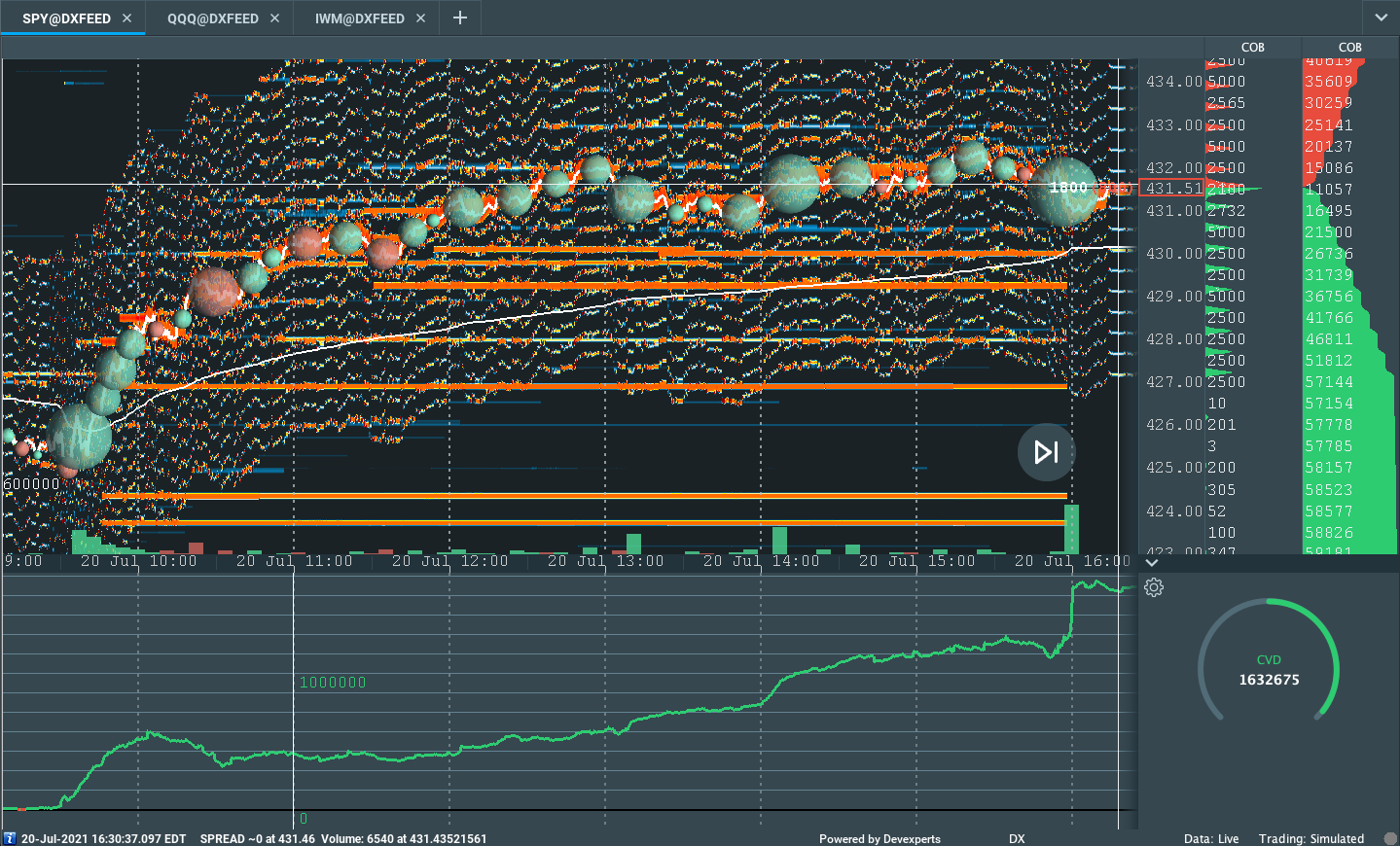
Graphic: SPDR S&P 500 ETF Trust (NYSE: SPY) market liquidity, via Bookmap. Note the supportive volume delta, a measure of buying and selling power as calculated by the difference in volume traded at the bid and offer.
Volume-Weighted Average Prices (VWAPs): A metric highly regarded by chief investment officers, among other participants, for quality of trade. Additionally, liquidity algorithms are benchmarked and programmed to buy and sell around VWAPs.

For today, participants can trade from the following frameworks.

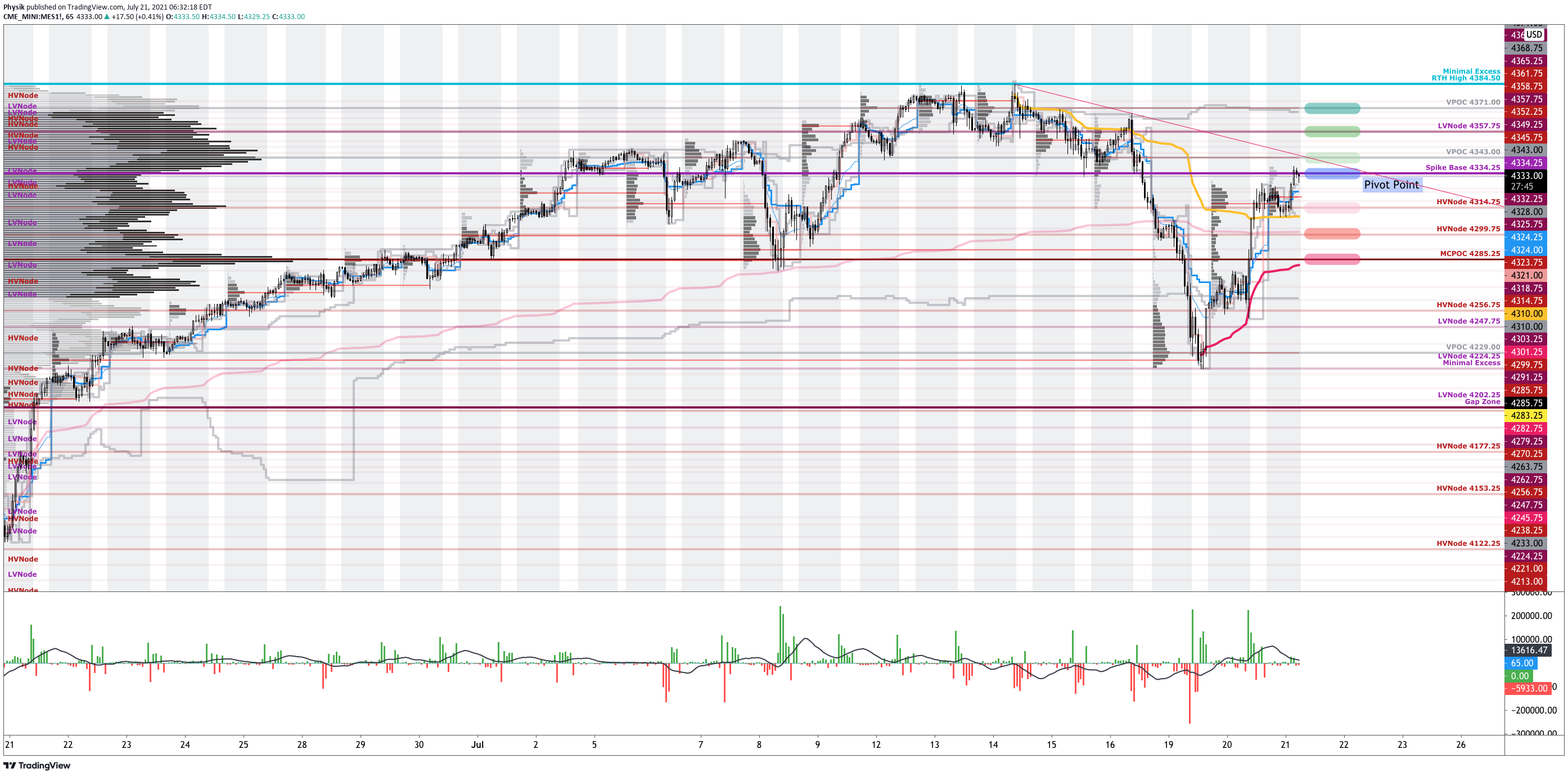
In the best case, the S&P 500 trades sideways or higher; activity above the $4,334.25 spike base puts in play the $4,343.00 untested Point of Control (VPOC). Initiative trade beyond the VPOC could reach as high as the $4,357.75 low volume area (LVNode) and $4,371.00 VPOC.

In the worst case, the S&P 500 trades lower; activity below the $4,334.25 spike base puts in play the $4,314.75 HVNode. Initiative trade beyond the $4,314.75 HVNode could reach as low as the $4,299.75 HVNode and $4,285.25 micro-composite POC.

Spikes: Spike’s mark the beginning of a break from value. Spikes higher (lower) are validated by trade at or above (below) the spike base (i.e., the origin of the spike).

POCs: POCs are valuable as they denote areas where two-sided trade was most prevalent. Participants will respond to future tests of value as they offer favorable entry and exit.

Volume Areas: A structurally sound market will build on past areas of high volume. Should the market trend for long periods of time, it will lack sound structure (identified as a low volume area which denotes directional conviction and ought to offer support on any test). 

If participants were to auction and find acceptance into areas of prior low volume, then future discovery ought to be volatile and quick as participants look to areas of high volume for favorable entry or exit.
Graphic: 65-minute profile chart of the Micro E-mini S&P 500 Futures.

News And Analysis

Work-in-progress U.S. infrastructure bill faces test in Senate. (REU)

Housing starts continuing to improve as permits lose ground. (MND)

Nasdaq to spin out market for pre-IPO shares in a bank deal. (WSJ)

Decentralized finance builds on three major waves of bitcoin. (Future)

Startups on a record acquisition spree buying other startups. (CBN)

U.S. and European consumer confidence and spending rise. (Moody’s)

Titan – Fidelity for Millennials – raised $58M Series B round. (CBN)

Survey showing U.S. majority supports more tech regulation. (Axios)

What People Are Saying

About

After years of self-education, strategy development, and trial-and-error, Renato Leonard Capelj began trading full-time and founded Physik Invest to detail his methods, research, and performance in the markets. Additionally, Capelj is a finance and technology reporter. Some of his biggest works include interviews with leaders such as John Chambers, founder and CEO, JC2 Ventures, Kevin O’Leary, businessman and Shark Tank host, Catherine Wood, CEO and CIO, ARK Invest, among others.

Disclaimer

At this time, Physik Invest does not manage outside capital and is not licensed. In no way should the materials herein be construed as advice. Derivatives carry a substantial risk of loss. All content is for informational purposes only.
Categories
Commentary

Daily Brief For July 13, 2021

Market Commentary

U.S. equity index futures diverge overnight.

  • Ahead: Inflation, earnings, Fed speak.
  • SPX, RUT, DJI lower. NDX firming up.

What Happened: U.S. stock index futures traded in different directions.

The S&P 500, Russell 2000, and Dow Jones Industrial Average traded relatively weak, in comparison to the technology and growth-focused Nasdaq 100. 

This rotation is likely attributable to technical factors – issuance, short coverings, a fading reflation trade, and peak growth pushing lower Treasury yields – as well as the upcoming monthly options expiration and pre-earnings positioning.

Ahead is data on inflation and earnings with some Fed speak around noon Eastern time. 

Graphic updated 7:20 AM ET.

What To Expect: Tuesday’s regular session (9:30 AM – 4:00 PM EST) in the S&P 500 will likely open inside of prior-range and -value, suggesting a limited potential for immediate directional opportunity.

Adding, during the prior day’s regular trade, the best case outcome occurred, evidenced by initiative trade up to the $4,373.00 Fibonacci-derived price target. 

This price exploration comes amidst a divergence. As noted, the Nasdaq 100 is trading relatively strong in comparison to the S&P, Russell, and Dow. The holding pattern is not only attributable to positioning ahead of the monthly options expiration (OPEX), but second-quarter earnings, inflation expectations, and the like. 

Options Expiration (OPEX): Option expiries mark an end to pinning (i.e, the theory that market makers and institutions short options move stocks to the point where the greatest dollar value of contracts will expire worthless) and the reduction dealer gamma exposure.

“The broad markets are settling back and awaiting U.S. inflation,” said Sebastien Galy, a senior macro strategist at Nordea Investment Funds SA. “We view the environment as one of gestation as earnings come in, before the risk-taking trend starts again, though a higher U.S. inflation print could create a temporary setback.”

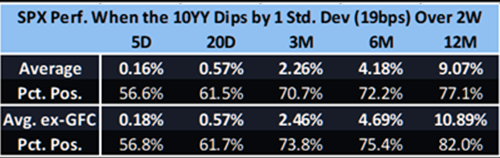
That said, the dip in the 10-year Treasury yield is not all too concerning. 

Graphic: S&P 500 performance when 10-year Treasury yield slides via The Market Ear.

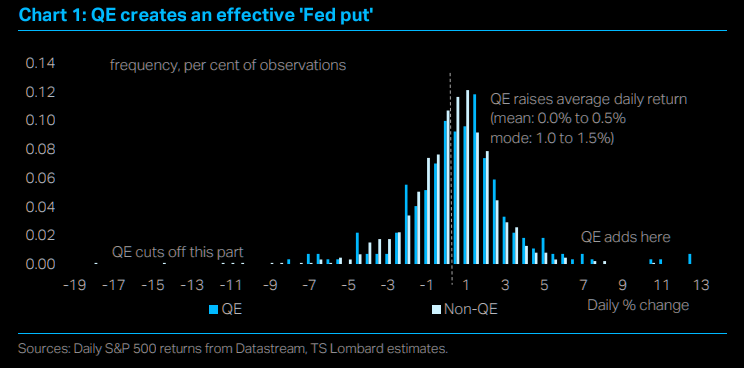
Obviously, that’s just one data point. Another consideration is the unwind of certain stimulus measures, like quantitative easing (QE) which shifts the returns distribution right.

Graphic: Impact of QE on S&P 500 returns via The Market Ear

Knowing the above, for today, participants can trade from the following frameworks. 

In the best case, the S&P 500 trades sideways or higher; activity above the $4,365.75 low volume area (LVNode) pivot puts in play the $4,378.75 minimal excess overnight high (ONH). Thereafter, if higher, the $4,398.50 and $4,417.50 Fibonacci price extensions come into play.

In the worst case, the S&P 500 trades lower; activity below $4,365.75 puts in play the $4,343.25 high volume area (HVNode). Initiative trade beyond the HVNode could reach as low as the $4,314.75 HVNode and $4,291.00 untested Point of Control (POC).

Volume Areas: A structurally sound market will build on past areas of high volume. Should the market trend for long periods of time, it will lack sound structure (identified as a low volume area which denotes directional conviction and ought to offer support on any test). 

If participants were to auction and find acceptance into areas of prior low volume, then future discovery ought to be volatile and quick as participants look to areas of high volume for favorable entry or exit.

Excess: A proper end to price discovery; the market travels too far while advertising prices. Responsive, other-timeframe (OTF) participants aggressively enter the market, leaving tails or gaps which denote unfair prices.

Overnight Rally Highs (Lows): Typically, there is a low historical probability associated with overnight rally-highs (lows) ending the upside (downside) discovery process.

POCs: POCs are valuable as they denote areas where two-sided trade was most prevalent. Participants will respond to future tests of value as they offer favorable entry and exit.
Graphic: 65-minute profile chart of the Micro E-mini S&P 500 Futures.
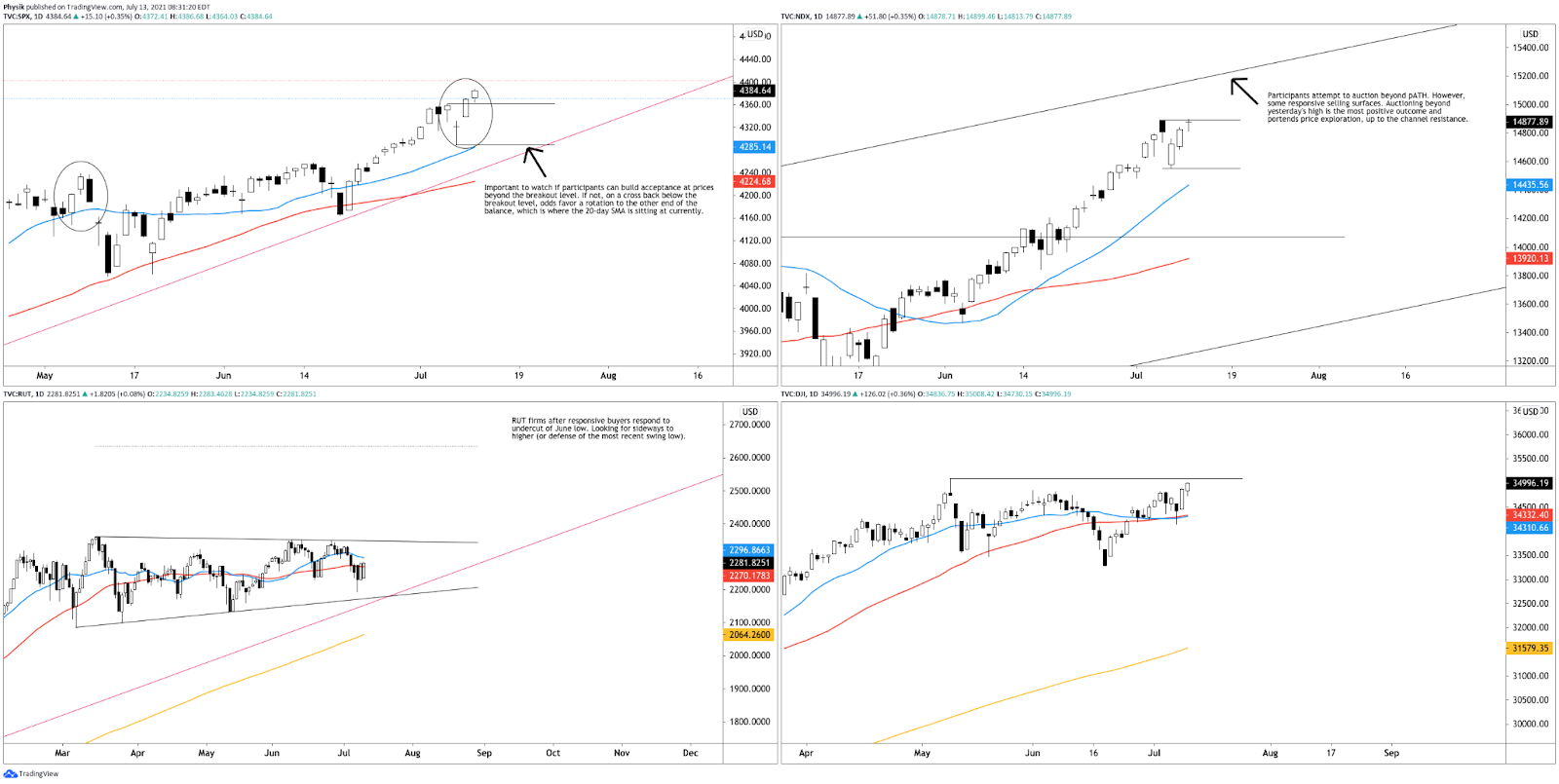
Graphic: Daily candlestick charts of the S&P 500 (top left), Nasdaq 100 (top right), Russell 2000 (bottom left), and Dow Jones Industrial Average (bottom right).
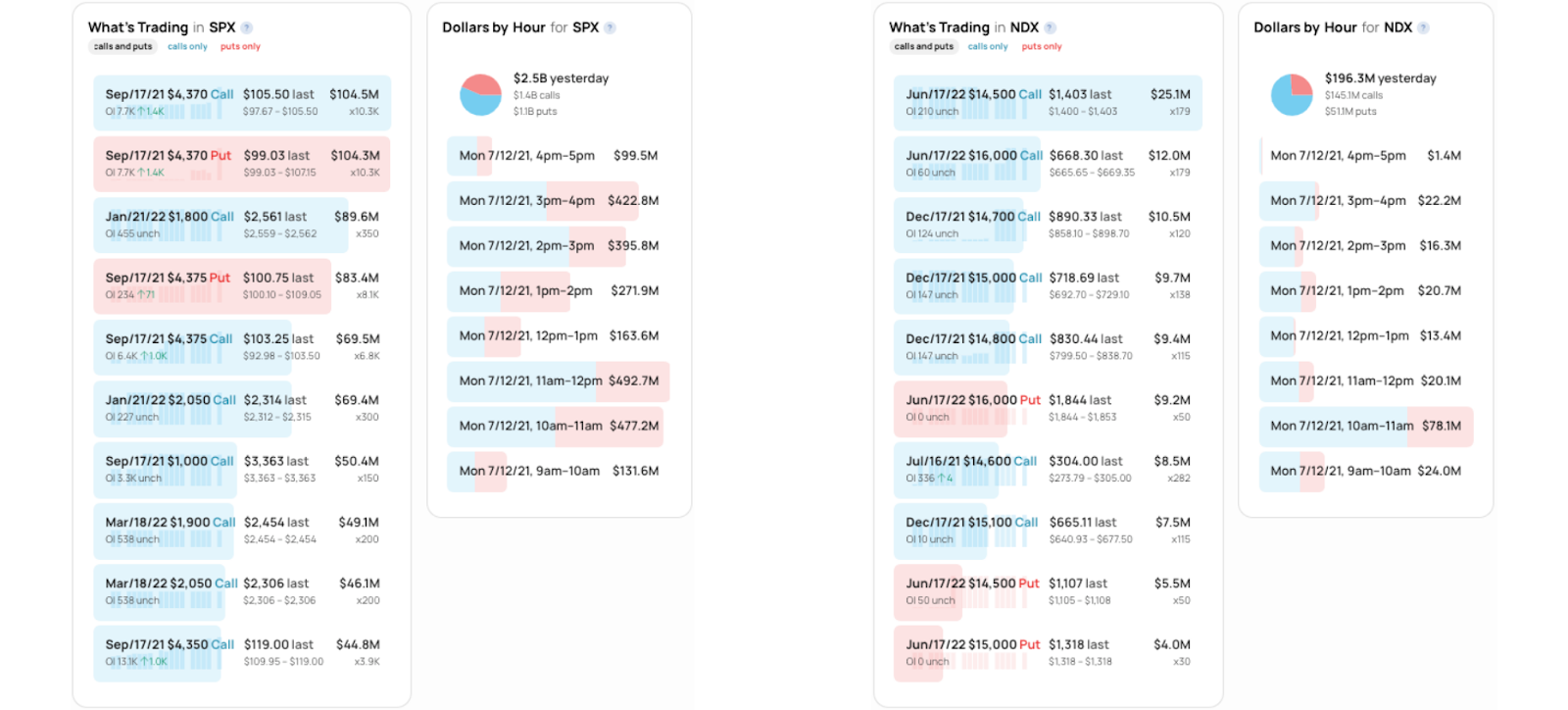
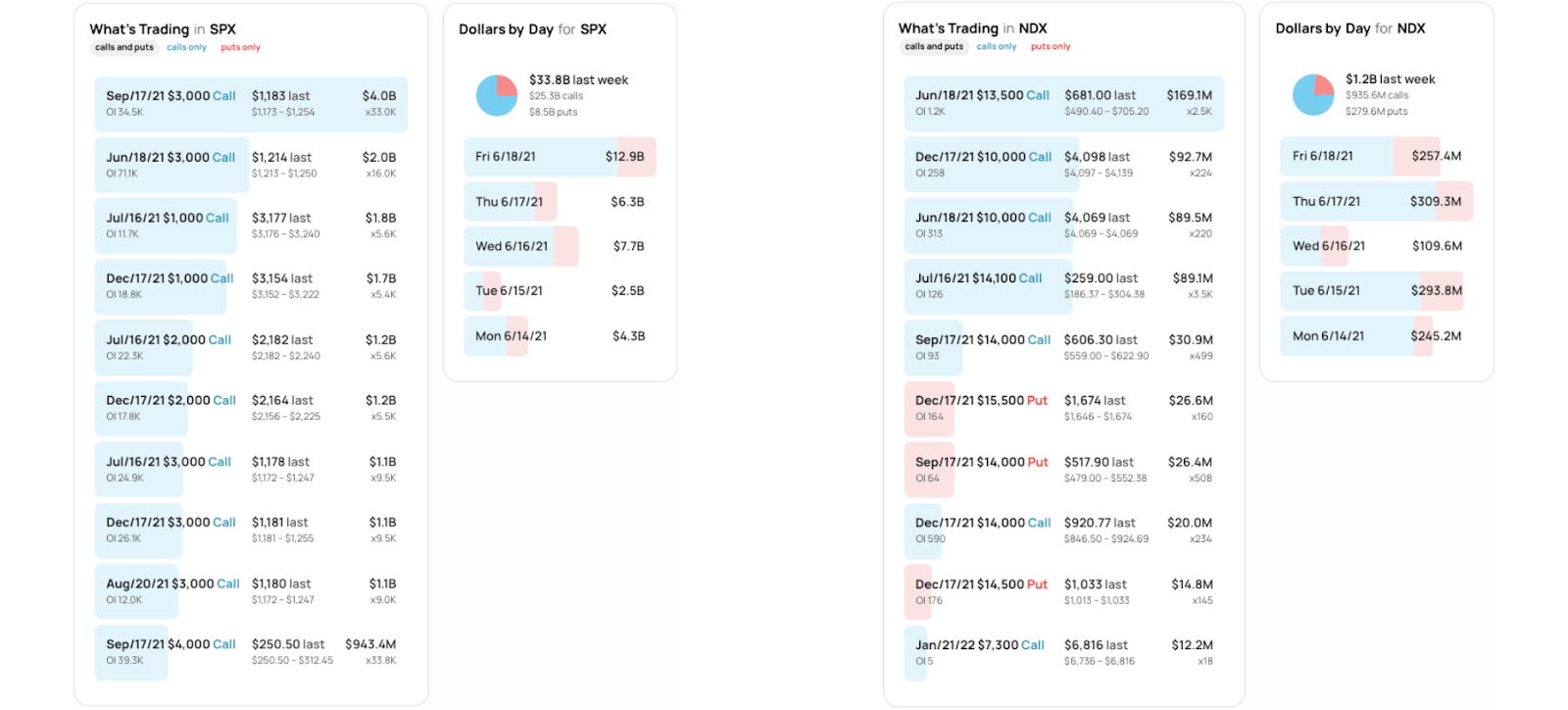
Graphic: SHIFT search suggests participants were most interested in call strikes at and below the price in the cash-settled S&P 500 (INDEX: SPX) and Nasdaq 100 (INDEX: NDX), yesterday. Noting, yesterday and over the past few weeks, there’s been increased activity in long-dated put options. 

News And Analysis

Economy | Yellen sees U.S. companies pushing back global tax deal. (BBG)

Energy | OPEC+ impasse risks price war as demand keeps surging. (REU)

Politics | Biden team mulls digital trade deal to counter China in Asia. (BBG)

Politics | Biden to warn companies of risks of operating in Hong Kong. (FT)

Markets | Boeing cutting 787 production on new structural problems. (REU)

Markets | Goldman dealmakers’ bumper quarter counters trade slump. (BBG)

Markets | JPM fell amid climbing expenses, loan growth expectations. (BBG)

Economy | PBOC said monetary policy unchanged despite RRR cut. (BBG)

FinTech | FTX deal provides institutions new access to crypto market. (BBG)

What People Are Saying

About

Renato founded Physik Invest after going through years of self-education, strategy development, and trial-and-error. His work reporting in the finance and technology space, interviewing leaders such as John Chambers, founder, and CEO, JC2 Ventures, Kevin O’Leary, businessman and Shark Tank host, Catherine Wood, CEO and CIO, ARK Invest, among others, afforded him the perspective and know-how very few come by.

Having worked in engineering and majored in economics, Renato is very detailed and analytical. His approach to the markets isn’t built on hope or guessing. Instead, he leverages the unique dynamics of time and volatility to efficiently act on opportunity.

Disclaimer

At this time, Physik Invest does not manage outside capital and is not licensed. In no way should the materials herein be construed as advice. Derivatives carry a substantial risk of loss. All content is for informational purposes only.
Categories
Commentary

Weekly Brief For July 11, 2021

Market Commentary

Key Takeaways: U.S. equity index futures diverge in their attempt to discover fair prices for two-sided trade. 

  • Ahead: Economic data and earnings.
  • SPX, RUT, DJI firm. NDX tad weaker. 

What Happened: Last week, U.S. stock index futures auctioned sideways to higher, only after enduring a brief liquidation alongside anxieties surrounding the spread of COVID-19 variants, as well as an evolution in monetary policy. 

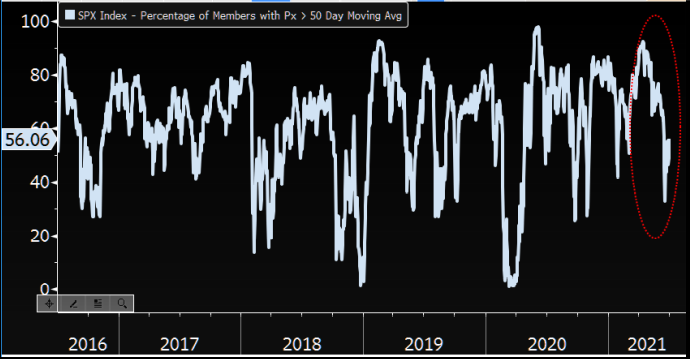
The liquidation, though, was not unwarranted. For weeks broad market indices, led by the Nasdaq 100, rose on narrowing breadth and tapering volumes.

Graphic: Breadth metrics from JPMorgan Chase & Co (NYSE: JPM), via The Market Ear.

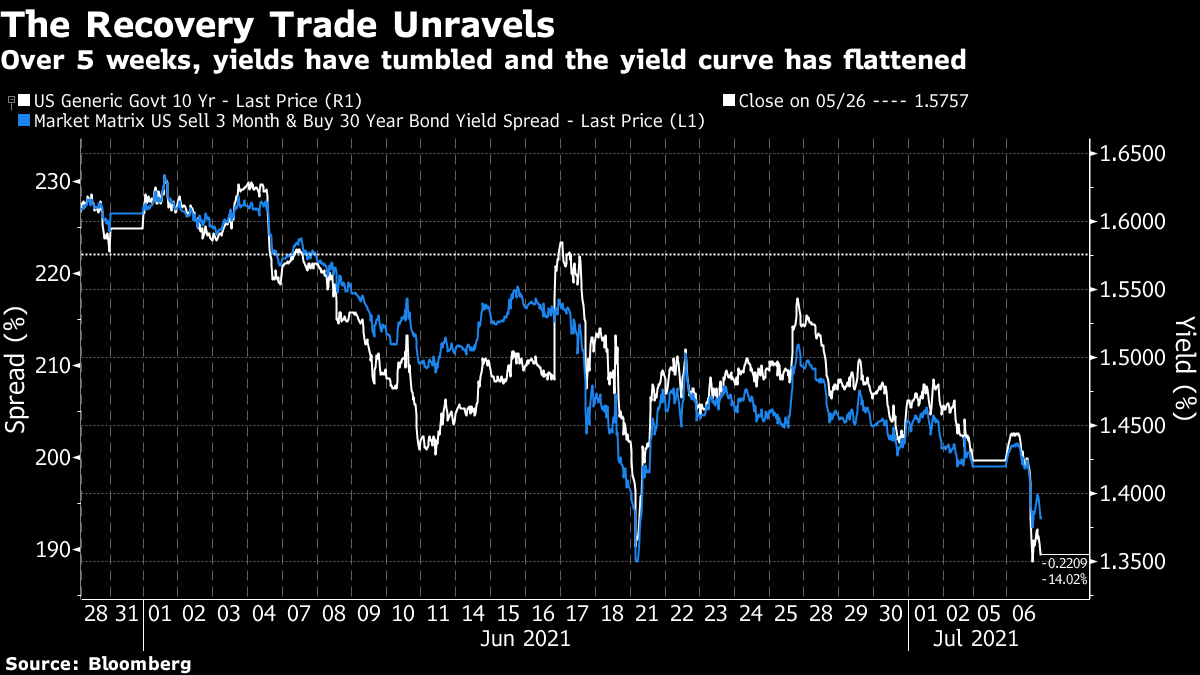
Then, during the unraveling, a meaningful divergence was observed with the Nasdaq 100 trading relatively weak. This came as rates on the 10 Year T-Note rebounded after testing trend support near 1.25%.

Graphic: In line with projections future inflation is easing, the yield curve flattened while bond yields fall substantially, via Bloomberg

Technical factors – issuance, short coverings, a fading reflation trade, and peak growth – are to blame for lower Treasury yields.

“Technical factors appear to be pushing rates lower and this should be temporary as current 10-year Treasury yield of 1.3% is well below its economic fair value,” Moody’s Corporation (NYSE: MCO) strategists wrote July 8. 

Through an ordinary least squares regression using an estimate of monthly real U.S. GDP, CPI, the current effective fed funds rate, the Fed’s balance sheet as a share of nominal GDP, and a Fed bias measure via fed funds futures, Moody’s comes up with an implied “economic fair value” of 1.6% and 1.65% for the 10-year yield.

Going into year-end, on the heels of the strongest and quickest recovery in history, Moody’s sees the 10-year rising to 1.9% as the Fed announces its intent to taper in September. Once monthly asset purchases have been reduced to zero, “the Fed will reinvest proceeds from maturing assets to ensure its balance sheet doesn’t contract, which would be contractionary monetary policy. [L]ook for the first-rate hike in the first quarter of 2023.”

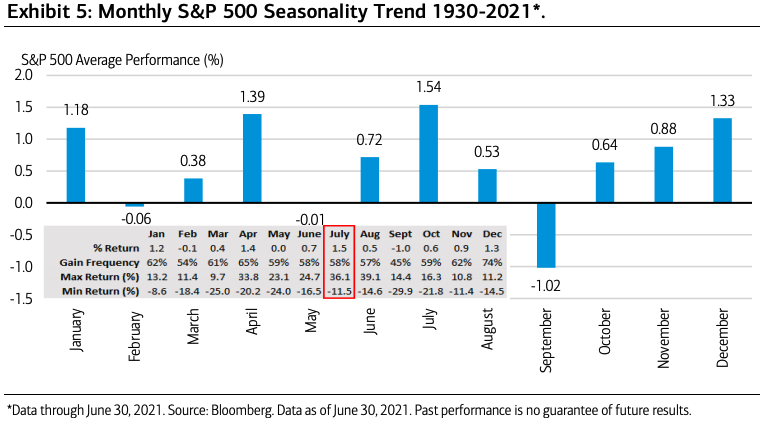
With that, Goldman Sachs Group Inc (NYSE: GS) suggests “[e]xpectations of higher interest rates and higher corporate tax rates by year-end are the primary reasons [to] forecast that the S&P 500 will trade sideways during the next six months.” Supporting that view are earnings estimates, the inventory positioning of participants, as well as early July seasonality metrics.

Graphic: Seasonality metrics via the Capital Market Outlook by Merrill.

Risks Ahead: As discussed in prior commentaries, after mid-July, the window for fundamental dynamics (e.g., a shift in preferences from saving and investing to spending, monetary tightening, seasonality, or a COVID-19 resurgence) to take over is opened. 

Why? Coming into the options expiration (OPEX) cycle, which starts on the third Friday of each month, associated hedging forces make it so there’s more liquidity and less movement. In other words, the market tends to pin. 

Options Expiration (OPEX): Option expiries mark an end to pinning (i.e, the theory that market makers and institutions short options move stocks to the point where the greatest dollar value of contracts will expire worthless) and the reduction dealer gamma exposure.

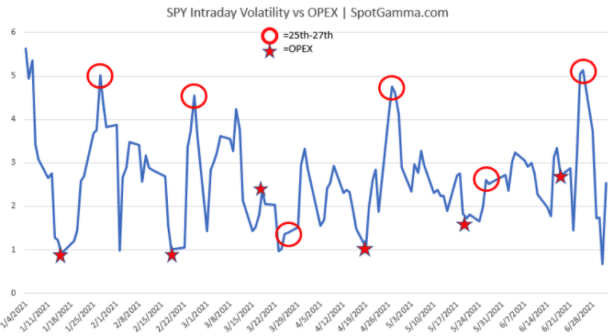
Thereafter, according to SpotGamma, “[t]he week after expiration the market tends to experience its largest intraday volatility which corresponds to the reduction in large options positions, and the hedging associated with them.”

Graphic: Volatility before and after OPEX, via SpotGamma.

Considerations: Ahead are some releases on consumer, producer, and import prices, as well as industrial production, consumer sentiment, and retail sales. Also, big banks kick off the earnings season with reports on second-quarter results.

Moody’s notes: “data on inflation, retail sales and industrial production could alter … estimate[s] of second-quarter U.S. GDP, which [are] currently tracking 8.2% at an annualized rate.”

What To Expect: In the coming sessions, participants will want to focus their attention on where the S&P 500 trades in relation to the $4,341.75 high volume area (HVNode) pivot.

Volume Areas: A structurally sound market will build on past areas of high volume. Should the market trend for long periods of time, it will lack sound structure (identified as a low volume area which denotes directional conviction and ought to offer support on any test). 

If participants were to auction and find acceptance into areas of prior low volume, then future discovery ought to be volatile and quick as participants look to areas of high volume for favorable entry or exit.

In the best case, the index trades sideways or higher; activity above $4,341.75 leaves in play the $4,363.50 regular trade high (RTH High). Initiative trade beyond the RTH High could reach as high as the Fibonacci-derived price targets at $4,373.00 and $4,398.50. 

Significance Of Prior ATHs, ATLs: Prices often encounter resistance (support) at prior highs (lows) due to the supply (demand) of old business. These areas take time to resolve. Breaking and establishing value (i.e., trading more than 30-minutes beyond this level) portends continuation.

In the worst case, the index trades lower; activity below $4,341.75 puts in play the $4,312.25 HVNode. Thereafter, if lower, the $4,291.00 untested Point of Control (POC), $4,285.75 micro-composite HVNode, and $4,239.25 HVNode come into play.

POCs: POCs are valuable as they denote areas where two-sided trade was most prevalent. Participants will respond to future tests of value as they offer favorable entry and exit.
Graphic: 65-minute profile chart of the Micro E-mini S&P 500 Futures.
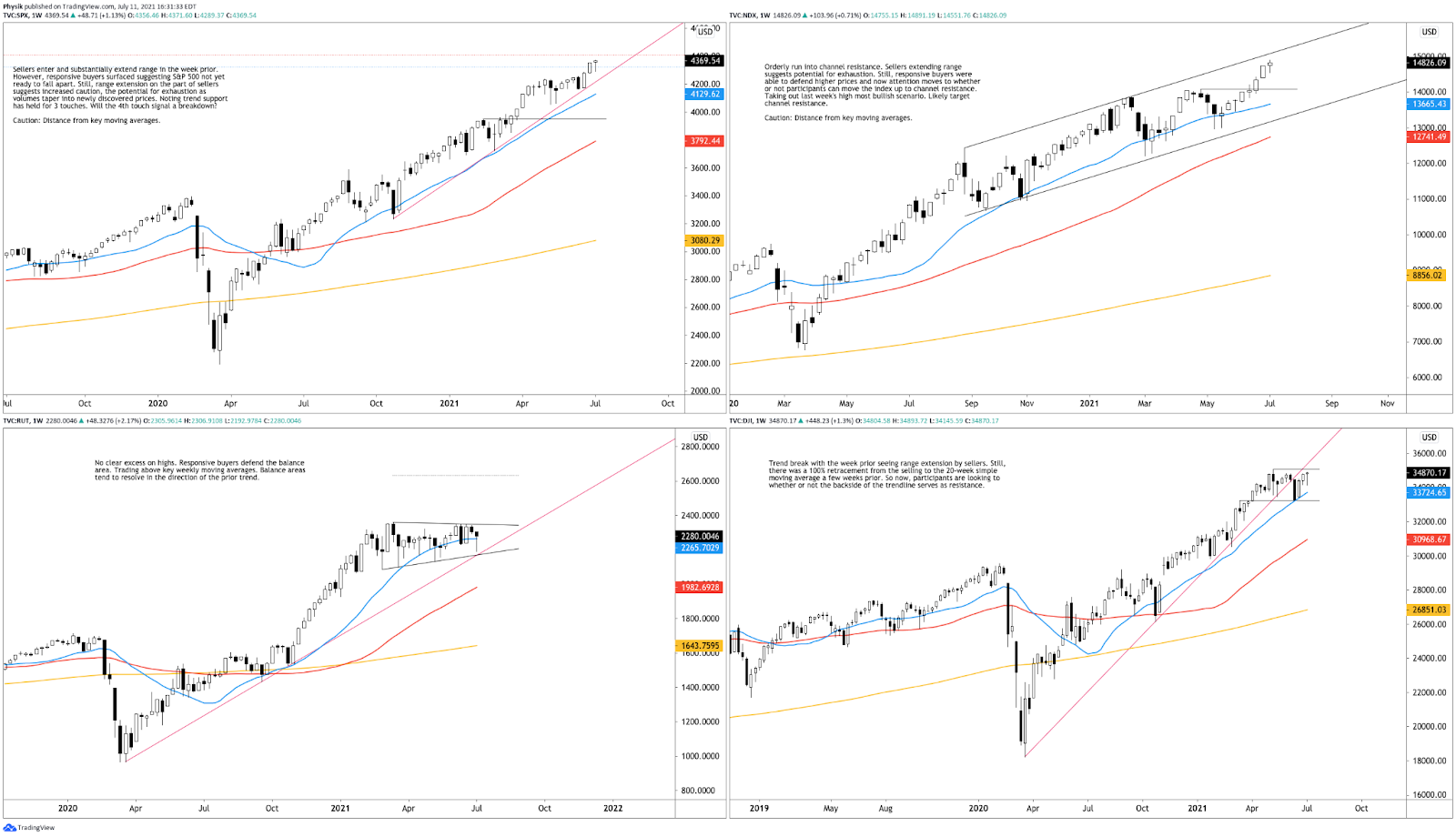
Graphic: Weekly candlestick charts of the S&P 500 (top left), Nasdaq 100 (top right), Russell 2000 (bottom left), and Dow Jones Industrial Average (bottom right).
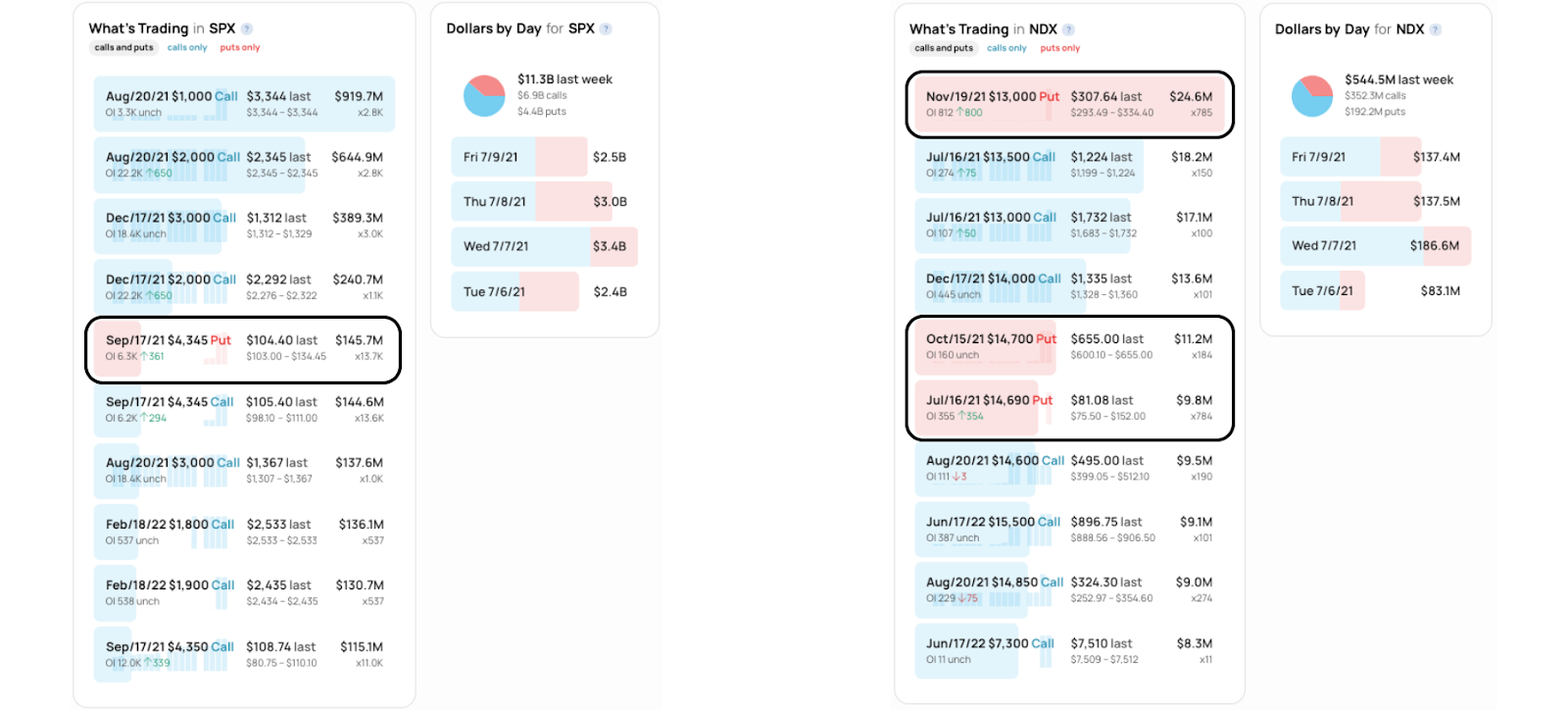
Graphic: SHIFT search suggests participants were most interested in call strikes at and below the price in the cash-settled S&P 500 (INDEX: SPX) and Nasdaq 100 (INDEX: NDX), last week. Noting, over the past few weeks, there’s been increased activity in long-dated put options.

News And Analysis

Markets | Lower stress capital buffers a credit negative for many U.S. banks. (Moody’s)

Economy | A faster recovery boosting prices, but runaway inflation unlikely. (Fitch)

Economy | Is the Fed “tempting FAIT” by assuming inflation is just transitory? (BLK)

Economy | The Fed’s dot plots are not enough in a quantitative easing world. (S&P)

Economy | China’s fading ‘first-in first-out’ rebound sending a global warning. (BBG)

Markets | Commodity boom dwarfs oil spat as emerging markets set to win. (BBG)

Economy | Unpacking several paths to higher-than-expected interest rates. (Fitch)

FinTech | Meet Unbound, a new decentralized cross-chain liquidity protocol. (VV)

Travel | Richard Branson, Virgin Galactic pull-off key test for space tourism. (BBG)

What People Are Saying

About

Renato founded Physik Invest after going through years of self-education, strategy development, and trial-and-error. His work reporting in the finance and technology space, interviewing leaders such as John Chambers, founder, and CEO, JC2 Ventures, Kevin O’Leary, businessman and Shark Tank host, Catherine Wood, CEO and CIO, ARK Invest, among others, afforded him the perspective and know-how very few come by.

Having worked in engineering and majored in economics, Renato is very detailed and analytical. His approach to the markets isn’t built on hope or guessing. Instead, he leverages the unique dynamics of time and volatility to efficiently act on opportunity.

Disclaimer

At this time, Physik Invest does not manage outside capital and is not licensed. In no way should the materials herein be construed as advice. Derivatives carry a substantial risk of loss. All content is for informational purposes only.

Categories
Commentary

Daily Brief For July 9, 2021

Market Commentary

U.S. equity index futures diverge in their attempt to discover fair prices for two-sided trade.

  • Volatility on COVID, growth concerns.
  • Today: ECB minutes, May inventories.
  • SPX, RUT, DJI firm. NDX tad weaker.

What Happened: U.S. stock index futures explored above and below yesterday’s cash-session close.

That said, a meaningful divergence can be observed with the Nasdaq 100 trading relatively weak, in comparison to its peers. This comes as rates on the 10 Year T-Note rebounded after testing trend support the session prior.

Ahead is the publication of ECB minutes. Prior to the open, participants will also be provided data on U.S. May wholesale inventories. Additionally, there is a G-20 meeting between finance ministers and central bankers.

Graphic updated 7:00 AM ET.

What To Expect: Friday’s regular session (9:30 AM – 4:00 PM EST) in the S&P 500 will likely open outside of prior-range and -value, suggesting a higher potential for directional opportunity.

Adding, during the prior day’s regular trade, the best case outcome occurred, evidenced by responsive buying above the $4,285.00 micro-composite high volume area (HVNode). Thursday’s intraday recovery, followed by the overnight session, found participants recovering over 50% of the liquidation. 

Volume Areas: A structurally sound market will build on past areas of high volume. Should the market trend for long periods of time, it will lack sound structure (identified as a low volume area which denotes directional conviction and ought to offer support on any test). 

If participants were to auction and find acceptance into areas of prior low volume, then future discovery ought to be volatile and quick as participants look to areas of high volume for favorable entry or exit.

Further, conditions aren’t as dire, today. Ahead, trade ought to be volatile but not that substantive as participants position themselves with respect to the weekly options expiration (OPEX) and weekend. 

Options Expiration (OPEX): Option expiries mark an end to pinning (i.e, the theory that market makers and institutions short options move stocks to the point where the greatest dollar value of contracts will expire worthless) and the reduction dealer gamma exposure.

Further, for today, participants can trade from the following frameworks. 

In the best case, the S&P 500 trades sideways or higher; activity above the $4,319.00 low volume area (LVNode) pivot puts in play the $4,340.75 HVNode, a 100% retracement of yesterday’s liquidation. Initiative trade beyond $4,340.75 could reach as high as the minimal excess overnight high (ONH) at $4,353.00.

Excess: A proper end to price discovery; the market travels too far while advertising prices. Responsive, other-timeframe (OTF) participants aggressively enter the market, leaving tails or gaps which denote unfair prices.

Overnight Rally Highs (Lows): Typically, there is a low historical probability associated with overnight rally-highs (lows) ending the upside (downside) discovery process.

In the worst case, the S&P 500 trades lower; activity below $4,319.00 puts in play the $4,303.25 LVNode. Trade beyond $4,303.25 could reach as low as the $4,291.00 untested Point of Control (POC) and $4,263.25 LVNode.

POCs: POCs are valuable as they denote areas where two-sided trade was most prevalent. Participants will respond to future tests of value as they offer favorable entry and exit.
Graphic: 65-minute profile chart of the Micro E-mini S&P 500 Futures.
Graphic: Daily candlestick charts of the S&P 500 (top left), Nasdaq 100 (top right), Russell 2000 (bottom left), and Dow Jones Industrial Average (bottom right).
Graphic: SHIFT search suggests participants were most interested in call strikes at and below the price in the cash-settled S&P 500 (INDEX: SPX), yesterday. On the Nasdaq 100 (INDEX: NDX), on the other hand, there was a meaningful shift in sentiment evidenced by increased activity in long-dated put options.

News And Analysis

Politics | U.S. set to add more Chinese companies to blacklist. (REU)

Economy | China’s central bank pivots to easing as risks build. (BBG)

COVID | Americans to need masks indoors amid COVID surge. (CNBC)

Economy | Attitudes about buying and selling homes diverging. (MND)

Politics | Biden issuing executive order on shipping consolidation. (Hill)

Markets | Technical factors pull the 10-YR Treasury yield lower. (Moody’s)

Politics | Biden will encourage the FCC to reinstate net neutrality. (Axios)

Economy | The explosion in used car prices is finally stalling out. (Axios)

What People Are Saying

Innovation And Emerging Trends

FinTech | London fintech funding soars in first half of the year. (REU)

FinTech | Robinhood compliance issues show fintech hazards. (Axios)

 About

Renato founded Physik Invest after going through years of self-education, strategy development, and trial-and-error. His work reporting in the finance and technology space, interviewing leaders such as John Chambers, founder, and CEO, JC2 Ventures, Kevin O’Leary, businessman and Shark Tank host, Catherine Wood, CEO and CIO, ARK Invest, among others, afforded him the perspective and know-how very few come by.

Having worked in engineering and majored in economics, Renato is very detailed and analytical. His approach to the markets isn’t built on hope or guessing. Instead, he leverages the unique dynamics of time and volatility to efficiently act on opportunity.

Disclaimer

At this time, Physik Invest does not manage outside capital and is not licensed. In no way should the materials herein be construed as advice. Derivatives carry a substantial risk of loss. All content is for informational purposes only.
Categories
Commentary

Daily Brief For July 8, 2021

Market Commentary

Equity index futures explore lower prices, widening a developing balance area.

  • Traders edgy over virus variant, Fed action.
  • Ahead is data on jobs and consumer credit.
  • Internal divergence resolved in lower prices.

What Happened: U.S. stock index futures liquidated as participants sought to price in anxieties surrounding the spread of COVID-19 variants as well as an evolution in monetary policy. 

“Worries about variant strains have hurt investor confidence that the pandemic’s effects on the global economy are truly past us,” Nicholas Colas and Jessica Rabe of DataTrek Research wrote in a note cited by Bloomberg. “Our working theory is that we’re in the middle of a modest global growth scare.”

Today, also, participants get data on initial and continued jobless claims, as well as consumer credit.

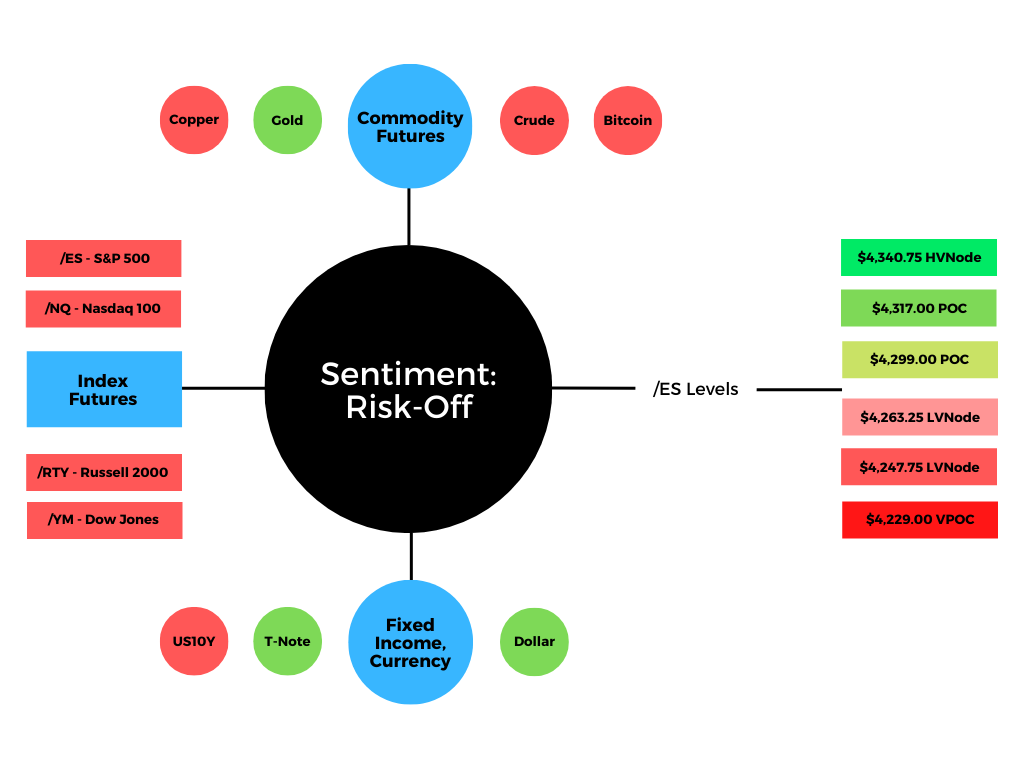
Graphic updated 6:58 AM ET.

What To Expect: Thursday’s regular session (9:30 AM – 4:00 PM EST) in the S&P 500 will likely open outside of prior-range and -value, suggesting a potential for immediate directional opportunity. Balance-break and gap scenarios are in play.

Balance-Break and/or Gap Scenarios: Monitor for acceptance (i.e., more than 1-hour of trade) outside of the balance area.

Gaps ought to fill quickly. Should they not, that’s a signal of strength; do not fade. Leaving value behind on a gap-fill or failing to fill a gap (i.e., remaining outside of the prior session’s range) is a go-with indicator.

Auctioning and spending at least 1-hour of trade back in the prior range suggests a lack of conviction; in such a case, do not follow the direction of the most recent initiative activity.

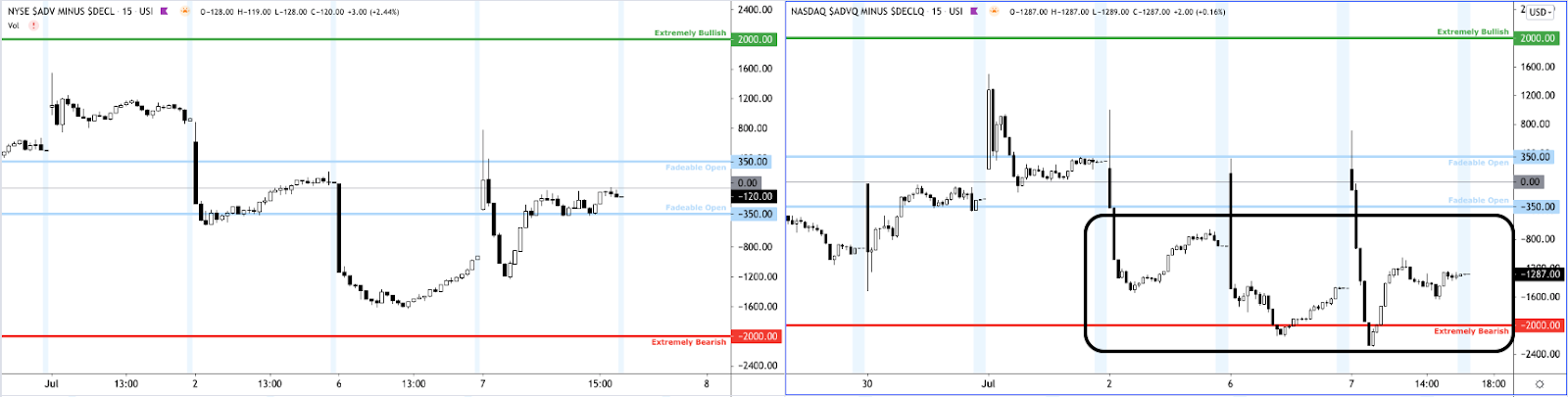
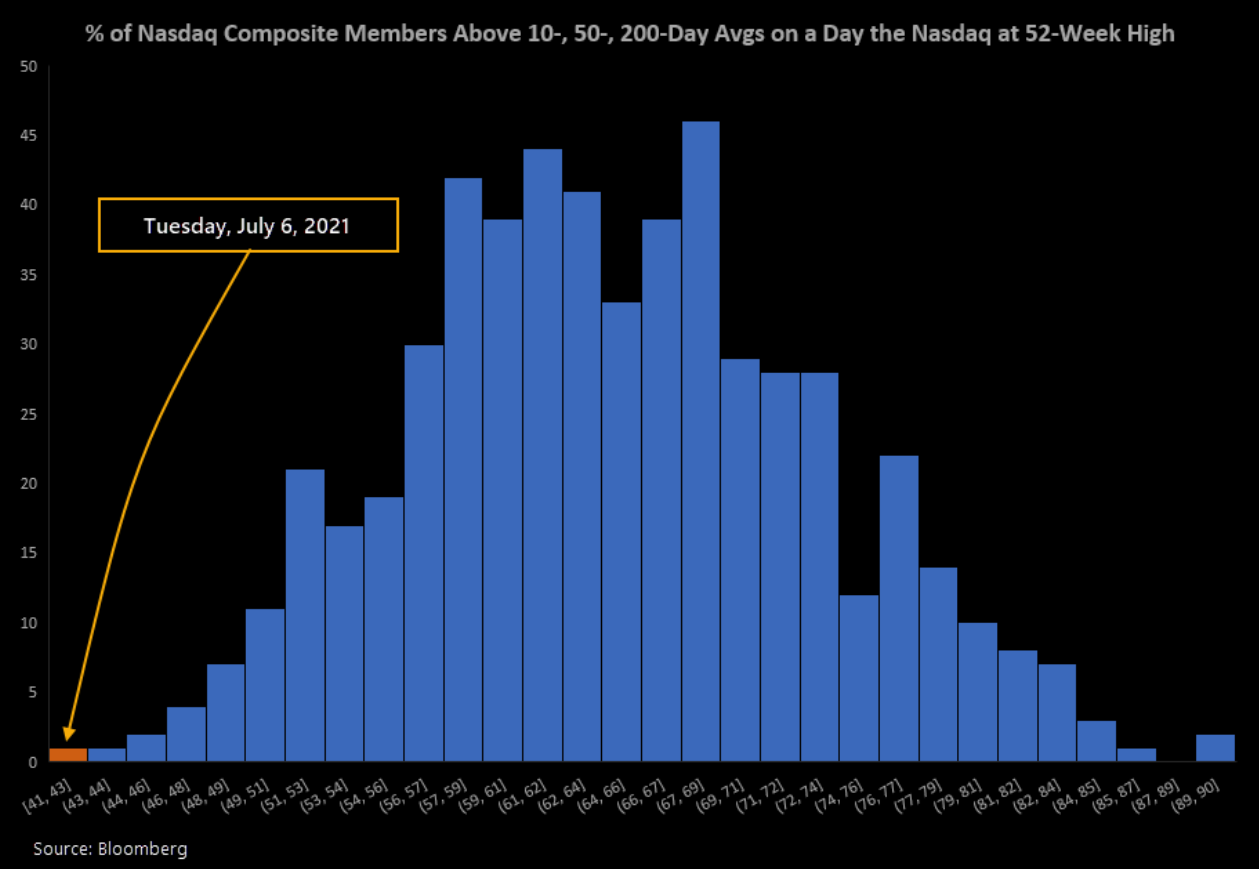
Further, the overnight liquidation comes after participants had a tough time establishing value at higher prices. Despite steady exploration in days prior, internal divergences via breadth metrics, became more pronounced, while profile dynamics revealed weak commitment at higher prices and an abundance of poor structures (e.g., low-volume areas). 

Graphic: Equity index leaders rose in price as internal divergences – like the ratio of advancers to decliners – grew. Noting a bigger divergence in internals tracking Nasdaq issues. 
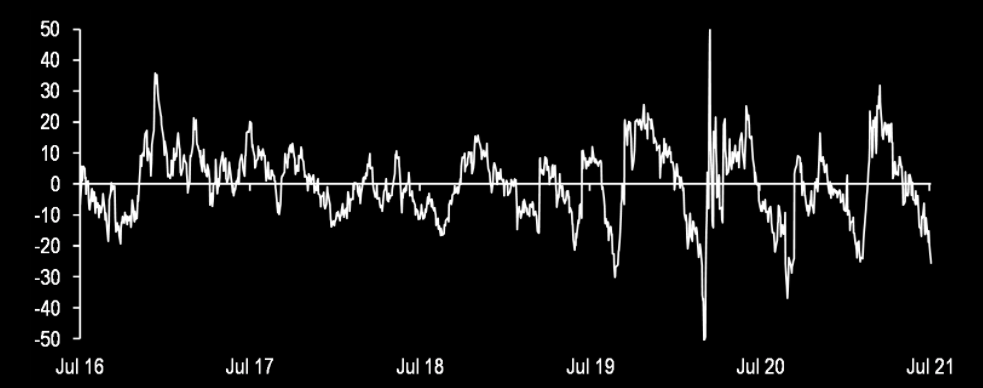
Graphic: Nasdaq-100 constituents fail to participate in price rise, via The Market Ear.

Also, yesterday, Federal Reserve officials, as evidenced by meeting minutes, were not yet ready to communicate their timeline for scaling back asset purchases. 

“The committee’s standard of ‘substantial further progress’ was generally seen as not having yet been met, though participants expected progress to continue,” according to minutes from the June 15-16 Federal Open Market Committee meeting published Wednesday. “Various participants mentioned that they expected the conditions for beginning to reduce the pace of asset purchases to be met somewhat earlier than they had anticipated at previous meetings.”

Following closely after, rates on the 10 Year T-Note moved into trend support. Though usually perceived as a boon for stocks – especially growth names – as low rates have to potential to increase the present value of future earnings, all major equity indexes are off their highs.

Graphic: Treasury yields nearly three standard deviations below their mode-implied fair value, via The Market Ear.

Regardless of the cause – comments by the Fed, in addition to the spread of COVID-19 variants, geopolitical tensions, among other things – for today, participants can trade from the following frameworks. 

In the best case, the S&P 500 trades sideways or higher; activity above the $4,285.00 micro-composite high volume area (HVNode), a pivot, participants may look for responses at the $4,299.00 Point of Control (POC), first. Thereafter, if higher, the $4,317.00 POC, which corresponds with the half-point of the overnight range comes next. If above $4,317.00, lookout. The S&P 500 may auction as high as the $4,340.75 HVNode. 

Volume Areas: A structurally sound market will build on past areas of high volume. Should the market trend for long periods of time, it will lack sound structure (identified as a low volume area which denotes directional conviction and ought to offer support on any test). 

If participants were to auction and find acceptance into areas of prior low volume, then future discovery ought to be volatile and quick as participants look to areas of high volume for favorable entry or exit.

POCs: POCs are valuable as they denote areas where two-sided trade was most prevalent. Participants will respond to future tests of value as they offer favorable entry and exit.

In the worst case, the S&P 500 trades lower; activity below $4,285.00 puts in play the $4,263.25 low volume area (LVNode). Trade beyond that signpost may reach as low as the $4,247.75 LVNode and $4,229.00 VPOC.

Graphic: 65-minute profile chart of the Micro E-mini S&P 500 Futures.
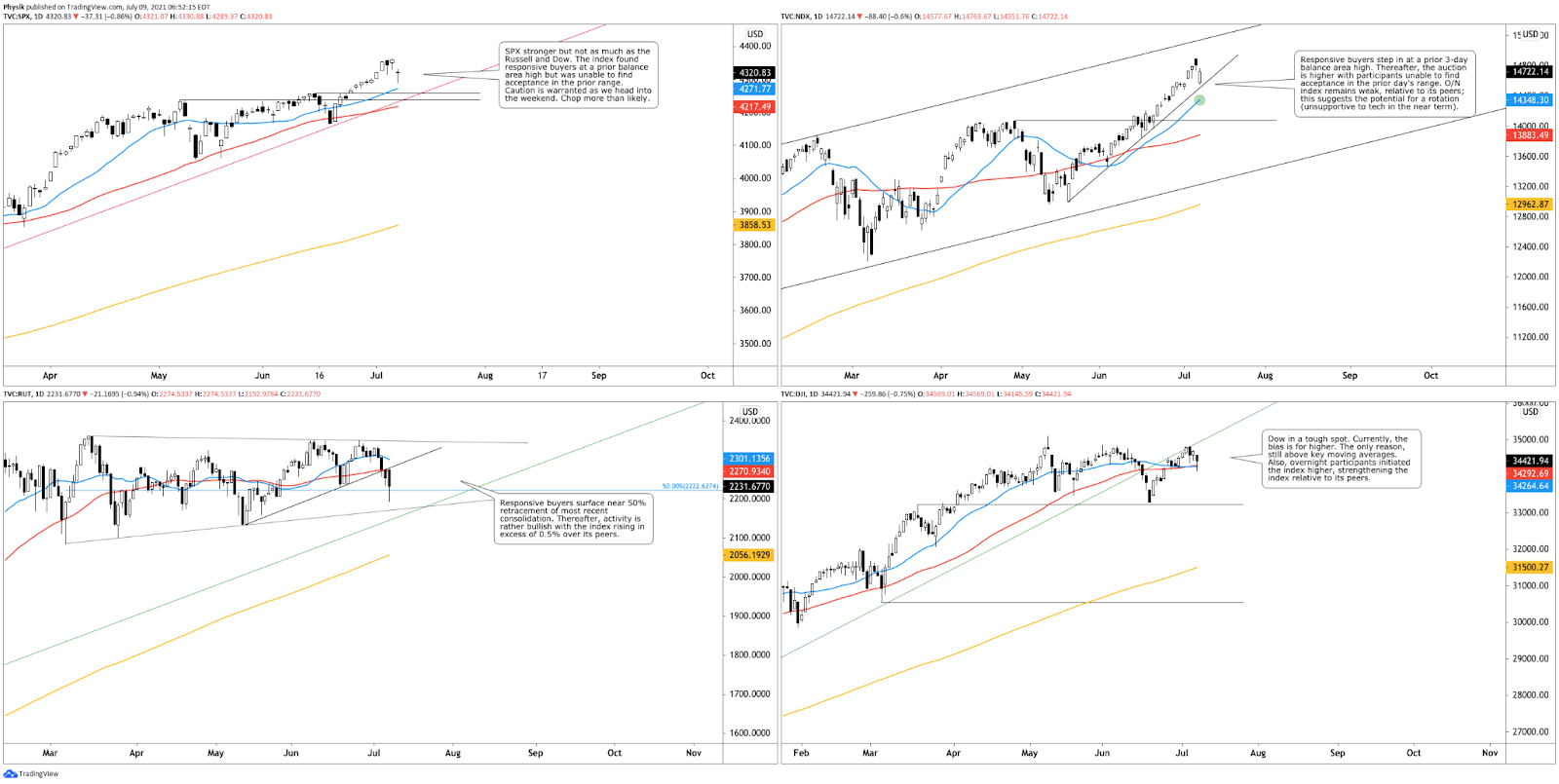
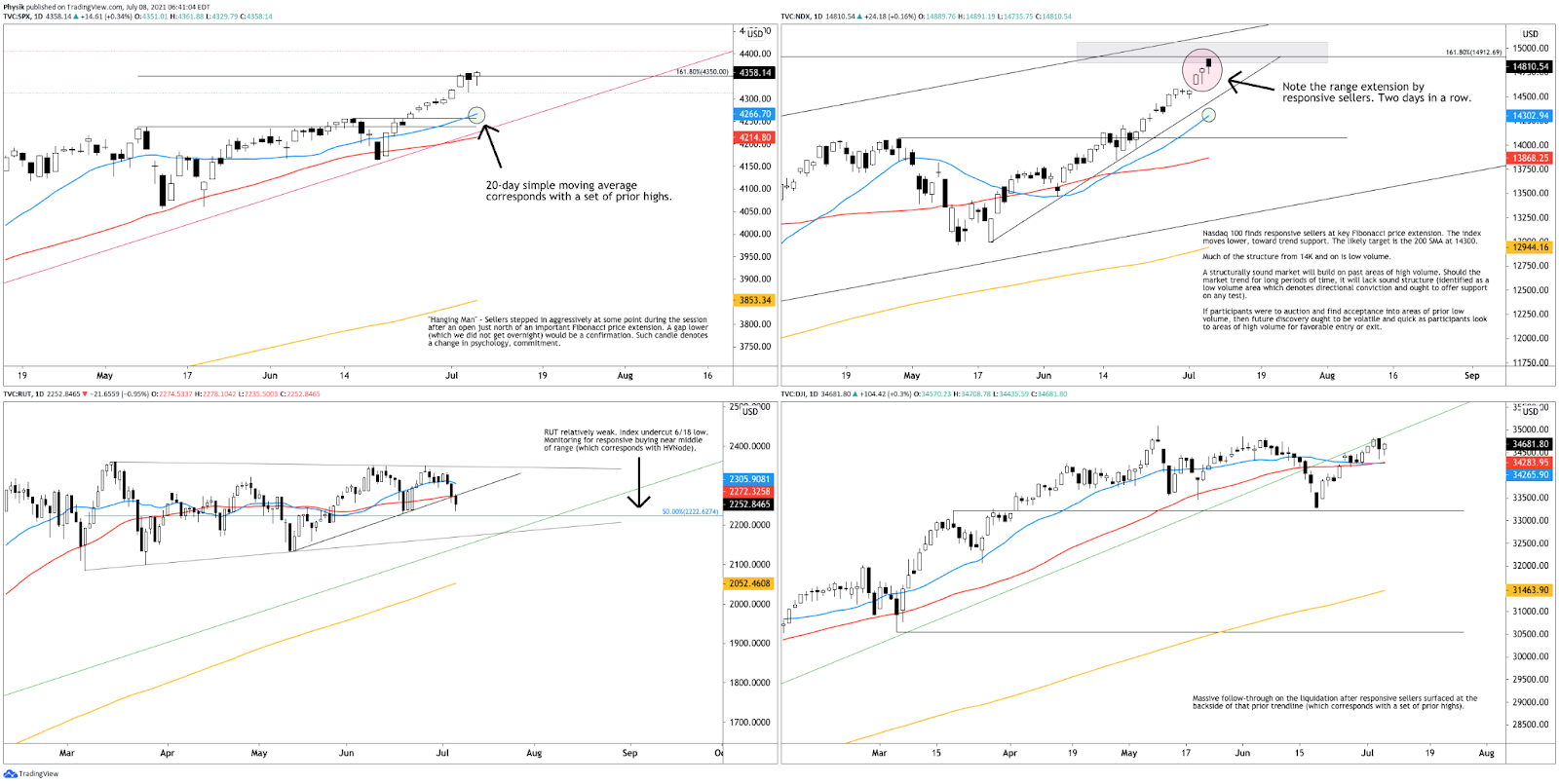
Graphic: Daily candlestick charts of the S&P 500 (top left), Nasdaq 100 (top right), Russell 2000 (bottom left), and Dow Jones Industrial Average (bottom right).
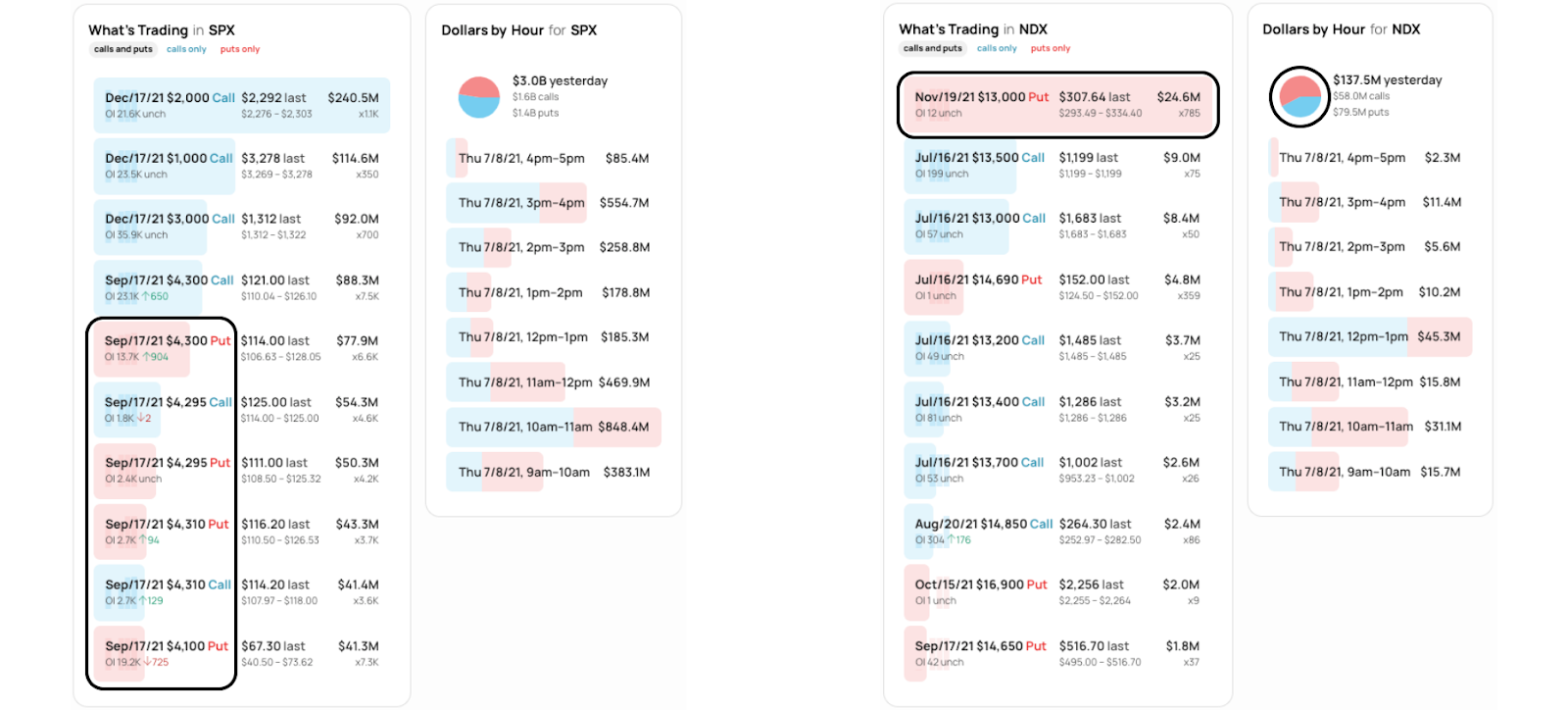
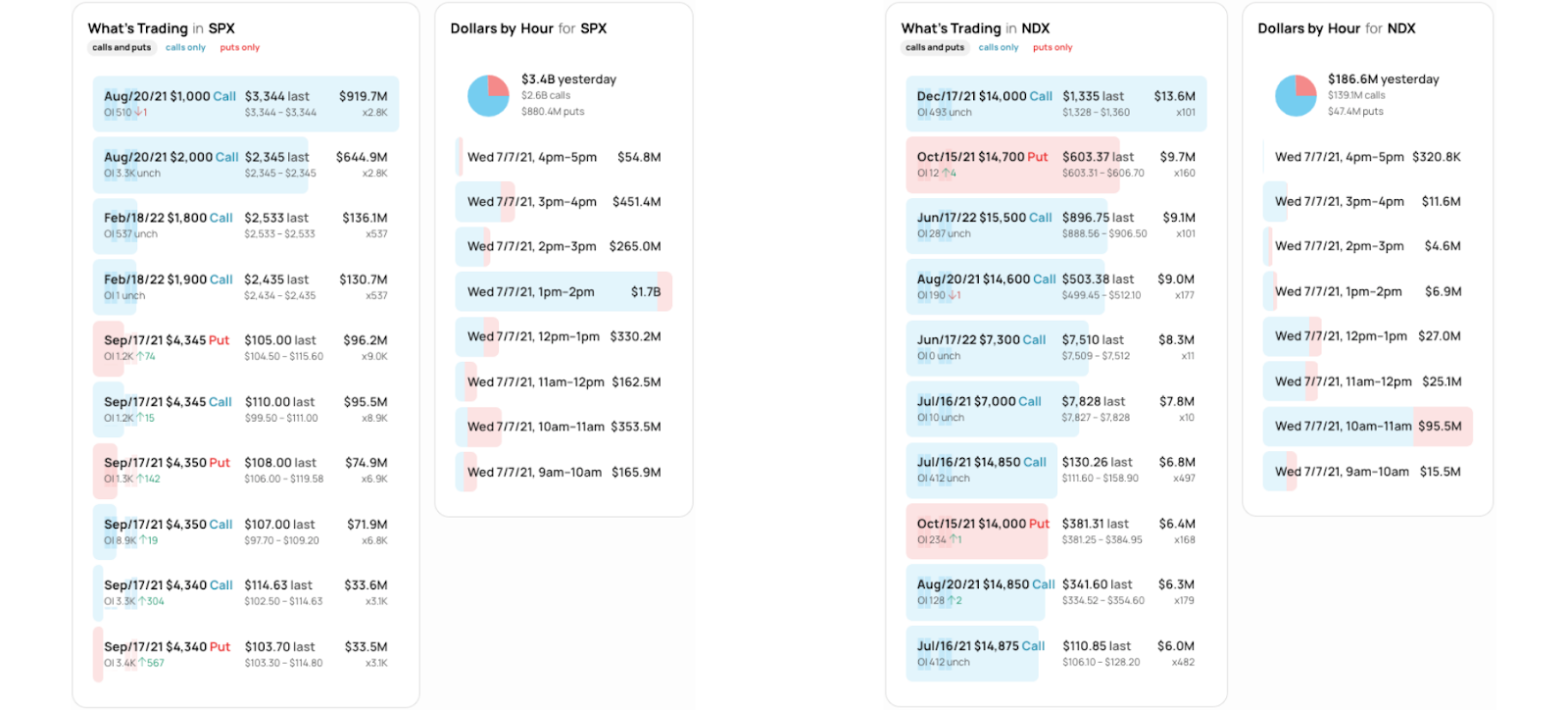
Graphic: SHIFT search suggests participants were committing the most capital to call strikes at and below current prices in the cash-settled S&P 500 Index (INDEX: SPX) and Nasdaq 100 (INDEX: NDX), yesterday. This activity may denote (1) stock replacement, (2) hedges for underlying short positions, or (3) speculation on the upside. Also, there was a meaningful bid in longer-dated puts on the S&P 500 and Nasdaq 100. This dynamic suggests participants, despite their commitment to higher prices, are hedging against near-term risks, like the Jackson Hole Economic Symposium.

News And Analysis

Economy | ECB unveils higher inflation goal that tolerates an overshoot. (BBG)

Politics | President Biden to speak on Afghanistan amid swift U.S. pullout. (REU)

Economy | Fed officials are split on easing quantitative easing program. (Axios)

Economy | Rates are down, jobs are up, but mortgage apps still decline. (MND)

Economy | External liquidity strains easing in some APAC economies. (Fitch)

Energy | OPEC gets ‘pass to lift oil prices’ as hedging losses hobble U.S. (FT)

COVID | Europe’s summer in peril as France warns on Spain, Portugal. (BBG)

Economy | Quest to define post-crisis global economic order is gaining. (BBG)

COVID | Tokyo games to go without fans as Japan declares emergency. (BBG)

What People Are Saying

Innovation And Emerging Trends

Markets | Crypto scammers rip off billions on pump-and-dump schemes. (BBG)

FinTech | Powell diary shows he met Coinbase CEO, crypto investor. (BBG)

Markets | A $9 trillion binge turns central banks into the biggest whales. (BBG)

FinTech | Momentum behind blockchain in public, private markets rises. (MM)

Markets | The LSE had its first direct listing of a technology company. (MM)

About

Renato founded Physik Invest after going through years of self-education, strategy development, and trial-and-error. His work reporting in the finance and technology space, interviewing leaders such as John Chambers, founder, and CEO, JC2 Ventures, Kevin O’Leary, businessman and Shark Tank host, Catherine Wood, CEO and CIO, ARK Invest, among others, afforded him the perspective and know-how very few come by.

Having worked in engineering and majored in economics, Renato is very detailed and analytical. His approach to the markets isn’t built on hope or guessing. Instead, he leverages the unique dynamics of time and volatility to efficiently act on opportunity.

Disclaimer

At this time, Physik Invest does not manage outside capital and is not licensed. In no way should the materials herein be construed as advice. Derivatives carry a substantial risk of loss. All content is for informational purposes only.
Categories
Commentary

Daily Brief For June 21, 2021

Market Commentary

Index futures attempt to balance.

  • Yield curve flattens, China eyes BTC.
  • Ahead: CFNAI. ECB and Fed speak.
  • Indices auctioned sideways to higher.

What Happened: U.S. stock index futures auctioned higher and yields dropped.

After a big shift in the Federal Reserve’s so-called dot-plot, bond yields on the short-end of the curve rose while long-dated yields dropped in line with projections future inflation is easing. This flatter yield curve is a negative for cyclical stocks which can’t pass on increased costs, thereby impacting sales and margins.

Given the divergence across major, broad market indices, the implications of a flatter yield curve are apparent. Investors sold, heavily, cyclical stocks, evidenced by relative weakness in sectors like financials and transportation. 

In other areas, bitcoin fell after China cracked down on crypto-related transactions. Oil held its highs on a slowdown in talks between the U.S. and Iran. 

Ahead is data on the Chicago Fed National Activity Index (CFNAI). Also, today, members of the ECB and Fed will speak. 

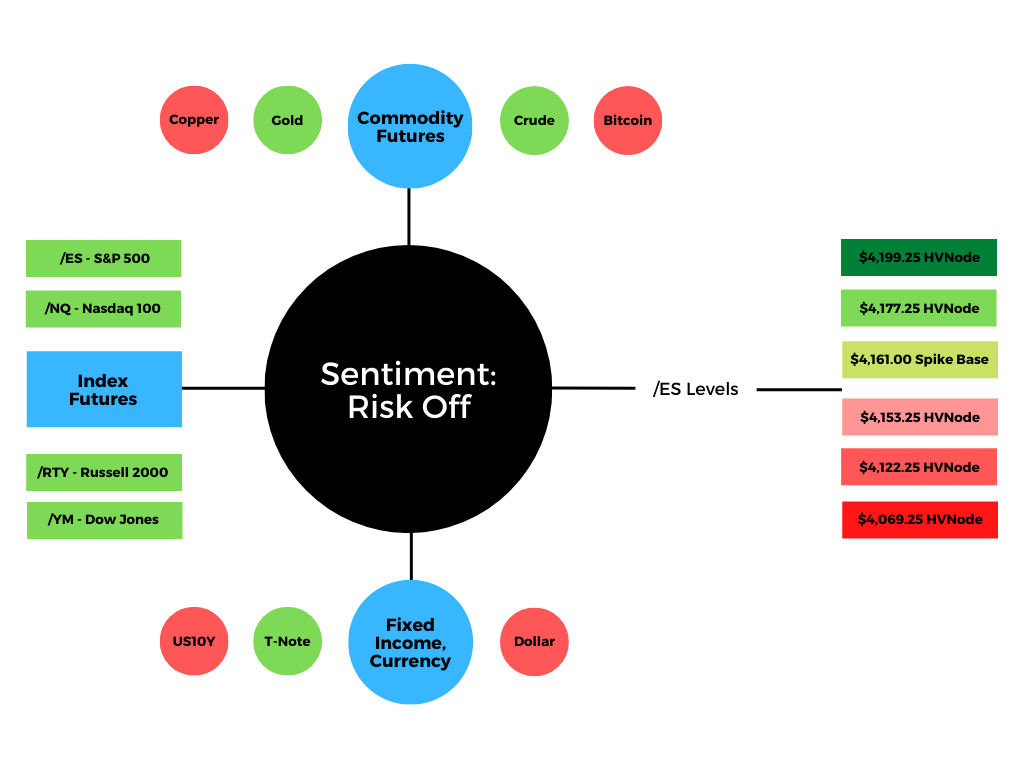
Graphic updated 7:10 AM ET.

What To Expect: Monday’s regular session (9:30 AM – 4:00 PM EST) in the S&P 500 will likely open inside of prior-range and -value, suggesting a limited potential for immediate directional opportunity.

Adding, during the prior day’s regular trade, the worst-case outcome occurred, evidenced by initiative trade below the $4,177.25 high volume area (HVNode) and end-of-day spike liquidation to and through $4,161.00, a strong support going into Friday’s derivative expiry.

Spikes: Spike’s mark the beginning of a break from value. Spikes higher (lower) are validated by trade at or above (below) the spike base (i.e., the origin of the spike).
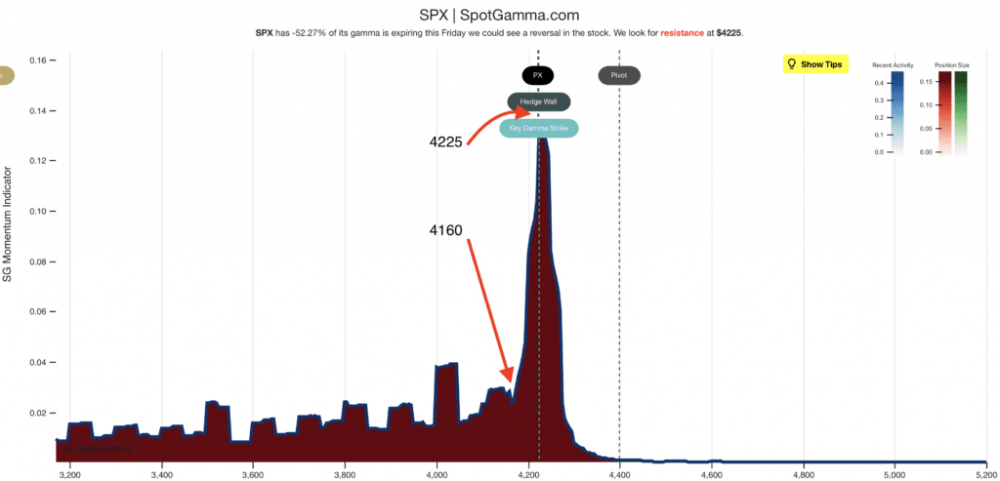
Graphic: SpotGamma analysis suggested minimal support below $4,200.00, in the S&P 500.

For today, participants can trade from the following frameworks. 

In the best case, the S&P 500 trades sideways or higher; activity above the $4,161.00 spike base puts in play the $4,177.25 HVNode. Initiative trade beyond the $4,177.25 HVNode could reach as high as the $4,199.25 HVNode.

Volume Areas: A structurally sound market will build on past areas of high volume. Should the market trend for long periods of time, it will lack sound structure (identified as a low volume area which denotes directional conviction and ought to offer support on any test). 

If participants were to auction and find acceptance into areas of prior low volume, then future discovery ought to be volatile and quick as participants look to areas of high volume for favorable entry or exit.

In the worst case, the S&P 500 trades lower; activity below $4,161.00 suggests an acceptance of Friday’s knee-jerk move from value. In such a case, participants are cautioned on further downside. First comes the $4,153.25 HVNode. Thereafter, if lower, participants can target the overnight low (ONL) at $4,126.75 and HVNode at $4,122.25.

Overnight Highs (Lows): Typically, there is a low historical probability associated with overnight rally-highs (lows) ending the upside (downside) discovery process.
Graphic: 65-minute profile chart of the Micro E-mini S&P 500 Futures.
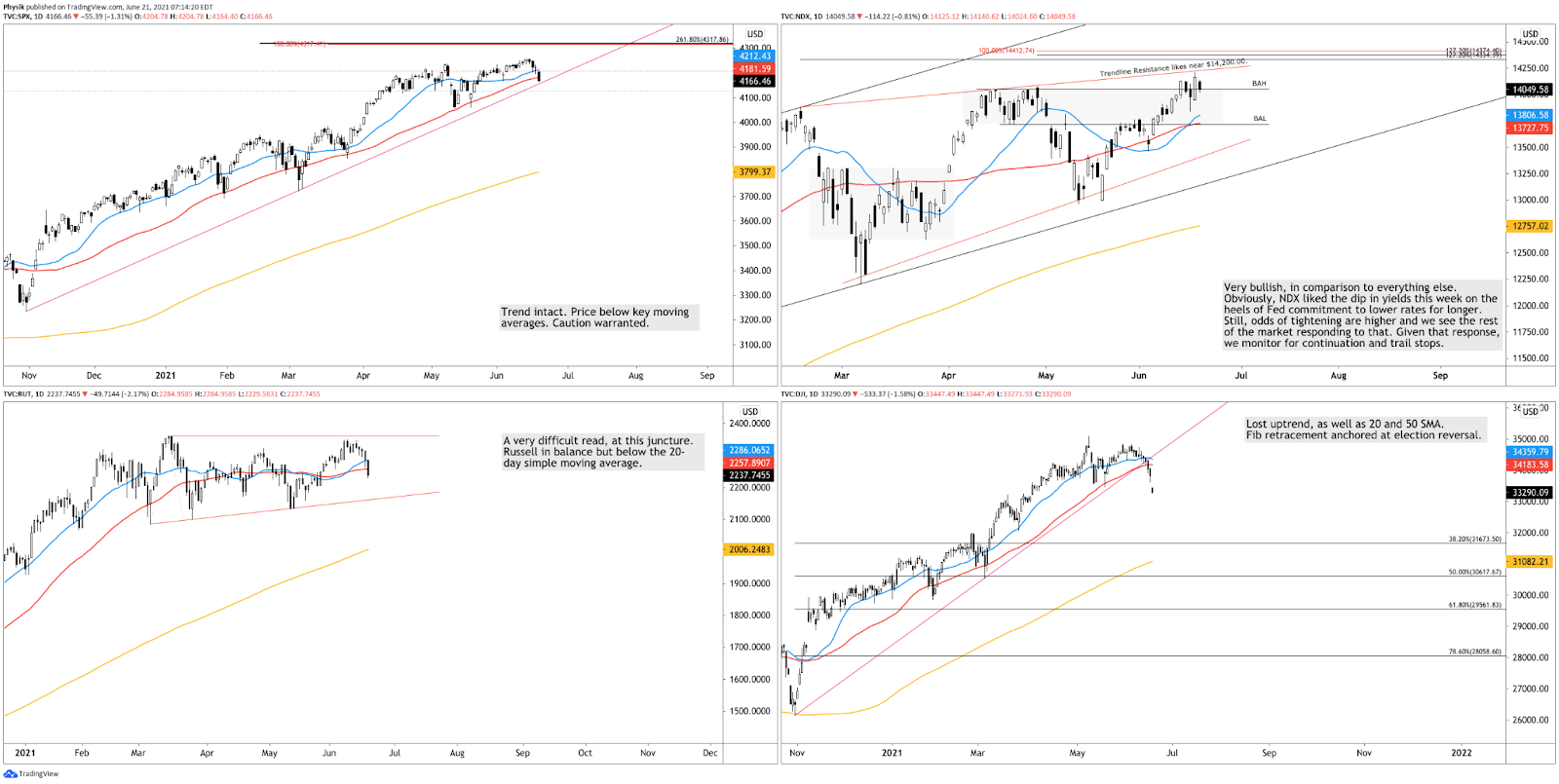
Graphic: Daily candlestick charts of the S&P 500 (top left), Nasdaq 100 (top right), Russell 2000 (bottom left), and Dow Jones Industrial Average (bottom right). Noting, seasonality supports the Nasdaq 100’s relative strength. 
Graphic: SHIFT search suggests participants were most interested in call strikes at and below current prices in the cash-settled S&P 500 Index (INDEX: SPX) and Nasdaq 100 (INDEX: NDX), last week. This activity may denote (1) stock replacement, (2) hedges for underlying short positions, or (3) speculation on the upside.

News And Analysis

Energy | Natural-gas glut has evaporated, driving prices higher. (WSJ)

Economy | Supply chain risks extend into 2022, stoking inflation. (WSJ)

Travel | American Air cuts some flights to avoid potential strains. (WSJ)

Politics | House bills put big tech step closer to antitrust regulation. (Fitch)

Markets | Goldman, JPMorgan pin emerging-market bets on hawks. (BBG)

Politics | Infrastructure bill talks continue; China comes in focus. (Moody’s)

Travel | Europe’s air traffic reaches 50% of 2019 amid recovery. (BBG)

Travel | Canada won’t fully reopen border until 75% vaccinations. (BBG)

What People Are Saying

Innovation And Emerging Trends

Technology | GM plans to expand its fuel-cell business beyond EVs. (CNBC)

Technology | Why the big automakers are pouring money into robotics. (TC)

Education | The pandemic’s effects have depressed college enrollment. (Axios)

About

Renato founded Physik Invest after going through years of self-education, strategy development, and trial-and-error. His work reporting in the finance and technology space, interviewing leaders such as John Chambers, founder, and CEO, JC2 Ventures, Kevin O’Leary, businessman and Shark Tank host, Catherine Wood, CEO and CIO, ARK Invest, among others, afforded him the perspective and know-how very few come by.

Having worked in engineering and majored in economics, Renato is very detailed and analytical. His approach to the markets isn’t built on hope or guessing. Instead, he leverages the unique dynamics of time and volatility to efficiently act on opportunity.

Disclaimer

At this time, Physik Invest does not manage outside capital and is not licensed. In no way should the materials herein be construed as advice. Derivatives carry a substantial risk of loss. All content is for informational purposes only.
Categories
Commentary

Weekly Brief For June 12, 2021

Market Commentary

Key Takeaways: Index futures exit balance, attempt to discover higher prices.

  • One big thing: Inflation temporary.
  • Ahead: FOMC 2-day rate meeting.
  • Indices were divergent but higher. 

What Happened: Last week, the movement was both volatile and mechanical, halting short of key visual references.

This technically-driven trade denotes a lack of interest by institutional participants, at record highs; supply chain uncertainties and rising inflation, fiscal and monetary tightening, COVID-19 concerns, political risks, employment, and the like, are some of the emerging concerns larger participants have been looking to price in.

Further, on Thursday, participants were provided more clarity on the hot topic of inflation. 

Why is inflation such a hot topic? In short, as described in prior commentaries, inflation and rates move inversely to each other. Low rates stimulate demand for loans (i.e., borrowing money is more attractive). With the rapid recovery, though, market participants were fearful that rates would rise to protect the economy from overheating. 

Higher rates have the potential to reduce the present value of future earnings, making stocks, especially those that are high growth, less attractive. 

Further, despite hot prices, consumer price index (CPI) data, Thursday, suggested inflation would be temporary. Thereafter, U.S. stock index futures broke balance, and rates on the 10 Year T-Note went lower as participants now thought it was more likely the Federal Reserve would maintain its easy monetary policy.

Coinciding with that breakdown in yields, the Nasdaq 100 and Russell 2000 ended the week strong while the S&P 500 and Dow Jones Industrial Average traded relatively weak, taking back Thursday’s vertical price rise on the CPI number.

Notwithstanding, there has been an inclination to talk taper.

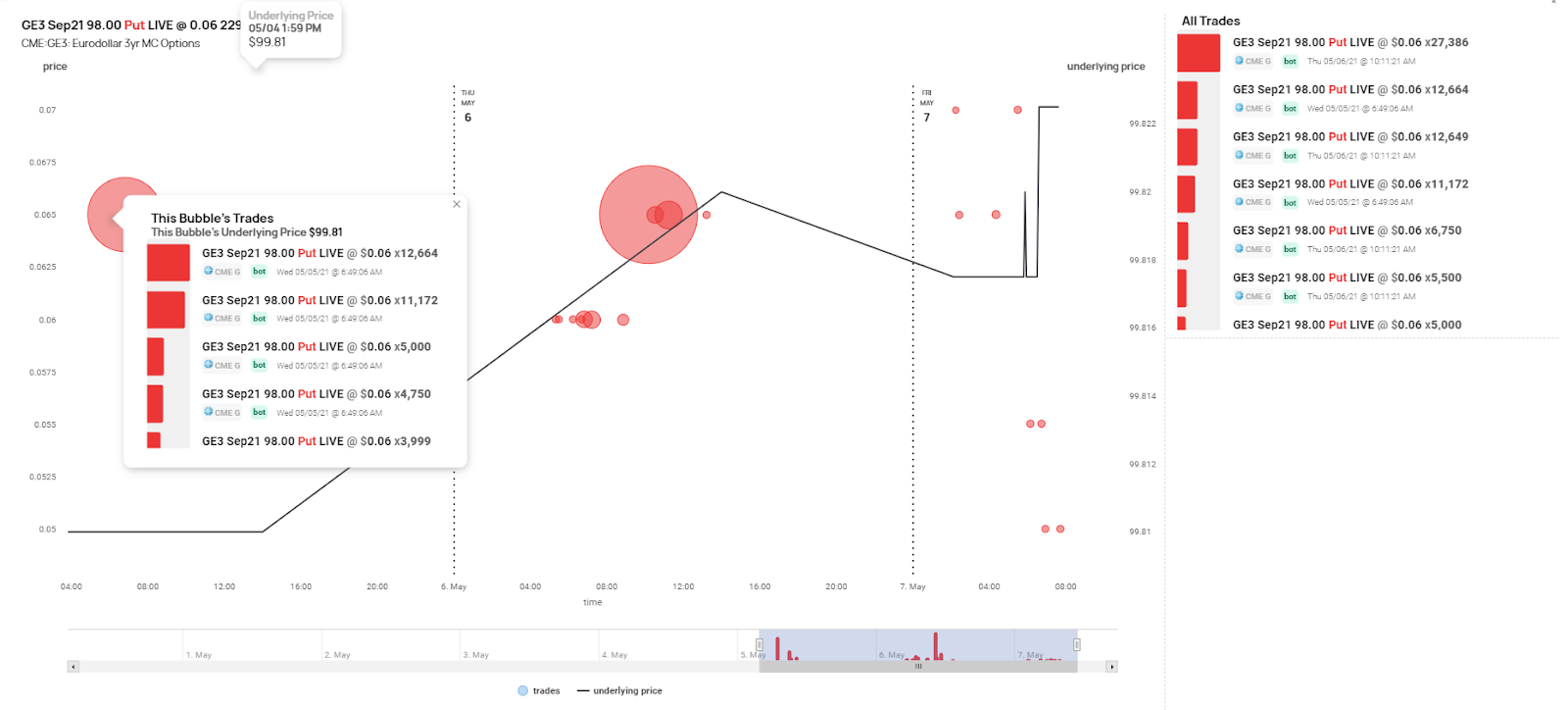
This was evidenced by some big option bets, earlier this year; of interest was one Eurodollar bet – carrying a notional value of $40 billion – focused on a potential surprise at the Jackson Hole symposium, used in the past to signal policy changes. 

Graphic: Eurodollar bet on SHIFT’s institutional platform. The purchase of 98.00 strike put options suggested traders were looking to add “two Fed hikes to [current] expectations.”

In a statement, Grant Thornton chief economist Diane Swonk said that despite investors not fearing an immediate change in course on monetary policy, inflation has surprised and will likely be the basis for taper talk at Jackson Hole, later this year. 

“I always expected tapering talk to begin more openly at the Jackson Hole meeting. It hasn’t changed my view. Some people thought the Fed would get closer to full employment before they did liftoff on tapering,” Swonk said.

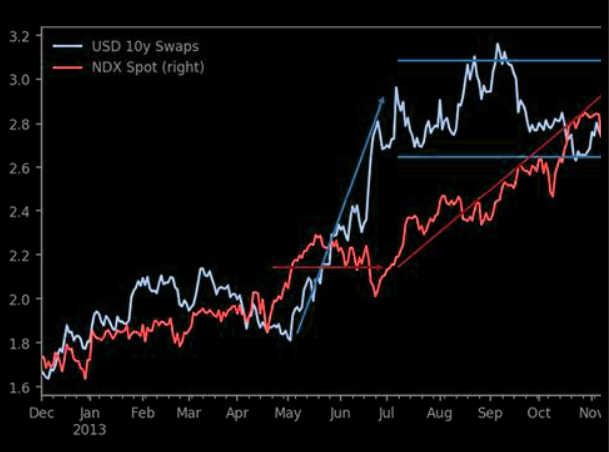
In terms of the impact on equities, looking back, according to The Market Ear, even during the so-called Taper Tantrum, in the early 2010s, rates settled in a wide range, and equities rallied big. 

Graphic: Nasdaq 100 rallies in 2013 after rates settle in a wide range, via The Market Ear.

Moreover, next week is a large monthly options expiration (OPEX). This is noteworthy because option expiries mark an end to pinning (i.e, the theory that market makers and institutions short options move stocks to the point where the greatest dollar value of contracts will expire worthless) and the reduction dealer gamma exposure. 

Options: If an option buyer was short (long) stock, he or she would buy a call (put) to hedge upside (downside) exposure. Option buyers can also use options as an efficient way to gain directional exposure.

Gamma: The sensitivity of an option to changes in the underlying price. Dealers that take the other side of options trades hedge their exposure to risk by buying and selling the underlying. When dealers are short-gamma, they hedge by buying into strength and selling into weakness. When dealers are long-gamma, they hedge by selling into strength and buying into weakness. The former exacerbates volatility. The latter calms volatility.

Aside from the Fed meeting and OPEX, some outlier risks remain; with VIX spreads at their lows, S&P 500 skew – a measure of perceived tail risk and the chances of a black swan event – rose dramatically over the past few weeks. At the same time, sentiment cooled considerably, while individual stock volatility increased the potential for another meme stock de-risking event.

What To Expect: In the coming sessions, participants will want to focus their attention on where the S&P 500 trades in relation to the $4,227.00 high volume area (HVNode), a pivot on the composite profile.

Volume Areas: A structurally sound market will build on past areas of high volume. Should the market trend for long periods of time, it will lack sound structure (identified as a low volume area which denotes directional conviction and ought to offer support on any test). 

If participants were to auction and find acceptance into areas of prior low volume, then future discovery ought to be volatile and quick as participants look to areas of high volume for favorable entry or exit.

Given the minimal excess high at $4,249.00, as well as the subsequent liquidation – a typical response – and lower value, participants can trade from the following frameworks.

Excess: A proper end to price discovery; the market travels too far while advertising prices. Responsive, other-timeframe (OTF) participants aggressively enter the market, leaving tails or gaps which denote unfair prices. 

Like Friday, in the best case, the S&P 500 trades sideways or higher; activity above the $4,227.00 high volume area (HVNode) puts in play the $4,249.00 minimal excess high. Initiative trade beyond that figure could reach as high as the $4,270.00 161.80% Fibonacci price extension and $4,294.75 127.20% extension.

In the worst case, the S&P 500 trades lower; activity below the $4,227.00 HVNode confirms a failed balance-area breakout. In such a case, the $4,213.75 low volume area (LVNode) comes into play first. Thereafter, if lower, participants ought to look for responses at the $4,206.25, $4,198.75, and $4,177.25 HVNodes.

Graphic: 4-hour profile chart of the Micro E-mini S&P 500 Futures.
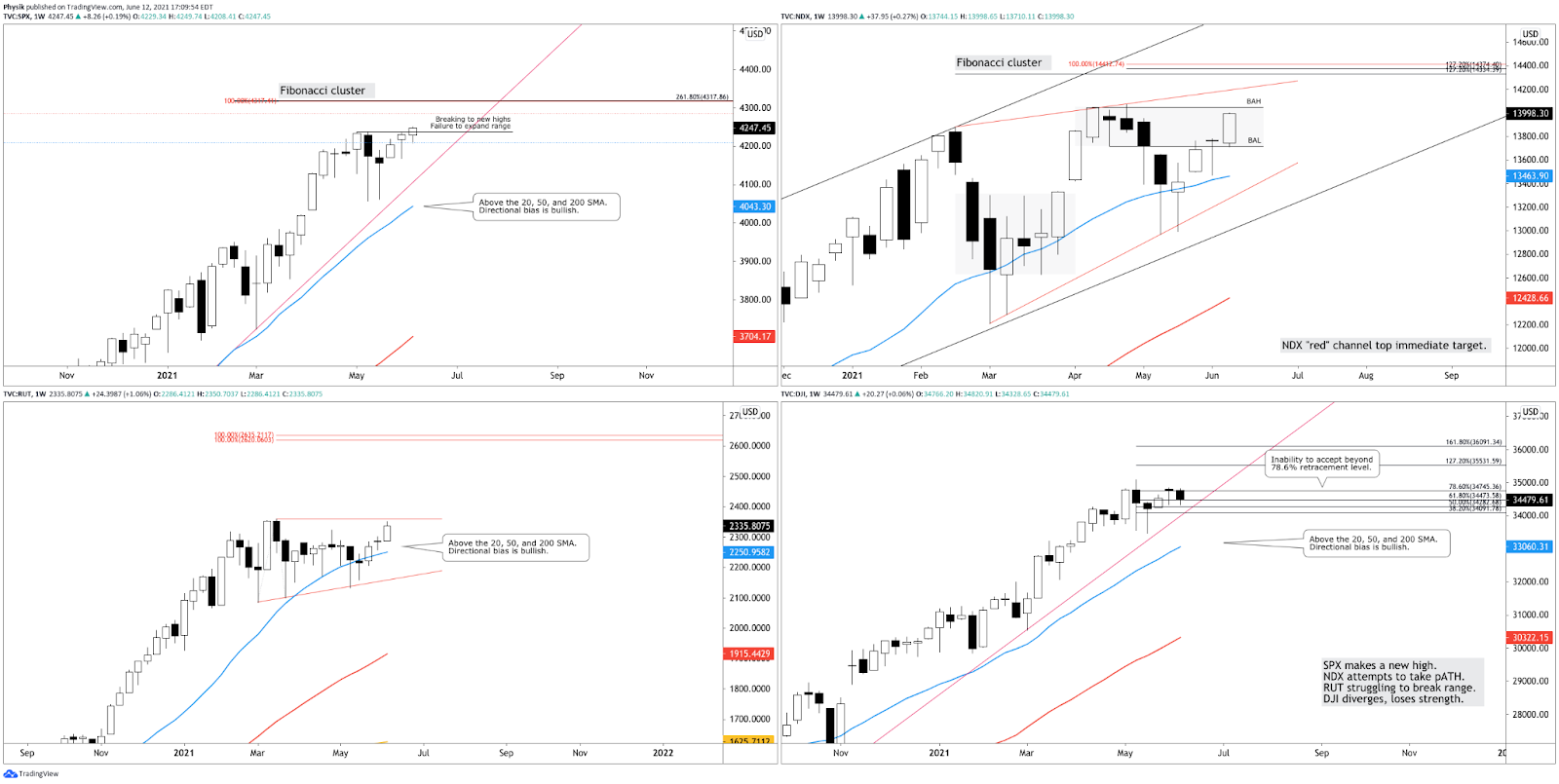
Graphic: Weekly candlestick charts of the S&P 500 (top left), Nasdaq 100 (top right), Russell 2000 (bottom left), and Dow Jones Industrial Average (bottom right). Note the weakness in the S&P 500 and Dow Jones Industrial Average. 
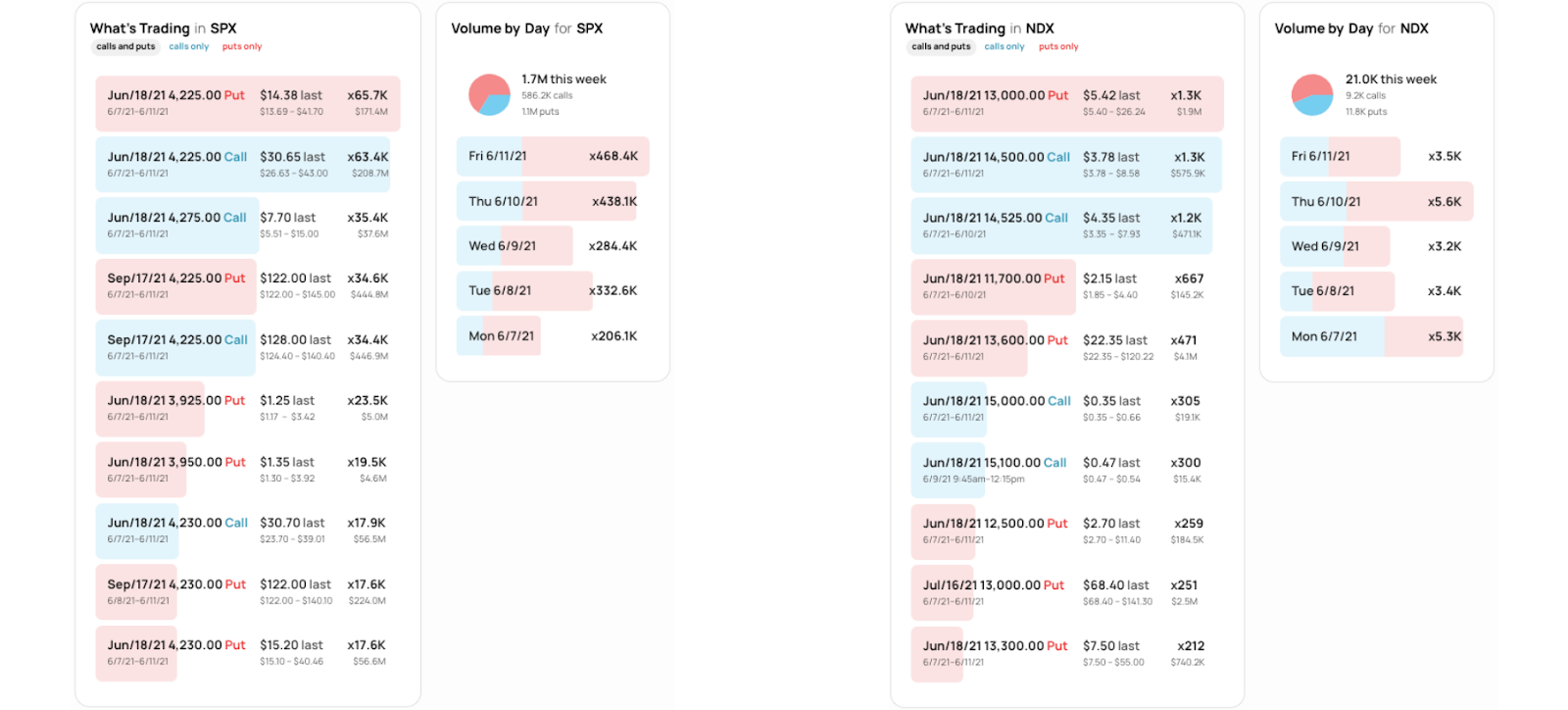
Graphic: SHIFT search suggests participants were most interested in put strikes at and below current prices in the larger cash-settled S&P 500 Index (INDEX: SPX) and Nasdaq 100 Index (INDEX: NDX), last week.

News And Analysis

Markets | Shorts squeezed; Fed (kind of) buys cryptocurrency bonds. (BBG)

Economy | Fed to announce taper in August or September on inflation. (REU)

Energy | OPEC sees more demand for oil with H2 growth quickening. (S&P)

Economy | The U.S. is experiencing temporary cost-push inflation. (Moody’s)

Economy | Pent-up demand, supply shortages improve credit recovery. (S&P)

Politics | Biden’s China policy emerging – and it looks like Trump’s. (WSJ)

What People Are Saying

Innovation And Emerging Trends

Venture | Funding, new unicorns, exits continue at a strong pace. (CB)

FinTech | G-7 dialogue on crypto to hasten the disintermediation. (Moody’s)

Trading | How to keep the gamma squeeze going with put sales. (SG)

Aviation | In aviation, the revolution likely will not be supersonic. (WSJ)

About

Renato founded Physik Invest after going through years of self-education, strategy development, and trial-and-error. His work reporting in the finance and technology space, interviewing leaders such as John Chambers, founder, and CEO, JC2 Ventures, Kevin O’Leary, businessman and Shark Tank host, Catherine Wood, CEO and CIO, ARK Invest, among others, afforded him the perspective and know-how very few come by.

Having worked in engineering and majored in economics, Renato is very detailed and analytical. His approach to the markets isn’t built on hope or guessing. Instead, he leverages the unique dynamics of time and volatility to efficiently act on opportunity.

Disclaimer

At this time, Physik Invest does not manage outside capital and is not licensed. In no way should the materials herein be construed as advice. Derivatives carry a substantial risk of loss. All content is for informational purposes only.

Categories
Commentary

Weekly Brief For May 31, 2021

Market Commentary

Key Takeaways: Index futures in balance.

  • Best to assume the taper tantrum happened.
  • Ahead: Fed speak and data on employment.
  • Indices traded sideways-to-higher last week.

What Happened: Coming into the large May monthly options expiration (OPEX) and extended holiday weekend, U.S. stock index futures pinned, trading sideways-to-higher.

Options: If an option buyer was short (long) stock, he or she would buy a call (put) to hedge upside (downside) exposure. Option buyers can also use options as an efficient way to gain directional exposure.

Options Expiration (OPEX): Option expiries mark an end to pinning (i.e, the theory that market makers and institutions short options move stocks to the point where the greatest dollar value of contracts will expire worthless) and the reduction dealer gamma exposure. 

Gamma is the sensitivity of an option to changes in the underlying price. Dealers that take the other side of options trades hedge their exposure to risk by buying and selling the underlying. When dealers are short-gamma, they hedge by buying into strength and selling into weakness. When dealers are long-gamma, they hedge by selling into strength and buying into weakness. The former exacerbates volatility. The latter calms volatility.

Furthermore, looking back, the movement in price was both volatile and mechanical.

After a short covering-like rally toward $4,200.00, the S&P 500 was responsively bought and sold at key visual references, suggesting a dominance by short-term participants.

Responsive Buying (Selling): Buying (selling) in response to prices below (above) areas of recent price acceptance.

The technically-driven trade denotes a lack of interest by institutional participants, at record highs; supply chain uncertainties and rising inflation, fiscal and monetary tightening, COVID-19 concerns, political risks, and the like, are some of the emerging concerns larger participants are looking to price in.

Of all the above risks, inflation remains the hottest topic.

Generally speaking, inflation and rates move inversely to each other. Low rates stimulate demand for loans (i.e., borrowing money is more attractive). With the rapid recovery, though, market participants fear that rates will rise to protect the economy from overheating.

Higher rates have the potential to reduce the present value of future earnings, making stocks, especially those that are high growth, less attractive. 

To note, however, rates remain range-bound; rates on the 10 Year T-Note sit below their March high and are likely to continue higher, which the market may absorb

How may the market absorb a rise in rates? During the so-called Taper Tantrum, in the early 2010s, rates settled in a wide range, and equities rallied big. Adding, some strategists, like Kit Juckes of Societe Generale SA (OTC: SCGLY) suggest it may be best to assume a tantrum has already happened.

“U.S. 10-year yields rose from a low of 1.4% in 2012 to 3% during their tantrum. In this cycle, the rise has been from 0.5% to a high just below 1.8%. That’s comparable in relative terms. The eventual peak in U.S. yields in 2018 was 3.25%. Can’t we accept that the taper tantrum has already happened? The important difference is that in the tantrum cycle, core CPI never got above 2 ½%. A bet on further bond weakness is a bet on inflation proving to be stickier than the Fed can cope with.”

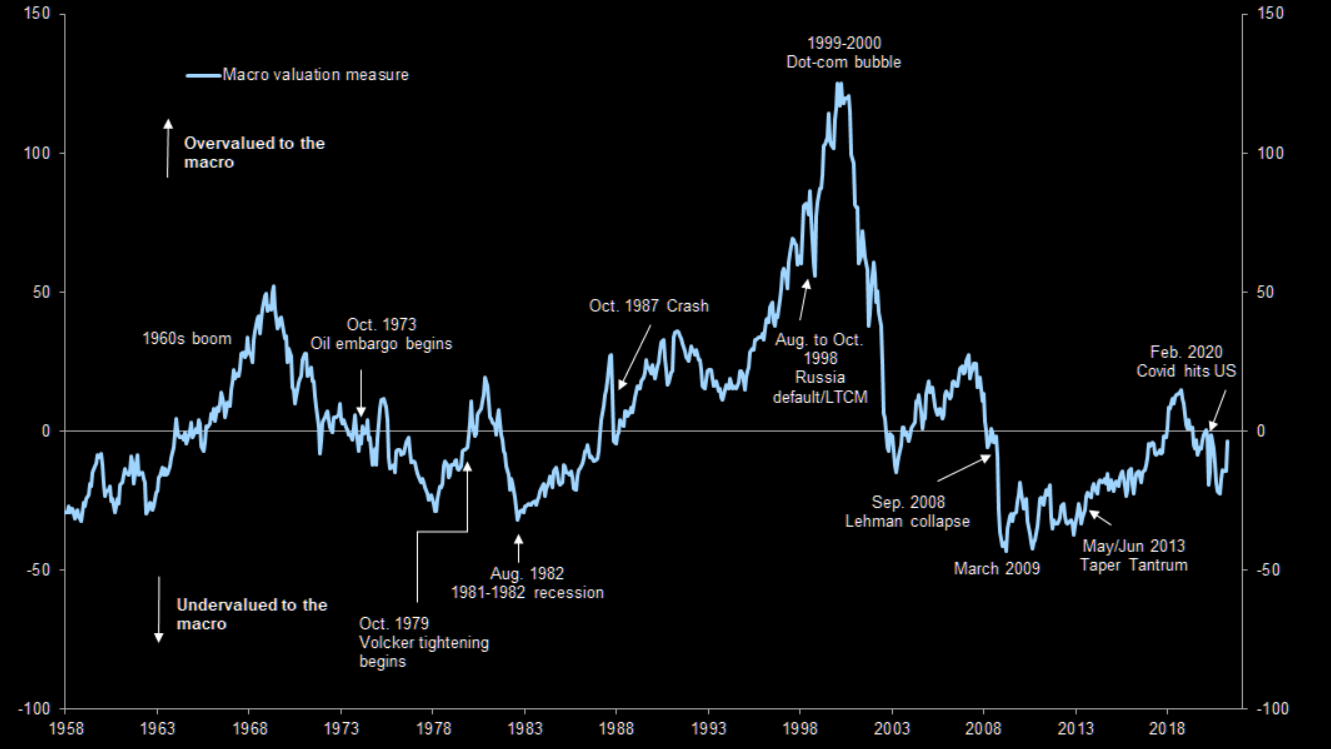
Adding, research by JPMorgan Chase & Co (NYSE: JPM), as well as Goldman Sachs Group Inc (NYSE: GS), suggests equities may be getting cheap with reflationary themes being the go-to play. This sentiment would help explain the increased interest in S&P 500 and Nasdaq 100 call options.

Graphic: Equity valuations at their cheapest, relative to the macro in March 2009 and in the depth of the 1982 recession, according to Goldman Sachs Group Inc (NYSE: GS), via The Market Ear.
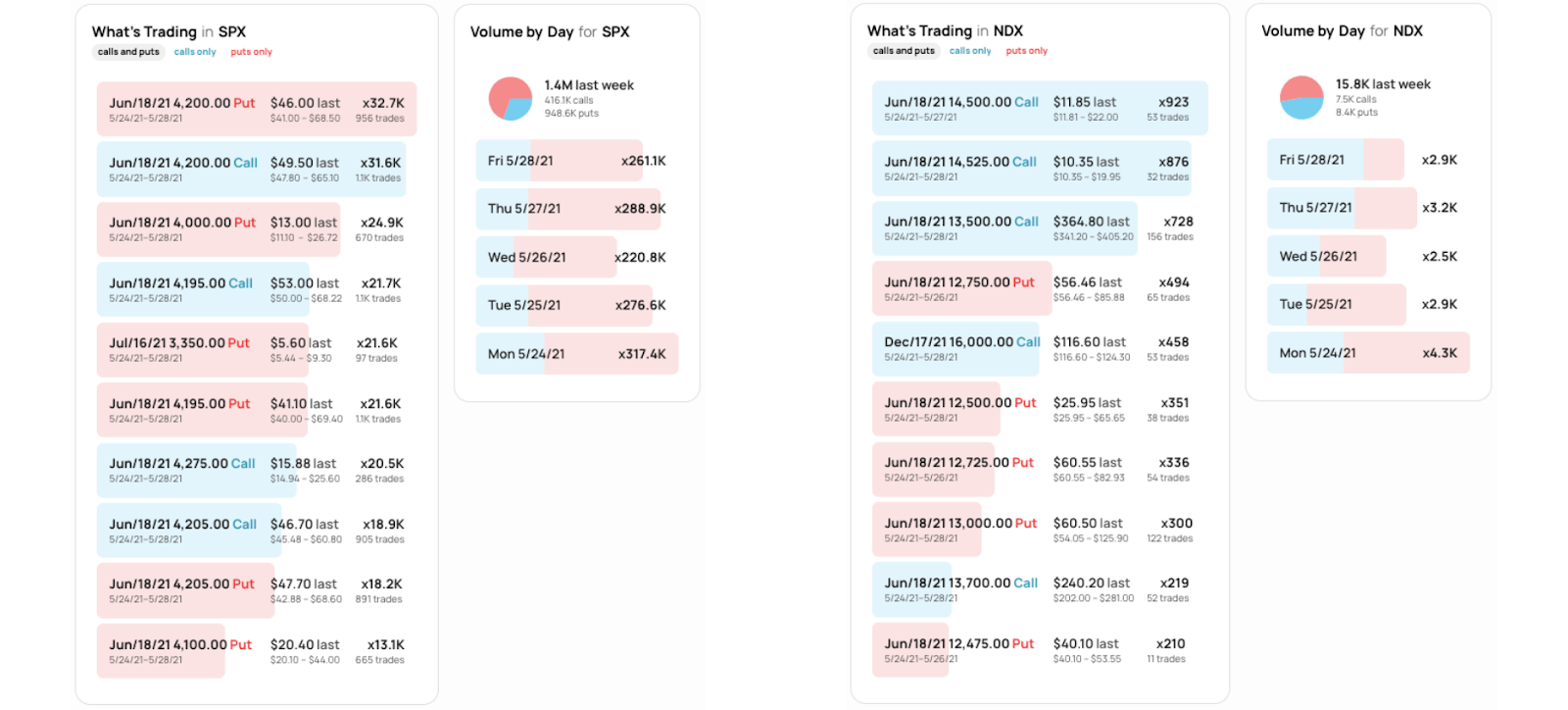
Graphic: SHIFT search suggests participants were becoming more interested in call strikes at and above current prices in the cash-settled S&P 500 Index (INDEX: SPX) and Nasdaq 100 Index (INDEX: NDX), last week.
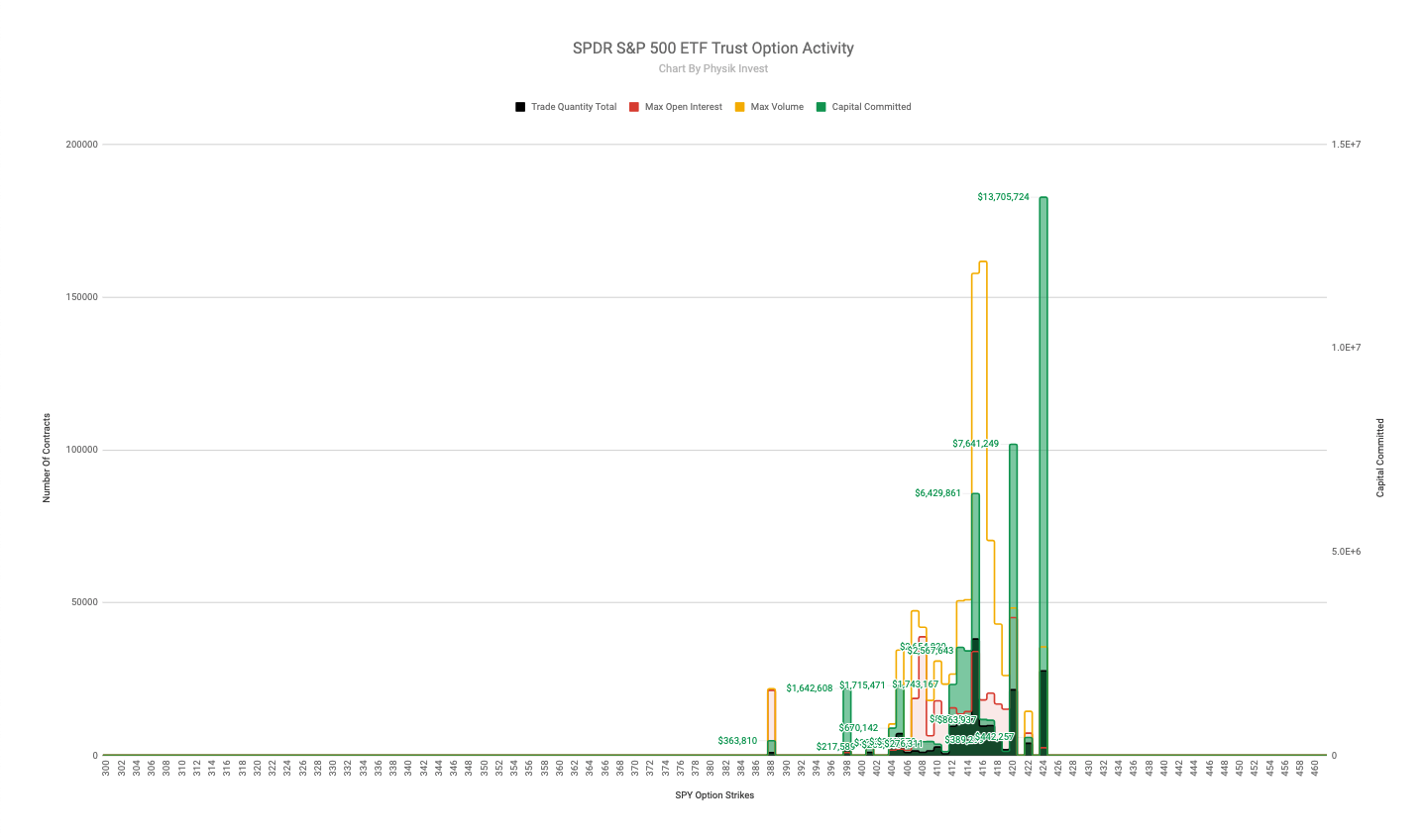
Graphic: Physik Invest maps out the purchase of call and put options in the SPDR S&P 500 ETF Trust (NYSE: SPY), for the week prior. Activity in the options market was primarily concentrated in short-dated tenors, in strikes at and above $425.

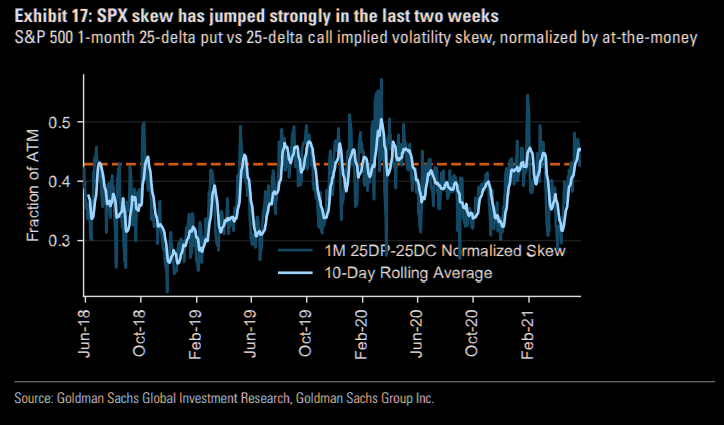
Outlier risks remain, though; aside from the seasonally weak period, S&P 500 skew – a measure of perceived tail risk and the chances of a black swan event – rose dramatically over the past few weeks. At the same time, sentiment cooled considerably, while individual stock volatility increased the potential for a repeat of the GameStop Corporation (NYSE: GME) de-risking event.

Graphic: Goldman Sachs Group Inc (NYSE: GS) unpacks outlier risks based on the implied volatility of S&P 500 out-of-the-money options, via The Market Ear.

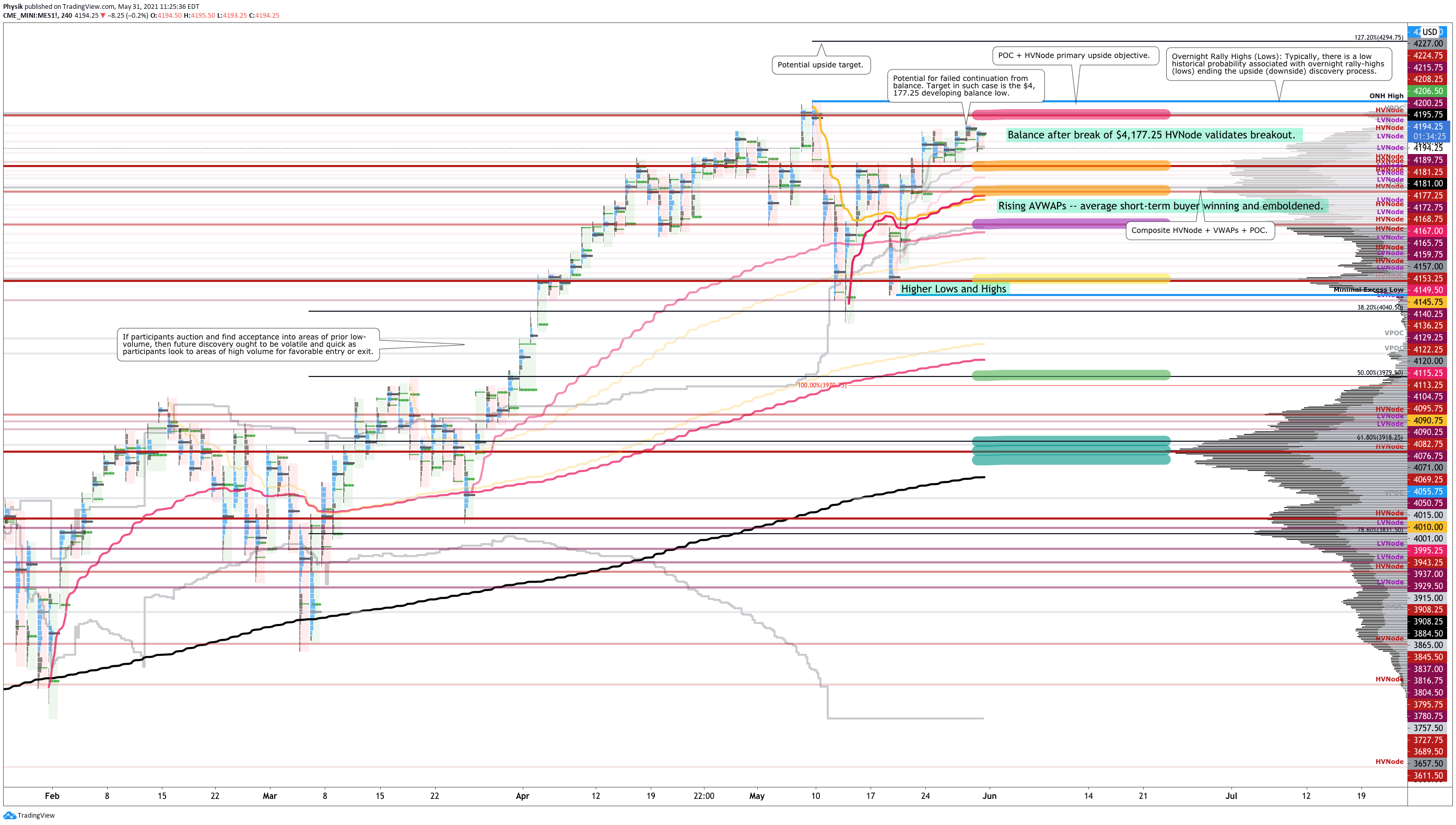
What To Expect: In the coming sessions, participants will want to focus their attention on where the S&P 500 trades in relation to the $4,197.25 high volume area (HVNode).

Volume Areas: A structurally sound market will build on past areas of high volume. Should the market trend for long periods of time, it will lack sound structure (identified as a low volume area which denotes directional conviction and ought to offer support on any test). 

If participants were to auction and find acceptance into areas of prior low volume, then future discovery ought to be volatile and quick as participants look to areas of high volume for favorable entry or exit.

That said, participants can trade from the following frameworks.

In the best case, the index trades sideways or higher; activity above $4,197.25 has the potential to reach the $4,227.00 point of control (POC). Initiative trade beyond the POC could reach as high as first the $4,238.00 overnight all-time high (ONH) and then, the $4,294.75 Fibonacci-derived price extension, a typical recovery target. 

POCs: POCs (like HVNodes described above) are valuable as they denote areas where two-sided trade was most prevalent. Participants will respond to future tests of value as they offer favorable entry and exit. 

Overnight Rally Highs (Lows): Typically, there is a low historical probability associated with overnight rally-highs (lows) ending the upside (downside) discovery process.

In the worst case, the index trades lower; activity below the $4,177.25 HVNode puts in play the $4,153.25 HVNode, first. Thereafter, if lower, the $4,122.25 HVNode and $4,071.00 POC come into play. 

On a cross through the $4,050.75 low volume area (LVNode), long-biased traders should beware of a rapid liquidation, as low as first the $4,015.00 and $4,001.00 POCs. In such a liquidation, odds favor a test of ~$3,970.00 50.00% retracement, as well as the $3,918.00 61.80% retracement and HVNode.

Graphic: 4-hour profile chart of the Micro E-mini S&P 500 Futures.
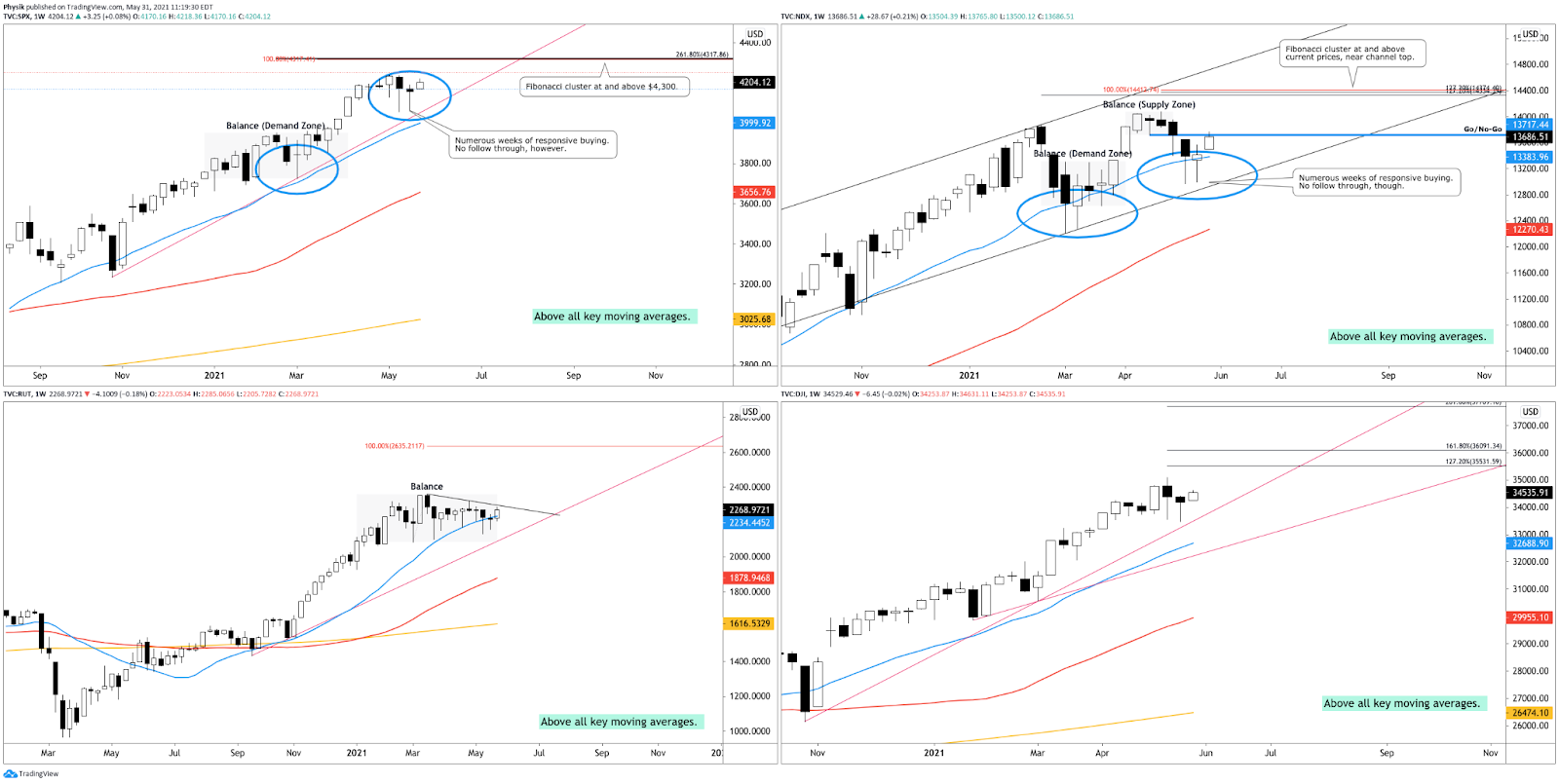
Graphic: Weekly candlestick charts of the S&P 500 (top left), Nasdaq 100 (top right), Russell 2000 (bottom left), and Dow Jones Industrial Average (bottom right). Nasdaq is primed for upside and has the potential to pull the S&P with it. 

News And Analysis

Trade | One of the world’s top ports expects delays on an outbreak. (BBG)

Markets | PBOC raises reserve ratio for foreign exchange holdings. (BBG)

Economy | Recovery solidifies in U.S., Europe, while EM faces risks. (Moody’s)

Markets | China bars banks from selling commodity-linked products. (REU)

Economy | Fed security purchases draw fire in hot U.S. housing market. (S&P)

Energy | Global oil demand is seen eclipsing India, Iran’s uncertainty. (S&P)

Economy | U.S. won’t experience stagflation over next few years. (Moody’s)

Economy | Non-government loans seeing a jump in forbearances. (MND)

Economy | U.S. speculative-grade corporate default rate to fall to 4%. (S&P)

Markets | Inflation, higher oil, stronger yuan point in same direction. (BBG)

Economy | U.S. retailers face headwinds from slowing sales, inflation. (S&P)

Markets | Everyone with bonds to liquidate had ample time to do so. (BBG)

What People Are Saying

Innovation And Emerging Trends

Markets | How recent growth in leveraged finance affects investors. (BZ)

Politics | Tech growth overshadowed by regulatory risks, challenges. (S&P)

Markets | Chamath: SPACs need more oversight and regulation. (BBG)

Politics | China moves to a three-child policy to boost its birthrate. (BBG)

Markets | Shakeout stirs debate over ether’s long-term potential. (BBG)

FinTech | Which banks are positioned for low rates, digital adoption. (S&P)

About

Renato founded Physik Invest after going through years of self-education, strategy development, and trial-and-error. His work reporting in the finance and technology space, interviewing leaders such as John Chambers, founder, and CEO, JC2 Ventures, Kevin O’Leary, businessman and Shark Tank host, Catherine Wood, CEO and CIO, ARK Invest, among others, afforded him the perspective and know-how very few come by.

Having worked in engineering and majored in economics, Renato is very detailed and analytical. His approach to the markets isn’t built on hope or guessing. Instead, he leverages the unique dynamics of time and volatility to efficiently act on opportunity.

Disclaimer

At this time, Physik Invest does not manage outside capital and is not licensed. In no way should the materials herein be construed as advice. Derivatives carry a substantial risk of loss. All content is for informational purposes only.
Categories
Commentary

Weekly Brief For May 23, 2021

Editor’s Note: Happy Sunday, everyone!

A lot of new subscribers this week in light of Physik Invest’s webinar with Benzinga. If you want access to the slides presented, click here.

Additionally, I am honored for your decision to follow along and will do my best to provide an objective, “no fluff” view into the who, what, when, where, why, and how in finance and technology.
Quick note, from May 25 to May 28, the daily newsletter will be off as I will be on a trip. It would not be fair for me to provide lackluster content since I won’t have all the tools at my disposal.

That said, I’ll try to be objective and concise in today’s note to ensure you have the proper direction for the volatile trade ahead.

Market Commentary

Key Takeaways: Index futures in balance.

  • Bitcoin’s weekend crash churns stomachs.
  • Tone on adjusting monetary policy altered.
  • Indices were sideways-to-higher last week.

What Happened: Last week, U.S. stock index futures auctioned sideways-to-higher, as participants looked to price in emerging dynamics with respect to rising inflation, fiscal and monetary tightening, COVID-19 concerns, political risks, and the like. 

In pricing in these dynamics, the movement was both volatile and mechanical, halting short of key visual references suggesting the participants involved were short-term (i.e., technically driven) in nature.

Adding, amid this rotation, quite a bit of poor structure was cleaned up (i.e., low volume areas), but still, judging by a lack of excess at certain points on the composite volume profile, odds point to limited conviction and commitment.

Excess: A proper end to price discovery; the market travels too far while advertising prices. Responsive, other-timeframe (OTF) participants aggressively enter the market, leaving tails or gaps which denote unfair prices.

Holistically, equities are in a seasonally weak period. At the same time, inflation and uninspiring economic data are major worries investors are attempting to price in.

Just last week, the Federal Reserve’s minutes showed that some on the committee were interested in tapering discussions. 

“It was a surprise to hear the talk about Fed tapering,” Joyce Chang, JPMorgan’s chair of global research, said. “The market had been thinking there might be a couple of months before you really saw this particular issue come into focus.” 

Generally speaking, inflation and rates move inverse to each other. Low rates stimulate demand for loans (i.e., borrowing money more attractive). With the rapid recovery, though, market participants fear that rates will rise to protect the economy from overheating.

Higher rates have the potential to reduce the present value of future earnings, making stocks, especially those that are high growth, less attractive. To note, however, rates remain range-bound; rates on the 10 Year T-Note sit below their March high and are likely to continue higher, which the market may absorb.

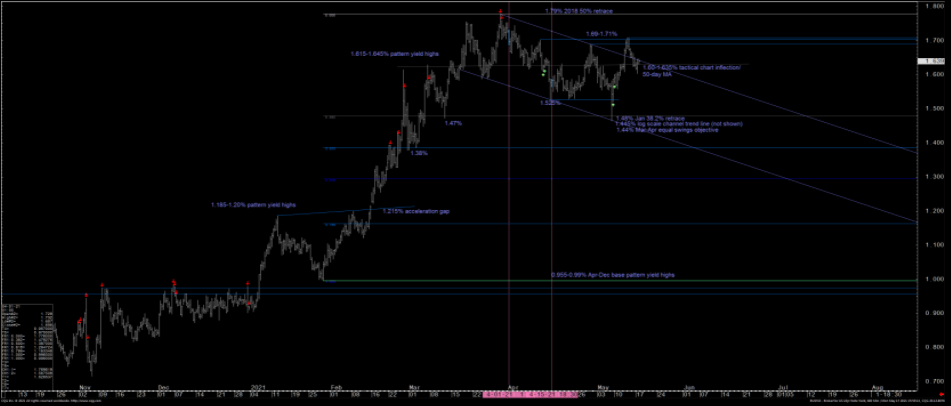
Graphic: JPMorgan Chase & Co (NYSE: JPM) analysts believe yields on the 10-year note will stay rangebound before breaking higher this summer, via The Market Ear.

How may the market absorb a move higher in rates? Looking back, according to The Market Ear, during the so-called Taper Tantrum, in the early 2010s, rates settled in a wide range, and equities rallied big. Adding, research by JPMorgan Chase & Co (NYSE: JPM) suggests equities may be getting cheap with reflationary themes the go-to play, still.

In support, during the May 19 reversal, in the S&P 500 and Nasdaq 100, participants increased exposure to the upside with relatively cheap, longer-dated calls.

Still, overall, the flows point to a lot of opportunistic hedging (see graphic below).

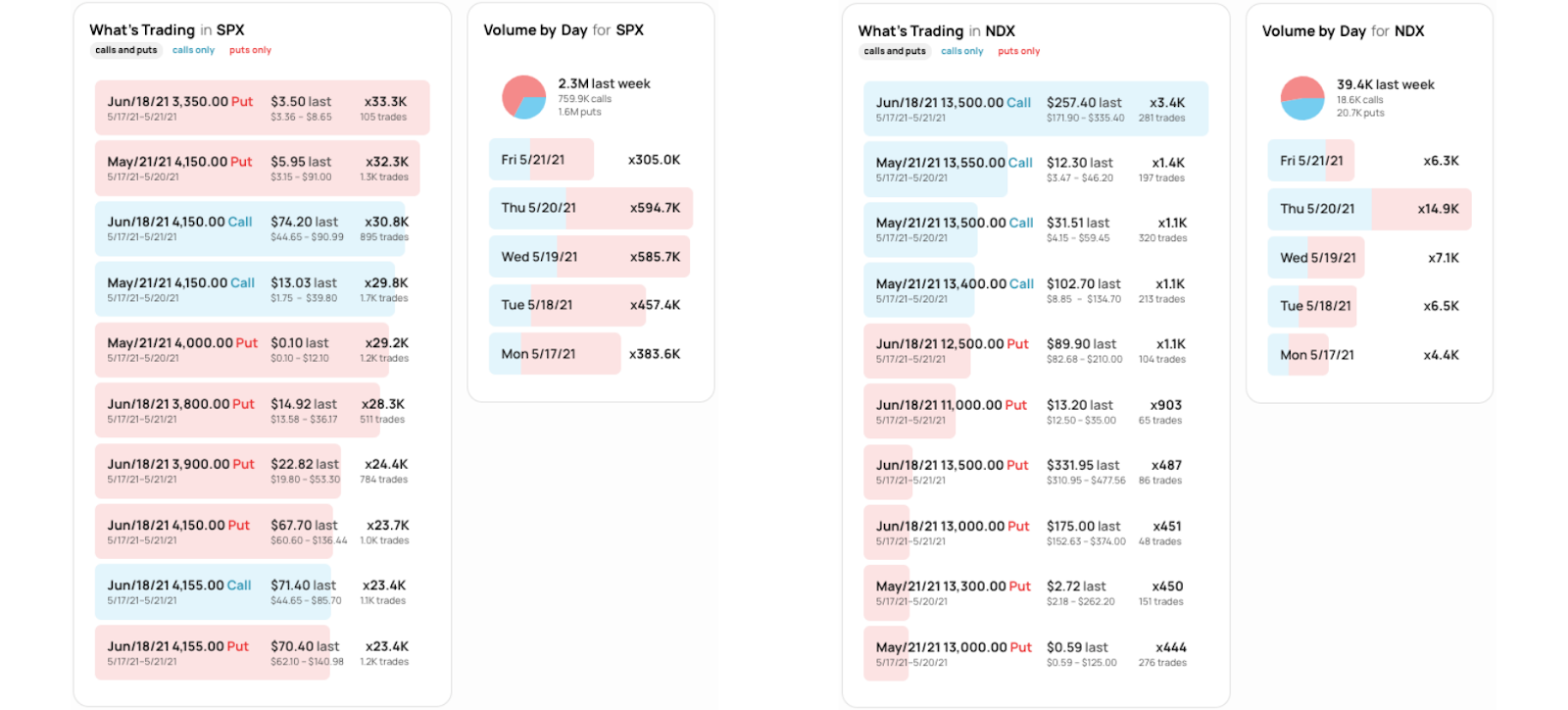
Graphic: SHIFT search suggests participants were most interested in put strikes at and below current prices in the cash-settled S&P 500 Index (INDEX: SPX) and Nasdaq 100 Index (INDEX: NDX), last week. To note, however, participants began paying up for longer-dated upside exposure (evidenced by call activity).

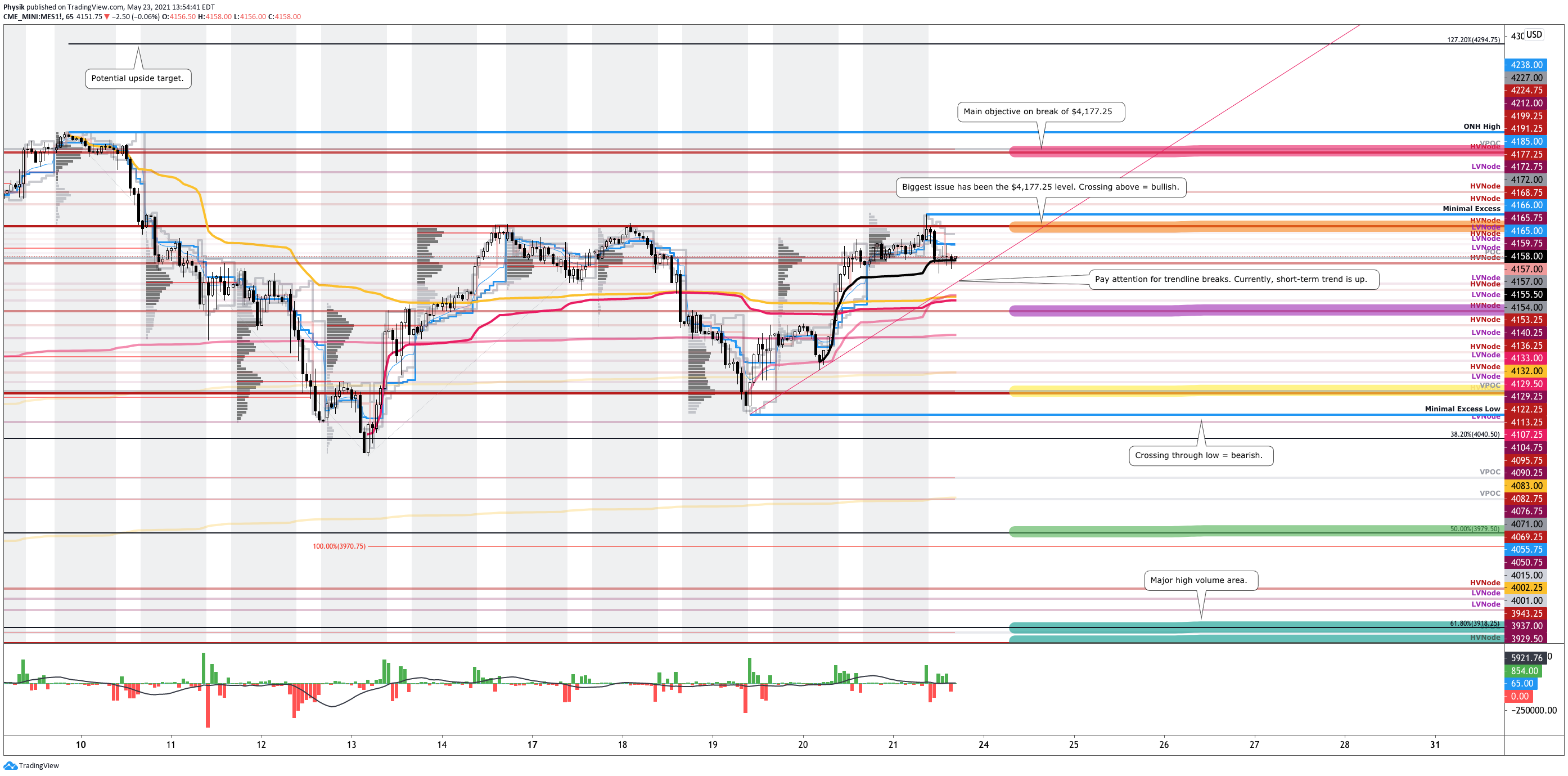
What To Expect: In the coming sessions, participants will want to focus their attention on where the S&P 500 trades in relation to its $4,177.25 composite high volume area (HVNode).

Volume Areas: A structurally sound market will build on past areas of high volume. Should the market trend for long periods of time, it will lack sound structure (identified as a low volume area which denotes directional conviction and ought to offer support on any test). 

If participants were to auction and find acceptance into areas of prior low volume, then future discovery ought to be volatile and quick as participants look to areas of high volume for favorable entry or exit.

In the best case, the index trades sideways or higher; activity above the $4,177.25 HVNode puts in play the $4,227.00 point of control (POC). Initiative trade beyond the POC could reach as high as first the $4,238.00 overnight all-time high and then, the $4,294.75 Fibonacci-derived price extension, a typical recovery target.

POCs: POCs (like HVNodes described above) are valuable as they denote areas where two-sided trade was most prevalent. Participants will respond to future tests of value as they offer favorable entry and exit.

Overnight Rally Highs (Lows): Typically, there is a low historical probability associated with overnight rally-highs (lows) ending the upside (downside) discovery process.

In the worst case, the index trades lower; activity below the $4,122.25 HVNode puts in play the $4,071.00 POC. Thereafter, if lower, on a cross through the $4,050.75 low volume area (LVNode), long-biased traders should beware of a rapid liquidation, as low as first the $4,015.00 and $4,001.00 POCs. In such a liquidation, odds favor a test of ~$3,970.00 50.00% retracement, as well as the $3,918.00 61.80% retracement and HVNode.

Graphic: 65-minute profile chart of the Micro E-mini S&P 500 Futures.
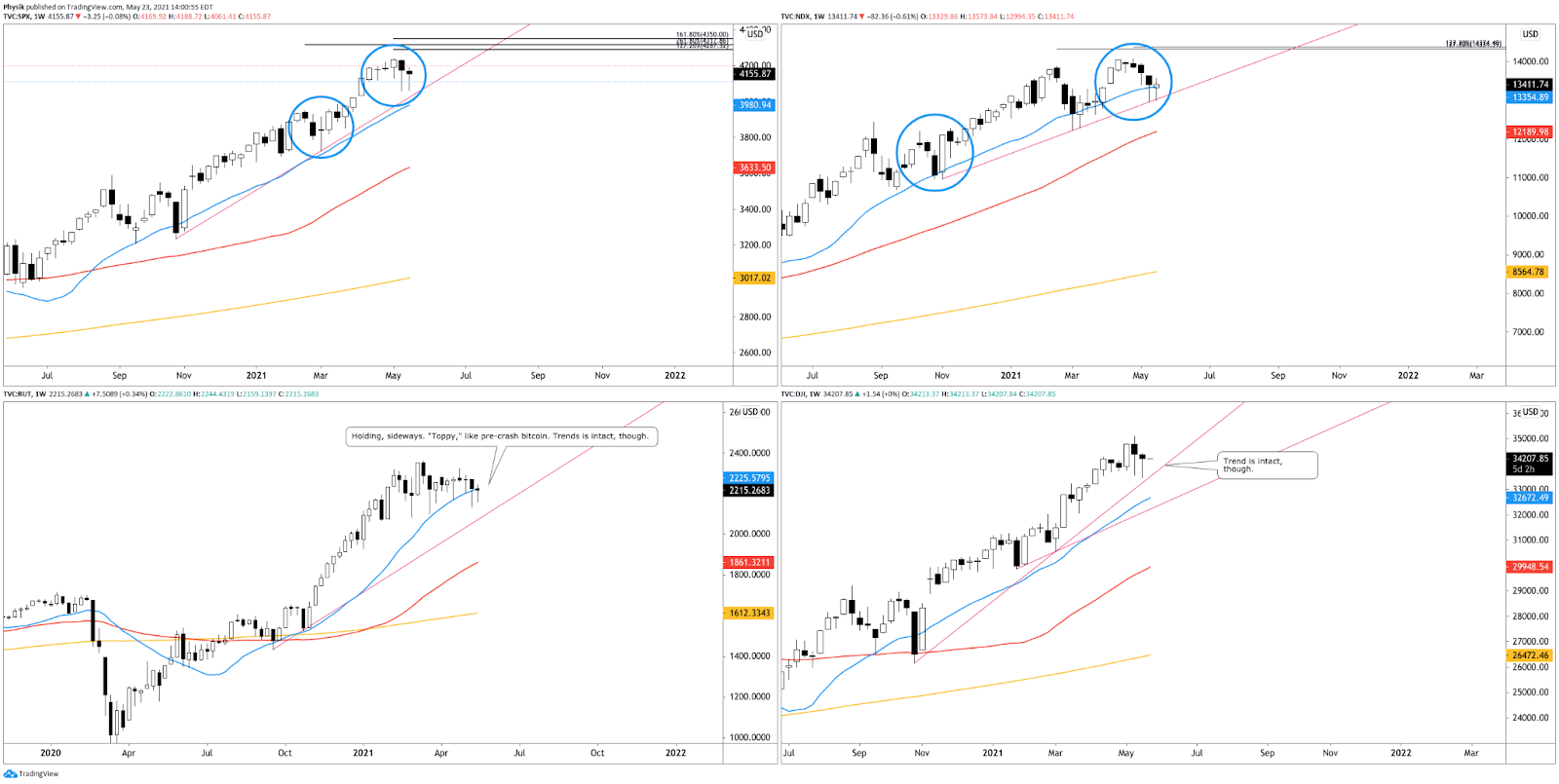
Graphic: Weekly candlestick charts of the S&P 500 (top left), Nasdaq 100 (top right), Russell 2000 (bottom left), and Dow Jones Industrial Average (bottom right). Note Russell’s “toppy” rotation, and similar pullbacks to trend in the S&P 500 and Nasdaq. One last push, higher?
Graphic: Physik Invest maps out the purchase of call and put options in the SPDR S&P 500 ETF Trust (NYSE: SPY), for last week. Though activity in the options market was primarily concentrated in short-dated tenors, increased trade in farther-dated call-side strikes is observed as a commitment to higher prices.

News And Analysis

Markets | Rotation from growth into value strengthens bull market. (ARK)

Recovery | Two COVID shots effective against the India variant. (REU)

Economy | U.S. inflation is transitory and consistent with recovery. (S&P

Crypto | Google search volume for cryptocurrency breaks ATH. (Block)

Economy | PBOC will maintain its exchange rate basically stable. (BBG)

Markets | Global chip shortages cost automakers 5% of production. (Fitch)

Markets | JPMorgan cross-asset strategy head warns of drop. (BBG)

Markets | Nomura, UBS, UniCredit fined over bond trading cartel. (TT)

Recovery | CDC probes reports of myocarditis in the vaccinated. (Axios)

Economy | U.S. home prices push to record highs, buying slows. (WSJ)

What People Are Saying

Innovation And Emerging Trends

FinTech | How cryptocurrency fits into Brazil’s vision for banking. (Block)

FinTech | Major Asia-Pacific region banks upping their fintech bets. (S&P)

FinTech | U.S. Federal Reserve plans to publish a paper on CBDC. (Block)

Real Estate | Manhattan’s apartment vacancy rate stubbornly high. (WSJ)

About

Renato founded Physik Invest after going through years of self-education, strategy development, and trial-and-error. His work reporting in the finance and technology space, interviewing leaders such as John Chambers, founder, and CEO, JC2 Ventures, Kevin O’Leary, businessman and Shark Tank host, Catherine Wood, CEO and CIO, ARK Invest, among others, afforded him the perspective and know-how very few come by.

Having worked in engineering and majored in economics, Renato is very detailed and analytical. His approach to the markets isn’t built on hope or guessing. Instead, he leverages the unique dynamics of time and volatility to efficiently act on opportunity.

Disclaimer

At this time, Physik Invest does not manage outside capital and is not licensed. In no way should the materials herein be construed as advice. Derivatives carry a substantial risk of loss. All content is for informational purposes only.