Categories
Commentary

Daily Brief For June 29, 2021

Market Commentary

Equity index futures diverge, trade sideways.

  • COVID variants cause lockdowns.
  • Ahead are some economic reports.
  • RUT, DJI firming. SPX, NDX weak.

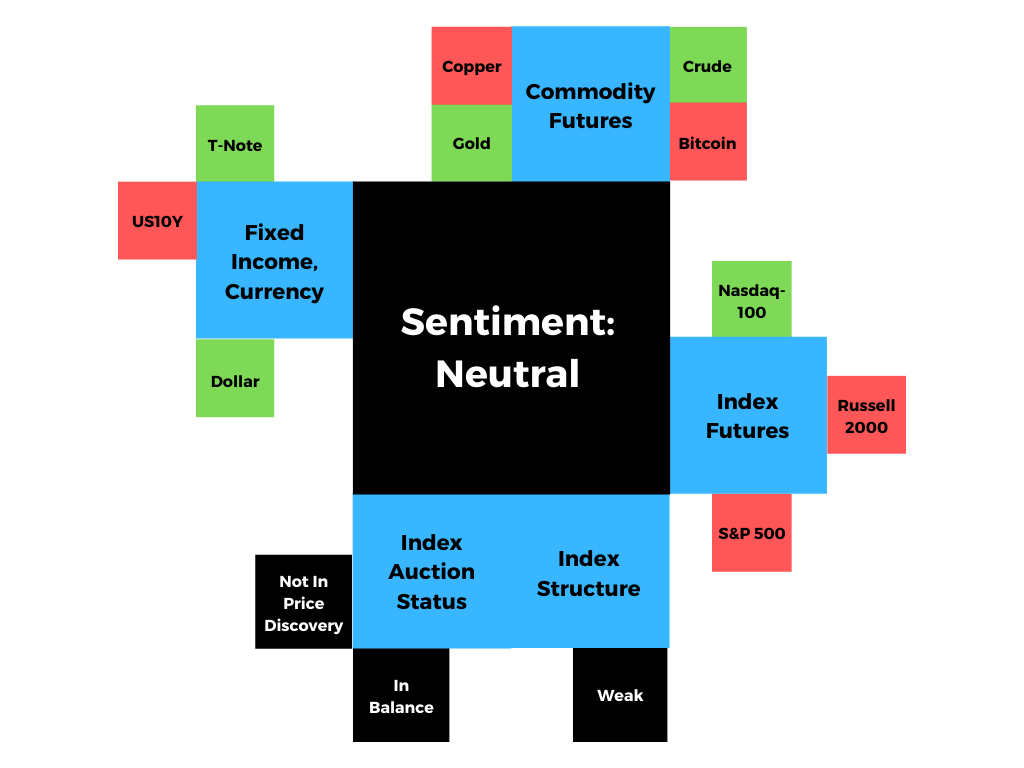
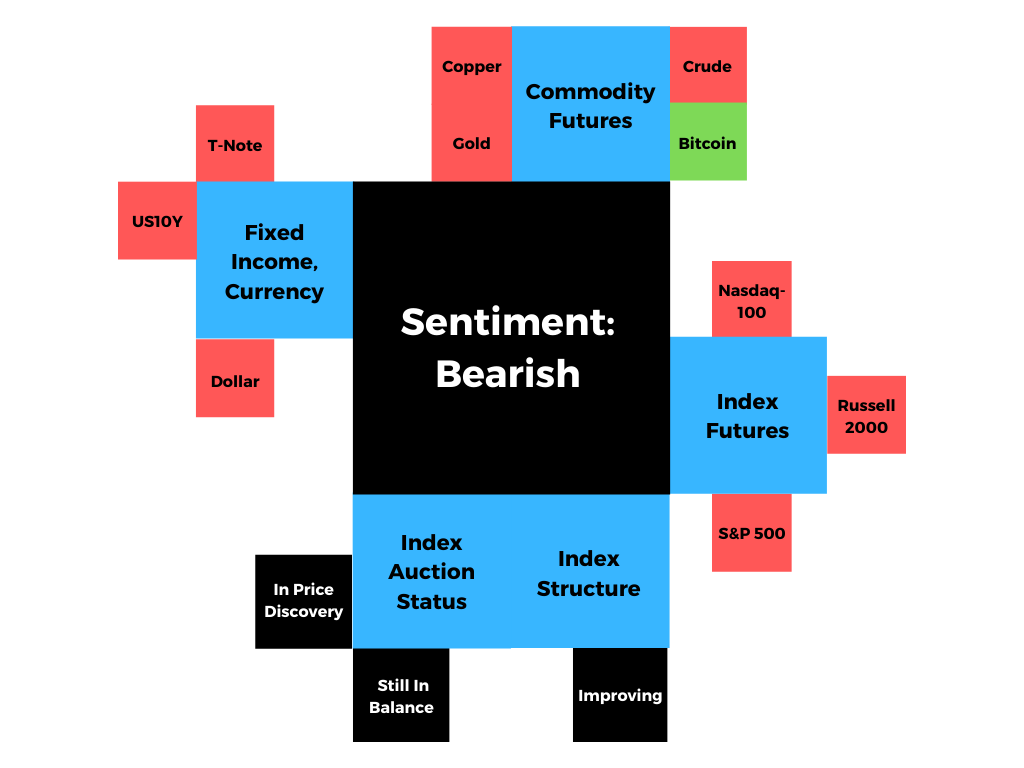
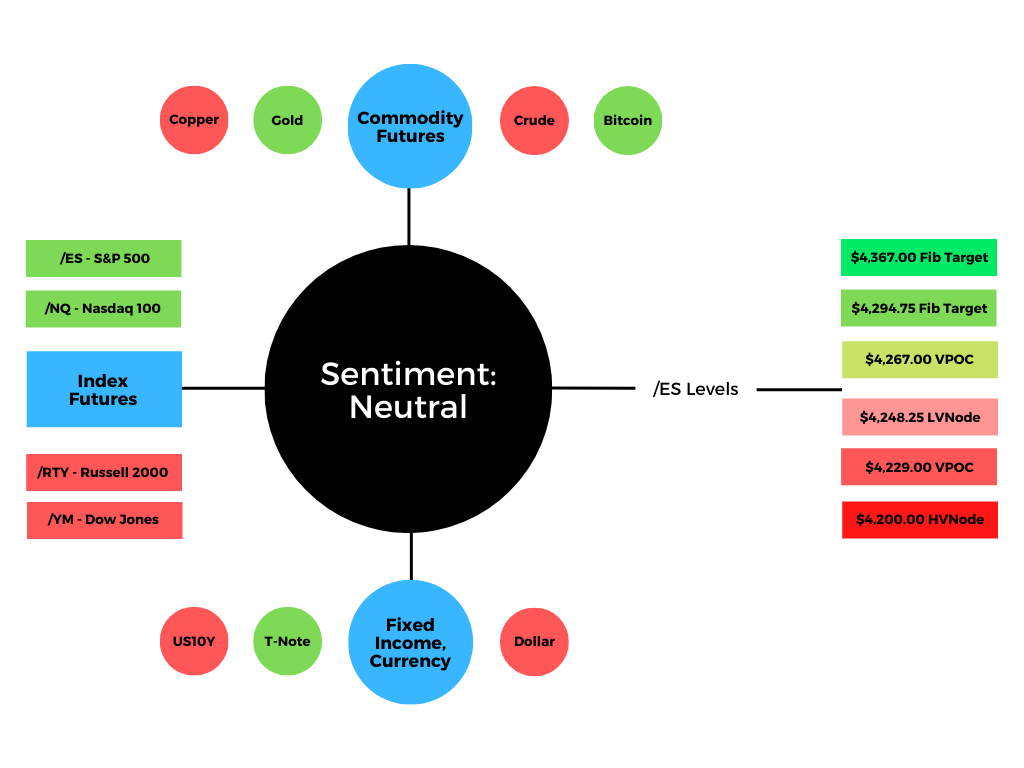
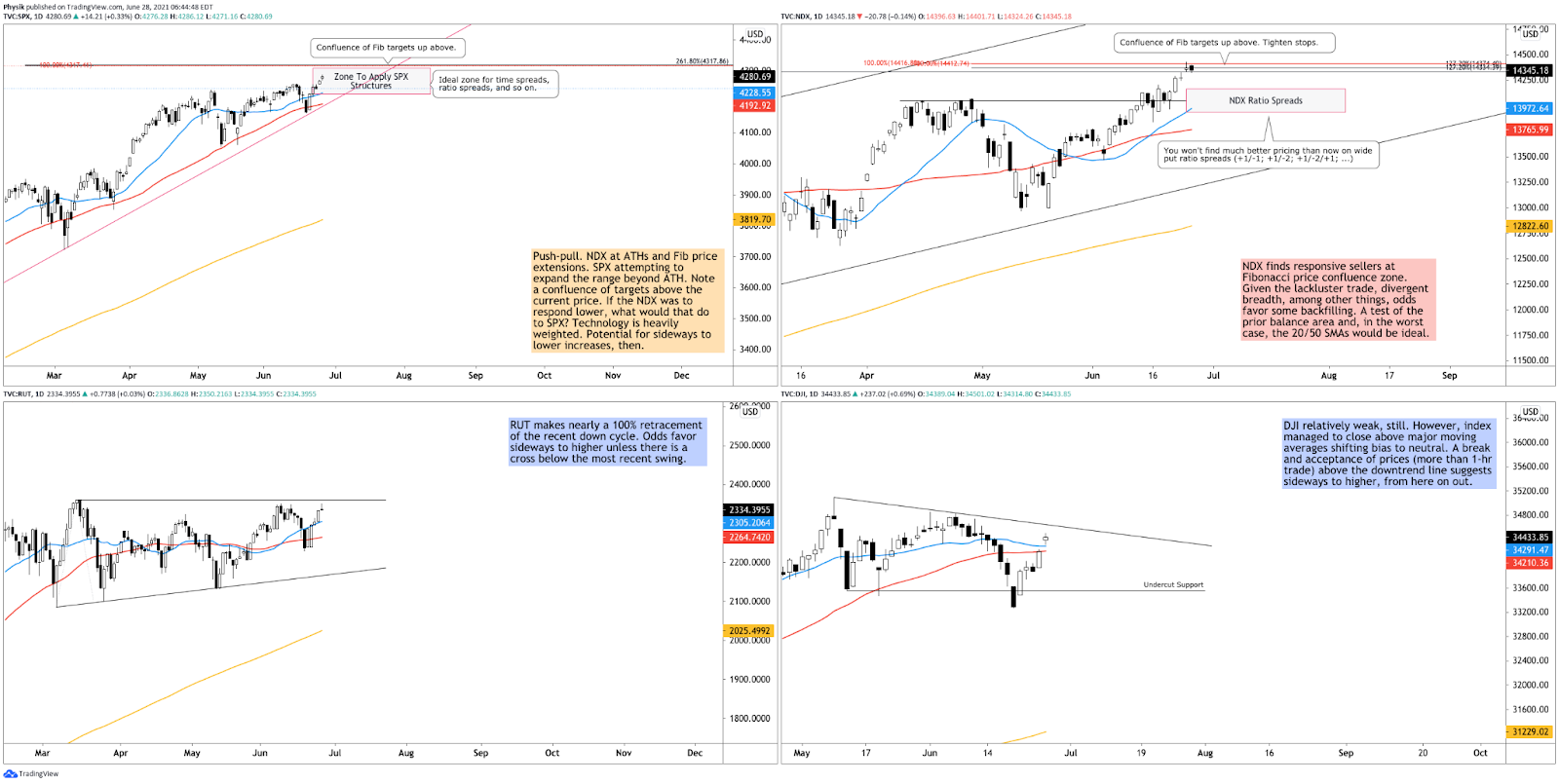
What Happened: U.S. stock index futures auctioned sideways ahead of some key releases. The Russell 2000 and Dow Jones Industrial Average firmed up relative to their peers, the S&P 500 and Nasdaq 100, the group leader.

This activity comes as banks boosted their dividends and uncertainties surrounding the COVID-19 delta-variant. Some reports suggest nearly half of Australia’s population is in lockdown, while Asian countries are looking to reduce the spread with mobility restrictions. Still, not all news is bad; some European countries are lifting restrictions on travel and OPEC may increase the supply of oil.

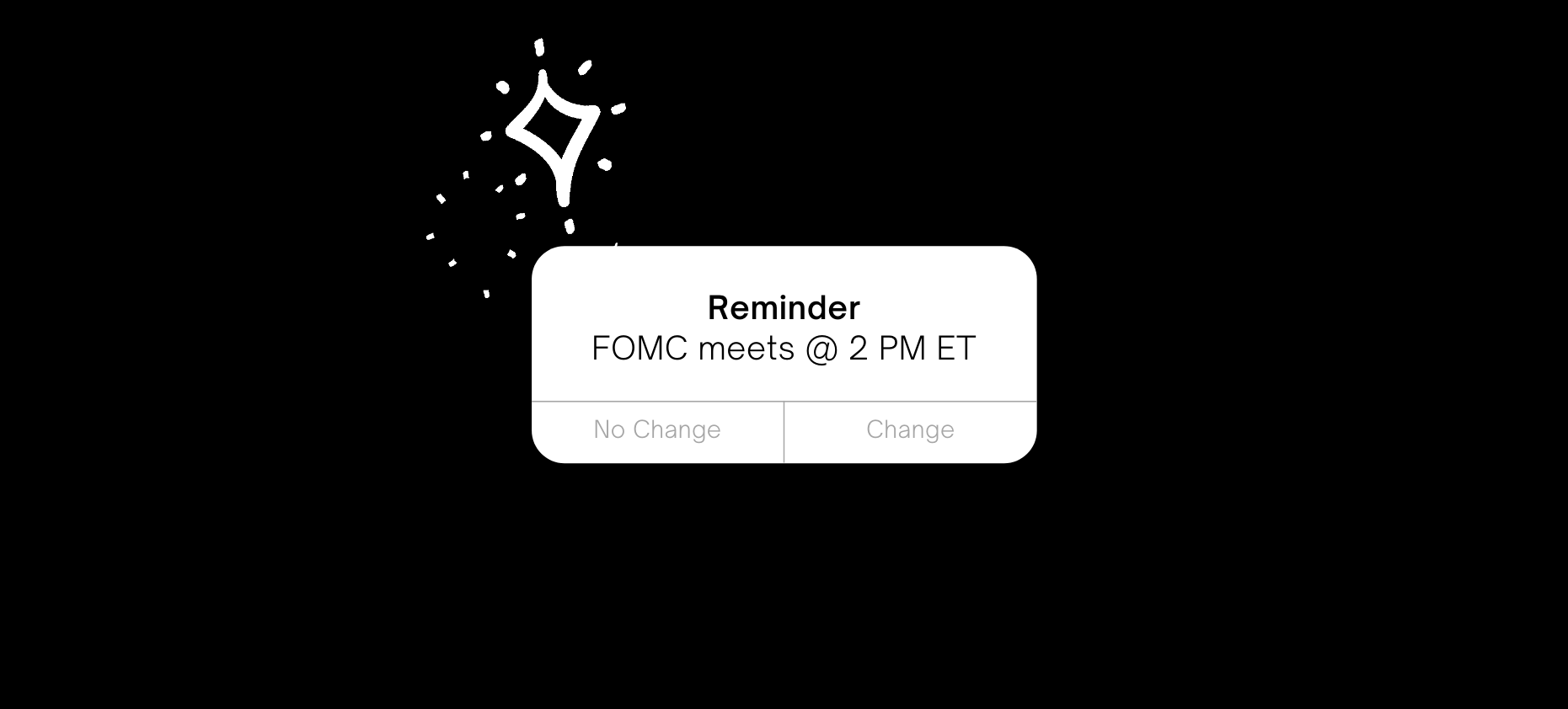
Of interest today is data around home prices, consumer confidence, and Fed speak.
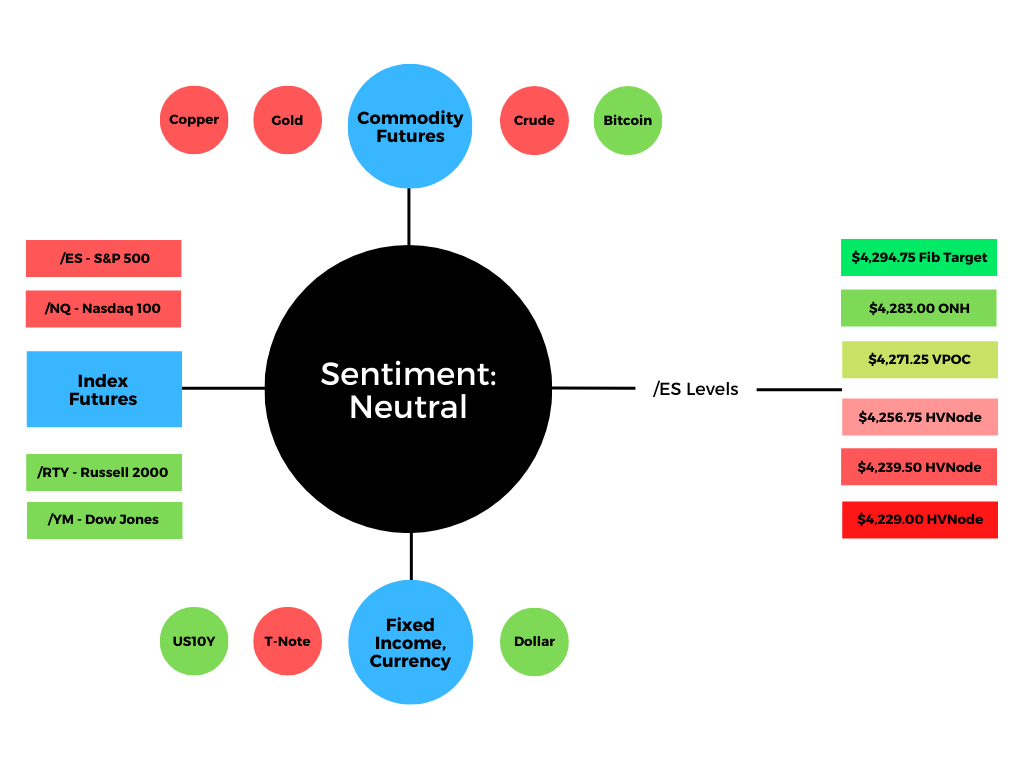
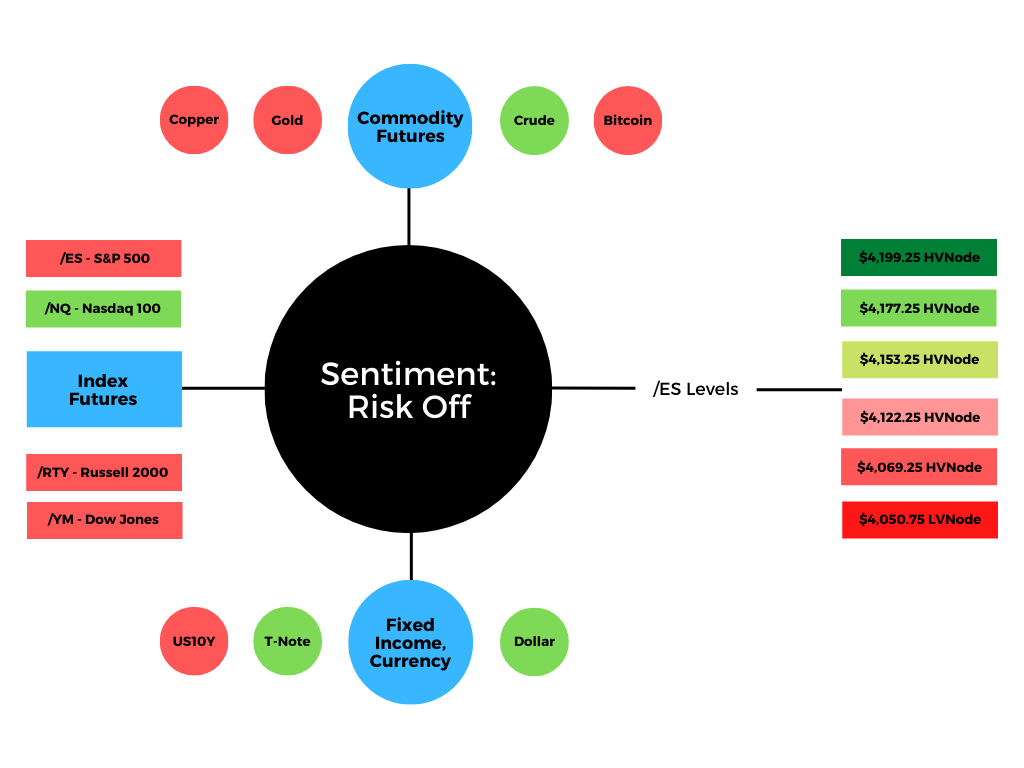
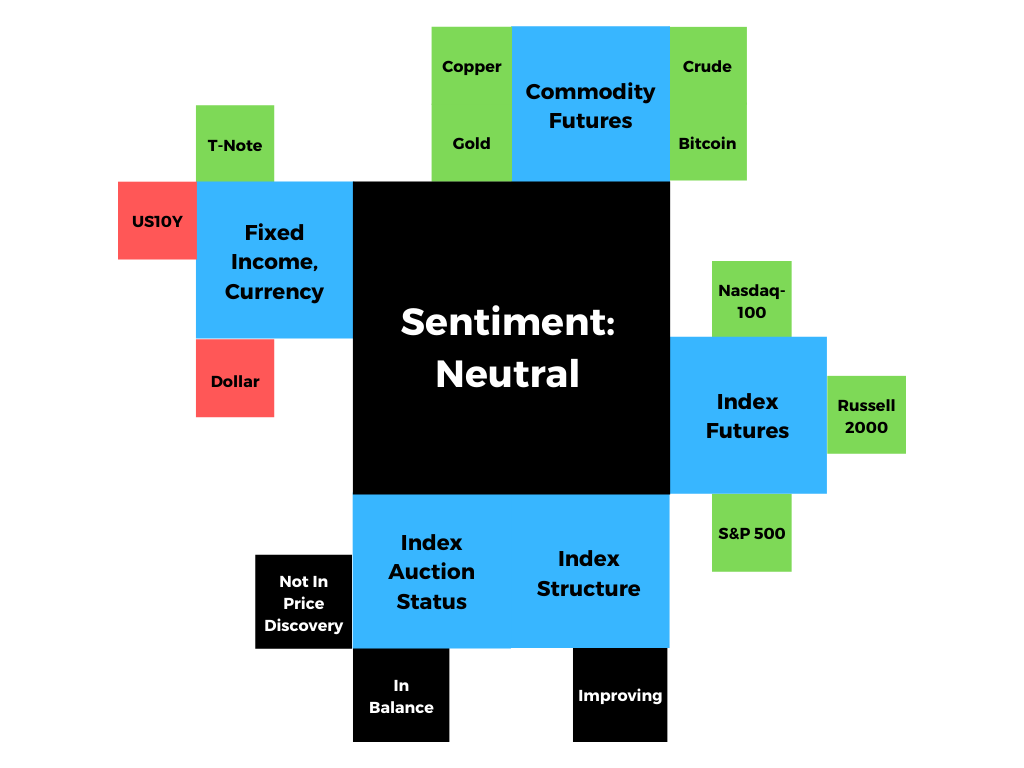
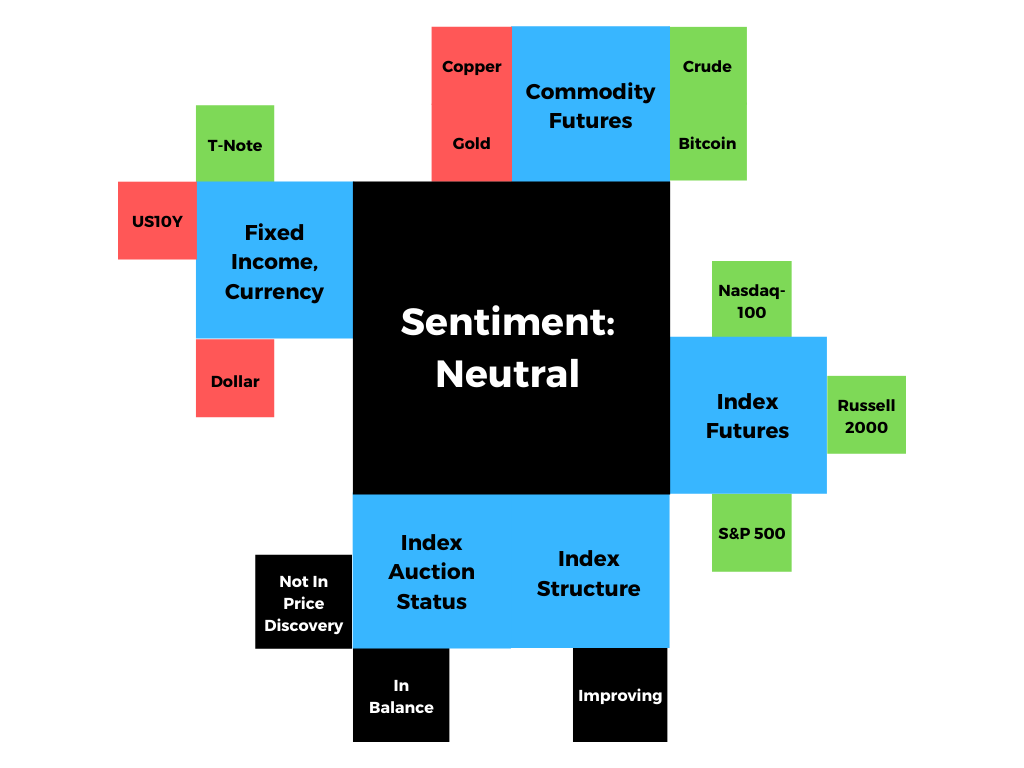
Graphic updated 7:20 AM ET.

What To Expect: Tuesday’s regular session (9:30 AM – 4:00 PM EST) in the S&P 500 will likely open inside of prior-range and -value, suggesting a limited potential for immediate directional opportunity.

Adding, during the prior day’s regular trade, the best case outcome occurred, evidenced by initiative trade above the $4,257.00 Point of Control (POC), up to a new overnight high (ONH) at $4,283.00.

POCs: POCs are valuable as they denote areas where two-sided trade was most prevalent. Participants will respond to future tests of value as they offer favorable entry and exit.

Overnight Rally Highs (Lows): Typically, there is a low historical probability associated with overnight rally-highs (lows) ending the upside (downside) discovery process.

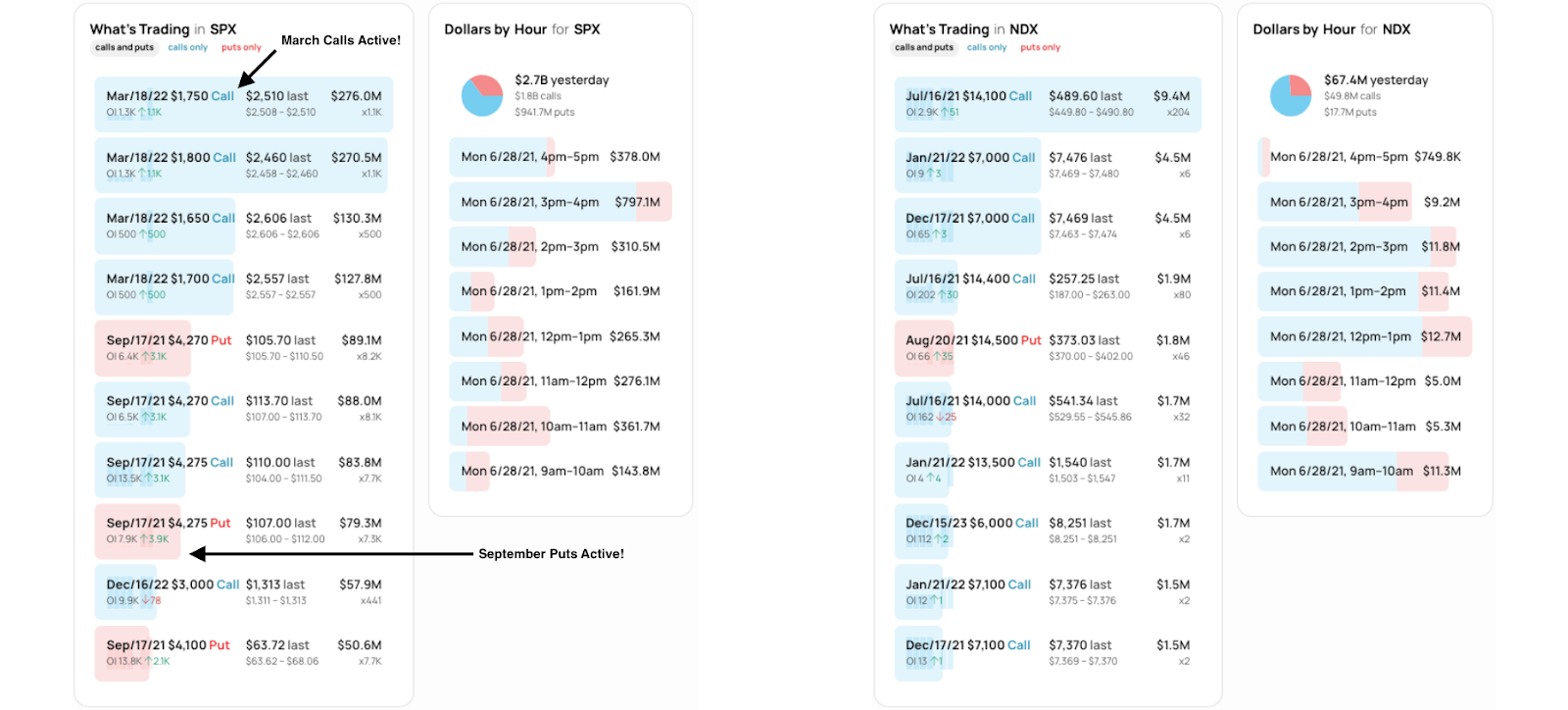
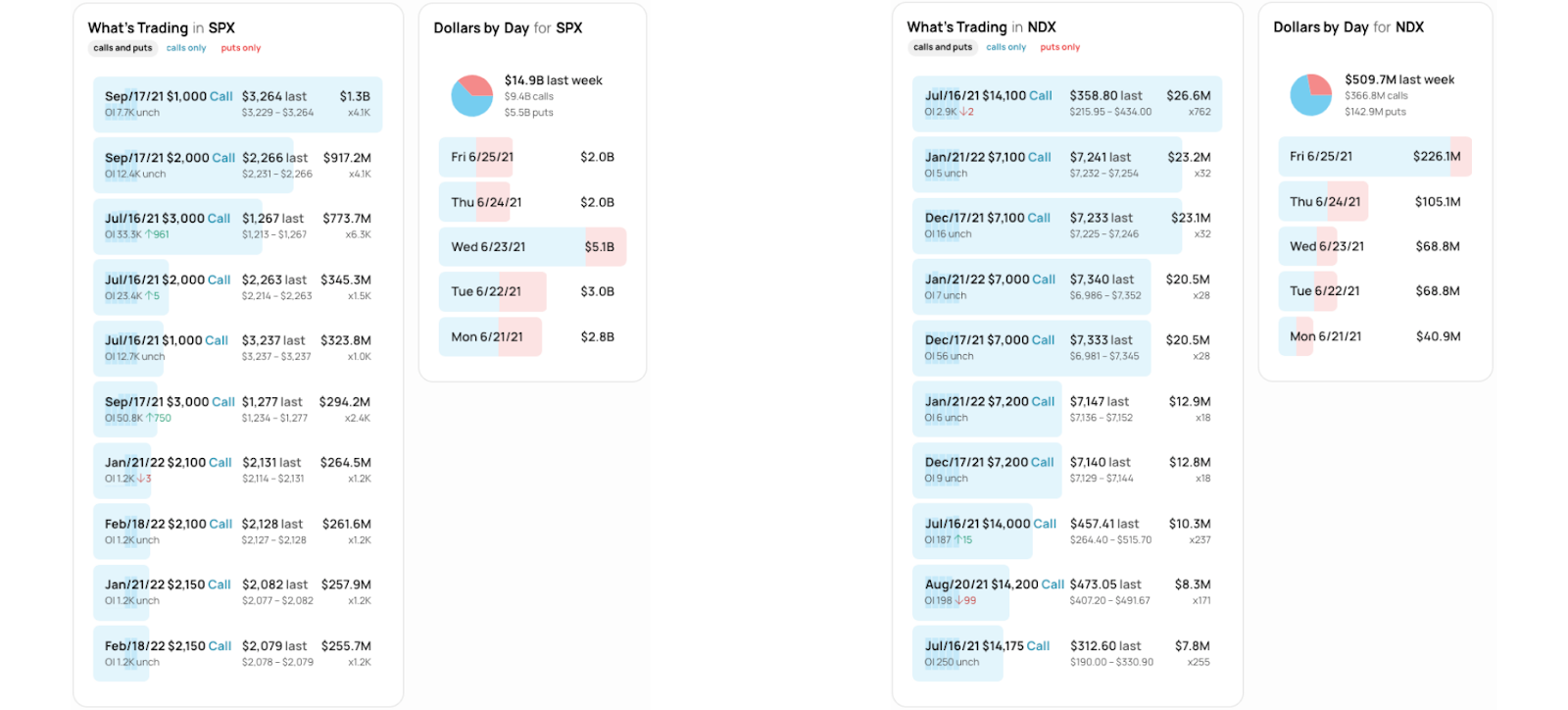
Prior to getting onto what’s expected for today’s trade, it is important to note some ongoing activity in the options market. Specifically, participants, despite their commitment to higher prices (as evidenced by longer-dated call activity), are likely hedging against near-term risks, like the Jackson Hole Economic symposium used in the past to signal monetary policy changes (see the graphic below for more detail). This hedging, in conjunction with lackluster breadth and poor expansion of range, cautions participants on increased volatility; a focus should be made on relatively strong issues.

Further, for today, participants can trade from the following frameworks. 

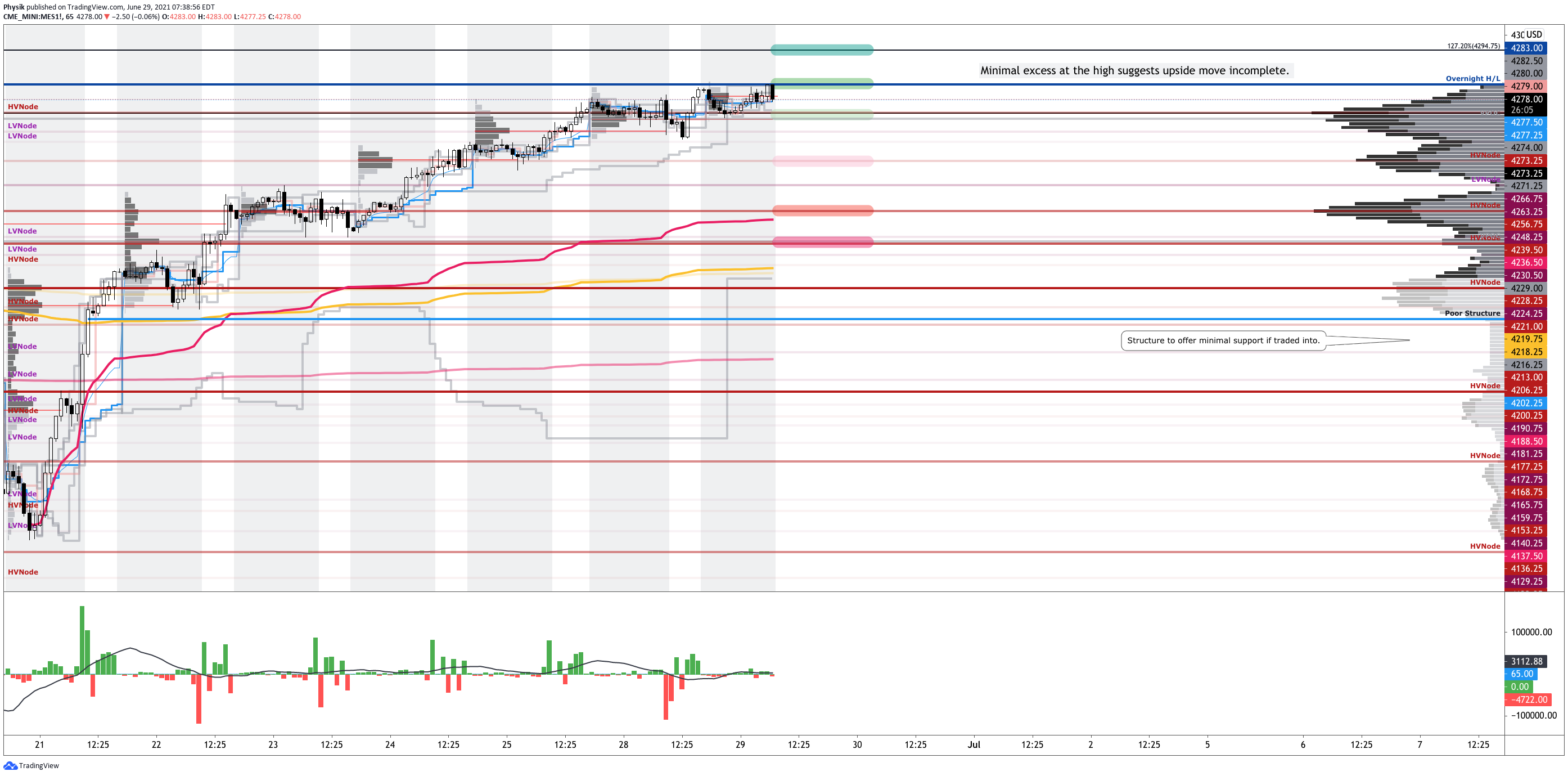
In the best case, the S&P 500 trades sideways or higher; activity above the $4,271.00 POC puts in play the $4,283.00 ONH. Initiative trade beyond the ONH could reach as high as the $4,294.75 Fibonacci-derived price target. 

In the worst case, the S&P 500 trades lower; activity below $4,271.00 puts in play the HVNodes at $4,256.75, $4,239.50, and $4,229.00.

Volume Areas: A structurally sound market will build on past areas of high volume. Should the market trend for long periods of time, it will lack sound structure (identified as a low volume area which denotes directional conviction and ought to offer support on any test). 

If participants were to auction and find acceptance into areas of prior low volume, then future discovery ought to be volatile and quick as participants look to areas of high volume for favorable entry or exit.
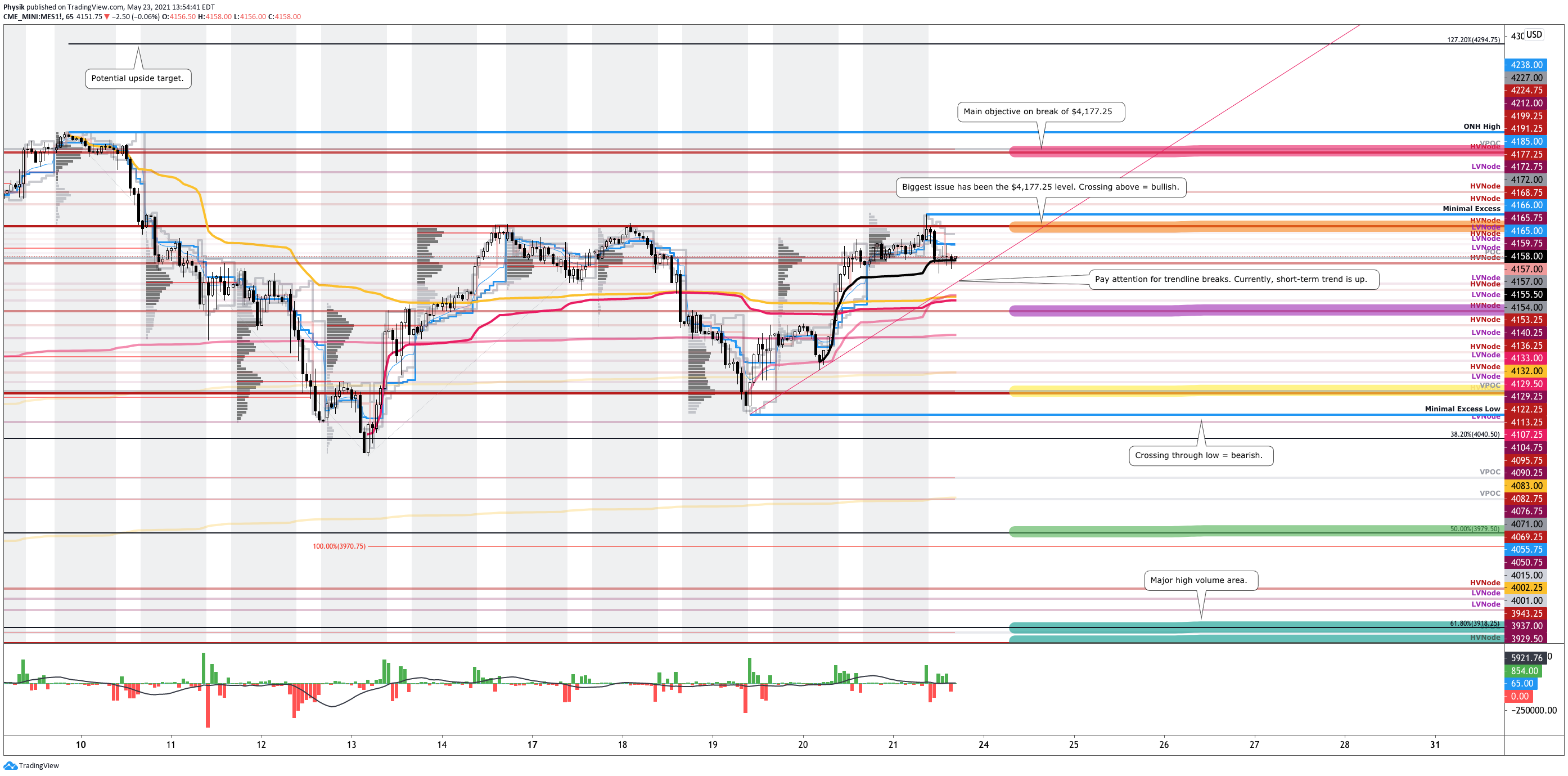
Graphic: 65-minute profile chart of the Micro E-mini S&P 500 Futures. Notice (1) increased churn at higher prices, (2) minimal excess on composite profile, (3) poor expansion of range, as well as (4) poor, and rather unsupportive, low volume structures beneath current price. 
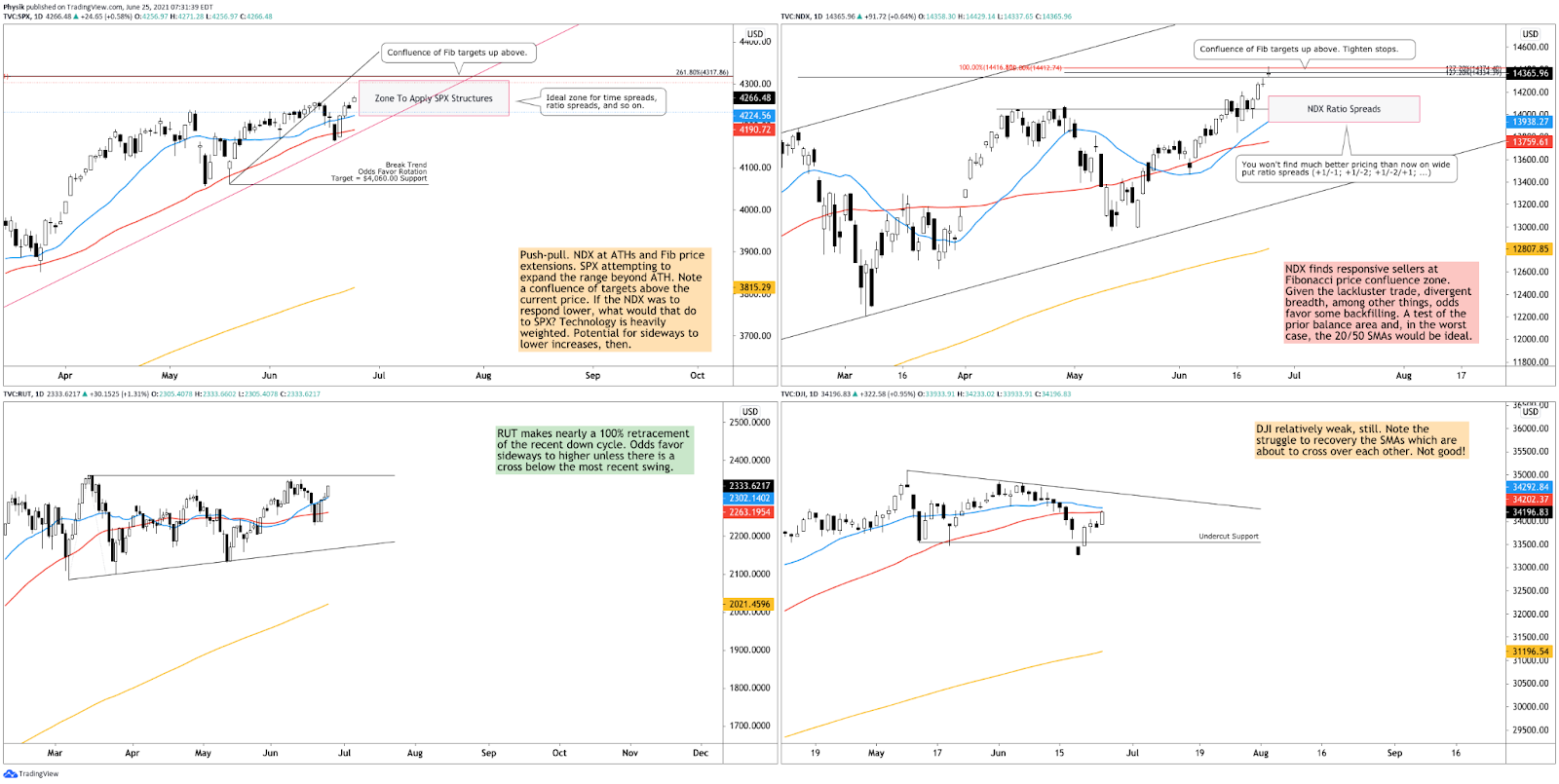
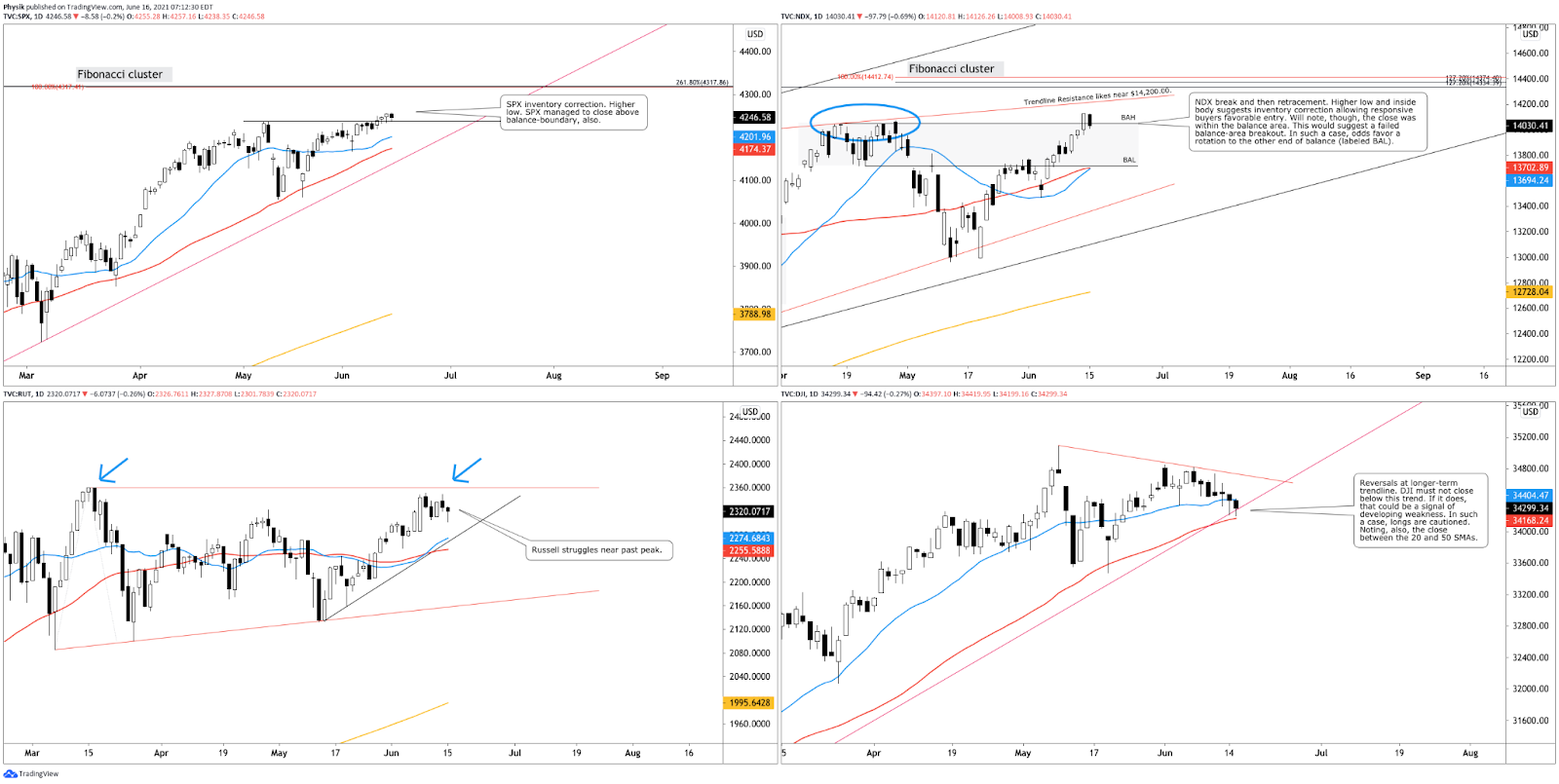
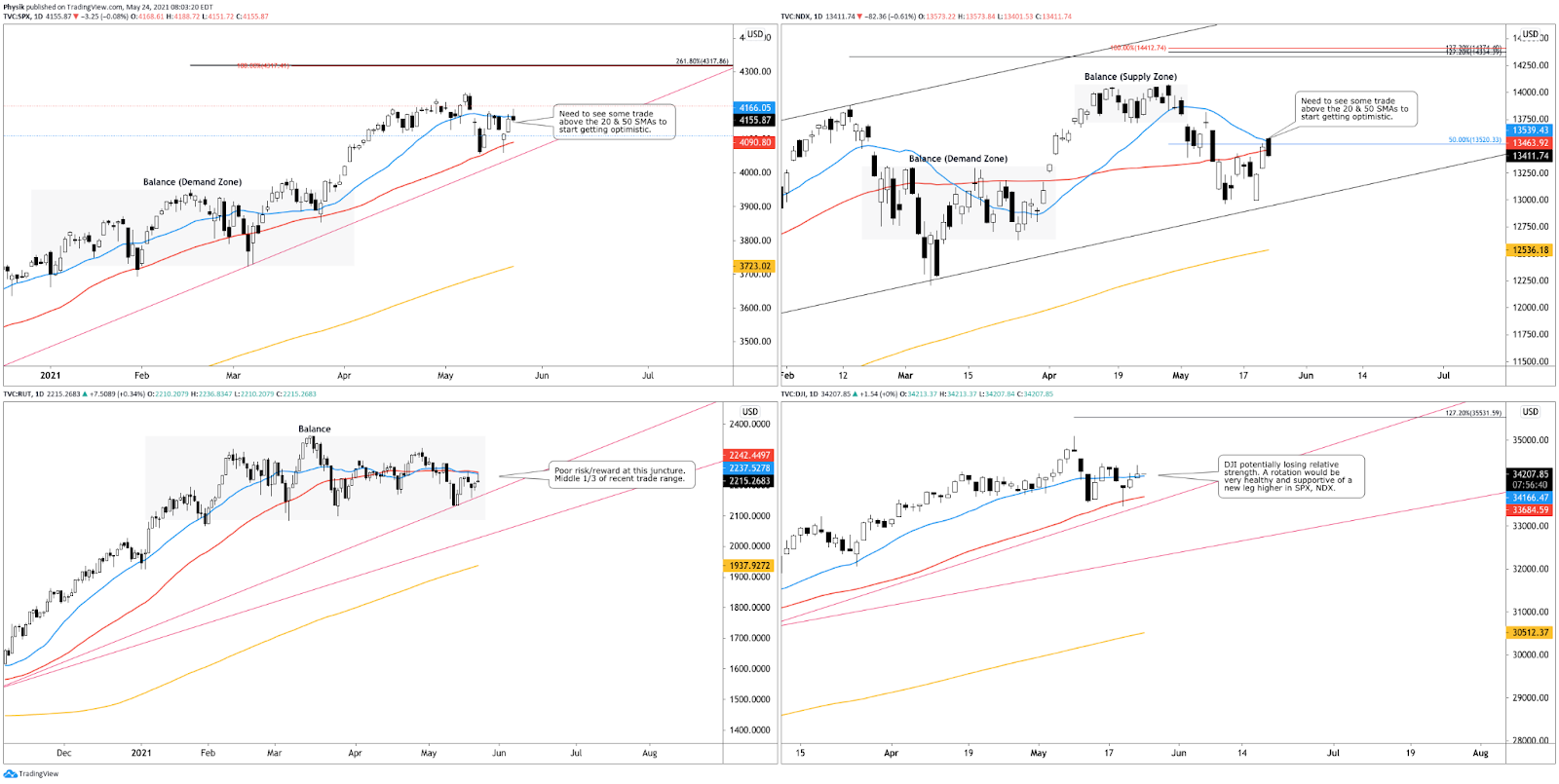
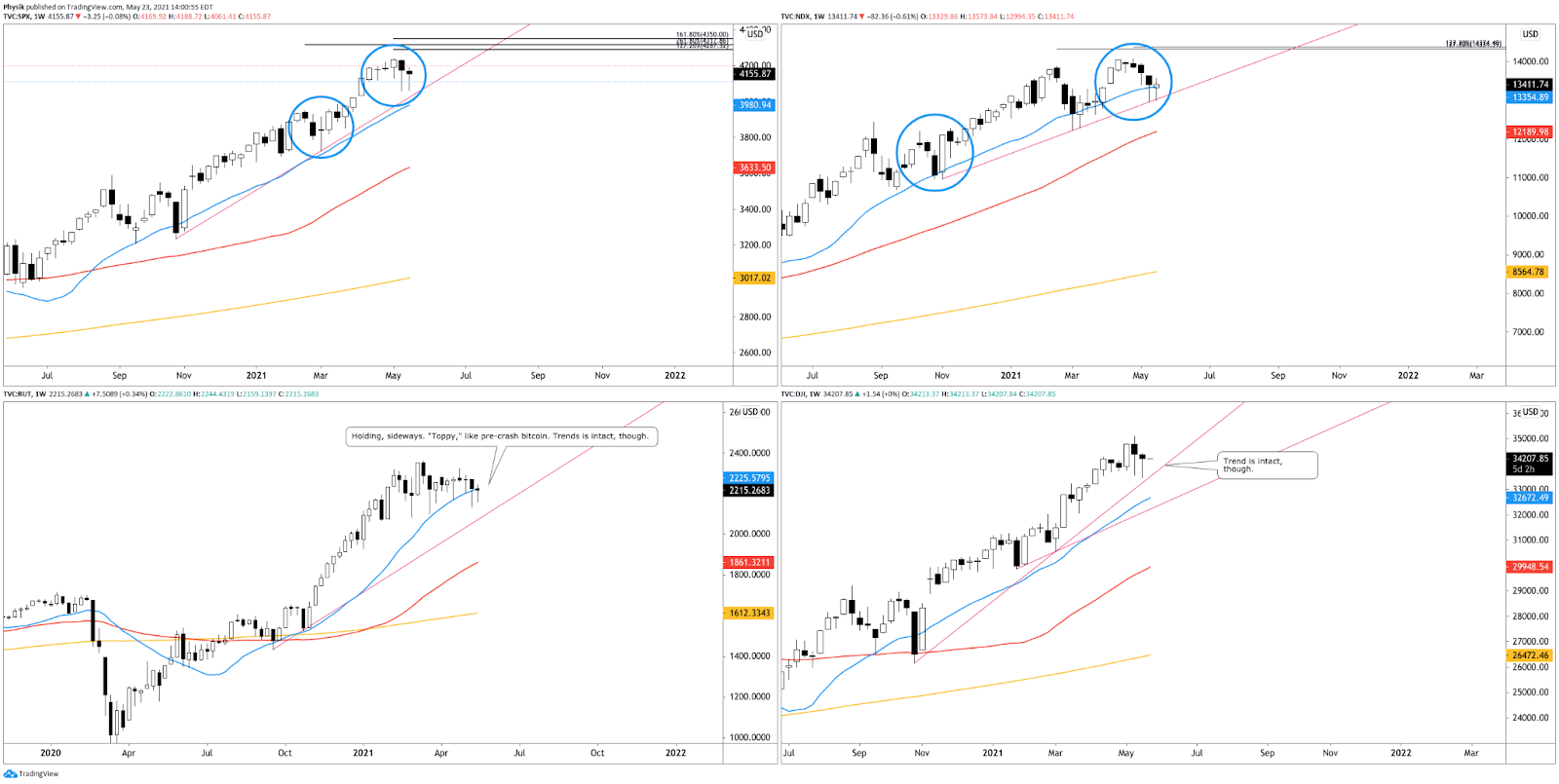
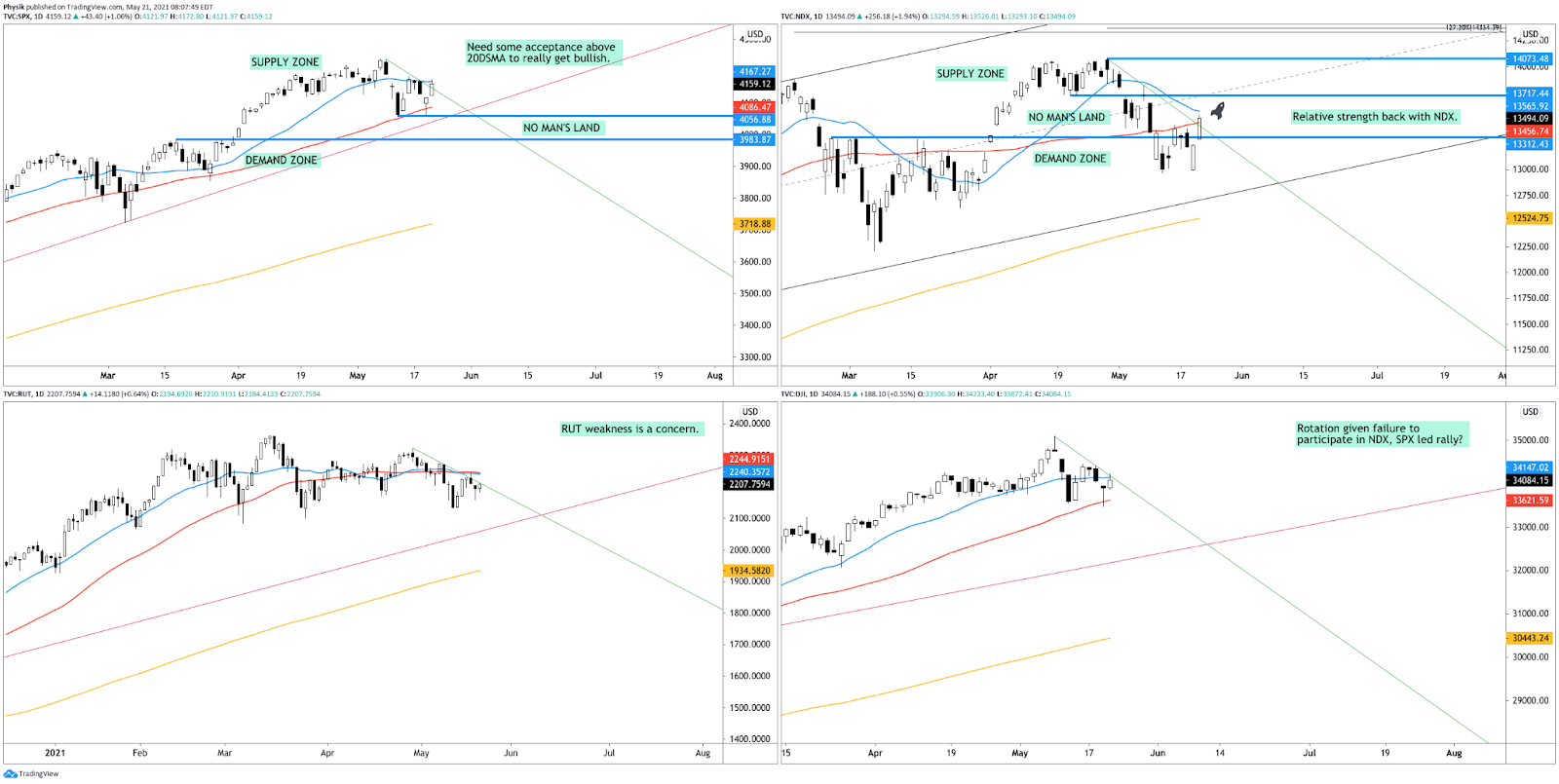
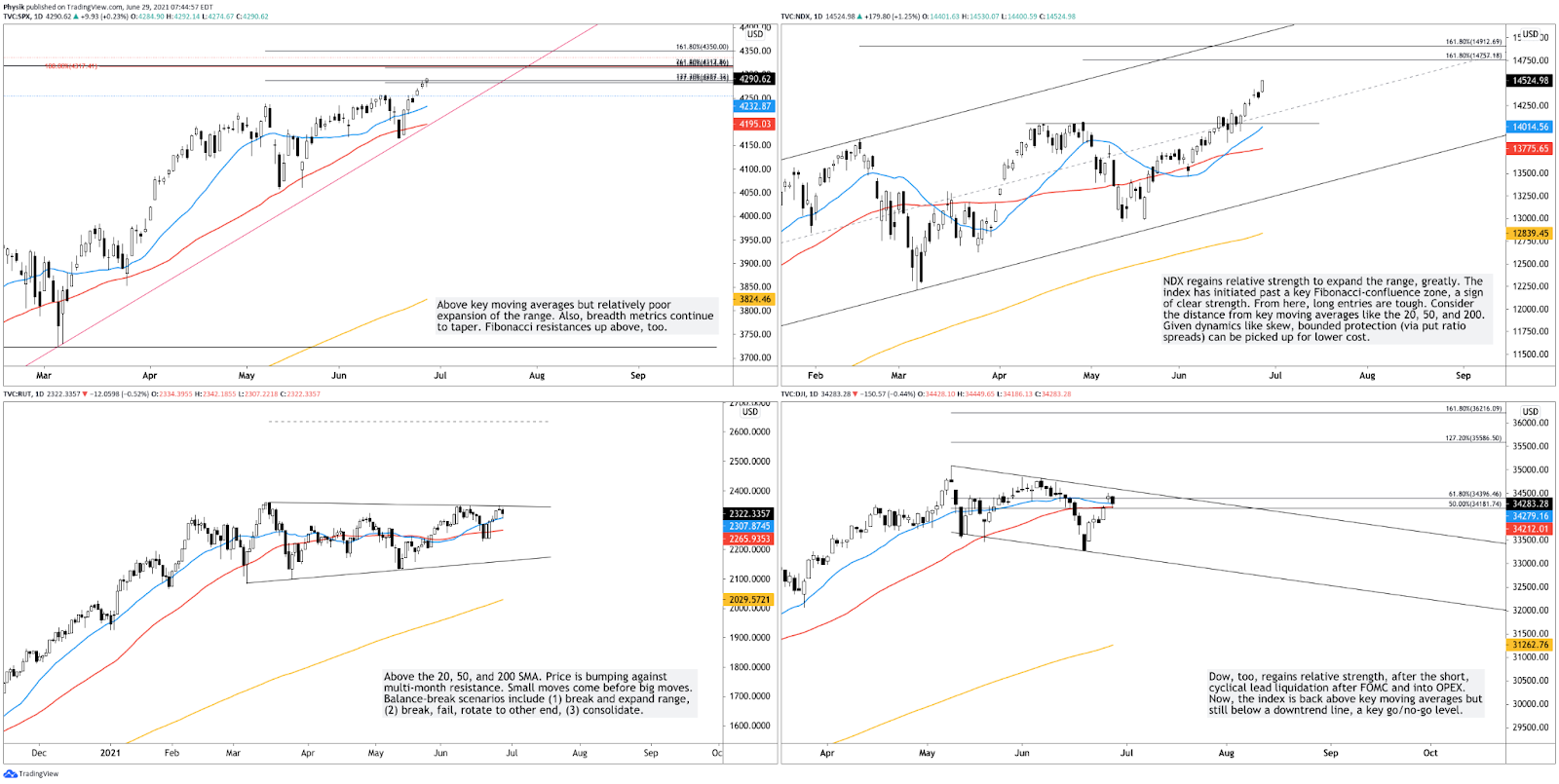
Graphic: Daily candlestick charts of the S&P 500 (top left), Nasdaq 100 (top right), Russell 2000 (bottom left), and Dow Jones Industrial Average (bottom right). 
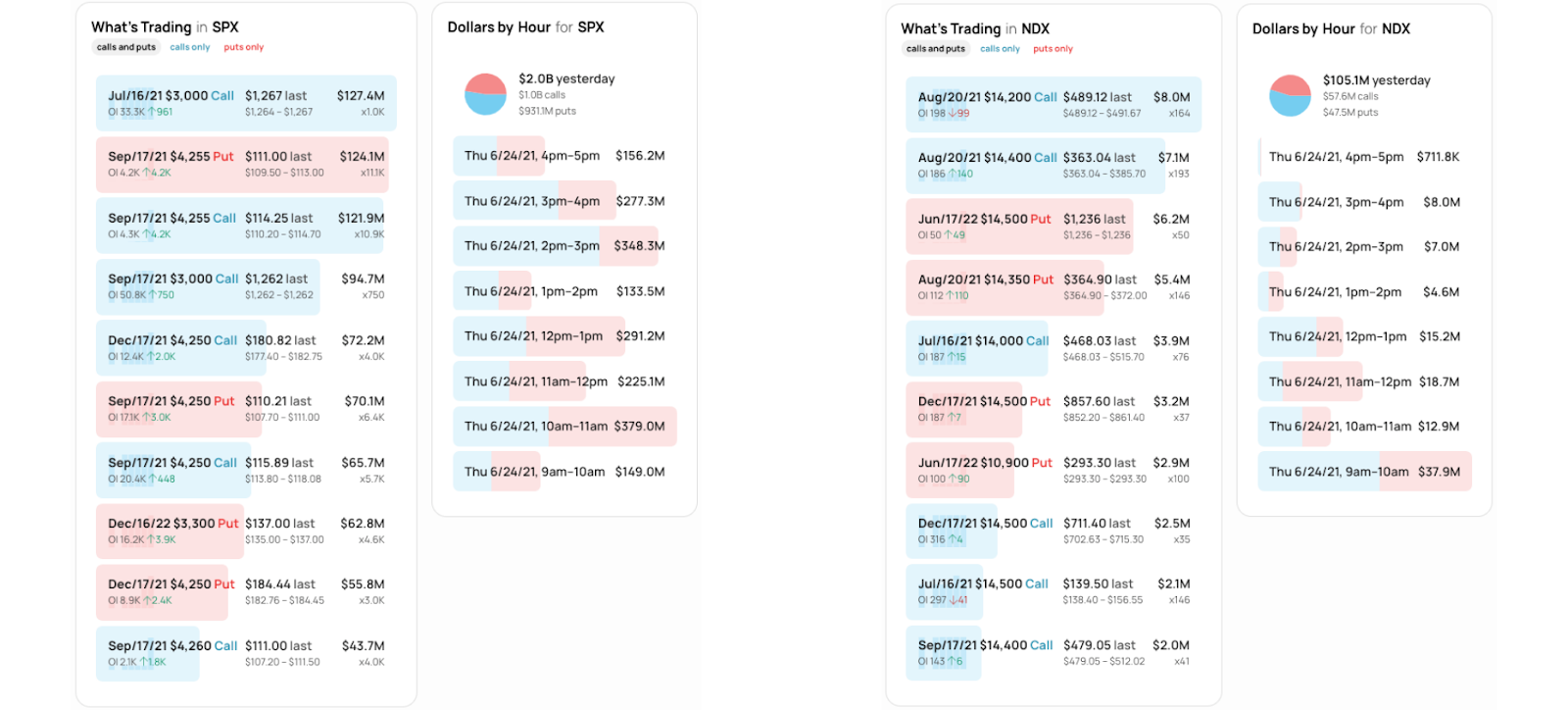
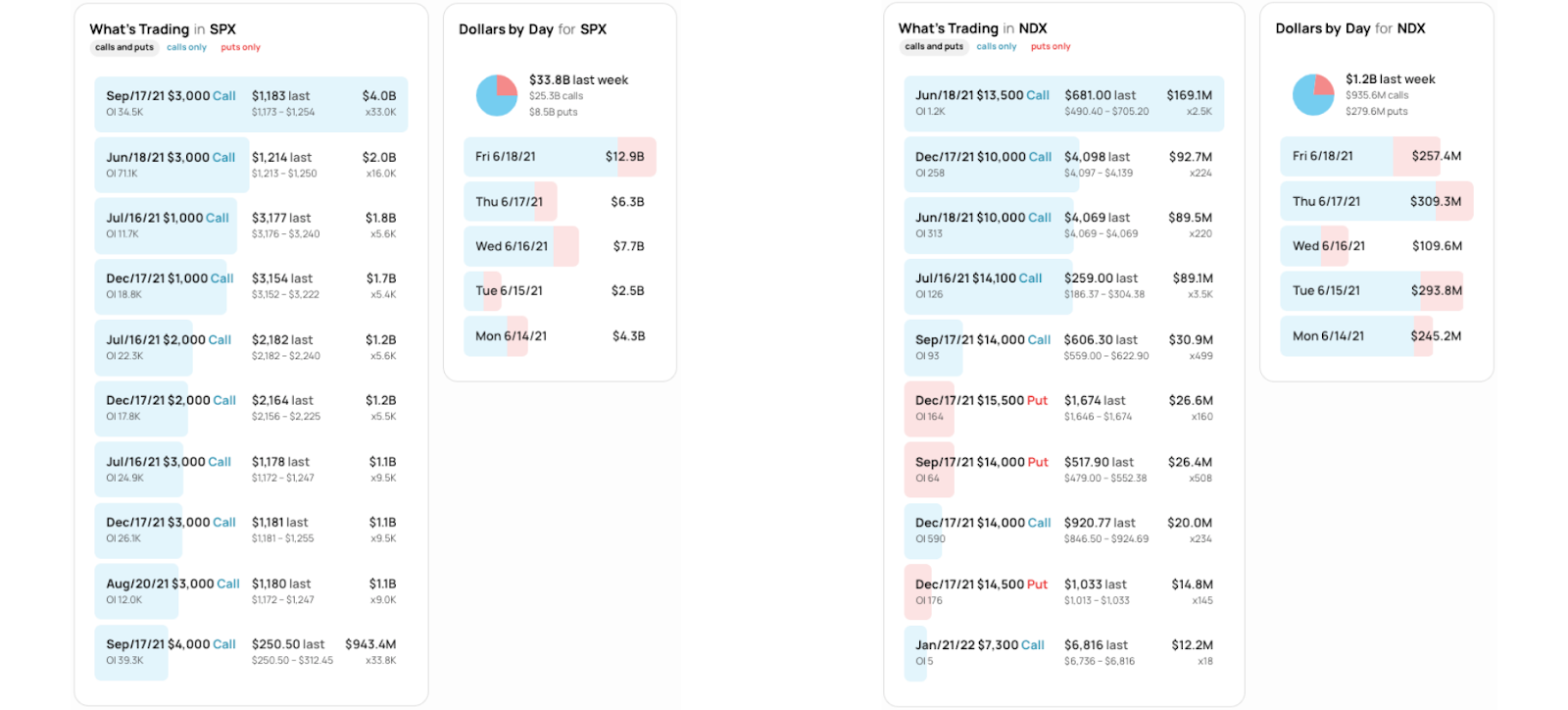
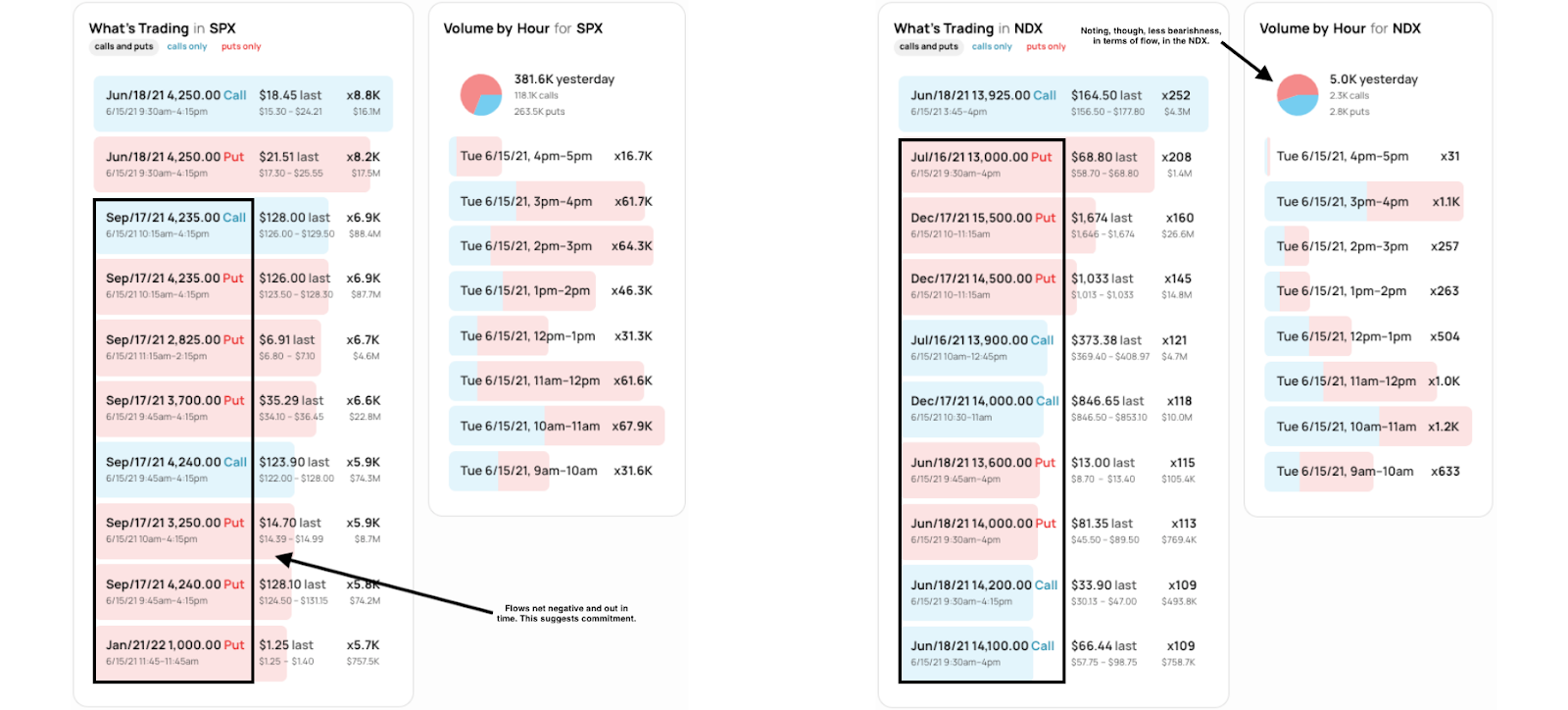
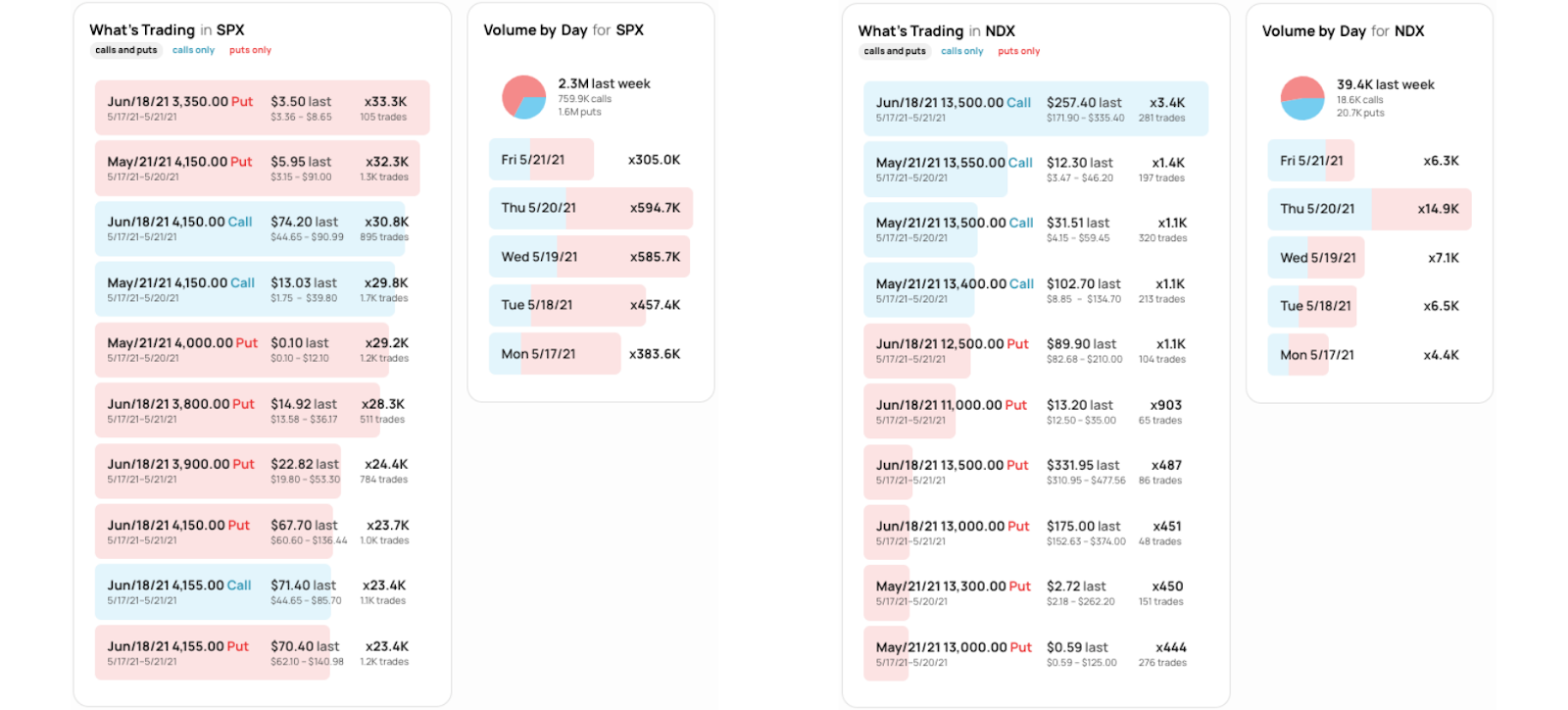
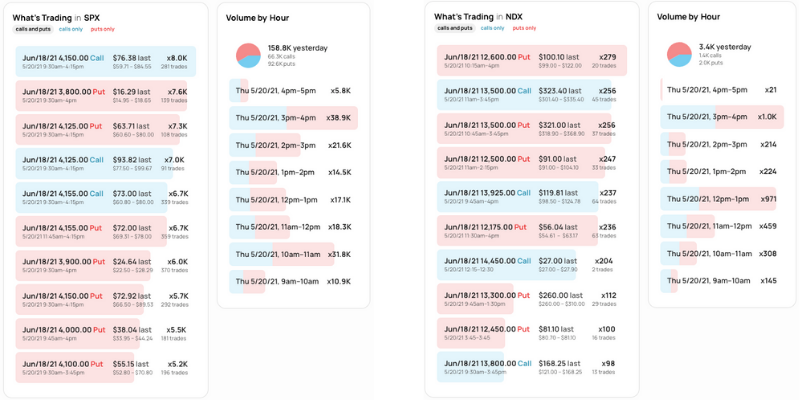
Graphic: SHIFT search suggests participants were committing the most capital to call strikes at and below current prices in the cash-settled S&P 500 Index (INDEX: SPX) and Nasdaq 100 (INDEX: NDX), last week. This activity may denote (1) stock replacement, (2) hedges for underlying short positions, or (3) speculation on the upside. Also, there was a meaningful bid in September puts on the S&P 500. This dynamic suggests participants, despite their commitment to higher prices, are hedging against near-term risks, like the Jackson Hole Economic Symposium.

News And Analysis

Economy | The Bank of Japan cuts some bond purchase targets. (BBG)

Markets | BlackRock warns U.S. stocks at risk from higher taxes. (BBG)

Markets | United Airlines confirmed 270 Boeing, Airbus jet order. (REU)

Markets | Wall Street funnels cash to investors post-stress-tests. (BBG)

Markets | FTC Facebook ruling slams brakes on tech’s legal foes. (Axios)

What People Are Saying

Innovation And Emerging Trends

FinTech | State Street is building out data and digital experiences. (BZ)

FinTech | Robinhood CEO backs SEC market modernization vision. (MI)

FinTech | ICAP launching crypto platform with Fidelity, StanChart. (BBG)

FinTech | JPMorgan buys an ESG investing platform, OpenInvest. (CNBC)

Markets | Cathie Wood’s ARK Invest to create bitcoin ETF, ‘ARKB’. (CNBC)

FinTech | Deutsche Boerse is buying Swiss fintech Crypto Finance. (REU)

About

Renato founded Physik Invest after going through years of self-education, strategy development, and trial-and-error. His work reporting in the finance and technology space, interviewing leaders such as John Chambers, founder, and CEO, JC2 Ventures, Kevin O’Leary, businessman and Shark Tank host, Catherine Wood, CEO and CIO, ARK Invest, among others, afforded him the perspective and know-how very few come by.

Having worked in engineering and majored in economics, Renato is very detailed and analytical. His approach to the markets isn’t built on hope or guessing. Instead, he leverages the unique dynamics of time and volatility to efficiently act on opportunity.

Disclaimer

At this time, Physik Invest does not manage outside capital and is not licensed. In no way should the materials herein be construed as advice. Derivatives carry a substantial risk of loss. All content is for informational purposes only.

Categories
Commentary

Daily Brief For June 28, 2021

Market Commentary

Equity index futures diverge, auction within prior range.

  • A slow start to a rather busy week.
  • Market is meaningfully overvalued.
  • Ahead: Fed speak, manufacturing.
  • /NQ firmed and the /ES backed off.

What Happened: U.S. stock index futures traded sideways to lower, ahead of what’s expected to be a light day.

Further, President Biden is looking to push along his infrastructure plan and the U.K. cracked down on cryptocurrency exchanges. 

On the calendar is Dallas Fed Manufacturing Activity. Also, John Williams, Randal Quarles, and Tom Barkin, of the Federal Reserve, are to speak.

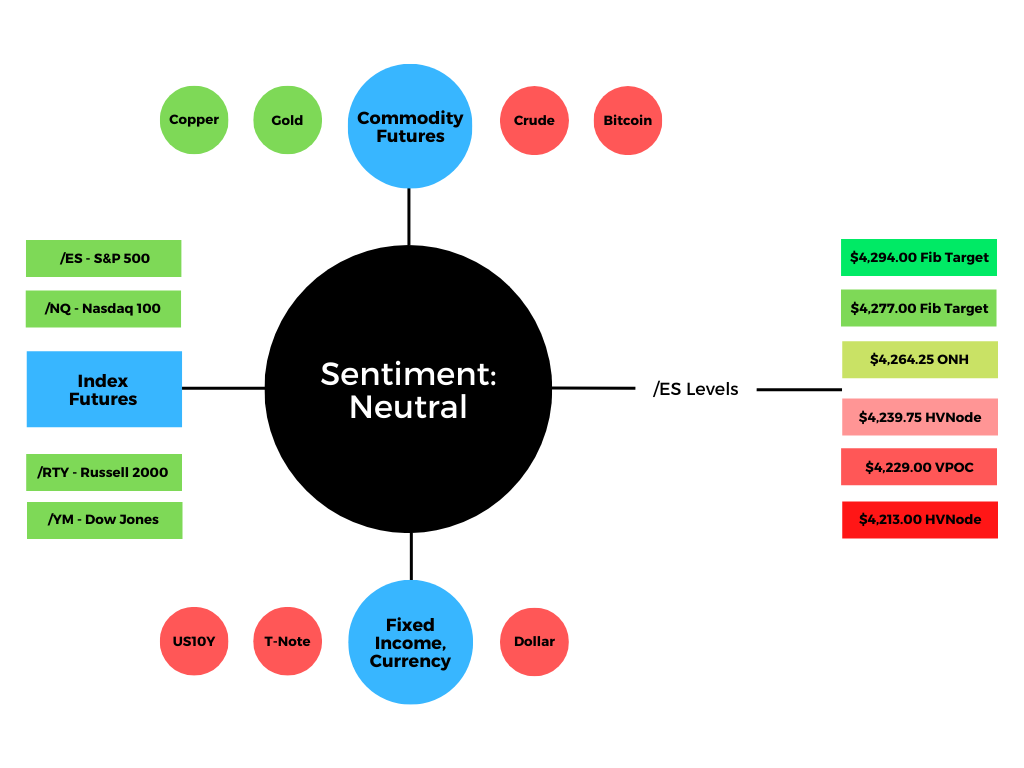
Graphic updated 6:55 AM ET.

What To Expect: Monday’s regular session (9:30 AM – 4:00 PM EST) in the S&P 500 will likely open inside of prior-range and -value. This likely limits the potential for immediate directional opportunity.

Adding, alongside positive economic and political developments, U.S. equity index futures traded higher, last week, in conjunction with narrowing breadth, weaker seasonality, and other things

Moreover, last night, the S&P 500 established a new overnight high (ONH) before trading back into range. Anchoring a Volume Weighted Average Price (VWAP) at that peak suggests the average overnight seller is in a winning position. Should the day timeframe find acceptance above that VWAP (yellow in color on the below chart), that is not a positive for those weak-handed overnight players that tend to trade in small size. 

Overnight Rally Highs (Lows): Typically, there is a low historical probability associated with overnight rally-highs (lows) ending the upside (downside) discovery process.

Volume Weighed Average Price (VWAP): The average price at which a stock is traded over a certain horizon.

For today, participants can trade from the following frameworks. 

In the best case, the S&P 500 trades sideways or higher; activity above the $4,267.00 Point of Control (POC) puts in play the $4,278.75 ONH. Initiative trade beyond the ONH could reach as high as $4,294.75, a Fibonacci-derived price target.

POCs: POCs (like HVNodes described above) are valuable as they denote areas where two-sided trade was most prevalent. Participants will respond to future tests of value as they offer favorable entry and exit.

In the worst case, the S&P 500 trades lower; activity below the $4,267.00 POC puts in play the $4,257.00 high volume area (HVNode), first. Failure to respond leaves the $4,248.25 low volume area (LVNode) exposed. Trade beyond that signpost is concerning; in such a case, a test of the $4,239.75 micro-composite point of control (MCPOC) and $4,229.00 VPOC is expected.

Volume Areas: A structurally sound market will build on past areas of high volume. Should the market trend for long periods of time, it will lack sound structure (identified as a low volume area which denotes directional conviction and ought to offer support on any test). 

If participants were to auction and find acceptance into areas of prior low volume, then future discovery ought to be volatile and quick as participants look to areas of high volume for favorable entry or exit.

Even lower? Yikes. Look for responses at the $4,213.00 and $4,200.25 HVNodes. The $4,200.25 signpost corresponds with an important 50% Fibonacci retracement and LVNode boundary.

Graphic: 65-minute profile chart of the Micro E-mini S&P 500 Futures.
Graphic: Daily candlestick charts of the S&P 500 (top left), Nasdaq 100 (top right), Russell 2000 (bottom left), and Dow Jones Industrial Average (bottom right).
Graphic: SHIFT search suggests participants were committing the most capital to call strikes at and below current prices in the cash-settled S&P 500 Index (INDEX: SPX) and Nasdaq 100 (INDEX: NDX), last week. This activity may denote (1) stock replacement, (2) hedges for underlying short positions, or (3) speculation on the upside.

News And Analysis

Economy | Support doesn’t provide a meaningful boost until mid-decade. (Moody’s)

Markets | Intel CEO says the chip shortage will hit bottom in second half. (BBG)

Economy | The U.S. cannot afford another housing market ‘boom and bust’. (FT)

Economy | Bank of Russia to consider key interest rate increase in July. (BBG)

Markets | Johnson & Johnson to pay $260M on claims it sparked epidemic. (Axios)

Politics | The last-and only-foreign scientist in the Wuhan lab speaks out. (BBG)

Markets | Tesla dealt a blow as almost all cars in China need a safety fix. (BBG)

Politics | U.S. warplanes strike against an Iran-backed militia in Iraq, Syria. (REU)

Energy | The U.S. shale industry tempers output even as oil price jumps. (REU)

What People Are Saying

Innovation And Emerging Trends

Work | UBS to let two-thirds of employees adopt permanent hybrid work. (BBG)

FinTech | CME joins battle for retail bond traders with new small products. (BBG)

Energy | Japan allows restarts of nuclear reactors older than 40 years. (Nikkei)

Tech | Study finds China’s cyber power at least a decade behind the U.S. (FT)

FinTech | Chaka first startup to receive SEC license for trading in Nigeria. (TC)

About

Renato founded Physik Invest after going through years of self-education, strategy development, and trial-and-error. His work reporting in the finance and technology space, interviewing leaders such as John Chambers, founder, and CEO, JC2 Ventures, Kevin O’Leary, businessman and Shark Tank host, Catherine Wood, CEO and CIO, ARK Invest, among others, afforded him the perspective and know-how very few come by.

Having worked in engineering and majored in economics, Renato is very detailed and analytical. His approach to the markets isn’t built on hope or guessing. Instead, he leverages the unique dynamics of time and volatility to efficiently act on opportunity.

Disclaimer

At this time, Physik Invest does not manage outside capital and is not licensed. In no way should the materials herein be construed as advice. Derivatives carry a substantial risk of loss. All content is for informational purposes only.

Categories
Commentary

Daily Brief For June 25, 2021

Market Commentary

Equity index futures balance, struggle in discovering higher prices.

  • Bipartisan agreement on infrastructure.
  • Ahead is income, spending, sentiment.
  • SPX struggles. NDX weak at key level.

What Happened: U.S. stock index futures auctioned sideways to higher alongside some positive economic and political developments.

President Biden announced an agreement on infrastructure which still faces opposition in Congress. Additionally, Federal Reserve bank stress tests went well, a boon for financials. 

Today, participants will receive data on U.S. personal income and spending, Core PCE, as well as University of Michigan sentiment. Also, please be aware that Fed’s Mester, Rosengren, and Williams will speak later today.

Graphic updated 7:30 AM ET.

What To Expect: Friday’s regular session (9:30 AM – 4:00 PM EST) in the S&P 500 will likely open inside of prior-range and -value, suggesting a limited potential for immediate directional opportunity.

Adding, during the prior day’s regular trade, the best case outcome occurred, evidenced by sideways trade above the $4,251.25 high volume area (HVNode), up to the prior overnight high (ONH) at $4,258.00.

Volume Areas: A structurally sound market will build on past areas of high volume. Should the market trend for long periods of time, it will lack sound structure (identified as a low volume area which denotes directional conviction and ought to offer support on any test). 

If participants were to auction and find acceptance into areas of prior low volume, then future discovery ought to be volatile and quick as participants look to areas of high volume for favorable entry or exit.
Overnight Highs (Lows): Typically, there is a low historical probability associated with overnight rally-highs (lows) ending the upside (downside) discovery process.

Further, earlier in the week, participants saw strong initiative activity to the upside. Later, the S&P 500 took out its all-time-high (ATH) at $4,258.00, and the Nasdaq 100 found responsive sellers at a zone of overlapping Fibonacci-derived price targets. 

That said, this price action comes alongside narrow breadth; according to Bloomberg, while the broader market is near ATHs, the “[l]owest % of stocks above 50-dma since 1999, when S&P hits record.”

With those dynamics in mind, in conjunction with potentially unsupportive market liquidity metrics and trade in the options market, participants can expect more of the same: pinning, or sideways chop.

Moreover, for today, participants can trade from the following frameworks. 

In the best case, the S&P 500 trades sideways or higher; activity above $4,257.25 – yesterday’s fairest price, or Point Of Control (POC) – puts in play the $4,264.25 ONH. Initiative trade beyond the ONH could reach as high as the $4,277.00 and $4,294.75 Fibonacci-derived price targets. 

Point of Control (POCs): POCs are valuable as they denote areas where two-sided trade was most prevalent. Participants will respond to future tests of value as they offer favorable entry and exit.

In the worst case, the S&P 500 trades lower; activity below $4,257.25 puts in play the $4,239.75 HVNode. Thereafter, if lower, participants ought to look for a response near the untested POC at $4,229.00. Below that level, caution. Odds could favor a move as low as the HVNode at $4,213.00.

Graphic: 65-minute profile chart of the Micro E-mini S&P 500 Futures. Updated 7:20 AM ET.
Graphic: Daily candlestick charts of the S&P 500 (top left), Nasdaq 100 (top right), Russell 2000 (bottom left), and Dow Jones Industrial Average (bottom right). Nasdaq’s relative strength weakens. Updated 7:30 AM ET.
Graphic: SHIFT search suggests participants were committing the most capital to call strikes at and below current prices in the cash-settled S&P 500 Index (INDEX: SPX) and Nasdaq 100 (INDEX: NDX), yesterday. This activity may denote (1) stock replacement, (2) hedges for underlying short positions, or (3) speculation on the upside. Noting, similar to the two days prior, there was increased interest in farther-dated put strikes at and above current prices. This may denote opportunistic hedging or speculation on the downside.

News And Analysis

Economy | Biden infrastructure win ramps fight on economic agenda. (BBG)

Markets | Major European banks’ 2H21 earnings: structural challenges. (Fitch)

Markets | U.S. banks gear up for buyback bonanza after passing tests. (FT)

Travel | The U.K. expands ‘Green’ list as German urges more caution. (BBG)

Politics | Senior NATO officer warns of China’s ‘shocking’ military moves. (FT)

Markets | Visa to acquire open banking platform Tink for more than $2B. (TC)

Markets | Virgin Galactic cleared by FAA to fly customers into space. (BBG)

Markets | SCOTUS has decided not to light the housing market on fire. (Vox)

Markets | U.S. ban to have only limited impact on China’s solar industry. (BBG)

Trade | More container ships score ‘astronomical’ $100,000/day rates. (FW)

Markets | SpotGamma: Finding your next gamma squeeze candidate. (SG)

What People Are Saying

Innovation And Emerging Trends

FinTech | China crushed Jack Ma, and his fintech rivals are up next. (BBG)

Markets | Citi: Global investment is becoming less reliant on China. (BBG)

Politics | Polls unpack America’s continued move toward socialism. (Axios)

Economy | Hyun Song Shin on CBDCs and future of central banking. (BBG)

Mobility | Apple’s car obsession is all about taking eyes off the road. (BBG)

About

Renato founded Physik Invest after going through years of self-education, strategy development, and trial-and-error. His work reporting in the finance and technology space, interviewing leaders such as John Chambers, founder, and CEO, JC2 Ventures, Kevin O’Leary, businessman and Shark Tank host, Catherine Wood, CEO and CIO, ARK Invest, among others, afforded him the perspective and know-how very few come by.

Having worked in engineering and majored in economics, Renato is very detailed and analytical. His approach to the markets isn’t built on hope or guessing. Instead, he leverages the unique dynamics of time and volatility to efficiently act on opportunity.

Disclaimer

At this time, Physik Invest does not manage outside capital and is not licensed. In no way should the materials herein be construed as advice. Derivatives carry a substantial risk of loss. All content is for informational purposes only.

Categories
Commentary

Weekly Brief For June 20, 2021

Too Lazy; Didn’t Read: As the market enters into a seasonally weak period, participants have noticed a divergence appear across the broader market. A breakdown in individual sectors – financials and transportation, for instance – and breadth, policy tightening concerns, outflows, elevated skew, put/call ratios, and degrossing on risk-taking (e.g., speculative activity in so-called meme stocks), in conjunction with the passage of Quadruple Witching, may portend increased volatility.

Market Commentary

Key Takeaways: Index futures diverge. Risk-off sentiment returns.

  • Fears over inflation and taper sparking movements.
  • Ahead: GDP, Home sales, PMI, Claims, Fed speak.
  • Indices sideways to lower; growth, tech stay strong.
Weekly price action graphic updated Sunday, June 20, 2021, at 12:00 PM ET.

What Happened: Last week, U.S. stock index futures diverged.

The Nasdaq 100 traded relatively strong, in comparison to the weaker S&P 500, Russell 2000, and Dow Jones Industrial Average. This action comes as the Federal Reserve signaled a faster-than-expected pace of policy tightening (learn more about the impact of policy tightening, here).

At the same time, in conjunction with the divergence in major indexes, participants saw sectoral breakdowns, a concern that may portend increased volatility after ‘Quadruple Witching’ Friday, or the rebalancing of benchmarks, as well as the expiration of stock index futures, stock index options, stock options, and single stock futures.

In light of the event, participants found it very difficult to discover prices. That’s according to Matt Tuttle, the CEO at Tuttle Capital Managment LLC. 

“When you get one of these events, you get noises around share movements,” Tuttle said by phone. “It messes up the information that we’re seeing.”

Adding, this Quadruple Witching Friday may throw a wrench into the recent bullishness.

Much of the advance, since the election, came in light of a historically bullish period for markets, amid increased mobility and reflation, supportive structural flows, as well as the pricing in of positive earnings expectations.

Now that the reaction to earnings was lackluster, in addition to the passage of a large derivative expiration and move into a seasonally weak period, the odds of volatility are substantially higher. 

Why? Most funds are committed to holding long positions. In the interest of lower volatility returns, these funds will collar off their positions, selling calls to finance the purchase of downside put protection. 

As a result of this activity, options dealers are long upside and short downside protection. 

This exposure must be hedged; dealers will sell into strength as their call (put) positions gain (lose) value and buy into weakness as their call (put) positions lose (gain) value. 

Now, unlike theory suggests, dealers will hedge call losses (gains) quicker (slower). This leads to “long-gamma,” a dynamic that crushes volatility and promotes momentum, observed by lengthy sprints — like the one the market is currently in — followed by rapid de-risking events as the market transitions into “short-gamma.” 

“‘Equities stable on hawkish Fed guidance’ is the wrong read here,” Nomura’s Charlie McElligott notes. “Equities are stable for the same reason they’ve been chopping for weeks: markets continue choking on an oversupply of gamma from vol sellers!”

The implications of this volatility supply can be summed up with the below graphic.

Given that OPEX will lead to a drop in gamma exposures, the market will, in the simplest way, be subject to more movement in its attempt to price in changing financial conditions.

Options Expiration (OPEX): Option expiries mark an end to pinning (i.e, the theory that market makers and institutions short options move stocks to the point where the greatest dollar value of contracts will expire worthless) and the reduction dealer gamma exposure.

“The extremely low SPX realized volatility is consistent with the possibility that 18-Jun has left ‘the street’ long index gamma, in which case realized volatility could pick up once positions are cleaner,” Rocky Fishman of Goldman Sachs said.

What To Expect: In the coming sessions, participants will want to focus their attention on where the S&P 500 trades in relation to the $4,153.25 high volume area (HVNode).

Volume Areas: A structurally sound market will build on past areas of high volume. Should the market trend for long periods of time, it will lack sound structure (identified as a low volume area which denotes directional conviction and ought to offer support on any test). 

If participants were to auction and find acceptance into areas of prior low volume, then future discovery ought to be volatile and quick as participants look to areas of high volume for favorable entry or exit.

That said, participants can trade from the following frameworks.

In the best case, the index trades sideways or higher; activity above $4,153.25 puts in play the HVNodes at $4,177.25 and $4,199.25. Initiative trade beyond $4,199.25 could reach as high as the $4,227.75 HVNode, $4,235.00 Point Of Control (POC), and $4,258.00 overnight high (ONH). 

POCs: POCs are valuable as they denote areas where two-sided trade was most prevalent. Participants will respond to future tests of value as they offer favorable entry and exit.

Overnight Highs (Lows): Typically, there is a low historical probability associated with overnight rally-highs (lows) ending the upside (downside) discovery process.

In the worst case, the index trades lower; activity below $4,153.25 puts in play the $4,122.25 HVNode. Thereafter, if lower, participants should look for responses at the $4,069.25 HVNode and $4,050.75 low volume area (LVNode).

Graphic: 4-hour profile chart of the Micro E-mini S&P 500 Futures.
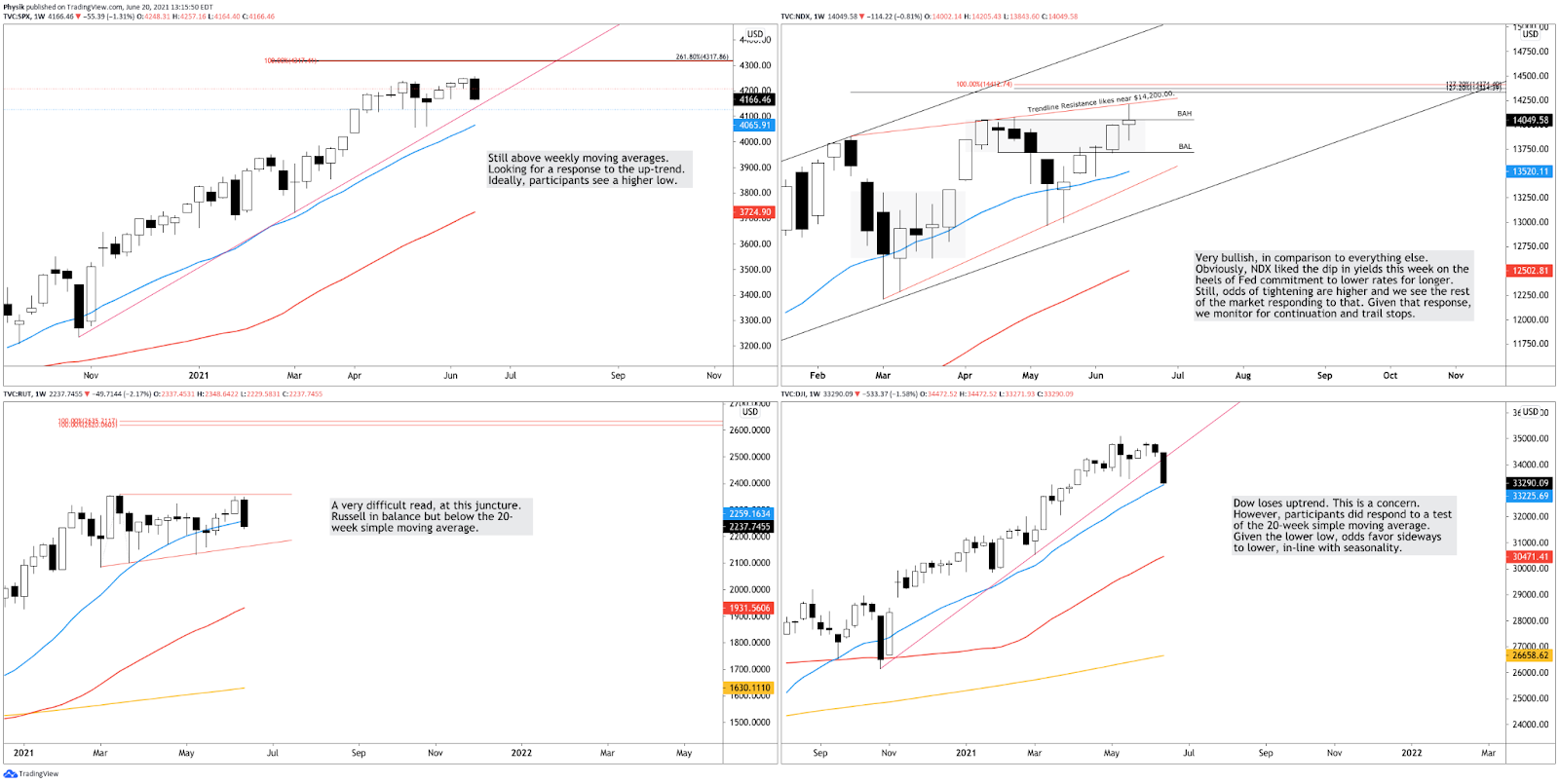
Graphic: Weekly candlestick charts of the S&P 500 (top left), Nasdaq 100 (top right), Russell 2000 (bottom left), and Dow Jones Industrial Average (bottom right).
Graphic: SHIFT search suggests participants, based on dollars committed, were most interested in call strikes at and below current prices in the cash-settled S&P 500 Index (INDEX: SPX) and Nasdaq 100 (INDEX: NDX), last week. This activity may denote (1) stock replacement, (2) hedges for underlying short positions, or (3) speculation on the upside.

News And Analysis

Economy | Big shift in the so-called “dot-plot” that tracks rate projections. (Moody’s)

Economy | Housing boom moderates on lower building permit authorizations. (S&P)

Economy | Capital gains – a century-old tax break gets a rush of attention. (WSJ)

Economy | Supply crunch risks are extending into 2022, stocking inflation. (WSJ)

Economy | New Chinese regulation requires recovery, resolution plans. (Moody’s)

Markets | Troubled companies take pages from AMC playbook, selling stock. (WSJ)

Markets | Brace for huge oil volatility one U.S. trading group suggests. (REU)

Economy | U.S. bank loan-to-deposit ratios fall and pressure margins. (S&P)

Economy | U.S. economic recovery doesn’t have to follow herd immunity. (Moody’s)

Economy | The U.S. distress ratio continued its downward trend last month. (S&P)

Economy | Global structured finance – charting the recovery from COVID-19. (S&P)

Economy | The MBA is predicting another decline in new home sales. (MND)

Markets | Bond market in midst of repricing, but not the kind we’re used to. (MND)

What People Are Saying

Innovation And Emerging Trends

FinTech | Owning the paycheck is the key to financial technology success. (TC)

FinTech | Mark Cuban says ‘banks should be scared’ of crypto-based DeFi. (CNBC)

FinTech | Outlook: How the API economy is reinventing financial services. (CBI)

FinTech | Analysis: Big differences between a digital dollar and a CBDC. (BBG)

FinTech | Cryptocurrency lode of $100B stirs worries over hidden danger. (BBG)

FinTech | Axis-Z is working hard to bring virtual reality (VR) tech to trading. (BZ)

FinTech | OVTLYR’s platform helps investors take advantage of volatility. (BZ)

FinTech | Liti Capital allows investors tokenized access to litigation finance. (BZ)

Disclaimer

In no way should the materials herein be construed as advice. Derivatives carry a substantial risk of loss. All content is for informational purposes only.

Categories
Commentary

Daily Brief For June 16, 2021

Market Commentary

Index futures in balance.

  • Ahead: Housing starts, trade prices, FOMC.
  • Indices diverge and trade sideways to lower.

What Happened: U.S. stock index futures auctioned sideways ahead of an important Federal Open Market Committee (FOMC) announcement at 2:00 p.m. Eastern Time, today.

As stated in prior commentaries, the odds of substantial change to policy are low. Instead, participants will likely hear that despite Fed policy remaining unchanged, tools exist to combat inflation.

Also, before the open, China established orders limiting exposure to overseas commodities and U.K. consumer prices rose. Important releases, aside from the Fed decision, include data on housing starts and trade prices, as well as text on infrastructure.

Graphic updated 7:13 AM ET.

What To Expect: Wednesday’s regular session (9:30 AM – 4:00 PM EST) in the S&P 500 will likely open inside of prior-range and -value, suggesting a limited potential for immediate directional opportunity. 

Adding, during the prior day’s regular trade, the worst-case outcome occurred, evidenced by a liquidation break that found acceptance below the $4,238.00 spike base. That is significant because it negated the knee-jerk, end-of-day bullishness of Monday’s session.

Liquidation Breaks: The profile shape suggests participants were “too” long and had poor location. This corrective activity enables favorable entry and exit.

Spikes: Spike’s mark the beginning of a break from value. Spikes higher (lower) are validated by trade at or above (below) the spike base (i.e., the origin of the spike).

Further, for today, participants can trade from the following frameworks. 

In the best case, the S&P 500 trades sideways or higher; activity above the $4,234.25 high volume area (HVNode), which corresponds with the average price bought and sold (via the VWAP) since consumer price data was released last week, puts in play the $4,249.00 low volume area (LVNode). Initiative trade beyond the LVNode could reach as high as the $4,258.00 overnight high (ONH) and $4,270.25 Fibonacci price extension.

Volume Areas: A structurally sound market will build on past areas of high volume. Should the market trend for long periods of time, it will lack sound structure (identified as a low volume area which denotes directional conviction and ought to offer support on any test). 

If participants were to auction and find acceptance into areas of prior low volume, then future discovery ought to be volatile and quick as participants look to areas of high volume for favorable entry or exit.

Volume Weighed Average Price (VWAP): The average price at which a stock is traded over a certain horizon.

Overnight Rally Highs (Lows): Typically, there is a low historical probability associated with overnight rally-highs (lows) ending the upside (downside) discovery process.

In the worst case, the S&P 500 trades lower; activity below the $4,234.25 HVNode suggests caution. It is likely participants will trade to the $4,227.75 HVNode. Thereafter, depending on how participants respond to a test of the HVNode, if lower, the $4,213.75 LVNode and balance area low (BAL) come into play, first. Initiating below the BAL is bearish. In that instance, if selling is aggressive, the $4,177.25 HVNode is in play.

Graphic: 65-minute profile chart of the Micro E-mini S&P 500 Futures.
Graphic: Daily candlestick charts of the S&P 500 (top left), Nasdaq 100 (top right), Russell 2000 (bottom left), and Dow Jones Industrial Average (bottom right). Important to monitor where the indices close, today. Above balance high or trend, bullish. Below, that’s near-term bearish.
Graphic: SHIFT search suggests participants were most interested in put strikes at and below current prices in the cash-settled S&P 500 Index (INDEX: SPX) and Nasdaq 100 Index (INDEX: NDX), yesterday.

News And Analysis

Economy | U.K. inflation’s jump above BOE goal stirring a debate. (BBG)

Economy | China’s economic data disappoints as spending lags. (BBG)

Politics | Disagreements, low expectations as Biden and Putin meet. (REU)

Economy | U.S. retail sales drop, hinting at shift to services spend. (BBG)

Politics | China’s government made warning. Planes fly over Taiwan. (Axios)

Markets | Citi is latest to warn of bigger-than-expected trading drop. (BBG)

What People Are Saying

Innovation And Emerging Trends

FinTech | The big difference between a digital dollar and a CBDC. (BBG)

Markets | Everyone’s a rising star when debt is relatively cheap. (BBG)

Markets | Well-behaved bubbles often make history. An analysis. (a16z)

Markets | The latest blow to 60/40 model is an exodus of pensions. (BBG)

COVID | How prior coronavirus infections factor into herd immunity. (Axios)

Travel | You’ll soon be able to use your iPhone as ID at the airport. (Verge)

FinTech | Exchanges are looking to accelerate their cloud adoption. (TM)

About

Renato founded Physik Invest after going through years of self-education, strategy development, and trial-and-error. His work reporting in the finance and technology space, interviewing leaders such as John Chambers, founder, and CEO, JC2 Ventures, Kevin O’Leary, businessman and Shark Tank host, Catherine Wood, CEO and CIO, ARK Invest, among others, afforded him the perspective and know-how very few come by.

Having worked in engineering and majored in economics, Renato is very detailed and analytical. His approach to the markets isn’t built on hope or guessing. Instead, he leverages the unique dynamics of time and volatility to efficiently act on opportunity.

Disclaimer

At this time, Physik Invest does not manage outside capital and is not licensed. In no way should the materials herein be construed as advice. Derivatives carry a substantial risk of loss. All content is for informational purposes only.
Categories
Commentary

Daily Brief For June 3, 2021

Quick Note: As I will be on a short trip, the daily newsletter will be off tomorrow, June 4, and Monday, June 7. 

If you will be in the Miami, Florida area this weekend and would like to network, please let me know.

Market Commentary

Index futures are in balance and attempting to discover lower prices.

  • Russia cutting DXY holding, taper talk.
  • Ahead: PMIs, ISM, Claims, Fed speak.
  • Stock indexes trade sideways to lower.

What Happened: U.S. stock index futures auctioned lower overnight ahead of weekly claims and payrolls data.

The alleged culprit? Geopolitical tensions and concerns over inflation.

Russia said it would eliminate the dollar (DXY) from its National Wellbeing Fund, President Biden announced plans to amend a U.S. ban on foreign investments, and Fed President Patrick Harker suggested the central bank should discuss time frames for taper.

Graphic updated 7:50 AM ET.

What To Expect: Thursday’s regular session (9:30 AM – 4:00 PM EST) in the S&P 500 will likely open outside of prior-range and -value, suggesting a potential for immediate directional opportunity. 

Adding, during the prior day’s regular trade, the best case outcome occurred, evidenced by sideways trade up to the low volume area (LVNode) at $4,215.75. This LVNode is significant because it marks an area on the profile where participants were likely acting out of emotion, triggering stops, and at-market orders. 

Volume Areas: A structurally sound market will build on past areas of high volume. Should the market trend for long periods of time, it will lack sound structure (identified as a low volume area which denotes directional conviction and ought to offer support on any test). 

If participants were to auction and find acceptance into areas of prior low volume, then future discovery ought to be volatile and quick as participants look to areas of high volume for favorable entry or exit.
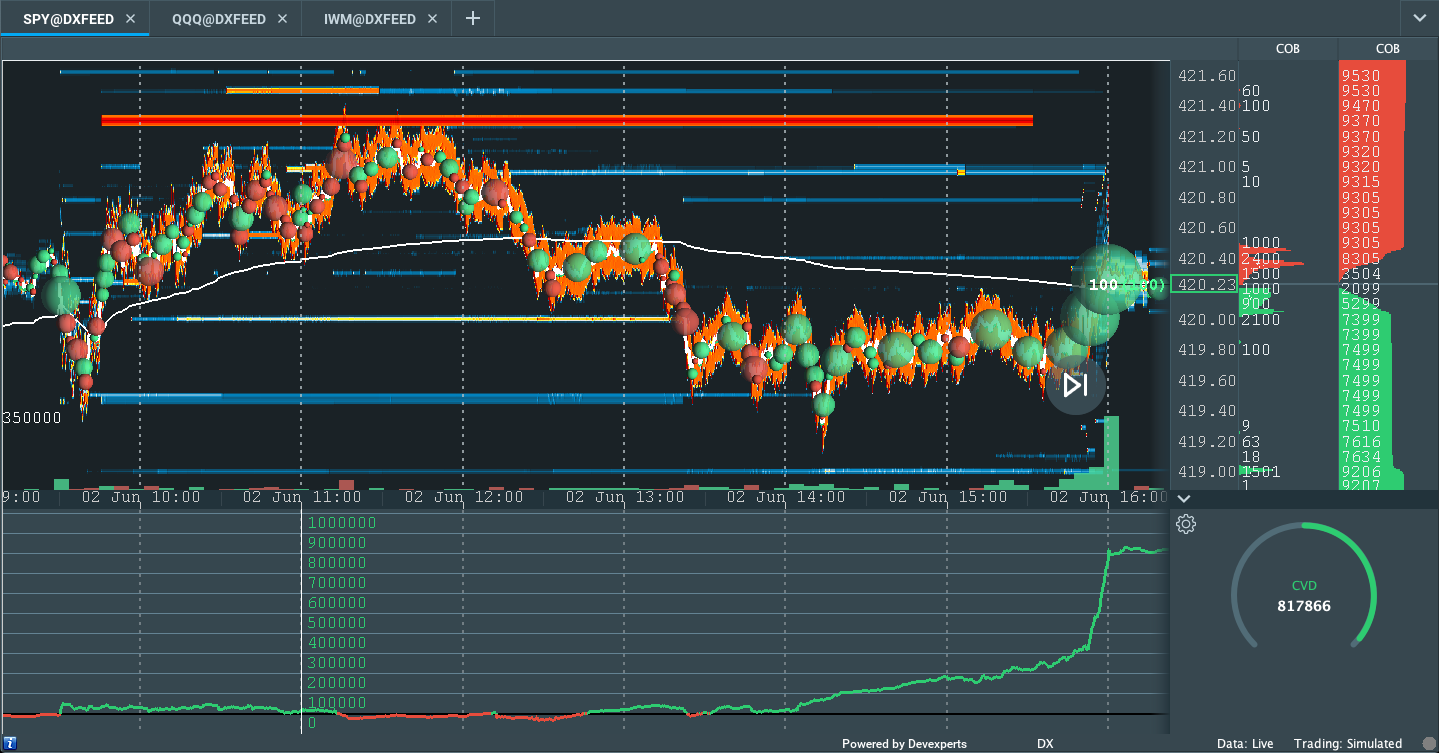
Graphic: SPDR S&P 500 ETF Trust (NYSE: SPY) market liquidity, via Bookmap. Note the divergent volume delta, a measure of buying and selling power as calculated by the difference in volume traded at the bid and offer. Such conditions favor more balance (two-timeframe, rotational, or bracket trade).

Further, the broad equity market has been consolidating now for more than a month. This comes as participants look to price in supply chain uncertainties and rising inflation, fiscal and monetary tightening, COVID-19 concerns, political risks, and the like.

There is a possibility that data on U.S. payrolls, this week, may shed a light on the Federal Reserve’s stimulus schedule. Most likely, though, indices chop, remain in range. 

Moreover, for today, participants can trade from the following frameworks. 

In the best case, the S&P 500 trades sideways or higher; activity above the $4,177.25 high volume area HVNode puts in play the $4,199.00 HVNode. Initiative trade beyond the $4,199.00 HVNode could reach as high as $4,209.00 point of control (POC). 

POCs: POCs (like HVNodes described above) are valuable as they denote areas where two-sided trade was most prevalent. Participants will respond to future tests of value as they offer favorable entry and exit.

In the worst case, the S&P 500 trades lower; activity below $4,177.25 HVNode puts in play the $4,153.25 HVNode. Thereafter, if lower, attention is drawn to the HVNodes at $4,122.25 and $4,069.25.

Graphic: 65-minute profile chart of the Micro E-mini S&P 500 Futures
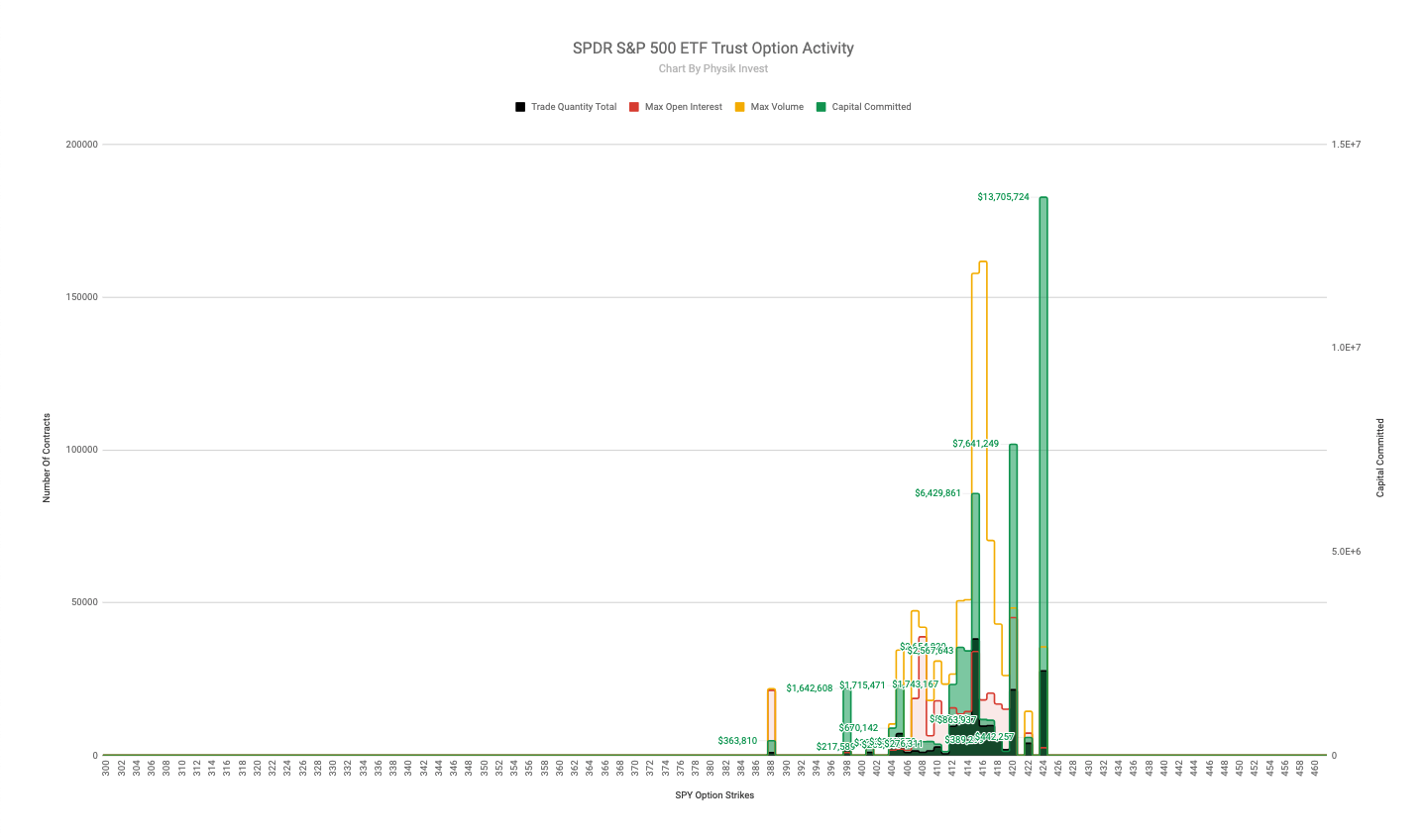
Graphic: Physik Invest maps out the purchase of call and put options in the SPDR S&P 500 ETF Trust (NYSE: SPY), for June 2. Activity in the options market was primarily concentrated in short-dated tenors, in put strikes below current prices.
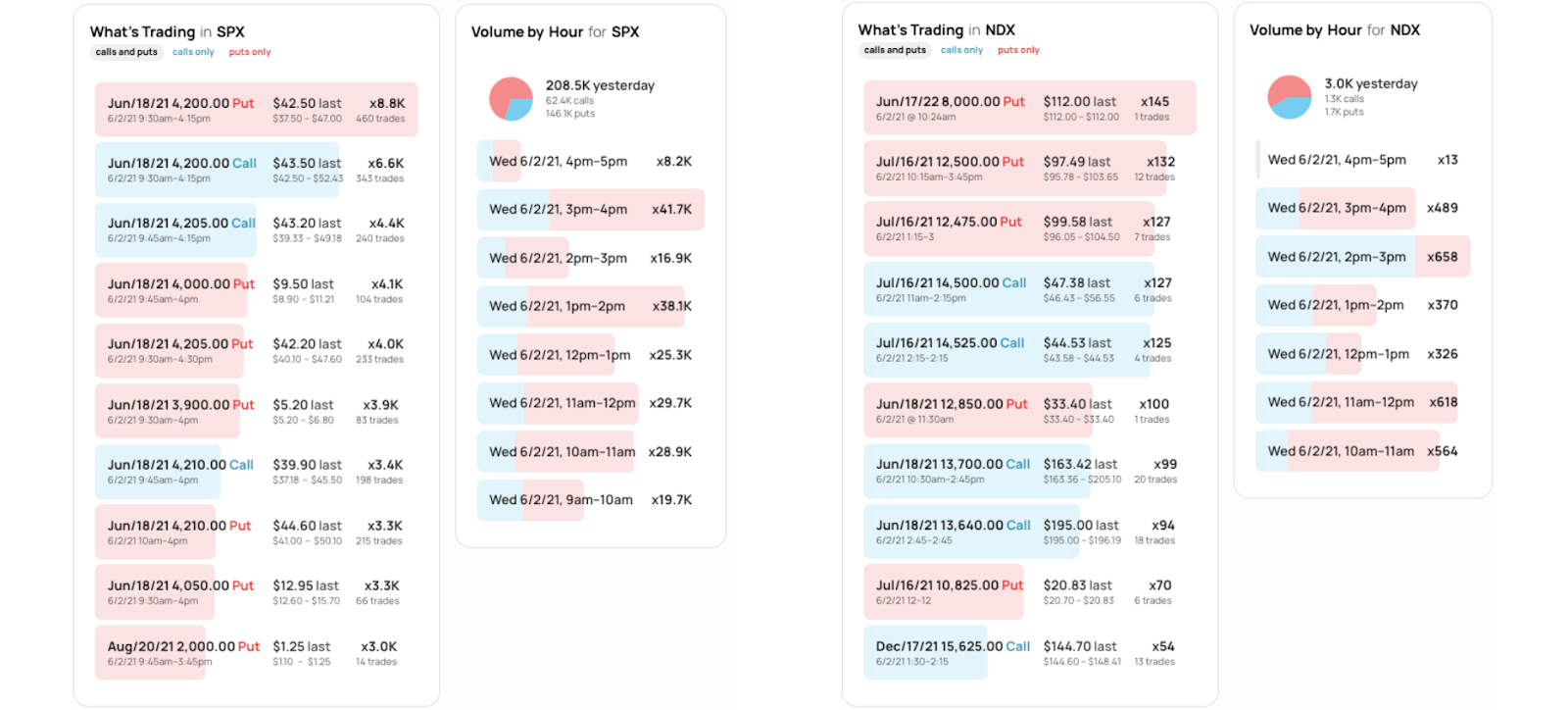
Graphic: SHIFT search suggests participants were most interested in put strikes at and below current prices in the cash-settled S&P 500 Index (INDEX: SPX) and Nasdaq 100 Index (INDEX: NDX), yesterday. Noting, again, the interest in long-dated out-of-the-money Nasdaq calls.

News And Analysis

Economy | Demand back, supply lagging. Both to grow in coming months. (PIIE)

Politics | Russia cuts dollar holdings from a wealth fund amid sanctions. (BBG)

Recovery | COVID-19 cases hit lowest point in U.S. since pandemic start. (Axios)

Economy | Harker says Fed needs to start discussing tapering timeline. (BBG)

Economy | U.K.’s Sunak says U.S. plan to break tax deadlock could work. (REU)

Politics | Biden to amend Trump’s China blacklist, target key industries. (BBG)

Politics | Iran investigates a fire that sank one of its largest navy ships. (WSJ)

What People Are Saying

Innovation And Emerging Trends

Politics | U.S. plows cash into R&D as China triggers a ‘Sputnik Moment.’ (BBG)

FinTech | Crypto firms are failing to meet AML regulations, says watchdog. (BBG)

FinTech | DeFi helping fuel the cryptocurrency market boom and volatility. (WSJ)

Climate | Eight major companies unite to push climate change solutions. (Axios)

Technology | Media industry braces for post-COVID-19 pandemic reality. (Axios)

About

Renato founded Physik Invest after going through years of self-education, strategy development, and trial-and-error. His work reporting in the finance and technology space, interviewing leaders such as John Chambers, founder, and CEO, JC2 Ventures, Kevin O’Leary, businessman and Shark Tank host, Catherine Wood, CEO and CIO, ARK Invest, among others, afforded him the perspective and know-how very few come by.

Having worked in engineering and majored in economics, Renato is very detailed and analytical. His approach to the markets isn’t built on hope or guessing. Instead, he leverages the unique dynamics of time and volatility to efficiently act on opportunity.

Disclaimer

At this time, Physik Invest does not manage outside capital and is not licensed. In no way should the materials herein be construed as advice. Derivatives carry a substantial risk of loss. All content is for informational purposes only.
Categories
Commentary

Weekly Brief For May 31, 2021

Market Commentary

Key Takeaways: Index futures in balance.

  • Best to assume the taper tantrum happened.
  • Ahead: Fed speak and data on employment.
  • Indices traded sideways-to-higher last week.

What Happened: Coming into the large May monthly options expiration (OPEX) and extended holiday weekend, U.S. stock index futures pinned, trading sideways-to-higher.

Options: If an option buyer was short (long) stock, he or she would buy a call (put) to hedge upside (downside) exposure. Option buyers can also use options as an efficient way to gain directional exposure.

Options Expiration (OPEX): Option expiries mark an end to pinning (i.e, the theory that market makers and institutions short options move stocks to the point where the greatest dollar value of contracts will expire worthless) and the reduction dealer gamma exposure. 

Gamma is the sensitivity of an option to changes in the underlying price. Dealers that take the other side of options trades hedge their exposure to risk by buying and selling the underlying. When dealers are short-gamma, they hedge by buying into strength and selling into weakness. When dealers are long-gamma, they hedge by selling into strength and buying into weakness. The former exacerbates volatility. The latter calms volatility.

Furthermore, looking back, the movement in price was both volatile and mechanical.

After a short covering-like rally toward $4,200.00, the S&P 500 was responsively bought and sold at key visual references, suggesting a dominance by short-term participants.

Responsive Buying (Selling): Buying (selling) in response to prices below (above) areas of recent price acceptance.

The technically-driven trade denotes a lack of interest by institutional participants, at record highs; supply chain uncertainties and rising inflation, fiscal and monetary tightening, COVID-19 concerns, political risks, and the like, are some of the emerging concerns larger participants are looking to price in.

Of all the above risks, inflation remains the hottest topic.

Generally speaking, inflation and rates move inversely to each other. Low rates stimulate demand for loans (i.e., borrowing money is more attractive). With the rapid recovery, though, market participants fear that rates will rise to protect the economy from overheating.

Higher rates have the potential to reduce the present value of future earnings, making stocks, especially those that are high growth, less attractive. 

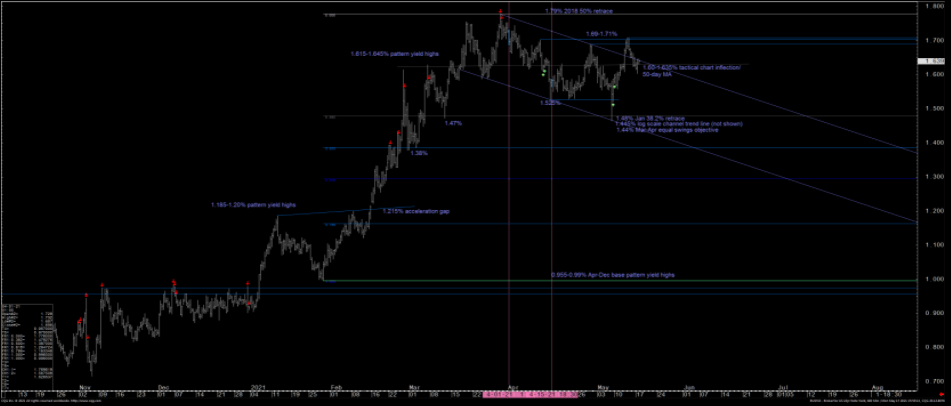
To note, however, rates remain range-bound; rates on the 10 Year T-Note sit below their March high and are likely to continue higher, which the market may absorb

How may the market absorb a rise in rates? During the so-called Taper Tantrum, in the early 2010s, rates settled in a wide range, and equities rallied big. Adding, some strategists, like Kit Juckes of Societe Generale SA (OTC: SCGLY) suggest it may be best to assume a tantrum has already happened.

“U.S. 10-year yields rose from a low of 1.4% in 2012 to 3% during their tantrum. In this cycle, the rise has been from 0.5% to a high just below 1.8%. That’s comparable in relative terms. The eventual peak in U.S. yields in 2018 was 3.25%. Can’t we accept that the taper tantrum has already happened? The important difference is that in the tantrum cycle, core CPI never got above 2 ½%. A bet on further bond weakness is a bet on inflation proving to be stickier than the Fed can cope with.”

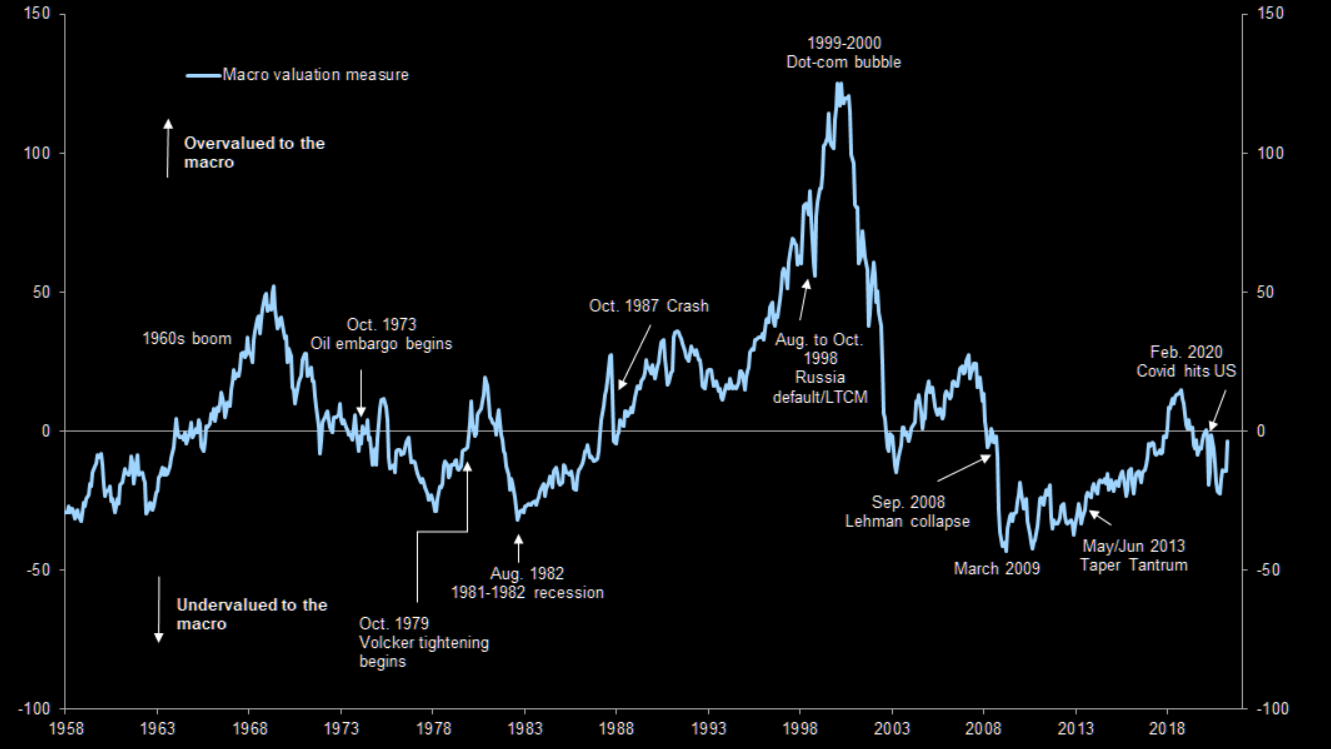
Adding, research by JPMorgan Chase & Co (NYSE: JPM), as well as Goldman Sachs Group Inc (NYSE: GS), suggests equities may be getting cheap with reflationary themes being the go-to play. This sentiment would help explain the increased interest in S&P 500 and Nasdaq 100 call options.

Graphic: Equity valuations at their cheapest, relative to the macro in March 2009 and in the depth of the 1982 recession, according to Goldman Sachs Group Inc (NYSE: GS), via The Market Ear.
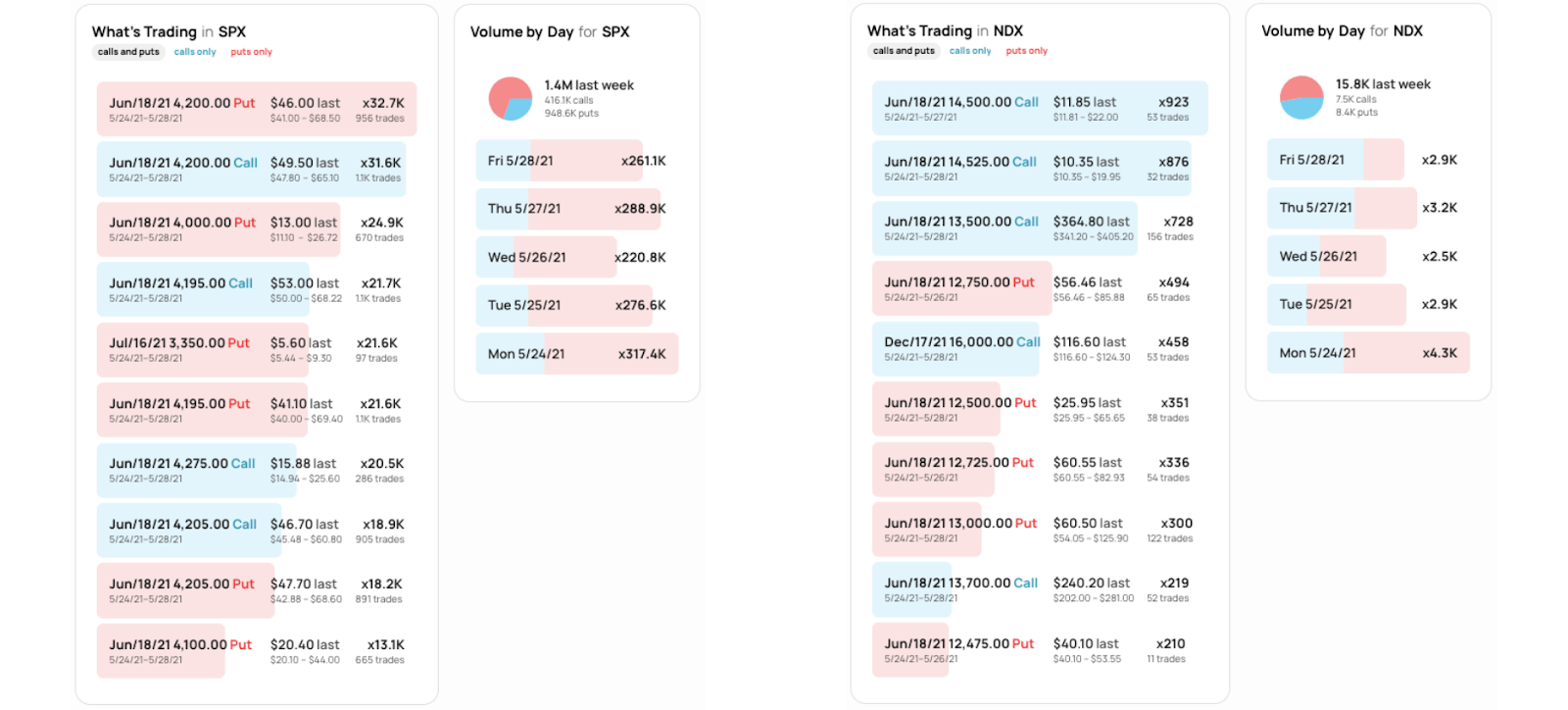
Graphic: SHIFT search suggests participants were becoming more interested in call strikes at and above current prices in the cash-settled S&P 500 Index (INDEX: SPX) and Nasdaq 100 Index (INDEX: NDX), last week.
Graphic: Physik Invest maps out the purchase of call and put options in the SPDR S&P 500 ETF Trust (NYSE: SPY), for the week prior. Activity in the options market was primarily concentrated in short-dated tenors, in strikes at and above $425.

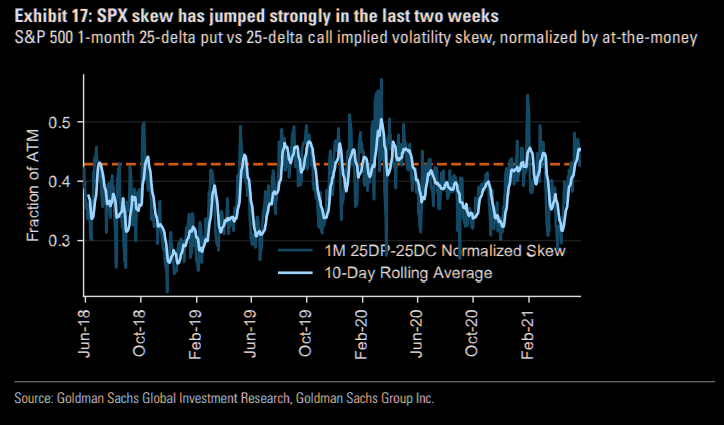
Outlier risks remain, though; aside from the seasonally weak period, S&P 500 skew – a measure of perceived tail risk and the chances of a black swan event – rose dramatically over the past few weeks. At the same time, sentiment cooled considerably, while individual stock volatility increased the potential for a repeat of the GameStop Corporation (NYSE: GME) de-risking event.

Graphic: Goldman Sachs Group Inc (NYSE: GS) unpacks outlier risks based on the implied volatility of S&P 500 out-of-the-money options, via The Market Ear.

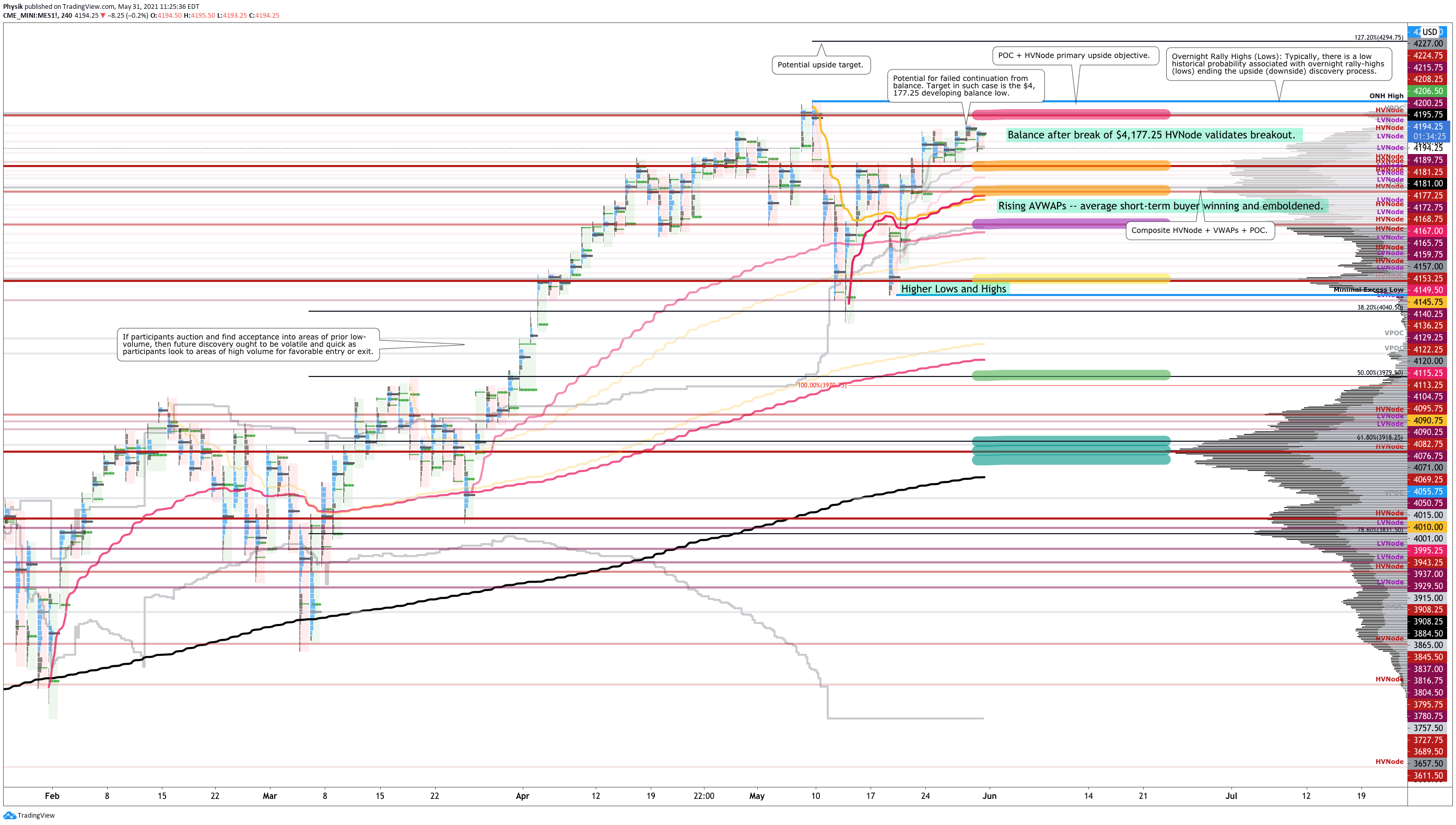
What To Expect: In the coming sessions, participants will want to focus their attention on where the S&P 500 trades in relation to the $4,197.25 high volume area (HVNode).

Volume Areas: A structurally sound market will build on past areas of high volume. Should the market trend for long periods of time, it will lack sound structure (identified as a low volume area which denotes directional conviction and ought to offer support on any test). 

If participants were to auction and find acceptance into areas of prior low volume, then future discovery ought to be volatile and quick as participants look to areas of high volume for favorable entry or exit.

That said, participants can trade from the following frameworks.

In the best case, the index trades sideways or higher; activity above $4,197.25 has the potential to reach the $4,227.00 point of control (POC). Initiative trade beyond the POC could reach as high as first the $4,238.00 overnight all-time high (ONH) and then, the $4,294.75 Fibonacci-derived price extension, a typical recovery target. 

POCs: POCs (like HVNodes described above) are valuable as they denote areas where two-sided trade was most prevalent. Participants will respond to future tests of value as they offer favorable entry and exit. 

Overnight Rally Highs (Lows): Typically, there is a low historical probability associated with overnight rally-highs (lows) ending the upside (downside) discovery process.

In the worst case, the index trades lower; activity below the $4,177.25 HVNode puts in play the $4,153.25 HVNode, first. Thereafter, if lower, the $4,122.25 HVNode and $4,071.00 POC come into play. 

On a cross through the $4,050.75 low volume area (LVNode), long-biased traders should beware of a rapid liquidation, as low as first the $4,015.00 and $4,001.00 POCs. In such a liquidation, odds favor a test of ~$3,970.00 50.00% retracement, as well as the $3,918.00 61.80% retracement and HVNode.

Graphic: 4-hour profile chart of the Micro E-mini S&P 500 Futures.
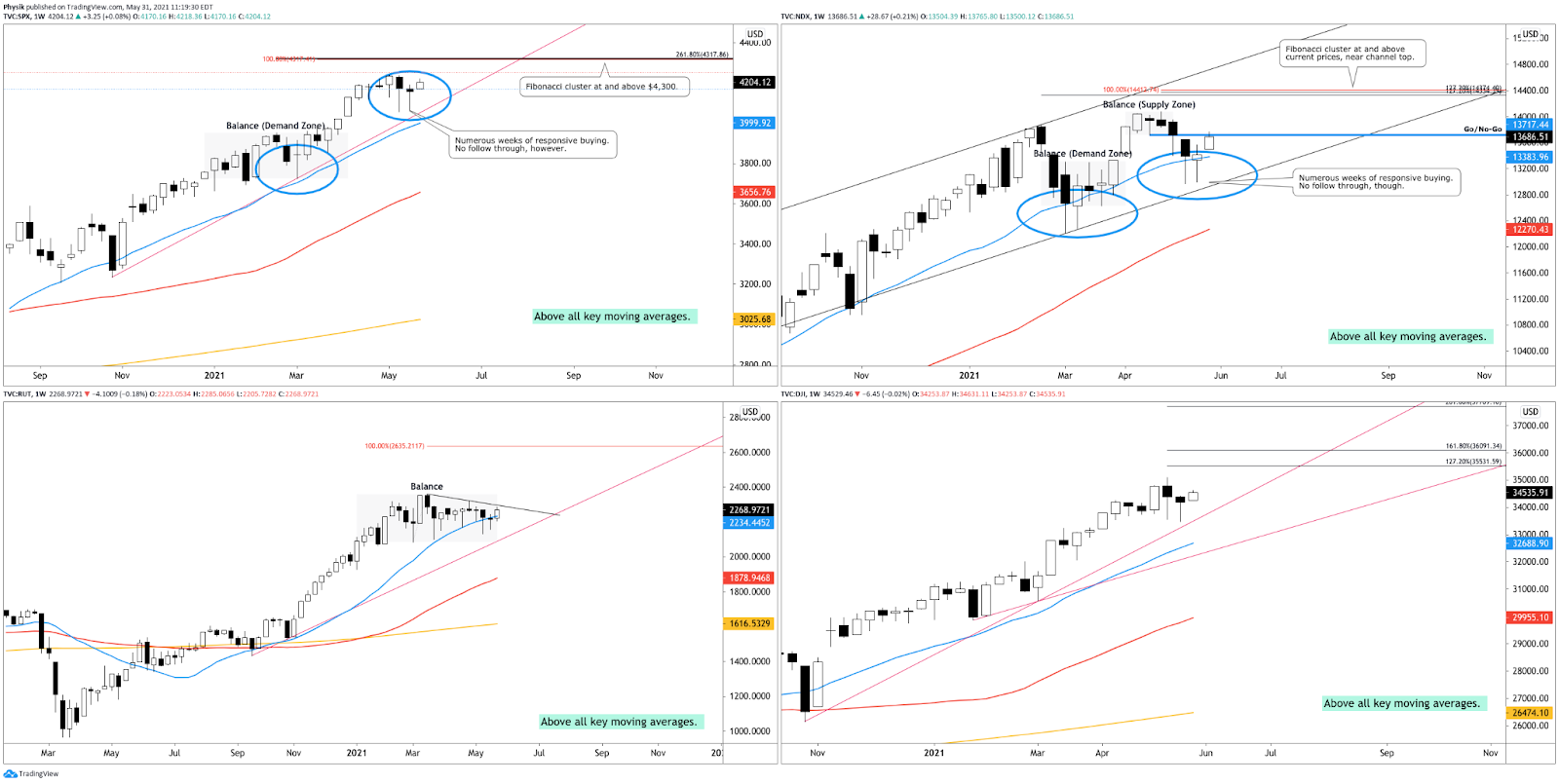
Graphic: Weekly candlestick charts of the S&P 500 (top left), Nasdaq 100 (top right), Russell 2000 (bottom left), and Dow Jones Industrial Average (bottom right). Nasdaq is primed for upside and has the potential to pull the S&P with it. 

News And Analysis

Trade | One of the world’s top ports expects delays on an outbreak. (BBG)

Markets | PBOC raises reserve ratio for foreign exchange holdings. (BBG)

Economy | Recovery solidifies in U.S., Europe, while EM faces risks. (Moody’s)

Markets | China bars banks from selling commodity-linked products. (REU)

Economy | Fed security purchases draw fire in hot U.S. housing market. (S&P)

Energy | Global oil demand is seen eclipsing India, Iran’s uncertainty. (S&P)

Economy | U.S. won’t experience stagflation over next few years. (Moody’s)

Economy | Non-government loans seeing a jump in forbearances. (MND)

Economy | U.S. speculative-grade corporate default rate to fall to 4%. (S&P)

Markets | Inflation, higher oil, stronger yuan point in same direction. (BBG)

Economy | U.S. retailers face headwinds from slowing sales, inflation. (S&P)

Markets | Everyone with bonds to liquidate had ample time to do so. (BBG)

What People Are Saying

Innovation And Emerging Trends

Markets | How recent growth in leveraged finance affects investors. (BZ)

Politics | Tech growth overshadowed by regulatory risks, challenges. (S&P)

Markets | Chamath: SPACs need more oversight and regulation. (BBG)

Politics | China moves to a three-child policy to boost its birthrate. (BBG)

Markets | Shakeout stirs debate over ether’s long-term potential. (BBG)

FinTech | Which banks are positioned for low rates, digital adoption. (S&P)

About

Renato founded Physik Invest after going through years of self-education, strategy development, and trial-and-error. His work reporting in the finance and technology space, interviewing leaders such as John Chambers, founder, and CEO, JC2 Ventures, Kevin O’Leary, businessman and Shark Tank host, Catherine Wood, CEO and CIO, ARK Invest, among others, afforded him the perspective and know-how very few come by.

Having worked in engineering and majored in economics, Renato is very detailed and analytical. His approach to the markets isn’t built on hope or guessing. Instead, he leverages the unique dynamics of time and volatility to efficiently act on opportunity.

Disclaimer

At this time, Physik Invest does not manage outside capital and is not licensed. In no way should the materials herein be construed as advice. Derivatives carry a substantial risk of loss. All content is for informational purposes only.

Categories
Commentary

Daily Brief For May 24, 2021

Quick Note: From May 25 to May 28, the daily newsletter will be off as I will be on a trip. It would not be fair for me to provide lackluster content since I won’t have all the tools at my disposal.

Market Commentary

Index futures in balance.

  • The U.S. may be facing deflation.
  • Ahead is CFNAI data, Fed speak.
  • Stock indexes sideways to higher.

What Happened: U.S. stock index futures auctioned higher overnight alongside renewed political tensions, cryptocurrency volatility, as well as a crackdown by China on commodity speculation.

Graphic updated 7:50 AM EST.

What To Expect: Monday’s regular session (9:30 AM – 4:00 PM EST) in the S&P 500 will likely open inside of prior-range and -value, suggesting a limited potential for immediate directional opportunity. 

Value-Area Placement: Perception of value unchanged if value overlapping (i.e., inside day). Perception of value has changed if value not overlapping (i.e., outside day). Delay trade in the former case.

Adding, during the prior day’s regular trade, the worst-case outcome occurred, evidenced by the responsive selling that surfaced at and above the $4,177.25 high volume area (HVNode). This is not all too significant given the large monthly options expiration. Still, according to SpotGamma, “[w]hile roughly 1/3 of total QQQ gamma rolled off on Friday, … [the] QQQ remains under the control of put options,” a source of potential volatility in the Nasdaq 100.

Responsive Selling: Selling in response to prices above area of recent price acceptance.

Volume Areas: A structurally sound market will build on past areas of high volume. Should the market trend for long periods of time, it will lack sound structure (identified as a low volume area which denotes directional conviction and ought to offer support on any test). 

If participants were to auction and find acceptance into areas of prior low volume, then future discovery ought to be volatile and quick as participants look to areas of high volume for favorable entry or exit.

Options: If an option buyer was short (long) stock, he or she would buy a call (put) to hedge upside (downside) exposure. Option buyers can also use options as an efficient way to gain directional exposure.

Options Expiration (OPEX): Option expiries mark an end to pinning (i.e, the theory that market makers and institutions short options move stocks to the point where the greatest dollar value of contracts will expire worthless) and the reduction dealer gamma exposure.

Gamma: Gamma is the sensitivity of an option to changes in the underlying price. Dealers that take the other side of options trades hedge their exposure to risk by buying and selling the underlying. When dealers are short-gamma, they hedge by buying into strength and selling into weakness. When dealers are long-gamma, they hedge by selling into strength and buying into weakness. The former exacerbates volatility. The latter calms volatility.

As stated in Sunday’s weekly note, equities are in a seasonally weak period. At the same time, inflation and uninspiring economic data are major worries investors are attempting to price in. That said, however, during the May 19 reversal, in the S&P 500 and Nasdaq 100, participants increased exposure to the upside with relatively cheap, longer-dated calls.

Further, for today, participants can trade from the following frameworks. 

In the best case, the S&P 500 trades sideways or higher; activity above $4,177.25 puts in play the $4,227.00 point of control (POC). Initiative trade beyond the POC could reach as high as the $4,238.00 overnight all-time high. 

POCs: POCs (like HVNodes described above) are valuable as they denote areas where two-sided trade was most prevalent. Participants will respond to future tests of value as they offer favorable entry and exit.

Initiative Buying: Buying within or above the previous day’s value area.

Overnight Rally Highs (Lows): Typically, there is a low historical probability associated with overnight rally-highs (lows) ending the upside (downside) discovery process.

In the worst case, the S&P 500 trades lower; activity below $4,177.25 puts in play the $4,122.25 HVNode. Thereafter, if lower, key references include the $4,071.00 POC and $4,050.75 low volume area (LVNode). Long-biased traders are cautioned on trade below the LVNode. 

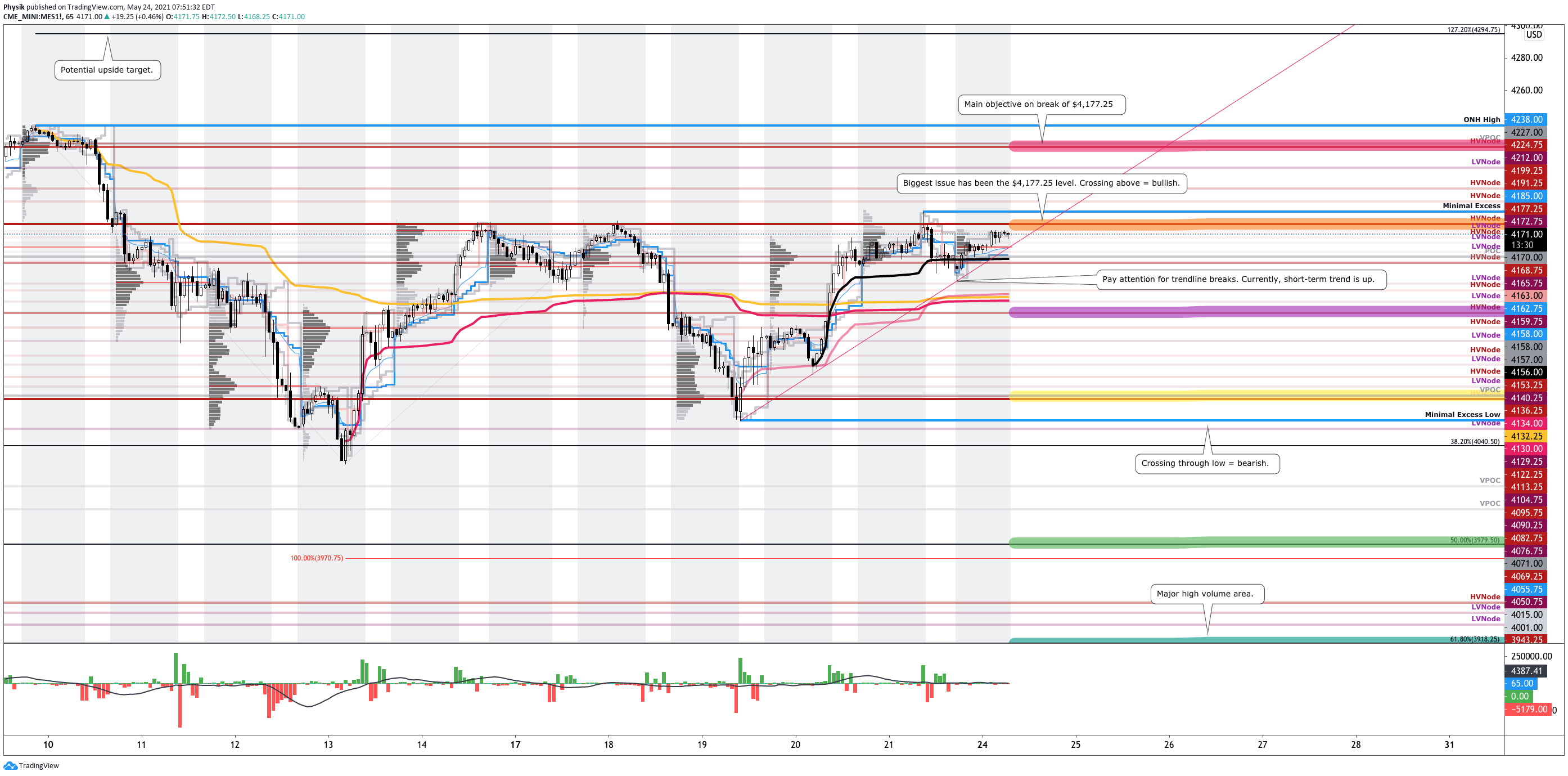
Graphic: 65-minute profile chart of the Micro E-mini S&P 500 Futures.
Graphic: Daily candlestick charts of the S&P 500 (top left), Nasdaq 100 (top right), Russell 2000 (bottom left), and Dow Jones Industrial Average (bottom right). The Nasdaq is regaining relative strength. A rotation would be bullish, or supportive of a new leg higher (if one were to happen).
Graphic: Physik Invest maps out the purchase of call and put options in the SPDR S&P 500 ETF Trust (NYSE: SPY), for last week. Though activity in the options market was primarily concentrated in short-dated tenors, increased trade in farther-dated call-side strikes is observed as a commitment to higher prices.
Graphic: SHIFT search suggests participants were most interested in put strikes at and below current prices in the cash-settled S&P 500 Index (INDEX: SPX) and Nasdaq 100 Index (INDEX: NDX), last week. To note, however, participants began paying up for longer-dated upside exposure (evidenced by call activity).

News And Analysis

Economy | Cathie Wood: U.S. “setting up for a massive period deflation.” (BBG)

Economy | European labor market’s capacity to absorb shocks varies. (Moody’s)

Markets | How a global minimum corporate tax could impact markets. (WSJ)

Markets | Goldman sees oil hitting $80/bbl despite likely supply return. (REU)

Security | Three disasters show gaps in the $1.7T infrastructure plan. (BBG)

Markets | Mainstream markets shrug volatile $1T crypto flash crash. (BBG)

Trade | Sea change: global freight sails out of the digital dark ages. (REU)

Politics | EU weighs sanctions over so-called ‘hijacking’ of Ryanair jet. (BBG)

What People Are Saying

Innovation And Emerging Trends

FinTech | HSBC CEO says bitcoin, cryptocurrencies are not for them. (REU)

FinTech | Robinhood to allow users to buy into IPOs ahead of debut. (REU)

FinTech | VCs are predicting new areas of consumer fintech disruption. (BI)

Environment | Unpacking the problems with reinforced concrete. (Convo)

Markets | First warning sign in global commodity boom flashes in China. (BBG)

About

Renato founded Physik Invest after going through years of self-education, strategy development, and trial-and-error. His work reporting in the finance and technology space, interviewing leaders such as John Chambers, founder, and CEO, JC2 Ventures, Kevin O’Leary, businessman and Shark Tank host, Catherine Wood, CEO and CIO, ARK Invest, among others, afforded him the perspective and know-how very few come by.

Having worked in engineering and majored in economics, Renato is very detailed and analytical. His approach to the markets isn’t built on hope or guessing. Instead, he leverages the unique dynamics of time and volatility to efficiently act on opportunity.

Disclaimer

At this time, Physik Invest does not manage outside capital and is not licensed. In no way should the materials herein be construed as advice. Derivatives carry a substantial risk of loss. All content is for informational purposes only.
Categories
Commentary

Weekly Brief For May 23, 2021

Editor’s Note: Happy Sunday, everyone!

A lot of new subscribers this week in light of Physik Invest’s webinar with Benzinga. If you want access to the slides presented, click here.

Additionally, I am honored for your decision to follow along and will do my best to provide an objective, “no fluff” view into the who, what, when, where, why, and how in finance and technology.

Quick note, from May 25 to May 28, the daily newsletter will be off as I will be on a trip. It would not be fair for me to provide lackluster content since I won’t have all the tools at my disposal.

That said, I’ll try to be objective and concise in today’s note to ensure you have the proper direction for the volatile trade ahead.

Market Commentary

Key Takeaways: Index futures in balance.

  • Bitcoin’s weekend crash churns stomachs.
  • Tone on adjusting monetary policy altered.
  • Indices were sideways-to-higher last week.

What Happened: Last week, U.S. stock index futures auctioned sideways-to-higher, as participants looked to price in emerging dynamics with respect to rising inflation, fiscal and monetary tightening, COVID-19 concerns, political risks, and the like. 

In pricing in these dynamics, the movement was both volatile and mechanical, halting short of key visual references suggesting the participants involved were short-term (i.e., technically driven) in nature.

Adding, amid this rotation, quite a bit of poor structure was cleaned up (i.e., low volume areas), but still, judging by a lack of excess at certain points on the composite volume profile, odds point to limited conviction and commitment.

Excess: A proper end to price discovery; the market travels too far while advertising prices. Responsive, other-timeframe (OTF) participants aggressively enter the market, leaving tails or gaps which denote unfair prices.

Holistically, equities are in a seasonally weak period. At the same time, inflation and uninspiring economic data are major worries investors are attempting to price in.

Just last week, the Federal Reserve’s minutes showed that some on the committee were interested in tapering discussions. 

“It was a surprise to hear the talk about Fed tapering,” Joyce Chang, JPMorgan’s chair of global research, said. “The market had been thinking there might be a couple of months before you really saw this particular issue come into focus.” 

Generally speaking, inflation and rates move inverse to each other. Low rates stimulate demand for loans (i.e., borrowing money more attractive). With the rapid recovery, though, market participants fear that rates will rise to protect the economy from overheating.

Higher rates have the potential to reduce the present value of future earnings, making stocks, especially those that are high growth, less attractive. To note, however, rates remain range-bound; rates on the 10 Year T-Note sit below their March high and are likely to continue higher, which the market may absorb.

Graphic: JPMorgan Chase & Co (NYSE: JPM) analysts believe yields on the 10-year note will stay rangebound before breaking higher this summer, via The Market Ear.

How may the market absorb a move higher in rates? Looking back, according to The Market Ear, during the so-called Taper Tantrum, in the early 2010s, rates settled in a wide range, and equities rallied big. Adding, research by JPMorgan Chase & Co (NYSE: JPM) suggests equities may be getting cheap with reflationary themes the go-to play, still.

In support, during the May 19 reversal, in the S&P 500 and Nasdaq 100, participants increased exposure to the upside with relatively cheap, longer-dated calls.

Still, overall, the flows point to a lot of opportunistic hedging (see graphic below).

Graphic: SHIFT search suggests participants were most interested in put strikes at and below current prices in the cash-settled S&P 500 Index (INDEX: SPX) and Nasdaq 100 Index (INDEX: NDX), last week. To note, however, participants began paying up for longer-dated upside exposure (evidenced by call activity).

What To Expect: In the coming sessions, participants will want to focus their attention on where the S&P 500 trades in relation to its $4,177.25 composite high volume area (HVNode).

Volume Areas: A structurally sound market will build on past areas of high volume. Should the market trend for long periods of time, it will lack sound structure (identified as a low volume area which denotes directional conviction and ought to offer support on any test). 

If participants were to auction and find acceptance into areas of prior low volume, then future discovery ought to be volatile and quick as participants look to areas of high volume for favorable entry or exit.

In the best case, the index trades sideways or higher; activity above the $4,177.25 HVNode puts in play the $4,227.00 point of control (POC). Initiative trade beyond the POC could reach as high as first the $4,238.00 overnight all-time high and then, the $4,294.75 Fibonacci-derived price extension, a typical recovery target.

POCs: POCs (like HVNodes described above) are valuable as they denote areas where two-sided trade was most prevalent. Participants will respond to future tests of value as they offer favorable entry and exit.

Overnight Rally Highs (Lows): Typically, there is a low historical probability associated with overnight rally-highs (lows) ending the upside (downside) discovery process.

In the worst case, the index trades lower; activity below the $4,122.25 HVNode puts in play the $4,071.00 POC. Thereafter, if lower, on a cross through the $4,050.75 low volume area (LVNode), long-biased traders should beware of a rapid liquidation, as low as first the $4,015.00 and $4,001.00 POCs. In such a liquidation, odds favor a test of ~$3,970.00 50.00% retracement, as well as the $3,918.00 61.80% retracement and HVNode.

Graphic: 65-minute profile chart of the Micro E-mini S&P 500 Futures.
Graphic: Weekly candlestick charts of the S&P 500 (top left), Nasdaq 100 (top right), Russell 2000 (bottom left), and Dow Jones Industrial Average (bottom right). Note Russell’s “toppy” rotation, and similar pullbacks to trend in the S&P 500 and Nasdaq. One last push, higher?
Graphic: Physik Invest maps out the purchase of call and put options in the SPDR S&P 500 ETF Trust (NYSE: SPY), for last week. Though activity in the options market was primarily concentrated in short-dated tenors, increased trade in farther-dated call-side strikes is observed as a commitment to higher prices.

News And Analysis

Markets | Rotation from growth into value strengthens bull market. (ARK)

Recovery | Two COVID shots effective against the India variant. (REU)

Economy | U.S. inflation is transitory and consistent with recovery. (S&P

Crypto | Google search volume for cryptocurrency breaks ATH. (Block)

Economy | PBOC will maintain its exchange rate basically stable. (BBG)

Markets | Global chip shortages cost automakers 5% of production. (Fitch)

Markets | JPMorgan cross-asset strategy head warns of drop. (BBG)

Markets | Nomura, UBS, UniCredit fined over bond trading cartel. (TT)

Recovery | CDC probes reports of myocarditis in the vaccinated. (Axios)

Economy | U.S. home prices push to record highs, buying slows. (WSJ)

What People Are Saying

Innovation And Emerging Trends

FinTech | How cryptocurrency fits into Brazil’s vision for banking. (Block)

FinTech | Major Asia-Pacific region banks upping their fintech bets. (S&P)

FinTech | U.S. Federal Reserve plans to publish a paper on CBDC. (Block)

Real Estate | Manhattan’s apartment vacancy rate stubbornly high. (WSJ)

About

Renato founded Physik Invest after going through years of self-education, strategy development, and trial-and-error. His work reporting in the finance and technology space, interviewing leaders such as John Chambers, founder, and CEO, JC2 Ventures, Kevin O’Leary, businessman and Shark Tank host, Catherine Wood, CEO and CIO, ARK Invest, among others, afforded him the perspective and know-how very few come by.

Having worked in engineering and majored in economics, Renato is very detailed and analytical. His approach to the markets isn’t built on hope or guessing. Instead, he leverages the unique dynamics of time and volatility to efficiently act on opportunity.

Disclaimer

At this time, Physik Invest does not manage outside capital and is not licensed. In no way should the materials herein be construed as advice. Derivatives carry a substantial risk of loss. All content is for informational purposes only.

Categories
Commentary

Daily Brief For May 21, 2021

Market Commentary

Index futures in balance.

  • Global tax revamp is gathering pace.
  • Ahead: Home sales, PMI, Fed speak.
  • Indices sideways-to-higher overnight.

What Happened: U.S. stock index futures auctioned within prior-range, overnight, alongside calls for a global minimum corporate tax rate of 15%, data on existing home sales and PMI, as well as Fed speak.

Graphic updated 7:25 AM EST.

What To Expect: Friday’s regular session (9:30 AM – 4:00 PM EST) in the S&P 500 will likely open near prior-range and -value, suggesting a limited potential for immediate directional opportunity. 

Adding, during the prior day’s regular trade, the best case outcome occurred, evidenced by initiative trade beyond the S&P 500’s $4,134.00 spike base, which is significant because it marked a so-called pivot on the composite profile (i.e., above = bullish, below = neutral-to-bearish).
Spikes: Spike’s mark the beginning of a break from value. Spikes higher (lower) are validated by trade at or above (below) the spike base (i.e., the origin of the spike).

Initiative Buying: Buying within or above the previous day’s value area.

This recent ongoing rotation at higher prices comes as participants have been attempting to price in emerging dynamics with respect to rising inflation, fiscal and monetary tightening, COVID-19 case rises, geopolitical conflict, and the like.

In pricing in these dynamics, the movement has been both volatile and mechanical, halting short of key visual references suggesting the participants involved are short-term (i.e., technically-driven) in nature. Adding, amid this rotation, quite a bit of poor structure has been cleaned up (i.e., low-volume areas), but still, judging by a lack of excess at certain points on the composite volume profile, odds point to limited conviction and commitment.

Excess: A proper end to price discovery; the market travels too far while advertising prices. Responsive, other-timeframe (OTF) participants aggressively enter the market, leaving tails or gaps which denote unfair prices.

The major takeaway? Without follow-through to the downside, it is difficult to get pessimistic. As the saying goes, “never short a dull market.” The case for higher prices, as high as $4,300.00-$4,400.00, per JPMorgan Chase & Co (NYSE: JPM) research remains in play.

Moreover, for today, participants can trade from the following frameworks. 

In the best case, the S&P 500 trades sideways or higher; activity above the $4,153.25 high volume area (HVNode) targets the $4,177.25 HVNode. Initiative trade beyond the $4,177.25 HVNode could reach as high as the $4,227.00 POC. 

In the worst case, the S&P 500 trades lower; activity below the $4,153.25 HVNode puts in play the $4,136.25 and $4,122.25 HVNodes. Trading below those two references is negative; participants should look for the $4,071.00 POC to offer some response.

Volume Areas: A structurally sound market will build on past areas of high volume. Should the market trend for long periods of time, it will lack sound structure (identified as a low volume area which denotes directional conviction and ought to offer support on any test). 

If participants were to auction and find acceptance into areas of prior low volume, then future discovery ought to be volatile and quick as participants look to areas of high volume for favorable entry or exit.

POCs: POCs (like HVNodes described above) are valuable as they denote areas where two-sided trade was most prevalent. Participants will respond to future tests of value as they offer favorable entry and exit.
Graphic: 65-minute profile chart of the Micro E-mini S&P 500 Futures.
Graphic: Daily candlestick charts of the S&P 500 (top left), Nasdaq 100 (top right), Russell 2000 (bottom left), and Dow Jones Industrial Average (bottom right). Relative strength is shifting back to the Nasdaq.
Graphic: Physik Invest maps out the purchase of call and put options in the SPDR S&P 500 ETF Trust (NYSE: SPY), for May 20. Activity in the options market was primarily concentrated in short-dated tenors, in call strikes at and above current prices.
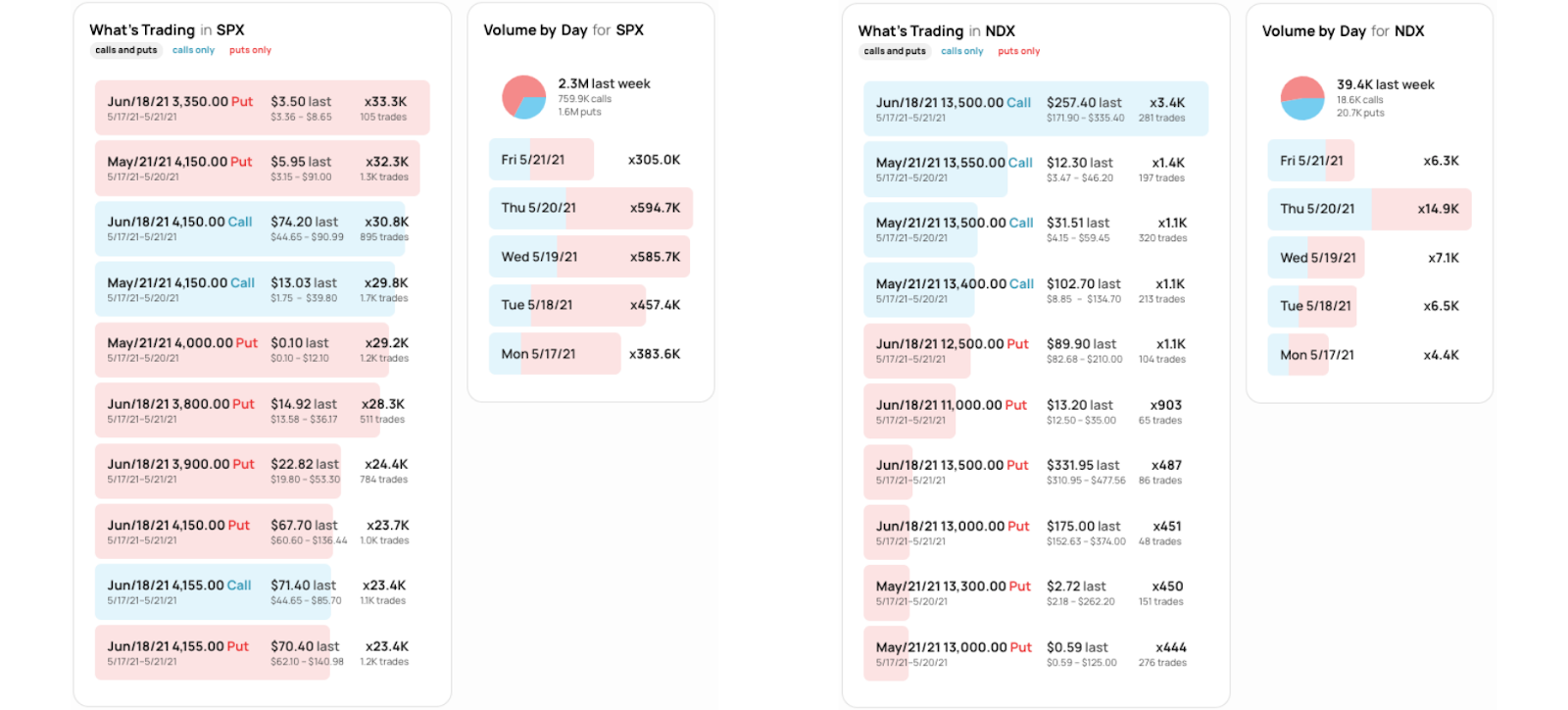
Graphic: SHIFT search suggests participants were most interested in call and put strikes across available strikes in the cash-settled S&P 500 Index (INDEX: SPX) and Nasdaq 100 Index (INDEX: NDX), May 20.

News And Analysis

Economy | Global tax revamp gathers pace as Europe salutes U.S. proposal. (BBG)

Economy | Markets still pricing in first rate hike well ahead of Fed guidance. (Moody’s)

Economy | Housing outlook facing more uncertainty as 2022 growth revised. (MND)

Economy | Global corporate rating stabilization continues as recovery unfolds. (Fitch)

Economy | Uneven economic, population trends contribute to diverging credit. (Moody’s)

Economy | How the post-pandemic labor crunch is curbing U.S. manufacturing. (REU)

Economy | Eurozone business growth hits a high on services resurgence. (REU)

What People Are Saying

Innovation And Emerging Trends

FinTech | Nasdaq, Benzinga partner over actionable market intelligence. (BZ)

FinTech | Analysis: How to borrow cryptocurrencies with more certainty. (VV)

FinTech | MX adds Lexi Hall to empower regulatory innovation in fintech. (BZ)

Crypto | U.S. Treasury calls for stricter cryptocurrency rules, reporting. (TC)

Energy | Ford’s powerhouse EV F-150 can actually power your house. (TC)

FinTech | Harris, CHC discussed digital banking for Northern Triangle. (Axios)

About

Renato founded Physik Invest after going through years of self-education, strategy development, and trial-and-error. His work reporting in the finance and technology space, interviewing leaders such as John Chambers, founder, and CEO, JC2 Ventures, Kevin O’Leary, businessman and Shark Tank host, Catherine Wood, CEO and CIO, ARK Invest, among others, afforded him the perspective and know-how very few come by.

Having worked in engineering and majored in economics, Renato is very detailed and analytical. His approach to the markets isn’t built on hope or guessing. Instead, he leverages the unique dynamics of time and volatility to efficiently act on opportunity.

Disclaimer

At this time, Physik Invest does not manage outside capital and is not licensed. In no way should the materials herein be construed as advice. Derivatives carry a substantial risk of loss. All content is for informational purposes only.