Categories
Commentary

Daily Brief For May 17, 2021

Market Commentary

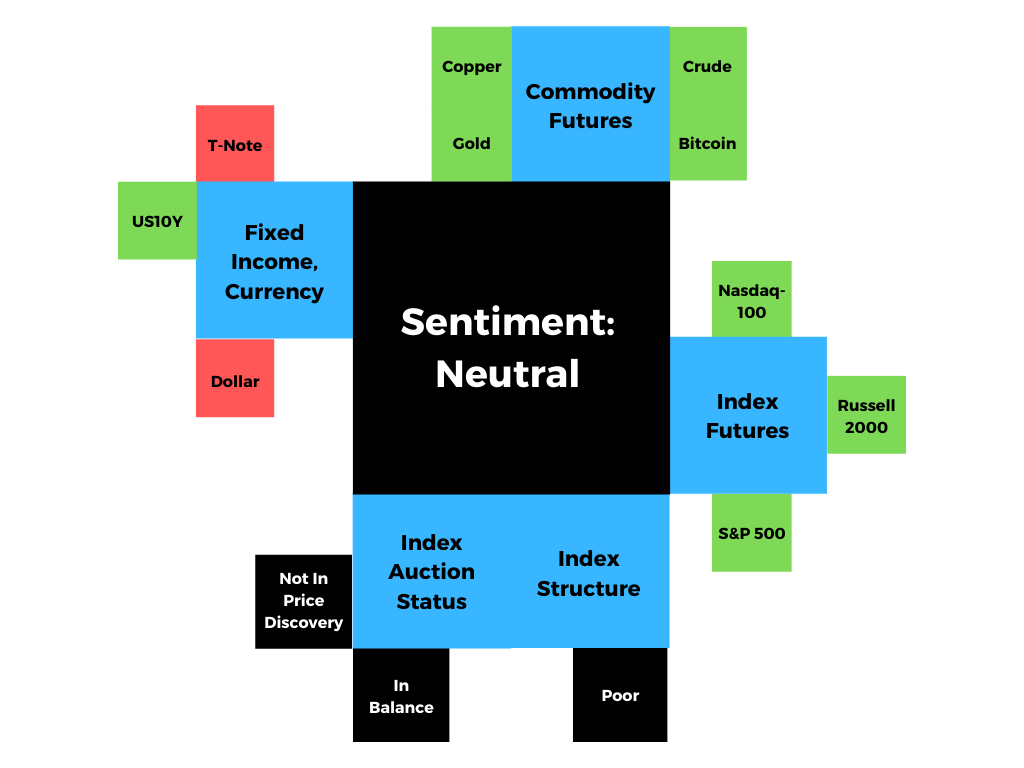
Index futures in balance.

  • Themes: Inflation, COVID outbreaks.
  • Ahead: Manufacturing, housing data.
  • Indices are lower but holding up well.

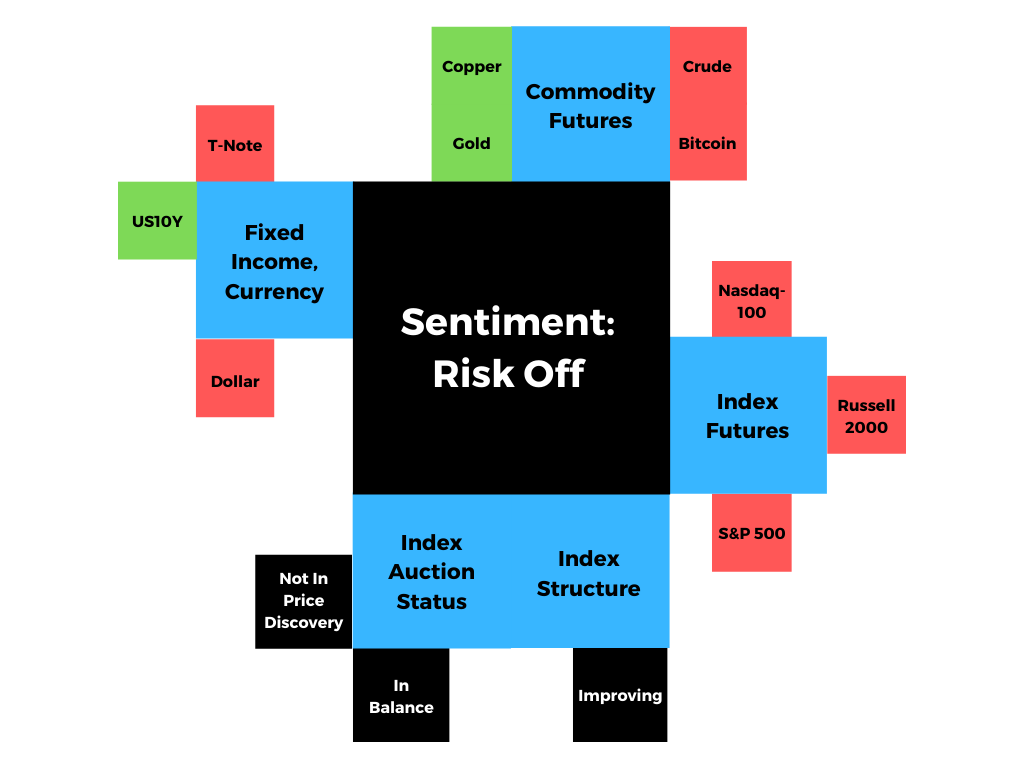
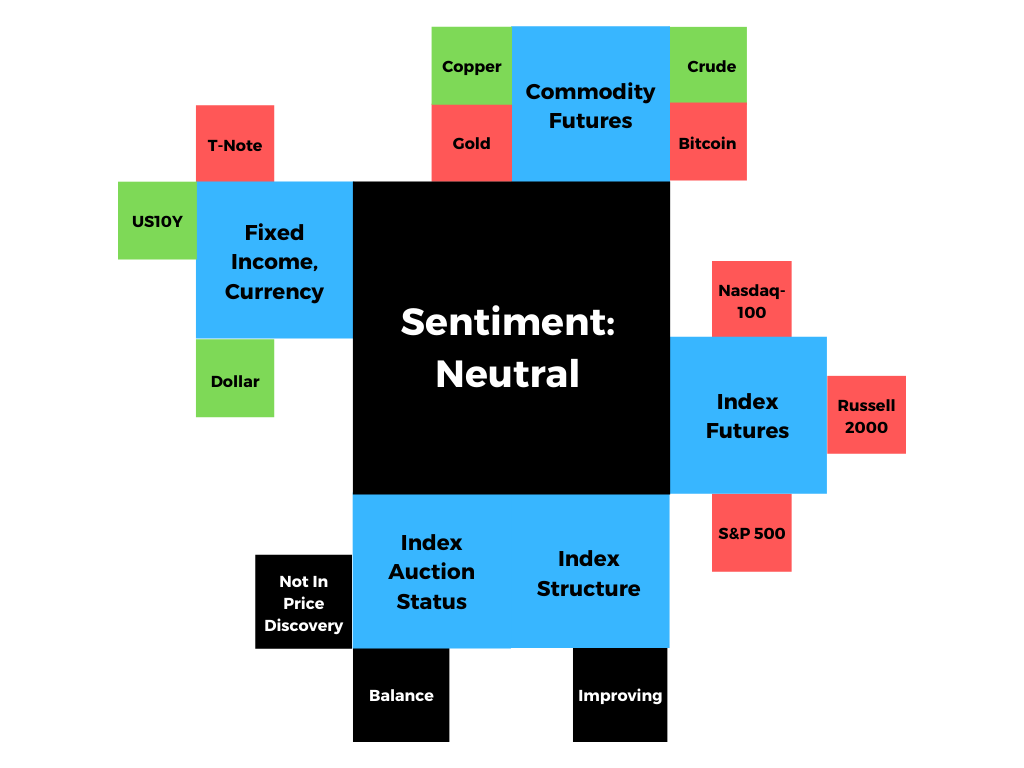
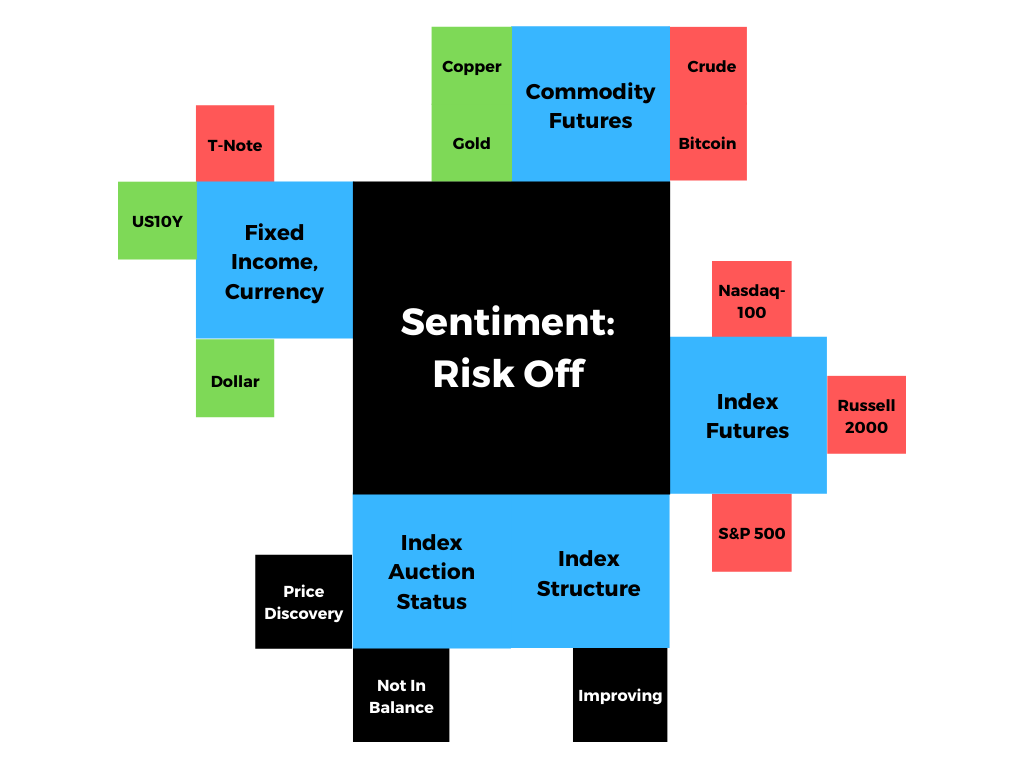
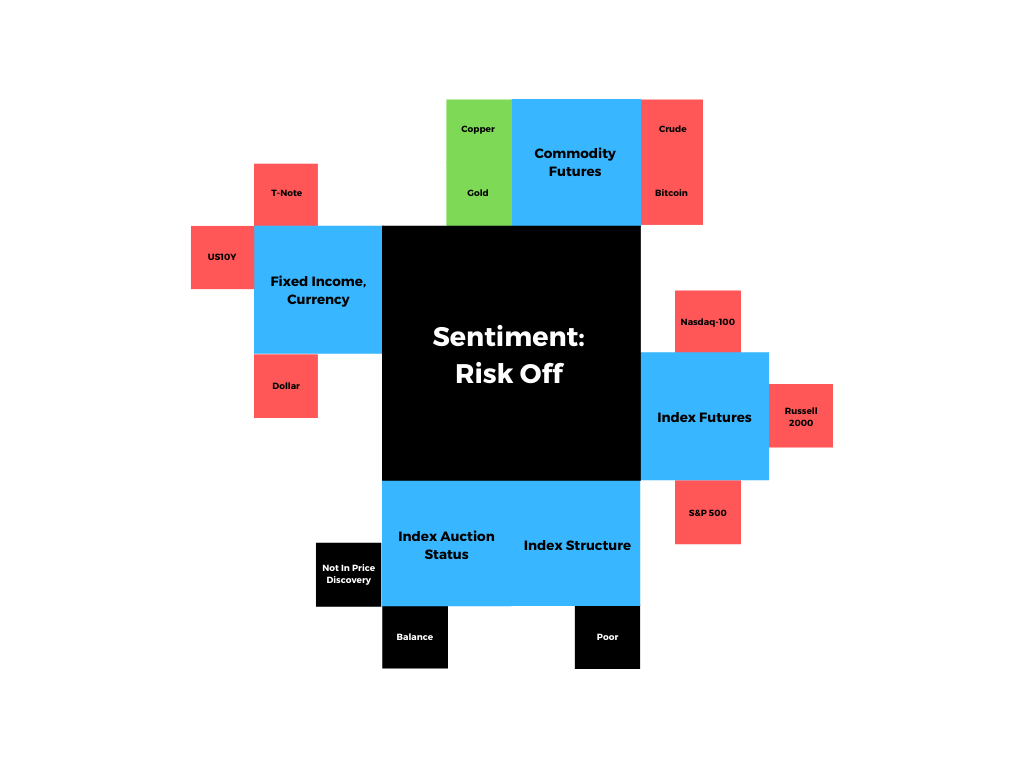
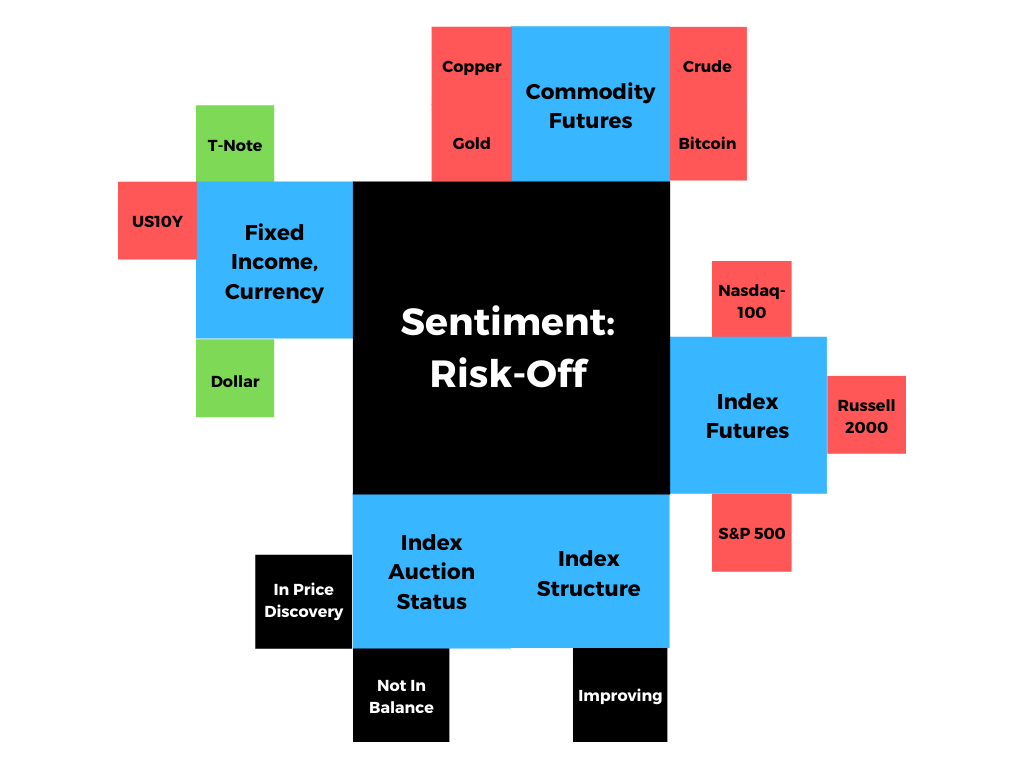
What Happened: U.S. stock index futures auctioned lower, overnight, alongside a so-called flight to safety. Bonds and metals were higher while risk assets, like equities and cryptocurrencies, were down.

At the same time, supply-side disruptions continue with coronavirus outbreaks in Asia; Taiwan’s benchmark index fell nearly 4% during overnight trade.

In terms of releases, participants are looking forward to Empire Manufacturing and the NAHB housing market index for May. Also, an Atlanta Fed conference begins, today.
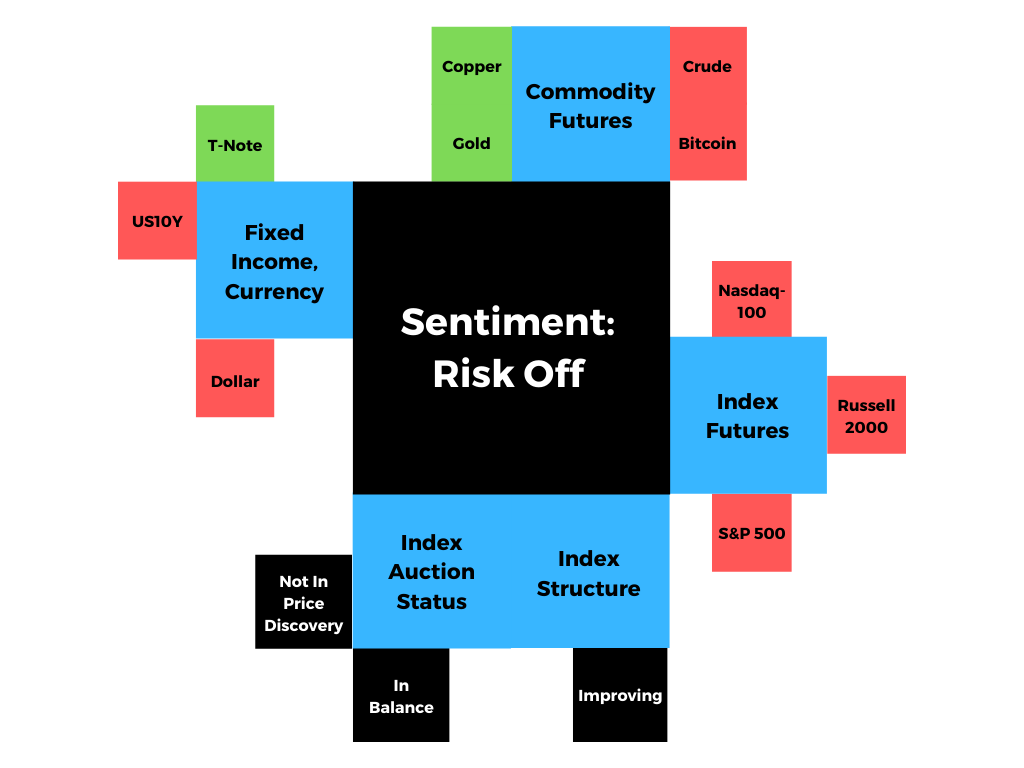
Graphic updated at 7:00 AM EST.

What To Expect: Monday’s regular session (9:30 AM – 4:00 PM EST) in the S&P 500 will likely open inside of prior-range and -value, suggesting a limited potential for immediate directional opportunity.

Adding, during Friday’s regular trade, the best case outcome occurred, evidenced by initiative trade up to the $4,177.25 high volume area (HVNode). This is significant because that level marks a major pivot on the composite profile (i.e., above = bullish, below = bearish-to-neutral). To note, however, participants were unable to introduce meaningful excess at the recovery high.

Volume Areas: A structurally sound market will build on past areas of high volume. Should the market trend for long periods of time, it will lack sound structure (identified as a low-volume area which denotes directional conviction and ought to offer support on any test). 

If participants were to auction and find acceptance into areas of prior low-volume, then future discovery ought to be volatile and quick as participants look to areas of high volume for favorable entry or exit.

Excess: A proper end to price discovery; the market travels too far while advertising prices. Responsive, other-timeframe (OTF) participants aggressively enter the market, leaving tails or gaps which denote unfair prices.

It is important to touch on the push-pull dynamic in markets, over the past few weeks. 

Historically speaking, equities are in a seasonally weak period. At the same time, inflation and uninspiring economic data are major worries investors are attempting to price in. Despite these emerging themes, JPMorgan Chase & Co’s (NYSE: JPM) Marko Kolanovic, in a CNBC appearance, said that the market is a little oversold, and his S&P 500 target of $4,400.00 remains in play.

“I think market is now actually getting cheap, in some sense,” Kolanovic said. “I think we’re at the end of this upset. I think the market is going to go higher here. That said, we do still again prefer reflationary themes.”

Given the brief fundamental context, for today, participants can trade from the following frameworks. 

In the best case, the S&P 500 trades sideways or higher; activity above the $4,177.25 HVNode pivot may reach as high as the $4,227.00 POC. Initiative trade beyond the POC targets the $4,238.00 overnight high (ONH).

POCs: POCs (like HVNodes described above) are valuable as they denote areas where two-sided trade was most prevalent. Participants will respond to future tests of value as they offer favorable entry and exit.

Overnight Rally Highs (Lows): Typically, there is a low historical probability associated with overnight rally-highs (lows) ending the upside (downside) discovery process.

In the worst case, the S&P 500 trades lower; activity below $4,177.25 has the potential to reach down, through the $4,129.25 and $4,069.25 HVNodes, to the $4,050.75 low volume area (LVNode). 

Trading beyond the LVNode, caution longs. The S&P 500 may rapidly discover lower prices, repairing the poor, low-volume structure down to the $3,979.50 Fibonacci retracement. Closeby is the $3,953.25 HVNode and $3,908.25 composite HVNode (a key response area).
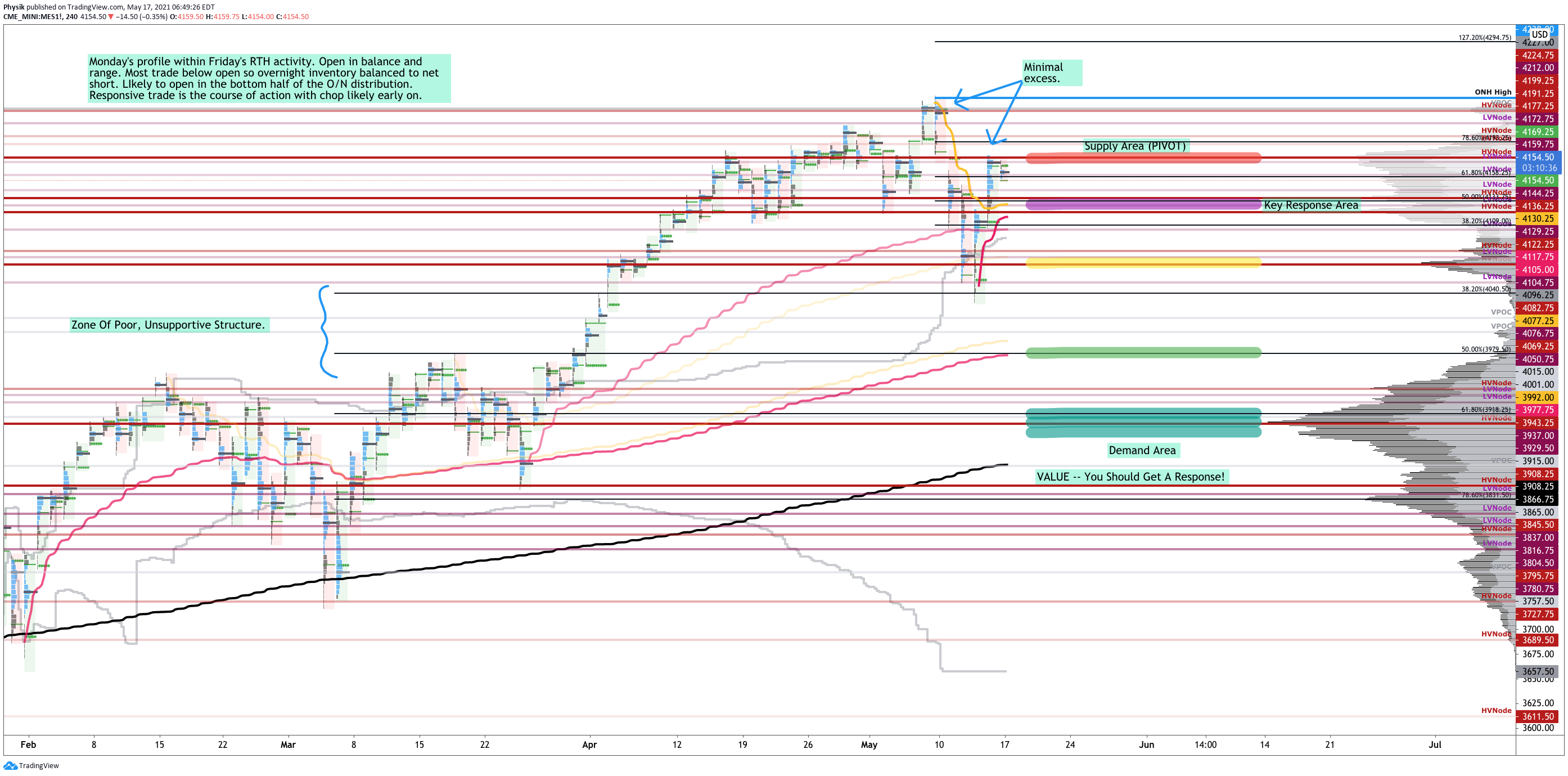
Graphic: 4-hour profile chart of the Micro E-mini S&P 500 Futures.
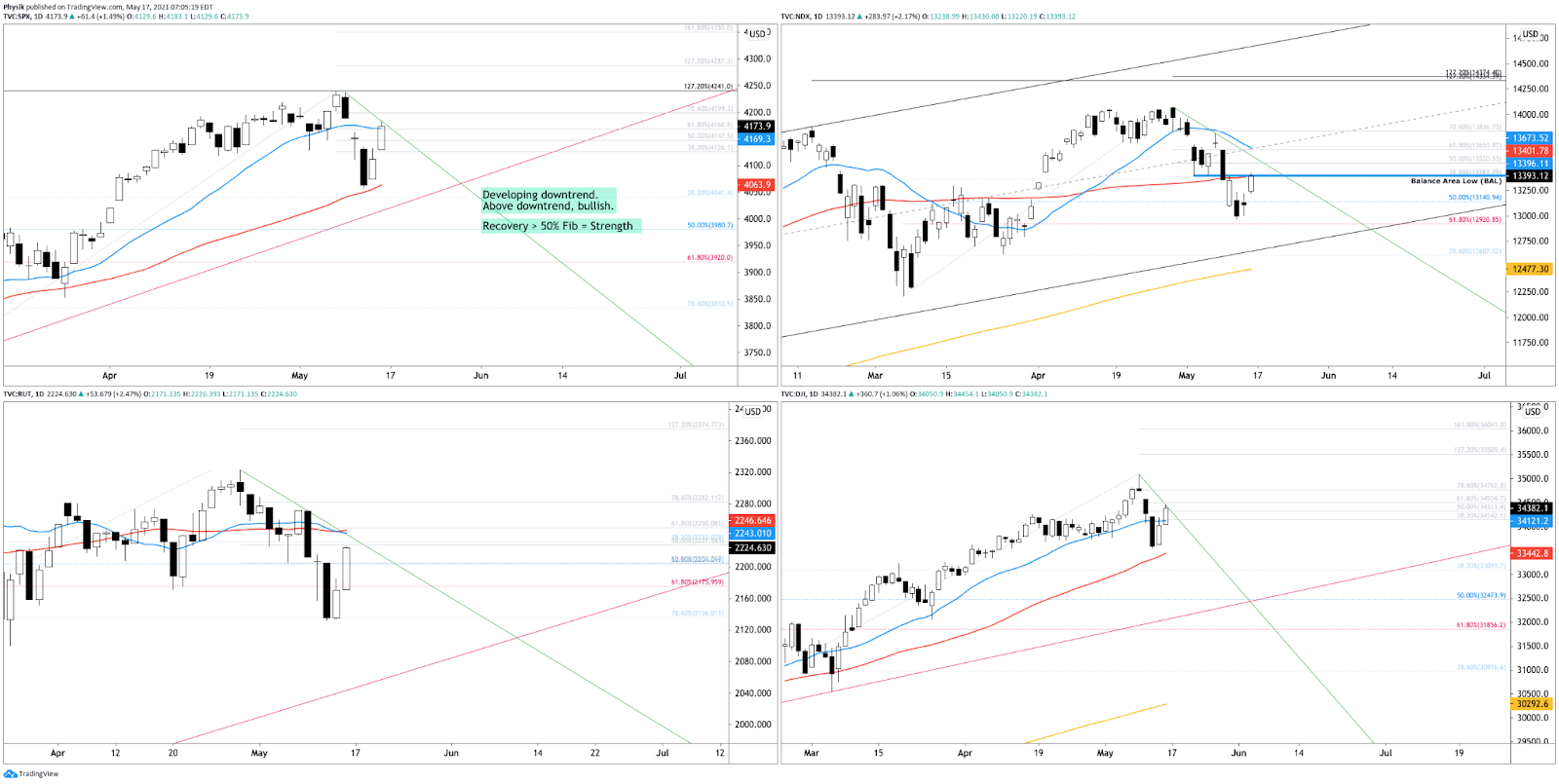
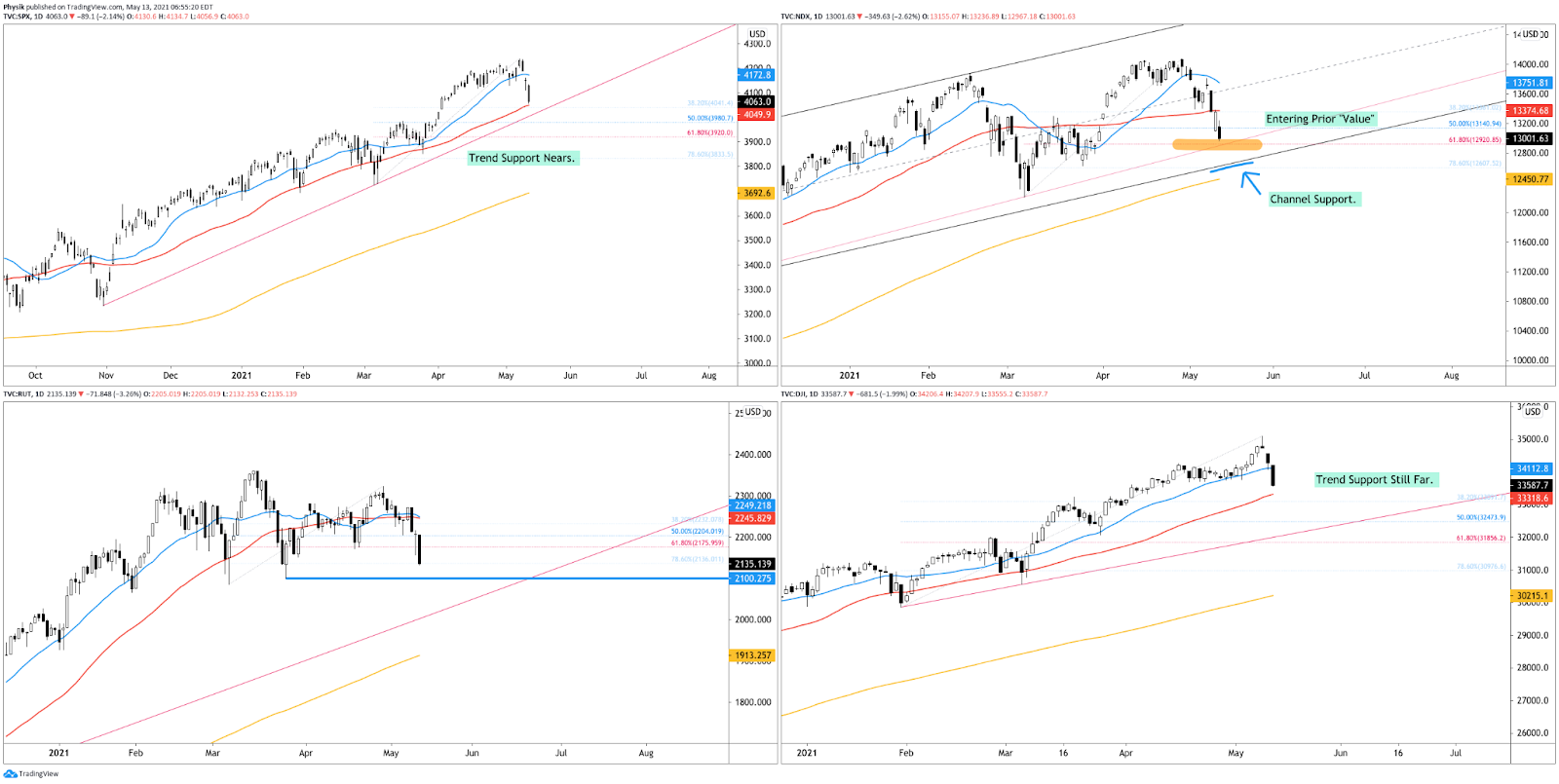
Graphic: Daily candlestick charts of the S&P 500 (top left), Nasdaq 100 (top right), Russell 2000 (bottom left), and Dow Jones Industrial Average (bottom right).
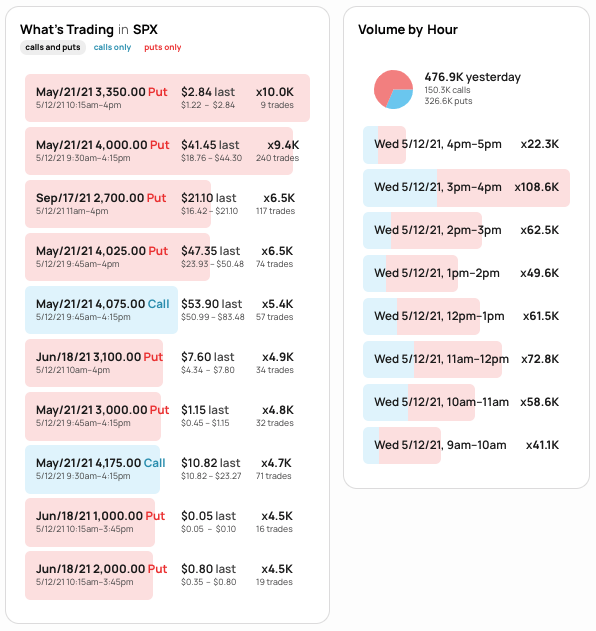
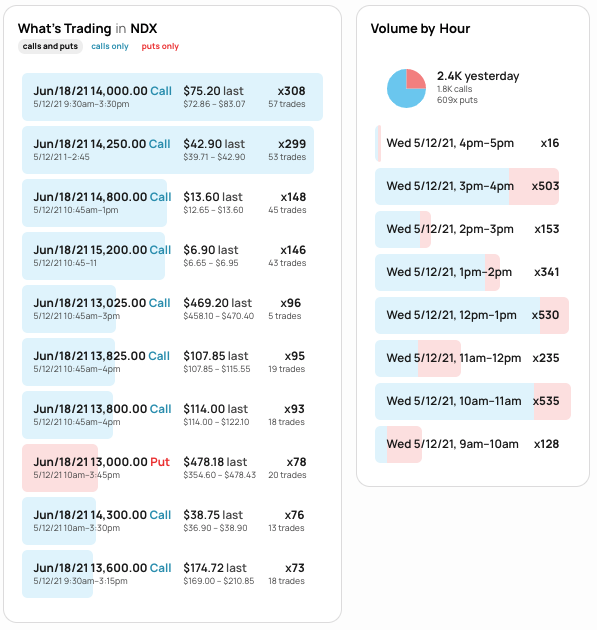
Graphic: SHIFT search suggests participants were most interested in put strikes at and below current prices in the cash-settled S&P 500 Index (INDEX: SPX) and Nasdaq 100 Index (INDEX: NDX), last week. It appears that participants were positioning themselves in strikes across further-dated expiries (e.g., June 18, 2021) suggesting more commitment.

News And Analysis

Trade | Surging corporate demand is upending global supply chains. (BBG)

Credit | Fiscal stimulus, borrower discipline behind loan asset quality. (Moody’s)

Economy | Households and most U.S. children to get monthly stimulus. (REU)

Travel | United to add more than 400 daily flights in July amid demand. (REU)

Trade | EU agrees to a partial truce with the U.S. over old Trump tariffs. (REU)

Markets | Companies flush with cash, ready to pad shareholder pockets. (WSJ)

What People Are Saying

Innovation And Emerging Trends

Travel | Bankers flee Wall Street, head home to virus-free Australia. (BBG)

FinTech | Crypto, blockchain must accept problems, lead in sustainability. (TC)

Energy | The electrification of everything: what you need to know. (WSJ)

FinTech | How you can build a DIY robot-advisor using Passiv. (BZ)

About

Renato founded Physik Invest after going through years of self-education, strategy development, and trial-and-error. His work reporting in the finance and technology space, interviewing leaders such as John Chambers, founder, and CEO, JC2 Ventures, Kevin O’Leary, businessman and Shark Tank host, Catherine Wood, CEO and CIO, ARK Invest, among others, afforded him the perspective and know-how very few come by.

Having worked in engineering and majored in economics, Renato is very detailed and analytical. His approach to the markets isn’t built on hope or guessing. Instead, he leverages the unique dynamics of time and volatility to efficiently act on opportunity.

Disclaimer

At this time, Physik Invest does not manage outside capital and is not licensed. In no way should the materials herein be construed as advice. Derivatives carry a substantial risk of loss. All content is for informational purposes only.

Categories
Commentary

Daily Brief For May 13, 2021

Market Commentary

Index futures in price discovery.

  • Inflation contagion hits pocketbook.
  • Ahead: Claims, PPI, and earnings.
  • Index futures are lower but steady.

What Happened: U.S. stock index futures continued their sell-off, overnight, after a strong move lower, Wednesday.

Graphic updated 7:00 AM EST.

What To Expect: Thursday’s regular session (9:30 AM – 4:00 PM EST), in the S&P 500, will likely open just outside of prior -range and -value, suggesting the potential for immediate directional opportunity.

Adding, during the prior day’s regular trade, the worst-case outcome occurred, evidenced by initiative trade below Tuesday’s excess low. This is significant because that reference marked the start of a prior intermediate-term bounce.

Excess: A proper end to price discovery; the market travels too far while advertising prices. Responsive, other-timeframe (OTF) participants aggressively enter the market, leaving tails or gaps which denote unfair prices.

This downside price discovery comes alongside the release of poor employment and payroll data. 

Price Discovery (One-Timeframe Or Trend): Elongation and range expansion denotes a market seeking new prices to establish value, or acceptance (i.e., more than 30-minutes of trade at a particular price level). 

“‘Markets have lost a little bit of confidence that the Fed has control of inflation’ and the concern was that the central bank might wait too long to address the rise,” Victoria Fernandez, Crossmark Global Investments chief market strategist, said. “I am not sure the market is extremely comfortable with that at this point.”

However, that said, stock indexes may be positioned for a vicious rebound as near-term downside discovery may have reached a limit, based on market liquidity metrics and the inventory positioning of participants. According to SqueezeMetrics, the steepness of the GammaVol (GXV) curve suggests that there’s more risk to the upside than the downside, at the S&P 500’s present juncture.

More On Gamma: In the simplest way, gamma is the sensitivity of an option to changes in underlying price. Dealers that take the other side of option trades hedge their exposure to risk by buying and selling the underlying. When dealers are short-gamma, they hedge by buying into strength and selling into weakness. When dealers are long-gamma, they hedge by selling into strength and buying into weakness. The former exacerbates volatility. The latter calms volatility.

Knowing the above, for today, participants can trade from the following frameworks. 

In the best case, the S&P 500 trades sideways or higher; activity above the $4,051.00 regular trade low targets the $4,069.25 high volume area (HVNode). Initiative trade beyond the HVNode could reach as high as $4,082.75 HVNode, $4,105.75 low volume area (LVNode), and then the $4,117.00 POC. 

Volume Areas: A structurally sound market will build on past areas of high volume. Should the market trend for long periods of time, it will lack sound structure (identified as a low-volume area which denotes directional conviction and ought to offer support on any test). 

If participants were to auction and find acceptance into areas of prior low-volume, then future discovery ought to be volatile and quick as participants look to areas of high volume for favorable entry or exit.

POCs: POCs (like HVNodes described above) are valuable as they denote areas where two-sided trade was most prevalent. Participants will respond to future tests of value as they offer favorable entry and exit.

In the worst case, the S&P 500 trades lower; activity below $4,051.00 puts the index within a composite low-volume zone, a situation in which follow-through, to the next high-volume area, is likely. Further, participants, in such a case, should look for responses at the $4,015.00 and $4,001.00 POCs, the $3,980.00 50% Fibonacci retracement, the $3,943.00 HVNode, and lastly, the $3,918.25-$3,908.00 Fibonacci and volume area confluence zone.

Graphic: 4-hour profile chart of the Micro E-mini S&P 500 Futures.
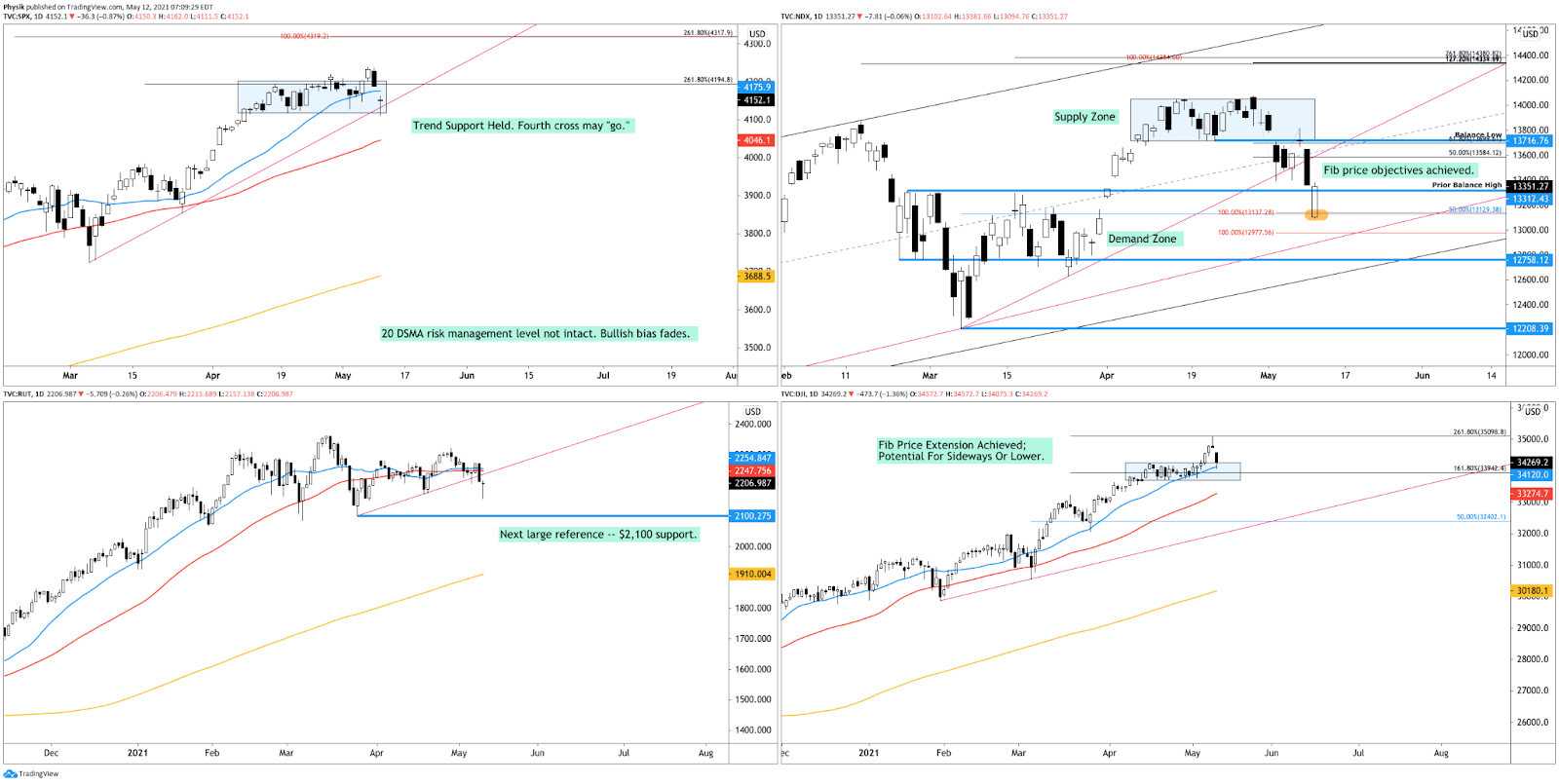
Graphic: Daily candlestick charts of the S&P 500 (top left), Nasdaq 100 (top right), Russell 2000 (bottom left), and Dow Jones Industrial Average (bottom right).
Graphic: Physik Invest maps out the purchase of call and put options in the SPDR S&P 500 ETF Trust (NYSE: SPY), for May 12. Activity in the options market was primarily concentrated in short-dated tenors, in put strikes as low as $389.00, which corresponds with ~$4,000.00 in the cash-settled S&P 500 Index (INDEX: SPX).
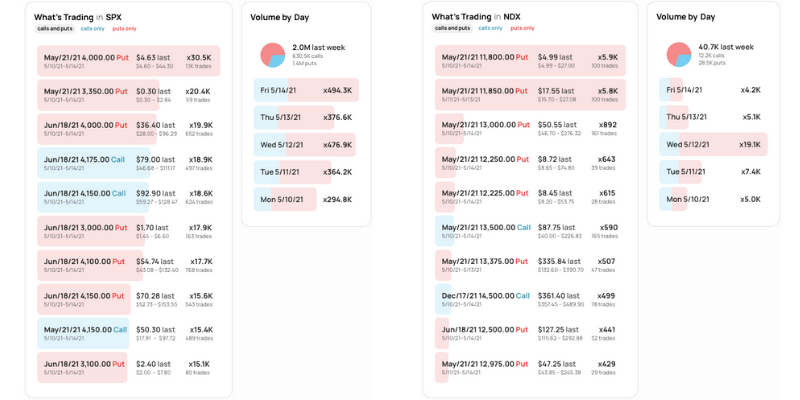
Graphic: SHIFT search suggests participants were most interested in short-dated put strikes at and below current prices in the cash-settled S&P 500 Index (INDEX: SPX), Wednesday. 
Graphic: SHIFT search suggests participants were most interested in long-dated call strikes at and above current prices in the cash-settled Nasdaq 100 Index (INDEX: NDX), Wednesday.

News And Analysis

Crypto | Musk splits from Cathie Wood’s Ark on Bitcoin’s environment cost. (BBG)

Economy | Travel bookings are surging as vaccines unleash pent-up demand. (Axios)

Markets | The SPAC King doing just fine even as the bubble starts to burst. (BBG)

Energy | Top U.S. pipeline recovering from a devastating ransomware attack. (REU)

Markets | Hedging gets frantic as puts soar amid stock market hammering. (BBG)

Economy | April’s inflation surge wasn’t as drastic as it looked. Real test ahead. (CNBC)

What People Are Saying

Innovation And Emerging Trends

MedTech | Unpacking how mRNA molecule became a vaccine game-changer. (FT)

Energy | Nuclear reactions are increasing in an inaccessible Chernobyl chamber. (CNET)

Climate | The Fed privately presses big banks on risks from climate change. (REU)

Economy | China bets on productivity, over population, to drive its economy. (BBG)

Crypto | Fintech giant Ant Group’s MYbank joins China’s digital yuan platform. (SCMP)

About

Renato founded Physik Invest after going through years of self-education, strategy development, and trial-and-error. His work reporting in the finance and technology space, interviewing leaders such as John Chambers, founder, and CEO, JC2 Ventures, Kevin O’Leary, businessman and Shark Tank host, Catherine Wood, CEO and CIO, ARK Invest, among others, afforded him the perspective and know-how very few come by.

Having worked in engineering and majored in economics, Renato is very detailed and analytical. His approach to the markets isn’t built on hope or guessing. Instead, he leverages the unique dynamics of time and volatility to efficiently act on opportunity.

Disclaimer

At this time, Physik Invest does not manage outside capital and is not licensed. In no way should the materials herein be construed as advice. Derivatives carry a substantial risk of loss. All content is for informational purposes only.

Categories
Commentary

Daily Brief For May 12, 2021

Market Commentary

Index futures in balance.

  • Tugging as sectors push and pull.
  • Ahead: Consumer prices, inflation.
  • Indices settle, position for resolve.

What Happened: After responsive buying the day prior, U.S. stock index futures auctioned lower overnight, ahead of data on inflation.

Graphic updated at 6:35 AM EST.

What To Expect: Wednesday’s regular session (9:30 AM – 4:00 PM EST) in the S&P 500 will likely open inside of prior-range and -value, suggesting a limited potential for immediate directional opportunity.

Adding, during the prior day’s regular trade, the worst-case outcome occurred, evidenced by the initiative trade down to the $4,110.50 minimal excess low. Thereafter, responsive buying brought the S&P 500 back in range. Later, participants found it most favorable to transact at last Tuesday’s POC, a development that suggests visually-driven technical traders may be out in full force.

Initiative Selling (Buying): Selling (buying) within or below (above) the previous day’s value area.

Excess: A proper end to price discovery; the market travels too far while advertising prices. Responsive, other-timeframe (OTF) participants aggressively enter the market, leaving tails or gaps which denote unfair prices.

Responsive Buying (Selling): Buying (selling) in response to prices below (above) an area of recent price acceptance.

POCs: POCs are valuable as they denote areas where two-sided trade was most prevalent. Participants will respond to future tests of value as they offer favorable entry and exit.

Further, this week’s early dip comes ahead of inflation figures that will provide clarity on emerging price pressures. Generally speaking, inflation and rates move inverse to each other. Low rates stimulate demand for loans (i.e., borrowing money more attractive). With the rapid recovery, though, market participants are fearful that rates may have to rise to protect the economy from overheating.

That’s pretty significant.

Higher rates may reduce the present value of future earnings, making stocks, especially those that are high growth, less attractive. To note, however, rates haven’t budged much since March. Rates on the 10 Year T-Note sit well below their March high.

That said, here is a quote to sum current conditions: “For an economy coming out of a pandemic, normal rules don’t apply,” said Matthew Cady, an investment strategist at Brooks Macdonald. “For broad sustained inflation you really need to see much tighter labor markets, and the bottom line is that the CPI out-turn due this week is very unlikely to change that picture.”

Further, for today, participants can trade from the following frameworks.

In the best case, the S&P 500 trades sideways or higher; activity above the $4,141.00 POC targets first the $4,163.00 POC and then the $4,177.25 composite high volume (HVNode) pivot. Initiative trade beyond the pivot could reach as high as the $4,224.75 HVNode. 

Volume Areas: A structurally sound market will build on past areas of high volume. Should the market trend for long periods of time, it will lack sound structure (identified as a low volume area which denotes directional conviction and ought to offer support on any test). 

If participants were to auction and find acceptance into areas of prior low volume, then future discovery ought to be volatile and quick as participants look to areas of high volume for favorable entry or exit.

In the worst case, the S&P 500 trades sideways or lower; activity below the $4,141.00 POC targets first the $4,103.00 excess low. Thereafter, if no response, participants may look for responses at the $4,128.00 and $4,093.00 POCs.

At this juncture, it pays not to be involved; the risk-to-reward of establishing new swing positions, in a tight trading range, is poor. Responsive trade is the course of action. Only after trading beyond the HVNode pivot, or excess low, may participants have the conviction to participate in initiative trades.

Graphic: 65-minute profile chart of the Micro E-mini S&P 500 Futures.
Graphic: Daily candlestick charts of the S&P 500 (top left), Nasdaq 100 (top right), Russell 2000 (bottom left), and Dow Jones Industrial Average (bottom right). The Dow is the strongest of the four. The Nasdaq is beginning to strengthen, relative to its peers. 
Graphic: Physik Invest maps out the purchase of call and put options in the SPDR S&P 500 ETF Trust (NYSE: SPY), for May 11. Activity in the options market was primarily concentrated in very short-dated tenors, in strikes as low as $396.00, which corresponds with ~$4,050.00 in the cash-settled S&P 500 Index (INDEX: SPX). Despite some size bets on both sides of the market, a short duration suggests an overall lack of commitment. 
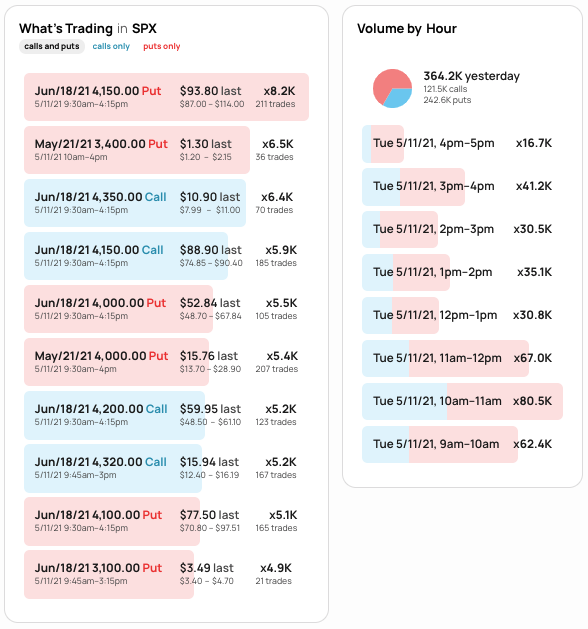
Graphic: SHIFT search suggests participants were most interested in put strikes at and below current prices in the cash-settled S&P 500 Index (INDEX: SPX), Tuesday. Exposure was concentrated in both the May and June monthly expiries.

News And Analysis

Commodities | Colonial faces deadline to decide on hacked pipeline restart. (BBG)

Politics | Israel and Hamas escalate deadly strikes as the U.S. calls for calm. (BBG)

Markets | SPAC fees to support banks through 2022 even as deals dry up. (BBG)

Markets | COVID-19 concerns, chip sell-off roil the Taiwanese stock market. (WSJ)

Markets | SEC warning over bitcoin futures risks in mutual fund investments. (BBG)

Markets | A higher U.S. corporate tax rate is not a key credit risk driver. (Fitch)

What People Are Saying

Innovation And Emerging Trends

Economy | Housing-market surge is making the cheapest homes the hottest. (WSJ)

Markets | Media account Litquidity Capital is the Meme King of Wall Street. (VOX)

FinTech | eBay joined the NFT frenzy, will allow sale of NFTs on its platform. (REU)

About

Renato founded Physik Invest after going through years of self-education, strategy development, and trial-and-error. His work reporting in the finance and technology space, interviewing leaders such as John Chambers, founder, and CEO, JC2 Ventures, Kevin O’Leary, businessman and Shark Tank host, Catherine Wood, CEO and CIO, ARK Invest, among others, afforded him the perspective and know-how very few come by.

Having worked in engineering and majored in economics, Renato is very detailed and analytical. His approach to the markets isn’t built on hope or guessing. Instead, he leverages the unique dynamics of time and volatility to efficiently act on opportunity.

 Disclaimer

At this time, Physik Invest does not manage outside capital and is not licensed. In no way should the materials herein be construed as advice. Derivatives carry a substantial risk of loss. All content is for informational purposes only.
Categories
Commentary

Daily Brief For May 11, 2021

Market Commentary

Index futures in balance.

  • Inflation fears stoking weakness.
  • Ahead is JOLTS data, Fed speak.
  • Index futures lower, tech weighs.
Graphic updated 7:55 AM EST.

What Happened: U.S. stock index futures auctioned lower, overnight, alongside fears of rising inflation. Most affected were heavily-weighted index constituents (e.g., Facebook, Netflix, Google, Microsoft, Amazon, Nvidia, and Tesla), or stocks that have the most to lose in an environment that favors cyclical and value assets.

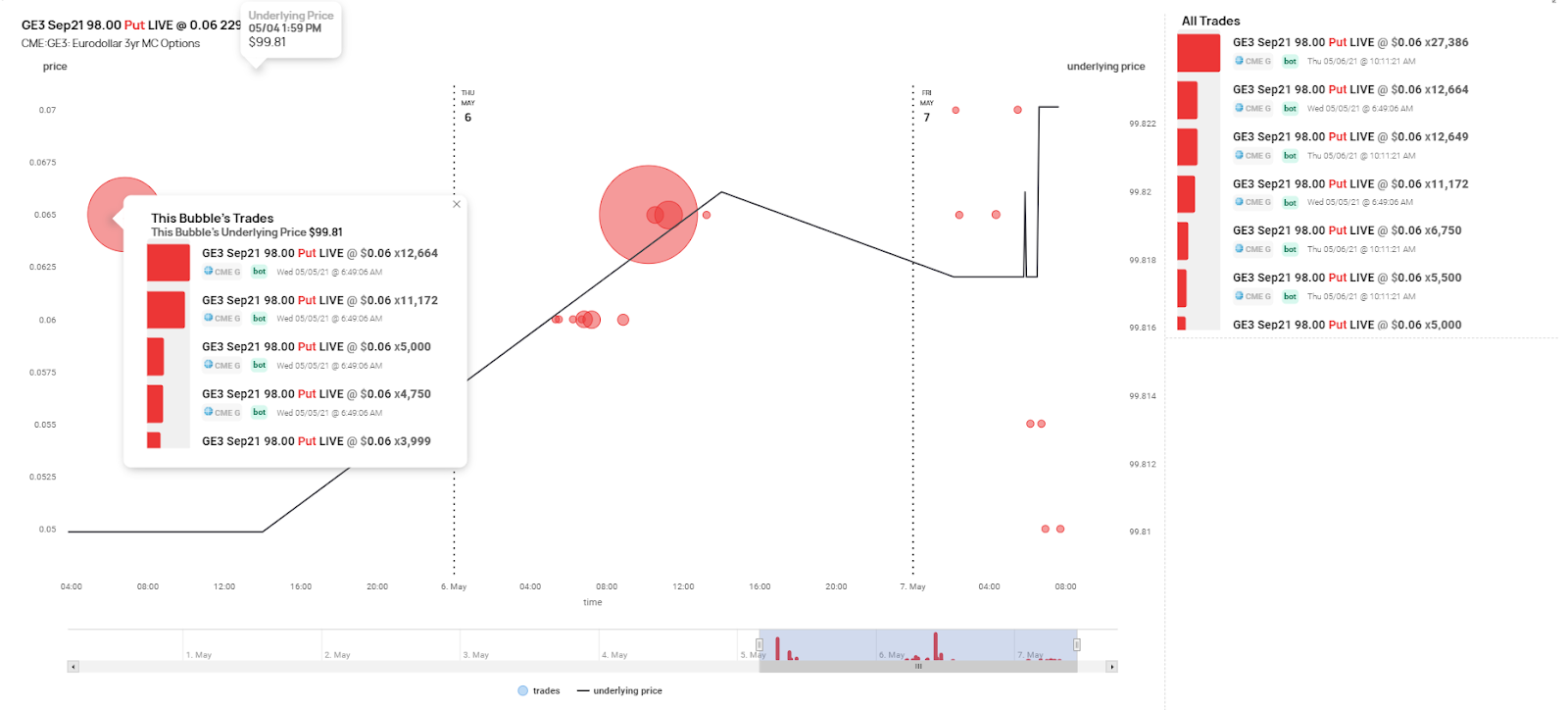
Adding, despite the Federal Reserve’s commitment to limiting talk of taper and rate hikes, traders are positioning themselves for a change in tone. Activity in the 98.00 put strike options, in the Eurodollar, suggests traders are betting on a potential surprise at the Jackson Hole symposium.

Graphic: Eurodollar bet on SHIFT’s institutional platform. The purchase of 98.00 strike put options suggests traders are looking to add “two Fed hikes to [current] expectations.”

What To Expect: Tuesday’s regular session (9:30 AM – 4:00 PM EST) in the S&P 500 will open far from prior-range and -value, suggesting a limited potential for immediate directional opportunity. Reason being — a state of shock, as a result of a severe overnight drop.

Adding, during the prior day’s regular trade, the worst-case outcome occurred, evidenced by initiative trade below the $4,216.00 low volume area (LVNode). The HVNodes at $4,199.25, $4,190.75, and $4,177.25 (a major pivot) all were in play, yesterday.

Volume Areas: A structurally sound market will build on past areas of high volume. Should the market trend for long periods of time, it will lack sound structure (identified as a low volume area which denotes directional conviction and ought to offer support on any test). 

If participants were to auction and find acceptance into areas of prior low volume, then future discovery ought to be volatile and quick as participants look to areas of high volume for favorable entry or exit.

For today, participants can trade from the following frameworks. 

In the best case, the S&P 500 trades sideways or higher; activity above the $4,169.75 overnight pullback high targets the $4,177.25 HVNode pivot. Initiative trade beyond the pivot puts in play the $4,191.25, $4,199.25, $4,211.50, and $4,224.75 HVNodes. 

In the worst case, the S&P 500 trades lower; activity below the $4,177.25 pivot targets the $4,141.00 VPOC. Thereafter, if lower, participants may look for responses at the $4,137.25 and $4,122.75 HVNodes. Auctioning through $4,130.25 increases the odds of trade to the poor structure at $4,110.50.

POCs: POCs (like HVNodes described above) are valuable as they denote areas where two-sided trade was most prevalent. Participants will respond to future tests of value as they offer favorable entry and exit.
Graphic: 65-minute profile chart of the Micro E-mini S&P 500 Futures.
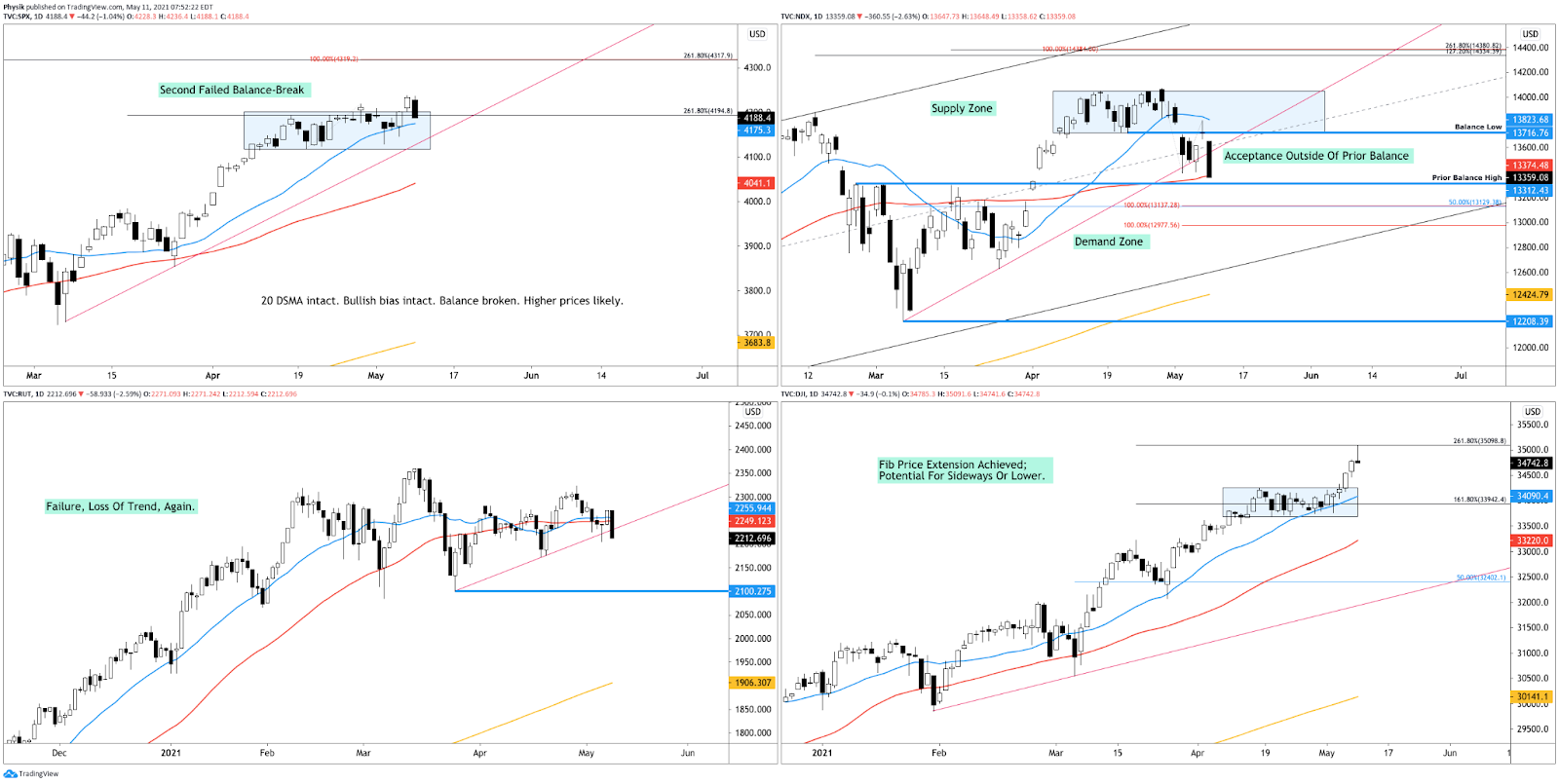
Graphic: Daily candlestick charts of the S&P 500 (top left), Nasdaq 100 (top right), Russell 2000 (bottom left), and Dow Jones Industrial Average (bottom right). The Dow is the strongest of the four. The Nasdaq is the weakest.
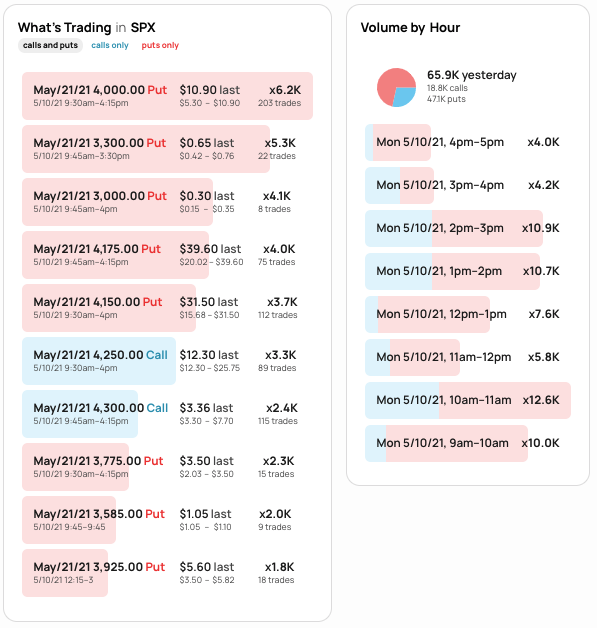
Graphic: SHIFT search suggests participants were very interested in put strikes at and below $4,200.00 in the cash-settled S&P 500 Index (INDEX: SPX), May 10.

News And Analysis

Economy | The Fed is playing with fire by clinging to emergency policies. (WSJ)

Economy | Homebuying sentiment negative despite economic improvement. (MND)

Markets | Pipeline shutdown could push prices at the pump above $3 a gallon. (CNBC)

Economy | Near-term activity data unlikely to affect Fed’s policy rate outlook. (BLK)

Economy | COVID one year on, global infrastructure proves its resilience. (Moody’s)

Recovery | New U.S. COVID infections fall to the lowest level in 11 months. (FT)

What People Are Saying

Innovation And Emerging Trends

Markets | What happens to stocks after the Fed stops raining money? (WSJ)

Housing | Americans moved during the pandemic. Where did they go? (WSJ)

Commodities | The role of critical minerals in the clean energy transition. (IEA)

Markets | More whacks around the head for investors after jobs data. (BBG)

About

Renato founded Physik Invest after going through years of self-education, strategy development, and trial-and-error. His work reporting in the finance and technology space, interviewing leaders such as John Chambers, founder, and CEO, JC2 Ventures, Kevin O’Leary, businessman and Shark Tank host, Catherine Wood, CEO and CIO, ARK Invest, among others, afforded him the perspective and know-how very few come by.

Having worked in engineering and majored in economics, Renato is very detailed and analytical. His approach to the markets isn’t built on hope or guessing. Instead, he leverages the unique dynamics of time and volatility to efficiently act on opportunity.

Disclaimer

At this time, Physik Invest does not manage outside capital and is not licensed. In no way should the materials herein be construed as advice. Derivatives carry a substantial risk of loss. All content is for informational purposes only.

Categories
Commentary

Daily Brief For May 6, 2021

Market Commentary

Index futures in balance.

  • Recovery evolves, growth picked up.
  • Ahead: Claims, Nonfarm Productivity.
  • Divergences appear, flow is turning.
  • S&P 500 $4,178 a major pivot point.

What Happened: U.S. stock index futures auctioned sideways-to-higher overnight ahead of impactful fundamental releases, like data on Initial Jobless Claims, and a preliminary report on Nonfarm Productivity.

Graphic updated 7:40 AM AM EST.

What To Expect: Thursday’s regular session (9:30 AM – 4:00 PM EST) in the S&P 500 will likely open inside of prior-range and -value, suggesting a limited potential for immediate directional opportunity.

Adding, during the prior day’s regular trade, the best case outcome occurred, evidenced by responsive (sideways) trade just below the $4,178.00 high volume area (HVNode), which is significant because that level denotes a pivot point on the composite profile (i.e., above = bullish, below = caution, the potential for lower).

Responsive Buying (Selling): Buying (selling) in response to prices below (above) an area of recent price acceptance.

Volume Areas: A structurally sound market will build on past areas of high-volume. Should the market trend for long periods of time, it will lack sound structure (identified as a low-volume area which denotes directional conviction and ought to offer support on any test). 

If participants were to auction and find acceptance into areas of prior low-volume, then future discovery ought to be volatile and quick as participants look to areas of high-volume for favorable entry or exit.

For today, participants can trade from the following frameworks. 

In the best case, the S&P 500 trades sideways or higher; activity above $4,177.25 targets the $4,189.00 POC. Initiative trade beyond the POC could reach as high as the $4,200.00 HVNode and $4,210.75 minimal excess rally high.

POCs: POCs (like HVNodes described above) are valuable as they denote areas where two-sided trade was most prevalent. Participants will respond to future tests of value as they offer favorable entry and exit.

Excess: A proper end to price discovery; the market travels too far while advertising prices. Responsive, other-timeframe (OTF) participants aggressively enter the market, leaving tails or gaps which denote unfair prices.

In the worst case, the S&P 500 trades lower; activity below the $4,151.75 low volume area (LVNode) puts in play the $4,141.00 POC. Below the $4,141.00 POC, participants ought to become cautious. A break of $4,110.50 puts the S&P 500 within a composite low-volume area; trade ought to be violent as participants look to the next high-volume area for favorable opportunities to enter (new longs) and exit (close shorts).

Graphic: 65-minute profile chart of the Micro E-mini S&P 500 Futures. Noting the $4,178.00 pivot.
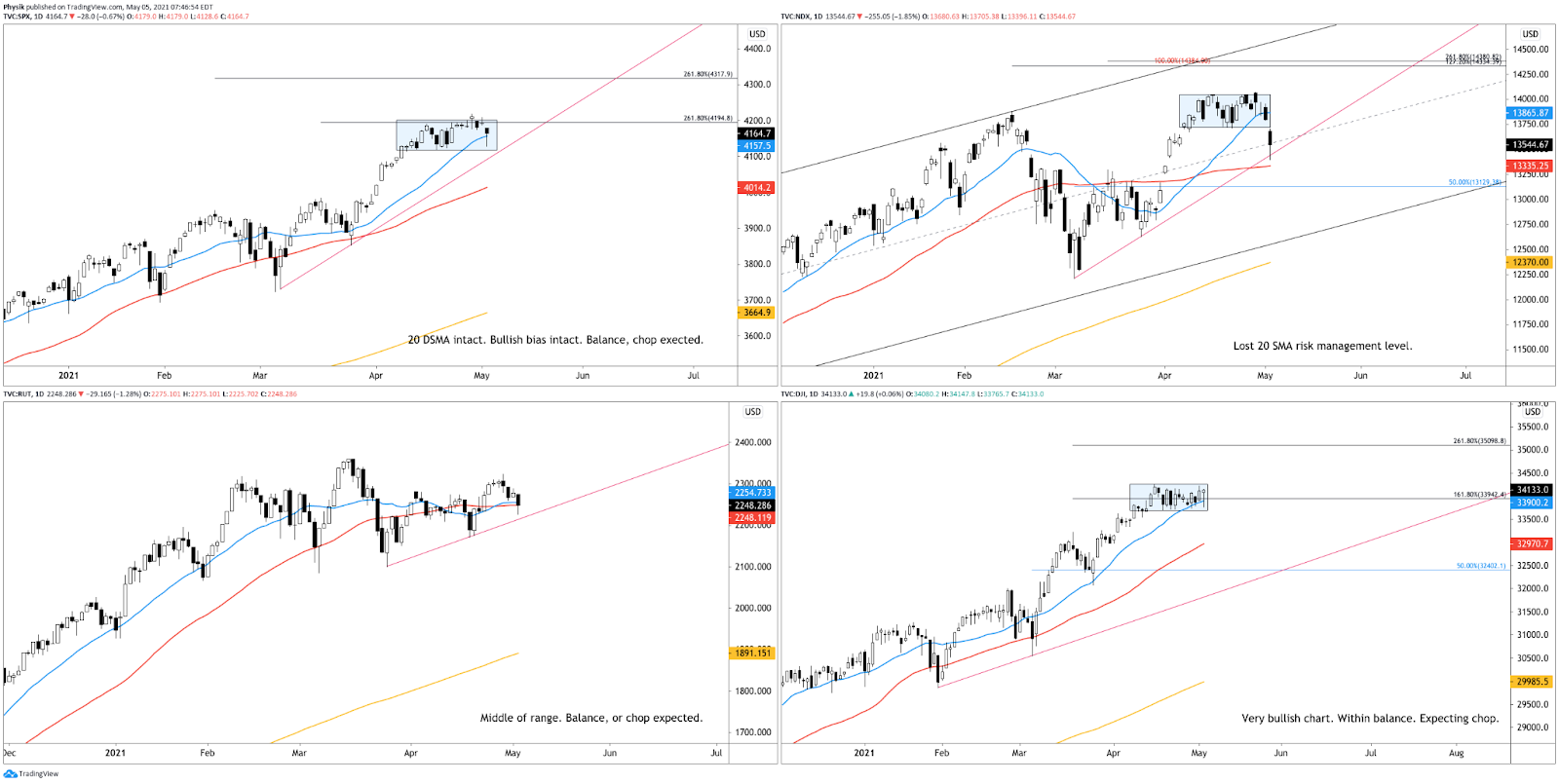
Graphic: Daily candlestick charts of the S&P 500 (top left), Nasdaq 100 (top right), Russell 2000 (bottom left), and Dow Jones Industrial Average (bottom right). The Dow is the strongest of the four. The Nasdaq is the weakest.
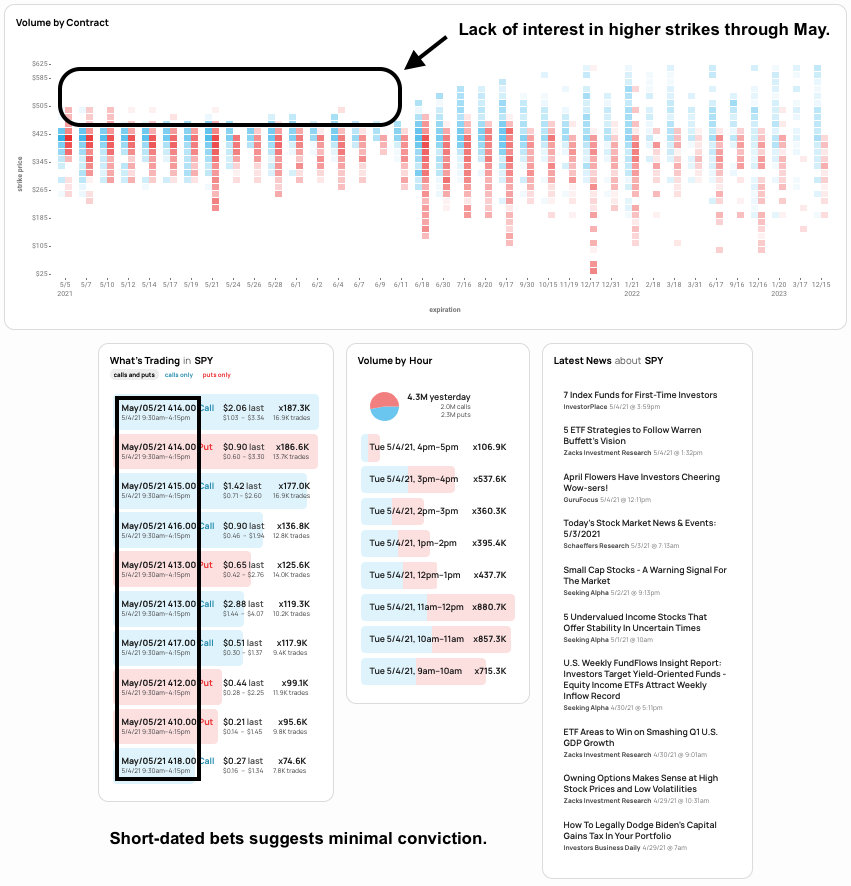
Graphic: SHIFT search suggests participants are still not as inclined to add call-side exposure, through the month of May, in the cash-settled S&P 500 Index (INDEX: SPX).
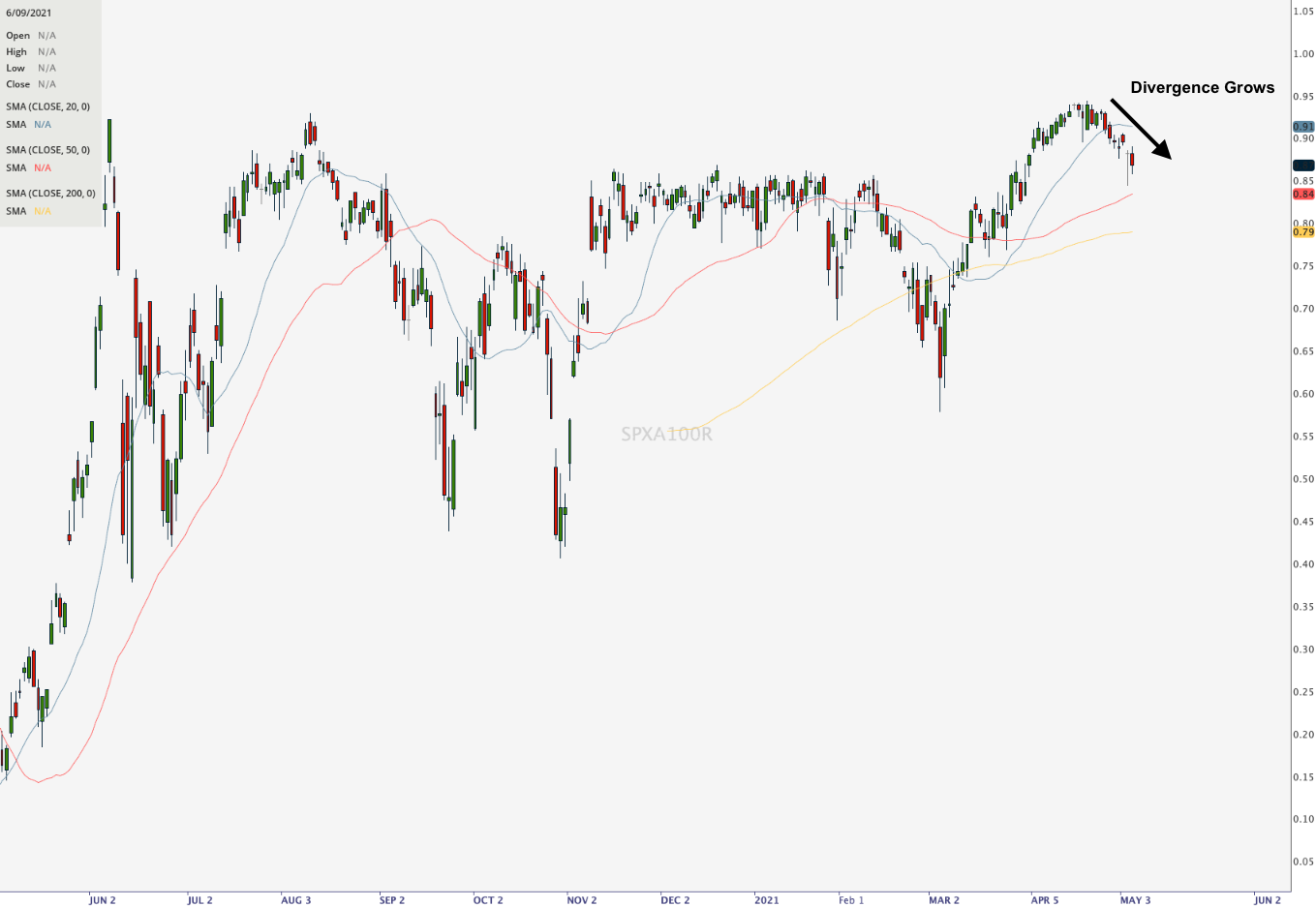
Graphic: Noting a continuation lower in the % of S&P 500 companies trading above their 100-day simple moving average.

News And Analysis

Markets | Gensler raises concern about the market influence of Citadel. (FT)

Markets | Uber leans on delivery business with ridesharing demand flat. (FT)

Housing | Mortgage servicer complaints soar as Americans can’t pay. (MW)

Markets | CMBS loan defaults marked a peak in 2020; retail vulnerable. (Fitch)

Economy | BoE sees U.K. growth surging over 7% this year on vaccine. (CNBC)

Economy | Norwegian Cruise: Bookings move past pre-pandemic levels. (REU)

Markets | Jeff Bezos sold nearly $2B worth of Amazon shares this week. (CNBC)

Markets | JPMorgan looks to move another $200B in assets post-Brexit. (BBG)

Markets | SocGen cites equity trading activity as it smashes expectations. (CNBC)

COVID | Moderna says early data shows vaccine 96% effective in teens. (CNBC)

Markets | Credit Suisse to keep limits on risk-weighted assets and leverage. (REU)

What People Are Saying

Innovation And Emerging Trends

Crypto | Crypto trading volumes boom as activity cools on stock markets. (FT)

Crypto | Metromile is looking to accept premiums and pay claims in bitcoin. (BZ)

Space | SpaceX Starship prototype SN15 successfully lands after testing. (CNBC)

About

Renato founded Physik Invest after going through years of self-education, strategy development, and trial-and-error. His work reporting in the finance and technology space, interviewing leaders such as John Chambers, founder, and CEO, JC2 Ventures, Kevin O’Leary, Canadian businessman and Shark Tank host, Catherine Wood, CEO and CIO, ARK Invest, among others, afforded him the perspective and know-how very few come by.

Having worked in engineering and majored in economics, Renato is very detailed and analytical. His approach to the markets isn’t built on hope or guessing. Instead, he leverages the unique dynamics of time and volatility to efficiently act on opportunity.

Disclaimer

At this time, Physik Invest does not manage outside capital and is not licensed. In no way should the materials herein be construed as advice. Derivatives carry a substantial risk of loss. All content is for informational purposes only.
Categories
Commentary

Daily Brief For May 5, 2021

Market Commentary

Index futures attempt to exit balance.

  • Yellen walks back rate comment.
  • Ahead is employment, ISM data.
  • Divergence grew, low conviction.

What Happened: U.S. stock index futures auctioned higher overnight as Treasury Secretary Janet Yellen clarified her comments on interest rates. 

The Secretary’s note that rates may “have to rise somewhat” to protect the economy from overheating weighed on the market. Most hurt was the Nasdaq 100; higher rates may reduce the present value of future earnings, making innovation-driven growth stocks less attractive.

Graphic updated 8:00 AM EST.

What To Expect: Wednesday’s regular session (9:30 AM – 4:00 PM EST) in the S&P 500 will likely open just outside of prior -range and -value, suggesting a limited potential for immediate directional opportunity.

Adding, during the prior day’s regular trade, the worst-case outcome occurred, evidenced by initiative trade below the $4,167.25 low, which is significant because it was a level that participants, for numerous sessions, supported.

Graphic: Daily candlestick charts of the S&P 500 (top left), Nasdaq 100 (top right), Russell 2000 (bottom left), and Dow Jones Industrial Average (bottom right). The Dow is the strongest of the four. The Nasdaq is the weakest.

For today, participants can trade from the following frameworks. 

In the best case, the S&P 500 trades sideways or higher; activity above $4,178.00 high-volume area (HVNode) targets the $4,189.00 POC. Initiative trade beyond the POC could reach as high as the $4,200.00 HVNode and $4,210.75 minimal excess high. 

Volume Areas: A structurally sound market will build on past areas of high-volume. Should the market trend for long periods of time, it will lack sound structure (identified as a low-volume area which denotes directional conviction and ought to offer support on any test). 

If participants were to auction and find acceptance into areas of prior low-volume, then future discovery ought to be volatile and quick as participants look to areas of high-volume for favorable entry or exit.

POCs: POCs (like HVNodes described above) are valuable as they denote areas where two-sided trade was most prevalent. Participants will respond to future tests of value as they offer favorable entry and exit.

In the worst case, the S&P 500 trades lower; activity below the $4,178.00 HVNode puts in play the prior day’s POC near $4,141.00 and the $4,110.50 minimal excess low. Trade below $4,110.50 puts in play the $4,093.00 POC, $4,082.75 HVNode, and $4,067.00 POC.

Excess: A proper end to price discovery; the market travels too far while advertising prices. Responsive, other-timeframe (OTF) participants aggressively enter the market, leaving tails or gaps which denote unfair prices.
Graphic: 4-hour profile chart of the Micro E-mini S&P 500 Futures. Noting the $4,178.00 pivot.
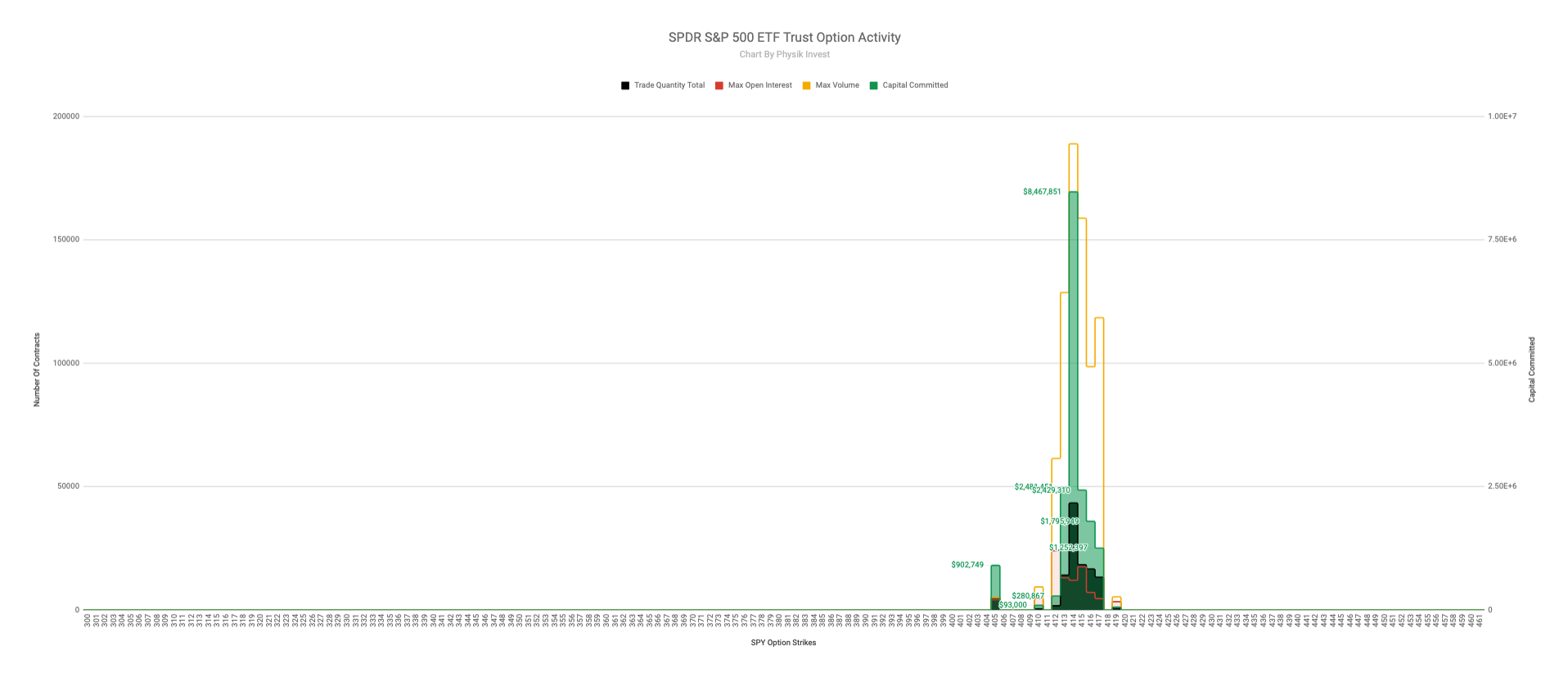
Graphic: Physik Invest maps out the purchase of call and put options in the SPDR S&P 500 ETF Trust (NYSE: SPY), for May 4, 2021. Notable activity in the options market was primarily concentrated on the call-side, in short-dated tenors, in strikes at and around $414.00, which corresponds with $4,140.00, or so, in the cash-settled S&P 500 Index (INDEX: SPX).
Graphic: SHIFT search suggests participants are still not as inclined to add call-side exposure, through the month of May, in the SPDR S&P 500 ETF Trust (NYSE: SPY).

News And Analysis

Economy | Biden’s Fed choices add uncertainty for inflation-wary investors. (BBG)

Economy | Post-COVID U.S. births drop to the lowest level since the 1970s. (BBG)

Commodities | IEA: Governments should consider stockpiling battery metals. (BBG)

Markets | Facing chips shortage, Biden may shelve blunt tool used in COVID. (REU)

Economy | Private payrolls show big gain in April but still short of expectations. (CNBC)

Markets | Commodities jump to highest since 2011 on COVID-19 rebound. (BBG)

Economy | Weekly mortgage demand stalls as rates rise, competition hurts. (CNBC)

What People Are Saying

Innovation And Emerging Trends

FinTech | CME exchange plans to permanently close physical trading pits. (REU)

FinTech | Robinhood CEO holds up crypto exchanges as model for settlement. (TB)

Venture | Proposed changes to capital gains could affect VCs differently. (CB)

Crypto | S&P Dow Jones launches series of cryptocurrency benchmarks. (MM)

FinTech | Berkshire Hathaway’s stock price too much for Nasdaq computers. (WSJ)

About

Renato founded Physik Invest after going through years of self-education, strategy development, and trial-and-error. His work reporting in the finance and technology space, interviewing leaders such as John Chambers, founder, and CEO, JC2 Ventures, Kevin O’Leary, Canadian businessman and Shark Tank host, Catherine Wood, CEO and CIO, ARK Invest, among others, afforded him the perspective and know-how very few come by.

Having worked in engineering and majored in economics, Renato is very detailed and analytical. His approach to the markets isn’t built on hope or guessing. Instead, he leverages the unique dynamics of time and volatility to efficiently act on opportunity.

Disclaimer

At this time, Physik Invest does not manage outside capital and is not licensed. In no way should the materials herein be construed as advice. Derivatives carry a substantial risk of loss. All content is for informational purposes only.
Categories
Commentary

Daily Brief For April 23, 2021

Market Commentary

Index futures base. Position for directional resolve.

  • Tax hike news causes a liquidation.
  • Home sales. Biden climate summit.
  • Indices are correcting through time.

What Happened: U.S. stock index futures auctioned sideways, overnight, after liquidating alongside reports that President Biden wants to nearly double the capital gains tax paid by top earners.

Liquidation Breaks: The profile shape suggests participants were “too” long and had poor location. The news event helped resolve this dynamic.
Updated: 8:45 AM EST

What To Expect: Friday’s regular session in the S&P 500 (9:30 AM – 4:00 PM EST) will likely open inside of prior-range and -value, suggesting a limited potential for immediate directional opportunity. 

Adding, during the prior day’s regular trade, the worst-case outcome failed to occur. 

In the interest of objectivity, despite the $4,117.75 regular trade low (RTH Low) being taken out, responsive buyers stepped in aggressively, causing the S&P 500 to halt short of the $4,110.50 poor, minimal excess low. This action is noteworthy — had the poor low been taken out, conditions would have been markedly different. Instead, given technical nuances, it is obvious the market is correcting in time (i.e., balancing), rather than price.

Responsive Buying: Buying in response to prices below area of recent price acceptance.

Excess: A proper end to price discovery; the market travels too far while advertising prices. Responsive, other-timeframe (OTF) participants aggressively enter the market, leaving tails or gaps which denote unfair prices.

Balance (Two-Timeframe Or Bracket): Rotational trade that denotes current prices offer favorable entry and exit. Balance-areas make it easy to spot change in the market (i.e., the transition from two-time frame trade, or balance, to one-time frame trade, or trend).

Simply put, markets are basing, pricing in new information, ahead of any directional resolve.

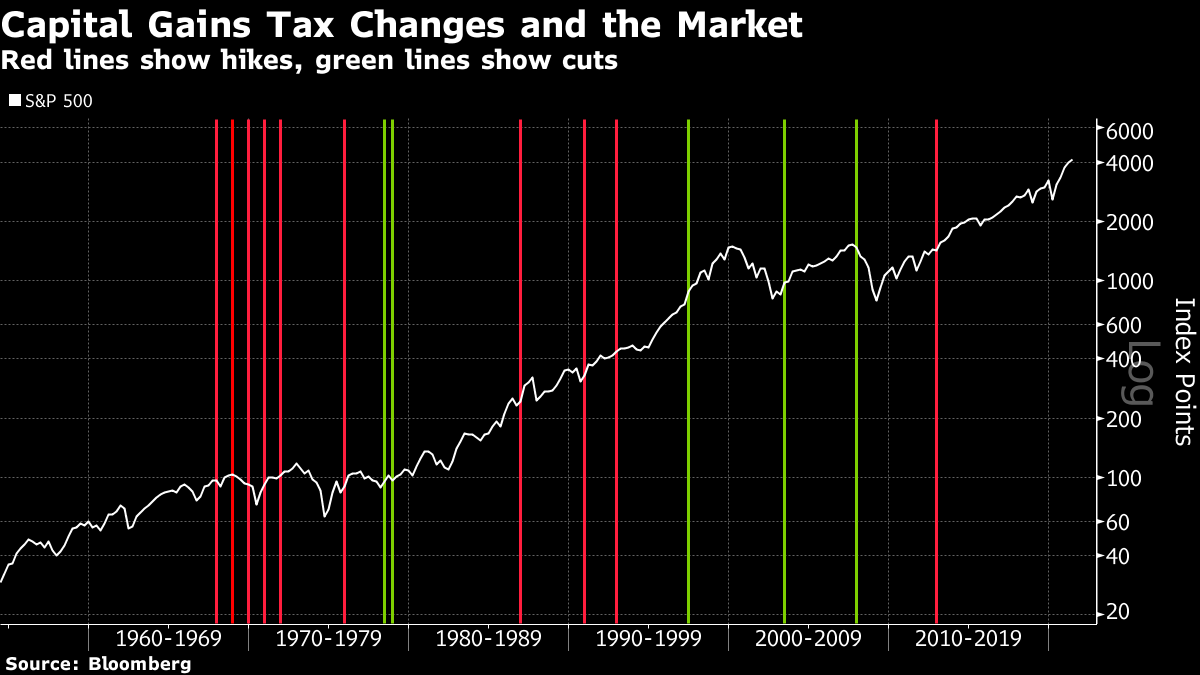
Important to add into the narrative, too, are historical responses to capital gains tax increases.

Bloomberg’s John Authers notes: “The way the market handled the last major CGT increase, at the end of 2012, is instructive. As it grew clear that higher capital gains taxes were coming, the S&P 500 languished and went sideways for the last few months of the year, closing roughly where it had been in March. Then 2013 turned out to be a great year; stocks started their rally at the beginning of January and never really stopped.”

Graphic: Bloomberg unpacks implications of a capital gains tax hike. 

“Stocks do indeed tend to fall in the run-up to the change, but more than make up for it thereafter. Earnings multiples increased slightly before those rises, but did better in the six months afterwards. And households sold a little before the hikes, but more than made up for it.”

The highest returning, momentum stocks, however, stand to lose the most. Given that “[m]omentum stocks have had something of a correction in recent months, … it is unlikely that the tax change will have a major effect on them.”

For today, moreover, participants can trade from the following frameworks. 

In the best case, the S&P 500 trades sideways or higher; activity above the $4,137.25 high-volume area (HVNode) targets the $4,162.50 VPOC. Initiative trade beyond the VPOC could reach as high as the $4,183.50 regular trade high (RTH High). In the worst case, the S&P 500 trades lower; activity below $4,115.25 targets the $4,110.50 poor, minimal excess low. 

Volume Areas: A structurally sound market will build on past areas of high-volume. Should the market trend for long periods of time, it will lack sound structure (identified as a low-volume area which denotes directional conviction and ought to offer support on any test). 

If participants were to auction and find acceptance into areas of prior low-volume, then future discovery ought to be volatile and quick as participants look to areas of high-volume for favorable entry or exit.

Initiative Buying: Buying within or above the previous day’s value area.

POCs: POCs (like HVNodes described above) are valuable as they denote areas where two-sided trade was most prevalent. Participants will respond to future tests of value as they offer favorable entry and exit.

Thereafter, if lower, participants can look for responses at (1) the $4,093.00 VPOC, (2) $4,082.75 HVNode, and (3) the $4,069.25 HVNode.

Graphic: 4-hour profile chart of the Micro E-mini S&P 500 Futures.
Graphic: Physik Invest maps out the purchase of call and put options in the SPDR S&P 500 ETF Trust (NYSE: SPY), for April 22. Activity in the options market was primarily concentrated in short-dated tenors, in strikes as low as $400.00, which corresponds with $4,000.00 in the cash-settled S&P 500 Index (INDEX: SPX).
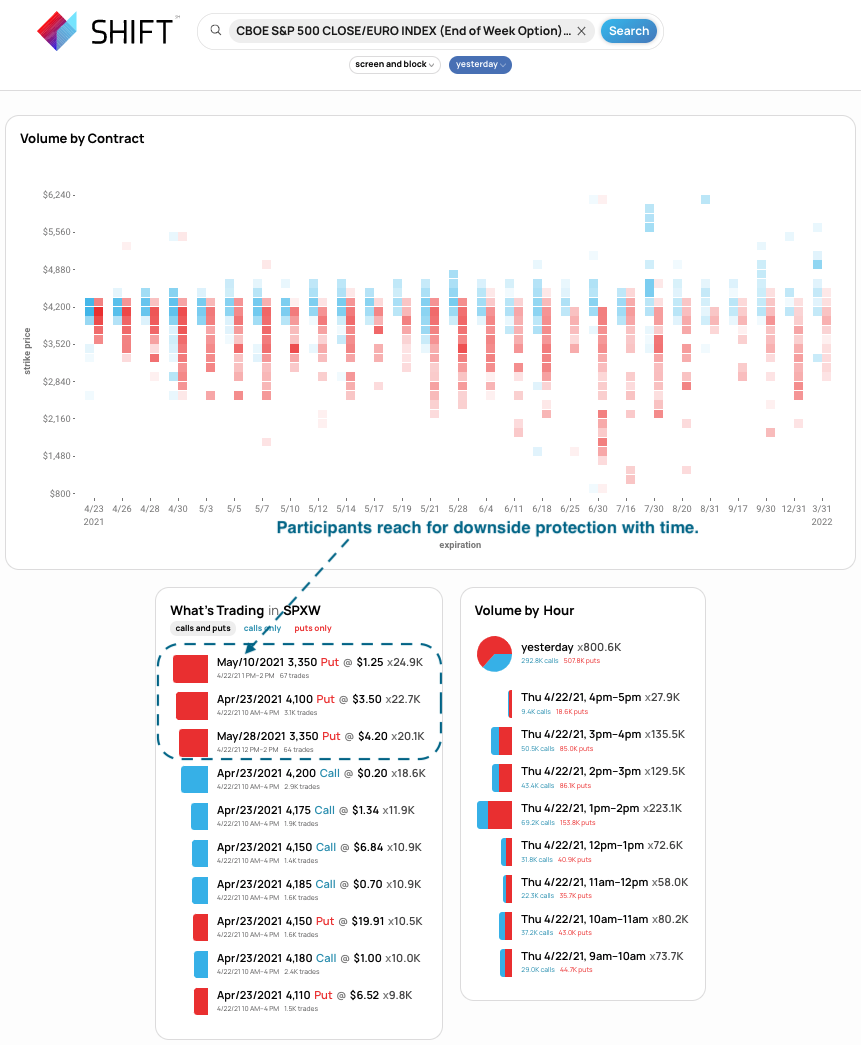
Graphic: Increase in put-side interest on the cash-settled S&P 500 Index (INDEX: SPX). Such activity suggests participants are interested in hedging their downside. Visual via SHIFT.
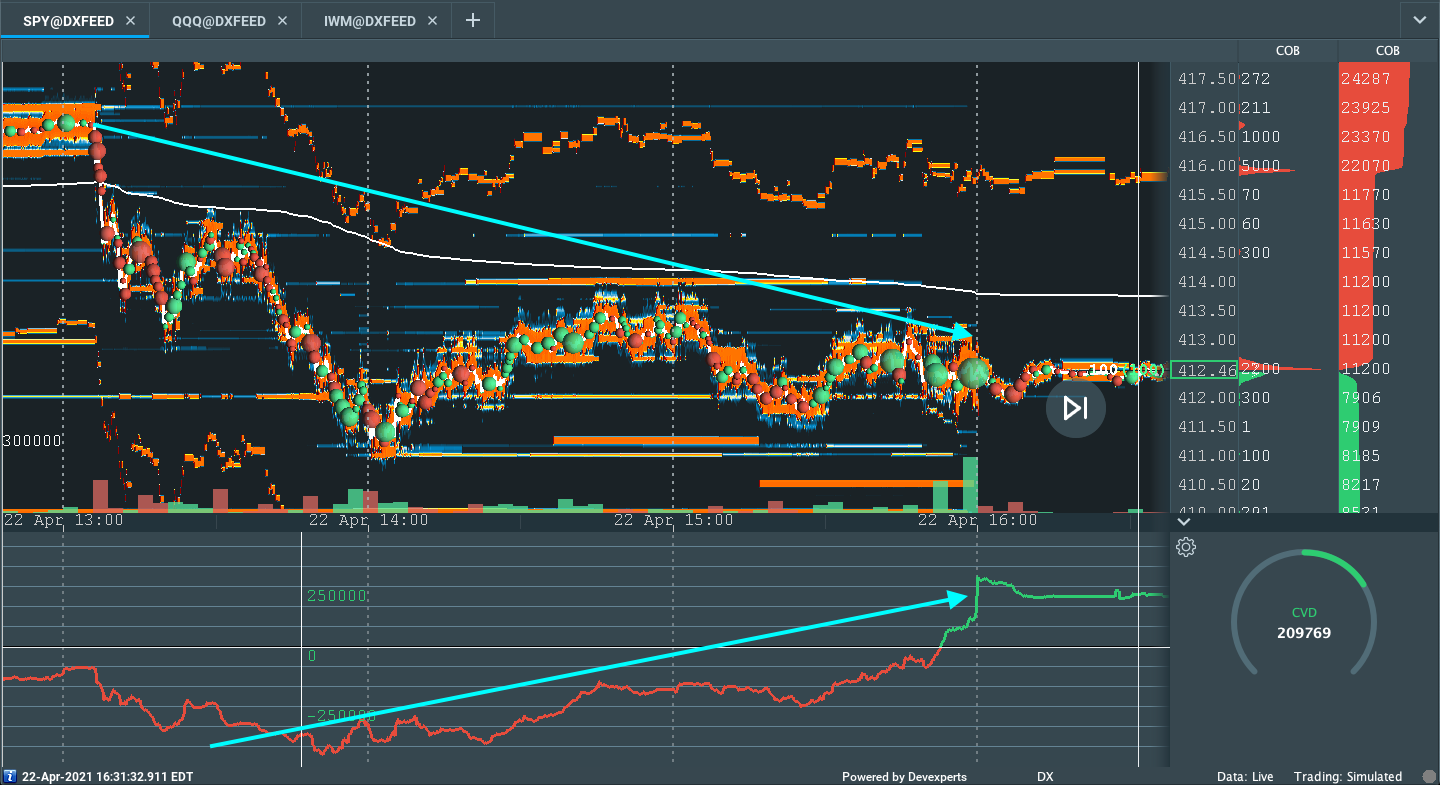
Graphic: Price and volume delta, or buying and selling power as calculated by the difference in volume traded at the bid and offer, diverge into the close in the SPDR S&P 500 ETF Trust (NYSE: SPY).

News And Analysis

Economy | Senate Republicans rolled out a $568B infrastructure proposal. (Axios)

Economy | The Fed’s monthly bond purchases endure as goals fall short. (S&P)

Wellness | Studies show the coronavirus can kill months after infection. (BBG)

Economy | EU economy ‘on crutches,’ warns ECB chief Christine Lagarde. (DW)

Markets | High-yield corporate bond issuance, prospects for a recovery. (Moody’s)

Politics | Russia is planning to end a massive troop buildup near Ukraine. (Axios)

Economy | $12.3T in stimulus killed off the U.S. credit default cycle. (BBG)

Banking | Two blowups have Credit Suisse paying the price for riskiness. (BBG)

Economy | March mortgage delinquency drop exaggerated by events. (MND)

Markets | Mortgage rates improve on 7-week lows, bond market stable. (MND)

Markets | GS: Congress is likely to cap Biden’s CGT hike at around 28%. (MI)

Markets | Scale of T-Bill drought hinges on Biden rescue, income-tax haul. (BBG)

What People Are Saying

Innovation And Emerging Trends

Transportation | Newer planes providing airlines trove of useful data. (NYT)

FinTech | Public.com app connects users with public company leaders. (BZ)

FinTech | From breakthroughs to copycats, here’s what to consider. (Fortune)

FinTech | Signal Advisors adds Series A for financial advising tech. (BZ)

Education | MasterClass co-founder secures funding for new ed-tech. (BZ)

About

Renato founded Physik Invest after going through years of self-education, strategy development, and trial-and-error. His work reporting in the finance and technology space, interviewing leaders such as John Chambers, founder, and CEO, JC2 Ventures, Kevin O’Leary, Canadian businessman and Shark Tank host, Catherine Wood, CEO and CIO, ARK Invest, among others, afforded him the perspective and know-how very few come by.

Having worked in engineering and majored in economics, Renato is very detailed and analytical. His approach to the markets isn’t built on hope or guessing. Instead, he leverages the unique dynamics of time and volatility to efficiently act on opportunity.

 Disclaimer

At this time, Physik Invest does not manage outside capital and is not licensed. In no way should the materials herein be construed as advice. Derivatives carry a substantial risk of loss. All content is for informational purposes only.

Categories
Commentary

Daily Brief For April 22, 2021

Market Commentary

Index futures resolve directionally, yesterday. Base overnight.

  • Growth warning, economic data.
  • ECB decision, claims, and more.
  • Sellers have trouble dominating.

What Happened: U.S. stock index futures broke their downtrend, yesterday, and auctioned sideways overnight, ahead of announcements by the European Central Bank, data on initial claims, home sales, and manufacturing, as well as earnings releases.

What To Expect: Thursday’s regular session (9:30 AM – 4:00 PM EST) in the S&P 500 will likely open inside of prior-range and -value, suggesting a limited potential for immediate directional opportunity. 

Adding, during the prior day’s regular trade, the best case outcome occurred, evidenced by initiative trade above the $4,155.00 high volume area (HVNode). This is significant due to the fact that the downtrend broke after participants lacked the conviction to move prices lower, evidenced via a poor, minimal excess low. 

Volume Areas: A structurally sound market will build on past areas of high volume. Should the market trend for long periods of time, it will lack sound structure (identified as a low-volume area which denotes directional conviction and ought to offer support on any test). If participants were to auction and find acceptance into areas of prior low-volume, then future discovery ought to be volatile and quick as participants look to areas of high volume for favorable entry or exit.

Excess: A proper end to price discovery; the market travels too far while advertising prices. Responsive, other-timeframe (OTF) participants aggressively enter the market, leaving tails or gaps which denote unfair prices.

Short-term sellers, simply put, piled on at the low and weren’t paid quickly for their risk. This inventory was resolved during Wednesday’s trend-day higher. 

Looking beyond the equity indices, breadth is pegged at its high. In the U.S., according to The Market Ear, the percent of stocks above their 200-day moving average hit 96%, the highest since 2009. Typically, after such instances, one- to three-month returns are positive.

Beyond big-picture narratives, for today, participants can trade from the following frameworks. 

In the best case, the S&P 500 trades sideways or higher; activity above the $4,153.50 spike base targets the point of control (POC) near $4,171.00. Initiative trade beyond the POC could reach as high as (1) the $4,183.00 regular trade high (RTH High) and (2) Fibonacci-derived price targets near $4,187.00-$4,197.25.

In the worst case, the S&P 500 trades sideways or lower; activity below the $4,117.75 regular trade low targets first the $4,110.50 poor, minimal excess low. Thereafter, if lower, participants can look for responses at (1) the $4,093.00 VPOC, (2) $4,082.75 HVNode, and (3) the $4069.25 HVNode. 

Spikes: Spike’s mark the beginning of a break from value. Spikes higher (lower) are validated by trade at or above (below) the spike base (i.e., the origin of the spike).

POCs: POCs (like HVNodes described above) are valuable as they denote areas where two-sided trade was most prevalent. Participants will respond to future tests of value as they offer favorable entry and exit.
Graphic: 4-hour profile chart of the Micro E-mini S&P 500 Futures.
Graphic: Physik Invest maps out the purchase of call and put options in the SPDR S&P 500 ETF Trust (NYSE: SPY), for April 21. Activity in the options market was primarily concentrated in short-dated tenors, in strikes as high as $422, which corresponds with $4,220.00 in the cash-settled S&P 500 Index (INDEX: SPX).
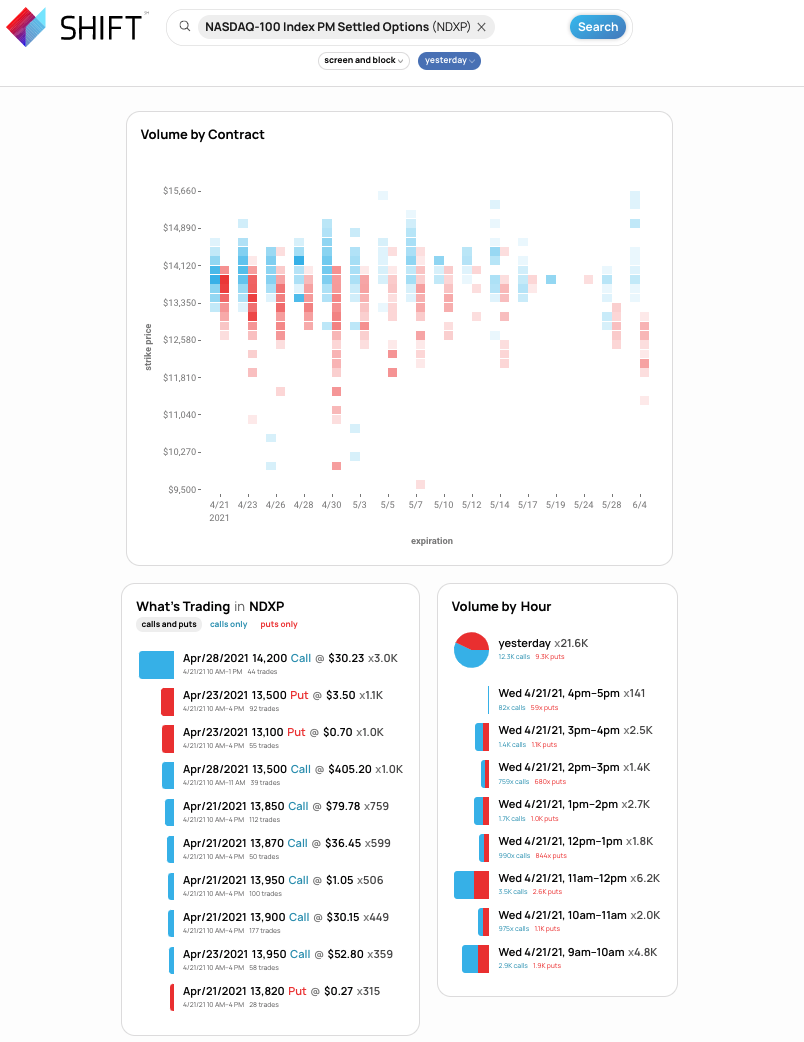
Graphic: Noticeable increase in call-side interest on the cash-settled Nasdaq-100 Index (INDEX: NDX), expiring 4/28. Such activity suggests (1) an expectation, by participants, of a rotation back into technology, or (2) a hedge against earnings surprises, and the like. Visual via SHIFT.
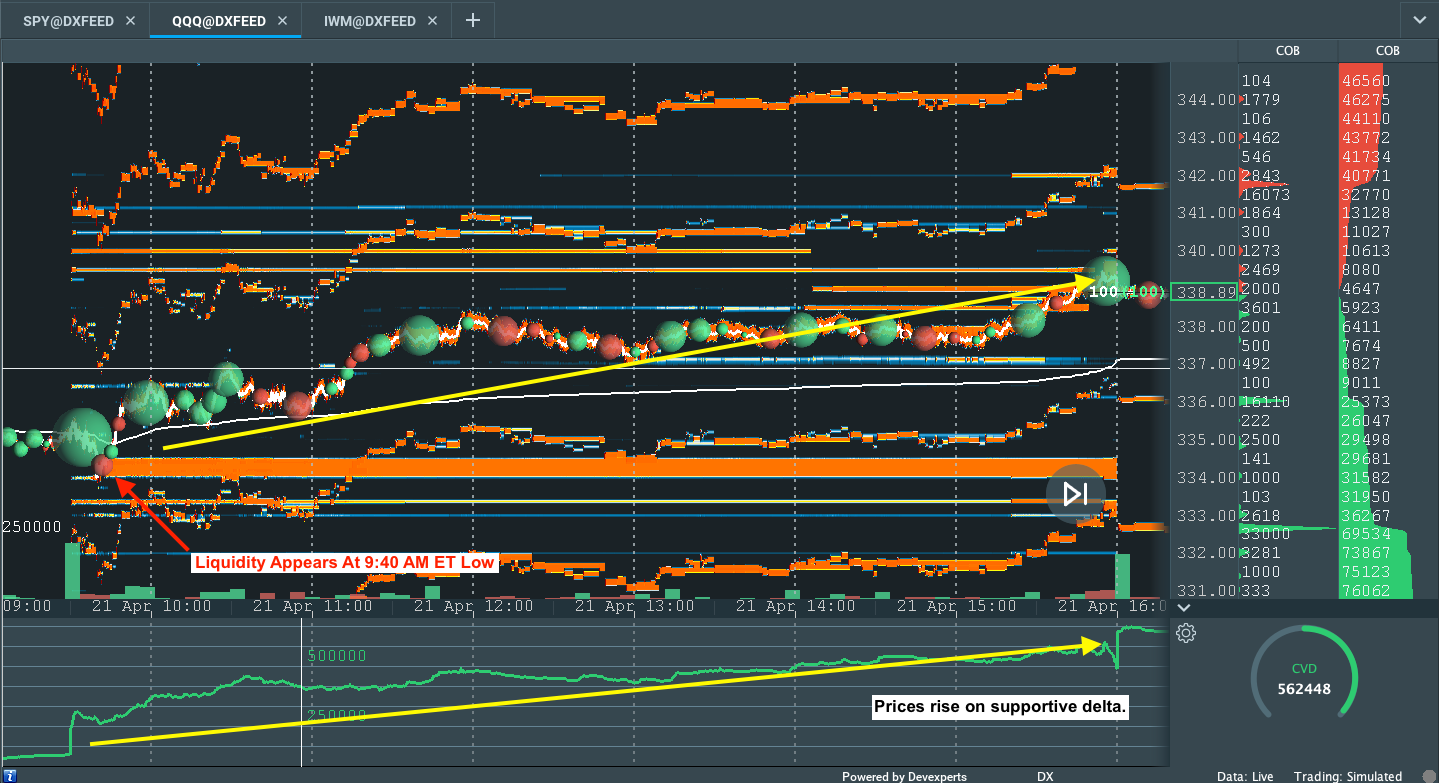
Graphic: Market liquidity in the Invesco QQQ Trust (NASDAQ: QQQ), one of the largest ETFs that track Nasdaq-100 prices, supports price rise.

News And Analysis

Economy | U.S. jobless claims plunged last week to a pandemic low. (BBG)

Politics | President Biden plans to cut U.S. greenhouse gas emissions. (BBG)

Markets | Credit Suisse Group raises $2B as CEO cuts hedge fund unit. (BBG)

Markets | Southwest Airlines bookings improve, will likely break even. (CNBC)

Economy | Should investors worry about a Chinese Lehman-style crisis? (BBG)

Markets | Bank of Canada signals rake hike, tapers bond purchases. (REU)

Economy | Fiscal stimulus, improving employment supports bank assets. (Moody’s)

Economy | Mortgage applications broke a six-week slump, last week. (SOURCE)

Economy | U.S. economy on a solid footing, the virus still a top threat. (REU)

What People Are Saying

Innovation And Emerging Trends

FinTech | Nasdaq democratizes information, fuels on-demand finance trend. (BZ)

Startups | Investors, executives, and founders discuss Zagreb’s startup potential. (TC)

FinTech | Why VCs are investing in non-fungible token (NFT) marketplaces? (CBN)

Investing | How can you build a robust portfolio that outperforms for a century? (BBG)

 About

Renato founded Physik Invest after going through years of self-education, strategy development, and trial-and-error. His work reporting in the finance and technology space, interviewing leaders such as John Chambers, founder, and CEO, JC2 Ventures, Kevin O’Leary, Canadian businessman and Shark Tank host, Catherine Wood, CEO and CIO, ARK Invest, among others, afforded him the perspective and know-how very few come by.

Having worked in engineering and majored in economics, Renato is very detailed and analytical. His approach to the markets isn’t built on hope or guessing. Instead, he leverages the unique dynamics of time and volatility to efficiently act on opportunity.

 Disclaimer

At this time, Physik Invest does not manage outside capital and is not licensed. In no way should the materials herein be construed as advice. Derivatives carry a substantial risk of loss. All content is for informational purposes only.

Categories
Commentary

Daily Brief For April 21, 2021

Market Commentary

Index futures auction within prior range, position for directional resolve.

  • Virus surges, earnings accelerate.
  • Calendar light. ECB rate decision.
  • Buyers responded to lower prices.

What Happened: U.S. stock index futures auctioned sideways, overnight, after strong downside discovery the day prior.

ING Group Strategists“Markets remain very much caught between the rock of improving macroeconomic conditions and the treacherous waters of geopolitical risks and alarming Covid-19 case growth in some corners of the world.”

What To Expect: Wednesday’s regular session (9:30 AM – 4:00 PM EST) will likely open inside of prior-range and -value, suggesting a limited potential for immediate directional opportunity. 

Adding, during the prior day’s regular trade, the worst-case outcome occurred, evidenced by initiative trade beyond the $4,142.00 regular trade low, down to the $4,122.75 HVNode, which is significant because denotes an area of prior two-sided trade.

Volume Areas: A structurally sound market will build on past areas of high volume. Should the market trend for long periods of time, it will lack sound structure (identified as a low-volume area which denotes directional conviction and ought to offer support on any test).

If participants were to auction and find acceptance into areas of prior low-volume, then future discovery ought to be volatile and quick as participants look to areas of high volume for favorable entry or exit.

Further, in a nutshell, the market explored higher prices and is now probing into pockets of old value to drum up increased participation. The market is doing what it is supposed to — move to the area where participants want to do business. Given the remaining price targets at $4,200.00 and minimal excess (i.e., flat high) left behind last Friday’s price discovery, odds are participants lacked conviction and the market was unable to advertise higher prices.

Excess: A proper end to price discovery; the market travels too far while advertising prices. Responsive, other-timeframe (OTF) participants aggressively enter the market, leaving tails or gaps which denote unfair prices.

Price Discovery (One-Timeframe Or Trend): Elongation and range expansion denotes a market seeking new prices to establish value, or acceptance (i.e., more than 30-minutes of trade at a particular price level). 

This is generally a bullish dynamic. Why? Think of there being unfinished business at the all-time high. As stated earlier, a market moves to where there is business to be conducted.

Moving on, the two-day liquidation has pushed the S&P 500 down into short-gamma territory. This is not good. Why? Short-gamma is opposite to the forces that crush volatility and promote lengthy bursts of momentum.

Liquidation Breaks: The profile shape suggests participants were “too” long and had poor location.

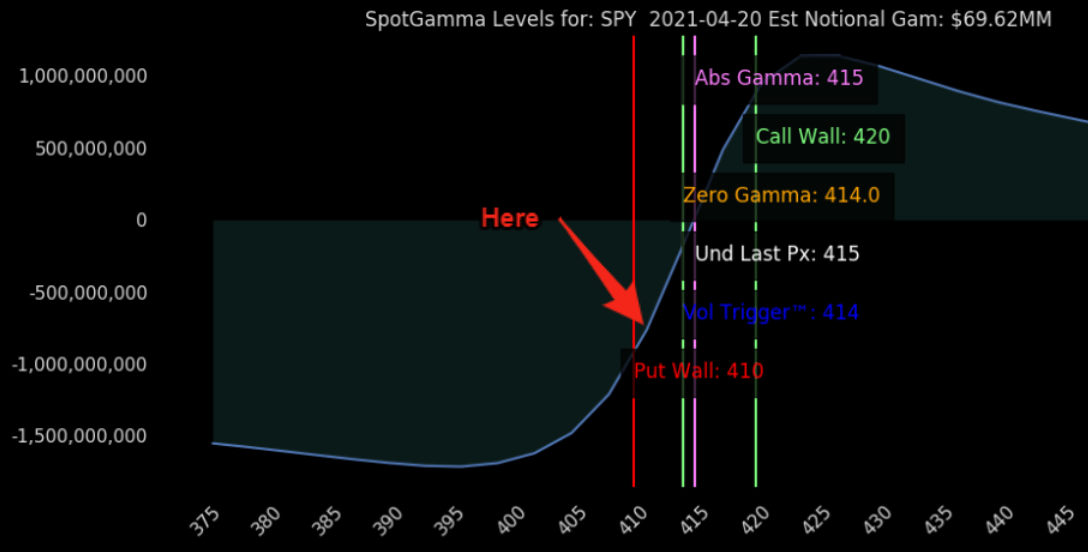
Gamma: Gamma is the sensitivity of an option to changes in the underlying price. Dealers that take the other side of options trades hedge their exposure to risk by buying and selling the underlying. When dealers are short-gamma, they hedge by buying into strength and selling into weakness. When dealers are long-gamma, they hedge by selling into strength and buying into weakness. The former exacerbates volatility. The latter calms volatility.
Graphic: SPDR S&P 500 ETF Trust (NYSE: SPY) in short-gamma territory, via SpotGamma.

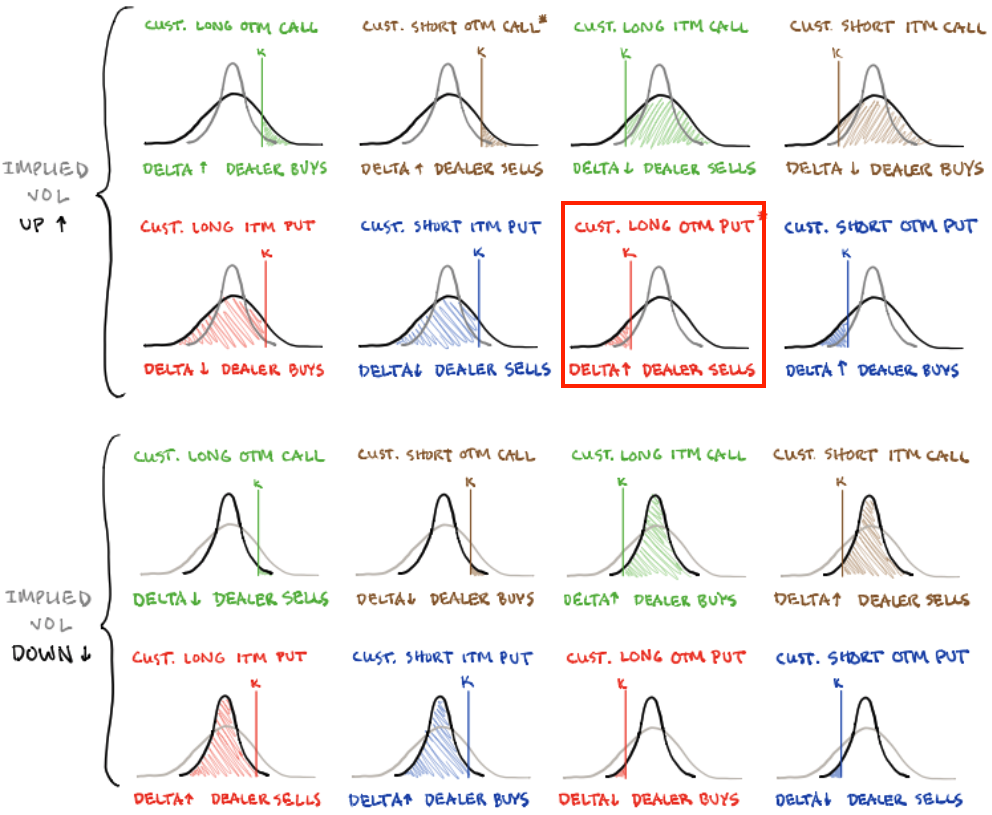
Due to occurrences discussed in the weekend commentary, such as increased put selling during market strength, volatility expansion and a rise in delta (i.e., exposure to the underlying asset) will force put-side option sellers to sell into weakness, to hedge off their risk, thereby exacerbating volatility.

Graphic: SqueezeMetrics highlights implications of volatility, direction, and moneyness.

In the event that some exogenous event (e.g., COVID-19 resurgence, tax-hike) was to surface, odds favor increased volatility and potential for downside.

Moreover, for today, participants can trade from the following frameworks. 

In the best case, the S&P 500 trades higher; activity higher than the $4,142.00 regular trade low targets the $4,155 high volume area (HVNode). Initiative trade beyond the HVNode could reach as high as the $4,171 VPOC. In the worst case, the S&P 500 trades lower; activity below $4,122.75 targets the $4,104.00 low volume area (LVNode). Initiative trade beyond that figure puts in play the $4,082.75 and $4,069.25 HVNodes.

POCs: POCs (like HVNodes described above) are valuable as they denote areas where two-sided trade was most prevalent. Participants will respond to future tests of value as they offer favorable entry and exit.
Graphic: 65-minute profile chart of the Micro E-mini S&P 500 Futures.
Graphic: Physik Invest maps out the purchase of call and put options in the SPDR S&P 500 ETF Trust (NYSE: SPY), for April 20. Activity in the options market was primarily concentrated in short-dated tenors, in strikes as low as $381, which corresponds with $3,810 in the cash-settled S&P 500 Index (INDEX: SPX).
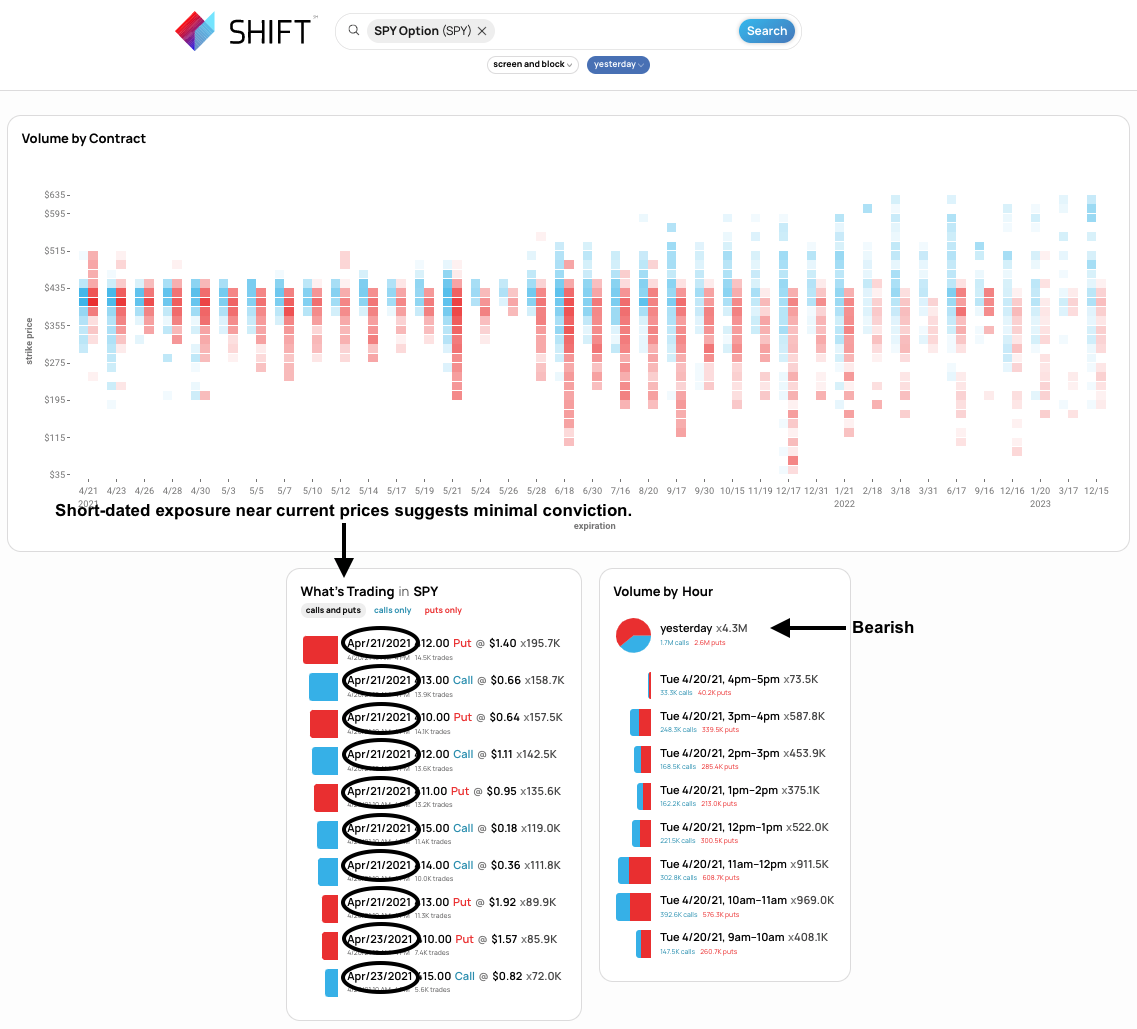
Graphic: SHIFT search suggests participants lack directional conviction in the SPDR S&P 500 ETF Trust (NYSE: SPY).

News And Analysis

Science | Man-made lakes in U.S. West and Mexico to shrink to historical lows. (AP)

Markets | Mortgage rates come down as the bond market regains strength. (MND)

Markets | Federal Reserve will limit any overshoot of inflation target, Powell says. (REU)

Travel | Washington says travel warnings will cover 80% of the world’s nations. (BBG)

Policy | On the verge of a realignment of politics, economic policy, and living. (Ritholtz)

Markets | MIAX expanding futures division with new hires from Cboe and Citi. (TT)

Markets | U.K. scaps MiFID II requirements in ambitious capital markets reform. (TT)

Economy | While lumber prices are soaring, actual logs remain very dirt cheap. (BBG)

What People Are Saying

Innovation And Emerging Trends

Innovation | Lessons from Jeff Bezos’ annual letters to Amazon shareholders. (CB)

Markets | How Robinhood made trading easy and maybe even too hard to resist. (BBG)

Space | International crew, recycled capsule: SpaceX is preparing to launch. (AMN)

Venture | A look at Stripe, the most highly valued venture-backed private company. (CN)

FinTech | Fintech IPOs: Four foundational keys to success, preparing for IPO. (FM)

FinTech | U.K. creates a new fintech sandbox for distributed ledger technology. (S&P

FinTech | Venture capital interest in Latin America swells as fintech takes flight. (PB)

FinTech | Insurtech startups are leveraging rapid growth to raise big money. (TC)

FinTech | China’s central bank plans to build out a fintech cloud infrastructure. (SCMP)

 About

Renato founded Physik Invest after going through years of self-education, strategy development, and trial-and-error. His work reporting in the finance and technology space, interviewing leaders such as John Chambers, founder, and CEO, JC2 Ventures, Kevin O’Leary, Canadian businessman and Shark Tank host, Catherine Wood, CEO and CIO, ARK Invest, among others, afforded him the perspective and know-how very few come by.

Having worked in engineering and majored in economics, Renato is very detailed and analytical. His approach to the markets isn’t built on hope or guessing. Instead, he leverages the unique dynamics of time and volatility to efficiently act on opportunity.

 Disclaimer

At this time, Physik Invest does not manage outside capital and is not licensed. In no way should the materials herein be construed as advice. Derivatives carry a substantial risk of loss. All content is for informational purposes only.

Categories
Commentary

Daily Brief For April 19, 2021

Market Commentary

Index futures are attempting to balance and validate higher prices.

  • Global pandemic recovery uneven. 
  • Investors await corporate earnings.
  • Indices to correct in time and price.

What Happened: U.S. stock index futures balanced ahead of a fresh round of corporate earnings.

What To Expect: Monday’s regular session (9:30 AM – 4:00 PM EST) will likely open inside of prior-range and -value, suggesting a limited potential for directional opportunity. 

Adding, during the prior week, the best case outcome occurred, evidenced by initiative trade that established new all-time highs in the S&P 500, Nasdaq-100, and Dow Jones Industrial Average.

Coming into this week, though equity markets are positioned bullishly, there exists an increased potential to correct in time and price. Adding, should there be a turn and spike in volatility, participants must be ready to accept the possibility of a violent liquidation, given the poor structure left behind prior price discovery and increased put selling, among other factors highlighted in Sunday’s commentary.

Price Discovery (One-Timeframe Or Trend): Elongation and range expansion denotes a market seeking new prices to establish value, or acceptance (i.e., more than 30-minutes of trade at a particular price level). 

For today, participants can trade from the following frameworks. 

In the best case, the S&P 500 trades sideways or higher; activity above the $4,161.75 regular trade low targets the $4,171.00 VPOC. Initiative trade beyond the VPOC could reach as high as the $4,183.50 regular-trade high and the cluster of Fibonacci price extensions above $4,187.00. In the worst case, the S&P 500 trades lower; activity below $4,171.00 is likely to solicit responsive buying near the $4,157.00 high-volume area (HVNode). Thereafter, if lower, $4,137.00 and $4,123.00 are other valuable areas to do business. 

Volume Areas: A structurally sound market will build on past areas of high-volume. Should the market trend for long periods of time, it will lack sound structure (identified as a low-volume area which denotes directional conviction and ought to offer support on any test). 

If participants were to auction and find acceptance into areas of prior low-volume, then future discovery ought to be volatile and quick as participants look to areas of high-volume for favorable entry or exit.

POCs: POCs (like HVNodes described above) are valuable as they denote areas where two-sided trade was most prevalent. Participants will respond to future tests of value as they offer favorable entry and exit.

Responsive Buying: Buying in response to prices below area of recent price acceptance.
Graphic: 4-hour profile chart of the Micro E-mini S&P 500 Futures.
Graphic: Physik Invest maps out the purchase of call and put options in the SPDR S&P 500 ETF Trust (NYSE: SPY), for the week ending April 16. Activity in the options market was primarily concentrated in short-dated tenors, in strikes as low as $364, which corresponds with $3,640 in the cash-settled S&P 500 Index (INDEX: SPX).

News And Analysis

Markets | Crypto stock mania tested by sliding prices, bitcoin drop. (BBG)

Markets | China opens borders to billions of dollars of gold imports. (REU)

Markets | Key takeaways from Q1 results of the investment banks. (Moody’s)

Travel | Airlines can’t get the world flying despite a big U.S. boom. (BBG)

Trade | TSMC says trade tensions may disrupt chip equipment supply. (BBG)
What People Are Saying

Innovation And Emerging Trends

Startups | Tips for those that are joining a startup for the first time. (FRR)

Space | Why flying a four-pound helicopter on Mars is a big deal. (BBG)

FinTech | U.S. banks deploy AI to monitor customers and workers. (REU)

Spirits | Whisky world at war as tech allows for instant spirit aging. (FT)

Crypto | Bank of England, HM Treasury create a CBDC taskforce. (BoE)

Technology | Clubhouse closes round of funding, raising value. (REU)

 About

Renato founded Physik Invest after going through years of self-education, strategy development, and trial-and-error. His work reporting in the finance and technology space, interviewing leaders such as John Chambers, founder, and CEO, JC2 Ventures, Kevin O’Leary, Canadian businessman and Shark Tank host, Catherine Wood, CEO and CIO, ARK Invest, among others, afforded him the perspective and know-how very few come by.
Having worked in engineering and majored in economics, Renato is very detailed and analytical. His approach to the markets isn’t built on hope or guessing. Instead, he leverages the unique dynamics of time and volatility to efficiently act on opportunity.

 Disclaimer

At this time, Physik Invest does not manage outside capital and is not licensed. In no way should the materials herein be construed as advice. Derivatives carry a substantial risk of loss. All content is for informational purposes only.