Categories
Commentary

Daily Brief For July 7, 2021

Market Commentary

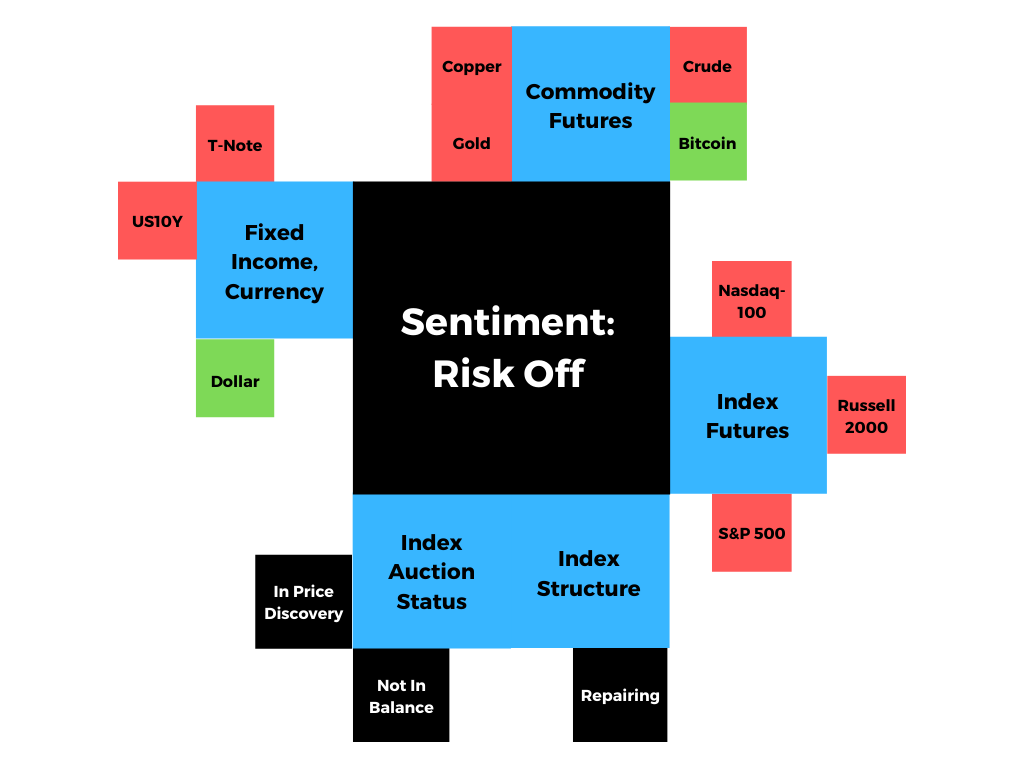
Equity index futures rotate after participants initiated the bracketing process.

  • Bad news for China tech & vaccine hesitancy.
  • Ahead: Fed minutes, Mortgage Apps, JOLTS.
  • Equity index futures see volatility before open.

What Happened: U.S. stock index futures auctioned higher ahead of June’s Federal Reserve meeting minutes release at 2:00 PM ET.

The release should provide participants clarity over the Fed’s intent to taper asset purchases and the expected path for inflation.

In other areas, so-called vaccine hesitancy is a concern as President Joe Biden’s target to get up to 70% of Americans vaccinated, by July 4, was missed. 

Also, participants get data on U.S. mortgage applications, JOLTS, and the EIA energy outlook, as well as Fed-speak by President Raphael Bostic.
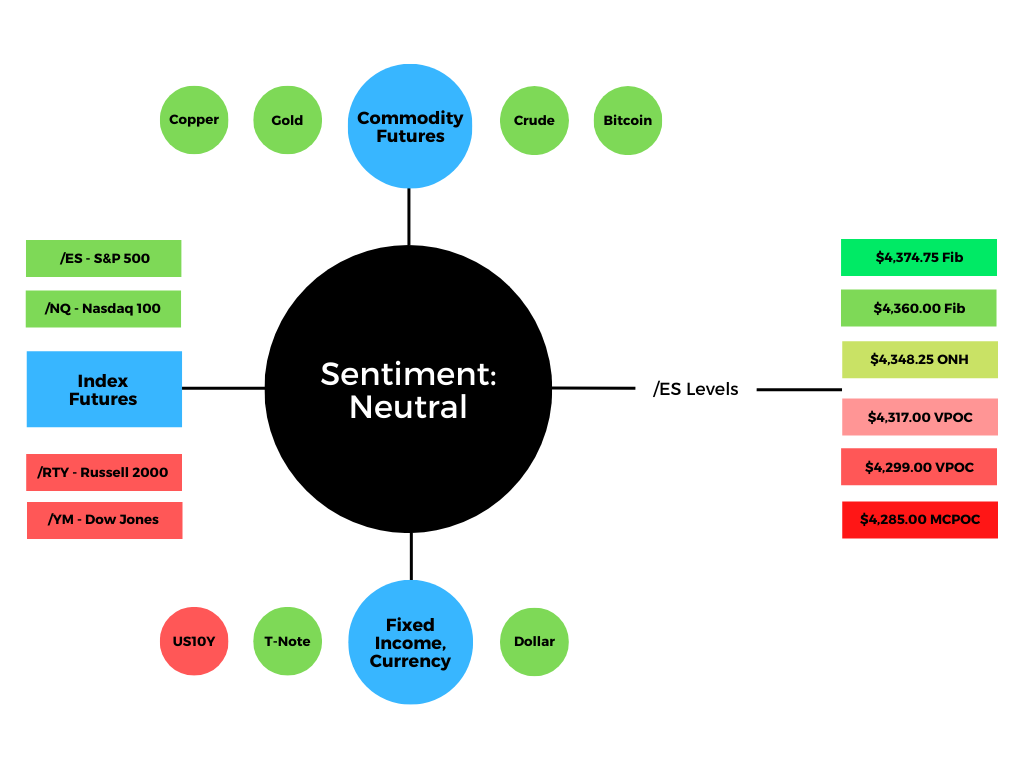
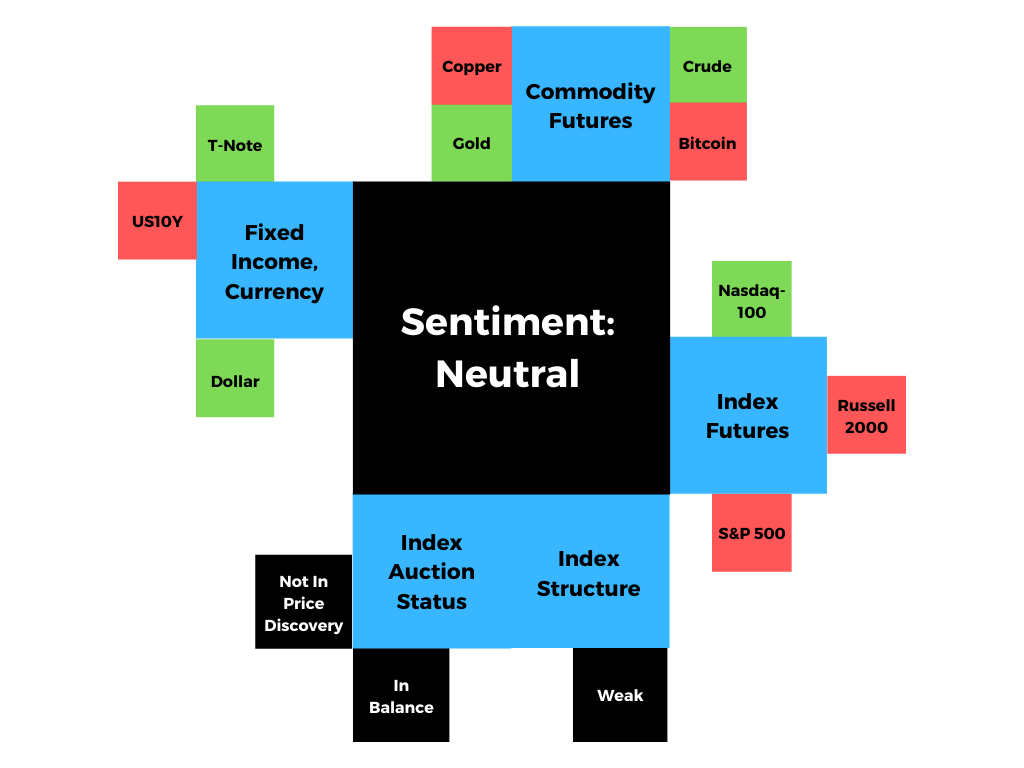
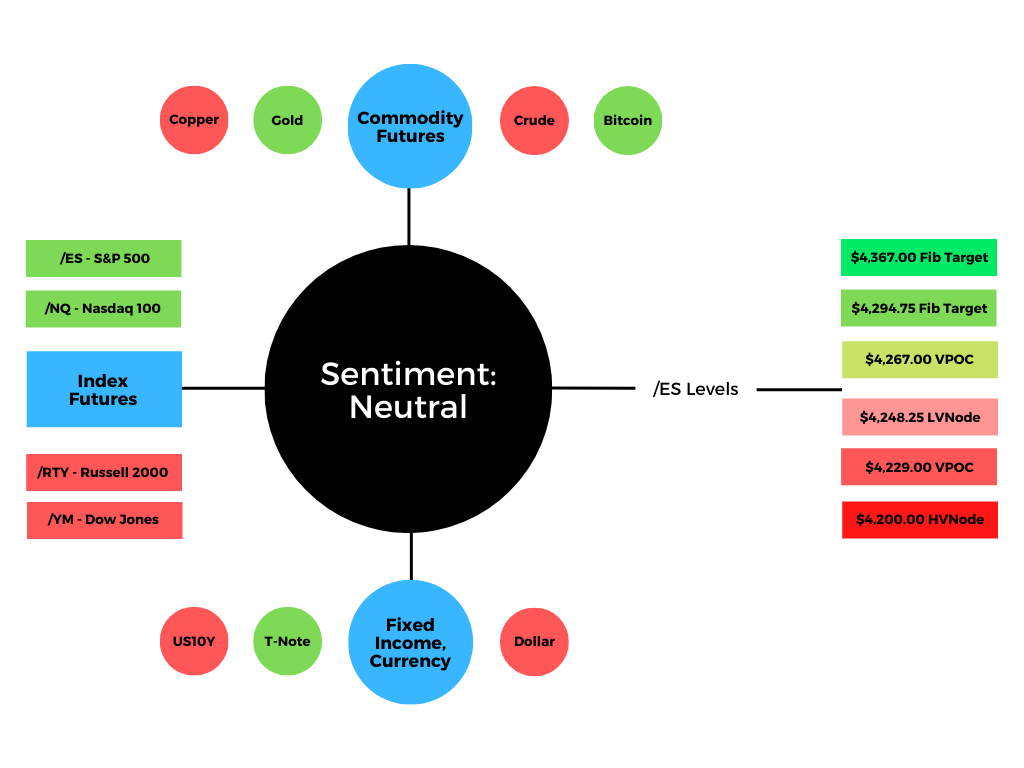
Graphic updated 9:09 AM ET.

What To Expect: Wednesday’s regular session (9:30 AM – 4:00 PM EST) in the S&P 500 will likely open outside of prior value but inside of range. Such dynamic increases the potential for directional opportunity.

Adding, during the prior day’s regular trade, the best case outcome occurred, evidenced by a liquidation break that found responsive buyers at a key anchored Volume Weighted Average Price (VWAP). Thereafter, on lighter volume, the S&P 500 established value (i.e., evidenced by more than 30-minutes of trade) above the VWAP anchored from the $4,348.25 overnight high (ONH). This suggests the average buyer, since the peak, is in a winning position.

Liquidation Breaks: The profile shape suggests participants were “too” long and had poor location. Such dynamic offers responsive buyers (initiative sellers) favorable entry (exit).

More On Volume-Weighted Average Prices (VWAPs): A metric highly regarded by chief investment officers, among other participants, for quality of trade. Additionally, liquidity algorithms are benchmarked and programmed to buy and sell around VWAPs.

Overnight Rally Highs (Lows): Typically, there is a low historical probability associated with overnight rally-highs (lows) ending the upside (downside) discovery process.

Adding, Tuesday’s liquidation break marked the start of balance as participants look to establish value at higher prices. This, in conjunction with a severe breakdown in yields, was a boon for the tech-heavy Nasdaq 100 which, unlike the S&P 500, closed higher.

Balance (Two-Timeframe Or Bracket): Rotational trade that denotes current prices offer favorable entry and exit. Balance-areas make it easy to spot a change in the market (i.e., the transition from two-time frame trade, or balance, to one-time frame trade, or trend).

Low rates have to potential to increase the present value of future earnings making stocks, especially those that are high growth, more attractive. To note, inflation and rates move inversely to each other. Low rates stimulate demand for loans (i.e., borrowing money is more attractive). In conjunction with the rapid recovery, lower rates may solicit hawkish commentary as policymakers look to inhibit inflation.
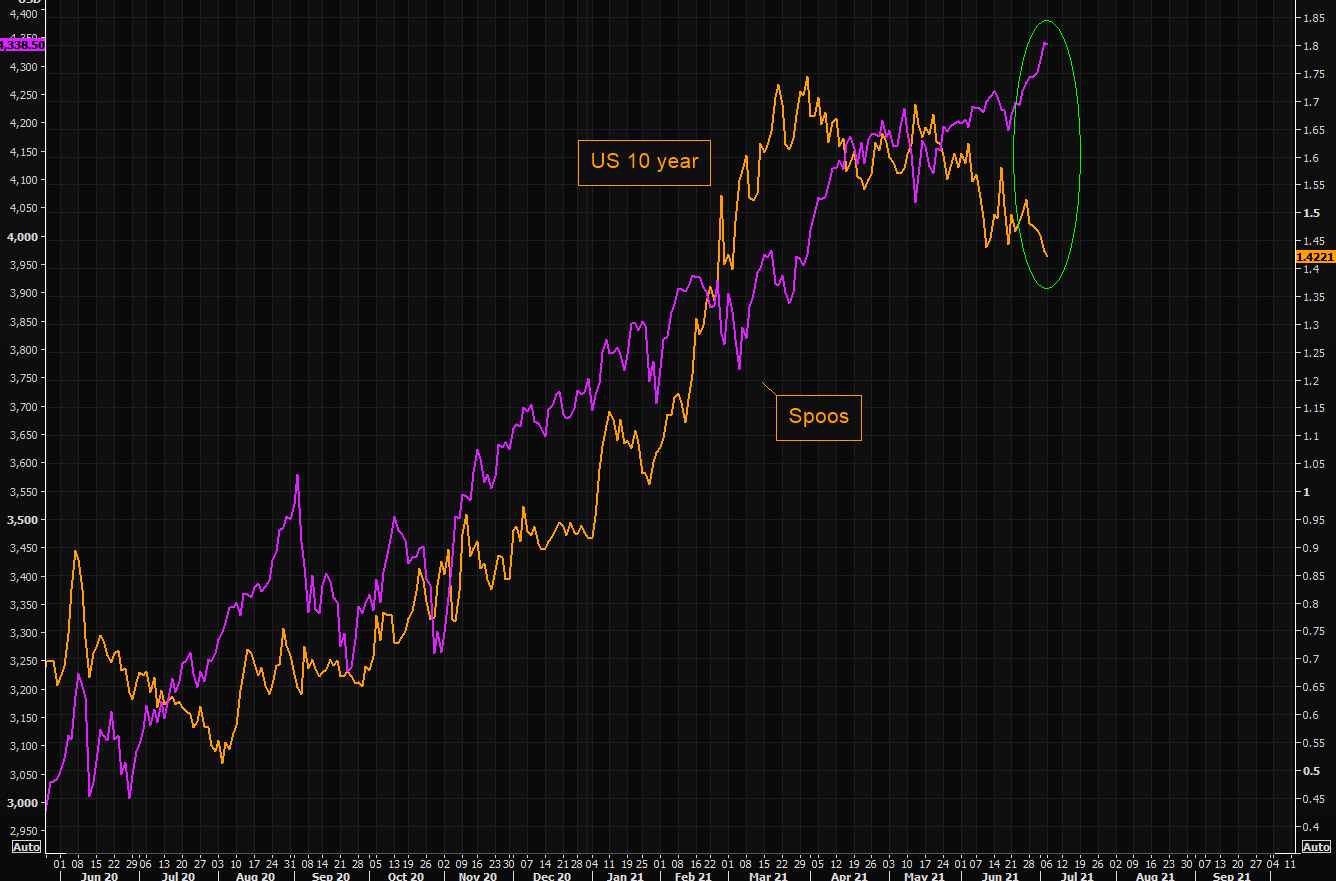
Graphic: Rates (yellow color) on the 10 Year T-Note move lower, via The Market Ear. 

Important to note, also, as stated in the weekly commentary, the CBOE Volatility Index (INDEX: VIX), a measure of the stock market’s expectation of volatility, recently traded to its lowest level since February 2020. This dynamic has the potential to solicit the involvement of certain systematic strategies which can not only add fuel to the price rise but, potentially, exacerbate any future liquidation. 

Putting it all together, for today, participants can trade from the following frameworks. 

In the best case, the S&P 500 trades sideways or higher; activity above the yellow AVWAP (near $4,325.00) puts in play the $4,348.25 ONH. Thereafter, if higher, participants can look for responses at the $4,360.00 and $4,374.75 Fibonacci-derived price extensions. 

In the worst case, the S&P 500 trades lower; activity below the yellow AVWAP (near $4,325.00) puts in play the $4,317.00 untested Point of Control (POC). Initiative trade beyond the POC could reach as low as the $4,299.00 POC and $4,285.00 micro-composite high volume area (HVNode). 

POCs: POCs are valuable as they denote areas where two-sided trade was most prevalent. Participants will respond to future tests of value as they offer favorable entry and exit.

Volume Areas: A structurally sound market will build on past areas of high volume. Should the market trend for long periods of time, it will lack sound structure (identified as a low volume area which denotes directional conviction and ought to offer support on any test). 

If participants were to auction and find acceptance into areas of prior low volume, then future discovery ought to be volatile and quick as participants look to areas of high volume for favorable entry or exit.
Graphic: 65-minute profile chart of the Micro E-mini S&P 500 Futures.
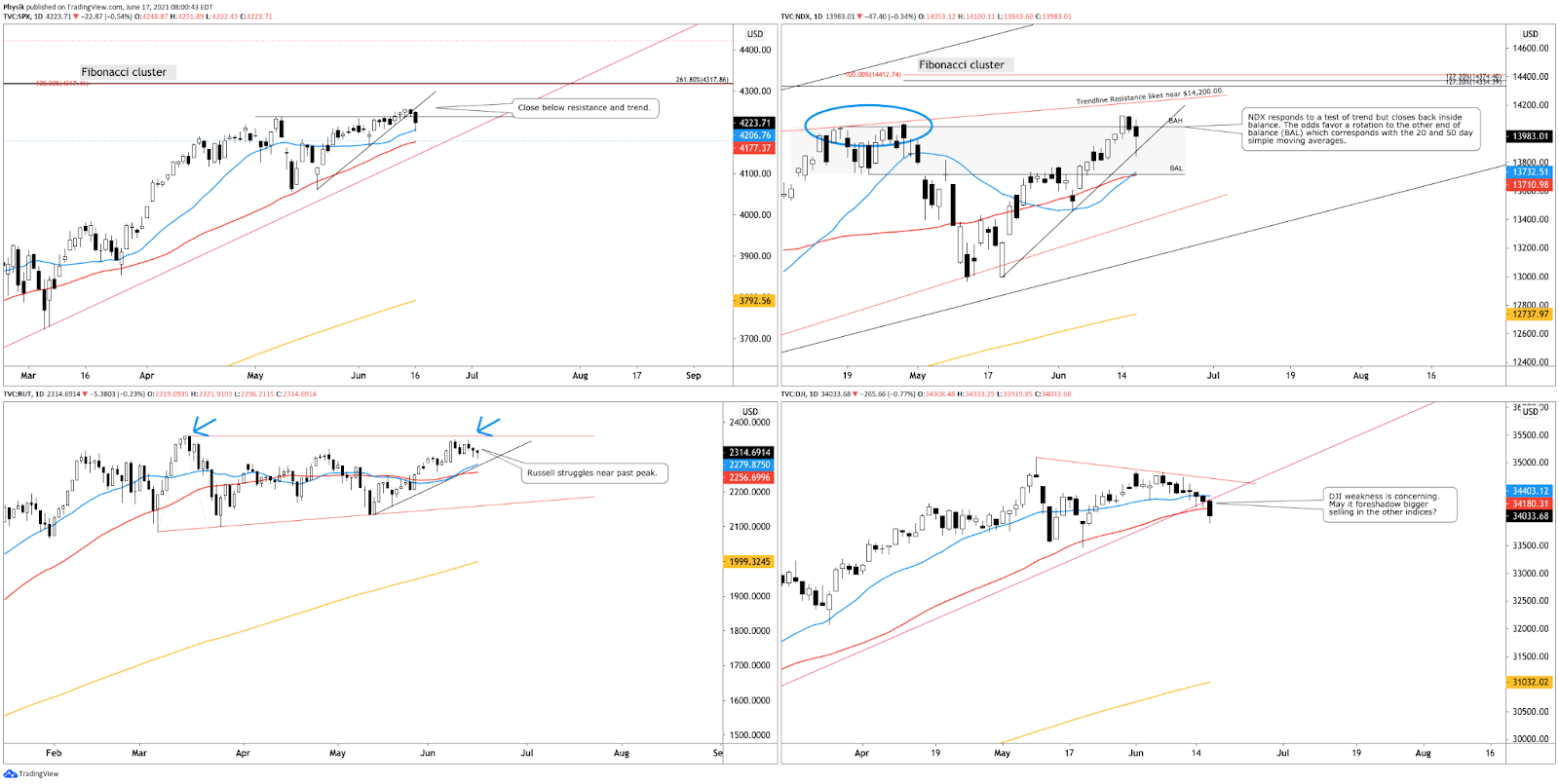
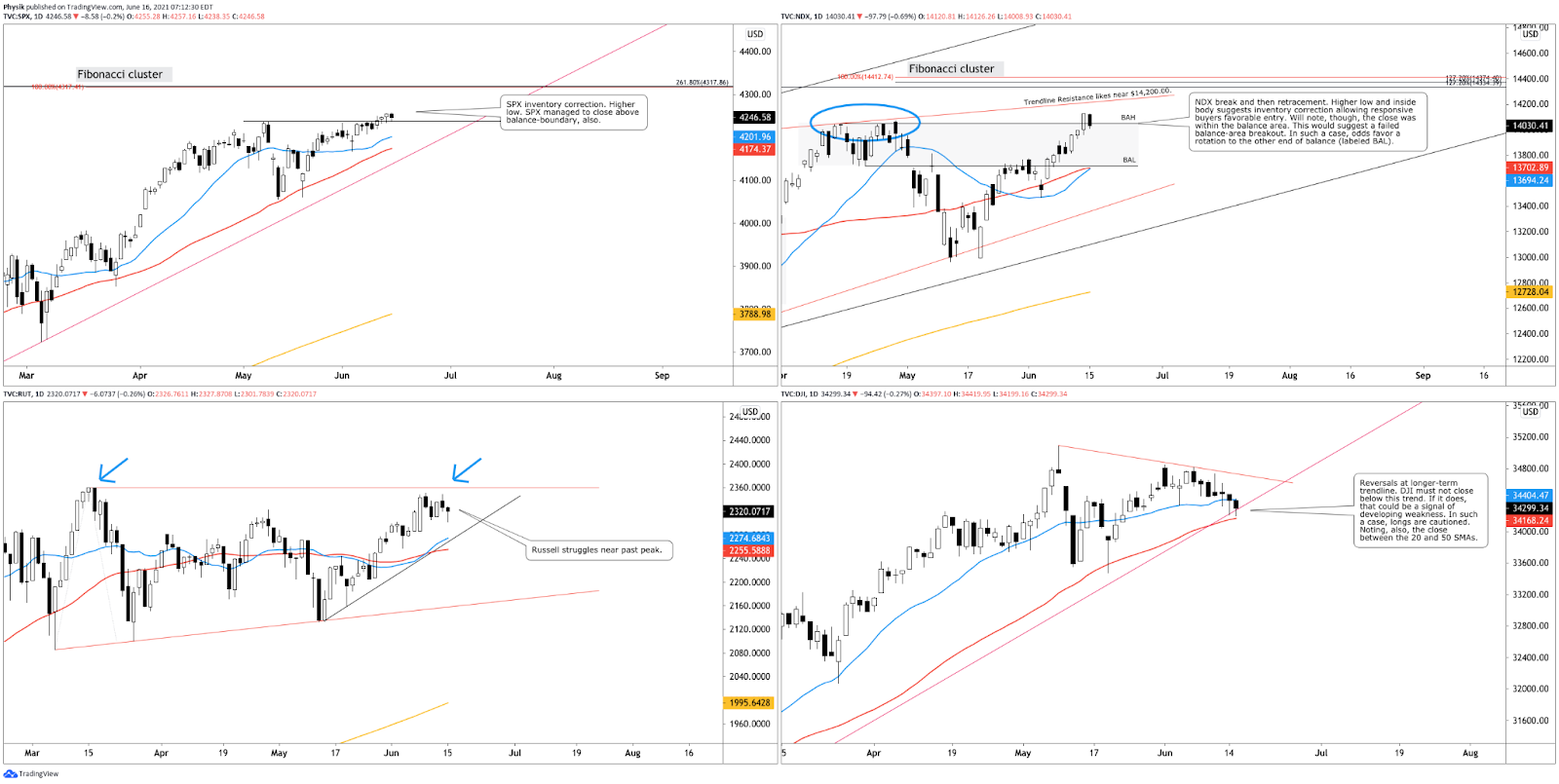
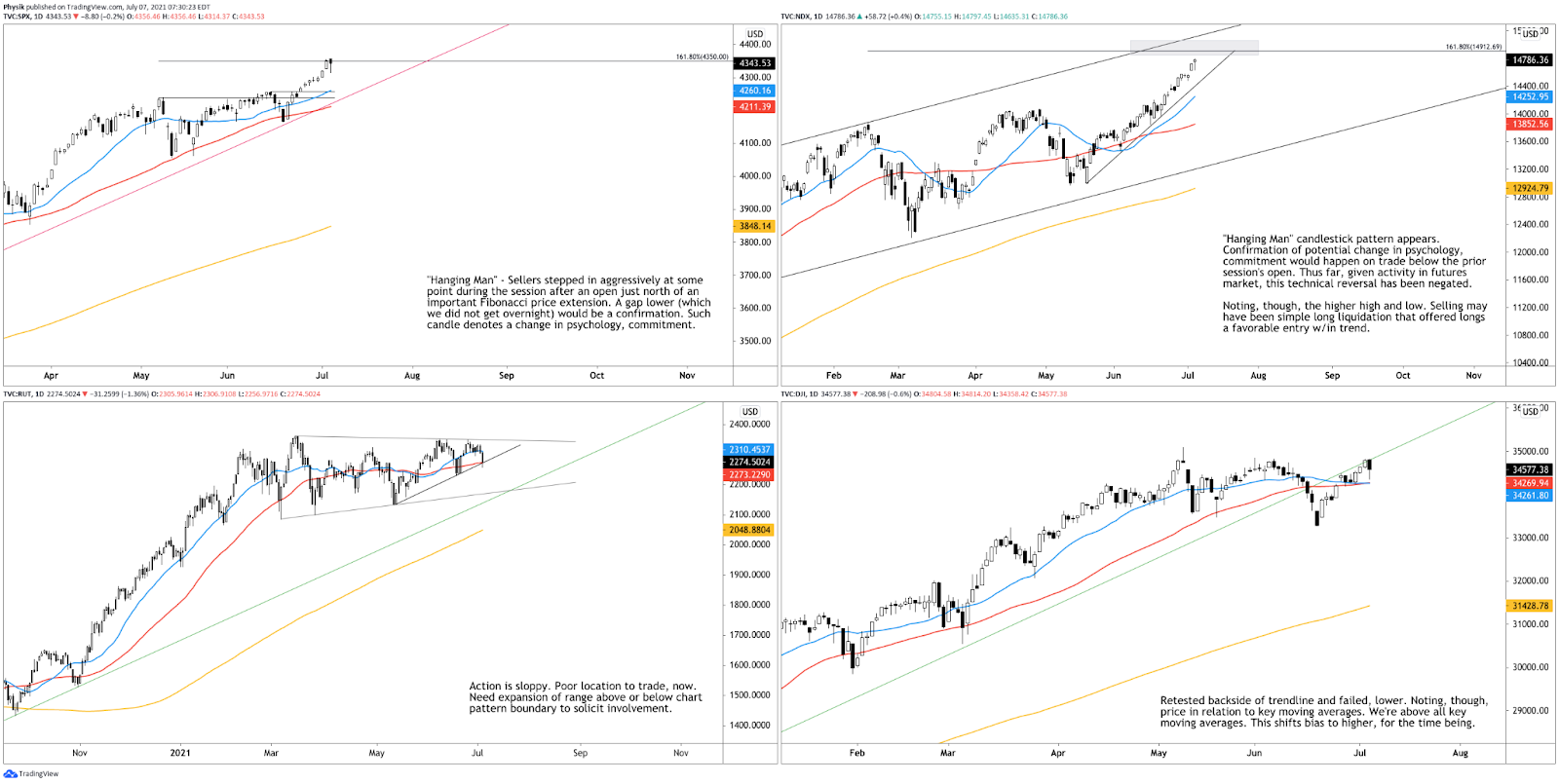
Graphic: Daily candlestick charts of the S&P 500 (top left), Nasdaq 100 (top right), Russell 2000 (bottom left), and Dow Jones Industrial Average (bottom right).
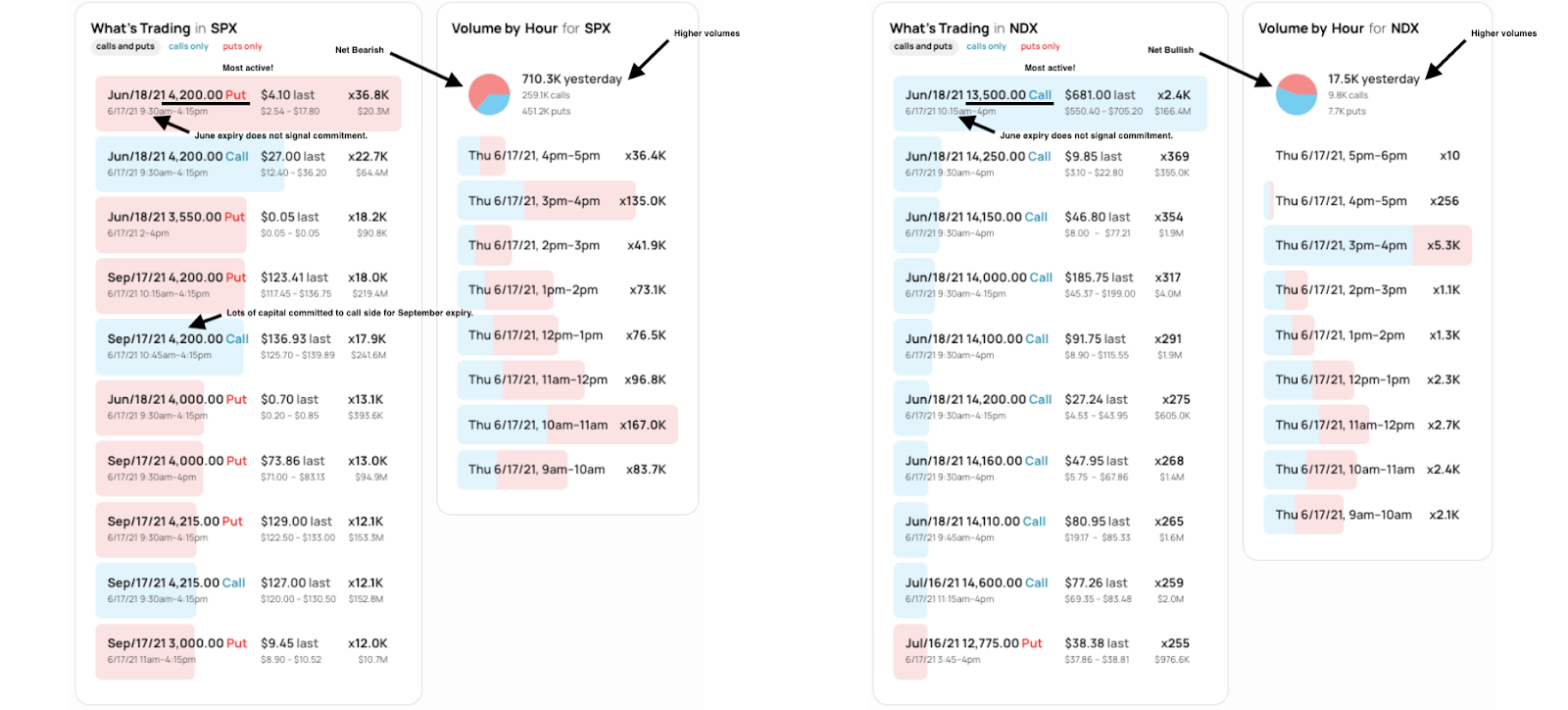
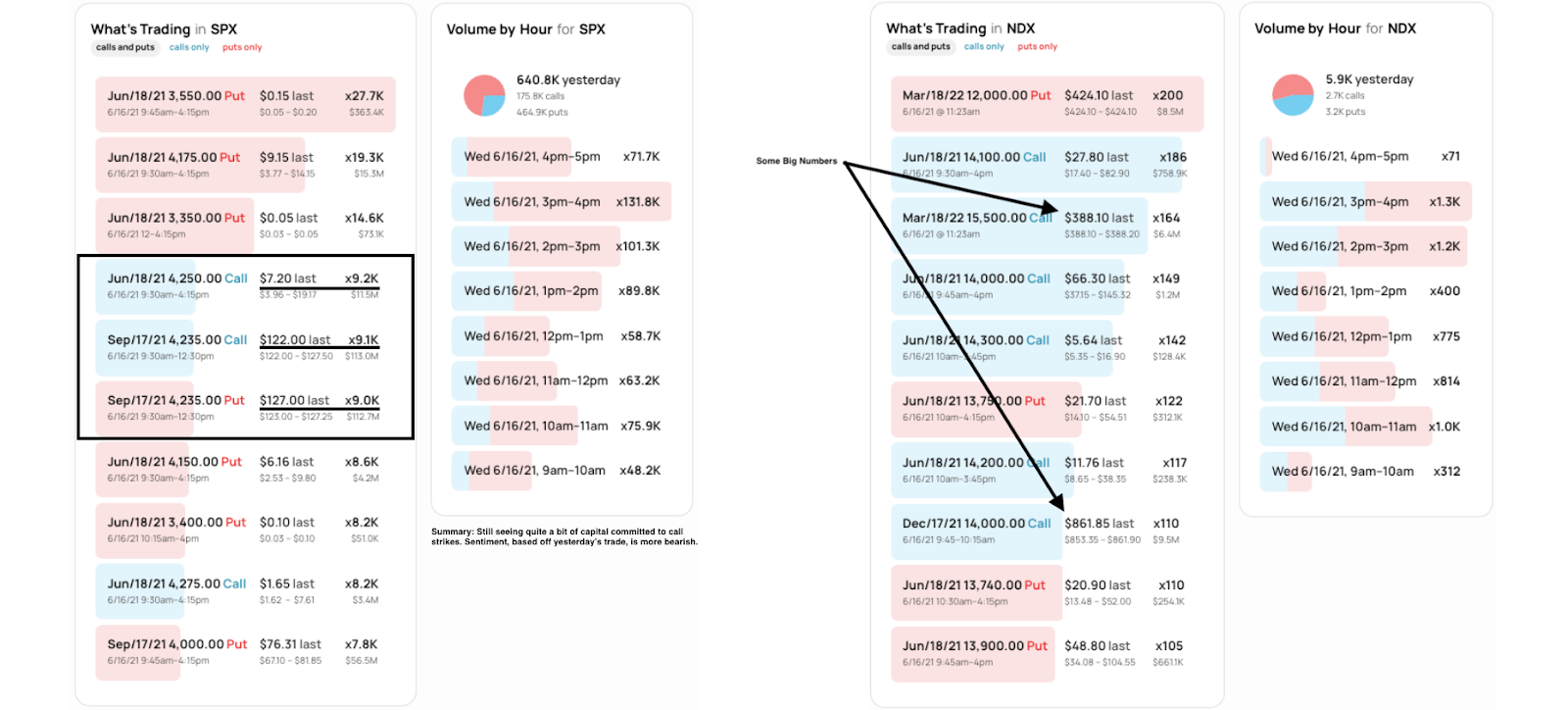
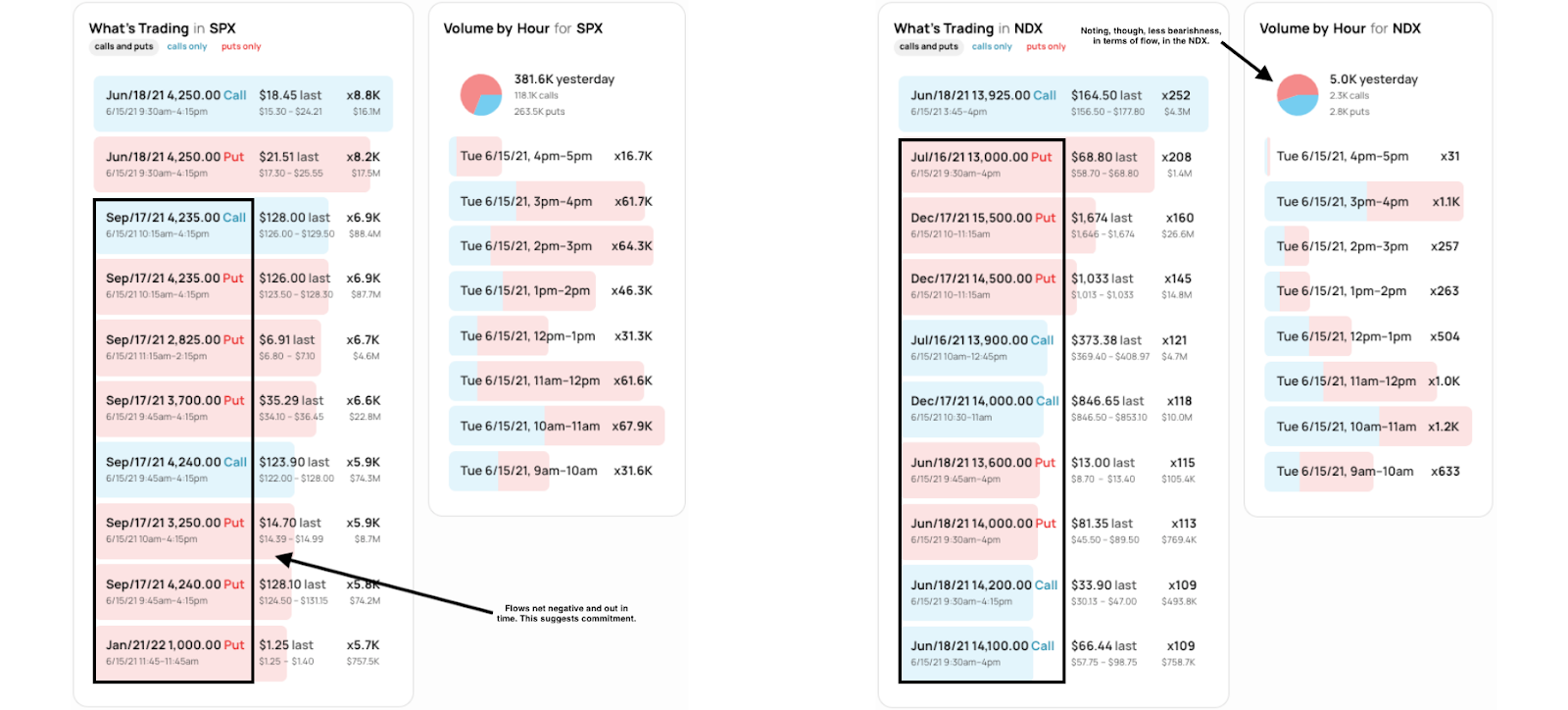
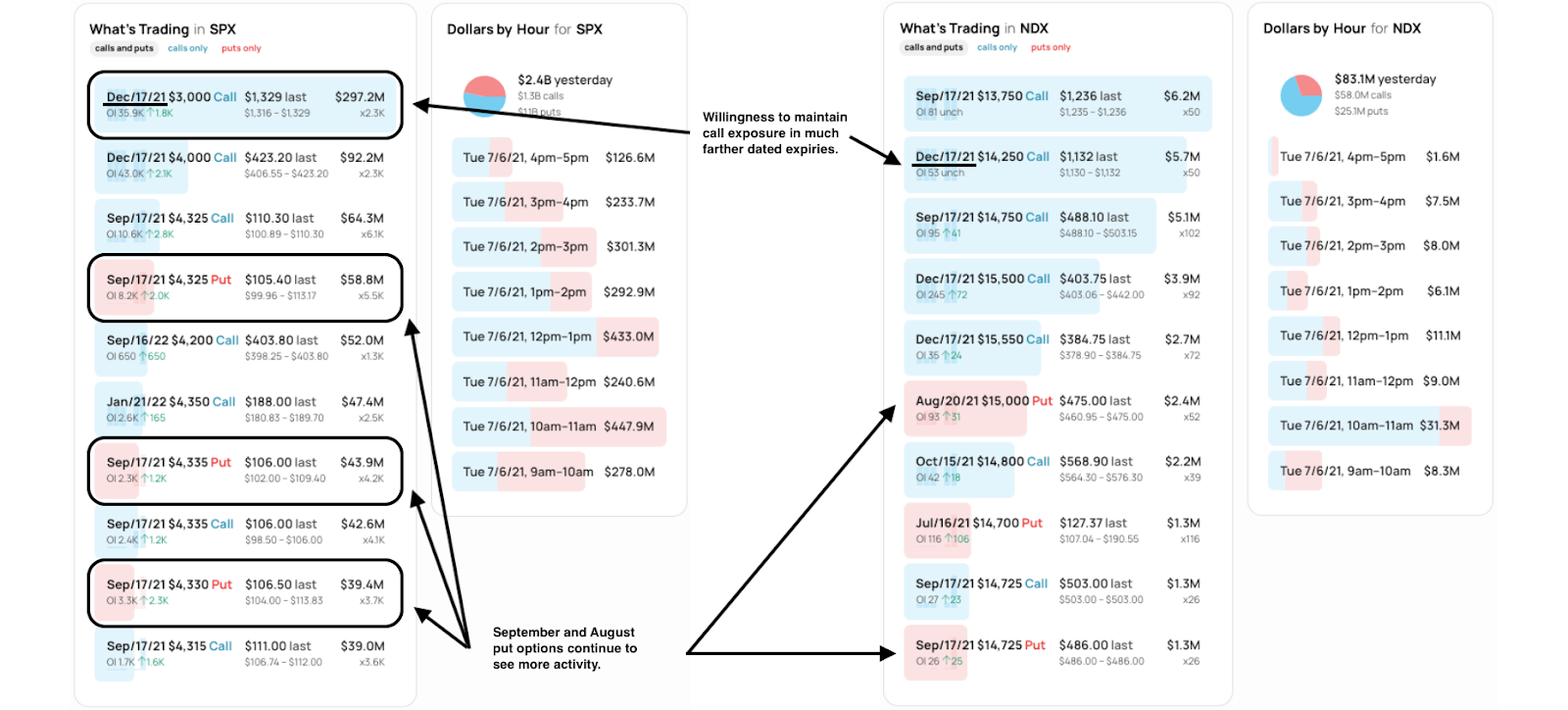
Graphic: SHIFT search suggests participants were committing the most capital to call strikes at and below current prices in the cash-settled S&P 500 Index (INDEX: SPX) and Nasdaq 100 (INDEX: NDX), yesterday. This dynamic suggests participants, despite their commitment to higher prices, are hedging against near-term risks, like the Jackson Hole Economic Symposium.

News And Analysis

Economy | America is hitting its vaccination ceiling. (Axios)

Economy | Mortgage applications sinking to lowest. (CNBC)

Markets | Nomura’s prime brokerage is pulling back. (BBG)

Economy | EU forecasts higher growth in eurozone. (REU)

Trade | Cargo glut at key shipping port has loosened. (Axios)

What People Are Saying

About

Renato founded Physik Invest after going through years of self-education, strategy development, and trial-and-error. His work reporting in the finance and technology space, interviewing leaders such as John Chambers, founder, and CEO, JC2 Ventures, Kevin O’Leary, businessman and Shark Tank host, Catherine Wood, CEO and CIO, ARK Invest, among others, afforded him the perspective and know-how very few come by.

Having worked in engineering and majored in economics, Renato is very detailed and analytical. His approach to the markets isn’t built on hope or guessing. Instead, he leverages the unique dynamics of time and volatility to efficiently act on opportunity.

Disclaimer

At this time, Physik Invest does not manage outside capital and is not licensed. In no way should the materials herein be construed as advice. Derivatives carry a substantial risk of loss. All content is for informational purposes only.

Categories
Commentary

Daily Brief For June 28, 2021

Market Commentary

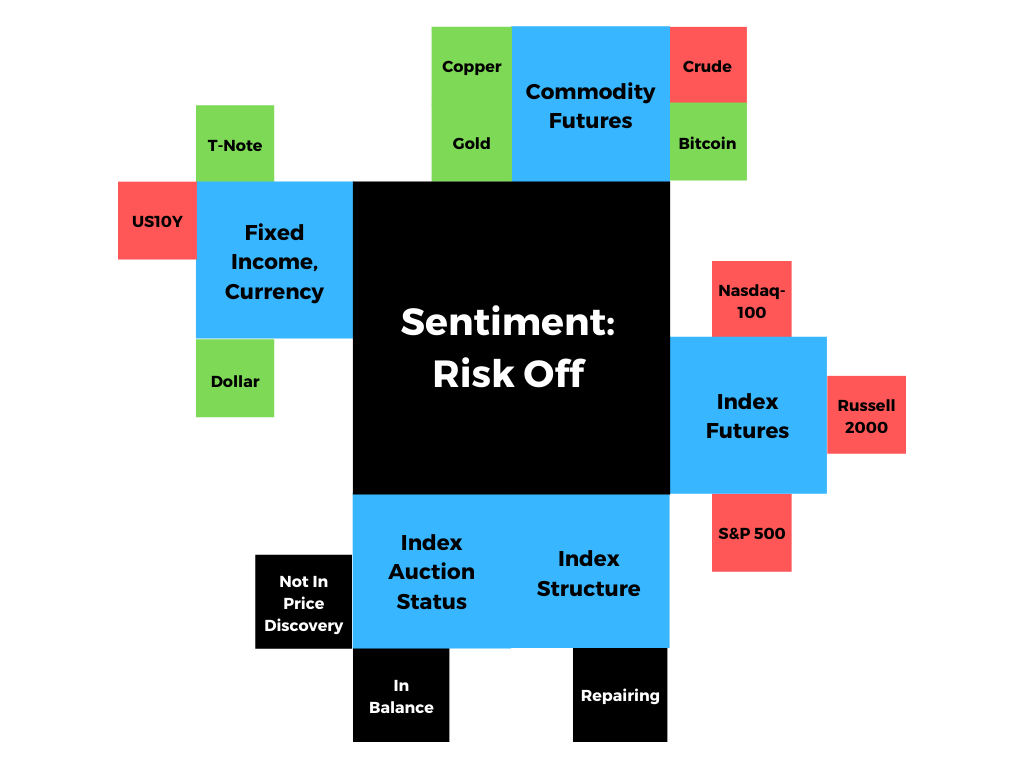
Equity index futures diverge, auction within prior range.

  • A slow start to a rather busy week.
  • Market is meaningfully overvalued.
  • Ahead: Fed speak, manufacturing.
  • /NQ firmed and the /ES backed off.

What Happened: U.S. stock index futures traded sideways to lower, ahead of what’s expected to be a light day.

Further, President Biden is looking to push along his infrastructure plan and the U.K. cracked down on cryptocurrency exchanges. 

On the calendar is Dallas Fed Manufacturing Activity. Also, John Williams, Randal Quarles, and Tom Barkin, of the Federal Reserve, are to speak.

Graphic updated 6:55 AM ET.

What To Expect: Monday’s regular session (9:30 AM – 4:00 PM EST) in the S&P 500 will likely open inside of prior-range and -value. This likely limits the potential for immediate directional opportunity.

Adding, alongside positive economic and political developments, U.S. equity index futures traded higher, last week, in conjunction with narrowing breadth, weaker seasonality, and other things

Moreover, last night, the S&P 500 established a new overnight high (ONH) before trading back into range. Anchoring a Volume Weighted Average Price (VWAP) at that peak suggests the average overnight seller is in a winning position. Should the day timeframe find acceptance above that VWAP (yellow in color on the below chart), that is not a positive for those weak-handed overnight players that tend to trade in small size. 

Overnight Rally Highs (Lows): Typically, there is a low historical probability associated with overnight rally-highs (lows) ending the upside (downside) discovery process.

Volume Weighed Average Price (VWAP): The average price at which a stock is traded over a certain horizon.

For today, participants can trade from the following frameworks. 

In the best case, the S&P 500 trades sideways or higher; activity above the $4,267.00 Point of Control (POC) puts in play the $4,278.75 ONH. Initiative trade beyond the ONH could reach as high as $4,294.75, a Fibonacci-derived price target.

POCs: POCs (like HVNodes described above) are valuable as they denote areas where two-sided trade was most prevalent. Participants will respond to future tests of value as they offer favorable entry and exit.

In the worst case, the S&P 500 trades lower; activity below the $4,267.00 POC puts in play the $4,257.00 high volume area (HVNode), first. Failure to respond leaves the $4,248.25 low volume area (LVNode) exposed. Trade beyond that signpost is concerning; in such a case, a test of the $4,239.75 micro-composite point of control (MCPOC) and $4,229.00 VPOC is expected.

Volume Areas: A structurally sound market will build on past areas of high volume. Should the market trend for long periods of time, it will lack sound structure (identified as a low volume area which denotes directional conviction and ought to offer support on any test). 

If participants were to auction and find acceptance into areas of prior low volume, then future discovery ought to be volatile and quick as participants look to areas of high volume for favorable entry or exit.

Even lower? Yikes. Look for responses at the $4,213.00 and $4,200.25 HVNodes. The $4,200.25 signpost corresponds with an important 50% Fibonacci retracement and LVNode boundary.

Graphic: 65-minute profile chart of the Micro E-mini S&P 500 Futures.
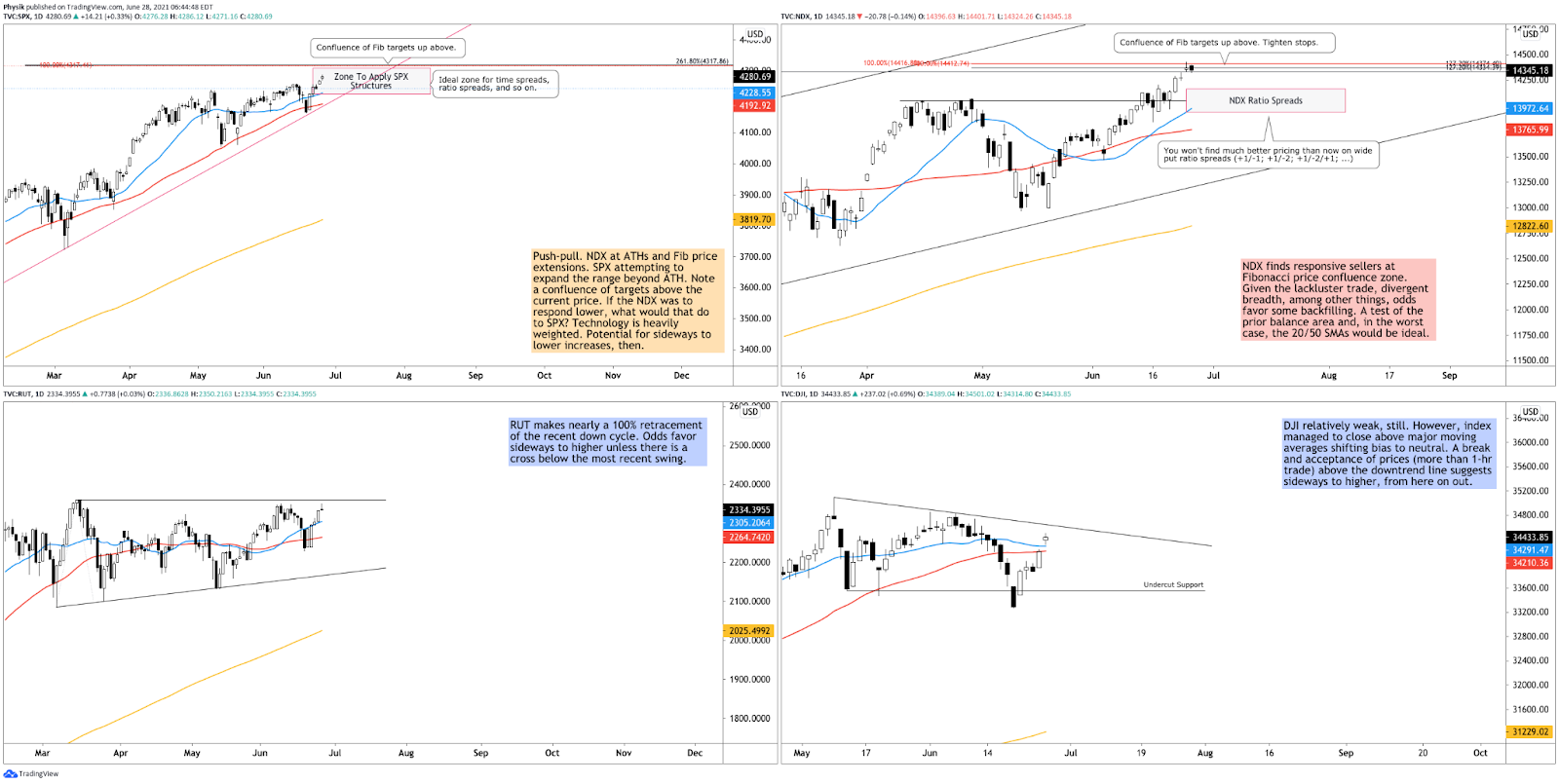
Graphic: Daily candlestick charts of the S&P 500 (top left), Nasdaq 100 (top right), Russell 2000 (bottom left), and Dow Jones Industrial Average (bottom right).
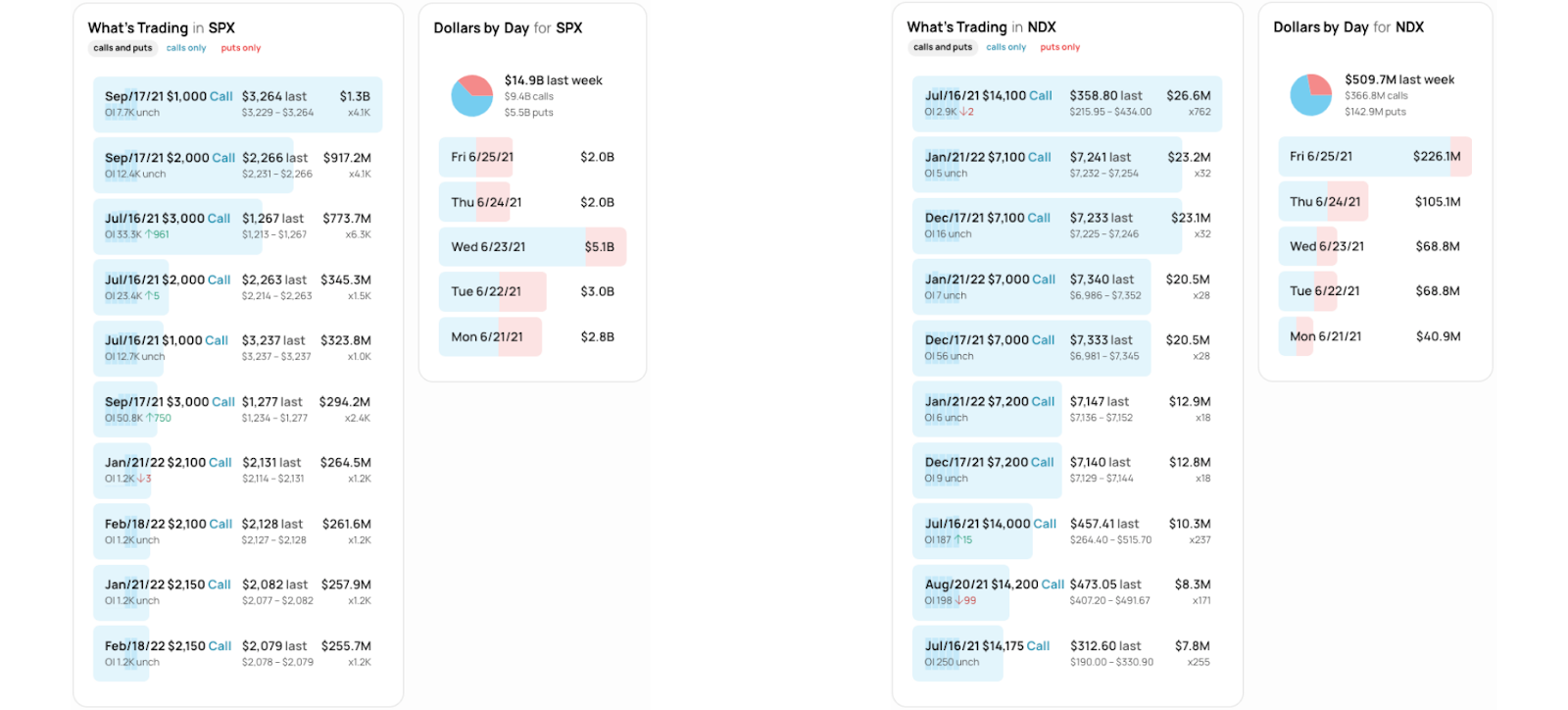
Graphic: SHIFT search suggests participants were committing the most capital to call strikes at and below current prices in the cash-settled S&P 500 Index (INDEX: SPX) and Nasdaq 100 (INDEX: NDX), last week. This activity may denote (1) stock replacement, (2) hedges for underlying short positions, or (3) speculation on the upside.

News And Analysis

Economy | Support doesn’t provide a meaningful boost until mid-decade. (Moody’s)

Markets | Intel CEO says the chip shortage will hit bottom in second half. (BBG)

Economy | The U.S. cannot afford another housing market ‘boom and bust’. (FT)

Economy | Bank of Russia to consider key interest rate increase in July. (BBG)

Markets | Johnson & Johnson to pay $260M on claims it sparked epidemic. (Axios)

Politics | The last-and only-foreign scientist in the Wuhan lab speaks out. (BBG)

Markets | Tesla dealt a blow as almost all cars in China need a safety fix. (BBG)

Politics | U.S. warplanes strike against an Iran-backed militia in Iraq, Syria. (REU)

Energy | The U.S. shale industry tempers output even as oil price jumps. (REU)

What People Are Saying

Innovation And Emerging Trends

Work | UBS to let two-thirds of employees adopt permanent hybrid work. (BBG)

FinTech | CME joins battle for retail bond traders with new small products. (BBG)

Energy | Japan allows restarts of nuclear reactors older than 40 years. (Nikkei)

Tech | Study finds China’s cyber power at least a decade behind the U.S. (FT)

FinTech | Chaka first startup to receive SEC license for trading in Nigeria. (TC)

About

Renato founded Physik Invest after going through years of self-education, strategy development, and trial-and-error. His work reporting in the finance and technology space, interviewing leaders such as John Chambers, founder, and CEO, JC2 Ventures, Kevin O’Leary, businessman and Shark Tank host, Catherine Wood, CEO and CIO, ARK Invest, among others, afforded him the perspective and know-how very few come by.

Having worked in engineering and majored in economics, Renato is very detailed and analytical. His approach to the markets isn’t built on hope or guessing. Instead, he leverages the unique dynamics of time and volatility to efficiently act on opportunity.

Disclaimer

At this time, Physik Invest does not manage outside capital and is not licensed. In no way should the materials herein be construed as advice. Derivatives carry a substantial risk of loss. All content is for informational purposes only.

Categories
Commentary

Daily Brief For June 18, 2021

Editor’s Note: Happy Friday! In the coming days, there will be some additions to the newsletter helping you better identify the levels in play. Also, I will try to improve engagement with some visual effects.

Stay tuned,

Renato

Market Commentary

Index futures balance after violent downside discovery.

  • Inflation fears spark morning dips.
  • EU opened up travel with the US.
  • Indicies traded sideways to lower.

What Happened: U.S. stock index futures auctioned sideways to lower after violent downside discovery just days prior.

Ahead, there are no significant economic releases.

Graphic updated 7:48 AM ET.

What To Expect: Friday’s regular session (9:30 AM – 4:00 PM EST) in the S&P 500 will likely open inside of prior-range and -value, suggesting a limited potential for immediate directional opportunity. 

Adding, during the prior day’s regular trade, the best case outcome occurred, evidenced by sideways trade at and around the VWAP (blue in color on the below graphic) anchored from the time of Wednesday’s Federal Reserve event. This suggests the average buyer, since the event, is regaining strength. 

So, what is needed in the coming days? Ideally, the S&P 500 trades (and stays) above the blue VWAP line.

Volume Weighed Average Price (VWAP): The average price at which a stock is traded over a certain horizon.

Moreover, since the Federal Reserve’s signal of the faster-than-expected pace of policy tightening provided participants more clarity, major indices broke out of balance, but in different directions. 

The S&P 500, Russell 2000, and Dow Jones Industrial Average are trading relatively weak in comparison to the tech- and growth-focused Nasdaq 100 which quickly recovered FOMC losses to discover higher prices. This divergence, in conjunction with sectoral breakdowns, is concerning and may foreshadow increased volatility after the monthly options expiration (OPEX), into quarter-end. 

Options Expiration (OPEX): Option expiries mark an end to pinning (i.e, the theory that market makers and institutions short options move stocks to the point where the greatest dollar value of contracts will expire worthless) and the reduction dealer gamma exposure.

According to SpotGamma’s models, up to 50% of the gamma in and across the S&P 500 complex is expiring. Here’s an explanation and visual to understand why that matters.

After those gamma exposures drop (and related hedging forces disappear), the market will be subject to more movement. That is when things will get interesting. 

Based on the price action across the biggest FANGMANT stocks, participants would think another run higher is likely. However, looking at the breakdowns in individual sectors – financials and transportation, for instance – a dip in certain breadth metrics, elevated skew, put/call ratios, and volatility spreads, the picture becomes less clear. 

Without going into things too deep, the odds favor volatility and sideways trade for today’s session.

Like yesterday, in the best case, the S&P 500 trades sideways or higher; activity above the $4,207.25 VWAP (blue in color on the below chart) puts in play the $4,227.25 HVNode. Initiative trade beyond that HVNode could reach as high as the $4,235.00 Virgin Point Of Control (VPOC), $4,249.00 low volume area (LVNode), and $4,258.00 overnight high (ONH).

Overnight Highs (Lows): Typically, there is a low historical probability associated with overnight rally-highs (lows) ending the upside (downside) discovery process.

POCs: POCs (like HVNodes described above) are valuable as they denote areas where two-sided trade was most prevalent. Participants will respond to future tests of value as they offer favorable entry and exit.

In the worst case, the S&P 500 trades lower; activity below the blue VWAP suggests a risk-off sentiment remains. In such a case, there is the potential to test lower, into the $4,182.50 overnight low (ONL) and $4,177.25 HVNode. Breaking $4,177.25 suggests a higher potential to trade to the HVNodes at $4,153.25, $4,122.25, and $4,069.25.

Graphic: 65-minute profile chart of the Micro E-mini S&P 500 Futures.
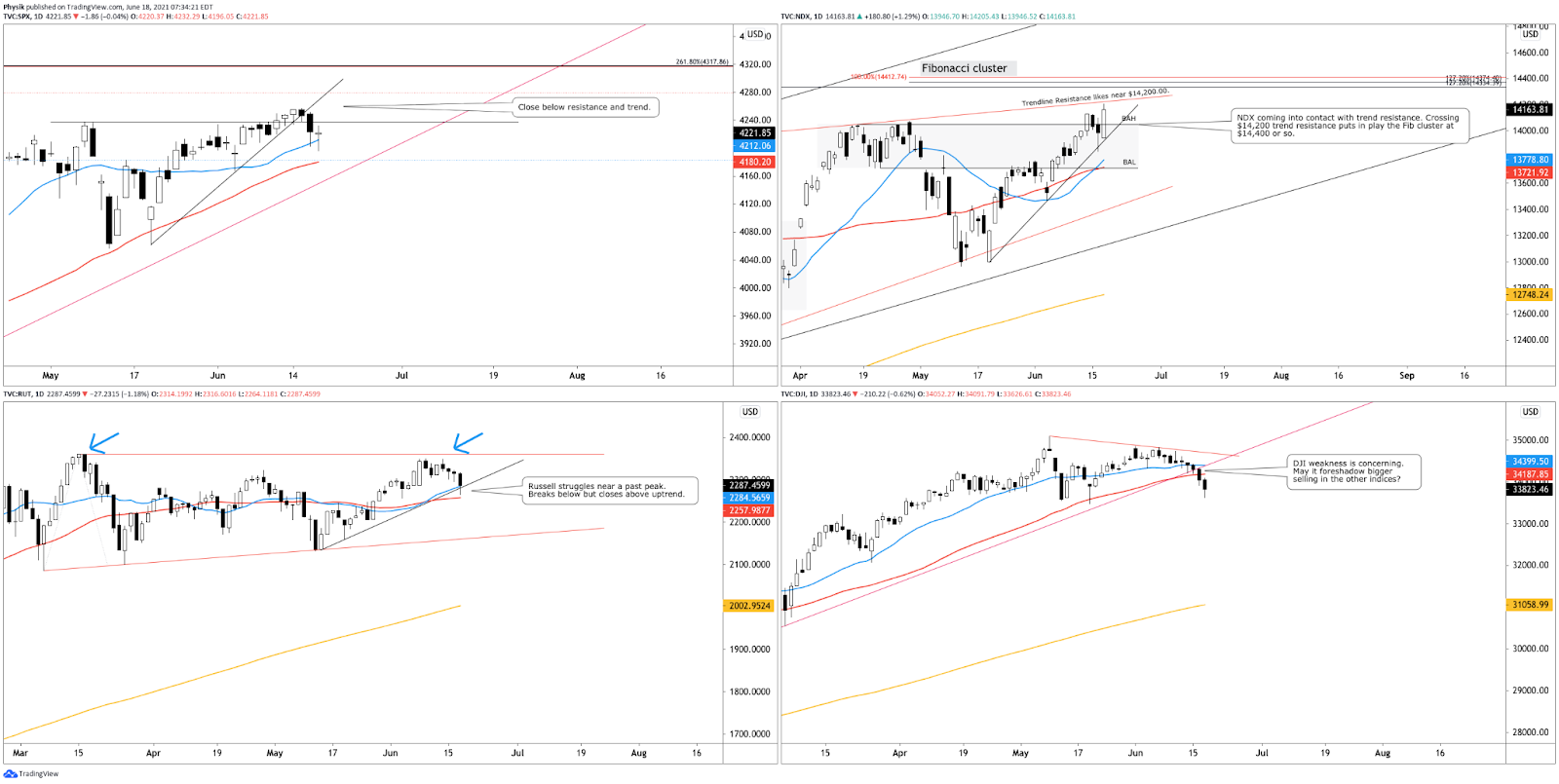
Graphic: Daily candlestick charts of the S&P 500 (top left), Nasdaq 100 (top right), Russell 2000 (bottom left), and Dow Jones Industrial Average (bottom right).
Graphic: SHIFT search suggests participants were most interested in put strikes at and below current prices in the cash-settled S&P 500 Index (INDEX: SPX), yesterday. On the other hand, in the cash-settled Nasdaq 100 Index (INDEX: NDX), participants were most interested in call strikes at and above current prices.

News And Analysis

Economy | Fed’s Bullar says inflation running hotter than expected. (REU)

Economy | EU opens up for Americans wanting to vacation abroad. (BBG)

Economy | Faster world recovery boosting prices, inflation will halt. (Fitch)

Economy | Fear during the COVID-19 comeback largely transitory. (Axios)

Economy | Inflation data holding key to Fannie Mae’s new forecast. (MND)

Politics | Pacific cable project sinks after warning against China bid. (REU)

Politics | Supreme Court rejects GOP challenge to Affordable Care. (BBG)

What People Are Saying

Innovation And Emerging Trends

FinTech | Mark Cuban wants stablecoin regulation amid token crash. (BBG)

Markets | Google to open first retail store steps away from Apple. (BBG)

About

Renato founded Physik Invest after going through years of self-education, strategy development, and trial-and-error. His work reporting in the finance and technology space, interviewing leaders such as John Chambers, founder, and CEO, JC2 Ventures, Kevin O’Leary, businessman and Shark Tank host, Catherine Wood, CEO and CIO, ARK Invest, among others, afforded him the perspective and know-how very few come by.

Having worked in engineering and majored in economics, Renato is very detailed and analytical. His approach to the markets isn’t built on hope or guessing. Instead, he leverages the unique dynamics of time and volatility to efficiently act on opportunity.

Disclaimer

At this time, Physik Invest does not manage outside capital and is not licensed. In no way should the materials herein be construed as advice. Derivatives carry a substantial risk of loss. All content is for informational purposes only.

Categories
Commentary

Daily Brief For June 17, 2021

Market Commentary

Index futures exit balance, discover lower prices.

  • The Fed eyes taper, signals faster tightening.
  • Ahead: Claims, Business Outlook, and more.
  • Indices exit balance, trade lower, then base.

What Happened: U.S. stock index futures auctioned sideways-to-lower after news the Federal Reserve is signaling a faster-than-expected pace of policy tightening. This comes alongside concerns over inflation which the Federal Reserve suggests is transitory. 

“The reason for the committee moving a bit in this direction is risk management,” said Jonathan Wright, an economics professor at Johns Hopkins University and a former Fed economist. “The risks of overheating are a bit greater than they were.”

Today, participants get data on weekly jobless claims, the Philadelphia Fed Business Outlook, and the U.S. Leading Index. Additionally, Janet Yellen will speak on the budget and the SEC may issue a decision on cryptocurrency ETFs.

Graphic updated 7:25 AM ET.

What To Expect: Thursday’s regular session (9:30 AM – 4:00 PM EST) in the S&P 500 will likely open inside of prior-range and -value, suggesting a limited potential for immediate directional opportunity. 

Adding, during the prior day’s regular trade, the worst-case outcome occurred evidenced by initiative trade below the $4,227.75 high volume area (HVNode). This is significant because that level marked a pivot (i.e., above = bullish, below = bearish) on the composite profile. 

Initiative Selling: Selling within or below the previous day’s value area.

Volume Areas: A structurally sound market will build on past areas of high volume. Should the market trend for long periods of time, it will lack sound structure (identified as a low volume area which denotes directional conviction and ought to offer support on any test). 

If participants were to auction and find acceptance into areas of prior low volume, then future discovery ought to be volatile and quick as participants look to areas of high volume for favorable entry or exit.
It is important to think about who is winning and losing. We start by anchoring a VWAP (blue in color on the below graphic) from the time of the Federal Reserve event. Clearly, the S&P 500 is trading below this VWAP. This suggests the average buyer, since yesterday’s liquidation, is losing. Trading (and staying) above this blue line changes the dynamics; in such a case, shorts should reconsider their involvement.

Volume Weighed Average Price (VWAP): The average price at which a stock is traded over a certain horizon.

For today, participants can trade from the following frameworks. 

In the best case, the S&P 500 trades sideways or higher; activity above the $4,207.25 VWAP (blue in color on the below chart) puts in play the $4,227.25 HVNode. Initiative trade beyond that HVNode could reach as high as the $4,235.00 Virgin Point Of Control (VPOC), $4,249.00 low volume area (LVNode), and $4,258.00 overnight high (ONH).

Overnight Highs (Lows): Typically, there is a low historical probability associated with overnight rally-highs (lows) ending the upside (downside) discovery process.

POCs: POCs (like HVNodes described above) are valuable as they denote areas where two-sided trade was most prevalent. Participants will respond to future tests of value as they offer favorable entry and exit.

In the worst case, the S&P 500 trades sideways or lower; activity below the blue VWAP suggests a risk-off sentiment remains. In such a case, there is the potential to test lower, into the $4,182.50 overnight low (ONL) and $4,177.25 HVNode. If a probe into lower value is not responded to, lookout. There’s a higher potential to trade to the HVNodes at $4,153.25, $4,122.25, and $4,069.25.

Graphic: 65-minute profile chart of the Micro E-mini S&P 500 Futures.
Graphic: Daily candlestick charts of the S&P 500 (top left), Nasdaq 100 (top right), Russell 2000 (bottom left), and Dow Jones Industrial Average (bottom right).
Graphic: SHIFT search suggests participants were most interested in put strikes at and below current prices in the cash-settled S&P 500 Index (INDEX: SPX) and Nasdaq 100 Index (INDEX: NDX), yesterday. Noting, participants are still paying up for upside call exposure.

News And Analysis

Energy | Climbing oil prices signal the need for more output. (REU)

Markets | OPEX is a huge thing and June FOMC a non-event. (HR)

COVID | Delta variant fuelled a 50% rise in England infections. (REU)

Economy | World Bank rejects El Salvador’s request on BTC. (REU)

Energy | Blistering heatwave hits California and fire risks build. (Axios)

What People Are Saying

Innovation And Emerging Trends

Markets | OnlyFans explores share sale after the lockdown boom. (FT)

FinTech | New crypto working group in Congress to hone policies. (TB)

Markets | Cboe extends global trading hours in SPX, VIX options. (MM)

Markets | How SEC boss should deal with ‘meme’ stock schemes. (NYP)

About

Renato founded Physik Invest after going through years of self-education, strategy development, and trial-and-error. His work reporting in the finance and technology space, interviewing leaders such as John Chambers, founder, and CEO, JC2 Ventures, Kevin O’Leary, businessman and Shark Tank host, Catherine Wood, CEO and CIO, ARK Invest, among others, afforded him the perspective and know-how very few come by.

Having worked in engineering and majored in economics, Renato is very detailed and analytical. His approach to the markets isn’t built on hope or guessing. Instead, he leverages the unique dynamics of time and volatility to efficiently act on opportunity.

Disclaimer

At this time, Physik Invest does not manage outside capital and is not licensed. In no way should the materials herein be construed as advice. Derivatives carry a substantial risk of loss. All content is for informational purposes only.

Categories
Commentary

Daily Brief For June 16, 2021

Market Commentary

Index futures in balance.

  • Ahead: Housing starts, trade prices, FOMC.
  • Indices diverge and trade sideways to lower.

What Happened: U.S. stock index futures auctioned sideways ahead of an important Federal Open Market Committee (FOMC) announcement at 2:00 p.m. Eastern Time, today.

As stated in prior commentaries, the odds of substantial change to policy are low. Instead, participants will likely hear that despite Fed policy remaining unchanged, tools exist to combat inflation.

Also, before the open, China established orders limiting exposure to overseas commodities and U.K. consumer prices rose. Important releases, aside from the Fed decision, include data on housing starts and trade prices, as well as text on infrastructure.

Graphic updated 7:13 AM ET.

What To Expect: Wednesday’s regular session (9:30 AM – 4:00 PM EST) in the S&P 500 will likely open inside of prior-range and -value, suggesting a limited potential for immediate directional opportunity. 

Adding, during the prior day’s regular trade, the worst-case outcome occurred, evidenced by a liquidation break that found acceptance below the $4,238.00 spike base. That is significant because it negated the knee-jerk, end-of-day bullishness of Monday’s session.

Liquidation Breaks: The profile shape suggests participants were “too” long and had poor location. This corrective activity enables favorable entry and exit.

Spikes: Spike’s mark the beginning of a break from value. Spikes higher (lower) are validated by trade at or above (below) the spike base (i.e., the origin of the spike).

Further, for today, participants can trade from the following frameworks. 

In the best case, the S&P 500 trades sideways or higher; activity above the $4,234.25 high volume area (HVNode), which corresponds with the average price bought and sold (via the VWAP) since consumer price data was released last week, puts in play the $4,249.00 low volume area (LVNode). Initiative trade beyond the LVNode could reach as high as the $4,258.00 overnight high (ONH) and $4,270.25 Fibonacci price extension.

Volume Areas: A structurally sound market will build on past areas of high volume. Should the market trend for long periods of time, it will lack sound structure (identified as a low volume area which denotes directional conviction and ought to offer support on any test). 

If participants were to auction and find acceptance into areas of prior low volume, then future discovery ought to be volatile and quick as participants look to areas of high volume for favorable entry or exit.

Volume Weighed Average Price (VWAP): The average price at which a stock is traded over a certain horizon.

Overnight Rally Highs (Lows): Typically, there is a low historical probability associated with overnight rally-highs (lows) ending the upside (downside) discovery process.

In the worst case, the S&P 500 trades lower; activity below the $4,234.25 HVNode suggests caution. It is likely participants will trade to the $4,227.75 HVNode. Thereafter, depending on how participants respond to a test of the HVNode, if lower, the $4,213.75 LVNode and balance area low (BAL) come into play, first. Initiating below the BAL is bearish. In that instance, if selling is aggressive, the $4,177.25 HVNode is in play.

Graphic: 65-minute profile chart of the Micro E-mini S&P 500 Futures.
Graphic: Daily candlestick charts of the S&P 500 (top left), Nasdaq 100 (top right), Russell 2000 (bottom left), and Dow Jones Industrial Average (bottom right). Important to monitor where the indices close, today. Above balance high or trend, bullish. Below, that’s near-term bearish.
Graphic: SHIFT search suggests participants were most interested in put strikes at and below current prices in the cash-settled S&P 500 Index (INDEX: SPX) and Nasdaq 100 Index (INDEX: NDX), yesterday.

News And Analysis

Economy | U.K. inflation’s jump above BOE goal stirring a debate. (BBG)

Economy | China’s economic data disappoints as spending lags. (BBG)

Politics | Disagreements, low expectations as Biden and Putin meet. (REU)

Economy | U.S. retail sales drop, hinting at shift to services spend. (BBG)

Politics | China’s government made warning. Planes fly over Taiwan. (Axios)

Markets | Citi is latest to warn of bigger-than-expected trading drop. (BBG)

What People Are Saying

Innovation And Emerging Trends

FinTech | The big difference between a digital dollar and a CBDC. (BBG)

Markets | Everyone’s a rising star when debt is relatively cheap. (BBG)

Markets | Well-behaved bubbles often make history. An analysis. (a16z)

Markets | The latest blow to 60/40 model is an exodus of pensions. (BBG)

COVID | How prior coronavirus infections factor into herd immunity. (Axios)

Travel | You’ll soon be able to use your iPhone as ID at the airport. (Verge)

FinTech | Exchanges are looking to accelerate their cloud adoption. (TM)

About

Renato founded Physik Invest after going through years of self-education, strategy development, and trial-and-error. His work reporting in the finance and technology space, interviewing leaders such as John Chambers, founder, and CEO, JC2 Ventures, Kevin O’Leary, businessman and Shark Tank host, Catherine Wood, CEO and CIO, ARK Invest, among others, afforded him the perspective and know-how very few come by.

Having worked in engineering and majored in economics, Renato is very detailed and analytical. His approach to the markets isn’t built on hope or guessing. Instead, he leverages the unique dynamics of time and volatility to efficiently act on opportunity.

Disclaimer

At this time, Physik Invest does not manage outside capital and is not licensed. In no way should the materials herein be construed as advice. Derivatives carry a substantial risk of loss. All content is for informational purposes only.

Categories
Commentary

Market Commentary For The Week Ahead: ‘Up, Up And Away’

Key Takeaways:

What Happened: U.S. stock index futures closed higher, last week.

What Does It Mean: The S&P 500 closed above $4,000.00 for the first time.

This comes as investors shifted their focus from the risks of rapidly rising inflation to the increasing pace of COVID-19 coronavirus vaccinations and a rebound in economic activity.
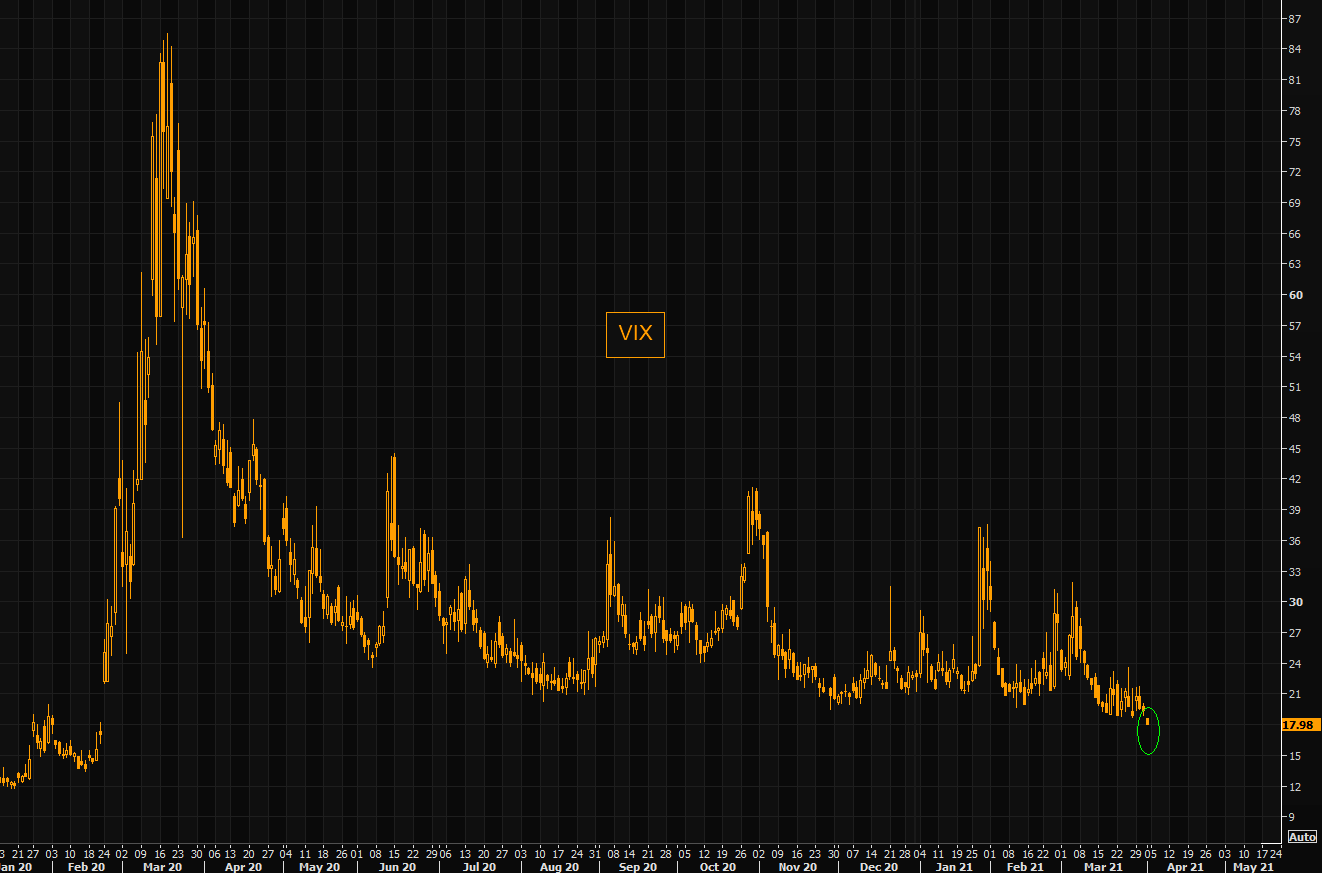
At the time, the CBOE Volatility Index (INDEX: VIX), a measure of the stock market’s expectation of volatility based on S&P 500 (INDEX: SPX) options, hit the lowest level since February of 2020. This was likely the result of an oversupply in volatility due to contract rolling, signaling a shift in the demand for volatility and options-based hedging.

Graphic 1: Volatility declines ahead of the extended holiday weekend.

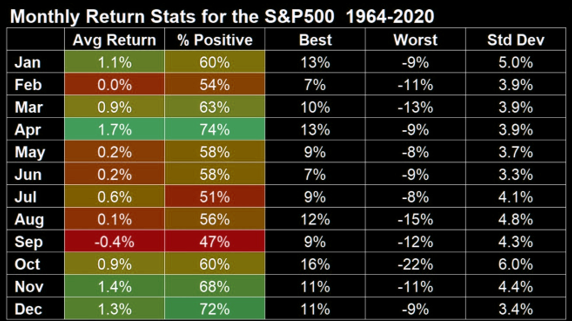
Adding, the market is entering into a historically bullish period, ahead of the upcoming corporate earnings season, with structural flows supporting the ongoing narrative, also, at least until mid-April. The reason being, most funds are committed to holding long positions. In the interest of lower volatility returns, these funds will collar off their positions, selling calls to finance the purchase of downside put protection.

Graphic 2: April, historically speaking, is usually a good month for equity investors. 

As a result of this activity, options dealers are long upside and short downside protection.

This exposure must be hedged; dealers will sell into strength as their call (put) positions gain (lose) value and buy into weakness as their call (put) positions lose (gain) value.

Now, unlike theory suggests, dealers will hedge call losses (gains) quicker (slower). This leads to “long-gamma,” a dynamic that crushes volatility and promotes momentum, observed by lengthy sprints — like the one the market is currently in — followed by rapid de-risking events as the market transitions into “short-gamma.”

What To Expect: Balance-to-higher into mid-April.

Why? One last hurrah before the reopening accelerates and flows turn. 

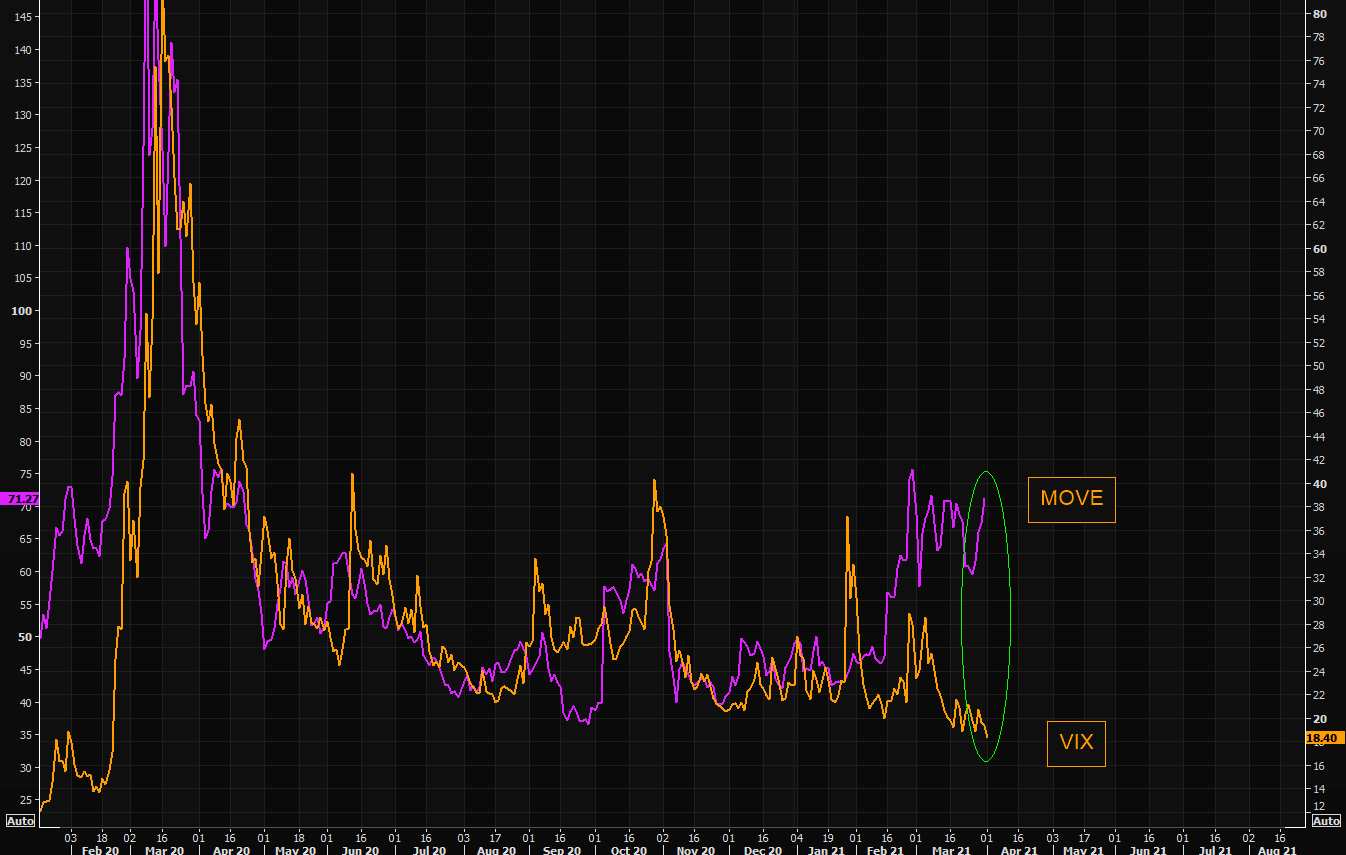
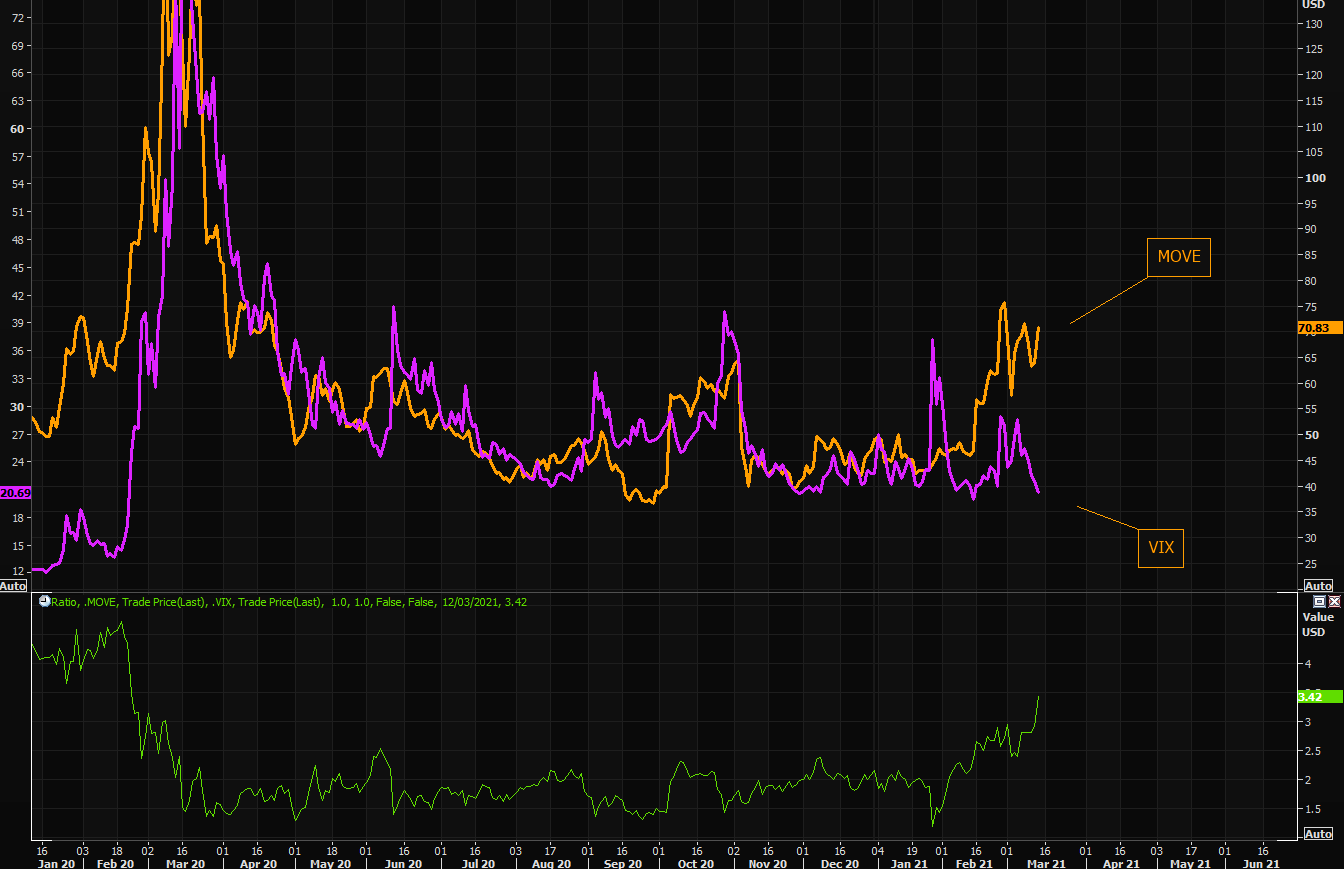
When flows turn, it is likely that equity and bond market volatility converge; the ongoing divergence comes alongside an attempt, by market participants, to price in rising debt levels and inflation. As consumers shift their preferences from saving and investing to spending, this divergence ought to disappear.

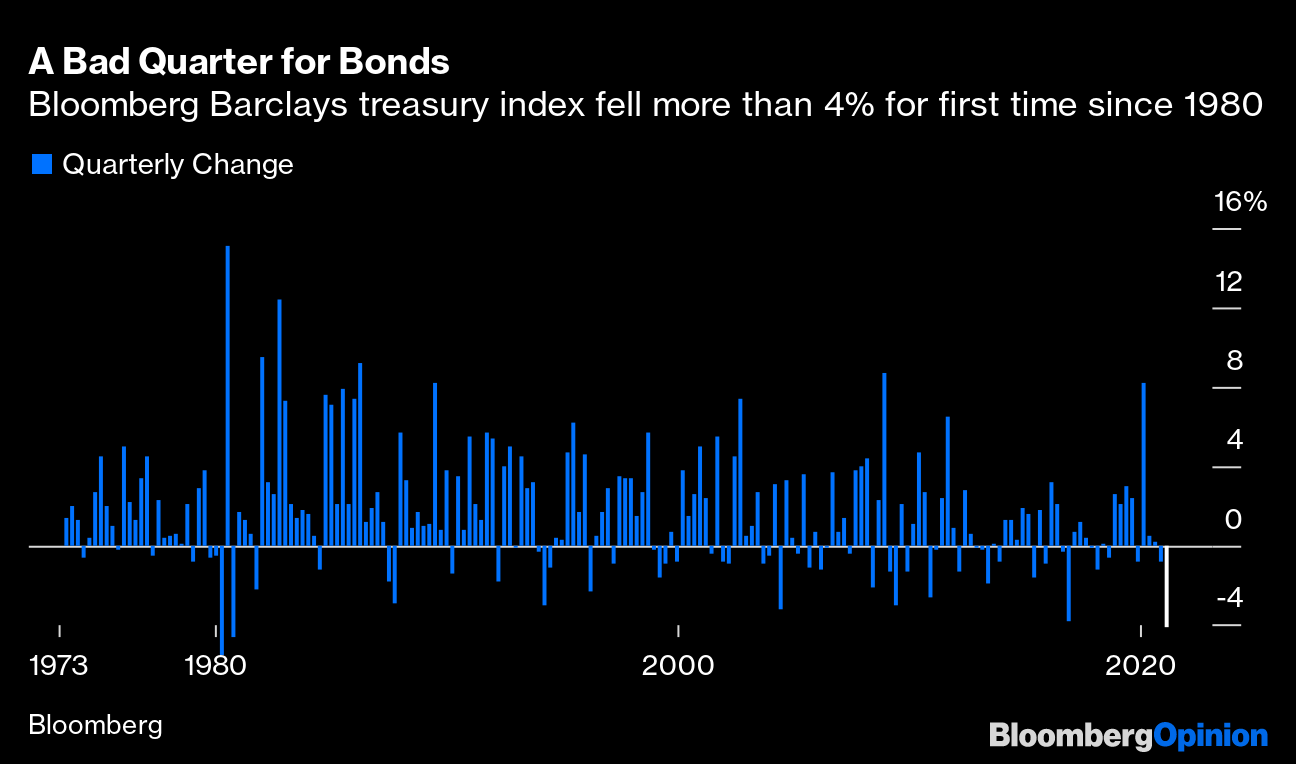
Graphic 3: Q1 2021 the worst quarter for bonds in decades, via Bloomberg
Graphic 4: Divergence in volatility across the bond and equity market.

Adding, metrics, like DIX, confirm increased buying pressure while divergences in options activity and volume delta suggest opportunistic selling.

More On DIX: For every buyer is a seller (usually a market maker). Using DIX — which is derived from short sales (i.e., liquidity provision on the market-making side) — we can measure buying pressure.

Volume Delta: Buying and selling power as calculated by the difference in volume traded at the bid and offer.
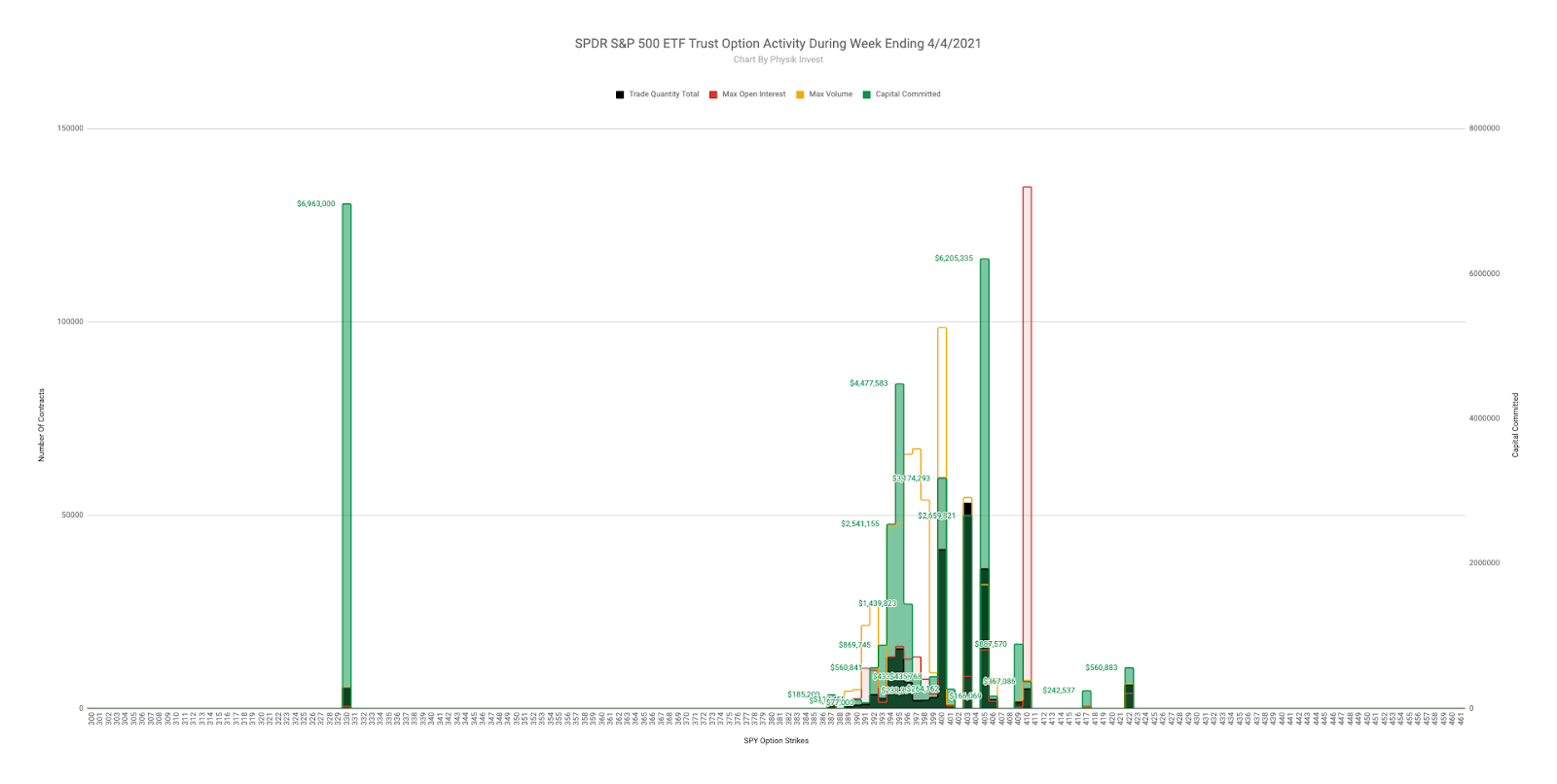
Graphic 5: Physik Invest maps out the purchase of call and put options in the SPDR S&P 500 ETF Trust (NYSE: SPY), for the week ending April 4, 2021. Activity in the options market was primarily concentrated in short- and long-dated tenors, in strikes as low as $330, which corresponds with $3,300 in the cash-settled S&P 500 Index (INDEX: SPX).

What To Do: In the coming sessions, participants will want to pay attention to where the S&P 500 trades in relation to Thursday’s end-of-day spike higher.

More On Spikes: Spike’s mark the beginning of a break from value. Spikes higher (lower) are validated by trade at or above (below) the spike base (i.e., the origin of the spike).

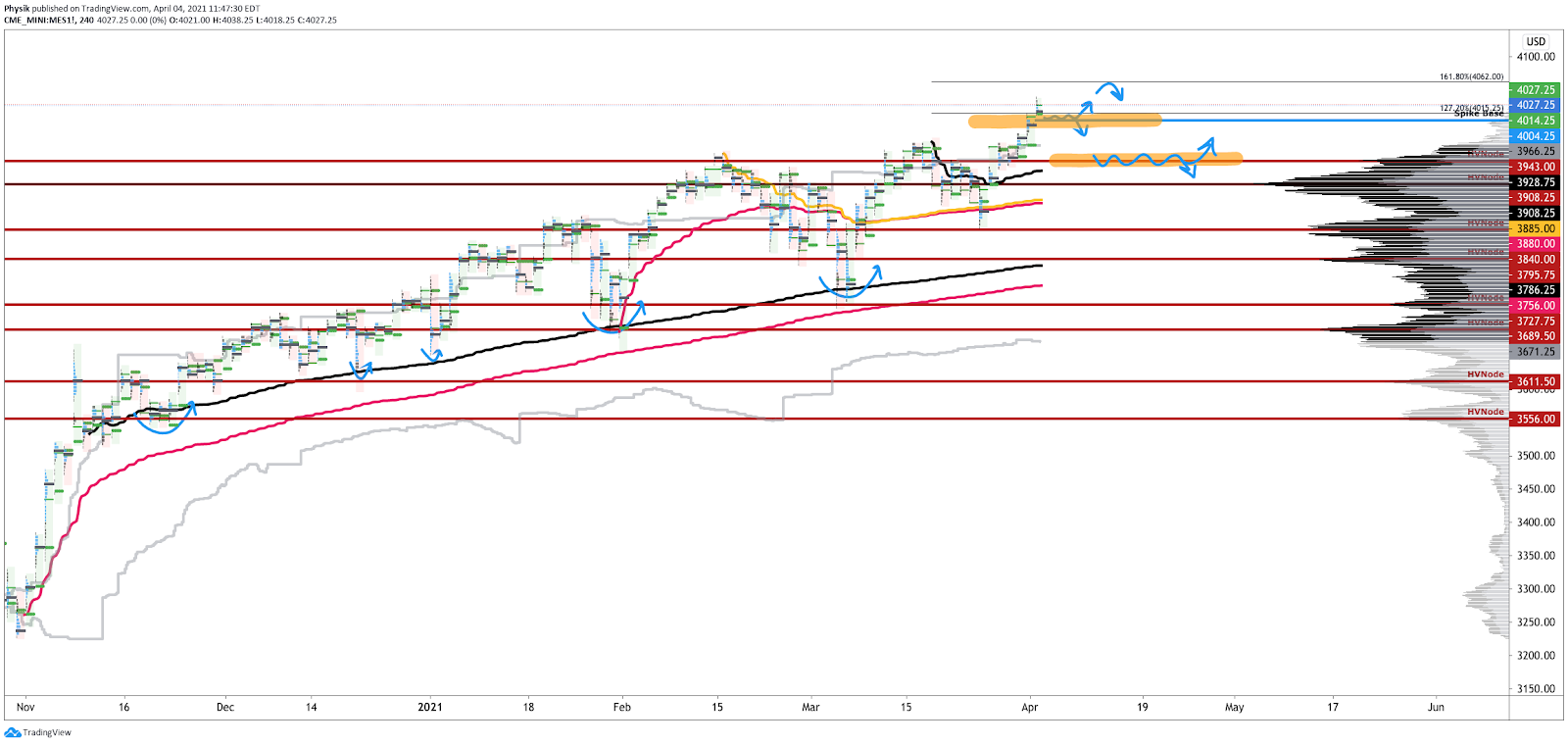
In the best case, the S&P 500 remains above the $4,004.25 spike base. Doing so means that the participants are finding higher prices, above the VWAP anchored from the March 17 rally-high, valuable (i.e., buyers, on average, are in control and winning since the March 17 rally-high).

More On Volume-Weighted Average Prices (VWAPs): A metric highly regarded by chief investment officers, among other participants, for quality of trade. Additionally, liquidity algorithms are benchmarked and programmed to buy and sell around VWAPs. 

In the case of higher prices, given that the $4,015.25 price extension was achieved in after-market trade that established an overnight high at $4,038.25, participants can target the $4,062.00 extension.

More On Overnight Rally Highs (Lows): Typically, there is a low historical probability associated with overnight rally-highs (lows) ending the upside (downside) discovery process.

Any activity below the $4,004.25 spike base puts the rally on hold and calls for balance or digestion of higher prices.

Balance (Two-Timeframe Or Bracket): Rotational trade that denotes current prices offer favorable entry and exit. Balance-areas make it easy to spot a change in the market (i.e., the transition from two-time frame trade, or balance, to one-time frame trade, or trend).

In the case of lower prices, participants can look to whether a test of the $3,943.00 and $3,908.25 high-volume areas (HVNodes) solicit a response.

More On Volume Areas: A structurally sound market will build on past areas of high-volume (HVNode). Should the market trend for long periods of time, it will lack sound structure (identified as a low-volume area (LVNode) which denotes directional conviction and ought to offer support on any test). 

If participants were to auction and find acceptance into areas of prior low-volume, then future discovery ought to be volatile and quick as participants look to areas of high volume for favorable entry or exit.
Graphic 6: 4-hour profile chart of the Micro E-mini S&P 500 Futures.

Conclusions: The go/no-go level for next week’s trade is $4,004.25.

Any activity above this level confirms the bullishness of last Thursday’s end-of-day spike. 

Levels Of Interest: $4,004.25 Spike Base.

Cover photo by Taryn Elliott from Pexels.

Categories
Commentary

Market Commentary For The Week Ahead: ‘Down, Then Up’

Key Takeaways:

What Happened: U.S. stock index futures closed higher, last week.

What Does It Mean: In the face of stretched sentiment and positioning — a heightened appetite for risk — investors shifted their focus from the risks of rapidly rising inflation to the increasing pace of COVID-19 coronavirus vaccinations and a rebound in economic activity.

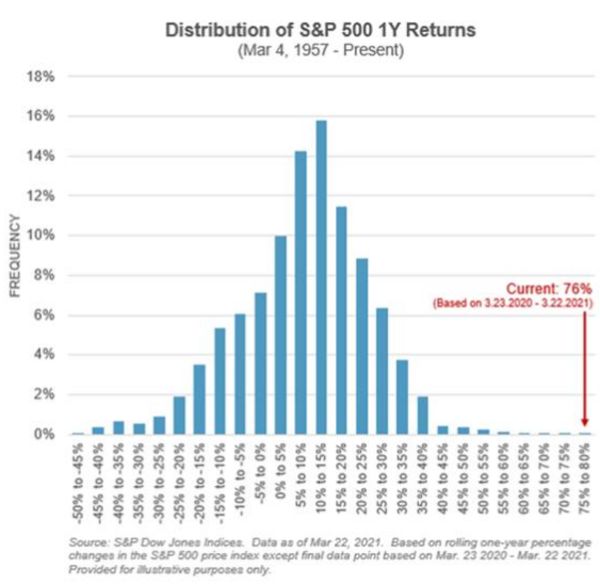
This comes after an outlier 2020; the distribution of S&P 500 1-year returns was ‘unexpected,’ sitting in the far end of the right tail.

Graphic 1: Distribution of S&P 500 1-Year Returns via Bloomberg

Adding, according to S&P Global Ratings, concerns over inflation appear “overblown and [] orderly reflation, around a return to sustainable growth, is a healthy development for both macro and credit outcomes.”

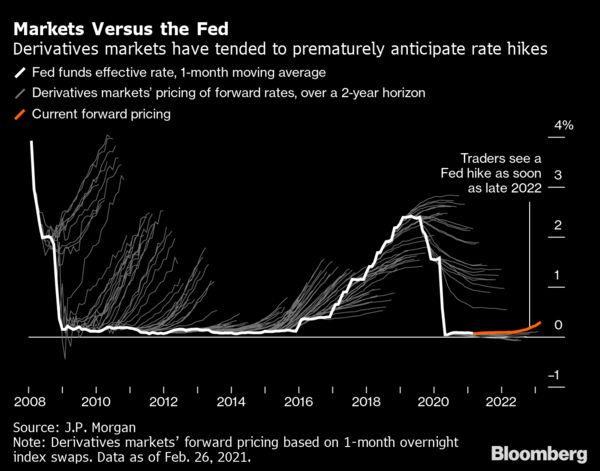
This notion is further validated by history; according to Bloomberg, “Since 2008, markets have consistently priced in a more aggressive path of Fed rate hikes than what ultimately happened. Consider the situation in late 2008: traders were already bracing for several hikes in the years ahead, according to data crunched by JPMorgan Chase & Co. (NYSE: JPM), but policy makers held off on tightening until 2015.”

Due to this mispricing, traders are behind the curve when the Fed finally hikes. Between 2017, through 2018, traders were scrambling to keep up with the Fed’s seven hikes.

Graphic 2: Bloomberg maps out the pricing in of Federal Reserve rate hikes.

“The market has its pricing and perceptions, and what happens can differ from that and has,” Alex Roever, head of U.S. rates strategy at JPMorgan, told Bloomberg News. The market has been testing the Fed by “trying to push further forward the first hike. But Fed officials don’t seem to be having any of it.”

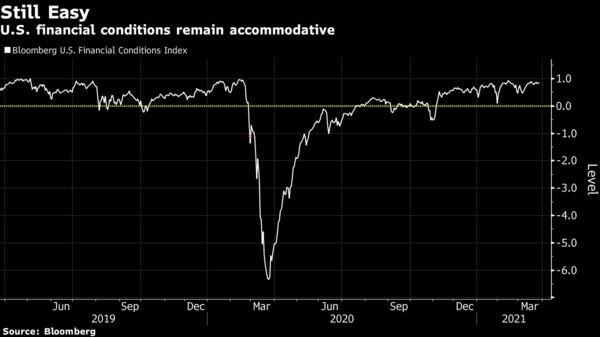
The Fed’s hesitancy to change its stance is warranted; broadly speaking, financial conditions haven’t budged. 

Graphic 3: U.S. financial conditions appear accommodative, via Bloomberg

Analysts at S&P Global Ratings put it best: “Our bottom line is that orderly reflation is, on balance, a healthy development for macro and credit outcomes. This narrative implies that moderate demand and wage pressures have reemerged after a lost decade and that the interest rate structure has the potential to return to more normal levels. While there will inevitably be some market adjustments as credit is repriced, this will lead to better outcomes.”

A natural evolution — trend in rates toward normalcy — would provide monetary authorities ammunition in another downturn, and price credit in a way that rebalances the natural supply and demand dynamics of the market (i.e., non-productive firms are forced out of business).

What To Expect: Directional resolve.

Why? During prior trade, participants lacked conviction. This is evidenced by a failure, by participants, to introduce excess (e.g., tails or range expansion past historical turning points) in the S&P 500.

More On Excess: A proper end to price discovery; the market travels too far while advertising prices. Responsive, other-timeframe (OTF) participants can aggressively enter the market, leaving tails or gaps which denote unfair prices.

Adding, metrics, like DIX, suggest increased buying pressure. This comes after what appears to have been opportunistic buying or short covering into weakness, and some bearish trades in the cash-settled S&P 500 Index (INDEX: SPX), among other products like Chinese technology stocks and U.S. media companies. 

More On DIX: For every buyer is a seller (usually a market maker). Using DIX — which is derived from short sales (i.e., liquidity provision on the market making side) — we can measure buying pressure.
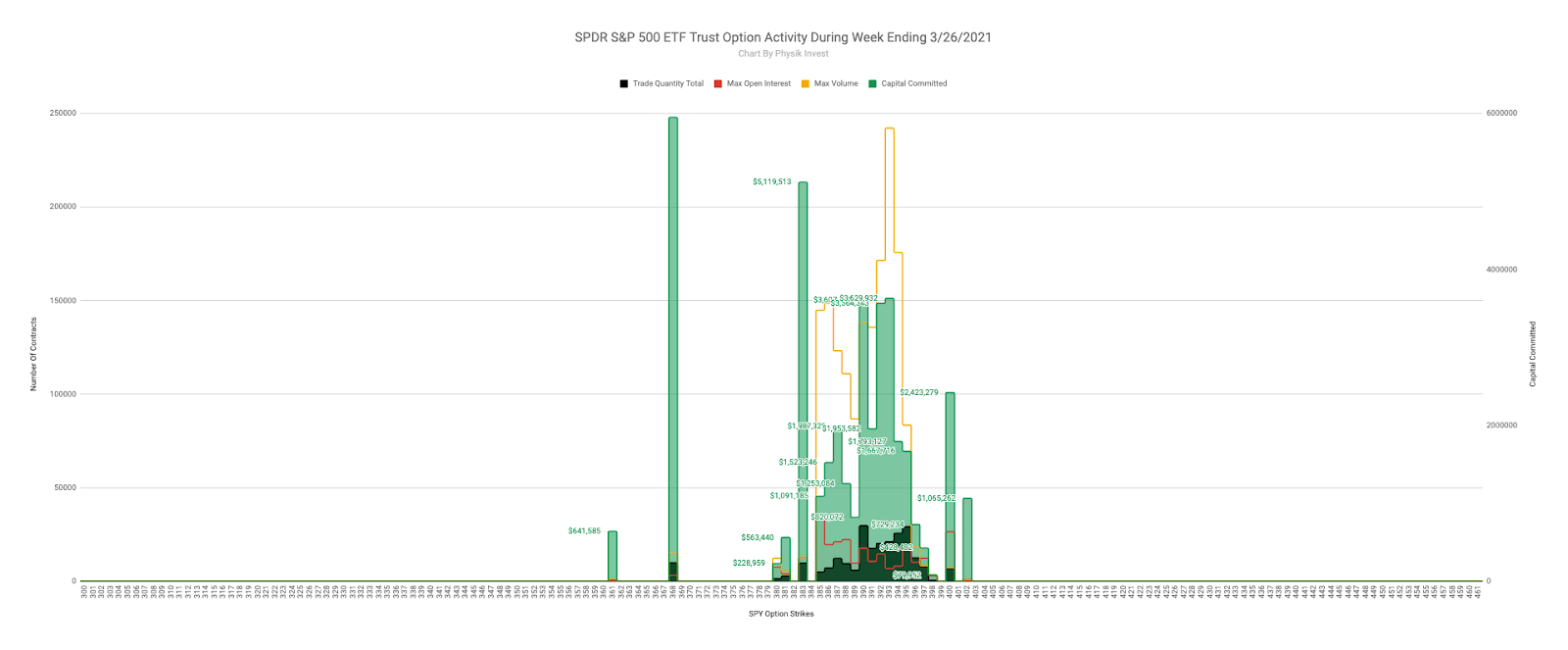
Graphic 4: Physik Invest maps out the purchase of call and put options in the SPDR S&P 500 ETF Trust (NYSE: SPY), for the week ending March 26, 2021. Activity in the options market was primarily concentrated in short- and long-dated tenors, in strikes as low as $361, which corresponds with $3,610 in the cash-settled S&P 500 Index (INDEX: SPX).

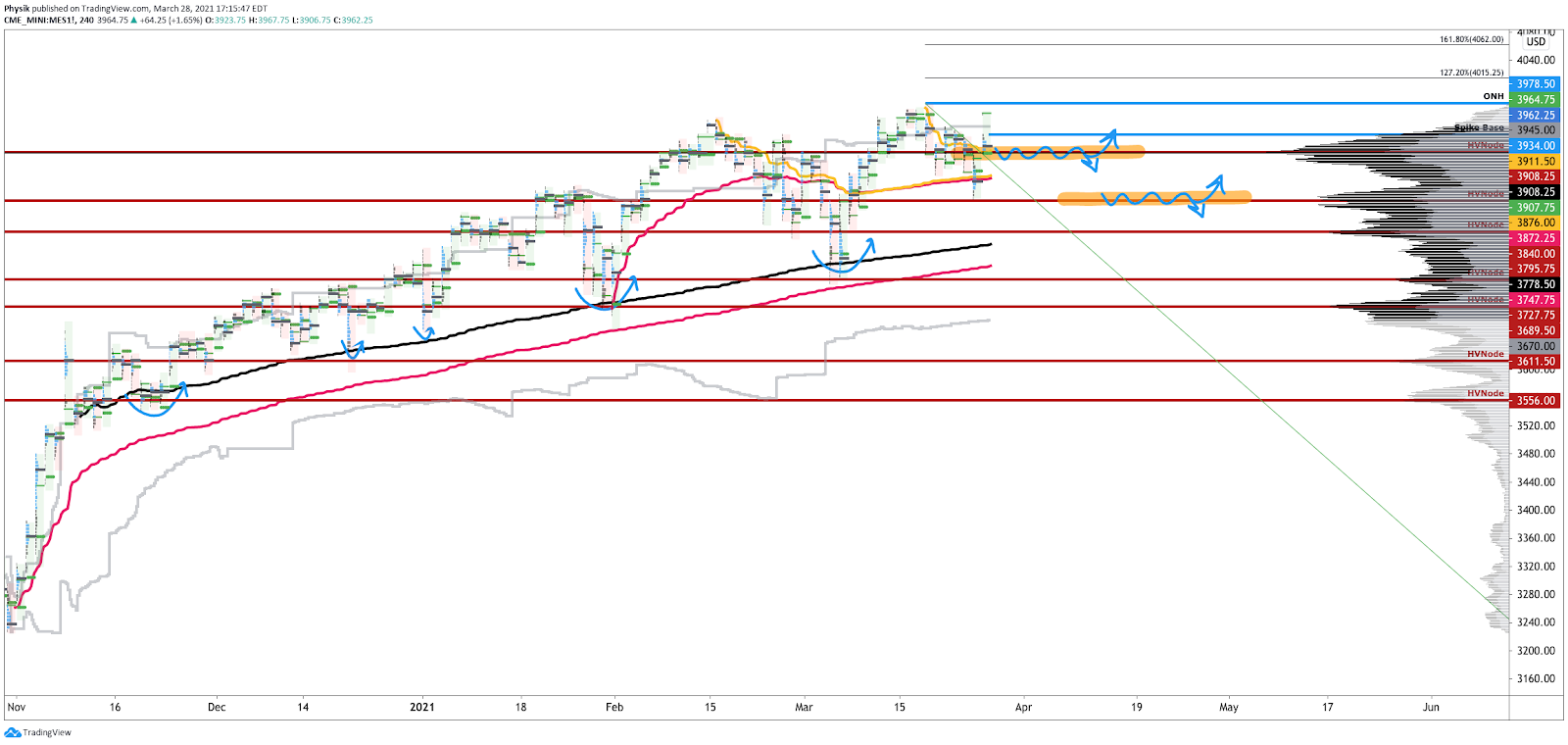
What To Do: In the coming sessions, participants will want to pay attention to where the S&P 500 trades in relation to Friday’s end-of-day spike higher, which was likely the result of hedging.

More On Spikes: Spike’s mark the beginning of a break from value. Spikes higher (lower) are validated by trade at or above (below) the spike base (i.e., the origin of the spike).

In the best case, the S&P 500 remains above the $3,934.00 spike base, taking out Friday’s minimal excess high. Doing so means that the participants are finding higher prices, above the VWAP anchored from the March 17 rally-high, valuable (i.e., buyers, on average, are in control and winning since the March 17 rally-high).

More On Volume-Weighted Average Prices (VWAPs): A metric highly regarded by chief investment officers, among other participants, for quality of trade. Additionally, liquidity algorithms are benchmarked and programmed to buy and sell around VWAPs. 

In case of higher prices, participants can target the $3,978.50 overnight rally-high, as well as the $4,015.25 and $4,062.00 price extensions.

More On Overnight Rally Highs (Lows): Typically, there is a low historical probability associated with overnight rally-highs (lows) ending the upside (downside) discovery process.

Any activity below the VWAP anchored from the $3,978.50 peak may (1) leave the $3,900.00 HVNode as an area of supply, offering initiative sellers favorable entry and responsive buyers favorable exit.

More On Volume Areas: A structurally sound market will build on past areas of high-volume (HVNode). Should the market trend for long periods of time, it will lack sound structure (identified as a low-volume area (LVNode) which denotes directional conviction and ought to offer support on any test). 

If participants were to auction and find acceptance into areas of prior low-volume, then future discovery ought to be volatile and quick as participants look to areas of high-volume for favorable entry or exit.
Graphic 5: 4-hour profile chart of the Micro E-mini S&P 500 Futures.

Conclusions: The go/no-go level for next week’s trade is $3,934.00.

Any activity above this level confirms the bullishness of last Friday’s end-of-day spike. 

Levels Of Interest: $3,934.00 Spike Base.

Cover photo by Min An from Pexels

Categories
Commentary

Market Commentary For The Week Ahead: ‘Green Shoots’

Notice: Physik Invest’s daily market commentaries will be suspended until further notice.

Please accept our apologies for the inconvenience, thank you for the support, and see you next week!

Key Takeaways:

What Happened: U.S. stock index futures closed lower, last week.

What Does It Mean: Heading into last week’s Federal Reserve policy update, stock index futures were in balanced, two-sided trade as participants looked for more information to base their next move. 

Then, Federal Reserve Chairman Jerome Powell discussed his organization’s commitment to an inclusive recovery. At the same time, the central bank announced it expects real GDP to grow 6.5% and inflation to rise as high as 2.4% this year.

The comments were immediately followed by a vertical price rise.

Thereafter, participants that caused the vertical price rise traded out, evidenced by the index trading lower into Friday’s derivative expiry.

Important to note is that despite the attempted pricing in of rising debt levels and inflation, a divergence in bond and equity market volatility persists. Historically, fear across markets tends to move in tandem. That hasn’t been the case for a number of weeks, now (e.g., Graphic 1).

Graphic 1: Divergence in volatility across the bond and equity market. 

What To Expect: Directional resolve.

Why? The passage of a large derivative expiry, the resolve of the vertical price range that occurred in the face of Federal Reserve policy updates, as well as market liquidity metrics suggesting opportunistic buying or short covering into weakness, and increased buying pressure (as witnessed through measures like DIX and options activity).

More On DIX: For every buyer is a seller (usually a market maker). Using DIX — which is derived from short sales (i.e., liquidity provision on the market making side) — we can measure buying pressure.

More On Option Expiration (OPEX): Option expiries mark an end to pinning (i.e, the theory that market makers and institutions short options move stocks to the point where the greatest dollar value of contracts will expire worthless) and the reduction dealer gamma exposure.
Graphic 2: Physik Invest maps out the purchase of call and put options in the SPDR S&P 500 ETF Trust (NYSE: SPY), for the week ending March 19, 2021. Activity in the options market was primarily concentrated in short- and long-dated tenors, in strikes as high as $435, which corresponds with $4,350.00 in the cash-settled S&P 500 Index (INDEX: SPX).
Graphic 3: Index option traders add to call buying and put selling, a bullish dynamic. 

What To Do: In the coming sessions, participants will want to pay attention to the VWAP anchored from the $3,978.50 overnight rally-high, as well as the high-volume area (HVNode) near $3,900.00.

Volume-Weighted Average Prices (VWAPs): Metrics highly regarded by chief investment officers, among other participants, for quality of trade. Additionally, liquidity algorithms are benchmarked and programmed to buy and sell around VWAPs.

More On Volume Areas: A structurally sound market will build on past areas of high-volume (HVNode). Should the market trend for long periods of time, it will lack sound structure (identified as a low-volume area (LVNode) which denotes directional conviction and ought to offer support on any test). 

If participants were to auction and find acceptance into areas of prior low-volume, then future discovery ought to be volatile and quick as participants look to areas of high-volume for favorable entry or exit.

More On Overnight Rally Highs (Lows): Typically, there is a low historical probability associated with overnight rally-highs (lows) ending the upside (downside) discovery process.

In the best case, the S&P 500 remains above the $3,900.00 volume area, and VWAP anchored from the $3,978.50 peak, taking out Friday’s minimal excess high. This would suggest buyers, on average, are in control and winning since the March 17 rally-high.

More On Excess: A proper end to price discovery; the market travels too far while advertising prices. Responsive, other-timeframe (OTF) participants aggressively enter the market, leaving tails or gaps which denote unfair prices.

Any activity below the VWAP anchored from the $3,978.50 peak may (1) leave the $3,900.00 HVNode as an area of supply, offering initiative sellers favorable entry and responsive buyers favorable exit.

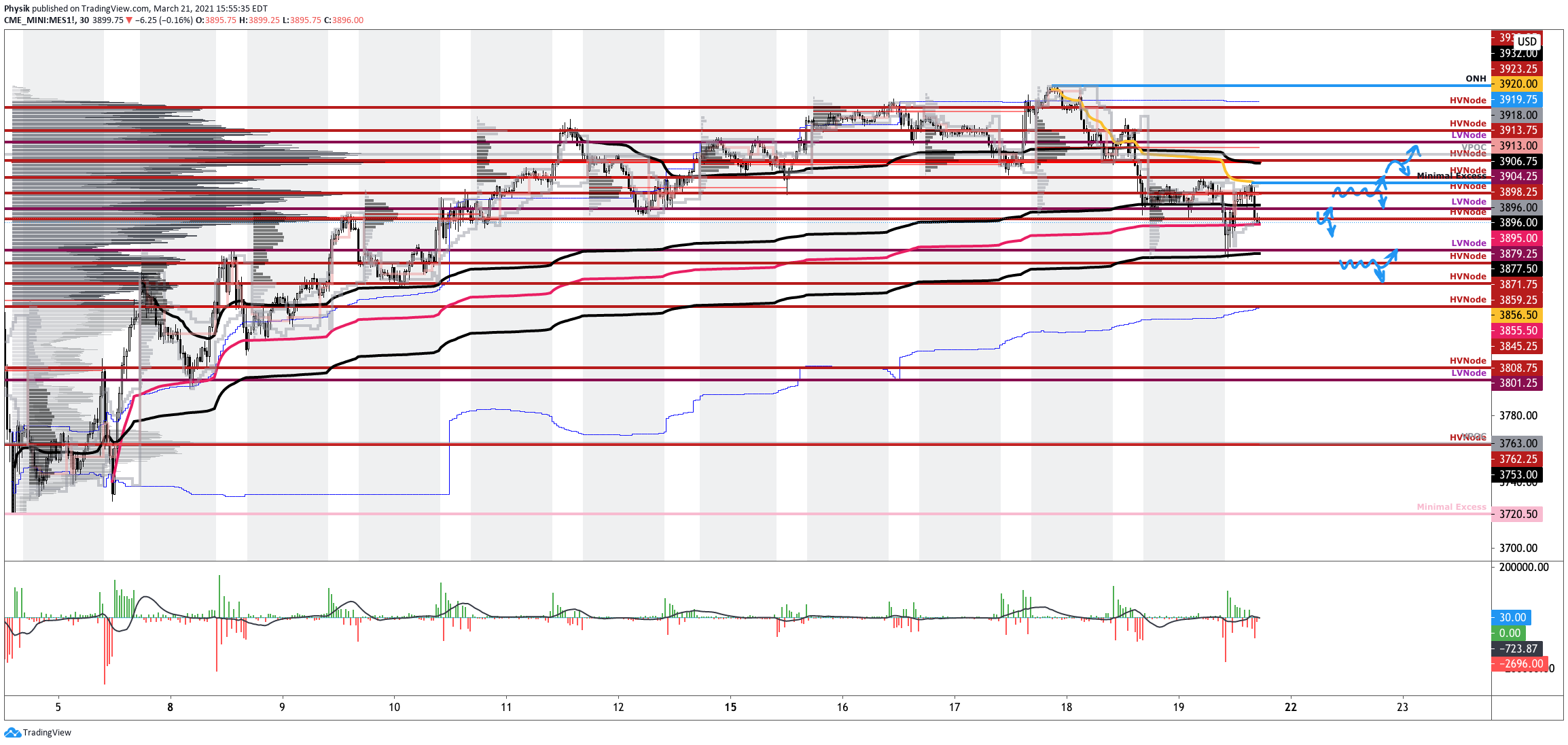
Graphic 4: Profile overlays on a 30-minute candlestick chart of the Micro E-mini S&P 500 Futures.
Graphic 5: 4-hour profile chart of the Micro E-mini S&P 500 Futures.

Conclusions: The go/no-go level for next week’s trade is $3,900.00.

Any activity at this level suggests market participants are looking for more information to base their next move. Anything above (below) this level increases the potential for higher (lower).

Levels Of Interest: $3,900.00 HVNode.

Photo by Ylanite Koppens from Pexels.

Categories
Commentary

Market Commentary For The Week Ahead: ‘Mostly Sunny’

Key Takeaways:

  • $1.9T relief package is enacted.
  • Inflation to print past Fed goal.
  • Policy actions to limit volatility.
  • Potential for late-March selling.
  • Bond, equity volatility diverged.
  • U.S. to lead economic recovery.

What Happened: U.S. stock index futures closed higher, last week.

This came alongside (1) the enactment of a massive, $1.9 trillion coronavirus relief plan, (2) convergence in the 10-year Treasury rate and S&P 500 dividend yield, as well as (3) a material divergence in bond and equity market volatility.

What Does It Mean: The pandemic disrupted the global economy, hitting the hardest airlines, leisure facilities, energy, manufacturing, and restaurants, among other industries.

The stock market tumbled, as a result, and the subsequent recovery was lead by technology, which delivered its strongest annual average return since the Global Financial Crisis (GFC).

Now, as virus case counts fall, the pace of vaccinations accelerates, and massive coronavirus relief bills are passed, shares of stocks in beaten-down industries are becoming favorites.

This reopening trade, as it’s called, comes alongside projections the U.S. will lead the 2021 global economic recovery.

Amidst the bullishness, the yield on a 10-year Treasury, a risk-free asset, which was — per Axios — “artificially depressed by the flight-to-quality trade during the coronavirus pandemic, as well as by large-scale purchases by the Federal Reserve,” converged with S&P 500’s dividend yield. 

Graphic 1: Goldman Sachs Group Inc (NYSE: GS) projects yields to rise and the curve to steepen.

Typically, the S&P 500’s dividend yield is less than the risk-free rate because investors expect to earn less in dividends than they would holding the same amount in bonds, absent rising stock prices.

Values are derived using the discounted cash flow calculation; as interest and discount rates go up, the present value of future earnings goes down, which will drag stock prices, especially in growth categories, as evidenced by the Nasdaq-100’s relative weakness.

Graphic 2: Nordea Group expects inflation to print above the Federal Reserve’s target, soon.

Still, historically speaking, rising yields aren’t that harmful. Looking as far back as the 1960s, there are 13 periods in which the yield on a 10-year Treasury rose by at least 1.5%.

“In nearly 80% (10 of 13) of the prior periods, the S&P 500 Index posted gains as rates rose, as it has so far in the current rising-rate period,” a statement by LPL Financial said. “In fact, the average yearly gain for the index during the previous rising-rate periods, at 6.4%, is just a little lower than the historical average over the entire period of 7.1%, while rising rates have been particularly bullish for stocks since the mid-1990s.”

Further, despite an attempted pricing in of rising debt levels and inflation, a divergence in bond and equity market volatility persists.

Historically, fear across markets tends to move in tandem. That’s not the case today.

Graphic 3: Divergence in volatility across the bond and equity market. 

What To Expect: Balance, or two-sided trade as participants look for more information to base their next move on after last week’s rapid recovery.

Coming into the weekend, market liquidity suggested (1) buying pressure was leveling out and/or (2) buyers were absorbing resting liquidity (opportunistic selling or selling into strength), while speculative options activity was concentrated on the put-side. 

Graphic 4: Physik Invest maps out the purchase of call and put options in the SPDR S&P 500 ETF Trust (NYSE: SPY), for the week ending March 12, 2021. Activity in the options market was primarily concentrated in short- and long-dated tenors, in strikes as low as $353, which corresponds with $3,530.00 in the cash-settled S&P 500 Index (INDEX: SPX).

What To Do: In the coming sessions, participants will want to pay attention to the VWAP anchored from the $3,959.25 overnight rally-high, as well as the $3,840.00 high-volume area (HVNode).

Volume-Weighted Average Prices (VWAPs): Metrics highly regarded by chief investment officers, among other participants, for quality of trade. Additionally, liquidity algorithms are benchmarked and programmed to buy and sell around VWAPs.

More On Volume Areas: A structurally sound market will build on past areas of high-volume (HVNode). Should the market trend for long periods of time, it will lack sound structure (identified as a low-volume area (LVNode) which denotes directional conviction and ought to offer support on any test). 

If participants were to auction and find acceptance into areas of prior low-volume, then future discovery ought to be volatile and quick as participants look to areas of high-volume for favorable entry or exit.

More On Overnight Rally Highs (Lows): Typically, there is a low historical probability associated with overnight rally-highs (lows) ending the upside (downside) discovery process.

In the best case, the S&P 500 remains above the $3,840.00 volume area, and VWAP anchored from the $3,959.25 peak. This would suggest buyers, on average, are in control and winning since the February 15 rally-high.

Any activity below the VWAP anchored from the $3,959.25 peak may (1) leave the $3,840.00 HVNode as an area of supply, offering initiative sellers favorable entry and responsive buyers favorable exit.

Graphic 5: Profile overlays on a 30-minute candlestick chart of the Micro E-mini S&P 500 Futures.
Graphic 6: 4-hour profile chart of the Micro E-mini S&P 500 Futures.

Conclusions: The go/no-go level for next week’s trade is $3,840.00.

Any activity at this level suggests market participants are looking for more information to base their next move. Anything above (below) this level increases the potential for higher (lower). 

Levels Of Interest: $3,840.00 HVNode.

Photo by Aleksandar Pasaric from Pexels.

Categories
Commentary

Market Commentary For The Week Ahead: ‘Fast Moves’

Key Takeaways:

  • U.S. Senate passes a $1.9T relief package.
  • COVID vaccination timeline is sped up.
  • Equities are recipients of $12B in inflows.
  • Treasury yields aren’t at worrisome levels.
  • VIX term structure suggests no real panic.
  • Real GDP growth to be over 6% this year.

What Happened: U.S. stock index futures ended the week mixed.

This came after U.S. non-farm payrolls grew by 379,000, versus a consensus of ~180,000, improvement in sales and manufacturing data, as well as news that COVID-19 coronavirus vaccinations were accelerating.

Dynamics Unpacked: On a relative basis, the Nasdaq-100 is weaker, while the S&P 500, Russell 2000, and Dow Jones Industrial Average are stronger. This push-pull dynamic, in prior sessions, made it hard for participants to resolve directionally, evidenced by volatility.

On Friday, after an attempt by market participants to resolve lower, via a break of consolidation, stock indexes made a vicious rebound.

Why did stock indexes make a sudden reversal? Well, despite indexes being best positioned for sideways or lower trade, technically, near-term downside discovery reached its limit, based on market liquidity metrics and the inventory positioning of participants.

As stated in Friday’s morning commentary, according to SqueezeMetrics, the steepness of the GammaVol (GXV) curve suggested there was more risk to the upside than downside.

More On Gamma: Gamma is the sensitivity of an option to changes in the underlying price. Dealers that take the other side of options trades hedge their exposure to risk by buying and selling the underlying. When dealers are short-gamma, they hedge by buying into strength and selling into weakness. When dealers are long-gamma, they hedge by selling into strength and buying into weakness. The former exacerbates volatility. The latter calms volatility.
Graphic 1: SqueezeMetrics data suggested a near-term turnaround after Thursday’s violent liquidation.

Adding, also, coming into Friday’s session, market liquidity suggested (1) buying pressure was increasing and/or (2) sellers were absorbing resting liquidity (opportunistic buying or short covering into weakness), while speculative options activity was concentrated on the call-side.

In simple terms, one could argue, based on the aforementioned dynamics (e.g., speculative derivatives activity), that participants bought last week’s dip.

Graphic 2: Physik Invest maps out the purchase of call and put options in the SPDR S&P 500 ETF Trust (NYSE: SPY), for the week ending February 26, 2021. Noting activity in short- and long-dated tenors, near the $380, a strike that corresponds with $3,800.00 in the cash-settled S&P 500 Index (INDEX: SPX).

Important to note, though, is the S&P 500’s long-term trend break, prior to Friday’s dramatic reversal and higher close, as well as Friday’s divergent volume delta in ETFs that track the S&P 500, Nasdaq-100, and Russell 2000.

Graphic 3: Long-term uptrend in the cash-settled S&P 500 Index (INDEX: SPX) was broken.
More On Volume Delta: Buying and selling power as calculated by the difference in volume traded at the bid and offer.

What To Expect: Directional resolve and volatility, given news that the U.S. Senate, on Saturday, passed President Joe Biden’s $1.9 trillion COVID-19 coronavirus relief plan, as well as the (2) short-gamma (Graphic 4) environment (i.e, volatility is exacerbated due to dealer hedging requirements), as mentioned in the prior section.

Graphic 4: SpotGamma data suggests Nasdaq-100, the weakest index discussed in this commentary, is below the “Short-Gamma” juncture.

What To Do: In the coming sessions, participants will want to pay attention to the VWAP anchored from the $3,959.25 peak, the $3,720.50 minimal excess low, as well as the $3,837.75 high-volume area (HVNode).

Volume-Weighted Average Prices (VWAPs): Metrics highly regarded by chief investment officers, among other participants, for quality of trade. Additionally, liquidity algorithms are benchmarked and programmed to buy and sell around VWAPs.

More On Excess: A proper end to price discovery; the market travels too far while advertising prices. Responsive, other-timeframe (OTF) participants aggressively enter the market, leaving tails or gaps which denote unfair prices.

More On Volume Areas: A structurally sound market will build on past areas of high-volume (HVNode). Should the market trend for long periods of time, it will lack sound structure (identified as a low-volume area (LVNode) which denotes directional conviction and ought to offer support on any test). 

If participants were to auction and find acceptance into areas of prior low-volume, then future discovery ought to be volatile and quick as participants look to areas of high-volume for favorable entry or exit.

In the best case, the S&P 500 opens and remains above the $3,837.75 volume area. Auctioning above the VWAP anchored from the $3,959.25 peak would suggest buyers, on average, are in control and winning since the February 15 rally high.

In such a case, participants can look to the $3,892.75 HVNode for favorable entry and exit, the $3,934.25 profile ledge, and $3,959.25 overnight rally-high.

More On Ledges: Flattened area on the profile which suggests responsive participants are in control, or initiative participants lack confidence to continue the discovery process. The ledge will either hold and force participants to liquidate (cover) their positions, or crack and offer support (resistance).

More On Overnight Rally Highs (Lows): Typically, there is a low historical probability associated with overnight rally-highs (lows) ending the upside (downside) discovery process.

Any activity below the VWAP anchored from the $3,959.25 peak may leave the $3,837.75 HVNode as an area of supply — offering initiative sellers favorable entry and responsive buyers favorable exit.

In such a case, participants can look to other areas of high-volume (i.e., $3,795.75 and $3,727.75) for favorable entry and exit, as well as the repair of the $3,720.50 minimal excess low.

Graphic 5: Profile overlays on a 65-minute candlestick chart of the Micro E-mini S&P 500 Futures.
Graphic 6: 4-hour chart of the Micro E-mini S&P 500 Futures.

Conclusions: The go/no-go level for next week’s trade is $3,837.75.

Any activity at this level suggests market participants are looking for more information to base their next move. Anything above (below) this level increases the potential for higher (lower). 

Levels Of Interest: $3,837.75 HVNode.

Cover photo by Chris Peeters from Pexels.