Categories
Commentary

Weekly Brief For April 25, 2021

Happy Sunday! Markets were choppy, ending the week unchanged. This came alongside talk of central bank tapering and an evolution in fiscal policy.

The following commentary on U.S. broad market equity indices will discuss what happened, why it matters, what to expect, and how participants can position themselves for the coming week.

But first, here’s a quote from Adam Funds CEO, Mark E. Stoeckle:

“To try to guess that this is the right time to be out of the market, you may as well go to Las Vegas.”

Market Commentary

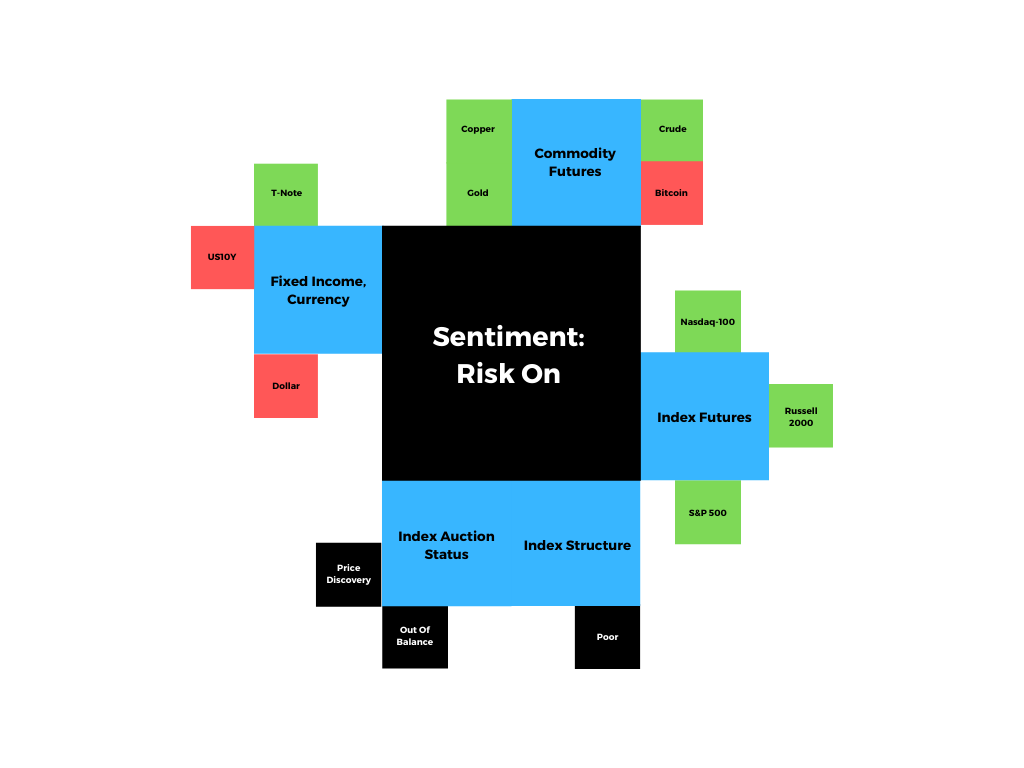
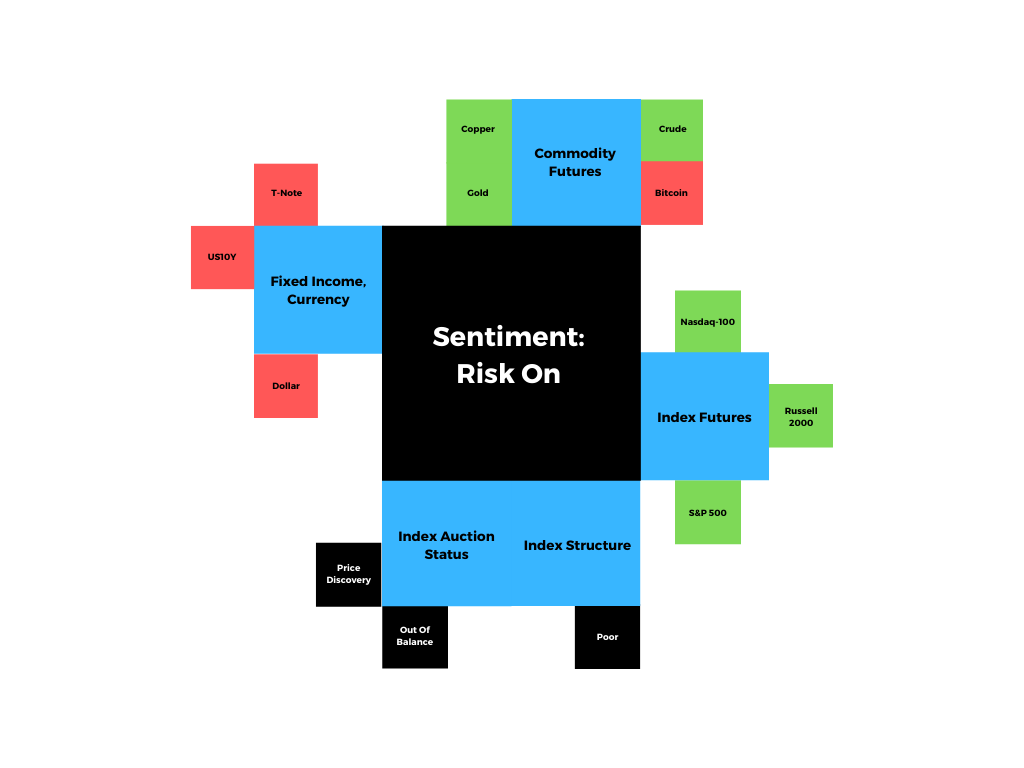
What Happened: The S&P 500, Nasdaq 100, Russell 2000, and Dow Jones Industrial Average closed the week out basing, pricing in new information for the next directional move.

  • All talk and no action from policy leaders, creators.
  • Ahead: Fed meeting, GDP and Sentiment, earnings.
  • Markets balancing, position for directional resolve.
Updated: 10:30 AM EST

Why It Matters: The sideways action during last week’s trade came after a lengthy run, higher.

The S&P 500, in particular, from its March 4 low, is up nearly 13%.

Moreover, just because something is high, doesn’t mean it must come crashing down. To put this into perspective, here’s a quote from Jeff deGraaf, co-founder at Renaissance Macro Research: “Overbought/oversold conditions are useless without first defining the underlying trend of the market.”

So, with that, in maintaining objectivity, we zoom out and ask a few questions: 

  1. Where are we in relation to the prior week’s range? Overlapping, but slightly higher. 
  2. Is the market’s attempt to go in a certain direction supported? Yes, value, defined by the area where 70% of prior trade (i.e., 1 standard deviation) is conducted, is following price.
  3. Is the technical and fundamental narrative supportive of current prices? Technically, the market is in an extended uptrend, but recent activity suggests a validation of higher prices. Fundamentally, the topics of monetary and fiscal tightening have investors worried.

Now, in determining whether to change equity market exposure, we zoom closer in and analyze the risks at hand. 

The Bank of Canada, ahead of other central banks, in light of increased growth and inflation forecasts, cut its bond-purchase target and suggested an increased potential to hike rates earlier than expected.

This is an interesting development. The Federal Reserve, too, last week announced the U.S. economy would see higher inflation, but Chair Jerome Powell expressed the institution’s commitment to limiting any overshoot.

Why the change in tone? Here’s Janus Henderson’s portfolio manager Jay Sivapalan’s take.

“We’ve got inflated asset prices in equities, house prices, and infrastructure, how do you normalize that? You need revenue growth and you need inflation … [b]ut at some point in the future, growth may need to be traded off for financial stability.”

In simpler terms, with prolonged periods of low interest rates and debt expansion, market participants are incentivized to take risks. This is how destabilizing factors begin to brew.

“The growth of structured products, passive investing, the regulatory standpoint that’s been implemented with Dodd-Frank and dealers needing to hedge off their risk more frequently than not” are all part of a regime change that’s affected the stability of markets, said Sidial Kris Sidial, a former institutional trader and the co-chief investment officer of The Ambrus Group, a volatility arbitrage fund that looks to exploit changing market structure dynamics.

Here’s an image to help visualize some of what Sidial is referring to.
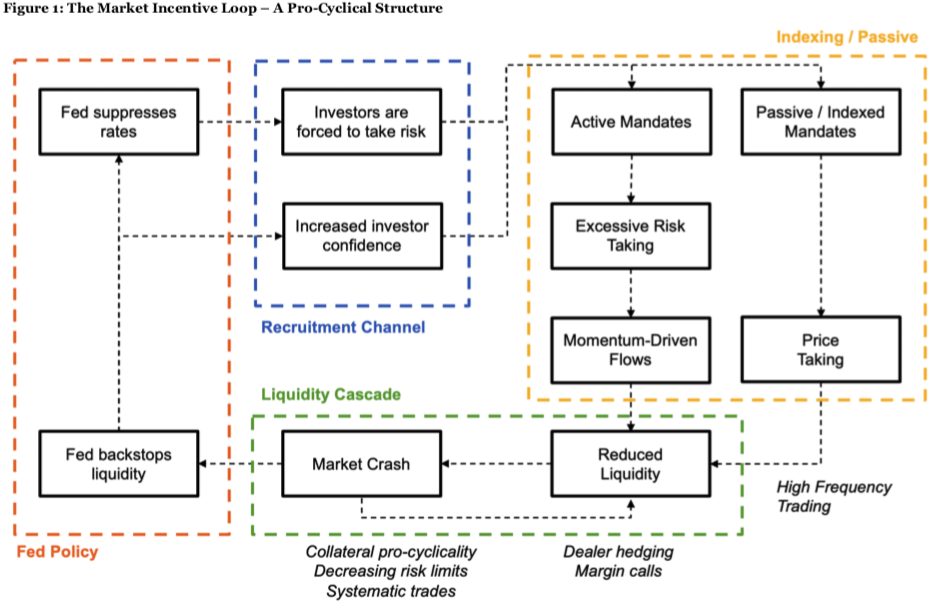
Pictured: Newfound Research unpacks market drivers, implications of liquidity.

Also, this week, the White House expressed its desire to raise the federal capital gains tax (CGT) rate to 43.4% for wealthy individuals. Despite the market selling on the news, all losses were recouped prior to the end of the week. Why? As Goldman Sachs Group (NYSE: GS) sees it, Congress is likely to settle on a more modest increase, less than 30%.

Adding, as Bloomberg’s John Authers notes: “The way the market handled the last major CGT increase, at the end of 2012, is instructive. As it grew clear that higher capital gains taxes were coming, the S&P 500 languished and went sideways for the last few months of the year, closing roughly where it had been in March. Then 2013 turned out to be a great year; stocks started their rally at the beginning of January and never really stopped.”

So, if a CGT hike is already being discounted by the market, given Friday’s rapid recovery — which also has something to do with how participants are positioned, but that conversation is beyond the scope of this commentary — then why are some of the largest exchange-traded funds seeing outflows?

In particular, the Invesco QQQ Trust Series 1 (NASDAQ: QQQ) bled nearly $6 billion over the last week, the worst exodus since the dot-com era of 2000.

Graphic: The advance/decline line (A/D), an indicator of breadth, is diverging from Nasdaq-100 prices, via MarketInOut. This dynamic has not presented itself in other broad market indices this commentary covers. 

One explanation: “With earning season starting to heat up, especially for the tech sector next week, it is likely that the expectations for technology companies may be too high,” said James Pillow, managing director at Moors & Cabot Inc. “It’s early still, but just look where the earnings surprises are coming from: materials, energy, and financials, all about 80% or higher. Money will follow performance — and the performance is coming from those sectors.”

So, in summarizing this section, technically, the market is bullish, supported by a healthy rotation.

Fundamentally, though, clouds are forming. Participants are adding shifts in tone, by policymakers, into their narrative. Should fundamental conditions change markedly, odds of a technical breakdown in momentum increase substantially.

Till then, the market is flashing green lights. Any correction may offer participants favorable entry.

What To Expect: An increased potential to correct in time, rather than price.

In addition, metrics, like market liquidity and speculative derivatives activity, confirm participants’ bullishness and opportunistic hedging ahead of an acceleration in the global restart and a turn in flows, the result of an increasingly apparent shift in consumer preferences, from saving and investing to spending.

Graphic: SHIFT search suggests participants are still not as inclined to add call-side exposure, through the month of May, in the cash-settled S&P 500 Index (INDEX: SPX).

What To Do: In the coming sessions, participants will want to pay attention to where the S&P 500 trades in relation to its $4,186.75-$4,110.50 balance area. 

Balance (Two-Timeframe Or Bracket): Rotational trade that denotes current prices offer favorable entry and exit. Balance-areas make it easy to spot change in the market (i.e., the transition from two-time frame trade, or balance, to one-time frame trade, or trend).

Any activity above (below) the balance-area high suggests participants are interested in discovering higher (lower) prices. Any activity within the balance area suggests participants are looking for more information to base their next move; in such case, responsive buying and selling is the course of action. 

Responsive Buying (Selling): Buying (selling) in response to prices below (above) area of recent price acceptance.

Initiative trade below the balance-area low suggests an inclination by participants to revert to the mean and repair some of the poor structure left behind prior discovery. Initiative trade above the balance area puts in play the cluster of price extensions at and above $4,200.00, typical price targets based on Fibonacci principles.

Initiative Buying (Selling): Buying (selling) within or above (below) previous price acceptance.

So, in the best case, the S&P 500 makes an attempt to balance or discover prices as high as $4,300.00. In the worst case, participants look to auction the S&P 500 into prior poor structures and low-volume areas (LVNodes) that ought to offer little-to-no support.

More On Volume Areas: A structurally sound market will build on past areas of high-volume (HVNode). Should the market trend for long periods of time, it will lack sound structure (identified as a low-volume area (LVNode) which denotes directional conviction and ought to offer support on any test). 

If participants were to auction and find acceptance into areas of prior low-volume, then future discovery ought to be volatile and quick as participants look to areas of high volume for favorable entry or exit.
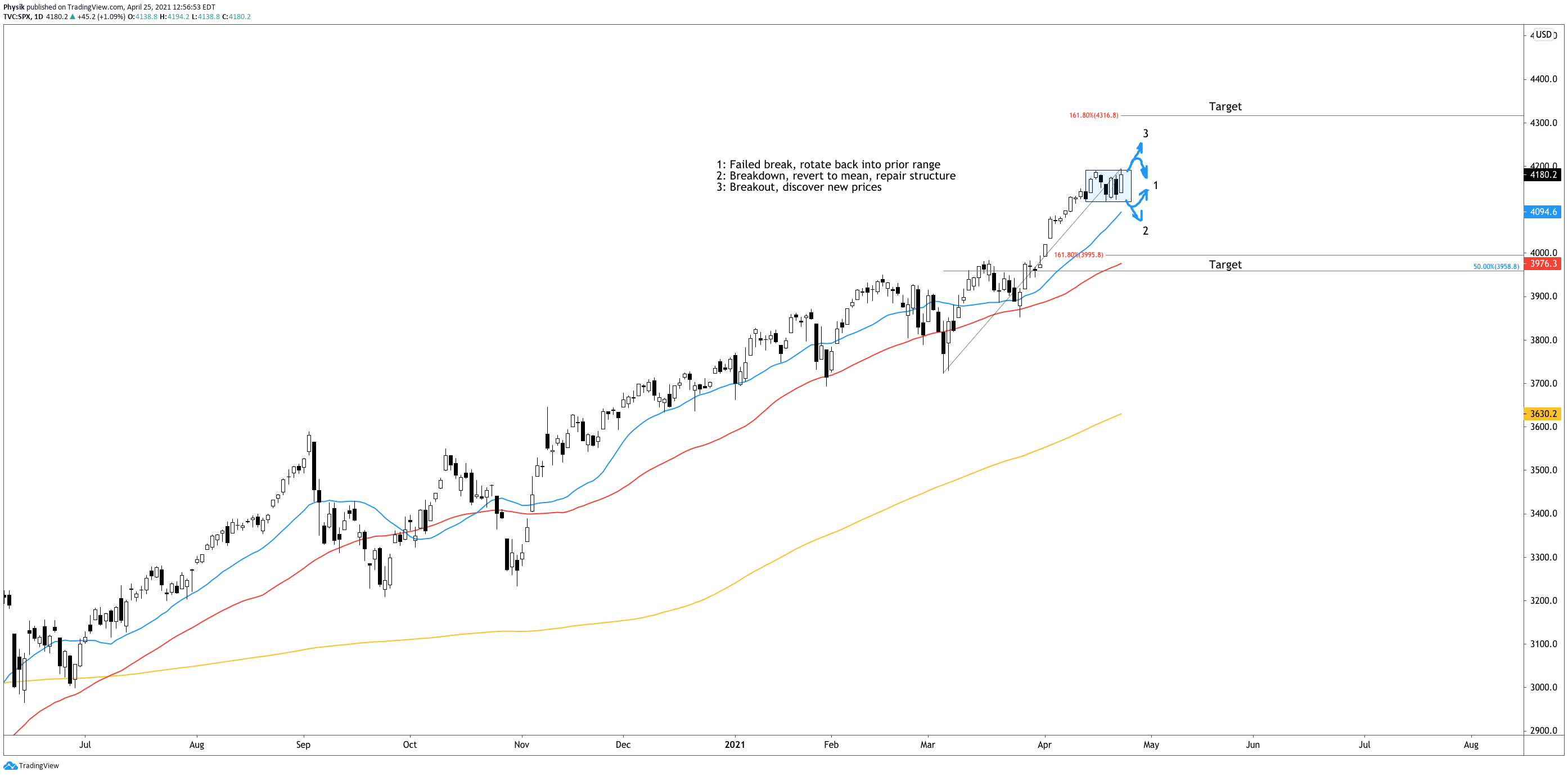
Graphic: 1-day candlestick chart of the cash-settled S&P 500 Index (INDEX: SPX). See Micro E-mini S&P 500 Futures profile chart here.

News And Analysis

Politics | Joe Biden will deliver a ‘joint session of Congress’ this week. (ABC)

Market | The Rise of Carry returns; stock buybacks are kicking into gear. (Axios)

Recovery | The end of U.S. mass vaccination coming sooner than later. (BBG)

Commodities | OPEC says NOPEC bill could put U.S. overseas assets at risk. (REU)

Markets | SPAC deals are far below peaks but are still generously valued. (CB)

Economy | The MBA is forecasting record purchase volume this year. (MND)

Banking | Goldman, JPM talk with the U.K. over business travel corridor. (FN)

Climate | Leaking landfill contributes to world’s mystery methane hotspot. (BBG)

Trade | Beijing hopes U.S. companies will push to scrap China tariffs. (BBG)

Economy | Existing home sales suffer second straight monthly decline. (CNBC)

Markets | Taxes and inflation key themes for markets in the week ahead. (CNBC)

What People Are Saying

Innovation And Emerging Trends

FinTech | On blockchain- and smart contract-based financial markets. (FED)

FinTech | U.K. banks speed plans to ax branches, switch to digital focus. (S&P)

Health | What are all those constant video calls doing to your brain? (TC)

FinTech | Participants identify key operational areas for improvement. (TM)

FinTech | Alpaca intros Broker API that lets you build own Robinhood. (BZ)

FinTech | Public.com app connects users with public company leaders. (BZ)

About

Renato founded Physik Invest after going through years of self-education, strategy development, and trial-and-error. His work reporting in the finance and technology space, interviewing leaders such as John Chambers, founder, and CEO, JC2 Ventures, Kevin O’Leary, Canadian businessman and Shark Tank host, Catherine Wood, CEO and CIO, ARK Invest, among others, afforded him the perspective and know-how very few come by.

Having worked in engineering and majored in economics, Renato is very detailed and analytical. His approach to the markets isn’t built on hope or guessing. Instead, he leverages the unique dynamics of time and volatility to efficiently act on opportunity.

 Disclaimer

At this time, Physik Invest does not manage outside capital and is not licensed. In no way should the materials herein be construed as advice. Derivatives carry a substantial risk of loss. All content is for informational purposes only.

Cover photo by sklei from Pexels

Categories
Commentary

Daily Brief For April 23, 2021

Market Commentary

Index futures base. Position for directional resolve.

  • Tax hike news causes a liquidation.
  • Home sales. Biden climate summit.
  • Indices are correcting through time.

What Happened: U.S. stock index futures auctioned sideways, overnight, after liquidating alongside reports that President Biden wants to nearly double the capital gains tax paid by top earners.

Liquidation Breaks: The profile shape suggests participants were “too” long and had poor location. The news event helped resolve this dynamic.
Updated: 8:45 AM EST

What To Expect: Friday’s regular session in the S&P 500 (9:30 AM – 4:00 PM EST) will likely open inside of prior-range and -value, suggesting a limited potential for immediate directional opportunity. 

Adding, during the prior day’s regular trade, the worst-case outcome failed to occur. 

In the interest of objectivity, despite the $4,117.75 regular trade low (RTH Low) being taken out, responsive buyers stepped in aggressively, causing the S&P 500 to halt short of the $4,110.50 poor, minimal excess low. This action is noteworthy — had the poor low been taken out, conditions would have been markedly different. Instead, given technical nuances, it is obvious the market is correcting in time (i.e., balancing), rather than price.

Responsive Buying: Buying in response to prices below area of recent price acceptance.

Excess: A proper end to price discovery; the market travels too far while advertising prices. Responsive, other-timeframe (OTF) participants aggressively enter the market, leaving tails or gaps which denote unfair prices.

Balance (Two-Timeframe Or Bracket): Rotational trade that denotes current prices offer favorable entry and exit. Balance-areas make it easy to spot change in the market (i.e., the transition from two-time frame trade, or balance, to one-time frame trade, or trend).

Simply put, markets are basing, pricing in new information, ahead of any directional resolve.

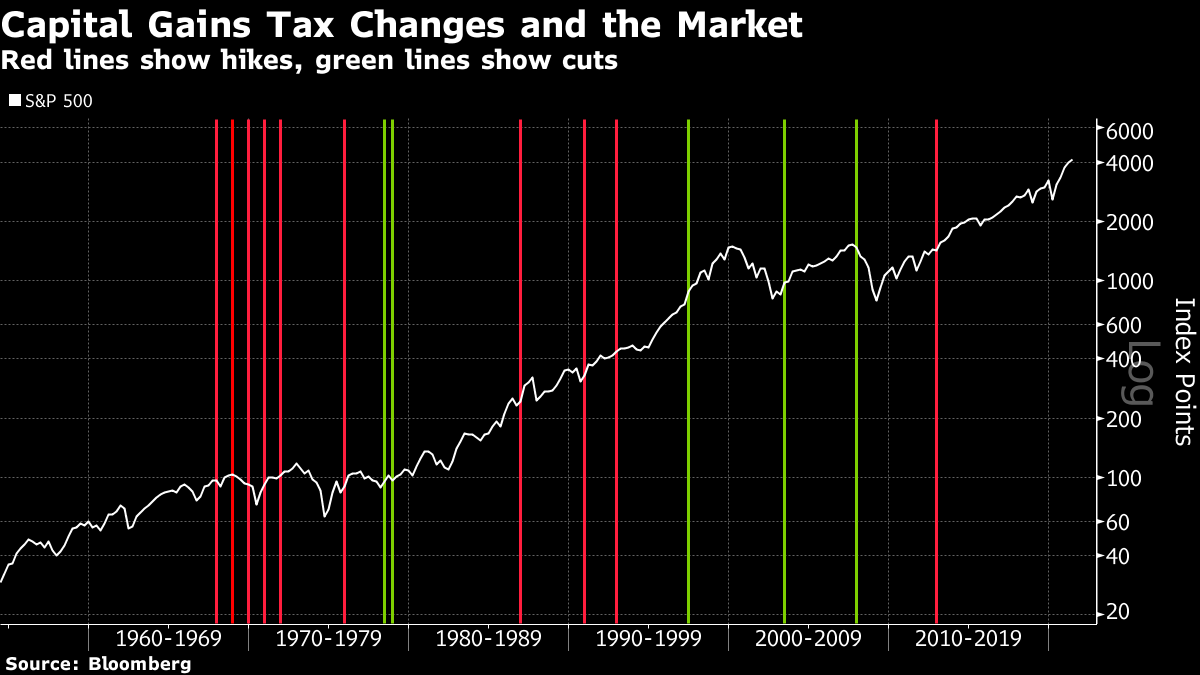
Important to add into the narrative, too, are historical responses to capital gains tax increases.

Bloomberg’s John Authers notes: “The way the market handled the last major CGT increase, at the end of 2012, is instructive. As it grew clear that higher capital gains taxes were coming, the S&P 500 languished and went sideways for the last few months of the year, closing roughly where it had been in March. Then 2013 turned out to be a great year; stocks started their rally at the beginning of January and never really stopped.”

Graphic: Bloomberg unpacks implications of a capital gains tax hike. 

“Stocks do indeed tend to fall in the run-up to the change, but more than make up for it thereafter. Earnings multiples increased slightly before those rises, but did better in the six months afterwards. And households sold a little before the hikes, but more than made up for it.”

The highest returning, momentum stocks, however, stand to lose the most. Given that “[m]omentum stocks have had something of a correction in recent months, … it is unlikely that the tax change will have a major effect on them.”

For today, moreover, participants can trade from the following frameworks. 

In the best case, the S&P 500 trades sideways or higher; activity above the $4,137.25 high-volume area (HVNode) targets the $4,162.50 VPOC. Initiative trade beyond the VPOC could reach as high as the $4,183.50 regular trade high (RTH High). In the worst case, the S&P 500 trades lower; activity below $4,115.25 targets the $4,110.50 poor, minimal excess low. 

Volume Areas: A structurally sound market will build on past areas of high-volume. Should the market trend for long periods of time, it will lack sound structure (identified as a low-volume area which denotes directional conviction and ought to offer support on any test). 

If participants were to auction and find acceptance into areas of prior low-volume, then future discovery ought to be volatile and quick as participants look to areas of high-volume for favorable entry or exit.

Initiative Buying: Buying within or above the previous day’s value area.

POCs: POCs (like HVNodes described above) are valuable as they denote areas where two-sided trade was most prevalent. Participants will respond to future tests of value as they offer favorable entry and exit.

Thereafter, if lower, participants can look for responses at (1) the $4,093.00 VPOC, (2) $4,082.75 HVNode, and (3) the $4,069.25 HVNode.

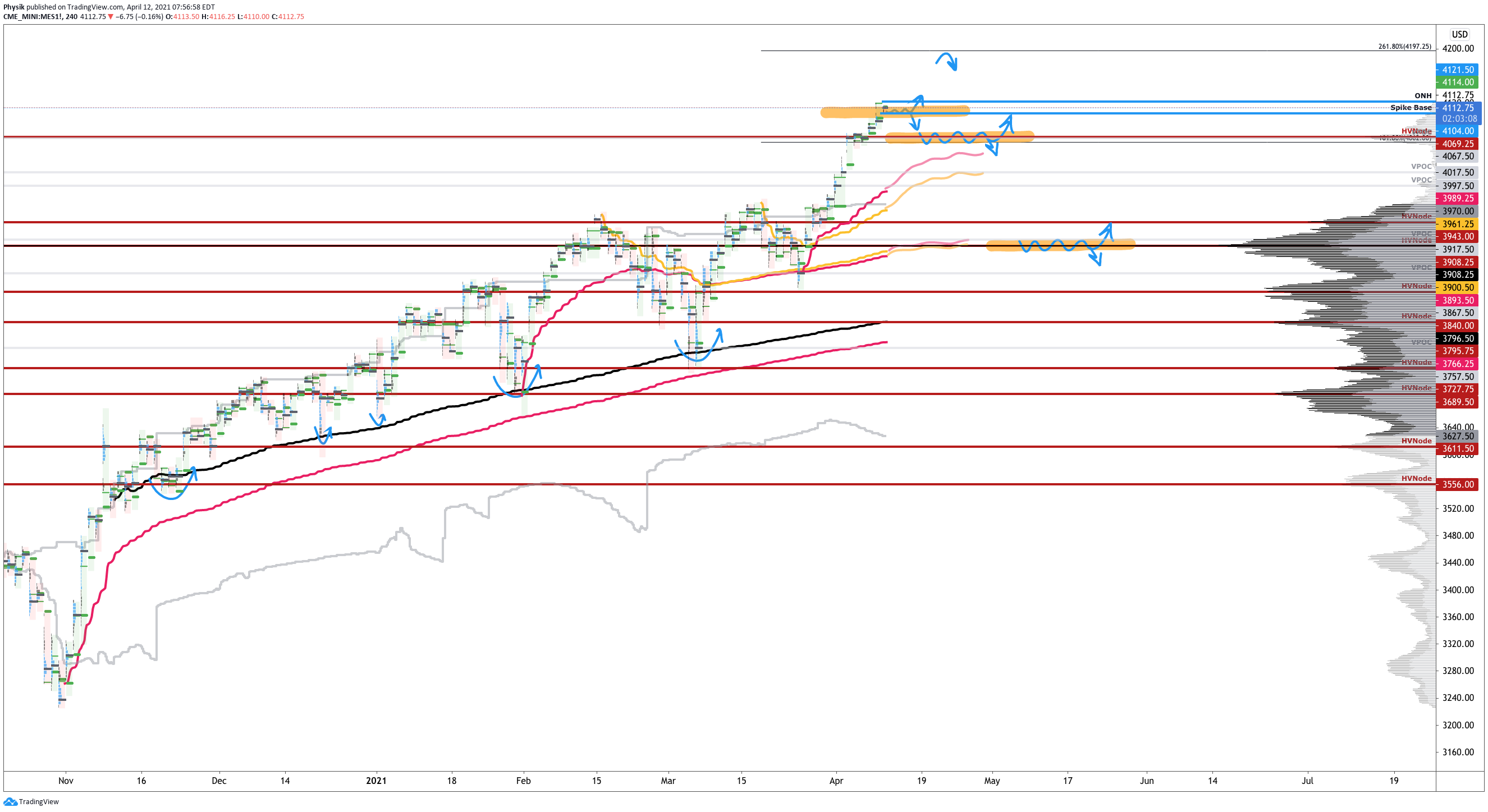
Graphic: 4-hour profile chart of the Micro E-mini S&P 500 Futures.
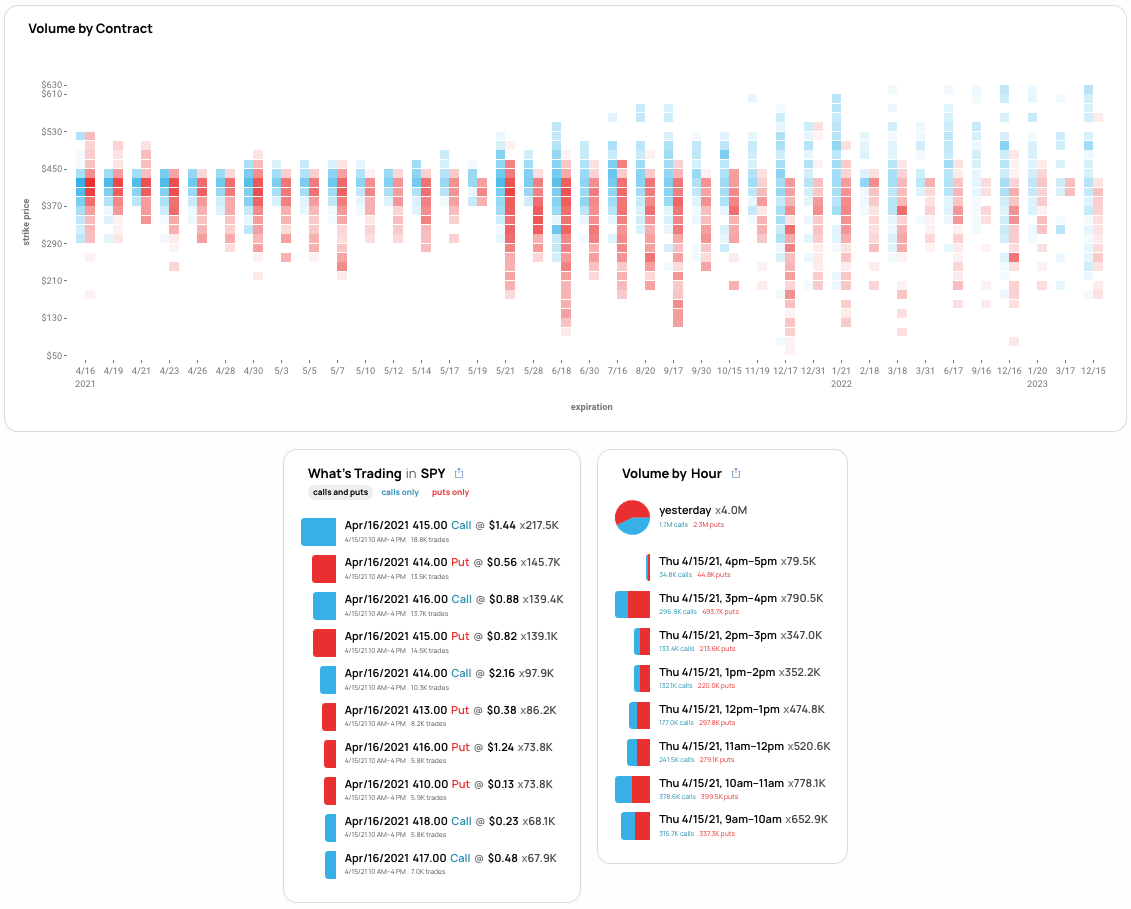
Graphic: Physik Invest maps out the purchase of call and put options in the SPDR S&P 500 ETF Trust (NYSE: SPY), for April 22. Activity in the options market was primarily concentrated in short-dated tenors, in strikes as low as $400.00, which corresponds with $4,000.00 in the cash-settled S&P 500 Index (INDEX: SPX).
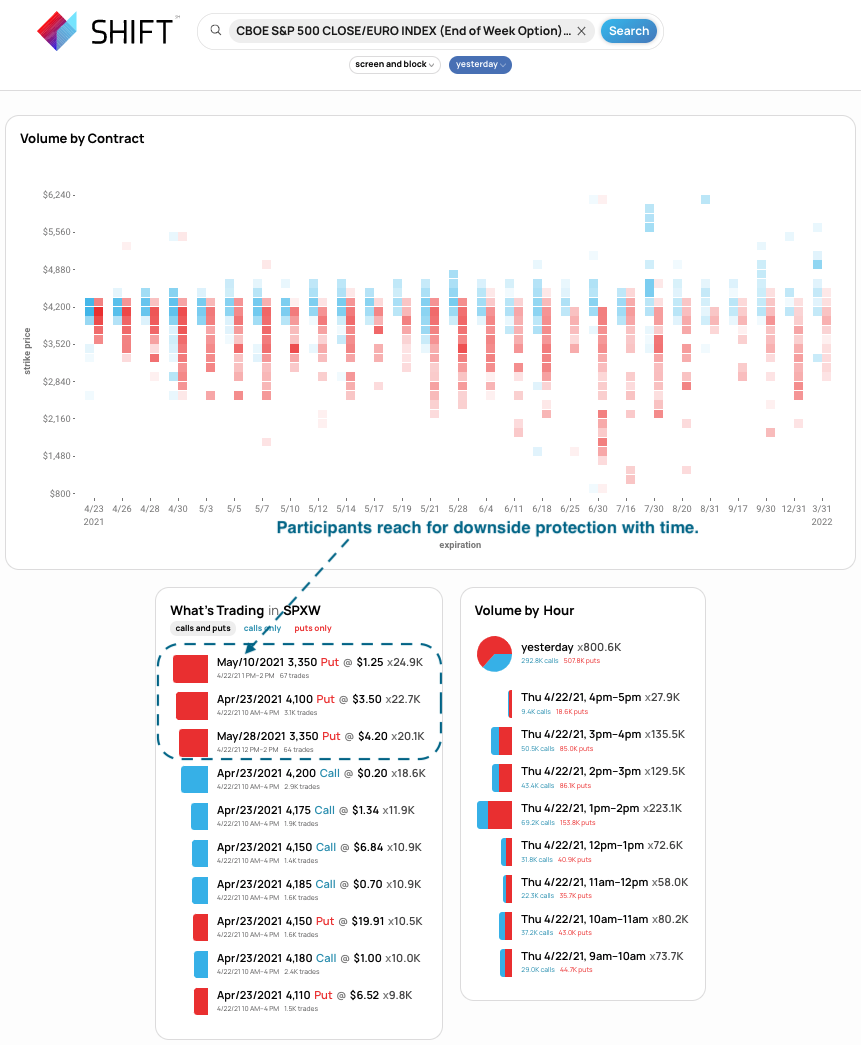
Graphic: Increase in put-side interest on the cash-settled S&P 500 Index (INDEX: SPX). Such activity suggests participants are interested in hedging their downside. Visual via SHIFT.
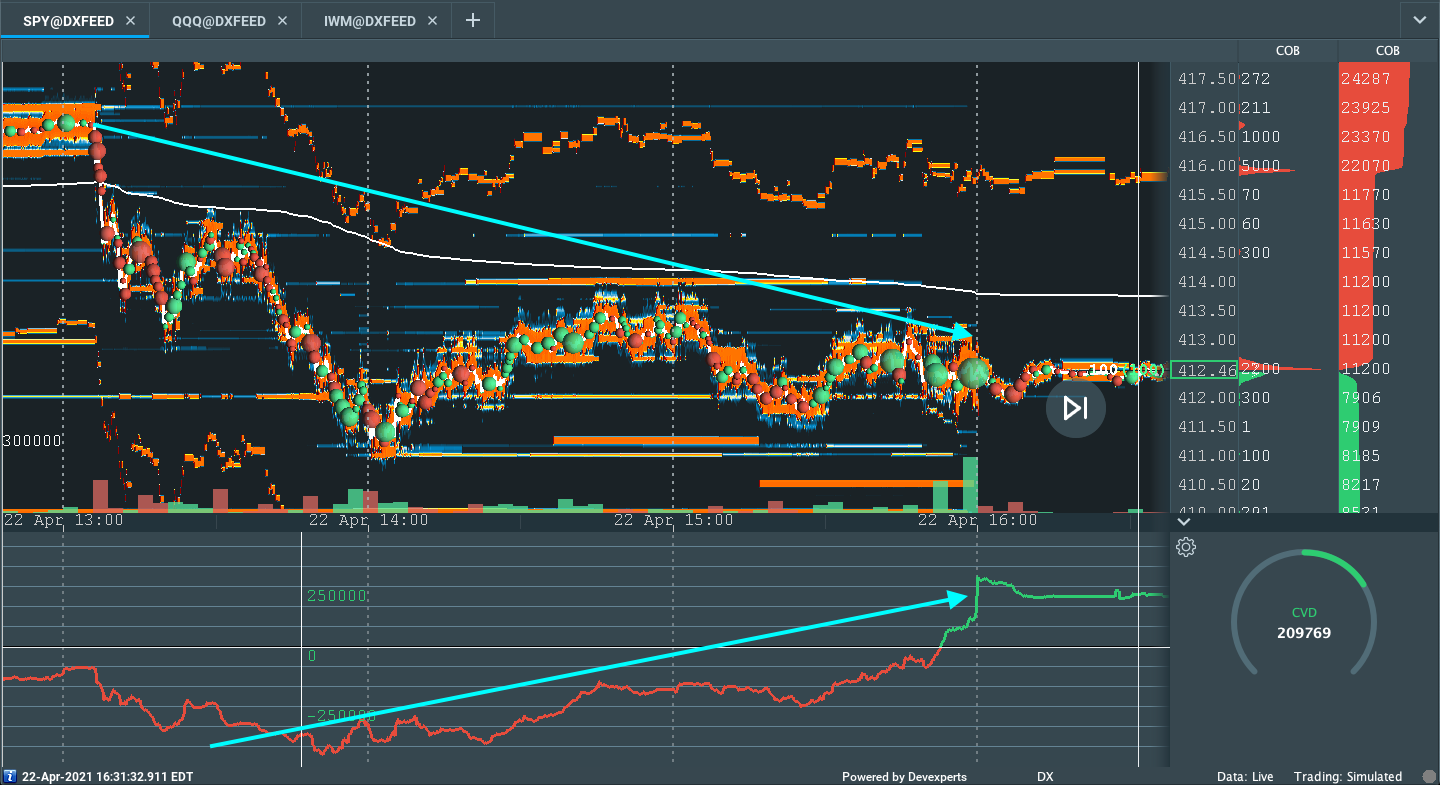
Graphic: Price and volume delta, or buying and selling power as calculated by the difference in volume traded at the bid and offer, diverge into the close in the SPDR S&P 500 ETF Trust (NYSE: SPY).

News And Analysis

Economy | Senate Republicans rolled out a $568B infrastructure proposal. (Axios)

Economy | The Fed’s monthly bond purchases endure as goals fall short. (S&P)

Wellness | Studies show the coronavirus can kill months after infection. (BBG)

Economy | EU economy ‘on crutches,’ warns ECB chief Christine Lagarde. (DW)

Markets | High-yield corporate bond issuance, prospects for a recovery. (Moody’s)

Politics | Russia is planning to end a massive troop buildup near Ukraine. (Axios)

Economy | $12.3T in stimulus killed off the U.S. credit default cycle. (BBG)

Banking | Two blowups have Credit Suisse paying the price for riskiness. (BBG)

Economy | March mortgage delinquency drop exaggerated by events. (MND)

Markets | Mortgage rates improve on 7-week lows, bond market stable. (MND)

Markets | GS: Congress is likely to cap Biden’s CGT hike at around 28%. (MI)

Markets | Scale of T-Bill drought hinges on Biden rescue, income-tax haul. (BBG)

What People Are Saying

Innovation And Emerging Trends

Transportation | Newer planes providing airlines trove of useful data. (NYT)

FinTech | Public.com app connects users with public company leaders. (BZ)

FinTech | From breakthroughs to copycats, here’s what to consider. (Fortune)

FinTech | Signal Advisors adds Series A for financial advising tech. (BZ)

Education | MasterClass co-founder secures funding for new ed-tech. (BZ)

About

Renato founded Physik Invest after going through years of self-education, strategy development, and trial-and-error. His work reporting in the finance and technology space, interviewing leaders such as John Chambers, founder, and CEO, JC2 Ventures, Kevin O’Leary, Canadian businessman and Shark Tank host, Catherine Wood, CEO and CIO, ARK Invest, among others, afforded him the perspective and know-how very few come by.

Having worked in engineering and majored in economics, Renato is very detailed and analytical. His approach to the markets isn’t built on hope or guessing. Instead, he leverages the unique dynamics of time and volatility to efficiently act on opportunity.

 Disclaimer

At this time, Physik Invest does not manage outside capital and is not licensed. In no way should the materials herein be construed as advice. Derivatives carry a substantial risk of loss. All content is for informational purposes only.
Categories
Commentary

Daily Brief For April 22, 2021

Market Commentary

Index futures resolve directionally, yesterday. Base overnight.

  • Growth warning, economic data.
  • ECB decision, claims, and more.
  • Sellers have trouble dominating.

What Happened: U.S. stock index futures broke their downtrend, yesterday, and auctioned sideways overnight, ahead of announcements by the European Central Bank, data on initial claims, home sales, and manufacturing, as well as earnings releases.

What To Expect: Thursday’s regular session (9:30 AM – 4:00 PM EST) in the S&P 500 will likely open inside of prior-range and -value, suggesting a limited potential for immediate directional opportunity. 

Adding, during the prior day’s regular trade, the best case outcome occurred, evidenced by initiative trade above the $4,155.00 high volume area (HVNode). This is significant due to the fact that the downtrend broke after participants lacked the conviction to move prices lower, evidenced via a poor, minimal excess low. 

Volume Areas: A structurally sound market will build on past areas of high volume. Should the market trend for long periods of time, it will lack sound structure (identified as a low-volume area which denotes directional conviction and ought to offer support on any test). If participants were to auction and find acceptance into areas of prior low-volume, then future discovery ought to be volatile and quick as participants look to areas of high volume for favorable entry or exit.

Excess: A proper end to price discovery; the market travels too far while advertising prices. Responsive, other-timeframe (OTF) participants aggressively enter the market, leaving tails or gaps which denote unfair prices.

Short-term sellers, simply put, piled on at the low and weren’t paid quickly for their risk. This inventory was resolved during Wednesday’s trend-day higher. 

Looking beyond the equity indices, breadth is pegged at its high. In the U.S., according to The Market Ear, the percent of stocks above their 200-day moving average hit 96%, the highest since 2009. Typically, after such instances, one- to three-month returns are positive.

Beyond big-picture narratives, for today, participants can trade from the following frameworks. 

In the best case, the S&P 500 trades sideways or higher; activity above the $4,153.50 spike base targets the point of control (POC) near $4,171.00. Initiative trade beyond the POC could reach as high as (1) the $4,183.00 regular trade high (RTH High) and (2) Fibonacci-derived price targets near $4,187.00-$4,197.25.

In the worst case, the S&P 500 trades sideways or lower; activity below the $4,117.75 regular trade low targets first the $4,110.50 poor, minimal excess low. Thereafter, if lower, participants can look for responses at (1) the $4,093.00 VPOC, (2) $4,082.75 HVNode, and (3) the $4069.25 HVNode. 

Spikes: Spike’s mark the beginning of a break from value. Spikes higher (lower) are validated by trade at or above (below) the spike base (i.e., the origin of the spike).

POCs: POCs (like HVNodes described above) are valuable as they denote areas where two-sided trade was most prevalent. Participants will respond to future tests of value as they offer favorable entry and exit.
Graphic: 4-hour profile chart of the Micro E-mini S&P 500 Futures.
Graphic: Physik Invest maps out the purchase of call and put options in the SPDR S&P 500 ETF Trust (NYSE: SPY), for April 21. Activity in the options market was primarily concentrated in short-dated tenors, in strikes as high as $422, which corresponds with $4,220.00 in the cash-settled S&P 500 Index (INDEX: SPX).
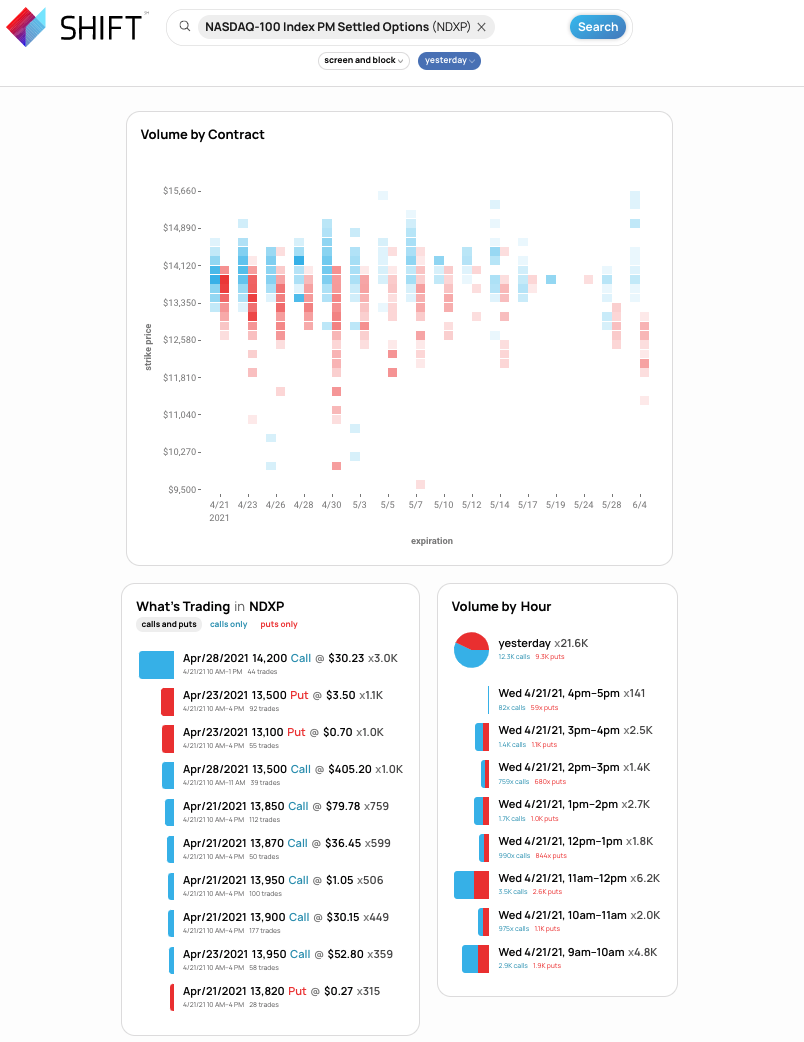
Graphic: Noticeable increase in call-side interest on the cash-settled Nasdaq-100 Index (INDEX: NDX), expiring 4/28. Such activity suggests (1) an expectation, by participants, of a rotation back into technology, or (2) a hedge against earnings surprises, and the like. Visual via SHIFT.
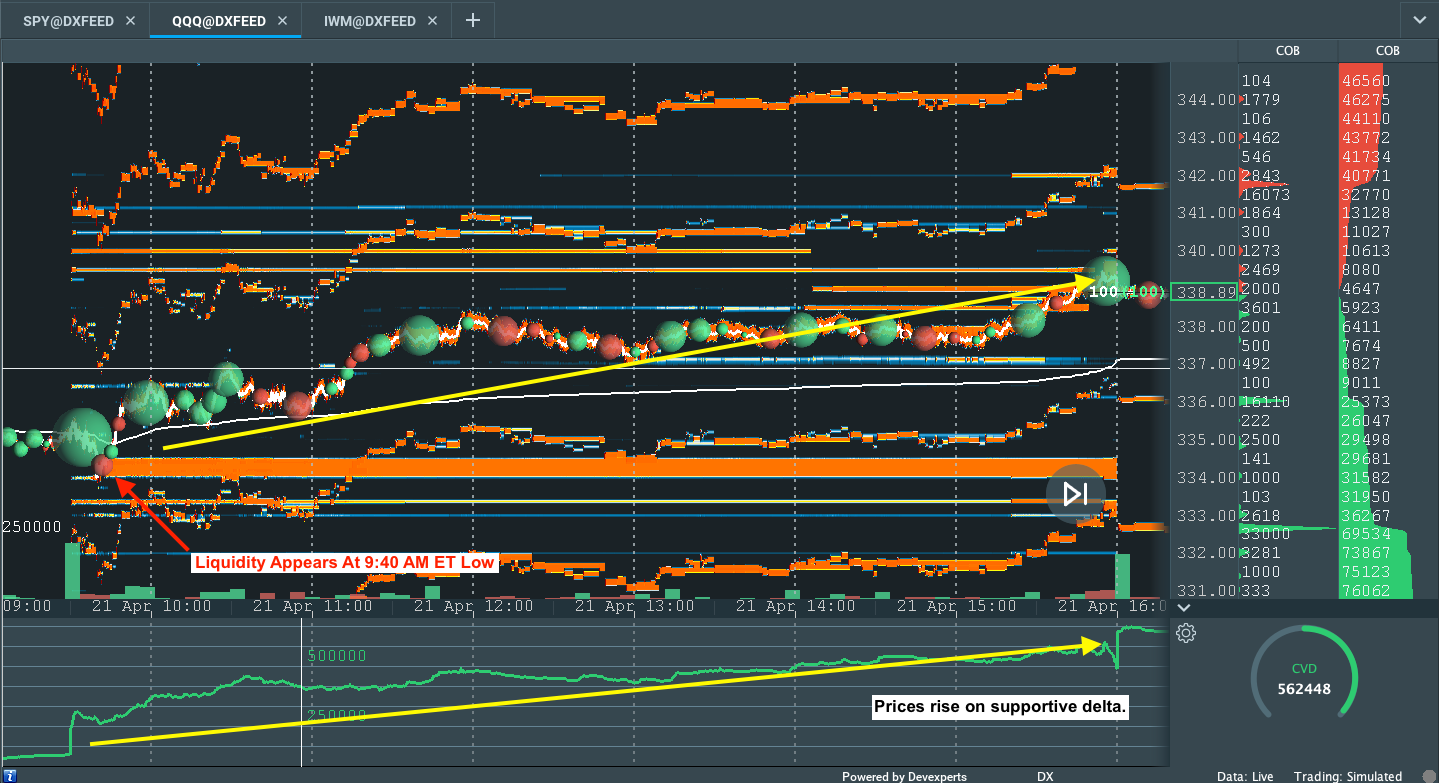
Graphic: Market liquidity in the Invesco QQQ Trust (NASDAQ: QQQ), one of the largest ETFs that track Nasdaq-100 prices, supports price rise.

News And Analysis

Economy | U.S. jobless claims plunged last week to a pandemic low. (BBG)

Politics | President Biden plans to cut U.S. greenhouse gas emissions. (BBG)

Markets | Credit Suisse Group raises $2B as CEO cuts hedge fund unit. (BBG)

Markets | Southwest Airlines bookings improve, will likely break even. (CNBC)

Economy | Should investors worry about a Chinese Lehman-style crisis? (BBG)

Markets | Bank of Canada signals rake hike, tapers bond purchases. (REU)

Economy | Fiscal stimulus, improving employment supports bank assets. (Moody’s)

Economy | Mortgage applications broke a six-week slump, last week. (SOURCE)

Economy | U.S. economy on a solid footing, the virus still a top threat. (REU)

What People Are Saying

Innovation And Emerging Trends

FinTech | Nasdaq democratizes information, fuels on-demand finance trend. (BZ)

Startups | Investors, executives, and founders discuss Zagreb’s startup potential. (TC)

FinTech | Why VCs are investing in non-fungible token (NFT) marketplaces? (CBN)

Investing | How can you build a robust portfolio that outperforms for a century? (BBG)

 About

Renato founded Physik Invest after going through years of self-education, strategy development, and trial-and-error. His work reporting in the finance and technology space, interviewing leaders such as John Chambers, founder, and CEO, JC2 Ventures, Kevin O’Leary, Canadian businessman and Shark Tank host, Catherine Wood, CEO and CIO, ARK Invest, among others, afforded him the perspective and know-how very few come by.

Having worked in engineering and majored in economics, Renato is very detailed and analytical. His approach to the markets isn’t built on hope or guessing. Instead, he leverages the unique dynamics of time and volatility to efficiently act on opportunity.

 Disclaimer

At this time, Physik Invest does not manage outside capital and is not licensed. In no way should the materials herein be construed as advice. Derivatives carry a substantial risk of loss. All content is for informational purposes only.

Categories
Commentary

Daily Brief For April 20, 2021

Market Commentary

Index futures auction lower, attempt to validate higher prices.

  • Investors weigh earnings, taxes.
  • Light calendar, earnings pick up.
  • Indices correct in time and price.

What Happened: U.S. stock index futures auctioned lower overnight as investors weighed the risks of exposure given the potential for surprise earnings results and a recent spike in virus cases, among other factors. 

What To Expect: Tuesday’s regular session (9:30 AM – 4:00 PM EST) in the S&P 500 will likely open outside of prior-range and -value, suggesting a higher-than-normal potential for directional opportunity. 

During the prior day’s regular trade, the worst-case outcome occurred, evidenced by trade below the $4,171.00 VPOC, which is significant because it marks an area where participants found it most valuable to conduct business during a prior session. Thereafter, overnight, participants discovered lower prices and solicited responsive buying at the $4,137.00 high-volume area (HVNode).

Volume Areas: A structurally sound market will build on past areas of high volume. Should the market trend for long periods of time, it will lack sound structure (identified as a low-volume area which denotes directional conviction and ought to offer support on any test).

If participants were to auction and find acceptance into areas of prior low-volume, then future discovery ought to be volatile and quick as participants look to areas of high volume for favorable entry or exit.

This price action is occurring on the heels of an outstanding rally, fueled by vaccine rollouts, supportive central banks, and improved consumer finances. In a statement, JPMorgan Chase & Co (NYSE: JPM) expressed its optimism on a sustained equity market boom. 

“We would not be cutting stocks exposure on a 6-9 months horizon, and continue to see any dips as buying opportunities,” JPMorgan analysts said. “We would not expect to see a more sustained pullback before Q4.”

Further, as stated in prior commentaries, equity markets are positioned bullish, but there exists an increased potential to correct in time and price. Should there be a drastic turn and spike in volatility, participants must be ready to accept the possibility of a violent liquidation, given poor structure left behind prior price discovery and increased put selling, among other factors

Price Discovery (One-Timeframe Or Trend): Elongation and range expansion denotes a market seeking new prices to establish value, or acceptance (i.e., more than 30-minutes of trade at a particular price level).

For today, participants can trade from the following frameworks. 

In the best case, the S&P 500 trades sideways or higher; activity above the $4,142.00 regular trade low (RTH Low) targets the $4,155.00 HVNode. Initiative trade beyond the HVNode could reach as high as $4,167.50 overnight high (ONH).

In the worst case, the S&P 500 trades lower; activity below $4,142.00 targets the $4,122.75 HVNode. Thereafter, if lower, participants can look for a repair of the poor structure sitting at the $4,113.00 low. Trading below $4,104.00 suggests a test as low as the $4,069.25 HVNode is likely.

Graphic: 65-minute profile chart of the Micro E-mini S&P 500 Futures.
Graphic: Physik Invest maps out the purchase of call and put options in the SPDR S&P 500 ETF Trust (NYSE: SPY), for April 19, 2021. Activity in the options market was primarily concentrated in short-dated tenors, in strikes as low as $403, which corresponds with $4,030 in the cash-settled S&P 500 Index (INDEX: SPX).

News And Analysis

Economy | Equity markets haven’t priced in Biden’s corporate tax hikes, yet. (BBG)

Recovery | More than half of U.S. adults vaccinated. Why are cases rising? (AB)

Trade | Why the chip shortage is so hard to overcome despite recent efforts. (WSJ)

Economy | Fannie Mae seeing a brighter outlook for housing and economy. (MND)

Economy | Fearing foreclosure crisis, watchdog cracks down on servicers. (REU)

Politics | Xi is challenging U.S. global leadership, warns against decoupling. (BBG)

Markets | Dogecoin’s surge was fueled by retail and institutional participants. (TB)

Markets | Credit Suisse halts trader’s fund on risk concerns, post-Archegos. (BBG)

Markets | China’s yuan is overvalued, and that could stoke global inflation. (BBG)

Markets | Stock shorts collapsed as no hedge fund wants head ripped off. (BBG)

What People Are Saying

Innovation And Emerging Trends

Markets | Large hidden bond market problem poses a whole new set of risks. (BBG)

FinTech | Here is how the big brokerage firms are breaking into bitcoin trading. (TB)

FinTech | Intercontinental Exchange-owned Bakkt targeting innovation, NFTs. (BZ)

Markets | The OCC has announced a reduction of its clearing fee to two cents. (TM)

Venture | Where the startup world sees money in the $2.3T infrastructure plan. (CN)

 About

Renato founded Physik Invest after going through years of self-education, strategy development, and trial-and-error. His work reporting in the finance and technology space, interviewing leaders such as John Chambers, founder, and CEO, JC2 Ventures, Kevin O’Leary, Canadian businessman and Shark Tank host, Catherine Wood, CEO and CIO, ARK Invest, among others, afforded him the perspective and know-how very few come by.

Having worked in engineering and majored in economics, Renato is very detailed and analytical. His approach to the markets isn’t built on hope or guessing. Instead, he leverages the unique dynamics of time and volatility to efficiently act on opportunity.

 Disclaimer

At this time, Physik Invest does not manage outside capital and is not licensed. In no way should the materials herein be construed as advice. Derivatives carry a substantial risk of loss. All content is for informational purposes only.

Categories
Commentary

Daily Brief For April 19, 2021

Market Commentary

Index futures are attempting to balance and validate higher prices.

  • Global pandemic recovery uneven. 
  • Investors await corporate earnings.
  • Indices to correct in time and price.

What Happened: U.S. stock index futures balanced ahead of a fresh round of corporate earnings.

What To Expect: Monday’s regular session (9:30 AM – 4:00 PM EST) will likely open inside of prior-range and -value, suggesting a limited potential for directional opportunity. 

Adding, during the prior week, the best case outcome occurred, evidenced by initiative trade that established new all-time highs in the S&P 500, Nasdaq-100, and Dow Jones Industrial Average.

Coming into this week, though equity markets are positioned bullishly, there exists an increased potential to correct in time and price. Adding, should there be a turn and spike in volatility, participants must be ready to accept the possibility of a violent liquidation, given the poor structure left behind prior price discovery and increased put selling, among other factors highlighted in Sunday’s commentary.

Price Discovery (One-Timeframe Or Trend): Elongation and range expansion denotes a market seeking new prices to establish value, or acceptance (i.e., more than 30-minutes of trade at a particular price level). 

For today, participants can trade from the following frameworks. 

In the best case, the S&P 500 trades sideways or higher; activity above the $4,161.75 regular trade low targets the $4,171.00 VPOC. Initiative trade beyond the VPOC could reach as high as the $4,183.50 regular-trade high and the cluster of Fibonacci price extensions above $4,187.00. In the worst case, the S&P 500 trades lower; activity below $4,171.00 is likely to solicit responsive buying near the $4,157.00 high-volume area (HVNode). Thereafter, if lower, $4,137.00 and $4,123.00 are other valuable areas to do business. 

Volume Areas: A structurally sound market will build on past areas of high-volume. Should the market trend for long periods of time, it will lack sound structure (identified as a low-volume area which denotes directional conviction and ought to offer support on any test). 

If participants were to auction and find acceptance into areas of prior low-volume, then future discovery ought to be volatile and quick as participants look to areas of high-volume for favorable entry or exit.

POCs: POCs (like HVNodes described above) are valuable as they denote areas where two-sided trade was most prevalent. Participants will respond to future tests of value as they offer favorable entry and exit.

Responsive Buying: Buying in response to prices below area of recent price acceptance.
Graphic: 4-hour profile chart of the Micro E-mini S&P 500 Futures.
Graphic: Physik Invest maps out the purchase of call and put options in the SPDR S&P 500 ETF Trust (NYSE: SPY), for the week ending April 16. Activity in the options market was primarily concentrated in short-dated tenors, in strikes as low as $364, which corresponds with $3,640 in the cash-settled S&P 500 Index (INDEX: SPX).

News And Analysis

Markets | Crypto stock mania tested by sliding prices, bitcoin drop. (BBG)

Markets | China opens borders to billions of dollars of gold imports. (REU)

Markets | Key takeaways from Q1 results of the investment banks. (Moody’s)

Travel | Airlines can’t get the world flying despite a big U.S. boom. (BBG)

Trade | TSMC says trade tensions may disrupt chip equipment supply. (BBG)

What People Are Saying

Innovation And Emerging Trends

Startups | Tips for those that are joining a startup for the first time. (FRR)

Space | Why flying a four-pound helicopter on Mars is a big deal. (BBG)

FinTech | U.S. banks deploy AI to monitor customers and workers. (REU)

Spirits | Whisky world at war as tech allows for instant spirit aging. (FT)

Crypto | Bank of England, HM Treasury create a CBDC taskforce. (BoE)

Technology | Clubhouse closes round of funding, raising value. (REU)

 About

Renato founded Physik Invest after going through years of self-education, strategy development, and trial-and-error. His work reporting in the finance and technology space, interviewing leaders such as John Chambers, founder, and CEO, JC2 Ventures, Kevin O’Leary, Canadian businessman and Shark Tank host, Catherine Wood, CEO and CIO, ARK Invest, among others, afforded him the perspective and know-how very few come by.

Having worked in engineering and majored in economics, Renato is very detailed and analytical. His approach to the markets isn’t built on hope or guessing. Instead, he leverages the unique dynamics of time and volatility to efficiently act on opportunity.

 Disclaimer

At this time, Physik Invest does not manage outside capital and is not licensed. In no way should the materials herein be construed as advice. Derivatives carry a substantial risk of loss. All content is for informational purposes only.
Categories
Commentary

Weekly Brief For April 18, 2021

Happy Sunday! Though markets were relatively choppy, they ended higher last week. This came at a time of heightened public attention to the market.

The following commentary on U.S. broad market equity indices will discuss what happened, why it matters, what to expect, and how participants can position themselves for the coming week.

But first, here’s a quote from Sterling professor of economics at Yale, Robert J. Shiller:

“The current widespread fascination with the rising market accompanied by recent concern about a possible downward spiral and strained stock market valuations echo those of 100 years ago.”

Market Commentary

What Happened: The S&P 500, Nasdaq-100, and Dow Jones Industrial Average made new all-time highs before closing the week out with an attempt to balance and validate newly discovered prices.

  • Data suggests economic outlook improving.
  • Earnings pick up, add to clarity on recovery.
  • Risk, reward poor for new entries. Be picky.

Why It Matters: The price rise in U.S. broad market equity indices comes as the economic recovery from the COVID-19 coronavirus pandemic accelerated.

According to S&P Global, the recovery’s acceleration warranted a revision in the firm’s 2021 global GDP growth forecast to 5.5%, a 50 basis point change.

At the same time, it’s S&P’s belief that U.S. inflation fears are overblown. Traders began to price in that realization, last week. 

After a slew of economic releases, yields pulled back dramatically.

In a Bloomberg article, Barclays strategists, including Anshul Pradhan, noted a raising of the bar on reflation; the drop in yields “reflects the fact that expectations for growth, inflation and the hiking cycle have all been significantly revised higher.”

Further, participants saw the CBOE Volatility Index (INDEX: VIX), a measure of the stock market’s expectation of volatility based on S&P 500 (INDEX: SPX) options, continue a multi-week drop attracting the participation of systemic strategies and opportunistic hedging, as noted last week.

It is important to note that this most recent rally in equity indices, which coincides with a historically bullish period, came soon after Archegos Capital’s default on margin calls which triggered a fire sale by several big Wall Street banks.

SpotGamma, a source for actionable insights based on activity in the options market, in a commentary, attempted to unpack the narrative which suggests the mechanical bid across the broad market is tied to a “tangled web of counterparty risk and hedging,” among other factors.

Moving beyond speculations, a couple of things are true and must be accounted for in our narrative.

First, equity market inflows, over the past 5 months, exceeded inflows of the prior 12 years, total. Second, as the April monthly options expiration (OPEX) passes and the positioning of participants changes, the risks of a near-term pullback have increased substantially. 

Despite the stock market trading in a historically bullish period, as well as declining volatility attracting the participation of systematic strategies, increased put selling, and the like, downside protection is trading cheap relative to its upside counterpart.

Option Expiration (OPEX): Option expiries mark an end to pinning (i.e, the theory that market makers and institutions short options move stocks to the point where the greatest dollar value of contracts will expire worthless) and the reduction dealer gamma exposure.

Should the market turn and customers demand downside protection in an increasing fashion, dealers’ risk exposure to direction and volatility will cause violent crash dynamics to transpire.

An example of this is last year’s sell-off.

In a discussion on rising delta and volatility forcing dealers to sell into weakness to hedge a rapid move in prices, Kris Sidial, a former institutional trader and the co-chief investment officer of The Ambrus Group, a volatility arbitrage fund that looks to exploit changing market structure dynamics, said: “You have this dynamic in the derivatives market where there is a gamma squeeze when people are buying way far out-of-the-money [options], and dealers reflexively have to hedge off their risk,” Sidial said.

Graphic: SqueezeMetrics highlights implications of volatility, direction, and moneyness.

Putting it all together, despite markets being in a position to move higher, should there be a turn and spike in volatility, participants must be ready to accept the possibility of a violent liquidation.

As Market Ear puts it, hedge when you can, not when you must.

What To Expect: An increased potential to correct in time and price.

In addition, metrics, like DIX, market liquidity, and speculative derivatives activity, confirm participants’ bullishness and opportunistic hedging ahead of an acceleration in the global restart and a turn in flows, the result of consumers shifting their preferences from saving and investing to spending.

Graphic: Physik Invest maps out the purchase of call and put options in the SPDR S&P 500 ETF Trust (NYSE: SPY), for the week ending April 16. Activity in the options market was primarily concentrated in short-dated tenors, in strikes as low as $364, which corresponds with $3,640 in the cash-settled S&P 500 Index (INDEX: SPX).
Graphic: SHIFT search suggests participants are not as inclined to add call-side exposure, through the month of May, in the SPDR S&P 500 ETF Trust (NYSE: SPY).

What To Do: In the coming sessions, participants will want to pay attention to where the S&P 500 trades in relation to Friday’s open-high-low-close (OHLC). 

Any activity above Friday’s regular trade-low suggests participants are not yet done discovering higher prices. Trading below Friday’s low suggests an inclination by participants to (1) form a consolidation area that denotes acceptance of higher prices or (2) revert to the mean and repair some of the poor structure left behind prior discovery. 

It is important to take note of the minimal excess and cluster of price extensions at $4,200.00, a typical price target based on Fibonacci principles.

Excess: A proper end to price discovery; the market travels too far while advertising prices. Responsive, other-timeframe (OTF) participants aggressively enter the market, leaving tails or gaps which denote unfair prices.

So, in the best case, the S&P 500 makes an attempt to balance or discover prices as high as $4,200.00. In the worst case, participants look to auction the S&P 500 into prior poor structures and low-volume areas (LVNodes) that ought to offer little-to-no support.

More On Volume Areas: A structurally sound market will build on past areas of high-volume (HVNode). Should the market trend for long periods of time, it will lack sound structure (identified as a low-volume area (LVNode) which denotes directional conviction and ought to offer support on any test). 

If participants were to auction and find acceptance into areas of prior low-volume, then future discovery ought to be volatile and quick as participants look to areas of high volume for favorable entry or exit.
Graphic: 4-hour profile chart of the Micro E-mini S&P 500 Futures.

News And Analysis

Economy | Housing starts reach the highest level since 2006. (MND)

Recovery | U.S. is unlikely to ‘just cancel’ J&J COVID-19 shots. (BBG)

Markets | Citi to exit banking in 13 markets across Asia, Europe. (BBG)

Markets | Record-high systemic leverage is pressuring rates. (Moody’s)

Economy | S&P Global Ratings expects global rebound to roar. (S&P)

Economy | Projections on global population, aging, urbanization. (REU)

Trade | Amazon sellers slammed with COVID-induced constraints. (S&P)

Recovery | How well COVID-19 vaccines work against variants. (AB)

Markets | SPACs boost credit at targets but carry unique risks. (Moody’s)
Markets | ‘Roaring Kitty’ adds to GME bet after exercising calls. (BBG)

What People Are Saying

Innovation And Emerging Trends

Economy | Looking at the pop culture of the original Roaring Twenties. (NYT)

Markets | Want to take your company public? Here are your options. (CB)

FinTech | Societe Generale adds first structured product on blockchain. (SG)

Exodus | Hedge funds are ready to get out of NY and move to FL. (BBG)

Trading | The answer to how much capital you should be allocating. (TT)

Venture | European venture reaches all-time high in first quarter 2021. (CB)

About

Renato founded Physik Invest after going through years of self-education, strategy development, and trial-and-error. His work reporting in the finance and technology space, interviewing leaders such as John Chambers, founder, and CEO, JC2 Ventures, Kevin O’Leary, Canadian businessman and Shark Tank host, Catherine Wood, CEO and CIO, ARK Invest, among others, afforded him the perspective and know-how very few come by.

Having worked in engineering and majored in economics, Renato is very detailed and analytical. His approach to the markets isn’t built on hope or guessing. Instead, he leverages the unique dynamics of time and volatility to efficiently act on opportunity.

 Disclaimer

At this time, Physik Invest does not manage outside capital and is not licensed. In no way should the materials herein be construed as advice. Derivatives carry a substantial risk of loss. All content is for informational purposes only.
Cover photo by eberhard grossgasteiger from Pexels.

Categories
Commentary

Daily Brief For April 16, 2021

Market Commentary

Index futures initiate out of balance and explore higher prices.

  • Economic data fuels strong rally.
  • Ahead: Housing, sentiment data.
  • Market is accepting higher prices.

What Happened: U.S. stock index futures auctioned higher alongside strong economic data, over the past 24 hours.

What To Expect: Friday’s regular session (9:30 AM – 4:00 PM EST) in the S&P 500 will likely open outside of prior-range and -value, suggesting the potential for immediate directional opportunity. 

Adding, during the prior day’s regular trade, the best case outcome occurred, evidenced by initiative trade above $4,137.00, which is significant because it marked Wednesday’s POC, the fairest price to do business. 

POCs: POCs are valuable as they denote areas where two-sided trade was most prevalent. Participants will respond to future tests of value as they offer favorable entry and exit.

Yesterday, the Dow Jones Industrial Average pushed through $34,000. Peter Essele, Head of Portfolio Management for Commonwealth Financial Network, in a statement on the development, said: “[I]nvestor appetite for future growth prospects is spilling over into more value-oriented names. The industrial heavy index has trailed its more tech-oriented counterparts over the last year (S&P 500 and NASDAQ), a trend that has started to reverse as of late. The demand for industrials and more cyclically-oriented areas should continue as the vaccines take hold and earnings potentially come in higher than originally expected.”

Obviously, there are a lot of reasons to be highly bullish on the stock market and economy, in general. However, as the April monthly options expiration (OPEX) passes and the positioning of participants changes, the risks of a near-term pullback have increased substantially. Despite the stock market trading in a historically bullish period, as well as declining volatility attracting the participation of systematic strategies, and the like, downside protection is trading cheap relative to its upside counterpart. 

Option Expiration (OPEX): Option expiries mark an end to pinning (i.e, the theory that market makers and institutions short options move stocks to the point where the greatest dollar value of contracts will expire worthless) and the reduction dealer gamma exposure.

In the simplest way, as Market Ear puts it, hedge when you can, not when you must. 

For today, participants can trade from the following frameworks. 

In the best case, the S&P 500 trades sideways or higher; activity above the $4,166.75 regular-trade high could reach as high as the $4,174.50 price extension. Initiative trade beyond $4,174.50 could reach as high as the confluence of Fibonacci price extension near $4,187.00-$4,197.25. In the worst case, the S&P 500 trades lower; activity below the $4,154.25 overnight-low (ONL) could reach as low as the $4,137.00 POC and $4,113.00 minimal excess low.

Excess: A proper end to price discovery; the market travels too far while advertising prices. Responsive, other-timeframe (OTF) participants aggressively enter the market, leaving tails or gaps which denote unfair prices.
Graphic: 4-hour profile chart of the Micro E-mini S&P 500 Futures.
Graphic: Physik Invest maps out the purchase of call and put options in the SPDR S&P 500 ETF Trust (NYSE: SPY), for April 15. Activity in the options market was primarily concentrated in short-dated tenors, in strikes as low as $385, which corresponds with $3,850 in the cash-settled S&P 500 Index (INDEX: SPX).
Graphic: SHIFT search suggests participants are not as inclined to add call-side exposure, through the month of May, in the SPDR S&P 500 ETF Trust (NYSE: SPY).

News And Analysis

Markets | There’s a New Jersey deli valued at $105 million. Not good. (BBG)

Markets | Record amount of assets in ETFs and ETPs listed globally. (MM)

Markets | Yields dropped Thursday, despite strong economic data. (CNBC)

Technology | Regulators are seeking to revoke Robinhood’s license. (REU)

Markets | Coinbase’s retail popularity tops that of GameStop, Tesla. (FN)

Investing | Family offices target 800% returns with SPAC economies. (BBG)

Markets | JPMorgan sells $13B of bonds in the largest bank deal. (BBG)

Economy | China’s GDP grows at a record pace as recovery speeds. (REU)

Economy | City of London Brexit hit worst than expected, says study. (REU)

Economy | Retail sales jumped nearly 10% in March amid reopening. (Axios)

What People Are Saying

Innovation And Emerging Trends

Crypto | Miami-Dade County may get a cryptocurrency task force. (TB)

Markets | Unpacking what happens to IPOs over the long-term. (NDAQ)

Travel | Porsche’s electric Taycan sales on course to eclipse 911. (BBG)

Travel | Elon Musk’s Boring Company finds paradise in the desert. (BBG)

Crypto | Brevan Howard to invest nearly 1.5% in cryptocurrencies. (TB)

Markets | Coinbase direct listing alters landscape for fintech startups. (TC)

About

Renato founded Physik Invest after going through years of self-education, strategy development, and trial-and-error. His work reporting in the finance and technology space, interviewing leaders such as John Chambers, founder, and CEO, JC2 Ventures, Kevin O’Leary, Canadian businessman and Shark Tank host, Catherine Wood, CEO and CIO, ARK Invest, among others, afforded him the perspective and know-how very few come by.

Having worked in engineering and majored in economics, Renato is very detailed and analytical. His approach to the markets isn’t built on hope or guessing. Instead, he leverages the unique dynamics of time and volatility to efficiently act on opportunity. 

Disclaimer

At this time, Physik Invest does not manage outside capital and is not licensed. In no way should the materials herein be construed as advice. Derivatives carry a substantial risk of loss. All content is for informational purposes only.

Categories
Commentary

Daily Brief For April 13, 2021

Market Commentary

Index futures are attempting to balance and validate higher prices.

  • U.S. calls for pause to one vaccine.
  • Participants await data on inflation.
  • Futures off new highs, but in-range.

What Happened: U.S. stock index futures auctioned higher overnight before liquidating alongside calls to stop using the Johnson & Johnson (NYSE: JNJ) vaccine after clotting cases.

What To Expect: Tuesday’s regular session (9:30 AM – 4:00 PM EST) will likely open inside of prior-range and -value, suggesting a low potential for immediate directional opportunity.

Adding, during the prior day’s regular trade, the best case outcome occurred, evidenced by range-bound trade above the $4,104.00 spike base, which is significant because it validated Friday’s late-day knee-jerk rally away from value, or the fairest price to do business for that session.

Coming up, consumer-price index numbers will be released at 8:30 a.m. EST; participants increasingly see the risks of inflation and taxes as a big headwind

As an aside, as noted in the Weekly Brief, Friday, April 16, will mark an end to the monthly options expiration. As that date approaches, and volatility continues to drop, given how participants are positioned, odds of sustained directional resolve are low.

For today, participants can trade from the following frameworks. 

In the best case, the S&P 500 trades sideways or higher; activity above the $4,104.00 spike base targets $4,117.25, the 50% overnight retracement. Initiative trade beyond the 50% retracement could reach as high as the $4,127.00 ONH. In the worst case, the S&P 500 trades lower; activity below $4,104.00 puts the rally on hold and targets the $4,069.00 and $3,943.00 high-volume areas (HVNodes).

More On Overnight Rally Highs (Lows): Typically, there is a low historical probability associated with overnight rally-highs (lows) ending the upside (downside) discovery process.

More On Volume Areas: A structurally sound market will build on past areas of high-volume (HVNode). Should the market trend for long periods of time, it will lack sound structure (identified as a low-volume area (LVNode) which denotes directional conviction and ought to offer support on any test). 

If participants were to auction and find acceptance into areas of prior low-volume, then future discovery ought to be volatile and quick as participants look to areas of high volume for favorable entry or exit.
Graphic: 4-hour profile chart of the Micro E-mini S&P 500 Futures.
Graphic: Physik Invest maps out the purchase of call and put options in the SPDR S&P 500 ETF Trust (NYSE: SPY), for April 12. Activity in the options market was primarily concentrated in short-dated tenors, in strikes as low as $398, which corresponds with $3,980 in the cash-settled S&P 500 Index (INDEX: SPX).
Graphic: SHIFT search shows that trade in the cash-settled S&P 500 Index (INDEX: SPX) was concentrated in put strikes below current prices. 

News And Analysis

Technology | Nvidia challenges Intel with Arm-based ‘Grace’ server chip. (REU)

Markets | Large U.S. Treasury auctions could restart the rise in yields. (REU)

Markets | Bank returns to rebound dramatically amid reserve releases. (S&P)

Markets | U.S. put off derivatives rule for a decade before Archegos failure. (FT)

Markets | Extreme contango in Bitcoin futures curve is raising eyebrows. (BBG)

Markets | The SEC announced a review of the WisdomTree Bitcoin ETF. (CD)

Markets | Yellen plans to spare China from a currency manipulator label. (BBG)

Recovery | COVID strain that emerged in U.K. not as deadly as feared. (BBG)

Economy | Simple mathematics is about to cause an inflation problem. (BBG)

What People Are Saying

Innovation And Emerging Trends

FinTech | Coinbase’s direct listing to drive a wave of crypto innovation. (CB)

FinTech | Binance launches tokenized stock trading, starting with Tesla. (TB)

FinTech | State Street allows use of platform for cryptocurrency trading. (BD)

Banking | Crypto shadow banking explained and why yields are so high. (BBG)

FinTech | Machine learning futures algo trading surges at JPMorgan. (TT)

About

Renato founded Physik Invest after going through years of self-education, strategy development, and trial-and-error. His work reporting in the finance and technology space, interviewing leaders such as John Chambers, founder, and CEO, JC2 Ventures, Kevin O’Leary, Canadian businessman and Shark Tank host, Catherine Wood, CEO and CIO, ARK Invest, among others, afforded him the perspective and know-how very few come by.

Having worked in engineering and majored in economics, Renato is very detailed and analytical. His approach to the markets isn’t built on hope or guessing. Instead, he leverages the unique dynamics of time and volatility to efficiently act on opportunity.

Disclaimer

At this time, Physik Invest does not manage outside capital and is not licensed. In no way should the materials herein be construed as advice. Derivatives carry a substantial risk of loss. All content is for informational purposes only.
Categories
Commentary

Daily Brief For April 12, 2021

Market Commentary

Index futures are attempting to balance and validate higher prices.

  • Pay attention to economic reports.
  • Earnings season officially starting.
  • Balance-to-higher into April OPEX.

What Happened: U.S. stock index futures balanced overnight ahead of first-quarter earnings reports by large financial firms.

What To Expect: Monday’s regular session in the S&P 500 (9:30 AM – 4:00 PM EST) will likely open inside of prior-range and -value, suggesting a limited potential for directional opportunity. 

Adding, during prior regular trade, the best case outcome occurred, evidenced by initiative trade above the S&P 500’s $4,100.00 high-interest strike, which will act as a magnet into Friday’s monthly options expiration (OPEX). 

Option Expiration (OPEX) Significance: Option expiries mark an end to pinning (i.e, the theory that market makers and institutions short options move stocks to the point where the greatest dollar value of contracts will expire worthless) and the reduction dealer gamma exposure.

As a result, given low trading volumes, and because of how impactful activity in the derivatives market is, traders should consider the potential for further balance or digestion of higher prices.

Further, for today, participants can trade from the following frameworks. 

In the best case, the S&P 500 trades sideways or higher; activity above the $4,104.00 spike base targets the $4,121.50 overnight-high (ONH). Initiative trade beyond the ONH could reach as high as the $4,197.25 price extension. In the worst case, the S&P 500 trades lower; activity below the $4,104.00 spike base targets the $4,069.00 and $3,943.00 high-volume areas (HVNode).

More On Overnight Rally Highs (Lows): Typically, there is a low historical probability associated with overnight rally-highs (lows) ending the upside (downside) discovery process.

More On Volume Areas: A structurally sound market will build on past areas of high-volume (HVNode). Should the market trend for long periods of time, it will lack sound structure (identified as a low-volume area (LVNode) which denotes directional conviction and ought to offer support on any test). 

If participants were to auction and find acceptance into areas of prior low-volume, then future discovery ought to be volatile and quick as participants look to areas of high volume for favorable entry or exit.
Graphic 1: 4-hour profile chart of the Micro E-mini S&P 500 Futures.
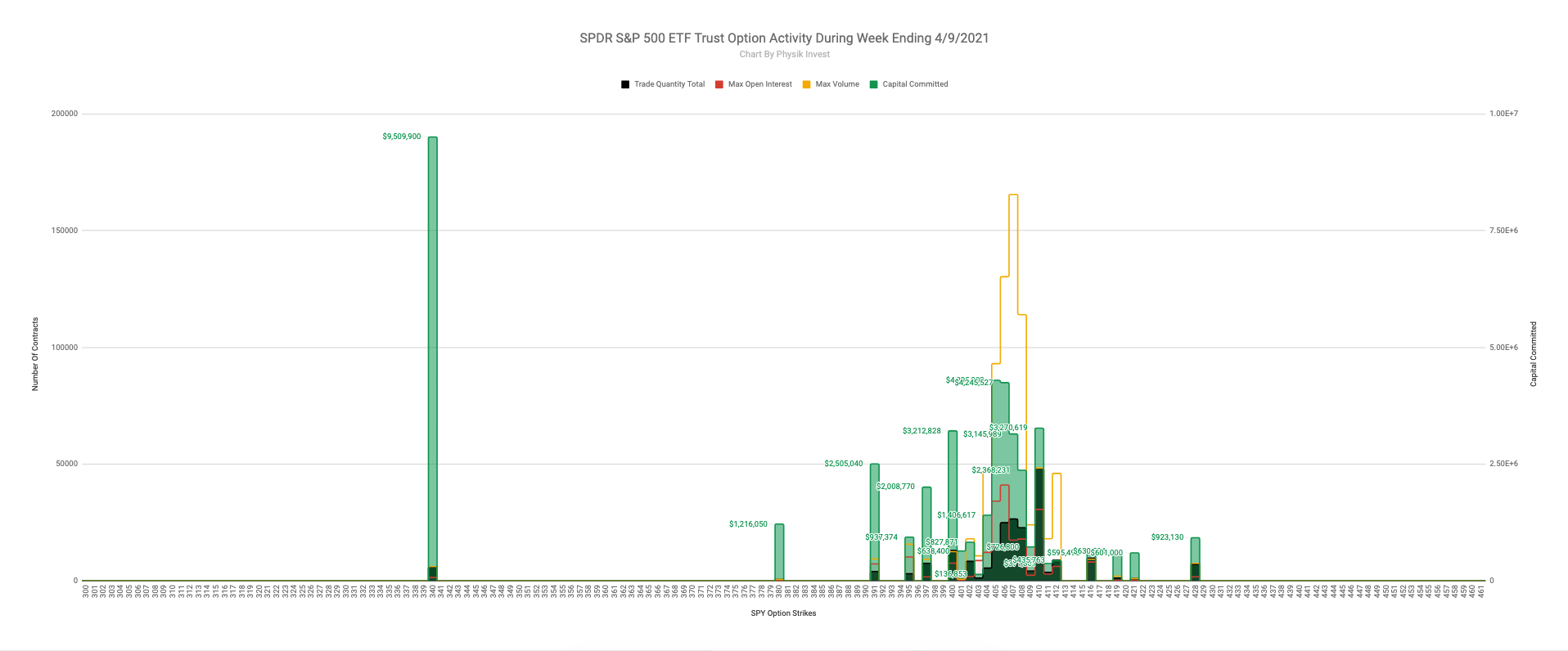
Graphic 2: Physik Invest maps out the purchase of call and put options in the SPDR S&P 500 ETF Trust (NYSE: SPY), for the week ending April 9, 2021. Activity in the options market was primarily concentrated in short- and long-dated tenors, in put strikes as low as $340, which corresponds with $3,400 in the cash-settled S&P 500 Index (INDEX: SPX).

News And Analysis

Markets | U.S. economic recovery underpins dollar strength. (Moody’s)

FinTech | Jack Ma’s Ant Group bows to Beijing with an overhaul. (WSJ)

Trade | U.S. freight traffic posted its biggest annual gain ever. (Axios)

Housing | U.S. housing frenzy driven by an inventory shortage. (Axios)

FinTech | Biden team eyes potential threat from Digital Yuan plans. (BBG)

Economy | Survey suggests 53% of Canadians near insolvency. (BNN)

Hedge Funds | How Ken Griffin rebuilt Citadel’s ramparts post-2008. (FT)

Markets | Bloomberg analysts arguing over $400K bitcoin target. (CD)

FinTech | Coinbase experiences brisk user growth ahead of IPO. (VC)

Economy | Five reasons why COVID herd immunity is impossible. (Nature)

Politics | U.S., China deploy carriers in South China amid tension. (CNN)

Economy | Goldman Sachs warns Biden Tax Plan will cut earnings. (BBG)

Banking | Credit Suisse faces tough choices on investment bank. (WSJ)

Economy | In unprecedented times, don’t rely on precedent. (BR)

What People Are Saying

Innovation And Emerging Trends

Markets | Financial industry supports cutting equities settlement. (MM)

Technology | Businesses taking a hurry-up-and-wait approach to AI. (WSJ)

FinTech | Charles Schwab is looking to shape crypto procedures. (Block)

About

Renato founded Physik Invest after going through years of self-education, strategy development, and trial-and-error. His work reporting in the finance and technology space, interviewing leaders such as John Chambers, founder, and CEO, JC2 Ventures, Kevin O’Leary, Canadian businessman and Shark Tank host, Catherine Wood, CEO and CIO, ARK Invest, among others, afforded him the perspective and know-how very few come by.

Having worked in engineering and majored in economics, Renato is very detailed and analytical. His approach to the markets isn’t built on hope or guessing. Instead, he leverages the unique dynamics of time and volatility to efficiently act on opportunity.

Disclaimer

At this time, Physik Invest does not manage outside capital and is not licensed. In no way should the materials herein be construed as advice. Derivatives carry a substantial risk of loss. All content is for informational purposes only.

Categories
Commentary

Weekly Brief For April 11, 2021

Editor’s Note

Welcome to Market Intelligence, Physik Invest’s response to the many newsletters that seldom provide actionable market insights, free.

Through this newsletter you will get a glimpse into the following:

  • The implications of credit and positioning.
  • Impactful events in finance and technology.
  • Technical commentary for index products.
  • Media on emerging trends and hot topics.

Again, thanks for joining! Physik Invest looks forward to providing you an objective view into the who, what, when, where, why, and how in finance and technology.

Regards,

Renato Leonard Capelj


Market Commentary

Index futures are in price discovery mode.

  • Institutions bullish but risks add up.
  • Earnings season to start this week.
  • Balance-to-higher into April OPEX.

What Happened: U.S. stock index futures closed higher, last week.

What Does It Mean: The S&P 500 closed above $4,100 for the first time as investors looked to price in an economic “‘Goldilocks moment’—fast, sustained growth alongside inflation and interest rates that drift slowly upward.”

According to a letter by JPMorgan Chase & Co’s (NYSE: JPM) Jamie Dimon, strong consumer savings, an increased pace in COVID-19 coronavirus vaccinations, and unprecedented efforts to spur economic activity could mean that a boom lasts as long as 2023. 

This perspective differs from Dimon’s comments a year ago; he warned of a recession in which GDP could fall nearly 35%. Is Dimon one to fade? Likely not, given the fact that (1) he heads one of the biggest banks and (2) most forecasts by other institutions support Dimon’s perspectives.

Further, the CBOE Volatility Index (INDEX: VIX), a measure of the stock market’s expectation of volatility based on S&P 500 (INDEX: SPX) options, traded to its lowest level since February 2020.

At the same time, participants saw blocks of VIX call spreads — bets that serenity won’t last — hit the tape; the unknown participant(s) bought nearly 200,000 contracts.

Graphic 1: Risk graph of the 25/40 VIX call spread in question via MarketEar

“With VIX being priced in the low 17 area, I would imagine we would see more of these larger-sized bets going forward,” Kris Sidial, co-chief investment officer at Ambrus Group, told Bloomberg. “I think smart money understands that, although volatility has contracted a lot in these last two months, we are still seeing signs of excess market fragility appear from many different angles.”

Graphic 2: Volatility declines to its lowest level since February 2020.

As stated last week, the market is in a historically bullish period, ahead of the upcoming corporate earnings season, with structural flows supporting the ongoing narrative into the coming April monthly options expiration (OPEX).

Option Expiration (OPEX) Significance: Option expiries mark an end to pinning (i.e, the theory that market makers and institutions short options move stocks to the point where the greatest dollar value of contracts will expire worthless) and the reduction dealer gamma exposure.

Adding, most funds are committed to holding long positions. In the interest of lower volatility returns, these funds will collar off their positions, selling calls to finance the purchase of downside put protection.

As a result of this activity, options dealers are long upside and short downside protection.

This exposure must be hedged; dealers will sell into strength as their call (put) positions gain (lose) value and buy into weakness as their call (put) positions lose (gain) value.

Now, unlike theory suggests, dealers will hedge call losses (gains) quicker (slower). This leads to “long-gamma,” a dynamic that crushes volatility and promotes momentum, observed by lengthy sprints — like the one the market is currently in — followed by rapid de-risking events as the market transitions into “short-gamma.”

What To Expect: Balance-to-higher.

Important to note is that equity market inflows, over the past 5 months, exceeded inflows of the prior 12 years, total. Think about the supply and demand dynamics of the market; in case of an equity market sell-off, a lot of late buyers will have poor location which may leave a thick area of supply above the market, putting a dampener on future rallies. 

“You should definitely be worried about valuations and all the more so when people start justifying extremely high valuations. We are risk-on, but we haven’t put our foot down on the accelerator because of valuations in some parts of the market,” said Fahad Kamal, chief investment officer at Kleinwort Hambros.

Adding to the narrative, metrics, like DIX, confirm increased buying pressure while divergences in options activity suggest opportunistic hedging, especially with puts trading at their cheapest level, relative to calls the same delta.

Graphic 3: 1-month 25 delta risk-reversal, via SpotGamma, suggests puts are trading cheap.
More On DIX: For every buyer is a seller (usually a market maker). Using DIX — which is derived from short sales (i.e., liquidity provision on the market-making side) — we can measure buying pressure.
Graphic 4: Physik Invest maps out the purchase of call and put options in the SPDR S&P 500 ETF Trust (NYSE: SPY), for the week ending April 9, 2021. Activity in the options market was primarily concentrated in short- and long-dated tenors, in put strikes as low as $340, which corresponds with $3,400 in the cash-settled S&P 500 Index (INDEX: SPX).

What To Do: In the coming sessions, participants will want to pay attention to where the S&P 500 trades in relation to Friday’s end-of-day spike higher.

More On Spikes: Spike’s mark the beginning of a break from value. Spikes higher (lower) are validated by trade at or above (below) the spike base (i.e., the origin of the spike).

In the best case, the S&P 500 remains above the $4,104.00 spike base. Doing so means that the participants are validating the prices caused by the late-day knee-jerk rally. 

In the case of higher prices, given that the 161.80% and 127.20% Fibonacci price extensions were achieved, and after-market trade established an overnight high at $4,121.50, participants can target prices as high as the $4,197.25 price extension.

More On Overnight Rally Highs (Lows): Typically, there is a low historical probability associated with overnight rally-highs (lows) ending the upside (downside) discovery process.

Any activity below the $4,104.00 spike base puts the rally on hold and calls for balance or an attempt to digest higher prices.

Balance (Two-Timeframe Or Bracket): Rotational trade that denotes current prices offer favorable entry and exit. Balance-areas make it easy to spot a change in the market (i.e., the transition from two-time frame trade, or balance, to one-time frame trade, or trend).

In the case of lower prices, participants can look to whether a test of the $4,069.00 high-volume area (HVNode) solicits a response. If not, initiative trade could take prices as low as $3,943.00, the next most valuable price area in the chain.

More On Volume Areas: A structurally sound market will build on past areas of high-volume (HVNode). Should the market trend for long periods of time, it will lack sound structure (identified as a low-volume area (LVNode) which denotes directional conviction and ought to offer support on any test). 

If participants were to auction and find acceptance into areas of prior low-volume, then future discovery ought to be volatile and quick as participants look to areas of high volume for favorable entry or exit.
Graphic 5: 4-hour profile chart of the Micro E-mini S&P 500 Futures.

News And Analysis

Economy | No elevated default risk expected until 2023. (Moody’s)

Economy | China looks to curtail loan growth amid bubble fears. (BBG)

Markets | Pre-IPO, Coinbase releases blowout Q1 2021 results. (BW)

Markets | Growing signs that equity bull market overheating. (Axios)

Economy | CFPB warns lenders of a wave of distressed mortgages. (MP)

Markets | Cboe extends global trading for VIX and SPX options. (Cboe)

Markets | Unpacking the feedback loop that is distorting markets. (RV)

Trade | Global trade disruptions after the Suez Canal incident. (S&P)

Economy | U.S. COVID-19 vaccination rates to plateau in April. (Surgo)

Markets | Treasuries rally signaling bets on Fed hikes pared back. (BBG)

Markets | Bitcoin fills a demand for alternatives to fiat currencies. (BBG)

Economy | Powell says the economy poised for stronger growth. (BBG)

Markets | Earnings season starts with banks reporting this week. (WSJ)

Markets | Citadel Securities feels the heat of the political spotlight. (BBG)

Markets | Oil sideways. Gold, DXY higher. Copper, aluminum lower. (REU)

What People Are Saying

Innovation And Emerging Trends

Strategy | Strategies one VC believes made Stripe so successful. (BI)

FinTech | Fidelity, Square, and others, form crypto trade group. (WSJ)

FinTech | WealthCharts expands offer, tackles emerging trends. (BZ)

FinTech | SoftBank invests $500M in mortgage lender Better. (CNBC)

FinTech | Rarible co-founder says NFTs to stay, growth robust. (BZ)

FinTech | JPMorgan’s Dimon acknowledges fintech’s big threat. (BZ)

FinTech | Vesica launches a search engine for the options market. (BZ)

About

Renato founded Physik Invest after going through years of self-education, strategy development, and trial-and-error. His work reporting in the finance and technology space, interviewing leaders such as John Chambers, founder, and CEO, JC2 Ventures, Kevin O’Leary, Canadian businessman and Shark Tank host, Catherine Wood, CEO and CIO, ARK Invest, among others, afforded him the perspective and know-how very few come by.

Having worked in engineering and majored in economics, Renato is very detailed and analytical. His approach to the markets isn’t built on hope or guessing. Instead, he leverages the unique dynamics of time and volatility to efficiently act on opportunity.

Disclaimer

At this time, Physik Invest does not manage outside capital and is not licensed. In no way should the materials herein be construed as advice. Derivatives carry a substantial risk of loss. All content is for informational purposes only.

Cover photo by Kammeran Gonzalez-Keola from Pexels.