Categories
Commentary

Daily Brief For June 17, 2021

Market Commentary

Index futures exit balance, discover lower prices.

  • The Fed eyes taper, signals faster tightening.
  • Ahead: Claims, Business Outlook, and more.
  • Indices exit balance, trade lower, then base.

What Happened: U.S. stock index futures auctioned sideways-to-lower after news the Federal Reserve is signaling a faster-than-expected pace of policy tightening. This comes alongside concerns over inflation which the Federal Reserve suggests is transitory. 

“The reason for the committee moving a bit in this direction is risk management,” said Jonathan Wright, an economics professor at Johns Hopkins University and a former Fed economist. “The risks of overheating are a bit greater than they were.”

Today, participants get data on weekly jobless claims, the Philadelphia Fed Business Outlook, and the U.S. Leading Index. Additionally, Janet Yellen will speak on the budget and the SEC may issue a decision on cryptocurrency ETFs.
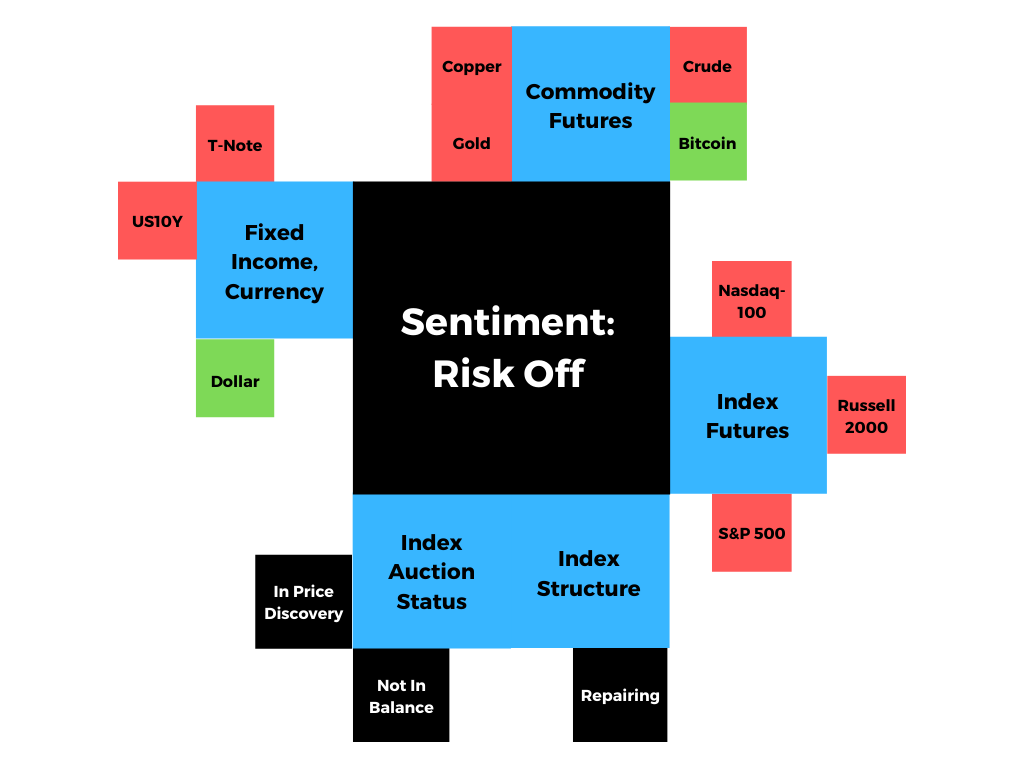
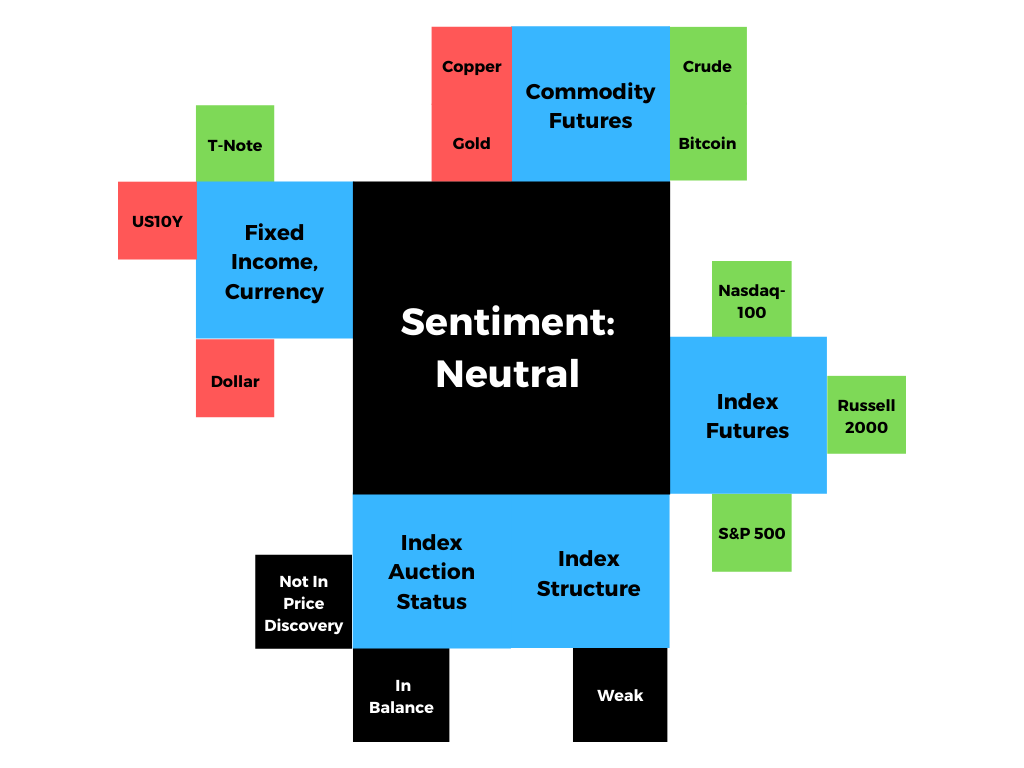
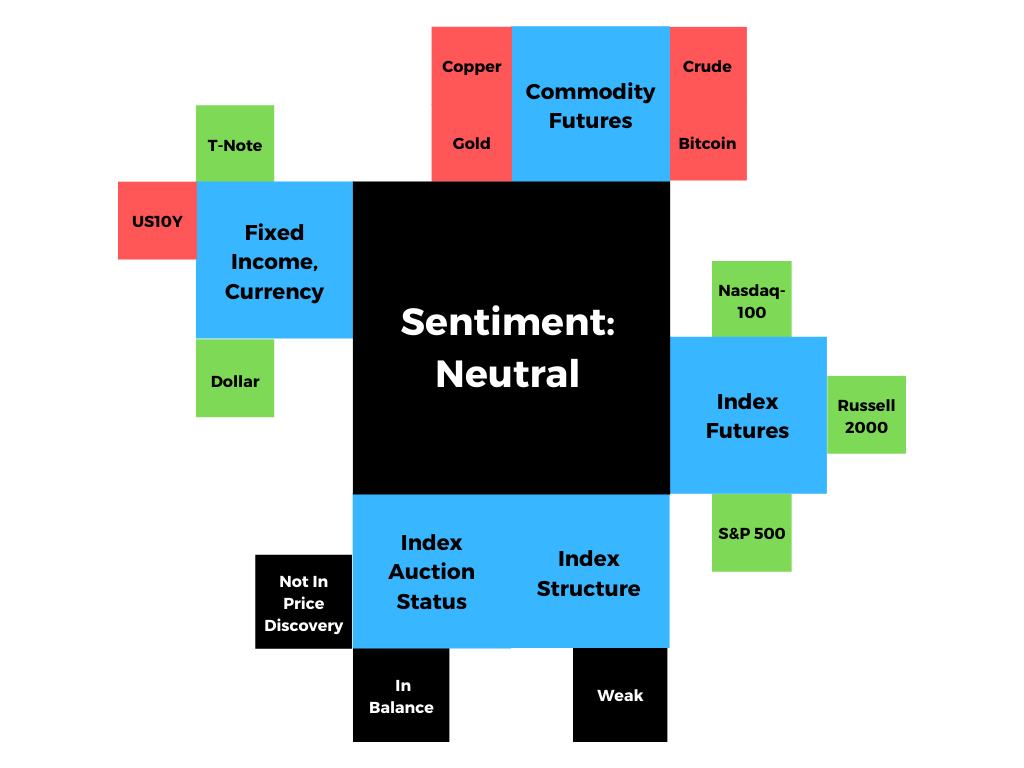
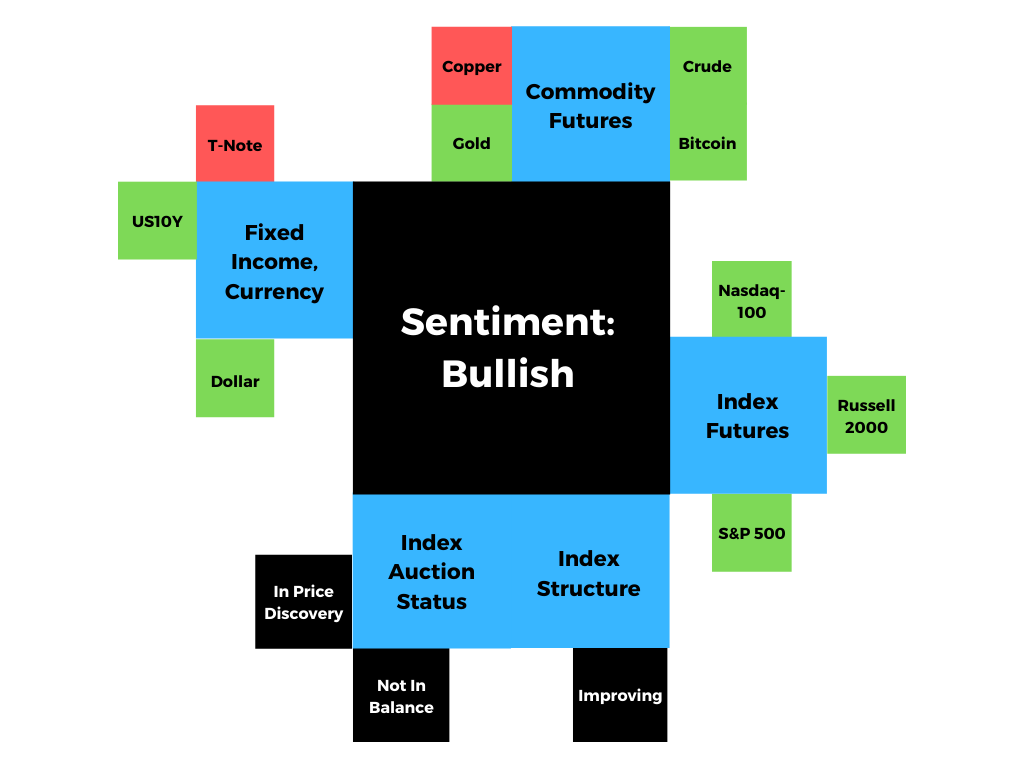
Graphic updated 7:25 AM ET.

What To Expect: Thursday’s regular session (9:30 AM – 4:00 PM EST) in the S&P 500 will likely open inside of prior-range and -value, suggesting a limited potential for immediate directional opportunity. 

Adding, during the prior day’s regular trade, the worst-case outcome occurred evidenced by initiative trade below the $4,227.75 high volume area (HVNode). This is significant because that level marked a pivot (i.e., above = bullish, below = bearish) on the composite profile. 

Initiative Selling: Selling within or below the previous day’s value area.

Volume Areas: A structurally sound market will build on past areas of high volume. Should the market trend for long periods of time, it will lack sound structure (identified as a low volume area which denotes directional conviction and ought to offer support on any test). 

If participants were to auction and find acceptance into areas of prior low volume, then future discovery ought to be volatile and quick as participants look to areas of high volume for favorable entry or exit.

It is important to think about who is winning and losing. We start by anchoring a VWAP (blue in color on the below graphic) from the time of the Federal Reserve event. Clearly, the S&P 500 is trading below this VWAP. This suggests the average buyer, since yesterday’s liquidation, is losing. Trading (and staying) above this blue line changes the dynamics; in such a case, shorts should reconsider their involvement.

Volume Weighed Average Price (VWAP): The average price at which a stock is traded over a certain horizon.

For today, participants can trade from the following frameworks. 

In the best case, the S&P 500 trades sideways or higher; activity above the $4,207.25 VWAP (blue in color on the below chart) puts in play the $4,227.25 HVNode. Initiative trade beyond that HVNode could reach as high as the $4,235.00 Virgin Point Of Control (VPOC), $4,249.00 low volume area (LVNode), and $4,258.00 overnight high (ONH).

Overnight Highs (Lows): Typically, there is a low historical probability associated with overnight rally-highs (lows) ending the upside (downside) discovery process.

POCs: POCs (like HVNodes described above) are valuable as they denote areas where two-sided trade was most prevalent. Participants will respond to future tests of value as they offer favorable entry and exit.

In the worst case, the S&P 500 trades sideways or lower; activity below the blue VWAP suggests a risk-off sentiment remains. In such a case, there is the potential to test lower, into the $4,182.50 overnight low (ONL) and $4,177.25 HVNode. If a probe into lower value is not responded to, lookout. There’s a higher potential to trade to the HVNodes at $4,153.25, $4,122.25, and $4,069.25.

Graphic: 65-minute profile chart of the Micro E-mini S&P 500 Futures.
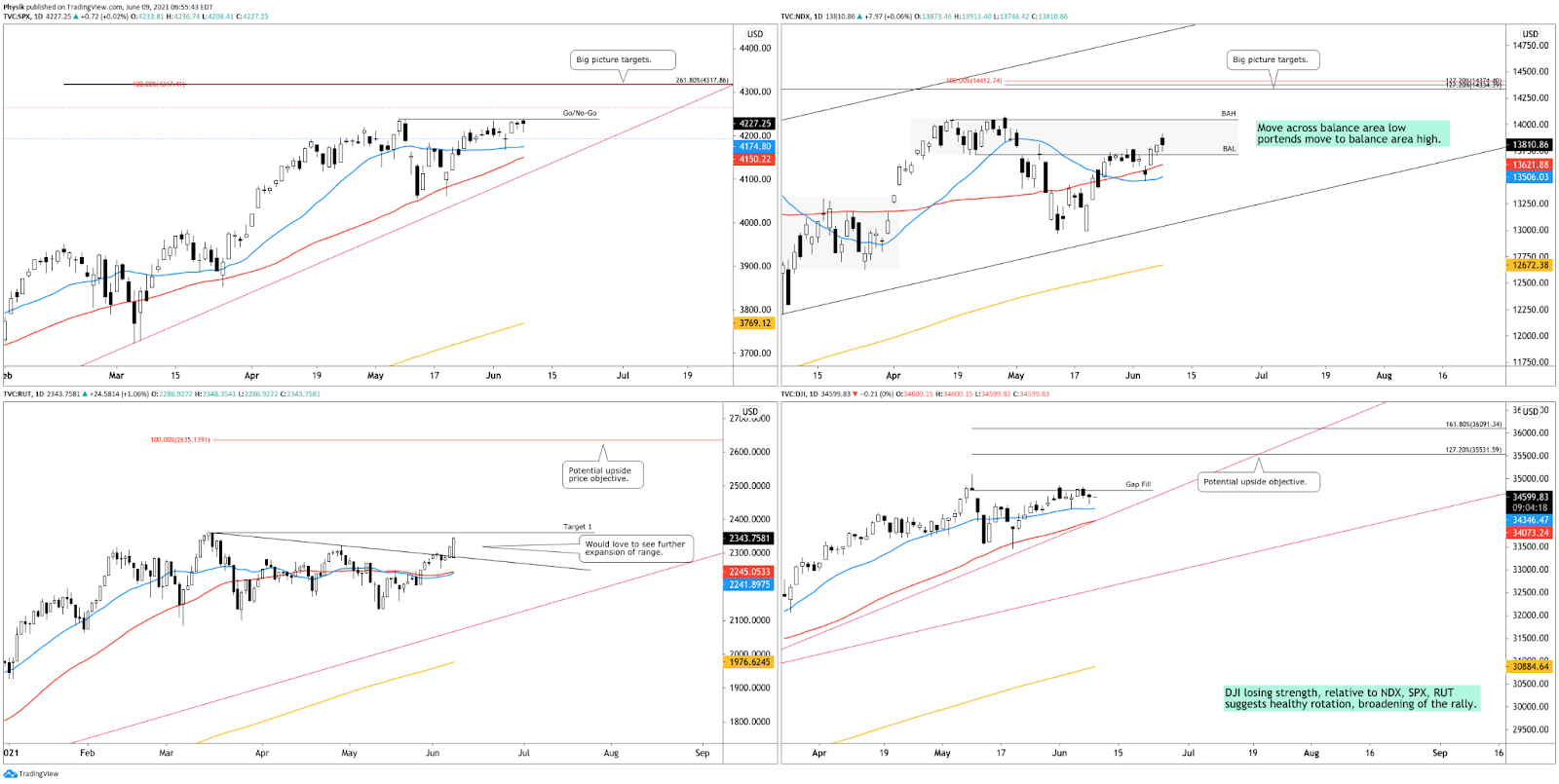
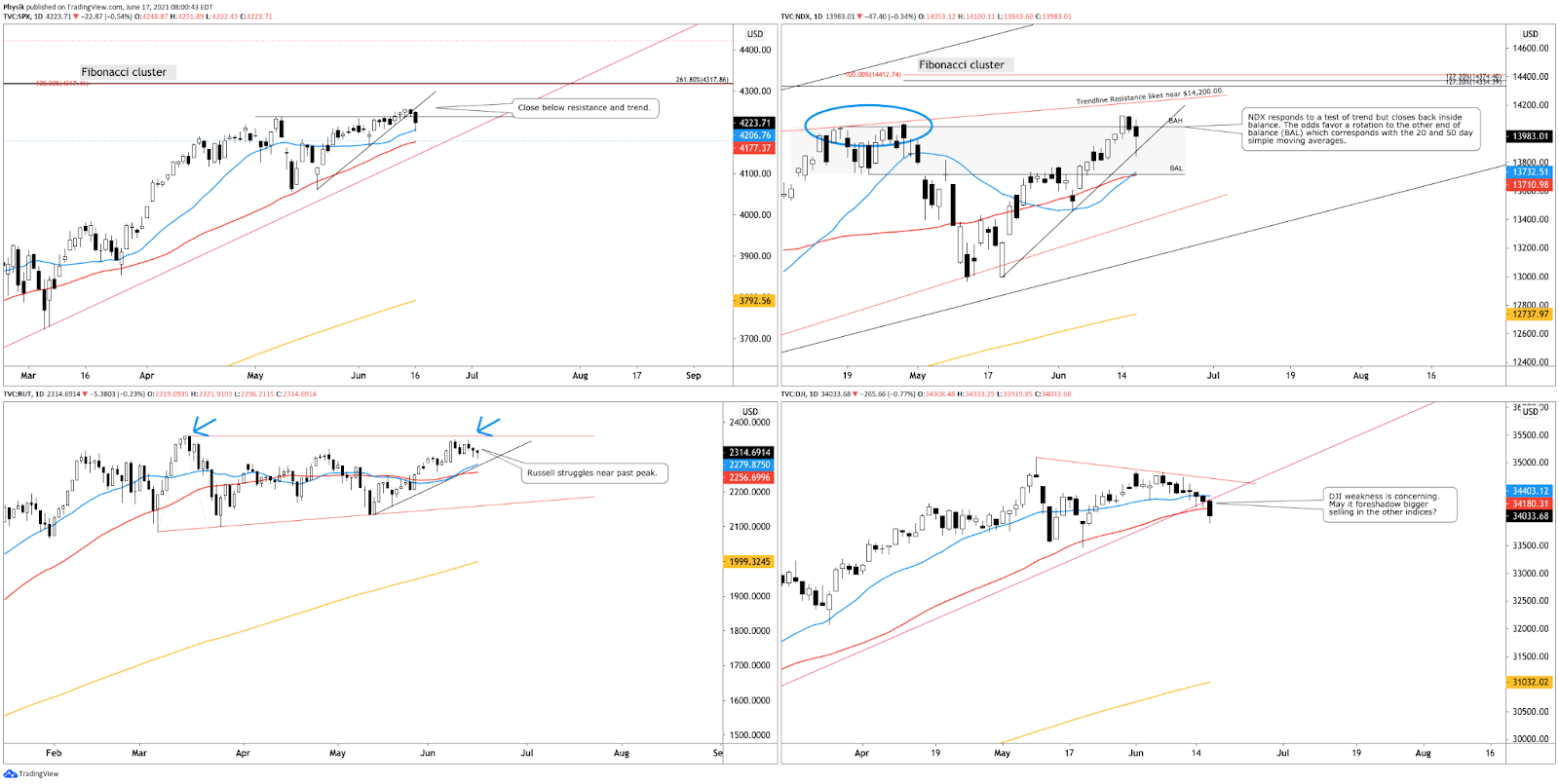
Graphic: Daily candlestick charts of the S&P 500 (top left), Nasdaq 100 (top right), Russell 2000 (bottom left), and Dow Jones Industrial Average (bottom right).
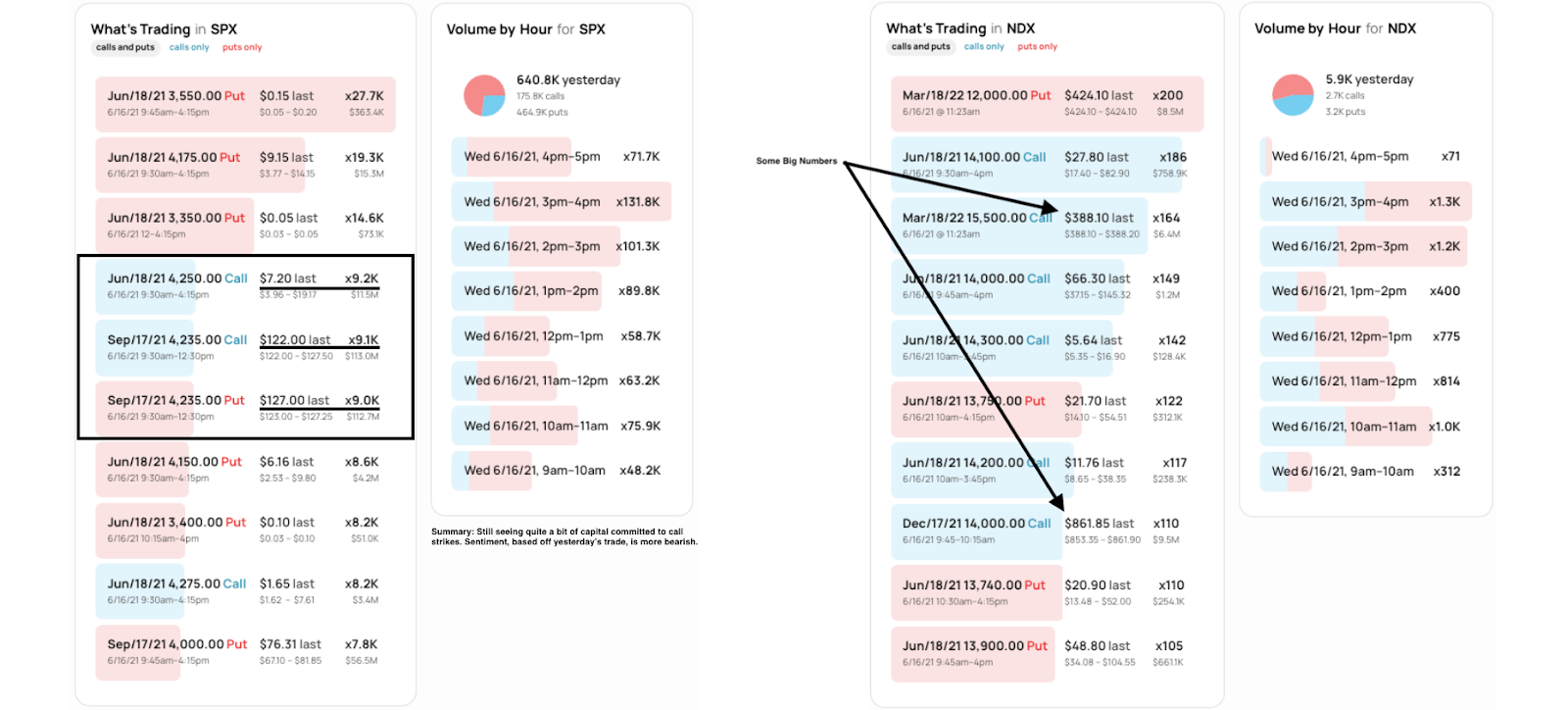
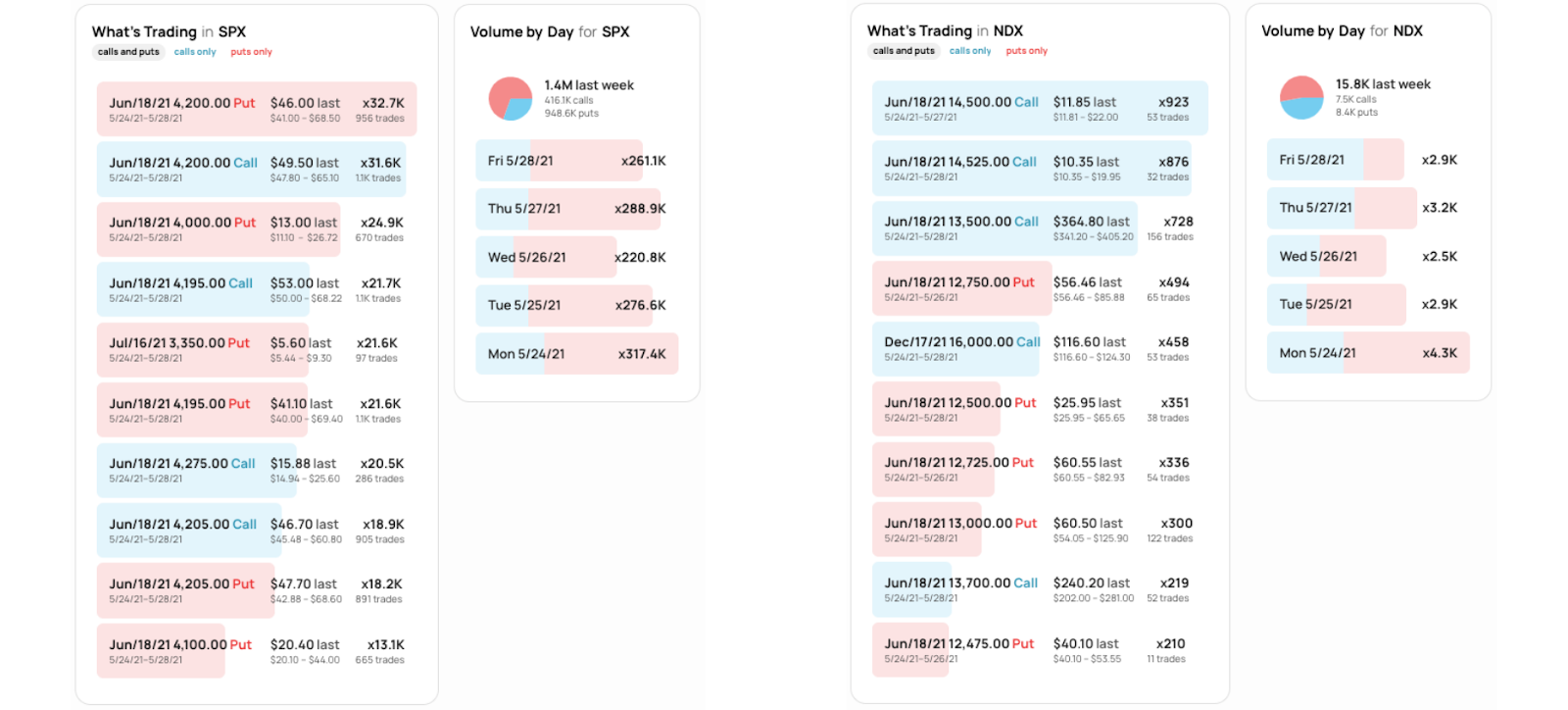
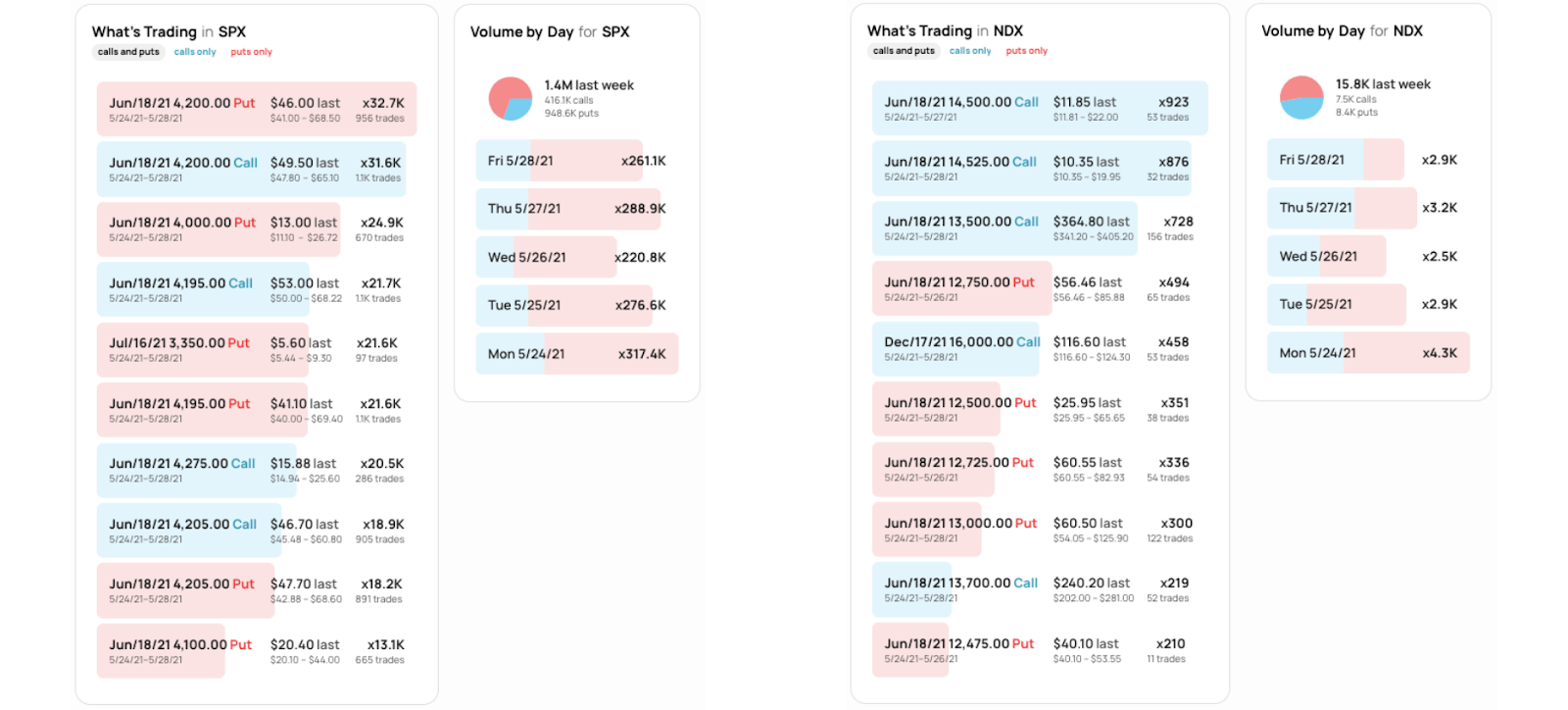
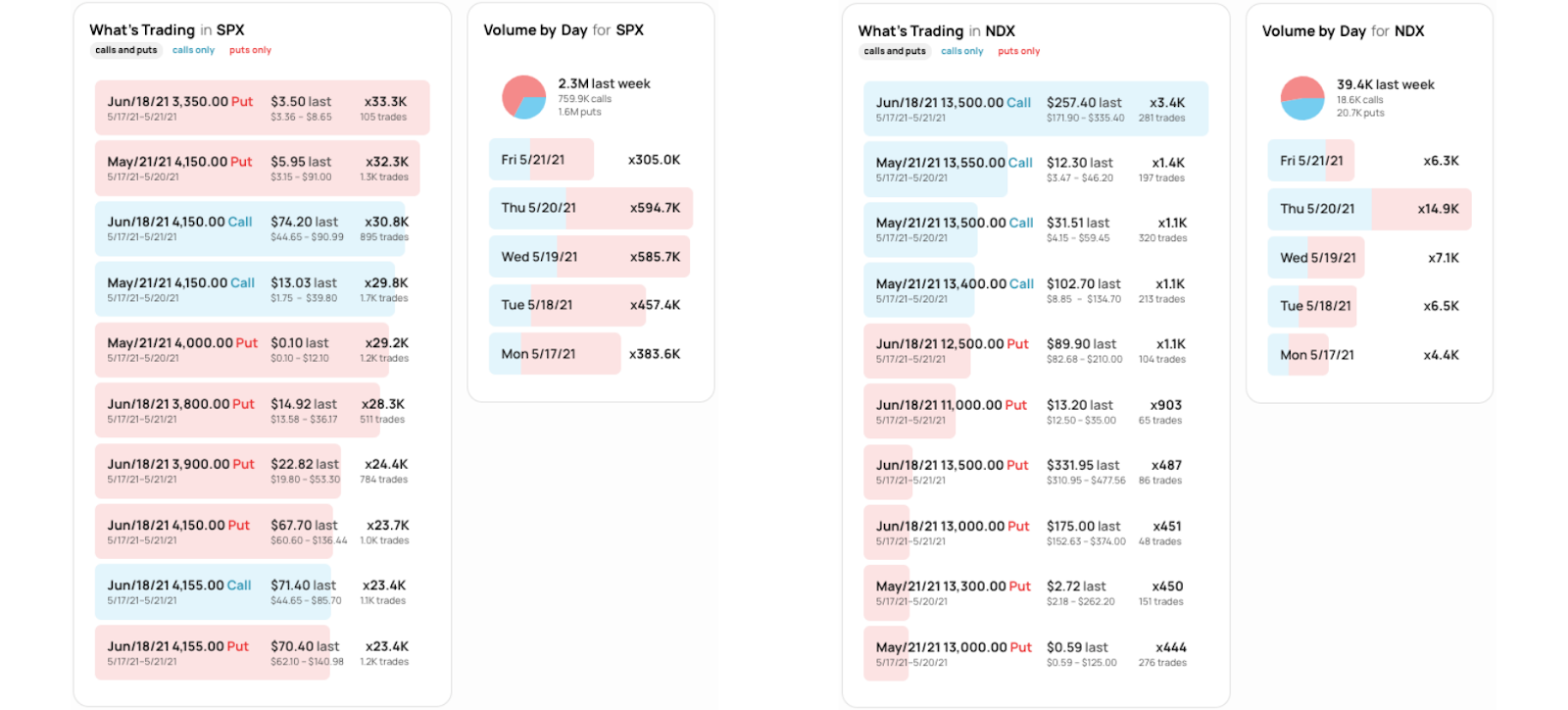
Graphic: SHIFT search suggests participants were most interested in put strikes at and below current prices in the cash-settled S&P 500 Index (INDEX: SPX) and Nasdaq 100 Index (INDEX: NDX), yesterday. Noting, participants are still paying up for upside call exposure.

News And Analysis

Energy | Climbing oil prices signal the need for more output. (REU)

Markets | OPEX is a huge thing and June FOMC a non-event. (HR)

COVID | Delta variant fuelled a 50% rise in England infections. (REU)

Economy | World Bank rejects El Salvador’s request on BTC. (REU)

Energy | Blistering heatwave hits California and fire risks build. (Axios)

What People Are Saying

Innovation And Emerging Trends

Markets | OnlyFans explores share sale after the lockdown boom. (FT)

FinTech | New crypto working group in Congress to hone policies. (TB)

Markets | Cboe extends global trading hours in SPX, VIX options. (MM)

Markets | How SEC boss should deal with ‘meme’ stock schemes. (NYP)

About

Renato founded Physik Invest after going through years of self-education, strategy development, and trial-and-error. His work reporting in the finance and technology space, interviewing leaders such as John Chambers, founder, and CEO, JC2 Ventures, Kevin O’Leary, businessman and Shark Tank host, Catherine Wood, CEO and CIO, ARK Invest, among others, afforded him the perspective and know-how very few come by.

Having worked in engineering and majored in economics, Renato is very detailed and analytical. His approach to the markets isn’t built on hope or guessing. Instead, he leverages the unique dynamics of time and volatility to efficiently act on opportunity.

Disclaimer

At this time, Physik Invest does not manage outside capital and is not licensed. In no way should the materials herein be construed as advice. Derivatives carry a substantial risk of loss. All content is for informational purposes only.
Categories
Commentary

Daily Brief For June 16, 2021

Market Commentary

Index futures in balance.

  • Ahead: Housing starts, trade prices, FOMC.
  • Indices diverge and trade sideways to lower.

What Happened: U.S. stock index futures auctioned sideways ahead of an important Federal Open Market Committee (FOMC) announcement at 2:00 p.m. Eastern Time, today.

As stated in prior commentaries, the odds of substantial change to policy are low. Instead, participants will likely hear that despite Fed policy remaining unchanged, tools exist to combat inflation.

Also, before the open, China established orders limiting exposure to overseas commodities and U.K. consumer prices rose. Important releases, aside from the Fed decision, include data on housing starts and trade prices, as well as text on infrastructure.

Graphic updated 7:13 AM ET.

What To Expect: Wednesday’s regular session (9:30 AM – 4:00 PM EST) in the S&P 500 will likely open inside of prior-range and -value, suggesting a limited potential for immediate directional opportunity. 

Adding, during the prior day’s regular trade, the worst-case outcome occurred, evidenced by a liquidation break that found acceptance below the $4,238.00 spike base. That is significant because it negated the knee-jerk, end-of-day bullishness of Monday’s session.

Liquidation Breaks: The profile shape suggests participants were “too” long and had poor location. This corrective activity enables favorable entry and exit.

Spikes: Spike’s mark the beginning of a break from value. Spikes higher (lower) are validated by trade at or above (below) the spike base (i.e., the origin of the spike).

Further, for today, participants can trade from the following frameworks. 

In the best case, the S&P 500 trades sideways or higher; activity above the $4,234.25 high volume area (HVNode), which corresponds with the average price bought and sold (via the VWAP) since consumer price data was released last week, puts in play the $4,249.00 low volume area (LVNode). Initiative trade beyond the LVNode could reach as high as the $4,258.00 overnight high (ONH) and $4,270.25 Fibonacci price extension.

Volume Areas: A structurally sound market will build on past areas of high volume. Should the market trend for long periods of time, it will lack sound structure (identified as a low volume area which denotes directional conviction and ought to offer support on any test). 

If participants were to auction and find acceptance into areas of prior low volume, then future discovery ought to be volatile and quick as participants look to areas of high volume for favorable entry or exit.

Volume Weighed Average Price (VWAP): The average price at which a stock is traded over a certain horizon.

Overnight Rally Highs (Lows): Typically, there is a low historical probability associated with overnight rally-highs (lows) ending the upside (downside) discovery process.

In the worst case, the S&P 500 trades lower; activity below the $4,234.25 HVNode suggests caution. It is likely participants will trade to the $4,227.75 HVNode. Thereafter, depending on how participants respond to a test of the HVNode, if lower, the $4,213.75 LVNode and balance area low (BAL) come into play, first. Initiating below the BAL is bearish. In that instance, if selling is aggressive, the $4,177.25 HVNode is in play.

Graphic: 65-minute profile chart of the Micro E-mini S&P 500 Futures.
Graphic: Daily candlestick charts of the S&P 500 (top left), Nasdaq 100 (top right), Russell 2000 (bottom left), and Dow Jones Industrial Average (bottom right). Important to monitor where the indices close, today. Above balance high or trend, bullish. Below, that’s near-term bearish.
Graphic: SHIFT search suggests participants were most interested in put strikes at and below current prices in the cash-settled S&P 500 Index (INDEX: SPX) and Nasdaq 100 Index (INDEX: NDX), yesterday.

News And Analysis

Economy | U.K. inflation’s jump above BOE goal stirring a debate. (BBG)

Economy | China’s economic data disappoints as spending lags. (BBG)

Politics | Disagreements, low expectations as Biden and Putin meet. (REU)

Economy | U.S. retail sales drop, hinting at shift to services spend. (BBG)

Politics | China’s government made warning. Planes fly over Taiwan. (Axios)

Markets | Citi is latest to warn of bigger-than-expected trading drop. (BBG)

What People Are Saying

Innovation And Emerging Trends

FinTech | The big difference between a digital dollar and a CBDC. (BBG)

Markets | Everyone’s a rising star when debt is relatively cheap. (BBG)

Markets | Well-behaved bubbles often make history. An analysis. (a16z)

Markets | The latest blow to 60/40 model is an exodus of pensions. (BBG)

COVID | How prior coronavirus infections factor into herd immunity. (Axios)

Travel | You’ll soon be able to use your iPhone as ID at the airport. (Verge)

FinTech | Exchanges are looking to accelerate their cloud adoption. (TM)

About

Renato founded Physik Invest after going through years of self-education, strategy development, and trial-and-error. His work reporting in the finance and technology space, interviewing leaders such as John Chambers, founder, and CEO, JC2 Ventures, Kevin O’Leary, businessman and Shark Tank host, Catherine Wood, CEO and CIO, ARK Invest, among others, afforded him the perspective and know-how very few come by.

Having worked in engineering and majored in economics, Renato is very detailed and analytical. His approach to the markets isn’t built on hope or guessing. Instead, he leverages the unique dynamics of time and volatility to efficiently act on opportunity.

Disclaimer

At this time, Physik Invest does not manage outside capital and is not licensed. In no way should the materials herein be construed as advice. Derivatives carry a substantial risk of loss. All content is for informational purposes only.

Categories
Commentary

Daily Brief For June 15, 2021

Market Commentary

Index futures exit balance, discover higher prices.

  • The calm before the storm (FOMC).
  • Ahead: Production, PPI, retail sales.
  • Indices trade higher, then sideways.

What Happened: U.S. stock index futures traded higher ahead of key releases on U.S. industrial production, producer prices, and retail sales. Tomorrow, of bigger concern, is Wednesday’s Federal Open Market Committee (FOMC) rate decision.

As stated in Monday’s commentary, the FOMC will likely not change its forward guidance on interest rates or asset purchases. That’s according to Moody’s which noted: “The statement will likely strengthen the FOMC’s assessment of the acceleration in inflation and possibly mention the central bank has the tools to address inflation if needed. This would be an effort to keep long-term inflation expectations in check.”

Graphic updated 6:43 AM ET.

What To Expect: Tuesday’s regular session (9:30 AM – 4:00 PM EST) in the S&P 500 may open just outside of prior-range and -value, suggesting a potential for immediate directional opportunity. 

Adding, during the prior day’s regular trade, the best case outcome occurred, evidenced by initiative trade above the $4,249.00 minimal excess high.

Initiative Buying: Buying within or above the previous day’s value area.

Excess: A proper end to price discovery; the market travels too far while advertising prices. Responsive, other-timeframe (OTF) participants aggressively enter the market, leaving tails or gaps which denote unfair prices.

This move higher, across the broad market, comes as participants attempt to jack up prices in accordance with their views on issues like inflation, COVID-19, employment, supply chains, and more. Adding, measures of breadth indicate index constituents are participating.

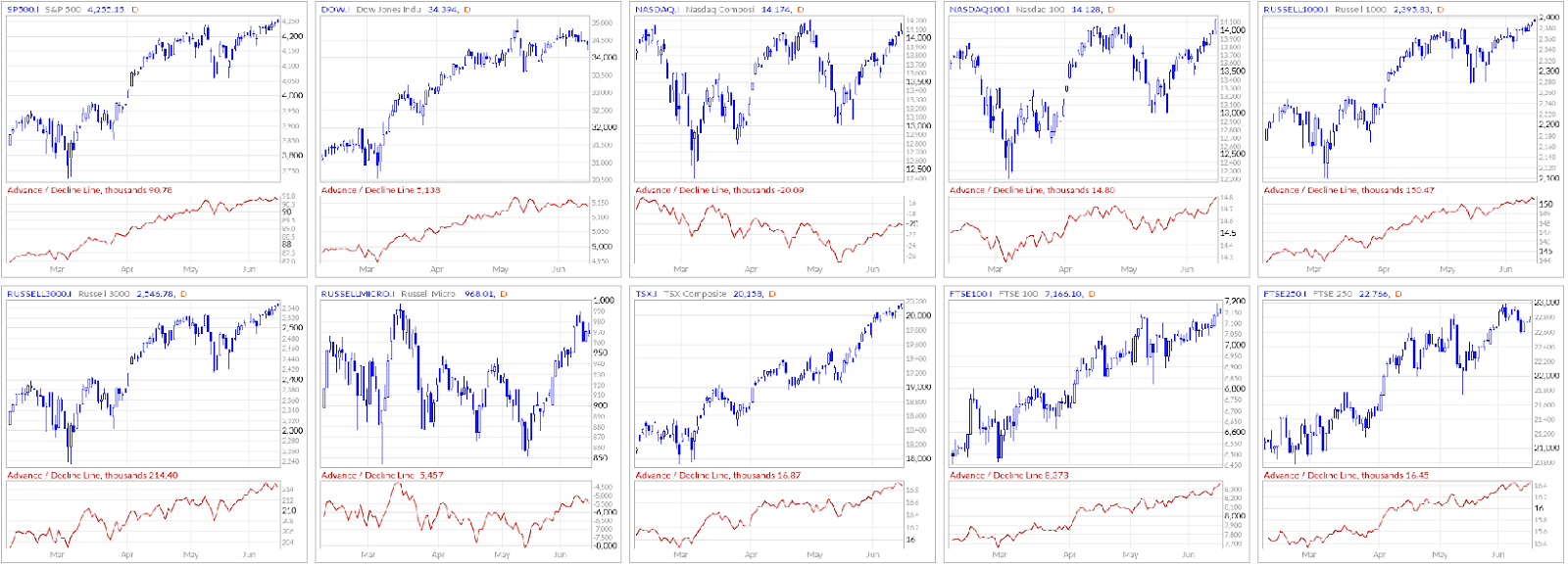
Graphic: Advance/Decline Lines for broad market indices suggest breadth has improved, via MarketInOut.

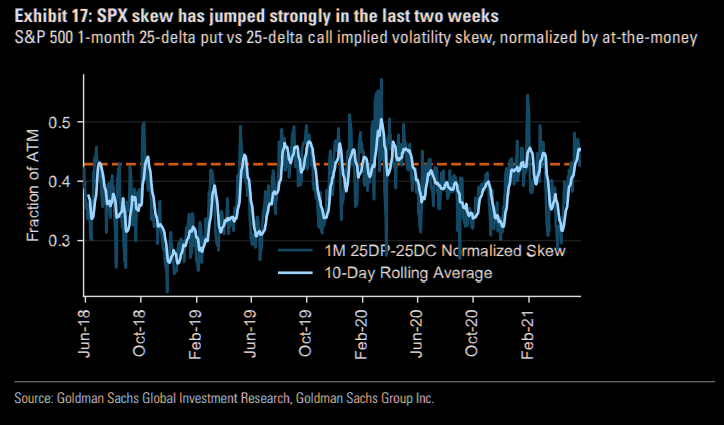
On the other hand, metrics, such as S&P 500 skew – a measure of perceived tail risk and the chances of a black swan event – suggest participants are pricing the slope of implied volatility higher. At the same time, sentiment cooled and individual stock volatility rose.

Further, for today, participants can trade from the following frameworks. 

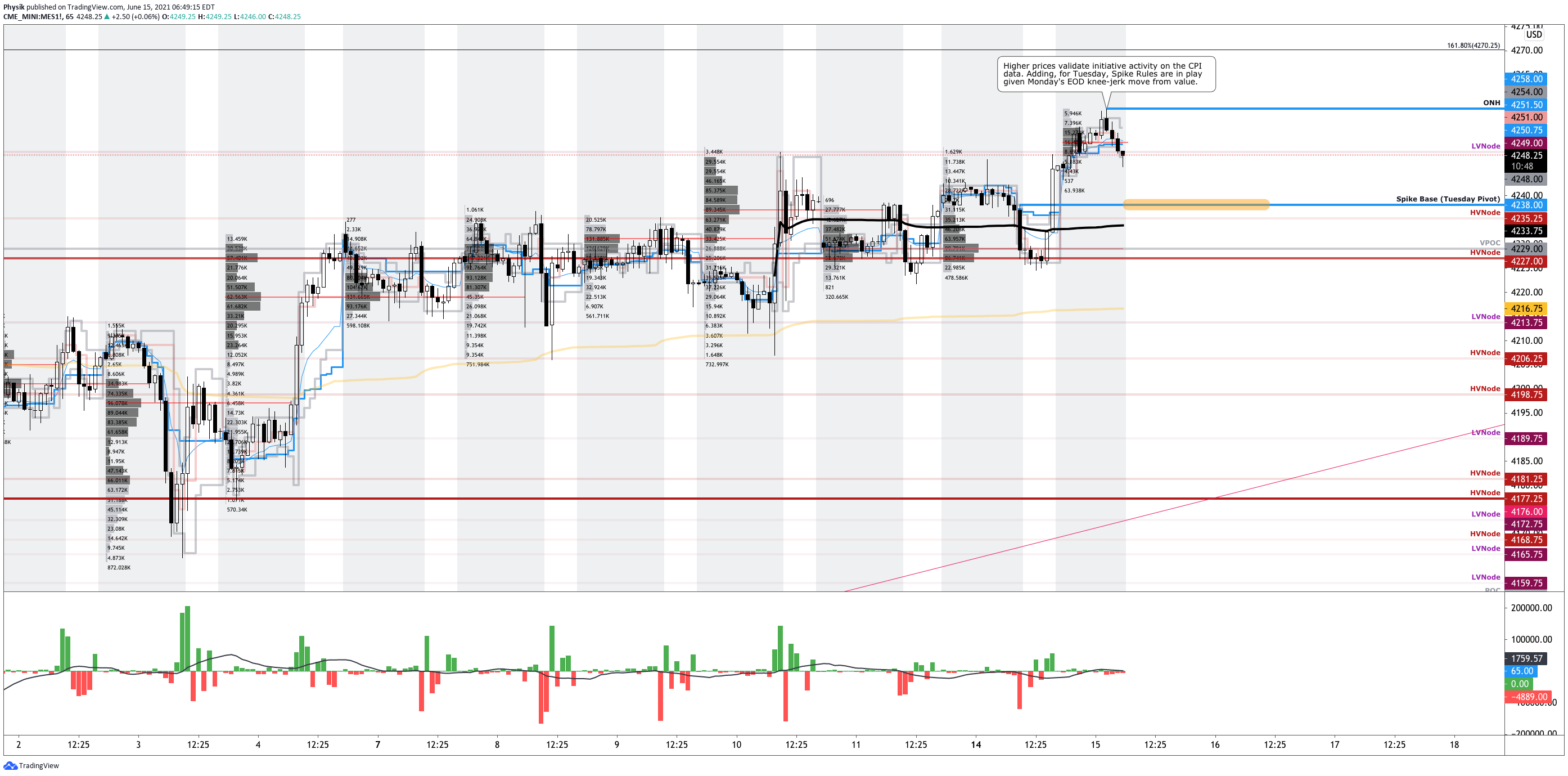
In the best case, the S&P 500 trades sideways or higher; activity above the $4,238.00 spike base puts in play the $4,249.00 low volume area (LVNode). Initiative trade beyond the LVNode could reach as high as the $4,258.00 overnight high (ONH) and $4,270.25 Fibonacci price extension.

Spikes: Spike’s mark the beginning of a break from value. Spikes higher (lower) are validated by trade at or above (below) the spike base (i.e., the origin of the spike).

Volume Areas: A structurally sound market will build on past areas of high volume. Should the market trend for long periods of time, it will lack sound structure (identified as a low volume area which denotes directional conviction and ought to offer support on any test). 

If participants were to auction and find acceptance into areas of prior low volume, then future discovery ought to be volatile and quick as participants look to areas of high volume for favorable entry or exit.

Overnight Rally Highs (Lows): Typically, there is a low historical probability associated with overnight rally-highs (lows) ending the upside (downside) discovery process.

In the worst case, the S&P 500 trades lower; activity below the $4,238.00 spike base puts in play the $4,229.00 point of control (POC). Thereafter, if lower than the $4,227.00 composite high volume area (HVNode), the $4,213.75 balance area low (BAL) comes into play. 

POCs: POCs (like HVNodes described above) are valuable as they denote areas where two-sided trade was most prevalent. Participants will respond to future tests of value as they offer favorable entry and exit.
Graphic: 65-minute profile chart of the Micro E-mini S&P 500 Futures.
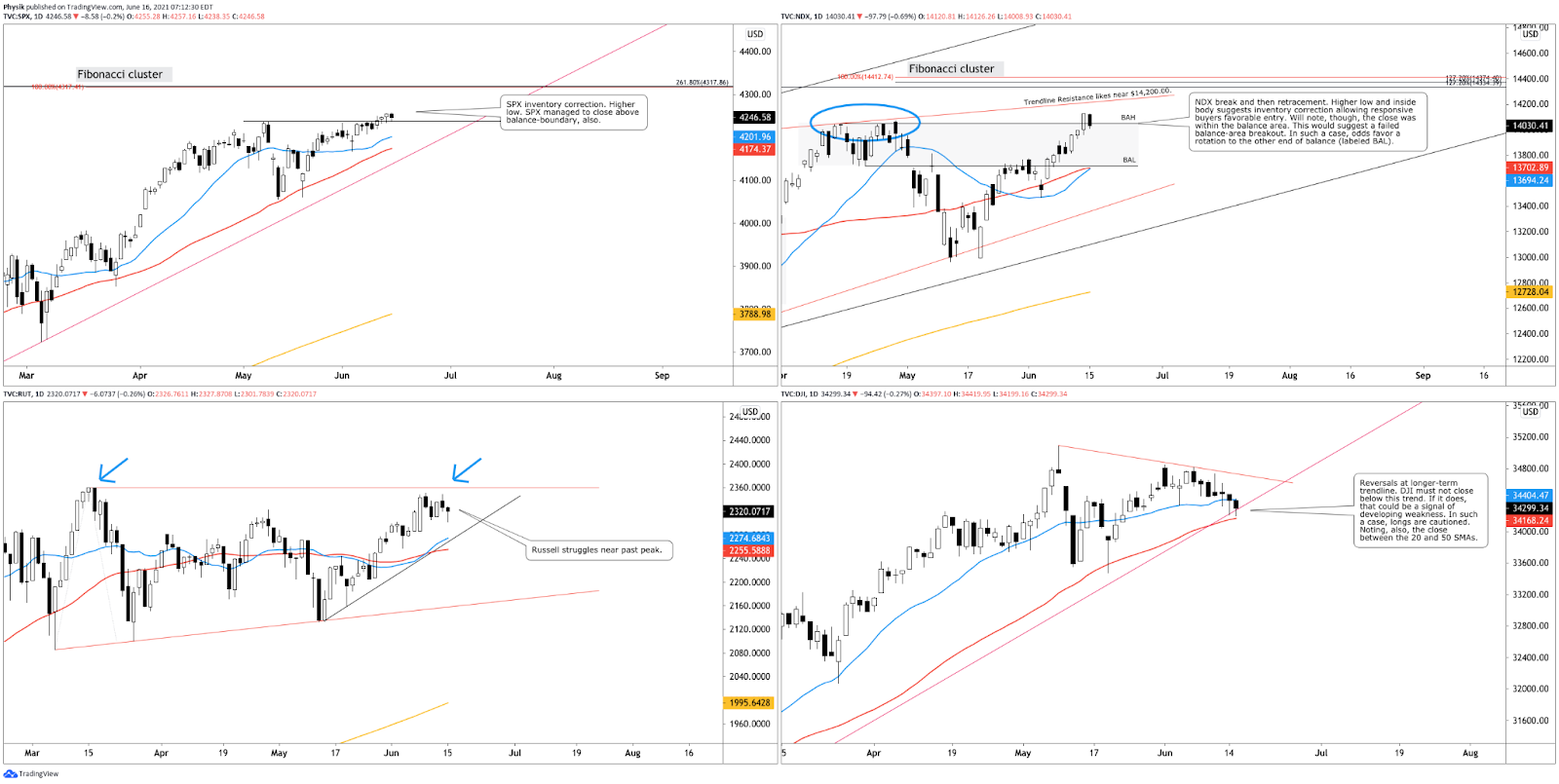
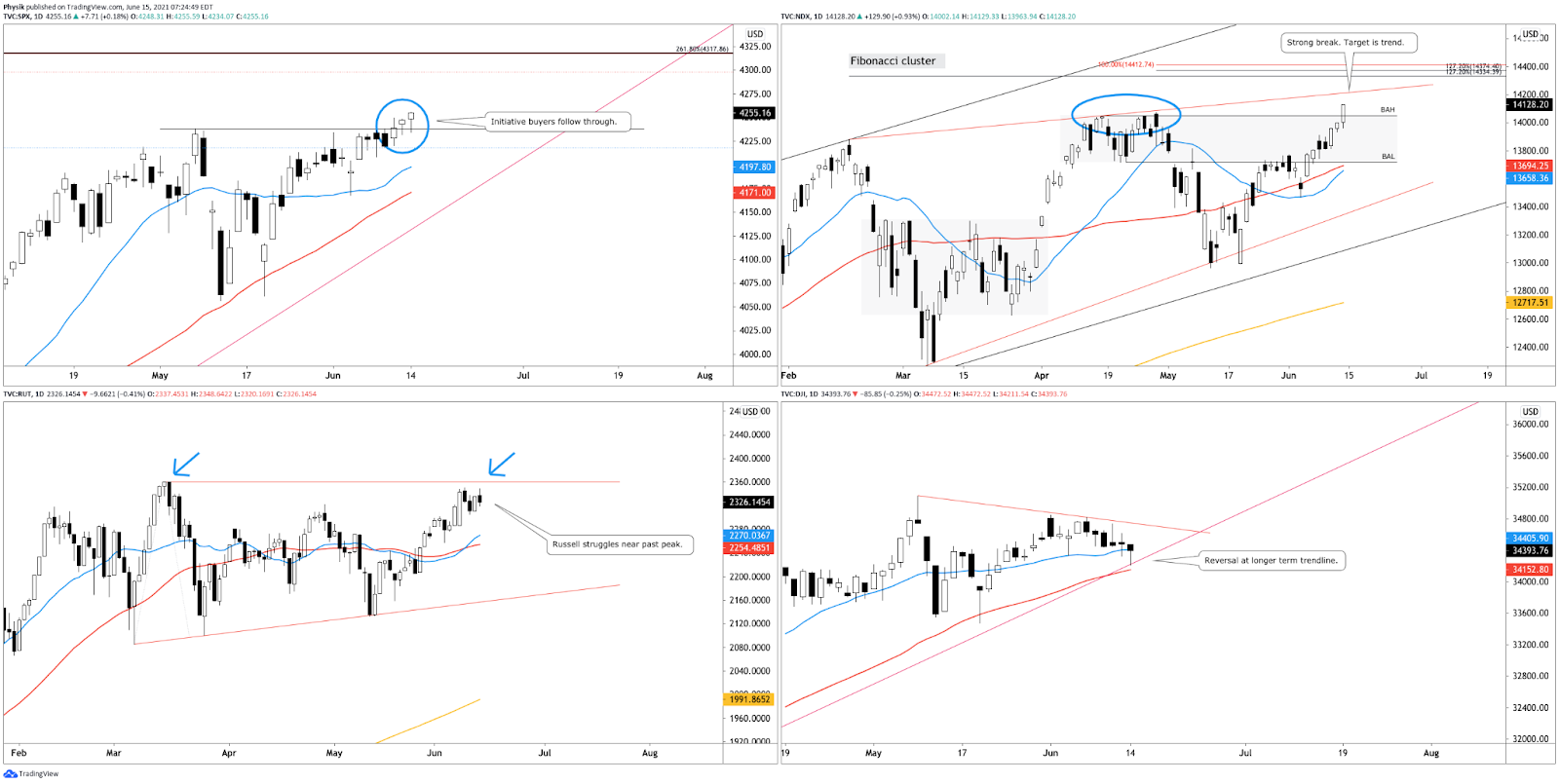
Graphic: Daily candlestick charts of the S&P 500 (top left), Nasdaq 100 (top right), Russell 2000 (bottom left), and Dow Jones Industrial Average (bottom right). The S&P 500 and Nasdaq 100 follow-through on breakouts. Russell struggles with past peaks. Dow puts in reversal candle at a longer-term trendline.
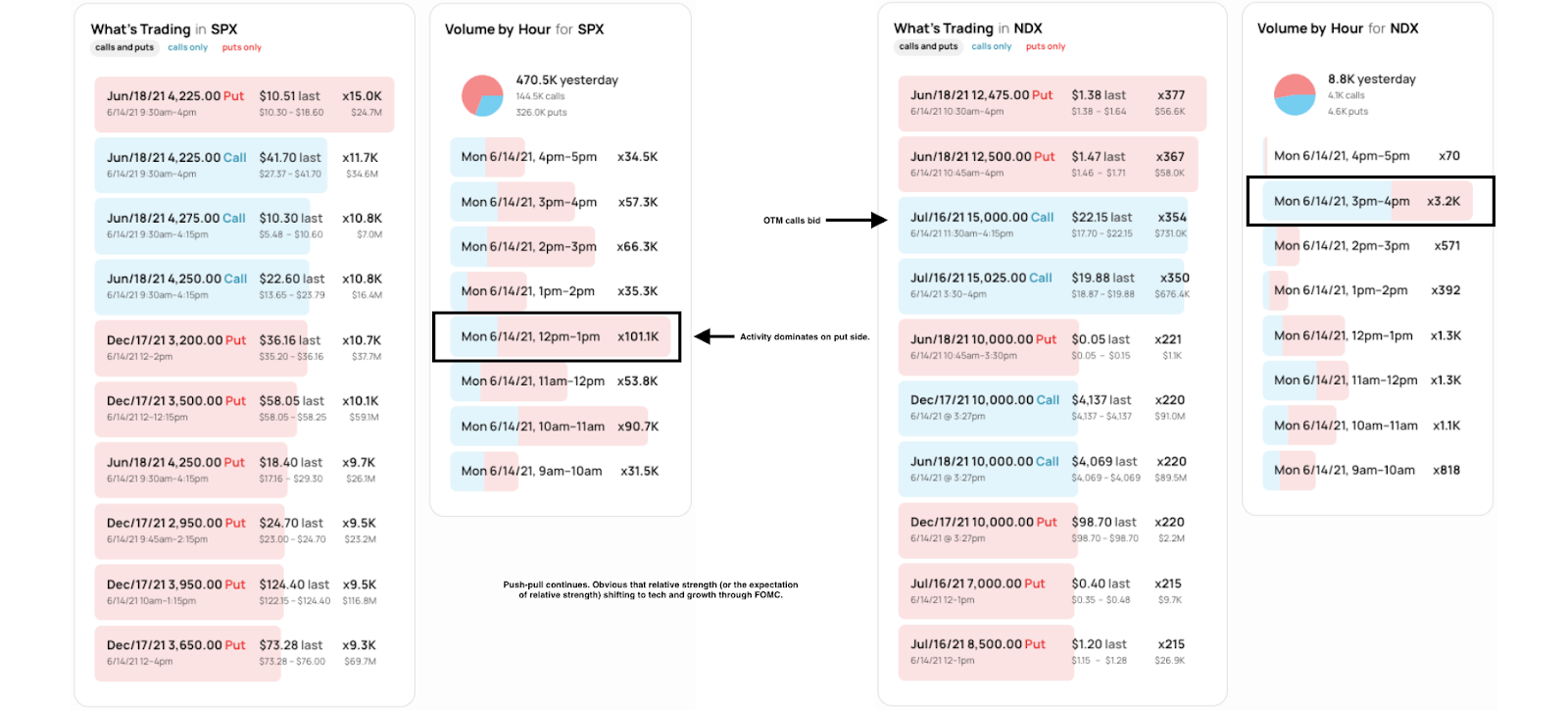
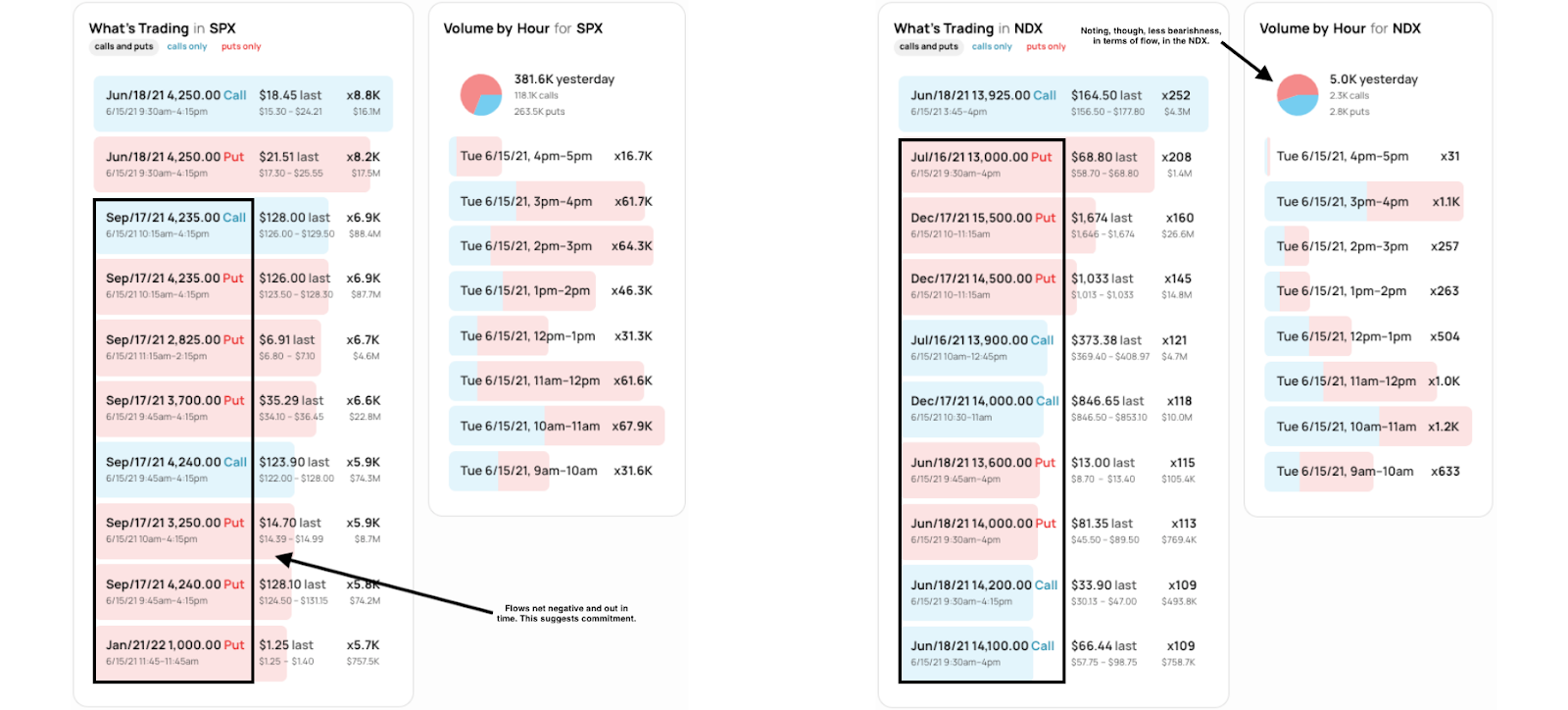
Graphic: SHIFT search suggests participants were most interested in put strikes at and below in the cash-settled S&P 500 Index (INDEX: SPX), Monday. The same is true for the cash-settled Nasdaq 100 Index (INDEX: NDX). Note, however, a bid in far out-of-the-money calls on Nasdaq, through FOMC. This activity supports a rotation back into technology and growth, possibly.

News And Analysis

Politics | China calling U.S. ill after Biden rallies G-7 against Beijing. (BBG)

Politics | EU, U.S. agree to a five-year truce on Boeing-Airbus trade. (BBG)

Economy | EU is set to lift travel curbs for U.S. residents this week. (BBG)

Politics | House antitrust bills taking a tight aim at technology giants. (Axios)

Economy | Dimon said JPMorgan hoarding cash due to inflation. (CNBC)

What People Are Saying

Innovation And Emerging Trends

Politics | White House releases national strategy for domestic terror. (Axios)

FinTech | Mark Cuban suggesting ‘banks should be scared’ of DeFi. (CNBC)

Economy | The bubbliest housing markets flash 2008-type warnings. (BBG)

FinTech | Bitcoin’s most significant code improvement was approved. (Axios)

About

Renato founded Physik Invest after going through years of self-education, strategy development, and trial-and-error. His work reporting in the finance and technology space, interviewing leaders such as John Chambers, founder, and CEO, JC2 Ventures, Kevin O’Leary, businessman and Shark Tank host, Catherine Wood, CEO and CIO, ARK Invest, among others, afforded him the perspective and know-how very few come by.

Having worked in engineering and majored in economics, Renato is very detailed and analytical. His approach to the markets isn’t built on hope or guessing. Instead, he leverages the unique dynamics of time and volatility to efficiently act on opportunity.

Disclaimer

At this time, Physik Invest does not manage outside capital and is not licensed. In no way should the materials herein be construed as advice. Derivatives carry a substantial risk of loss. All content is for informational purposes only.
Categories
Commentary

Daily Brief For June 9, 2021

Market Commentary

Index futures in balance.

  • Manufacturing, tech bill is passed.
  • Ahead: Wholesale inventory data.
  • Indexes trade sideways overnight.

What Happened: U.S. stock index futures traded sideways overnight alongside the passage of a bill that bolsters U.S. manufacturing and technology initiatives.

At the same time, so-called meme stocks, like Clover Health, rocketed amid speculative commentaries on platforms like Reddit. This comes as risk metrics flash warnings ahead of the Fed’s annual meeting in Jackson Hole which, as discussed in prior commentaries, may mark a shift in policy tone.

Ahead is data on wholesale inventories and policy decisions by the Bank of Canada. 

Graphic updated 8:02 AM ET.

What To Expect: Wednesday’s regular session (9:30 AM – 4:00 PM EST) in the S&P 500 will likely open inside of prior-range and -value, suggesting a limited potential for immediate directional opportunity. 

Adding, during the prior day’s regular trade, the best case outcome occurred, evidenced by responsive buying below balance, at the $4,208.25 high volume area (HVNode). This is significant because it suggested lower prices did not solicit initiative selling.

Responsive Buying: Buying in response to prices below an area of recent price acceptance.

Balance (Two-Timeframe Or Bracket): Rotational trade that denotes current prices offer favorable entry and exit. Balance-areas make it easy to spot a change in the market (i.e., the transition from two-time frame trade, or balance, to one-time frame trade, or trend).

Volume Areas: A structurally sound market will build on past areas of high volume. Should the market trend for long periods of time, it will lack sound structure (identified as a low volume area which denotes directional conviction and ought to offer support on any test). 

If participants were to auction and find acceptance into areas of prior low volume, then future discovery ought to be volatile and quick as participants look to areas of high volume for favorable entry or exit.

Initiative Selling: Selling within or below the previous day’s value area.

Further, for today, participants can trade from the following frameworks. 

In the best case, the S&P 500 trades sideways or higher; activity above the $4,224.75 HVNode puts in play the $4,232.25 low volume area (LVNode) and $4,238.00 overnight high (ONH). Initiative trade beyond the ONH could reach as high as the $4,247.75 Fibonacci-derived price target.

Overnight Rally Highs (Lows): Typically, there is a low historical probability associated with overnight rally-highs (lows) ending the upside (downside) discovery process.

In the worst case, the S&P 500 trades lower; activity below the $4,224.75 HVNode puts in play the $4,213.75 LVNode and $4,208.25 HVNode. If lower, participants ought to look for responses at the $4,198.75 and $4,177.25 HVNodes.

Graphic: 65-minute profile chart of the Micro E-mini S&P 500 Future.
Graphic: Daily candlestick charts of the S&P 500 (top left), Nasdaq 100 (top right), Russell 2000 (bottom left), and Dow Jones Industrial Average (bottom right).
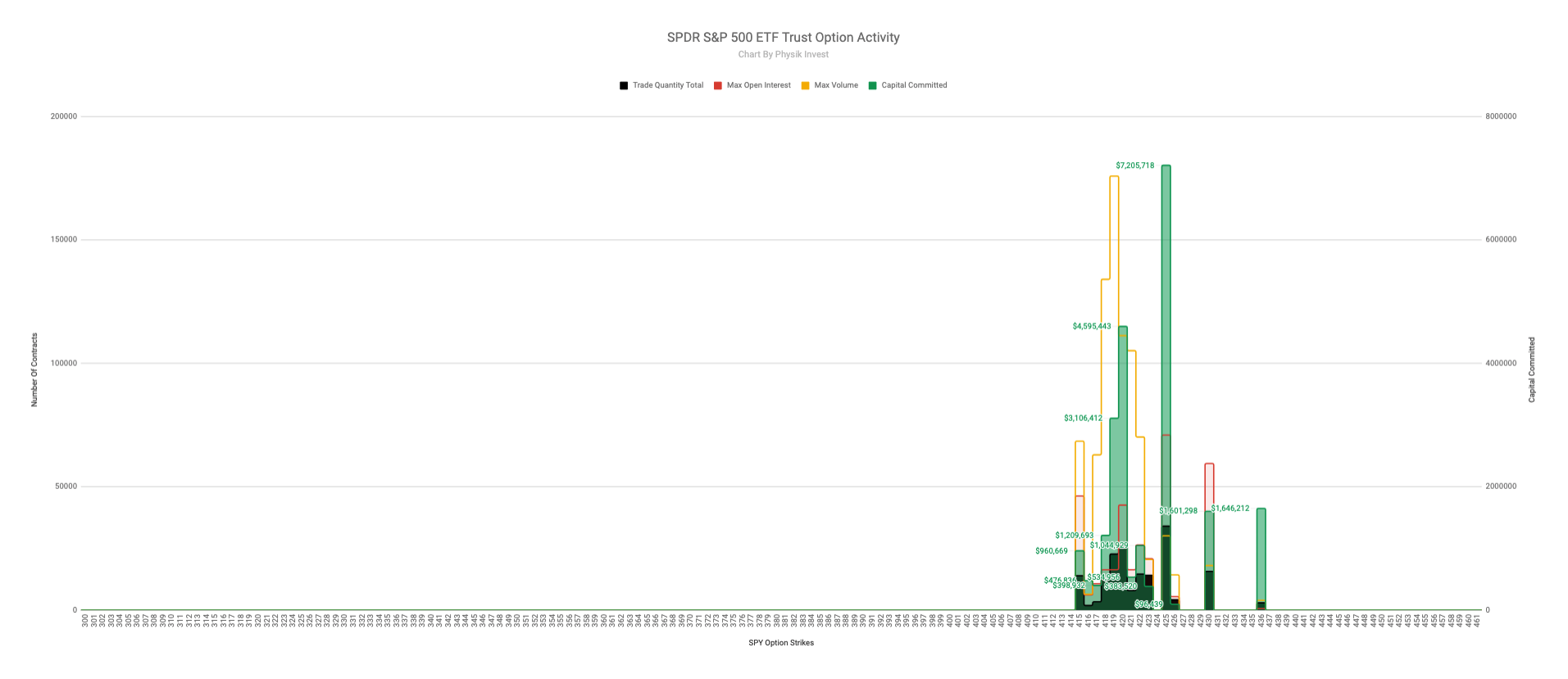
Graphic: Physik Invest maps out the purchase of call and put options in the SPDR S&P 500 ETF Trust (NYSE: SPY), for Tuesday. Activity in the options market was primarily concentrated in short-dated tenors, in call strikes as high as $435.
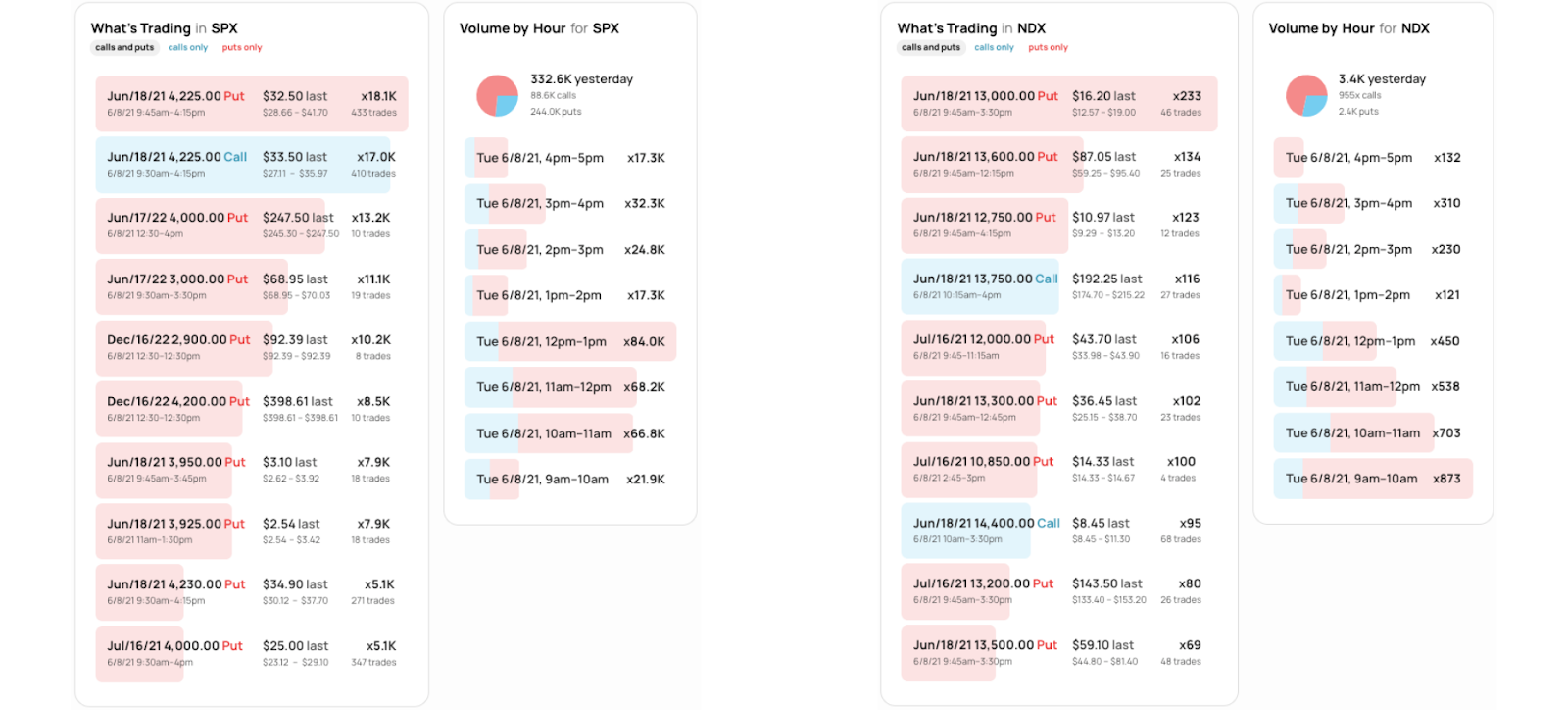
Graphic: SHIFT search suggests participants were most interested in put strikes at and below current prices in the cash-settled S&P 500 Index (INDEX: SPX) and Nasdaq 100 Index (INDEX: NDX), Tuesday.

News And Analysis

Politics | Democratic, GOP House members pitch infrastructure. (BBG)

Energy | One password allowed hackers to disrupt Colonial Pipeline. (REU)

Politics | U.S. Senate passes sweeping bill to address China threat. (REU)

Economy | The World Bank sees the strongest rebound in 80 years. (BBG)

Economy | Surprise jump in U.S. wages gives inflation debate twist. (BBG)

Politics | Gig companies’ push for state worker laws faces division. (REU)

Economy | Delinquency rates inching closer to pre-COVID levels. (MND)

Politics | Hungary’s Orban calls global corporate tax plan absurd. (BBG)

COVID | Fauci urges U.S. vaccinations as harmful variant spreads. (BBG)

What People Are Saying

Innovation And Emerging Trends

Economy | Bottom 90% of Americans borrowing from the top 1%. (BBG)

FinTech | Man Group-Oxford quants say AI can predict stock moves. (BBG)

Technology | Price of batteries has declined by 97% over 30 years. (OWID)

Economy | Fed paying 0.00%. Such a deal. Depositors are flocking. (BBG)

Crypto | El Salvador passes a law to be 1st country to adopt BTC. (Axios)

Crypto | Hong Kong to explore digital currency, HKMA fintech plan. (SCMP)

About

Renato founded Physik Invest after going through years of self-education, strategy development, and trial-and-error. His work reporting in the finance and technology space, interviewing leaders such as John Chambers, founder, and CEO, JC2 Ventures, Kevin O’Leary, businessman and Shark Tank host, Catherine Wood, CEO and CIO, ARK Invest, among others, afforded him the perspective and know-how very few come by.

Having worked in engineering and majored in economics, Renato is very detailed and analytical. His approach to the markets isn’t built on hope or guessing. Instead, he leverages the unique dynamics of time and volatility to efficiently act on opportunity.

Disclaimer

At this time, Physik Invest does not manage outside capital and is not licensed. In no way should the materials herein be construed as advice. Derivatives carry a substantial risk of loss. All content is for informational purposes only.
Categories
Commentary

Daily Brief For June 8, 2021

Market Commentary

Index futures in balance.

  • News: Websites dark, new variant.
  • Ahead: Trade Balance and JOLTs.
  • Indices are volatile, trade sideways.

What Happened: U.S. stock index futures traded within range, overnight, after Monday’s wild, end-of-day price discovery. 

To note, multiple websites including the New York Times and Amazon Web Services came offline. At the same time, news of the government’s retrieval of the ransom paid to the Colonial Pipeline hackers came alongside selling in cryptocurrencies.

Ahead is the April U.S. trade balance and job openings data.

Graphic updated 7:00 AM ET.

What To Expect: On top of poor, low volume structure, the result of emotional trade in the day’s prior, Tuesday’s regular session (9:30 AM – 4:00 PM EST), in the S&P 500, will likely open just outside of prior-range and -value, suggesting a potential for immediate directional opportunity. 

Adding, during prior regular trade, the best case outcome occurred, evidenced by sideways trade above the $4,224.75 high volume area (HVNode). This area is significant because it marked a prior zone of supply.

The sideways-to-higher trade, over the past week, or so, comes alongside a continuation of the Fed’s dovish stance. As a result, traders are seeing a rotation into the technology-driven Nasdaq names, which may support a broader S&P 500 rally.

“We advocate looking through near-term market volatility and remain pro-risk, predicated on our belief that the Fed faces a very high bar to change its easy monetary policy stance,” BlackRock Investment Institute strategists led by Elga Bartsch wrote.

Further, for today, participants can trade from the following frameworks.

In the best case, the S&P 500 trades sideways or higher; activity above the $4,224.75 HVNode puts in play the all-time, rally-high at $4,238.00. Initiative trade beyond $4,238.00 could reach as high as some minor Fibonacci extensions at $4,240.75 and $4,248.00. 

Overnight Rally Highs (Lows): Typically, there is a low historical probability associated with overnight rally-highs (lows) ending the upside (downside) discovery process.

Volume Areas: A structurally sound market will build on past areas of high volume. Should the market trend for long periods of time, it will lack sound structure (identified as a low volume area which denotes directional conviction and ought to offer support on any test). 

If participants were to auction and find acceptance into areas of prior low volume, then future discovery ought to be volatile and quick as participants look to areas of high volume for favorable entry or exit.

In the worst case, the S&P 500 trades lower; activity below the $4,224.75 HVNode puts in play the $4,213.75 low volume area (LVNode). Thereafter, if lower, participants can look for responses at the $4,208.25 and $4,199.00 HVNodes.

Graphic: 65-minute profile chart of the Micro E-mini S&P 500 Futures. 
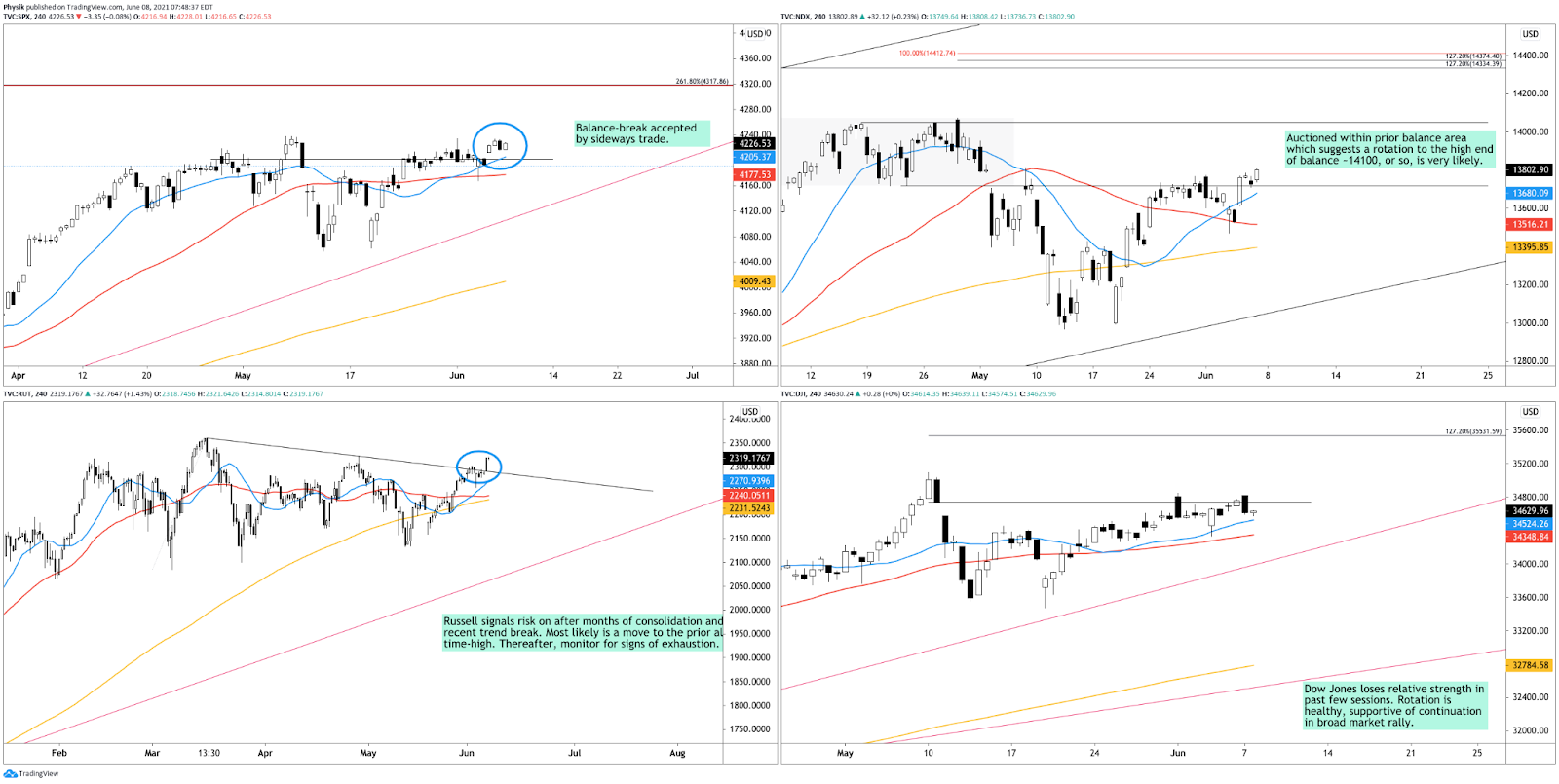
Graphic: 4-hour candlestick charts of the S&P 500 (top left), Nasdaq 100 (top right), Russell 2000 (bottom left), and Dow Jones Industrial Average (bottom right). Relative strength shifts to the Nasdaq.
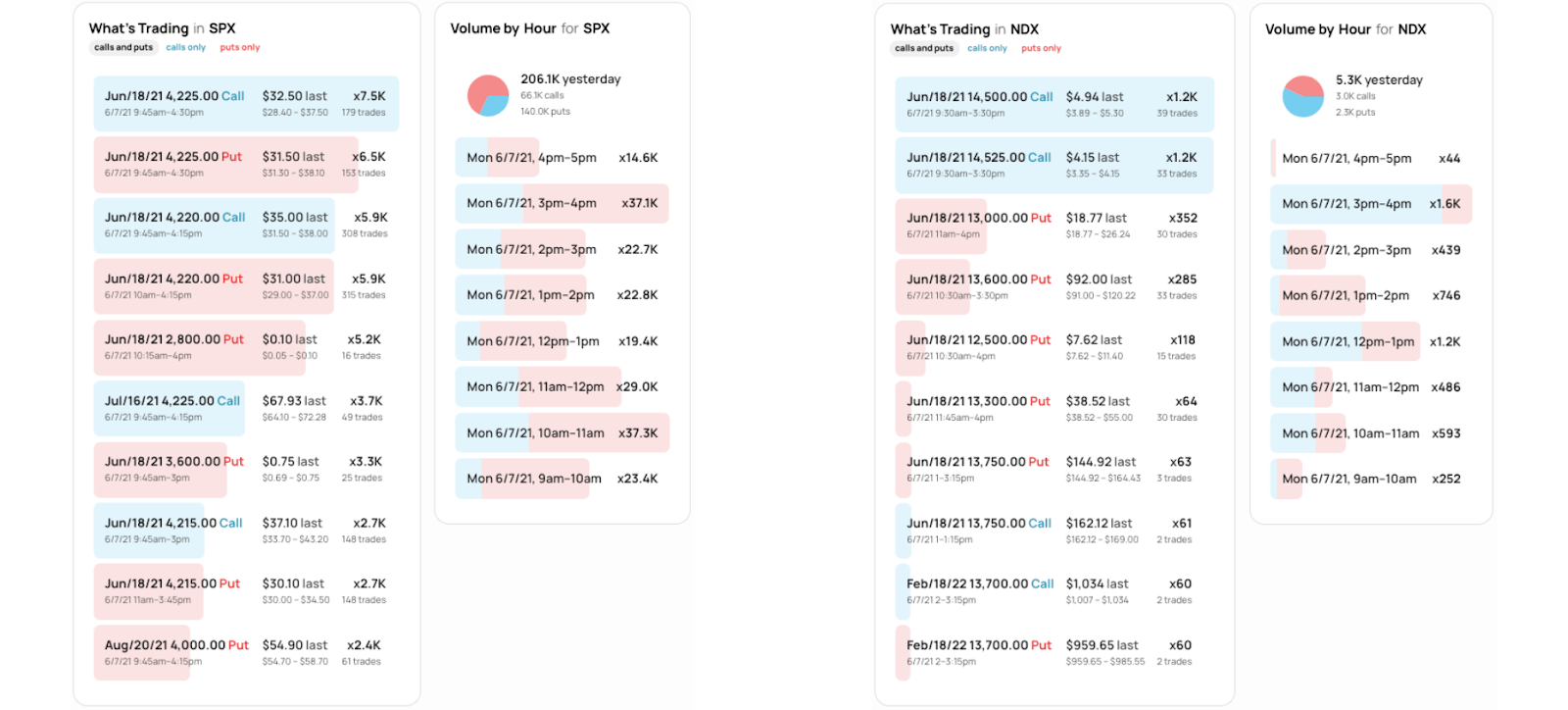
Graphic: SHIFT search suggests participants were most interested in put strikes at and below current prices in the cash-settled S&P 500 Index (INDEX: SPX). On the other hand, participants were most interested in call strikes at and above current prices in the cash-settled Nasdaq 100 Index (INDEX: NDX), yesterday. This shift in interest may support a broader rally. 

News And Analysis

Politics | Amazon to be covered by global tax deal despite thin margins. (BBG)

Politics | Schumer, Pelosi face new pressure as infrastructure talks stall. (BBG)

Politics | Canada is set to ease quarantine rules for vaccinated travelers. (BBG)

Economy | Lack of homes for sale eventually curbs affordability constraints. (MND)

Markets | Commodities crunch on stingy capital spending has no quick fix. (WSJ)

COVID | Gangrene, hearing loss show new variant may be more severe. (BBG)

Climate | The U.S. must work with allies to secure electric vehicle metals. (REU)

Markets | Meme stocks quickly turning the options market upside down. (WSJ)

What People Are Saying

Innovation And Emerging Trends

FinTech | Crypto exchange is going to extreme lengths on cybersecurity. (BBG)

FinTech | Central bank digital currencies may disrupt financial systems. (Fitch)

FinTech | MicroStrategy is selling corporate bonds to buy more bitcoin. (BBG)

Banking | De-globalization of retail banking, disruption of traditional models. (Axios)

FinTech | Colonial Pipeline ransom recovery a major moment for crypto. (NYT)

Trading | London Metals Exchange pedals back on closing trading ring. (WSJ)

Technology | NY project combines solar power with high-speed broadband. (Axios)

About

Renato founded Physik Invest after going through years of self-education, strategy development, and trial-and-error. His work reporting in the finance and technology space, interviewing leaders such as John Chambers, founder, and CEO, JC2 Ventures, Kevin O’Leary, businessman and Shark Tank host, Catherine Wood, CEO and CIO, ARK Invest, among others, afforded him the perspective and know-how very few come by.

Having worked in engineering and majored in economics, Renato is very detailed and analytical. His approach to the markets isn’t built on hope or guessing. Instead, he leverages the unique dynamics of time and volatility to efficiently act on opportunity.

Disclaimer

At this time, Physik Invest does not manage outside capital and is not licensed. In no way should the materials herein be construed as advice. Derivatives carry a substantial risk of loss. All content is for informational purposes only.
Categories
Commentary

Daily Brief For June 1, 2021

Market Commentary

Index futures in price discovery.

  • Optimism around a recovery mounting.
  • Ahead: Data on manufacturing, OPEC.
  • Stock indexes traded higher overnight.

What Happened: U.S. stock index futures auctioned higher overnight ahead of data on U.S. manufacturing.

Graphic updated at 6:30 AM EST

What To Expect: Tuesday’s regular session (9:30 AM – 4:00 PM EST) in the S&P 500 will likely open outside of prior-range and -value, on a gap outside of balance, suggesting a potential for immediate directional opportunity.

Balance-Break and/or Gap Scenarios: Monitor for acceptance (i.e., more than 1-hour of trade) outside of the balance area. Gaps ought to fill quickly. Should they not, that’s a signal of strength; do not fade. Leaving value behind on a gap-fill or failing to fill a gap (i.e., remaining outside of the prior session’s range) is a go-with indicator. Auctioning and spending at least 1-hour of trade back in the prior range suggests a lack of conviction; in such a case, do not follow the direction of the most recent initiative activity.

Adding, during the prior week’s regular trade, the best case outcome occurred, evidenced by responsive trade after a breakout above the $4,177.25 high volume area (HVNode). This is significant because that HVNode marked a pivot (i.e., above = bullish, below = bearish) on the composite profile.

Responsive Buying (Selling): Buying (selling) in response to prices below (above) areas of recent price acceptance.

Volume Areas: A structurally sound market will build on past areas of high volume. Should the market trend for long periods of time, it will lack sound structure (identified as a low volume area which denotes directional conviction and ought to offer support on any test). 

If participants were to auction and find acceptance into areas of prior low volume, then future discovery ought to be volatile and quick as participants look to areas of high volume for favorable entry or exit.

Further, this bullish price action is happening in the face of supply chain uncertainties and rising inflation, fiscal and monetary tightening, COVID-19 concerns, political risks, and the like. 

However, research by JPMorgan Chase & Co (NYSE: JPM), as well as Goldman Sachs Group Inc (NYSE: GS), suggests equities are still in play. This thinking would help explain the increased interest in S&P 500 and Nasdaq 100 call options.

For today, participants can trade from the following frameworks. 

In the best case, the S&P 500 trades sideways or higher; activity above last Friday’s $4,217.75 overnight high (ONH) puts in play the $4,224.75 HVNode and $4,227.00 POC. Initiative trade beyond the two aforementioned signposts could reach as high as first the $4,238.00 overnight all-time high (ONH) and then, the $4,294.75 Fibonacci-derived price extension, a typical recovery target.

POCs: POCs (like HVNodes described above) are valuable as they denote areas where two-sided trade was most prevalent. Participants will respond to future tests of value as they offer favorable entry and exit. 

Overnight Rally Highs (Lows): Typically, there is a low historical probability associated with overnight rally-highs (lows) ending the upside (downside) discovery process.

In the worst case, the S&P 500 trades lower; activity below the $4,217.75 ONH puts in play the $4,209.00 point of control (POC). Then, if lower, comes the $4,177.25 and $4,153.25 HVNode. On a cross of the $4,153.25 HVNode, the $4,122.25 HVNode and $4,071.00 POC come into play, also.

Graphic: 65-minute profile chart of the Micro E-mini S&P 500 Futures.
Graphic: SHIFT search suggests participants were becoming more interested in call strikes at and above current prices in the cash-settled S&P 500 Index (INDEX: SPX) and Nasdaq 100 Index (INDEX: NDX), last week.
Graphic: Physik Invest maps out the purchase of call and put options in the SPDR S&P 500 ETF Trust (NYSE: SPY), for the week prior. Activity in the options market was primarily concentrated in short-dated tenors, in strikes at and above $425.

News And Analysis

Markets | Meme stock AMC continues rally, jumping on a share sale. (CNBC)

Markets | Cyberattack hits the world’s largest meat processor units. (CNBC)

Politics | Buttigieg: mask mandates on planes are a matter of respect. (Hill)

Economy | Mortgage rates dip beneath 3% again, offering new savings. (Y!)

Economy | Inflation in the euro area climbed to 2% in the month of May. (BBG)

Energy | With oil majors under attack, OPEC’s hand has strengthened. (BBG)

Markets | Bitcoin is unlikely to escape regulation as authorities respond. (BBG)

Markets | Tesla’s vehicle price increases due to supply chain pressure. (REU)

What People Are Saying

Innovation And Emerging Trends

Markets | The 60/40 strategy needs a modern makeover to win skeptics. (BBG)

FinTech | Nasdaq: upstarts are forcing legacy banks to evolve and adapt. (NDAQ)

FinTech | Coinbase Institutional planning the launch of a prime brokerage. (MM

About

Renato founded Physik Invest after going through years of self-education, strategy development, and trial-and-error. His work reporting in the finance and technology space, interviewing leaders such as John Chambers, founder, and CEO, JC2 Ventures, Kevin O’Leary, businessman and Shark Tank host, Catherine Wood, CEO and CIO, ARK Invest, among others, afforded him the perspective and know-how very few come by.

Having worked in engineering and majored in economics, Renato is very detailed and analytical. His approach to the markets isn’t built on hope or guessing. Instead, he leverages the unique dynamics of time and volatility to efficiently act on opportunity.

Disclaimer

At this time, Physik Invest does not manage outside capital and is not licensed. In no way should the materials herein be construed as advice. Derivatives carry a substantial risk of loss. All content is for informational purposes only.
Categories
Commentary

Weekly Brief For May 31, 2021

Market Commentary

Key Takeaways: Index futures in balance.

  • Best to assume the taper tantrum happened.
  • Ahead: Fed speak and data on employment.
  • Indices traded sideways-to-higher last week.

What Happened: Coming into the large May monthly options expiration (OPEX) and extended holiday weekend, U.S. stock index futures pinned, trading sideways-to-higher.

Options: If an option buyer was short (long) stock, he or she would buy a call (put) to hedge upside (downside) exposure. Option buyers can also use options as an efficient way to gain directional exposure.

Options Expiration (OPEX): Option expiries mark an end to pinning (i.e, the theory that market makers and institutions short options move stocks to the point where the greatest dollar value of contracts will expire worthless) and the reduction dealer gamma exposure. 

Gamma is the sensitivity of an option to changes in the underlying price. Dealers that take the other side of options trades hedge their exposure to risk by buying and selling the underlying. When dealers are short-gamma, they hedge by buying into strength and selling into weakness. When dealers are long-gamma, they hedge by selling into strength and buying into weakness. The former exacerbates volatility. The latter calms volatility.

Furthermore, looking back, the movement in price was both volatile and mechanical.

After a short covering-like rally toward $4,200.00, the S&P 500 was responsively bought and sold at key visual references, suggesting a dominance by short-term participants.

Responsive Buying (Selling): Buying (selling) in response to prices below (above) areas of recent price acceptance.

The technically-driven trade denotes a lack of interest by institutional participants, at record highs; supply chain uncertainties and rising inflation, fiscal and monetary tightening, COVID-19 concerns, political risks, and the like, are some of the emerging concerns larger participants are looking to price in.

Of all the above risks, inflation remains the hottest topic.

Generally speaking, inflation and rates move inversely to each other. Low rates stimulate demand for loans (i.e., borrowing money is more attractive). With the rapid recovery, though, market participants fear that rates will rise to protect the economy from overheating.

Higher rates have the potential to reduce the present value of future earnings, making stocks, especially those that are high growth, less attractive. 

To note, however, rates remain range-bound; rates on the 10 Year T-Note sit below their March high and are likely to continue higher, which the market may absorb

How may the market absorb a rise in rates? During the so-called Taper Tantrum, in the early 2010s, rates settled in a wide range, and equities rallied big. Adding, some strategists, like Kit Juckes of Societe Generale SA (OTC: SCGLY) suggest it may be best to assume a tantrum has already happened.

“U.S. 10-year yields rose from a low of 1.4% in 2012 to 3% during their tantrum. In this cycle, the rise has been from 0.5% to a high just below 1.8%. That’s comparable in relative terms. The eventual peak in U.S. yields in 2018 was 3.25%. Can’t we accept that the taper tantrum has already happened? The important difference is that in the tantrum cycle, core CPI never got above 2 ½%. A bet on further bond weakness is a bet on inflation proving to be stickier than the Fed can cope with.”

Adding, research by JPMorgan Chase & Co (NYSE: JPM), as well as Goldman Sachs Group Inc (NYSE: GS), suggests equities may be getting cheap with reflationary themes being the go-to play. This sentiment would help explain the increased interest in S&P 500 and Nasdaq 100 call options.

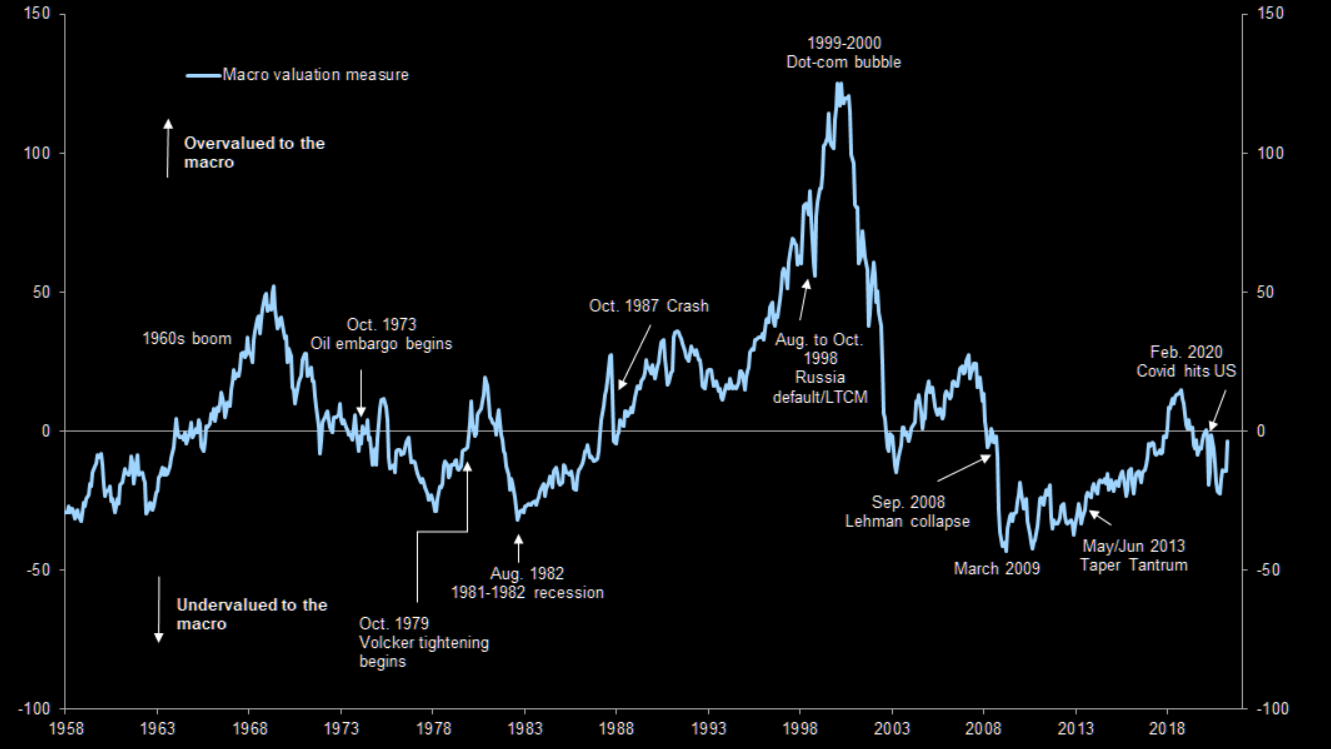
Graphic: Equity valuations at their cheapest, relative to the macro in March 2009 and in the depth of the 1982 recession, according to Goldman Sachs Group Inc (NYSE: GS), via The Market Ear.
Graphic: SHIFT search suggests participants were becoming more interested in call strikes at and above current prices in the cash-settled S&P 500 Index (INDEX: SPX) and Nasdaq 100 Index (INDEX: NDX), last week.
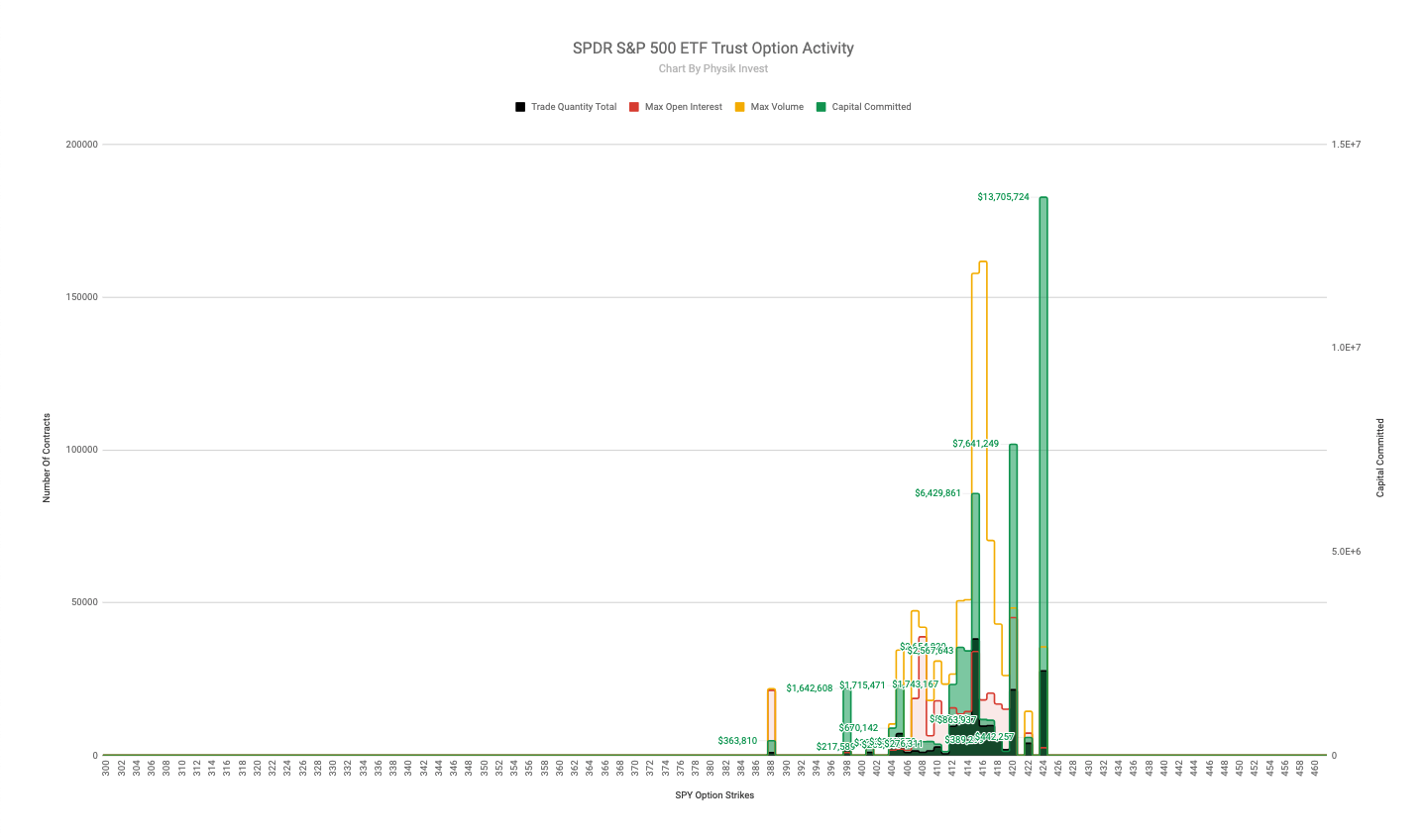
Graphic: Physik Invest maps out the purchase of call and put options in the SPDR S&P 500 ETF Trust (NYSE: SPY), for the week prior. Activity in the options market was primarily concentrated in short-dated tenors, in strikes at and above $425.

Outlier risks remain, though; aside from the seasonally weak period, S&P 500 skew – a measure of perceived tail risk and the chances of a black swan event – rose dramatically over the past few weeks. At the same time, sentiment cooled considerably, while individual stock volatility increased the potential for a repeat of the GameStop Corporation (NYSE: GME) de-risking event.

Graphic: Goldman Sachs Group Inc (NYSE: GS) unpacks outlier risks based on the implied volatility of S&P 500 out-of-the-money options, via The Market Ear.

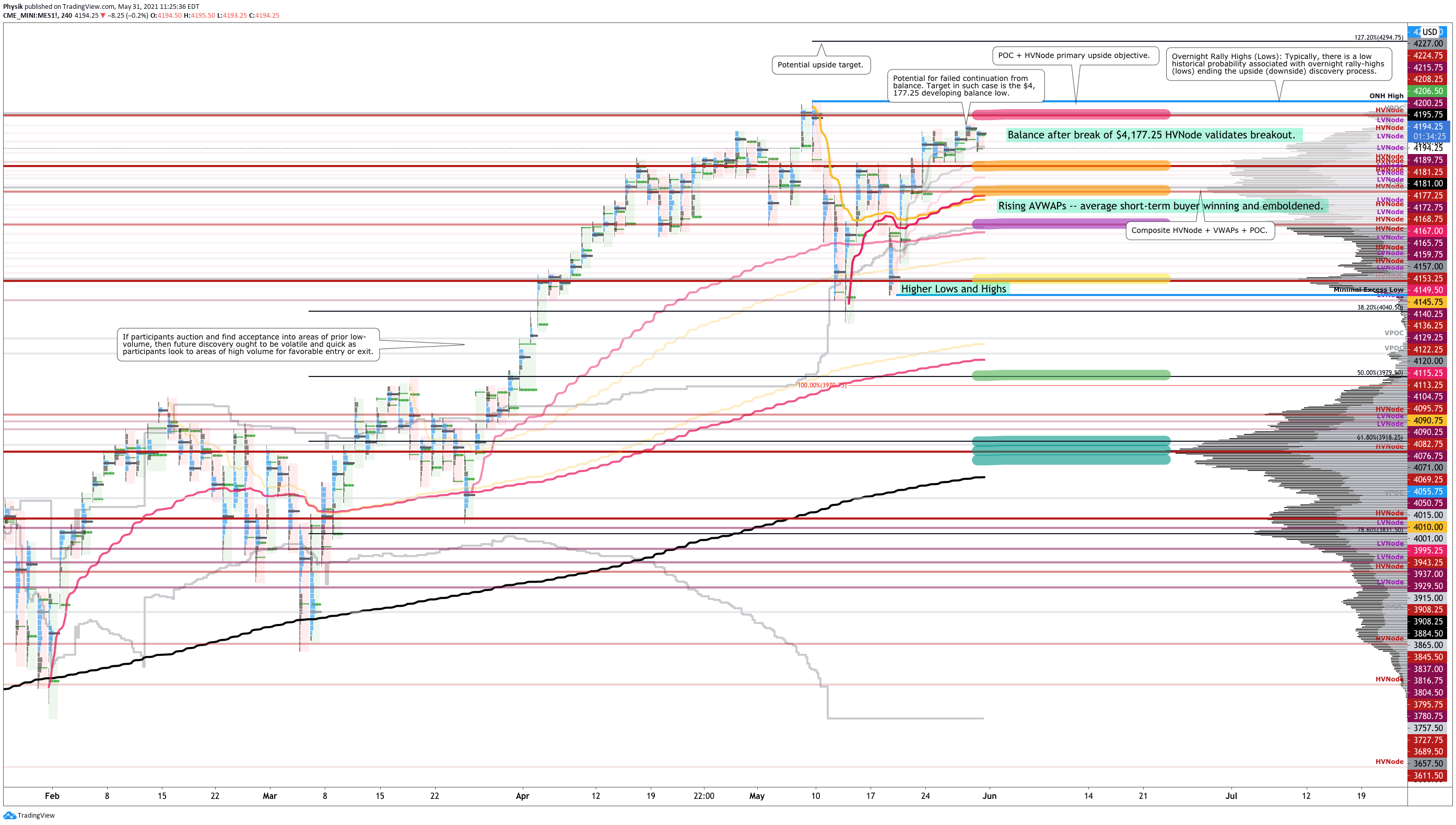
What To Expect: In the coming sessions, participants will want to focus their attention on where the S&P 500 trades in relation to the $4,197.25 high volume area (HVNode).

Volume Areas: A structurally sound market will build on past areas of high volume. Should the market trend for long periods of time, it will lack sound structure (identified as a low volume area which denotes directional conviction and ought to offer support on any test). 

If participants were to auction and find acceptance into areas of prior low volume, then future discovery ought to be volatile and quick as participants look to areas of high volume for favorable entry or exit.

That said, participants can trade from the following frameworks.

In the best case, the index trades sideways or higher; activity above $4,197.25 has the potential to reach the $4,227.00 point of control (POC). Initiative trade beyond the POC could reach as high as first the $4,238.00 overnight all-time high (ONH) and then, the $4,294.75 Fibonacci-derived price extension, a typical recovery target. 

POCs: POCs (like HVNodes described above) are valuable as they denote areas where two-sided trade was most prevalent. Participants will respond to future tests of value as they offer favorable entry and exit. 

Overnight Rally Highs (Lows): Typically, there is a low historical probability associated with overnight rally-highs (lows) ending the upside (downside) discovery process.

In the worst case, the index trades lower; activity below the $4,177.25 HVNode puts in play the $4,153.25 HVNode, first. Thereafter, if lower, the $4,122.25 HVNode and $4,071.00 POC come into play. 

On a cross through the $4,050.75 low volume area (LVNode), long-biased traders should beware of a rapid liquidation, as low as first the $4,015.00 and $4,001.00 POCs. In such a liquidation, odds favor a test of ~$3,970.00 50.00% retracement, as well as the $3,918.00 61.80% retracement and HVNode.

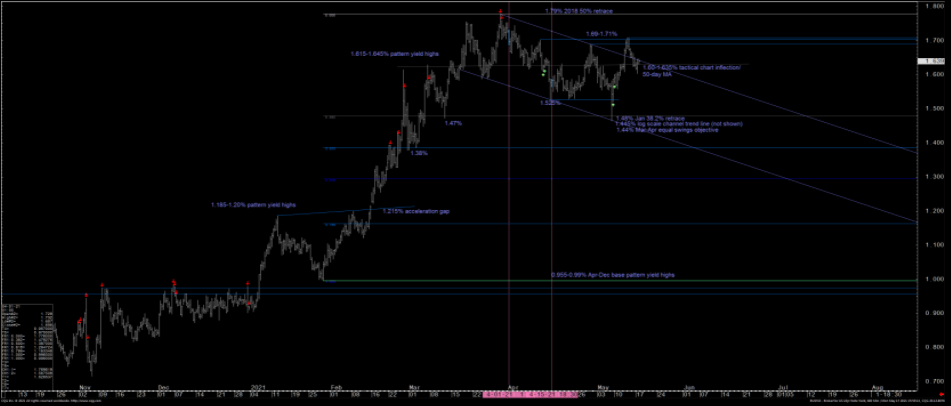
Graphic: 4-hour profile chart of the Micro E-mini S&P 500 Futures.
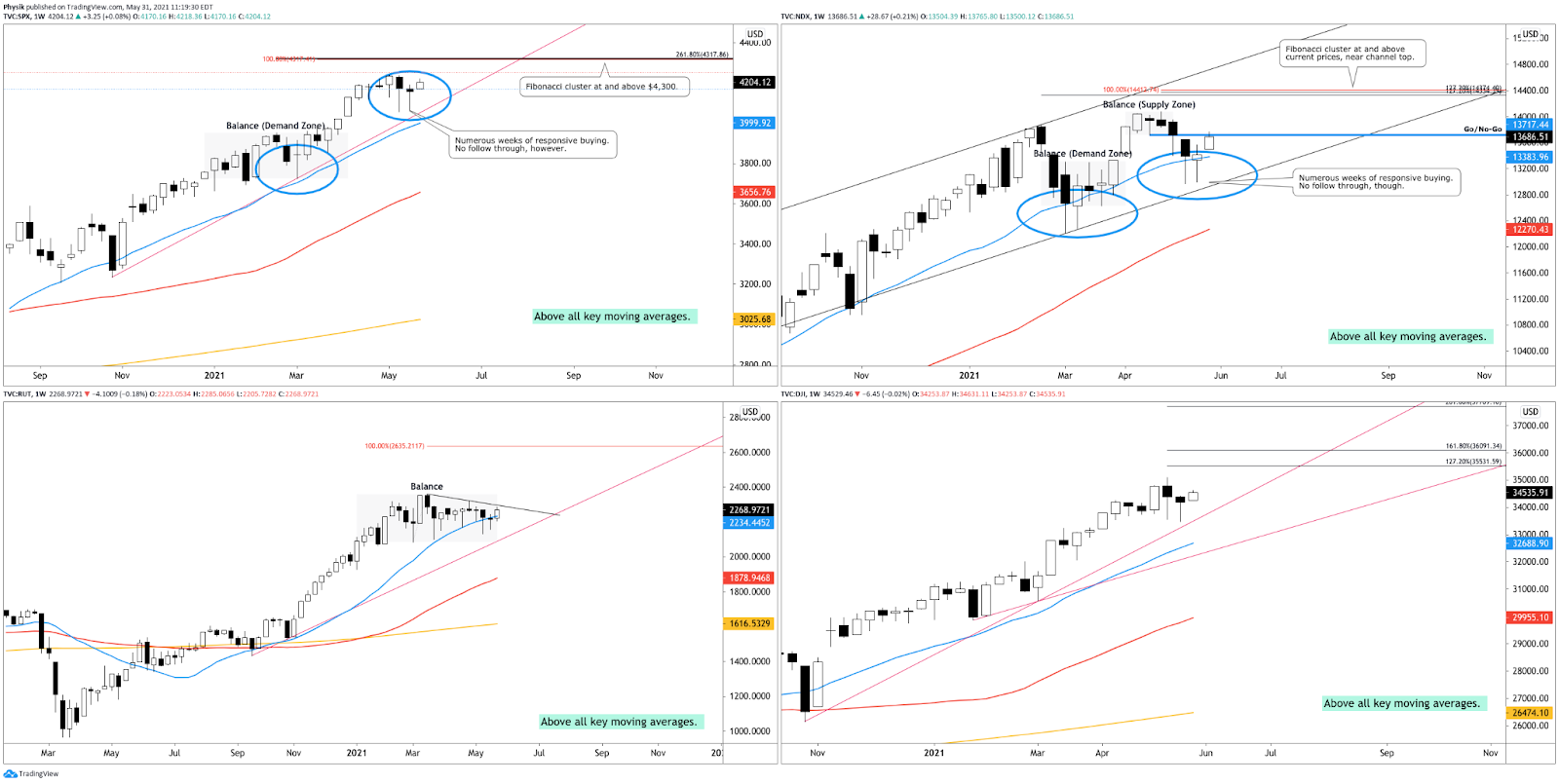
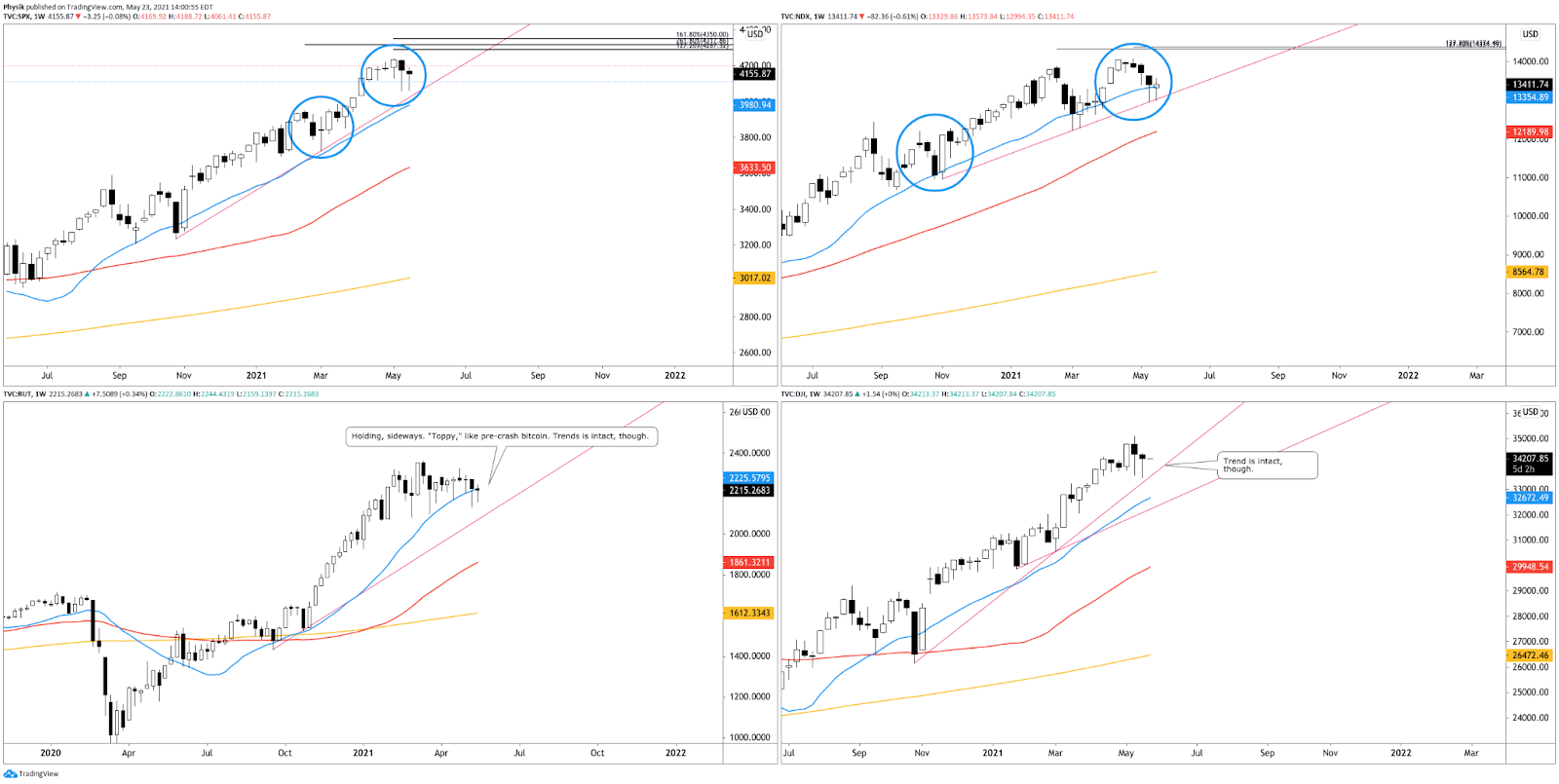
Graphic: Weekly candlestick charts of the S&P 500 (top left), Nasdaq 100 (top right), Russell 2000 (bottom left), and Dow Jones Industrial Average (bottom right). Nasdaq is primed for upside and has the potential to pull the S&P with it. 

News And Analysis

Trade | One of the world’s top ports expects delays on an outbreak. (BBG)

Markets | PBOC raises reserve ratio for foreign exchange holdings. (BBG)

Economy | Recovery solidifies in U.S., Europe, while EM faces risks. (Moody’s)

Markets | China bars banks from selling commodity-linked products. (REU)

Economy | Fed security purchases draw fire in hot U.S. housing market. (S&P)

Energy | Global oil demand is seen eclipsing India, Iran’s uncertainty. (S&P)

Economy | U.S. won’t experience stagflation over next few years. (Moody’s)

Economy | Non-government loans seeing a jump in forbearances. (MND)

Economy | U.S. speculative-grade corporate default rate to fall to 4%. (S&P)

Markets | Inflation, higher oil, stronger yuan point in same direction. (BBG)

Economy | U.S. retailers face headwinds from slowing sales, inflation. (S&P)

Markets | Everyone with bonds to liquidate had ample time to do so. (BBG)

What People Are Saying

Innovation And Emerging Trends

Markets | How recent growth in leveraged finance affects investors. (BZ)

Politics | Tech growth overshadowed by regulatory risks, challenges. (S&P)

Markets | Chamath: SPACs need more oversight and regulation. (BBG)

Politics | China moves to a three-child policy to boost its birthrate. (BBG)

Markets | Shakeout stirs debate over ether’s long-term potential. (BBG)

FinTech | Which banks are positioned for low rates, digital adoption. (S&P)

About

Renato founded Physik Invest after going through years of self-education, strategy development, and trial-and-error. His work reporting in the finance and technology space, interviewing leaders such as John Chambers, founder, and CEO, JC2 Ventures, Kevin O’Leary, businessman and Shark Tank host, Catherine Wood, CEO and CIO, ARK Invest, among others, afforded him the perspective and know-how very few come by.

Having worked in engineering and majored in economics, Renato is very detailed and analytical. His approach to the markets isn’t built on hope or guessing. Instead, he leverages the unique dynamics of time and volatility to efficiently act on opportunity.

Disclaimer

At this time, Physik Invest does not manage outside capital and is not licensed. In no way should the materials herein be construed as advice. Derivatives carry a substantial risk of loss. All content is for informational purposes only.
Categories
Commentary

Daily Brief For May 24, 2021

Quick Note: From May 25 to May 28, the daily newsletter will be off as I will be on a trip. It would not be fair for me to provide lackluster content since I won’t have all the tools at my disposal.

Market Commentary

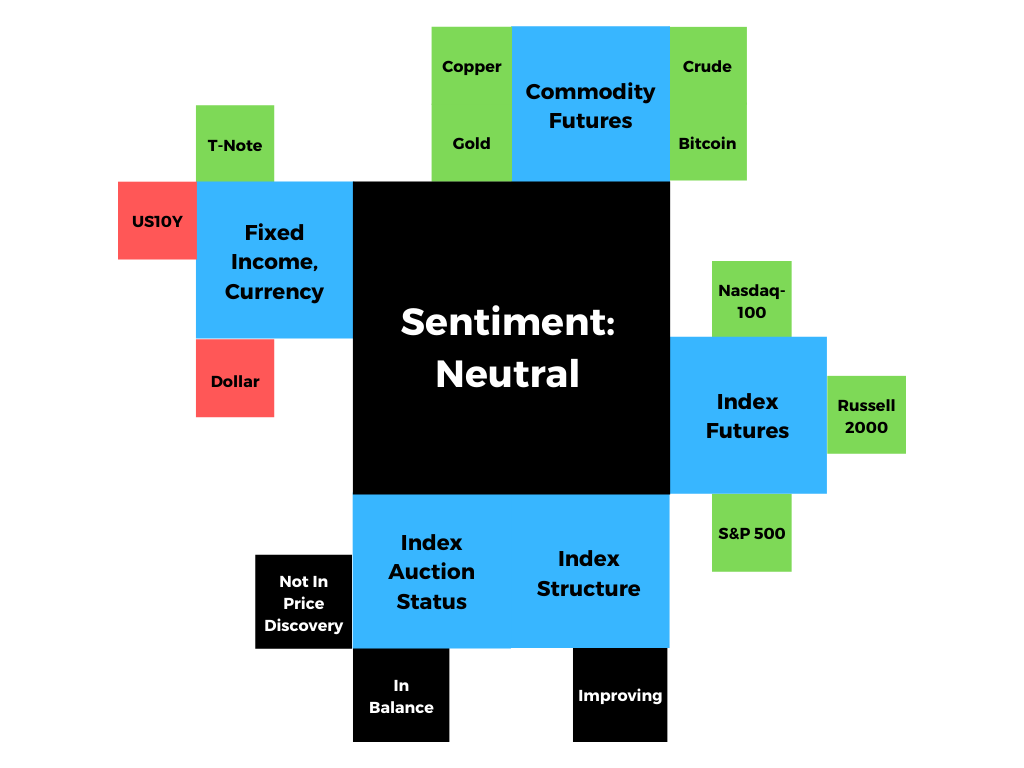
Index futures in balance.

  • The U.S. may be facing deflation.
  • Ahead is CFNAI data, Fed speak.
  • Stock indexes sideways to higher.

What Happened: U.S. stock index futures auctioned higher overnight alongside renewed political tensions, cryptocurrency volatility, as well as a crackdown by China on commodity speculation.

Graphic updated 7:50 AM EST.

What To Expect: Monday’s regular session (9:30 AM – 4:00 PM EST) in the S&P 500 will likely open inside of prior-range and -value, suggesting a limited potential for immediate directional opportunity. 

Value-Area Placement: Perception of value unchanged if value overlapping (i.e., inside day). Perception of value has changed if value not overlapping (i.e., outside day). Delay trade in the former case.

Adding, during the prior day’s regular trade, the worst-case outcome occurred, evidenced by the responsive selling that surfaced at and above the $4,177.25 high volume area (HVNode). This is not all too significant given the large monthly options expiration. Still, according to SpotGamma, “[w]hile roughly 1/3 of total QQQ gamma rolled off on Friday, … [the] QQQ remains under the control of put options,” a source of potential volatility in the Nasdaq 100.

Responsive Selling: Selling in response to prices above area of recent price acceptance.

Volume Areas: A structurally sound market will build on past areas of high volume. Should the market trend for long periods of time, it will lack sound structure (identified as a low volume area which denotes directional conviction and ought to offer support on any test). 

If participants were to auction and find acceptance into areas of prior low volume, then future discovery ought to be volatile and quick as participants look to areas of high volume for favorable entry or exit.

Options: If an option buyer was short (long) stock, he or she would buy a call (put) to hedge upside (downside) exposure. Option buyers can also use options as an efficient way to gain directional exposure.

Options Expiration (OPEX): Option expiries mark an end to pinning (i.e, the theory that market makers and institutions short options move stocks to the point where the greatest dollar value of contracts will expire worthless) and the reduction dealer gamma exposure.

Gamma: Gamma is the sensitivity of an option to changes in the underlying price. Dealers that take the other side of options trades hedge their exposure to risk by buying and selling the underlying. When dealers are short-gamma, they hedge by buying into strength and selling into weakness. When dealers are long-gamma, they hedge by selling into strength and buying into weakness. The former exacerbates volatility. The latter calms volatility.

As stated in Sunday’s weekly note, equities are in a seasonally weak period. At the same time, inflation and uninspiring economic data are major worries investors are attempting to price in. That said, however, during the May 19 reversal, in the S&P 500 and Nasdaq 100, participants increased exposure to the upside with relatively cheap, longer-dated calls.

Further, for today, participants can trade from the following frameworks. 

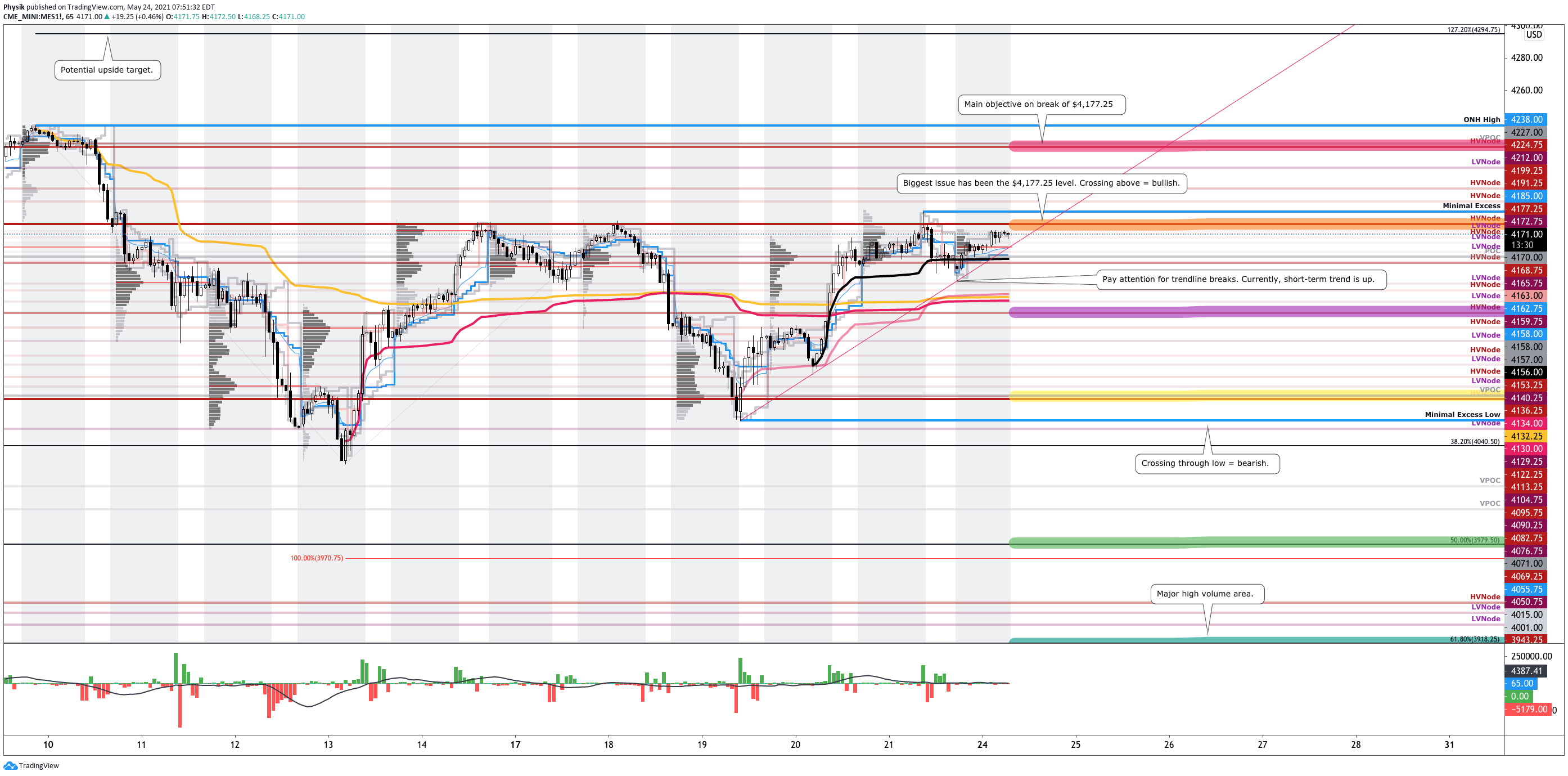
In the best case, the S&P 500 trades sideways or higher; activity above $4,177.25 puts in play the $4,227.00 point of control (POC). Initiative trade beyond the POC could reach as high as the $4,238.00 overnight all-time high. 

POCs: POCs (like HVNodes described above) are valuable as they denote areas where two-sided trade was most prevalent. Participants will respond to future tests of value as they offer favorable entry and exit.

Initiative Buying: Buying within or above the previous day’s value area.

Overnight Rally Highs (Lows): Typically, there is a low historical probability associated with overnight rally-highs (lows) ending the upside (downside) discovery process.

In the worst case, the S&P 500 trades lower; activity below $4,177.25 puts in play the $4,122.25 HVNode. Thereafter, if lower, key references include the $4,071.00 POC and $4,050.75 low volume area (LVNode). Long-biased traders are cautioned on trade below the LVNode. 

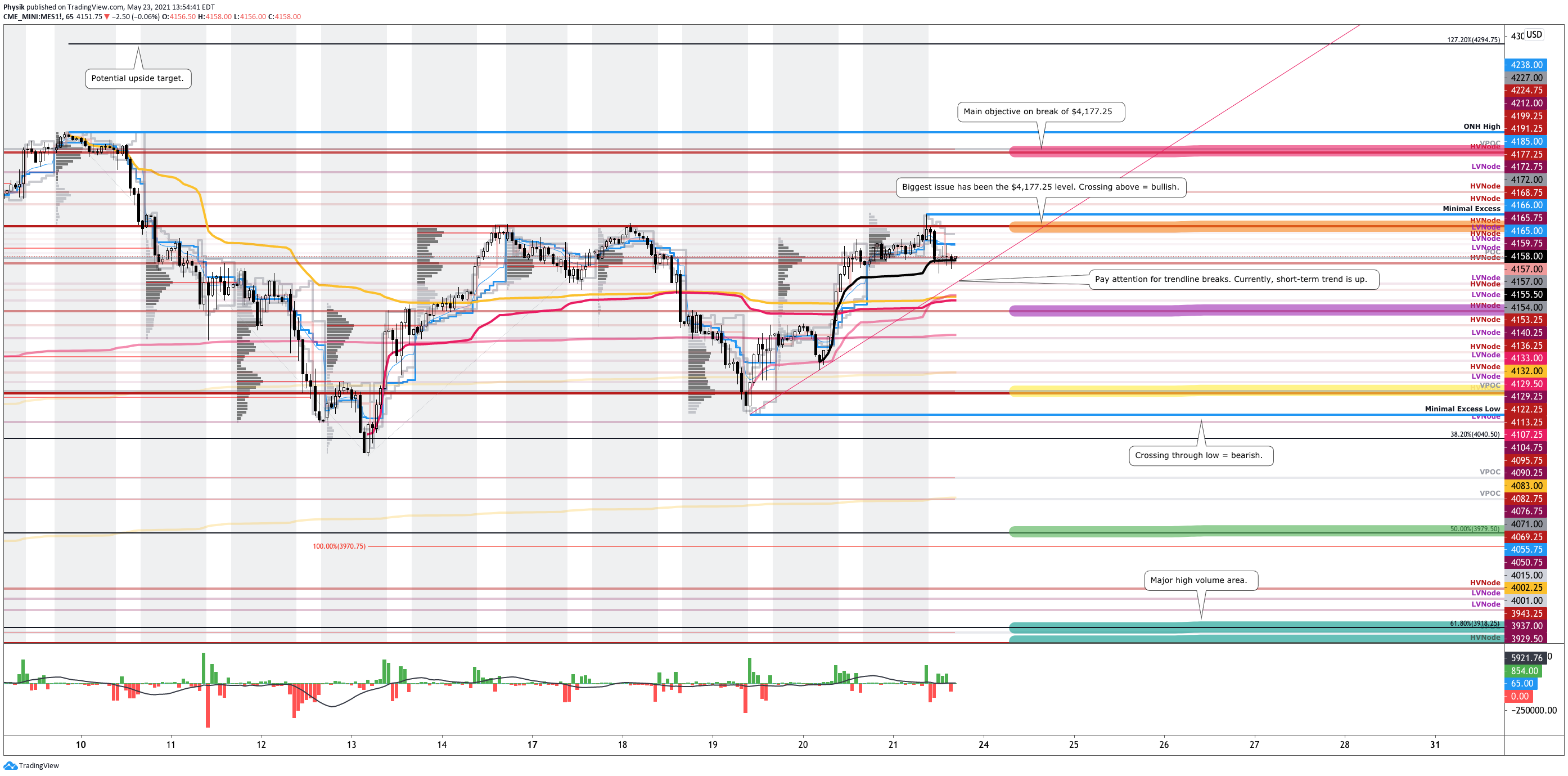
Graphic: 65-minute profile chart of the Micro E-mini S&P 500 Futures.
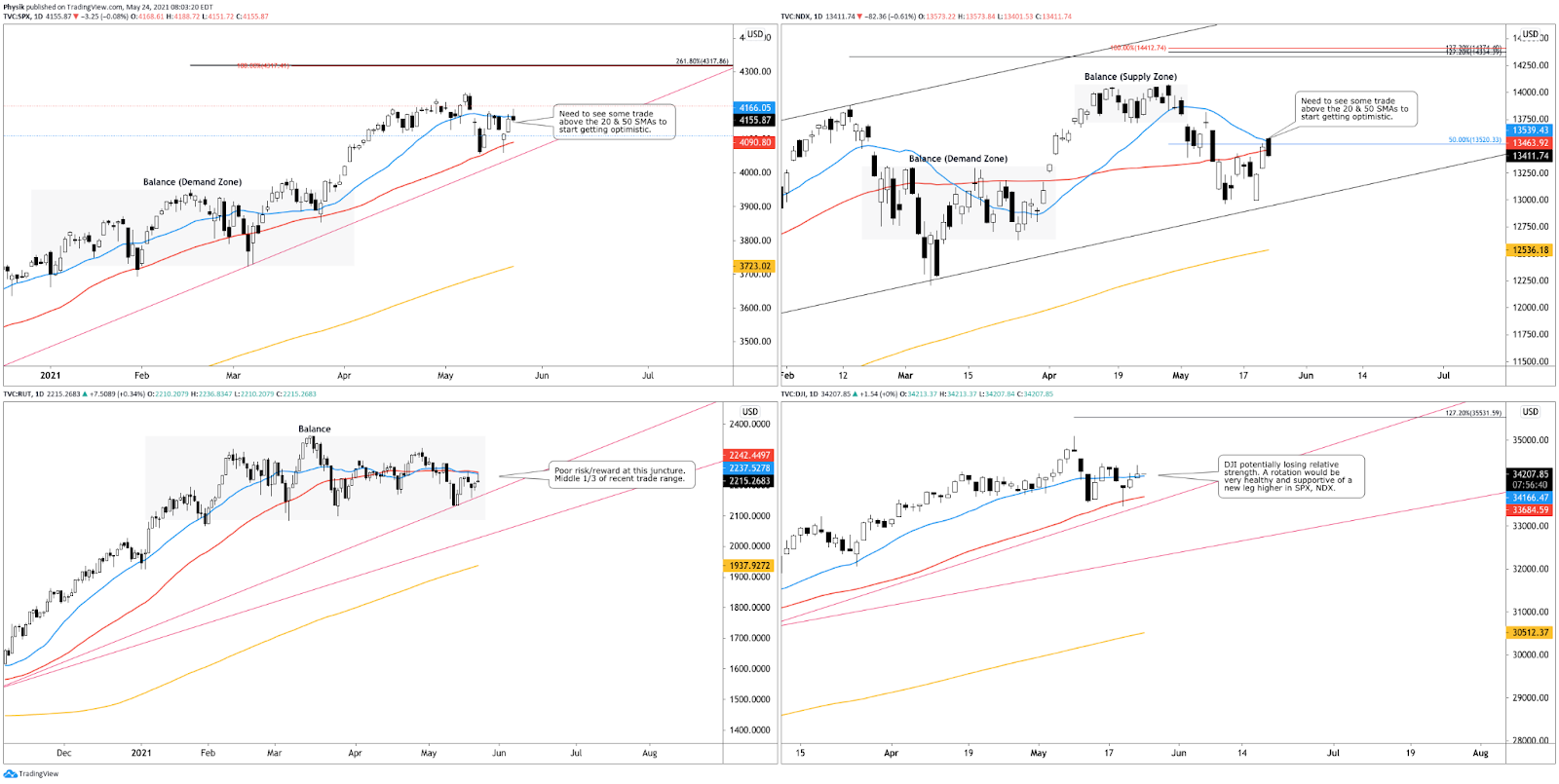
Graphic: Daily candlestick charts of the S&P 500 (top left), Nasdaq 100 (top right), Russell 2000 (bottom left), and Dow Jones Industrial Average (bottom right). The Nasdaq is regaining relative strength. A rotation would be bullish, or supportive of a new leg higher (if one were to happen).
Graphic: Physik Invest maps out the purchase of call and put options in the SPDR S&P 500 ETF Trust (NYSE: SPY), for last week. Though activity in the options market was primarily concentrated in short-dated tenors, increased trade in farther-dated call-side strikes is observed as a commitment to higher prices.
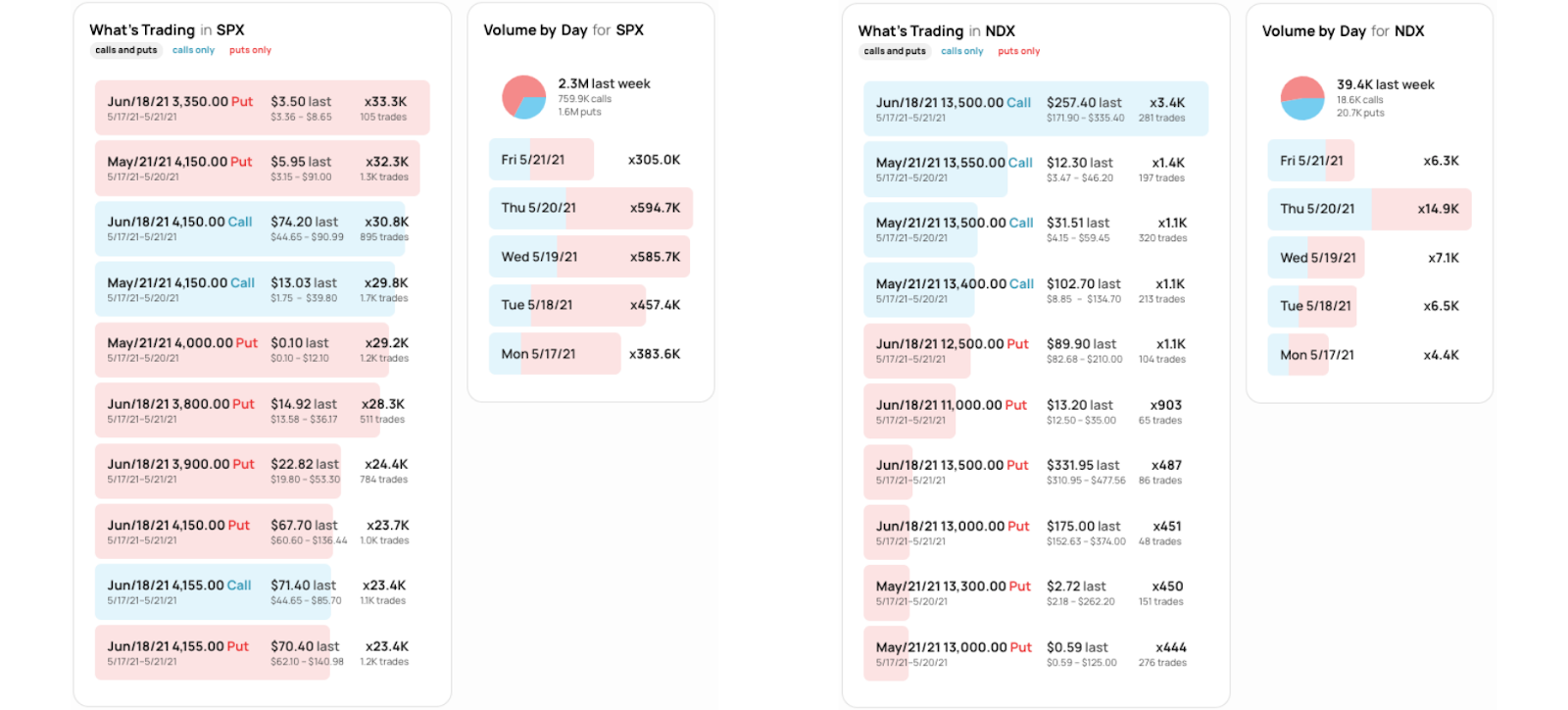
Graphic: SHIFT search suggests participants were most interested in put strikes at and below current prices in the cash-settled S&P 500 Index (INDEX: SPX) and Nasdaq 100 Index (INDEX: NDX), last week. To note, however, participants began paying up for longer-dated upside exposure (evidenced by call activity).

News And Analysis

Economy | Cathie Wood: U.S. “setting up for a massive period deflation.” (BBG)

Economy | European labor market’s capacity to absorb shocks varies. (Moody’s)

Markets | How a global minimum corporate tax could impact markets. (WSJ)

Markets | Goldman sees oil hitting $80/bbl despite likely supply return. (REU)

Security | Three disasters show gaps in the $1.7T infrastructure plan. (BBG)

Markets | Mainstream markets shrug volatile $1T crypto flash crash. (BBG)

Trade | Sea change: global freight sails out of the digital dark ages. (REU)

Politics | EU weighs sanctions over so-called ‘hijacking’ of Ryanair jet. (BBG)

What People Are Saying

Innovation And Emerging Trends

FinTech | HSBC CEO says bitcoin, cryptocurrencies are not for them. (REU)

FinTech | Robinhood to allow users to buy into IPOs ahead of debut. (REU)

FinTech | VCs are predicting new areas of consumer fintech disruption. (BI)

Environment | Unpacking the problems with reinforced concrete. (Convo)

Markets | First warning sign in global commodity boom flashes in China. (BBG)

About

Renato founded Physik Invest after going through years of self-education, strategy development, and trial-and-error. His work reporting in the finance and technology space, interviewing leaders such as John Chambers, founder, and CEO, JC2 Ventures, Kevin O’Leary, businessman and Shark Tank host, Catherine Wood, CEO and CIO, ARK Invest, among others, afforded him the perspective and know-how very few come by.

Having worked in engineering and majored in economics, Renato is very detailed and analytical. His approach to the markets isn’t built on hope or guessing. Instead, he leverages the unique dynamics of time and volatility to efficiently act on opportunity.

Disclaimer

At this time, Physik Invest does not manage outside capital and is not licensed. In no way should the materials herein be construed as advice. Derivatives carry a substantial risk of loss. All content is for informational purposes only.

Categories
Commentary

Weekly Brief For May 23, 2021

Editor’s Note: Happy Sunday, everyone!

A lot of new subscribers this week in light of Physik Invest’s webinar with Benzinga. If you want access to the slides presented, click here.

Additionally, I am honored for your decision to follow along and will do my best to provide an objective, “no fluff” view into the who, what, when, where, why, and how in finance and technology.

Quick note, from May 25 to May 28, the daily newsletter will be off as I will be on a trip. It would not be fair for me to provide lackluster content since I won’t have all the tools at my disposal.

That said, I’ll try to be objective and concise in today’s note to ensure you have the proper direction for the volatile trade ahead.

Market Commentary

Key Takeaways: Index futures in balance.

  • Bitcoin’s weekend crash churns stomachs.
  • Tone on adjusting monetary policy altered.
  • Indices were sideways-to-higher last week.

What Happened: Last week, U.S. stock index futures auctioned sideways-to-higher, as participants looked to price in emerging dynamics with respect to rising inflation, fiscal and monetary tightening, COVID-19 concerns, political risks, and the like. 

In pricing in these dynamics, the movement was both volatile and mechanical, halting short of key visual references suggesting the participants involved were short-term (i.e., technically driven) in nature.

Adding, amid this rotation, quite a bit of poor structure was cleaned up (i.e., low volume areas), but still, judging by a lack of excess at certain points on the composite volume profile, odds point to limited conviction and commitment.

Excess: A proper end to price discovery; the market travels too far while advertising prices. Responsive, other-timeframe (OTF) participants aggressively enter the market, leaving tails or gaps which denote unfair prices.

Holistically, equities are in a seasonally weak period. At the same time, inflation and uninspiring economic data are major worries investors are attempting to price in.

Just last week, the Federal Reserve’s minutes showed that some on the committee were interested in tapering discussions. 

“It was a surprise to hear the talk about Fed tapering,” Joyce Chang, JPMorgan’s chair of global research, said. “The market had been thinking there might be a couple of months before you really saw this particular issue come into focus.” 

Generally speaking, inflation and rates move inverse to each other. Low rates stimulate demand for loans (i.e., borrowing money more attractive). With the rapid recovery, though, market participants fear that rates will rise to protect the economy from overheating.

Higher rates have the potential to reduce the present value of future earnings, making stocks, especially those that are high growth, less attractive. To note, however, rates remain range-bound; rates on the 10 Year T-Note sit below their March high and are likely to continue higher, which the market may absorb.

Graphic: JPMorgan Chase & Co (NYSE: JPM) analysts believe yields on the 10-year note will stay rangebound before breaking higher this summer, via The Market Ear.

How may the market absorb a move higher in rates? Looking back, according to The Market Ear, during the so-called Taper Tantrum, in the early 2010s, rates settled in a wide range, and equities rallied big. Adding, research by JPMorgan Chase & Co (NYSE: JPM) suggests equities may be getting cheap with reflationary themes the go-to play, still.

In support, during the May 19 reversal, in the S&P 500 and Nasdaq 100, participants increased exposure to the upside with relatively cheap, longer-dated calls.

Still, overall, the flows point to a lot of opportunistic hedging (see graphic below).

Graphic: SHIFT search suggests participants were most interested in put strikes at and below current prices in the cash-settled S&P 500 Index (INDEX: SPX) and Nasdaq 100 Index (INDEX: NDX), last week. To note, however, participants began paying up for longer-dated upside exposure (evidenced by call activity).

What To Expect: In the coming sessions, participants will want to focus their attention on where the S&P 500 trades in relation to its $4,177.25 composite high volume area (HVNode).

Volume Areas: A structurally sound market will build on past areas of high volume. Should the market trend for long periods of time, it will lack sound structure (identified as a low volume area which denotes directional conviction and ought to offer support on any test). 

If participants were to auction and find acceptance into areas of prior low volume, then future discovery ought to be volatile and quick as participants look to areas of high volume for favorable entry or exit.

In the best case, the index trades sideways or higher; activity above the $4,177.25 HVNode puts in play the $4,227.00 point of control (POC). Initiative trade beyond the POC could reach as high as first the $4,238.00 overnight all-time high and then, the $4,294.75 Fibonacci-derived price extension, a typical recovery target.

POCs: POCs (like HVNodes described above) are valuable as they denote areas where two-sided trade was most prevalent. Participants will respond to future tests of value as they offer favorable entry and exit.

Overnight Rally Highs (Lows): Typically, there is a low historical probability associated with overnight rally-highs (lows) ending the upside (downside) discovery process.

In the worst case, the index trades lower; activity below the $4,122.25 HVNode puts in play the $4,071.00 POC. Thereafter, if lower, on a cross through the $4,050.75 low volume area (LVNode), long-biased traders should beware of a rapid liquidation, as low as first the $4,015.00 and $4,001.00 POCs. In such a liquidation, odds favor a test of ~$3,970.00 50.00% retracement, as well as the $3,918.00 61.80% retracement and HVNode.

Graphic: 65-minute profile chart of the Micro E-mini S&P 500 Futures.
Graphic: Weekly candlestick charts of the S&P 500 (top left), Nasdaq 100 (top right), Russell 2000 (bottom left), and Dow Jones Industrial Average (bottom right). Note Russell’s “toppy” rotation, and similar pullbacks to trend in the S&P 500 and Nasdaq. One last push, higher?
Graphic: Physik Invest maps out the purchase of call and put options in the SPDR S&P 500 ETF Trust (NYSE: SPY), for last week. Though activity in the options market was primarily concentrated in short-dated tenors, increased trade in farther-dated call-side strikes is observed as a commitment to higher prices.

News And Analysis

Markets | Rotation from growth into value strengthens bull market. (ARK)

Recovery | Two COVID shots effective against the India variant. (REU)

Economy | U.S. inflation is transitory and consistent with recovery. (S&P

Crypto | Google search volume for cryptocurrency breaks ATH. (Block)

Economy | PBOC will maintain its exchange rate basically stable. (BBG)

Markets | Global chip shortages cost automakers 5% of production. (Fitch)

Markets | JPMorgan cross-asset strategy head warns of drop. (BBG)

Markets | Nomura, UBS, UniCredit fined over bond trading cartel. (TT)

Recovery | CDC probes reports of myocarditis in the vaccinated. (Axios)

Economy | U.S. home prices push to record highs, buying slows. (WSJ)

What People Are Saying

Innovation And Emerging Trends

FinTech | How cryptocurrency fits into Brazil’s vision for banking. (Block)

FinTech | Major Asia-Pacific region banks upping their fintech bets. (S&P)

FinTech | U.S. Federal Reserve plans to publish a paper on CBDC. (Block)

Real Estate | Manhattan’s apartment vacancy rate stubbornly high. (WSJ)

About

Renato founded Physik Invest after going through years of self-education, strategy development, and trial-and-error. His work reporting in the finance and technology space, interviewing leaders such as John Chambers, founder, and CEO, JC2 Ventures, Kevin O’Leary, businessman and Shark Tank host, Catherine Wood, CEO and CIO, ARK Invest, among others, afforded him the perspective and know-how very few come by.

Having worked in engineering and majored in economics, Renato is very detailed and analytical. His approach to the markets isn’t built on hope or guessing. Instead, he leverages the unique dynamics of time and volatility to efficiently act on opportunity.

Disclaimer

At this time, Physik Invest does not manage outside capital and is not licensed. In no way should the materials herein be construed as advice. Derivatives carry a substantial risk of loss. All content is for informational purposes only.
Categories
Commentary

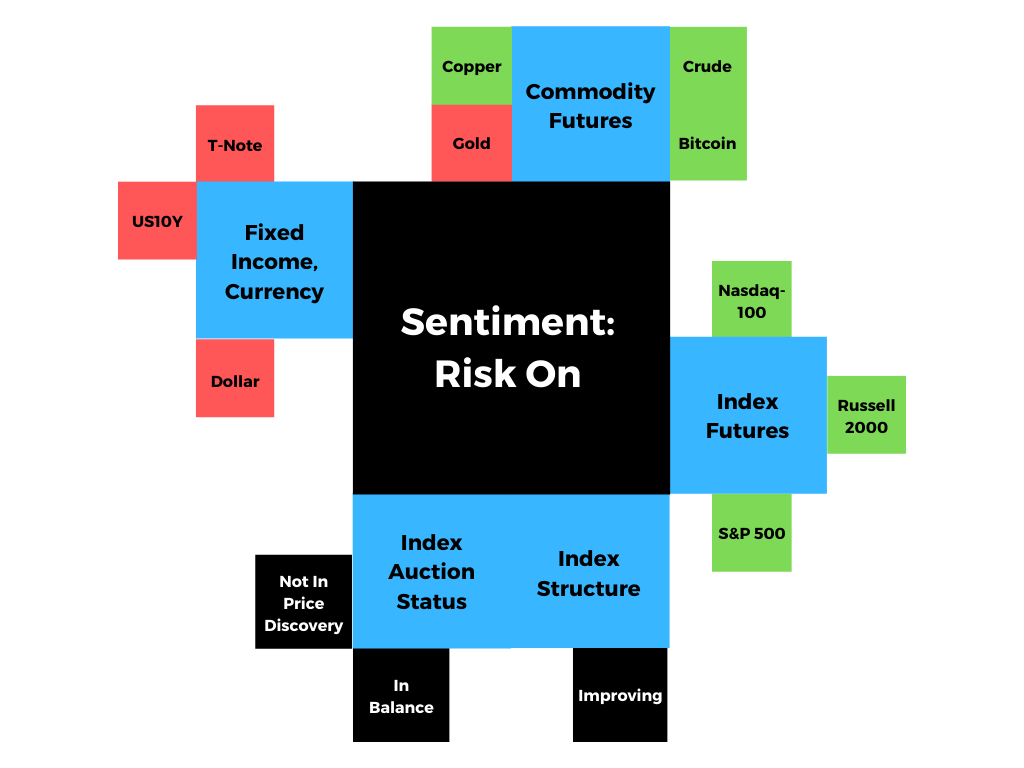
Daily Brief For May 18, 2021

Market Commentary

Index futures attempting to exit balance.

  • Potential deal on infrastructure package.
  • Ahead: Housing starts, building permits.
  • Indices balance, move up-and-sideways.

What Happened: U.S. stock index futures auctioned higher overnight after an attempt to probe lower, yesterday, was countered by strong responsive buying.

Graphic updated at 7:20 AM EST.

What To Expect: Tuesday’s regular session (9:30 AM – 4:00 PM EST) in the S&P 500 will likely open on a minor gap, inside of prior-range and -value, suggesting a limited potential for immediate directional opportunity.

Gap: Gaps ought to fill quickly. Should they not, that’s a signal of strength; do not fade. Leaving value behind on a gap-fill or failing to fill a gap (i.e., remaining outside of the prior session’s range) is a go-with indicator. Auctioning and spending at least 1-hour of trade back in the prior range suggests a lack of conviction; in such a case, do not follow the direction of the most recent initiative activity.
Adding, during the prior day’s regular trade, the best case outcome occurred, evidenced by sideways trade just under the $4,177.25 high volume area (HVNode), which is significant because that level marks a major pivot on the composite profile (i.e., above = bullish, below = bearish-to-neutral).

To note, however, despite bullish dynamics ahead of this week’s monthly options expiration (OPEX), participants are unable to gather the conviction and breakthrough to higher prices. This evidenced by a developing ledge at the $4,177.25 HVNode pivot. 

Options Expiration (OPEX): Option expiries mark an end to pinning (i.e, the theory that market makers and institutions short options move stocks to the point where the greatest dollar value of contracts will expire worthless) and the reduction dealer gamma exposure.

Ledges: Flattened area on the profile which suggests responsive participants are in control, or initiative participants lack the confidence to continue the discovery process. The ledge will either hold and force participants to liquidate (cover) their positions, or crack and offer support (resistance).

Volume Areas: A structurally sound market will build on past areas of high-volume. Should the market trend for long periods of time, it will lack sound structure (identified as a low-volume area which denotes directional conviction and ought to offer support on any test). 

If participants were to auction and find acceptance into areas of prior low-volume, then future discovery ought to be volatile and quick as participants look to areas of high-volume for favorable entry or exit.

Moreover, for today, participants can trade from the following frameworks. 

In the best case, the S&P 500 trades sideways or higher; like yesterday, activity above the $4,177.25 HVNode pivot may reach as high as the $4,227.00 POC. Initiative trade beyond the POC targets the $4,238.00 overnight high (ONH).

POCs: POCs (like HVNodes described above) are valuable as they denote areas where two-sided trade was most prevalent. Participants will respond to future tests of value as they offer favorable entry and exit.

Overnight Rally Highs (Lows): Typically, there is a low historical probability associated with overnight rally-highs (lows) ending the upside (downside) discovery process.

In the worst case, the S&P 500 trades lower; activity below $4,177.25 has the potential to reach down, through the $4,129.25 and $4,069.25 HVNodes, to the $4,050.75 low volume area (LVNode).

Graphic: 65-minute profile chart of the Micro E-mini S&P 500 Futures
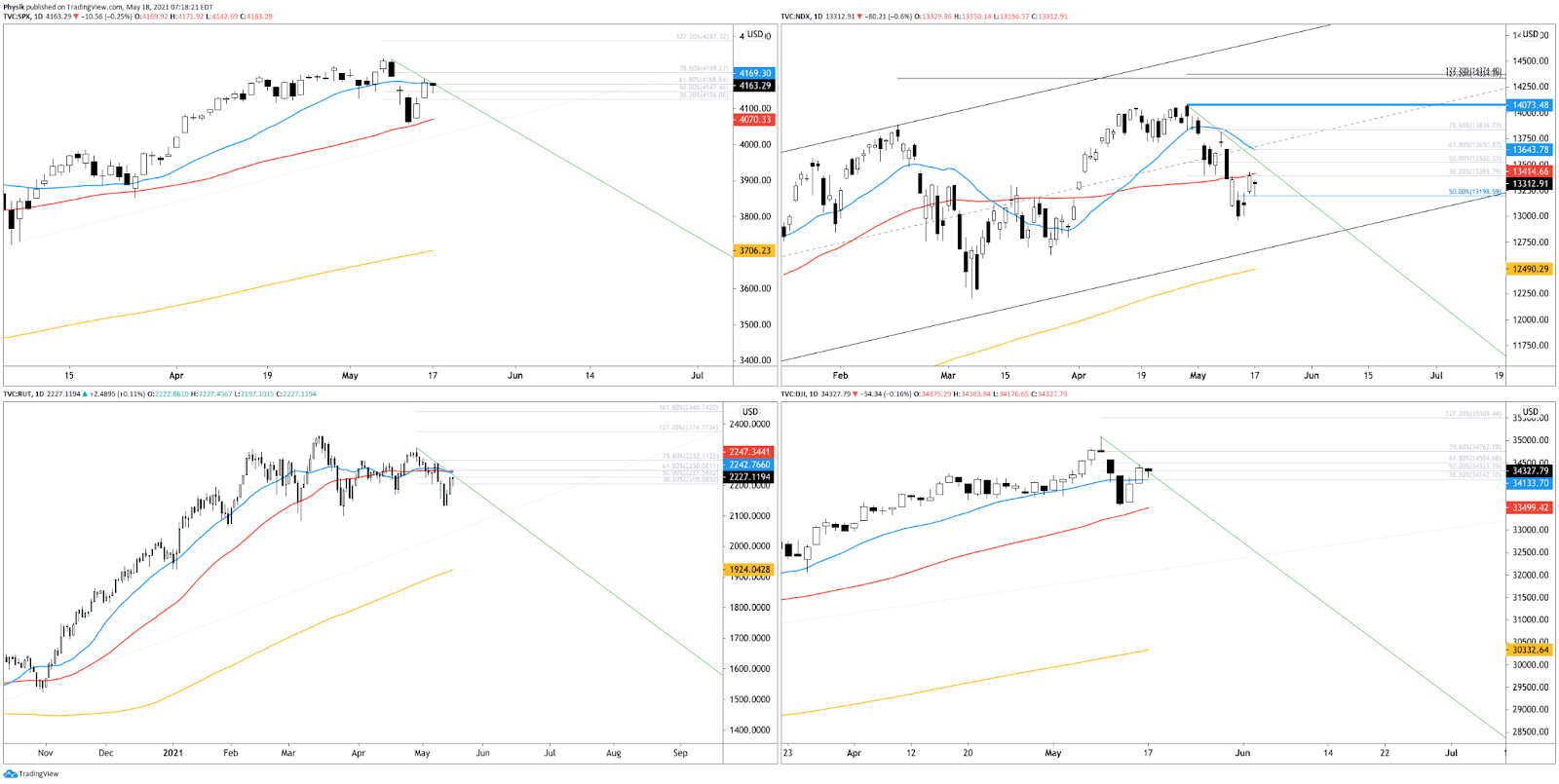
Graphic: Daily candlestick charts of the S&P 500 (top left), Nasdaq 100 (top right), Russell 2000 (bottom left), and Dow Jones Industrial Average (bottom right). Note that the SPX, RUT, and DJI are about to break out of their most recent downtrends. Monitor for continuation. 
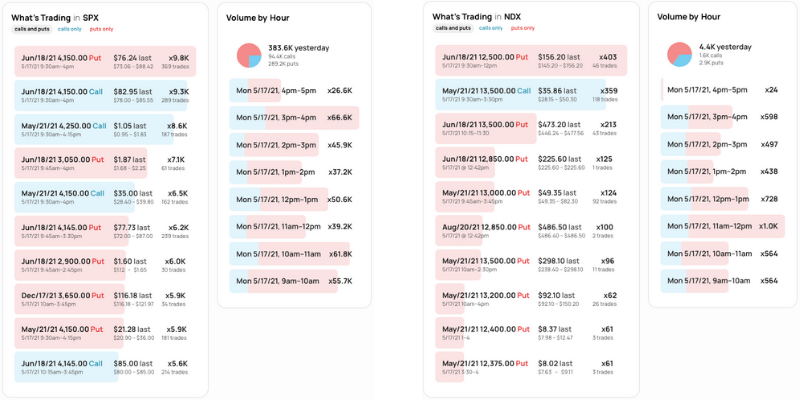
Graphic: SHIFT search suggests participants were most interested in put strikes at and below current prices in the cash-settled S&P 500 Index (INDEX: SPX) and Nasdaq 100 Index (INDEX: NDX), May 17.

News And Analysis

Markets | Burry of ‘Big Short’ fame reveals a $530 million Tesla bet. (REU)

Energy | Brent crude hits $70 as traders bet on sustained demand. (FT)

Technology | Biden pitching $174B electric vehicle plan in Michigan. (REU)

Economy | Yellen wants businesses to help foot infrastructure bills. (Axios)

Recovery | Several states report zero COVID deaths for the first time. (Axios)

What People Are Saying

Innovation And Emerging Trends

Venture | Growth firms, as most active investors, look to double down. (CB)

Energy | Energy groups must stop new oil, gas projects, IEA said. (FT)

Markets | Small Exchange lowers barrier to energy with new futures. (BZ)

About

Renato founded Physik Invest after going through years of self-education, strategy development, and trial-and-error. His work reporting in the finance and technology space, interviewing leaders such as John Chambers, founder, and CEO, JC2 Ventures, Kevin O’Leary, businessman and Shark Tank host, Catherine Wood, CEO and CIO, ARK Invest, among others, afforded him the perspective and know-how very few come by.

Having worked in engineering and majored in economics, Renato is very detailed and analytical. His approach to the markets isn’t built on hope or guessing. Instead, he leverages the unique dynamics of time and volatility to efficiently act on opportunity.

Disclaimer

At this time, Physik Invest does not manage outside capital and is not licensed. In no way should the materials herein be construed as advice. Derivatives carry a substantial risk of loss. All content is for informational purposes only.