Categories
Commentary

Market Commentary For 2/17/2021

Notice: To view this week’s big picture outlook, click here.

What Happened: U.S. stock index futures auctioned lower as investors turned cautious ahead of economic releases.

What Does It Mean: After a v-pattern recovery and sideways trade in the weeks prior, stock index futures auctioned out of prior-balance and -range, via Friday’s end-of-day spike.

More On Spikes: Spike’s mark the beginning of a break from value. Spikes higher (lower) are validated by trade at or above (below) the spike base (i.e., the origin of the spike).

The spike and shift from balance (i.e., the transition from two- to one-time frame trade) was accepted, despite Tuesday’s liquidation break.

More On Liquidation Breaks: The profile shape in the S&P 500 suggests participants were “too” long and had poor location.

Adding, for the entirety of Tuesday’s session, prices rotated lower in the face of increased buying interest, as observed by volume delta and option activity.

Given that the market is technically positioned for higher, it will be interesting to see whether on not Tuesday’s interest (as measured by volume delta) leads to upside resolve.

More On Volume Delta: Buying and selling power as calculated by the difference in volume traded at the bid and offer.

What To Expect: Wednesday’s regular session (9:30 AM – 4:00 PM ET) will likely open inside of prior-balance and -range, suggesting the limited potential for immediate directional opportunity.

This comes alongside a resumption in trend, acceptance of higher prices (above a prominent high-volume area), and an overnight rally-high at $3,959.25.

More On Overnight Rally Highs: Typically, there is a low historical probability associated with overnight rally-highs ending the upside discovery process.

More On Volume Areas: A structurally sound market will build on past areas of high-volume. Should the market trend for long periods of time, it will lack sound structure (identified as a low-volume area which denotes directional conviction and ought to offer support on any test). 

If participants were to auction and find acceptance into areas of prior low-volume, then future discovery ought to be volatile and quick as participants look to areas of high-volume for favorable entry or exit.

Thus, given the above dynamics, the following frameworks ought to be applied.

In the best case, the S&P 500 opens and remains above the $3,919.75 spike base, further confirming last week’s higher prices. In the worst case, the S&P 500 auctions below the $3,919.75 spike base.

Trade below the spike base would be the most negative outcome.

Why? Beneath the spike base is a high-volume concentration which offers favorable entry and exit for initiative buyers and responsive sellers. Should the market auction beneath the spike base (and aforementioned high-volume area), then participants may see a new wave of downside discovery.

Levels Of Interest: $3,919.75 spike base.

Categories
Commentary

Market Commentary For 2/16/2021

Notice: To view this week’s big picture outlook, click here.

What Happened: U.S. stock index futures auctioned higher, over the holiday weekend, as investors remained optimistic on the progress of coronavirus relief.

What Does It Mean: After a v-pattern recovery and sideways trade in the weeks prior, stock index futures auctioned out of prior-balance and -range, via Friday’s end-of-day spike.

More On Spikes: Spike’s mark the beginning of a break from value. Spikes higher (lower) are validated by trade at or above (below) the spike base (i.e., the origin of the spike).

Adding, the spike makes it easy to spot the shift from balance (i.e., the transition from two- to one-time frame trade). For the entirety of Friday’s session, prices rotated in the face of increased buying interest, as observed by volume delta. At the outset, buying pressure looked as thought it was absorbed by sellers. Eventually, the rise in delta was resolved when participants broke through a ledge of responsive selling, and established record highs.

More On Volume Delta: Buying and selling power as calculated by the difference in volume traded at the bid and offer.

What To Expect: Tuesday’s regular session (9:30 AM – 4:00 PM ET) will likely open outside of prior-balance and -range, suggesting the potential for immediate directional opportunity.

This comes alongside a resumption in trend and an overnight rally-high at $3,959.25.

More On Overnight Rally Highs: Typically, there is a low historical probability associated with overnight rally-highs ending the upside discovery process.

Given the spike, balance-break and subsequent resumption in trend, as well as the overnight high (ONH), participants are aware that favorable opportunities primarily rest on the long-side.

Thus, given the aforementioned dynamics, the following frameworks ought to be applied.

In the best case, the S&P 500 opens and remains above the $3,919.75 spike base, confirming last week’s higher prices. In the worst case, the S&P 500 auctions below the $3,919.75 spike base.

Trade below the spike base would be the most negative outcome and could trigger a new wave of downside discovery, repairing some of the poor structures left in the wake of the aforementioned advance.

Levels Of Interest: $3,919.75 spike base.

Categories
Commentary

Market Commentary For 2/12/2021

Notice: To view this week’s big picture outlook, click here.

What Happened: As the new administration pushes approval of a $1.9 trillion coronavirus relief plan, alongside the approval of another $14 billion for pandemic-hit airlines and signs of improve in the labor market, U.S. stock index futures traded sideways, in prior-balance and -range.

What Does It Mean: Market’s were range-bound after a rapid de-risking event associated with the GameStop Corporation (NYSE: GME) crisis, and subsequent v-pattern recovery.

Pictured: 4-hour profile chart of the Micro E-mini S&P 500 Futures

The tight trading range is most attributable to the large February monthly options expiration (OPEX), after which, the interest at the $3,900.00 S&P 500 option strike will roll-off. Why’s this? Most funds are committed to holding long positions. In the interest of lower volatility returns, these funds will collar off their positions, selling calls to finance the purchase of downside put protection.

As a result of this activity, option dealers are long upside and short downside protection.

The exposure must be hedged: dealers sell into strength as their call (put) positions gain (lose) value and buy into weakness as their call (put) positions lose (gain) value.

Now, unlike theory suggests, dealers will hedge call losses (gains) quicker (slower). This leads to “long-gamma,” a dynamic that crushes volatility and promotes momentum, observed by lengthy sprints, followed by rapid de-risking events as the market transitions into “short-gamma.”

If the interest near $3,900.00 S&P 500 is not rolled up in price and out in time, then option hedging requirements will change.

The absence of strong fundamentally-driven buying (as we’ve seen with such things as DIX), can have serious implications on price action.

More On DIX: For every buyer is a seller (usually a market maker). Using DIX — which is derived from short sales (i.e., liquidity provision on the market making side) — we can measure buying pressure.
Pictured: DIX by Squeeze Metrics

However, it is important to note that, in recent days, some exposure has been rolled up in price and out in time.

One such example can be seen below.

Pictured: Purchase of call positions higher in price and farther out in time in the cash-settled S&P 500 Index

What To Expect: Friday’s regular session (9:30 AM – 4:00 PM ET) will likely open inside of prior-balance and -range, suggesting limited potential for immediate directional opportunity.

Given dynamics discussed in the prior section, the odds of substantial change are low, so long as broad market indices, like the S&P 500, remain in balance (i.e., range-bound).

Also, trading in a prominent area of high-volume ($3,900.00) will likely make for a volatile session as such areas denote the market’s most recent perception of value and offer favorable entry and exit, hence the two-sided trade.

More On Volume Areas: A structurally sound market will build on past areas of high-volume. Should the market trend for long periods of time, it will lack sound structure (identified as a low-volume area which denotes directional conviction and ought to offer support on any test). 

If participants were to auction and find acceptance into areas of prior low-volume, then future discovery ought to be volatile and quick as participants look to areas of high-volume for favorable entry or exit.

Going forward, participants will look to the overnight rally-high at $3,928.25, and low-volume structure beneath the $3,880.00 HVNode, which offered responsive buyers favorable entry during Wednesday’s intraday liquidation break.

More On Overnight Rally Highs: Typically, there is a low historical probability associated with overnight rally-highs ending the upside discovery process.

More On Liquidation Breaks: The profile shape in the S&P 500 suggests participants were “too” long and had poor location.

That said, the following frameworks apply.

In the best case, the S&P 500 remains rotational, at or above the $3,900.00 HVNode. In the worst case, any break that finds increased involvement (i.e., supportive flows and delta) below the $3,880.00 HVNode, would favor continuation as low as the $3,830.75 HVNode.

As stated yesterday, major change will be identified with trade above the $3,928.25 overnight rally-high, and below the $3,878.50 regular-trade low.

Levels Of Interest: $3,928.25 overnight rally-high, $3,900.00 HVNode, $3,878.50 regular-trade low.

Categories
Commentary

Market Commentary For 2/11/2021

Notice: To view this week’s big picture outlook, click here.

What Happened: After a volatile Wednesday, U.S. stock index futures rose alongside fiscal stimulus and vaccine optimism, ahead of releases that would shine light on the labor market recovery.

What Does It Mean: After a gap open, participants sold stock indexes into prior value, yesterday.

This comes ahead of the large February monthly options expiration (OPEX), after which, the interest at the $3,900.00 S&P 500 option strike will roll-off. As a result, stickiness near the $3,900.00 high-volume area (HVNode) will likely cease in the absence of option hedging requirements.

More On Volume Areas: A structurally sound market will build on past areas of high-volume. Should the market trend for long periods of time, it will lack sound structure (identified as a low-volume area which denotes directional conviction and ought to offer support on any test).

If participants were to auction and find acceptance into areas of prior low-volume, then future discovery ought to be volatile and quick as participants look to areas of high-volume for favorable entry or exit. 
Pictured: Micro E-mini S&P 500 Future.

Further, we have numerous pieces of context to unpack prior to getting into today’s outlook on trade.

First, the v-pattern recovery after the recent de-risking event suggests room for higher. Second, the market is stuck in a long-gamma environment that favors less volatility (as witnessed during Wednesday’s muted intra-day sell-off and recovery). Third, the S&P 500 is trading just shy of $3,940.00, a primary upside target based on a multi-month balance-area projection.

More On The V-Pattern: A pattern that forms after a market establishes a high, retests some support, and then breaks above said high. In most cases, this pattern portends continuation. 

More On Gamma: Gamma is the sensitivity of an option to changes in underlying price. Dealers that take the other side of option trades hedge their exposure to risk by buying and selling the underlying. 

When dealers are short-gamma, they hedge by buying into strength and selling into weakness. When dealers are long-gamma, they hedge by selling into strength and buying into weakness. The former exacerbates volatility. The latter calms volatility.
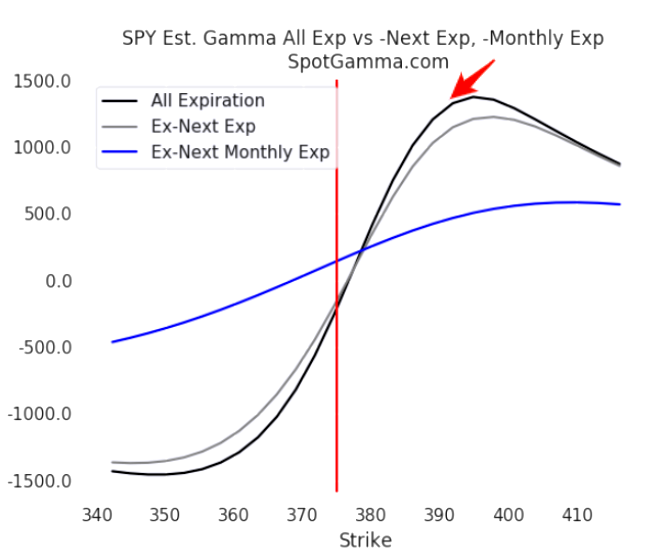
Graphic 1: SpotGamma data suggests S&P 500 at or above “Long-Gamma” juncture.

What To Expect: Thursday’s regular session (9:30 AM – 4:00 PM ET) will likely open inside of prior-range, suggesting limited potential for immediate directional opportunity.

Adding, given dynamics discussed in the prior section, the odds of substantial change are low, so long as broad market indices, like the S&P 500, remain range bound. Also, trading in a prominent area of high-volume ($3,900.00) will likely make for a volatile session as such areas denote the market’s most recent perception of value and offer favorable entry and exit, hence the two-sided trade.

Going forward, participants will look to the overnight rally-high at $3,928.25, and low-volume structure beneath the $3,880.00 HVNode, which offered responsive buyers favorable entry during Wednesday’s intraday liquidation break.

More On Overnight Rally Highs: Typically, there is a low historical probability associated with overnight rally-highs ending the upside discovery process.

More On Liquidation Breaks: The profile shape in the S&P 500 suggests participants were “too” long and had poor location.

Knowing participants are doing a good job of defending their ~7% advance, a non-typical weekly trading range, after taking out the 127.20% price extension, a typical recovery target, and leaving minimal excess (i.e., a proper end to price discovery) at the high, odds point to the increased potential for higher trade or balance in the coming session(s).

That said, the following frameworks apply.

In the best case, the S&P 500 remains rotational, at or above the $3,900.00 HVNode. In the worst case, any break that finds increased involvement (i.e., supportive flows and delta) below the $3,880.00 HVNode, would favor continuation as low as the $3,830.75 HVNode.

Major change will be identified with trade above the $3,928.25 overnight rally-high, and below the $3,878.50 regular-trade low.

Levels Of Interest: $3,928.25 overnight rally-high, $3,900.00 HVNode, $3,878.50 regular-trade low.

Categories
Commentary

Market Commentary For 2/10/2021

Notice: To view this week’s big picture outlook, click here.

What Happened: Alongside optimism around an economic rebound, U.S. stock index futures established record all-time highs, overnight, before trading back into range.

What Does It Mean: On the heels of a de-risking event and v-pattern recovery, indices, like the S&P 500, maintained higher prices.

This price action occurred in the face of bearish undercurrents, highlighted in past commentary.

Important to note, however, is a pick up in call-side activity in the SPDR S&P 500 ETF Trust (NYSE: SPY), the largest ETF that tracks the S&P 500. This comes alongside the S&P 500’s re-entry into long-gamma (Graphic 1) and rotation near the $3,900 high-open interest strike.

Further, the addition of derivative exposure at higher strikes (Graphic 2), farther out in time, suggests an inclination by participants to maintain long exposure through February’s monthly options expiration (OPEX), a day that often marks an end to pinning (which we’ve seen over the past week).

More On The V-Pattern: A pattern that forms after a market establishes a high, retests some support, and then breaks above said high. In most cases, this pattern portends continuation. 

More On Gamma: Gamma is the sensitivity of an option to changes in underlying price. Dealers that take the other side of option trades hedge their exposure to risk by buying and selling the underlying. 

When dealers are short-gamma, they hedge by buying into strength and selling into weakness. When dealers are long-gamma, they hedge by selling into strength and buying into weakness. The former exacerbates volatility. The latter calms volatility.
Graphic 1: SpotGamma data suggests S&P 500 at or above “Long-Gamma” juncture.
Graphic 2: Option Order Flow.

What To Expect: Wednesday’s regular session (9:30 AM – 4:00 PM ET) will likely open outside of prior-balance and -range, suggesting the potential for immediate directional opportunity.

This comes after participants traversed over 7%, a non-typical weekly trading range, taking out the 127.20% price extension, a typical recovery target.

Given how far the discovery process has come, attention is drawn to the overnight high. Typically, there is a low historical probability associated with overnight rally-highs ending the upside discovery process. Add on the fact that Tuesday’s regular trade left minimal excess (i.e., a proper end to price discovery) at the high, odds point to the increased potential for higher trade or balance in the coming session(s).

Given that reference, the following frameworks apply.

In the best case, the S&P 500 does some backfilling to repair poor structures left in the wake of strong initiative buying overnight. In such a case, participants would look for responsive buying to surface at or above the $3,912.25 regular-trade high.

In the worst case, any break that finds increased involvement (i.e., supportive flows and delta) below the $3,908.75 high-volume area (HVNode), would favor continuation as low as the $3,900.00 and $3,880.00 HVNodes.

More On Volume Areas: A structurally sound market will build on past areas of high-volume. Should the market trend for long periods of time, it will lack sound structure (identified as a low-volume area which denotes directional conviction and ought to offer support on any test). 

If participants were to auction and find acceptance into areas of prior low-volume, then future discovery ought to be volatile and quick as participants look to areas of high-volume for favorable entry or exit.

Levels Of Interest: $3,908.75 HVNode.

Categories
Commentary

Market Commentary For 2/9/2021

Notice: To view this week’s big picture outlook, click here.

What Happened: U.S. stock index futures established record all-time highs Monday before trading back into range.

What Does It Mean: On an end-of-day spike, U.S. stock index futures established new all-time highs.

This price action occurred on the heels of a quick de-risking event and v-pattern recovery, alongside non-participatory speculative flows, a divergence in the DIX, and the market’s re-entry into long-gamma.

More On The V-Pattern: A pattern that forms after a market establishes a high, retests some support, and then breaks above said high. In most cases, this pattern portends continuation. 

More On Speculative Flows: Participants looking to capitalize on either upside or downside through the purchase and sale of options, the right to buy or sell an asset at a later date and agreed upon price.

More On DIX: For every buyer is a seller (usually a market maker). Using DIX — which is derived from short sales (i.e., liquidity provision on the market making side) — we can measure buying pressure.

More On Gamma: Gamma is the sensitivity of an option to changes in underlying price. Dealers that take the other side of option trades hedge their exposure to risk by buying and selling the underlying. 

When dealers are short-gamma, they hedge by buying into strength and selling into weakness. When dealers are long-gamma, they hedge by selling into strength and buying into weakness. The former exacerbates volatility. The latter calms volatility.
Graphic 1: SpotGamma data suggests S&P 500 at or above “Long-Gamma” juncture.

Important to note: unlike in prior sessions, participants saw some change in the undercurrents. A divergence between price (lower) and cumulative volume delta (higher). This divergence resolved itself in the last hour of trade on Monday.

More On Volume Delta: Buying and selling power as calculated by the difference in volume traded at the bid and offer.

What To Expect: Tuesday’s regular session (9:30 AM – 4:00 PM ET) will likely open inside a spike, within prior-balance and -range, suggesting minimal directional opportunity. This comes after participants traversed nearly 7%, a non-typical weekly trading range.

More On Spikes: Spike’s mark the beginning of a break from value. Spikes higher (lower) are validated by trade at or above (below) the spike base (i.e., the origin of the spike).

Further, given how far the discovery process has come, attention is drawn to a few key references.

The first is the end-of-day spike. Trade below the $3,899.00 spike base would be the most negative outcome and may trigger a new wave of downside discovery that would repair some of the poor structures left in the wake of the aforementioned advance.

The second key reference is the overnight high. Typically, there is a low historical probability associated with overnight rally-highs ending the upside discovery process. Add on the fact that Monday’s regular trade left minimal excess (i.e., a proper end to price discovery) at the high, odds point to the potential to trade higher in the coming session(s).

Given those key references, the following frameworks apply.

In the best case, the S&P 500 does some backfilling to repair poor structures left in the wake of strong initiative buying. In such a case, participants would look for responsive buying to surface at or above the $3,880.00 high-volume area (HVNode). 

In the worst case, any break that finds increased involvement (i.e., supportive flows and delta) below the $3,880.00 HVNode, would favor continuation as low as the $3,794.75 and $3,727.75 HVNodes.

More On Volume Areas: A structurally sound market will build on past areas of high-volume. Should the market trend for long periods of time, it will lack sound structure (identified as a low-volume area which denotes directional conviction and ought to offer support on any test). 

If participants were to auction and find acceptance into areas of prior low-volume, then future discovery ought to be volatile and quick as participants look to areas of high-volume for favorable entry or exit.

Today’s go/no-go level is the $3,899.00 spike base. Below, would portend downside discovery and structural repair. At or above denotes balance or continued upside discovery.

Levels Of Interest: $3,899.00 spike base.

Categories
Commentary

Market Commentary For 1/8/2021

Notice: To view this week’s big picture outlook, click here.

What Happened: Alongside hopes for more stimulus spending to help the U.S. recover from the pandemic downturn, U.S. index futures established a new all-time high in the overnight session, before backing off into prior-range and -value.

What Does It Mean: After the resolve of a long-liquidation earlier in the week, the market is in price discovery mode, trending to establish balance, or two-sided trade.

What To Expect: Friday’s regular session (9:30 AM – 4:00 PM ET) will likely open close to prior-balance and -range, implying higher volatility at the open.

Few dynamics to note: (1) poor structure in prior sessions, as evidenced by the low-volume areas (LVNodes) in the graphic above, (2) divergence from developing value, (3) a new overnight all-time high (i.e., historically, there is a low probability that overnight all-time highs end the upside discovery process), as well as (4) unsupportive speculative flows and delta in some instances.

Given the above dynamics, the go/no-go level for upside in the S&P 500 is the $3,817.75 overnight high. The go/no-go level for downside is the low-volume node at $3,787.50, an area that denotes upside conviction. On any virgin test, the S&P 500 ought to find support at this LVNode. However, should the index break below that level, then conviction has changed.

In a failure to break either go/no-go level, the normal course of action would be responsive trade.

Noting: Since the prior day’s range is close by, any acceptance (i.e., at least one half-hour of trade) of price within prior value reduces the odds of a dynamic move.

Levels Of Interest: $3,817.75 overnight high and $3,787.50 LVNode.

Categories
Commentary

Market Commentary For 11/27/2020

What Happened: On hopes of a sustained economic rebound, stock index futures are trading higher, in balance, suggesting acceptance of higher prices in the S&P 500.

What Does It Mean: In Wednesday’s regular trading, participants balanced, accepting higher prices near the $3,630 balance-area high, as evidenced by the non-presence of range expansion.

Now, buyers extended their gains, auctioning into Tuesday’s excess high, which ended the upside discovery process when responsive sellers were found near the $3,650 mark, a balance-area projection.

As a result, participants come into Friday’s session knowing that (1) the market has accepted Tuesday’s advance, (2) the auction is trading into a prior excess high, above the $3,630 balance-area boundary, and (3) the odds do not favor range expansion during a shortened, holiday session.

Therefore, today will likely further confirm Tuesday’s activity was the start of a new trend to the upside. Since the auction below $3,625, into Tuesday’s poor profile structure, did not attract further selling, initiative buyers remain in control. Thus, participants must monitor for signs of (1) continuation or (2) balance.

In case of the former, participants ought to take out the $3,655 overnight rally high first. In case of the latter, the auction ought to find responsive buyers near $3,630, a prior resistive balance-area high. An initiative drive below below that figure would put the rally on hold, and would target first $3,620, and then the node near $3,610.

Levels Of Interest: $3,655 overnight high, $3,630 balance-area high/high-volume node.