Categories
Commentary

The Mar-a-Lago Accords

“Good investing doesn’t come from buying good things, but from buying things well.” – Howard Marks

There is a lot of noise—it’s exhausting. Today, we will sift through the noise and focus on how we can protect and potentially grow our portfolios this year. This is a follow-up to our Market Tremors letter. But first, let’s clarify the context for our approach. This is a long newsletter, so you may have to view it in another window.


Inflation is back in focus, gold is soaring, and investors are optimistic about stocks. Correlations remain low, dispersion is high, and the market’s volatility pricing/positioning obscures potential risks lurking beneath the surface. The macro landscape is shifting rapidly, yet when we zoom out, we’re confronted with something we’ve discussed before: inflation is here to stay!

For a long time, the expectation was that inflation would take a particular shape—a transitory spike and a manageable trend. Instead, structurally, we’re dealing with a world that is moving away from the low-inflation paradigms of the past. The pillars supporting cheap capital and abundant liquidity—globalization and dovish monetary policy—are shifting.

These shifts are neither sudden nor unexpected. In 2023, we wrote much about the narrative of the ideological struggle between the West and East, particularly with the Russia-Ukraine conflict sparking. Historically, whenever Eastern economies prosper, the West adjusts the rules. Now, it’s more about who controls what. Control over assets, inflation, and interest rates define economic power. Folks like Zoltan Pozsar have warned that the fundamental drivers of the low-inflation era—globalization and financialization—are unraveling, leaving policymakers with little choice.

The well-respected Kai Volatility’s Cem Karsan, a mentor to many, has pointed out in excruciating, albeit digestible detail that the trends favoring high-beta portfolios over the past four decades are reversing. Monetary authorities, particularly the Federal Reserve, have been constrained in their ability to address the widening wealth divide. Their response to inflation in the early 2020s—from creating demand to absorb surplus supplies of low-priced items to structurally restricting demand in response to shortages—was intended to guide the economy along a path of managed declines in activity while maneuvering interest rates to prevent another inflationary flare. Rising populism is a byproduct manifesting as shifts in public demand and political sentiment.

Thus, today’s Mar-a-Lago Accords and the broader economic overhaul signify a significant trade, monetary policy, and financial stability restructuring. Tariffs, a U.S. sovereign wealth fund, and global security restructuring are the key issues at this forefront. The implications of this shift are profound, and markets have yet to adjust. A portfolio for this new environment could creatively layer exposure to stocks, bonds, commodities, and volatility. Understanding the pieces herein will be critical for structuring trades and managing risk. Let’s dive in.


Macro Context: A New Economic Framework

#1 – Tariffs

One significant component of this broader economic overhaul is tariffs. Economist Stephen Miran, nominated by the U.S. President to be Chairman of the Council of Economic Advisers, has outlined how tariffs, historically used to influence trade flows, are being retooled as protectionist instruments and an alternative revenue source.

According to Miran’s A User’s Guide to Restructuring the Global Trading System and fantastic explanations by Bianco Research founder Jim Bianco, a core issue is a persistently strong dollar distorting global trade balances. If paired with currency adjustments, tariffs could redistribute the costs away from U.S. consumers, “present[ing] minimal inflationary or otherwise adverse side effects, consistent with the [U.S.-China trade war] experience in 2018-2019.” However, this approach risks retaliation or distancing from key trading partners, further fracturing global supply chains.

To mitigate these risks, policymakers consider implementing tariffs in phases, gradually increasing rates to address inflationary pressures and market volatility. Even during the 2018-2019 trade war, tariff rate increases were implemented over time. Additionally, tariffs will be driven by national security concerns, targeting industries essential to defense and technological innovation. From this perspective, policymakers view access to the U.S. market as a privilege.

#2 – Sovereign Wealth Fund

A significant consideration is a U.S. sovereign wealth fund leaning on undervalued national assets to restore fiscal stability. Unlike traditional sovereign wealth funds built on surpluses, this fund would operate by revaluing and monetizing domestic reserves.

Key assets under consideration include undervalued gold reserves and billions in government-possessed bitcoin, which could be integrated into this fund. Bianco says these could total nearly $1 trillion.

This strategy introduces volatility concerns. Those concerned say government exposure and potential speculation on financial assets could lead to instability. Should we invest now for later?

#3 – Global Security Agreements

Beyond trade and monetary policy, a core element of the broader economic overhaul is linking military alliances to economic policy. The longstanding framework in which the U.S. provided security to allies without direct compensation is being rethought. The warnings are explicit; note the President’s Davos remarks and the Vice President’s Munich Security Conference speech.

Under a new paradigm, Bianco summarizes that NATO members may be required to contribute more to defense (say ~5% of GDP), foreign-held U.S. Treasury bonds may be converted into 100-year zero-coupon bonds, reducing short-term debt burdens, and tariff structures may be adjusted based on a country’s alignment with U.S. security interests.

“What Miran said in his paper is: you owe us so much for the last 80 years that what we want to do is a debt swap,” Bianco explains how the U.S. can be paid for being the world’s protector. “Those NATO countries have trillions of dollars of debt. [You’ll] swap it for 100-year or perpetual zero coupon non-marketable Treasury securit[ies]. So, you’re going to swap $10 billion worth of Treasuries for a $10 billion coupon century bond [that] won’t mature for 100 years, [and] won’t get any interest.”

In short, this is a fundamental shift that requires allies to bear a more significant share of security and costs. It’s the Mar-a-Lago Accords, a new financial order and policy framework akin to past agreements that reshaped the global economy, such as the Bretton Woods Agreement of 1944, which established the U.S. dollar as the international reserve currency, and the Plaza Accord of 1985, which coordinated currency adjustments to correct trade imbalances.

The proposed Mar-a-Lago Accords aim to reprice U.S. debt through asset monetization, weaken the dollar to improve U.S. export competitiveness and enforce tariff structures to rebalance global trade.


Positioning Context: Market Positioning Obscures

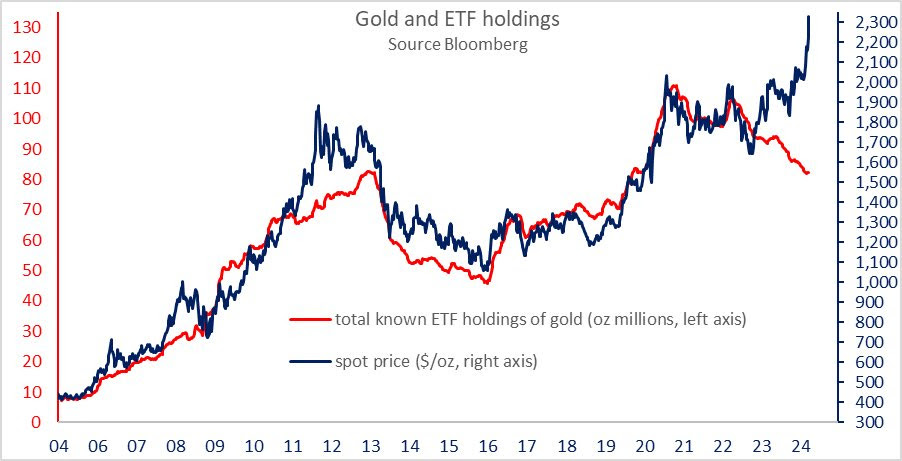
Tariff-driven price pressures, a weaker dollar, and a floor under interest rates raise bond yields, corporate borrowing costs, and strain leveraged players. This backdrop favors debasement plays and perceived safe havens like bitcoin and gold, which have been climbing for reasons discussed in the past and present.

Graphic: Retrieved from Bloomberg via @convertbond.

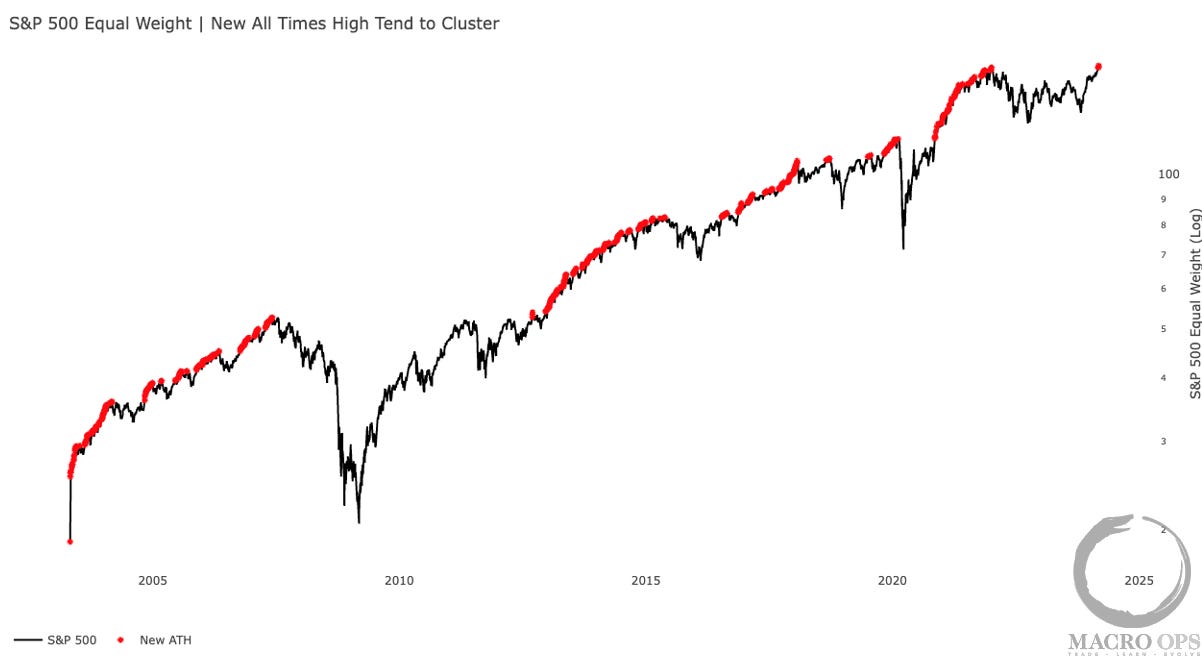
Equities face a less promising outlook. Oaktree Capital highlights that decade-long returns have historically been lackluster when investors bought the S&P 500 at today’s multiples. As Howard Marks puts it, earning +/-2% annually isn’t disastrous—but the real risk lies in a sharp valuation reset, compressed into just a few years, much like the brutal selloffs of the 1970s and 2000s.
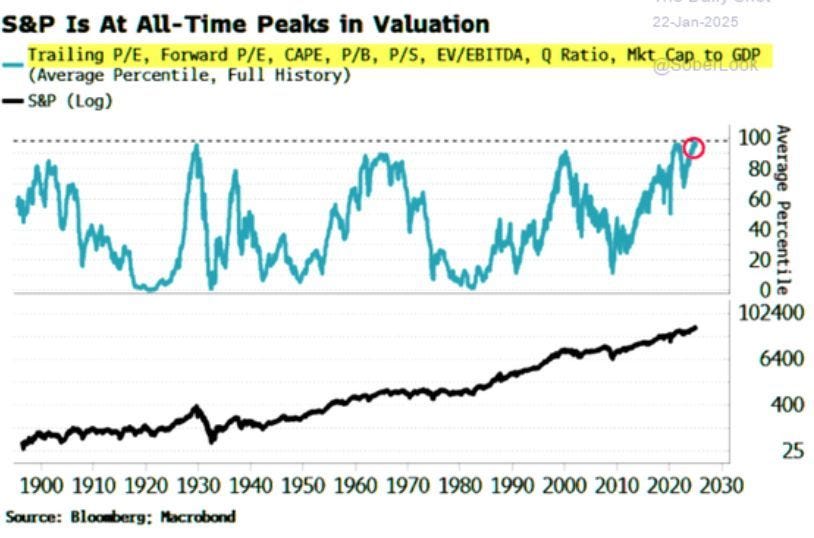
Graphic: Retrieved from Bloomberg via Bob Elliott.

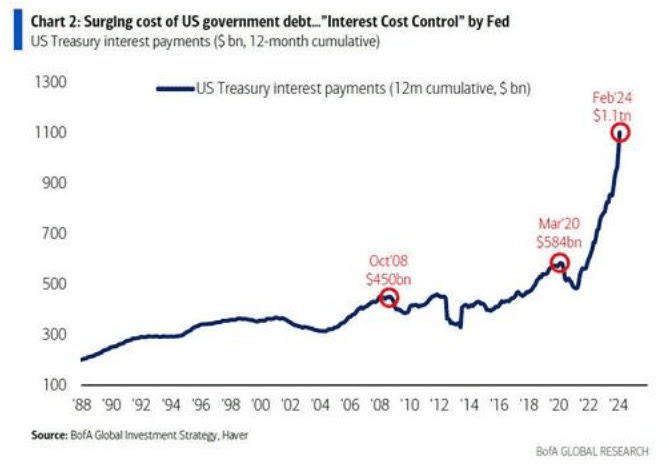
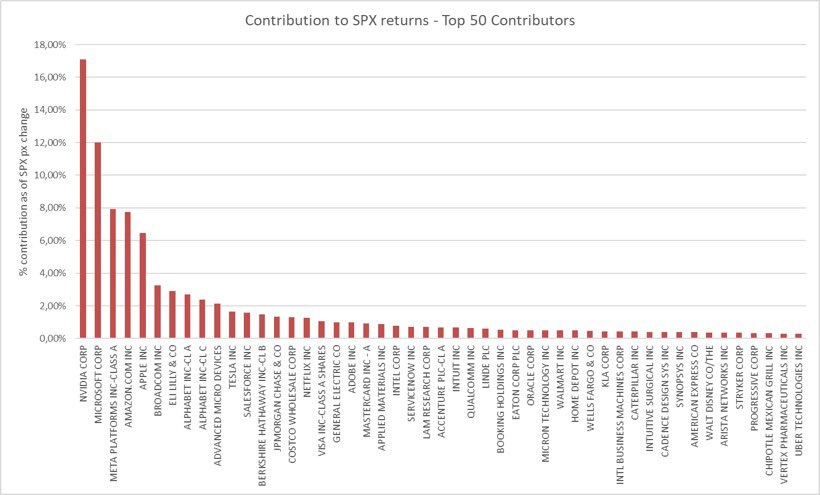
While the current market environment may feel frothy, with stretched valuations and narrow leadership, we’re not in an imbalanced 1970s scenario. Also, the possibility of a dollar devaluation serves as a tailwind for S&P 500 earnings, potentially boosting stock prices, Fallacy Alarm explains. Markets are not irrational; instead, they could face modest returns of around 5-6% annually for stocks and bonds over the next decade. Such sanguine sentiment is evident in the options/volatility market, reflecting the distribution of future possible outcomes; the trading and hedging of options make them a robust gauge of future outcomes—offering a view of where markets stand and where they might be headed.
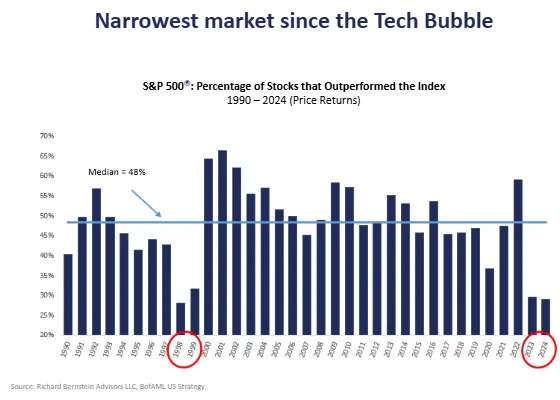
Graphic: Retrieved from Bank of America via Bloomberg.

We observe several key happenings:

#1 – Hedging Volatility Spikes, Not Market Crashes

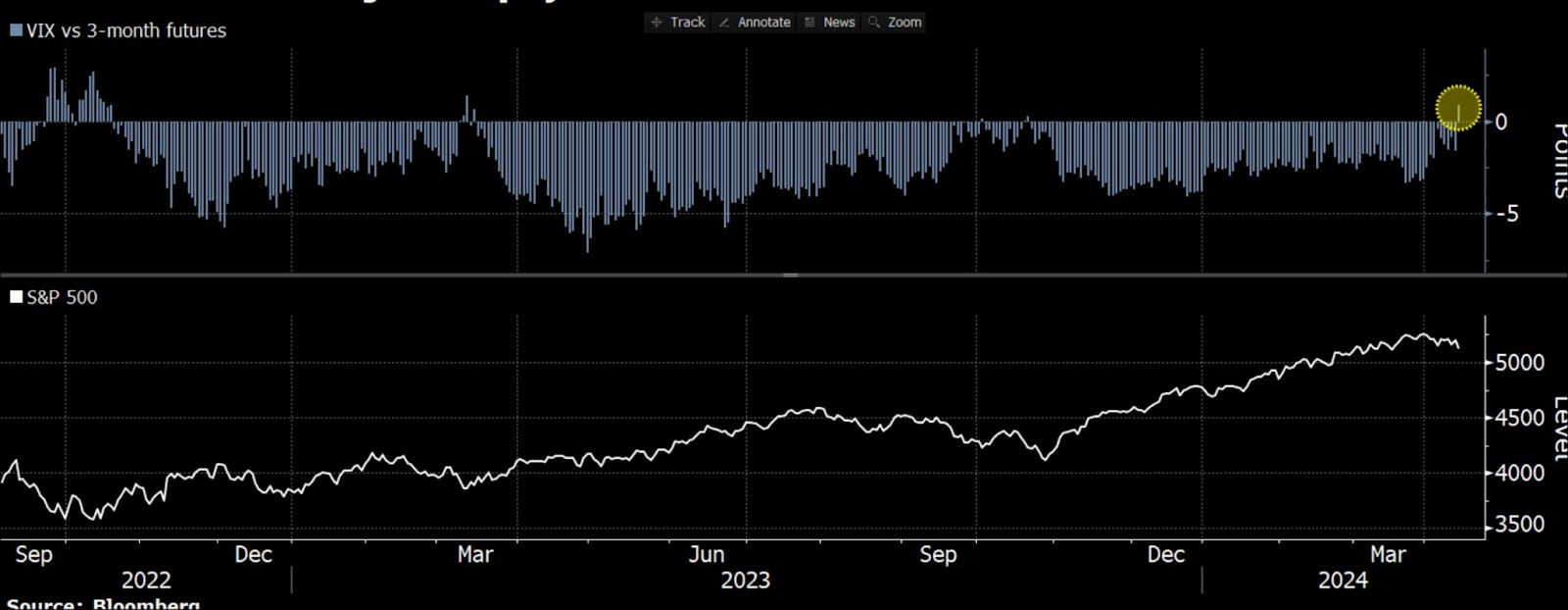
Investors are hedging against potential volatility spikes like those seen on August 5, 2024, when the VIX exploded higher. While the S&P 500 grinds upward and the VIX drifts lower and appears cheap (<16), the VVIX—“VIX of the VIX”—remains elevated. This unusual divergence manifests from demand for VIX calls, suggesting the market worries sharp repricings of risk are more likely than broad equity selloffs. The dynamic boils down to supply and demand; SPX options remain underappreciated—why protect when the market seems stable—meanwhile, VIX options are in demand, bolstering VVIX.

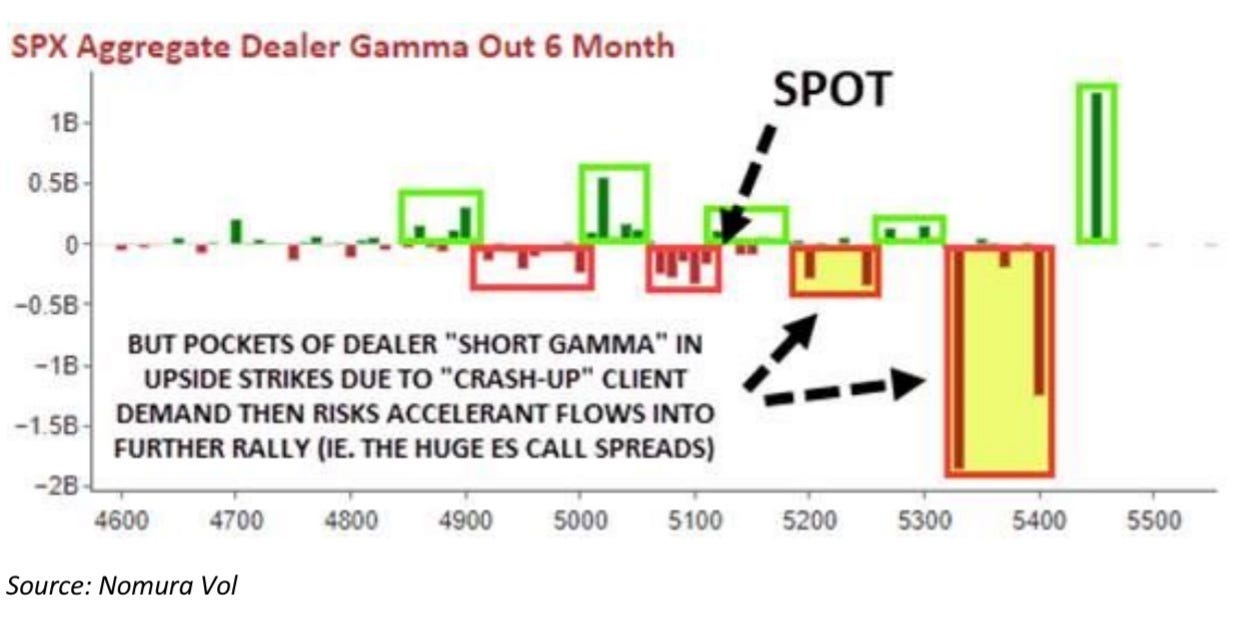
SpotGamma highlights this massive VIX call buying, noting dealer short convexity positioning suggests that, should volatility “wake up,” there could be significant downside pressure on equities and upside pressure on volatility, reinforcing the view that the VVIX’s elevated levels could signal a potential volatility spike, rather than a broad market crash.
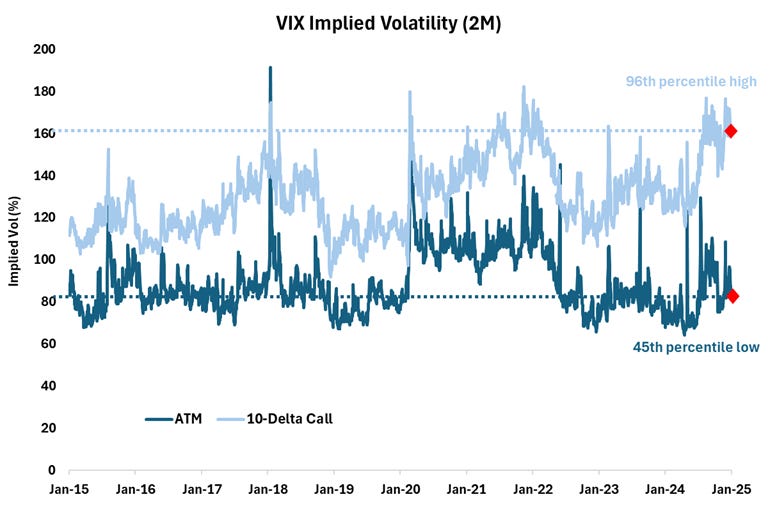
Graphic: Retrieved from Cboe Global Markets.

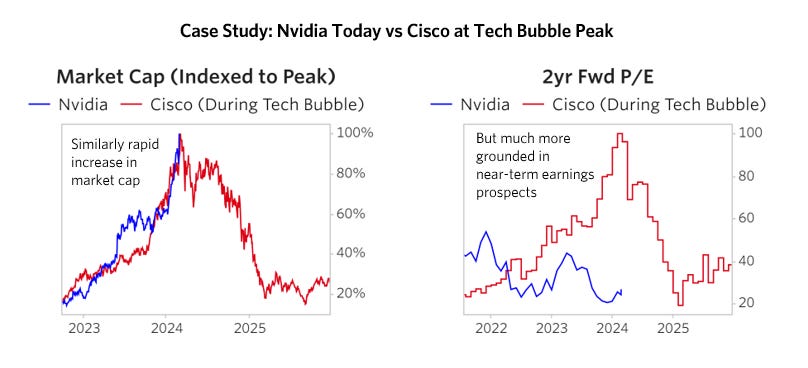
“The aforementioned vega supply is indeed large, but it is innocuous unless provoked,” SpotGamma’s founder Brent Kochuba explains. Still, “with correlation stretched and IVs at lows, there is the potential for an SPX index short vol cover/single stock spasm to push into this upside vega convexity – something that we think a sharp NVDA [earnings] miss could spark.”
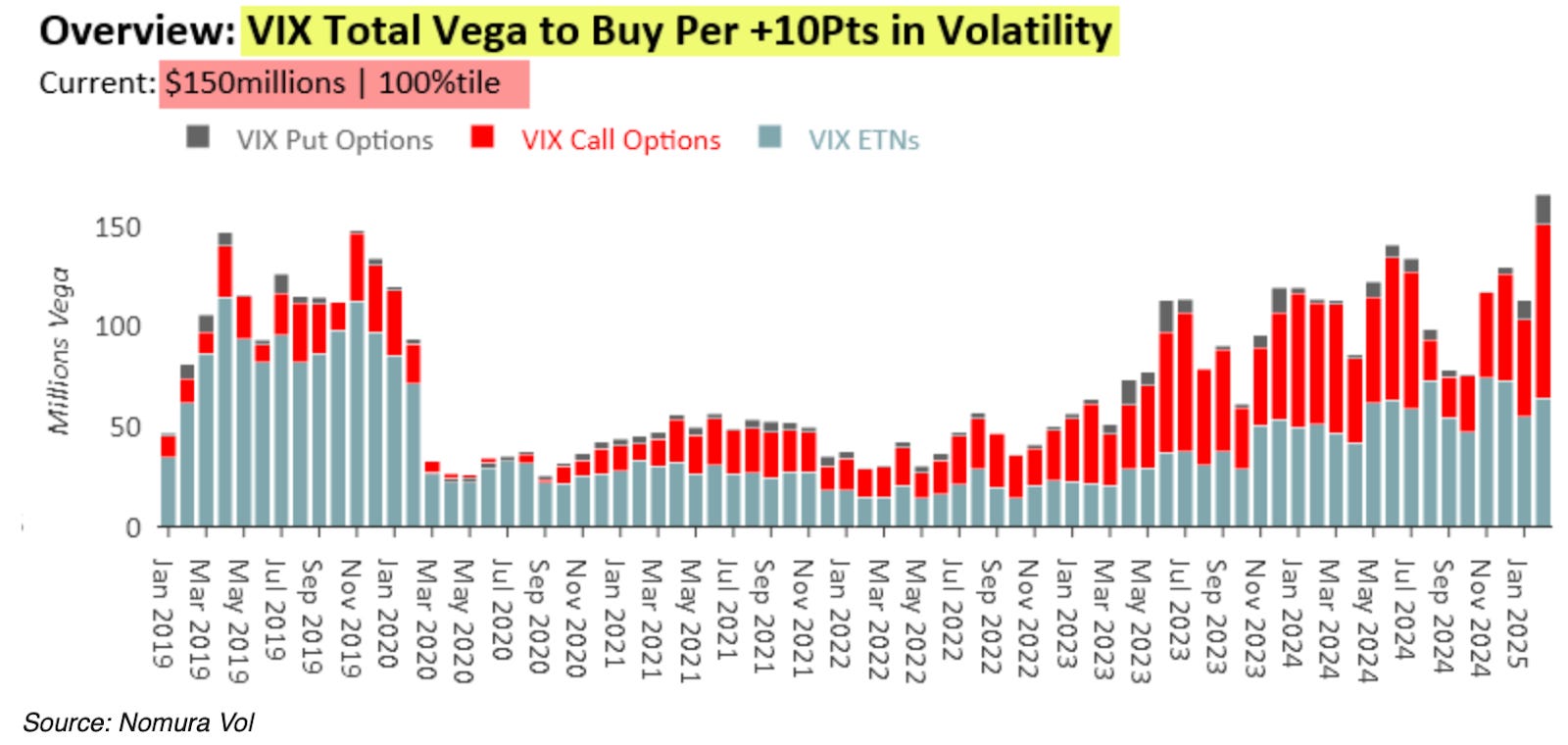
Graphic: Retrieved from Nomura via SpotGamma.

#2 – Options Selling and the ‘Buy My Course’ Gurus

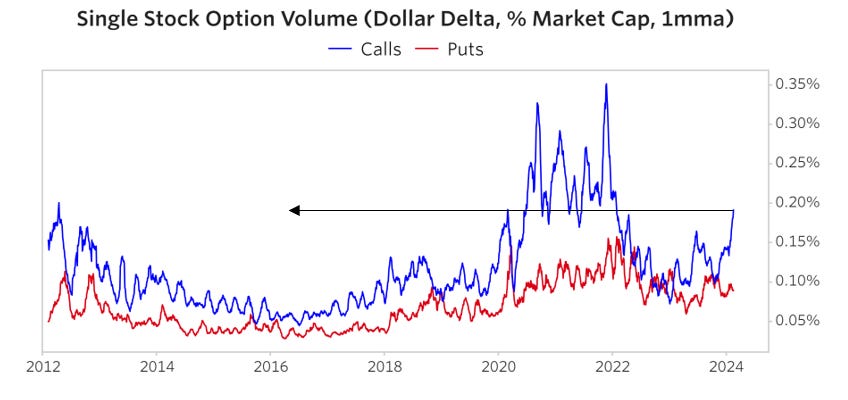
Investors are leaning toward short-dated options selling (sometimes packaged within an ETF structure, without regard for price and thoroughly assessing broader market positioning) and structured products.
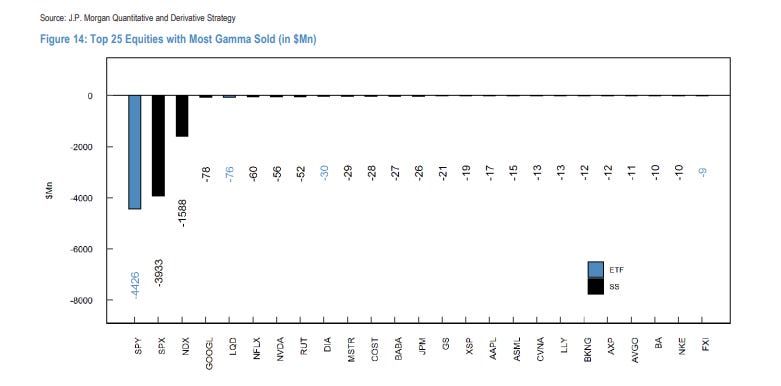
Graphic: Retrieved from JPMorgan via @jaredhstocks.

As QVR Advisors’ Benn Eifert explains, dynamic creates opportunity: deep out-of-the-money, long-dated volatility in single stocks looks attractive for tail-risk hedging. But there’s a catch—the persistence of this activity reinforces spot-vol covariance (i.e., the relationship between the underlying movements or spot and its volatility or vol). If the market shifts and volatility rises as the underlying asset moves up/down (the usual pattern flips), long volatility positions could become highly profitable, as it is then they would benefit from this reversal in spot-vol dynamics (e.g., 2020).
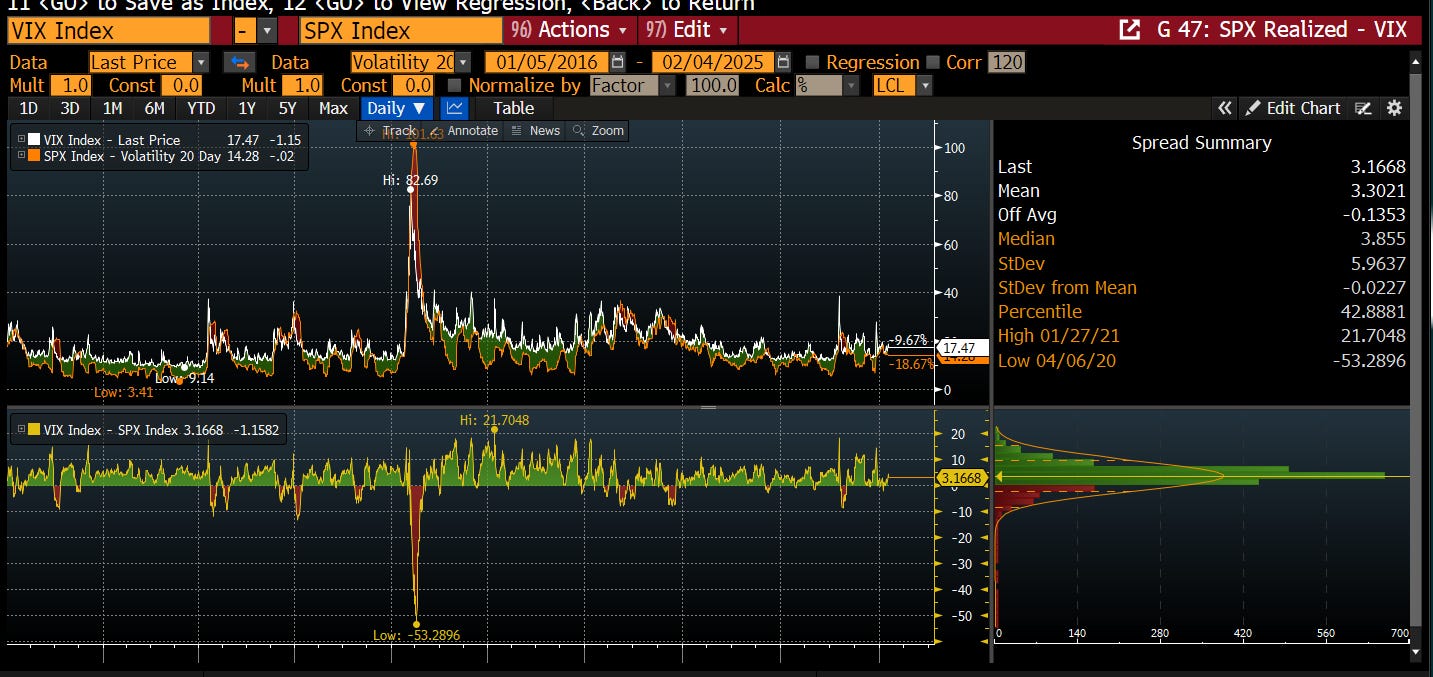
Graphic: Retrieved from Bloomberg via Kris Sidial. Volatility is fair in indexes; “much better opportunities in singles right now.”

As SpotGamma elaborated, if strength through earnings persists, “it will supply a final equity vol and correlation drop (a ‘final vol squeeze’), ushering in a blow-off equity top. At the same time, these metrics are low enough to justify owning 3-6 month downside protection, as bad things usually happen from these vol levels.”

Graphic: Correlation via TradingView. Stocks are expected to move more independently. Peep the pre-2018 Volmageddon levels.

As an aside, implied correlation measures the degree to which the prices of the assets in the basket are expected to move together (positively correlated) or in opposite directions (negatively correlated). Low correlation, in this case, indicates that the stocks are expected to move independently or in opposite directions; hence, dispersion trades betting on this have performed well.
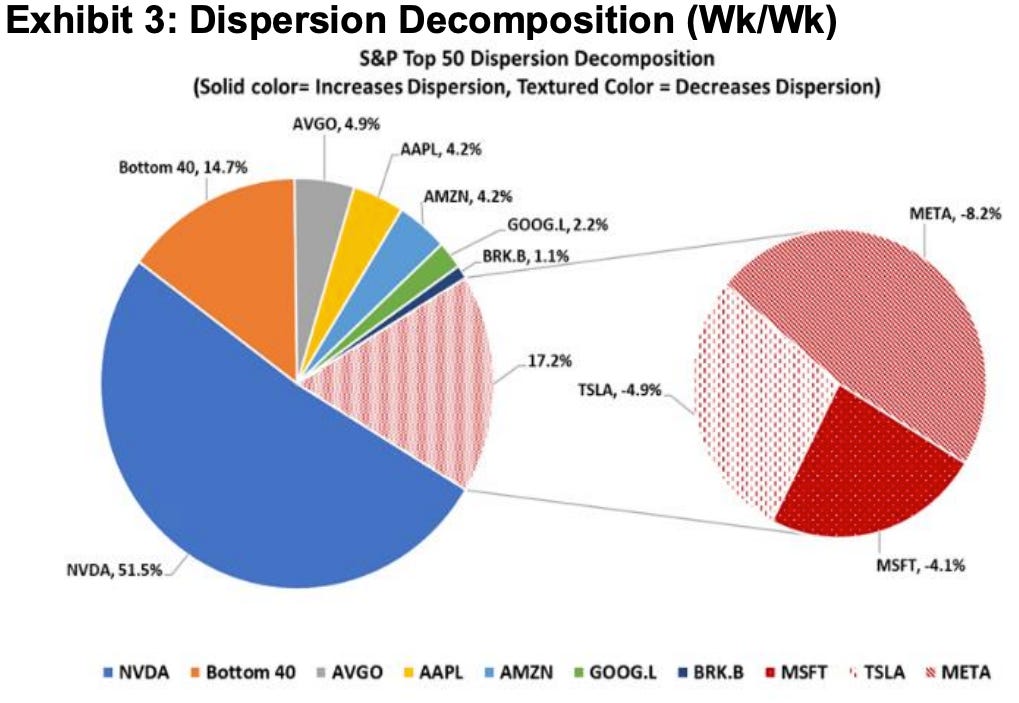
Graphic: Retrieved from Cboe Global Markets.

#4 – The Changing Narrative of Bitcoin and Its Maximalists

Similar patterns emerge in bitcoin. As countries face currency debasement and economic stresses, bitcoin stands out as a hedge to some. Like equities, bitcoin options are underappreciated.

For example, implied volatility has traded under 50% for one-month options, representing an attractive entry point for those looking to position themselves for a surge. This low volatility environment in Bitcoin mirrors the opportunities in equities. Here, bitcoin benefits from any volatility reversal, presenting a compelling case for those looking to participate in a big market move.
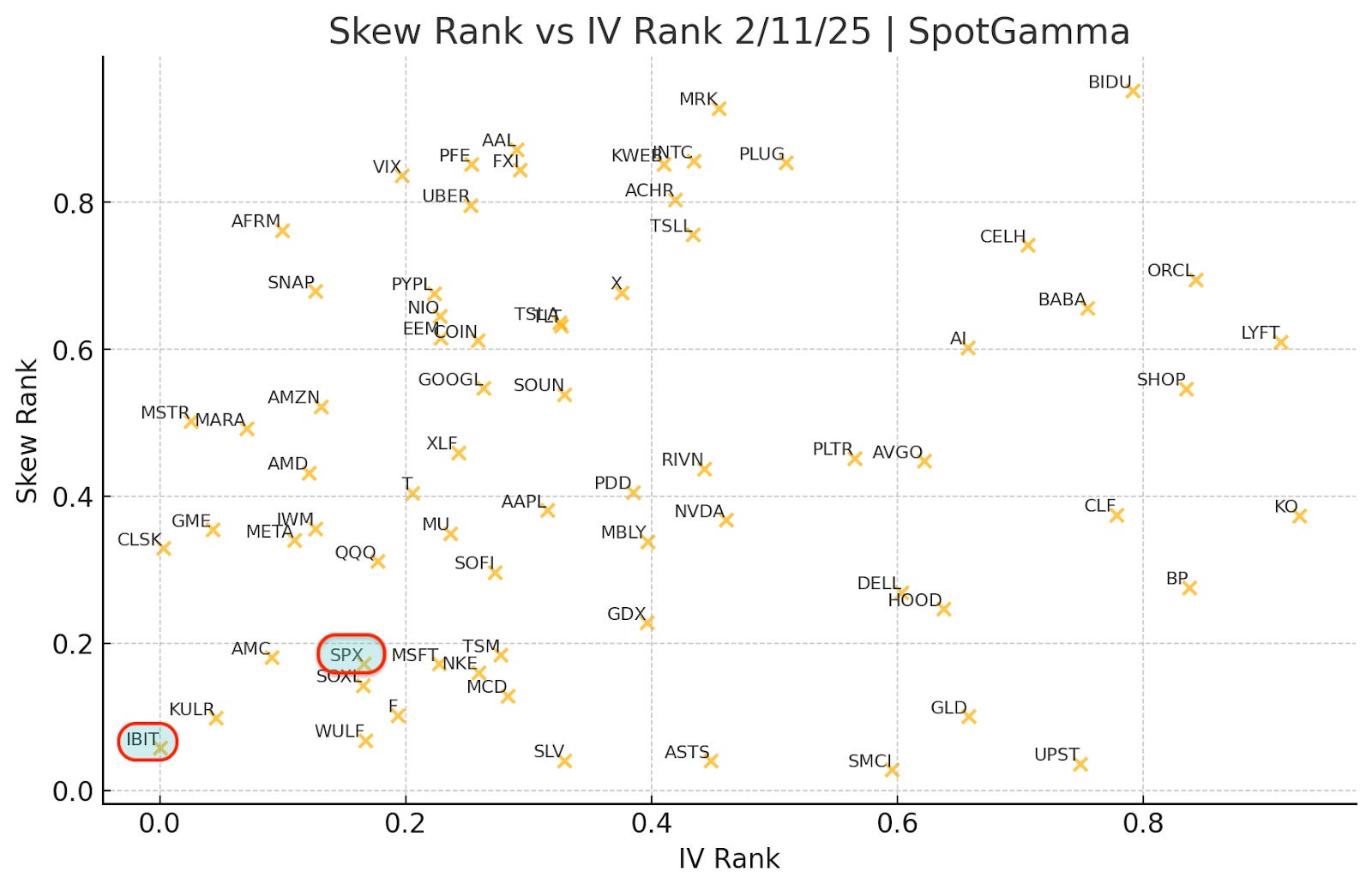
Graphic: Retrieved from SpotGamma. Higher skew and IV rank suggest calls are expensive and moves are stretched.

Context Applied: Trade Structuring

Trade structuring this year is all about creativity. We’ve added the following to our portfolios.

#1 – Rates

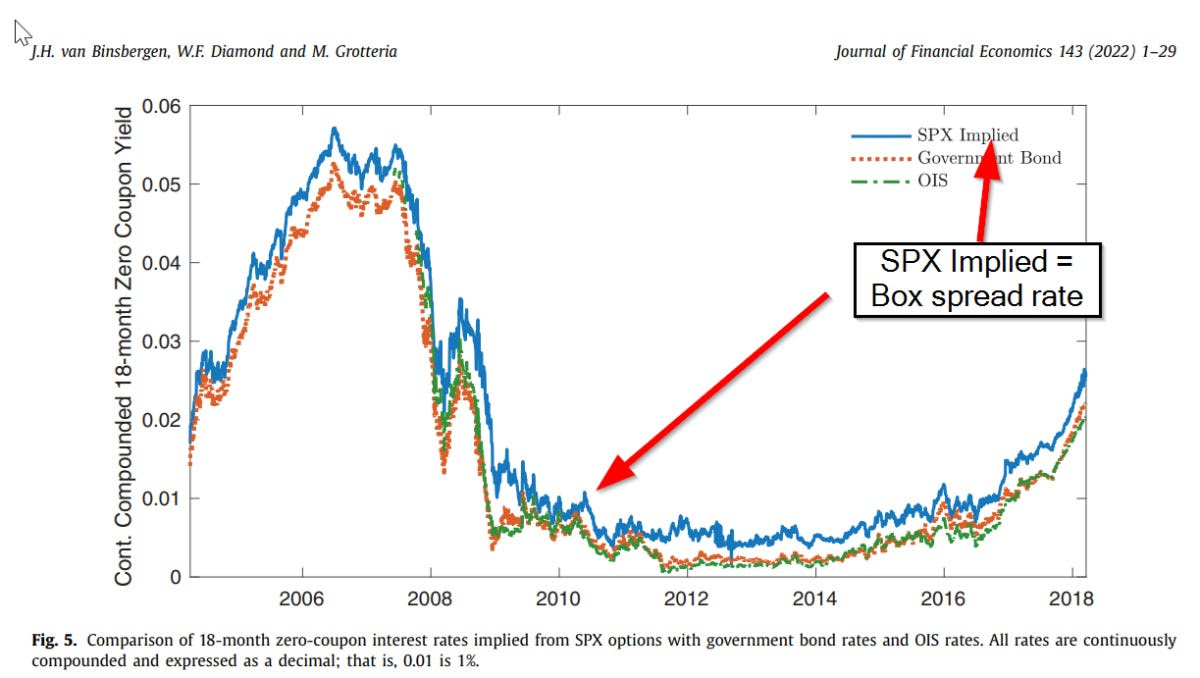
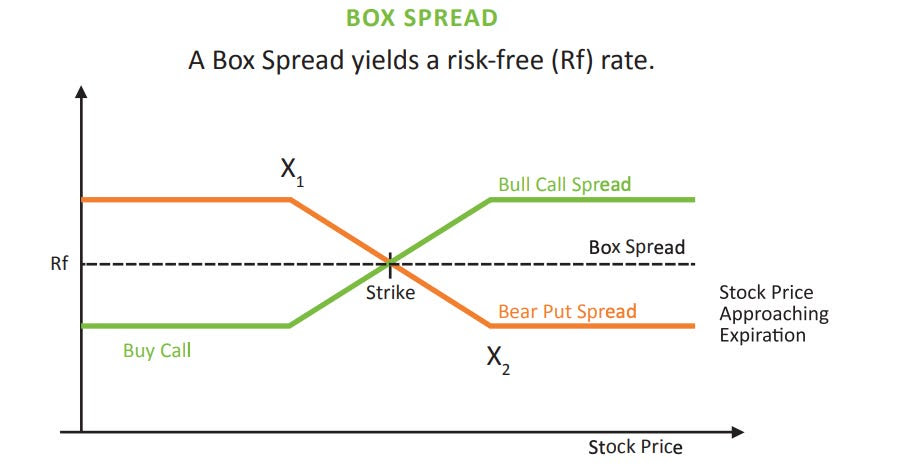
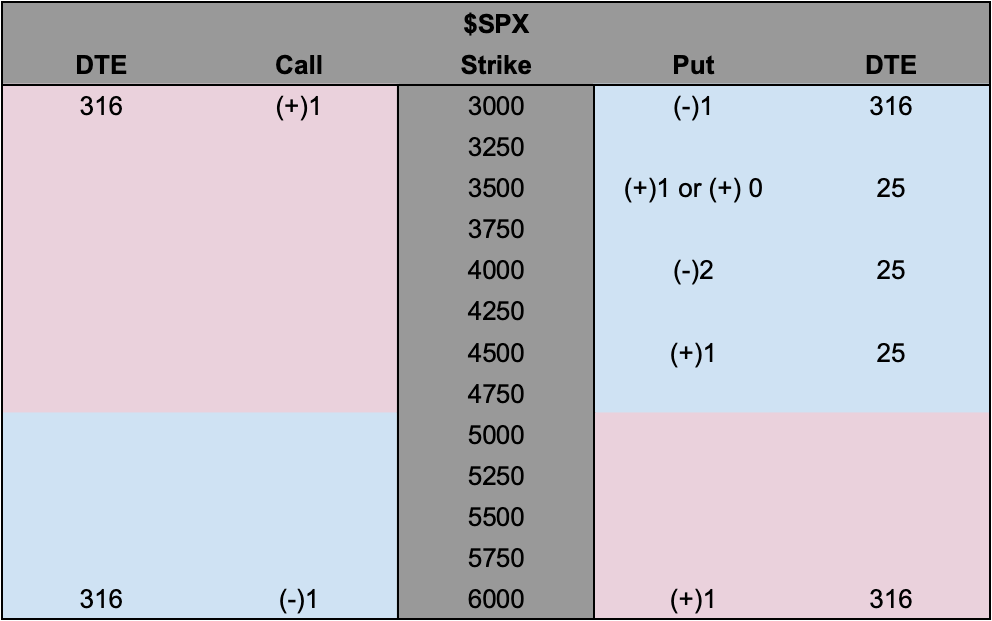
One efficient structure for safeguarding cash is the box spread, which offers several key benefits: a convenience yield, capital efficiency (especially for users of portfolio margin), easy execution via most retail brokers, and favorable tax treatment—60% long-term and 40% short-term if executed using cash-settled index options (e.g., SPX). This strategy combines a bull call spread and a bear put spread, matching lower and higher strikes and the same expiration date.

We frequently trade such structures. For instance, here’s one we purchased at the beginning of this year: BOT +1 IRON CONDOR SPX 100 (Quarterlys) 31 DEC 25 4000/7100/7100/4000 CALL/PUT @2964.25 CBOE

In this case, we invest $296,425 now to receive $310,000 in a year. This represents an implied interest rate of 5.32% or ((3100-2964.25)/2964.25)*(365/314)=0.053234. Note that there is a convenience yield, and that’s due to counterparty risk, as box spreads depend on the Options Clearing Corporation (OCC) to guarantee the transaction.

Tools like boxtrades.com help with tracking yields and finding attractive box structures.
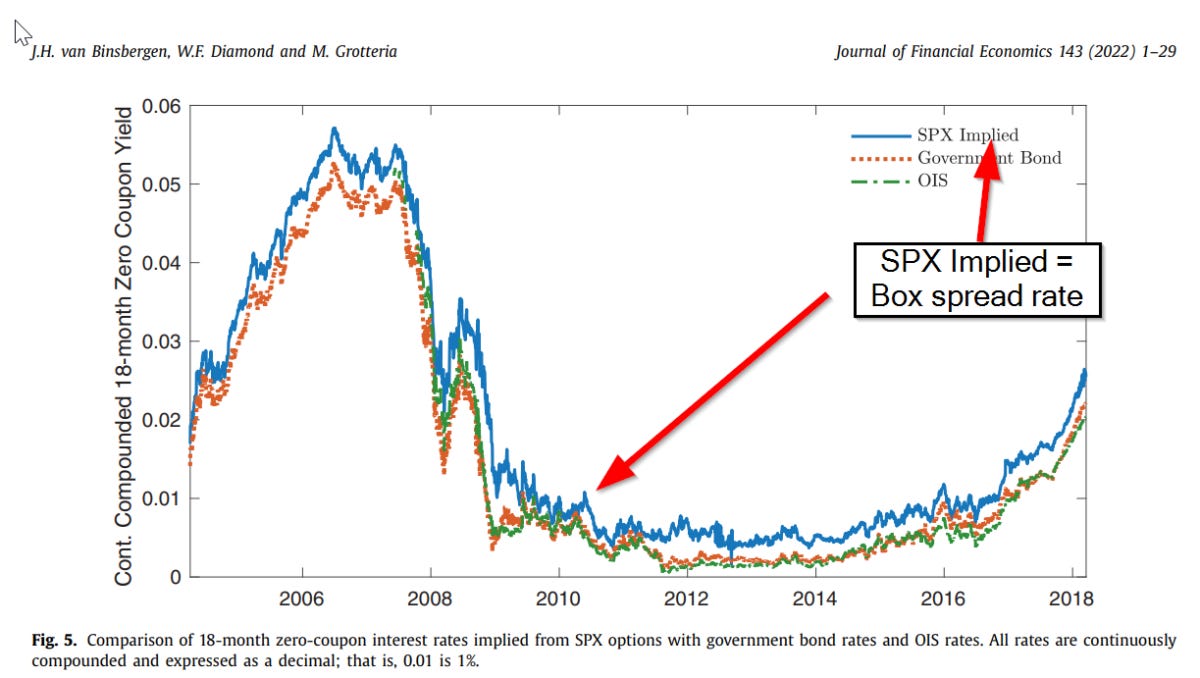
Graphic: Retrieved via Alpha Architect.

Box trades unlock the power of yield stacking, enhancing returns by layering multiple exposures without increasing capital outlay. They preserve full buying power with portfolio margin for margin-intensive trades like synthetic longs.

For non-portfolio margin traders, yield stacking is less applicable. Instead, you can allocate ~95% of cash to box spreads, locking in your principal at maturity while risking only ~5% (the interest you stand to make), with limited downside.
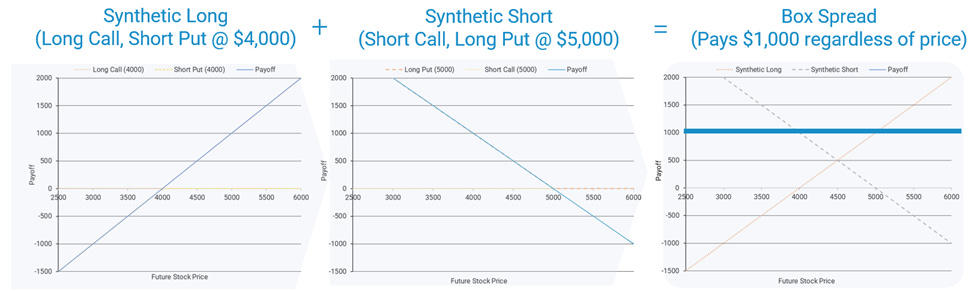
Graphic: Retrieved from Cboe Global Markets.

#2 – Upside

Low correlation and subdued implied volatility signal stability, but any disruption could spark sharp moves.

As we explained better in Reality Is Path-Dependent, Cem Karsan notes that a slow grind higher cheapens options, fueled by continued volatility selling. Eventually, realized upside volatility will surpass implied, prompting smart money to buy options at these discounts. If the VIX holds steady or rises, it suggests fixed-strike volatility is creeping up, potentially forcing options counterparties to cut exposure or hedge, boosting markets higher; increased call demand could push counterparties to hedge by buying the underlying asset, reinforcing stability and giving a floor to options prices and the market by that token.

The play here? Replace stock exposure with options. You can buy calls outright and hedge them by selling stock—gains on the calls should outpace hedge losses. Karsan has talked about this a lot. One of our moves is to structure broken-wing butterflies or similar: buy an option near the money, sell a larger number of options further out, and cap risk with an even farther out option. In this environment, you can often put on these trades for little cost and exit at multiples higher if the market drifts sideways or up. Please see our website for case studies and example trades.

Don’t overlook crypto, either. Implied volatility remains underappreciated in bitcoin, making synthetic exposures compelling. Swapping spot for synthetic alternatives is a play on these opportunities. Though we haven’t touched them, check out Cboe’s cash-settled options on spot bitcoin: the Cboe Bitcoin US ETF Index (CBTX) and Cboe Mini Bitcoin US ETF Index (MBTX).

#3 – Hedging

Though less attractive now, VIX calls and call spreads remain a powerful tool for hedging tail risks. In our Reality Is Path-Dependent letter, we explore this topic further.

There are more compelling structures within the S&P 500 complex, particularly back spreads. For example, a put back spread involves selling a higher strike put option and buying a larger number of lower strike put options, positioning you to profit from substantial volatility shifts—similar to what we saw on August 5, 2024.

Although this structure takes advantage of the market’s unappealing volatility skew, drift presents challenges; if volatility fails to perform well during a downturn, you risk losing more money than you initially invested in the spread. Caution!
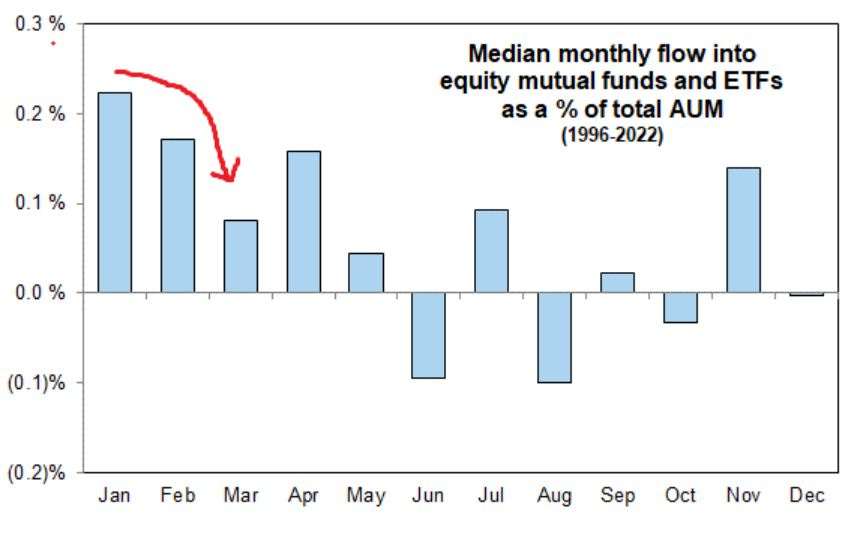
Graphic: Retrieved from Bloomberg via Goldman Sachs.

Bonus: From the White House to Wall Street

We had the opportunity to catch up with Steven Orr, founder of Quasar Markets. We discussed his career and the future of fintech and trading technology. Before Quasar Markets, Orr worked as an executive at Money.net and Benzinga. He also serves on the board of the American Blockchain and Cryptocurrency Association. His diverse background includes positions with the White House, the U.S. State Department, the PGA Tour, the NBA, and various professional sports leagues. Orr frequently shares his insights on TV and appears at events like the World Economic Forum. Check it out, and thank you, Steven!


Disclaimer

By viewing our content, you agree to be bound by the terms and conditions outlined in this disclaimer. Consume our content only if you agree to the terms and conditions below.

Physik Invest is not registered with the US Securities and Exchange Commission or any other securities regulatory authority. Our content is for informational purposes only and should not be considered investment advice or a recommendation to buy or sell any security or other investment. The information provided is not tailored to your financial situation or investment objectives.

We do not guarantee the accuracy, completeness, or timeliness of any information. Please do not rely solely on our content to make investment decisions or undertake any investment strategy. Trading is risky, and investors can lose all or more than their initial investment. Hypothetical performance results have limitations and may not reflect actual trading results. Other factors related to the markets and specific trading programs can adversely affect actual trading results. We recommend seeking independent financial advice from a licensed professional before making investment decisions.

We don’t make any claims, representations, or warranties about the accuracy, completeness, timeliness, or reliability of any information we provide. We are not liable for any loss or damage caused by reliance on any information we provide. We are not liable for direct, indirect, incidental, consequential, or damages from the information provided. We do not have a professional relationship with you and are not your financial advisor. We do not provide personalized investment advice.

Our content is provided without warranties, is the property of our company, and is protected by copyright and other intellectual property laws. You may not be able to reproduce, distribute, or use any content provided through our services without our prior written consent. Please email renato@physikinvest for consent.

We reserve the right to modify these terms and conditions at any time. Following any such modification, your continued consumption of our content means you accept the modified terms. This disclaimer is governed by the laws of the jurisdiction in which our company is located.

Categories
Results

Alpha Drop

Hedge fund week just wrapped up here in Miami, and I had the chance to catch up with some industry friends like fellow Croatian and former podcast guest Vuk Vukovic. A big shoutout to Vuk and the incredible success of Oraclum Capital, his NYC-based hedge fund! Beyond motivation, these conversations always get us thinking—about how far we’ve come, the lessons learned, and the market patterns emerging. So, today, we’re switching things up a bit.

Breaking Down Thinking vs. Acting in Real-Time

These newsletters often dive deeply into trade theory—how to form opinions, identify dislocations, and structure trades to take advantage of them. Thinking critically about market context is just as important, if not more so, than taking action, as outlined in the case study linked here. But let’s be honest: we don’t always have the luxury of testing every idea before committing capital. Sometimes, decisions must be made on the spot, and more often than not, they’re more straightforward than they appear—they have to be.

To illustrate this, I share a slightly refined diary entry from a year ago, offering reflection and motivation. Market highs, uncertainty, and the fear of missing out create a lot of noise—but they also spark new ways of thinking. I hope this record and perspective spark new ideas on when and how to engage in markets this year ahead.

Take your time, enjoy the read, and try to focus on the bigger picture rather than getting lost in the details. Stay tuned for upcoming podcasts, explainers, and part two of the Market Tremors newsletter. Cheers, and let’s make some money.


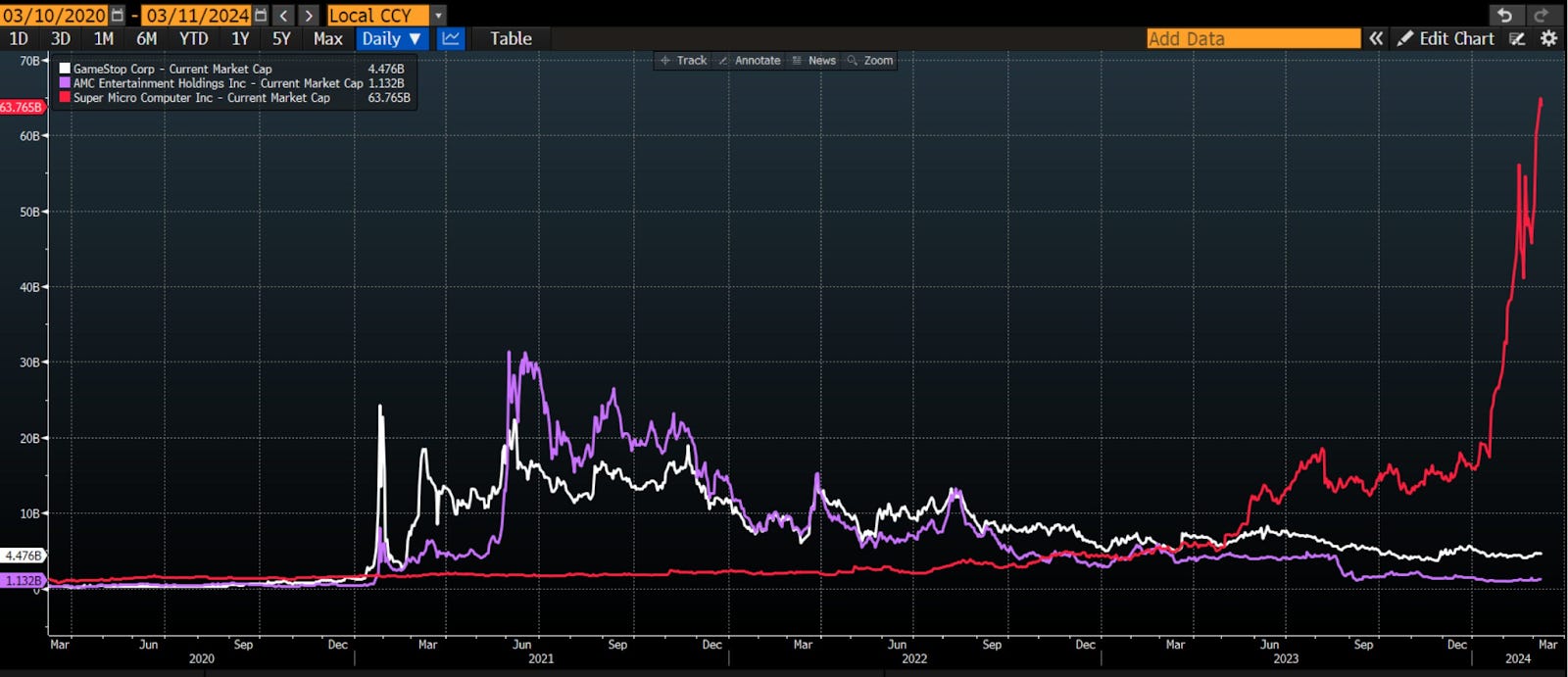
On February 16, 2024, my trading partner Justin pointed out a rich, elevated call skew in Super Micro Computer Inc. (NASDAQ: SMCI). This occurs when out-of-the-money call options carry higher implied volatility than at-the-money or in-the-money options, often signaling strong demand for upside exposure. At that point, SMCI had been climbing steadily for weeks, with the charts suggesting a parabolic advance and an imminent climax.

I spotted 200-wide 1×2 ratio spreads that could be opened for credit. Simply put, a ratio spread is an options structure in which you buy a contract at one strike and sell two (or more) at another, further away. I often use such a structure when volatility is more steeply skewed, meaning certain strikes—like deep out-of-the-money (OTM) calls—have much higher implied volatility (IV) because traders expect more risk or extreme moves in that direction.

IV is the amount of movement traders anticipate. A higher IV means the market expects more significant price swings, leading to more expensive options, while a lower IV suggests less expected movement, making options cheaper—factors like earnings reports, economic data, or overall market uncertainty influence IV.

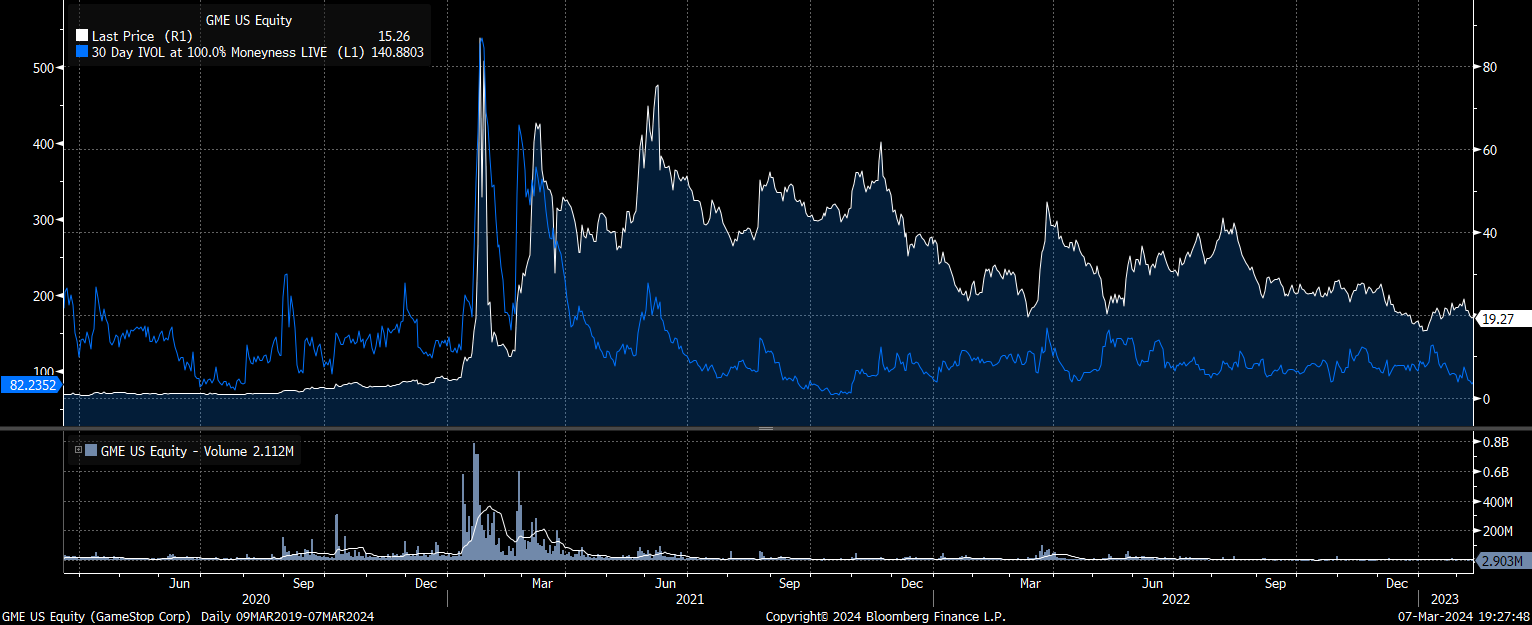
In this case, using Schwab’s thinkorswim lookback feature, implied volatility on the call side ranged from the mid-100s near the current market price to over 200% at the furthest strike. On the put side, things got even wilder—volatility climbed from the mid-100s near the market price to several hundred percent at the farthest strike, as pictured below. When volatility is this high in far-out-of-the-money options, traders are piling in—either looking for protection or betting on a big, unexpected move.

As the stock was pulled back from its highs, we observed that the excitement in call-side volatility had begun to diminish—it wasn’t as intense as it had been a month earlier, according to SpotGamma data. This served as a key signal for us. A declining enthusiasm for calls indicates that traders are less inclined to chase the stock higher. We were prepared to act on this shift, betting that the stock had reached an interim peak; this was great news for us, as our options structures tend to perform best when volatility stabilizes and the stock drifts rather than making significant, protracted moves.

Right after the market opened, the 23 FEB 24 1300/1500 spread flipped from a 0.50 debit to over a 1.00 credit to open. I didn’t catch it right at the start, but about an hour later, I spotted the opportunity. The pricing looked solid—it offered a credit to close at the money—and everything checked out risk-wise according to my rules. So, I decided to dip my toes in with five units, keeping it on the smaller side for this trade. This all went down on February 16.

SOLD -1 1/2 BACKRATIO SMCI 100 (Weeklys) 23 FEB 24 1300/1500 CALL @1.10

All else equal, if the trade were entirely in the money (ITM), meaning the short strikes are right around the current market price, it would price for about 40.00 credit to close. At the money (ATM), right around the current market price, the structures traded for around 12.00 credit to close. This quick check suggests we’re good to move forward. Here are the orders for one account. You can find a summary screenshot of all orders at the end of this letter.

Given the risk involved in this trade, the abovementioned account could take on a maximum of 8 units. As we’ll see later in this entry, I pushed those limits, possibly going beyond what’s typical for me. However, I justified this by considering the distance between the stock price and the strikes used in the trades, which felt like a safe cushion to work with.

$320,000 (Net Liquidation Value) / $38,000 (Daily Loss at +1 EPR if the Spread’s Long Strike is ATM) = 8.4 units. EPR represents the brokerage firm’s estimate of the maximum expected one-day price range for an underlying security. Net Liquidation Value refers to the total value of a portfolio if all positions were liquidated at current market prices. Here are more details.

A few hours later, implied volatility dropped across the board, with the further out-of-the-money (OTM) options seeing the most significant decline. The implied volatility of the options closest to the stock price fell moderately, while the farther OTM strikes experienced a more substantial drop. This shift worked in our favor and helped make the trade profitable.

The long strike I owned (1300) had an implied volatility of ~190% before, which dropped to ~165% after.

The short strike I sold (1500) had an implied volatility of ~215% before, which dropped to ~180% after.

The trades were closed on the consolidation following the sharp morning liquidation. Here are the trade tickets.

BOT +1 1/2 BACKRATIO SMCI 100 (Weeklys) 23 FEB 24 1300/1500 CALL @-1.05

From the panicked price movement, it looked like people late to the party were just selling off existing positions, not necessarily big new sellers entering the market; the stock might eventually retest those higher levels again. Even with the drop, implied volatility stayed high, which is crucial because it suggests continued uncertainty and anticipation of significant movement.

Given how sharp the sell-off was and how many traders were probably surprised by it, I decided to jump back into the trade on February 20—this time with a bigger position, especially after the long weekend when the market had some time to settle. Strikes and trade tickets follow.

SOLD -1 1/2 BACKRATIO SMCI 100 (Weeklys) 1 MAR 24 1300/1500 CALL @1.10

SOLD -1 1/2 BACKRATIO SMCI 100 (Weeklys) 1 MAR 24 1400/1600 CALL @1.10

SOLD -1 1/2 BACKRATIO SMCI 100 (Weeklys) 1 MAR 24 1350/1550 CALL @1.05

With the liquidation, the trade above was farther away from current prices than the last. Additionally, we moved it to next week’s expiry after the long weekend since it was no longer present for the 23 FEB 24 expiry. The lookback feature on Schwab’s thinkorswim shows implied volatility at the 1300 strike was ~180%, while at the short strikes, it was ~200%.

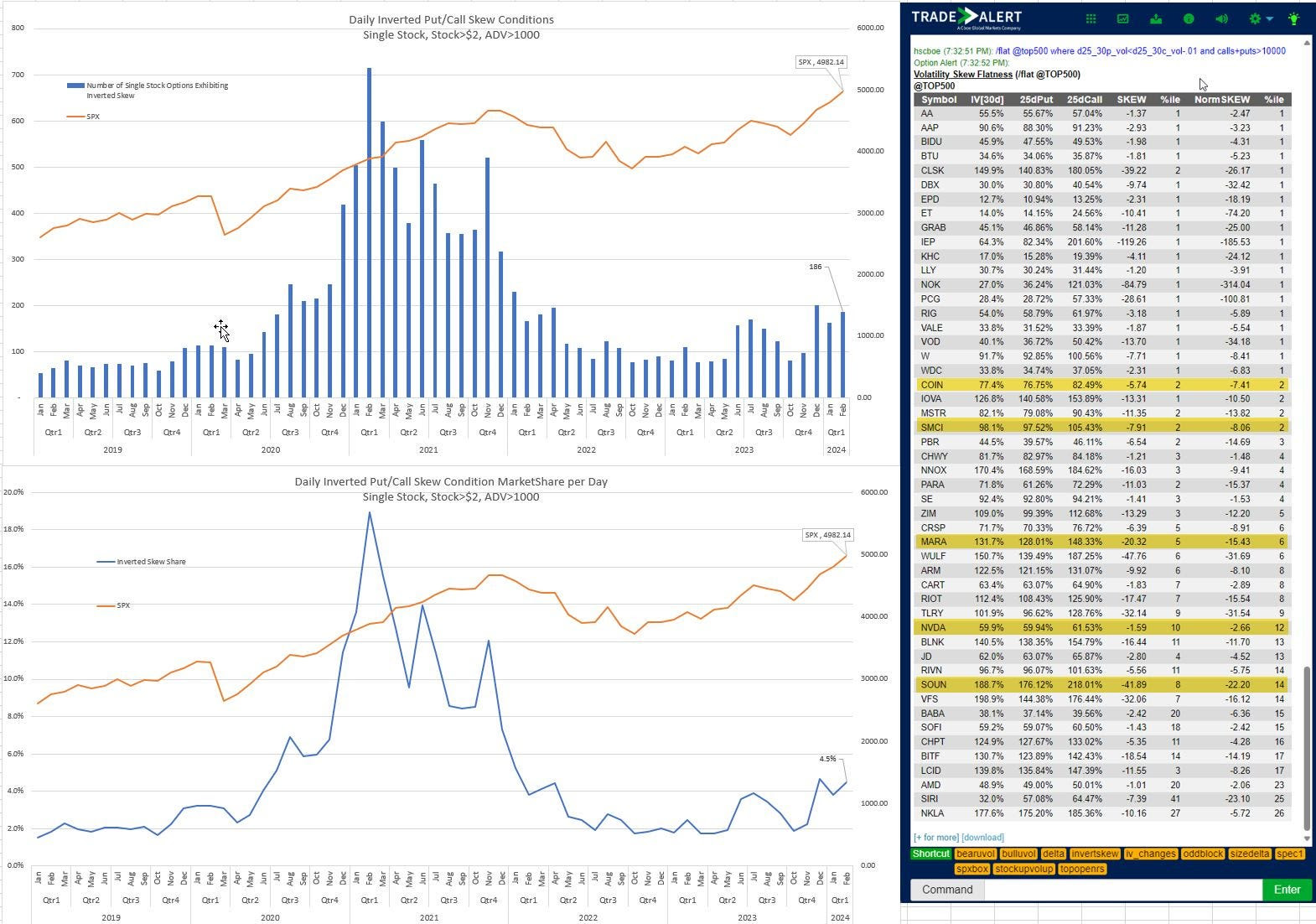
A quick check of SpotGamma’s implied volatility skew tool reveals a still-elevated call skew. Awesome!

Soon after, despite minor volatility shifts, we added similar trades with strikes that were further from the current price.

Gauging implied volatility accurately using the lookback feature can be tricky, but we observed that the difference in implied volatility between the strikes was narrowing. This indicated that the volatility skew was “flattening.” In simpler terms, the implied volatility between different strikes was becoming more similar, unlike a steeper skew where the farther strikes have much higher implied volatility. This can be good for the trade.

Here’s a chart that illustrates this “flattening” volatility skew. While this example shows the S&P 500, the concept is the same. Pay attention to the blue versus green line!

Anyways, back to the charts. So, here’s the price action. Straight down!

On February 22, we rotated more into similar structures we started working on February 20.

SOLD -1 1/2 BACKRATIO SMCI 100 (Weeklys) 8 MAR 24 1400/1600 CALL @1.10

At the time of entry, lookback showed the implied volatility of the 8 MAR 24 spreads was around 145% for the long and 155% for the short strikes. At the second entry, the volatility spread between the strikes started narrowing. Overall volatility came down, but the difference between the strikes was about the same.

Here’s what the volatility skew looked like at this point. This is a 30-day look back (the shadow).

I ended up closing the 1 MAR 24 spreads on February 22 for up to a 1.00 cr.

BOT +1 1/2 BACKRATIO SMCI 100 (Weeklys) 1 MAR 24 1350/1550 CALL @-.50

Here’s the implied volatility for the 1 MAR 24 options chain. Again, while a bit lower than when we started, the difference between the two is roughly the same. The passage of time is definitely working in our favor, here!

I’ll note that I closed prematurely because underlying price action suggested we could trend higher, with the upper VWAP band as an upside target. The spreads ended up pricing for $1.00 more in credit. Take what you can get, Renato!

The challenge we faced was deciding whether closing and rotating the trade early would lead to additional profits. Ultimately, we rolled the position and made money either way, but this was the thought at the time. In other words, are we doing too much?

After closing the 1 MAR structure, we added 8 MAR structures on February 22. Trade tickets for one account below. These additions made the position larger than I wanted, so I bought cheaper crash options to manage the margin (the amount of money required to maintain the position) first and foremost. It was a tense moment! Thankfully, with these additions, we stayed within our limits and didn’t breach any safety thresholds.

SOLD -12 1/2 BACKRATIO SMCI 100 (Weeklys) 8 MAR 24 1400/1600 CALL @1.05

BOT +3 SMCI 100 (Weeklys) 23 FEB 24 1580 CALL @.13

At this point, the lookback showed implied volatility for the short strikes was around 160%, while the long strikes were at 150%. The difference between the two was around 10%.

Again, IV refers to the market’s expectations of future price movement expressed as a percentage. A higher IV suggests more movement, while a lower IV suggests less movement.

This is what the chart looked like at that time.

Around 2 PM, the market struggled but recovered, finishing higher by the close. The trades moved against me slightly, but the ATM and ITM entry and holding criteria (i.e., credit to close) mentioned above were still met, so I stuck with it.

Regarding having to hedge, I just focused on the spread’s sensitivity to price movements. Despite intense price action, the Greeks were okay. I remained in the position for about a week and a half. After the first week, the spread moved in my favor, but not to the extent I had hoped.

To explain, implied volatility remained higher on the short strike but dropped more on the long strike. Had the volatility on the short strikes dropped significantly more, the spreads would have likely come off sooner. Pricing the 15 MAR 24 spreads, those were trading for a debit to close, and it did not make sense to do anything other than sit on my hands and wait. If the stock continued to rise, which eventually occurred, the spread had more potential. Here’s the lookback at the time.

This is the price chart at month-end. It felt like there was more room to go up.

After the weekend, there was a big overnight move. Traders caught the news that SMCI would be included in the S&P 500.

I used the gap as a gift and sold into it, monetizing spreads from 3.00 to 5.05 cr to close. Trade tickets for one account follow.

BOT +1 1/2 BACKRATIO SMCI 100 (Weeklys) 8 MAR 24 1400/1600 CALL @-5.05

5.05 marked the top in the structure’s pricing despite the stock moving higher after 10:00 AM. It took me years of watching these structures to spot softening sensitivity in the spread, prompting such closure. Had this gap not happened, the spreads likely would have been closed for small credits (0.05 cr). Again, the gap was a gift. Take it, Renato!

At this point, I am already considering rinsing and repeating this trade. The 15 MAR 24 200-point spread fully ITM traded for a small credit to close, which was unsafe. I widened accordingly to a 250-wide spread, priced for a very thick credit to close—the lookback shows about 44.00 cr. Here’s the lookback.

So, we went out to 1300/1550. There, I saw 1x2s pricing for thick credits to open.

SOLD -1 1/2 BACKRATIO SMCI 100 15 MAR 24 1350/1600 CALL @3.05

The implied volatility at the 1300 strike was ~150%, and at the 1550 strike, it was ~175%. We entered an hour early without regard for the stock chart (above), which was a costly mistake. The stock ripped higher, resulting in a ~$2.00 loss per spread.

Notably, the implied volatility skew steepened on the day of entry. Here’s a visual.

However, later that day, the spreads settled down. At 1:40 PM, the stock peaked, and the pricing of the 1300/1550 we put on declined slightly. To manage risk, I closed some units there. In any case, the spread narrowed, owing to a flattening and stickiness of the skew; 1300/1550 = 150/175% (~25% spread) → 140/160% (~20% spread). If I waited longer, the additional units would have gone massively in my favor. Oh, well!

Over the next few days, the stock moved down and then up; overall, the stock stayed flat. During this time, the spread increased in value, working in my favor. With these spreads, you want drift, not protracted movement!

My targets were at 5.00 and 10.00 cr to close, as I got over the next day or so. Implied volatility didn’t budge much. Based on thinkorswim’s lookback feature, it rose in the long strike more than the short strikes, which is what you want to see. Decay helped!

I wanted to hold longer because the spread 50 points closer to the money was pricing at 10.00 cr to close, about 3-5.00 cr more than I had my pricing for. Based on the stock price chart, we were peaking, but these moves tend to go sideways or higher for a bit longer. Candle shadows tend to get tested!

If we fast forward, the session was quiet, with SMCI trading sideways to lower from the open. The pricing of the spread went as high as 10.00 cr (at which point I started to monetize).

BOT +1 1/2 BACKRATIO SMCI 100 15 MAR 24 1350/1600 CALL @-10.05

Here’s what implied volatility looked like (i.e., a rise in the long strike, whereas the short strike stayed about the same).

After the close, I started thinking, “Man, I should have closed that last spread.” It went to my target, but I kept holding (correctly), as you want to maintain some runners. However, the price action was weak into the evening, after the market closed, and I was now concerned I would lose all or most of the profit in my remaining spread. Mental games, here. Patience, Renato!

The market opened sideways the next day. I monetized my last spread for 11.00 cr, close to its peak.

BOT +1 1/2 BACKRATIO SMCI 100 15 MAR 24 1350/1600 CALL @-11.07

Here are the implied volatilities at the exit (i.e., noticing the more significant drops in short strikes relative to the long ones).

There’s a critical factor that helped the trade keep its value. The stock went sideways, and a day or so passed, allowing some of the decay to kick in. The decay disproportionately affected the further OTM strikes (i.e., there’s more to decay than usual), with the lookback showing implied volatility dropped to 135% long / 150% short a few minutes after I closed my position. The market was attempting to go higher, volume was low on the 1300 strike, and the spread ended up pricing higher than what I closed it for. Bummer! Here’s what it looked like.

SELL -1 1/2 BACKRATIO SMCI 100 15 MAR 24 1300/1550 CALL @-15.70 LMT

On March 8, the market peaked, hitting the 1200 figure I had envisioned. 1200 was a target for me due to the amount of interest (open interest and volume) at that strike, as well as the trend of the market. The March 4 shadow would also be taken based on the March 5-7 price action. Essentially, we traded up to and held short of the March 4 high, and the spread increased in value by $10.00 cr. I could have doubled my profits for the trade, but at the risk of losing it if things had gone the other way. Remember February 22, when the extreme volume was at the 1000 strike and above? We failed there. This was a blow to options buyers!

On March 8, 10-15 minutes after the market opened, implied volatility for 1300/1550 per thinkorswim’s lookback showed a much more significant drop in further OTM strike as the stock went up by $33 in that one day. Vol down, stock up, weekend decay, and that’s how a spread that priced 5.00 cr to close two days before ended up trading to 25.00 cr to close. Here’s the lookback.

On March 11, the stock traded much weaker. Implied volatility on the 1300/1550 went to 150/170%. Despite this, the trade lost a lot of delta, which the implied volatility bump couldn’t make up. The lookback shows the trade went to a 7.00 cr, a ~70% loss. This is what I say you’re up against. There’s not a lot of give to work with at times.

At this point, I realized I was doing what I was supposed to: take what I could get. Sometimes, the risk of losing what you made is not worth the potential reward. The trade was done after the stock hit 1200 (a location where I struck a bunch of Fibonacci extensions, too).

Finally, this is what the implied volatility skew looked like on March 8, the peak day.

In conclusion, this trade demonstrated one of my better executions. Over the month, SMCI traded sideways, and I captured about $24,000 in premiums across a couple of accounts. As I told my trading partner, the execution felt “divine”; there were plenty of moments where we could have made big mistakes—being too greedy, sizing too large and having to delta hedge in response, entering or exiting at the wrong times, or letting fears take over. However, the SMCI trades show improved thinking and acting quickly. Continuous improvement is all this is about—and that’s all I can ask for!

Some thoughts from this experience include waiting for market capitulation when the excitement fades, which helps spot better opportunities to trade the above structures. I identify these trades by scanning for high implied volatility, tracking a watchlist daily, sizing trades appropriately, and monitoring them closely; I size appropriately when I spot potential trades and save those trades (i.e., keep them in my monitor tab). I also suggest tracking implied volatility at specific strikes and keeping detailed notes; if you see a pattern, note it and decide whether adding or reducing the position is worth it. Additionally, holding onto “runners” (remaining positions) can significantly boost profits, as seen with the trades expiring on 15 MAR. Also, consider what may happen if the underlying moves toward the spreads and how you’ll react, adding, hedging, or reducing size.

What’s your favorite engagement trade when the fear of missing out is so great? Let’s discuss.


Disclaimer

By viewing our content, you agree to be bound by the terms and conditions outlined in this disclaimer. Consume our content only if you agree to the terms and conditions below.

Physik Invest is not registered with the US Securities and Exchange Commission or any other securities regulatory authority. Our content is for informational purposes only and should not be considered investment advice or a recommendation to buy or sell any security or other investment. The information provided is not tailored to your financial situation or investment objectives.

We do not guarantee the accuracy, completeness, or timeliness of any information. Please do not rely solely on our content to make investment decisions or undertake any investment strategy. Trading is risky, and investors can lose all or more than their initial investment. Hypothetical performance results have limitations and may not reflect actual trading results. Other factors related to the markets and specific trading programs can adversely affect actual trading results. We recommend seeking independent financial advice from a licensed professional before making investment decisions.

We don’t make any claims, representations, or warranties about the accuracy, completeness, timeliness, or reliability of any information we provide. We are not liable for any loss or damage caused by reliance on any information we provide. We are not liable for direct, indirect, incidental, consequential, or damages from the information provided. We do not have a professional relationship with you and are not your financial advisor. We do not provide personalized investment advice.

Our content is provided without warranties, is the property of our company, and is protected by copyright and other intellectual property laws. You may not be able to reproduce, distribute, or use any content provided through our services without our prior written consent. Please email renato@physikinvest for consent.

We reserve the right to modify these terms and conditions at any time. Following any such modification, your continued consumption of our content means you accept the modified terms. This disclaimer is governed by the laws of the jurisdiction in which our company is located.

Categories
Commentary

The Alchemy of Forecasting

This week’s letter is about 6,000 words and may be cut off. If so, try viewing it in a browser window!

Our recent focus reflexivity manifests in politics through reinforcing shared beliefs and narratives. When political group members share an ideology, their interactions often confirm and amplify their existing views, creating feedback loops. These loops can shape the group’s perception of political realities, such as the strength of their candidate, which in turn influences voter turnout and campaign contributions. This homogeneity also leads to a lack of exposure to opposing views, increasing the risk of misreading voter sentiment and making strategic errors in political campaigns.

This dynamic was evident in the 2016 U.S. presidential election. Many in liberal circles were convinced of Hillary Clinton’s victory, relying on polling data and a widespread belief in her inevitability. This perception reinforced within these groups created a reflexive cycle that contributed to complacency and lower turnout in critical swing states. Those in the Republican bubble who supported Donald Trump also experienced their form of reflexivity; early support and momentum generated enthusiasm that ultimately led to his victory. Both sides exhibited fallibility—Democrats overestimated Clinton’s support, while Republicans underestimated the opposition to Trump.

Vuk Vukovic, the CIO and co-founder of Oraclum Capital, is acutely aware of reflexivity and fallibility’s impact on politics and economics. Over the past decade, he has applied his academic research in political economics to accurately predict the outcomes of the past two U.S. elections and the Brexit referendum, as well as influence policy in his home country of Croatia. Following the pandemic, Vuković and his co-founders sought to monetize their predictive success, leading them to the financial markets. Today, they use the wisdom of crowds and their understanding of social networks to outperform markets with their hedge fund. Vuković graciously joined Physik Invest’s Market Intelligence podcast to discuss his career, research, starting and operating a hedge fund, trading psychology, and investment processes. The video can be accessed at this link and below. An edited transcript follows.

We spoke in April, and Oraclum Capital, your upstart hedge fund, sat at ~$8.6 million in assets under management. Has this number changed?

We’re going into September with $17 million under management, so it has been going well.

I want to go back in time before you studied economics. What were some of your big interests growing up, and how did they guide your pursuit of economics in school?

My interest in economics partly stemmed from my parents, who were both involved in that field. But even as a kid, I was fascinated by currencies and stock markets. Something about them attracted me—maybe it was the whole money aspect, but I think it was more profound than that. However, as I pursued my education, I diverted from finance and instead focused on political economics, which is more theoretical and combines public choice theory with macroeconomics. You can’t fully understand economics without understanding politics. Fast forward to today, I’ve returned to my first love, finance.

The idea of making money got me engaged in markets, but the details and the process kept me engaged. So, structuring trades, learning how markets work, and things like credit and positioning kept me involved. Does this resonate?

That’s the primary motivation, and you learn things that make it more or less attractive. In our case, it was more attractive.

So you went to the London School of Economics and the University of Oxford. Why those two?

Before that, I earned my Bachelor of Economics at the University of Zagreb in Croatia. During the summers of 2009 and 2010, I went to the United States—first to attend a summer school at Berkeley and then Harvard the following year. 

I considered staying in Zagreb, but after those experiences, I realized I should go abroad. I chose the United Kingdom because it was closer and less expensive than the United States, especially at the master’s level. In Europe, you typically pursue a master’s before a PhD, allowing you to finance your education gradually.

The LSE is a prestigious institution with a political economy program aligned with my interests. If I wanted to go to the United States immediately, I would have had to choose an economics PhD and then branch out from there, which is not what I wanted.

Did you get a lot of value from those summer schools? 

Absolutely. They showed me that I could compete in an environment where I wasn’t sure I would be able to.

I earned straight A’s at Berkeley and Harvard. I took an Intermediate Macroeconomics course and a Contemporary Theories of Political Economy course at Berkeley. At Harvard, I studied International Monetary Economics, taught by a former assistant to Milton Friedman. I also took a course on global financial crises there, which was particularly interesting to me because the Global Financial Crisis had just started in 2008. At that time, I was in my second or third year of university, and it shaped my research focus ever since. I found my niche by exploring the financial crisis from a political economy perspective, examining the political causes of the crisis, such as why banks were allowed to take on so much risk, and so on.

You wrote a couple of papers. How did you develop your theses, and how long did it take you to research and defend them?

Most of my political economics research explicitly focuses on corruption and lobbying. When I came to Oxford, my attention was primarily on the collusion between politics and economics—essentially, the relationship between the corporate and political worlds. 

It all began with a paper on corruption in Croatia, where I examined the connection between firms and people in power and how this relationship affected reelection chances. I also attempted to measure corruption through public procurements awarded to specific firms. Unfortunately, my findings showed a significant impact of corruption on the reelection chances of Croatian mayors, cities, and municipalities.

The second paper I worked on centered around bank bailouts in the United States during the 2008 crisis, which has been a focal point of my research interests. I aimed to determine whether banks better connected to congresspeople received a more favorable bailout deal relative to their assets, and indeed, they did. With these two ideas and the supporting data, I developed a more unified theory on how corporate executives and politicians connect and how those connections impact economic outcomes. In my specific case, I was looking at income distribution and inequality.

This led to my third paper at Oxford. I analyzed a massive dataset of about a million corporate executives in the United States and the United Kingdom, linking them to politicians and observing that those better connected had much higher salaries. Specifically, the impact was about $150,000 more in annual salary in the United States. To clarify, these were corporate executives—CEOs, the C-suite, or board members—being compared within the same company, with the politically connected ones earning a premium of approximately $150,000. Political connections were measured by whether the executive had previously worked with someone at a senior government level or belonged to the same organization, such as a country club, charity, or other networking group. These affiliations might not necessarily make you friends, but they provide a way to connect with critical individuals when needed.

This academic work culminated in the book I published this year, Elite Networks: The Political Economy of Inequality. It is trending well at Amazon, Barnes & Noble, and other retailers.

I remember this a couple of years ago: Amazon’s Jeff Bezos and Jerome Powell appeared at the same party or dinner. Jerome Powell was grilled over what was potentially discussed, and your response reminded me of that.

I was looking into that precisely during the Global Financial Crisis when Timothy Franz Geithner and Henry M. Paulson, Jr. held regularly scheduled meetings with the CEOs of the top eight banks. This was documented in The New Yorker and The New York Times. I was reading those transcripts, and it was clear that these people were friends. There’s also an excellent paper on social connections in a crisis, highlighting the importance of being connected—especially when you need to reach the right person to secure a bailout for your bank in times of crisis.

Graphic: Retrieved from CNBC.

Did your findings in Croatia ever have an impact on policy?

Surprisingly, yes, though not as much as I had hoped.

My main finding was that there are very suspicious levels of public procurement where companies with, for example, zero employees can bid and secure huge deals from local governments. I focused solely on the local level. One potential solution to combat this issue is to introduce complete budget transparency so that the public can see every single expenditure made by the government. This would include everything from large procurement deals down to receipts for lunches, dinners, and similar expenses. You could even see who’s dining with whom and the salaries of public sector employees.

We started implementing this project in a few cities in Croatia, including Bjelovar—about five or six cities. These cities adopted the project with a message of having nothing to hide and being open and completely transparent. Incidentally, all the mayors who implemented our project significantly outperformed their opponents in subsequent elections. So, while corruption may help you get reelected, being fully transparent helps even more.

We wanted to extend this project to a broader audience of mayors, but unfortunately, the interest wasn’t there. What did happen, however, was that we were able to make this a formal part of the budget law. But now, the problem is that the bureaucracy watered it down. The law explicitly requires every local government to have full transparency, but as they say, the devil is in the details. Bureaucrats added a second layer of interpretation, defining what it means to be fully transparent, and the law’s impact has been diluted. So, I’m done fighting those battles. That’s behind me, and I’m doing something completely different now.

How did you develop the methodology used to predict elections, and how did you monetize it?

I didn’t initially think about starting a hedge fund, but I knew there was some applicability in markets.

So, my two colleagues, Dejan Vinković, a physicist, and Mile Šikić, a computer scientist, and I were in the academic sector. They were professors, and I was a lecturer at my university. We wanted to find a new way to create better, more predictive surveys. We were looking at what Nate Silver was doing in the United States, and since the three of us were all political junkies, elections were the first thing we wanted to apply these methods to. So, we started with the British elections in 2015, and it worked well. Our correct prediction of the Brexit referendum and Trump’s 2016 election further propelled us; we initially wanted to write a paper on our new prediction method, but we opted to try to build a company and monetize it instead.

Now, what’s the logic behind that? There are two components. 

The first is the wisdom of crowds. You ask people what they think will happen and what everyone around them thinks will happen. Let’s say it’s an election. So, who is going to win, Trump or Harris? That’s the first question. Second, what do you think other people around you think will happen? When you get to that second question, you put people in other people’s shoes, forcing them to switch between System 1 and 2 thinking, as Daniel Kahneman and Amos Tversky describe.

The second part involves the networking aspect, the crux of our approach. We aimed to figure out who was friends with whom. For example, if you’re in a liberal or conservative bubble, you have a low ability to predict what’s going to happen outside of your bubble. So, we focused on people in more heterogeneous groups, where some friends are left-leaning, some are right-leaning, and some are centrist. This diversity increases the probability of making accurate predictions. The methodology involves playing with probabilities assigned to different individuals, and these probabilities have weights, which is how we determine the accuracy. So, not every person’s opinion matters in the same way. That’s the general idea.

Where would these surveys be accessible?

The crucial part is social media. Previously, during the elections, we did everything on Facebook. But this was before Cambridge Analytica when Facebook was very open to giving us the data we needed. We didn’t take any personal information besides what we asked for in the survey, like gender and age; we only gathered network data from Facebook. If your friends joined the survey with you, we could connect you. Now, we’re doing everything on Twitter and LinkedIn. We’re sourcing from those networks because Facebook no longer allows it following the Cambridge Analytica scandal. This is not a problem because people are typically on the same platforms. Again, we don’t need to know who these people are. All we know is who they’re connected with.

Would you have achieved the same results if you could go back and use Twitter and LinkedIn?

The data on Facebook was more versatile, and there was more of it. You could do more with a bigger pool. It wasn’t just the data itself but also the critical relationships between the data. Much of this was based on network theory in physics, akin to network science in general. My two partners, and later I, became remarkably proficient in this area. So, all we needed was good data to fit the theory and see if these things worked, and they did. With the Twitter data, I don’t think it would have been as helpful as the Facebook data, but once you learn what you need, you can apply it to any other platform that has a network.

How did you come up with the name Oraclum?

It’s a Latin word for prediction.

So, before starting the hedge fund, did you have any investing experience, and how did you learn about markets? What books did you read?

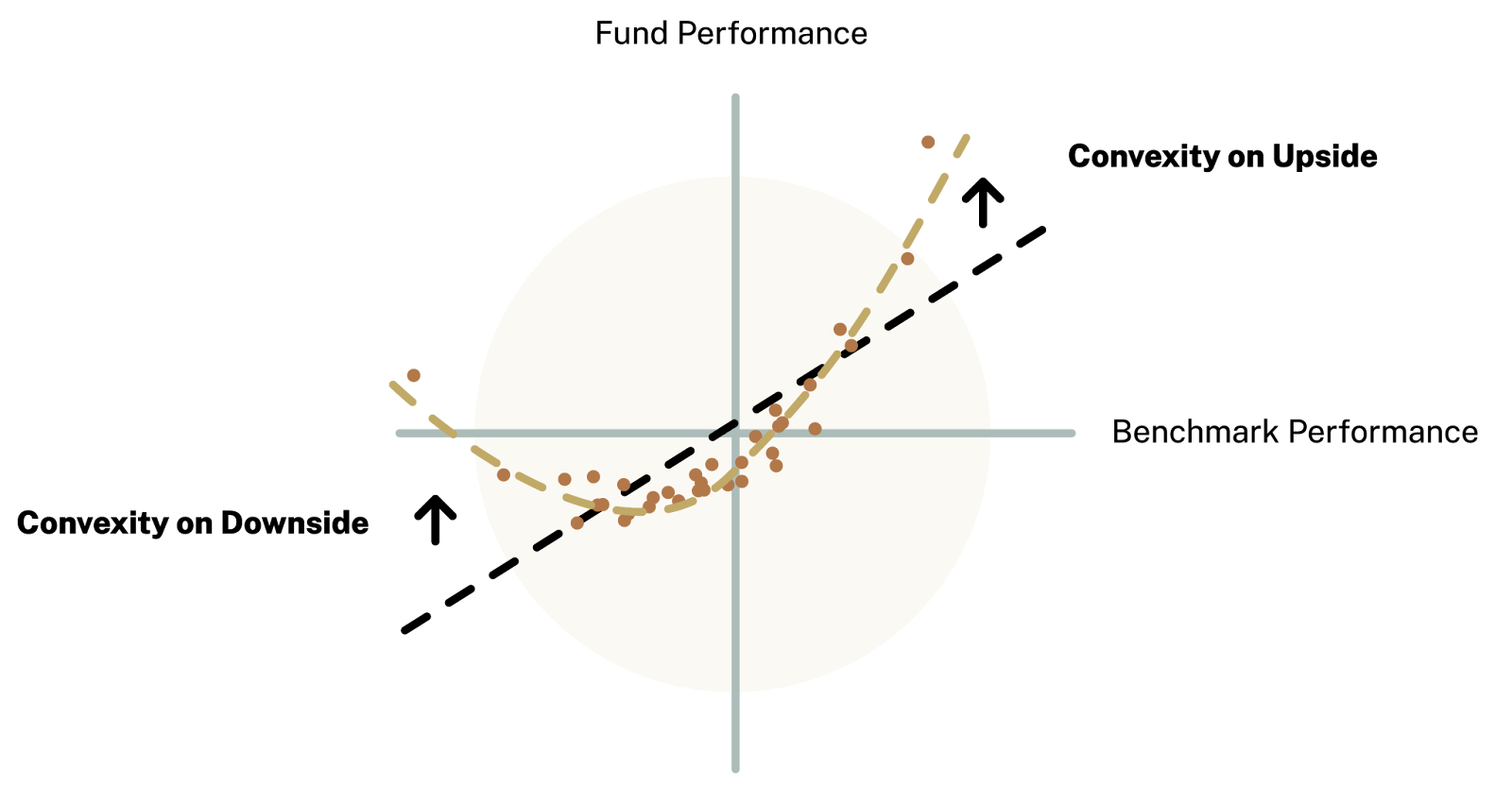
I’ve been investing on and off since 2011-2012. I began trading options in a retail capacity in 2018. Back then, trading options on Tesla was the name of the game, and I went through the whole trader experience. I love the Market Wizards book by Schwager because I went through the same processes as many of the people featured in it. You initially make a lot of money on something and think, “Oh my, this is easy, and I am so smart.” Then, you lose a lot of money on something else, and that’s when you start learning. So, I did have some experience with options. Since 2021, when I began testing Oraclum’s methodology, my options trading knowledge has improved significantly. We needed options because they provide convexity (i.e., non-linear payoffs), which is crucial when predicting with 60%-70% accuracy, which is what we achieved. So, while I did have some experience, it has grown exponentially over the past few years since I started the fund.

Graphic: Retrieved from Simplify Asset Management. “An investment strategy is convex if its payoff relative to its benchmark is curved upward.”

What did the fund structuring process look like, and what guided your decision to create a hedge fund versus an ETF, which would allow more people access?

The hedge fund versus the ETF is a matter of cost. Launching an ETF requires about $250,000 upfront, which is beyond our reach at the time. However, we aim to establish an ETF within the next few years to offer it to a broader audience. Many people who participate in our surveys are eager to invest, but with our current $100,000 cap, they can’t. The ETF would allow them to be investors, providing an even stronger incentive to participate and perform well in the surveys.

To answer your question further, we need to go back to 2016, around the time of Brexit and Trump’s election. That’s when we decided to start a company. We set up shop in the United Kingdom, specifically in Cambridge—no connection to Cambridge Analytica; we’re the good guys and don’t misuse data. Initially, we focused on market research projects on elections, market trends, and public sentiment. However, after correctly predicting the 2020 election outcome between Biden and Trump, we started attracting clients from the finance industry who were buying our election predictions. I thought, “Why not test this on the markets?”

We had some funds and could hire people to help us, so we began the project with the mindset of trying it out for a year or two. If it didn’t work, we could always return to market research. But the project quickly gained momentum. I invested about $20,000 of my own money, and over a year and a half, I grew it to $54,000. I did this transparently, posting screenshots of my trades in my newsletter. People could see my profits and losses weekly. I would even send survey participants the trades I planned to make, and this transparency resonated with them—some became investors.

Like many others, our biggest investor initially followed us on Twitter and subscribed to the newsletter. After nearly a year of testing, the final decision to start the hedge fund came around the summer of 2022. People following us said they wanted to invest more seriously, so we started the process. I remember discussing it with my wife and telling her, “You need the confidence of someone who knows nothing about something but does it anyway.” We launched the hedge fund in 2023 and learned as we went.

Before we started, I spoke with a lawyer and met with potential investors. I also surveyed newsletter subscribers to gauge interest and ask if they’d like to invest. We received around $10 million in commitments. Of course, there’s a difference between pledging money and investing it, so we only started with about $2 million when we launched the fund in February 2023.

Our hedge fund story differs from most. While others often launch with $100 million, $200 million, or even $1 billion, we’re bootstrapping our way up, starting small but with solid performance and growing trust from our investors. It’s an unconventional story, but we don’t need the typical team of analysts or a Bloomberg terminal. We have our method and trade in a very straightforward way.

What does it cost to run your type of operation?

In the first year, last year, the budget was about $100,000. It is more significant this year because I’m expanding the entire marketing scope. It’s projected to be around $400,000. However, with our profit, we’re comfortably funding the entire operation.

Was creating the fund structure cost-intensive as well? 

Surprisingly, no. It was about $30,000 altogether and set up in Delaware. I found good lawyers and used all the money I earned investing myself to fund it.

What does your investment process look like from pre- to post-trade?

It is straightforward. We get a signal every Wednesday before the market opens. Once we get the signal, we want to determine its strength. Then, we typically open positions about an hour after the opening, at about 10:30 Eastern on Wednesdays. We will keep the position until the end of trading on Fridays. This is the optimal timing for our prediction if we were right. We only allocate about 2% of our portfolio to each trade. If we’re wrong, the options expire worthless, and we lose 2% of the premium. If we’re right, then we make multiples of that. That is in a nutshell. Now, there are things that we can do. For example, we have this trailing stop strategy; if we make 1.5%, we will increase stops and keep raising them gradually. We have been testing and have considered using 0 DTE options in the other direction to hedge our profits.

Are these options spreads that you are buying? 

A vertical. We always buy spreads.

You would never try any complex or ratio-type structures, right?

No, we keep it simple. We used to, and the following is a great story about that.

The fund is performing well currently. However, right out of the gate in March of last year, we were down 15% on our first $2 million. At the start, we told our investors they would be out if we lost 20%, so it was a tricky situation.

What went wrong? Several things contributed. 

For background, I only risked 10% each week when trading alone. With about $20,000, this meant risking $2,000. A part of my strategy involved using iron condors, as our methodology works well in both direction and precision; our predictions are within 2% of the market’s actual ending about 80-85% of the time, which is quite significant. Thus, the iron condor structure worked well when trading on my own in 2021 and early 2022.

However, since the introduction of 0 DTE options, the price of the Friday options has changed dramatically, and the risk-reward ratio has shifted from 2:1 to 8:1; now, I would risk $800 to make the same $100. If I lost $800, I would need eight good weeks to compensate for one bad week. Consequently, iron condors are no longer viable. This structure, we know, significantly hurt us in the first quarter of 2023, which is why we abandoned it, along with others, focusing solely on directional options and spreads.

Graphic: Retrieved from Oraclum Capital.

My first thought was how much of that was the volatility environment. So you dropped the condors, and then, did you change how you traded the verticals?

When we started the fund, we risked about 5%. When things quickly got out of hand, we lowered it; when we were down 15%, we reduced it to 1%, and it took us about five months to break even, gradually increasing our exposure. Now, we’ve found that 2% to 3%, depending on the strength of the signal, is our optimal point. So yes, it affected our position sizing. Regarding volatility in March of last year, the collapse of Silicon Valley Bank also impacted us.

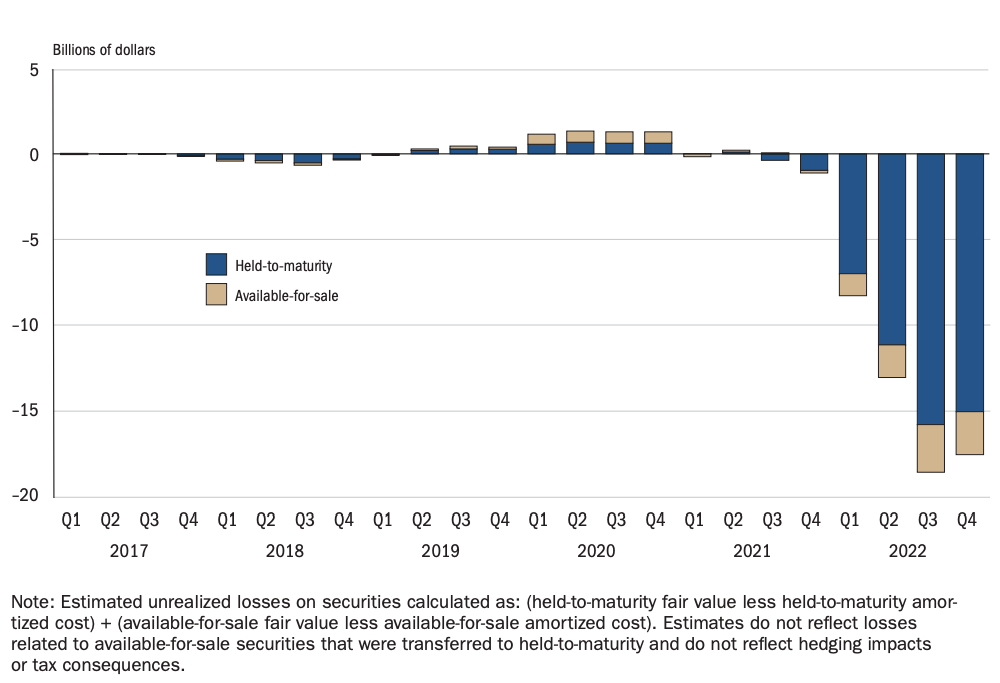
Graphic: Retrieved from Federal Reserve. Due to the rapid pace of interest rate increases, Silicon Valley Bank’s unhedged bond portfolio significantly lost value, contributing to difficulties meeting withdrawal demands.

Would you consider trades like the iron condor again if the volatility environment changed?

It works for us over 80% of the time, but the risk-reward ratio is no longer suitable. That’s why we don’t want to engage again. The current data shows flat or slightly above-flat results, so there’s no point in doing it.

Do changes in volatility and positioning affect how you trade the underlying market? So, at the beginning of August, we had a bunch of volatility. You probably weren’t in positions at the start of the week because it was a Monday, and you avoided that. But do those significant changes in volatility impact how you structure trades?

Not the structure. 

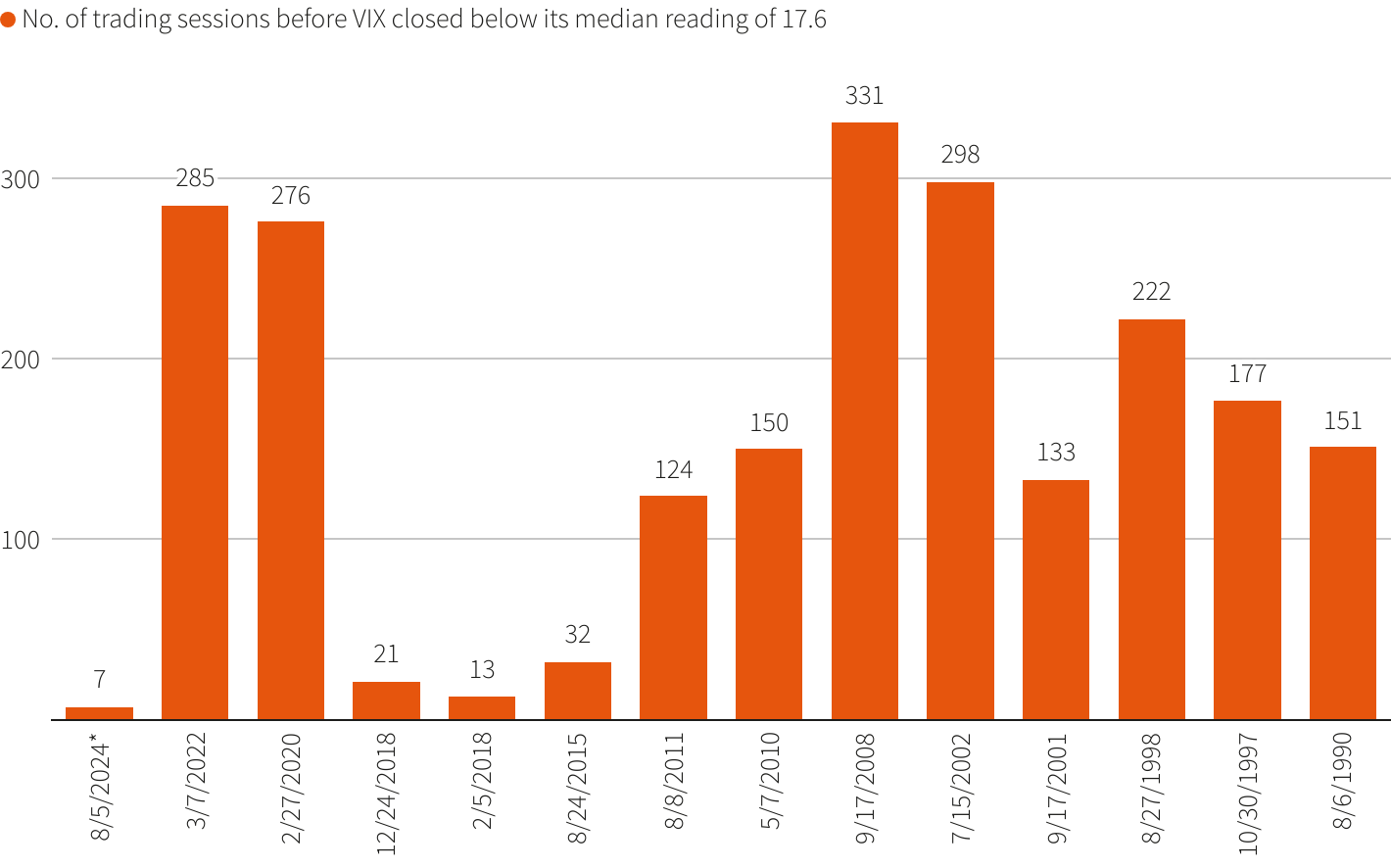
Let’s go back to that week. On Monday, markets were down. We were mostly in bonds and cash. We ended the week up 1%, with the compression of volatility benefitting us; as volatility went down and markets went up, it was an easy trade for us in retrospect.

It would have been fantastic if we had held puts on that Monday. If we had held calls, we would have only lost the premiums. That’s why volatility doesn’t impact us negatively, no matter how big. This is because we’re not sellers of options. If we were sellers, that would be a different problem. However, since we buy options, the most we can lose is the premium. We know our risk—if we’re wrong in a week like that, we lose 2% and move on to the following week.

Also, I noticed a mismatch between bid and ask prices on that particular day. That is something to consider as well. But if I had put options and there was a huge mismatch, we would have worked them at the mid-price.

Graphic: Retrieved from Reuters.

How are you executing these orders? Are these just market orders, or are you setting a limit?

Always limit orders.

Are you using one of the ETFs, or do you use cash-settled indexes like the SPX?

ETF. Not the cash.

Would going into something like the SPX be more cost-efficient if you grow large enough?

Yes, absolutely. Right now, one of our institutional investors is coming in, and they want us to employ the same strategy using options on futures like the E-mini S&P 500 (FUTURE: /ES). Looking at the data, the approach also works there.

Are you testing trades in real time or backtesting?

Backtest.

If you were to go live with either the /ES or SPX, would you do that with a smaller size initially, test it out, and see how it works on that scale? 

Yes. Initially, use a smaller size and then push it up as we go along.

Right now, we’re small—a $17 million fund—so I trade a couple hundred thousand dollars worth of premium every week, which is not a lot. Once bigger, we can look to the SPX and /ES, where the liquidity pools keep increasing. 

As we grow in size, it’s straightforward for us to scale.

You said you risked 2%. Is the other 98% still in Treasury Bills?

90% in T-Bills, and 8% is a cash buffer.

Graphic: Retrieved from Exotic Options and Hybrids.

Because you’re always out of these spreads at the end of the week, I assume you’re pretty liquid and can quickly meet redemptions. 

Yes, that’s not a problem for us.

If interest rates fell or you had a significant lull, would that change how you invest that capital?

It probably would. Right now, we’re taking advantage of the carry. There’s a straightforward carry trade—you leave cash in bonds for a year and get ~4%. It will probably be a different instrument if we return to the pre-COVID interest rate environment or even post-COVID 2021. However, I would still want to keep most of it in bonds because of the safety. Think of it like Taleb’s “Barbell Strategy.” You have 90% in something very safe and 10% in something very volatile—in our case, 2%.

You’re not using box spreads, right? You’re actually in T-Bills, right?

We have T-Bills but will switch to box spreads because of the tax implications.

Graphic: Retrieved from the OCC.

How do you monitor the strength of the signals, and do you scale back if that signal weakens?

This is an ongoing process, and there are several things we’re looking at. Regarding the signal strength, we have KPIs. We’re monitoring whether the signal is improving or worsening over the past 4 or 5 weeks. If it falls below our crucial indicator, we say, “Okay, let’s see what the problem is, what’s happening, and how we can fix it?” Signal weakening can be due to several reasons, such as a drop in our survey response rates during slower periods of the year. If we can detect issues, we can prevent them from escalating. We allow ourselves a maximum of one lousy month.

Can you explain your fee structure?

We have a 1.5% management fee and a 25% performance fee subject to an 8% hurdle, accounted for quarterly. We must clear 2% each quarter before applying the 25% performance fee. There’s also a high-water mark in place. Performance fees can only be charged if the fund consistently makes money. So, if the fund makes money in one quarter but loses money in the next, it can only charge a performance fee once it has recovered the losses in the subsequent quarter and exceeded the previous high-water mark; the performance fee can only be applied to any additional profits after surpassing the previous peak value.

Despite being systematic, you’re still executing these by hand, inputting orders, setting limits, and so on, right? How do you manage any biases and emotions and just execute?

I have a psychology coach guiding me through this process, which is necessary. I’ve experienced losses before starting the fund, but managing other people’s money is different—it comes with much higher responsibility. Plus, you must report to these people regularly and inform them about any losses. This was particularly challenging for us in March of 2023 when we had just started the fund and were down 15%. We thought, “What do we do now, and how do we face these people again?” I did a lot of exercises to help myself cope with the situation, and I realized that the solution lies in sticking to the process. The less I meddle, the better our investment returns are; we achieve better outcomes by completely removing our biases and following the process, one of our key performance indicators. Ultimately, I aim to expand the team, hire traders, and stop trading myself. Although I could automate the entire process, it doesn’t always work as intended; sometimes, the machine won’t perform exactly as you want. That’s why I believe human traders still have value. We’re not high-frequency traders, so we don’t need machines to execute nanosecond trades. Instead, we rely on humans following a system to execute the orders.

Do you ever have a signal and you’re putting on a trade but think, “This isn’t going to work,” but you still go through with it because you are following a system?

Yes, but I’ve taught myself not to deviate. Sure, maybe this week I’m going to help it, but the next week I’m probably going to destroy it. Again, it is the whole psychological mindset thing. I still get the urge, but you’re pushing yourself to make this emotionless. It is a process, so it’s going to take a while.

So, the hedge fund feels like your second act to me. Do you have a third in mind, and may that involve you working in the government, especially given the research you’ve done?

I’m so removed from governments that it’s liberating. 

The three of us at Oraclum—Vinković, Šikić, and myself—are political junkies. Since starting the fund, I’ve asked myself why I even cared. At this point, it’s tough for me to think about a third act, especially now that we’re in the middle of building this. 

It depends on how much money I earn—maybe philanthropy or something else. We’ll see.

Have you done any work for the next set of U.S. elections? If so, can you share any results?

This is the big argument that my two co-founders and I have. One of them is against us doing this because of the focus of the fund, our investors, and everything else. And that makes sense. We won’t do it, even though I see it as a great marketing tool.

If you were to predict the next set of elections, what would you do differently?

I streamline much more toward the key swing states. 

Pennsylvania was the key state in the last two U.S. elections, 2020 and 2016. As soon as we saw in our survey that Trump was winning Pennsylvania in 2016, that was it; Trump was taking the election. The same happened in 2020. At no point did Biden ever lose Pennsylvania in our surveys. So that was the turning point for us. Ohio and Florida were going for Trump. Before this election, whoever won Ohio and Florida would become the U.S. president. Not this time because you had Pennsylvania and Michigan going in the other direction. So, if I were doing it this year, I would focus on a handful of swing states. You can follow the surveys for the rest, focusing on Pennsylvania and Michigan. Ohio and Florida will most likely go to Trump. But then, I would also look at Arizona, North Carolina, Georgia, Pennsylvania, Michigan, and Wisconsin.

I recently watched a podcast featuring Citadel’s Ken Griffin. In it, he emphasized the importance of studying your winners rather than getting too hung up on the losers. Does your experience validate this thinking?

That’s a good point. I get more excited about the winners and learn that the losers don’t matter—move on. 

There’s this great quote by Roger Federer: “In tennis, perfection is impossible. In the 1526 matches I played, I won almost 80% of them. But I only won 54% of the points in those matches.” For him, it’s not about the points. When they’re gone, they’re gone. You move on to the next one. It’s the same thing here. For every week we lose 2%, we move on. But when we get a big win, we’re delighted. It’s a psychological thing as well. You can get much more if you don’t cut the profits too soon and keep a trailing loss. That’s why we have weeks where we’ve made 5% or 6% in a week, which is good. So there is something to it. 

We study the winners because it can all come down to 5 or 6 weeks a year when we make the bulk of the return on the fund. Everything else cancels out; the small winners and losers cancel each other out.

Graphic: YouTube interview with Citadel’s Kenneth Griffin.

Do you have any mentors or people you look up to? 

I love that Market Wizards book by Schwager. Every interview in it is very revealing and comforting. When I was younger, I idolized George Soros. What we do has nothing to do with how Soros trades; he’s a big ideas guy, and I could never compete. It’s the same thing with people like Ray Dalio. It’s a different way of competing. 

I want to emulate someone like Paul Tudor Jones.

Do you have a favorite book recommendation?

Nassim Nicholas Taleb opened my eyes to options trading. After I read his third book, Antifragile: Things That Gain from Disorder, I thought, “Options are interesting; let’s see how this works.” I also think psychology books are great. So, Trading in the Zone: Master the Market with Confidence, Discipline, and a Winning Attitude and Schwager’s Market Wizards are fantastic because traders often make the same stupid mistakes; everyone goes through the same process.


Disclaimer

By viewing our content, you agree to be bound by the terms and conditions outlined in this disclaimer. Consume our content only if you agree to the terms and conditions below.

Physik Invest is not registered with the US Securities and Exchange Commission or any other securities regulatory authority. Our content is for informational purposes only and should not be considered investment advice or a recommendation to buy or sell any security or other investment. The information provided is not tailored to your financial situation or investment objectives.

We do not guarantee any information’s accuracy, completeness, or timeliness. Please do not rely solely on our content to make investment decisions or undertake any investment strategy. Trading is risky, and investors can lose all or more than their initial investment. Hypothetical performance results have limitations and may not reflect actual trading results. Other factors related to the markets and specific trading programs can adversely affect actual trading results. We recommend seeking independent financial advice from a licensed professional before making investment decisions.

We don’t make any claims, representations, or warranties about the accuracy, completeness, timeliness, or reliability of any information we provide. We are not liable for any loss or damage caused by reliance on any information we provide. We are not liable for direct, indirect, incidental, consequential, or damages from the information provided. We do not have a professional relationship with you and are not your financial advisor. We do not provide personalized investment advice.

Our content is provided without warranties, is the property of our company, and is protected by copyright and other intellectual property laws. You may not be able to reproduce, distribute, or use any content provided through our services without our prior written consent. Please email renato@physikinvest for consent. 

We reserve the right to modify these terms and conditions at any time. Following any such modification, your continued consumption of our content means you accept the modified terms. This disclaimer is governed by the laws of the jurisdiction in which our company is located.

Categories
Commentary

The End Game

Good Morning! I hope you have a great start to the week. I would be so honored if you could comment and/or share this post. Cheers!

Bursts of volatility punctuate calm and resilience, resulting in demand for safety and protection in everything from stocks and commodities to bonds and currencies. The general agreement is that macroeconomic policy and geopolitics are to blame, and investors are repositioning to stem risk and potential bleeding in their portfolios. This sometimes disturbs historical trends and relationships. 

Thank you for tuning in. We will unpack much of it herein. Let’s get into it.

Graphic: Retrieved from Bloomberg.

Hedging Against Monetary Inflation, Weaponized Dollars, And Debt Monetization

Gold serves as a prime example. Instead of being guided by conventional catalysts, including real interest rates (i.e., nominal interest rate minus inflation), growth prospects, and currencies like the dollar, recent movements are more likely driven by factors like central bank accumulation on macroeconomic and geopolitical shifts.

For instance, China may increase its gold reserves to hedge potential disruptions and sanctions, as Russia saw after it invaded Ukraine in February 2022, or establish a collateral reserve for an autonomous financial system. Likewise, Poland, the Czech Republic, and Singapore have also increased their gold reserves.

As liquidity in the gold market is thinner, this buying activity amplifies volatility and disrupts established trends. Therefore, fast moves up!

Graphic: Retrieved from Bloomberg via SuperMacro.

Why could gold continue this upward trajectory?

The typical trajectory is guided by monetary inflation, characterized by increasing liquidity within the financial system. According to CrossBorder Capital, gold moves 1.5 times the liquidity growth, a solid sensitivity to so-called monetary expansion. Bitcoin, often considered a digital gold, moves sooner and exhibits higher sensitivity.

Recent expressions of interest in Treasury securities by central banking authorities, such as Federal Reserve Governor Christopher Waller, further fuel ascents. New demand would lead to higher bond prices and lower yields.

Therefore, gold continues surging due to geopolitical shifts, liquidity in the financial system, and the potential for debt monetization. The latter occurs when excessive debts prompt central bank authorities to intervene, using printed money to purchase bonds to manage interest rate levels more effectively.

“Investors are looking beyond the ‘here and now,’ realizing that there is no way markets or the economy can sustain 5% nominal and 2% real rates,” Bank of America elaborates. Investors are “hedging two things: i) the risk that the Fed cuts as CPI accelerates, and ii) and more ominously, the ‘endgame of Fed Interest Cost Control (‘ICC’), Yield Curve Control (YCC) and QE to backstop US government spending.’”

Graphic: Retrieved from Bank of America.

There is bi-modality. Typically, high rates are bad for gold. But, with debts and rates as they are, the probability of debt monetization increases. For now, we have a cycle wherein stocks and commodities may rise with a firming economy, and bonds may offer limited salvation, nodding to higher-for-longer rates.

Hedging Loss Of Momentum And Left Tails Following Big Move-Up And De-levering

Interest rate increases are likely only on the horizon if something unexpected occurs. Given that stocks are priced well, the question arises: how can we protect ourselves while many anticipate, based on market pricing, either minimal changes to the status quo or a substantial event triggering a broad downturn?

For one, commodities don’t do much good in a broad downturn.

Consider the years 2001 (during the tech bubble), 2008 (amidst the global financial crisis), 2015 (the flash crash), 2018 (during Volmageddon), and 2020 (amidst the pandemic). According to Kris Sidial of The Ambrus Group, gold was an ineffective hedge against equities during these periods.

So, how do we hedge the middle reality between “minimal” and “substantial.”

Graphic: Retrieved from Bloomberg.

While direct bets on equity volatility bursts have been prominent, digestion trades may be a better alternative. Let’s unpack why.

Graphic: Retrieved from Bloomberg.

The first idea involves hedging downside thrusts in equities via call options in the Cboe Volatility Index (INDEX: VIX), Goldman Sachs, and UBS note. This isn’t necessarily optimal. Volatility is high over the short term and may revert quickly, indirectly boosting stocks. The alternative strategy entails selling options and utilizing the funds to purchase similar options with later expiration dates. Such digestion trades enable traders to capitalize on increases in volatility in the near term, reducing their costs on longer-term trades.

Graphic: Retrieved from SpotGamma’s April 15, 2024 Founder Note.

To explain, in a recent letter to subscribers, SpotGamma shared that numerous expiring VIX call options were in the money. In other words, this exposure, which makes money if the VIX and S&P 500 implied volatility (or the options market’s anticipation of future movement in the underlying), was soon to disappear. Accordingly, the hedges to this exposure would do the same, and the rebalancing after that would be enough to buoy markets.

We’ll try to break it down further in the simplest way possible. 

The S&P 500 (INDEX: SPX) and VIX are inversely correlated. When the S&P 500 falls, the VIX tends to rise. Naive of us to say, we know, but bear with us.

One can buy an SPX put or a VIX call to hedge a portfolio’s volatility. Let’s say one buys an SPX put, and the other side of this trade sells an SPX put. The other side may hedge this short put by selling stock and futures correlated to the S&P 500. Let us say the S&P 500 falls and volatility rises (pictured below). That counterparty may have to sell more stock and futures, pressuring markets. If this now valuable put expires, the counterparty will buy back the stock and futures it sold. This can support markets or do less to exacerbate movement and underlying volatility.

Graphic: Retrieved from SqueezeMetrics.

SpotGamma’s data suggests the markets are not facing an impending crash; instead, per their April 17, 2024 note, “if stocks rally and IV drops, it may add more stock for dealers to buy.” I plug SpotGamma because I worked there. Check them out! 😀

Graphic: Retrieved from SpotGamma.

So, calendar and unbalanced butterfly or ratio spread trades (pictured naively below), a play on the recent richness (pictured much further above) of options, may help capture the low case of downside and stem potential portfolio volatility.

Graphic: Retrieved from Physik Invest.

Flipping these trades (i.e., using call options in the SPX instead of put options) allows one to play the market rising. For instance, let us say the upside of gold and silver will continue, but only after stopping and digesting recent movements. You can sell a call expiring soon and buy one later at the same strike price. Your loss is, technically, limited to the amount paid for the trade.

Graphic: Retrieved from Schwab’s thinkorswim platform.

In general, ratio spreads, and butterfly trades are designed to capitalize on movement toward specific price levels, while outright calls and puts are better suited for hedging sharp movements.

The former two strategies serve as practical tools for safeguarding the value of your positions during periods of heightened volatility. In such environments, the options you own are positioned closer to the market, usually retaining their value well, while the options you sell are priced higher than usual and located farther from the market, with more value to decay into expiry. 

Consequently, while the options you own tend to keep their value, the options you sell struggle to retain theirs. As a result, the spread can appreciate even without significant movement, particularly if implied volatility declines significantly at the furthest strikes. Earlier this year, such was true in Super Micro Computer Inc (NASDAQ: SMCI) and Nvidia Corp (NASDAQ: NVDA).

SMCI was trending up, and traders were feverishly betting/hedging this reality. In a 20-page case study we may release, we detail how Physik Invest navigated this environment successfully. In short, we bought options closer to where the market was trading and sold more of them in places where we thought the market wouldn’t end up going. With implied volatility jacked, for lack of better phrasing, it was often difficult for those far-away and short-dated options to keep their value. Hence, we managed to put trades on for low or no cost and flip them for significant credits!!!

Graphic: Retrieved from SpotGamma. SMCI volatility skew.

In any case, there’s been a weakening under the surface of the indexes (see below).

Graphic: Retrieved from TradingView via Physik Invest. Black = Breadth Measure.

Later, when breadth improves, we can use the portfolio volatility-reducing trades discussed to cut costs or buy more stocks, anticipating upside continuation. According to Carson Group’s Ryan Detrick, the S&P 500 experienced its first close below the 50-day moving average in 110 trading days, marking the longest streak since 2011. Following similar streaks, stocks were higher three months later, 88% of the time, and six months later, 81% of the time. “A warning? Maybe, but maybe not.”

Graphic: Retrieved from Ryan Detrick of Carson Group.

If you enjoyed this week’s letter, comment below and share. Thanks and take care!

Categories
Commentary

Swapping Nvidia For Cocoa

Good Morning! I hope you have a great start to the week. I would be so honored if you could comment and/or share this post. Cheers!

Broad measures of equity implied volatility (the options market’s anticipation of future stock movement) decline, hinting at reduced concerns about the economy and valuations. The shift follows a period of stocks and their implied volatility consistently rising together. We unpack why all this is herein, starting with where we were.

In recent months, a frenzy propelled large stocks higher. Among the favored tactics, institutions and retail investors bought call option contracts, a cost-effective means to hedge bets against equities or partake in potential upside. This phenomenon indirectly amplifies market thrusts, primarily through the hedging process, where a customer purchases a call option, and the counterparty sells it while dynamically hedging with purchases of the underlying stock. This mechanism partly contributed to the rapid ascent of weighty index constituents like Nvidia Corporation (NASDAQ: NVDA). However, as enthusiasm wanes (resulting in cheaper options due to decreased demand or increasing supply), it can set the stage for contrasting outcomes and vulnerability in the overall market.

Have no fear, though. As the broadening breadth shows, the less weighty constituents save the day. Such a rotation and momentum seldom precede immediate crashes and instability. Historically, rallies persist, resulting in double-digit returns for investors a year later. After all, it is an election year with fiscal spending and deglobalization counteracting contractionary monetary policy or the notion of it (i.e., rising money deployed in growth and monetary inflation hedges).

The key observation is that generating profits from high-performing stocks is more challenging. Gone are the times of chasing upward movements, where the potential gains far outweighed the risks. Implied volatility in stagnant stocks like Super Micro Computer Inc (NASDAQ: SMCI) has dropped by over 100% for out-of-the-money call options with about a week to expiration. With the stock now an S&P 500 component, both realized and implied volatility may continue downward. Consequently, the strategies we’ve shared turn costly and are less profitable.

Like Ariana Grande says, “Thank u, next.”

If high-performing commodities like cocoa aren’t for you, so-called “digestion” trades (e.g., calendar spreads) or direct bets on equity volatility bursts may be. The first idea regards selling options and using those proceeds to buy similar options that expire later. The other is to hedge downside thrusts in equities via call options in the Cboe Volatility Index (INDEX: VIX), Goldman Sachs, and UBS note. The latter isn’t necessarily optimal. Savvy traders know low implied volatility can stay low (e.g., 2017). Cheap is cheap for a reason, and the market’s current position suggests lower odds of expansive movement; instead (and this isn’t advice), calendar and ratio spreads, a play on the current richness of out-of-the-money put options, stick out. We’d aim to use the proceeds of these portfolio volatility-reducing trades to cut our cost basis or buy more stocks. See this case study from 2022 for some context.

Now, in what case would those VIX trades perform? There would have to be enough downside follow-through to warrant an adjustment to the status quo and for people to demand protection and re-price cheap insurance big. Some say that figure sits at -5 or -10%, where the stabilizing forces from common options selling strategies fade, writes FT, “leaving markets more vulnerable to other selling flows (e.g., from volatility targeting funds, CTAs/momentum investors, short gamma flows from hedging puts and levered ETFs, discretionary investors).”

Upon further downside, previously indiscriminate options selling may come into focus as sparks for cascades, similar to February 2020’s historic reach for insurance to cover, protect, and fix margin issues. As a result of dispersion trades and other things, the VIX has fallen more relative to single-stock implied volatility, offering poor rewards for optimistic investors and newer yield-hungry volatility sellers. Investors hedging could be better off avoiding options altogether, allocating instead to the S&P 500 and T-bills or debt issued with short-term maturities.

Investing in T-bills can tie up a little margin. If your account allows, the remaining cash and margin can be used to buy stock or its synthetic equivalent (i.e., buy a call and sell a put) or construct asymmetric bets to the upside. For alternative trading ideas, please check out our “BOXXing For Beginners” newsletter, in which we discussed using portfolio margin, box spreads, and unbalanced call spread structures to capture the upside more efficiently. 

Nevertheless, the current low implied volatility scenario suggests investors expect little upset. If their assumptions are wrong, it could portend significant repricing if or when things sour. The market reflects this with a multimodal reality/pattern as options further out are sticky, displaying heightened premiums. It’s an expectation that minimal change or a significant event transpires—little middle ground.

Categories
Commentary

Yield Hunger Sparks Concerns Of A Volmageddon Redux

Good Morning! I hope you are having a good week. I would be so honored if you could comment and/or share this post. Cheers!

As we step into Spring, we’re riding the wave of one of the strongest stock market rallies in over fifty years. It’s been a period of smooth sailing, with record highs beckoning transition from concern over potential downturns to the fear of being left out of further gains.

The BIS has commented on some of these trading behaviors, which can drive upward momentum and foster a sense of calm or low volatility. They point to the increased use of yield-enhancing structured products as a critical reason for reducing volatility. These products have stolen the show, boosting investor returns by selling options or betting against market fluctuations. In calm markets, those on the opposite side of these bets hedge in a way that reduces volatility: they buy when underlying asset prices dip and sell when they rise. As the supply of options increases, the liquidity injected to hedge stifles movement, resulting in a stubbornly low Cboe Volatility Index or VIX.

The BIS example illustrates a product that sells call options against an index position to lower the cost basis by collecting premiums. The counterparty buys call options and hedges by selling the same index. If the call options lose value or the market declines, the counterparty buys back the index they sold initially. This strategy is constructive and potentially bullish, especially in a rising market, as one could infer counterparties may postpone rebalancing to optimize profits (i.e., swiftly cut losses and allow profits to accumulate).

Graphic: Retrieved from Bank for International Settlements.

However, these trading behaviors come with risks. 

While individual stocks may experience volatility, the indexes representing them move begrudgingly. Investors have concentrated on selling options or volatility (the all-encompassing term) on indexes to fund volatility in individual components, a strategy known as dispersion. Although typically stabilizing, experts caution that it can end dramatically. One can look at the destructive selling in China as a cautionary example.

Kai Volatility’s Cem Karsan compares the trade to two sumo wrestlers or colossal plates on the Earth’s core exerting immense pressure against each other. While the trade may appear balanced and continue far longer, the accumulated pressures pose significant risks. Major crashes (up or down) happen when entities are compelled to trade volatility and options. Often, the trigger is the inability to cover the margin and meet regulatory requirements, causing a cascading effect (e.g., GameStop and 2020 crash).

The current scenario mirrors the conditions before Volmageddon, where short-volatility tactics failed. 

With implied correlations low, a market shock could see investors exiting their positions abruptly, amplifying volatility. Karsan notes a precursor to such a crash is a weakening supply of margin puts, particularly the highly convex and far out-of-the-money ones. These options play a significant role during stressful market periods, acting as indicators and drivers of impending crashes. The focus is on convexity (i.e., the rate of change of delta for changes in the underlying asset’s price or the nonlinear relationship between the option’s price and the underlying asset) rather than whether there are good odds the underlying asset will trade down to the options in question.

“Implied vol is about liquidity. It isn’t about fear or greed,” writes Capital Flows Research. “Implied vol is about liquidity on specific parts of the distribution of returns on an asset. Remember, even the outright price of an asset is pricing a distribution of outcomes, not a single destination. Options make this even more explicit by having various strikes and expirations with differing premiums and discounts.”

History shows a minor catalyst can lead to a dramatic unwind. Take what happened with S&P 500 options a day before XIV crash day.

“Going into the close the last hour, we saw nickel, ten, and five-cent options trade up to about $0.50 and $0.70,” Karsan elaborates. “They really started to pop in the last hour.”

“And then, the next day, we opened up and they were worth $10.00. You often don’t see them go from a nickel to $0.50. If you do, don’t sell them. Buy them, which is the next trade.”

Graphic: Retrieved from Bloomberg.

Similar to downward crashes, there are occasional but now more common upward crashes. 

Recent market movements, particularly the surge in stocks such as Nvidia, Super Micro Computer, and MicroStrategy, echo the frenzy seen with high-flying stocks like GameStop in 2021. This caused losses for some liquidity providers and funds that mistakenly equated the price or level of volatility with value, selling it at a discount to where it would eventually trade.

Graphic: Retrieved from Bloomberg via Simplify Asset Management’s Michael Green.

“I remember several traders I knew trying to short-vol on GME when it was at 300 because it was ‘cheap’ due to its level,” Capital Flows Research adds. “They were blown out of those positions.”

Graphic: Retrieved from Bloomberg via Capital Flows Research.

So, we have played along, nodding to George Soros’s famous statement: “When I see a bubble forming, I rush in to buy, adding fuel to the fire. That is not irrational.”

To explain, we go deeper into something known as implied volatility skew.

Skew refers to the difference in implied volatility across different strike options on the same underlying asset. Typically, options with farther away strike prices (out-of-the-money puts) have higher implied volatility than options with higher strike prices (at-the-money calls).

Implied volatility skew, as shown below, is often nonsymmetrical due to higher demand for downside protection.

When volatility skews become steeper, the disparity in implied volatility between various strike prices widens. For instance, the implied volatility of out-of-the-money (OTM) puts, which offer protection against market downturns, rises compared to at-the-money (ATM) puts and upside protection (calls). This steepening volatility skew indicates heightened apprehension among investors regarding potentially large downward market movements. Similarly, when the implied volatility of upside protection (calls) surpasses that of downside protection (puts), it signals growing concern (i.e., FOMO) about potential upward market movements. A steepening call volatility skew results from distant call options pricing higher implied volatility than usual due to investor demand/fear.

Graphic: Retrieved from Exotic Options and Hybrids: A Guide to Structuring, Pricing and Trading.

As savvy traders, we can construct creative structures and sell options against the closer ones we own to lower our costs on bullish trades. We detailed such bullish trades in our last two commentaries titled “BOXXing For Beginners” and “Foreshocks.” The outcomes for one of Physik Invest’s accounts are detailed below.

Graphic: Retrieved from TD Ameritrade’s thinkorswim platform.

Regrettably, enthusiasm is waning. Using Nvidia as an illustration, the stock surged 2.6% on Friday but plummeted 8% on the same day. The call skew was elevated over the weekend before leveling off earlier this week, which poses difficulties for traders betting on further upward movement.

Graphic: Retrieved from SpotGamma.

We discussed how such a flattening could foreshadow waning risk appetite and potentially herald market softness. SpotGamma indicates that call skews are flattening across the board, as illustrated in the chart below.

The red bars on the left represent approximately 90th percentile skews during a significant stock rally. However, a week later, on the right side, the skew rankings decline. “This appears like the uniformly bullish action in top tech stocks is breaking apart,” SpotGamma explains. This “is a reduction in bullish exuberance.”

Graphic: Retrieved from SpotGamma.

This activity will not likely disrupt the broader market; markets will stay intact as traders double down, selling shorter-dated volatility and buying farther-dated ones. We observe this using SpotGamma’s Fixed Strike Matrix below. In a simplistic sense, red indicates selling, while green suggests buying.

“By default, cells are color-coded red-to-green based on the Implied Volatility Z-Score,” SpotGamma explains. “If the cell is red, Implied Volatility is lower than the average implied volatility over the past two months. If the cell is green, Implied Volatility is higher than the implied volatility over the past two months.”

Graphic: Retrieved from SpotGamma on Monday, March 11, 2024.

The recent compression in short-term volatility aids stabilization, leading to restrained ranges in the indexes relative to components. Among these components, which drove the S&P 500 upwards, some big ones face downward pressure, partly due to the expiration of previously demanded/bought call options. This expiration prompts those initially selling these (e.g., call) options to re-hedge by selling the corresponding stocks.

Graphic: Retrieved from Damped Spring Advisors.

As the indexes remain fixed, the only resolution is a decline in correlation. As larger stocks decline, smaller constituents rise, contributing to the strength observed in the S&P 500 Equal Weight Index.

Graphic: Retrieved from Macro Ops.

Breadth can be evaluated naively by comparing the S&P 500 stocks trading above their 50-day moving average and examining the proportion of index constituents achieving new highs and lows. We see improvement, per the below.

Graphic: Retrieved from Physik Invest via TradingView. Breadth black. Correlation purple.

Based on the above explanation and graphics, after the triple witching expiration of futures, stock, and index options, traders may rebalance their portfolios and sell some of the remaining volatility they’ve bid. 

As explained earlier, this will further compress volatility, reducing the potential downside and providing critical support for stocks. Considering it’s an election year and policymakers prioritize growth over instability, Karsan suggests the market may remain stable with these forces above offering an added boost. Therefore, focus on creatively structuring longer-dated call structures and financing them with other trades to amplify return potential.

If the market consolidates without breaking, we may have the groundwork for a much bigger FOMO-driven call-buying rally culminating in a blow-off. Karsan adds that the signs of this “more combustible situation” would appear when “volatility remains persistent during a rally.” To assess combustibility, observe the options market. 

We remember that calls trade at lower implied volatility than puts, particularly from all the supply. As the market moves higher, it transitions to lower implied volatility, reflected in broad measures like the VIX. If the VIX measures remain steady or higher, “that indicates that fixed-strike volatility is increasing, and if this persists, … it can unsettle volatility and create a situation where dealers themselves … begin to reduce their volatility exposure, leading to a more combustible scenario.”

To elaborate on the reducing exposure note in the previous paragraph, if there is greater demand for calls, counterparties will take on more exposure and hedge through purchases of the underlying asset. The support dealers provide will diminish once this exposure expires. If the assumption is that equity markets are currently expensive, then after another rally, there may be more room for a decline, all else being equal (a simplified perspective), thus increasing risk and combustibility.

Graphic: Outdated. Retrieved from Nomura. To help explain.

This week, we discussed a lot of information. Some of it may need to be explained better. Therefore, we look forward to your feedback. Separately, I wish my friend Giovanni Berardi congratulations on starting his newsletter. I worked with Berardi, giving him input on some of his positioning-related research. He shares his insights here. Please consider supporting him with a subscription. Cheers, Giovanni!

Categories
Commentary

Foreshocks

Good Morning! I hope you are having a good start to the week. I would be so honored if you could comment and/or share this post. Cheers!

There is lots of buzz around bubbles and euphoria.

Since late 2022, the Nasdaq 100 has increased by ~75%, and the S&P 500 has increased by ~50%. However, there were some bumps along the way. In mid-to-late 2023, people got worried about the economy, which boosted interest rates. But in November 2023, investors discovered the government would issue less debt, decreasing interest rates. This was good news because future profits are more valuable now when interest rates drop (i.e., lower discount rates elevate the present value of future cash flows), so stocks tend to rise.

The general idea is that stocks will likely keep rising because of the promise of AI and expected profits growing faster than stock prices. Also, people think this will happen as the economy grows and inflation decreases. But it’s not just those factors. How people invest right now is also a big reason why stocks may increase.

Much Further To Run?

The primary catalyst lies in the imbalance of investor positioning stemming from the aftermath of ZIRP (Zero Interest Rate Policy), Fallacy Alarm elaborates. The conclusion of ZIRP reintroduced fixed-income securities as viable investments, prompting investors to boost their fixed-income allocations significantly in recent times.

Further asset rotation could manifest through a stagnant or declining stock market coupled with rising yields or through a robust stock market alongside stagnant or falling yields.

Accordingly, investors are now pursuing stocks at seemingly elevated valuations.

Graphic: Retrieved from Bank of America via Bloomberg.

Fallacy Alarm adds color, making an interesting point on elevated valuations.

Bubbles (the hot topic) are not solely about prices; the collective portfolio allocation characterizes them. We dive further, finding there is room to expand. Per Bloomberg’s John Authers, the market is not as absurd, with the Magnificent Seven aligning more closely with the broader market than before.

Graphic: Retrieved from Ray Dalio.

Additionally, Authers says that the S&P 500 remains relatively inexpensive, with room to go based on global liquidity, subdued margin debt levels, and not overly elevated single-stock call option volumes.

Graphic: Retrieved from Ray Dalio.

“The S&P 500 looks extended in absolute terms when measured by US domestic liquidity flows, but it looks far more comfortably placed when Global Liquidity is the benchmark,” CrossBorder Capital’s Mike Howell states. “US equities have got much further to run if we can reassure ourselves that Wall Street has become the ‘World market’ for stocks. Indeed, this might be plausible given the dominance of US firms in tech and AI applications?”

Graphic: Retrieved from CrossBorder Capital via Bloomberg.

Embedded Risks To Rally

Some others are more cautious regarding the options volumes.

Nomura’s Charlie McElligott suggests the fear of a “crash up” causes a steeper call skew (i.e., the asymmetry in implied volatility levels across different strike prices). We see this with the positive relationship between spot prices and implied volatility. Additionally, volatility selling and structured product issuance may present risky dislocations.

Graphic: Retrieved from SpotGamma.

Some experts, like QVR Advisors, agree, note that selling volatility doesn’t offer the same returns with less risk as it used to. Instead, it’s now seen as taking on more risk for lower returns.

Graphic: Retrieved from QVR Advisors.

Options Volatility And Pricing

SpotGamma acknowledges these trends and dislocations can persist for some time.

So, what do we do about that?

In last week’s detailed “BOXXing For Beginners” letter, we discussed getting selective and trading soaring stocks using creative options structures. Remaining faithful to our approach, we traded Super Micro Computer Inc (NASDAQ: SMCI) throughout the past week, utilizing a steep call skew to play upside potential at lower costs.

The outcomes for one of our accounts are detailed below.

Most positions were opened with modest credits and gradually closed with larger ones following news of its upcoming inclusion in the S&P 500. A significant portion of the profits were captured when the value of the 8 MAR 24 series reached its peak on Monday morning. During such moments, especially when nearing expiry, it’s crucial to pay attention to the market, closely monitoring the responsiveness of the spreads to underlying price action. When this responsiveness slipped in the morning, we closed all the positions, timing the peak on the structures at ~$5.00.

Graphic: Retrieved from TD Ameritrade’s thinkorswim platform.

Managing ‘Greeks’ Versus ‘PnL’

When it is that late, as it was in the above trade, you are more focused on managing the PnL (i.e., profit and loss) and not Greek risk (i.e., the set of risk measures used to assess the sensitivity of option prices to changes in various factors, such as underlying asset price or delta, time decay or theta, volatility or vega, and interest rates or rho).

Accordingly, despite SMCI moving higher, the same spreads traded at a ~90% discount per late-Monday pricing. On Tuesday, that discount lessened to ~60%. Regardless, the right decision was to roll into similar, albeit wider, structures in anticipation of that same index effect that drove shares of Tesla Inc (NASDAQ: TSLA) higher in 2020 with its inclusion in the S&P 500.

Graphic: Retrieved from Physik Invest.

When trading these high-flying stocks, the level of risk often hinges on your exposure to vega. This risk can be mitigated by widening the gap between the closer long (+1) and farther away short (-2) options strikes. 

Here’s the rationale.

As the underlying asset moves along its skew curve, the impact of volatility on delta shifts, driven by increased implied volatility from options demand. Events, such as the market decline in 2020 and the meme stock frenzy in 2021, have illustrated how the implied volatility of out-of-the-money options can spike significantly more than the underlying asset’s movement.

Option exposures can exacerbate volatile situations through covering and hedging activities—a squeeze can occur caused by substantial movements and dramatic increases in options prices.

As mentioned last week, a straightforward method to assess the safety of such trades is by examining the pricing of fully in-the-money spreads. If these spreads trade at large credits to close, they are worth considering. Conversely, if the spreads require a debit to close, it’s advisable to steer clear. For those focused on the Greeks, aim for flat or positive exposure to vega.

Conclusions

In any case, the moral is as follows: many seem to be turning optimistic and raising their expectations while some pockets of irrationality, albeit not extreme, are popping up.

Sure, stocks may be cheap and not in a bubble to some, with added support coming from investors (re)positioning, earnings growth, and falling inflation, but there are slight shifts that may draw concern.

Such slight shifts can include the flattening of call skew, foreshadowing a waning appetite for risk, and potentially heralding market softness. Additionally, SpotGamma’s Brent Kochuba has shared data that points to lower correlations aligning with interim stock market highs, presenting more cause for caution.

While the allure of record highs may be enticing, we look to lock in some inflation protection as shared last week, participate in the upside creatively, be that in metals or high-flying stocks, and hedge using similarly creative structures on the downside, albeit much wider and with protection (e.g., Long Put Butterfly), and favorable Greeks (-delta, +gamma, +vega). There are many more details to add, but we will finish here to publish the newsletter as soon as possible. Cheers!

Graphic: Retrieved from DATATREK via Barchart. The current market conditions, again, don’t indicate a bubble.
Categories
Commentary

BOXXing For Beginners

Good Morning! I hope you had a great weekend and enjoy today’s letter. I would be so honored if you could comment and/or share this post. Cheers!

Nvidia Corporation (NASDAQ: NVDA) beat on earnings last week, lifting the entire stock market.

Graphic: Retrieved from Bloomberg via Christian Fromhertz.

The chipmaker confirms it can meet lofty expectations fueled by the artificial intelligence boom, with demand for Nvidia’s newest products likely to outpace supply throughout the year. Despite mounting competition and regulatory challenges in markets like China, Nvidia pursues strategic partnerships to expand its distribution channels.

Graphic: Retrieved from Bloomberg via @Marlin_Capital. NVDA eclipses $2T market capitalization, with its 12-month forward PE now at 33.

Before the earnings announcement, heightened implied volatility derived from options prices on the chipmaker’s stock indicated anticipation of significant fluctuations. The at-the-money straddles, composed of call and put options, suggested movement expectations of as much as +/-10% after earnings.

Various methods exist to estimate the expected move. One approach involves taking the value of the at-the-money straddle for the front month and multiplying it by 85%. Another entails using a narrow range of options.

The volatility skew, which will be defined later, implied that the perceived risk of movement was tilted toward the upside. In any case, staying within the anticipated movement would not favor options buyers, as we show later.

Graphic: Retrieved from Bloomberg.

Since late 2023, traders have increasingly been hedging against or speculating on market upswings. This is evident in the higher call option implied volatility. Expectations for significant upward movement are particularly notable in the growing number of stocks where the 25 delta call implied volatility exceeds the 25 delta put implied volatility, shares Henry Schwartz of Cboe Global Markets.

To elaborate, options delta (∆) measures the change in an option’s price relative to changes in the underlying asset’s price. It indicates the option’s sensitivity to the underlying asset’s price movements. A delta of 0.50 means that for every $1 change in the underlying asset’s price, the option’s price would change by $0.50 in the same direction. The skew reflects the difference in implied volatility between out-of-the-money call and put options with the same delta. 

When the 25 delta call implied volatility surpasses that of the 25 delta put implied volatility, a more pronounced positive skew suggests traders are willing to pay a premium for calls. Conversely, if the 25 delta put implied volatility exceeds that of the 25 delta call implied volatility, often observed in products like the S&P 500 (due to concerns about protecting equity downside), there is a negative skew or stronger inclination to pay a higher price for put options.

Graphic: Retrieved from Henry Schwartz.

This persistent fear of missing out on sudden upward movements manifests a cascading effect when markets move higher, says Nomura Americas Cross-Asset Macro Strategist Charlie McElligott.

“The key to equities seemingly being able to keep shaking off nascent pullbacks? Well outside of the ongoing ‘AI  euphoria’ theme and de-grossing of shorts, … it’s been all about the Pavlovian ‘options selling’ flows, which continue to suppress [implied volatility].”

Graphic: Retrieved from Nomura.

As explained by McElligott, these “options selling flows” have the potential to amplify momentum. For instance, when traders or customers purchase call spreads, as they are large, the counterparties or dealers are left with a short skew, negative delta position that loses money if implied volatility rises or markets rise. In response to a rising market, dealers may manage their delta by selling put options or buying call options, stocks, or futures. Adding these positive delta hedges helps propel the market into uncharted territory during swift movements.

Graphic: Retrieved from Nomura.

As validation, after Nvidia Corporation’s stock surged about 10% post-earnings, Bloomberg reported that “to fully re-hedge all open option positions coming into the day, 51 million shares, or 91% of the daily average,” would need to be traded. Bloomberg added that the March 15 $680 call, February 23 $700, and $750 calls experienced the most significant changes in the delta before the market opening.

Graphic: Retrieved from Bloomberg via Global_Macro or @Marcomadness2.

Observing SpotGamma’s real-time options hedging impact measure HIRO, the chipmaker was boosted partly on positive flows from the hedging of call options, as shown by the orange line below, while put options trading had a limited effect, as indicated by the blue line. The re-hedging activity positively affected the stock on Thursday post-earnings and had a pressuring effect on Friday, owing to the short-datedness of some of the options exposure traders initiated.

Graphic: Retrieved from SpotGamma. 

While mentioning pressures, see below the volatility skew before (green) and after (grey) earnings. 

Graphic: Retrieved from SpotGamma.

Short-dated options with very high strikes (e.g., 900+) and close expiration dates (e.g., ten days) struggled to hold their value. SpotGamma shared that the pricing of near-the-money $785 calls expiring on March 15 returned to their previous levels just a week before earnings. Since the actual movement closely matched the expected movement, there was little justification for options well above the market (i.e., +30%) to retain their value.

Graphic: Retrieved from Bloomberg via SpotGamma.

At Physik Invest, we foresaw such a situation and executed 100-point wide 1×2 call ratio spreads between the 900s and 1000s for a credit of approximately 0.90. We closed these positions the next day for an additional credit of 0.50 when the 1000 strike options failed to keep their value as good as the closer 900 strike options. The resulting profit was a 1.40 credit per spread.

Graphic: Via Banco Santander SA (NYSE: SAN) research. The return profile, at expiry, of a 1×2 (buy 1 and sell 2 further away) ratio spread.

Please be aware that similar trades are present in other high-flying products, albeit less widespread than in 2021 during the meme-stock trend. A simple way to determine whether such trades are safe is to check the pricing of fully in-the-money spreads. If the spreads trade at substantial credits to close, they are worth considering. However, if the spreads require a debit to close, it’s best to avoid them. In the case of Nvidia, the 100-point spread was priced at 25.00 in credit to close the day of earnings.

Graphic: Retrieved from TD Ameritrade’s thinkorswim platform.

Generally speaking, this trend in implied volatility is something that may continue. Kris Sidial from The Ambrus Group says the trend, which masks the risks of short volatility under the hood, such as those tied to risk-management practices, is driven by several factors not limited to the following:

(1) Increased demand for call options.

(2) Larger institutions seeking volatility as a hedge against rising risk exposure as the S&P 500 climbs. 

(3) Significant market movements make it difficult for implied volatility to decrease significantly.

Must Read: Two Major Risks Investors Should Watch Out For

Graphic: Retrieved from The Ambrus Group.

As such, Sidial suggests that “there is significant value in embracing volatility in both directions,” hedging against geopolitical and economic uncertainties while also capitalizing on the market upside. As discussed last week, we focus on leveraging elevated skew to reduce the cost of bullish trades (e.g., metals). Additionally, we plan to replenish our long put skew by acquiring put spreads in equities as a precaution against potential risks ahead, mainly local market peaks this time of year.

Graphic: Retrieved from Bloomberg via Tavi Costa.

With recent data dissuading anticipated cuts, there’s room to safeguard cash at higher rates for longer. 

One trade structure to help us do so is the box spread, which includes benefits such as a convenience yield, capital efficiencies achieved through portfolio margining, easy entry/exit on an exchange through most retail brokers, and potential 60% long-term and 40% short-term tax treatment.

Graphic: Retrieved via Alpha Architect. 

Like a Treasury bill, the loan structure combines a bull call spread and a bear put spread. In a bull call spread, an investor purchases a call option and sells another at a higher strike price. A bear put spread involves buying a put option and selling another at a lower strike price. The lower (X1) and higher strikes (X2) match for a box spread, with all legs sharing the same expiration date.

Graphic: Retrieved from OCC.

In calculating the loan rate, we take, for example, a recent box spread trade of Physik Invest’s: BOT +1 IRON CONDOR SPX 100 (Quarterlys) 31 DEC 24 3000/6000/6000/3000 CALL/PUT @2867.90 CBOE.

[(WIDTH−PRICE)/Price](365/DTE) = Implied Interest Rate

Where:

WIDTH: Distance between higher and lower strikes

PRICE: The price of the box spread

DTE: Days until the trade matures

[(3000-2867.90)/2867.90](365/319) = 0.0527036866 = 5.27%

We lend $286,790.00, at a risk-free rate of 5.27%, in exchange for $13,210.00 of interest at maturity. You can track box spread yields more quickly using tools like boxtrades.com. Such insights open up several strategic avenues for traders.

One approach is investing about 95% of your cash into box spreads to return the principal at maturity, risking the 5% interest you make on trades with a limited downside (e.g., SPX bull call spread). 

A more preferable option exists for portfolio margin traders. Portfolio margining is a risk-based approach to determining margin requirements in a customer’s account, aligning collateral with the overall portfolio risk. Portfolio margining considers offsets between correlated products, calculating margin requirements based on projected losses. This approach may lower margin requirements, allowing for more efficient capital utilization.

As portfolio margin traders, we retain our buying power due to the minimal directional risk associated with box spreads, allocating it to other margin-intensive trades. To illustrate, if such a trader initially invests $100,000 in box spreads, they are left with $0 in cash and $100,000 in buying power available for margin-intensive trades (e.g., synthetic long stock or the purchase of an at-the-money call and simultaneous sale of an at-the-money put). You get your inflation protection while participating 100% in up-and-down market movements. Why not, right?

The point of the above passage is that much of what you see online can be done yourself in a tax, margin, and cost-efficient way. Alternatively, you can be hands-off, investing in money markets and CDs or complicated yet cool products like the popularized Alpha Architect 1-3 Month Box ETF (BATS: BOXX), which has grabbed attention for its tax arbitrage through complex strategies and loopholes.

Graphic: Retrieved from Bloomberg via Eric Balchunas.

With BOXX, you’re investing in something as safe as short-term Treasury bills, but you can get your money back anytime and enjoy better tax treatment than Treasury bills. Bloomberg’s Matt Levine has an excellent write-up on the mechanics of BOXX, which you can read here.

We digress. You can do more with your unused cash and buying power when following the methods outlined earlier and as we put well in our “Investing In A High Rate World” report published in April 2023. There, we discussed return stacking utilizing Nasdaq call ratio spreads and S&P 500 box spreads, two trades that continue to kill it this year.

Graphic: Retrieved from Bespoke Investment Group.

We choose these structures, which have limited losses in case of market downside, for the following reasons: There is considerable support for the market, but this support appears fragile. For one, we refer to record-level dispersion trading, which involves the sale of index options and buying options in individual stocks. 

It’s the same short volatility exposure Sidial has warned us about. With some stocks realizing substantial differences in movement from the index, this booming trade may have gone too far, setting the stage for a potential market reversal.

The situation resembles the period leading up to Volmageddon when short-volatility strategies backfired. Implied correlations are low, and if a market shock occurs, investors may be forced to close out their trades, which could feed volatility. As was in the case leading up to Volmageddon, however, volatility can cluster and mean-revert for longer.

Graphic: Retrieved from Bloomberg via Tallbacken Capital Advisors.

.

Categories
Commentary

Reversion To The Meme

Good Morning! I hope you had a great weekend and enjoy today’s letter. I would be so honored if you could comment and/or share this post. Cheers!

After a period of taking the stairs up, markets took the elevator down last week. Through Tuesday, the S&P 500 fell over 2.5% on a Consumer Price Index (CPI) print, which signaled higher-than-expected inflation. Internally, the selling was heavy.

Graphic: Retrieved from TradingView. Market Internals as taught by Shadowtrader’s Peter Reznicek.

Additionally, options were repriced in a big way.

Graphic: Retrieved from Bloomberg via Options Insight.

Let’s digress. 

Recall that options implied volatility is a measure of the market’s expectation of the future volatility of an underlying asset, as reflected by the supply and demand of options themselves. Higher implied volatility indicates more significant expected price fluctuations.

Options implied volatility skew refers to the unevenness in implied volatility levels across different strike prices. Steep, smile-looking, or v-shaped volatility skew reflects a scenario where increased market volatility disproportionately impacts farther away strike options due to (expected) losses from more frequent delta rebalancing in a moving market. Options traders assign higher implied volatility to those farther away strike options to compensate for increased risk/cost, often enabling savvy traders to exploit these variations to reduce their hedging costs.

Moreover, before last week’s drop, the S&P 500’s implied volatility skew was subdued, as indicated by the grey-shaded area below. Tuesday’s decline coincided with increased options trading activity and demand, leading to a notable upward shift in skew. Distant S&P 500 put options experienced significant increases in implied volatility (see the below grey line moving away from the shaded area).

Graphic: Retrieved from SpotGamma. Volatility skew for S&P 500 options expiring March 15, 2024.

Though skew remains elevated, broader implied volatility measures, such as the Cboe Volatility Index or VIX, declined as rapidly as markets rallied in the days following Tuesday’s downturn.

What’s happening?

Despite further negative economic indicators, such as hot producer prices or weaker retail sales and manufacturing output, markets surged strongly, closing the week almost unchanged. Beyond significant investor inflows into stocks, totaling approximately $16 billion on Wednesday, according to Bank of America Corporation, analysis of S&P options positioning revealed mechanical demand for the S&P 500, as highlighted by SqueezeMetrics. Higher implied volatility strengthened an automatic buying mechanism, supporting markets.

Graphic: Retrieved from SqueezeMetrics. Dealer S&P 500 Vanna Exposure or VEX.

This phenomenon is partially attributed to the significant options selling discussed in our recent newsletters, acknowledging the warnings issued by Cem Karsan of Kai Volatility and Kris Sidial of The Ambrus Group. Essentially, there’s been a rush among options sellers to enter into sizable positions, exemplified by the substantial options selling activity observed last week. UBS Group highlighted the persistence of this concerning toxic flow, noting aggressive trader actions, such as the sale of “70K of Thursday expiry 4120 puts at 0.05 on Wednesday.”

Graphic: Retrieved from Goldman Sachs Group Inc.

The estimated risk profile of this position is provided below (please allow for a margin of error of a day or two due to expiry). Essentially, it’s unfavorable, with the option seller at risk of losing much money if the market drops or implied volatility increases. Please be aware that we’re assessing this position independently, without knowledge of the option seller’s overall portfolio, including potential risk offsets from other positions they may hold.

Graphic: Retrieved from TD Ameritrade’s thinkorswim platform using the Analyze function.

Customers favoring such positive delta “short skew” positions prompt dealers on the other side to assume a negative delta (i.e., make money if the market is lower or implied volatility is higher) “long skew” or “long options” position, which they may manage through the sale of put options or the purchase of call options, underlying stock shares, or futures for hedging purposes. For a deeper understanding of these mechanisms, refer to SqueezeMetrics’ paper, “The Implied Order Book.”

Graphic: Retrieved from SqueezeMetrics.

This all happened during a seasonally weak period. We’ll go past the positioning side of things in a moment, so bear with me, but you can see the drop-off in options deltas following mid-February below.

Graphic: Retrieved from ConvexValue.

In essence, despite the anticipated reduction in options-based support, which Cem Karsan describes as a “window of non-strength” or a scenario conducive to increased volatility, the market’s reaction to Tuesday’s drop stemmed volatility. Observing these dynamics in real-time, here’s how we responded.

Graphic: Retrieved from Goldman Sachs Group Inc.

We had proactively positioned ourselves for a potentially weaker February, capitalizing on overlooked hedge opportunities outlined in recent newsletters—specifically, put spreads like butterflies. Others did similar, with Nomura Americas Cross-Asset Macro Strategist Charlie McElligott noting increased buying of put butterfly spreads in recent weeks (please see our late January and early February letters).

Depending on their setup (including the distance between strikes, the distance from the spot price, and the expiration timeframe), these spreads were positioned to profit from market declines. When the drop occurred, the unbalanced, very far out-of-the-money structures were priced to be closed at a small debit loss when the skew elevated substantially. Utilizing real-time analysis, we concluded it was opportune to increase our exposure to these far out-of-the-money units, capitalizing on the surge in implied volatility while cashing in on the closer spreads priced for a credit profit.

Graphic: Retrieved from Goldman Sachs Group Inc.

As markets recovered, we closed the recently initiated riskier spreads, freeing up buying power for opportunities elsewhere, such as in NVIDIA Corporation (NASDAQ: NVDA) and Super Micro Computer Inc (NASDAQ: SMCI), where a significant volatility skew, driven by heightened call options trading, enabled us to generate credit from short-dated spread trades.

By Friday’s end, we achieved one of our most successful weeks of the year, boosting our confidence and reinforcing our patience with underperforming trades, like the put butterfly hedges. PAY-tience!

Graphic: Retrieved from TD Ameritrade’s thinkorswim platform.

What motivated our actions? Let’s elaborate.

Tactically, we favor owning options to express our opinions efficiently selling options further out to reduce costs. Occasionally, we will utilize a ratio, such as selling two options for every one purchased. For those less experienced, simplicity often proves effective. Consider straightforward approaches like purchasing a wide put vertical, entailing buying a put, and selling a put at some greater distance. Depending on your position, the returns may come in at multiples of each unit of risk undertaken.

Furthermore, the speculative trading and crowded positions in equities (as previously discussed in this and prior newsletters), along with the persistent volatility skew (as indicated by the yellow line compared to the grey line below), imply that hedging strategies (such as owning longer-dated calls and selling stock/futures as a combination, or using put option spread strategies to hedge shares) may continue to be appealing.

Graphic: Retrieved from SpotGamma. Volatility skew for S&P 500 options expiring March 15, 2024.

In terms of what to hedge, as highlighted by Fallacy Alarm, mid-February traditionally signals local market peaks due to significant cash injections followed by selling pressure to cover tax obligations. Additionally, a dilemma presents itself: should the focus be on combating inflation or stimulating growth? Presently, the data would dissuade anticipated rate cuts, though such actions might be contemplated if the Personal Consumption Expenditure, a key metric, points to lower price increases, particularly in services. Current interest rate projections suggest a bimodal scenario with a low probability of sudden rate declines.

Graphic: Retrieved from Bloomberg.

As further context, John Authers of Bloomberg says there remains a risk of overheating or a scenario where the economy remains robust, eventually forcing the Federal Reserve (Fed) to tighten policies until it precipitates a recession. This is in disagreement with TS Lombard. They question whether the Fed’s current stance is overly restrictive, while Bob Elliott of Unlimited Funds suggests that rates may decrease in response to slowing growth. Eventually, the persistent inflation stemming from structural factors could prompt subsequent rate hikes driven by increased funding needs.

Graphic: Retrieved from Sven Henrich.

Traders must remain vigilant, adopting strategic approaches to hedge exuberance and so-called windows of non-strength. Should there be “a stronger catalyst than a telegraphed CPI print,” says Kris Sidial, then “both tails and skew are likely to perform well,” with any rally, given the short-volatility, likely to unsettle positioning, leading dealers to boost momentum and whipsaw. In other words, much lower or higher markets, coupled with more demand for puts or calls respectively, means dealers take on more short volatility risk, which they adjust for by repricing options higher and hedging with underlying asset sales (in the case of puts) or purchases (in the case of calls).

Graphic: Retrieved from Bank of America Corporation.

In conclusion, we remain mindful that it’s an election year, which could lead to heightened monetary and fiscal support in response to any weaknesses. While we maintain a positive outlook over the long term, we’re less optimistic in the short term.

This week, our attention is directed toward protecting our cash by rolling our remaining S&P 500 box spreads (acting as synthetic T-bills without impacting our buying power). We aim to secure these interest rates, keep a close watch on high-performing assets like silver, and replenish our long put skew (i.e., purchasing put spreads) in equities to hedge against potential vulnerabilities ahead. Following earnings announcements, we may resume engagement with companies such as Nvidia.

Graphic: Example of trade structuring. Retrieved from Physik Invest. This does not accurately represent this newsletter writer’s position. However, it is close. Note that one may own stock on top of this and view positions in aggregate.

If you’re wondering what’s up with the newsletter formatting over the past weeks, we are trying stuff. Let us know what you like and don’t like. Cheers, and have a good week! And, finally, if you can, share!

The cover photo was retrieved from a RidgeHaven Capital post on Seeking Alpha.

Categories
Commentary

Daily Brief For April 26, 2023

LOAD LEVELS ON TRADINGVIEW BY CLICKING HERE.

Morning, team. The detailed 11-page context and trade structuring report on better-protecting investments in 2023 and beyond was published. You can access it below:

If you do read it, please consider providing me with some feedback below:

https://forms.gle/82jBsN6H4qVoeU5m8

Separately, over the next few days, the Daily Brief newsletter will be ultra-brief, and only the levels will be updated.
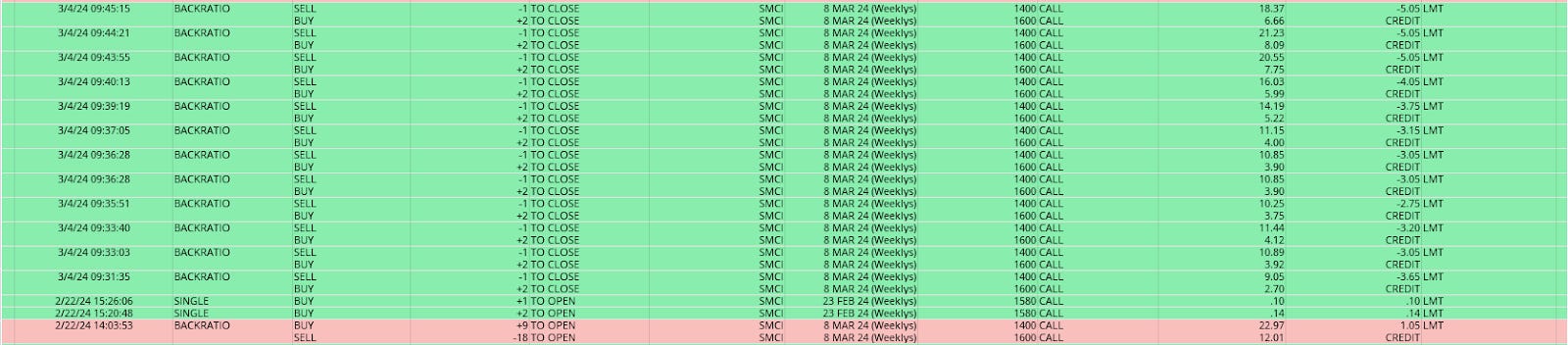
Thanks for understanding, and I hope you got some value out of that report in the meantime! Stay well.
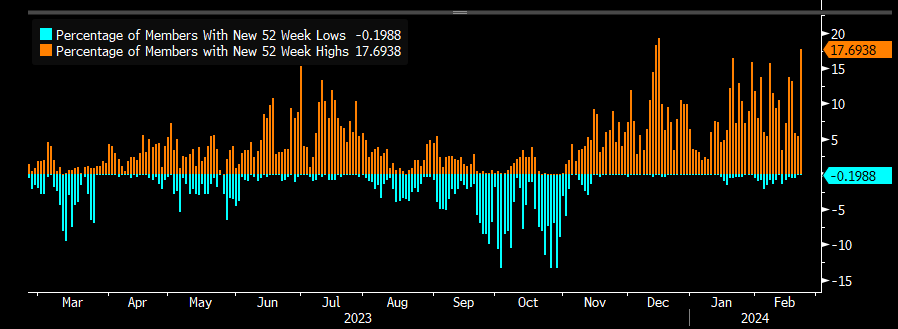

About

Welcome to the Daily Brief by Physik Invest, a soon-to-launch research, consulting, trading, and asset management solutions provider. Learn about our origin story here, and consider subscribing for daily updates on the critical contexts that could lend to future market movement.

Separately, please don’t use this free letter as advice; all content is for informational purposes, and derivatives carry a substantial risk of loss. At this time, Capelj and Physik Invest, non-professional advisors, will never solicit others for capital or collect fees and disbursements. Separately, you may view this letter’s content calendar at this link.