Notice: To view this week’s big picture outlook, click here.
What Happened: As earnings season kicks into gear, alongside a resurgence in COVID-19 across Europe, U.S. index futures auctioned into the developing balance-area low.
What Does It Mean: The S&P 500, after consolidating near the $3,800 high-open interest strike, is testing the extremes of balance, the bracket of overlapping value areas in the days prior, as participants position themselves for directional resolve.
What To Expect: Friday’s regular session (9:30 AM – 4:00 PM ET) will likely open outside of prior-balance and -range, suggesting the potential for immediate directional opportunity.
Given that the open will still be inside of a larger balance area ($3,824.25-$3,763.75), participants must monitor for responsive buying below value.
Re-entry into value (i.e., a cross through the $3,787.50 LVNode) portends continuation, at least until the $3,793.25 high-volume area, the market’s most recent perception of value.
Excess (e.g., buying tail) may denote an end to downside discovery. The absence of excess, or multiple periods of trade below value, may signal a shift in conviction. In such case, participants would monitor for supportive flows and delta (i.e., committed selling) on a break of the $3,763.75 balance low. If price is accepted (i.e., more than one-half hour of trade) below the balance area, then participants ought to trade in the direction of the new activity. Trading back into the consolidation, thereby invalidating the break-out, would portend a move to the other end of balance.
Noting: (1) The multi-month upside breakout targeting prices as high as $4,000 remains intact and (2) end-of-day positioning was accompanied by aggressive buying into the lows. If the market was to sell hard, aggressive buying would have not been present.
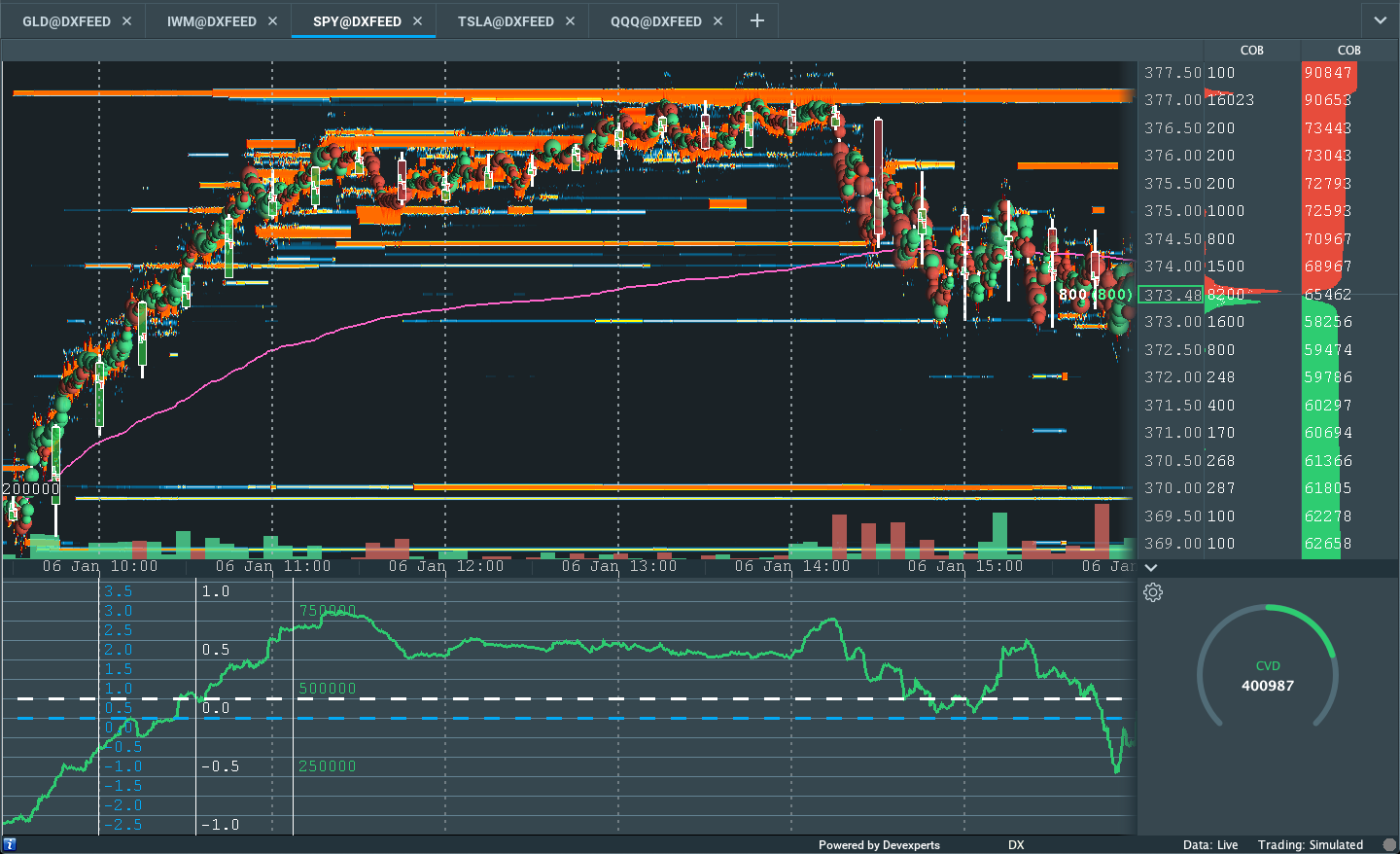
Pictured: Divergent delta in theSPDR S&P 500 ETF Trust (NYSE: SPY), the largest ETF that tracks the S&P 500
Levels Of Interest: $3,824.25 regular trade high, the $3,763.75 balance low, as well as the $3,787.50 LVNode.
Notice: To view this week’s big picture outlook, click here.
What Happened: Market participants further digested higher prices, as evidenced by U.S. index futures balancing within prior range.
What Does It Mean: For ten sessions in a row, the S&P 500 has consolidated near the $3,800 high-open interest strike.
What To Expect: Thursday’s regular session (9:30 AM – 4:00 PM ET) will likely open in prior-balance and -range, suggesting no immediate directional opportunity, again.
Given the open inside of a developing balance area, participants can expect higher volatility. As a result, focus should be directed to price levels that, if broken, would denote a change in tone, as well as the following dynamics:
The failure to resolve directionally points to the absence of larger, other time frame participants (i.e., institutions that don’t transact at technical levels). Still, all broad-market indices are in an uptrend, evidenced by higher prices and value. This recent pause is healthy; consolidation after trend allows prices to converge with value, forming high-volume areas. The prices in this area are valuable and offer favorable entry and exit.
The minimal excess rally high at $3,824.25 remains intact. Excess forms after an auction has traveled too far in a particular direction and portends a sustained reversal. The absence of excess, in the case of a high, suggests not enough conviction; in such case participants will (1) liquidate (i.e., back off the high) and strengthen the market, before (2) following through. Participants have already accomplished the first reaction.
The pinch and subsequent recovery of the volume-weighted average price, anchored from the Sunday evening open, suggests further upside resolve as the average participant, from the anchoring point, holds a profitable position.
The week ending January 8 established a v-pattern recovery, a price sequence that ought to be followed by further price discovery, as high as the 100% price projection, which happens to be near the multi-month upside breakout target at $4,000.
Unsupportive speculative flows and delta (e.g., commitment of buying or selling), as can be viewed by the order flow graphic below.
Pictured: Divergent delta in theSPDR S&P 500 ETF Trust (NYSE: SPY), the largest ETF that tracks the S&P 500
Moreover, in light of the above dynamics, the normal course of action is responsive trade. However, any break that finds increased involvement (i.e., supportive flows and delta) above $3,824.25 or below $3,763.75, in the S&P 500, would favor continuation.
Noting: In most cases, a break-out from balance is usually the start of a short-term auction. Therefore, placing trades in the direction of the break is the normal course of action. Trading back into the consolidation, thereby invalidating the break-out, would portend a move to the other end of balance.
Levels Of Interest: $3,824.25 regular trade high and $3,763.75 balance low.
What Happened: As investors looked beyond a weak jobs report and political uncertainty, to added economic stimulus and the coming earnings season, U.S. index futures hit new highs.
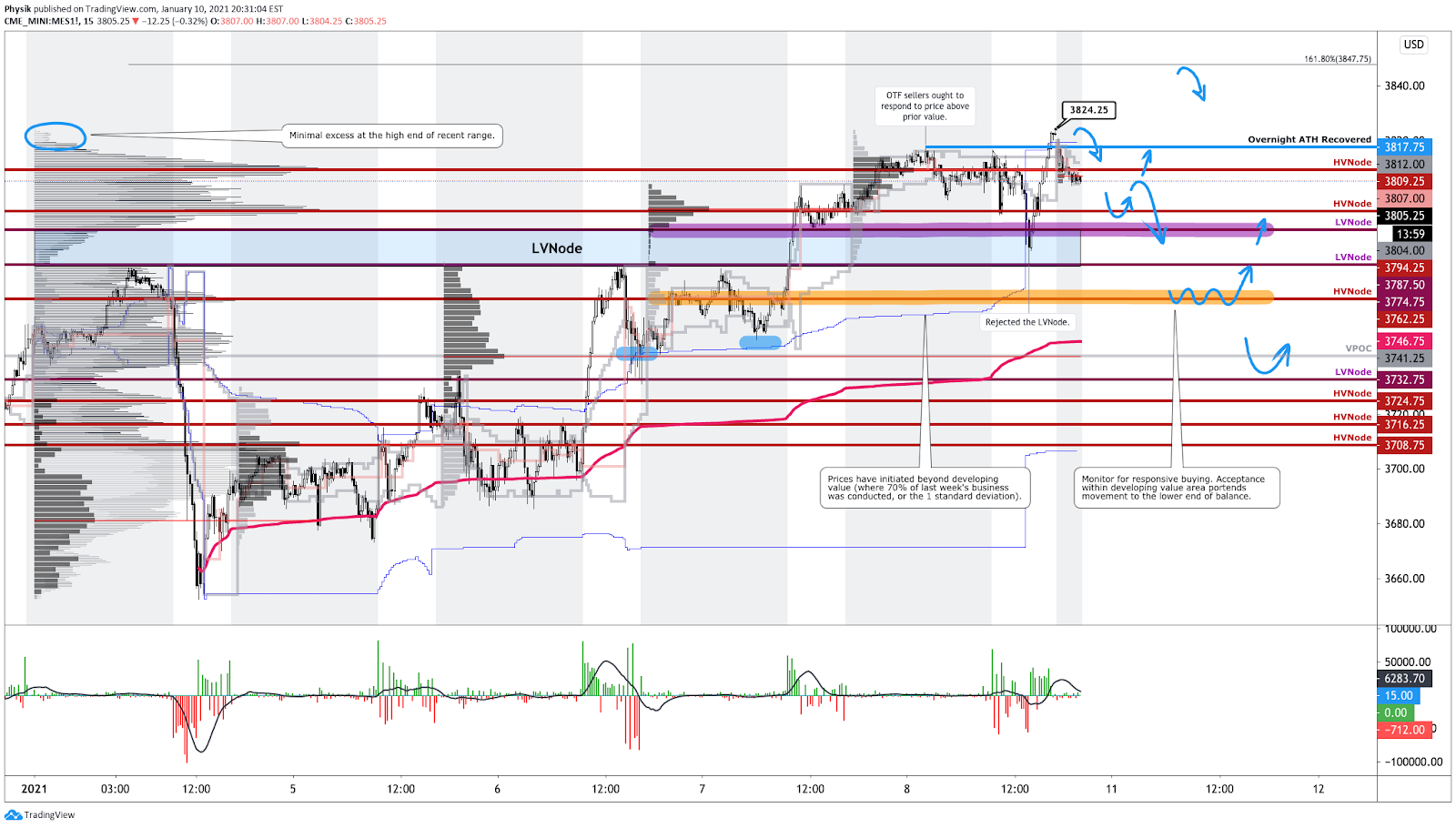
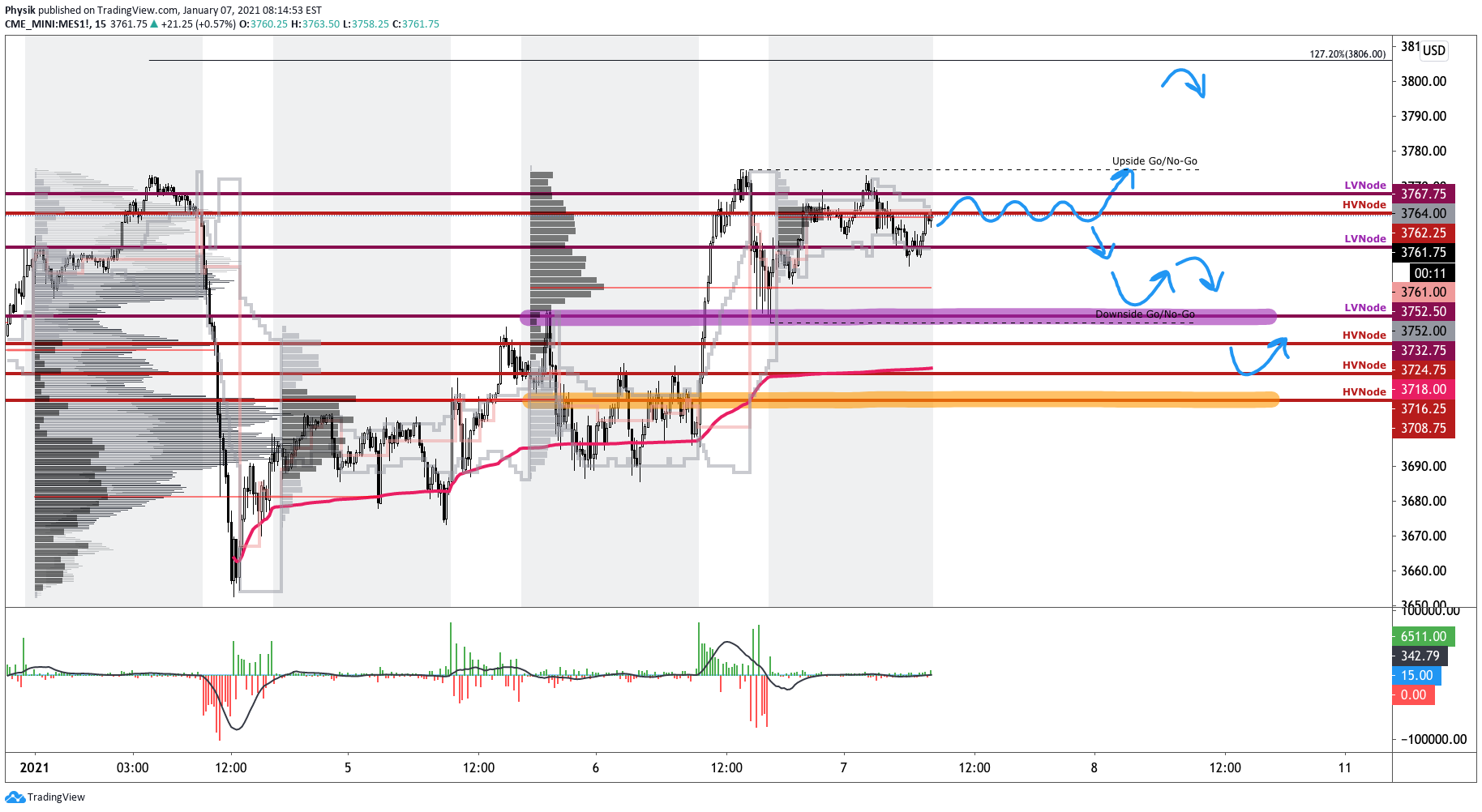
Graphic 1: Profile overlays on a 15-minute candlestick chart of the Micro E-mini S&P 500 Futures
What To Expect: Friday’s session in the S&P 500 found initiative buying surface after a test of $3,774.75, the lower boundary of the low-volume area left in the wake of Thursday’s opening drive.
The long-liquidation and subsequent recovery left the market with minimal excess (i.e., a proper end to discovery) at the highs, and a strong close, taking out the overnight stat at $3,817.75 (which had low odds of remaining, given that overnight all-time highs rarely end the upside discovery process).
Noting: Excess forms after an auction has traveled too far in a particular direction and portends a sustained reversal. The absence of excess, in the case of a high, suggests not enough conviction; in such case participants will liquidate (i.e., back off the high) and strengthen the market, before following through.
In light of the market’s search for an area to establish balanced, two-sided trade, participants will come into Monday’s session knowing the following:
The multi-month upside breakout targeting S&P 500 prices as high as $4,000.00 remains intact.
Prices are above all major moving averages, including the year-to-date volume-weighted average price (VWAP).
After the resolution of last Monday’s long-liquidation, the market shifted into price discovery mode, evidenced by higher prices and value migration.
For numerous sessions, profile structures denoted the presence of short-covering, the result of old, weak-handed business emotionally buying to cover short positions, causing swift movement followed by a stalled advance, or two-sided intraday trade.
The week ending January 8 established a v-pattern recovery, a price sequence that ought to be followed by further price discovery, as high as the 100% price projection, which happens to be near the multi-month upside breakout target at $4,000.
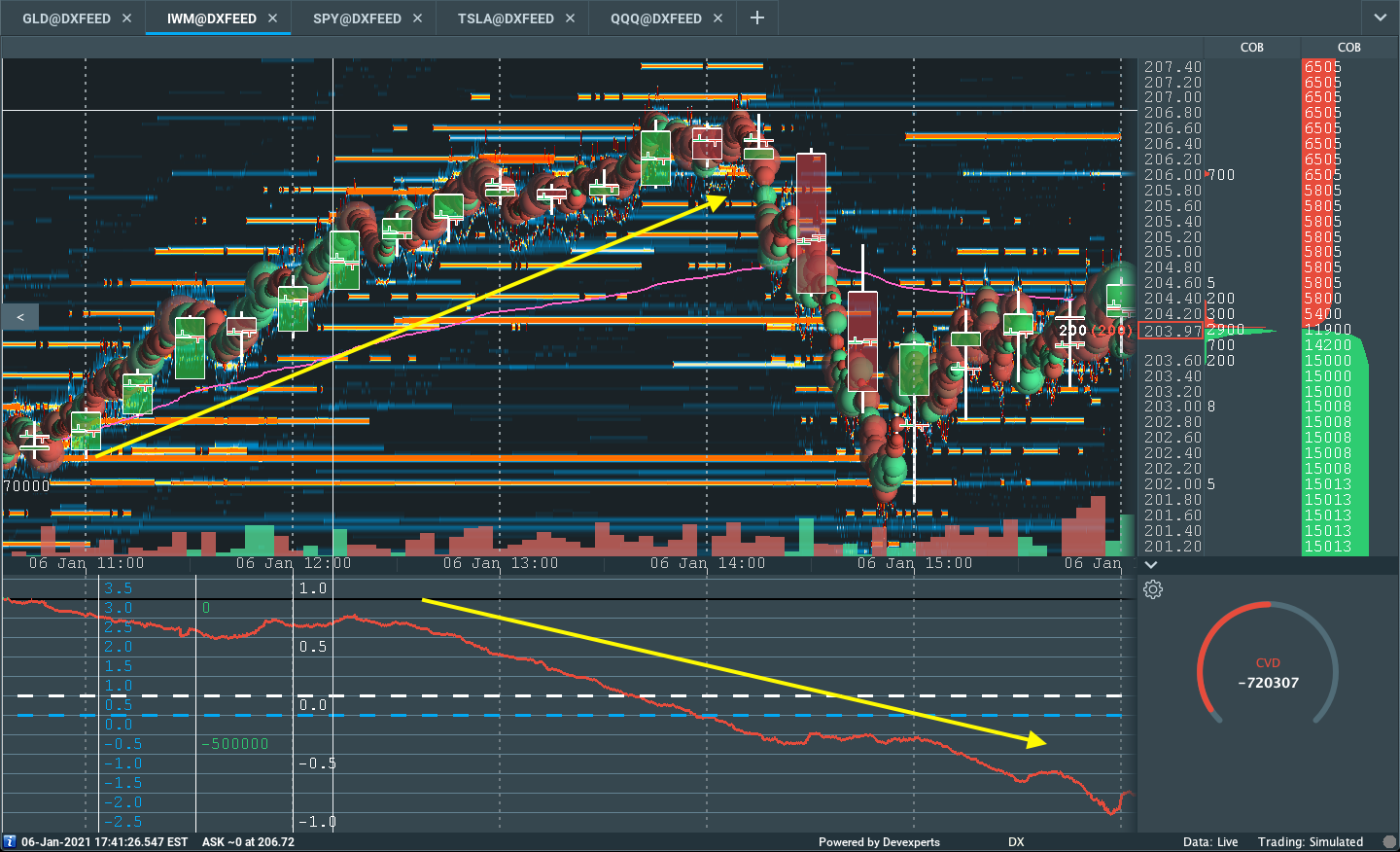
Unsupportive speculative flows and delta (e.g., commitment of buying or selling) in some instances, as can be viewed by order flow graphics 2 and 3 below.
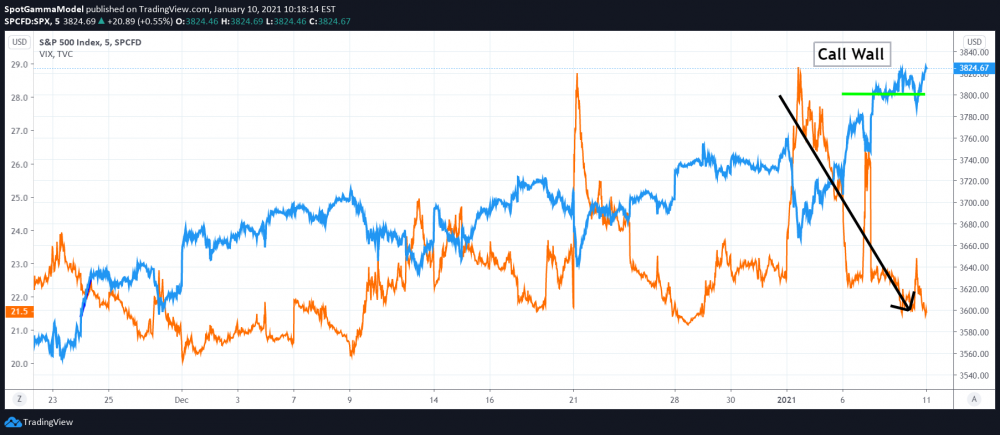
Alongside the long gamma narrative, in which dealers buy dips and sell rips to hedge their exposure, record options activity, among other dynamics, the S&P 500 closed near $3,800, a high open interest strike. For sustained upside directional resolve, participants would look for this exposure to roll up.
Pictured: Divergent delta in the iShares Russell 2000 ETF (NYSE: IWM), one of the largest ETFs that track the Russell 2000Pictured: Order flow in the SPDR S&P 500 ETF Trust (NYSE: SPY), the largest ETF that tracks the S&P 500Graphic 4: S&P 500 tests the $3,800 high open interest strike, per SpotGamma
Given the above dynamics, the following frameworks apply for next week’s trade.
In the best case, the S&P 500 remains above its $3,762.25 high-volume node (HVNode). Expectations thereafter include continued balance or a response followed by initiative buying to take out the price extension at $3,847.75.
Noting: Any structure that denotes meaningful buying continuation, not short-covering, would feature elongated, upside range expansion on committed volumes, as well as the migration of value.
In the worst case, the S&P 500 initiates below its $3,762.25 HVNode. Expectations thereafter include a test of the minimal excess low near $3,732.75 (a LVNode). A break of Monday’s regular session (9:30 AM – 4:00 PM ET) low would jeopardize the bullish thesis.
Two go, no-go levels exist; trade that finds increased involvement above $3,824.25 and below $3,775.25 would suggest a change in conviction. Anything in-between favors responsive trade.
Conclusions: In a GMO article, Jeremy Grantham expressed his opinion on recent market activity.
I am long retired from the job of portfolio management but I am happy to give my opinion here: it is highly probable that we are in a major bubble event in the U.S. market, of the type we typically have every several decades and last had in the late 1990s. It will very probably end badly, although nothing is certain. I will also tell you my definition of success for a bear market call. It is simply that sooner or later there will come a time when an investor is pleased to have been out of the market. That is to say, he will have saved money by being out, and also have reduced risk or volatility on the round trip. This definition of success absolutely does not include precise timing. (Predicting when a bubble breaks is not about valuation. All prior bubble markets have been extremely overvalued, as is this one. Overvaluation is a necessary but not sufficient condition for their bursting.) Calling the week, month, or quarter of the top is all but impossible.
Continuing, in addition to market participants reckoning with the uneven recovery, stimulus, trade, inflation, among other risks, they must also worry about something that’s arguably more important: price and value.
As of now, all broad-market indices are in an uptrend, evidenced by higher prices and value. A break below $3,600.00 in the S&P 500 would denote a substantial change in tone.
Levels Of Interest: $3,762.25 HVNode, $3,732.75 LVNode, $3,824.25 rally high, as well as the $3,847.75 price extension.
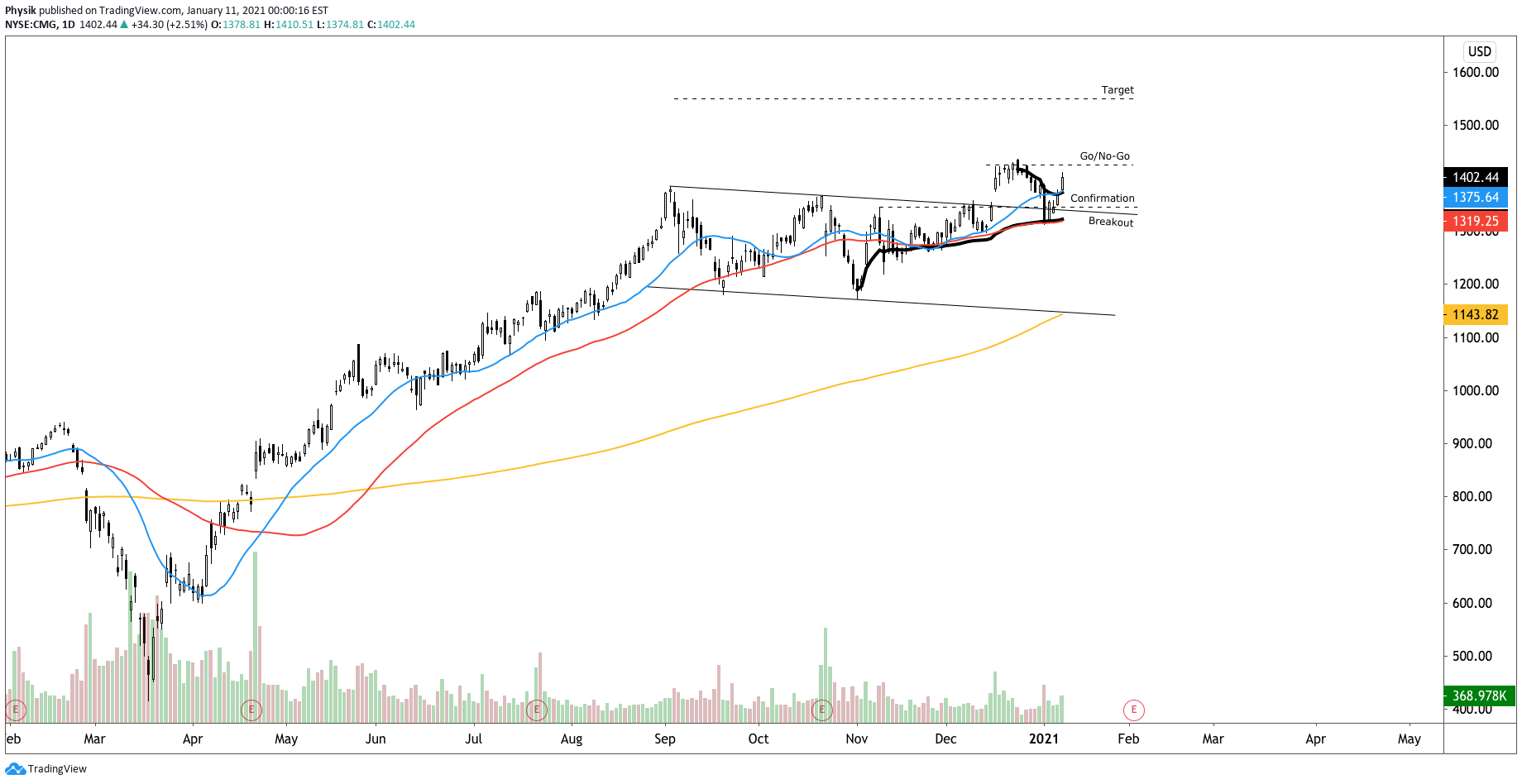
Bonus: Some opportunities unfolding in the week ahead.
Notice: To view this week’s big picture outlook, click here.
What Happened: Alongside news of a Democrat sweep in the Georgia runoffs and Congressional certification of Joe Biden’s election victory, U.S. index futures balanced overnight.
What Does It Mean: After a divergence between price and value resolved itself in Monday’s regular trade, the S&P 500 broke the $3,734.50 recovery high, above the $3,727.25 high-volume node, prior to taking out the overnight all-time high, a level that seldom ends the upside discovery process.
What To Expect: Thursday’s regular session (9:30 AM – 4:00 PM ET) will open inside of prior-balance and -range, providing little context as to what will transpire.
Participants can expect higher volatility at the open. The go/no-go level for upside is the $3,774.75 regular trade high. The go/no-go level for downside is the low-volume node at $3,731.00, an area that denotes upside conviction. On any virgin test, the S&P 500 ought to find support at this LVNode. However, should the index break below that level, then conviction has changed.
In a failure to break either go/no-go level, the normal course of action would be responsive trade.
Adding, below are orderflow snapshots for the SPDR S&P 500 ETF Trust(NYSE: SPY) and iShares Russell 2000 ETF (NYSE: IWM). Note the divergence between price and volume delta in the Russell 2000 ETF; in the simplest of terms, participants were not committed at the highs.
Pictured: Divergent delta in the iShares Russell 2000 ETF (NYSE: IWM), one of the largest ETFs that track the Russell 2000.Pictured: Order flow in the SPDR S&P 500 ETF Trust (NYSE: SPY), the largest ETF that tracks the S&P 500.
Levels Of Interest: $3,774.75 regular trade high and $3,731.00 LVNode.
Notice: To view this week’s big picture outlook, click here.
What Happened: Alongside uncertainty surrounding Senate runoffs and new COVID lockdowns, U.S. index futures balanced overnight after Monday’s rapid sell-off.
What Does It Mean: During last Thursday’s session, initiative buying, in the S&P 500, diverged prices from value. This dynamic resolved itself in Monday’s regular trade.
Overnight, prices recovered off their lows, but encountered responsive selling at the $3,705.00 low-volume node (LVNode).
What To Expect: Tuesday’s regular session (9:30 AM – 4:00 PM ET) will open inside of prior-balance and -range.
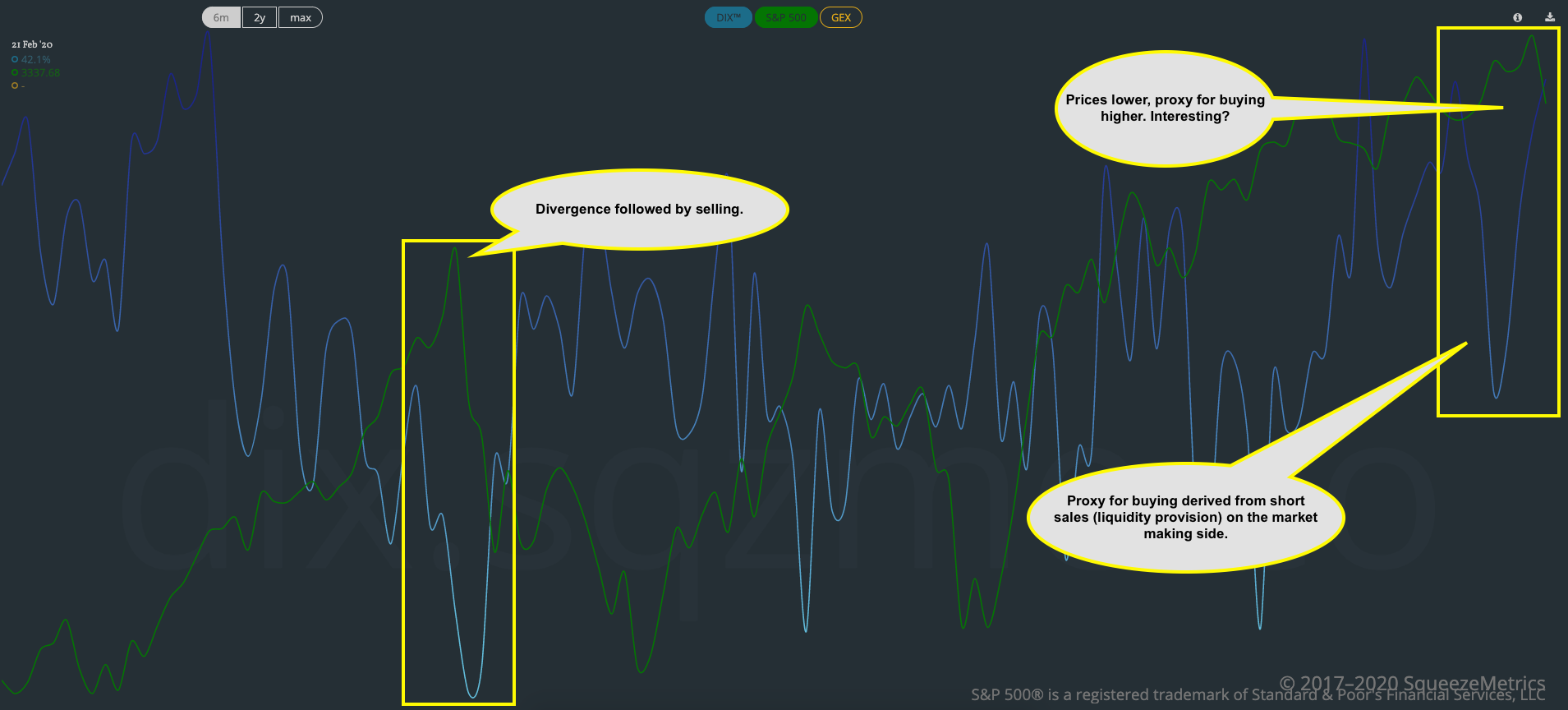
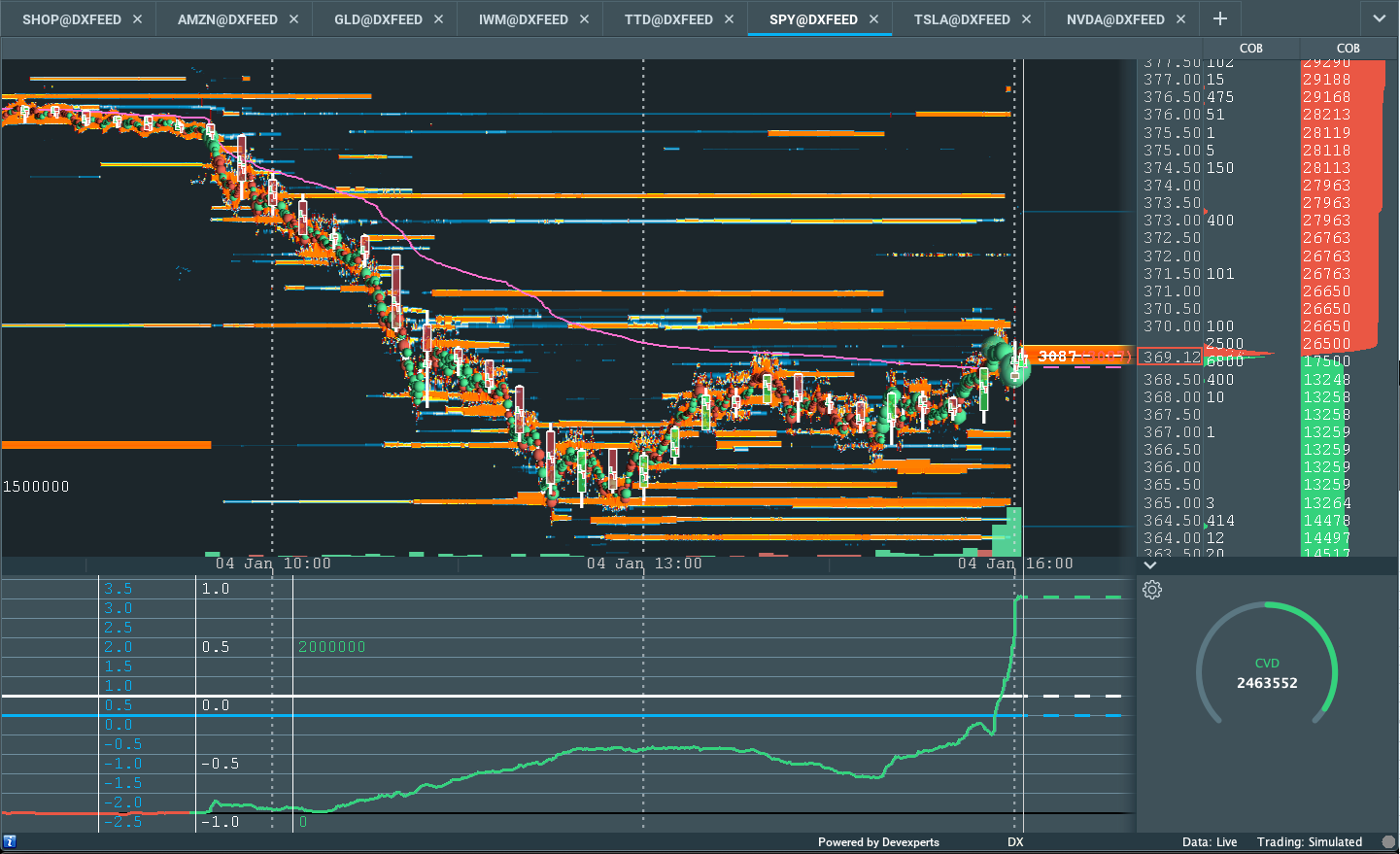
Adding, participants will come into today’s session knowing the following: (1) short-term, technically-driven market traders were not able to defend last week’s advance on tapering, holiday volumes, (2) weekend trade established a new all-time high (i.e., historically, there is a low probability that overnight all-time highs end the upside discovery process), (3) increased capital was not committed into the lows, evidenced by a divergent delta (i.e., the difference between buying and selling pressure), (4) the auction is resisting the low-volume area above $3,705.00, leaving a ledge, (5) a proxy for buying derived from short sales (i.e., liquidity provision on the market making side) rose, (6) bearish activity was concentrated in shorter-dated options.
Pictured: Speculative derivatives activity on Monday, January 4, 2021. Pictured: DIX by Squeeze Metrics suggests divergence between price and buying. Pictured: Divergent delta in the SPDR S&P 500 ETF Trust (NYSE: SPY), the largest ETF that tracks the S&P 500.
Given the above dynamics, the following framework applies:
The S&P 500 will likely open within prior-balance and -range, so volatility will likely be high. The go/no-go level for upside is the $3,705.00 ledge which has repeatedly attracted responsive selling. Should prices auction off the ledge, into the low-volume area, the likelihood of continuation increases substantially. In such case, participants would then monitor for a response at the $3,727.25 high-volume node (HVNode), which also corresponds with a 61.80% fibonacci retracement.
Noting: High-volume areas represent value and have the tendency to attract price. Should the market auction into the high-volume area, then prices should slow as balanced, two-sided trade takes over (i.e., the region offers attractive entry and exit). Auctioning through the high-volume area would be the most positive outcome.
Breaking below Monday’s regular-trade low would be the most negative outcome. In that case, participants would monitor for responses at the high-volume node near $3,610.00 and the $3,597.50 anchored, volume-weighted average price.
Levels Of Interest: $3,705.00 LVNode.
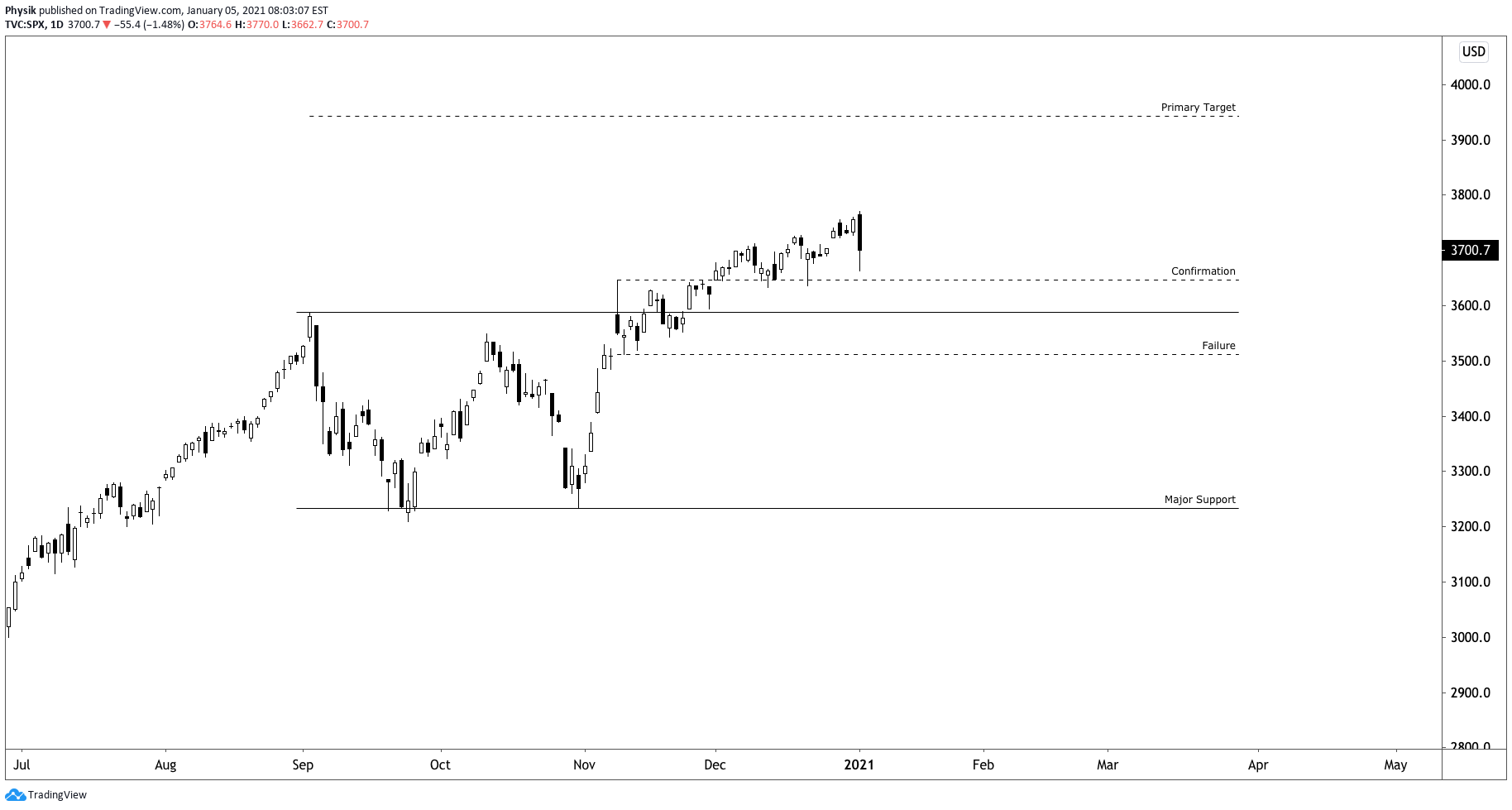
Overall: The higher-time frame breakout in the S&P 500 remains intact. Caution warranted.
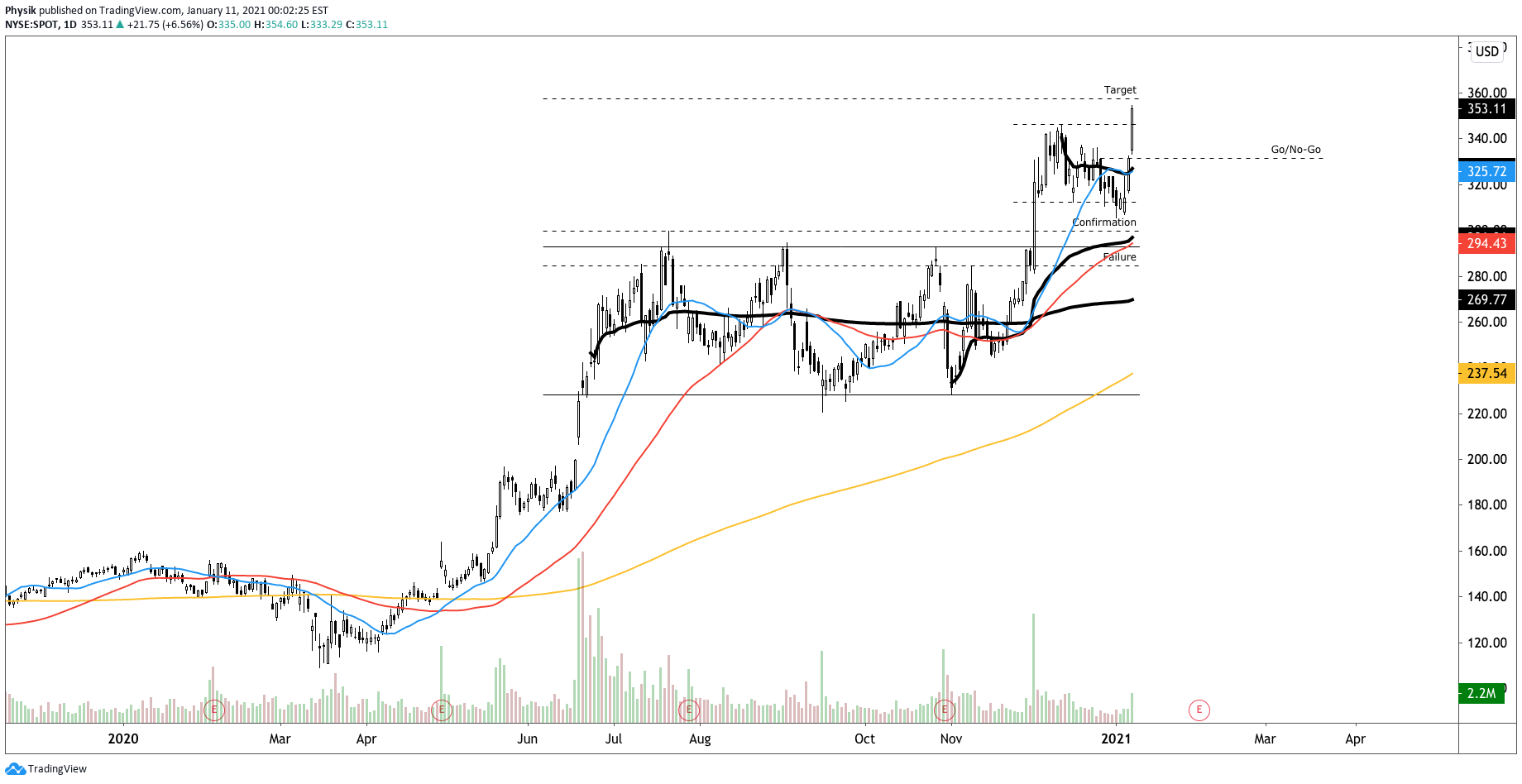
Pictured: Daily candlestick chart of the cash S&P 500 Index.